Cambridge A Level English - Language AS and A Level (from 2014) 9093 — 2016 Oct/Nov Paper 4 · Variant 2
9093/42/O/N/16 · 50 marks · ≈56 min
The question paper and its mark scheme, free to read here and free to download. This is Cambridge’s own paper, exactly as it was sat.
Question paper8 pages


Mark scheme7 pages
Answers below. Sit the paper first if you are practising.
Paper as text
Question paper, page 1
This document consists of 7 printed pages, 1 blank page and 1 insert. DC (LK) 107486/2 © UCLES 2016 [Turn over * 1 0 2 3 8 9 5 1 6 0 * ENGLISH LANGUAGE 9093/42 Paper 4 Language Topics October/November 2016 2 hours 15 minutes No Additional Materials are required. READ THESE INSTRUCTIONS FIRST An answer booklet is provided inside this question paper. You should follow the instructions on the front cover of the answer booklet. If you need additional answer paper, ask the invigilator for a continuation booklet. Answer two questions. You should spend about 15 minutes reading the passages and questions before you start writing your answers. You are reminded of the need for good English and clear presentation in your answers. All questions in this paper carry equal marks. Cambridge International Examinations Cambridge International Advanced Subsidiary and Advanced Level
Question paper, page 2
2 9093/42/O/N/16 © UCLES 2016 Answer two questions. 1 Spoken language and social groups The following text is a transcription of part of a television interview that Piers Morgan (PM) conducted with Usain Bolt (UB) in 2012. Usain Bolt is an athlete who won three gold medals at the London Olympics in 2012. Discuss ways in which the speakers are using language here to communicate and how their language is affected by the context. You should refer to specific details from the transcription, relating your observations to ideas from your wider study. PM: if i sound like a dolt and if i sound a little excited usain (.) its because YOURE my hero (1) so how does that make you feel↗ UB: [smiles] i (.) i feel GOOD (1) i feel good PM: how many people do you meet on a daily basis that go (.) you are my hero UB: a LOT (.) a lot of people (2) especially when i travel (1) i get (.) i get a lot of that (1) so its cool PM: when i was young there was something about (1) i remember my first olympics (.) i really noticed was when valeriy borzov (.) on the one hundred metres (.) the russian (1) and from that moment (.) there are lots of great events at the olympics (1) but for me the hundred metre dash is the GREATEST test of a man UB: [smiles] its true PM: how do you feel (1) when you get down on those blocks and youre about to explode (.) what actually goes through the golden bolts mind↗ UB: you (.) all you try to do is just relax really (1) for me its always just trying to compose myself (.) try to NOT think about anything (1) because as soon as something comes into your mind (.) then you are going to be in a lot of trouble (1) so for me (1) i try to clear my mind as quickly as possible (.) i just take some deep breaths PM: what does it take to be a CHAMPION↗ (.) not just ANY old champion (.) to be a great champion↗ UB: well (1) its just hard work (.) for me (.) it was just hard work and dedication and you (.) you just need a team (.) because (.) for me (.) err (.) i remember (.) THIS year (.) i was going on good and i thought i was (.) yeah i was doing well (.) doing well (1) and then (.) all of a sudden i got to the trials (.) i lost (.) and then i was like whooo (1) and then i (.) i refocused (.) and i really (.) talked to my coach (.) talked to my friends (.) talked to my agent (.) everybody (.) they came together and they explained to me (.) theres no need to worry (.) ESPECIALLY my coach (.) we have three or four weeks to go or one month (.) lets just put the work in (.) sacrifice a few things and we’ll get it done (.) so (.) i did just that PM: what is it that motivates you most now↗ (1) is it the winning↗ (.) is it being the champ↗ (.) is it money↗ (.) is it fame↗ (.) is it the women↗ (.) is it ALL of it do you think↗ 5 10 15 20 25 30
Question paper, page 3
3 9093/42/O/N/16 © UCLES 2016 [Turn over UB: [laughs] its EVERYTHING (.) its (.) its ALL those factors (.) its ALL those factors (.) everything comes together (.) i (.) i think (1) but to me err (.) the FANS are one of the biggest things for me (.) i really enjoy just going out and performing for the fans (.) the energy that they give me (.) i think THIS year (.) the olympics (.) i went out there and when i got there in the heat (.) there was so much people in the stands that early in the morning that i was so surprised (.) i was like (.) WHY (1) every championship ive been to (.) its been like three hundred people (.) EVERYBODY has come out (.) a few people might come out and watch because they are really into track and field (1) but at london (.) early in the morning (.) EVERYBODY was out (.) like it was full from the morning sessions (1) so for me the energy that i got in london was wonderful TRANSCRIPTION KEY (1) = pause in seconds (.) = micro-pause underlined = stressed sound/syllable(s) [italics] = paralinguistic features [UPPER CASE] = words spoken with increased volume ↗ = upward intonation 35 40 45
Question paper, page 4
4 9093/42/O/N/16 © UCLES 2016 2 English as a global language The passage below is an extract from an article written in 2012 and published in an international business magazine. Discuss what you feel are the most important issues raised here relating to the changing use of English as a global language. You should refer to specific details from the passage as well as to ideas and examples from your wider study. English – the Language of Global Business? With China’s growing economic might, is Mandarin becoming the preferred language of business? Not anytime soon, says a newly released study. Instead, English will maintain and grow its dominance, moving from “a marker of the elite” in years past to “a basic skill needed for the entire workforce, in the same way that literacy has been transformed in the last two centuries from an elite privilege into a basic requirement for informed citizenship”. (Indeed, the British Council reports that by 2020, two billion people will be studying English.) The new study of 1.6 million online test-takers in more than 50 countries was conducted by EF Education First, a company that – it should be noted – specialises in English language training. The study is somewhat comforting for English speakers like me, who have struggled to master a foreign language. Indeed, statistics show that only 10% of native-born Americans can speak a second language, compared to 56% of European Union citizens. (In the “credit for trying department”, I spent an hour composing two emails in French yesterday, an effort my Parisian colleague declared “adorable”.) The ability to speak a second (or third) language is clearly important for becoming a global leader. But, for better or worse – it seems that English may be the most essential language for global business success at the moment. Indeed, even in powerhouse China, more people are currently studying English than in any other country. An incredible 100,000 native English speakers are currently teaching there. Here are the two most intriguing takeaways from EF’s study, which have potential implications for future global development. • Women speak better English than men – in almost every country worldwide. Increasing numbers of women are attending college, and they’re often over-represented in humanities classes compared to men. The net result? Women are speaking better English, and may find themselves well positioned to succeed in the global economy. • International sectors use English, and local sectors don’t. If someone works in travel and tourism, for an international consulting firm, or in telecom, there’s a good chance they speak English. For instance, the Finnish telecom concern Nokia and the German business software company SAP both use English as their official language. In retail, not so much (which is why it’s so devilishly hard to communicate with shop clerks while travelling). The dominance of English is no excuse for monolingual native speakers to slack off. But at least we’ll know, as we struggle to write our “adorable” emails in a foreign tongue, that our global colleagues will be making the same effort in reverse – and hopefully, in the end, we’ll all understand each other a bit better. 5 10 15 20 25 30 35
Question paper, page 5
5 9093/42/O/N/16 © UCLES 2016 [Turn over TURN OVER FOR QUESTION 3.
Question paper, page 6
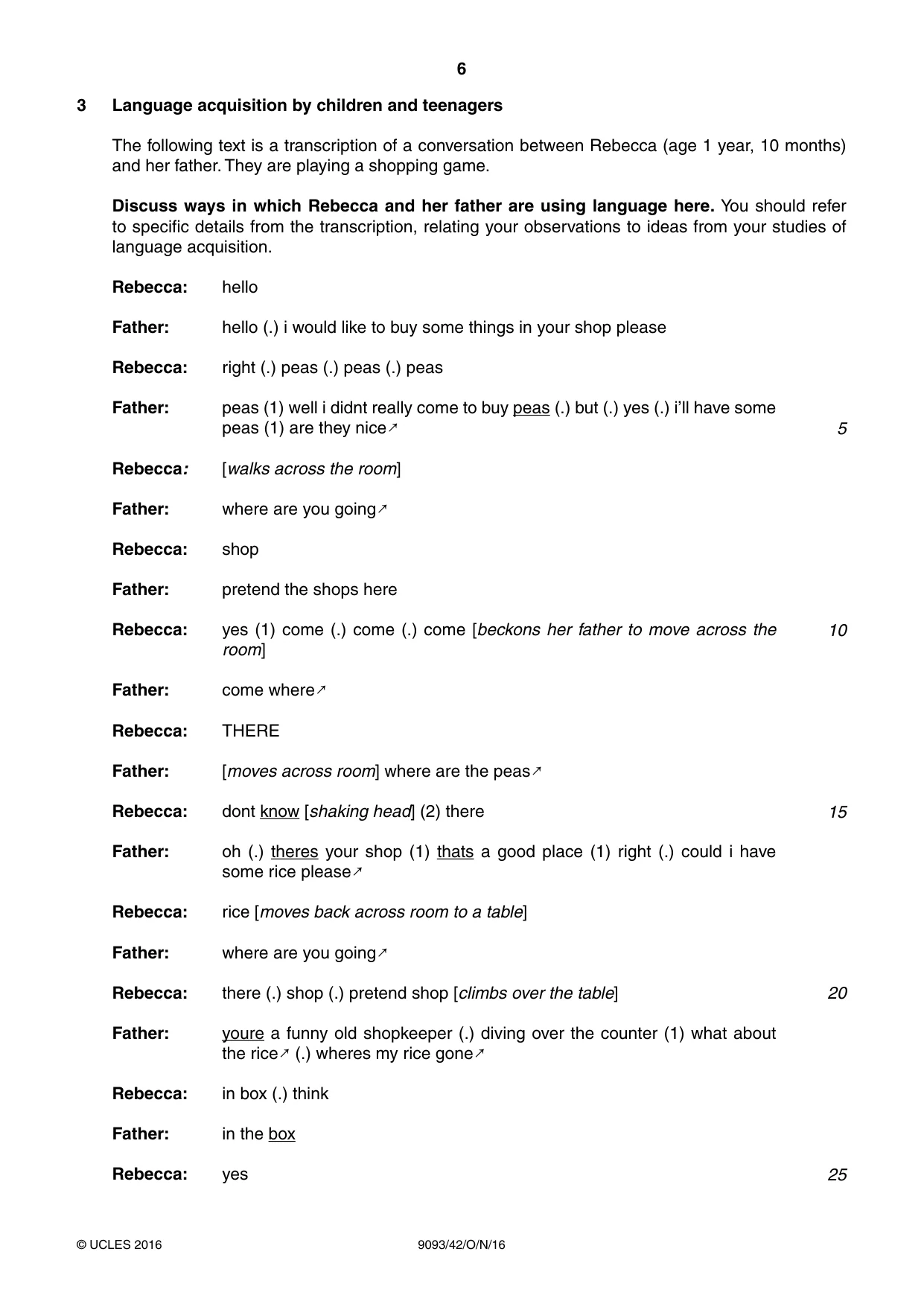
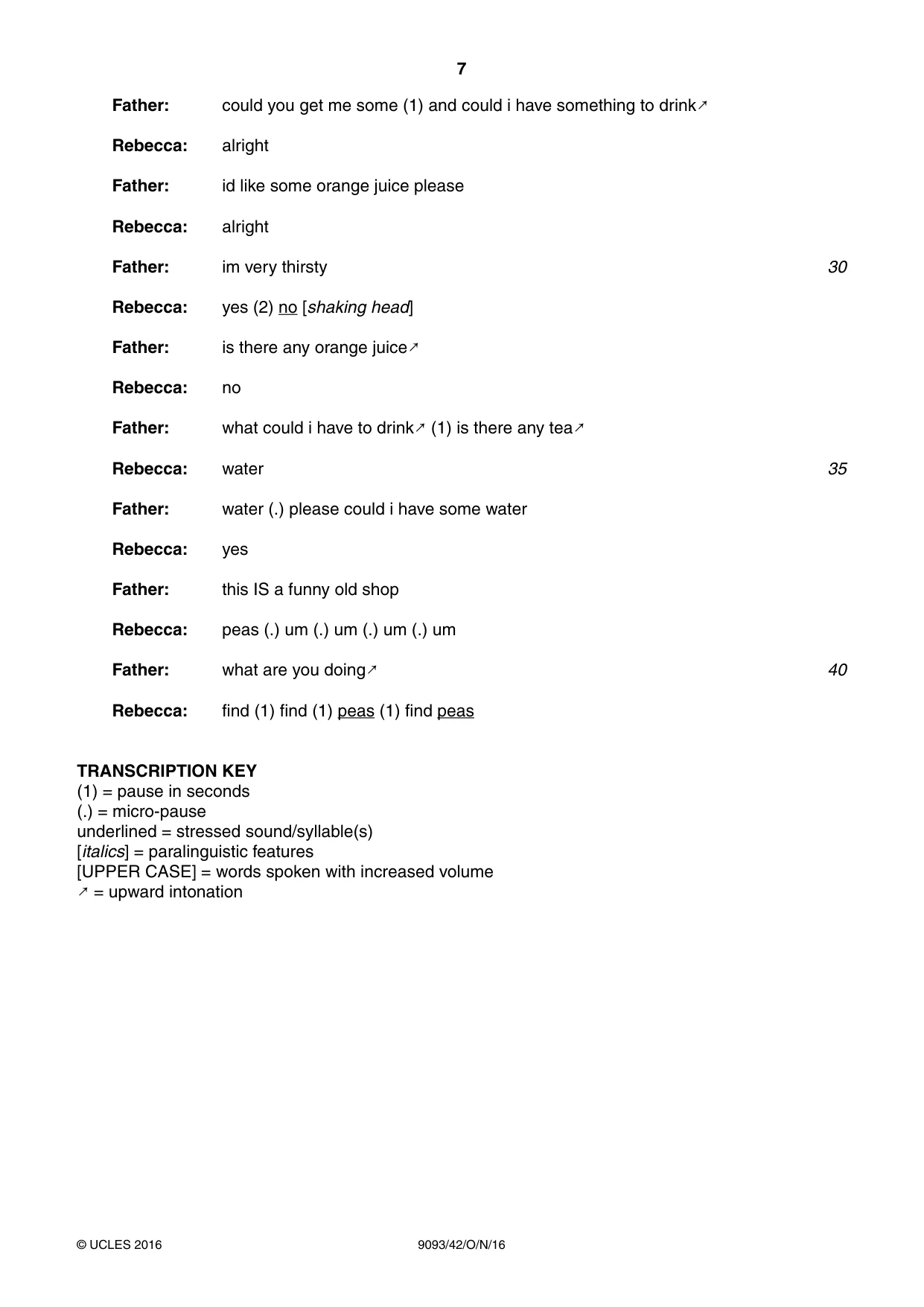
6 9093/42/O/N/16 © UCLES 2016 3 Lang uage acquisition by children and teenagers The following text is a transcription of a conversation between Rebecca (age 1 year, 10 months) and her father. They are playing a shopping game. Discuss ways in which Rebecca and her father are using language here. You should refer to specific details from the transcription, relating your observations to ideas from your studies of language acquisition. Rebecca: hello Father: hello (.) i would like to buy some things in your shop please Rebecca: right (.) peas (.) peas (.) peas Father: peas (1) well i didnt really come to buy peas (.) but (.) yes (.) i’ll have some peas (1) are they nice↗ Rebecca: [walks across the room] Father: where are you going↗ Rebecca: shop Father: pretend the shops here Rebecca: yes (1) come (.) come (.) come [beckons her father to move across the room] Father: come where↗ Rebecca: THERE Father: [moves across room] where are the peas↗ Rebecca: dont know [shaking head] (2) there Father: oh (.) theres your shop (1) thats a good place (1) right (.) could i have some rice please↗ Rebecca: rice [moves back across room to a table] Father: where are you going↗ Rebecca: there (.) shop (.) pretend shop [climbs over the table] Father: youre a funny old shopkeeper (.) diving over the counter (1) what about the rice↗ (.) wheres my rice gone↗ Rebecca: in box (.) think Father: in the box Rebecca: yes 5 10 15 20 25
Question paper, page 7
7 9093/42/O/N/16 © UCLES 2016 Father: could you get me some (1) and could i have something to drink↗ Rebecca: alright Father: id like some orange juice please Rebecca: alright Father: im very thirsty Rebecca: yes (2) no [shaking head] Father: is there any orange juice↗ Rebecca: no Father: what could i have to drink↗ (1) is there any tea↗ Rebecca: water Father: water (.) please could i have some water Rebecca: yes Father: this IS a funny old shop Rebecca: peas (.) um (.) um (.) um (.) um Father: what are you doing↗ Rebecca: find (1) find (1) peas (1) find peas TRANSCRIPTION KEY (1) = pause in seconds (.) = micro-pause underlined = stressed sound/syllable(s) [italics] = paralinguistic features [UPPER CASE] = words spoken with increased volume ↗ = upward intonation 30 35 40
Question paper, page 8
8 9093/42/O/N/16 © UCLES 2016 Permission to reproduce items where third-party owned material protected by copyright is included has been sought and cleared where possible. Every reasonable effort has been made by the publisher (UCLES) to trace copyright holders, but if any items requiring clearance have unwittingly been included, the publisher will be pleased to make amends at the earliest possible opportunity. To avoid the issue of disclosure of answer-related information to candidates, all copyright acknowledgements are reproduced online in the Cambridge International Examinations Copyright Acknowledgements Booklet. This is produced for each series of examinations and is freely available to download at www.cie.org.uk after the live examination series. Cambridge International Examinations is part of the Cambridge Assessment Group. Cambridge Assessment is the brand name of University of Cambridge Local Examinations Syndicate (UCLES), which is itself a department of the University of Cambridge. BLANK PAGE
Mark scheme, page 1
® IGCSE is the registered trademark of Cambridge International Examinations. This document consists of 7 printed pages. © UCLES 2016 [Turn over Cambridge International Examinations Cambridge International Advanced Level ENGLISH LANGUAGE 9093/42 Paper 4 Language Topics October/November 2016 MARK SCHEME Maximum Mark: 50 Published This mark scheme is published as an aid to teachers and candidates, to indicate the requirements of the examination. It shows the basis on which Examiners were instructed to award marks. It does not indicate the details of the discussions that took place at an Examiners’ meeting before marking began, which would have considered the acceptability of alternative answers. Mark schemes should be read in conjunction with the question paper and the Principal Examiner Report for Teachers. Cambridge will not enter into discussions about these mark schemes. Cambridge is publishing the mark schemes for the October/November 2016 series for most Cambridge IGCSE®, Cambridge International A and AS Level components and some Cambridge O Level components.
Mark scheme, page 2
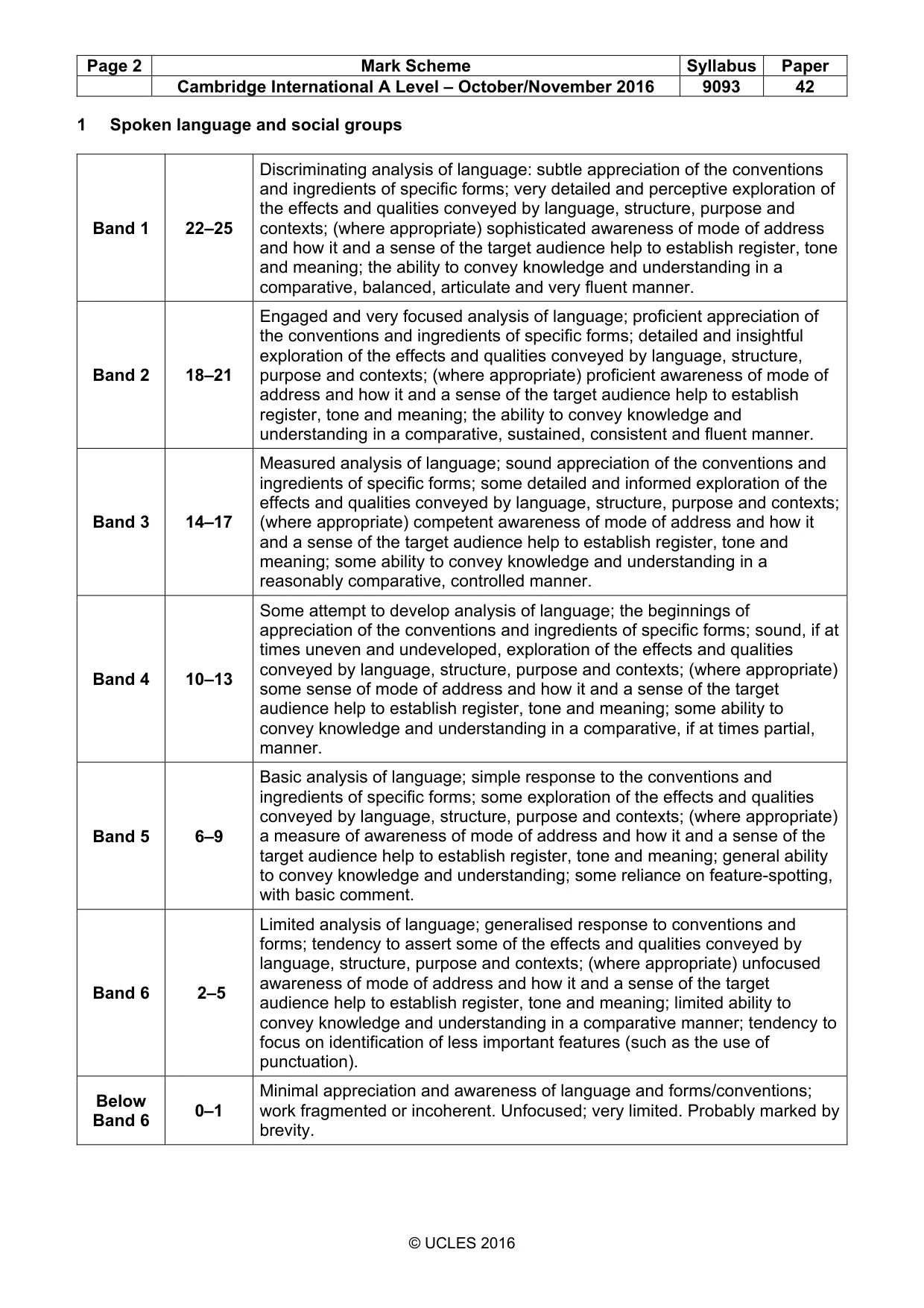
Page 2 Mark Scheme Syllabus Paper Cambridge International A Level – October/November 2016 9093 42 © UCLES 2016 1 Spoken language and social groups Band 1 22–25 Discriminating analysis of language: subtle appreciation of the conventions and ingredients of specific forms; very detailed and perceptive exploration of the effects and qualities conveyed by language, structure, purpose and contexts; (where appropriate) sophisticated awareness of mode of address and how it and a sense of the target audience help to establish register, tone and meaning; the ability to convey knowledge and understanding in a comparative, balanced, articulate and very fluent manner. Band 2 18–21 Engaged and very focused analysis of language; proficient appreciation of the conventions and ingredients of specific forms; detailed and insightful exploration of the effects and qualities conveyed by language, structure, purpose and contexts; (where appropriate) proficient awareness of mode of address and how it and a sense of the target audience help to establish register, tone and meaning; the ability to convey knowledge and understanding in a comparative, sustained, consistent and fluent manner. Band 3 14–17 Measured analysis of language; sound appreciation of the conventions and ingredients of specific forms; some detailed and informed exploration of the effects and qualities conveyed by language, structure, purpose and contexts; (where appropriate) competent awareness of mode of address and how it and a sense of the target audience help to establish register, tone and meaning; some ability to convey knowledge and understanding in a reasonably comparative, controlled manner. Band 4 10–13 Some attempt to develop analysis of language; the beginnings of appreciation of the conventions and ingredients of specific forms; sound, if at times uneven and undeveloped, exploration of the effects and qualities conveyed by language, structure, purpose and contexts; (where appropriate) some sense of mode of address and how it and a sense of the target audience help to establish register, tone and meaning; some ability to convey knowledge and understanding in a comparative, if at times partial, manner. Band 5 6–9 Basic analysis of language; simple response to the conventions and ingredients of specific forms; some exploration of the effects and qualities conveyed by language, structure, purpose and contexts; (where appropriate) a measure of awareness of mode of address and how it and a sense of the target audience help to establish register, tone and meaning; general ability to convey knowledge and understanding; some reliance on feature-spotting, with basic comment. Band 6 2–5 Limited analysis of language; generalised response to conventions and forms; tendency to assert some of the effects and qualities conveyed by language, structure, purpose and contexts; (where appropriate) unfocused awareness of mode of address and how it and a sense of the target audience help to establish register, tone and meaning; limited ability to convey knowledge and understanding in a comparative manner; tendency to focus on identification of less important features (such as the use of punctuation). Below Band 6 0–1 Minimal appreciation and awareness of language and forms/conventions; work fragmented or incoherent. Unfocused; very limited. Probably marked by brevity.
Mark scheme, page 3
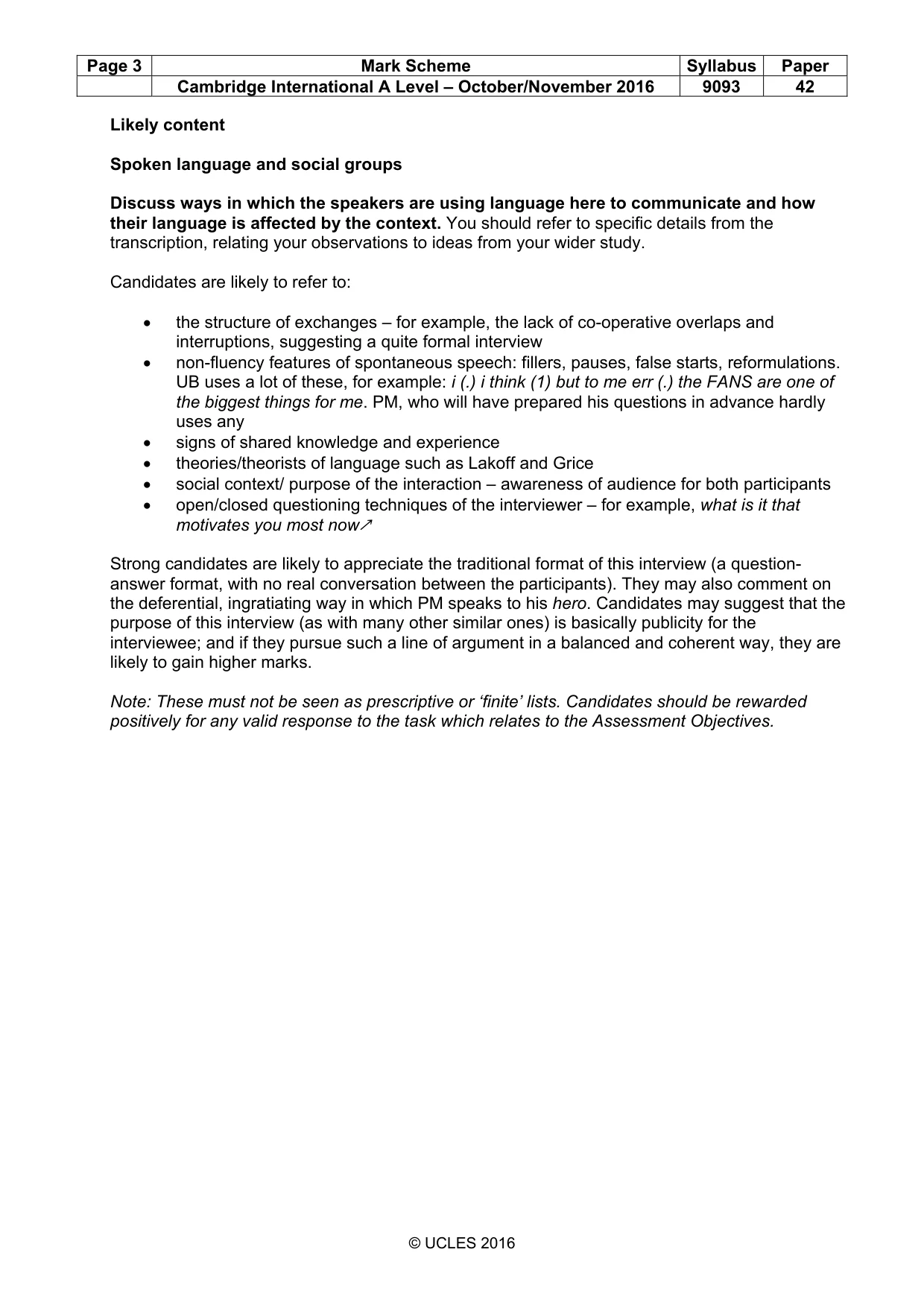
Page 3 Mark Scheme Syllabus Paper Cambridge International A Level – October/November 2016 9093 42 © UCLES 2016 Likely content Spoken language and social groups Discuss ways in which the speakers are using language here to communicate and how their language is affected by the context. You should refer to specific details from the transcription, relating your observations to ideas from your wider study. Candidates are likely to refer to: • the structure of exchanges – for example, the lack of co-operative overlaps and interruptions, suggesting a quite formal interview • non-fluency features of spontaneous speech: fillers, pauses, false starts, reformulations. UB uses a lot of these, for example: i (.) i think (1) but to me err (.) the FANS are one of the biggest things for me. PM, who will have prepared his questions in advance hardly uses any • signs of shared knowledge and experience • theories/theorists of language such as Lakoff and Grice • social context/ purpose of the interaction – awareness of audience for both participants • open/closed questioning techniques of the interviewer – for example, what is it that motivates you most now↗ Strong candidates are likely to appreciate the traditional format of this interview (a question- answer format, with no real conversation between the participants). They may also comment on the deferential, ingratiating way in which PM speaks to his hero. Candidates may suggest that the purpose of this interview (as with many other similar ones) is basically publicity for the interviewee; and if they pursue such a line of argument in a balanced and coherent way, they are likely to gain higher marks. Note: These must not be seen as prescriptive or ‘finite’ lists. Candidates should be rewarded positively for any valid response to the task which relates to the Assessment Objectives.
Mark scheme, page 4
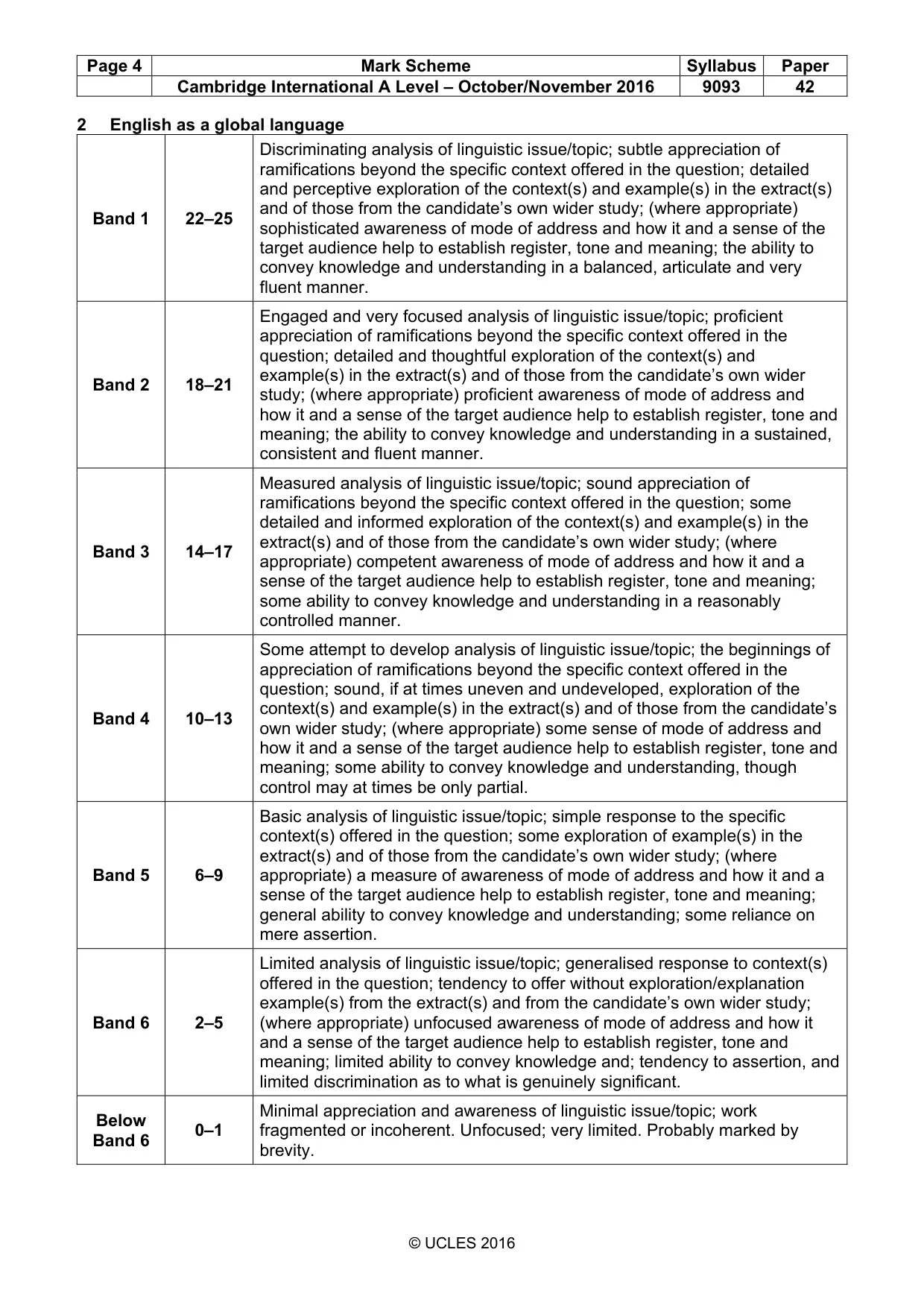
Page 4 Mark Scheme Syllabus Paper Cambridge International A Level – October/November 2016 9093 42 © UCLES 2016 2 English as a global language Band 1 22–25 Discriminating analysis of linguistic issue/topic; subtle appreciation of ramifications beyond the specific context offered in the question; detailed and perceptive exploration of the context(s) and example(s) in the extract(s) and of those from the candidate’s own wider study; (where appropriate) sophisticated awareness of mode of address and how it and a sense of the target audience help to establish register, tone and meaning; the ability to convey knowledge and understanding in a balanced, articulate and very fluent manner. Band 2 18–21 Engaged and very focused analysis of linguistic issue/topic; proficient appreciation of ramifications beyond the specific context offered in the question; detailed and thoughtful exploration of the context(s) and example(s) in the extract(s) and of those from the candidate’s own wider study; (where appropriate) proficient awareness of mode of address and how it and a sense of the target audience help to establish register, tone and meaning; the ability to convey knowledge and understanding in a sustained, consistent and fluent manner. Band 3 14–17 Measured analysis of linguistic issue/topic; sound appreciation of ramifications beyond the specific context offered in the question; some detailed and informed exploration of the context(s) and example(s) in the extract(s) and of those from the candidate’s own wider study; (where appropriate) competent awareness of mode of address and how it and a sense of the target audience help to establish register, tone and meaning; some ability to convey knowledge and understanding in a reasonably controlled manner. Band 4 10–13 Some attempt to develop analysis of linguistic issue/topic; the beginnings of appreciation of ramifications beyond the specific context offered in the question; sound, if at times uneven and undeveloped, exploration of the context(s) and example(s) in the extract(s) and of those from the candidate’s own wider study; (where appropriate) some sense of mode of address and how it and a sense of the target audience help to establish register, tone and meaning; some ability to convey knowledge and understanding, though control may at times be only partial. Band 5 6–9 Basic analysis of linguistic issue/topic; simple response to the specific context(s) offered in the question; some exploration of example(s) in the extract(s) and of those from the candidate’s own wider study; (where appropriate) a measure of awareness of mode of address and how it and a sense of the target audience help to establish register, tone and meaning; general ability to convey knowledge and understanding; some reliance on mere assertion. Band 6 2–5 Limited analysis of linguistic issue/topic; generalised response to context(s) offered in the question; tendency to offer without exploration/explanation example(s) from the extract(s) and from the candidate’s own wider study; (where appropriate) unfocused awareness of mode of address and how it and a sense of the target audience help to establish register, tone and meaning; limited ability to convey knowledge and; tendency to assertion, and limited discrimination as to what is genuinely significant. Below Band 6 0–1 Minimal appreciation and awareness of linguistic issue/topic; work fragmented or incoherent. Unfocused; very limited. Probably marked by brevity.
Mark scheme, page 5
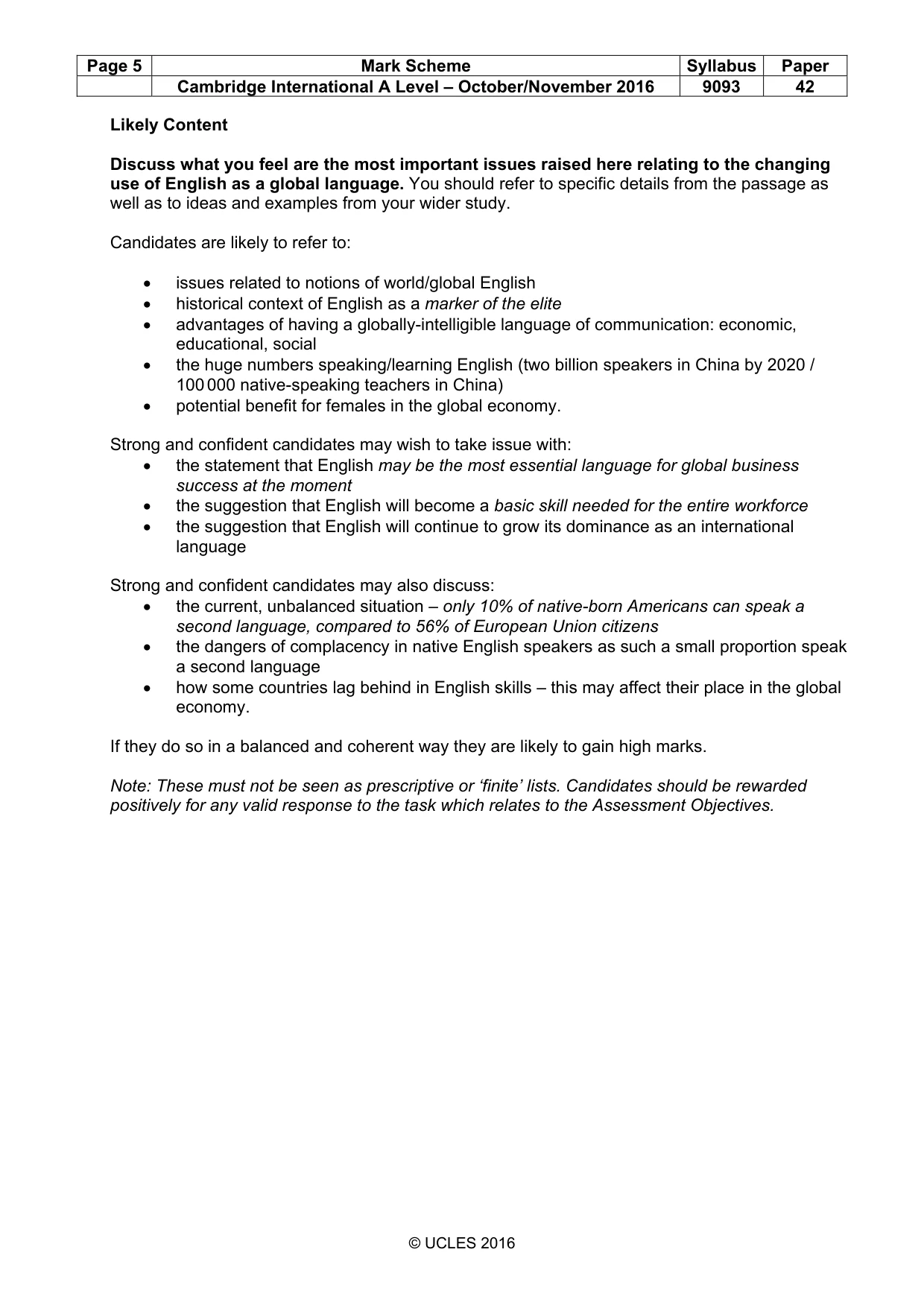
Page 5 Mark Scheme Syllabus Paper Cambridge International A Level – October/November 2016 9093 42 © UCLES 2016 Likely Content Discuss what you feel are the most important issues raised here relating to the changing use of English as a global language. You should refer to specific details from the passage as well as to ideas and examples from your wider study. Candidates are likely to refer to: • issues related to notions of world/global English • historical context of English as a marker of the elite • advantages of having a globally-intelligible language of communication: economic, educational, social • the huge numbers speaking/learning English (two billion speakers in China by 2020 / 100 000 native-speaking teachers in China) • potential benefit for females in the global economy. Strong and confident candidates may wish to take issue with: • the statement that English may be the most essential language for global business success at the moment • the suggestion that English will become a basic skill needed for the entire workforce • the suggestion that English will continue to grow its dominance as an international language Strong and confident candidates may also discuss: • the current, unbalanced situation – only 10% of native-born Americans can speak a second language, compared to 56% of European Union citizens • the dangers of complacency in native English speakers as such a small proportion speak a second language • how some countries lag behind in English skills – this may affect their place in the global economy. If they do so in a balanced and coherent way they are likely to gain high marks. Note: These must not be seen as prescriptive or ‘finite’ lists. Candidates should be rewarded positively for any valid response to the task which relates to the Assessment Objectives.
Mark scheme, page 6
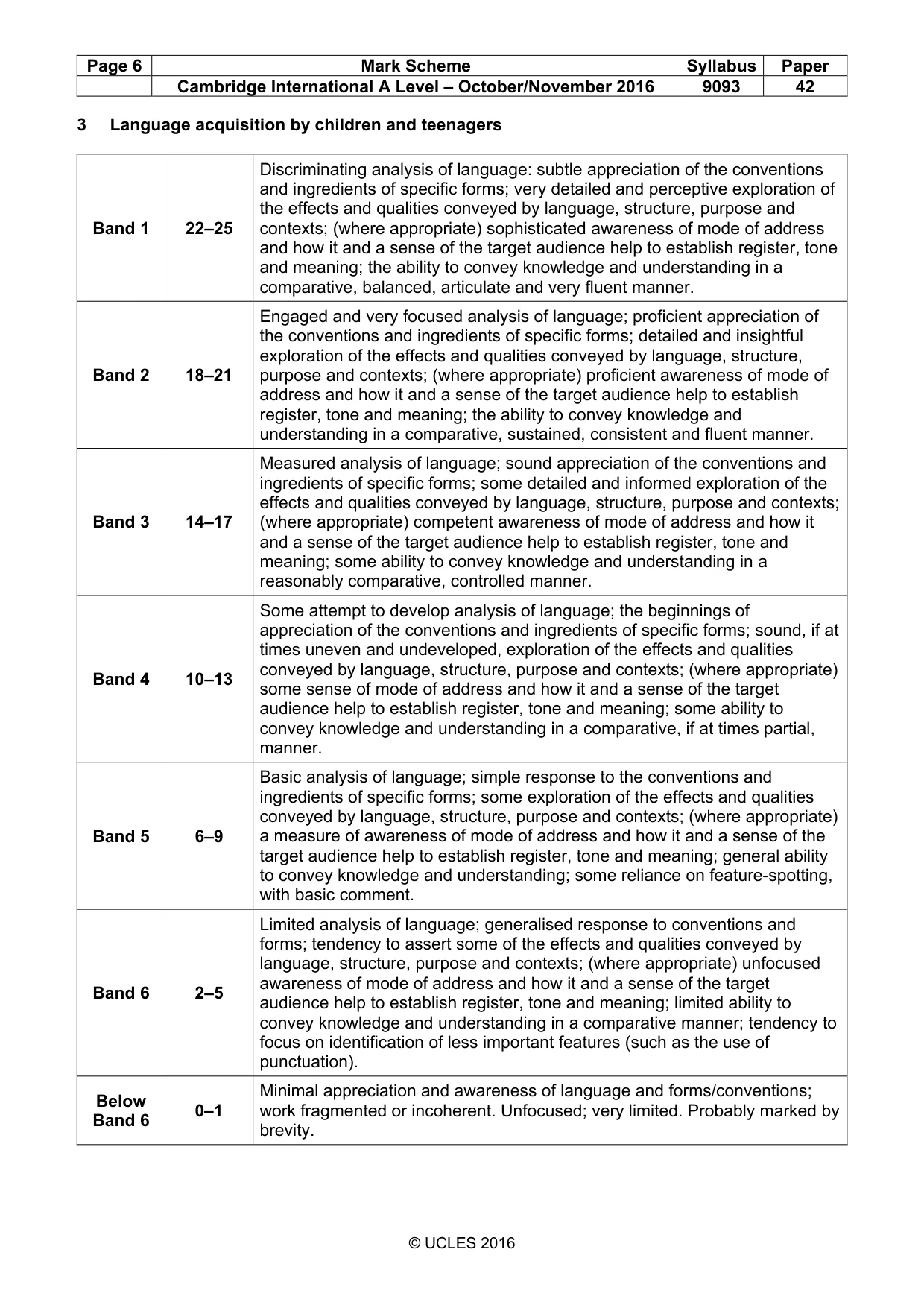
Page 6 Mark Scheme Syllabus Paper Cambridge International A Level – October/November 2016 9093 42 © UCLES 2016 3 Language acquisition by children and teenagers Band 1 22–25 Discriminating analysis of language: subtle appreciation of the conventions and ingredients of specific forms; very detailed and perceptive exploration of the effects and qualities conveyed by language, structure, purpose and contexts; (where appropriate) sophisticated awareness of mode of address and how it and a sense of the target audience help to establish register, tone and meaning; the ability to convey knowledge and understanding in a comparative, balanced, articulate and very fluent manner. Band 2 18–21 Engaged and very focused analysis of language; proficient appreciation of the conventions and ingredients of specific forms; detailed and insightful exploration of the effects and qualities conveyed by language, structure, purpose and contexts; (where appropriate) proficient awareness of mode of address and how it and a sense of the target audience help to establish register, tone and meaning; the ability to convey knowledge and understanding in a comparative, sustained, consistent and fluent manner. Band 3 14–17 Measured analysis of language; sound appreciation of the conventions and ingredients of specific forms; some detailed and informed exploration of the effects and qualities conveyed by language, structure, purpose and contexts; (where appropriate) competent awareness of mode of address and how it and a sense of the target audience help to establish register, tone and meaning; some ability to convey knowledge and understanding in a reasonably comparative, controlled manner. Band 4 10–13 Some attempt to develop analysis of language; the beginnings of appreciation of the conventions and ingredients of specific forms; sound, if at times uneven and undeveloped, exploration of the effects and qualities conveyed by language, structure, purpose and contexts; (where appropriate) some sense of mode of address and how it and a sense of the target audience help to establish register, tone and meaning; some ability to convey knowledge and understanding in a comparative, if at times partial, manner. Band 5 6–9 Basic analysis of language; simple response to the conventions and ingredients of specific forms; some exploration of the effects and qualities conveyed by language, structure, purpose and contexts; (where appropriate) a measure of awareness of mode of address and how it and a sense of the target audience help to establish register, tone and meaning; general ability to convey knowledge and understanding; some reliance on feature-spotting, with basic comment. Band 6 2–5 Limited analysis of language; generalised response to conventions and forms; tendency to assert some of the effects and qualities conveyed by language, structure, purpose and contexts; (where appropriate) unfocused awareness of mode of address and how it and a sense of the target audience help to establish register, tone and meaning; limited ability to convey knowledge and understanding in a comparative manner; tendency to focus on identification of less important features (such as the use of punctuation). Below Band 6 0–1 Minimal appreciation and awareness of language and forms/conventions; work fragmented or incoherent. Unfocused; very limited. Probably marked by brevity.
Mark scheme, page 7
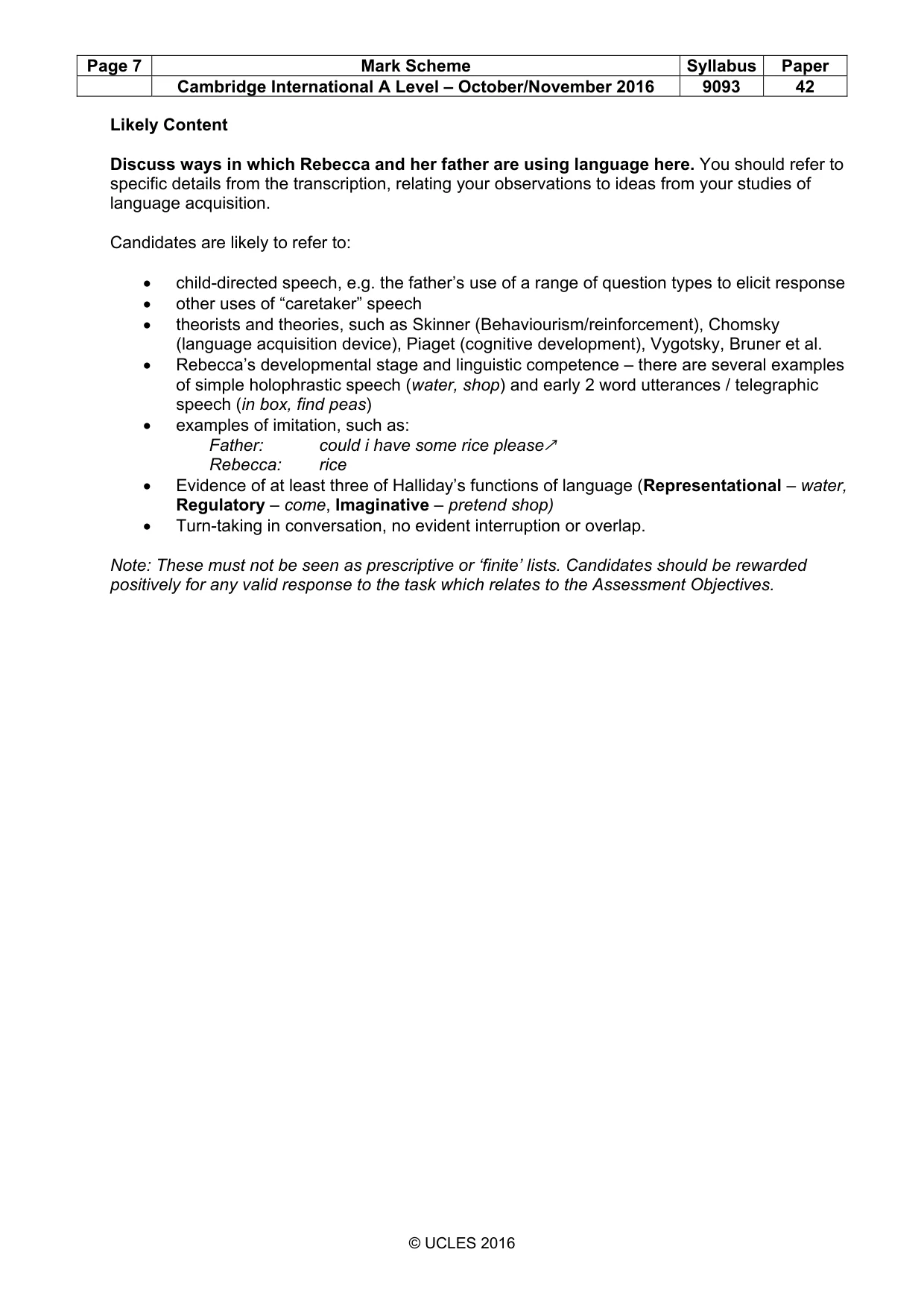
Page 7 Mark Scheme Syllabus Paper Cambridge International A Level – October/November 2016 9093 42 © UCLES 2016 Likely Content Discuss ways in which Rebecca and her father are using language here. You should refer to specific details from the transcription, relating your observations to ideas from your studies of language acquisition. Candidates are likely to refer to: • child-directed speech, e.g. the father’s use of a range of question types to elicit response • other uses of “caretaker” speech • theorists and theories, such as Skinner (Behaviourism/reinforcement), Chomsky (language acquisition device), Piaget (cognitive development), Vygotsky, Bruner et al. • Rebecca’s developmental stage and linguistic competence – there are several examples of simple holophrastic speech (water, shop) and early 2 word utterances / telegraphic speech (in box, find peas) • examples of imitation, such as: Father: could i have some rice please↗ Rebecca: rice • Evidence of at least three of Halliday’s functions of language (Representational – water, Regulatory – come, Imaginative – pretend shop) • Turn-taking in conversation, no evident interruption or overlap. Note: These must not be seen as prescriptive or ‘finite’ lists. Candidates should be rewarded positively for any valid response to the task which relates to the Assessment Objectives.
What you needed in this session
Cambridge’s own grade thresholds for 2016 Oct/Nov, Paper 4 · Variant 2. A higher threshold means an easier paper — the bar moves with how the cohort did.