Cambridge A Level English - Language AS and A Level (from 2014) 9093 — 2016 Oct/Nov Paper 4 · Variant 3
9093/43/O/N/16 · 50 marks · ≈56 min
The question paper and its mark scheme, free to read here and free to download. This is Cambridge’s own paper, exactly as it was sat.
Question paper8 pages


Mark scheme7 pages
Answers below. Sit the paper first if you are practising.
Paper as text
Question paper, page 1
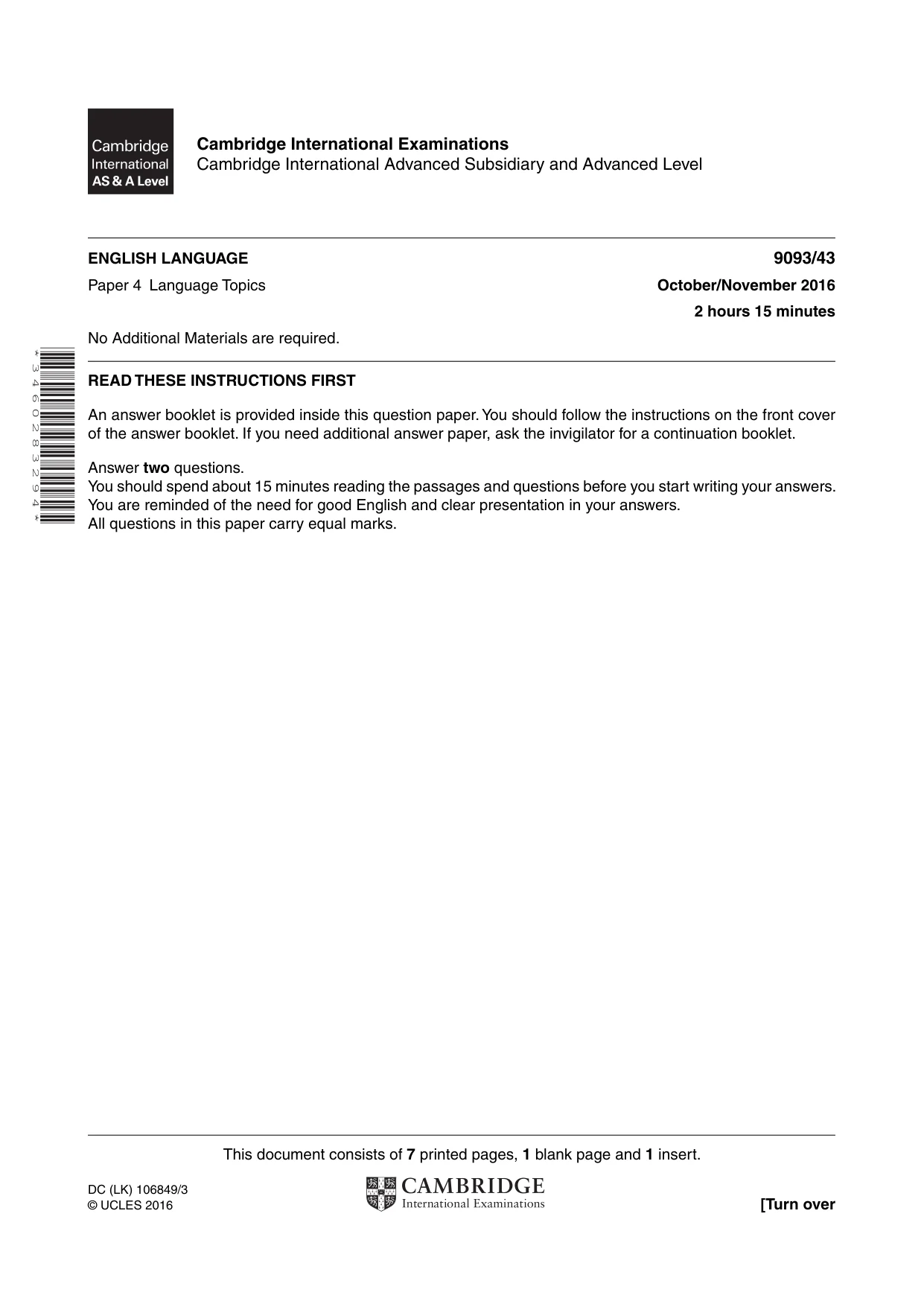
This document consists of 7 printed pages, 1 blank page and 1 insert. DC (LK) 106849/3 © UCLES 2016 [Turn over Cambridge International Examinations Cambridge International Advanced Subsidiary and Advanced Level * 3 4 6 0 2 8 3 2 9 4 * ENGLISH LANGUAGE 9093/43 Paper 4 Language Topics October/November 2016 2 hours 15 minutes No Additional Materials are required. READ THESE INSTRUCTIONS FIRST An answer booklet is provided inside this question paper. You should follow the instructions on the front cover of the answer booklet. If you need additional answer paper, ask the invigilator for a continuation booklet. Answer two questions. You should spend about 15 minutes reading the passages and questions before you start writing your answers. You are reminded of the need for good English and clear presentation in your answers. All questions in this paper carry equal marks.
Question paper, page 2
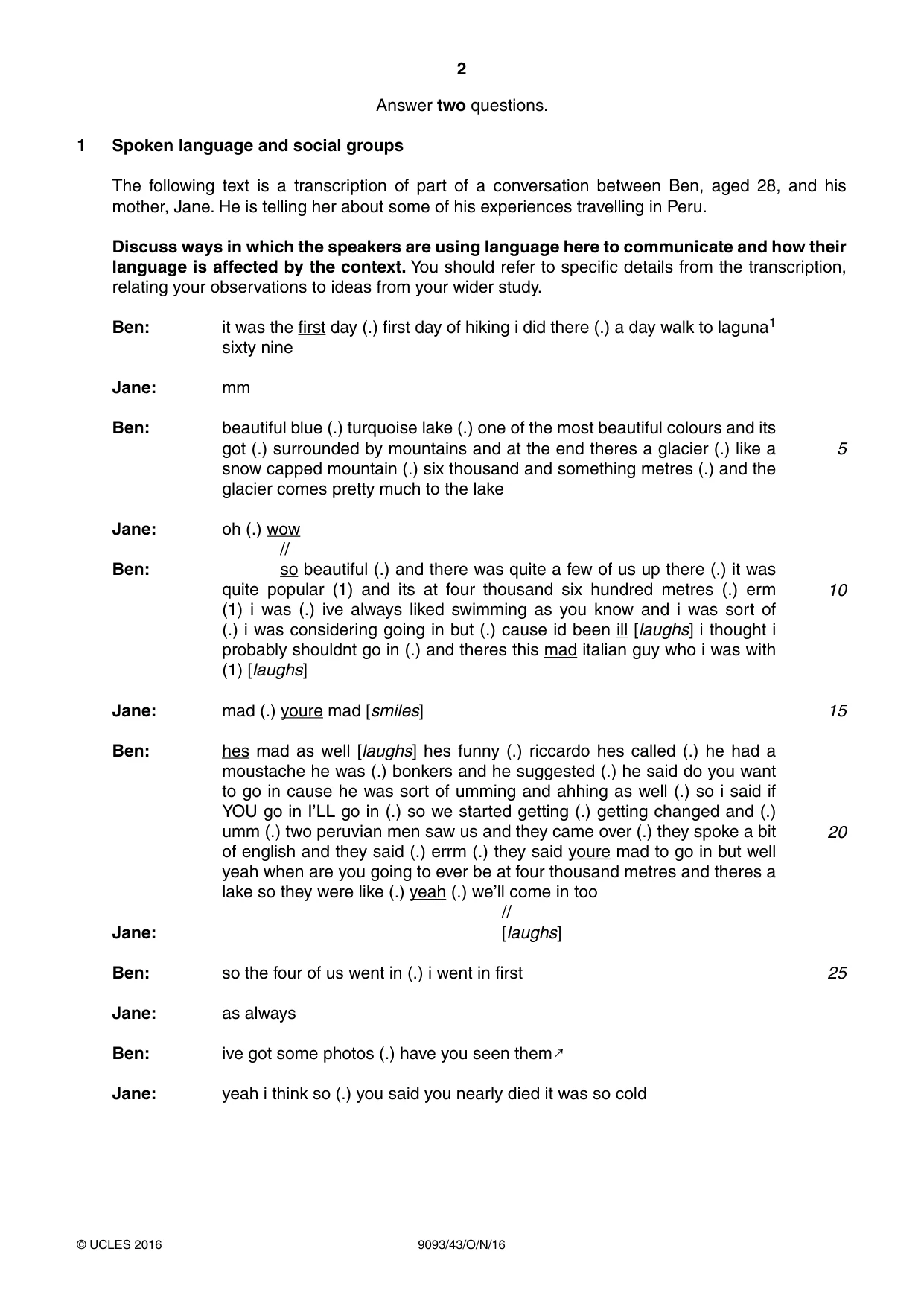
2 9093/43/O/N/16 © UCLES 2016 Answer two questions. 1 Spoken language and social groups The following text is a transcription of part of a conversation between Ben, aged 28, and his mother, Jane. He is telling her about some of his experiences travelling in Peru. Discuss ways in which the speakers are using language here to communicate and how their language is affected by the context. You should refer to specific details from the transcription, relating your observations to ideas from your wider study. Ben: it was the first day (.) first day of hiking i did there (.) a day walk to laguna1 sixty nine Jane: mm Ben: beautiful blue (.) turquoise lake (.) one of the most beautiful colours and its got (.) surrounded by mountains and at the end theres a glacier (.) like a snow capped mountain (.) six thousand and something metres (.) and the glacier comes pretty much to the lake Jane: oh (.) wow // Ben: so beautiful (.) and there was quite a few of us up there (.) it was quite popular (1) and its at four thousand six hundred metres (.) erm (1) i was (.) ive always liked swimming as you know and i was sort of (.) i was considering going in but (.) cause id been ill [laughs] i thought i probably shouldnt go in (.) and theres this mad italian guy who i was with (1) [laughs] Jane: mad (.) youre mad [smiles] Ben: hes mad as well [laughs] hes funny (.) riccardo hes called (.) he had a moustache he was (.) bonkers and he suggested (.) he said do you want to go in cause he was sort of umming and ahhing as well (.) so i said if YOU go in I’LL go in (.) so we started getting (.) getting changed and (.) umm (.) two peruvian men saw us and they came over (.) they spoke a bit of english and they said (.) errm (.) they said youre mad to go in but well yeah when are you going to ever be at four thousand metres and theres a lake so they were like (.) yeah (.) we’ll come in too // Jane: [laughs] Ben: so the four of us went in (.) i went in first Jane: as always Ben: ive got some photos (.) have you seen them↗ Jane: yeah i think so (.) you said you nearly died it was so cold 5 10 15 20 25
Question paper, page 3
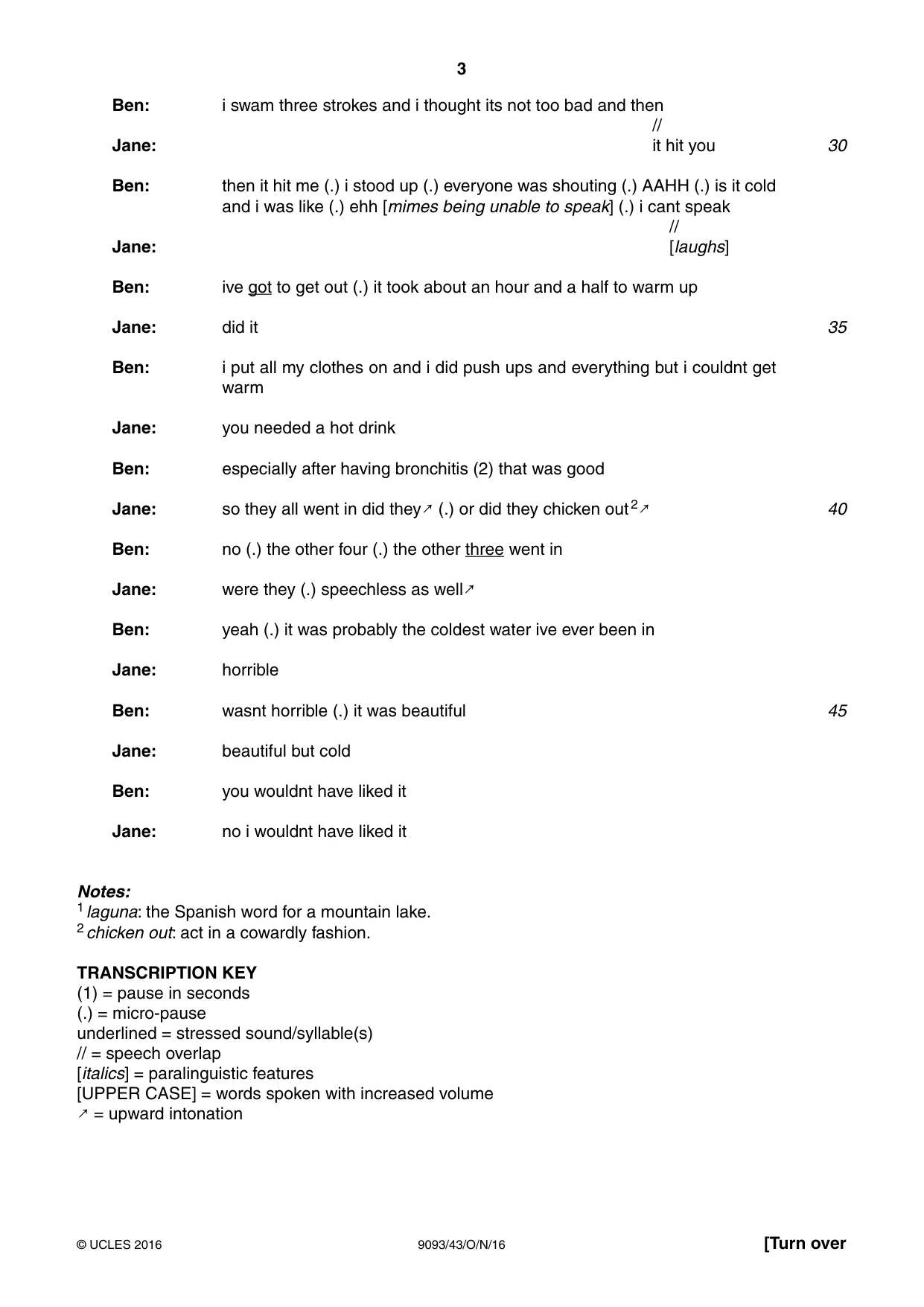
3 9093/43/O/N/16 © UCLES 2016 [Turn over Ben: i swam three strokes and i thought its not too bad and then // Jane: it hit you Ben: then it hit me (.) i stood up (.) everyone was shouting (.) AAHH (.) is it cold and i was like (.) ehh [mimes being unable to speak] (.) i cant speak // Jane: [laughs] Ben: ive got to get out (.) it took about an hour and a half to warm up Jane: did it Ben: i put all my clothes on and i did push ups and everything but i couldnt get warm Jane: you needed a hot drink Ben: especially after having bronchitis (2) that was good Jane: so they all went in did they↗ (.) or did they chicken out 2↗ Ben: no (.) the other four (.) the other three went in Jane: were they (.) speechless as well↗ Ben: yeah (.) it was probably the coldest water ive ever been in Jane: horrible Ben: wasnt horrible (.) it was beautiful Jane: beautiful but cold Ben: you wouldnt have liked it Jane: no i wouldnt have liked it Notes: 1 laguna: the Spanish word for a mountain lake. 2 chicken out: act in a cowardly fashion. TRANSCRIPTION KEY (1) = pause in seconds (.) = micro-pause underlined = stressed sound/syllable(s) // = speech overlap [italics] = paralinguistic features [UPPER CASE] = words spoken with increased volume ↗ = upward intonation 30 35 40 45
Question paper, page 4
4 9093/43/O/N/16 © UCLES 2016 2 English as a global language The passage on the next page comes from a magazine about language called Babel. The article was published in 2012. Discuss what you feel are the most important issues raised here relating to the changing use of English as a global language. You should refer to specific details from the passage as well as to ideas and examples from your wider study.
Question paper, page 5
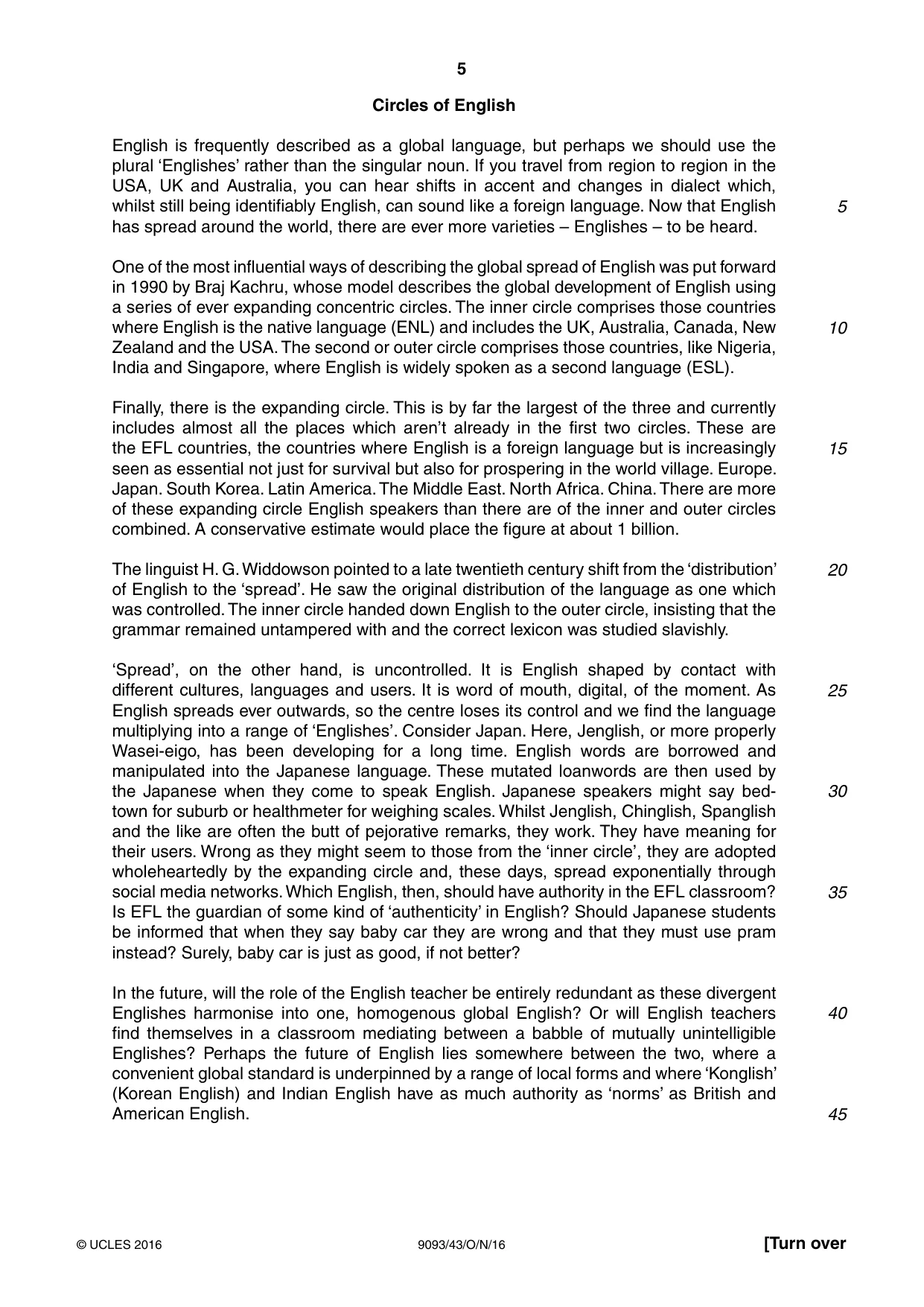
5 9093/43/O/N/16 © UCLES 2016 [Turn over Circles of English English is frequently described as a global language, but perhaps we should use the plural ‘Englishes’ rather than the singular noun. If you travel from region to region in the USA, UK and Australia, you can hear shifts in accent and changes in dialect which, whilst still being identifiably English, can sound like a foreign language. Now that English has spread around the world, there are ever more varieties – Englishes – to be heard. One of the most influential ways of describing the global spread of English was put forward in 1990 by Braj Kachru, whose model describes the global development of English using a series of ever expanding concentric circles. The inner circle comprises those countries where English is the native language (ENL) and includes the UK, Australia, Canada, New Zealand and the USA. The second or outer circle comprises those countries, like Nigeria, India and Singapore, where English is widely spoken as a second language (ESL). Finally, there is the expanding circle. This is by far the largest of the three and currently includes almost all the places which aren’t already in the first two circles. These are the EFL countries, the countries where English is a foreign language but is increasingly seen as essential not just for survival but also for prospering in the world village. Europe. Japan. South Korea. Latin America. The Middle East. North Africa. China. There are more of these expanding circle English speakers than there are of the inner and outer circles combined. A conservative estimate would place the figure at about 1 billion. The linguist H. G. Widdowson pointed to a late twentieth century shift from the ‘distribution’ of English to the ‘spread’. He saw the original distribution of the language as one which was controlled. The inner circle handed down English to the outer circle, insisting that the grammar remained untampered with and the correct lexicon was studied slavishly. Find out more ‘Spread’, on the other hand, is uncontrolled. It is English shaped by contact with different cultures, languages and users. It is word of mouth, digital, of the moment. As English spreads ever outwards, so the centre loses its control and we find the language multiplying into a range of ‘Englishes’. Consider Japan. Here, Jenglish, or more properly Wasei-eigo, has been developing for a long time. English words are borrowed and manipulated into the Japanese language. These mutated loanwords are then used by the Japanese when they come to speak English. Japanese speakers might say bed- town for suburb or healthmeter for weighing scales. Whilst Jenglish, Chinglish, Spanglish and the like are often the butt of pejorative remarks, they work. They have meaning for their users. Wrong as they might seem to those from the ‘inner circle’, they are adopted wholeheartedly by the expanding circle and, these days, spread exponentially through social media networks. Which English, then, should have authority in the EFL classroom? Is EFL the guardian of some kind of ‘authenticity’ in English? Should Japanese students be informed that when they say baby car they are wrong and that they must use pram instead? Surely, baby car is just as good, if not better? In the future, will the role of the English teacher be entirely redundant as these divergent Englishes harmonise into one, homogenous global English? Or will English teachers find themselves in a classroom mediating between a babble of mutually unintelligible Englishes? Perhaps the future of English lies somewhere between the two, where a convenient global standard is underpinned by a range of local forms and where ‘Konglish’ (Korean English) and Indian English have as much authority as ‘norms’ as British and American English. 5 10 15 20 25 30 35 40 45
Question paper, page 6
6 9093/43/O/N/16 © UCLES 2016 3 Language acquisition by children and teenagers The following text is a transcription of a conversation between Diego (age 7 years, 2 months) and his teacher. Discuss ways in which Diego and his teacher are using language here. You should refer to specific details from the transcription, relating your observations to ideas from your studies of language acquisition. Teacher: hey (.) youve just had your birthday (.) havent you (1) what did you get for your birthday↗ Diego: um (.) i got a bmx1 Teacher: you got a bmx (.) a real bike (.) whats it like↗ Diego: big r e d one (.) keep falling off it though Teacher: do you do stunts on it Diego: yeah Teacher: what do you do↗ Diego : table tops2 Teacher: huh Diego: jump doing somersaults (.) go WHEEEOW Teacher: do you do wheelies3↗ Diego: oh yeah (.) i can do them very well Teacher: can you↗ Diego: yeah ( . ) i can ride from one end of the street to the other end Teacher: my brother keeps falling off his bike when he does wheelies and things Diego: i dont Teacher: is it dangerous↗ Diego: no Teacher: do you do races on it↗ Diego: cor (.) YEAH (.) i always win them cause ive got this gear change and you go PSSSST WHOOOOM Teacher: who do you race with then↗ Diego: my mate called paul 5 10 15 20
Question paper, page 7
7 9093/43/O/N/16 © UCLES 2016 Teacher: has he got a bmx as well↗ Diego: [nods] Teacher: yeah↗ (.) and who wins↗ (.) i bet he wins sometimes Diego: some Teacher: some // Diego: only once Teacher: only once // Diego: once a week Teacher: once a week (.) do you let him win sometimes↗ Diego: um (.) some // Teacher: yeah Diego: i go slow but he gets a head start // Teacher: does he get a head start Diego: when he always gets a head start i always go WHOOOOM (.) im only about that much away from him [indicates a small distance with his hands] and I go WHEEEOW (.) shot right past him Teacher: where do you do it then (.) do y o u do it in the street↗ Diego: yeah Teacher: or in your garden↗ Diego: in our street Notes: 1 bmx: bicycl e on which stunts can be performed. 2 table tops: a BMX stunt (laying the bicycle horizontally in mid-air). 3 wheelies: a BMX stunt (riding on the rear wheel only). TRANSCRIPTION KEY (1) = pause in seconds (.) = micro-pause underlined = stressed sound/syllable(s) // = speech overlap [italics] = paralinguistic features [UPPER CASE] = words spoken with increased volume ↗ = upward intonation 25 30 35 40
Question paper, page 8
8 9093/43/O/N/16 © UCLES 2016 BLANK PAGE Permission to reproduce items where third-party owned material protected by copyright is included has been sought and cleared where possible. Every reasonable effort has been made by the publisher (UCLES) to trace copyright holders, but if any items requiring clearance have unwittingly been included, the publisher will be pleased to make amends at the earliest possible opportunity. To avoid the issue of disclosure of answer-related information to candidates, all copyright acknowledgements are reproduced online in the Cambridge International Examinations Copyright Acknowledgements Booklet. This is produced for each series of examinations and is freely available to download at www.cie.org.uk after the live examination series. Cambridge International Examinations is part of the Cambridge Assessment Group. Cambridge Assessment is the brand name of University of Cambridge Local Examinations Syndicate (UCLES), which is itself a department of the University of Cambridge.
Mark scheme, page 1
® IGCSE is the registered trademark of Cambridge International Examinations. This document consists of 7 printed pages. © UCLES 2016 [Turn over Cambridge International Examinations Cambridge International Advanced Level ENGLISH LANGUAGE 9093/43 Paper 4 Language Topics October/November 2016 MARK SCHEME Maximum Mark: 50 Published This mark scheme is published as an aid to teachers and candidates, to indicate the requirements of the examination. It shows the basis on which Examiners were instructed to award marks. It does not indicate the details of the discussions that took place at an Examiners’ meeting before marking began, which would have considered the acceptability of alternative answers. Mark schemes should be read in conjunction with the question paper and the Principal Examiner Report for Teachers. Cambridge will not enter into discussions about these mark schemes. Cambridge is publishing the mark schemes for the October/November 2016 series for most Cambridge IGCSE®, Cambridge International A and AS Level components and some Cambridge O Level components.
Mark scheme, page 2
Page 2 Mark Scheme Syllabus Paper Cambridge International A Level – October/November 2016 9093 43 © UCLES 2016 1 Spoken language and social groups Band 1 22–25 Discriminating analysis of language: subtle appreciation of the conventions and ingredients of specific forms; very detailed and perceptive exploration of the effects and qualities conveyed by language, structure, purpose and contexts; (where appropriate) sophisticated awareness of mode of address and how it and a sense of the target audience help to establish register, tone and meaning; the ability to convey knowledge and understanding in a comparative, balanced, articulate and very fluent manner. Band 2 18–21 Engaged and very focused analysis of language; proficient appreciation of the conventions and ingredients of specific forms; detailed and insightful exploration of the effects and qualities conveyed by language, structure, purpose and contexts; (where appropriate) proficient awareness of mode of address and how it and a sense of the target audience help to establish register, tone and meaning; the ability to convey knowledge and understanding in a comparative, sustained, consistent and fluent manner. Band 3 14–17 Measured analysis of language; sound appreciation of the conventions and ingredients of specific forms; some detailed and informed exploration of the effects and qualities conveyed by language, structure, purpose and contexts; (where appropriate) competent awareness of mode of address and how it and a sense of the target audience help to establish register, tone and meaning; some ability to convey knowledge and understanding in a reasonably comparative, controlled manner. Band 4 10–13 Some attempt to develop analysis of language; the beginnings of appreciation of the conventions and ingredients of specific forms; sound, if at times uneven and undeveloped, exploration of the effects and qualities conveyed by language, structure, purpose and contexts; (where appropriate) some sense of mode of address and how it and a sense of the target audience help to establish register, tone and meaning; some ability to convey knowledge and understanding in a comparative, if at times partial, manner. Band 5 6–9 Basic analysis of language; simple response to the conventions and ingredients of specific forms; some exploration of the effects and qualities conveyed by language, structure, purpose and contexts; (where appropriate) a measure of awareness of mode of address and how it and a sense of the target audience help to establish register, tone and meaning; general ability to convey knowledge and understanding; some reliance on feature-spotting, with basic comment. Band 6 2–5 Limited analysis of language; generalised response to conventions and forms; tendency to assert some of the effects and qualities conveyed by language, structure, purpose and contexts; (where appropriate) unfocused awareness of mode of address and how it and a sense of the target audience help to establish register, tone and meaning; limited ability to convey knowledge and understanding in a comparative manner; tendency to focus on identification of less important features (such as the use of punctuation). Below Band 6 0–1 Minimal appreciation and awareness of language and forms/conventions; work fragmented or incoherent. Unfocused; very limited. Probably marked by brevity.
Mark scheme, page 3
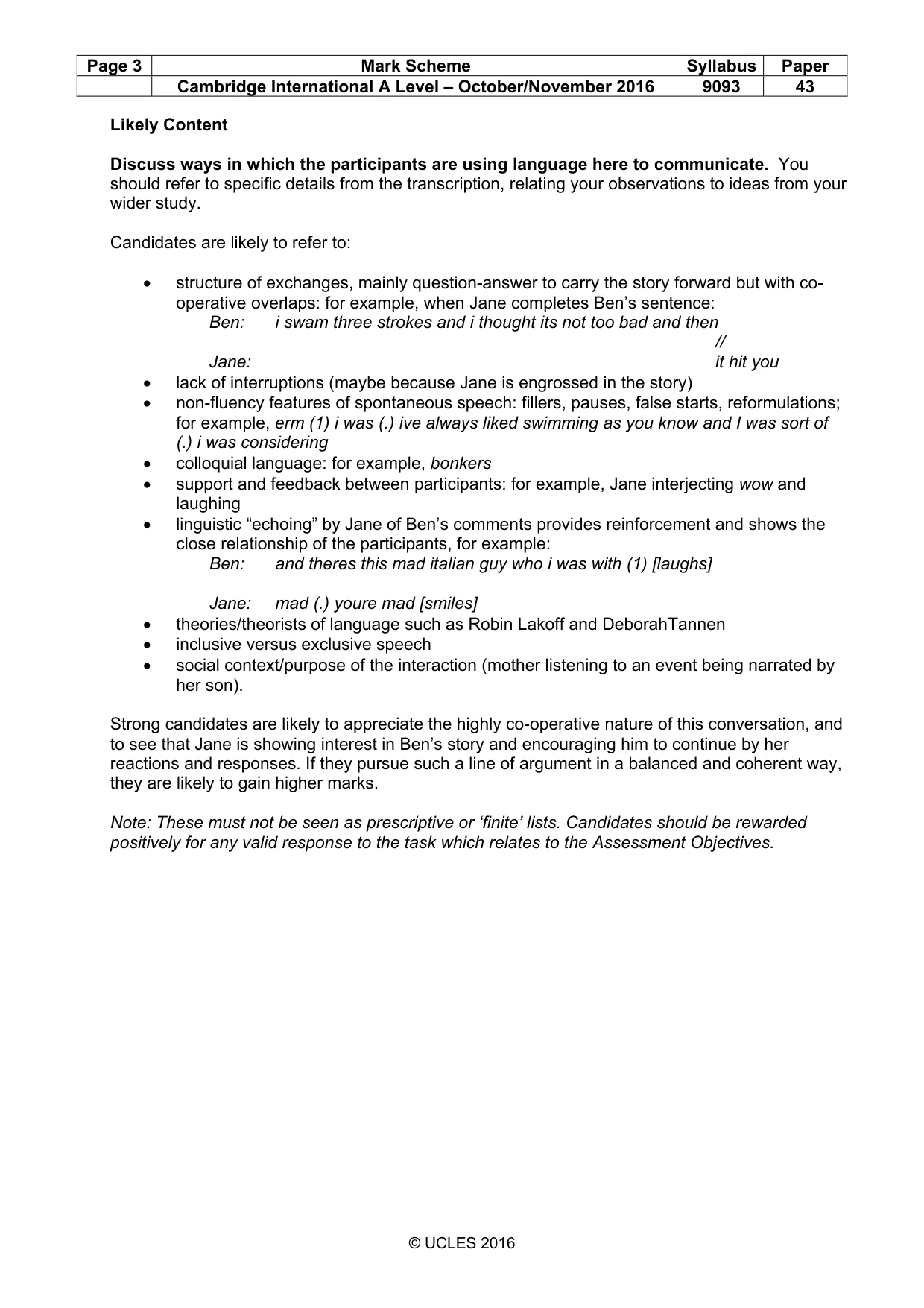
Page 3 Mark Scheme Syllabus Paper Cambridge International A Level – October/November 2016 9093 43 © UCLES 2016 Likely Content Discuss ways in which the participants are using language here to communicate. You should refer to specific details from the transcription, relating your observations to ideas from your wider study. Candidates are likely to refer to: • structure of exchanges, mainly question-answer to carry the story forward but with co- operative overlaps: for example, when Jane completes Ben’s sentence: Ben: i swam three strokes and i thought its not too bad and then // Jane: it hit you • lack of interruptions (maybe because Jane is engrossed in the story) • non-fluency features of spontaneous speech: fillers, pauses, false starts, reformulations; for example, erm (1) i was (.) ive always liked swimming as you know and I was sort of (.) i was considering • colloquial language: for example, bonkers • support and feedback between participants: for example, Jane interjecting wow and laughing • linguistic “echoing” by Jane of Ben’s comments provides reinforcement and shows the close relationship of the participants, for example: Ben: and theres this mad italian guy who i was with (1) [laughs] Jane: mad (.) youre mad [smiles] • theories/theorists of language such as Robin Lakoff and DeborahTannen • inclusive versus exclusive speech • social context/purpose of the interaction (mother listening to an event being narrated by her son). Strong candidates are likely to appreciate the highly co-operative nature of this conversation, and to see that Jane is showing interest in Ben’s story and encouraging him to continue by her reactions and responses. If they pursue such a line of argument in a balanced and coherent way, they are likely to gain higher marks. Note: These must not be seen as prescriptive or ‘finite’ lists. Candidates should be rewarded positively for any valid response to the task which relates to the Assessment Objectives.
Mark scheme, page 4
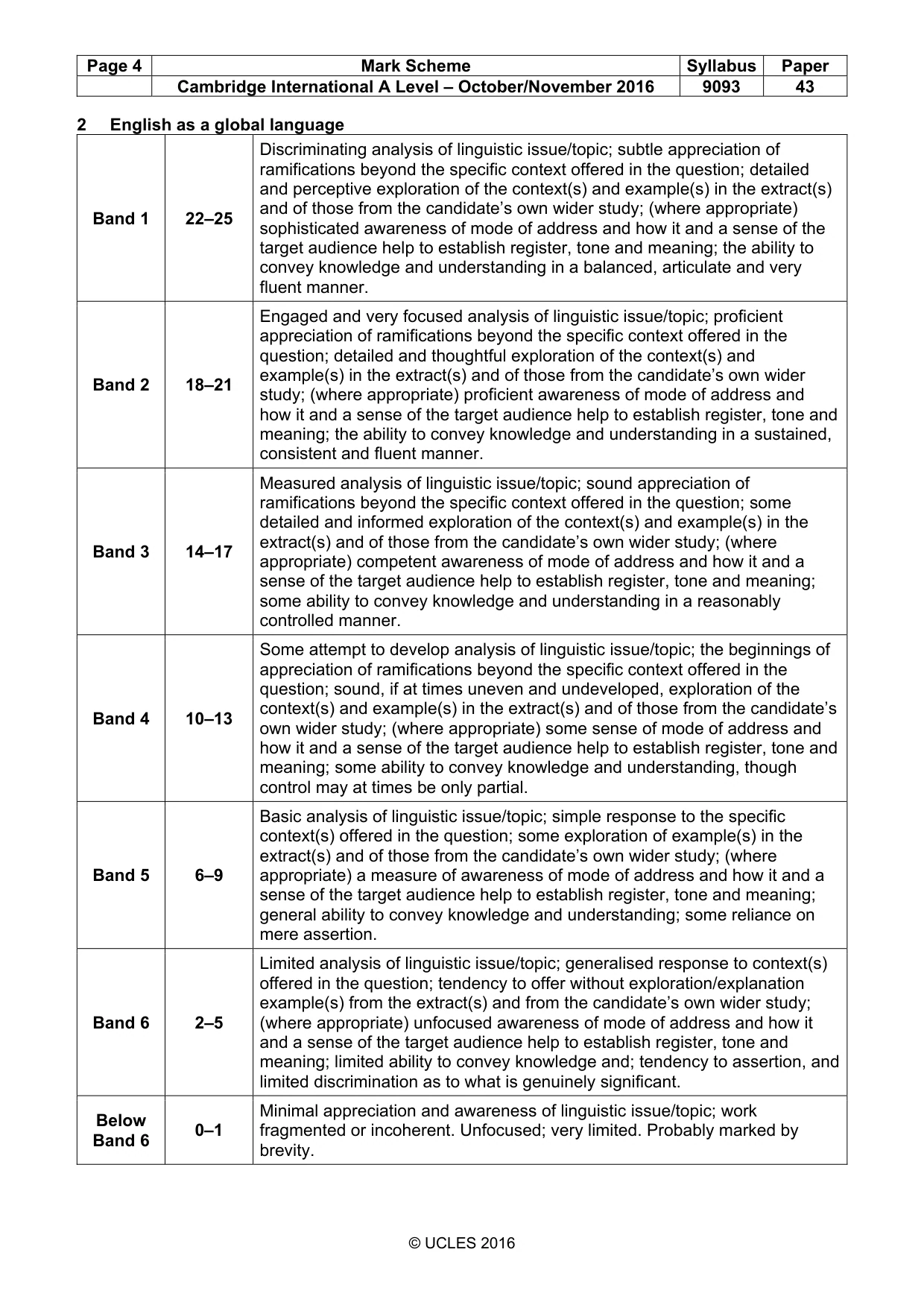
Page 4 Mark Scheme Syllabus Paper Cambridge International A Level – October/November 2016 9093 43 © UCLES 2016 2 English as a global language Band 1 22–25 Discriminating analysis of linguistic issue/topic; subtle appreciation of ramifications beyond the specific context offered in the question; detailed and perceptive exploration of the context(s) and example(s) in the extract(s) and of those from the candidate’s own wider study; (where appropriate) sophisticated awareness of mode of address and how it and a sense of the target audience help to establish register, tone and meaning; the ability to convey knowledge and understanding in a balanced, articulate and very fluent manner. Band 2 18–21 Engaged and very focused analysis of linguistic issue/topic; proficient appreciation of ramifications beyond the specific context offered in the question; detailed and thoughtful exploration of the context(s) and example(s) in the extract(s) and of those from the candidate’s own wider study; (where appropriate) proficient awareness of mode of address and how it and a sense of the target audience help to establish register, tone and meaning; the ability to convey knowledge and understanding in a sustained, consistent and fluent manner. Band 3 14–17 Measured analysis of linguistic issue/topic; sound appreciation of ramifications beyond the specific context offered in the question; some detailed and informed exploration of the context(s) and example(s) in the extract(s) and of those from the candidate’s own wider study; (where appropriate) competent awareness of mode of address and how it and a sense of the target audience help to establish register, tone and meaning; some ability to convey knowledge and understanding in a reasonably controlled manner. Band 4 10–13 Some attempt to develop analysis of linguistic issue/topic; the beginnings of appreciation of ramifications beyond the specific context offered in the question; sound, if at times uneven and undeveloped, exploration of the context(s) and example(s) in the extract(s) and of those from the candidate’s own wider study; (where appropriate) some sense of mode of address and how it and a sense of the target audience help to establish register, tone and meaning; some ability to convey knowledge and understanding, though control may at times be only partial. Band 5 6–9 Basic analysis of linguistic issue/topic; simple response to the specific context(s) offered in the question; some exploration of example(s) in the extract(s) and of those from the candidate’s own wider study; (where appropriate) a measure of awareness of mode of address and how it and a sense of the target audience help to establish register, tone and meaning; general ability to convey knowledge and understanding; some reliance on mere assertion. Band 6 2–5 Limited analysis of linguistic issue/topic; generalised response to context(s) offered in the question; tendency to offer without exploration/explanation example(s) from the extract(s) and from the candidate’s own wider study; (where appropriate) unfocused awareness of mode of address and how it and a sense of the target audience help to establish register, tone and meaning; limited ability to convey knowledge and; tendency to assertion, and limited discrimination as to what is genuinely significant. Below Band 6 0–1 Minimal appreciation and awareness of linguistic issue/topic; work fragmented or incoherent. Unfocused; very limited. Probably marked by brevity.
Mark scheme, page 5
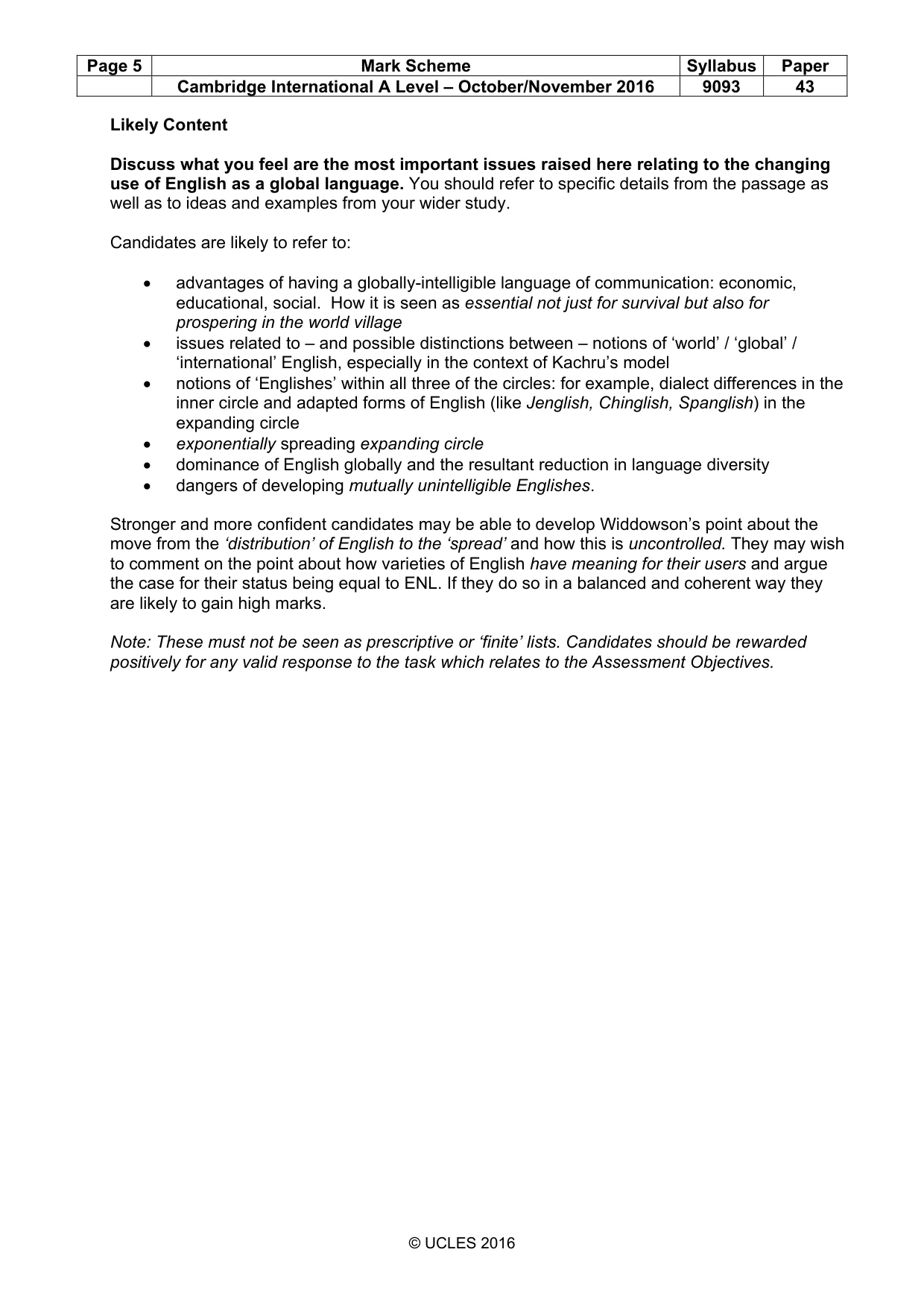
Page 5 Mark Scheme Syllabus Paper Cambridge International A Level – October/November 2016 9093 43 © UCLES 2016 Likely Content Discuss what you feel are the most important issues raised here relating to the changing use of English as a global language. You should refer to specific details from the passage as well as to ideas and examples from your wider study. Candidates are likely to refer to: • advantages of having a globally-intelligible language of communication: economic, educational, social. How it is seen as essential not just for survival but also for prospering in the world village • issues related to – and possible distinctions between – notions of ‘world’ / ‘global’ / ‘international’ English, especially in the context of Kachru’s model • notions of ‘Englishes’ within all three of the circles: for example, dialect differences in the inner circle and adapted forms of English (like Jenglish, Chinglish, Spanglish) in the expanding circle • exponentially spreading expanding circle • dominance of English globally and the resultant reduction in language diversity • dangers of developing mutually unintelligible Englishes. Stronger and more confident candidates may be able to develop Widdowson’s point about the move from the ‘distribution’ of English to the ‘spread’ and how this is uncontrolled. They may wish to comment on the point about how varieties of English have meaning for their users and argue the case for their status being equal to ENL. If they do so in a balanced and coherent way they are likely to gain high marks. Note: These must not be seen as prescriptive or ‘finite’ lists. Candidates should be rewarded positively for any valid response to the task which relates to the Assessment Objectives.
Mark scheme, page 6
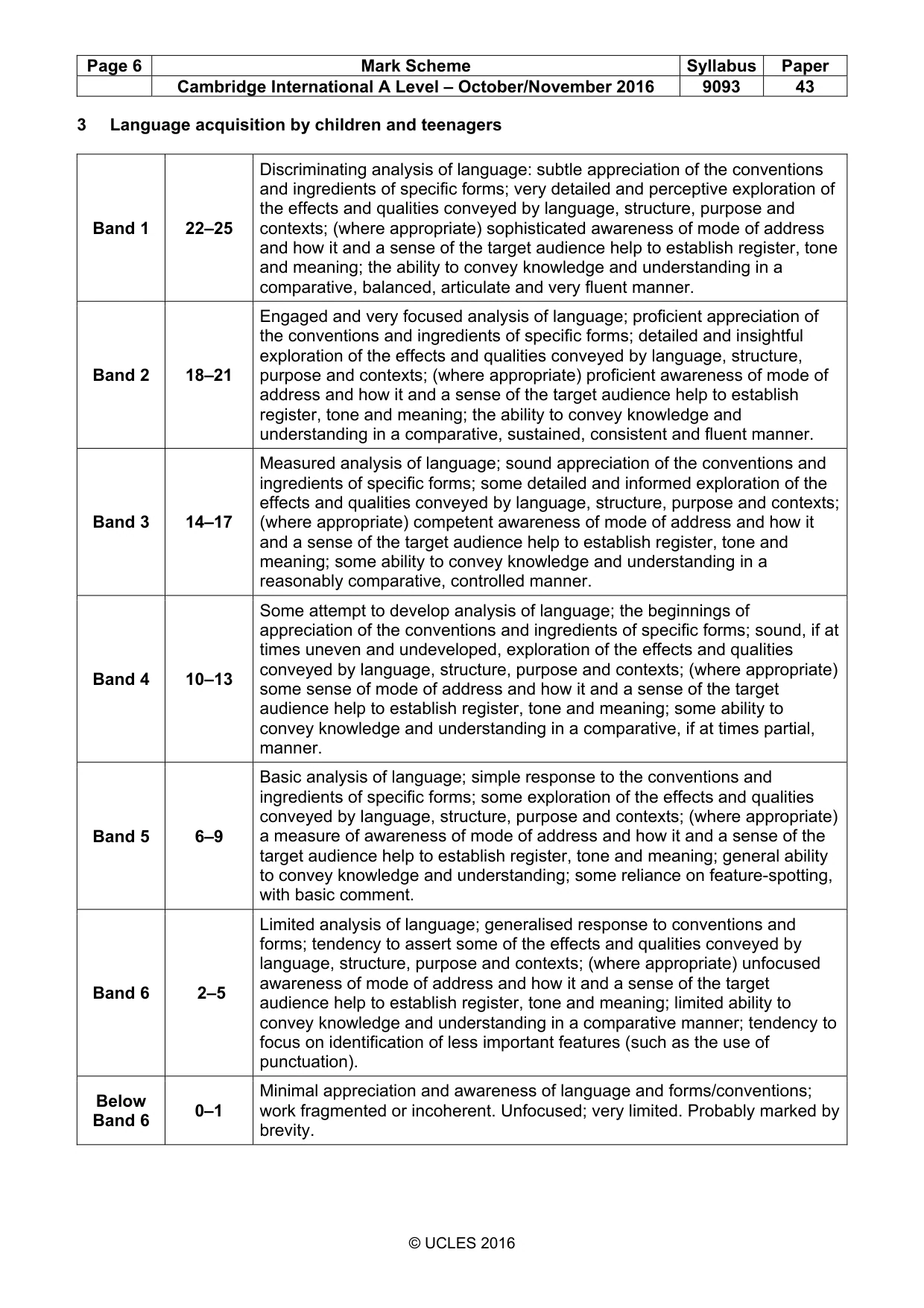
Page 6 Mark Scheme Syllabus Paper Cambridge International A Level – October/November 2016 9093 43 © UCLES 2016 3 Language acquisition by children and teenagers Band 1 22–25 Discriminating analysis of language: subtle appreciation of the conventions and ingredients of specific forms; very detailed and perceptive exploration of the effects and qualities conveyed by language, structure, purpose and contexts; (where appropriate) sophisticated awareness of mode of address and how it and a sense of the target audience help to establish register, tone and meaning; the ability to convey knowledge and understanding in a comparative, balanced, articulate and very fluent manner. Band 2 18–21 Engaged and very focused analysis of language; proficient appreciation of the conventions and ingredients of specific forms; detailed and insightful exploration of the effects and qualities conveyed by language, structure, purpose and contexts; (where appropriate) proficient awareness of mode of address and how it and a sense of the target audience help to establish register, tone and meaning; the ability to convey knowledge and understanding in a comparative, sustained, consistent and fluent manner. Band 3 14–17 Measured analysis of language; sound appreciation of the conventions and ingredients of specific forms; some detailed and informed exploration of the effects and qualities conveyed by language, structure, purpose and contexts; (where appropriate) competent awareness of mode of address and how it and a sense of the target audience help to establish register, tone and meaning; some ability to convey knowledge and understanding in a reasonably comparative, controlled manner. Band 4 10–13 Some attempt to develop analysis of language; the beginnings of appreciation of the conventions and ingredients of specific forms; sound, if at times uneven and undeveloped, exploration of the effects and qualities conveyed by language, structure, purpose and contexts; (where appropriate) some sense of mode of address and how it and a sense of the target audience help to establish register, tone and meaning; some ability to convey knowledge and understanding in a comparative, if at times partial, manner. Band 5 6–9 Basic analysis of language; simple response to the conventions and ingredients of specific forms; some exploration of the effects and qualities conveyed by language, structure, purpose and contexts; (where appropriate) a measure of awareness of mode of address and how it and a sense of the target audience help to establish register, tone and meaning; general ability to convey knowledge and understanding; some reliance on feature-spotting, with basic comment. Band 6 2–5 Limited analysis of language; generalised response to conventions and forms; tendency to assert some of the effects and qualities conveyed by language, structure, purpose and contexts; (where appropriate) unfocused awareness of mode of address and how it and a sense of the target audience help to establish register, tone and meaning; limited ability to convey knowledge and understanding in a comparative manner; tendency to focus on identification of less important features (such as the use of punctuation). Below Band 6 0–1 Minimal appreciation and awareness of language and forms/conventions; work fragmented or incoherent. Unfocused; very limited. Probably marked by brevity.
Mark scheme, page 7
Page 7 Mark Scheme Syllabus Paper Cambridge International A Level – October/November 2016 9093 43 © UCLES 2016 Likely Content Discuss ways in which Diego and his teacher are using language here. You should refer to specific details from the transcription, relating your observations to ideas from your studies of language acquisition. Candidates are likely to refer to: • child-directed Speech, e.g. the teacher’s use of a range of question-types to elicit response • teacher’s other uses of caretaker speech • theorists and theories, such as Skinner (Behaviourism/reinforcement), Chomsky (language acquisition device), Piaget (cognitive development), Vygotsky, Bruner et al. • Diego’s developmental stage and linguistic competence – there are some signs of telegraphic speech (big red one) but also some more complex structures well beyond the telegraphic stage (i can ride from one end of the street to the other end) • Diego’s use of sound effects to describe his speed • topic management and agenda-setting – the teacher is in control of the conversation • the structure of the exchanges: overwhelmingly fulfilled adjacency pairs, with little interruption or overlap. Note: These must not be seen as prescriptive or ‘finite’ lists. Candidates should be rewarded positively for any valid response to the task which relates to the Assessment Objectives.
What you needed in this session
Cambridge’s own grade thresholds for 2016 Oct/Nov, Paper 4 · Variant 3. A higher threshold means an easier paper — the bar moves with how the cohort did.