Cambridge A Level English - Language AS and A Level (from 2014) 9093 — 2016 Oct/Nov Paper 1 · Variant 3
9093/13/O/N/16 · 50 marks · ≈56 min
The question paper and its mark scheme, free to read here and free to download. This is Cambridge’s own paper, exactly as it was sat.
Question paper8 pages

Mark scheme4 pages
Answers below. Sit the paper first if you are practising.
Paper as text
Question paper, page 1
This document consists of 7 printed pages, 1 blank page and 1 insert. DC (CW) 106966/3 © UCLES 2016 [Turn over Cambridge International Examinations Cambridge International Advanced Subsidiary and Advanced Level * 1 3 8 6 0 9 3 5 1 1 * ENGLISH LANGUAGE 9093/13 Paper 1 Passages October/November 2016 2 hours 15 minutes No Additional Materials are required. READ THESE INSTRUCTIONS FIRST An answer booklet is provided inside this question paper. You should follow the instructions on the front cover of the answer booklet. If you need additional answer paper, ask the invigilator for a continuation booklet. Answer two questions: Question 1 and either Question 2 or Question 3. You should spend about 15 minutes reading the passages and questions before you start writing your answers. You are reminded of the need for good English and clear presentation in your answers. The number of marks is given in brackets [ ] at the end of each question or part question.
Question paper, page 2
2 9093/13/O/N/16 © UCLES 2016 Answer two questions: Question 1 and either Question 2 or Question 3. 1 The following text is the opening of a speech given by Emmeline Pankhurst in Hartford, Connecticut (USA), on 13 November, 1913. Mrs Pankhurst was a British suffragette – a campaigner for Votes for Women. (a) Comment on the style and language of the passage. [15] (b) Women were finally granted the right to vote in England in 1928. Imagine you are Mrs Pankhurst making a speech to mark this moment. Write the opening (between 120 and 150 words) of this speech. You should base your answer closely on the style and language of the original. [10] I am here as a soldier who has temporarily left the field of battle in order to explain – it seems strange it should have to be explained – what civil war is like when civil war is waged by women. I am not only here as a soldier temporarily absent from the field at battle; I am here – and that, I think, is the strangest part of my coming – I am here as a person who, according to the law courts of my country, it has been decided, is of no value to the community at all; and I am adjudged because of my life to be a dangerous person, under sentence of penal servitude in a convict prison. It is not at all difficult if revolutionaries come to you from Russia, if they come to you from China, or from any other part of the world, if they are men. But since I am a woman it is necessary to explain why women have adopted revolutionary methods in order to win the rights of citizenship. We women, in trying to make our case clear, always have to make as part of our argument, and urge upon men in our audience the fact – a very simple fact – that women are human beings. Suppose the men of Hartford had a grievance, and they laid that grievance before their legislature,1 and the legislature obstinately refused to listen to them, or to remove their grievance, what would be the proper and the constitutional and the practical way of getting their grievance removed? Well, it is perfectly obvious at the next general election the men of Hartford would turn out that legislature and elect a new one. But let the men of Hartford imagine that they were not in the position of being voters at all, that they were governed without their consent being obtained, that the legislature turned an absolutely deaf ear to their demands, what would the men of Hartford do then? They couldn’t vote the legislature out. They would have to choose; they would have to make a choice of two evils: they would either have to submit indefinitely to an unjust state of affairs, or they would have to rise up and adopt some of the antiquated means by which men in the past got their grievances remedied. Your forefathers decided that they must have representation for taxation, many, many years ago. When they felt they couldn’t wait any longer, when they laid all the arguments before an obstinate British government that they could think of, and when their arguments were absolutely disregarded, when every other means had failed, they began by the tea party2 at Boston, and they went on until they had won the independence of the United States of America. It is about eight years since the word militant was first used to describe what we were doing. It was not militant at all, except that it provoked militancy on the part of those who were opposed to it. When women asked questions in political meetings and failed to get answers, they were not doing anything militant. In Great Britain it 5 10 15 20 25 30 35
Question paper, page 3
3 9093/13/O/N/16 © UCLES 2016 [Turn over is a custom, a time-honoured one, to ask questions of candidates for parliament and ask questions of members of the government. No man was ever put out of a public meeting for asking a question. The first people who were put out of a political meeting for asking questions, were women; they were brutally ill-used; they found themselves in jail before 24 hours had expired. We were called militant, and we were quite willing to accept the name. We were determined to press this question of the enfranchisement3 of women to the point where we were no longer to be ignored by the politicians. You have two babies very hungry and wanting to be fed. One baby is a patient baby, and waits indefinitely until its mother is ready to feed it. The other baby is an impatient baby and cries lustily, screams and kicks and makes everybody unpleasant until it is fed. Well, we know perfectly well which baby is attended to first. That is the whole history of politics. You have to make more noise than anybody else, you have to make yourself more obtrusive than anybody else, you have to fill all the papers more than anybody else, in fact you have to be there all the time and see that they do not snow you under. Notes: 1legislature: law-making body/government. 2tea party : a famous American protest against British taxation. 3enfranchisement : being given the right to vote. 40 45 50
Question paper, page 4
4 9093/13/O/N/16 © UCLES 2016 2 The following is an extract from the autobiography of Helen Thomas. In it, she recalls the hours leading up to her husband, Edward’s, departure to fight in the trenches in the First World War (1914–18). (a) Comment on the language and style of the extract. [15] (b) Imagine that Helen Thomas writes a letter to a friend, telling them of her husband’s departure. Write the text of the letter (between 120 and 150 words). Base your answer closely on the style and language of the original. You do not have to bring the letter to a conclusion. [10] Edward did not speak except now and then to say some tender word or name, and hold me tight to him. “I’ve always been able to warm you, haven’t I?” “Yes, your lovely body never feels as cold as mine does. How is it that I am so cold when my heart is so full of passion?” “You must have Bronwen to sleep with you while I am away. But you must not make my heart cold with sadness, but keep it warm, for no one else but you has ever found my heart, and for you it was a poor thing after all.” “No, no, no, your heart’s love is all my life. I was nothing before you came and would be nothing without your love.” So we lay, all night, sometimes talking of our love and all that had been, and of the children, and what had been amiss and what right. We knew the best was that there had never been untruth between us. We knew all of each other, and it was right. So talking and crying and loving in each other’s arms we fell asleep as the cold reflected light of the snow crept through the frost-covered windows. Edward got up and made the fire and brought me some tea, and then got back into bed, and the children clambered in, too, and sat in a row sipping our tea. I was not afraid of crying any more. My tears had been shed, my heart was empty, stricken with something that tears would not express or comfort. The gulf had been bridged. Each bore the other’s suffering. We concealed nothing, for all was known between us. After breakfast, while he showed me where his account books were and what each was for, I listened calmly, and unbelievingly he kissed me when I said that I, too, would keep accounts. “And here are my poems. I’ve copied them all out in this book for you and the last of all is for you. I wrote it last night, but don’t read it now... It’s still freezing. The ground is like iron, and more snow has fallen. The children will come to the station with me; and now I must be off.” We were alone in my room. He took me in his arms, holding me tightly to him, his face white, his eyes full of a fear I had never seen before. My arms were around his neck. “Beloved, I love you,” was all I could say. “Helen, Helen, Helen,” he said, “remember that, whatever happens, all is well between us for ever and ever.” 5 10 15 20 25 30
Question paper, page 5
5 9093/13/O/N/16 © UCLES 2016 [Turn over And hand in hand we went downstairs and out to the children, who were playing in the snow. A thick mist hung everywhere, and there was not a sound except, far away in the valley, a train shunting. I stood at the gate watching him go; he turned back to wave until the mist and the hill hid him. I heard his old call coming up to me: “Coo-ee!” he called. “Coo-ee!” I answered, keeping my voice strong to call again. Again through the muffled air came his “Coo-ee”. And again went my answer like an echo. “Coo-ee” came fainter next time with the hill between us, but my “Coo-ee” went out of my lungs strongly, to pierce him as he strode away from me. “Coo-ee!” So faint now it might only be my own call flung back from the thick air and muffling snow. I put my hands up to my mouth to make a trumpet, but no sound came. Panic seized me, and I ran through the mist and the snow to the top of the hill, and stood there a moment dumbly, with straining eyes and ears. There was nothing but the mist and the snow and the silence of death. Then with leaden feet which stumbled in a sudden darkness that overwhelmed me I groped my way back to the empty house. 35 40 45 50
Question paper, page 6
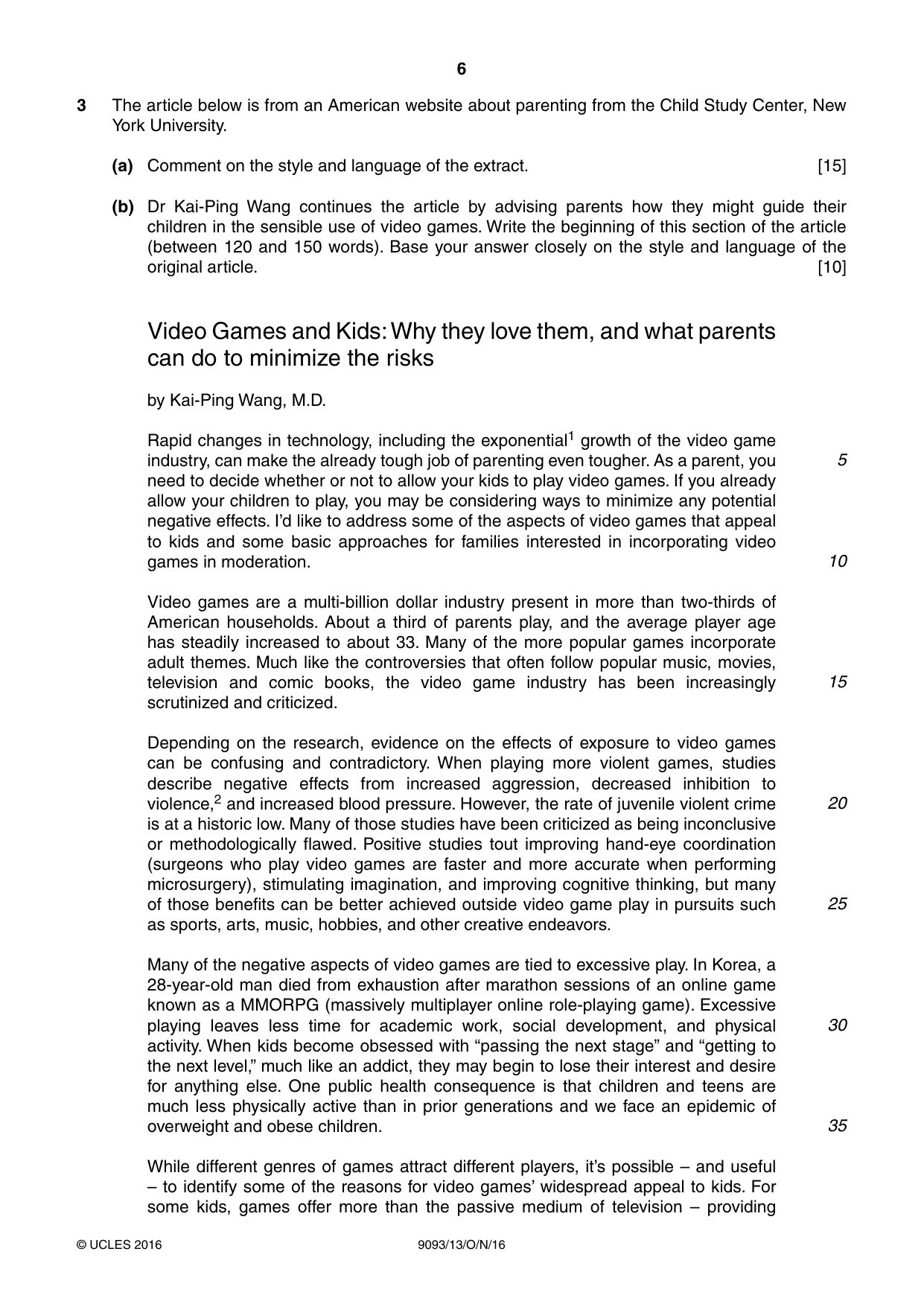
6 9093/13/O/N/16 © UCLES 2016 3 The article below is from an American website about parenting from the Child Study Center, New York University. (a) Comment on the style and language of the extract. [15] (b) Dr Kai-Ping Wang continues the article by advising parents how they might guide their children in the sensible use of video games. Write the beginning of this section of the article (between 120 and 150 words). Base your answer closely on the style and language of the original article. [10] Video Games and Kids: Why they love them, and what parents can do to minimize the risks by Kai-Ping Wang, M.D. Rapid changes in technology, including the exponential1 growth of the video game industry, can make the already tough job of parenting even tougher. As a parent, you need to decide whether or not to allow your kids to play video games. If you already allow your children to play, you may be considering ways to minimize any potential negative effects. I’d like to address some of the aspects of video games that appeal to kids and some basic approaches for families interested in incorporating video games in moderation. Video games are a multi-billion dollar industry present in more than two-thirds of American households. About a third of parents play, and the average player age has steadily increased to about 33. Many of the more popular games incorporate adult themes. Much like the controversies that often follow popular music, movies, television and comic books, the video game industry has been increasingly scrutinized and criticized. Depending on the research, evidence on the effects of exposure to video games can be confusing and contradictory. When playing more violent games, studies describe negative effects from increased aggression, decreased inhibition to violence,2 and increased blood pressure. However, the rate of juvenile violent crime is at a historic low. Many of those studies have been criticized as being inconclusive or methodologically flawed. Positive studies tout improving hand-eye coordination (surgeons who play video games are faster and more accurate when performing microsurgery), stimulating imagination, and improving cognitive thinking, but many of those benefits can be better achieved outside video game play in pursuits such as sports, arts, music, hobbies, and other creative endeavors. Many of the negative aspects of video games are tied to excessive play. In Korea, a 28-year-old man died from exhaustion after marathon sessions of an online game known as a MMORPG (massively multiplayer online role-playing game). Excessive playing leaves less time for academic work, social development, and physical activity. When kids become obsessed with “passing the next stage” and “getting to the next level,” much like an addict, they may begin to lose their interest and desire for anything else. One public health consequence is that children and teens are much less physically active than in prior generations and we face an epidemic of overweight and obese children. While different genres of games attract different players, it’s possible – and useful – to identify some of the reasons for video games’ widespread appeal to kids. For some kids, games offer more than the passive medium of television – providing 5 10 15 20 25 30 35
Question paper, page 7
7 9093/13/O/N/16 © UCLES 2016 a facsimile of individualized attention and self-paced stimulation and thus avoiding the frustration of waiting for others or feeling left behind. Many attention disordered children will sit enthralled for hours with the right game. Additionally, games can be seen as very fair (in terms of consistency). Actions are usually scored in a reliable, easily learned system. Kids love fairness. Even the most observant teacher or parent may miss something. Looking to ourselves, as adults we feel good when the work we do is appreciated and acknowledged, and become increasingly frustrated if we feel taken for granted. Video games provide that constant reinforcement and reward. Another source of appeal for many games is that they grant a feeling of control and competency. There is a universal desire to affect the world around us, a sense of mastery in seeing that the actions one takes matter. Some games also track progress and growth from session to session, allowing children to “invest” in the game. Finally, online games can give kids and teens a connection with others, an ability to compete, opportunities for teamwork, and a sense of belonging in a safe, anonymous environment more insulated from peer judgement.3 When parents understand what their children see in video games, it allows us to offer alternatives, or moderate their use. Notes: 1exponential: becoming more and more rapid. 2inhibition to violence: higher tolerance for, or tendencies towards, violence. 3peer judgement: judgement by people of the same age. 40 45 50 55
Question paper, page 8
8 9093/13/O/N/16 © UCLES 2016 BLANK PAGE Permission to reproduce items where third-party owned material protected by copyright is included has been sought and cleared where possible. Every reasonable effort has been made by the publisher (UCLES) to trace copyright holders, but if any items requiring clearance have unwittingly been included, the publisher will be pleased to make amends at the earliest possible opportunity. To avoid the issue of disclosure of answer-related information to candidates, all copyright acknowledgements are reproduced online in the Cambridge International Examinations Copyright Acknowledgements Booklet. This is produced for each series of examinations and is freely available to download at www.cie.org.uk after the live examination series. Cambridge International Examinations is part of the Cambridge Assessment Group. Cambridge Assessment is the brand name of University of Cambridge Local Examinations Syndicate (UCLES), which is itself a department of the University of Cambridge.
Mark scheme, page 1
® IGCSE is the registered trademark of Cambridge International Examinations. This document consists of 4 printed pages. © UCLES 2016 [Turn over Cambridge International Examinations Cambridge International Advanced Subsidiary and Advanced Level ENGLISH LANGUAGE 9093/13 Paper 1 Passages October/November 2016 MARK SCHEME Maximum Mark: 50 Published This mark scheme is published as an aid to teachers and candidates, to indicate the requirements of the examination. It shows the basis on which Examiners were instructed to award marks. It does not indicate the details of the discussions that took place at an Examiners’ meeting before marking began, which would have considered the acceptability of alternative answers. Mark schemes should be read in conjunction with the question paper and the Principal Examiner Report for Teachers. Cambridge will not enter into discussions about these mark schemes. Cambridge is publishing the mark schemes for the October/November 2016 series for most Cambridge IGCSE®, Cambridge International A and AS Level components and some Cambridge O Level components.
Mark scheme, page 2
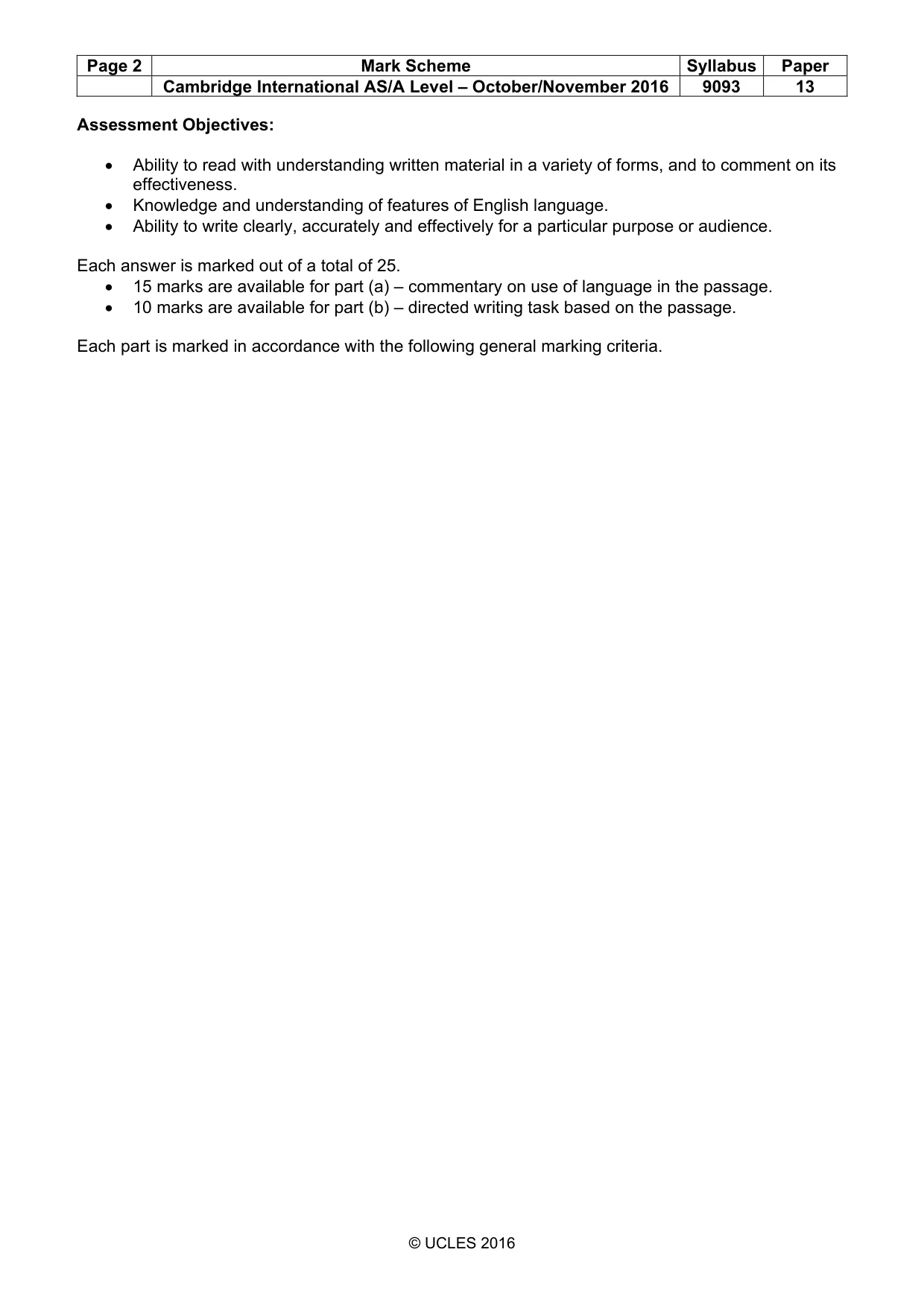
Page 2 Mark Scheme Syllabus Paper Cambridge International AS/A Level – October/November 2016 9093 13 © UCLES 2016 Assessment Objectives: • Ability to read with understanding written material in a variety of forms, and to comment on its effectiveness. • Knowledge and understanding of features of English language. • Ability to write clearly, accurately and effectively for a particular purpose or audience. Each answer is marked out of a total of 25. • 15 marks are available for part (a) – commentary on use of language in the passage. • 10 marks are available for part (b) – directed writing task based on the passage. Each part is marked in accordance with the following general marking criteria.
Mark scheme, page 3
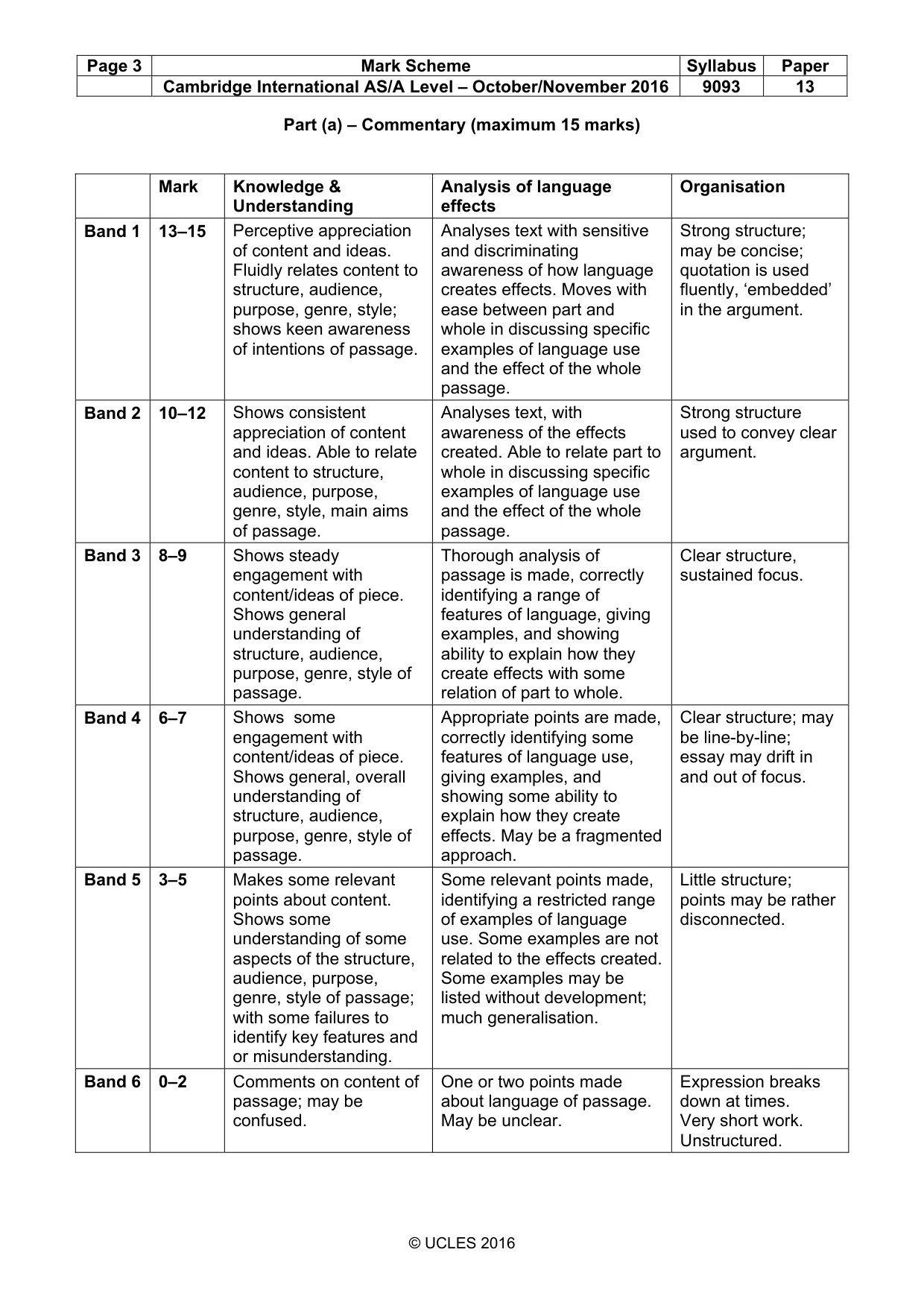
Page 3 Mark Scheme Syllabus Paper Cambridge International AS/A Level – October/November 2016 9093 13 © UCLES 2016 Part (a) – Commentary (maximum 15 marks) Mark Knowledge & Understanding Analysis of language effects Organisation Band 1 13–15 Perceptive appreciation of content and ideas. Fluidly relates content to structure, audience, purpose, genre, style; shows keen awareness of intentions of passage. Analyses text with sensitive and discriminating awareness of how language creates effects. Moves with ease between part and whole in discussing specific examples of language use and the effect of the whole passage. Strong structure; may be concise; quotation is used fluently, ‘embedded’ in the argument. Band 2 10–12 Shows consistent appreciation of content and ideas. Able to relate content to structure, audience, purpose, genre, style, main aims of passage. Analyses text, with awareness of the effects created. Able to relate part to whole in discussing specific examples of language use and the effect of the whole passage. Strong structure used to convey clear argument. Band 3 8–9 Shows steady engagement with content/ideas of piece. Shows general understanding of structure, audience, purpose, genre, style of passage. Thorough analysis of passage is made, correctly identifying a range of features of language, giving examples, and showing ability to explain how they create effects with some relation of part to whole. Clear structure, sustained focus. Band 4 6–7 Shows some engagement with content/ideas of piece. Shows general, overall understanding of structure, audience, purpose, genre, style of passage. Appropriate points are made, correctly identifying some features of language use, giving examples, and showing some ability to explain how they create effects. May be a fragmented approach. Clear structure; may be line-by-line; essay may drift in and out of focus. Band 5 3–5 Makes some relevant points about content. Shows some understanding of some aspects of the structure, audience, purpose, genre, style of passage; with some failures to identify key features and or misunderstanding. Some relevant points made, identifying a restricted range of examples of language use. Some examples are not related to the effects created. Some examples may be listed without development; much generalisation. Little structure; points may be rather disconnected. Band 6 0–2 Comments on content of passage; may be confused. One or two points made about language of passage. May be unclear. Expression breaks down at times. Very short work. Unstructured.
Mark scheme, page 4
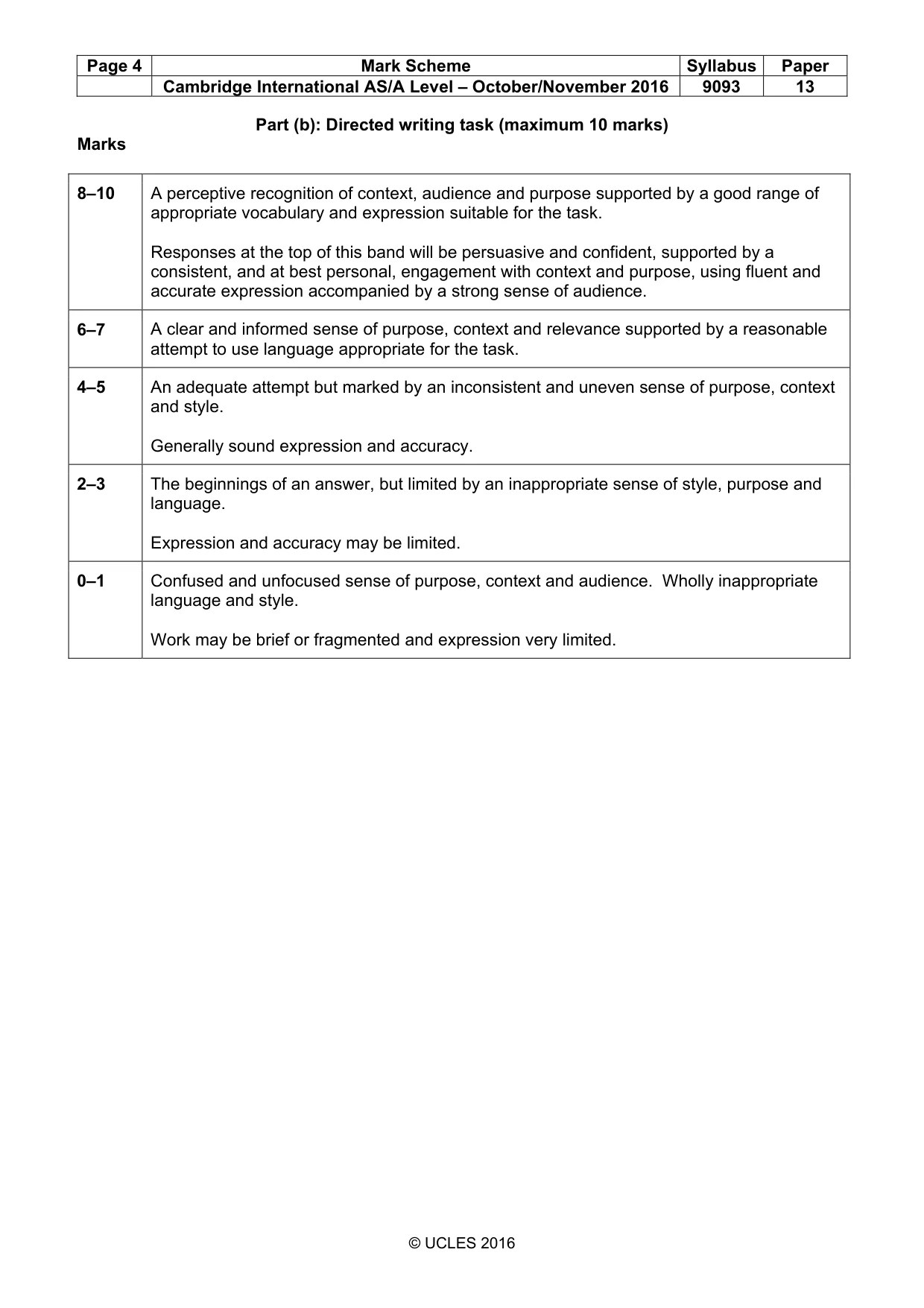
Page 4 Mark Scheme Syllabus Paper Cambridge International AS/A Level – October/November 2016 9093 13 © UCLES 2016 Part (b): Directed writing task (maximum 10 marks) Marks 8–10 A perceptive recognition of context, audience and purpose supported by a good range of appropriate vocabulary and expression suitable for the task. Responses at the top of this band will be persuasive and confident, supported by a consistent, and at best personal, engagement with context and purpose, using fluent and accurate expression accompanied by a strong sense of audience. 6–7 A clear and informed sense of purpose, context and relevance supported by a reasonable attempt to use language appropriate for the task. 4–5 An adequate attempt but marked by an inconsistent and uneven sense of purpose, context and style. Generally sound expression and accuracy. 2–3 The beginnings of an answer, but limited by an inappropriate sense of style, purpose and language. Expression and accuracy may be limited. 0–1 Confused and unfocused sense of purpose, context and audience. Wholly inappropriate language and style. Work may be brief or fragmented and expression very limited.
What you needed in this session
Cambridge’s own grade thresholds for 2016 Oct/Nov, Paper 1 · Variant 3. A higher threshold means an easier paper — the bar moves with how the cohort did.