Cambridge A Level English - Language AS and A Level (from 2014) 9093 — 2016 Oct/Nov Paper 1 · Variant 2
9093/12/O/N/16 · 50 marks · ≈56 min
The question paper and its mark scheme, free to read here and free to download. This is Cambridge’s own paper, exactly as it was sat.
Question paper8 pages
Mark scheme4 pages
Answers below. Sit the paper first if you are practising.
Paper as text
Question paper, page 1
This document consists of 7 printed pages, 1 blank page and 1 insert. DC (LK) 107485/3 © UCLES 2016 [Turn over Cambridge International Examinations Cambridge International Advanced Subsidiary and Advanced Level * 0 9 2 6 8 6 4 5 4 1 * ENGLISH LANGUAGE 9093/12 Paper 1 Passages October/November 2016 2 hours 15 minutes No Additional Materials are required. READ THESE INSTRUCTIONS FIRST An answer booklet is provided inside this question paper. You should follow the instructions on the front cover of the answer booklet. If you need additional answer paper, ask the invigilator for a continuation booklet. Answer two questions: Question 1 and either Question 2 or Question 3. You should spend about 15 minutes reading the passages and questions before you start writing your answers. You are reminded of the need for good English and clear presentation in your answers. The number of marks is given in brackets [ ] at the end of each question or part question.
Question paper, page 2
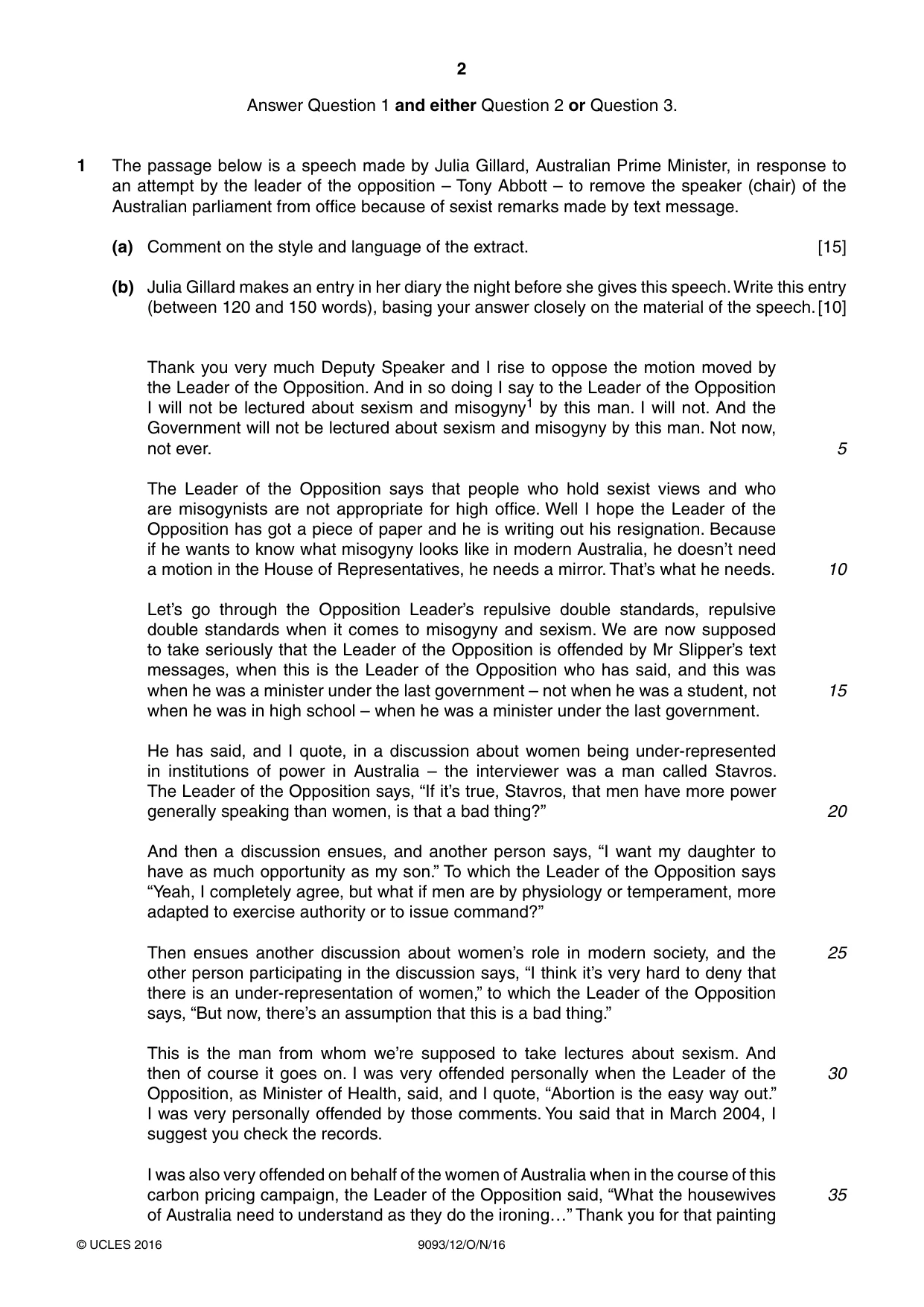
2 9093/12/O/N/16 © UCLES 2016 Answer Question 1 and either Question 2 or Question 3. 1 The passage below is a speech made by Julia Gillard, Australian Prime Minister, in response to an attempt by the leader of the opposition – Tony Abbott – to remove the speaker (chair) of the Australian parliament from office because of sexist remarks made by text message. (a) Comment on the style and language of the extract. [15] (b) Julia Gillard makes an entry in her diary the night before she gives this speech. Write this entry (between 120 and 150 words), basing your answer closely on the material of the speech. [10] Thank you very much Deputy Speaker and I rise to oppose the motion moved by the Leader of the Opposition. And in so doing I say to the Leader of the Opposition I will not be lectured about sexism and misogyny1 by this man. I will not. And the Government will not be lectured about sexism and misogyny by this man. Not now, not ever. The Leader of the Opposition says that people who hold sexist views and who are misogynists are not appropriate for high office. Well I hope the Leader of the Opposition has got a piece of paper and he is writing out his resignation. Because if he wants to know what misogyny looks like in modern Australia, he doesn’t need a motion in the House of Representatives, he needs a mirror. That’s what he needs. Let’s go through the Opposition Leader’s repulsive double standards, repulsive double standards when it comes to misogyny and sexism. We are now supposed to take seriously that the Leader of the Opposition is offended by Mr Slipper’s text messages, when this is the Leader of the Opposition who has said, and this was when he was a minister under the last government – not when he was a student, not when he was in high school – when he was a minister under the last government. He has said, and I quote, in a discussion about women being under-represented in institutions of power in Australia – the interviewer was a man called Stavros. The Leader of the Opposition says, “If it’s true, Stavros, that men have more power generally speaking than women, is that a bad thing?” And then a discussion ensues, and another person says, “I want my daughter to have as much opportunity as my son.” To which the Leader of the Opposition says “Yeah, I completely agree, but what if men are by physiology or temperament, more adapted to exercise authority or to issue command?” Then ensues another discussion about women’s role in modern society, and the other person participating in the discussion says, “I think it’s very hard to deny that there is an under-representation of women,” to which the Leader of the Opposition says, “But now, there’s an assumption that this is a bad thing.” This is the man from whom we’re supposed to take lectures about sexism. And then of course it goes on. I was very offended personally when the Leader of the Opposition, as Minister of Health, said, and I quote, “Abortion is the easy way out.” I was very personally offended by those comments. You said that in March 2004, I suggest you check the records. I was also very offended on behalf of the women of Australia when in the course of this carbon pricing campaign, the Leader of the Opposition said, “What the housewives of Australia need to understand as they do the ironing…” Thank you for that painting 5 10 15 20 25 30 35
Question paper, page 3
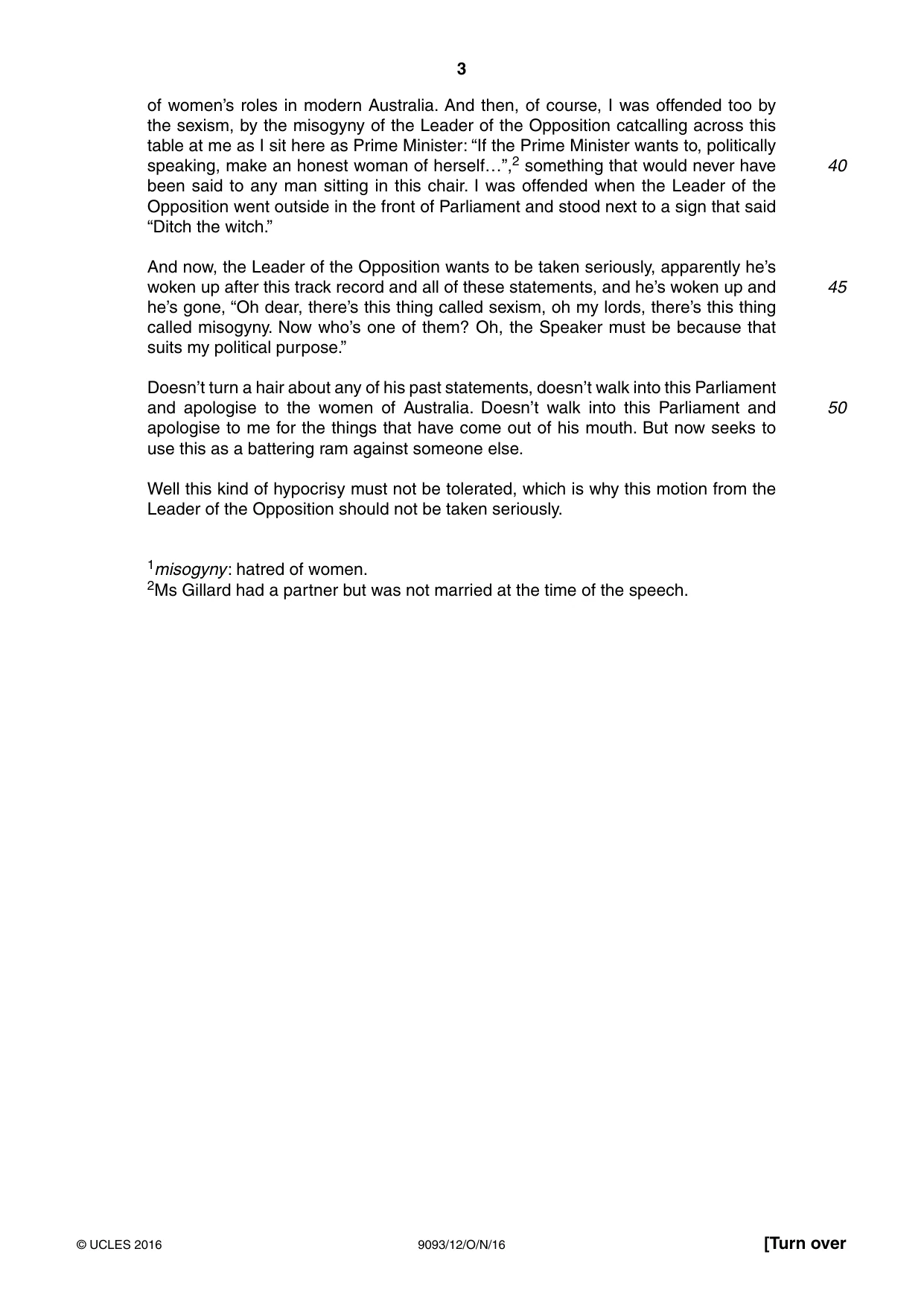
3 9093/12/O/N/16 © UCLES 2016 [Turn over of women’s roles in modern Australia. And then, of course, I was offended too by the sexism, by the misogyny of the Leader of the Opposition catcalling across this table at me as I sit here as Prime Minister: “If the Prime Minister wants to, politically speaking, make an honest woman of herself…”,2 something that would never have been said to any man sitting in this chair. I was offended when the Leader of the Opposition went outside in the front of Parliament and stood next to a sign that said “Ditch the witch.” And now, the Leader of the Opposition wants to be taken seriously, apparently he’s woken up after this track record and all of these statements, and he’s woken up and he’s gone, “Oh dear, there’s this thing called sexism, oh my lords, there’s this thing called misogyny. Now who’s one of them? Oh, the Speaker must be because that suits my political purpose.” Doesn’t turn a hair about any of his past statements, doesn’t walk into this Parliament and apologise to the women of Australia. Doesn’t walk into this Parliament and apologise to me for the things that have come out of his mouth. But now seeks to use this as a battering ram against someone else. Well this kind of hypocrisy must not be tolerated, which is why this motion from the Leader of the Opposition should not be taken seriously. 1misogyny : hatred of women. 2Ms Gillard had a partner but was not married at the time of the speech. 40 45 50
Question paper, page 4
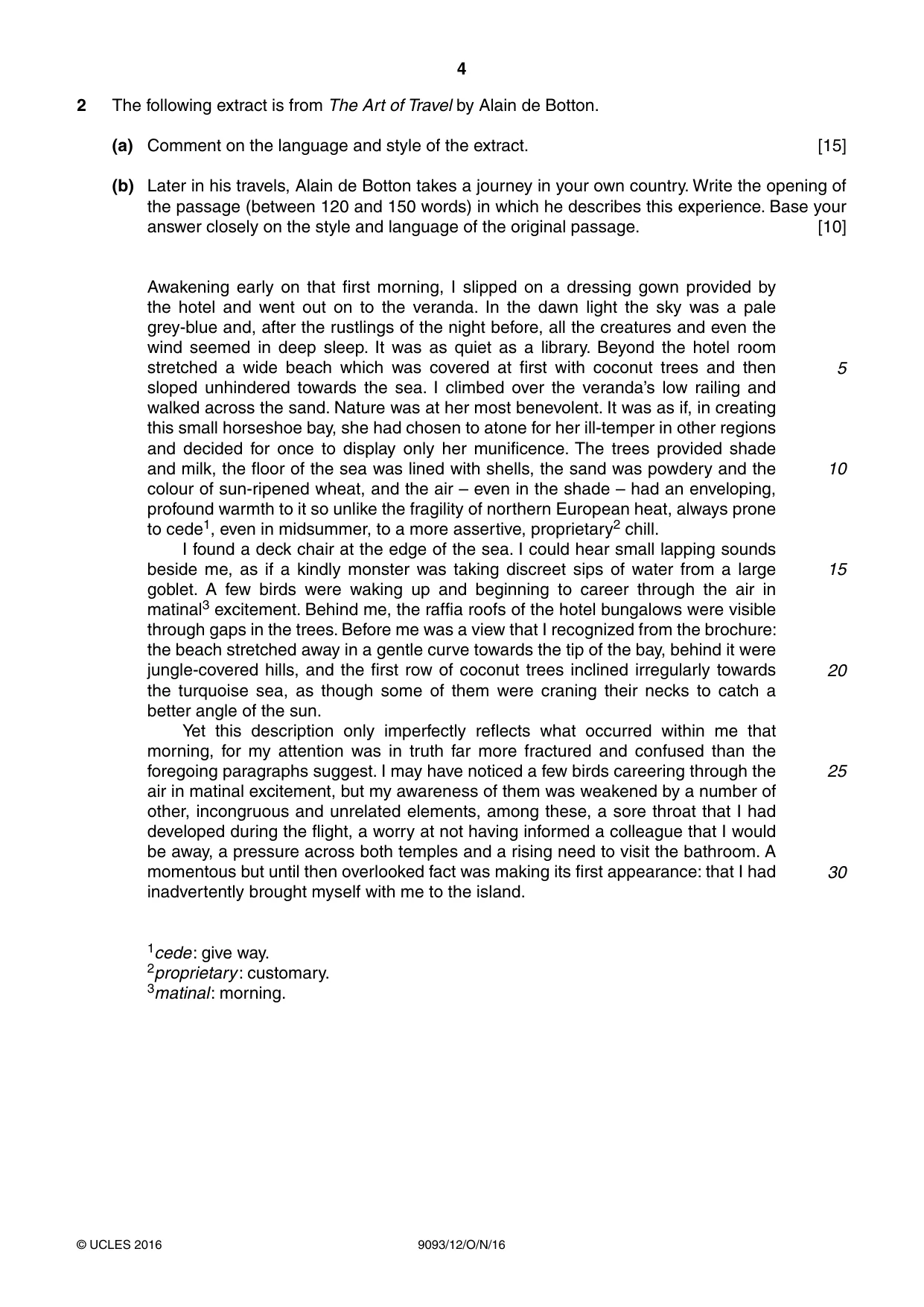
4 9093/12/O/N/16 © UCLES 2016 2 The following extract is from The Art of Travel by Alain de Botton. (a) Comment on the language and style of the extract. [15] (b) Later in his travels, Alain de Botton takes a journey in your own country. Write the opening of the passage (between 120 and 150 words) in which he describes this experience. Base your answer closely on the style and language of the original passage. [10] Awakening early on that first morning, I slipped on a dressing gown provided by the hotel and went out on to the veranda. In the dawn light the sky was a pale grey-blue and, after the rustlings of the night before, all the creatures and even the wind seemed in deep sleep. It was as quiet as a library. Beyond the hotel room stretched a wide beach which was covered at first with coconut trees and then sloped unhindered towards the sea. I climbed over the veranda’s low railing and walked across the sand. Nature was at her most benevolent. It was as if, in creating this small horseshoe bay, she had chosen to atone for her ill-temper in other regions and decided for once to display only her munificence. The trees provided shade and milk, the floor of the sea was lined with shells, the sand was powdery and the colour of sun-ripened wheat, and the air – even in the shade – had an enveloping, profound warmth to it so unlike the fragility of northern European heat, always prone to cede1, even in midsummer, to a more assertive, proprietary2 chill. I found a deck chair at the edge of the sea. I could hear small lapping sounds beside me, as if a kindly monster was taking discreet sips of water from a large goblet. A few birds were waking up and beginning to career through the air in matinal3 excitement. Behind me, the raffia roofs of the hotel bungalows were visible through gaps in the trees. Before me was a view that I recognized from the brochure: the beach stretched away in a gentle curve towards the tip of the bay, behind it were jungle-covered hills, and the first row of coconut trees inclined irregularly towards the turquoise sea, as though some of them were craning their necks to catch a better angle of the sun. Yet this description only imperfectly reflects what occurred within me that morning, for my attention was in truth far more fractured and confused than the foregoing paragraphs suggest. I may have noticed a few birds careering through the air in matinal excitement, but my awareness of them was weakened by a number of other, incongruous and unrelated elements, among these, a sore throat that I had developed during the flight, a worry at not having informed a colleague that I would be away, a pressure across both temples and a rising need to visit the bathroom. A momentous but until then overlooked fact was making its first appearance: that I had inadvertently brought myself with me to the island. 1cede : give way. 2proprietary : customary. 3matinal : morning. 5 10 15 20 25 30
Question paper, page 5
5 9093/12/O/N/16 © UCLES 2016 [Turn over TURN OVER FOR QUESTION 3.
Question paper, page 6
6 9093/12/O/N/16 © UCLES 2016 3 The following text is an entry from an internet diary kept by Simon Dixey, a member of the crew of a sailing boat during their round-the-world race in 2014. (a) Comment on the language and style of the extract. [15] (b) Write Simon Dixey’s internet diary entry (between 120 and 150 words) for his first night at home after nearly a year at sea. Base your answer closely on the style and language of the original. [10] I knew it was my underwear. It had fallen from the black bin bag and was lying in a damp black heap on the floor, but surely there was something familiar – yes, there the hole in the left cuff, and just here had the moths eaten that pattern of holes in the leg. My trusty Icebreakers1 for sure. It had not been in the search for thermal base layers that I had investigated this bag, thrust to the back of our storage bunk, although I was glad enough to find them. I was really searching for my best pair of earphones (still missing, by the way) – and while on the subject, has anybody seen my coffee mug, lost since San Francisco? Just asking … Ah well, if that’s all I end up losing after nearly a year at sea, I guess I have not done too badly. On the subject of losses, however, people have been known to ask about our routes on these races. From the comfort of their armchairs, they see our wriggly tracks, hairpin bends and general meanderings and sometimes speculate as to whether we have lost our way. One mutters about weather, currents, great circles and the like, but I can see they are not convinced. And thinking about it, I am wondering if the truth is not a lot more complicated. I think it’s all Carolus’s fault. He’s a mathematician you see, and has been trying to educate us about some of the more arcane2 areas of mathematical theory, during those long hours when our boat is in BG mode (Bobbing Gently). The shortest distance between two points is a straight line, so you might think. But not always. On the surface of a globe, for instance, this is no longer true. And it turns out there are many other geometries in which this axiom3 does not apply – these non-Euclidian geometries are described by Riemann and others. So it is entirely possible that we are sailing in a non-Euclidian dimension much of the time, just popping back into 3D at Race Viewer moments and at stopover ports. So just remember: for walking or cycling then you could use Euclid, but for wandering seamen then Riemann is best. Anyway, back to planet Earth for a moment, and moving from things lost to things missed. Many of us have been thinking now about what we will miss when this adventure is over. I don’t know about missing things, but I think I will remember our boat by its little peculiarities. For instance: • The wind angle reading that differs by 20 degrees depending on whether we are on port or starboard tack4. • The hatches that drip on you while you cook. • Navigation lights constantly on the blink. • How to close the starboard engine room door (use your hip). • Which heads5 pump out best on which tack. • The best way to tie up your lee cloth6. 5 10 15 20 25 30 35
Question paper, page 7
7 9093/12/O/N/16 © UCLES 2016 • How to reach underfloor plumbing. And so on. And perhaps that’s the basis for many affectionate relationships, this growing familiarity with endearing eccentricities and imperfections. So do we know them – our friends, spouses or partners, the boat we have lived on for nearly a year – even in the dark, even by a touch, a smell, by the odd sounds made in the night. And it’s a wise man that knows his own underwear. That last line might serve as an epitaph; it is certainly a farewell. This is my absolutely, final, last crew diary entry. The race is nearly over, we have sailed into our last sunrise. In a few days’ time the sun will set on our voyage as we leave The Netherlands and head west, for London and home. Simon Dixey 1Icebreakers: a brand of thermal underwear. 2more arcane: more abstract. 3axiom: mathematical rule. 4tack: direction of a boat relative to the wind. 5heads: ship’s lavatories. 6lee cloth: a length of cloth fixed to stop sailors falling out of their bunks. 40 45
Question paper, page 8
8 9093/12/O/N/16 © UCLES 2016 Permission to reproduce items where third-party owned material protected by copyright is included has been sought and cleared where possible. Every reasonable effort has been made by the publisher (UCLES) to trace copyright holders, but if any items requiring clearance have unwittingly been included, the publisher will be pleased to make amends at the earliest possible opportunity. To avoid the issue of disclosure of answer-related information to candidates, all copyright acknowledgements are reproduced online in the Cambridge International Examinations Copyright Acknowledgements Booklet. This is produced for each series of examinations and is freely available to download at www.cie.org.uk after the live examination series. Cambridge International Examinations is part of the Cambridge Assessment Group. Cambridge Assessment is the brand name of University of Cambridge Local Examinations Syndicate (UCLES), which is itself a department of the University of Cambridge. BLANK PAGE
Mark scheme, page 1
® IGCSE is the registered trademark of Cambridge International Examinations. This document consists of 4 printed pages. © UCLES 2016 [Turn over Cambridge International Examinations Cambridge International Advanced Subsidiary and Advanced Level ENGLISH LANGUAGE 9093/12 Paper 1 Passages October/November 2016 MARK SCHEME Maximum Mark: 50 Published This mark scheme is published as an aid to teachers and candidates, to indicate the requirements of the examination. It shows the basis on which Examiners were instructed to award marks. It does not indicate the details of the discussions that took place at an Examiners’ meeting before marking began, which would have considered the acceptability of alternative answers. Mark schemes should be read in conjunction with the question paper and the Principal Examiner Report for Teachers. Cambridge will not enter into discussions about these mark schemes. Cambridge is publishing the mark schemes for the October/November 2016 series for most Cambridge IGCSE®, Cambridge International A and AS Level components and some Cambridge O Level components.
Mark scheme, page 2
Page 2 Mark Scheme Syllabus Paper Cambridge International AS/A Level – October/November 2016 9093 12 © UCLES 2016 Assessment Objectives: • Ability to read with understanding written material in a variety of forms, and to comment on its effectiveness. • Knowledge and understanding of features of English language. • Ability to write clearly, accurately and effectively for a particular purpose or audience. Each answer is marked out of a total of 25. • 15 marks are available for part (a) – commentary on use of language in the passage. • 10 marks are available for part (b) – directed writing task based on the passage. Each part is marked in accordance with the following general marking criteria.
Mark scheme, page 3
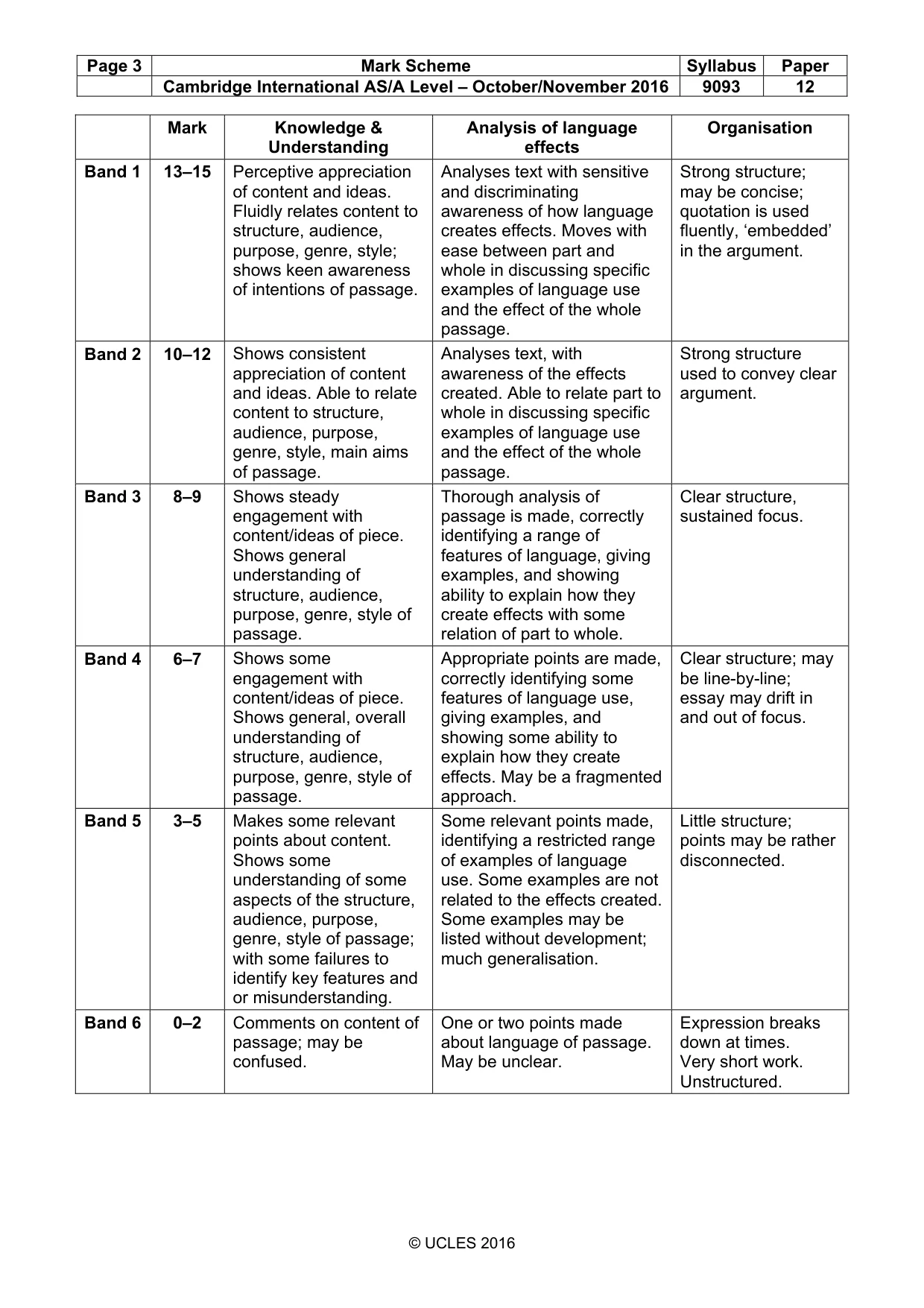
Page 3 Mark Scheme Syllabus Paper Cambridge International AS/A Level – October/November 2016 9093 12 © UCLES 2016 Mark Knowledge & Understanding Analysis of language effects Organisation Band 1 13–15 Perceptive appreciation of content and ideas. Fluidly relates content to structure, audience, purpose, genre, style; shows keen awareness of intentions of passage. Analyses text with sensitive and discriminating awareness of how language creates effects. Moves with ease between part and whole in discussing specific examples of language use and the effect of the whole passage. Strong structure; may be concise; quotation is used fluently, ‘embedded’ in the argument. Band 2 10–12 Shows consistent appreciation of content and ideas. Able to relate content to structure, audience, purpose, genre, style, main aims of passage. Analyses text, with awareness of the effects created. Able to relate part to whole in discussing specific examples of language use and the effect of the whole passage. Strong structure used to convey clear argument. Band 3 8–9 Shows steady engagement with content/ideas of piece. Shows general understanding of structure, audience, purpose, genre, style of passage. Thorough analysis of passage is made, correctly identifying a range of features of language, giving examples, and showing ability to explain how they create effects with some relation of part to whole. Clear structure, sustained focus. Band 4 6–7 Shows some engagement with content/ideas of piece. Shows general, overall understanding of structure, audience, purpose, genre, style of passage. Appropriate points are made, correctly identifying some features of language use, giving examples, and showing some ability to explain how they create effects. May be a fragmented approach. Clear structure; may be line-by-line; essay may drift in and out of focus. Band 5 3–5 Makes some relevant points about content. Shows some understanding of some aspects of the structure, audience, purpose, genre, style of passage; with some failures to identify key features and or misunderstanding. Some relevant points made, identifying a restricted range of examples of language use. Some examples are not related to the effects created. Some examples may be listed without development; much generalisation. Little structure; points may be rather disconnected. Band 6 0–2 Comments on content of passage; may be confused. One or two points made about language of passage. May be unclear. Expression breaks down at times. Very short work. Unstructured.
Mark scheme, page 4
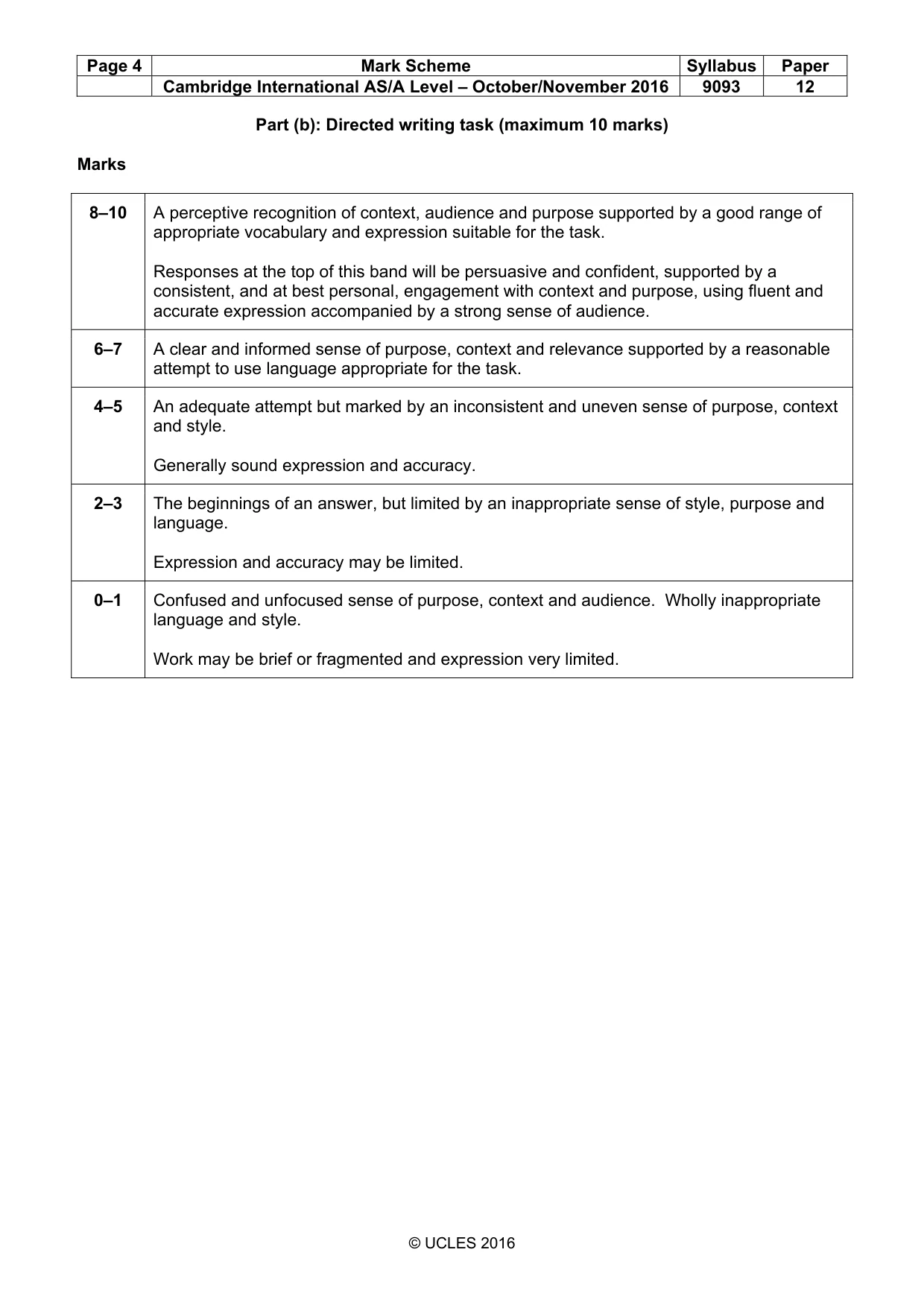
Page 4 Mark Scheme Syllabus Paper Cambridge International AS/A Level – October/November 2016 9093 12 © UCLES 2016 Part (b): Directed writing task (maximum 10 marks) Marks 8–10 A perceptive recognition of context, audience and purpose supported by a good range of appropriate vocabulary and expression suitable for the task. Responses at the top of this band will be persuasive and confident, supported by a consistent, and at best personal, engagement with context and purpose, using fluent and accurate expression accompanied by a strong sense of audience. 6–7 A clear and informed sense of purpose, context and relevance supported by a reasonable attempt to use language appropriate for the task. 4–5 An adequate attempt but marked by an inconsistent and uneven sense of purpose, context and style. Generally sound expression and accuracy. 2–3 The beginnings of an answer, but limited by an inappropriate sense of style, purpose and language. Expression and accuracy may be limited. 0–1 Confused and unfocused sense of purpose, context and audience. Wholly inappropriate language and style. Work may be brief or fragmented and expression very limited.
What you needed in this session
Cambridge’s own grade thresholds for 2016 Oct/Nov, Paper 1 · Variant 2. A higher threshold means an easier paper — the bar moves with how the cohort did.