Cambridge A Level English - Language AS and A Level (from 2014) 9093 — 2016 Oct/Nov Paper 1 · Variant 1
9093/11/O/N/16 · 50 marks · ≈56 min
The question paper and its mark scheme, free to read here and free to download. This is Cambridge’s own paper, exactly as it was sat.
Question paper8 pages
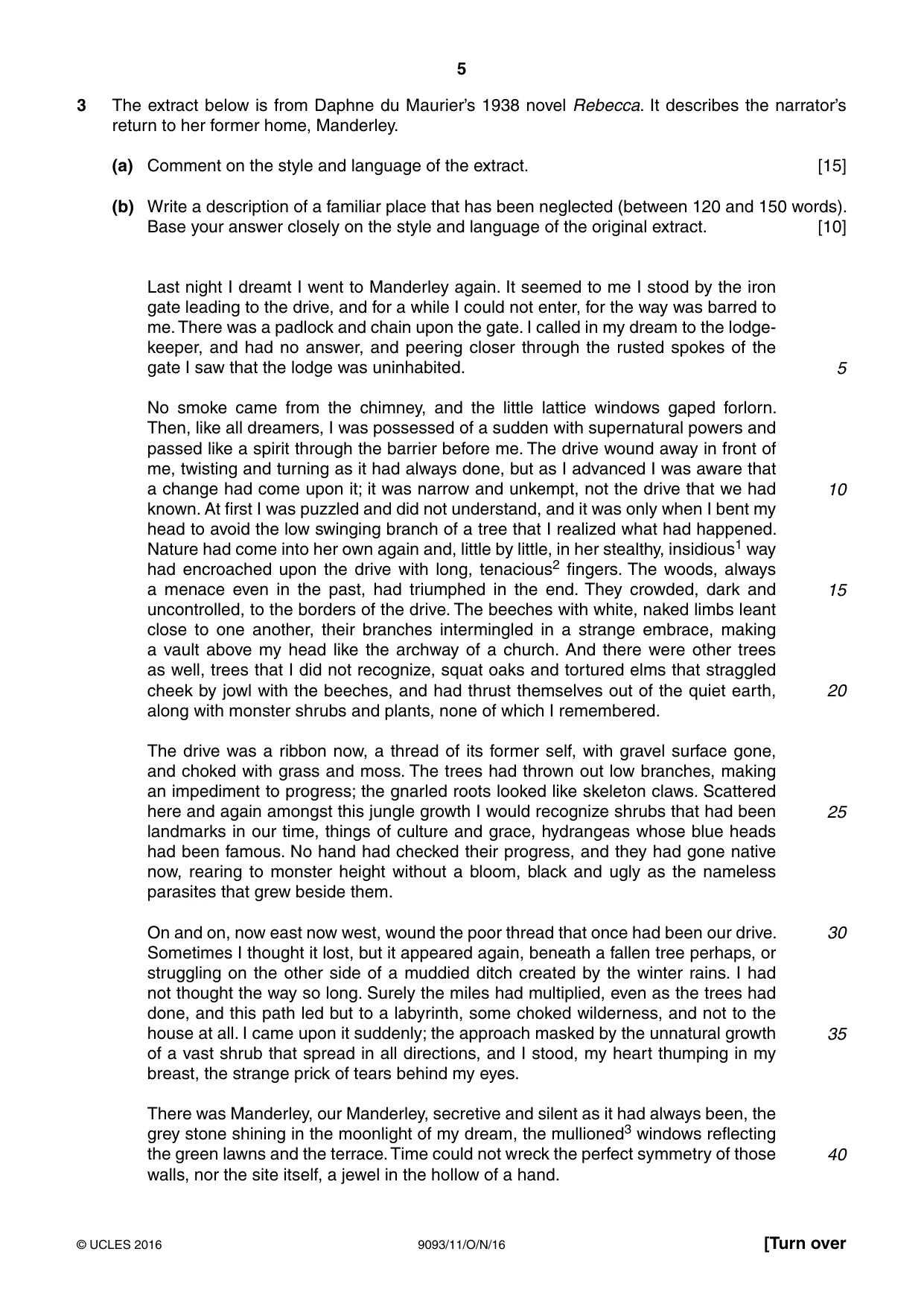
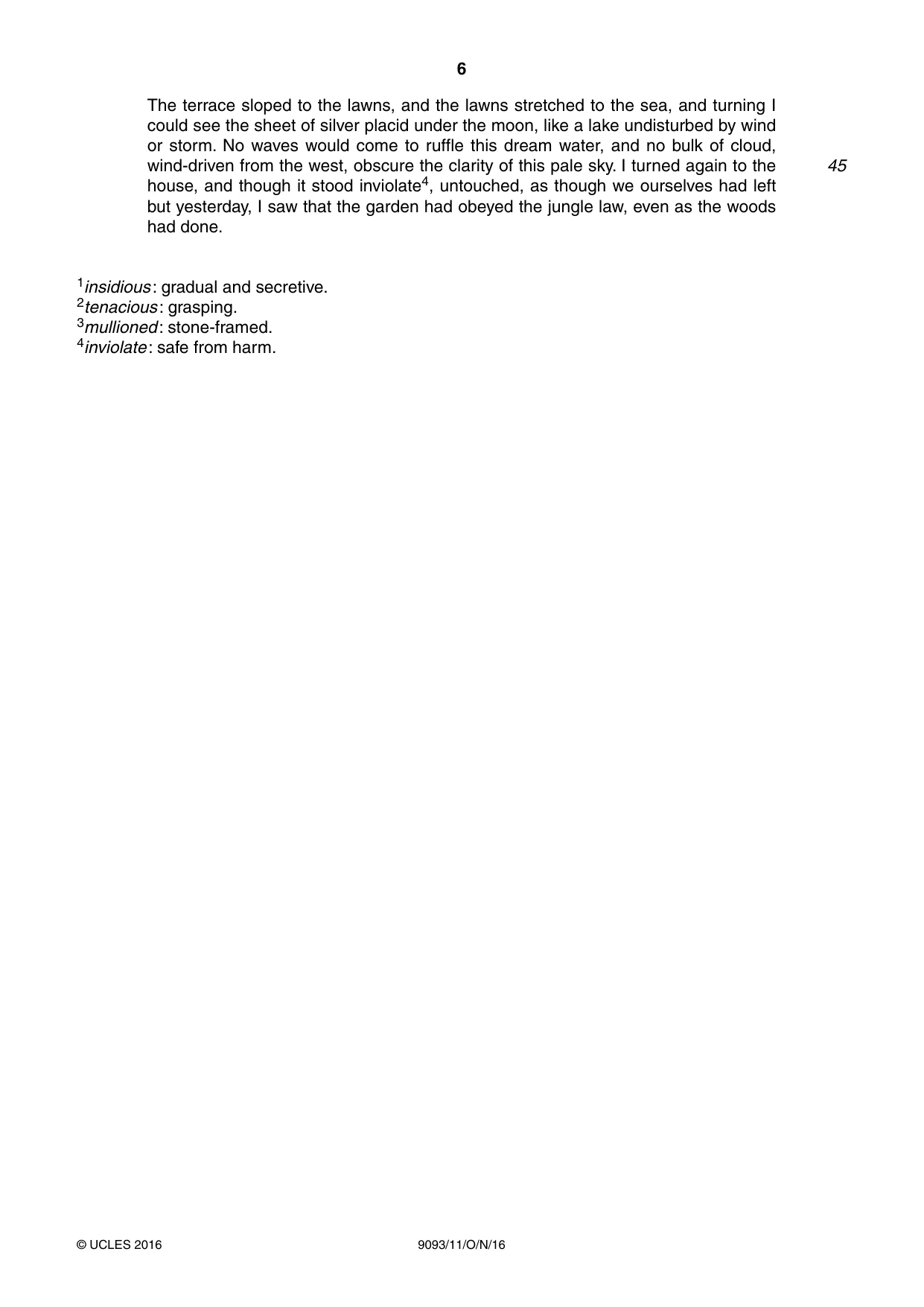
Mark scheme4 pages
Answers below. Sit the paper first if you are practising.
Paper as text
Question paper, page 1
This document consists of 6 printed pages, 2 blank pages and 1 insert. DC (ST) 106965/3 © UCLES 2016 [Turn over Cambridge International Examinations Cambridge International Advanced Subsidiary and Advanced Level * 8 8 0 5 1 7 3 2 0 9 * ENGLISH LANGUAGE 9093/11 Paper 1 Passages October/November 2016 2 hours 15 minutes No Additional Materials are required. READ THESE INSTRUCTIONS FIRST An answer booklet is provided inside this question paper. You should follow the instructions on the front cover of the answer booklet. If you need additional answer paper, ask the invigilator for a continuation booklet. Answer two questions: Question 1 and either Question 2 or Question 3. You should spend about 15 minutes reading the passages and questions before you start writing your answers. You are reminded of the need for good English and clear presentation in your answers. The number of marks is given in brackets [ ] at the end of each question or part question.
Question paper, page 2
2 9093/11/O/N/16 © UCLES 2016 Answer Question 1 and either Question 2 or Question 3. 1 The following text is by British writer Josie Dew, who is about to set off on a long cycle journey round New Zealand, after a journey by boat across the Pacific. She has arrived in the city of Auckland on Christmas Eve. (a) Comment on the style and language of the passage. [15] (b) Later, Josie Dew decides to make another cycle journey in your own country. Describe the beginning of her journey (between 120 and 150 words). Base your answer closely on the style and language of the original. [10] Before long I was dumped at the port gate, where I set about hooking and strapping and bungeeing a bewildering heap of bags on to my bike. Although I was burdened with exactly the same amount of luggage as I’d had when cycling to my ship rendezvous point all those blue moons and numerous seas ago, it had somehow expanded tenfold. I believe this is a phenomenon known in physicist circles as The Law of Voluminous Mass of Weighty Density Gone Round the Bend Bonkers. Also known as BABE (Blinking Automated Bag Extension) for short. Either way, I found myself struggling to house my mountain of kit in anything resembling a conveyable fashion. Half a day later I had my bursting charges under some sort of control and wheeled my steed out on to Quay Street, where I prepared my unseasoned legs to mount up. Quay Street sounds like it should be a small, dainty and narrow cobbled byway lined with topsy-turvy olde worlde houses on one side where smugglers had once secreted their illicit contraband in intricate underground passages, and quaint brightly coloured tubby-girthed fishing vessels tethered to an ancient stone-walled harbour front on the other. Instead it’s a big fast thoroughfare officially termed Main Urban Route 6 which, if followed in either direction, will filter you on to the truck- stonking State Highway 1 – a low-numbered but high-ranking swathe of tarmac that stretches the length of North Island: 1,098 kilometres (682 miles) from Cape Reinga in the north to Wellington in the south. Luckily, tackling this stately highway on my wheels could wait. And a good thing too: wobbling around on my feet fresh off a lurching boat meant that I was in no fine shape to do battle with 50-tonne logging trucks. The wobbliness didn’t last for long though as I swiftly substituted my sea legs with my cycling legs, bypassing the more unstable land legs (cycling, it seems, is the perfect antidote for ocean- swaying unsteadiness). I then spun myself the short distance down Quay Street to the big ninety-one-year-old neoclassical Ferry Building that, among all the foresting tower blocks of silvery glass and steel, sat solidly squat on the city’s waterfront like a friendly fat red toad. As I was in search of an address in a district called Bayswater I took off across the harbour (lovely view!) on board a passenger ferry to Devonport. Devonport is one of Auckland’s oldest suburbs, a good 160 years old, which for a relatively new land like New Zealand is saying something. It was still raining cats and kiwis as I wheeled my bike down the pier and along the waterfront. Everything was looking very Christmassy (glittery decorations wrapped around street lamps; piped carols emanating from shop doorways across the road, including an overload of Jingle Bells, or Jungle Bills as it seemed to mutate into in the Kiwi accent) though I couldn’t for the life of me think why. Oh, yes. It was Christmas tomorrow. How could I possibly forget? Quite easily actually. 5 10 15 20 25 30 35
Question paper, page 3
3 9093/11/O/N/16 © UCLES 2016 [Turn over 2 The following passage is an entry from the online weekly blog called ‘Life as a Junior Doctor’ by Nick Knight. (a) Comment on the language and style of the extract from the blog. [15] (b) After a week back at work, the writer produces another entry for his blog. Write the opening of this entry (between 120 and 150 words). Base your answer closely on the language and style of the original. [10] The Penny Dropping Posted on July 17, 2014 Hello all, Now, I may have neglected to mention in my last blog entry that I am indeed on a lovely week off. Rather than opt to jet off to some sunnier climate with the rest of the country or ‘find myself’ in some far flung corner of the world (I think I might be a little old to be ‘finding myself’ at 31, perhaps! If I do – I may need a GPS1), I decided to go back to my family home. For many people (but very sadly, I appreciate, not all) the family home is a place to reconnect, recuperate and reflect on their life’s journey and take stock of what’s important. I am definitely at my most relaxed at home, I suppose in a way, safe from the pressures that I place upon myself and society backs up with a whacking great punch of expectation. I become Nick, the 31 year old doctor – regressing back to 12 year old Nick, in my old bedroom, with all the dreams and aspirations that I had back then etched on the walls and photographs. And it makes me smile. It makes me smile because I realise that, despite being a little older (OK, fine, a lot), a little more grizzled and life-hardened with the highs and the lows that have presented themselves, I still have those deep-rooted dreams and aspirations – I still have belief. I feel incredibly lucky to have these. I may lose them through life. Which brings me onto the main point of today’s blog – as I sit here with a steaming cup of mum’s tea, having just done an hour of tedious (but necessary) revision questions for an exam in September – that I wanted to share with you. It is, in a way, a mission statement. I woke up this morning, as I always do back home, having had a wonderful night of sleep. I awoke calmly, body still paralysed from sleep, but as I opened my eyes and my brain started to get the first dusty, cerebral cog turning2 for the day, in that moment, I just knew what kind of doctor and more globally, health professional, I want to be, am meant to be, am positioned to be. And it is a great feeling. So let’s look at the “I want to be” part first. Quite simply I want to promote, help and support people to be as active, fit and perform to the best of their abilities that they wish to, both cognitively3 and physically. From the 45 year old running their first marathon, the 65 year old hoping to regain some more independence after an operation, to the 23 year old fitness addict – anyone. 5 10 15 20 25 30 35
Question paper, page 4
4 9093/11/O/N/16 © UCLES 2016 Now what about the “am meant to be” part? ALL by fate and not design I should start by saying, in the past 12 years I have tripped my way across a degree in exercise and sports sciences, a PhD in performance nutrition, worked in health care consultancy, gained a medical degree, and helped numerous teams and individuals maximise their physical and mental performance to achieve whatever the goal – whether it be the 4 guys (and dear friends) who rowed across the Indian Ocean or my relative that wanted to lose weight and be more active. Now, I am also getting the opportunities to do some media work (and we will have to wait a couple of months to see how the Discovery TV show is received) and this yet provides me with another platform to share what I love – our body and all the highs and lows of performance that come with it. And finally the “am positioned to be” part. I am very lucky to be a doctor as it means, in time, I will get the opportunity to specialise in my passion – Sports and Exercise Medicine – a means to understand to the nth degree about how to optimise health, fitness and performance – for ANYONE. Now despite misconceptions this does not just mean for the elite athlete – in fact it is more about you or I (unless of course you are an elite athlete!), the average person who wants to get fitter or healthier so that they can play with their grandchildren for longer or walk the dog for an extra thirty minutes… Performance of the body and mind is my distilled, summarised passion. I like to call it “PERFORMANCE FOR LIVING”… I’m going to follow it now fully, with excitement, drive and the self-belief that I still have since I was 12 years old. Have a great week everyone, Dr Nick 1GPS : Global Positioning System. 2cerebral cog turning : start the brain thinking. 3cognitively : in their minds/mentally. 40 45 50 55 60
Question paper, page 5
5 9093/11/O/N/16 © UCLES 2016 [Turn over 3 The extract below is from Daphne du Maurier’s 1938 novel Rebecca. It describes the narrator’s return to her former home, Manderley. (a) Comment on the style and language of the extract. [15] (b) Write a description of a familiar place that has been neglected (between 120 and 150 words). Base your answer closely on the style and language of the original extract. [10] Last night I dreamt I went to Manderley again. It seemed to me I stood by the iron gate leading to the drive, and for a while I could not enter, for the way was barred to me. There was a padlock and chain upon the gate. I called in my dream to the lodge- keeper, and had no answer, and peering closer through the rusted spokes of the gate I saw that the lodge was uninhabited. No smoke came from the chimney, and the little lattice windows gaped forlorn. Then, like all dreamers, I was possessed of a sudden with supernatural powers and passed like a spirit through the barrier before me. The drive wound away in front of me, twisting and turning as it had always done, but as I advanced I was aware that a change had come upon it; it was narrow and unkempt, not the drive that we had known. At first I was puzzled and did not understand, and it was only when I bent my head to avoid the low swinging branch of a tree that I realized what had happened. Nature had come into her own again and, little by little, in her stealthy, insidious1 way had encroached upon the drive with long, tenacious2 fingers. The woods, always a menace even in the past, had triumphed in the end. They crowded, dark and uncontrolled, to the borders of the drive. The beeches with white, naked limbs leant close to one another, their branches intermingled in a strange embrace, making a vault above my head like the archway of a church. And there were other trees as well, trees that I did not recognize, squat oaks and tortured elms that straggled cheek by jowl with the beeches, and had thrust themselves out of the quiet earth, along with monster shrubs and plants, none of which I remembered. The drive was a ribbon now, a thread of its former self, with gravel surface gone, and choked with grass and moss. The trees had thrown out low branches, making an impediment to progress; the gnarled roots looked like skeleton claws. Scattered here and again amongst this jungle growth I would recognize shrubs that had been landmarks in our time, things of culture and grace, hydrangeas whose blue heads had been famous. No hand had checked their progress, and they had gone native now, rearing to monster height without a bloom, black and ugly as the nameless parasites that grew beside them. On and on, now east now west, wound the poor thread that once had been our drive. Sometimes I thought it lost, but it appeared again, beneath a fallen tree perhaps, or struggling on the other side of a muddied ditch created by the winter rains. I had not thought the way so long. Surely the miles had multiplied, even as the trees had done, and this path led but to a labyrinth, some choked wilderness, and not to the house at all. I came upon it suddenly; the approach masked by the unnatural growth of a vast shrub that spread in all directions, and I stood, my heart thumping in my breast, the strange prick of tears behind my eyes. There was Manderley, our Manderley, secretive and silent as it had always been, the grey stone shining in the moonlight of my dream, the mullioned3 windows reflecting the green lawns and the terrace. Time could not wreck the perfect symmetry of those walls, nor the site itself, a jewel in the hollow of a hand. 5 10 15 20 25 30 35 40
Question paper, page 6
6 9093/11/O/N/16 © UCLES 2016 The terrace sloped to the lawns, and the lawns stretched to the sea, and turning I could see the sheet of silver placid under the moon, like a lake undisturbed by wind or storm. No waves would come to ruffle this dream water, and no bulk of cloud, wind-driven from the west, obscure the clarity of this pale sky. I turned again to the house, and though it stood inviolate4, untouched, as though we ourselves had left but yesterday, I saw that the garden had obeyed the jungle law, even as the woods had done. 1insidious : gradual and secretive. 2tenacious : grasping. 3mullioned : stone-framed. 4inviolate : safe from harm. 45
Question paper, page 7
7 9093/11/O/N/16 © UCLES 2016 BLANK PAGE
Question paper, page 8
8 9093/11/O/N/16 © UCLES 2016 BLANK PAGE Permission to reproduce items where third-party owned material protected by copyright is included has been sought and cleared where possible. Every reasonable effort has been made by the publisher (UCLES) to trace copyright holders, but if any items requiring clearance have unwittingly been included, the publisher will be pleased to make amends at the earliest possible opportunity. To avoid the issue of disclosure of answer-related information to candidates, all copyright acknowledgements are reproduced online in the Cambridge International Examinations Copyright Acknowledgements Booklet. This is produced for each series of examinations and is freely available to download at www.cie.org.uk after the live examination series. Cambridge International Examinations is part of the Cambridge Assessment Group. Cambridge Assessment is the brand name of University of Cambridge Local Examinations Syndicate (UCLES), which is itself a department of the University of Cambridge.
Mark scheme, page 1
® IGCSE is the registered trademark of Cambridge International Examinations. This document consists of 4 printed pages. © UCLES 2016 [Turn over Cambridge International Examinations Cambridge International Advanced Subsidiary and Advanced Level ENGLISH LANGUAGE 9093/11 Paper 1 Passages October/November 2016 MARK SCHEME Maximum Mark: 50 Published This mark scheme is published as an aid to teachers and candidates, to indicate the requirements of the examination. It shows the basis on which Examiners were instructed to award marks. It does not indicate the details of the discussions that took place at an Examiners’ meeting before marking began, which would have considered the acceptability of alternative answers. Mark schemes should be read in conjunction with the question paper and the Principal Examiner Report for Teachers. Cambridge will not enter into discussions about these mark schemes. Cambridge is publishing the mark schemes for the October/November 2016 series for most Cambridge IGCSE®, Cambridge International A and AS Level components and some Cambridge O Level components.
Mark scheme, page 2
Page 2 Mark Scheme Syllabus Paper Cambridge International AS/A Level – October/November 2016 9093 11 © UCLES 2016 Assessment Objectives: • Ability to read with understanding written material in a variety of forms, and to comment on its effectiveness. • Knowledge and understanding of features of English language. • Ability to write clearly, accurately and effectively for a particular purpose or audience. Each answer is marked out of a total of 25. • 15 marks are available for part (a) – commentary on use of language in the passage. • 10 marks are available for part (b) – directed writing task based on the passage. Each part is marked in accordance with the following general marking criteria.
Mark scheme, page 3
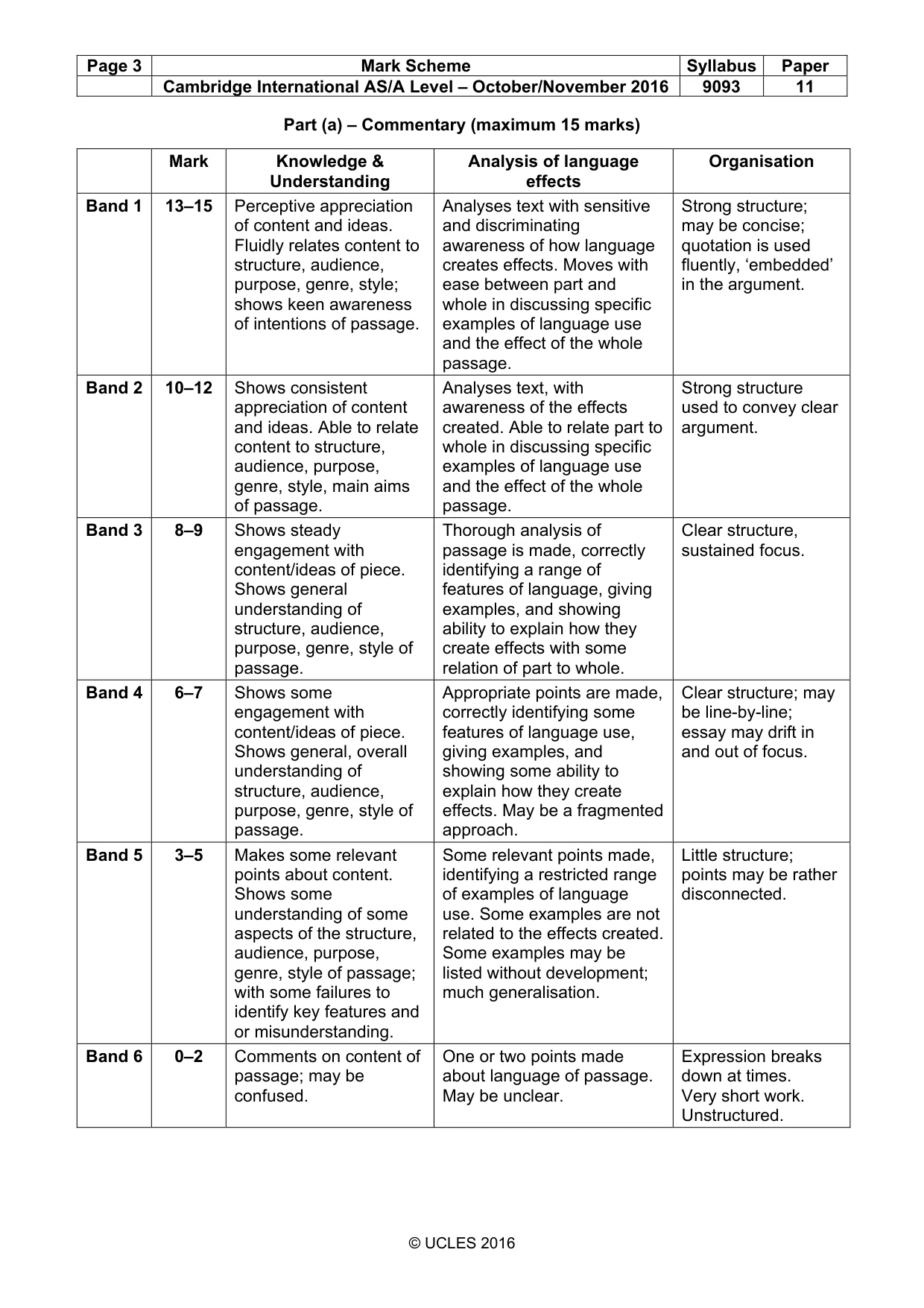
Page 3 Mark Scheme Syllabus Paper Cambridge International AS/A Level – October/November 2016 9093 11 © UCLES 2016 Part (a) – Commentary (maximum 15 marks) Mark Knowledge & Understanding Analysis of language effects Organisation Band 1 13–15 Perceptive appreciation of content and ideas. Fluidly relates content to structure, audience, purpose, genre, style; shows keen awareness of intentions of passage. Analyses text with sensitive and discriminating awareness of how language creates effects. Moves with ease between part and whole in discussing specific examples of language use and the effect of the whole passage. Strong structure; may be concise; quotation is used fluently, ‘embedded’ in the argument. Band 2 10–12 Shows consistent appreciation of content and ideas. Able to relate content to structure, audience, purpose, genre, style, main aims of passage. Analyses text, with awareness of the effects created. Able to relate part to whole in discussing specific examples of language use and the effect of the whole passage. Strong structure used to convey clear argument. Band 3 8–9 Shows steady engagement with content/ideas of piece. Shows general understanding of structure, audience, purpose, genre, style of passage. Thorough analysis of passage is made, correctly identifying a range of features of language, giving examples, and showing ability to explain how they create effects with some relation of part to whole. Clear structure, sustained focus. Band 4 6–7 Shows some engagement with content/ideas of piece. Shows general, overall understanding of structure, audience, purpose, genre, style of passage. Appropriate points are made, correctly identifying some features of language use, giving examples, and showing some ability to explain how they create effects. May be a fragmented approach. Clear structure; may be line-by-line; essay may drift in and out of focus. Band 5 3–5 Makes some relevant points about content. Shows some understanding of some aspects of the structure, audience, purpose, genre, style of passage; with some failures to identify key features and or misunderstanding. Some relevant points made, identifying a restricted range of examples of language use. Some examples are not related to the effects created. Some examples may be listed without development; much generalisation. Little structure; points may be rather disconnected. Band 6 0–2 Comments on content of passage; may be confused. One or two points made about language of passage. May be unclear. Expression breaks down at times. Very short work. Unstructured.
Mark scheme, page 4
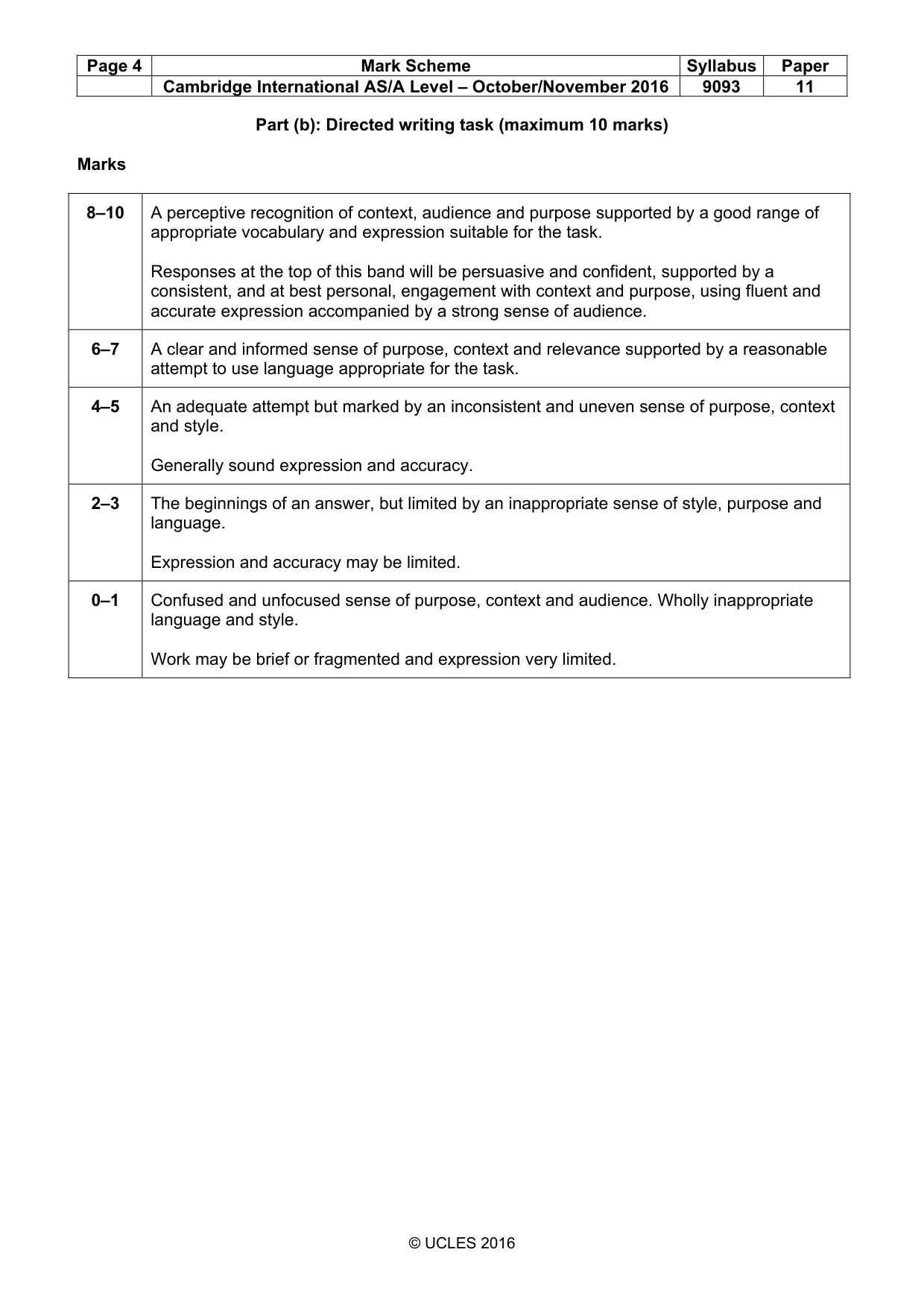
Page 4 Mark Scheme Syllabus Paper Cambridge International AS/A Level – October/November 2016 9093 11 © UCLES 2016 Part (b): Directed writing task (maximum 10 marks) Marks 8–10 A perceptive recognition of context, audience and purpose supported by a good range of appropriate vocabulary and expression suitable for the task. Responses at the top of this band will be persuasive and confident, supported by a consistent, and at best personal, engagement with context and purpose, using fluent and accurate expression accompanied by a strong sense of audience. 6–7 A clear and informed sense of purpose, context and relevance supported by a reasonable attempt to use language appropriate for the task. 4–5 An adequate attempt but marked by an inconsistent and uneven sense of purpose, context and style. Generally sound expression and accuracy. 2–3 The beginnings of an answer, but limited by an inappropriate sense of style, purpose and language. Expression and accuracy may be limited. 0–1 Confused and unfocused sense of purpose, context and audience. Wholly inappropriate language and style. Work may be brief or fragmented and expression very limited.
What you needed in this session
Cambridge’s own grade thresholds for 2016 Oct/Nov, Paper 1 · Variant 1. A higher threshold means an easier paper — the bar moves with how the cohort did.