Cambridge A Level English - Language AS and A Level (from 2014) 9093 — 2016 Feb/March Paper 3 · Variant 2
9093/32/F/M/16 · 50 marks · ≈56 min
The question paper and its mark scheme, free to read here and free to download. This is Cambridge’s own paper, exactly as it was sat.
Question paper8 pages

Mark scheme5 pages
Answers below. Sit the paper first if you are practising.
Paper as text
Question paper, page 1
This document consists of 6 printed pages, 2 blank pages and 1 insert. DC (LEG) 106808/2 © UCLES 2016 [Turn over Cambridge International Examinations Cambridge International Advanced Subsidiary and Advanced Level * 2 9 0 6 9 6 0 2 7 1 * ENGLISH LANGUAGE 9093/32 Paper 3 Text Analysis February/March 2016 2 hours 15 minutes No Additional Materials are required. READ THESE INSTRUCTIONS FIRST An answer booklet is provided inside this question paper. You should follow the instructions on the front cover of the answer booklet. If you need additional answer paper, ask the invigilator for a continuation booklet. Answer two questions. You should spend about 15 minutes reading the passages and questions before you start writing your answers. Both questions carry equal marks. You are reminded of the need for good English and clear presentation in your answers. The number of marks is given in brackets [ ] at the end of each question or part question.
Question paper, page 2
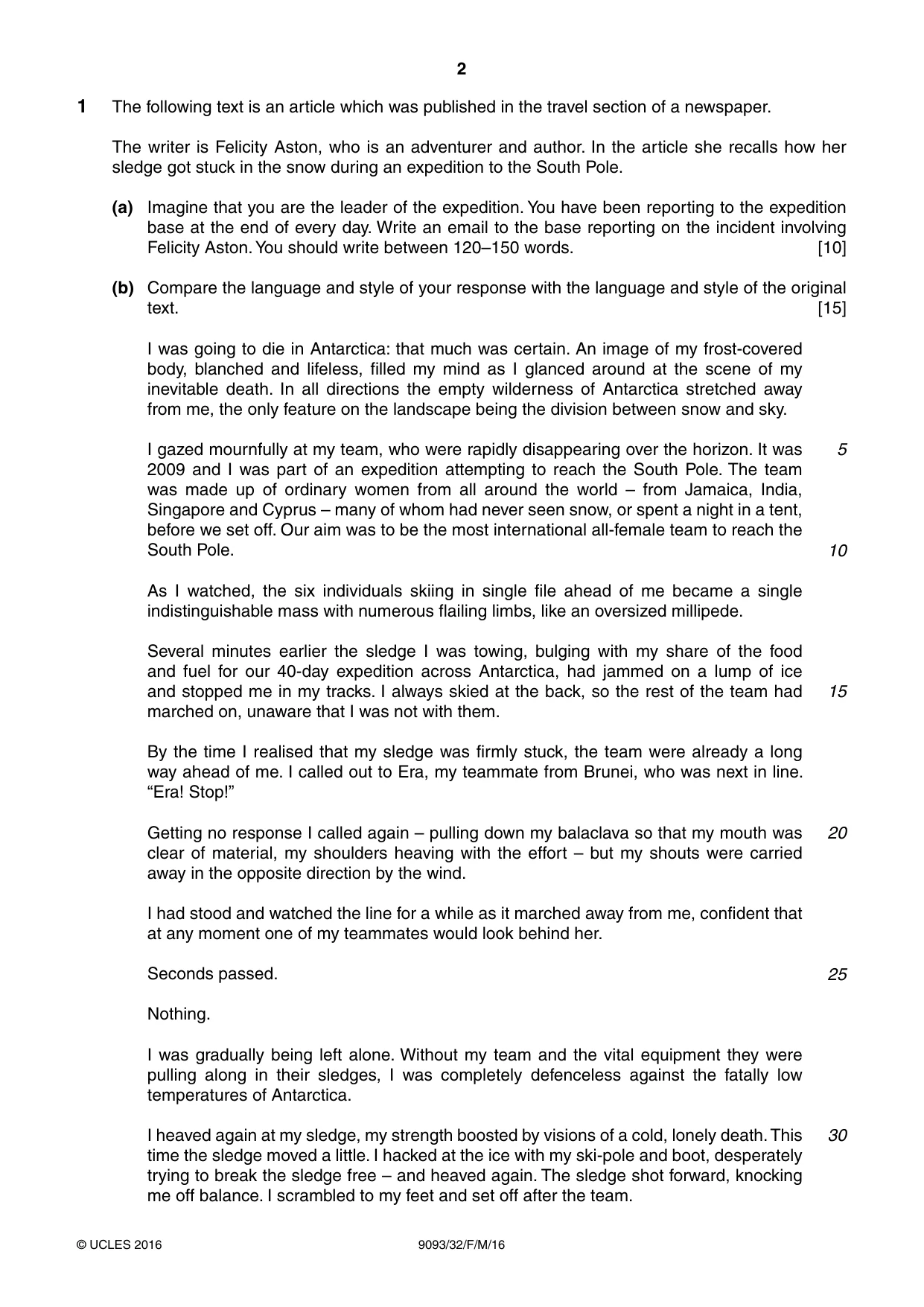
2 9093/32/F/M/16 © UCLES 2016 1 The following text is an article which was published in the travel section of a newspaper. The writer is Felicity Aston, who is an adventurer and author. In the article she recalls how her sledge got stuck in the snow during an expedition to the South Pole. (a) Imagine that you are the leader of the expedition. You have been reporting to the expedition base at the end of every day. Write an email to the base reporting on the incident involving Felicity Aston. You should write between 120–150 words. [10] (b) Compare the language and style of your response with the language and style of the original text. [15] I was going to die in Antarctica: that much was certain. An image of my frost-covered body, blanched and lifeless, filled my mind as I glanced around at the scene of my inevitable death. In all directions the empty wilderness of Antarctica stretched away from me, the only feature on the landscape being the division between snow and sky. I gazed mournfully at my team, who were rapidly disappearing over the horizon. It was 2009 and I was part of an expedition attempting to reach the South Pole. The team was made up of ordinary women from all around the world – from Jamaica, India, Singapore and Cyprus – many of whom had never seen snow, or spent a night in a tent, before we set off. Our aim was to be the most international all-female team to reach the South Pole. As I watched, the six individuals skiing in single file ahead of me became a single indistinguishable mass with numerous flailing limbs, like an oversized millipede. Several minutes earlier the sledge I was towing, bulging with my share of the food and fuel for our 40-day expedition across Antarctica, had jammed on a lump of ice and stopped me in my tracks. I always skied at the back, so the rest of the team had marched on, unaware that I was not with them. By the time I realised that my sledge was firmly stuck, the team were already a long way ahead of me. I called out to Era, my teammate from Brunei, who was next in line. “Era! Stop!” Getting no response I called again – pulling down my balaclava so that my mouth was clear of material, my shoulders heaving with the effort – but my shouts were carried away in the opposite direction by the wind. I had stood and watched the line for a while as it marched away from me, confident that at any moment one of my teammates would look behind her. Seconds passed. Nothing. I was gradually being left alone. Without my team and the vital equipment they were pulling along in their sledges, I was completely defenceless against the fatally low temperatures of Antarctica. I heaved again at my sledge, my strength boosted by visions of a cold, lonely death. This time the sledge moved a little. I hacked at the ice with my ski-pole and boot, desperately trying to break the sledge free – and heaved again. The sledge shot forward, knocking me off balance. I scrambled to my feet and set off after the team. 5 10 15 20 25 30
Question paper, page 3
3 9093/32/F/M/16 © UCLES 2016 [Turn over I caught up just as they realised I wasn’t there. I watched as Reena, my teammate from India, who was at the front of the line, looked behind her and did a double take as she noticed there was one person missing. Era swung around on her skis in shock to find that I wasn’t behind her, then looked up to spot me in the near distance. Pulling up behind them some minutes later I was panting with effort. “You could have left me behind,” I gasped, still in shock. The girls all looked sheepish, shuffling around on their skis. As we continued, my panic slowly faded. I found myself laughing quietly as I noticed Reena checking behind her after every few paces. In fact for the whole of the rest of the day the team looked as if they’d developed a serious twitch, each glancing over her shoulder every few minutes. They were not going to risk losing me again. 35 40
Question paper, page 4
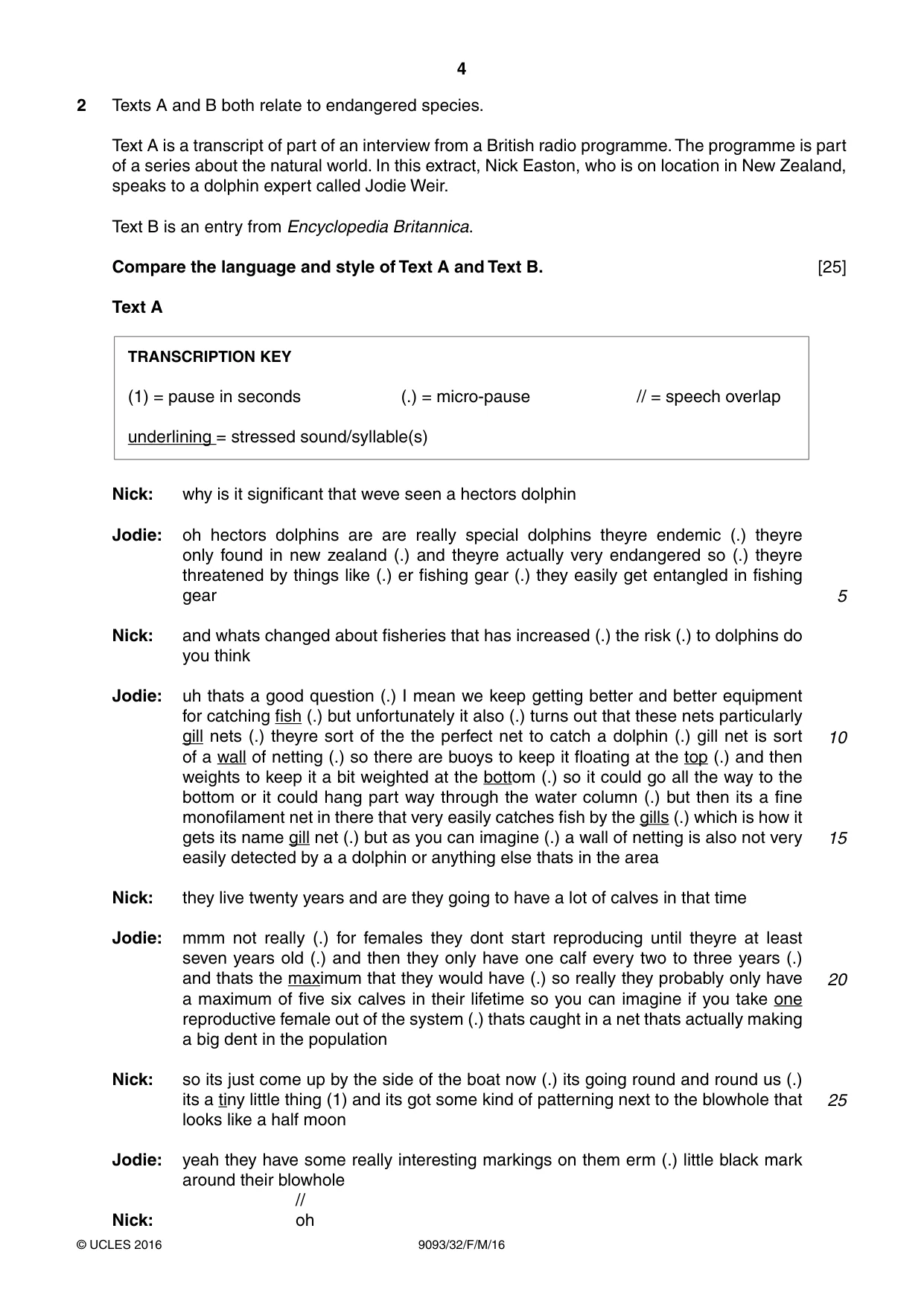
4 9093/32/F/M/16 © UCLES 2016 2 Texts A and B both relate to endangered species. Text A is a transcript of part of an interview from a British radio programme. The programme is part of a series about the natural world. In this extract, Nick Easton, who is on location in New Zealand, speaks to a dolphin expert called Jodie Weir. Text B is an entry from Encyclopedia Britannica. Compare the language and style of Text A and Text B. [25] Text A TRANSCRIPTION KEY (1) = pause in seconds (.) = micro-pause // = speech overlap underlining = stressed sound/syllable(s) Nick: why is it significant that weve seen a hectors dolphin Jodie: oh hectors dolphins are are really special dolphins theyre endemic (.) theyre only found in new zealand (.) and theyre actually very endangered so (.) theyre threatened by things like (.) er fishing gear (.) they easily get entangled in fishing gear Nick: and whats changed about fisheries that has increased (.) the risk (.) to dolphins do you think Jodie: uh thats a good question (.) I mean we keep getting better and better equipment for catching fish (.) but unfortunately it also (.) turns out that these nets particularly gill nets (.) theyre sort of the the perfect net to catch a dolphin (.) gill net is sort of a wall of netting (.) so there are buoys to keep it floating at the top (.) and then weights to keep it a bit weighted at the bottom (.) so it could go all the way to the bottom or it could hang part way through the water column (.) but then its a fine monofilament net in there that very easily catches fish by the gills (.) which is how it gets its name gill net (.) but as you can imagine (.) a wall of netting is also not very easily detected by a a dolphin or anything else thats in the area Nick: they live twenty years and are they going to have a lot of calves in that time Jodie: mmm not really (.) for females they dont start reproducing until theyre at least seven years old (.) and then they only have one calf every two to three years (.) and thats the maximum that they would have (.) so really they probably only have a maximum of five six calves in their lifetime so you can imagine if you take one reproductive female out of the system (.) thats caught in a net thats actually making a big dent in the population Nick: so its just come up by the side of the boat now (.) its going round and round us (.) its a tiny little thing (1) and its got some kind of patterning next to the blowhole that looks like a half moon Jodie: yeah they have some really interesting markings on them erm (.) little black mark around their blowhole // Nick: oh 5 10 15 20 25
Question paper, page 5
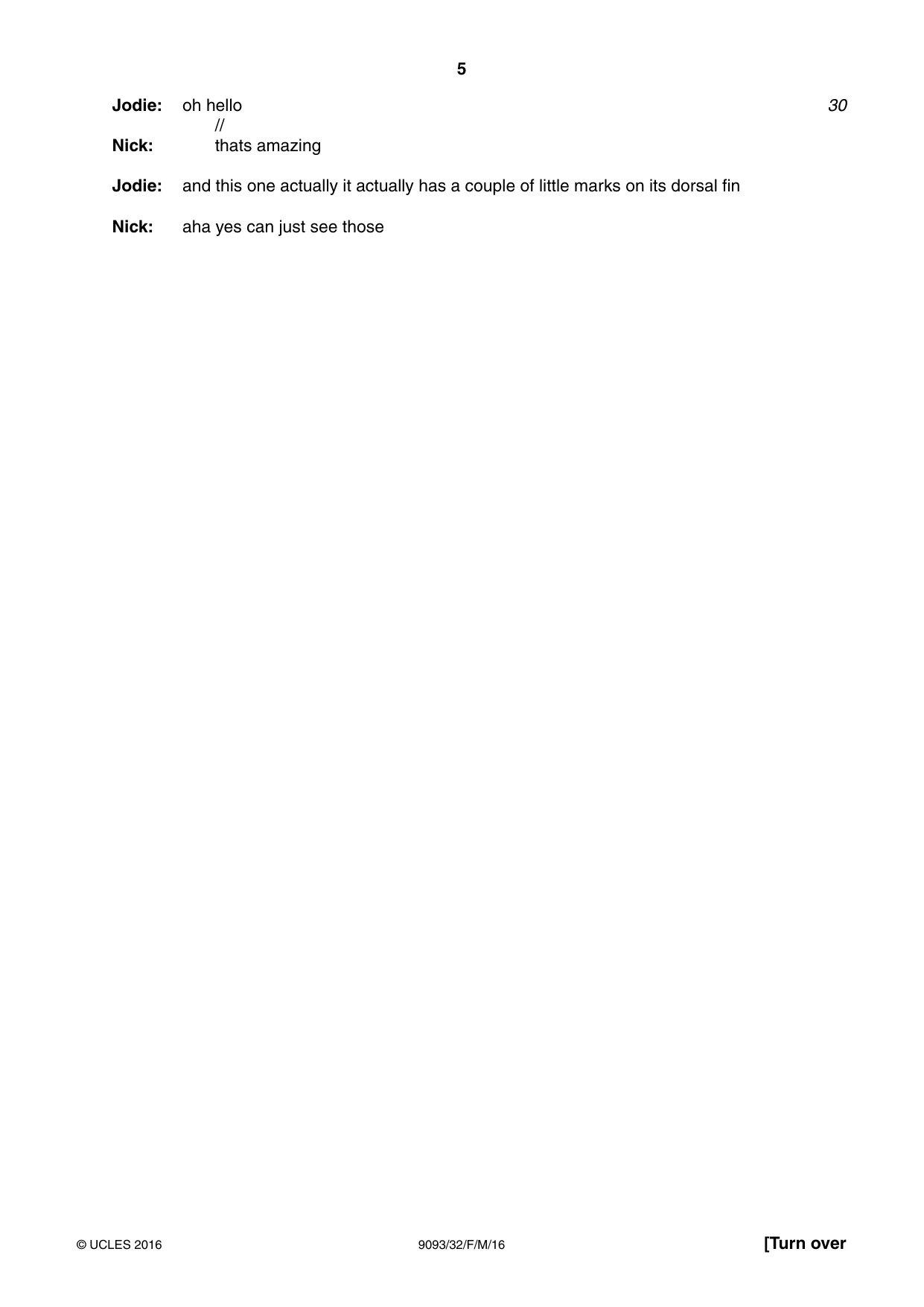
5 9093/32/F/M/16 © UCLES 2016 [Turn over Jodie: oh hello // Nick: thats amazing Jodie: and this one actually it actually has a couple of little marks on its dorsal fin Nick: aha yes can just see those 30
Question paper, page 6
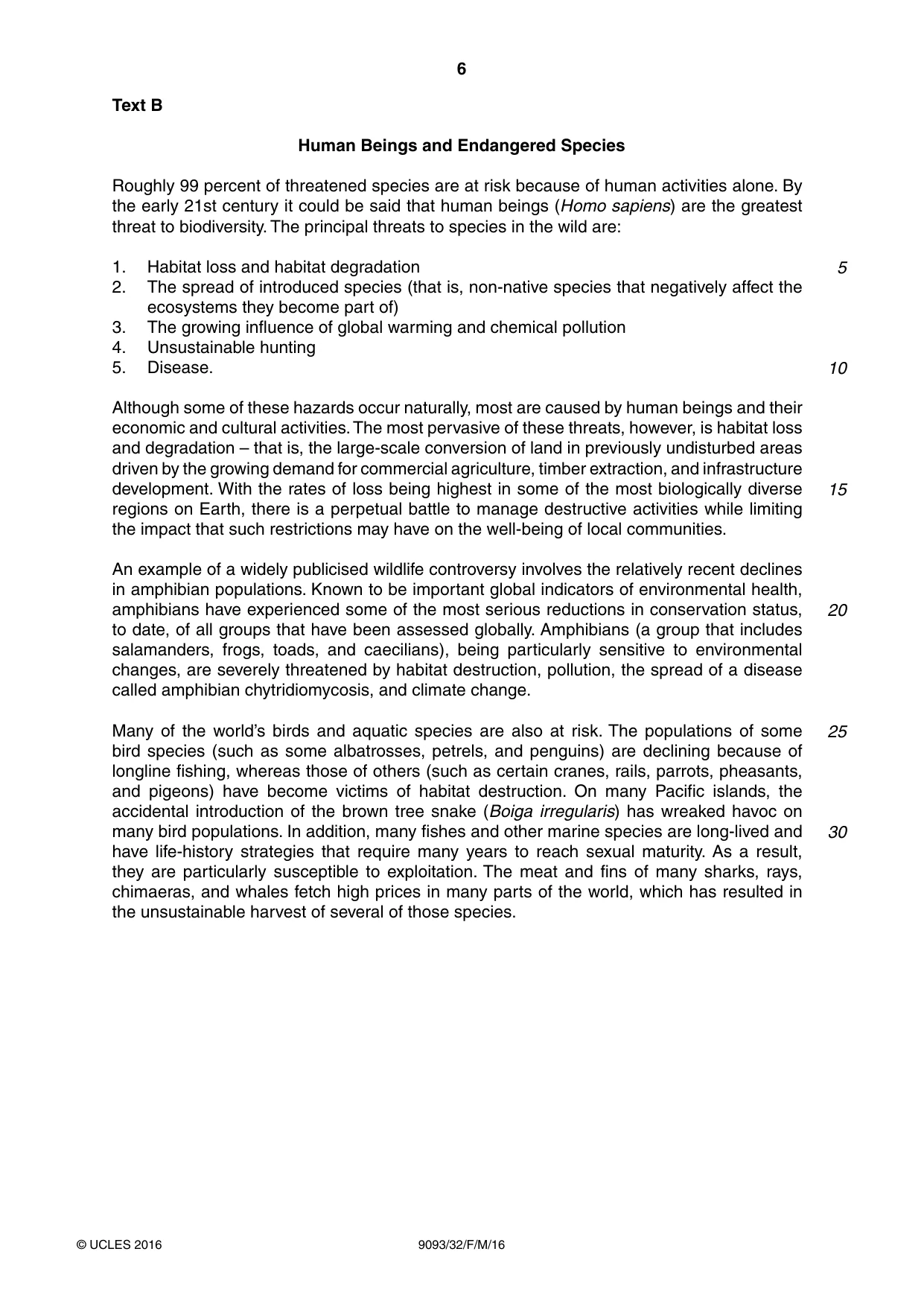
6 9093/32/F/M/16 © UCLES 2016 Text B Human Beings and Endangered Species Roughly 99 percent of threatened species are at risk because of human activities alone. By the early 21st century it could be said that human beings (Homo sapiens) are the greatest threat to biodiversity. The principal threats to species in the wild are: 1. Habitat loss and habitat degradation 2. The spread of introduced species (that is, non-native species that negatively affect the ecosystems they become part of) 3. The growing influence of global warming and chemical pollution 4. Unsustainable hunting 5. Disease. Although some of these hazards occur naturally, most are caused by human beings and their economic and cultural activities. The most pervasive of these threats, however, is habitat loss and degradation – that is, the large-scale conversion of land in previously undisturbed areas driven by the growing demand for commercial agriculture, timber extraction, and infrastructure development. With the rates of loss being highest in some of the most biologically diverse regions on Earth, there is a perpetual battle to manage destructive activities while limiting the impact that such restrictions may have on the well-being of local communities. An example of a widely publicised wildlife controversy involves the relatively recent declines in amphibian populations. Known to be important global indicators of environmental health, amphibians have experienced some of the most serious reductions in conservation status, to date, of all groups that have been assessed globally. Amphibians (a group that includes salamanders, frogs, toads, and caecilians), being particularly sensitive to environmental changes, are severely threatened by habitat destruction, pollution, the spread of a disease called amphibian chytridiomycosis, and climate change. Many of the world’s birds and aquatic species are also at risk. The populations of some bird species (such as some albatrosses, petrels, and penguins) are declining because of longline fishing, whereas those of others (such as certain cranes, rails, parrots, pheasants, and pigeons) have become victims of habitat destruction. On many Pacific islands, the accidental introduction of the brown tree snake (Boiga irregularis) has wreaked havoc on many bird populations. In addition, many fishes and other marine species are long-lived and have life-history strategies that require many years to reach sexual maturity. As a result, they are particularly susceptible to exploitation. The meat and fins of many sharks, rays, chimaeras, and whales fetch high prices in many parts of the world, which has resulted in the unsustainable harvest of several of those species. 5 10 15 20 25 30
Question paper, page 7
7 9093/32/F/M/16 © UCLES 2016 BLANK PAGE
Question paper, page 8
8 9093/32/F/M/16 © UCLES 2016 Permission to reproduce items where third-party owned material protected by copyright is included has been sought and cleared where possible. Every reasonable effort has been made by the publisher (UCLES) to trace copyright holders, but if any items requiring clearance have unwittingly been included, the publisher will be pleased to make amends at the earliest possible opportunity. To avoid the issue of disclosure of answer-related information to candidates, all copyright acknowledgements are reproduced online in the Cambridge International Examinations Copyright Acknowledgements Booklet. This is produced for each series of examinations and is freely available to download at www.cie.org.uk after the live examination series. Cambridge International Examinations is part of the Cambridge Assessment Group. Cambridge Assessment is the brand name of University of Cambridge Local Examinations Syndicate (UCLES), which is itself a department of the University of Cambridge. BLANK PAGE
Mark scheme, page 1
® IGCSE is the registered trademark of Cambridge International Examinations. CAMBRIDGE INTERNATIONAL EXAMINATIONS Cambridge International Advanced Subsidiary and Advanced Level MARK SCHEME for the March 2016 series 9093 ENGLISH LANGUAGE 9093/32 Paper 3 (Text Analysis), maximum raw mark 50 This mark scheme is published as an aid to teachers and candidates, to indicate the requirements of the examination. It shows the basis on which Examiners were instructed to award marks. It does not indicate the details of the discussions that took place at an Examiners’ meeting before marking began, which would have considered the acceptability of alternative answers. Mark schemes should be read in conjunction with the question paper and the Principal Examiner Report for Teachers. Cambridge will not enter into discussions about these mark schemes. Cambridge is publishing the mark schemes for the March 2016 series for most Cambridge IGCSE® and Cambridge International A and AS Level components.
Mark scheme, page 2
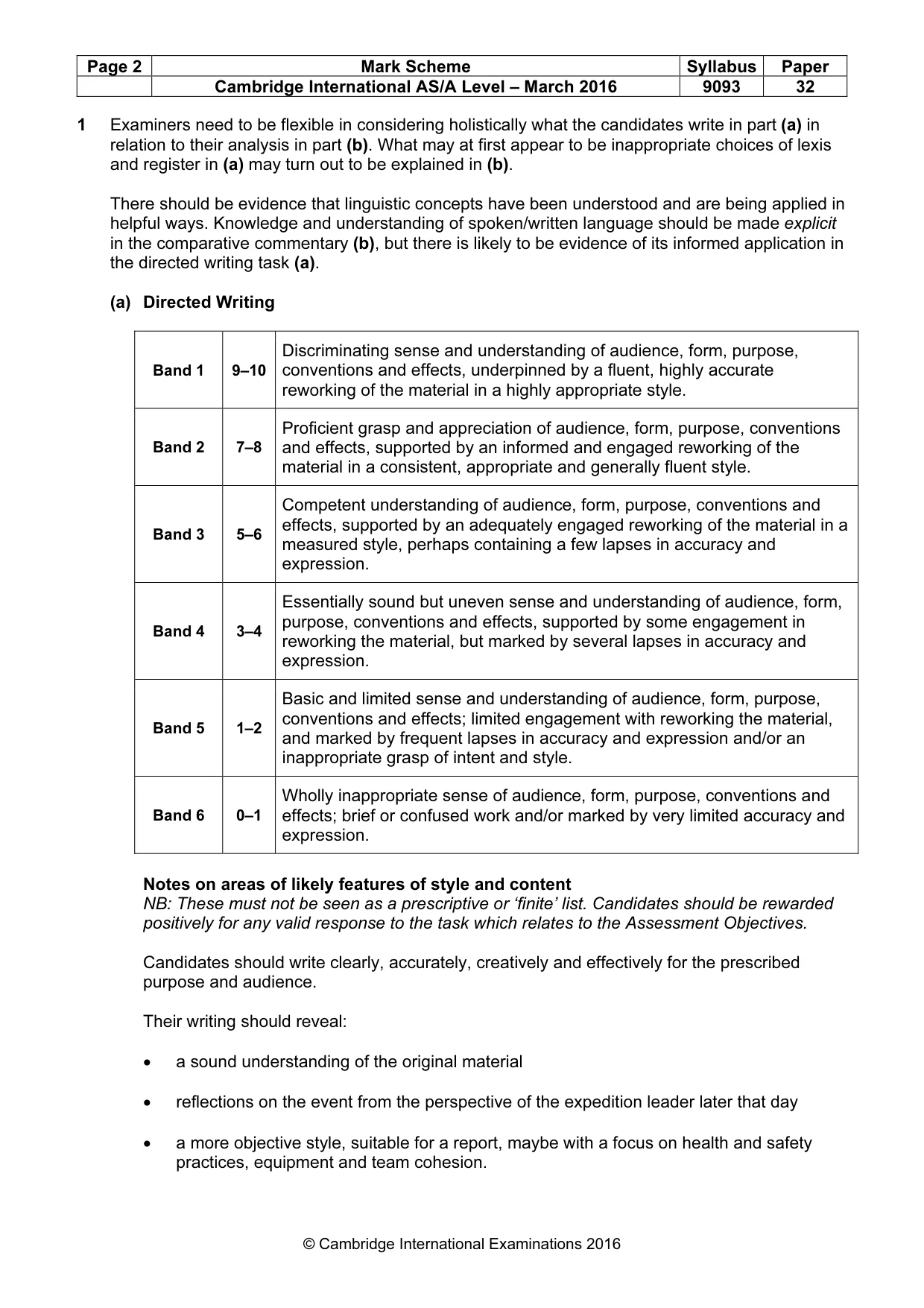
Page 2 Mark Scheme Syllabus Paper Cambridge International AS/A Level – March 2016 9093 32 © Cambridge International Examinations 2016 1 Examiners need to be flexible in considering holistically what the candidates write in part (a) in relation to their analysis in part (b). What may at first appear to be inappropriate choices of lexis and register in (a) may turn out to be explained in (b). There should be evidence that linguistic concepts have been understood and are being applied in helpful ways. Knowledge and understanding of spoken/written language should be made explicit in the comparative commentary (b), but there is likely to be evidence of its informed application in the directed writing task (a). (a) Directed Writing Band 1 9–10 Discriminating sense and understanding of audience, form, purpose, conventions and effects, underpinned by a fluent, highly accurate reworking of the material in a highly appropriate style. Band 2 7–8 Proficient grasp and appreciation of audience, form, purpose, conventions and effects, supported by an informed and engaged reworking of the material in a consistent, appropriate and generally fluent style. Band 3 5–6 Competent understanding of audience, form, purpose, conventions and effects, supported by an adequately engaged reworking of the material in a measured style, perhaps containing a few lapses in accuracy and expression. Band 4 3–4 Essentially sound but uneven sense and understanding of audience, form, purpose, conventions and effects, supported by some engagement in reworking the material, but marked by several lapses in accuracy and expression. Band 5 1–2 Basic and limited sense and understanding of audience, form, purpose, conventions and effects; limited engagement with reworking the material, and marked by frequent lapses in accuracy and expression and/or an inappropriate grasp of intent and style. Band 6 0–1 Wholly inappropriate sense of audience, form, purpose, conventions and effects; brief or confused work and/or marked by very limited accuracy and expression. Notes on areas of likely features of style and content NB: These must not be seen as a prescriptive or ‘finite’ list. Candidates should be rewarded positively for any valid response to the task which relates to the Assessment Objectives. Candidates should write clearly, accurately, creatively and effectively for the prescribed purpose and audience. Their writing should reveal: • a sound understanding of the original material • reflections on the event from the perspective of the expedition leader later that day • a more objective style, suitable for a report, maybe with a focus on health and safety practices, equipment and team cohesion.
Mark scheme, page 3
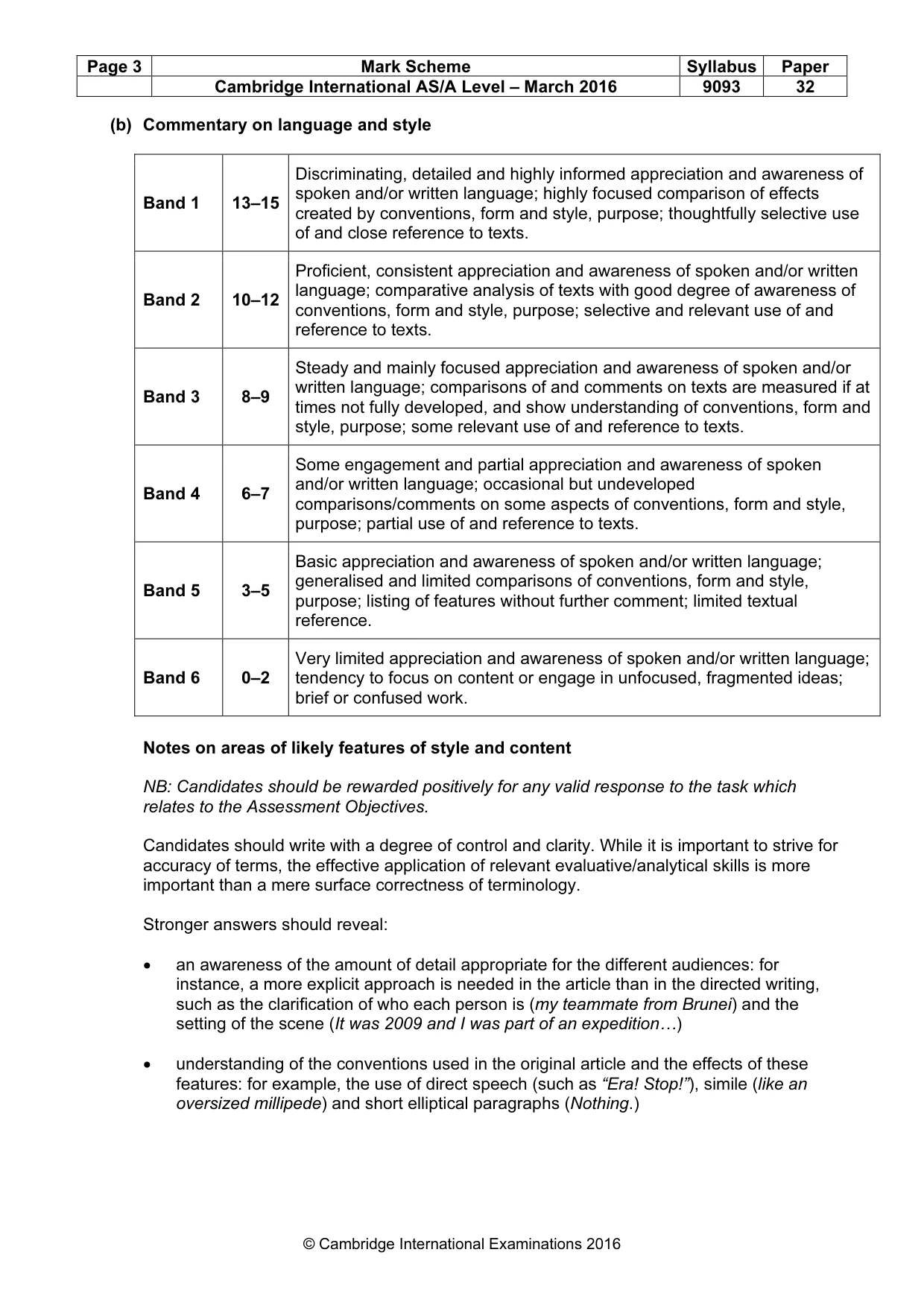
Page 3 Mark Scheme Syllabus Paper Cambridge International AS/A Level – March 2016 9093 32 © Cambridge International Examinations 2016 (b) Commentary on language and style Band 1 13–15 Discriminating, detailed and highly informed appreciation and awareness of spoken and/or written language; highly focused comparison of effects created by conventions, form and style, purpose; thoughtfully selective use of and close reference to texts. Band 2 10–12 Proficient, consistent appreciation and awareness of spoken and/or written language; comparative analysis of texts with good degree of awareness of conventions, form and style, purpose; selective and relevant use of and reference to texts. Band 3 8–9 Steady and mainly focused appreciation and awareness of spoken and/or written language; comparisons of and comments on texts are measured if at times not fully developed, and show understanding of conventions, form and style, purpose; some relevant use of and reference to texts. Band 4 6–7 Some engagement and partial appreciation and awareness of spoken and/or written language; occasional but undeveloped comparisons/comments on some aspects of conventions, form and style, purpose; partial use of and reference to texts. Band 5 3–5 Basic appreciation and awareness of spoken and/or written language; generalised and limited comparisons of conventions, form and style, purpose; listing of features without further comment; limited textual reference. Band 6 0–2 Very limited appreciation and awareness of spoken and/or written language; tendency to focus on content or engage in unfocused, fragmented ideas; brief or confused work. Notes on areas of likely features of style and content NB: Candidates should be rewarded positively for any valid response to the task which relates to the Assessment Objectives. Candidates should write with a degree of control and clarity. While it is important to strive for accuracy of terms, the effective application of relevant evaluative/analytical skills is more important than a mere surface correctness of terminology. Stronger answers should reveal: • an awareness of the amount of detail appropriate for the different audiences: for instance, a more explicit approach is needed in the article than in the directed writing, such as the clarification of who each person is (my teammate from Brunei) and the setting of the scene (It was 2009 and I was part of an expedition…) • understanding of the conventions used in the original article and the effects of these features: for example, the use of direct speech (such as “Era! Stop!”), simile (like an oversized millipede) and short elliptical paragraphs (Nothing.)
Mark scheme, page 4
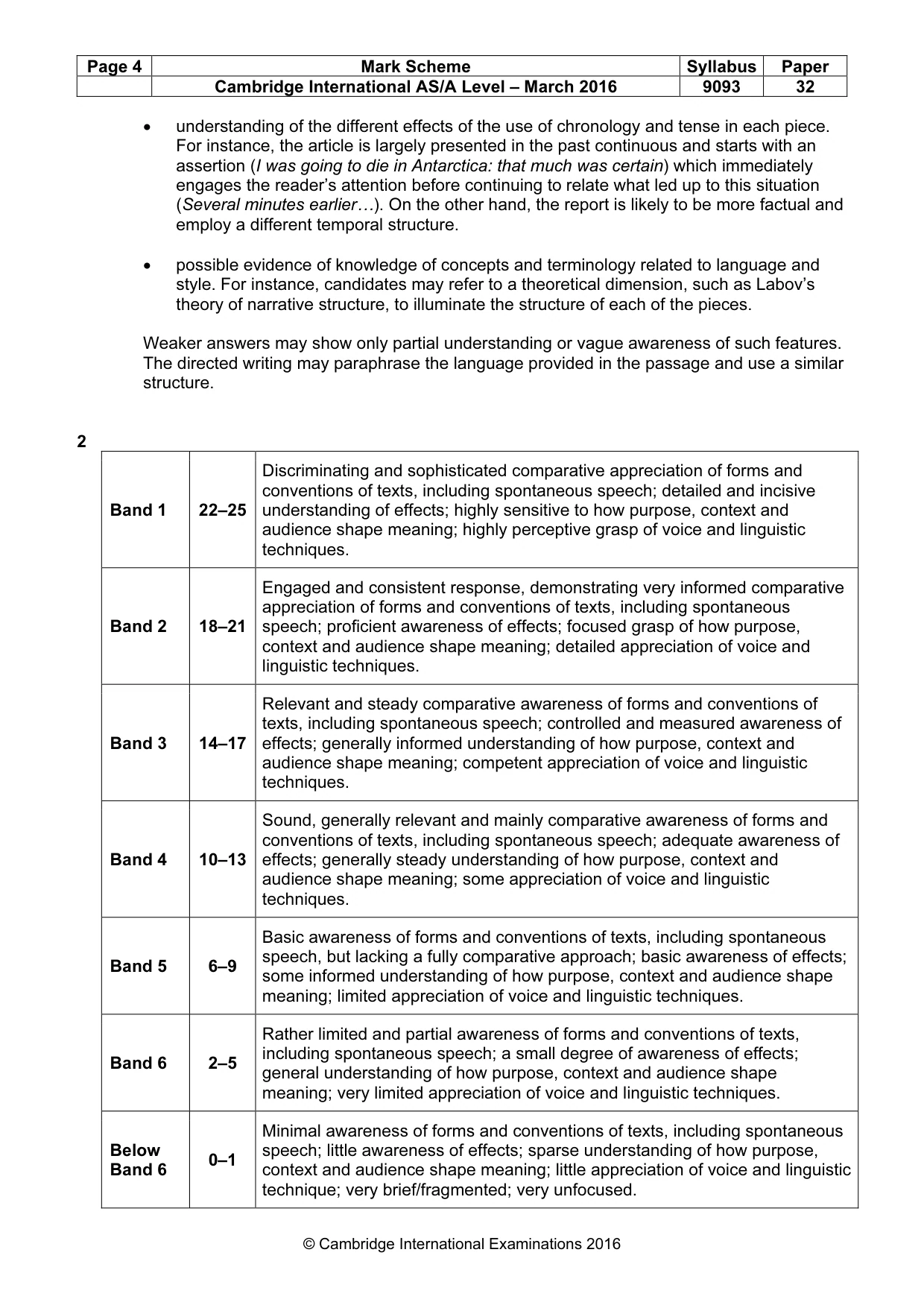
Page 4 Mark Scheme Syllabus Paper Cambridge International AS/A Level – March 2016 9093 32 © Cambridge International Examinations 2016 • understanding of the different effects of the use of chronology and tense in each piece. For instance, the article is largely presented in the past continuous and starts with an assertion (I was going to die in Antarctica: that much was certain) which immediately engages the reader’s attention before continuing to relate what led up to this situation (Several minutes earlier…). On the other hand, the report is likely to be more factual and employ a different temporal structure. • possible evidence of knowledge of concepts and terminology related to language and style. For instance, candidates may refer to a theoretical dimension, such as Labov’s theory of narrative structure, to illuminate the structure of each of the pieces. Weaker answers may show only partial understanding or vague awareness of such features. The directed writing may paraphrase the language provided in the passage and use a similar structure. 2 Band 1 22–25 Discriminating and sophisticated comparative appreciation of forms and conventions of texts, including spontaneous speech; detailed and incisive understanding of effects; highly sensitive to how purpose, context and audience shape meaning; highly perceptive grasp of voice and linguistic techniques. Band 2 18–21 Engaged and consistent response, demonstrating very informed comparative appreciation of forms and conventions of texts, including spontaneous speech; proficient awareness of effects; focused grasp of how purpose, context and audience shape meaning; detailed appreciation of voice and linguistic techniques. Band 3 14–17 Relevant and steady comparative awareness of forms and conventions of texts, including spontaneous speech; controlled and measured awareness of effects; generally informed understanding of how purpose, context and audience shape meaning; competent appreciation of voice and linguistic techniques. Band 4 10–13 Sound, generally relevant and mainly comparative awareness of forms and conventions of texts, including spontaneous speech; adequate awareness of effects; generally steady understanding of how purpose, context and audience shape meaning; some appreciation of voice and linguistic techniques. Band 5 6–9 Basic awareness of forms and conventions of texts, including spontaneous speech, but lacking a fully comparative approach; basic awareness of effects; some informed understanding of how purpose, context and audience shape meaning; limited appreciation of voice and linguistic techniques. Band 6 2–5 Rather limited and partial awareness of forms and conventions of texts, including spontaneous speech; a small degree of awareness of effects; general understanding of how purpose, context and audience shape meaning; very limited appreciation of voice and linguistic techniques. Below Band 6 0–1 Minimal awareness of forms and conventions of texts, including spontaneous speech; little awareness of effects; sparse understanding of how purpose, context and audience shape meaning; little appreciation of voice and linguistic technique; very brief/fragmented; very unfocused.
Mark scheme, page 5
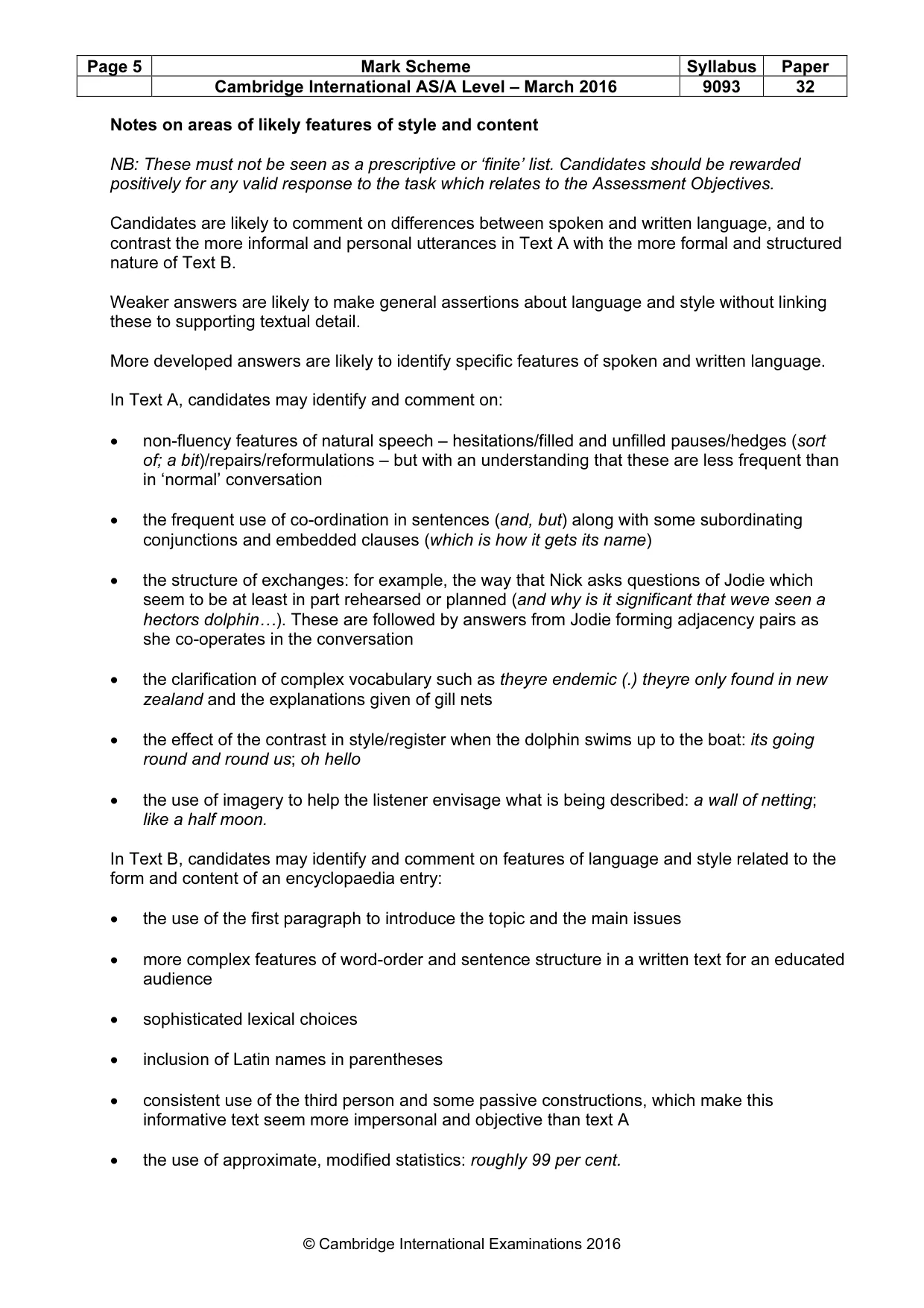
Page 5 Mark Scheme Syllabus Paper Cambridge International AS/A Level – March 2016 9093 32 © Cambridge International Examinations 2016 Notes on areas of likely features of style and content NB: These must not be seen as a prescriptive or ‘finite’ list. Candidates should be rewarded positively for any valid response to the task which relates to the Assessment Objectives. Candidates are likely to comment on differences between spoken and written language, and to contrast the more informal and personal utterances in Text A with the more formal and structured nature of Text B. Weaker answers are likely to make general assertions about language and style without linking these to supporting textual detail. More developed answers are likely to identify specific features of spoken and written language. In Text A, candidates may identify and comment on: • non-fluency features of natural speech – hesitations/filled and unfilled pauses/hedges (sort of; a bit)/repairs/reformulations – but with an understanding that these are less frequent than in ‘normal’ conversation • the frequent use of co-ordination in sentences (and, but) along with some subordinating conjunctions and embedded clauses (which is how it gets its name) • the structure of exchanges: for example, the way that Nick asks questions of Jodie which seem to be at least in part rehearsed or planned (and why is it significant that weve seen a hectors dolphin…). These are followed by answers from Jodie forming adjacency pairs as she co-operates in the conversation • the clarification of complex vocabulary such as theyre endemic (.) theyre only found in new zealand and the explanations given of gill nets • the effect of the contrast in style/register when the dolphin swims up to the boat: its going round and round us; oh hello • the use of imagery to help the listener envisage what is being described: a wall of netting; like a half moon. In Text B, candidates may identify and comment on features of language and style related to the form and content of an encyclopaedia entry: • the use of the first paragraph to introduce the topic and the main issues • more complex features of word-order and sentence structure in a written text for an educated audience • sophisticated lexical choices • inclusion of Latin names in parentheses • consistent use of the third person and some passive constructions, which make this informative text seem more impersonal and objective than text A • the use of approximate, modified statistics: roughly 99 per cent.
What you needed in this session
Cambridge’s own grade thresholds for 2016 Feb/March, Paper 3 · Variant 2. A higher threshold means an easier paper — the bar moves with how the cohort did.