Cambridge A Level English - Language AS and A Level (from 2014) 9093 — 2015 Oct/Nov Paper 4 · Variant 2
9093/42/O/N/15 · 50 marks · ≈56 min
The question paper and its mark scheme, free to read here and free to download. This is Cambridge’s own paper, exactly as it was sat.
Question paper8 pages


Mark scheme2 pages
Answers below. Sit the paper first if you are practising.
Paper as text
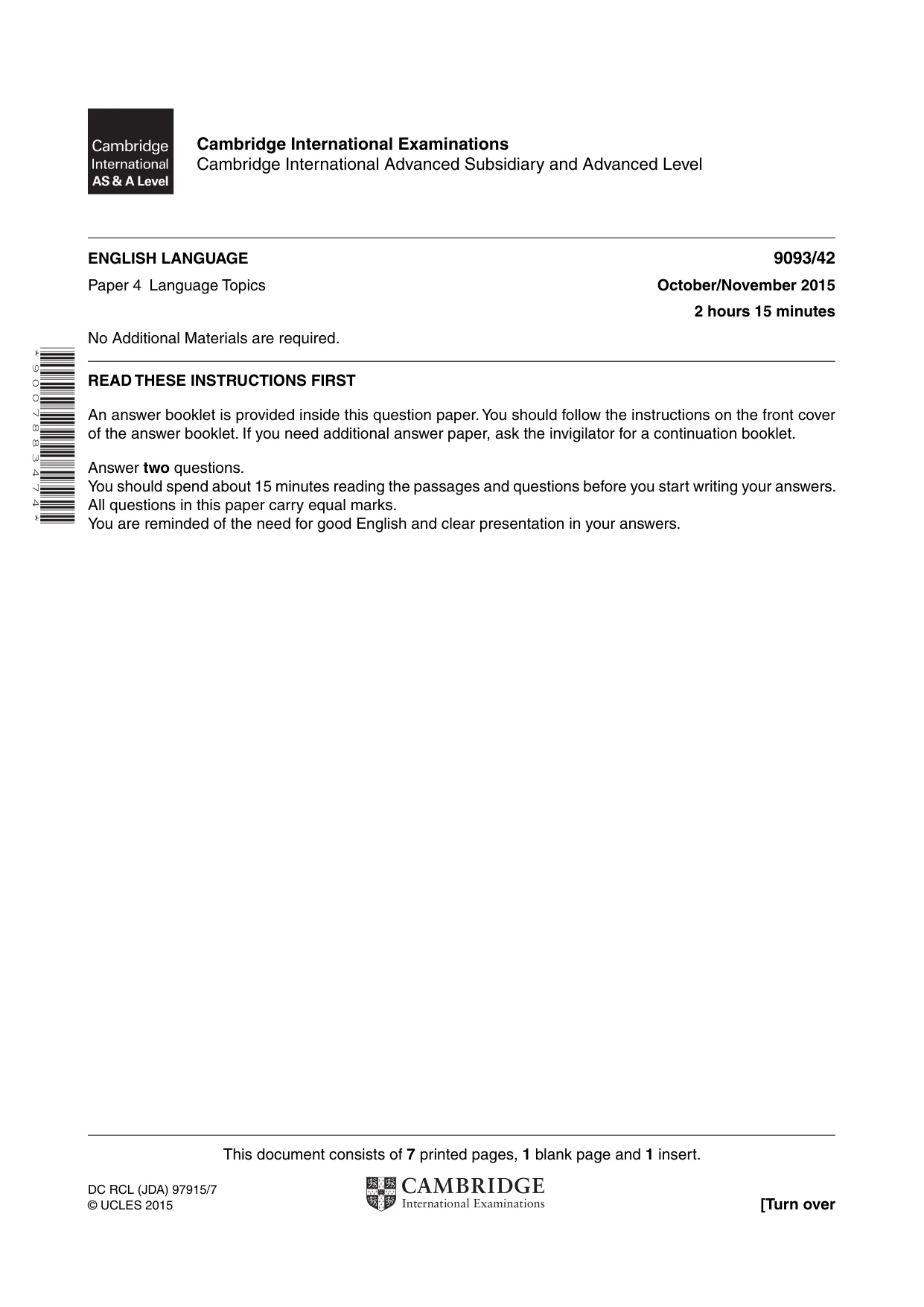
Question paper, page 1
This document consists of 7 printed pages, 1 blank page and 1 insert. DC RCL (JDA) 97915/7 © UCLES 2015 [Turn over Cambridge International Examinations Cambridge International Advanced Subsidiary and Advanced Level * 9 0 0 7 8 8 3 4 7 4 * ENGLISH LANGUAGE 9093/42 Paper 4 Language Topics October/November 2015 2 hours 15 minutes No Additional Materials are required. READ THESE INSTRUCTIONS FIRST An answer booklet is provided inside this question paper. You should follow the instructions on the front cover of the answer booklet. If you need additional answer paper, ask the invigilator for a continuation booklet. Answer two questions. You should spend about 15 minutes reading the passages and questions before you start writing your answers. All questions in this paper carry equal marks. You are reminded of the need for good English and clear presentation in your answers.
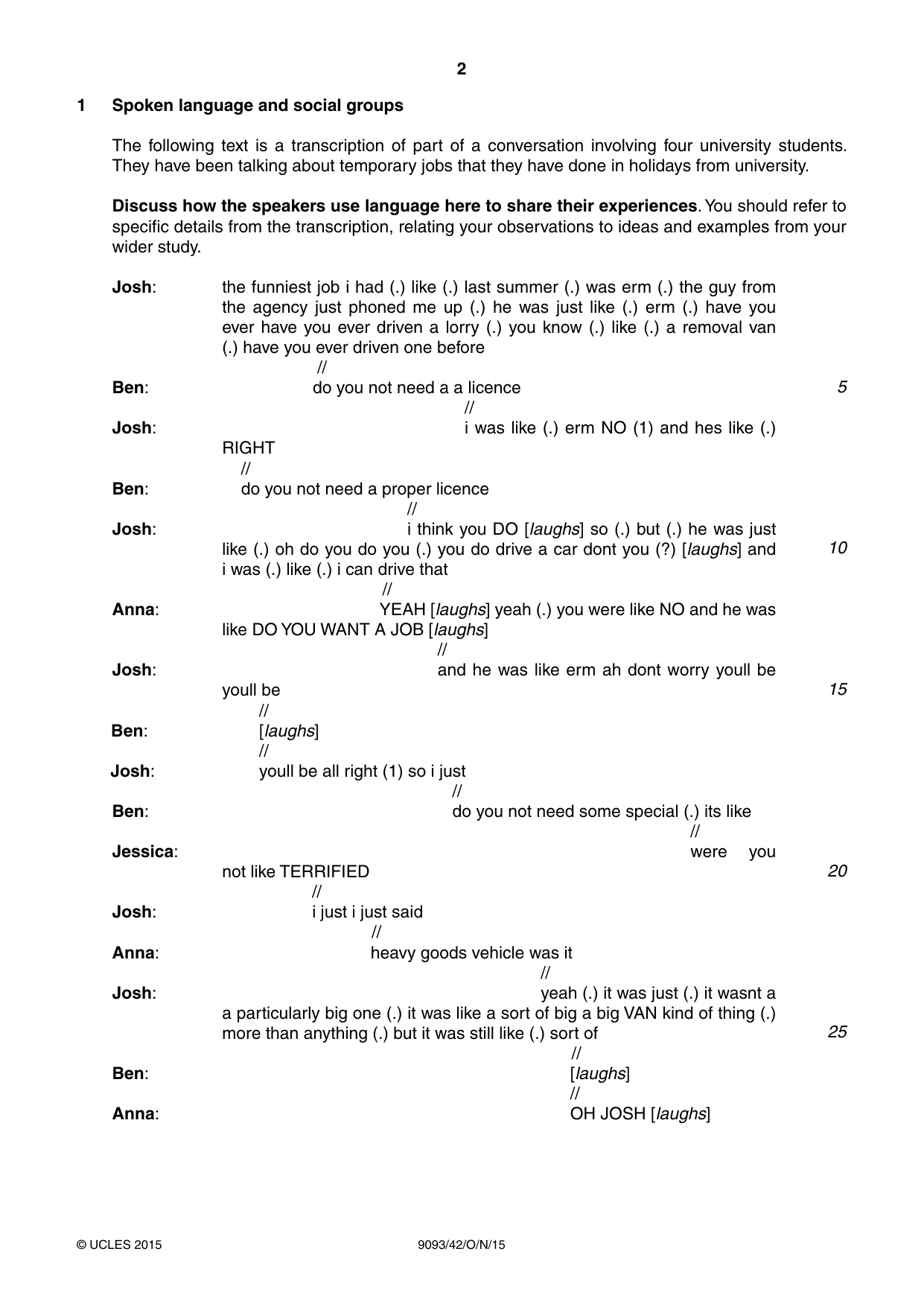
Question paper, page 2
2 9093/42/O/N/15 © UCLES 2015 1 Spoken language and social groups The following text is a transcription of part of a conversation involving four university students. They have been talking about temporary jobs that they have done in holidays from university. Discuss how the speakers use language here to share their experiences. You should refer to specific details from the transcription, relating your observations to ideas and examples from your wider study. Josh: the funniest job i had (.) like (.) last summer (.) was erm (.) the guy from the agency just phoned me up (.) he was just like (.) erm (.) have you ever have you ever driven a lorry (.) you know (.) like (.) a removal van (.) have you ever driven one before // Ben: do you not need a a licence // Josh: i was like (.) erm NO (1) and hes like (.) RIGHT // Ben: do you not need a proper licence // Josh: i think you DO [laughs] so (.) but (.) he was just like (.) oh do you do you (.) you do drive a car dont you (?) [laughs] and i was (.) like (.) i can drive that // Anna: YEAH [laughs] yeah (.) you were like NO and he was like DO YOU WANT A JOB [laughs] // Josh: and he was like erm ah dont worry youll be youll be // Ben: [laughs] // Josh: youll be all right (1) so i just // Ben: do you not need some special (.) its like // Jessica: were you not like TERRIFIED // Josh: i just i just said // Anna: heavy goods vehicle was it // Josh: yeah (.) it was just (.) it wasnt a a particularly big one (.) it was like a sort of big a big VAN kind of thing (.) more than anything (.) but it was still like (.) sort of // Ben: [laughs] // Anna: OH JOSH [laughs] 5 10 15 20 25
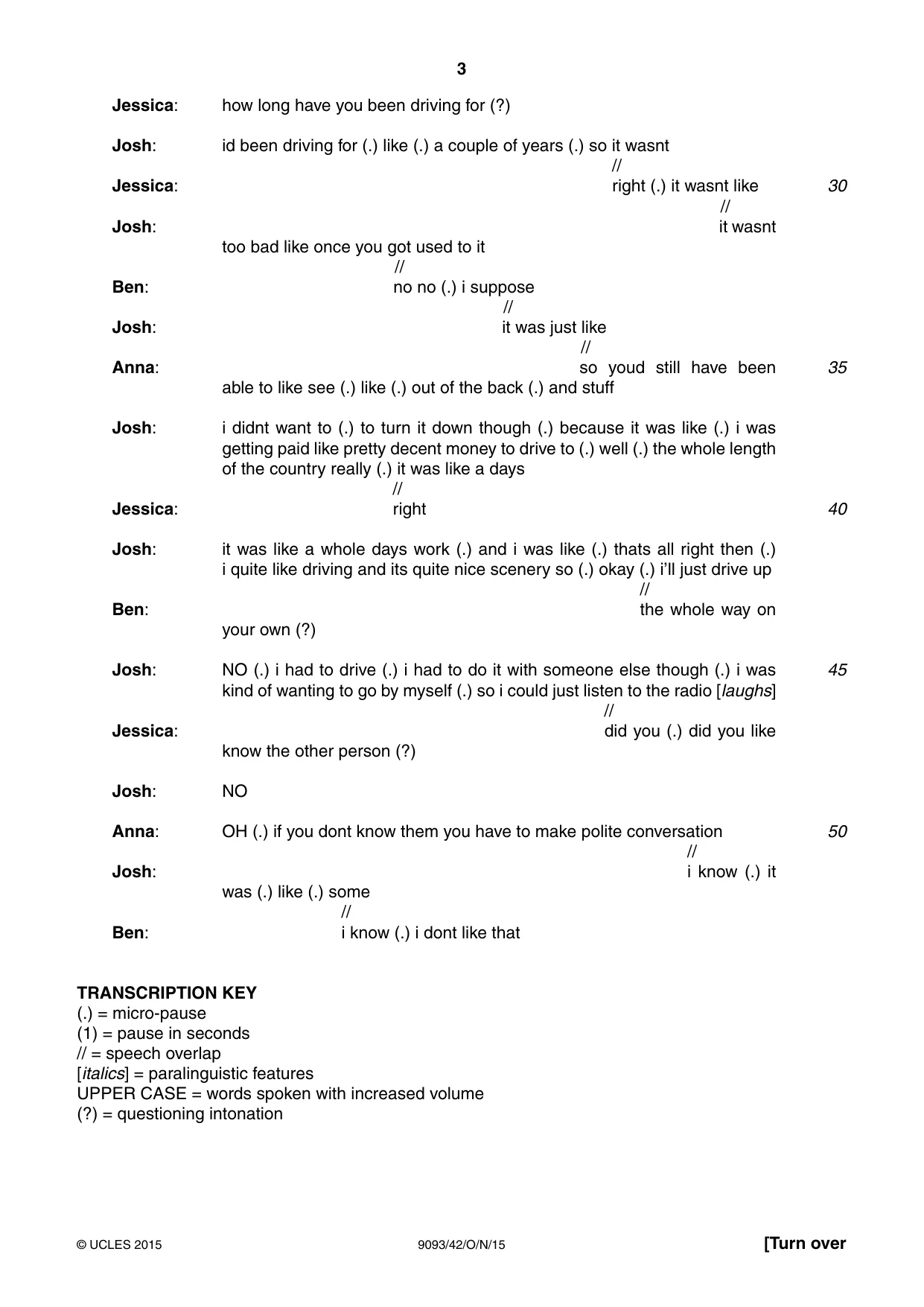
Question paper, page 3
3 9093/42/O/N/15 © UCLES 2015 [Turn over Jessica: how long have you been driving for (?) Josh: id been driving for (.) like (.) a couple of years (.) so it wasnt // Jessica: right (.) it wasnt like // Josh: it wasnt too bad like once you got used to it // Ben: no no (.) i suppose // Josh: it was just like // Anna: so youd still have been able to like see (.) like (.) out of the back (.) and stuff Josh: i didnt want to (.) to turn it down though (.) because it was like (.) i was getting paid like pretty decent money to drive to (.) well (.) the whole length of the country really (.) it was like a days // Jessica: right Josh: it was like a whole days work (.) and i was like (.) thats all right then (.) i quite like driving and its quite nice scenery so (.) okay (.) i’ll just drive up // Ben: the whole way on your own (?) Josh: NO (.) i had to drive (.) i had to do it with someone else though (.) i was kind of wanting to go by myself (.) so i could just listen to the radio [laughs] // Jessica: did you (.) did you like know the other person (?) Josh: NO Anna: OH (.) if you dont know them you have to make polite conversation // Josh: i know (.) it was (.) like (.) some // Ben: i know (.) i dont like that TRANSCRIPTION KEY (.) = micro-pause (1) = pause in seconds // = speech overlap [italics] = paralinguistic features UPPER CASE = words spoken with increased volume (?) = questioning intonation 30 35 40 45 50
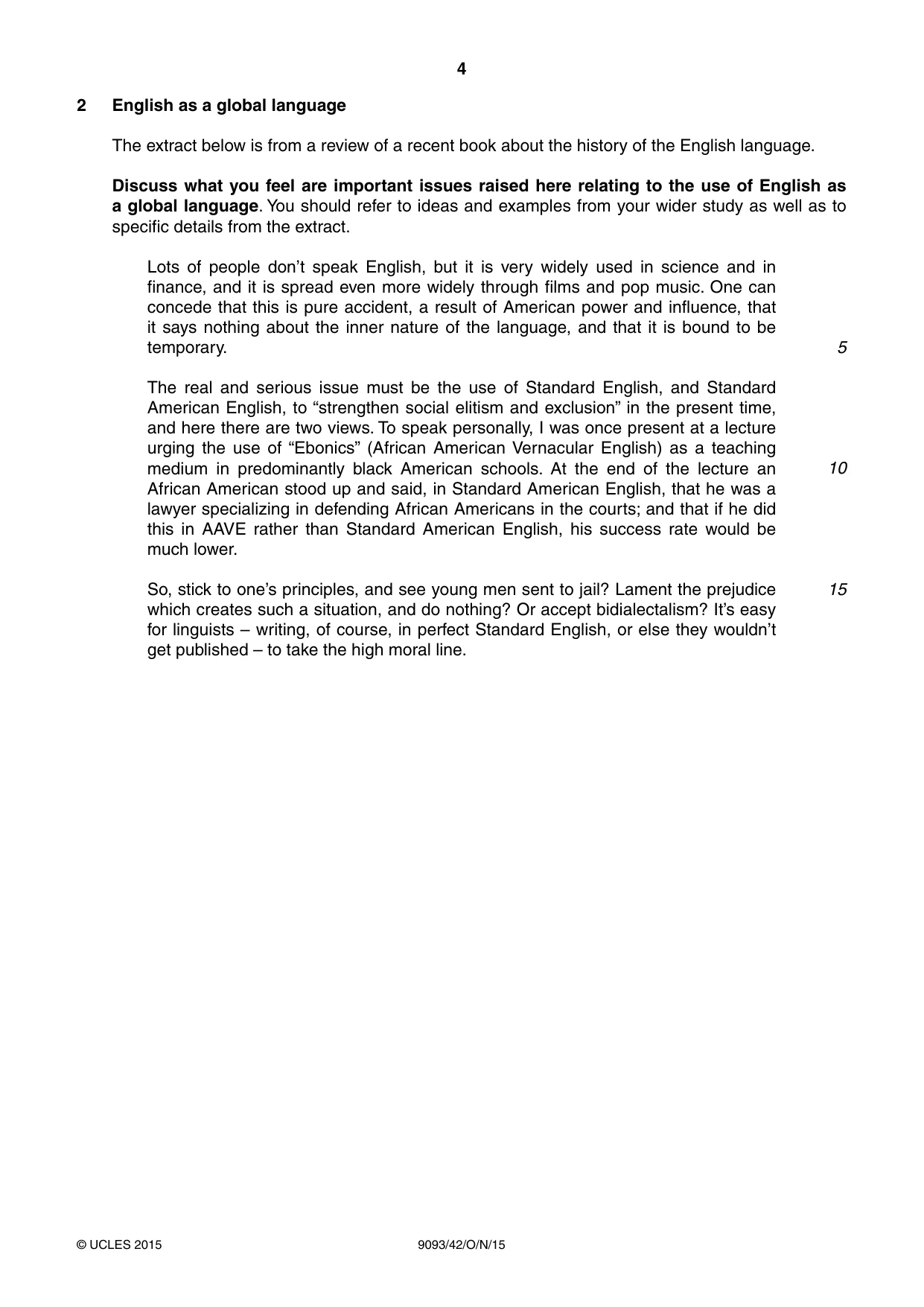
Question paper, page 4
4 9093/42/O/N/15 © UCLES 2015 2 English as a global language The extract below is from a review of a recent book about the history of the English language. Discuss what you feel are important issues raised here relating to the use of English as a global language. You should refer to ideas and examples from your wider study as well as to specific details from the extract. Lots of people don’t speak English, but it is very widely used in science and in finance, and it is spread even more widely through films and pop music. One can concede that this is pure accident, a result of American power and influence, that it says nothing about the inner nature of the language, and that it is bound to be temporary. The real and serious issue must be the use of Standard English, and Standard American English, to “strengthen social elitism and exclusion” in the present time, and here there are two views. To speak personally, I was once present at a lecture urging the use of “Ebonics” (African American Vernacular English) as a teaching medium in predominantly black American schools. At the end of the lecture an African American stood up and said, in Standard American English, that he was a lawyer specializing in defending African Americans in the courts; and that if he did this in AAVE rather than Standard American English, his success rate would be much lower. So, stick to one’s principles, and see young men sent to jail? Lament the prejudice which creates such a situation, and do nothing? Or accept bidialectalism? It’s easy for linguists – writing, of course, in perfect Standard English, or else they wouldn’t get published – to take the high moral line. 5 10 15
Question paper, page 5
5 9093/42/O/N/15 © UCLES 2015 [Turn over TURN OVER FOR QUESTION 3.
Question paper, page 6
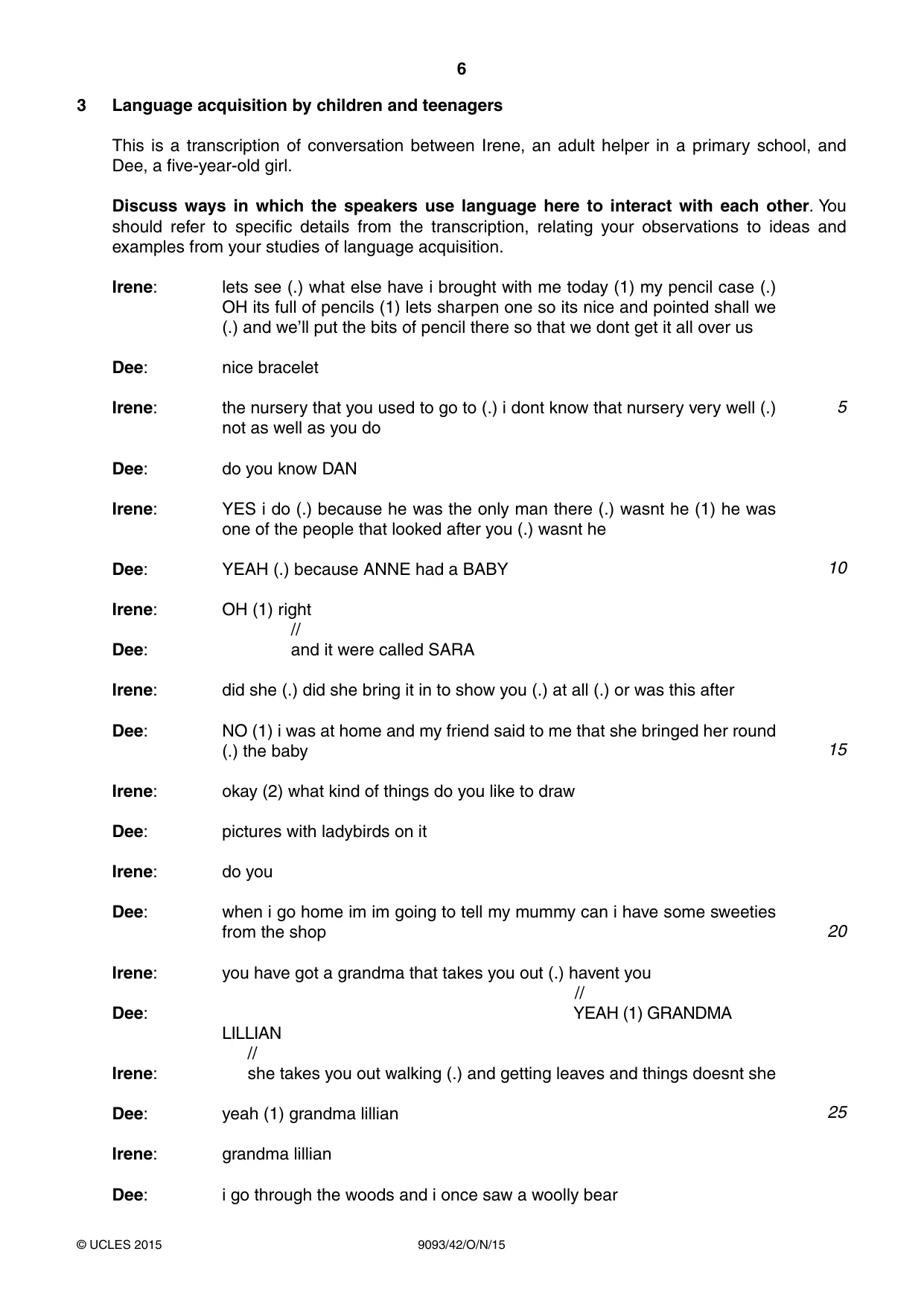
6 9093/42/O/N/15 © UCLES 2015 3 Language acquisition by children and teenagers This is a transcription of conversation between Irene, an adult helper in a primary school, and Dee, a five-year-old girl. Discuss ways in which the speakers use language here to interact with each other. You should refer to specific details from the transcription, relating your observations to ideas and examples from your studies of language acquisition. Irene: lets see (.) what else have i brought with me today (1) my pencil case (.) OH its full of pencils (1) lets sharpen one so its nice and pointed shall we (.) and we’ll put the bits of pencil there so that we dont get it all over us Dee: nice bracelet Irene: the nursery that you used to go to (.) i dont know that nursery very well (.) not as well as you do Dee: do you know DAN Irene: YES i do (.) because he was the only man there (.) wasnt he (1) he was one of the people that looked after you (.) wasnt he Dee: YEAH (.) because ANNE had a BABY Irene: OH (1) right // Dee: and it were called SARA Irene: did she (.) did she bring it in to show you (.) at all (.) or was this after Dee: NO (1) i was at home and my friend said to me that she bringed her round (.) the baby Irene: okay (2) what kind of things do you like to draw Dee: pictures with ladybirds on it Irene: do you Dee: when i go home im im going to tell my mummy can i have some sweeties from the shop Irene: you have got a grandma that takes you out (.) havent you // Dee: YEAH (1) GRANDMA LILLIAN // Irene: she takes you out walking (.) and getting leaves and things doesnt she Dee: yeah (1) grandma lillian Irene: grandma lillian Dee: i go through the woods and i once saw a woolly bear 5 10 15 20 25
Question paper, page 7
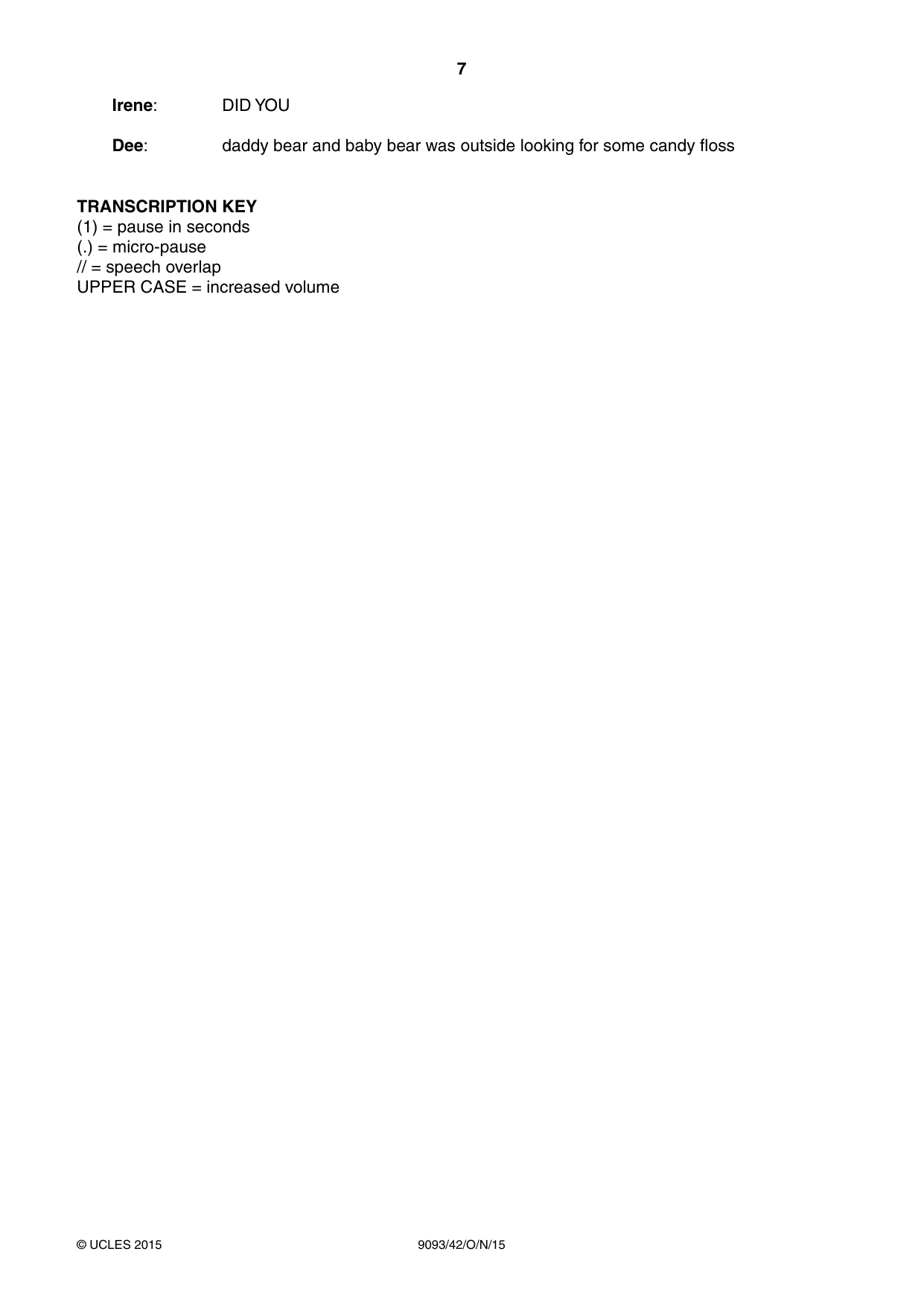
7 9093/42/O/N/15 © UCLES 2015 Irene: DID YOU Dee: daddy bear and baby bear was outside looking for some candy floss TRANSCRIPTION KEY (1) = pause in seconds (.) = micro-pause // = speech overlap UPPER CASE = increased volume
Question paper, page 8
8 9093/42/O/N/15 © UCLES 2015 BLANK PAGE Permission to reproduce items where third-party owned material protected by copyright is included has been sought and cleared where possible. Every reasonable effort has been made by the publisher (UCLES) to trace copyright holders, but if any items requiring clearance have unwittingly been included, the publisher will be pleased to make amends at the earliest possible opportunity. To avoid the issue of disclosure of answer-related information to candidates, all copyright acknowledgements are reproduced online in the Cambridge International Examinations Copyright Acknowledgements Booklet. This is produced for each series of examinations and is freely available to download at www.cie.org.uk after the live examination series. Cambridge International Examinations is part of the Cambridge Assessment Group. Cambridge Assessment is the brand name of University of Cambridge Local Examinations Syndicate (UCLES), which is itself a department of the University of Cambridge.
Mark scheme, page 1
® IGCSE is the registered trademark of Cambridge International Examinations. CAMBRIDGE INTERNATIONAL EXAMINATIONS Cambridge International Advanced Level MARK SCHEME for the October/November 2015 series 9093 ENGLISH LANGUAGE 9093/42 Paper 4 (Language Topics), maximum raw mark 50 This mark scheme is published as an aid to teachers and candidates, to indicate the requirements of the examination. It shows the basis on which Examiners were instructed to award marks. It does not indicate the details of the discussions that took place at an Examiners’ meeting before marking began, which would have considered the acceptability of alternative answers. Mark schemes should be read in conjunction with the question paper and the Principal Examiner Report for Teachers. Cambridge will not enter into discussions about these mark schemes. Cambridge is publishing the mark schemes for the October/November 2015 series for most Cambridge IGCSE®, Cambridge International A and AS Level components and some Cambridge O Level components.
Mark scheme, page 2
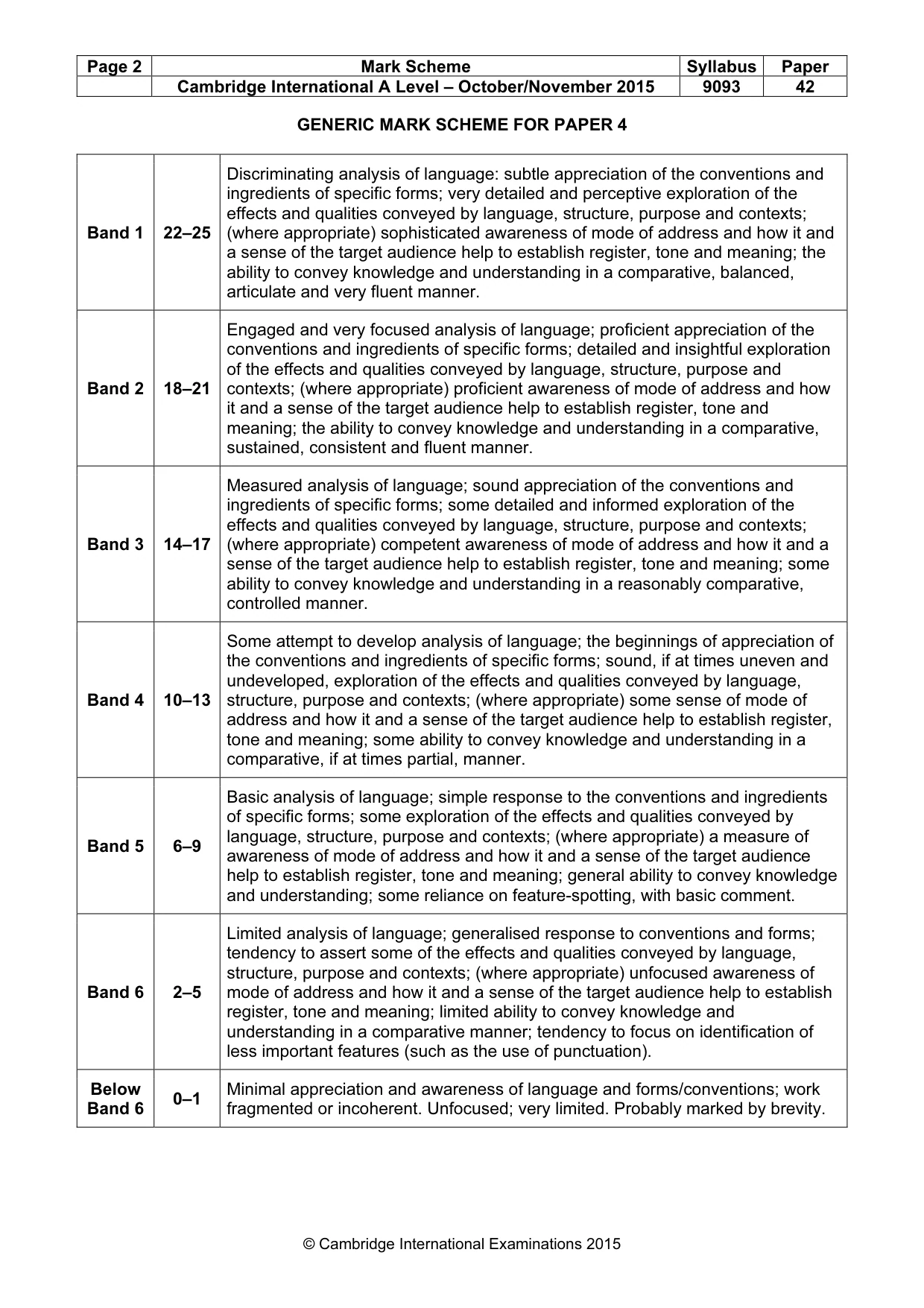
Page 2 Mark Scheme Syllabus Paper Cambridge International A Level – October/November 2015 9093 42 © Cambridge International Examinations 2015 GENERIC MARK SCHEME FOR PAPER 4 Band 1 22–25 Discriminating analysis of language: subtle appreciation of the conventions and ingredients of specific forms; very detailed and perceptive exploration of the effects and qualities conveyed by language, structure, purpose and contexts; (where appropriate) sophisticated awareness of mode of address and how it and a sense of the target audience help to establish register, tone and meaning; the ability to convey knowledge and understanding in a comparative, balanced, articulate and very fluent manner. Band 2 18–21 Engaged and very focused analysis of language; proficient appreciation of the conventions and ingredients of specific forms; detailed and insightful exploration of the effects and qualities conveyed by language, structure, purpose and contexts; (where appropriate) proficient awareness of mode of address and how it and a sense of the target audience help to establish register, tone and meaning; the ability to convey knowledge and understanding in a comparative, sustained, consistent and fluent manner. Band 3 14–17 Measured analysis of language; sound appreciation of the conventions and ingredients of specific forms; some detailed and informed exploration of the effects and qualities conveyed by language, structure, purpose and contexts; (where appropriate) competent awareness of mode of address and how it and a sense of the target audience help to establish register, tone and meaning; some ability to convey knowledge and understanding in a reasonably comparative, controlled manner. Band 4 10–13 Some attempt to develop analysis of language; the beginnings of appreciation of the conventions and ingredients of specific forms; sound, if at times uneven and undeveloped, exploration of the effects and qualities conveyed by language, structure, purpose and contexts; (where appropriate) some sense of mode of address and how it and a sense of the target audience help to establish register, tone and meaning; some ability to convey knowledge and understanding in a comparative, if at times partial, manner. Band 5 6–9 Basic analysis of language; simple response to the conventions and ingredients of specific forms; some exploration of the effects and qualities conveyed by language, structure, purpose and contexts; (where appropriate) a measure of awareness of mode of address and how it and a sense of the target audience help to establish register, tone and meaning; general ability to convey knowledge and understanding; some reliance on feature-spotting, with basic comment. Band 6 2–5 Limited analysis of language; generalised response to conventions and forms; tendency to assert some of the effects and qualities conveyed by language, structure, purpose and contexts; (where appropriate) unfocused awareness of mode of address and how it and a sense of the target audience help to establish register, tone and meaning; limited ability to convey knowledge and understanding in a comparative manner; tendency to focus on identification of less important features (such as the use of punctuation). Below Band 6 0–1 Minimal appreciation and awareness of language and forms/conventions; work fragmented or incoherent. Unfocused; very limited. Probably marked by brevity.
What you needed in this session
Cambridge’s own grade thresholds for 2015 Oct/Nov, Paper 4 · Variant 2. A higher threshold means an easier paper — the bar moves with how the cohort did.