Cambridge A Level English - Language AS and A Level (from 2014) 9093 — 2015 Oct/Nov Paper 4 · Variant 3
9093/43/O/N/15 · 50 marks · ≈56 min
The question paper and its mark scheme, free to read here and free to download. This is Cambridge’s own paper, exactly as it was sat.
Question paper8 pages

Mark scheme2 pages
Answers below. Sit the paper first if you are practising.
Paper as text
Question paper, page 1
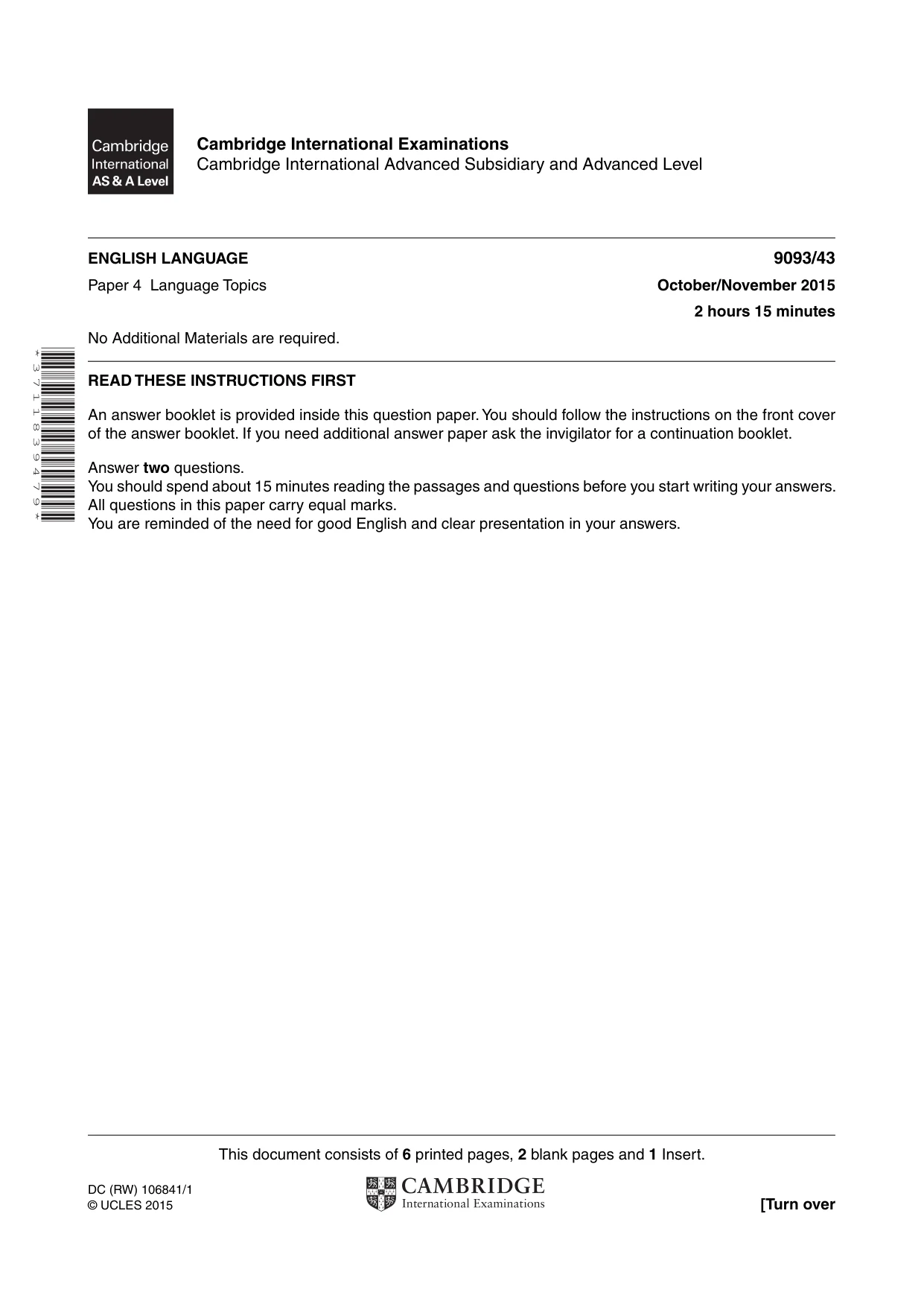
This document consists of 6 printed pages, 2 blank pages and 1 Insert. DC (RW) 106841/1 © UCLES 2015 [Turn over Cambridge International Examinations Cambridge International Advanced Subsidiary and Advanced Level * 3 7 1 1 8 3 9 4 7 9 * ENGLISH LANGUAGE 9093/43 Paper 4 Language Topics October/November 2015 2 hours 15 minutes No Additional Materials are required. READ THESE INSTRUCTIONS FIRST An answer booklet is provided inside this question paper. You should follow the instructions on the front cover of the answer booklet. If you need additional answer paper ask the invigilator for a continuation booklet. Answer two questions. You should spend about 15 minutes reading the passages and questions before you start writing your answers. All questions in this paper carry equal marks. You are reminded of the need for good English and clear presentation in your answers.
Question paper, page 2
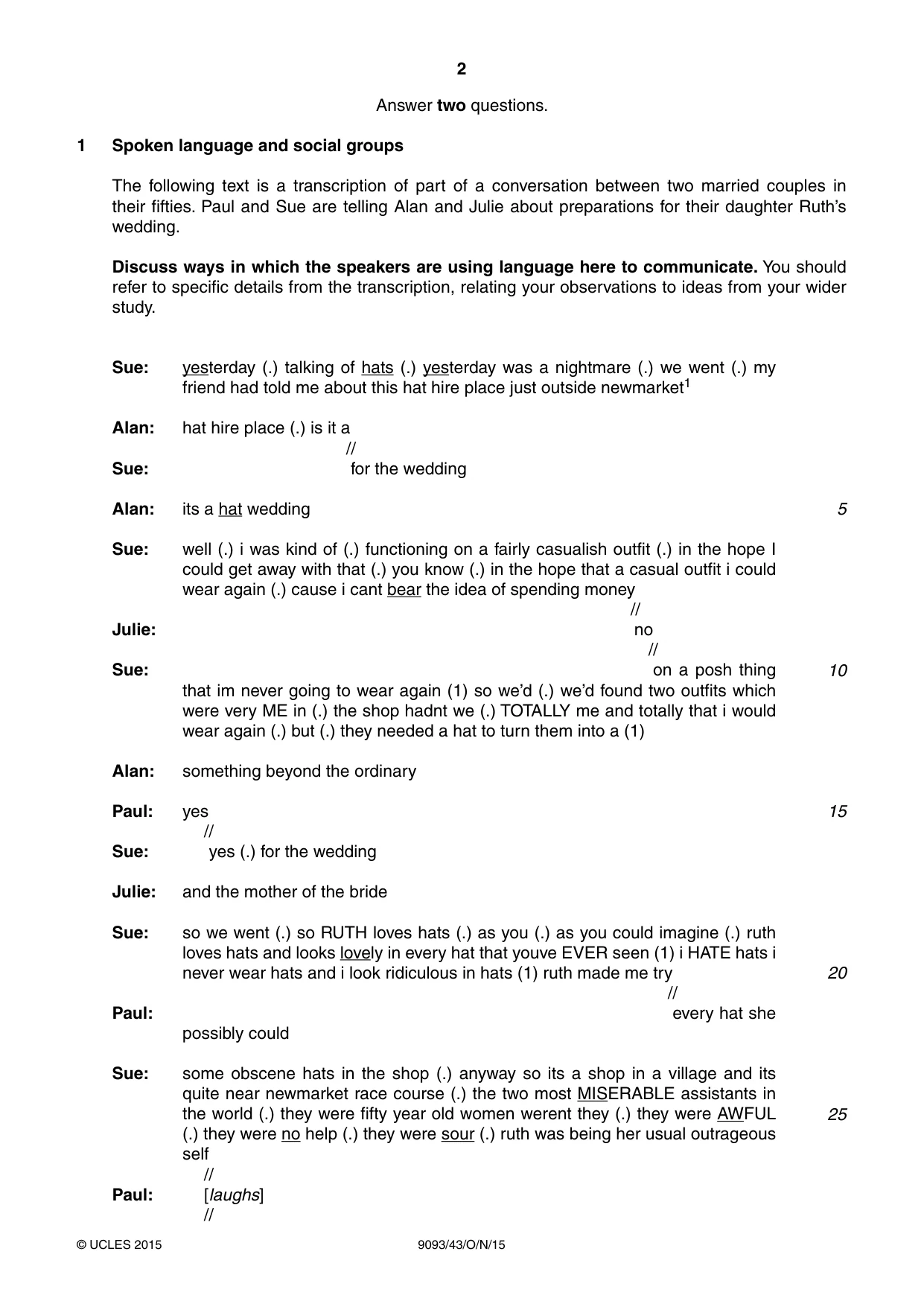
2 9093/43/O/N/15 © UCLES 2015 Answer two questions. 1 Spoken language and social groups The following text is a transcription of part of a conversation between two married couples in their fifties. Paul and Sue are telling Alan and Julie about preparations for their daughter Ruth’s wedding. Discuss ways in which the speakers are using language here to communicate. You should refer to specific details from the transcription, relating your observations to ideas from your wider study. Sue: yesterday (.) talking of hats (.) yesterday was a nightmare (.) we went (.) my friend had told me about this hat hire place just outside newmarket1 Alan: hat hire place (.) is it a // Sue: for the wedding Alan: its a hat wedding Sue: well (.) i was kind of (.) functioning on a fairly casualish outfit (.) in the hope I could get away with that (.) you know (.) in the hope that a casual outfit i could wear again (.) cause i cant bear the idea of spending money // Julie: no // Sue: on a posh thing that im never going to wear again (1) so we’d (.) we’d found two outfits which were very ME in (.) the shop hadnt we (.) TOTALLY me and totally that i would wear again (.) but (.) they needed a hat to turn them into a (1) Alan: something beyond the ordinary Paul: yes // Sue: yes (.) for the wedding Julie: and the mother of the bride Sue: so we went (.) so RUTH loves hats (.) as you (.) as you could imagine (.) ruth loves hats and looks lovely in every hat that youve EVER seen (1) i HATE hats i never wear hats and i look ridiculous in hats (1) ruth made me try // Paul: every hat she possibly could Sue: some obscene hats in the shop (.) anyway so its a shop in a village and its quite near newmarket race course (.) the two most MISERABLE assistants in the world (.) they were fifty year old women werent they (.) they were AWFUL (.) they were no help (.) they were sour (.) ruth was being her usual outrageous self // Paul: [laughs] // 5 10 15 20 25
Question paper, page 3
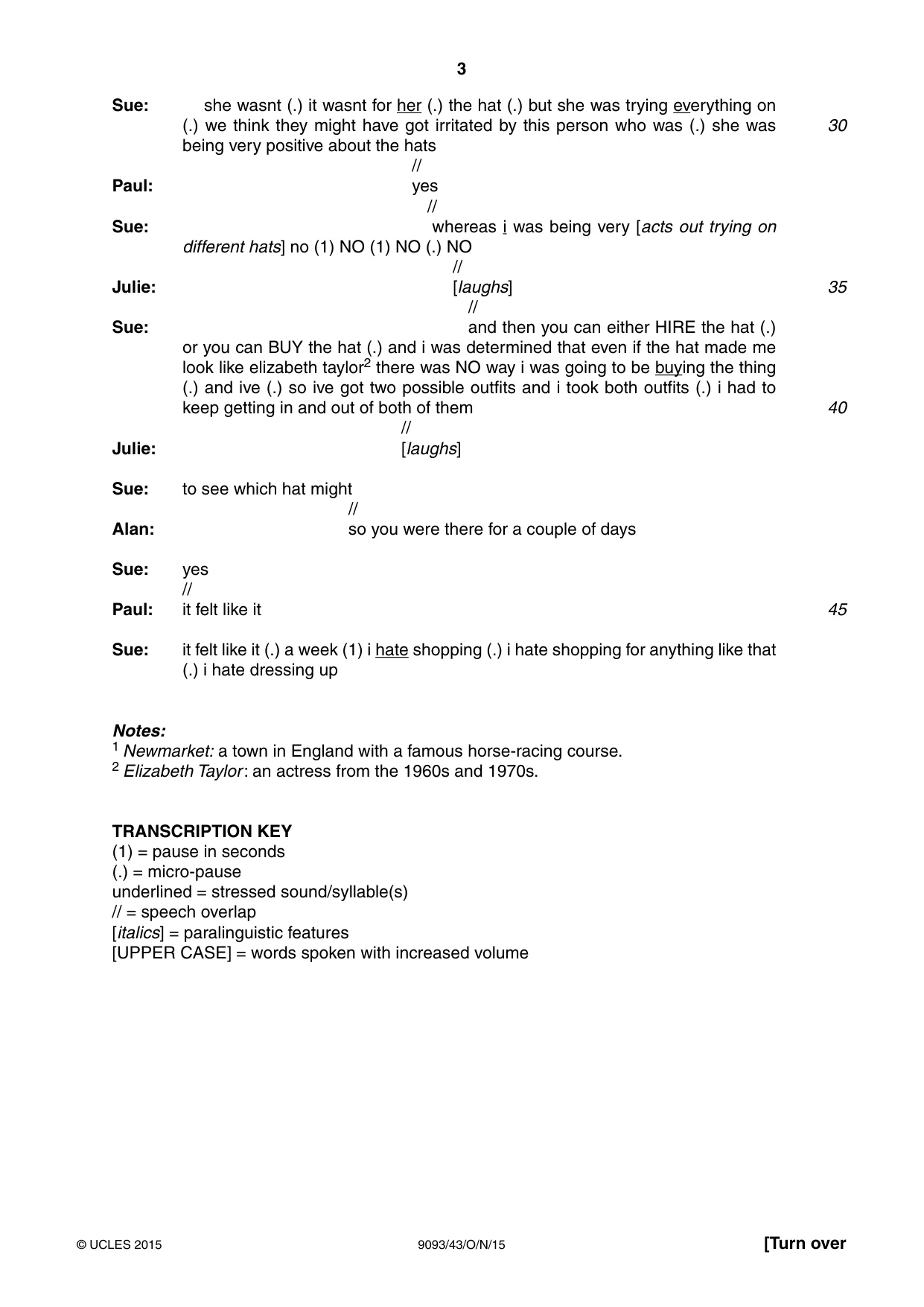
3 9093/43/O/N/15 © UCLES 2015 [Turn over Sue: she wasnt (.) it wasnt for her (.) the hat (.) but she was trying everything on (.) we think they might have got irritated by this person who was (.) she was being very positive about the hats // Paul: yes // Sue: whereas i was being very [acts out trying on different hats] no (1) NO (1) NO (.) NO // Julie: [laughs] // Sue: and then you can either HIRE the hat (.) or you can BUY the hat (.) and i was determined that even if the hat made me look like elizabeth taylor2 there was NO way i was going to be buying the thing (.) and ive (.) so ive got two possible outfits and i took both outfits (.) i had to keep getting in and out of both of them // Julie: [laughs] Sue: to see which hat might // Alan: so you were there for a couple of days Sue: yes // Paul: it felt like it Sue: it felt like it (.) a week (1) i hate shopping (.) i hate shopping for anything like that (.) i hate dressing up Notes: 1 Newmarket: a town in England with a famous horse-racing course. 2 Elizabeth Taylor : an actress from the 1960s and 1970s. TRANSCRIPTION KEY (1) = pause in seconds (.) = micro-pause underlined = stressed sound/syllable(s) // = speech overlap [italics] = paralinguistic features [UPPER CASE] = words spoken with increased volume 30 35 40 45
Question paper, page 4
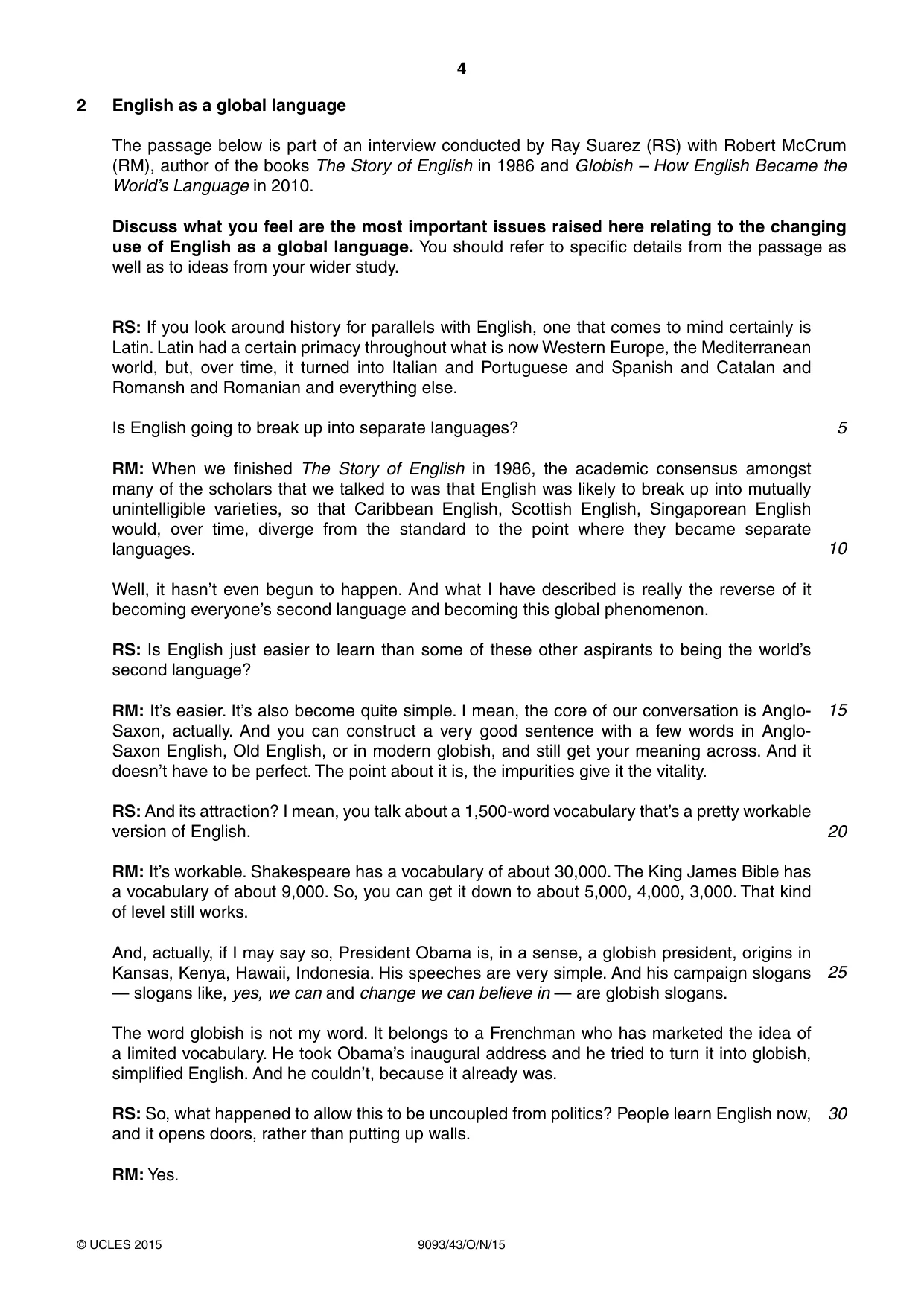
4 9093/43/O/N/15 © UCLES 2015 2 English as a global language The passage below is part of an interview conducted by Ray Suarez (RS) with Robert McCrum (RM), author of the books The Story of English in 1986 and Globish – How English Became the World’s Language in 2010. Discuss what you feel are the most important issues raised here relating to the changing use of English as a global language. You should refer to specific details from the passage as well as to ideas from your wider study. RS: If you look around history for parallels with English, one that comes to mind certainly is Latin. Latin had a certain primacy throughout what is now Western Europe, the Mediterranean world, but, over time, it turned into Italian and Portuguese and Spanish and Catalan and Romansh and Romanian and everything else. Is English going to break up into separate languages? RM: When we finished The Story of English in 1986, the academic consensus amongst many of the scholars that we talked to was that English was likely to break up into mutually unintelligible varieties, so that Caribbean English, Scottish English, Singaporean English would, over time, diverge from the standard to the point where they became separate languages. Well, it hasn’t even begun to happen. And what I have described is really the reverse of it becoming everyone’s second language and becoming this global phenomenon. RS: Is English just easier to learn than some of these other aspirants to being the world’s second language? RM: It’s easier. It’s also become quite simple. I mean, the core of our conversation is Anglo- Saxon, actually. And you can construct a very good sentence with a few words in Anglo- Saxon English, Old English, or in modern globish, and still get your meaning across. And it doesn’t have to be perfect. The point about it is, the impurities give it the vitality. RS: And its attraction? I mean, you talk about a 1,500-word vocabulary that’s a pretty workable version of English. RM: It’s workable. Shakespeare has a vocabulary of about 30,000. The King James Bible has a vocabulary of about 9,000. So, you can get it down to about 5,000, 4,000, 3,000. That kind of level still works. And, actually, if I may say so, President Obama is, in a sense, a globish president, origins in Kansas, Kenya, Hawaii, Indonesia. His speeches are very simple. And his campaign slogans — slogans like, yes, we can and change we can believe in — are globish slogans. The word globish is not my word. It belongs to a Frenchman who has marketed the idea of a limited vocabulary. He took Obama’s inaugural address and he tried to turn it into globish, simplified English. And he couldn’t, because it already was. RS: So, what happened to allow this to be uncoupled from politics? People learn English now, and it opens doors, rather than putting up walls. RM: Yes. 5 10 15 20 25 30
Question paper, page 5
5 9093/43/O/N/15 © UCLES 2015 [Turn over BLANK PAGE
Question paper, page 6
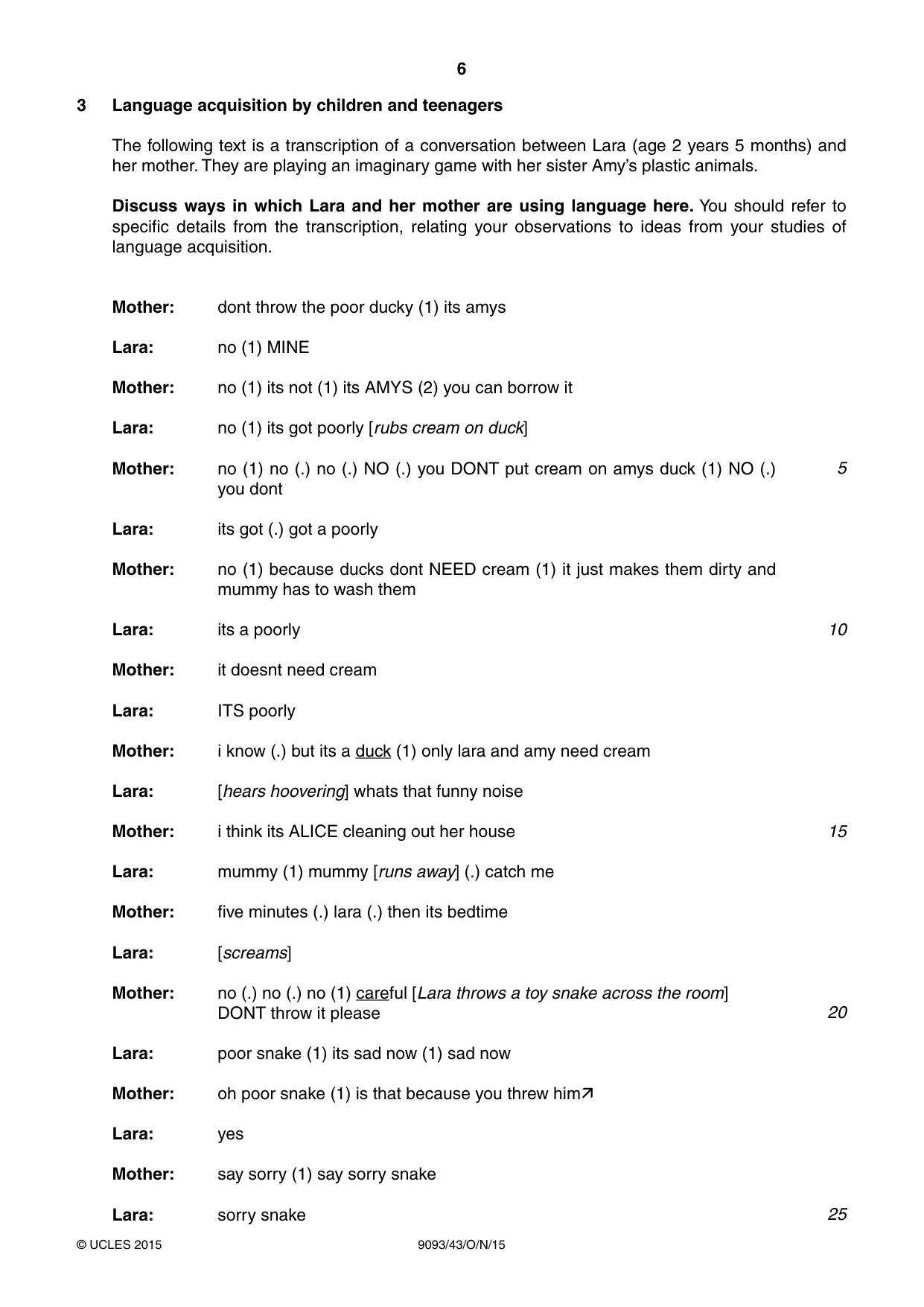
6 9093/43/O/N/15 © UCLES 2015 3 Language acquisition b y children and teenagers The following text is a transcription of a conversation between Lara (age 2 years 5 months) and her mother. They are playing an imaginary game with her sister Amy’s plastic animals. Discuss ways in which Lara and her mother are using language here. You should refer to specific details from the transcription, relating your observations to ideas from your studies of language acquisition. Mother: dont throw the poor ducky (1) its amys Lara: no (1) MINE Mother: no (1) its not (1) its AMYS (2) you can borrow it Lara: no (1) its got poorly [rubs cream on duck] Mother: no (1) no (.) no (.) NO (.) you DONT put cream on amys duck (1) NO (.) you dont Lara: its got (.) got a poorly Mother: no (1) because ducks dont NEED cream (1) it just makes them dirty and mummy has to wash them Lara: its a poorly Mother: it doesnt need cream Lara: ITS poorly Mother: i know (.) but its a duck (1) only lara and amy need cream Lara: [hears hoovering] whats that funny noise Mother: i think its ALICE cleaning out her house Lara: mummy (1) mummy [runs away] (.) catch me Mother: five minutes (.) lara (.) then its bedtime Lara: [screams] Mother: no (.) no (.) no (1) careful [Lara throws a toy snake across the room] DONT throw it please Lara: poor snake (1) its sad now (1) sad now Mother: oh poor snake (1) is that because you threw him Lara: yes Mother: say sorry (1) say sorry snake Lara: sorry snake 5 10 15 20 25
Question paper, page 7
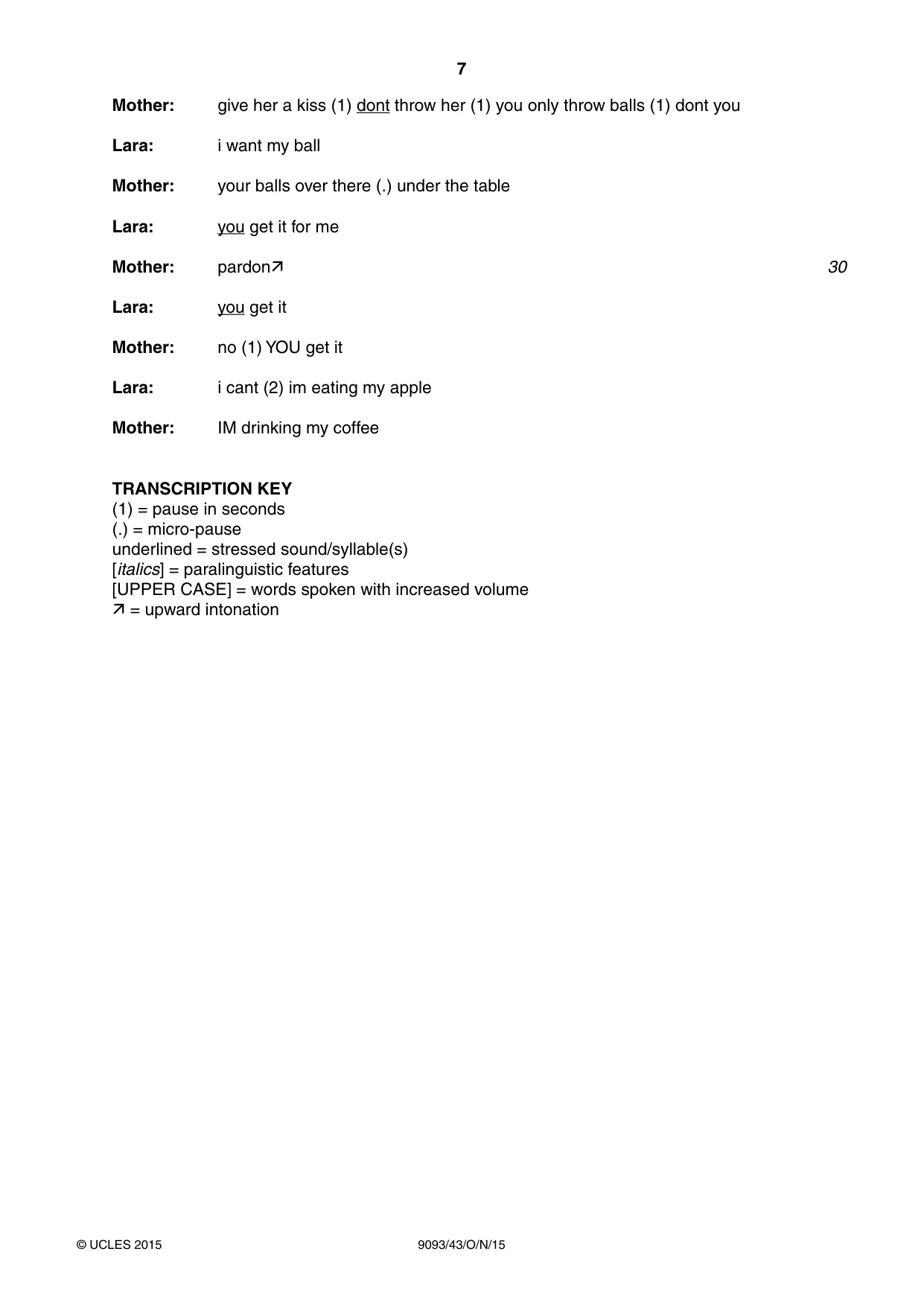
7 9093/43/O/N/15 © UCLES 2015 Mother: give her a kiss (1) dont throw her (1) you only throw balls (1) dont you Lara: i want my ball Mother: your balls over there (.) under the table Lara: you get it for me Mother: pardon Lara: you get it Mother: no (1) YOU get it Lara: i cant (2) im eating my apple Mother: IM drinking my coffee TRANSCRIPTION KEY (1) = pause in seconds (.) = micro-pause underlined = stressed sound/syllable(s) [italics] = paralinguistic features [UPPER CASE] = words spoken with increased volume = upward intonation 30
Question paper, page 8
8 9093/43/O/N/15 © UCLES 2015 BLANK PAGE Permission to reproduce items where third-party owned material protected by copyright is included has been sought and cleared where possible. Every reasonable effort has been made by the publisher (UCLES) to trace copyright holders, but if any items requiring clearance have unwittingly been included, the publisher will be pleased to make amends at the earliest possible opportunity. To avoid the issue of disclosure of answer-related information to candidates, all copyright acknowledgements are reproduced online in the Cambridge International Examinations Copyright Acknowledgements Booklet. This is produced for each series of examinations and is freely available to download at www.cie.org.uk after the live examination series. Cambridge International Examinations is part of the Cambridge Assessment Group. Cambridge Assessment is the brand name of University of Cambridge Local Examinations Syndicate (UCLES), which is itself a department of the University of Cambridge.
Mark scheme, page 1
® IGCSE is the registered trademark of Cambridge International Examinations. CAMBRIDGE INTERNATIONAL EXAMINATIONS Cambridge International Advanced Level MARK SCHEME for the October/November 2015 series 9093 ENGLISH LANGUAGE 9093/43 Paper 4 (Language Topics), maximum raw mark 50 This mark scheme is published as an aid to teachers and candidates, to indicate the requirements of the examination. It shows the basis on which Examiners were instructed to award marks. It does not indicate the details of the discussions that took place at an Examiners’ meeting before marking began, which would have considered the acceptability of alternative answers. Mark schemes should be read in conjunction with the question paper and the Principal Examiner Report for Teachers. Cambridge will not enter into discussions about these mark schemes. Cambridge is publishing the mark schemes for the October/November 2015 series for most Cambridge IGCSE®, Cambridge International A and AS Level components and some Cambridge O Level components.
Mark scheme, page 2
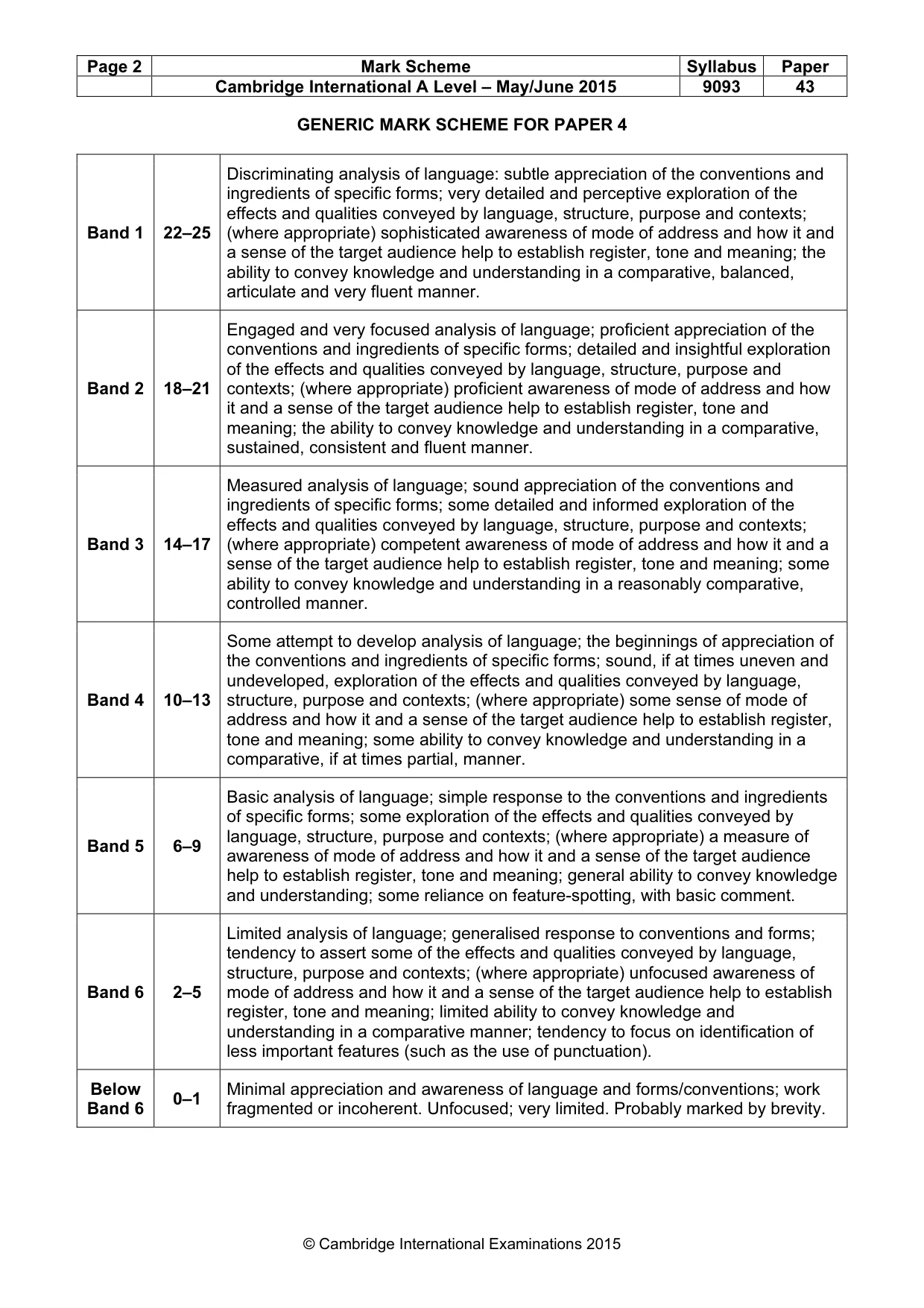
Page 2 Mark Scheme Syllabus Paper Cambridge International A Level – May/June 2015 9093 43 © Cambridge International Examinations 2015 GENERIC MARK SCHEME FOR PAPER 4 Band 1 22–25 Discriminating analysis of language: subtle appreciation of the conventions and ingredients of specific forms; very detailed and perceptive exploration of the effects and qualities conveyed by language, structure, purpose and contexts; (where appropriate) sophisticated awareness of mode of address and how it and a sense of the target audience help to establish register, tone and meaning; the ability to convey knowledge and understanding in a comparative, balanced, articulate and very fluent manner. Band 2 18–21 Engaged and very focused analysis of language; proficient appreciation of the conventions and ingredients of specific forms; detailed and insightful exploration of the effects and qualities conveyed by language, structure, purpose and contexts; (where appropriate) proficient awareness of mode of address and how it and a sense of the target audience help to establish register, tone and meaning; the ability to convey knowledge and understanding in a comparative, sustained, consistent and fluent manner. Band 3 14–17 Measured analysis of language; sound appreciation of the conventions and ingredients of specific forms; some detailed and informed exploration of the effects and qualities conveyed by language, structure, purpose and contexts; (where appropriate) competent awareness of mode of address and how it and a sense of the target audience help to establish register, tone and meaning; some ability to convey knowledge and understanding in a reasonably comparative, controlled manner. Band 4 10–13 Some attempt to develop analysis of language; the beginnings of appreciation of the conventions and ingredients of specific forms; sound, if at times uneven and undeveloped, exploration of the effects and qualities conveyed by language, structure, purpose and contexts; (where appropriate) some sense of mode of address and how it and a sense of the target audience help to establish register, tone and meaning; some ability to convey knowledge and understanding in a comparative, if at times partial, manner. Band 5 6–9 Basic analysis of language; simple response to the conventions and ingredients of specific forms; some exploration of the effects and qualities conveyed by language, structure, purpose and contexts; (where appropriate) a measure of awareness of mode of address and how it and a sense of the target audience help to establish register, tone and meaning; general ability to convey knowledge and understanding; some reliance on feature-spotting, with basic comment. Band 6 2–5 Limited analysis of language; generalised response to conventions and forms; tendency to assert some of the effects and qualities conveyed by language, structure, purpose and contexts; (where appropriate) unfocused awareness of mode of address and how it and a sense of the target audience help to establish register, tone and meaning; limited ability to convey knowledge and understanding in a comparative manner; tendency to focus on identification of less important features (such as the use of punctuation). Below Band 6 0–1 Minimal appreciation and awareness of language and forms/conventions; work fragmented or incoherent. Unfocused; very limited. Probably marked by brevity.
What you needed in this session
Cambridge’s own grade thresholds for 2015 Oct/Nov, Paper 4 · Variant 3. A higher threshold means an easier paper — the bar moves with how the cohort did.