Cambridge A Level English - Language AS and A Level (from 2014) 9093 — 2015 Oct/Nov Paper 1 · Variant 3
9093/13/O/N/15 · 50 marks · ≈56 min
The question paper and its mark scheme, free to read here and free to download. This is Cambridge’s own paper, exactly as it was sat.
Question paper8 pages

Mark scheme
No mark scheme is in the library for this paper.
Paper as text
Question paper, page 1
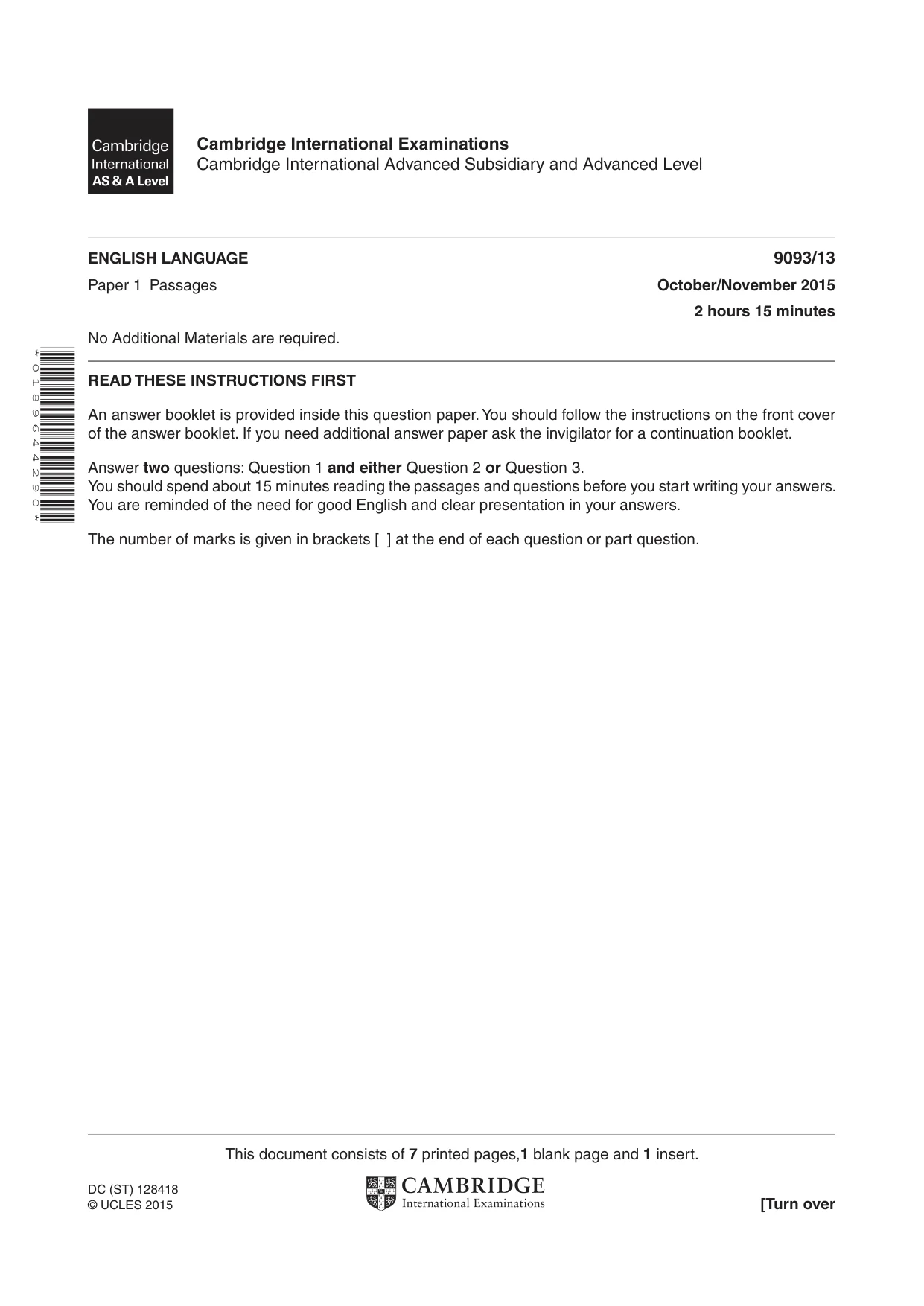
This document consists of 7 printed pages,1 blank page and 1 insert. DC (ST) 128418 © UCLES 2015 [Turn over Cambridge International Examinations Cambridge International Advanced Subsidiary and Advanced Level * 0 1 8 9 6 4 4 2 9 0 * ENGLISH LANGUAGE 9093/13 Paper 1 Passages October/November 2015 2 hours 15 minutes No Additional Materials are required. READ THESE INSTRUCTIONS FIRST An answer booklet is provided inside this question paper. You should follow the instructions on the front cover of the answer booklet. If you need additional answer paper ask the invigilator for a continuation booklet. Answer two questions: Question 1 and either Question 2 or Question 3. You should spend about 15 minutes reading the passages and questions before you start writing your answers. You are reminded of the need for good English and clear presentation in your answers. The number of marks is given in brackets [ ] at the end of each question or part question.
Question paper, page 2
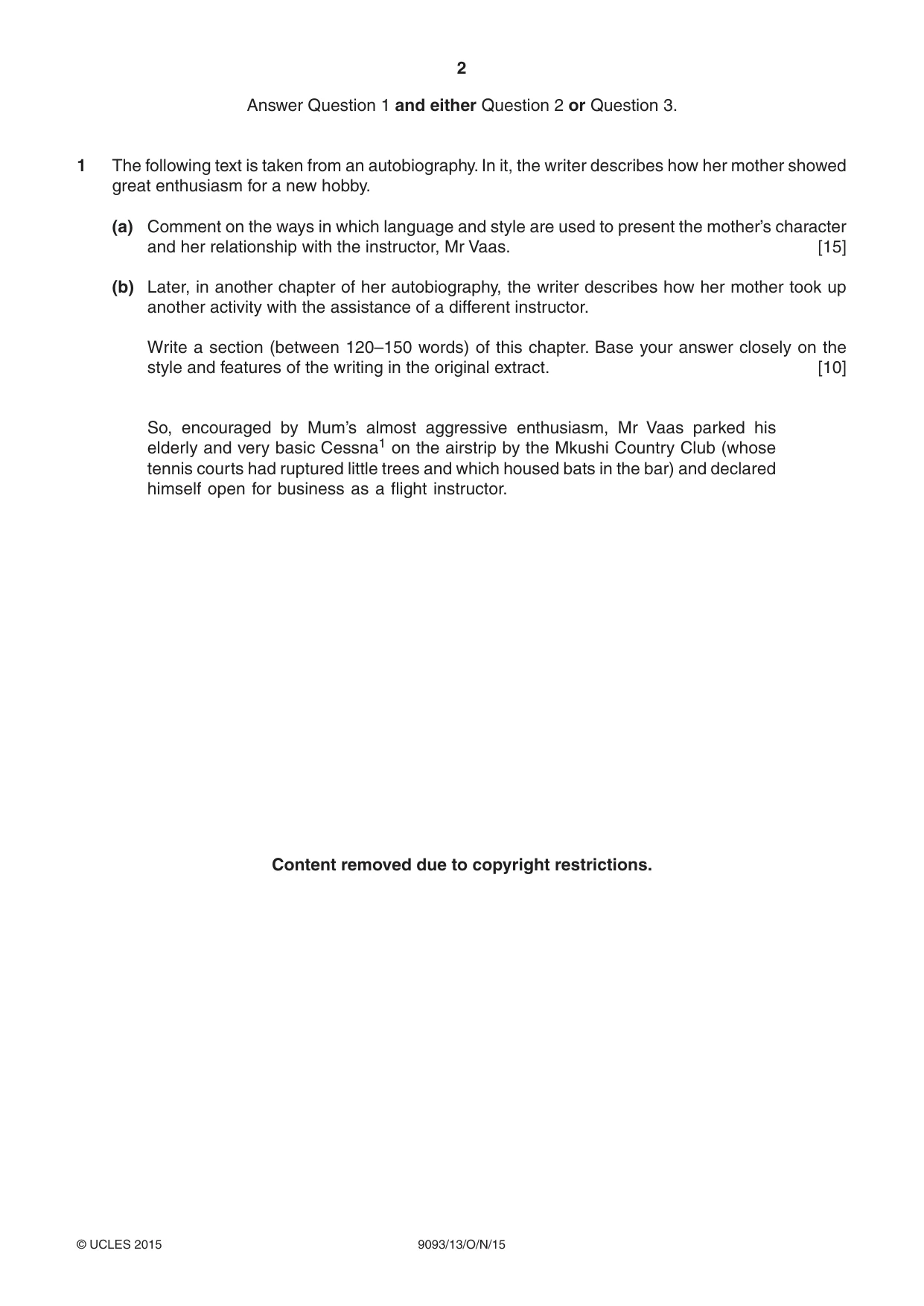
2 9093/13/O/N/15 © UCLES 2015 Answer Question 1 and either Question 2 or Question 3. 1 The following text is taken from an autobiography. In it, the writer describes how her mother showed great enthusiasm for a new hobby. (a) Comment on the ways in which language and style are used to present the mother’s character and her relationship with the instructor, Mr Vaas. [15] (b) Later, in another chapter of her autobiography, the writer describes how her mother took up another activity with the assistance of a different instructor. Write a section (between 120–150 words) of this chapter. Base your answer closely on the style and features of the writing in the original extract. [10] So, encouraged by Mum’s almost aggressive enthusiasm, Mr Vaas parked his elderly and very basic Cessna1 on the airstrip by the Mkushi Country Club (whose tennis courts had ruptured little trees and which housed bats in the bar) and declared himself open for business as a flight instructor. Content removed due to copyright restrictions.
Question paper, page 3
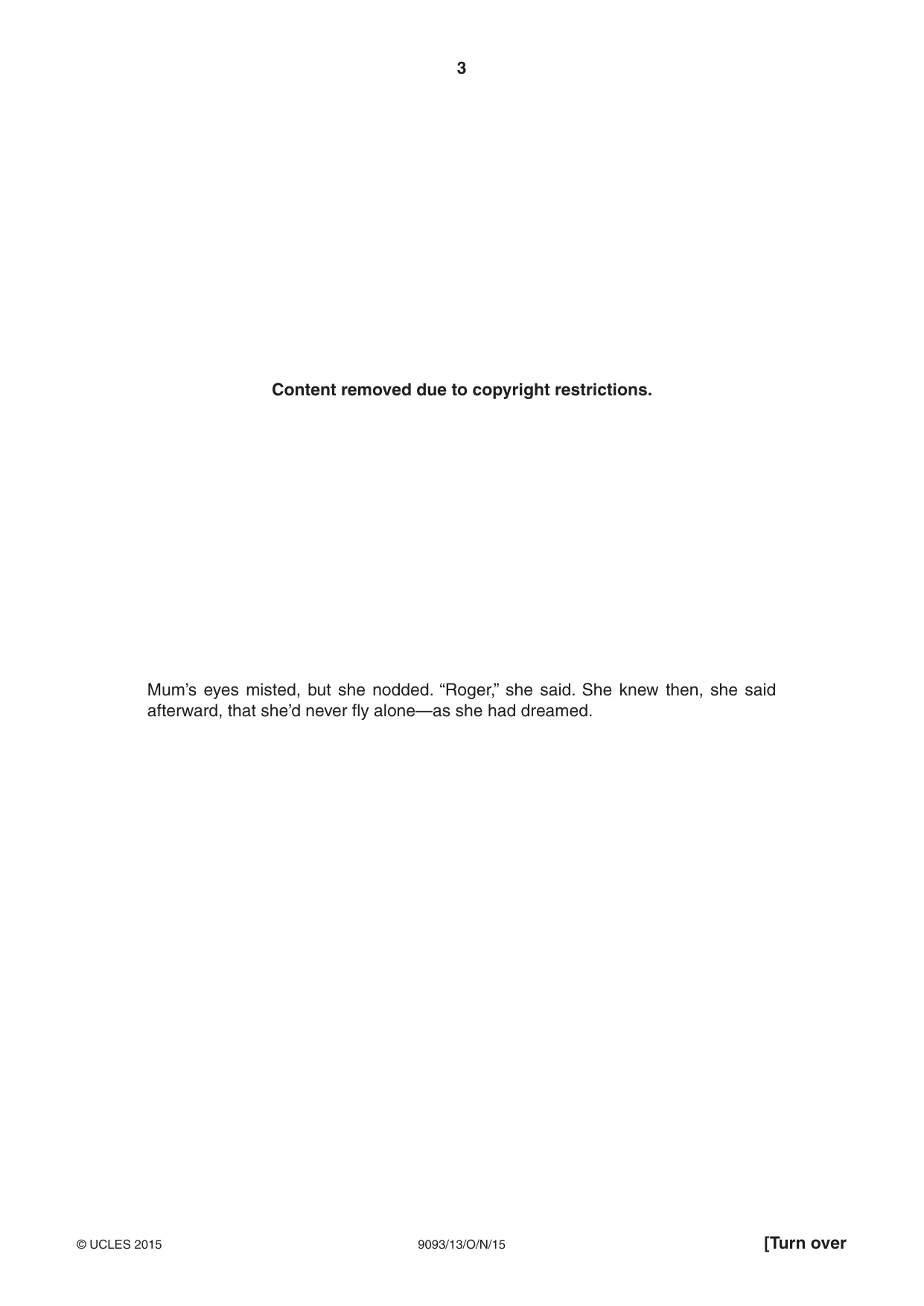
3 9093/13/O/N/15 © UCLES 2015 [Turn over Mum’s eyes misted, but she nodded. “Roger,” she said. She knew then, she said afterward, that she’d never fly alone—as she had dreamed. Content removed due to copyright restrictions.
Question paper, page 4
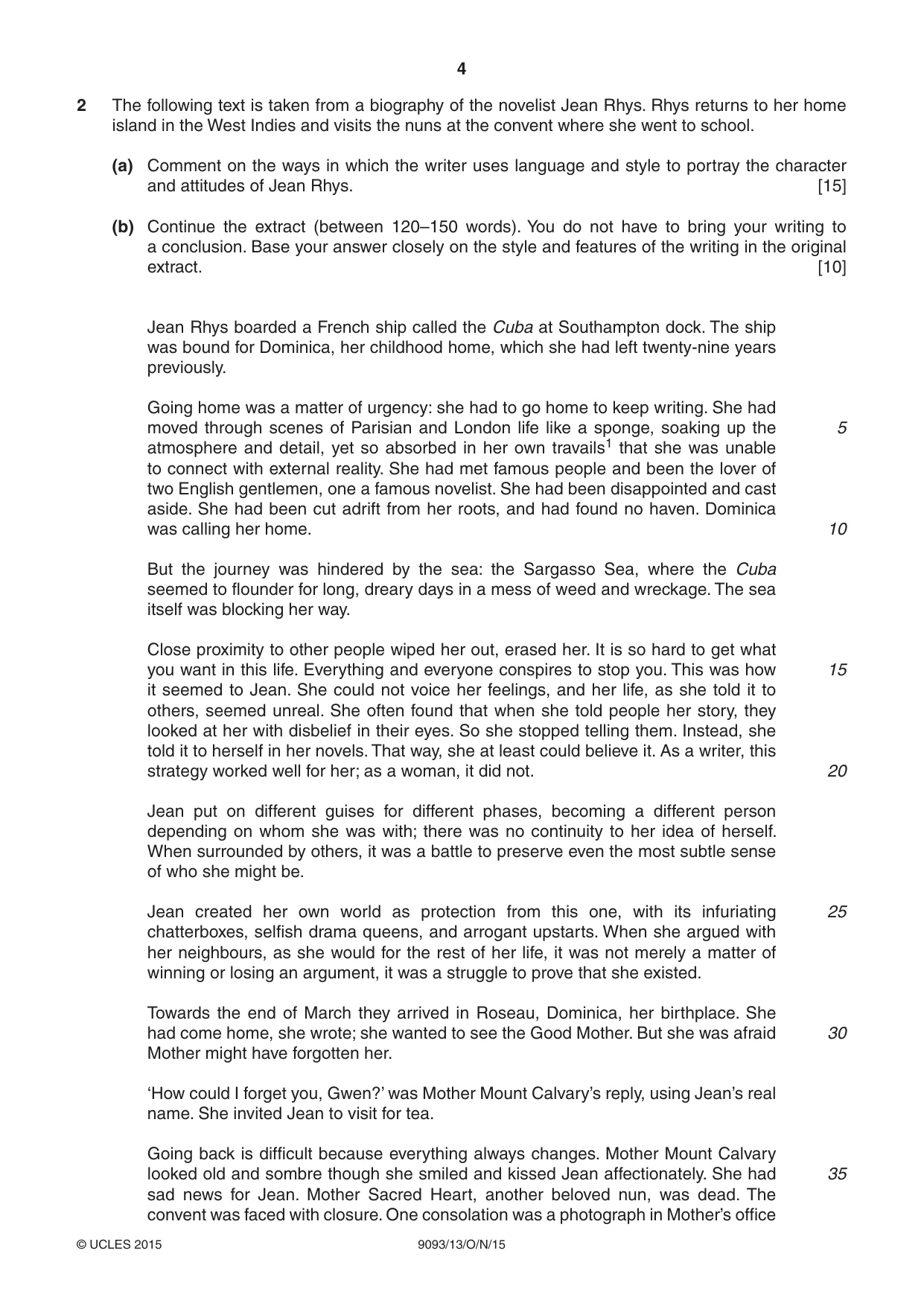
4 9093/13/O/N/15 © UCLES 2015 2 The following text is taken from a biography of the novelist Jean Rhys. Rhys returns to her home island in the West Indies and visits the nuns at the convent where she went to school. (a) Comment on the ways in which the writer uses language and style to portray the character and attitudes of Jean Rhys. [15] (b) Continue the extract (between 120–150 words). You do not have to bring your writing to a conclusion. Base your answer closely on the style and features of the writing in the original extract. [10] Jean Rhys boarded a French ship called the Cuba at Southampton dock. The ship was bound for Dominica, her childhood home, which she had left twenty-nine years previously. Going home was a matter of urgency: she had to go home to keep writing. She had moved through scenes of Parisian and London life like a sponge, soaking up the atmosphere and detail, yet so absorbed in her own travails1 that she was unable to connect with external reality. She had met famous people and been the lover of two English gentlemen, one a famous novelist. She had been disappointed and cast aside. She had been cut adrift from her roots, and had found no haven. Dominica was calling her home. But the journey was hindered by the sea: the Sargasso Sea, where the Cuba seemed to flounder for long, dreary days in a mess of weed and wreckage. The sea itself was blocking her way. Close proximity to other people wiped her out, erased her. It is so hard to get what you want in this life. Everything and everyone conspires to stop you. This was how it seemed to Jean. She could not voice her feelings, and her life, as she told it to others, seemed unreal. She often found that when she told people her story, they looked at her with disbelief in their eyes. So she stopped telling them. Instead, she told it to herself in her novels. That way, she at least could believe it. As a writer, this strategy worked well for her; as a woman, it did not. Jean put on different guises for different phases, becoming a different person depending on whom she was with; there was no continuity to her idea of herself. When surrounded by others, it was a battle to preserve even the most subtle sense of who she might be. Jean created her own world as protection from this one, with its infuriating chatterboxes, selfish drama queens, and arrogant upstarts. When she argued with her neighbours, as she would for the rest of her life, it was not merely a matter of winning or losing an argument, it was a struggle to prove that she existed. Towards the end of March they arrived in Roseau, Dominica, her birthplace. She had come home, she wrote; she wanted to see the Good Mother. But she was afraid Mother might have forgotten her. ‘How could I forget you, Gwen?’ was Mother Mount Calvary’s reply, using Jean’s real name. She invited Jean to visit for tea. Going back is difficult because everything always changes. Mother Mount Calvary looked old and sombre though she smiled and kissed Jean affectionately. She had sad news for Jean. Mother Sacred Heart, another beloved nun, was dead. The convent was faced with closure. One consolation was a photograph in Mother’s office 5 10 15 20 25 30 35
Question paper, page 5
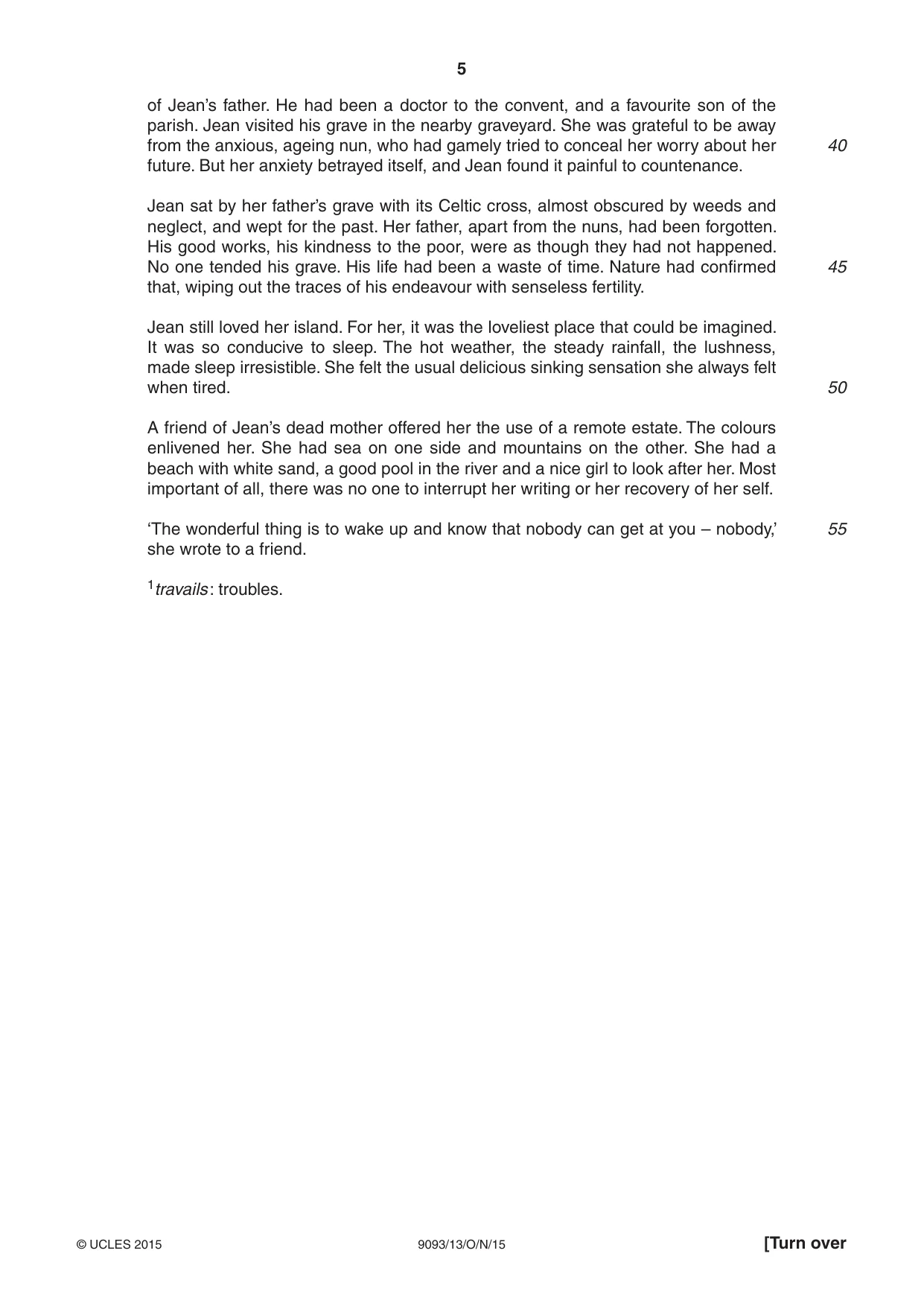
5 9093/13/O/N/15 © UCLES 2015 [Turn over of Jean’s father. He had been a doctor to the convent, and a favourite son of the parish. Jean visited his grave in the nearby graveyard. She was grateful to be away from the anxious, ageing nun, who had gamely tried to conceal her worry about her future. But her anxiety betrayed itself, and Jean found it painful to countenance. Jean sat by her father’s grave with its Celtic cross, almost obscured by weeds and neglect, and wept for the past. Her father, apart from the nuns, had been forgotten. His good works, his kindness to the poor, were as though they had not happened. No one tended his grave. His life had been a waste of time. Nature had confirmed that, wiping out the traces of his endeavour with senseless fertility. Jean still loved her island. For her, it was the loveliest place that could be imagined. It was so conducive to sleep. The hot weather, the steady rainfall, the lushness, made sleep irresistible. She felt the usual delicious sinking sensation she always felt when tired. A friend of Jean’s dead mother offered her the use of a remote estate. The colours enlivened her. She had sea on one side and mountains on the other. She had a beach with white sand, a good pool in the river and a nice girl to look after her. Most important of all, there was no one to interrupt her writing or her recovery of her self. ‘The wonderful thing is to wake up and know that nobody can get at you – nobody,’ she wrote to a friend. 1travails : troubles. 40 45 50 55
Question paper, page 6
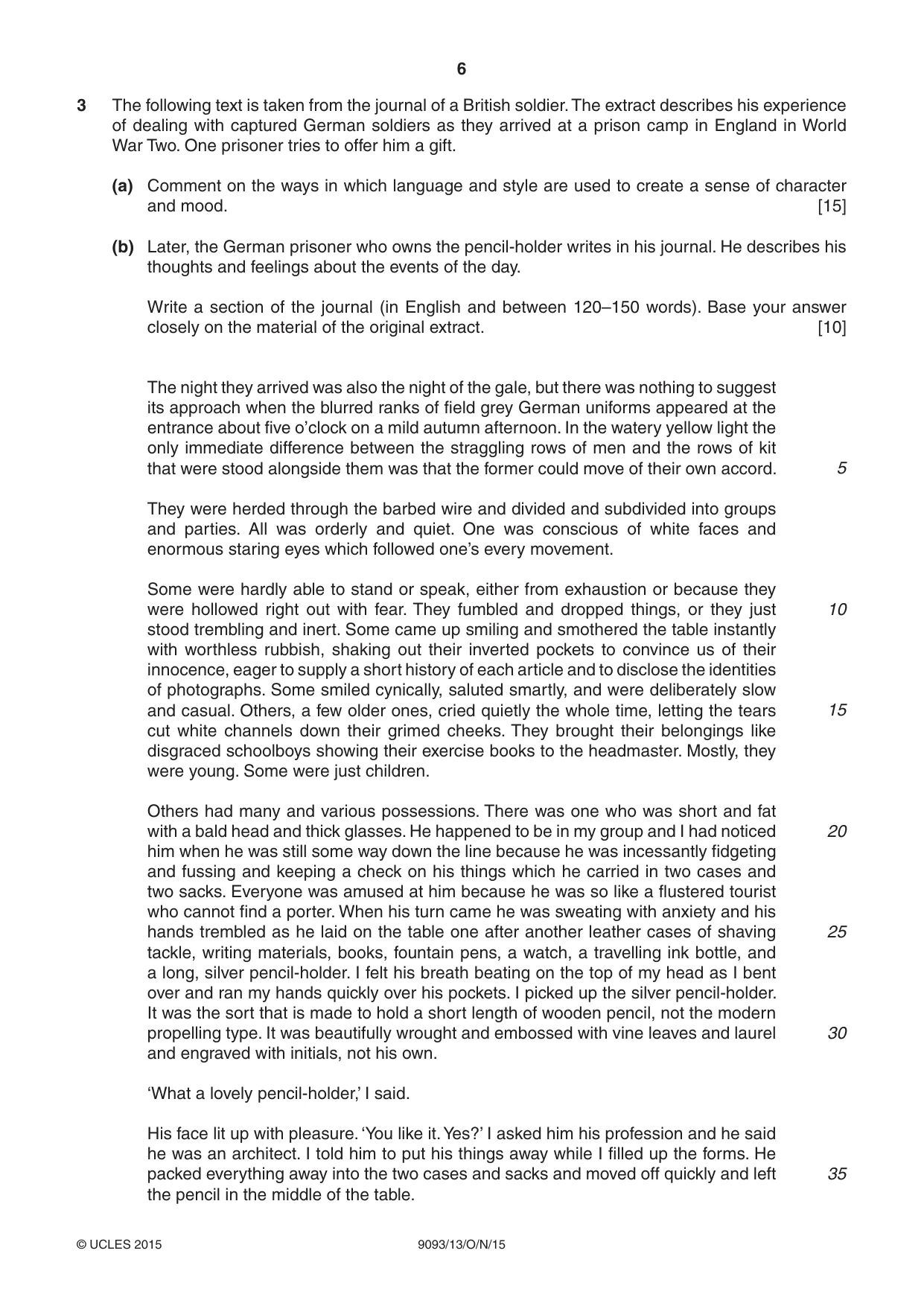
6 9093/13/O/N/15 © UCLES 2015 3 The following text is taken from the journal of a British soldier. The extract describes his experience of dealing with captured German soldiers as they arrived at a prison camp in England in World War Two. One prisoner tries to offer him a gift. (a) Comment on the ways in which language and style are used to create a sense of character and mood. [15] (b) Later, the German prisoner who owns the pencil-holder writes in his journal. He describes his thoughts and feelings about the events of the day. Write a section of the journal (in English and between 120–150 words). Base your answer closely on the material of the original extract. [10] The night they arrived was also the night of the gale, but there was nothing to suggest its approach when the blurred ranks of field grey German uniforms appeared at the entrance about five o’clock on a mild autumn afternoon. In the watery yellow light the only immediate difference between the straggling rows of men and the rows of kit that were stood alongside them was that the former could move of their own accord. They were herded through the barbed wire and divided and subdivided into groups and parties. All was orderly and quiet. One was conscious of white faces and enormous staring eyes which followed one’s every movement. Some were hardly able to stand or speak, either from exhaustion or because they were hollowed right out with fear. They fumbled and dropped things, or they just stood trembling and inert. Some came up smiling and smothered the table instantly with worthless rubbish, shaking out their inverted pockets to convince us of their innocence, eager to supply a short history of each article and to disclose the identities of photographs. Some smiled cynically, saluted smartly, and were deliberately slow and casual. Others, a few older ones, cried quietly the whole time, letting the tears cut white channels down their grimed cheeks. They brought their belongings like disgraced schoolboys showing their exercise books to the headmaster. Mostly, they were young. Some were just children. Others had many and various possessions. There was one who was short and fat with a bald head and thick glasses. He happened to be in my group and I had noticed him when he was still some way down the line because he was incessantly fidgeting and fussing and keeping a check on his things which he carried in two cases and two sacks. Everyone was amused at him because he was so like a flustered tourist who cannot find a porter. When his turn came he was sweating with anxiety and his hands trembled as he laid on the table one after another leather cases of shaving tackle, writing materials, books, fountain pens, a watch, a travelling ink bottle, and a long, silver pencil-holder. I felt his breath beating on the top of my head as I bent over and ran my hands quickly over his pockets. I picked up the silver pencil-holder. It was the sort that is made to hold a short length of wooden pencil, not the modern propelling type. It was beautifully wrought and embossed with vine leaves and laurel and engraved with initials, not his own. ‘What a lovely pencil-holder,’ I said. His face lit up with pleasure. ‘You like it. Yes?’ I asked him his profession and he said he was an architect. I told him to put his things away while I filled up the forms. He packed everything away into the two cases and sacks and moved off quickly and left the pencil in the middle of the table. 5 10 15 20 25 30 35
Question paper, page 7
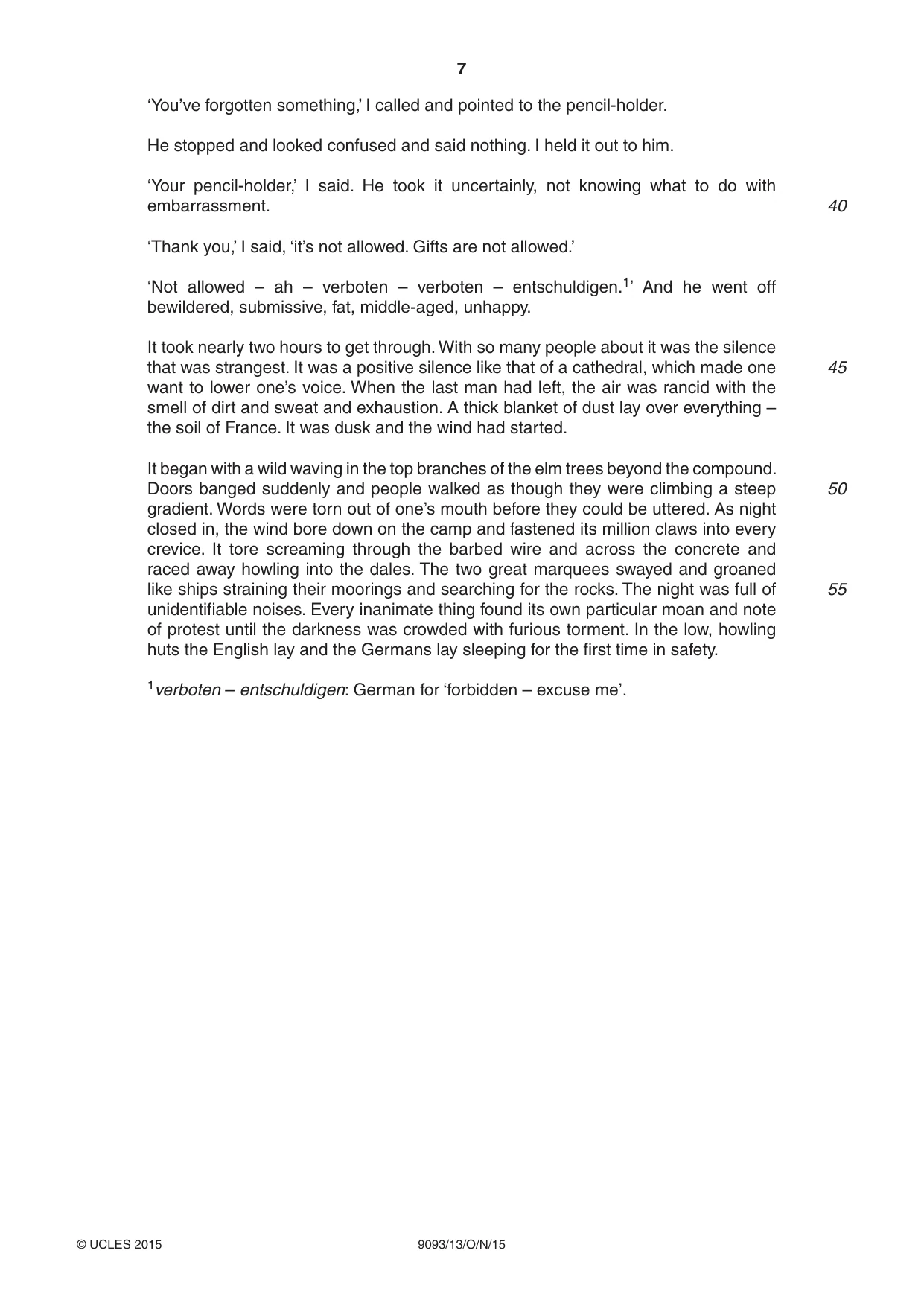
7 9093/13/O/N/15 © UCLES 2015 ‘You’ve forgotten something,’ I called and pointed to the pencil-holder. He stopped and looked confused and said nothing. I held it out to him. ‘Your pencil-holder,’ I said. He took it uncertainly, not knowing what to do with embarrassment. ‘Thank you,’ I said, ‘it’s not allowed. Gifts are not allowed.’ ‘Not allowed – ah – verboten – verboten – entschuldigen.1’ And he went off bewildered, submissive, fat, middle-aged, unhappy. It took nearly two hours to get through. With so many people about it was the silence that was strangest. It was a positive silence like that of a cathedral, which made one want to lower one’s voice. When the last man had left, the air was rancid with the smell of dirt and sweat and exhaustion. A thick blanket of dust lay over everything – the soil of France. It was dusk and the wind had started. It began with a wild waving in the top branches of the elm trees beyond the compound. Doors banged suddenly and people walked as though they were climbing a steep gradient. Words were torn out of one’s mouth before they could be uttered. As night closed in, the wind bore down on the camp and fastened its million claws into every crevice. It tore screaming through the barbed wire and across the concrete and raced away howling into the dales. The two great marquees swayed and groaned like ships straining their moorings and searching for the rocks. The night was full of unidentifiable noises. Every inanimate thing found its own particular moan and note of protest until the darkness was crowded with furious torment. In the low, howling huts the English lay and the Germans lay sleeping for the first time in safety. 1verboten – entschuldigen: German for ‘forbidden – excuse me’. 40 45 50 55
Question paper, page 8
8 9093/13/O/N/15 © UCLES 2015 BLANK PAGE Permission to reproduce items where third-party owned material protected by copyright is included has been sought and cleared where possible. Every reasonable effort has been made by the publisher (UCLES) to trace copyright holders, but if any items requiring clearance have unwittingly been included, the publisher will be pleased to make amends at the earliest possible opportunity. To avoid the issue of disclosure of answer-related information to candidates, all copyright acknowledgements are reproduced online in the Cambridge International Examinations Copyright Acknowledgements Booklet. This is produced for each series of examinations and is freely available to download at www.cie.org.uk after the live examination series. Cambridge International Examinations is part of the Cambridge Assessment Group. Cambridge Assessment is the brand name of University of Cambridge Local Examinations Syndicate (UCLES), which is itself a department of the University of Cambridge.
What you needed in this session
Cambridge’s own grade thresholds for 2015 Oct/Nov, Paper 1 · Variant 3. A higher threshold means an easier paper — the bar moves with how the cohort did.