Cambridge A Level English - Language AS and A Level (from 2014) 9093 — 2015 Oct/Nov Paper 1 · Variant 1
9093/11/O/N/15 · 50 marks · ≈56 min
The question paper and its mark scheme, free to read here and free to download. This is Cambridge’s own paper, exactly as it was sat.
Question paper8 pages

Mark scheme4 pages
Answers below. Sit the paper first if you are practising.
Paper as text
Question paper, page 1
This document consists of 7 printed pages, 1 blank page and 1 insert. DC RCL (KM) 93706/3 © UCLES 2015 [Turn over Cambridge International Examinations Cambridge International Advanced Subsidiary and Advanced Level * 1 2 6 7 4 6 9 8 7 4 * ENGLISH LANGUAGE 9093/11 Paper 1 Passages October/November 2015 2 hours 15 minutes No Additional Materials are required. READ THESE INSTRUCTIONS FIRST An answer booklet is provided inside this question paper. You should follow the instructions on the front cover of the answer booklet. If you need additional answer paper ask the invigilator for a continuation booklet. Answer two questions: Question 1 and either Question 2 or Question 3. You should spend about 15 minutes reading the passages and questions before you start writing your answers. You are reminded of the need for good English and clear presentation in your answers. The number of marks is given in brackets [ ] at the end of each question or part question.
Question paper, page 2
2 9093/11/O/N/15 © UCLES 2015 Answer Question 1 and either Question 2 or Question 3. 1 The following text is taken from a newspaper article. In it, the writer describes how a mother and father take a very keen interest in their son’s application to university. (a) Comment on the ways in which language and style are used to present the mother and father’s behaviour. [15] (b) Later, in another newspaper article, the same writer describes how the couple shows further enthusiasm about another important moment in their son’s life. Write a section (between 120–150 words) of the article. Base your answer closely on the style and features of the writing in the original extract. [10] At the beginning of the new year, my wife has recommenced her haunting of various online student forums, trying to gain insight into university places on behalf of our eldest son. It is not a form of torture in which the boy has shown much interest. I find my wife in her office, scrolling through one thread after another. “Any news?” I say. “People are beginning to hear,” she says. “Really?” I say. “Yes, but for other subjects,” she says. “Don’t try and jump on the bandwagon now.” “I won’t,” I say. “I think it’s weird that you’re pretending to be your own son.” “I’m not pretending to be him. I have my own persona.” The next day she is still there. She doesn’t look up from the screen when I come in. “Anything?” I ask. “A couple of rejections,” she says. “Nothing major.” “So what are you doing now?” I ask. She turns to glare at me. “These people,” she says, “are my friends.” Over the course of the next few days, my wife’s obsessive monitoring begins to affect me. I have trouble concentrating. At odd moments, my guts twist for no reason, until I remember the reason. On the morning of the day the letters are meant to arrive, my wife gets up at 5.45am to check her computer. Fifteen minutes later, she throws herself on the bed. “What’s happening?” I ask. “Nothing is happening!” she hisses. “It’s six o’clock in the morning! I’m hysterical.” Before he leaves for school, my wife secures the eldest one’s permission to monitor his emails all day, even though, according to the latest information, we are not expecting an email. By 10am we are both in a state of advanced panic. 5 10 15 20 25
Question paper, page 3
3 9093/11/O/N/15 © UCLES 2015 [Turn over “Oh my God!” I hear my wife shriek. I find her at her computer. “People are getting offers,” she says. “Apparently you can tell from the weight of the envelope.” “You need to breathe,” I say. “What time does the post actually come?” she says. For the first time in many months, my wife looks at me as if I might be in possession of useful information; I have been working from home for fifteen years. “I think it varies.” At 12.30pm the letter box snaps. We both race to the front door in time to fight over a pizza delivery leaflet. As we retreat back up the stairs panting, my wife turns to me. “We should probably start preparing for both outcomes,” she says. “What if it’s bad news?” I spend twenty minutes looking out of the window in the direction I’ve always assumed the postman originates from. As far up as I can see, the street is deserted. Finally, I go to my office to compose an overdue email. When I hit send, I find the screen has frozen. I am holding down several keys at once in an attempt to remedy the problem when the post hits the mat. I bolt from the room, but I can already hear my wife’s heels striking the hall tiles hard; she must have jumped from the landing. By the time I’ve turned the corner between flights, I can hear an envelope being rent in strips. And then, from directly below me, my wife lets out a blood-curdling scream. By the time I reach the kitchen, my wife’s blood-curdling screams have subsided. She is still scrutinising the letter from the university that hit the mat not twenty seconds before. The envelope, addressed to the oldest one, lies in shreds at her feet. “He got in?” I say. “Of course he got in,” she says. “Didn’t you hear me screaming?” We stand side by side reading the letter in silence. “It’s actually quite boring,” I say, “once you get past the first two lines.” “Oh my God,” my wife gasps. “It’s like someone is telling me I’m pretty!” With her free hand she is texting the oldest one over and over. We are struggling to make sense of page two when her phone finally pings. It’s a text from the boy. “I’m in a lesson,” it says. “GET OUT OF THE LESSON,” my wife writes. Much later, and when the boy has gone out with friends, I find my wife at the kitchen table with the letter, her phone and an open address book. “What are you doing?” I ask. “I’m just ringing people to tell them about my brilliant achievement,” she says. 30 35 40 45 50 55 60
Question paper, page 4
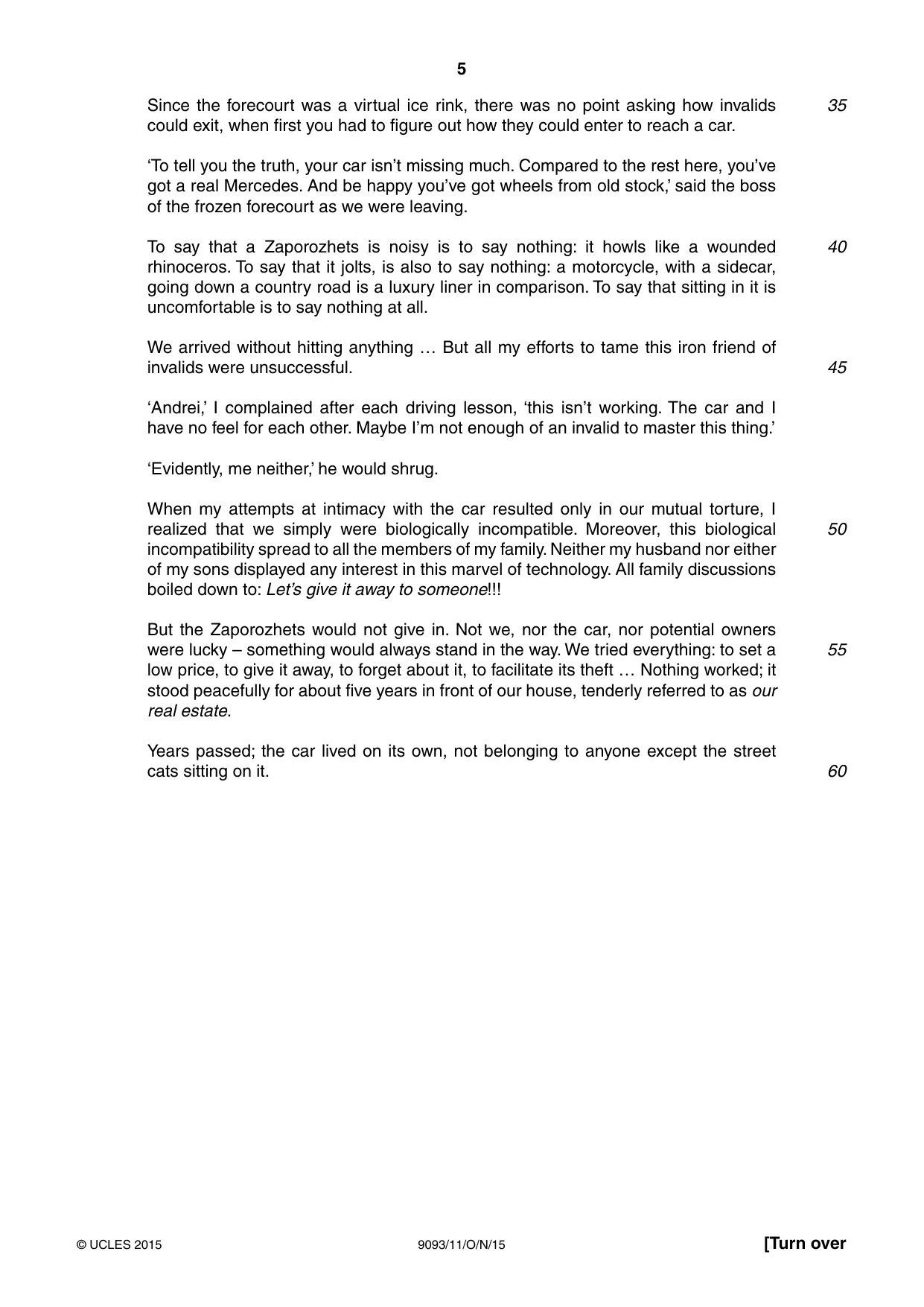
4 9093/11/O/N/15 © UCLES 2015 2 The following text is taken from an online magazine. In it, the writer, Anna, describes her experience of buying a car. (a) Comment on the ways in which the writer uses language and style to portray her experience of obtaining the car and her relationship with it afterwards. [15] (b) Later, Andrei publishes a biography about Anna. In one chapter, he recalls his memories of her and the car. Write a section of the chapter (between 120–150 words). Base your answer closely on the material of the original extract. [10] Our first car was a beige Zaporozhets made in Russia. I was eligible for a model with manual controls because I had a problem with my leg. Getting the car was rather simple: tests on a treadmill, proof that my leg acted weirdly, a certificate proving that I had good eyesight and was mentally stable, and, above all, coming to terms with the woman in charge. To this person, who dealt out these cheap monstrosities to humiliated invalids, I fell into none of the standard categories. She had never approved a young woman with a husband, but without a bribe. And so she started yelling at the top of her lungs. There was ‘no way, no reason, no right’ for people like me. I’ve had extensive experience dealing with such women, both in everyday life and at work and outside. So I humbly asked her for a sheet of paper and, right there at her desk, I addressed my complaint to her superiors about her incompetence and performance at this cushy job. Realizing I knew how to act in such situations, the woman looked embarrassed, her eyes sparkled, and then she fawned on me. Finally, she started to cry and complained about a woman’s hard lot, blaming fatigue for her inability to think straight … after which she filled out papers with the speed of a jet plane. The invalids who witnessed all this looked sideways at me, as if I were a knight who had chopped off the three heads of a dragon. The victory was intoxicating. And so, in that state, my husband, our friend the journalist Andrei Fadin and I rushed off to get the car. Neither my husband nor I could drive, so Andrei generously took us under his wing. ‘You’ll learn to drive, get around in Moscow, bash the car here and there, then buy a better one,’ explained Andrei. ‘I started with a Zaporozhets too.’ When we entered the extremely icy forecourt crowded with new Zaporozhetses, we were rather taken aback. Every single car was missing parts. The boss of the icy garage reluctantly informed us that that’s how they came, though the address of the missing parts was written on his face. ‘OK, man, it’ll get you as far as home and then you can take it in for service and they’ll install what’s missing,’ the boss of the lot advised. ‘The car is a winner! It’s better than a tank for fishing. Of course, it’s your choice. But then again, there won’t be any other cars until these go. Meanwhile, some other parts will be stripped – it can’t be helped.’ ‘Fine, I’ll drive,’ said Andrei to the guy. ‘If I hit something, you’ll need a lawyer!’ ‘Then don’t hit anything,’ winked the guy. 5 10 15 20 25 30
Question paper, page 5
5 9093/11/O/N/15 © UCLES 2015 [Turn over Since the forecourt was a virtual ice rink, there was no point asking how invalids could exit, when first you had to figure out how they could enter to reach a car. ‘To tell you the truth, your car isn’t missing much. Compared to the rest here, you’ve got a real Mercedes. And be happy you’ve got wheels from old stock,’ said the boss of the frozen forecourt as we were leaving. To say that a Zaporozhets is noisy is to say nothing: it howls like a wounded rhinoceros. To say that it jolts, is also to say nothing: a motorcycle, with a sidecar, going down a country road is a luxury liner in comparison. To say that sitting in it is uncomfortable is to say nothing at all. We arrived without hitting anything … But all my efforts to tame this iron friend of invalids were unsuccessful. ‘Andrei,’ I complained after each driving lesson, ‘this isn’t working. The car and I have no feel for each other. Maybe I’m not enough of an invalid to master this thing.’ ‘Evidently, me neither,’ he would shrug. When my attempts at intimacy with the car resulted only in our mutual torture, I realized that we simply were biologically incompatible. Moreover, this biological incompatibility spread to all the members of my family. Neither my husband nor either of my sons displayed any interest in this marvel of technology. All family discussions boiled down to: Let’s give it away to someone!!! But the Zaporozhets would not give in. Not we, nor the car, nor potential owners were lucky – something would always stand in the way. We tried everything: to set a low price, to give it away, to forget about it, to facilitate its theft … Nothing worked; it stood peacefully for about five years in front of our house, tenderly referred to as our real estate. Years passed; the car lived on its own, not belonging to anyone except the street cats sitting on it. 35 40 45 50 55 60
Question paper, page 6
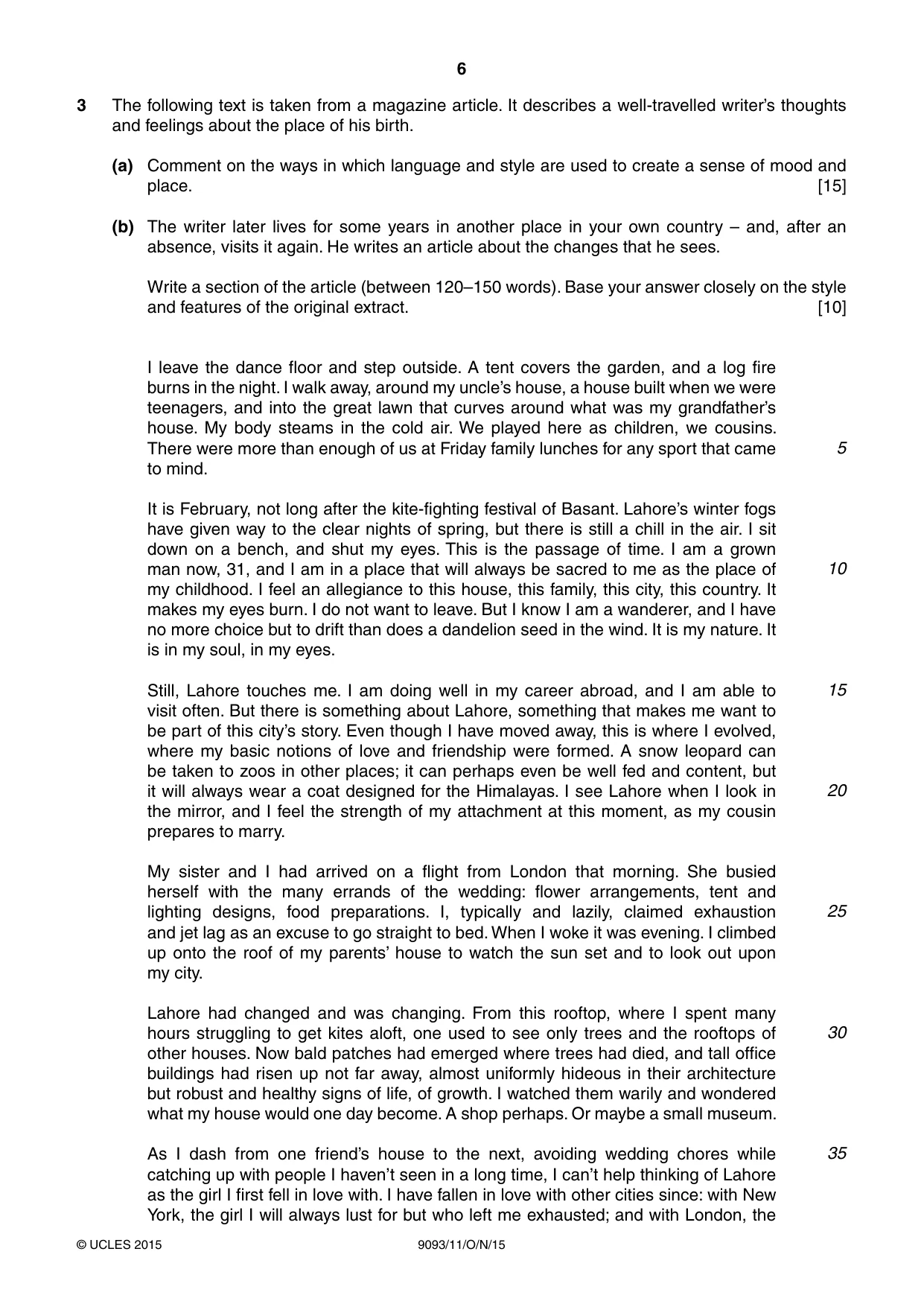
6 9093/11/O/N/15 © UCLES 2015 3 The following text is taken from a magazine article. It describes a well-travelled writer’s thoughts and feelings about the place of his birth. (a) Comment on the ways in which language and style are used to create a sense of mood and place. [15] (b) The writer later lives for some years in another place in your own country – and, after an absence, visits it again. He writes an article about the changes that he sees. Write a section of the article (between 120–150 words). Base your answer closely on the style and features of the original extract. [10] I leave the dance floor and step outside. A tent covers the garden, and a log fire burns in the night. I walk away, around my uncle’s house, a house built when we were teenagers, and into the great lawn that curves around what was my grandfather’s house. My body steams in the cold air. We played here as children, we cousins. There were more than enough of us at Friday family lunches for any sport that came to mind. It is February, not long after the kite-fighting festival of Basant. Lahore’s winter fogs have given way to the clear nights of spring, but there is still a chill in the air. I sit down on a bench, and shut my eyes. This is the passage of time. I am a grown man now, 31, and I am in a place that will always be sacred to me as the place of my childhood. I feel an allegiance to this house, this family, this city, this country. It makes my eyes burn. I do not want to leave. But I know I am a wanderer, and I have no more choice but to drift than does a dandelion seed in the wind. It is my nature. It is in my soul, in my eyes. Still, Lahore touches me. I am doing well in my career abroad, and I am able to visit often. But there is something about Lahore, something that makes me want to be part of this city’s story. Even though I have moved away, this is where I evolved, where my basic notions of love and friendship were formed. A snow leopard can be taken to zoos in other places; it can perhaps even be well fed and content, but it will always wear a coat designed for the Himalayas. I see Lahore when I look in the mirror, and I feel the strength of my attachment at this moment, as my cousin prepares to marry. My sister and I had arrived on a flight from London that morning. She busied herself with the many errands of the wedding: flower arrangements, tent and lighting designs, food preparations. I, typically and lazily, claimed exhaustion and jet lag as an excuse to go straight to bed. When I woke it was evening. I climbed up onto the roof of my parents’ house to watch the sun set and to look out upon my city. Lahore had changed and was changing. From this rooftop, where I spent many hours struggling to get kites aloft, one used to see only trees and the rooftops of other houses. Now bald patches had emerged where trees had died, and tall office buildings had risen up not far away, almost uniformly hideous in their architecture but robust and healthy signs of life, of growth. I watched them warily and wondered what my house would one day become. A shop perhaps. Or maybe a small museum. As I dash from one friend’s house to the next, avoiding wedding chores while catching up with people I haven’t seen in a long time, I can’t help thinking of Lahore as the girl I first fell in love with. I have fallen in love with other cities since: with New York, the girl I will always lust for but who left me exhausted; and with London, the 5 10 15 20 25 30 35
Question paper, page 7
7 9093/11/O/N/15 © UCLES 2015 girl who bored me at first but whose company I have come to savour. But my heart will always have a special place for my first love, for Lahore, the love of my childhood and teens and early 20s. She has hardened, become more cynical, angrier. She has lost some of her looks. She is less complacent than she was then, less sure of her enduring centrality in her universe. But Lahore is still a charmer, and she is more urbane and cosmopolitan than she was in the days when the opening of a new ice-cream parlour was enough to get her excited for months. Lahore is speckled with Internet cafés, with billboards offering broadband connections, with advertisements for health clubs featuring personal trainers. No, Lahore is no longer the same girl she was when we parted ways. And I am no longer the same boy. But even after all these years, even with the scars and frown lines she has acquired, she still makes my heart race, and I can’t help wondering what would have happened if we hadn’t broken up, what would have happened if I had stayed. This is the magic of Lahore. Maybe because of the heat or the big families or the social restrictions or the relative lack of money, Lahore is a place where bands of friends tend to form and hold together. I would not trade this evening in my long- disused study for a party in the coolest nightclub. There is far more pleasure and sustenance to be had here, and I gorge myself on it tonight. 40 45 50 55
Question paper, page 8
8 9093/11/O/N/15 © UCLES 2015 BLANK PAGE Permission to reproduce items where third-party owned material protected by copyright is included has been sought and cleared where possible. Every reasonable effort has been made by the publisher (UCLES) to trace copyright holders, but if any items requiring clearance have unwittingly been included, the publisher will be pleased to make amends at the earliest possible opportunity. To avoid the issue of disclosure of answer-related information to candidates, all copyright acknowledgements are reproduced online in the Cambridge International Examinations Copyright Acknowledgements Booklet. This is produced for each series of examinations and is freely available to download at www.cie.org.uk after the live examination series. Cambridge International Examinations is part of the Cambridge Assessment Group. Cambridge Assessment is the brand name of University of Cambridge Local Examinations Syndicate (UCLES), which is itself a department of the University of Cambridge.
Mark scheme, page 1
® IGCSE is the registered trademark of Cambridge International Examinations. CAMBRIDGE INTERNATIONAL EXAMINATIONS Cambridge International Advanced Subsidiary and Advanced Level MARK SCHEME for the October/November 2015 series 9093 ENGLISH LANGUAGE 9093/11 Paper 1 (Passages), maximum raw mark 50 This mark scheme is published as an aid to teachers and candidates, to indicate the requirements of the examination. It shows the basis on which Examiners were instructed to award marks. It does not indicate the details of the discussions that took place at an Examiners’ meeting before marking began, which would have considered the acceptability of alternative answers. Mark schemes should be read in conjunction with the question paper and the Principal Examiner Report for Teachers. Cambridge will not enter into discussions about these mark schemes. Cambridge is publishing the mark schemes for the October/November 2015 series for most Cambridge IGCSE®, Cambridge International A and AS Level components and some Cambridge O Level components.
Mark scheme, page 2
Page 2 Mark Scheme Syllabus Paper Cambridge International AS/A Level – October/November 2015 9093 11 © Cambridge International Examinations 2015 Assessment Objectives: • Ability to read with understanding written material in a variety of forms, and to comment on its effectiveness. • Knowledge and understanding of features of English language. • Ability to write clearly, accurately and effectively for a particular purpose or audience. Each answer is marked out of a total of 25. • 15 marks are available for part (a) – commentary on use of language in the passage. • 10 marks are available for part (b) – directed writing task based on the passage. Each part is marked in accordance with the following general marking criteria.
Mark scheme, page 3
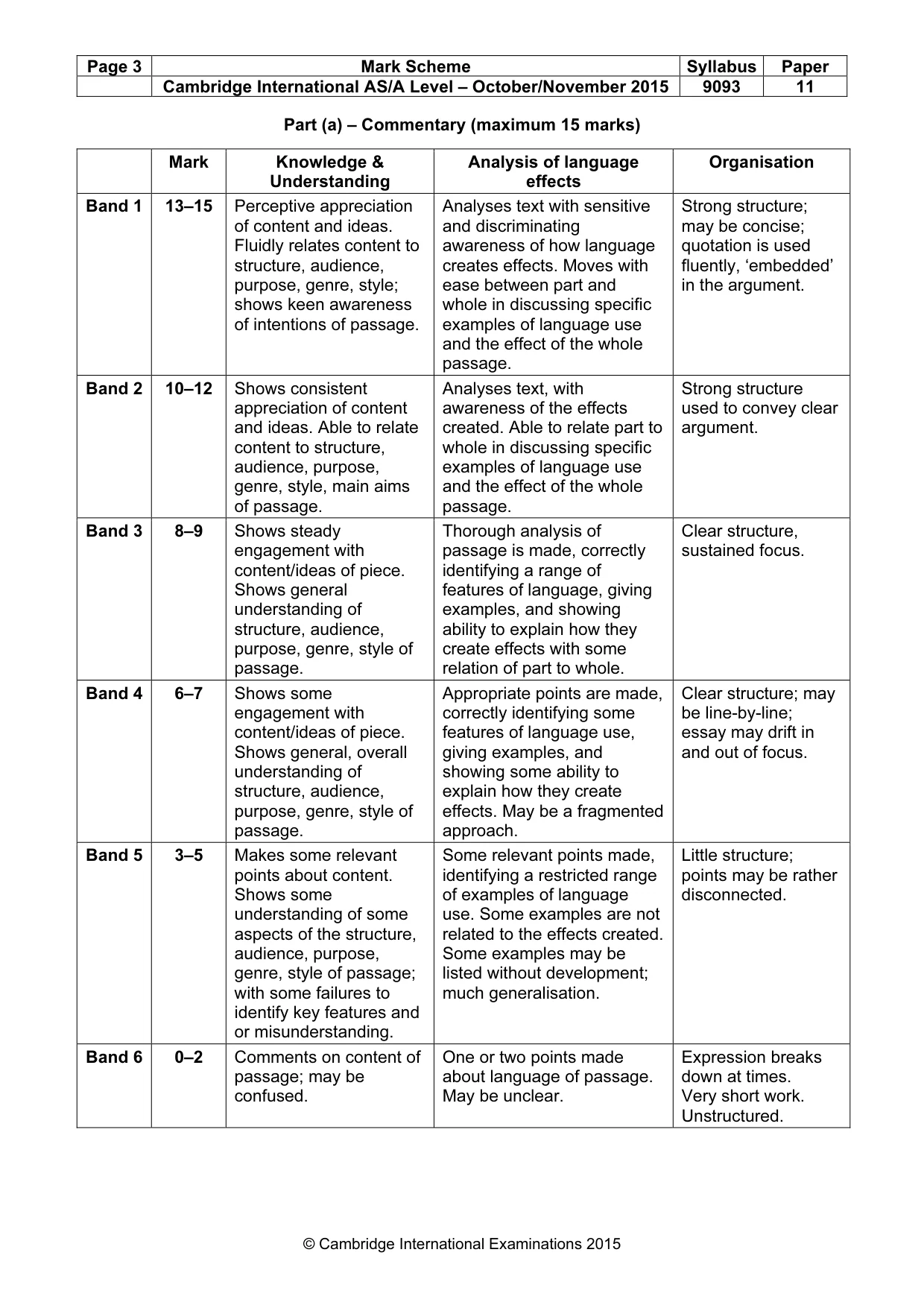
Page 3 Mark Scheme Syllabus Paper Cambridge International AS/A Level – October/November 2015 9093 11 © Cambridge International Examinations 2015 Part (a) – Commentary (maximum 15 marks) Mark Knowledge & Understanding Analysis of language effects Organisation Band 1 13–15 Perceptive appreciation of content and ideas. Fluidly relates content to structure, audience, purpose, genre, style; shows keen awareness of intentions of passage. Analyses text with sensitive and discriminating awareness of how language creates effects. Moves with ease between part and whole in discussing specific examples of language use and the effect of the whole passage. Strong structure; may be concise; quotation is used fluently, ‘embedded’ in the argument. Band 2 10–12 Shows consistent appreciation of content and ideas. Able to relate content to structure, audience, purpose, genre, style, main aims of passage. Analyses text, with awareness of the effects created. Able to relate part to whole in discussing specific examples of language use and the effect of the whole passage. Strong structure used to convey clear argument. Band 3 8–9 Shows steady engagement with content/ideas of piece. Shows general understanding of structure, audience, purpose, genre, style of passage. Thorough analysis of passage is made, correctly identifying a range of features of language, giving examples, and showing ability to explain how they create effects with some relation of part to whole. Clear structure, sustained focus. Band 4 6–7 Shows some engagement with content/ideas of piece. Shows general, overall understanding of structure, audience, purpose, genre, style of passage. Appropriate points are made, correctly identifying some features of language use, giving examples, and showing some ability to explain how they create effects. May be a fragmented approach. Clear structure; may be line-by-line; essay may drift in and out of focus. Band 5 3–5 Makes some relevant points about content. Shows some understanding of some aspects of the structure, audience, purpose, genre, style of passage; with some failures to identify key features and or misunderstanding. Some relevant points made, identifying a restricted range of examples of language use. Some examples are not related to the effects created. Some examples may be listed without development; much generalisation. Little structure; points may be rather disconnected. Band 6 0–2 Comments on content of passage; may be confused. One or two points made about language of passage. May be unclear. Expression breaks down at times. Very short work. Unstructured.
Mark scheme, page 4
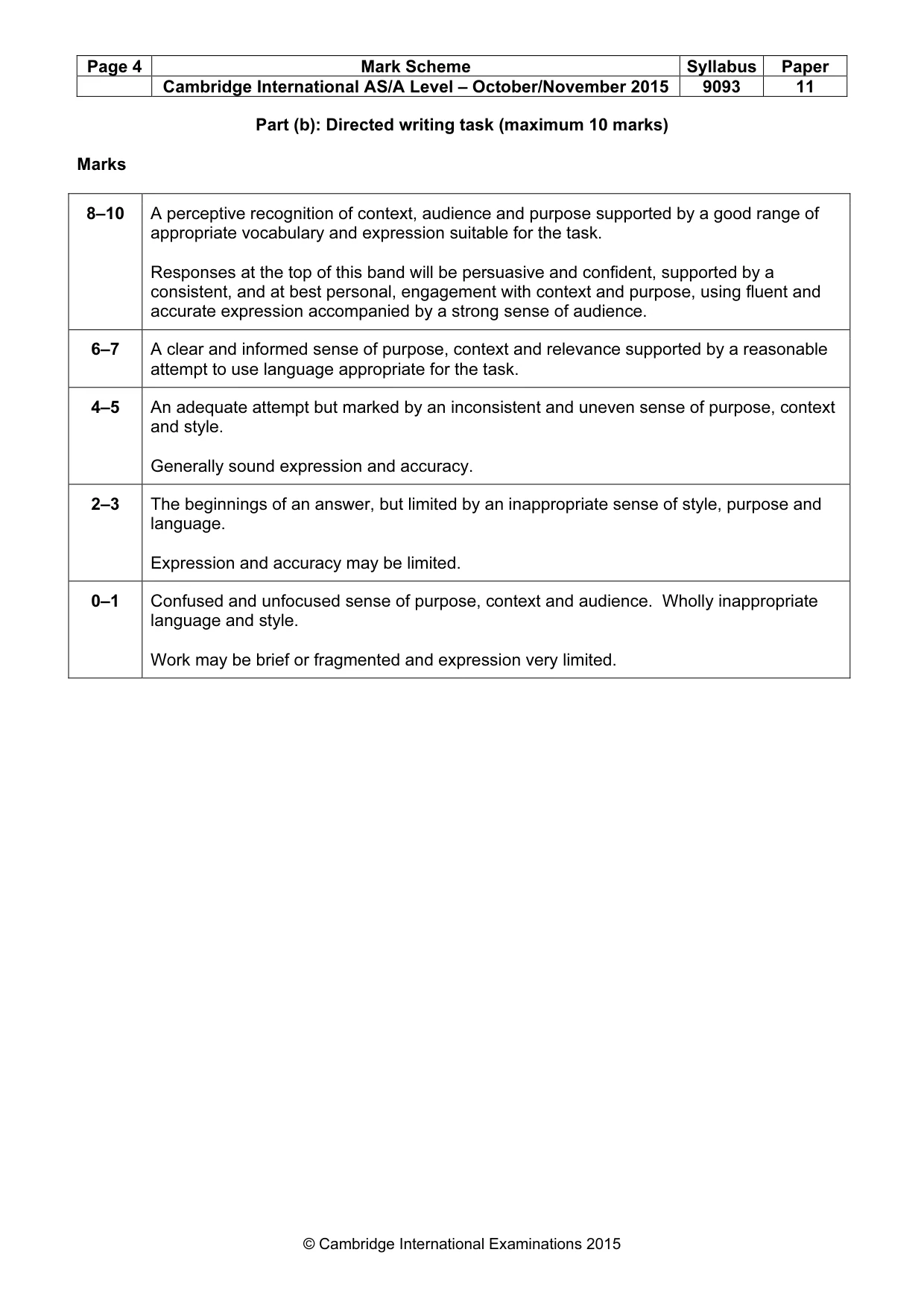
Page 4 Mark Scheme Syllabus Paper Cambridge International AS/A Level – October/November 2015 9093 11 © Cambridge International Examinations 2015 Part (b): Directed writing task (maximum 10 marks) Marks 8–10 A perceptive recognition of context, audience and purpose supported by a good range of appropriate vocabulary and expression suitable for the task. Responses at the top of this band will be persuasive and confident, supported by a consistent, and at best personal, engagement with context and purpose, using fluent and accurate expression accompanied by a strong sense of audience. 6–7 A clear and informed sense of purpose, context and relevance supported by a reasonable attempt to use language appropriate for the task. 4–5 An adequate attempt but marked by an inconsistent and uneven sense of purpose, context and style. Generally sound expression and accuracy. 2–3 The beginnings of an answer, but limited by an inappropriate sense of style, purpose and language. Expression and accuracy may be limited. 0–1 Confused and unfocused sense of purpose, context and audience. Wholly inappropriate language and style. Work may be brief or fragmented and expression very limited.
What you needed in this session
Cambridge’s own grade thresholds for 2015 Oct/Nov, Paper 1 · Variant 1. A higher threshold means an easier paper — the bar moves with how the cohort did.