Cambridge A Level English - Language AS and A Level (from 2014) 9093 — 2015 Oct/Nov Paper 1 · Variant 2
9093/12/O/N/15 · 50 marks · ≈56 min
The question paper and its mark scheme, free to read here and free to download. This is Cambridge’s own paper, exactly as it was sat.
Question paper8 pages
Mark scheme4 pages
Answers below. Sit the paper first if you are practising.
Paper as text
Question paper, page 1
This document consists of 7 printed pages, 1 blank page and 1 insert. DC (ST) 128420 © UCLES 2015 [Turn over Cambridge International Examinations Cambridge International Advanced Subsidiary and Advanced Level * 6 7 7 1 0 8 4 6 0 0 * ENGLISH LANGUAGE 9093/12 Paper 1 Passages October/November 2015 2 hours 15 minutes No Additional Materials are required. READ THESE INSTRUCTIONS FIRST An answer booklet is provided inside this question paper. You should follow the instructions on the front cover of the answer booklet. If you need additional answer paper ask the invigilator for a continuation booklet. Answer two questions: Question 1 and either Question 2 or Question 3. You should spend about 15 minutes reading the passages and questions before you start writing your answers. You are reminded of the need for good English and clear presentation in your answers. The number of marks is given in brackets [ ] at the end of each question or part question.
Question paper, page 2
2 9093/12/O/N/15 © UCLES 2015 Answer Question 1 and either Question 2 or Question 3. 1 The following is one of a series of magazine articles in which the writer describes his unusual relatives. (a) Comment on the ways in which language and style are used to present the grandfather and his absent-minded approach to life. [15] (b) The writer’s aunt, Ted’s daughter, shows a different type of strange behaviour. The writer describes her in another magazine article in the series. Write a section (between 120–150 words) of this article. Base your answer closely on the style and features of the writing in the original extract. [10] My late paternal grandad Ted was an almost constantly grinning man, with a moustache, glasses – and a scar running across the entirely bald dome of his head. Even from when I was very small, I’d known that he’d been injured in World War Two, but it was only later that I asked about the scar’s origin. “Oh, no,” my dad told me, “he didn’t get it while fighting. He didn’t do any fighting. He was mending a plane and forgot to move out of the way when the propeller started going, and it clonked him.” Nobody can remember the exact moment my grandad’s scatterbrain gene kicked in, but a poll of those who knew him puts it at around the age of 36: the age I am now, and still a good year or two before Ted set fire to a stranger’s coat by putting his still- lit pipe in his pocket during a coach trip. In my grandma, Joyce, he had found a complementary opposite: stern and fearful, a woman who once called the police on her own son for messing about on a train track close to their house. Joyce’s role was to remind Ted not to put his house keys in the fridge, or leave loaves of bread on the roof of the car on long journeys and, during visits to heavily mirrored buildings, stop him from spending too much time apologising profusely to other moustachioed men with scarred bald heads for blocking their path. Ted’s – arguably more significant – role was to shake Joyce out of her naturally pessimistic state with a succession of dancing classes, neighbourhood bonfires, fancy dress balls, caravan holidays and walking expeditions. When Ted went through a red light, which he often did, it was always out of absent- mindedness, not haste. One winter, after a visit to our house, a passing team of six sinewy cyclists helped push his car out of the snow and back on to the road. This was on one of the rare occasions when he hadn’t parked the car in the dead centre of the country lane we lived on, or left a small paraffin stove burning inside the footwell to “keep it defrosted”. Even with the weather conditions in mind, the task took an unusual amount of grunting. It was only later that it dawned on Ted that he’d forgotten to take the handbrake off. My mother remembers that on her first visit to my grandparents’ house, Ted was wearing a paper party hat. As it wasn’t Christmas or anybody’s birthday, this confused her, until she found out that making Ted wear the hat was my grandma’s scheme to help him remember not to leave the water heater on. 5 10 15 20 25 30
Question paper, page 3
3 9093/12/O/N/15 © UCLES 2015 [Turn over My own first-hand encounter with my grandad’s legendary doziness came when he caddied for me in a junior golf tournament and, arriving on the second tee and reaching for my club, I found the flag from the first green in my bag. This occurred during the same year that he and Joyce sent a Christmas card to my parents – whose names are Mick and Jo – reading, “To Joyce and Ted. Happy Christmas! Love from Joyce and Ted.” Recently, particularly as the hair on my head has become slightly thinner and the hair on my face thicker, I’ve started to see a hint of Ted in the mirror. This effect will no doubt become more extreme when I finally start wearing my glasses as often as I should, and gets me thinking about my genetic destiny, especially on the days when I put the coffee beans straight into the mug or a bottle of unused body wash directly into my recycling bin. Not long before he died, Ted was taken on a visit to a large country house by my parents. “Ah. If I could do it all over again, and got luckier,” he sighed. “I could have been the gardener here.” Ted worked hard all his life, with heavy machinery, in a factory that made women’s stockings, but he never got ideas above his station, which perhaps meant his doziness was easier to manage. I, on the other hand, have had many ideas above my station. But I should probably start thinking about winding those up now, for safety’s sake: spend more time pottering about in the garden, perhaps keep the car on the road for a few more years, but limit it to small trips, hardware firms and dinner dances. Occasionally, I’ll need to go shopping for slippers, and I might fall foul of the odd full-length mirror in the process, but I’ll cope. It won’t be a bad life, and if I live it a quarter as nobly as Ted did, I’ll have no complaints. 35 40 45 50 55
Question paper, page 4
4 9093/12/O/N/15 © UCLES 2015 2 The following text is an extract from a letter to the boss of an airline company. In it, the writer complains about his experience as a customer on a recent flight. The writer has included five photographs in his letter to Mr Richard Branson, which are not included here. (a) Comment on the ways in which the writer uses language and style to voice his concerns. [15] (b) On a return flight the writer has further problems, not relating to food, this time. He writes again to Mr Branson. Write a section of the letter (between 120–150 words). Base your answer closely on the material of the original extract. [10] Dear Richard, REF: Mumbai to Heathrow 7th December I love your brand, I really do – which is why I continue to use it despite a series of unfortunate incidents over the last few years. This latest incident takes the biscuit. Ironically, by the end of the flight I would have gladly paid over a thousand rupees for a single biscuit following the culinary journey of hell I was subjected to at the hands of your airline. Look at this Richard. Just look at it: [see photograph 1]. I imagine the same questions are racing through your brilliant mind as were racing through mine on that fateful day. What is this? Why have I been given it? What have I done to deserve this? And, which one is the starter, which one is the dessert? You don’t get to a position like yours, Richard, with anything less than a generous sprinkling of observational power so I KNOW you will have spotted the tomato next to the two yellow shafts of sponge on the left. Yes, it’s next to the sponge shaft without the green paste. That’s got to be the clue hasn’t it. No sane person would serve a dessert with a tomato would they? I know it looks like a baaji1 but it’s in custard, Richard, custard. It must be the pudding. Well, you’ll be fascinated to hear that it wasn’t custard. It was a sour gel with a clear oil on top. Its only redeeming feature was that it managed to be so alien to my palate that it took away the taste of the curry emanating from our miscellaneous central cuboid of beige matter. Perhaps the meal on the left might be the dessert after all. Anyway, this is all irrelevant at the moment. I was raised strictly, but neatly, by my parents and if they knew I had started dessert before the main course, a sponge shaft would be the least of my worries. So let’s peel back the tin-foil on the main dish and see what’s on offer. I’ll try and explain how this felt. Imagine being a twelve year old boy, Richard. Now imagine it’s Christmas morning and you’re sat there with your final present to open. It’s a big one, and you know what it is. It’s that stereo you picked out of the catalogue and wrote to Santa about. Only you open the present and it’s not in there. It’s like it is your hamster, Richard. It’s like it is your hamster in the box and it’s not breathing. That’s how I felt when I peeled back the foil and saw this: [see photograph 2]. 5 10 15 20 25 30
Question paper, page 5
5 9093/12/O/N/15 © UCLES 2015 [Turn over Now I know what you’re thinking. You’re thinking it’s more of that baaji custard. I admit I thought the same too, but no. It’s mustard, Richard. MUSTARD. More mustard than any man could consume in a month. I needed a sugar hit. Luckily there was a small cookie provided. It had caught my eye earlier due to its baffling presentation: [see photograph 3]. It appears to be in an evidence bag from the scene of a crime. A CRIME AGAINST COOKING. Either that or some sort of back-street underground cookie, purchased off a gun-toting maniac. You certainly wouldn’t want to be caught carrying one of these through customs. I was exhausted. All I wanted to do was relax, but obviously I had to sit with that mess in front of me for half an hour. Once cleared, I decided to relax with a bit of your world-famous onboard entertainment. I switched it on: [see photograph 4]. Is that Ray Liotta2? A question I found myself asking over and over again throughout the gruelling half-hour I attempted to watch the film like this. After that I switched off. I’d had enough. I was the hungriest I’d been in my adult life and I had a splitting headache from squinting at a crackling screen. My only option was to simply stare at the seat in front and wait for either food, or sleep. Neither came for an incredibly long time. But when it did it surpassed my wildest expectations: [see photograph 5]. Yes! It’s another crime-scene cookie. Only this time you dunk it in the white stuff. Richard, what is that white stuff? It looked like it was going to be yoghurt. It finally dawned on me what it was after staring at it. It was a mixture between the baaji custard and the mustard sauce. So that was that, Richard. I didn’t eat a thing. My only question is: how can you live like this? I can’t imagine what dinner round your house is like. It must be like something out of a nature documentary. As I said at the start I love your airline, I really do. It’s just a shame such a simple thing could bring it crashing to its knees and begging for sustenance. Yours sincerely, Tarun Achari 1baaji : an Indian vegetable dish 2Ray Liotta: a Hollywood film star 35 40 45 50 55 60
Question paper, page 6
6 9093/12/O/N/15 © UCLES 2015 3 The following text is taken from a travel magazine. It describes the writer’s experience of being lost in a hostile landscape. (a) Comment on the ways in which language and style are used to create a sense of mood and place. [15] (b) Later, the writer publishes another account of being stranded in a different type of harsh environment. Write a section (between 120–150 words) of this account. Base your answer closely on the style and features of the original extract. [10] The sun is still overhead. For brief moments, refracted through the heat waves on the right, I see villages, moving trucks, or a sweep of marsh. If I didn’t have a compass, I might be tempted to walk straight into the mirage. Content removed due to copyright restrictions.
Question paper, page 7
7 9093/12/O/N/15 © UCLES 2015 I crouch down and look at the driver. He is ten metres away, sitting in front of his truck, staring right back at me. “Thank you, brother,” I say, putting the lid down. Content removed due to copyright restrictions.
Question paper, page 8
8 9093/12/O/N/15 © UCLES 2015 BLANK PAGE Permission to reproduce items where third-party owned material protected by copyright is included has been sought and cleared where possible. Every reasonable effort has been made by the publisher (UCLES) to trace copyright holders, but if any items requiring clearance have unwittingly been included, the publisher will be pleased to make amends at the earliest possible opportunity. To avoid the issue of disclosure of answer-related information to candidates, all copyright acknowledgements are reproduced online in the Cambridge International Examinations Copyright Acknowledgements Booklet. This is produced for each series of examinations and is freely available to download at www.cie.org.uk after the live examination series. Cambridge International Examinations is part of the Cambridge Assessment Group. Cambridge Assessment is the brand name of University of Cambridge Local Examinations Syndicate (UCLES), which is itself a department of the University of Cambridge.
Mark scheme, page 1
® IGCSE is the registered trademark of Cambridge International Examinations. CAMBRIDGE INTERNATIONAL EXAMINATIONS Cambridge International Advanced Subsidiary and Advanced Level MARK SCHEME for the October/November 2015 series 9093 ENGLISH LANGUAGE 9093/12 Paper 1 (Passages), maximum raw mark 50 This mark scheme is published as an aid to teachers and candidates, to indicate the requirements of the examination. It shows the basis on which Examiners were instructed to award marks. It does not indicate the details of the discussions that took place at an Examiners’ meeting before marking began, which would have considered the acceptability of alternative answers. Mark schemes should be read in conjunction with the question paper and the Principal Examiner Report for Teachers. Cambridge will not enter into discussions about these mark schemes. Cambridge is publishing the mark schemes for the October/November 2015 series for most Cambridge IGCSE®, Cambridge International A and AS Level components and some Cambridge O Level components.
Mark scheme, page 2
Page 2 Mark Scheme Syllabus Paper Cambridge International AS/A Level – October/November 2015 9093 12 © Cambridge International Examinations 2015 Assessment Objectives: • Ability to read with understanding written material in a variety of forms, and to comment on its effectiveness. • Knowledge and understanding of features of English language. • Ability to write clearly, accurately and effectively for a particular purpose or audience. Each answer is marked out of a total of 25. • 15 marks are available for part (a) – commentary on use of language in the passage. • 10 marks are available for part (b) – directed writing task based on the passage. Each part is marked in accordance with the following general marking criteria.
Mark scheme, page 3
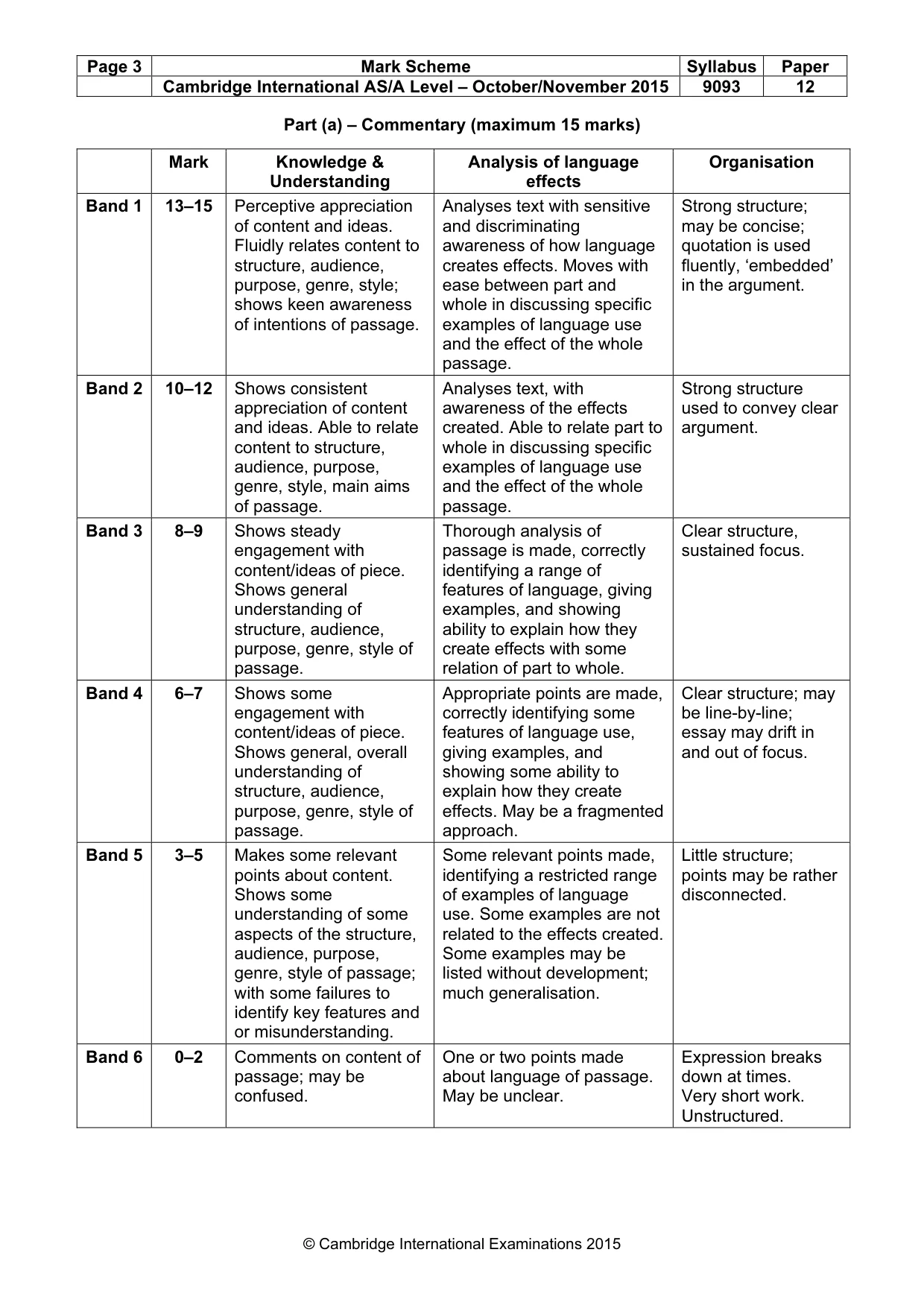
Page 3 Mark Scheme Syllabus Paper Cambridge International AS/A Level – October/November 2015 9093 12 © Cambridge International Examinations 2015 Part (a) – Commentary (maximum 15 marks) Mark Knowledge & Understanding Analysis of language effects Organisation Band 1 13–15 Perceptive appreciation of content and ideas. Fluidly relates content to structure, audience, purpose, genre, style; shows keen awareness of intentions of passage. Analyses text with sensitive and discriminating awareness of how language creates effects. Moves with ease between part and whole in discussing specific examples of language use and the effect of the whole passage. Strong structure; may be concise; quotation is used fluently, ‘embedded’ in the argument. Band 2 10–12 Shows consistent appreciation of content and ideas. Able to relate content to structure, audience, purpose, genre, style, main aims of passage. Analyses text, with awareness of the effects created. Able to relate part to whole in discussing specific examples of language use and the effect of the whole passage. Strong structure used to convey clear argument. Band 3 8–9 Shows steady engagement with content/ideas of piece. Shows general understanding of structure, audience, purpose, genre, style of passage. Thorough analysis of passage is made, correctly identifying a range of features of language, giving examples, and showing ability to explain how they create effects with some relation of part to whole. Clear structure, sustained focus. Band 4 6–7 Shows some engagement with content/ideas of piece. Shows general, overall understanding of structure, audience, purpose, genre, style of passage. Appropriate points are made, correctly identifying some features of language use, giving examples, and showing some ability to explain how they create effects. May be a fragmented approach. Clear structure; may be line-by-line; essay may drift in and out of focus. Band 5 3–5 Makes some relevant points about content. Shows some understanding of some aspects of the structure, audience, purpose, genre, style of passage; with some failures to identify key features and or misunderstanding. Some relevant points made, identifying a restricted range of examples of language use. Some examples are not related to the effects created. Some examples may be listed without development; much generalisation. Little structure; points may be rather disconnected. Band 6 0–2 Comments on content of passage; may be confused. One or two points made about language of passage. May be unclear. Expression breaks down at times. Very short work. Unstructured.
Mark scheme, page 4
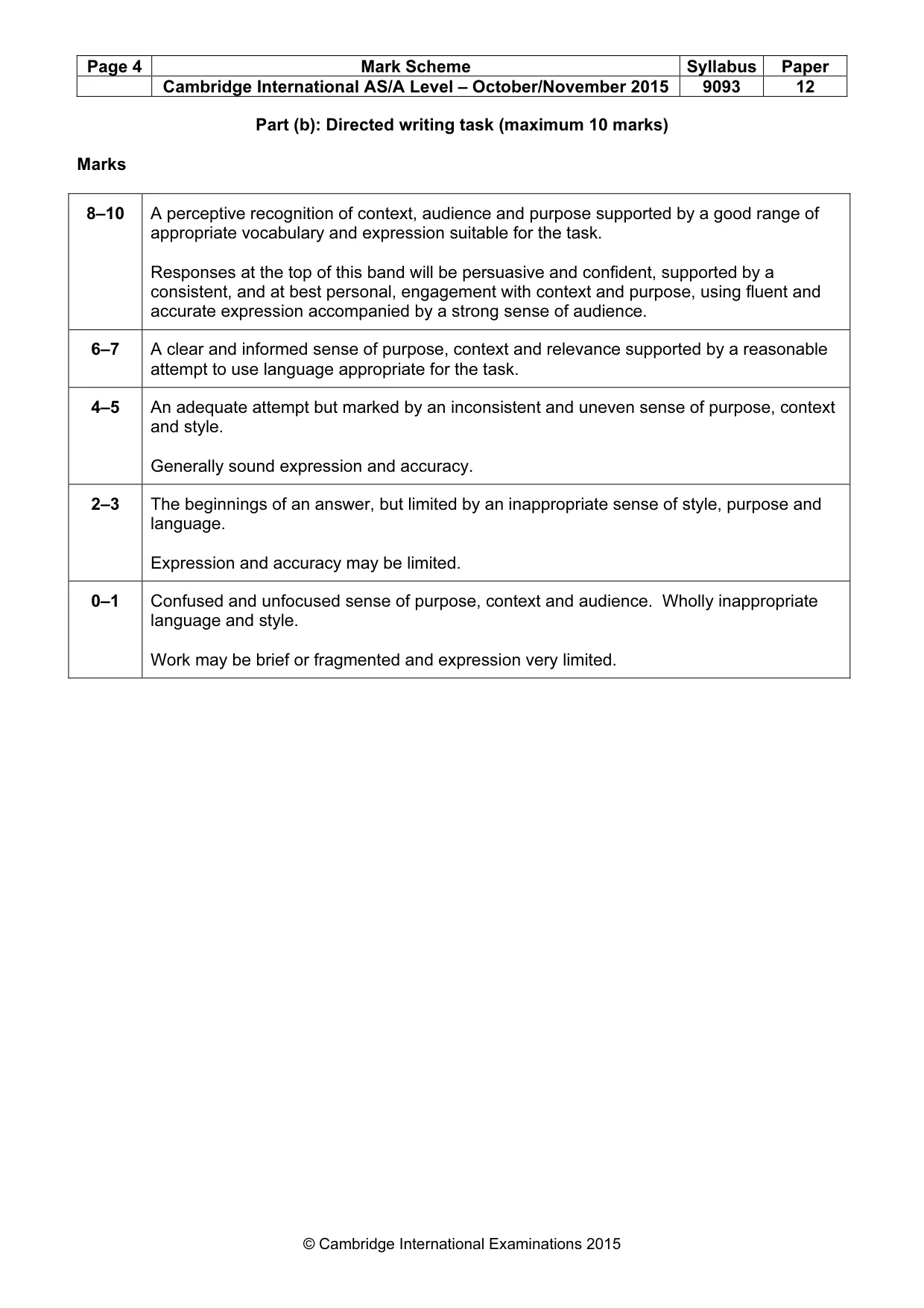
Page 4 Mark Scheme Syllabus Paper Cambridge International AS/A Level – October/November 2015 9093 12 © Cambridge International Examinations 2015 Part (b): Directed writing task (maximum 10 marks) Marks 8–10 A perceptive recognition of context, audience and purpose supported by a good range of appropriate vocabulary and expression suitable for the task. Responses at the top of this band will be persuasive and confident, supported by a consistent, and at best personal, engagement with context and purpose, using fluent and accurate expression accompanied by a strong sense of audience. 6–7 A clear and informed sense of purpose, context and relevance supported by a reasonable attempt to use language appropriate for the task. 4–5 An adequate attempt but marked by an inconsistent and uneven sense of purpose, context and style. Generally sound expression and accuracy. 2–3 The beginnings of an answer, but limited by an inappropriate sense of style, purpose and language. Expression and accuracy may be limited. 0–1 Confused and unfocused sense of purpose, context and audience. Wholly inappropriate language and style. Work may be brief or fragmented and expression very limited.
What you needed in this session
Cambridge’s own grade thresholds for 2015 Oct/Nov, Paper 1 · Variant 2. A higher threshold means an easier paper — the bar moves with how the cohort did.