Cambridge A Level English - Language AS and A Level (from 2014) 9093 — 2015 May/June Paper 4 · Variant 2
9093/42/M/J/15 · 50 marks · ≈56 min
The question paper and its mark scheme, free to read here and free to download. This is Cambridge’s own paper, exactly as it was sat.
Question paper8 pages

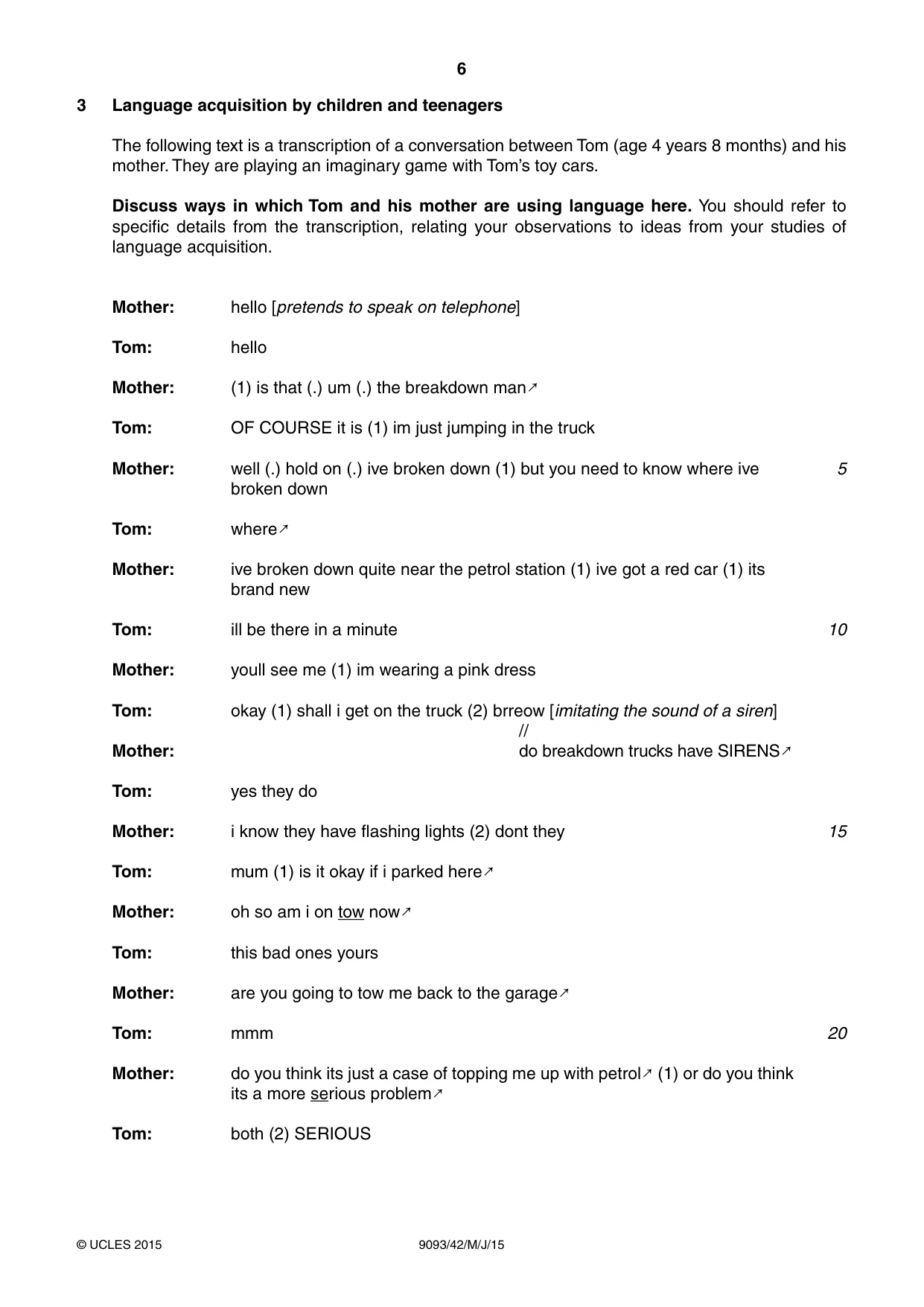
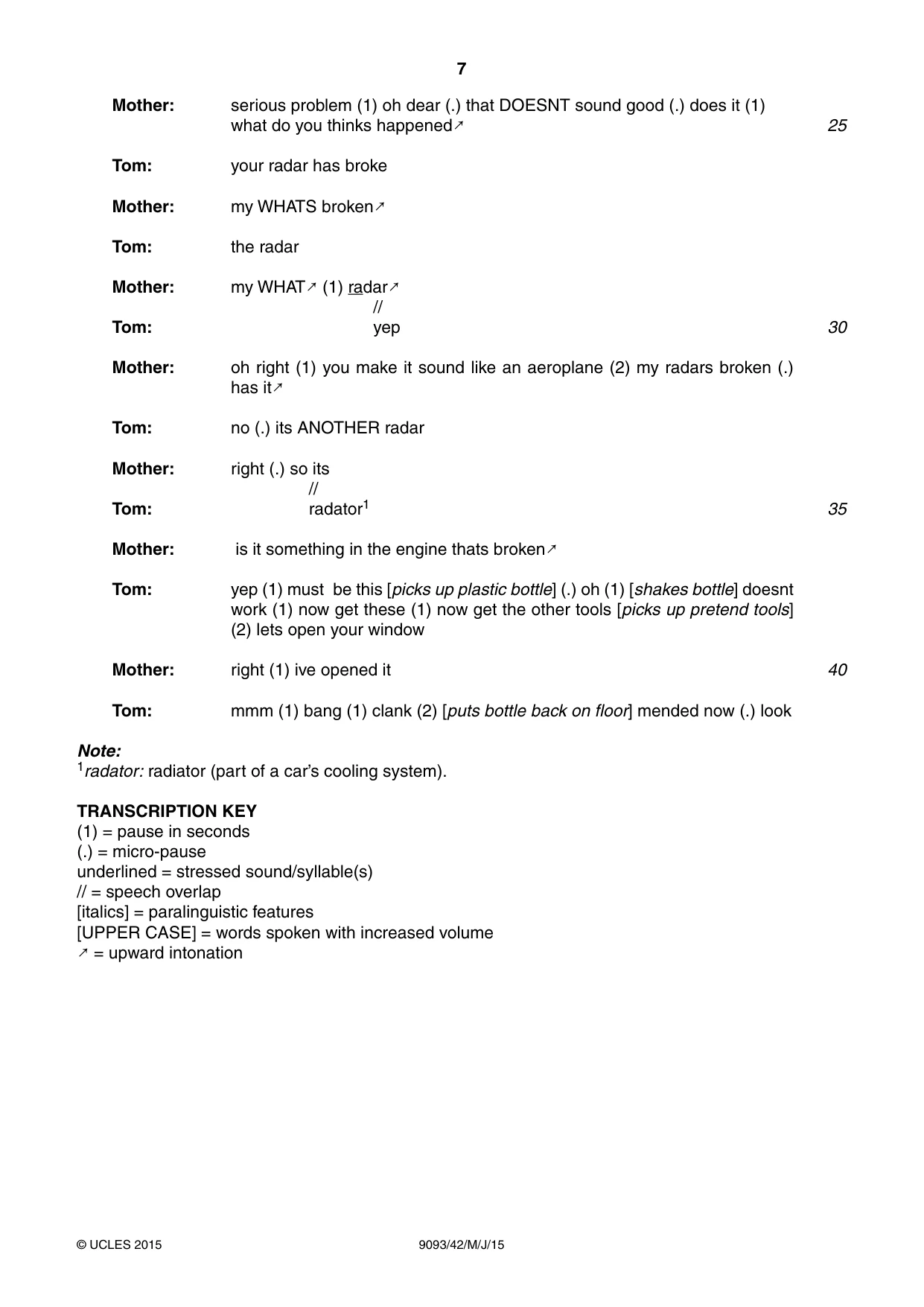

Mark scheme2 pages
Answers below. Sit the paper first if you are practising.
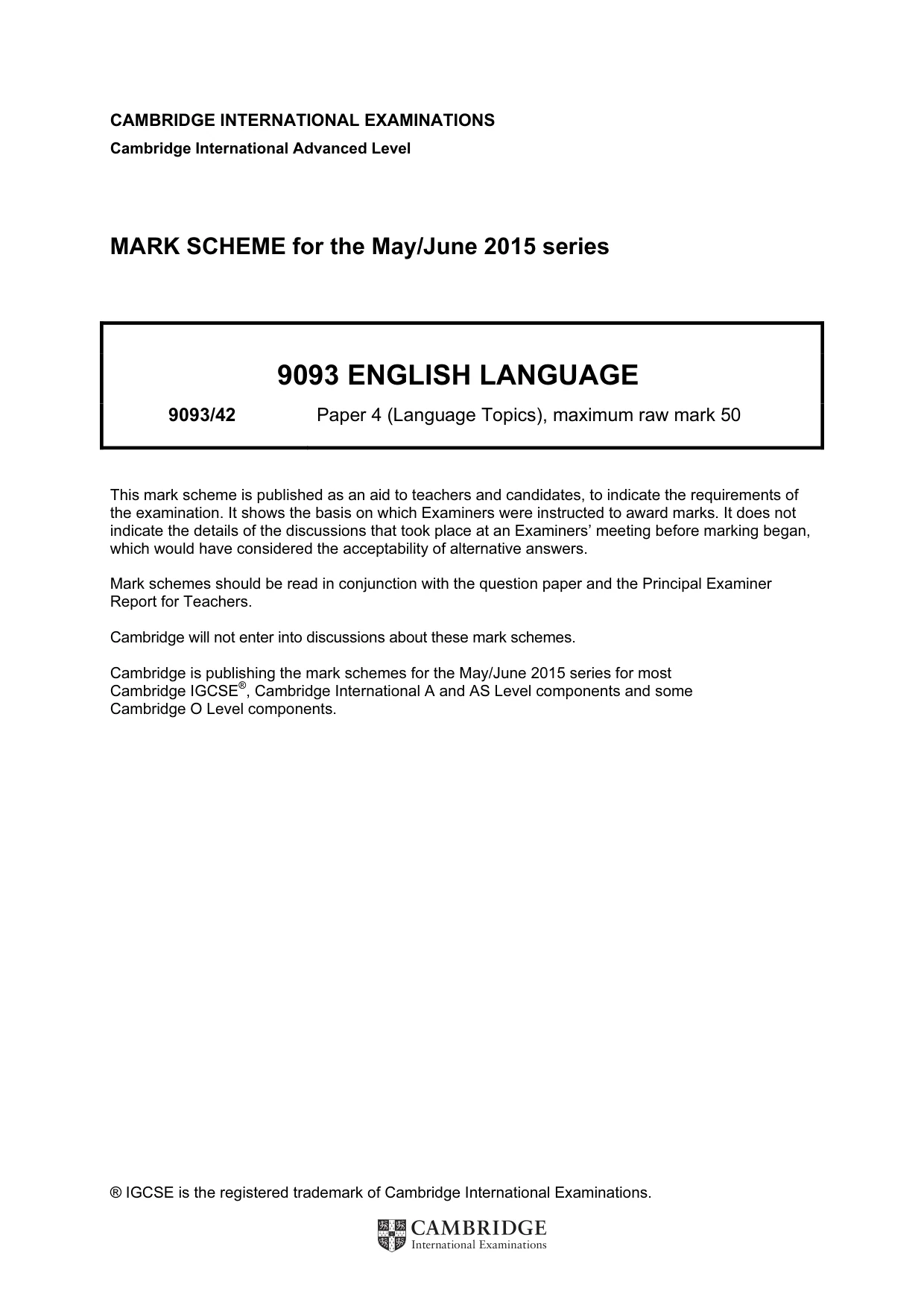
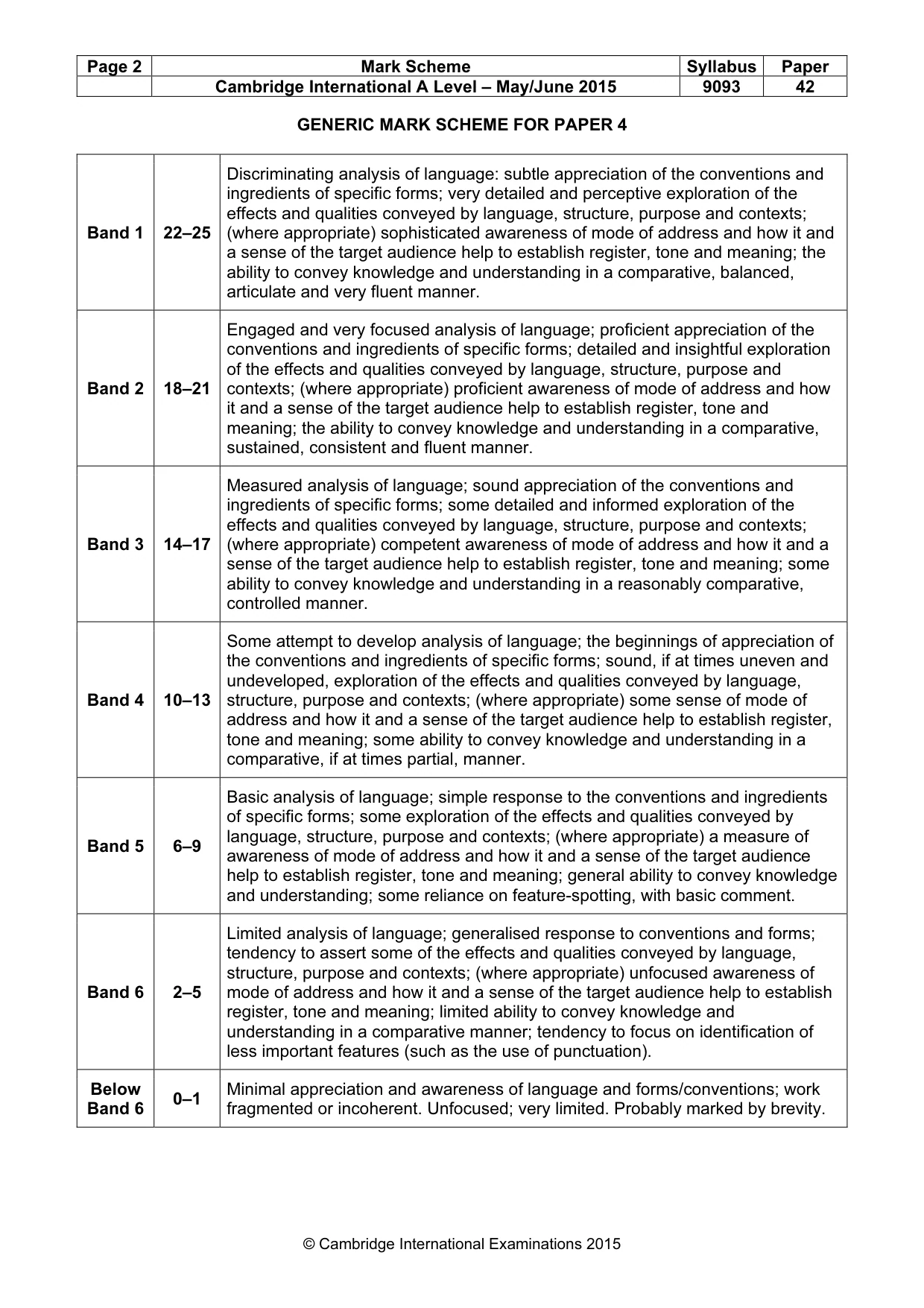
Paper as text
Question paper, page 1
This document consists of 7 printed pages, 1 blank page and 1 insert. DC (LK) 106952/1 © UCLES 2015 [Turn over Cambridge International Examinations Cambridge International Advanced Subsidiary and Advanced Level * 0 3 0 9 5 0 3 2 5 4 * ENGLISH LANGUAGE 9093/42 Paper 4 Language Topics May/June 2015 2 hours 15 minutes No Additional Materials are required. READ THESE INSTRUCTIONS FIRST An answer booklet is provided inside this question paper. You should follow the instructions on the front cover of the answer booklet. If you need additional answer paper ask the invigilator for a continuation booklet. Answer two questions. You should spend about 15 minutes reading the passages and questions before you start writing your answers. You are reminded of the need for good English and clear presentation in your answers. All questions in this paper carry equal marks.
Question paper, page 2
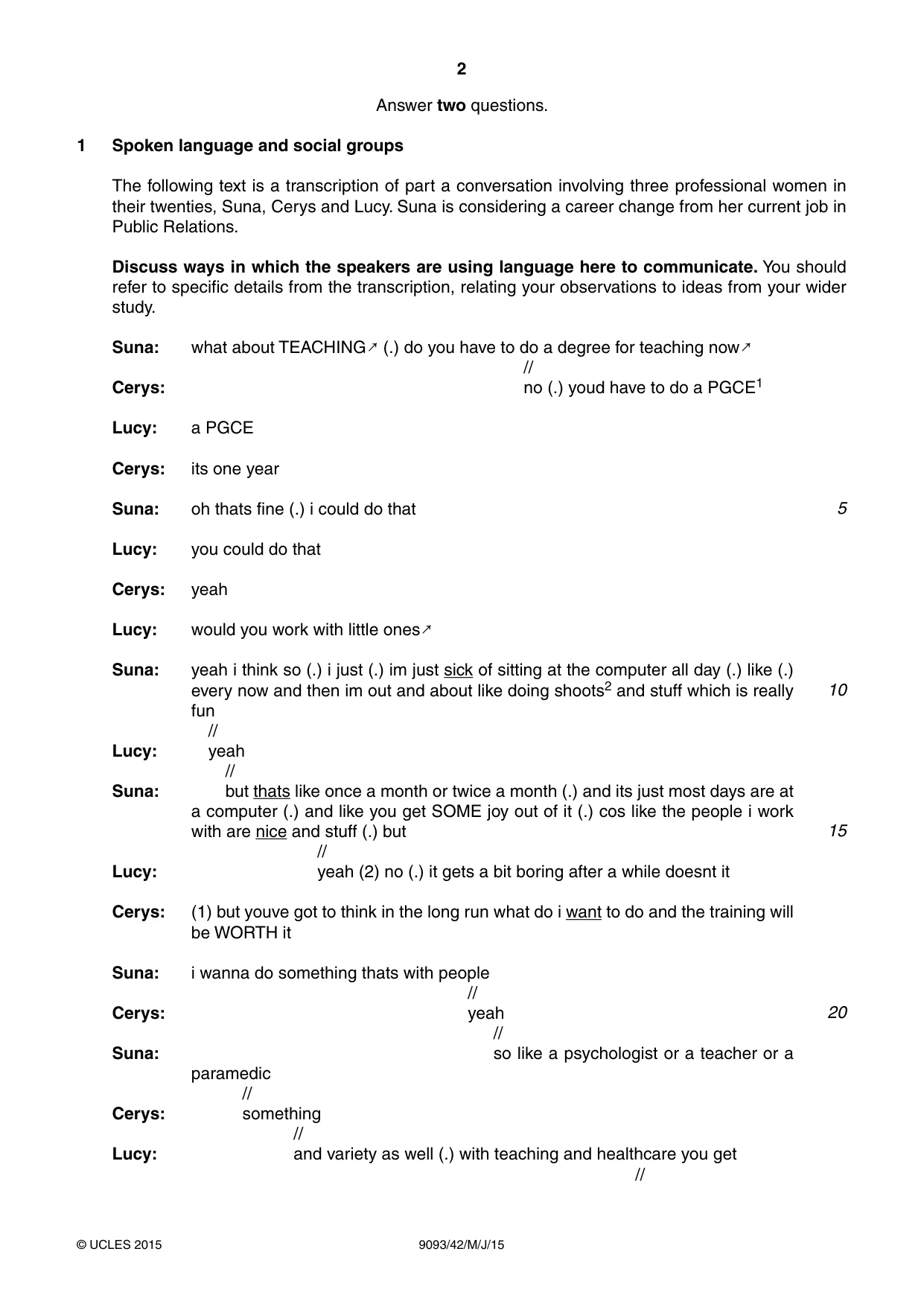
2 9093/42/M/J/15 © UCLES 2015 Answer two questions. 1 Spoken language and social groups The following text is a transcription of part a conversation involving three professional women in their twenties, Suna, Cerys and Lucy. Suna is considering a career change from her current job in Public Relations. Discuss ways in which the speakers are using language here to communicate. You should refer to specific details from the transcription, relating your observations to ideas from your wider study. Suna: what about TEACHING↗ (.) do you have to do a degree for teaching now↗ // Cerys: no (.) youd have to do a PGCE1 Lucy: a PGCE Cerys: its one year Suna: oh thats fine (.) i could do that Lucy: you could do that Cerys: yeah Lucy: would you work with little ones↗ Suna: yeah i think so (.) i just (.) im just sick of sitting at the computer all day (.) like (.) every now and then im out and about like doing shoots2 and stuff which is really fun // Lucy: yeah // Suna: but thats like once a month or twice a month (.) and its just most days are at a computer (.) and like you get SOME joy out of it (.) cos like the people i work with are nice and stuff (.) but // Lucy: yeah (2) no (.) it gets a bit boring after a while doesnt it Cerys: (1) but youve got to think in the long run what do i want to do and the training will be WORTH it Suna: i wanna do something thats with people // Cerys: yeah // Suna: so like a psychologist or a teacher or a paramedic // Cerys: something // Lucy: and variety as well (.) with teaching and healthcare you get // 5 10 15 20
Question paper, page 3
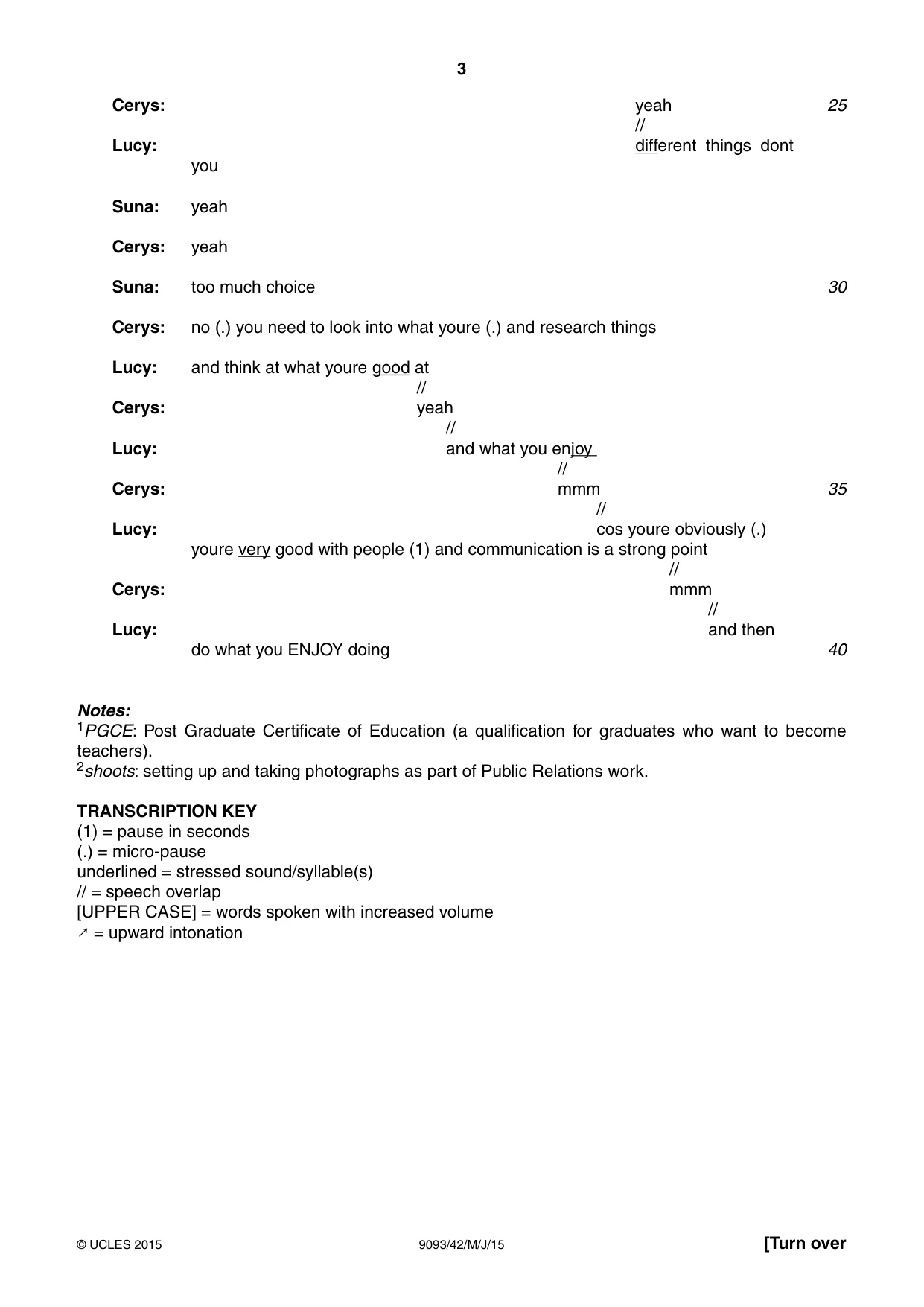
3 9093/42/M/J/15 © UCLES 2015 [Turn over Cerys: yeah // Lucy: different things dont you Suna: yeah Cerys: yeah Suna: too much choice Cerys: no (.) you need to look into what youre (.) and research things Lucy: and think at what youre good at // Cerys: yeah // Lucy: and what you enjoy // Cerys: mmm // Lucy: cos youre obviously (.) youre very good with people (1) and communication is a strong point // Cerys: mmm // Lucy: and then do what you ENJOY doing Notes: 1PGCE: Post Graduate Certificate of Education (a qualification for graduates who want to become teachers). 2shoots: setting up and taking photographs as part of Public Relations work. TRANSCRIPTION KEY (1) = pause in seconds (.) = micro-pause underlined = stressed sound/syllable(s) // = speech overlap [UPPER CASE] = words spoken with increased volume ↗ = upward intonation 25 30 35 40
Question paper, page 4
4 9093/42/M/J/15 © UCLES 2015 2 English as a global language The passage on the next page is an extract from a 2007 article published in the world news division of the New York Times. It discusses how English is used globally and its dominance as an international language. Discuss what you feel are the most important issues raised here relating to the changing use of English as a global language. You should refer to specific details from the passage as well as to ideas and examples from your wider study.
Question paper, page 5
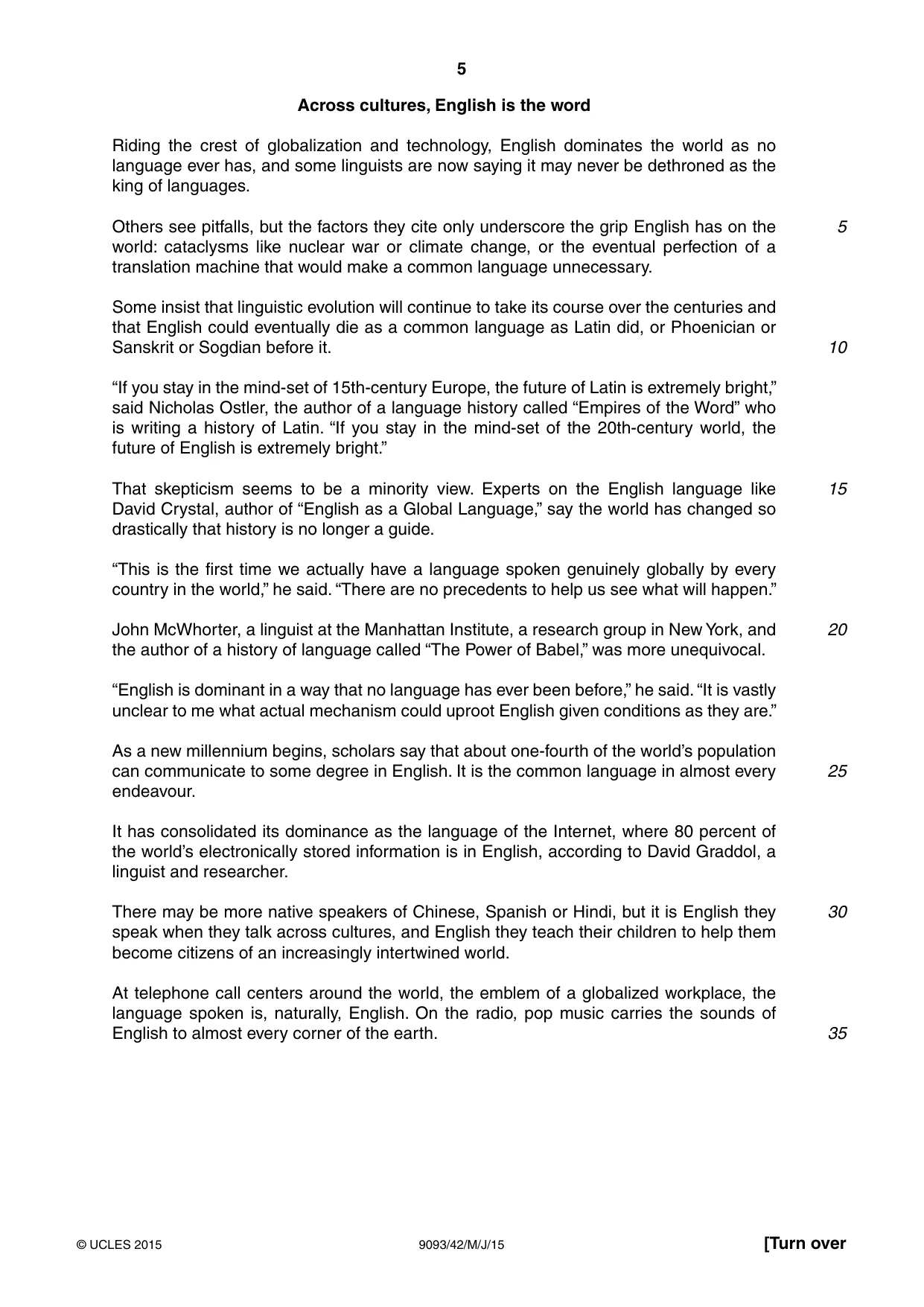
5 9093/42/M/J/15 © UCLES 2015 [Turn over Across cultures, English is the word Riding the crest of globalization and technology, English dominates the world as no language ever has, and some linguists are now saying it may never be dethroned as the king of languages. Others see pitfalls, but the factors they cite only underscore the grip English has on the world: cataclysms like nuclear war or climate change, or the eventual perfection of a translation machine that would make a common language unnecessary. Some insist that linguistic evolution will continue to take its course over the centuries and that English could eventually die as a common language as Latin did, or Phoenician or Sanskrit or Sogdian before it. “If you stay in the mind-set of 15th-century Europe, the future of Latin is extremely bright,” said Nicholas Ostler, the author of a language history called “Empires of the Word” who is writing a history of Latin. “If you stay in the mind-set of the 20th-century world, the future of English is extremely bright.” That skepticism seems to be a minority view. Experts on the English language like David Crystal, author of “English as a Global Language,” say the world has changed so drastically that history is no longer a guide. “This is the first time we actually have a language spoken genuinely globally by every country in the world,” he said. “There are no precedents to help us see what will happen.” John McWhorter, a linguist at the Manhattan Institute, a research group in New York, and the author of a history of language called “The Power of Babel,” was more unequivocal. “English is dominant in a way that no language has ever been before,” he said. “It is vastly unclear to me what actual mechanism could uproot English given conditions as they are.” As a new millennium begins, scholars say that about one-fourth of the world’s population can communicate to some degree in English. It is the common language in almost every endeavour. It has consolidated its dominance as the language of the Internet, where 80 percent of the world’s electronically stored information is in English, according to David Graddol, a linguist and researcher. There may be more native speakers of Chinese, Spanish or Hindi, but it is English they speak when they talk across cultures, and English they teach their children to help them become citizens of an increasingly intertwined world. At telephone call centers around the world, the emblem of a globalized workplace, the language spoken is, naturally, English. On the radio, pop music carries the sounds of English to almost every corner of the earth. 5 10 15 20 25 30 35
Question paper, page 6
6 9093/42/M/J/15 © UCLES 2015 3 Language acquisition by children and teenagers The following text is a transcription of a conversation between Tom (age 4 years 8 months) and his mother. They are playing an imaginary game with Tom’s toy cars. Discuss ways in which Tom and his mother are using language here. You should refer to specific details from the transcription, relating your observations to ideas from your studies of language acquisition. Mother: hello [pretends to speak on telephone] Tom: he llo Mother: (1) is that (.) um (.) the breakdown man↗ Tom: OF COURSE it is (1) im just jumping in the truck Mother: well (.) hold on (.) ive broken down (1) but you need to know where ive broken down Tom: whe re↗ Mother: ive broken down quite near the petrol station (1) ive got a red car (1) its brand new Tom: ill be there in a minute Mother: youll see me (1) im wearing a pink dress Tom: okay (1) shall i get on the truck (2) brreow [imitating the sound of a siren] // Mother: do breakdown trucks have SIRENS↗ Tom: yes they do Mother: i know they have flashing lights (2) dont they Tom: mum ( 1) is it okay if i parked here↗ Mother: oh so am i on tow now↗ Tom: this bad ones yours Mother: are you going to tow me back to the garage↗ Tom: mmm Mother: do you think its just a case of topping me up with petrol↗ (1) or do you think its a more serious problem↗ Tom: both (2) SERIOUS 5 10 15 20
Question paper, page 7
7 9093/42/M/J/15 © UCLES 2015 Mother: serious problem (1) oh dear (.) that DOESNT sound good (.) does it (1) what do you thinks happened↗ Tom: your radar has broke Mother: my WHATS broken↗ Tom: the radar Mother: my WHAT↗ (1) radar↗ // Tom: yep Mothe r: oh right (1 ) you make it sound like an aeroplane (2) my radars broken (.) has it↗ Tom: no (.) its ANO THER radar Mother: right (.) so its // Tom: radator1 Mother: is it something in the engine thats broken↗ Tom: yep (1) must be this [picks up plastic bottle] (.) oh (1) [shakes bottle] doesnt work (1) now get these (1 ) now get the other tools [picks up pretend tools] (2) lets open your window Mother: right (1) ive opened it Tom: mmm (1) bang (1 ) clank (2 ) [puts bottle back on floor] mended now (.) look Note: 1rada tor: radiator (part of a car’s cooling system). TRANSCRIPTION KEY (1) = pause in seconds (.) = micro-pause underlined = stressed sound/syllable(s) // = speech overlap [italics] = paralinguistic features [UPPER CASE] = words spoken with increased volume ↗ = upward intonation 25 30 35 40
Question paper, page 8
8 9093/42/M/J/15 © UCLES 2015 BLANK PAGE Permission to reproduce items where third-party owned material protected by copyright is included has been sought and cleared where possible. Every reasonable effort has been made by the publisher (UCLES) to trace copyright holders, but if any items requiring clearance have unwittingly been included, the publisher will be pleased to make amends at the earliest possible opportunity. To avoid the issue of disclosure of answer-related information to candidates, all copyright acknowledgements are reproduced online in the Cambridge International Examinations Copyright Acknowledgements Booklet. This is produced for each series of examinations and is freely available to download at www.cie.org.uk after the live examination series. Cambridge International Examinations is part of the Cambridge Assessment Group. Cambridge Assessment is the brand name of University of Cambridge Local Examinations Syndicate (UCLES), which is itself a department of the University of Cambridge.
Mark scheme, page 1
® IGCSE is the registered trademark of Cambridge International Examinations. CAMBRIDGE INTERNATIONAL EXAMINATIONS Cambridge International Advanced Level MARK SCHEME for the May/June 2015 series 9093 ENGLISH LANGUAGE 9093/42 Paper 4 (Language Topics), maximum raw mark 50 This mark scheme is published as an aid to teachers and candidates, to indicate the requirements of the examination. It shows the basis on which Examiners were instructed to award marks. It does not indicate the details of the discussions that took place at an Examiners’ meeting before marking began, which would have considered the acceptability of alternative answers. Mark schemes should be read in conjunction with the question paper and the Principal Examiner Report for Teachers. Cambridge will not enter into discussions about these mark schemes. Cambridge is publishing the mark schemes for the May/June 2015 series for most Cambridge IGCSE®, Cambridge International A and AS Level components and some Cambridge O Level components.
Mark scheme, page 2
Page 2 Mark Scheme Syllabus Paper Cambridge International A Level – May/June 2015 9093 42 © Cambridge International Examinations 2015 GENERIC MARK SCHEME FOR PAPER 4 Band 1 22–25 Discriminating analysis of language: subtle appreciation of the conventions and ingredients of specific forms; very detailed and perceptive exploration of the effects and qualities conveyed by language, structure, purpose and contexts; (where appropriate) sophisticated awareness of mode of address and how it and a sense of the target audience help to establish register, tone and meaning; the ability to convey knowledge and understanding in a comparative, balanced, articulate and very fluent manner. Band 2 18–21 Engaged and very focused analysis of language; proficient appreciation of the conventions and ingredients of specific forms; detailed and insightful exploration of the effects and qualities conveyed by language, structure, purpose and contexts; (where appropriate) proficient awareness of mode of address and how it and a sense of the target audience help to establish register, tone and meaning; the ability to convey knowledge and understanding in a comparative, sustained, consistent and fluent manner. Band 3 14–17 Measured analysis of language; sound appreciation of the conventions and ingredients of specific forms; some detailed and informed exploration of the effects and qualities conveyed by language, structure, purpose and contexts; (where appropriate) competent awareness of mode of address and how it and a sense of the target audience help to establish register, tone and meaning; some ability to convey knowledge and understanding in a reasonably comparative, controlled manner. Band 4 10–13 Some attempt to develop analysis of language; the beginnings of appreciation of the conventions and ingredients of specific forms; sound, if at times uneven and undeveloped, exploration of the effects and qualities conveyed by language, structure, purpose and contexts; (where appropriate) some sense of mode of address and how it and a sense of the target audience help to establish register, tone and meaning; some ability to convey knowledge and understanding in a comparative, if at times partial, manner. Band 5 6–9 Basic analysis of language; simple response to the conventions and ingredients of specific forms; some exploration of the effects and qualities conveyed by language, structure, purpose and contexts; (where appropriate) a measure of awareness of mode of address and how it and a sense of the target audience help to establish register, tone and meaning; general ability to convey knowledge and understanding; some reliance on feature-spotting, with basic comment. Band 6 2–5 Limited analysis of language; generalised response to conventions and forms; tendency to assert some of the effects and qualities conveyed by language, structure, purpose and contexts; (where appropriate) unfocused awareness of mode of address and how it and a sense of the target audience help to establish register, tone and meaning; limited ability to convey knowledge and understanding in a comparative manner; tendency to focus on identification of less important features (such as the use of punctuation). Below Band 6 0–1 Minimal appreciation and awareness of language and forms/conventions; work fragmented or incoherent. Unfocused; very limited. Probably marked by brevity.
What you needed in this session
Cambridge’s own grade thresholds for 2015 May/June, Paper 4 · Variant 2. A higher threshold means an easier paper — the bar moves with how the cohort did.