Cambridge A Level English - Language AS and A Level (from 2014) 9093 — 2015 May/June Paper 4 · Variant 1
9093/41/M/J/15 · 50 marks · ≈56 min
The question paper and its mark scheme, free to read here and free to download. This is Cambridge’s own paper, exactly as it was sat.
Question paper8 pages

Mark scheme2 pages
Answers below. Sit the paper first if you are practising.
Paper as text
Question paper, page 1
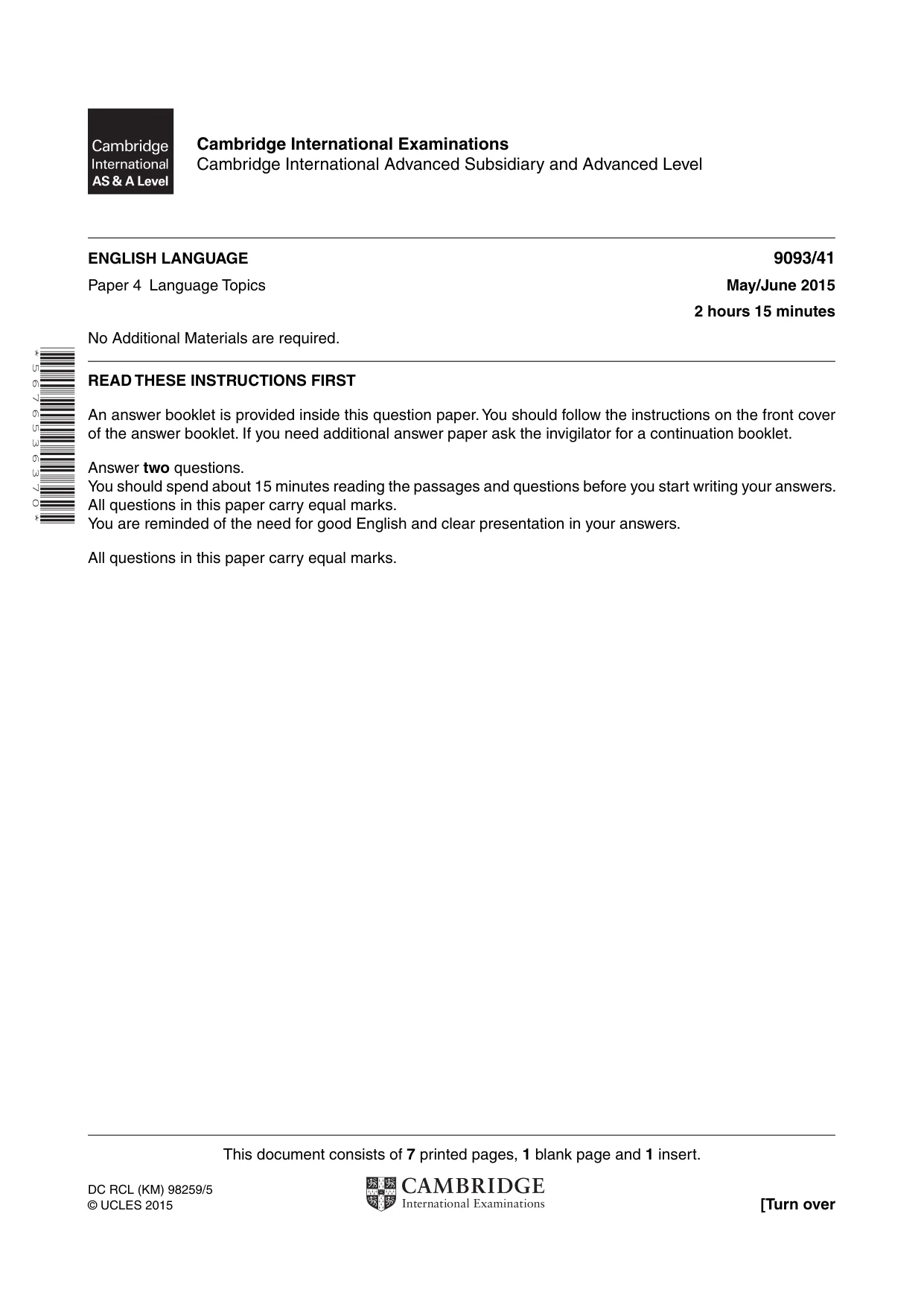
This document consists of 7 printed pages, 1 blank page and 1 insert. DC RCL (KM) 98259/5 © UCLES 2015 [Turn over Cambridge International Examinations Cambridge International Advanced Subsidiary and Advanced Level * 5 6 7 6 5 3 6 3 7 0 * ENGLISH LANGUAGE 9093/41 Paper 4 Language Topics May/June 2015 2 hours 15 minutes No Additional Materials are required. READ THESE INSTRUCTIONS FIRST An answer booklet is provided inside this question paper. You should follow the instructions on the front cover of the answer booklet. If you need additional answer paper ask the invigilator for a continuation booklet. Answer two questions. You should spend about 15 minutes reading the passages and questions before you start writing your answers. All questions in this paper carry equal marks. You are reminded of the need for good English and clear presentation in your answers. All questions in this paper carry equal marks.
Question paper, page 2
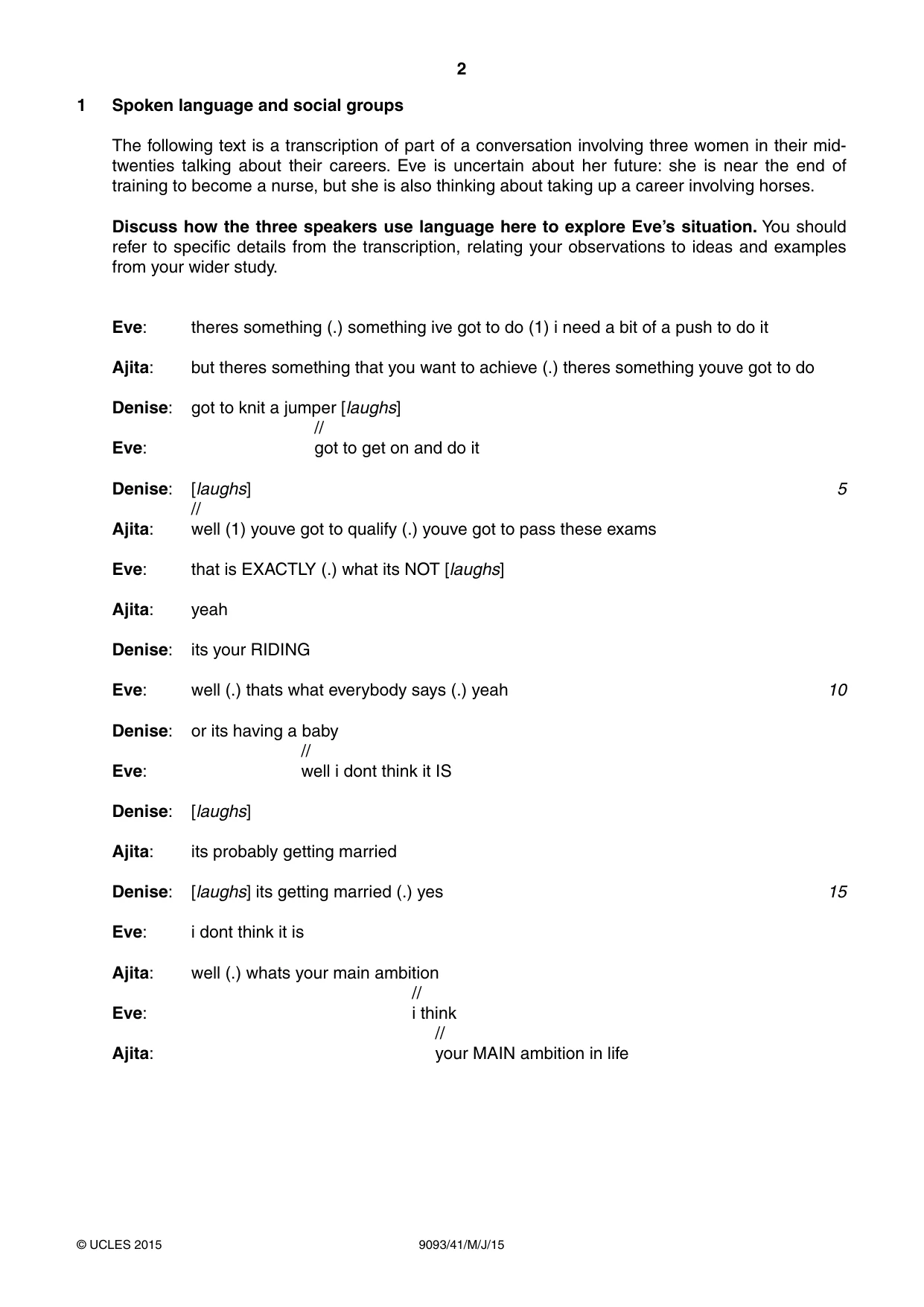
2 9093/41/M/J/15 © UCLES 2015 1 Spoken language and social groups The following text is a transcription of part of a conversation involving three women in their mid- twenties talking about their careers. Eve is uncertain about her future: she is near the end of training to become a nurse, but she is also thinking about taking up a career involving horses. Discuss how the three speakers use language here to explore Eve’s situation. You should refer to specific details from the transcription, relating your observations to ideas and examples from your wider study. Eve: theres something (.) something ive got to do (1) i need a bit of a push to do it Ajita: but theres something that you want to achieve (.) theres something youve got to do Denise: got to knit a jumper [laughs] // Eve: got to get on and do it Denise: [laughs] 5 // Ajita: well (1) youve got to qualify (.) youve got to pass these exams Eve: that is EXACTLY (.) what its NOT [laughs] Ajita: yeah Denise: its your RIDING Eve: well (.) thats what everybody says (.) yeah 10 Denise: or its having a baby // Eve: well i dont think it IS Denise: [laughs] Ajita: its probably getting married Denise: [laughs] its getting married (.) yes 15 Eve: i dont think it is Ajita: well (.) whats your main ambition // Eve: i think // Ajita: your MAIN ambition in life
Question paper, page 3
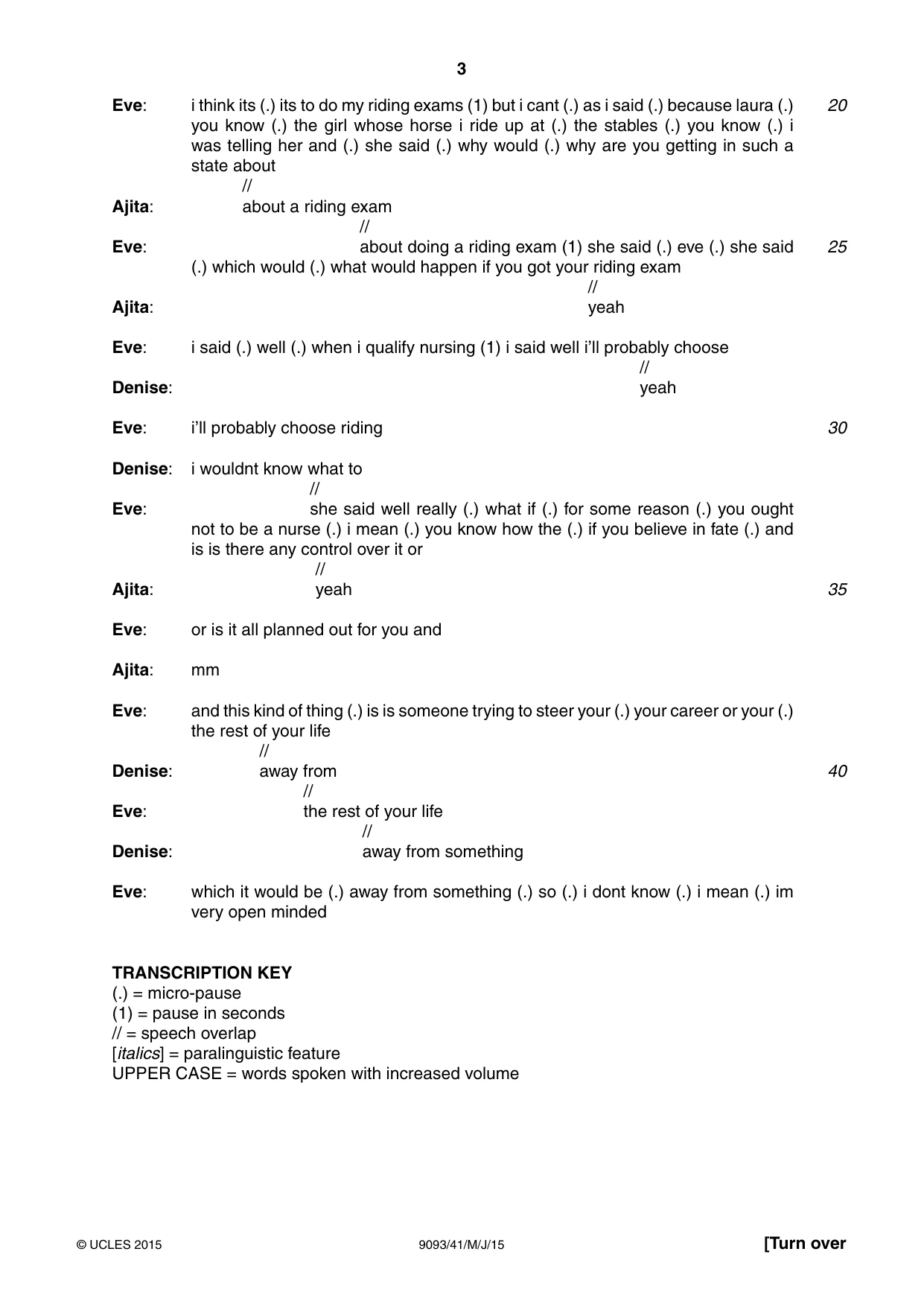
3 9093/41/M/J/15 © UCLES 2015 [Turn over Eve: i think its (.) its to do my riding exams (1) but i cant (.) as i said (.) because laura (.) you know (.) the girl whose horse i ride up at (.) the stables (.) you know (.) i was telling her and (.) she said (.) why would (.) why are you getting in such a state about // Ajita: about a riding exam // Eve: about doing a riding exam (1) she said (.) eve (.) she said (.) which would (.) what would happen if you got your riding exam // Ajita: yeah Eve: i said (.) well (.) when i qualify nursing (1) i said well i’ll probably choose // Denise: yeah Eve: i’ll probably choose riding Denise: i wouldnt know what to // Eve: she said well really (.) what if (.) for some reason (.) you ought not to be a nurse (.) i mean (.) you know how the (.) if you believe in fate (.) and is is there any control over it or // Ajita: yeah Eve: or is it all planned out for you and Ajita: mm Eve: and this kind of thing (.) is is someone trying to steer your (.) your career or your (.) the rest of your life // Denise: away from // Eve: the rest of your life // Denise: away from something Eve: which it would be (.) away from something (.) so (.) i dont know (.) i mean (.) im very open minded TRANSCRIPTION KEY (.) = micro-pause (1) = pause in seconds // = speech overlap [italics] = paralinguistic feature UPPER CASE = words spoken with increased volume 20 25 30 35 40
Question paper, page 4
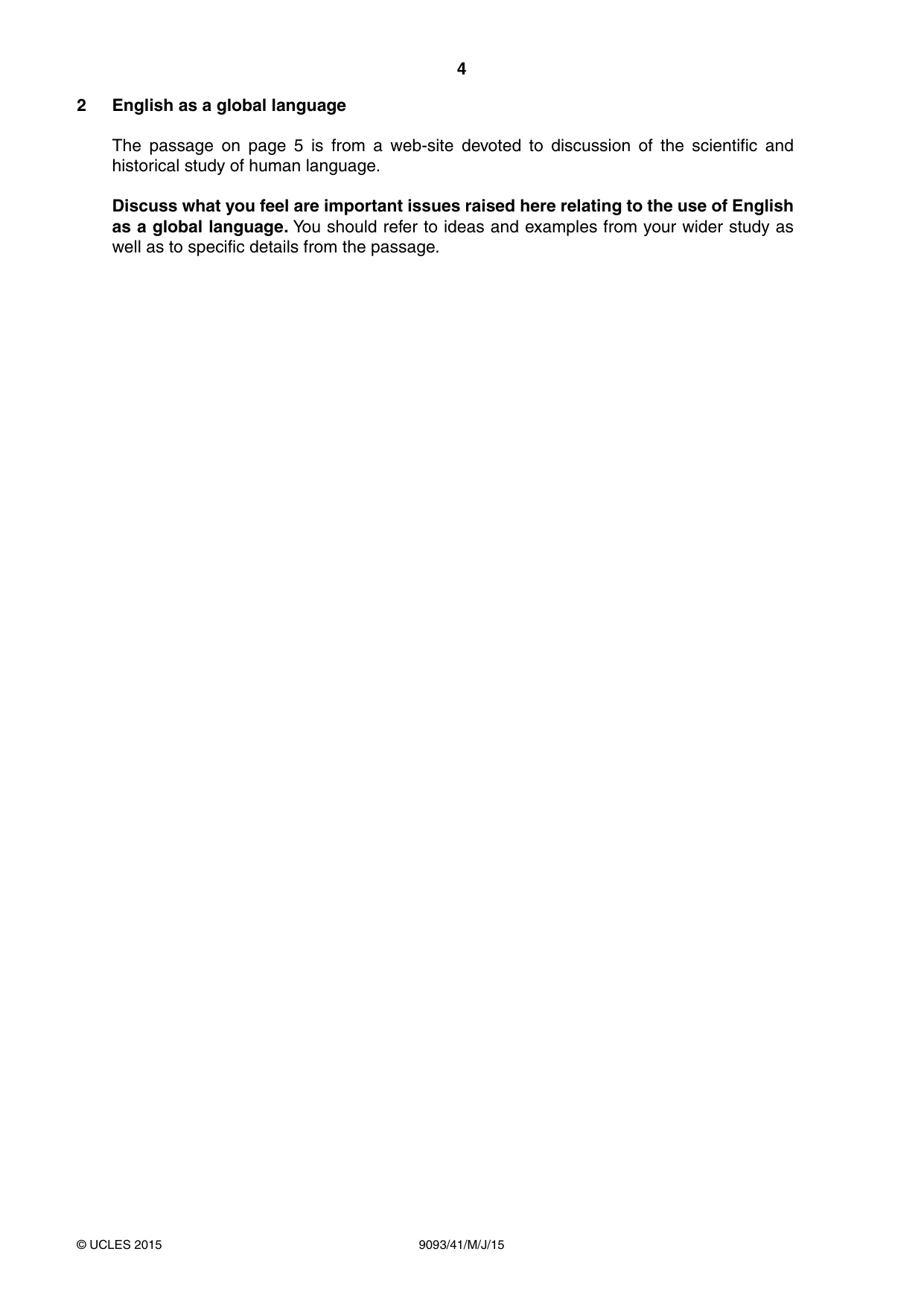
4 9093/41/M/J/15 © UCLES 2015 2 English as a global language The passage on page 5 is from a web-site devoted to discussion of the scientific and historical study of human language. Discuss what you feel are important issues raised here relating to the use of English as a global language. You should refer to ideas and examples from your wider study as well as to specific details from the passage.
Question paper, page 5
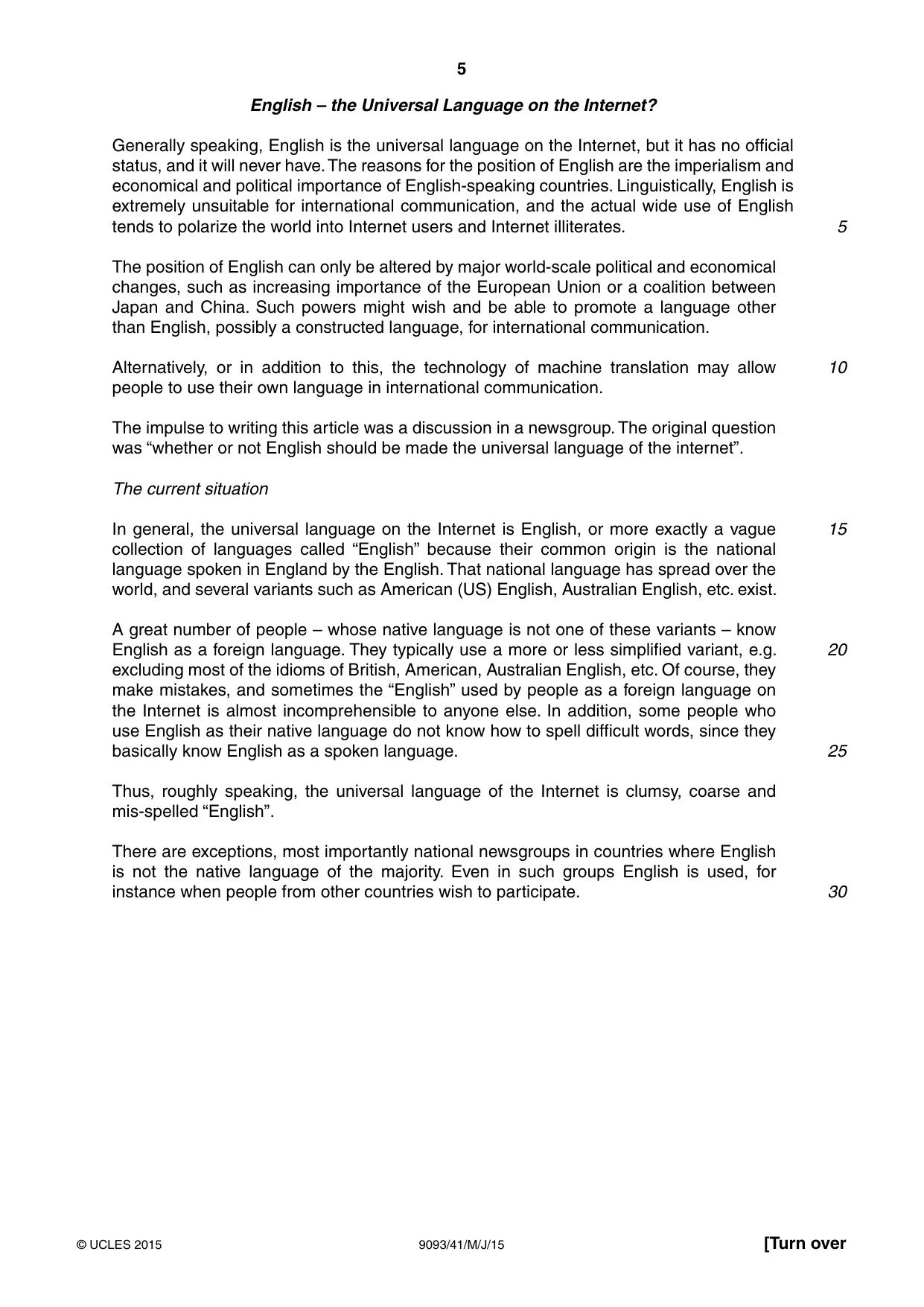
5 9093/41/M/J/15 © UCLES 2015 [Turn over English – the Universal Language on the Internet? Generally speaking, English is the universal language on the Internet, but it has no official status, and it will never have. The reasons for the position of English are the imperialism and economical and political importance of English-speaking countries. Linguistically, English is extremely unsuitable for international communication, and the actual wide use of English tends to polarize the world into Internet users and Internet illiterates. The position of English can only be altered by major world-scale political and economical changes, such as increasing importance of the European Union or a coalition between Japan and China. Such powers might wish and be able to promote a language other than English, possibly a constructed language, for international communication. Alternatively, or in addition to this, the technology of machine translation may allow people to use their own language in international communication. The impulse to writing this article was a discussion in a newsgroup. The original question was “whether or not English should be made the universal language of the internet”. The current situation In general, the universal language on the Internet is English, or more exactly a vague collection of languages called “English” because their common origin is the national language spoken in England by the English. That national language has spread over the world, and several variants such as American (US) English, Australian English, etc. exist. A great number of people – whose native language is not one of these variants – know English as a foreign language. They typically use a more or less simplified variant, e.g. excluding most of the idioms of British, American, Australian English, etc. Of course, they make mistakes, and sometimes the “English” used by people as a foreign language on the Internet is almost incomprehensible to anyone else. In addition, some people who use English as their native language do not know how to spell difficult words, since they basically know English as a spoken language. Thus, roughly speaking, the universal language of the Internet is clumsy, coarse and mis-spelled “English”. There are exceptions, most importantly national newsgroups in countries where English is not the native language of the majority. Even in such groups English is used, for instance when people from other countries wish to participate. 5 10 15 20 25 30
Question paper, page 6
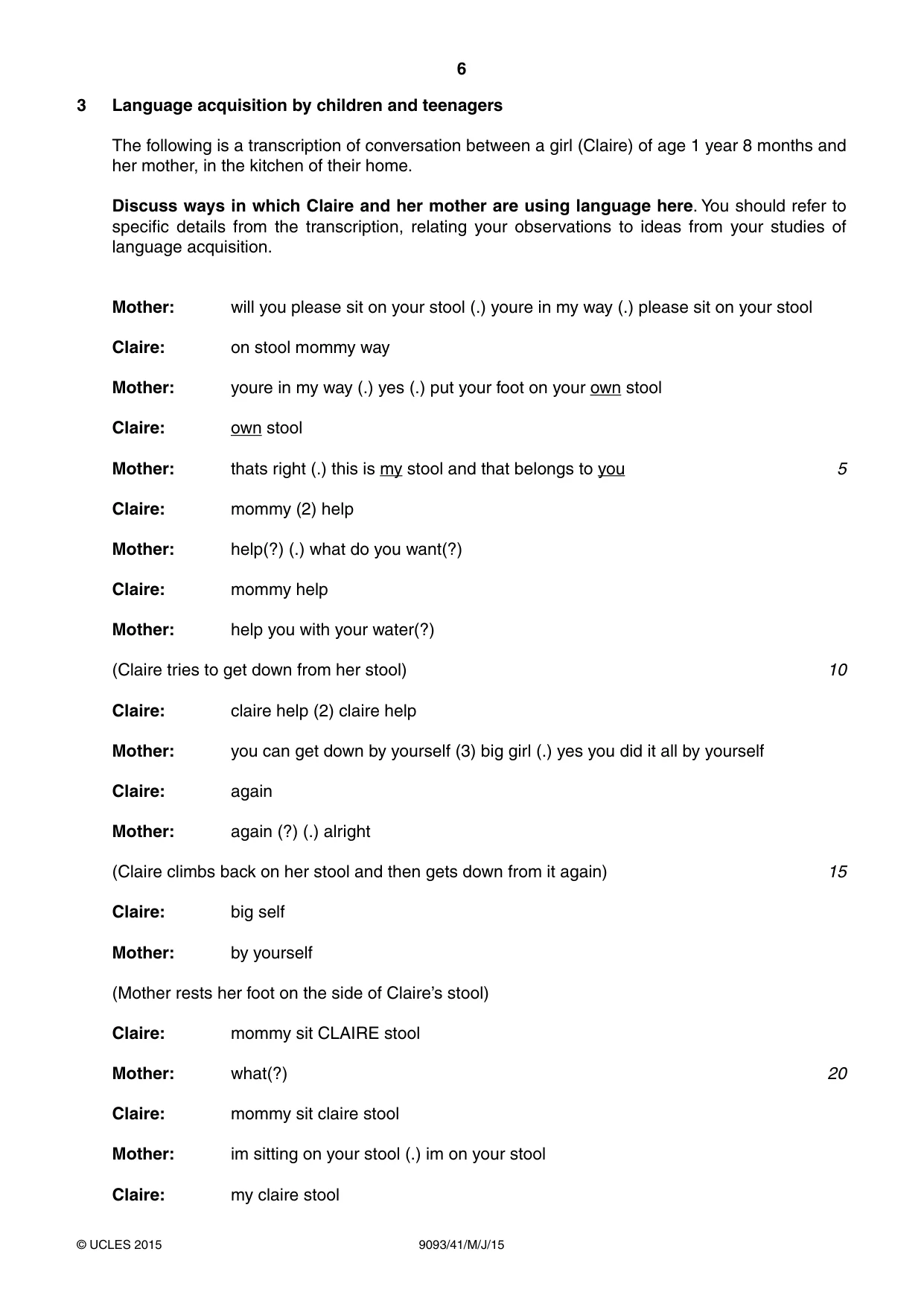
6 9093/41/M/J/15 © UCLES 2015 3 Language acquisition by children and teenagers The following is a transcription of conversation between a girl (Claire) of age 1 year 8 months and her mother, in the kitchen of their home. Discuss ways in which Claire and her mother are using language here. You should refer to specific details from the transcription, relating your observations to ideas from your studies of language acquisition. Mother: will you please sit on your stool (.) youre in my way (.) please sit on your stool Claire: on stool mommy way Mother: youre in my way (.) yes (.) put your foot on your own stool Claire: own stool Mother: thats right (.) this is my stool and that belongs to you 5 Claire: mommy (2) help Mother: help(?) (.) what do you want(?) Claire: mommy help Mother: help you with your water(?) (Claire tries to get down from her stool) 10 Claire: claire help (2) claire help Mother: you can get down by yourself (3) big girl (.) yes you did it all by yourself Claire: again Mother: again (?) (.) alright (Claire climbs back on her stool and then gets down from it again) 15 Claire: big self Mother: by yourself (Mother rests her foot on the side of Claire’s stool) Claire: mommy sit CLAIRE stool Mother: what(?) 20 Claire: mommy sit claire stool Mother: im sitting on your stool (.) im on your stool Claire: my claire stool
Question paper, page 7
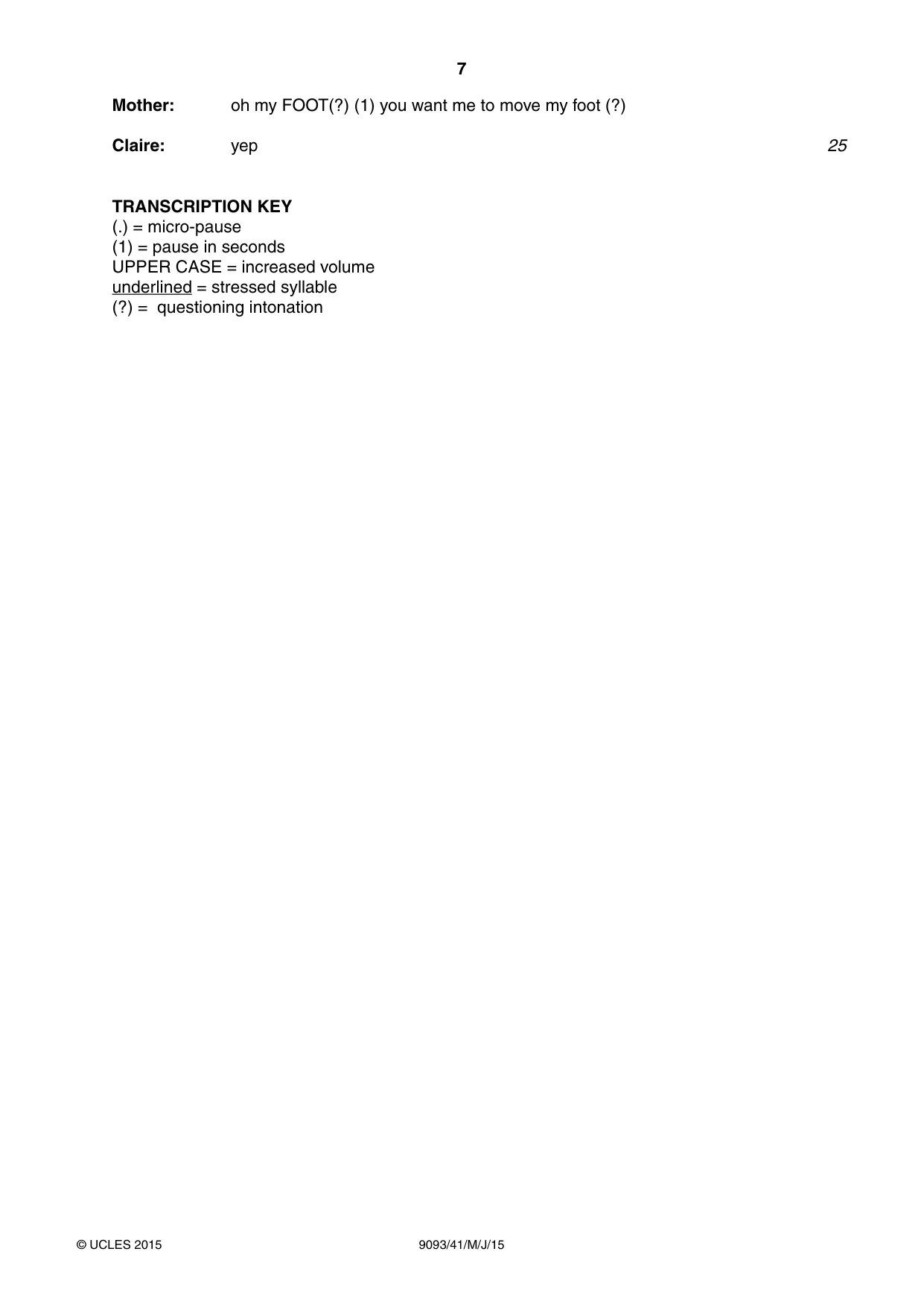
7 9093/41/M/J/15 © UCLES 2015 Mother: oh my FOOT(?) (1) you want me to move my foot (?) Claire: yep 25 TRANSCRIPTION KEY (.) = micro-pause (1) = pause in seconds UPPER CASE = increased volume underlined = stressed syllable (?) = questioning intonation
Question paper, page 8
8 9093/41/M/J/15 © UCLES 2015 BLANK PAGE Permission to reproduce items where third-party owned material protected by copyright is included has been sought and cleared where possible. Every reasonable effort has been made by the publisher (UCLES) to trace copyright holders, but if any items requiring clearance have unwittingly been included, the publisher will be pleased to make amends at the earliest possible opportunity. To avoid the issue of disclosure of answer-related information to candidates, all copyright acknowledgements are reproduced online in the Cambridge International Examinations Copyright Acknowledgements Booklet. This is produced for each series of examinations and is freely available to download at www.cie.org.uk after the live examination series. Cambridge International Examinations is part of the Cambridge Assessment Group. Cambridge Assessment is the brand name of University of Cambridge Local Examinations Syndicate (UCLES), which is itself a department of the University of Cambridge.
Mark scheme, page 1
® IGCSE is the registered trademark of Cambridge International Examinations. CAMBRIDGE INTERNATIONAL EXAMINATIONS Cambridge International Advanced Level MARK SCHEME for the May/June 2015 series 9093 ENGLISH LANGUAGE 9093/41 Paper 4 (Language Topics), maximum raw mark 50 This mark scheme is published as an aid to teachers and candidates, to indicate the requirements of the examination. It shows the basis on which Examiners were instructed to award marks. It does not indicate the details of the discussions that took place at an Examiners’ meeting before marking began, which would have considered the acceptability of alternative answers. Mark schemes should be read in conjunction with the question paper and the Principal Examiner Report for Teachers. Cambridge will not enter into discussions about these mark schemes. Cambridge is publishing the mark schemes for the May/June 2015 series for most Cambridge IGCSE®, Cambridge International A and AS Level components and some Cambridge O Level components.
Mark scheme, page 2
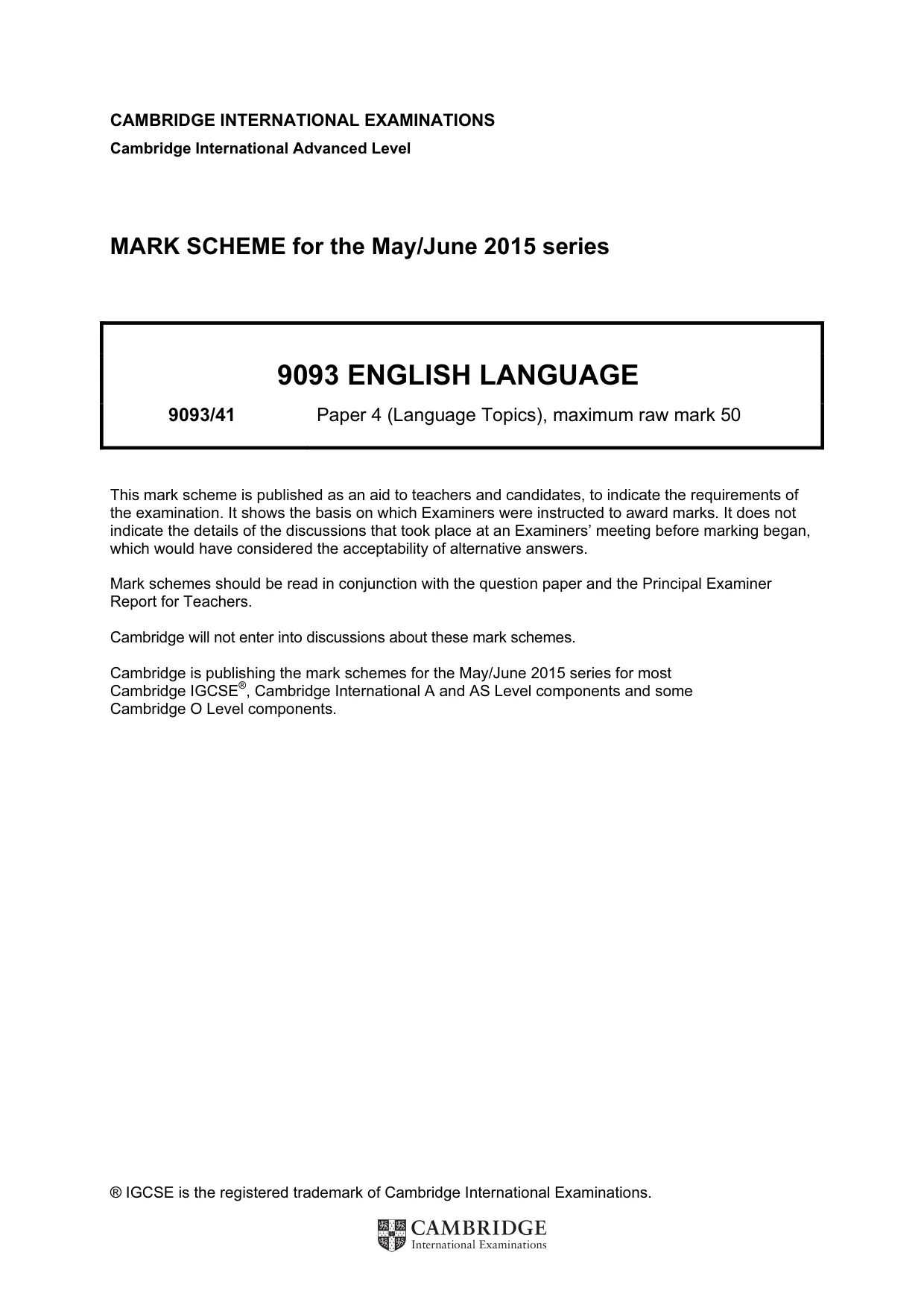
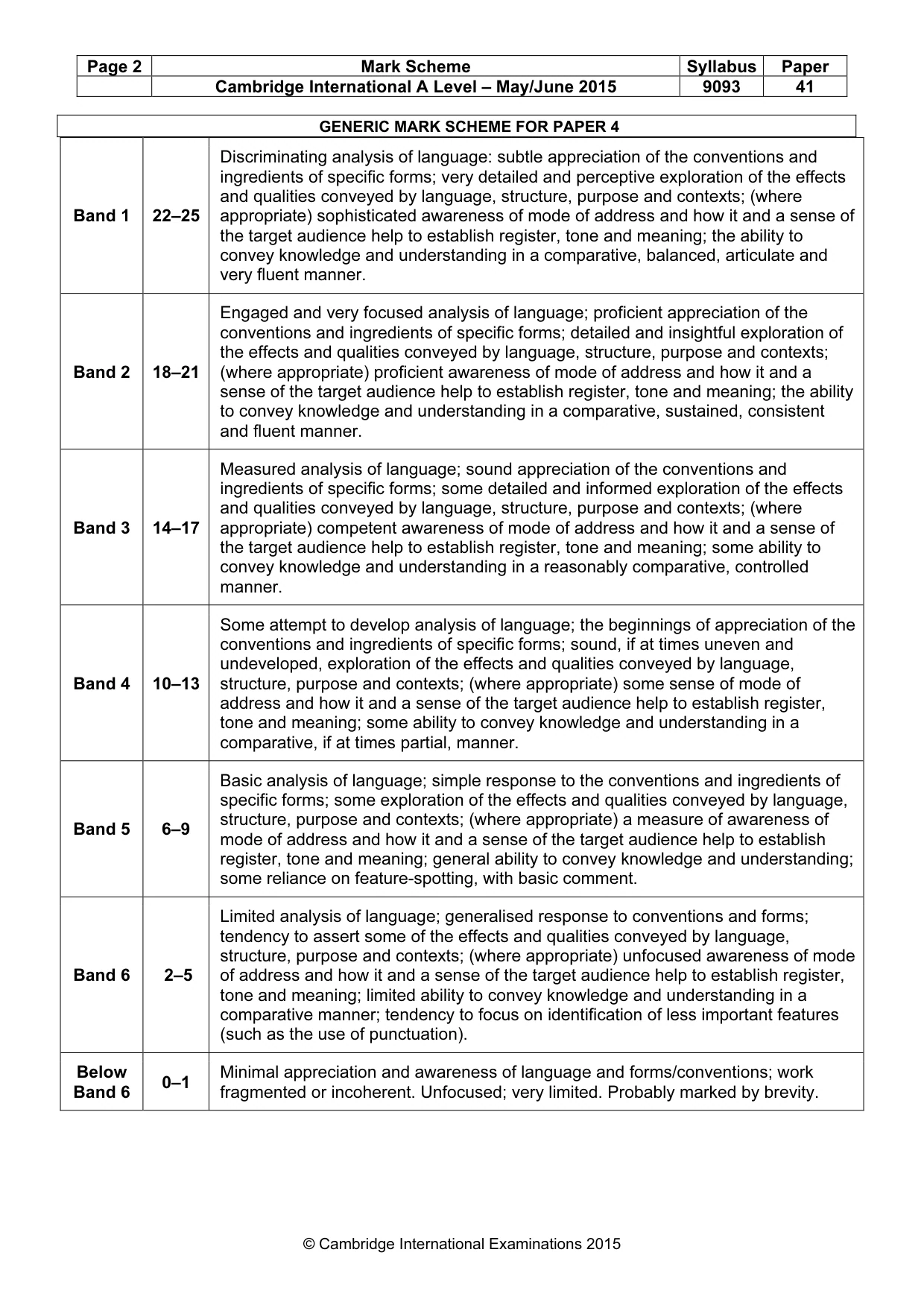
Page 2 Mark Scheme Syllabus Paper Cambridge International A Level – May/June 2015 9093 41 © Cambridge International Examinations 2015 GENERIC MARK SCHEME FOR PAPER 4 Band 1 22–25 Discriminating analysis of language: subtle appreciation of the conventions and ingredients of specific forms; very detailed and perceptive exploration of the effects and qualities conveyed by language, structure, purpose and contexts; (where appropriate) sophisticated awareness of mode of address and how it and a sense of the target audience help to establish register, tone and meaning; the ability to convey knowledge and understanding in a comparative, balanced, articulate and very fluent manner. Band 2 18–21 Engaged and very focused analysis of language; proficient appreciation of the conventions and ingredients of specific forms; detailed and insightful exploration of the effects and qualities conveyed by language, structure, purpose and contexts; (where appropriate) proficient awareness of mode of address and how it and a sense of the target audience help to establish register, tone and meaning; the ability to convey knowledge and understanding in a comparative, sustained, consistent and fluent manner. Band 3 14–17 Measured analysis of language; sound appreciation of the conventions and ingredients of specific forms; some detailed and informed exploration of the effects and qualities conveyed by language, structure, purpose and contexts; (where appropriate) competent awareness of mode of address and how it and a sense of the target audience help to establish register, tone and meaning; some ability to convey knowledge and understanding in a reasonably comparative, controlled manner. Band 4 10–13 Some attempt to develop analysis of language; the beginnings of appreciation of the conventions and ingredients of specific forms; sound, if at times uneven and undeveloped, exploration of the effects and qualities conveyed by language, structure, purpose and contexts; (where appropriate) some sense of mode of address and how it and a sense of the target audience help to establish register, tone and meaning; some ability to convey knowledge and understanding in a comparative, if at times partial, manner. Band 5 6–9 Basic analysis of language; simple response to the conventions and ingredients of specific forms; some exploration of the effects and qualities conveyed by language, structure, purpose and contexts; (where appropriate) a measure of awareness of mode of address and how it and a sense of the target audience help to establish register, tone and meaning; general ability to convey knowledge and understanding; some reliance on feature-spotting, with basic comment. Band 6 2–5 Limited analysis of language; generalised response to conventions and forms; tendency to assert some of the effects and qualities conveyed by language, structure, purpose and contexts; (where appropriate) unfocused awareness of mode of address and how it and a sense of the target audience help to establish register, tone and meaning; limited ability to convey knowledge and understanding in a comparative manner; tendency to focus on identification of less important features (such as the use of punctuation). Below Band 6 0–1 Minimal appreciation and awareness of language and forms/conventions; work fragmented or incoherent. Unfocused; very limited. Probably marked by brevity.
What you needed in this session
Cambridge’s own grade thresholds for 2015 May/June, Paper 4 · Variant 1. A higher threshold means an easier paper — the bar moves with how the cohort did.