Cambridge A Level English - Language AS and A Level (from 2014) 9093 — 2015 May/June Paper 1 · Variant 3
9093/13/M/J/15 · 50 marks · ≈56 min
The question paper and its mark scheme, free to read here and free to download. This is Cambridge’s own paper, exactly as it was sat.
Question paper8 pages
Mark scheme3 pages
Answers below. Sit the paper first if you are practising.
Paper as text
Question paper, page 1
This document consists of 7 printed pages, 1 blank page and 1 insert. DC (RCL (KM)) 93693/2 © UCLES 2015 [Turn over Cambridge International Examinations Cambridge International Advanced Subsidiary and Advanced Level * 2 7 2 3 1 9 5 7 8 5 * ENGLISH LANGUAGE 9093/13 Paper 1 Passages May/June 2015 2 hours 15 minutes No Additional Materials are required. READ THESE INSTRUCTIONS FIRST An answer booklet is provided inside this question paper. You should follow the instructions on the front cover of the answer booklet. If you need additional answer paper ask the invigilator for a continuation booklet. Answer two questions: Question 1 and either Question 2 or Question 3. You should spend about 15 minutes reading the passages and questions before you start writing your answers. You are reminded of the need for good English and clear presentation in your answers. The number of marks is given in brackets [ ] at the end of each question or part question.
Question paper, page 2
2 9093/13/M/J/15 © UCLES 2015 Answer Question 1 and either Question 2 or Question 3. 1 The following extract is taken from a speech given by Jawaharlal Nehru, the Prime Minister of India, in 1947. In it, he celebrates the beginning of India’s new independence. (a) Comment on the ways in which language and style are used to persuade the audience. [15] (b) Continue the speech (between 120–150 words). You do not have to bring it to a close. Base your answer closely on the style and features of the original extract. [10] Long years ago we made a tryst1 with destiny, and now the time comes when we shall redeem our pledge, not wholly or in full measure, but very substantially. At the stroke of the midnight hour, when the world sleeps, India will awake to life and freedom. A moment comes, which comes but rarely in history, when we step out from the old to the new, when an age ends, and when the soul of a nation, long suppressed, finds utterance. It is fitting that at this solemn moment we take the pledge of dedication to the service of India and her people and to the still larger cause of humanity. At the dawn of history India started on her unending quest, and trackless centuries are filled with her striving and the grandeur of her success and her failures. Through good and ill fortune alike she has never lost sight of that quest or forgotten the ideals which gave her strength. We end today a period of ill fortune and India discovers herself again. The achievement we celebrate today is but a step, an opening of opportunity, to the greater triumphs and achievements that await us. Are we brave enough and wise enough to grasp this opportunity and accept the challenge of the future? Freedom and power bring responsibility. The responsibility rests upon this assembly, a sovereign body representing the sovereign people of India. Before the birth of freedom we have endured all the pains of labour and our hearts are heavy with the memory of this sorrow. Some of those pains continue even now. Nevertheless, the past is over and it is the future that beckons to us now. That future is not one of ease or resting but of incessant striving so that we may fulfil the pledges we have so often taken and the one we shall take today. The service of India means the service of the millions who suffer. It means the ending of poverty and ignorance and disease and inequality of opportunity. The ambition of the greatest man of our generation has been to wipe every tear from every eye. That may be beyond us, but as long as there are tears and suffering, so long our work will not be over. And so we have to labour and to work, and work hard, to give reality to our dreams. Those dreams are for India, but they are also for the world, for all the nations and peoples are too closely knit together today for any one of them to imagine that it can live apart. Peace has been said to be indivisible; so is freedom, so is prosperity now, and so also is disaster in this one world that can no longer be split into isolated fragments. 5 10 15 20 25 30 35
Question paper, page 3
3 9093/13/M/J/15 © UCLES 2015 [Turn over To the people of India, whose representatives we are, we make an appeal to join us with faith and confidence in this great adventure. This is no time for petty and destructive criticism, no time for ill will or blaming others. We have to build the noble mansion of free India where all her children may dwell. The appointed day has come – the day appointed by destiny – and India stands forth again, after long slumber and struggle, awake, vital, free and independent. The past clings on to us still in some measure and we have to do much before we redeem the pledges we have so often taken. Yet the turning point is past, and history begins anew for us, the history which we shall live and act and others will write about. It is a fateful moment for us in India, for all Asia and for the world. A new star rises, the star of freedom in the east, a new hope comes into being, a vision long cherished materialises. May the star never set and that hope never be betrayed! We rejoice in that freedom, even though clouds surround us, and many of our people are sorrow-stricken and difficult problems encompass us. But freedom brings responsibilities and burdens and we have to face them in the spirit of a free and disciplined people. 1 tryst : date. 40 45 50
Question paper, page 4
4 9093/13/M/J/15 © UCLES 2015 2 The following text is taken from the journalist’s website. It describes his thoughts and feelings about a particular place in Ghana, Africa. (a) Comment on the ways in which language and style are used to create a sense of mood and place. [15] (b) The tour guide, Prosper, is not as enthusiastic about the setting as the writer is. Later, he sends a letter to his daughter. In it, he describes his thoughts and feelings about the visit to the waterfall and the journalist’s writing in response to it. Write a section (between 120–150 words) of the letter. Base your answer closely on material of the original extract. [10] There is something at Wli Waterfall that connects with the soul. Something surreal and yet so real. Something soothing that snaps a bouquet of emotions. It makes you thirst to see the water again. It makes you hunger for nature’s food for thought. This craving led me to the Waterfall, again. This time I was alert to unravel the mystery of Wli. I went with a critical observational stance. That ‘oh, it’s just another waterfall attitude.’ But at the end I bowed, as I was bowled over by the spectacle. The magic lies in witnessing tons and tons of water thunder down in an awesome, perpetual splash. This splash engulfs a large circumference creating a calming, cold-room of an atmosphere. By being there one is odorised with a refreshing spray of white water. This, added to the music of the water-rush in a lush forest, creates a Garden-of-Eden effect. The water cascaded between what appears to be two huge blocks of hills standing shoulder to shoulder. When the wind blew, it blew a gust of refreshing dew across my face seeping into my skin. I was wet, yet I wanted more. My T-shirt hugged my body. There was no complaining. Without tasting it, I could sense the cool sweetness of the water. Still rooted to the ground, I looked up. I could only wonder. What does this sight look like when it is midnight and the sun has gone to bed? What would the effect be when the moon strikes the water with her light? Would a rainbow appear? Through the course of time, how many souls have beheld this display? How many more would? Only one other person was close by, Prosper my tour guide. This man has seen this scene a thousand times. But what does it mean to him? Beyond the daily drudgery and his desire to pay his only daughter’s school fees, has Prosper ever stood to search his soul in this temple of nature? Standing at a respectable distance he was only accompanying another tourist. If this was a shrine Prosper is the one who would hold the sacrifice. On our way here it was all talk. But now I have no question for him. I wondered if he understood my silence. I remained upright. My chin was up in the air and my head dropped in the opposite direction. I watched and I watched. The water kept falling and falling. And with a forceful rapidity too. It was a never-ending rhythm; a great mass of water thundering down, followed by a great mass of water thundering down, followed by a great mass of water thundering down … I thought I would be enraptured up to meet the plunging grandeur in one blissful embrace. I had a strange feeling that something was about to appear. A face above the source of the water, a mystical face looming large and high. The earthly truth is that what is above is another waterfall, too high for my mortal eyes to behold. 5 10 15 20 25 30 35
Question paper, page 5
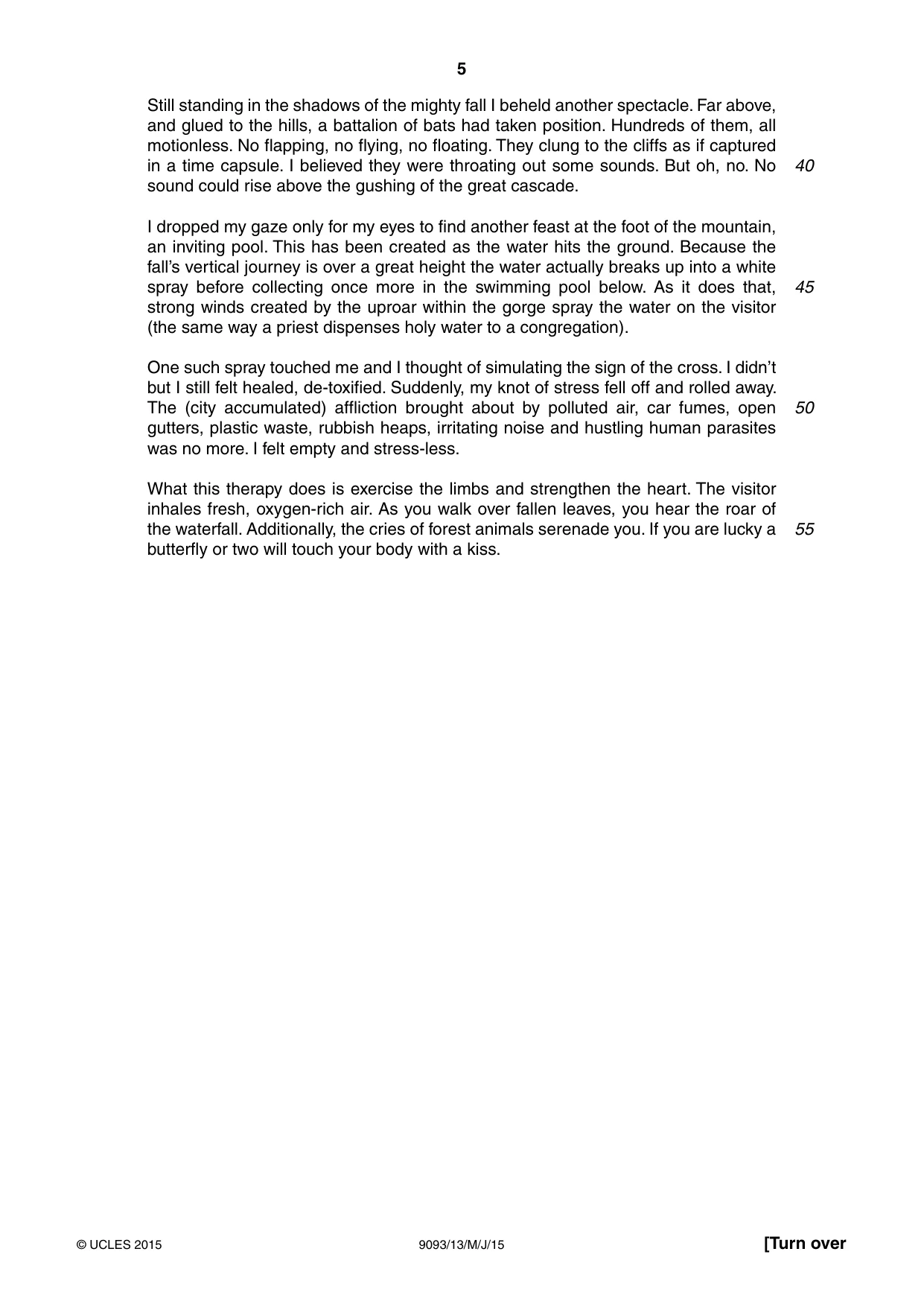
5 9093/13/M/J/15 © UCLES 2015 [Turn over Still standing in the shadows of the mighty fall I beheld another spectacle. Far above, and glued to the hills, a battalion of bats had taken position. Hundreds of them, all motionless. No flapping, no flying, no floating. They clung to the cliffs as if captured in a time capsule. I believed they were throating out some sounds. But oh, no. No sound could rise above the gushing of the great cascade. I dropped my gaze only for my eyes to find another feast at the foot of the mountain, an inviting pool. This has been created as the water hits the ground. Because the fall’s vertical journey is over a great height the water actually breaks up into a white spray before collecting once more in the swimming pool below. As it does that, strong winds created by the uproar within the gorge spray the water on the visitor (the same way a priest dispenses holy water to a congregation). One such spray touched me and I thought of simulating the sign of the cross. I didn’t but I still felt healed, de-toxified. Suddenly, my knot of stress fell off and rolled away. The (city accumulated) affliction brought about by polluted air, car fumes, open gutters, plastic waste, rubbish heaps, irritating noise and hustling human parasites was no more. I felt empty and stress-less. What this therapy does is exercise the limbs and strengthen the heart. The visitor inhales fresh, oxygen-rich air. As you walk over fallen leaves, you hear the roar of the waterfall. Additionally, the cries of forest animals serenade you. If you are lucky a butterfly or two will touch your body with a kiss. 40 45 50 55
Question paper, page 6
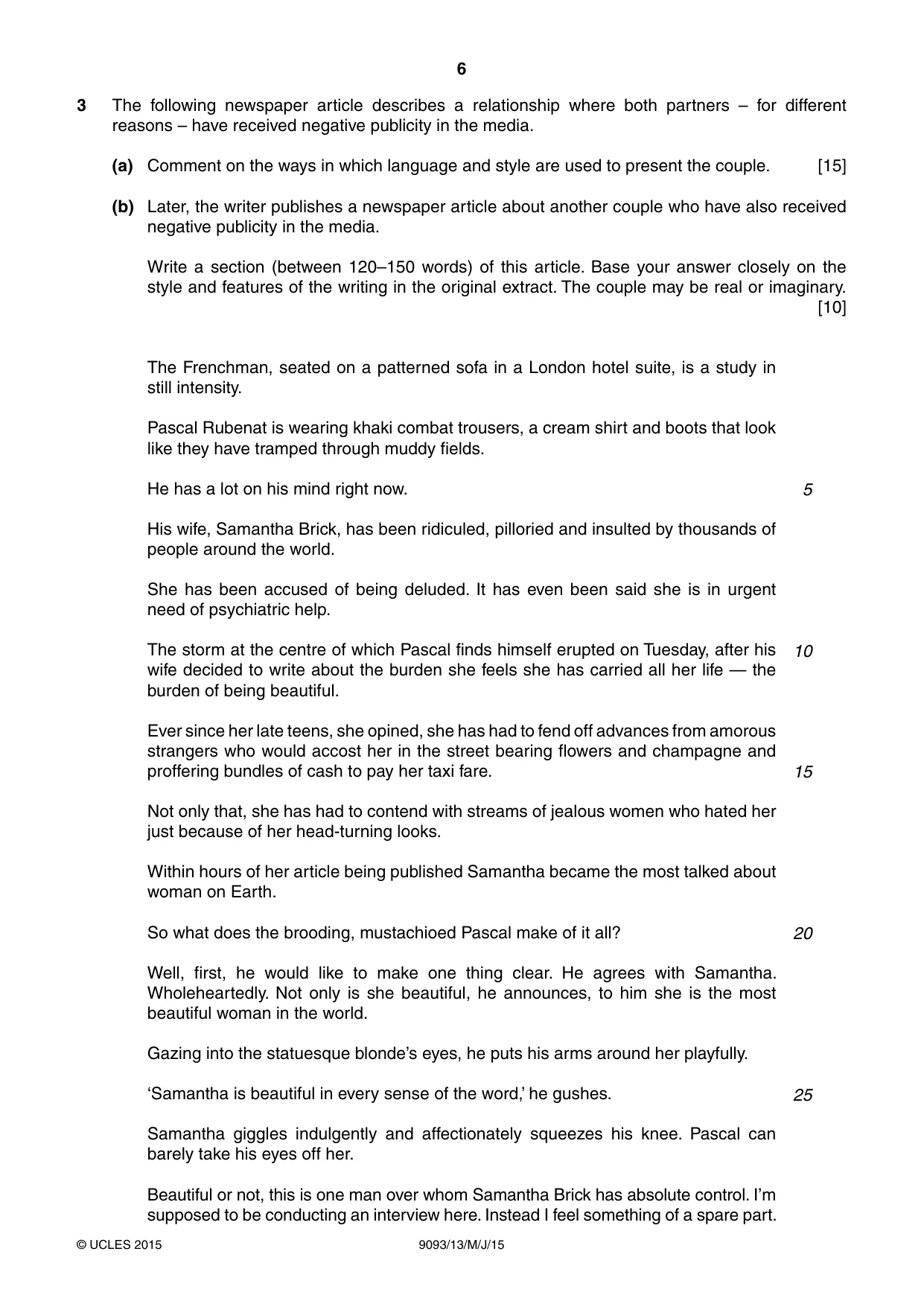
6 9093/13/M/J/15 © UCLES 2015 3 The following newspaper article describes a relationship where both partners – for different reasons – have received negative publicity in the media. (a) Comment on the ways in which language and style are used to present the couple. [15] (b) Later, the writer publishes a newspaper article about another couple who have also received negative publicity in the media. Write a section (between 120–150 words) of this article. Base your answer closely on the style and features of the writing in the original extract. The couple may be real or imaginary. [10] The Frenchman, seated on a patterned sofa in a London hotel suite, is a study in still intensity. Pascal Rubenat is wearing khaki combat trousers, a cream shirt and boots that look like they have tramped through muddy fields. He has a lot on his mind right now. His wife, Samantha Brick, has been ridiculed, pilloried and insulted by thousands of people around the world. She has been accused of being deluded. It has even been said she is in urgent need of psychiatric help. The storm at the centre of which Pascal finds himself erupted on Tuesday, after his wife decided to write about the burden she feels she has carried all her life — the burden of being beautiful. Ever since her late teens, she opined, she has had to fend off advances from amorous strangers who would accost her in the street bearing flowers and champagne and proffering bundles of cash to pay her taxi fare. Not only that, she has had to contend with streams of jealous women who hated her just because of her head-turning looks. Within hours of her article being published Samantha became the most talked about woman on Earth. So what does the brooding, mustachioed Pascal make of it all? Well, first, he would like to make one thing clear. He agrees with Samantha. Wholeheartedly. Not only is she beautiful, he announces, to him she is the most beautiful woman in the world. Gazing into the statuesque blonde’s eyes, he puts his arms around her playfully. ‘Samantha is beautiful in every sense of the word,’ he gushes. Samantha giggles indulgently and affectionately squeezes his knee. Pascal can barely take his eyes off her. Beautiful or not, this is one man over whom Samantha Brick has absolute control. I’m supposed to be conducting an interview here. Instead I feel something of a spare part. 5 10 15 20 25
Question paper, page 7
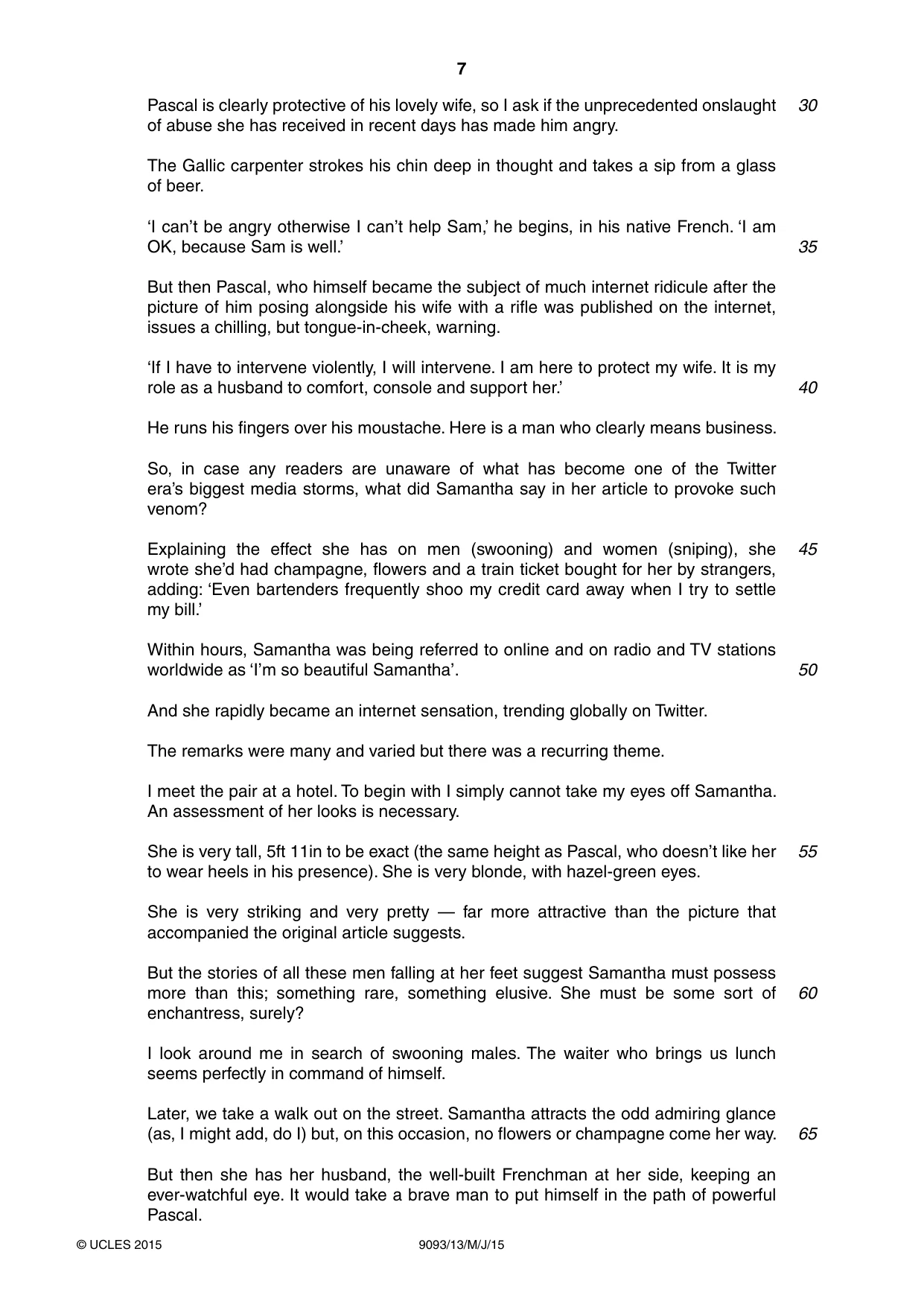
7 9093/13/M/J/15 © UCLES 2015 Pascal is clearly protective of his lovely wife, so I ask if the unprecedented onslaught of abuse she has received in recent days has made him angry. The Gallic carpenter strokes his chin deep in thought and takes a sip from a glass of beer. ‘I can’t be angry otherwise I can’t help Sam,’ he begins, in his native French. ‘I am OK, because Sam is well.’ But then Pascal, who himself became the subject of much internet ridicule after the picture of him posing alongside his wife with a rifle was published on the internet, issues a chilling, but tongue-in-cheek, warning. ‘If I have to intervene violently, I will intervene. I am here to protect my wife. It is my role as a husband to comfort, console and support her.’ He runs his fingers over his moustache. Here is a man who clearly means business. So, in case any readers are unaware of what has become one of the Twitter era’s biggest media storms, what did Samantha say in her article to provoke such venom? Explaining the effect she has on men (swooning) and women (sniping), she wrote she’d had champagne, flowers and a train ticket bought for her by strangers, adding: ‘Even bartenders frequently shoo my credit card away when I try to settle my bill.’ Within hours, Samantha was being referred to online and on radio and TV stations worldwide as ‘I’m so beautiful Samantha’. And she rapidly became an internet sensation, trending globally on Twitter. The remarks were many and varied but there was a recurring theme. I meet the pair at a hotel. To begin with I simply cannot take my eyes off Samantha. An assessment of her looks is necessary. She is very tall, 5ft 11in to be exact (the same height as Pascal, who doesn’t like her to wear heels in his presence). She is very blonde, with hazel-green eyes. She is very striking and very pretty — far more attractive than the picture that accompanied the original article suggests. But the stories of all these men falling at her feet suggest Samantha must possess more than this; something rare, something elusive. She must be some sort of enchantress, surely? I look around me in search of swooning males. The waiter who brings us lunch seems perfectly in command of himself. Later, we take a walk out on the street. Samantha attracts the odd admiring glance (as, I might add, do I) but, on this occasion, no flowers or champagne come her way. But then she has her husband, the well-built Frenchman at her side, keeping an ever-watchful eye. It would take a brave man to put himself in the path of powerful Pascal. 30 35 40 45 50 55 60 65
Question paper, page 8
8 9093/13/M/J/15 © UCLES 2015 Permission to reproduce items where third-party owned material protected by copyright is included has been sought and cleared where possible. Every reasonable effort has been made by the publisher (UCLES) to trace copyright holders, but if any items requiring clearance have unwittingly been included, the publisher will be pleased to make amends at the earliest possible opportunity. To avoid the issue of disclosure of answer-related information to candidates, all copyright acknowledgements are reproduced online in the Cambridge International Examinations Copyright Acknowledgements Booklet. This is produced for each series of examinations and is freely available to download at www.cie.org.uk after the live examination series. Cambridge International Examinations is part of the Cambridge Assessment Group. Cambridge Assessment is the brand name of University of Cambridge Local Examinations Syndicate (UCLES), which is itself a department of the University of Cambridge. BLANK PAGE
Mark scheme, page 1
® IGCSE is the registered trademark of Cambridge International Examinations. CAMBRIDGE INTERNATIONAL EXAMINATIONS Cambridge International Advanced Subsidiary and Advanced Level MARK SCHEME for the May/June 2015 series 9093 ENGLISH LANGUAGE 9093/13 Paper 1 (Passages), maximum raw mark 50 This mark scheme is published as an aid to teachers and candidates, to indicate the requirements of the examination. It shows the basis on which Examiners were instructed to award marks. It does not indicate the details of the discussions that took place at an Examiners’ meeting before marking began, which would have considered the acceptability of alternative answers. Mark schemes should be read in conjunction with the question paper and the Principal Examiner Report for Teachers. Cambridge will not enter into discussions about these mark schemes. Cambridge is publishing the mark schemes for the May/June 2015 series for most Cambridge IGCSE®, Cambridge International A and AS Level components and some Cambridge O Level components.
Mark scheme, page 2
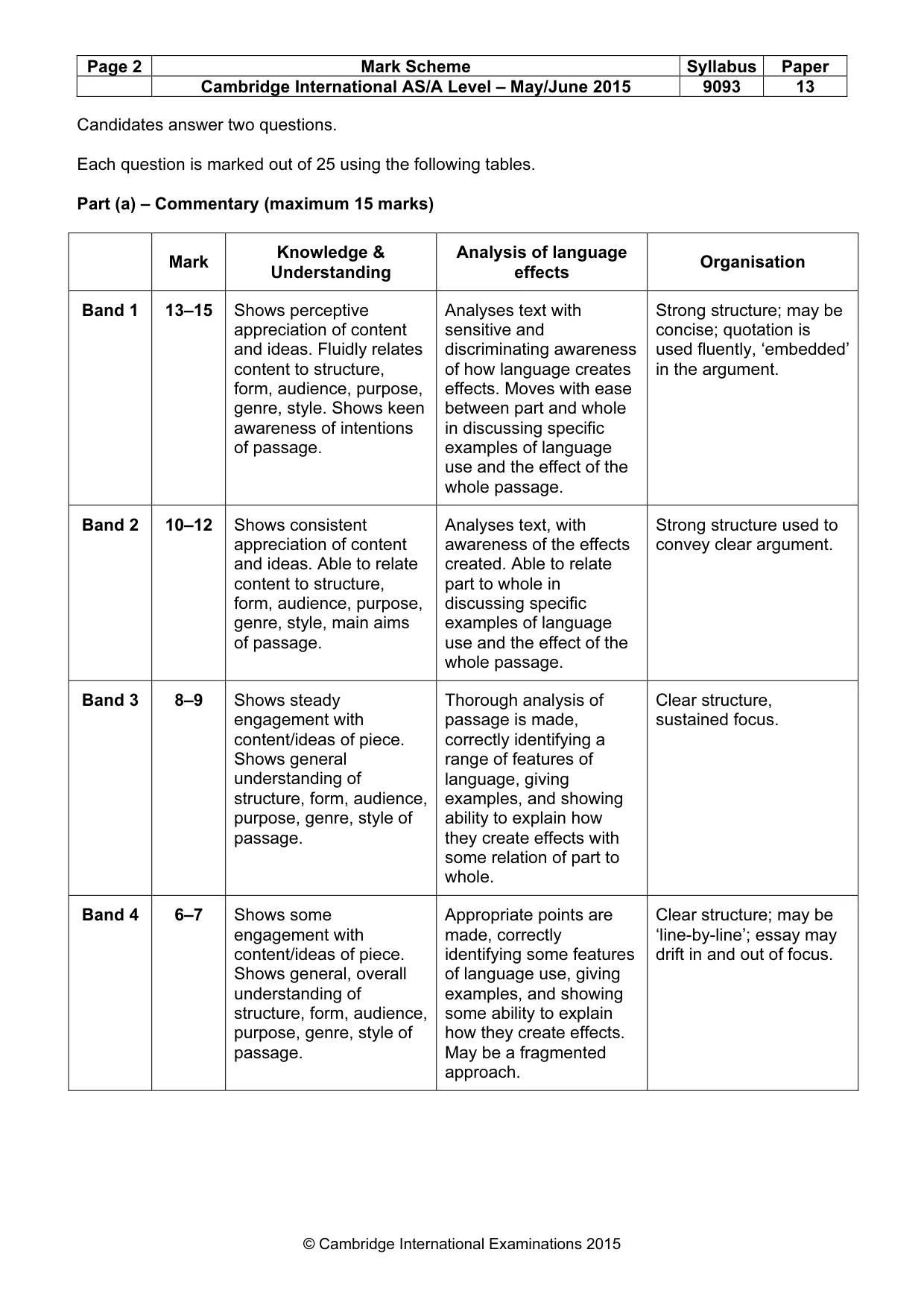
Page 2 Mark Scheme Syllabus Paper Cambridge International AS/A Level – May/June 2015 9093 13 © Cambridge International Examinations 2015 Candidates answer two questions. Each question is marked out of 25 using the following tables. Part (a) – Commentary (maximum 15 marks) Mark Knowledge & Understanding Analysis of language effects Organisation Band 1 13–15 Shows perceptive appreciation of content and ideas. Fluidly relates content to structure, form, audience, purpose, genre, style. Shows keen awareness of intentions of passage. Analyses text with sensitive and discriminating awareness of how language creates effects. Moves with ease between part and whole in discussing specific examples of language use and the effect of the whole passage. Strong structure; may be concise; quotation is used fluently, ‘embedded’ in the argument. Band 2 10–12 Shows consistent appreciation of content and ideas. Able to relate content to structure, form, audience, purpose, genre, style, main aims of passage. Analyses text, with awareness of the effects created. Able to relate part to whole in discussing specific examples of language use and the effect of the whole passage. Strong structure used to convey clear argument. Band 3 8–9 Shows steady engagement with content/ideas of piece. Shows general understanding of structure, form, audience, purpose, genre, style of passage. Thorough analysis of passage is made, correctly identifying a range of features of language, giving examples, and showing ability to explain how they create effects with some relation of part to whole. Clear structure, sustained focus. Band 4 6–7 Shows some engagement with content/ideas of piece. Shows general, overall understanding of structure, form, audience, purpose, genre, style of passage. Appropriate points are made, correctly identifying some features of language use, giving examples, and showing some ability to explain how they create effects. May be a fragmented approach. Clear structure; may be ‘line-by-line’; essay may drift in and out of focus.
Mark scheme, page 3
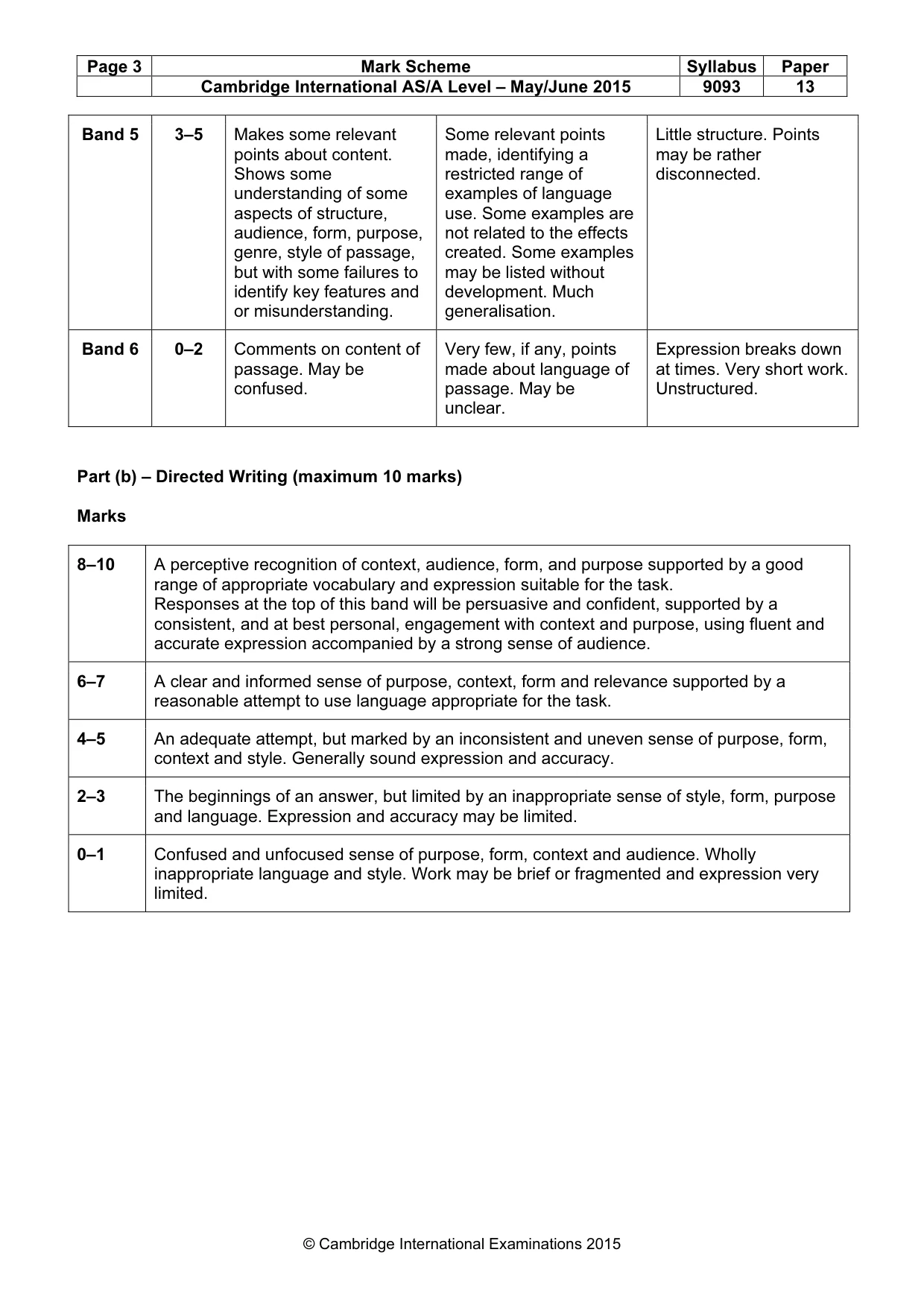
Page 3 Mark Scheme Syllabus Paper Cambridge International AS/A Level – May/June 2015 9093 13 © Cambridge International Examinations 2015 Band 5 3–5 Makes some relevant points about content. Shows some understanding of some aspects of structure, audience, form, purpose, genre, style of passage, but with some failures to identify key features and or misunderstanding. Some relevant points made, identifying a restricted range of examples of language use. Some examples are not related to the effects created. Some examples may be listed without development. Much generalisation. Little structure. Points may be rather disconnected. Band 6 0–2 Comments on content of passage. May be confused. Very few, if any, points made about language of passage. May be unclear. Expression breaks down at times. Very short work. Unstructured. Part (b) – Directed Writing (maximum 10 marks) Marks 8–10 A perceptive recognition of context, audience, form, and purpose supported by a good range of appropriate vocabulary and expression suitable for the task. Responses at the top of this band will be persuasive and confident, supported by a consistent, and at best personal, engagement with context and purpose, using fluent and accurate expression accompanied by a strong sense of audience. 6–7 A clear and informed sense of purpose, context, form and relevance supported by a reasonable attempt to use language appropriate for the task. 4–5 An adequate attempt, but marked by an inconsistent and uneven sense of purpose, form, context and style. Generally sound expression and accuracy. 2–3 The beginnings of an answer, but limited by an inappropriate sense of style, form, purpose and language. Expression and accuracy may be limited. 0–1 Confused and unfocused sense of purpose, form, context and audience. Wholly inappropriate language and style. Work may be brief or fragmented and expression very limited.
What you needed in this session
Cambridge’s own grade thresholds for 2015 May/June, Paper 1 · Variant 3. A higher threshold means an easier paper — the bar moves with how the cohort did.