Cambridge A Level English - Language AS and A Level (from 2014) 9093 — 2015 May/June Paper 1 · Variant 1
9093/11/M/J/15 · 50 marks · ≈56 min
The question paper and its mark scheme, free to read here and free to download. This is Cambridge’s own paper, exactly as it was sat.
Question paper8 pages
Mark scheme3 pages
Answers below. Sit the paper first if you are practising.
Paper as text
Question paper, page 1
This document consists of 7 printed pages, 1 blank page and 1 insert. DC RCL (KM) 93691/3 © UCLES 2015 [Turn over Cambridge International Examinations Cambridge International Advanced Subsidiary and Advanced Level * 4 5 7 9 1 5 7 0 1 6 * ENGLISH LANGUAGE 9093/11 Paper 1 Passages May/June 2015 2 hours 15 minutes No Additional Materials are required. READ THESE INSTRUCTIONS FIRST An answer booklet is provided inside this question paper. You should follow the instructions on the front cover of the answer booklet. If you need additional answer paper ask the invigilator for a continuation booklet. Answer two questions: Question 1 and either Question 2 or Question 3. You should spend about 15 minutes reading the passages and questions before you start writing your answers. You are reminded of the need for good English and clear presentation in your answers. The number of marks is given in brackets [ ] at the end of each question or part question.
Question paper, page 2
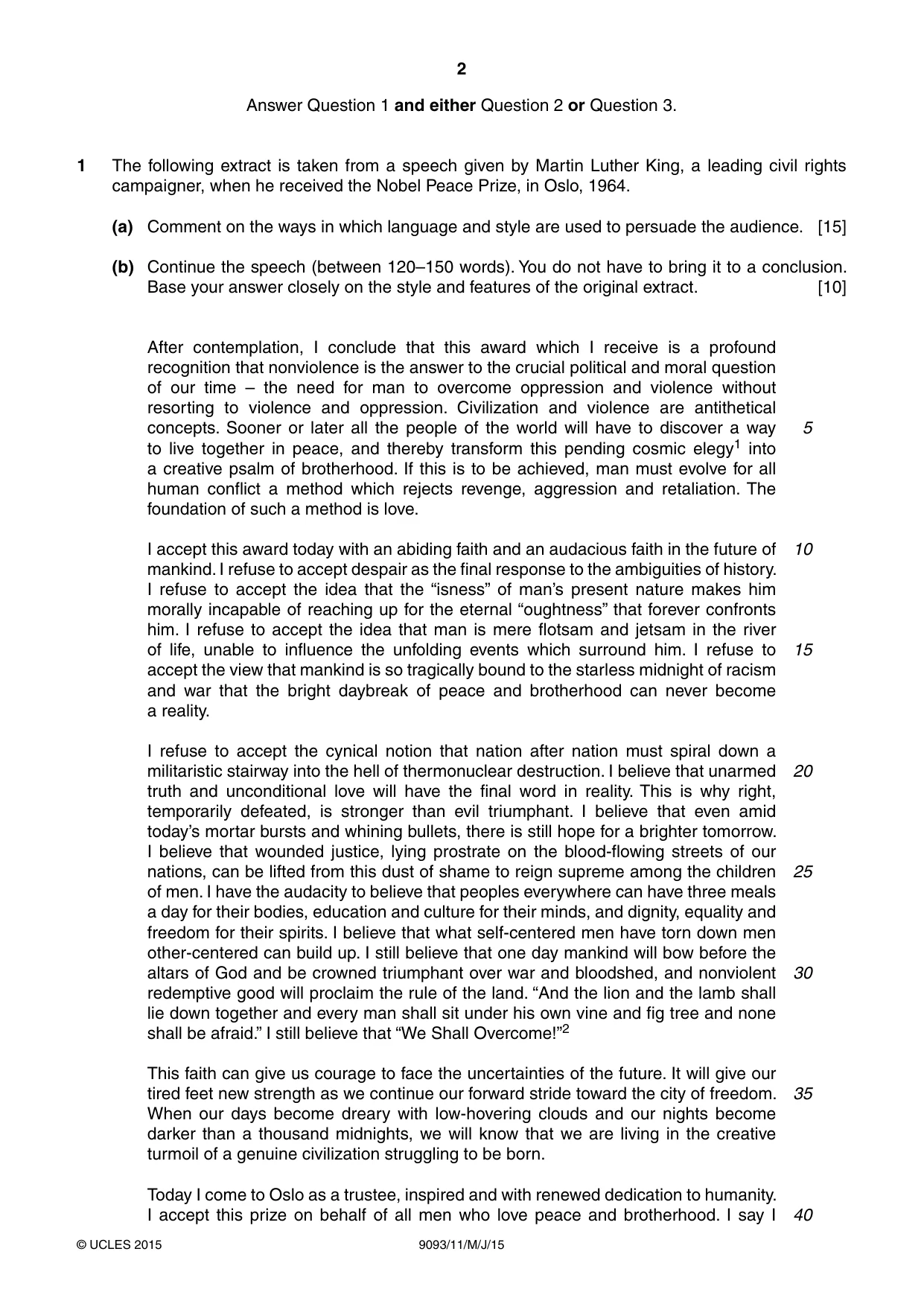
2 9093/11/M/J/15 © UCLES 2015 Answer Question 1 and either Question 2 or Question 3. 1 The following extract is taken from a speech given by Martin Luther King, a leading civil rights campaigner, when he received the Nobel Peace Prize, in Oslo, 1964. (a) Comment on the ways in which language and style are used to persuade the audience. [15] (b) Continue the speech (between 120–150 words). You do not have to bring it to a conclusion. Base your answer closely on the style and features of the original extract. [10] After contemplation, I conclude that this award which I receive is a profound recognition that nonviolence is the answer to the crucial political and moral question of our time – the need for man to overcome oppression and violence without resorting to violence and oppression. Civilization and violence are antithetical concepts. Sooner or later all the people of the world will have to discover a way to live together in peace, and thereby transform this pending cosmic elegy1 into a creative psalm of brotherhood. If this is to be achieved, man must evolve for all human conflict a method which rejects revenge, aggression and retaliation. The foundation of such a method is love. I accept this award today with an abiding faith and an audacious faith in the future of mankind. I refuse to accept despair as the final response to the ambiguities of history. I refuse to accept the idea that the “isness” of man’s present nature makes him morally incapable of reaching up for the eternal “oughtness” that forever confronts him. I refuse to accept the idea that man is mere flotsam and jetsam in the river of life, unable to influence the unfolding events which surround him. I refuse to accept the view that mankind is so tragically bound to the starless midnight of racism and war that the bright daybreak of peace and brotherhood can never become a reality. I refuse to accept the cynical notion that nation after nation must spiral down a militaristic stairway into the hell of thermonuclear destruction. I believe that unarmed truth and unconditional love will have the final word in reality. This is why right, temporarily defeated, is stronger than evil triumphant. I believe that even amid today’s mortar bursts and whining bullets, there is still hope for a brighter tomorrow. I believe that wounded justice, lying prostrate on the blood-flowing streets of our nations, can be lifted from this dust of shame to reign supreme among the children of men. I have the audacity to believe that peoples everywhere can have three meals a day for their bodies, education and culture for their minds, and dignity, equality and freedom for their spirits. I believe that what self-centered men have torn down men other-centered can build up. I still believe that one day mankind will bow before the altars of God and be crowned triumphant over war and bloodshed, and nonviolent redemptive good will proclaim the rule of the land. “And the lion and the lamb shall lie down together and every man shall sit under his own vine and fig tree and none shall be afraid.” I still believe that “We Shall Overcome!”2 This faith can give us courage to face the uncertainties of the future. It will give our tired feet new strength as we continue our forward stride toward the city of freedom. When our days become dreary with low-hovering clouds and our nights become darker than a thousand midnights, we will know that we are living in the creative turmoil of a genuine civilization struggling to be born. Today I come to Oslo as a trustee, inspired and with renewed dedication to humanity. I accept this prize on behalf of all men who love peace and brotherhood. I say I 5 10 15 20 25 30 35 40
Question paper, page 3
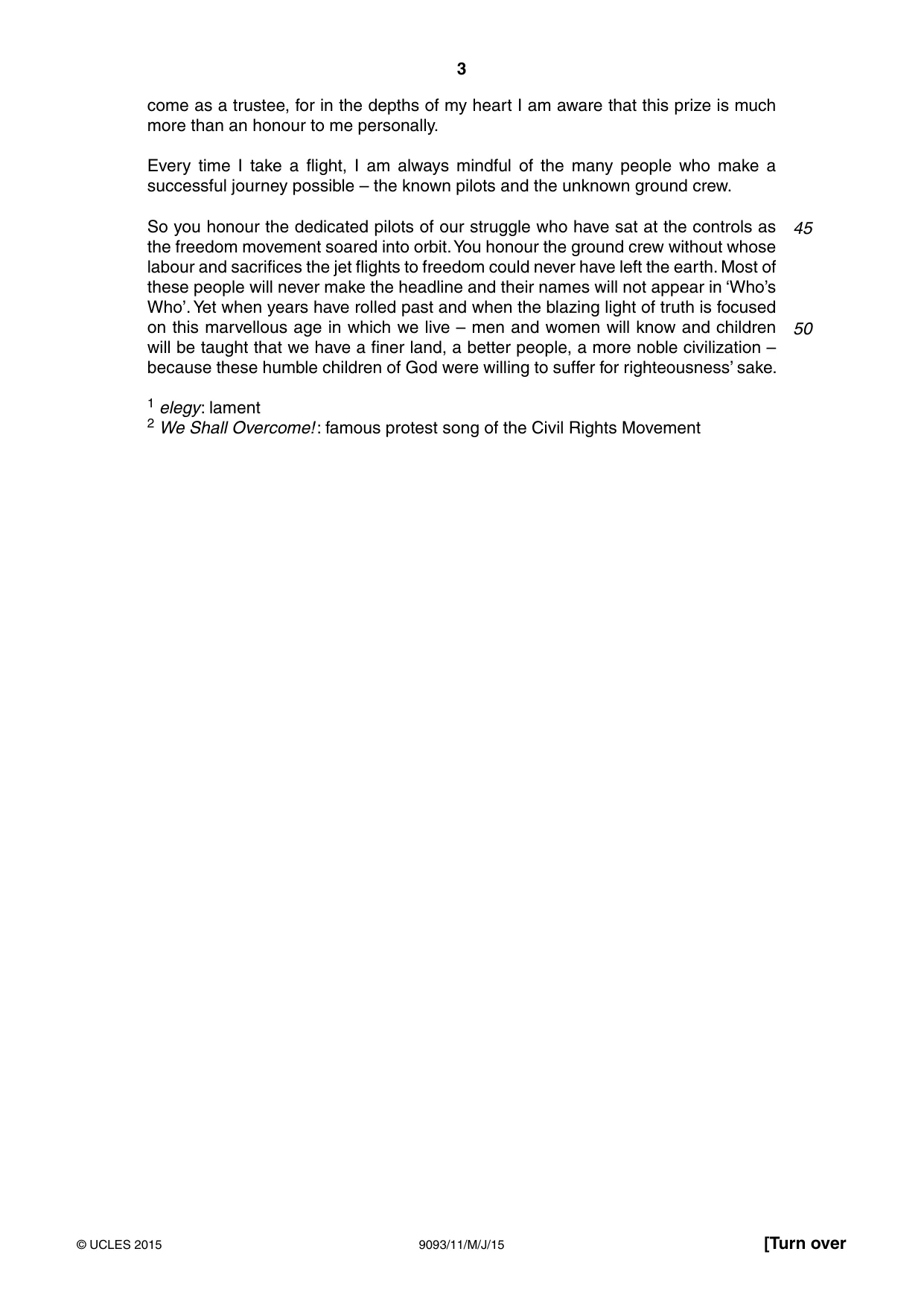
3 9093/11/M/J/15 © UCLES 2015 [Turn over come as a trustee, for in the depths of my heart I am aware that this prize is much more than an honour to me personally. Every time I take a flight, I am always mindful of the many people who make a successful journey possible – the known pilots and the unknown ground crew. So you honour the dedicated pilots of our struggle who have sat at the controls as the freedom movement soared into orbit. You honour the ground crew without whose labour and sacrifices the jet flights to freedom could never have left the earth. Most of these people will never make the headline and their names will not appear in ‘Who’s Who’. Yet when years have rolled past and when the blazing light of truth is focused on this marvellous age in which we live – men and women will know and children will be taught that we have a finer land, a better people, a more noble civilization – because these humble children of God were willing to suffer for righteousness’ sake. 1 elegy : lament 2 We Shall Overcome! : famous protest song of the Civil Rights Movement 45 50
Question paper, page 4
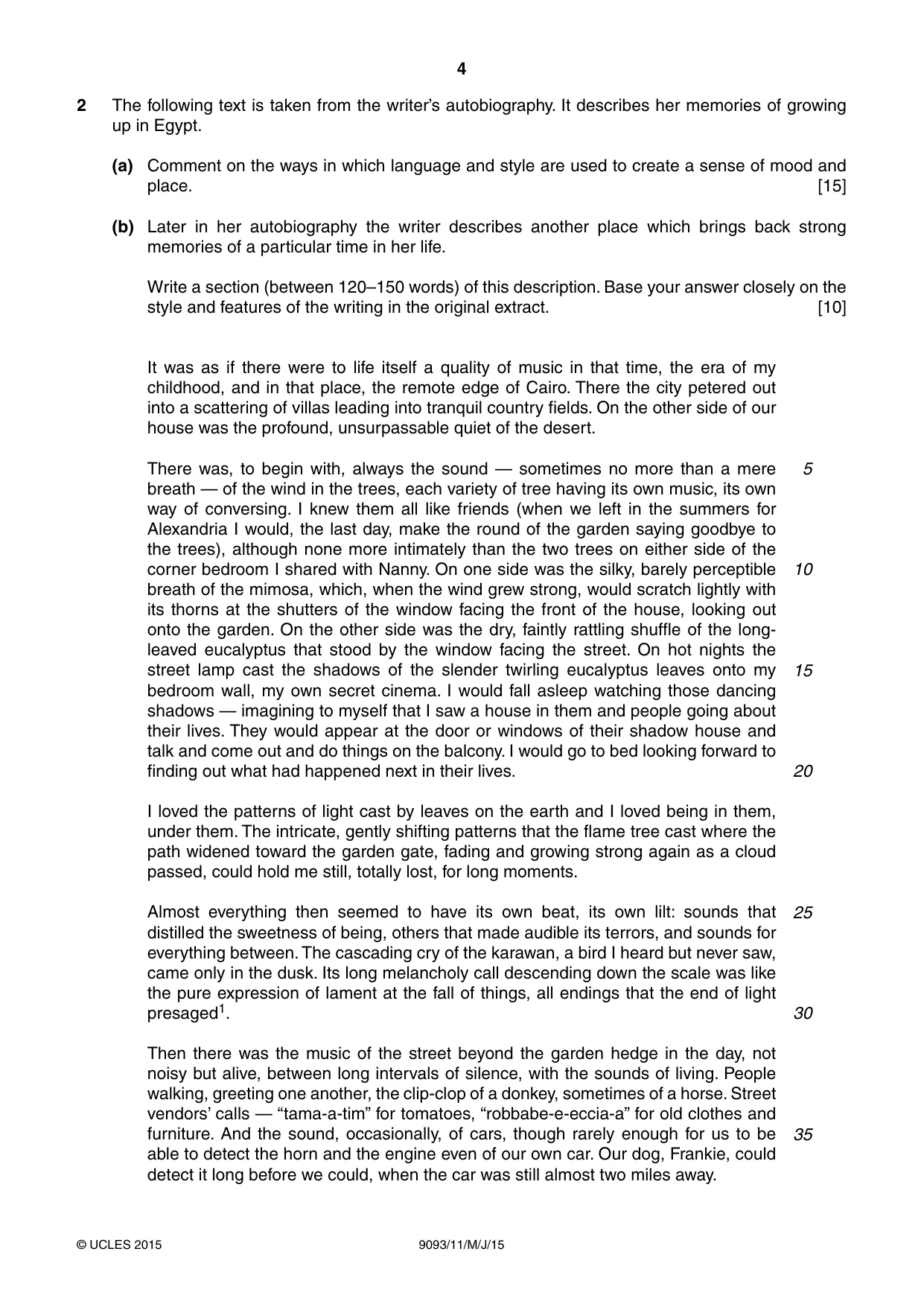
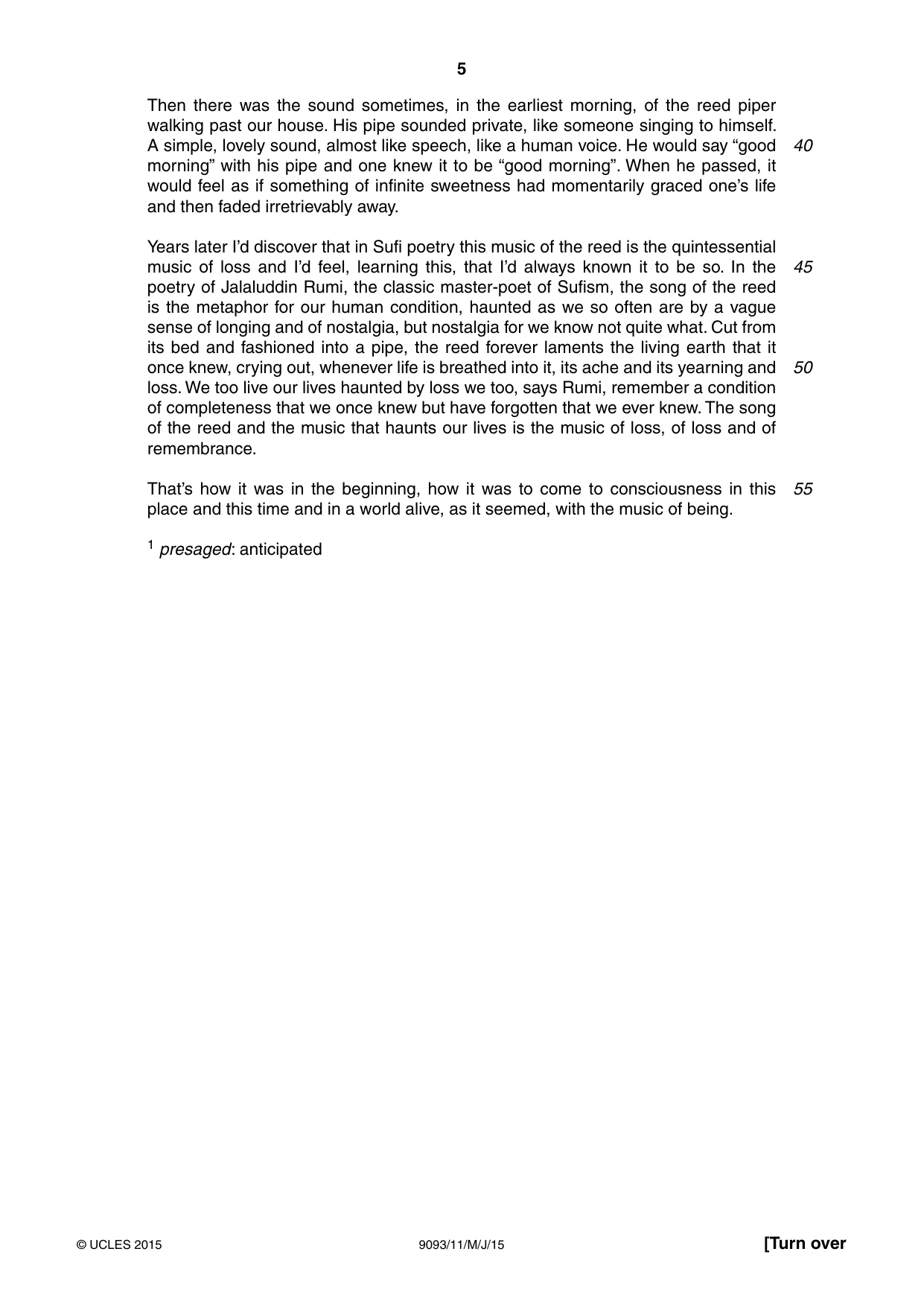
4 9093/11/M/J/15 © UCLES 2015 2 The following text is taken from the writer’s autobiography. It describes her memories of growing up in Egypt. (a) Comment on the ways in which language and style are used to create a sense of mood and place. [15] (b) Later in her autobiography the writer describes another place which brings back strong memories of a particular time in her life. Write a section (between 120–150 words) of this description. Base your answer closely on the style and features of the writing in the original extract. [10] It was as if there were to life itself a quality of music in that time, the era of my childhood, and in that place, the remote edge of Cairo. There the city petered out into a scattering of villas leading into tranquil country fields. On the other side of our house was the profound, unsurpassable quiet of the desert. There was, to begin with, always the sound — sometimes no more than a mere breath — of the wind in the trees, each variety of tree having its own music, its own way of conversing. I knew them all like friends (when we left in the summers for Alexandria I would, the last day, make the round of the garden saying goodbye to the trees), although none more intimately than the two trees on either side of the corner bedroom I shared with Nanny. On one side was the silky, barely perceptible breath of the mimosa, which, when the wind grew strong, would scratch lightly with its thorns at the shutters of the window facing the front of the house, looking out onto the garden. On the other side was the dry, faintly rattling shuffle of the long- leaved eucalyptus that stood by the window facing the street. On hot nights the street lamp cast the shadows of the slender twirling eucalyptus leaves onto my bedroom wall, my own secret cinema. I would fall asleep watching those dancing shadows — imagining to myself that I saw a house in them and people going about their lives. They would appear at the door or windows of their shadow house and talk and come out and do things on the balcony. I would go to bed looking forward to finding out what had happened next in their lives. I loved the patterns of light cast by leaves on the earth and I loved being in them, under them. The intricate, gently shifting patterns that the flame tree cast where the path widened toward the garden gate, fading and growing strong again as a cloud passed, could hold me still, totally lost, for long moments. Almost everything then seemed to have its own beat, its own lilt: sounds that distilled the sweetness of being, others that made audible its terrors, and sounds for everything between. The cascading cry of the karawan, a bird I heard but never saw, came only in the dusk. Its long melancholy call descending down the scale was like the pure expression of lament at the fall of things, all endings that the end of light presaged1. Then there was the music of the street beyond the garden hedge in the day, not noisy but alive, between long intervals of silence, with the sounds of living. People walking, greeting one another, the clip-clop of a donkey, sometimes of a horse. Street vendors’ calls — “ tama-a-tim” for tomatoes, “robbabe-e-eccia-a” for old clothes and furniture. And the sound, occasionally, of cars, though rarely enough for us to be able to detect the horn and the engine even of our own car. Our dog, Frankie, could detect it long before we could, when the car was still almost two miles away. 5 10 15 20 25 30 35
Question paper, page 5
5 9093/11/M/J/15 © UCLES 2015 [Turn over Then there was the sound sometimes, in the earliest morning, of the reed piper walking past our house. His pipe sounded private, like someone singing to himself. A simple, lovely sound, almost like speech, like a human voice. He would say “good morning” with his pipe and one knew it to be “good morning”. When he passed, it would feel as if something of infinite sweetness had momentarily graced one’s life and then faded irretrievably away. Years later I’d discover that in Sufi poetry this music of the reed is the quintessential music of loss and I’d feel, learning this, that I’d always known it to be so. In the poetry of Jalaluddin Rumi, the classic master-poet of Sufism, the song of the reed is the metaphor for our human condition, haunted as we so often are by a vague sense of longing and of nostalgia, but nostalgia for we know not quite what. Cut from its bed and fashioned into a pipe, the reed forever laments the living earth that it once knew, crying out, whenever life is breathed into it, its ache and its yearning and loss. We too live our lives haunted by loss we too, says Rumi, remember a condition of completeness that we once knew but have forgotten that we ever knew. The song of the reed and the music that haunts our lives is the music of loss, of loss and of remembrance. That’s how it was in the beginning, how it was to come to consciousness in this place and this time and in a world alive, as it seemed, with the music of being. 1 presaged : anticipated 40 45 50 55
Question paper, page 6
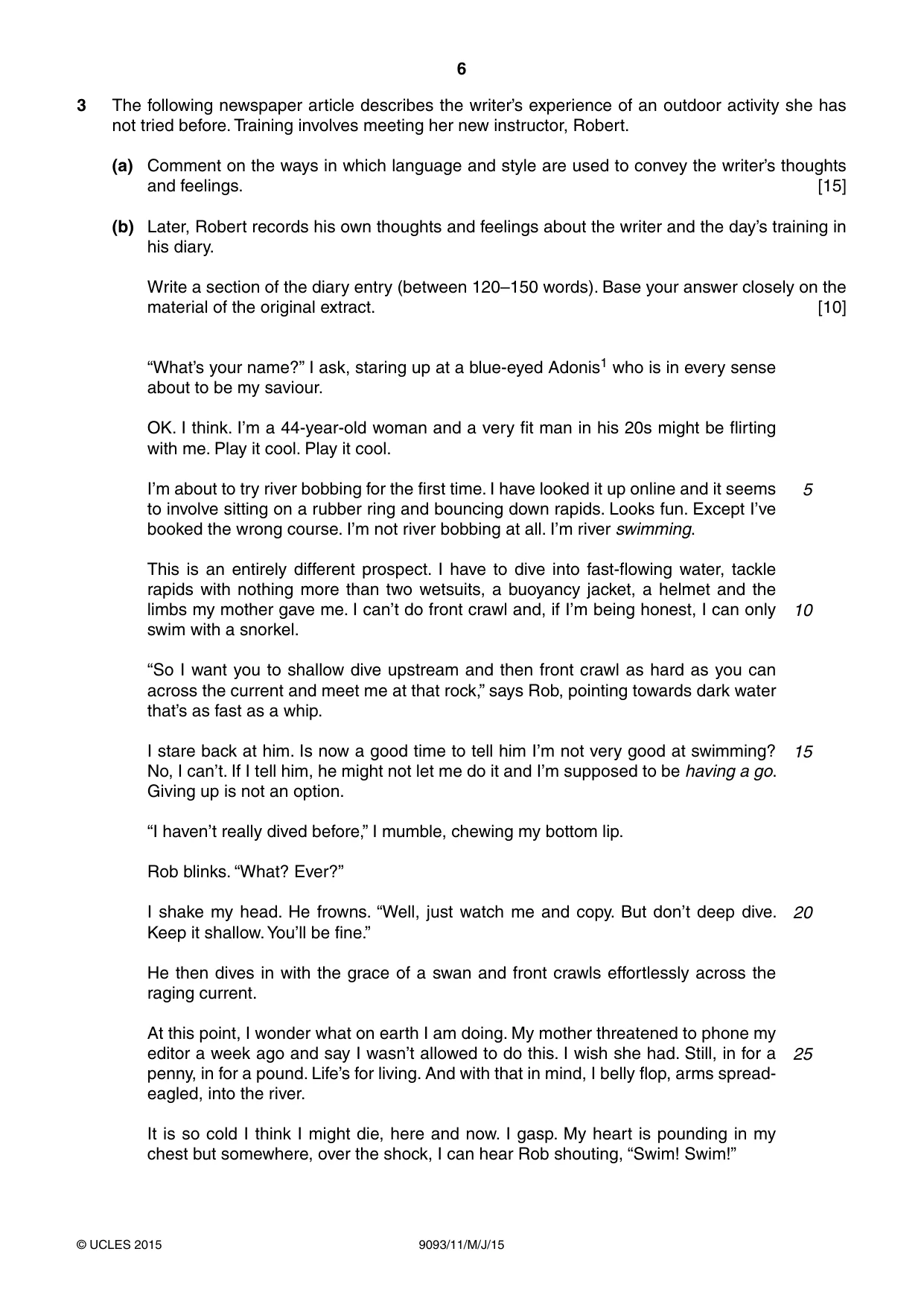
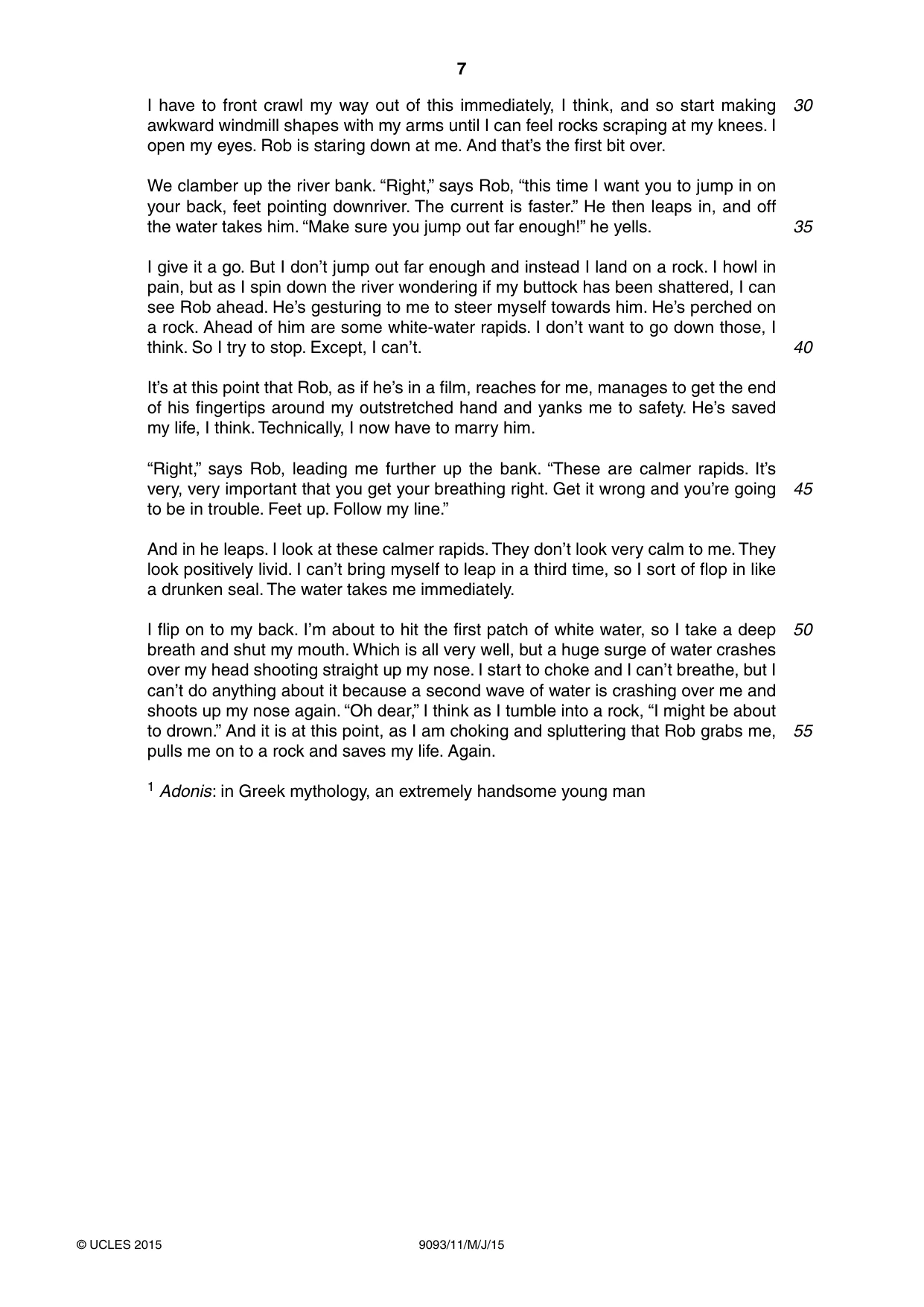
6 9093/11/M/J/15 © UCLES 2015 3 The following newspaper article describes the writer’s experience of an outdoor activity she has not tried before. Training involves meeting her new instructor, Robert. (a) Comment on the ways in which language and style are used to convey the writer’s thoughts and feelings. [15] (b) Later, Robert records his own thoughts and feelings about the writer and the day’s training in his diary. Write a section of the diary entry (between 120–150 words). Base your answer closely on the material of the original extract. [10] “What’s your name?” I ask, staring up at a blue-eyed Adonis1 who is in every sense about to be my saviour. OK. I think. I’m a 44-year-old woman and a very fit man in his 20s might be flirting with me. Play it cool. Play it cool. I’m about to try river bobbing for the first time. I have looked it up online and it seems to involve sitting on a rubber ring and bouncing down rapids. Looks fun. Except I’ve booked the wrong course. I’m not river bobbing at all. I’m river swimming. This is an entirely different prospect. I have to dive into fast-flowing water, tackle rapids with nothing more than two wetsuits, a buoyancy jacket, a helmet and the limbs my mother gave me. I can’t do front crawl and, if I’m being honest, I can only swim with a snorkel. “So I want you to shallow dive upstream and then front crawl as hard as you can across the current and meet me at that rock,” says Rob, pointing towards dark water that’s as fast as a whip. I stare back at him. Is now a good time to tell him I’m not very good at swimming? No, I can’t. If I tell him, he might not let me do it and I’m supposed to be having a go. Giving up is not an option. “I haven’t really dived before,” I mumble, chewing my bottom lip. Rob blinks. “What? Ever?” I shake my head. He frowns. “Well, just watch me and copy. But don’t deep dive. Keep it shallow. You’ll be fine.” He then dives in with the grace of a swan and front crawls effortlessly across the raging current. At this point, I wonder what on earth I am doing. My mother threatened to phone my editor a week ago and say I wasn’t allowed to do this. I wish she had. Still, in for a penny, in for a pound. Life’s for living. And with that in mind, I belly flop, arms spread- eagled, into the river. It is so cold I think I might die, here and now. I gasp. My heart is pounding in my chest but somewhere, over the shock, I can hear Rob shouting, “Swim! Swim!” 5 10 15 20 25
Question paper, page 7
7 9093/11/M/J/15 © UCLES 2015 I have to front crawl my way out of this immediately, I think, and so start making awkward windmill shapes with my arms until I can feel rocks scraping at my knees. I open my eyes. Rob is staring down at me. And that’s the first bit over. We clamber up the river bank. “Right,” says Rob, “this time I want you to jump in on your back, feet pointing downriver. The current is faster.” He then leaps in, and off the water takes him. “Make sure you jump out far enough!” he yells. I give it a go. But I don’t jump out far enough and instead I land on a rock. I howl in pain, but as I spin down the river wondering if my buttock has been shattered, I can see Rob ahead. He’s gesturing to me to steer myself towards him. He’s perched on a rock. Ahead of him are some white-water rapids. I don’t want to go down those, I think. So I try to stop. Except, I can’t. It’s at this point that Rob, as if he’s in a film, reaches for me, manages to get the end of his fingertips around my outstretched hand and yanks me to safety. He’s saved my life, I think. Technically, I now have to marry him. “Right,” says Rob, leading me further up the bank. “These are calmer rapids. It’s very, very important that you get your breathing right. Get it wrong and you’re going to be in trouble. Feet up. Follow my line.” And in he leaps. I look at these calmer rapids. They don’t look very calm to me. They look positively livid. I can’t bring myself to leap in a third time, so I sort of flop in like a drunken seal. The water takes me immediately. I flip on to my back. I’m about to hit the first patch of white water, so I take a deep breath and shut my mouth. Which is all very well, but a huge surge of water crashes over my head shooting straight up my nose. I start to choke and I can’t breathe, but I can’t do anything about it because a second wave of water is crashing over me and shoots up my nose again. “Oh dear,” I think as I tumble into a rock, “I might be about to drown.” And it is at this point, as I am choking and spluttering that Rob grabs me, pulls me on to a rock and saves my life. Again. 1 Adonis : in Greek mythology, an extremely handsome young man 30 35 40 45 50 55
Question paper, page 8
8 9093/11/M/J/15 © UCLES 2015 BLANK PAGE Permission to reproduce items where third-party owned material protected by copyright is included has been sought and cleared where possible. Every reasonable effort has been made by the publisher (UCLES) to trace copyright holders, but if any items requiring clearance have unwittingly been included, the publisher will be pleased to make amends at the earliest possible opportunity. To avoid the issue of disclosure of answer-related information to candidates, all copyright acknowledgements are reproduced online in the Cambridge International Examinations Copyright Acknowledgements Booklet. This is produced for each series of examinations and is freely available to download at www.cie.org.uk after the live examination series. Cambridge International Examinations is part of the Cambridge Assessment Group. Cambridge Assessment is the brand name of University of Cambridge Local Examinations Syndicate (UCLES), which is itself a department of the University of Cambridge.
Mark scheme, page 1
® IGCSE is the registered trademark of Cambridge International Examinations. CAMBRIDGE INTERNATIONAL EXAMINATIONS Cambridge International Advanced Subsidiary and Advanced Level MARK SCHEME for the May/June 2015 series 9093 ENGLISH LANGUAGE 9093/11 Paper 1 (Passages), maximum raw mark 50 This mark scheme is published as an aid to teachers and candidates, to indicate the requirements of the examination. It shows the basis on which Examiners were instructed to award marks. It does not indicate the details of the discussions that took place at an Examiners’ meeting before marking began, which would have considered the acceptability of alternative answers. Mark schemes should be read in conjunction with the question paper and the Principal Examiner Report for Teachers. Cambridge will not enter into discussions about these mark schemes. Cambridge is publishing the mark schemes for the May/June 2015 series for most Cambridge IGCSE®, Cambridge International A and AS Level components and some Cambridge O Level components.
Mark scheme, page 2
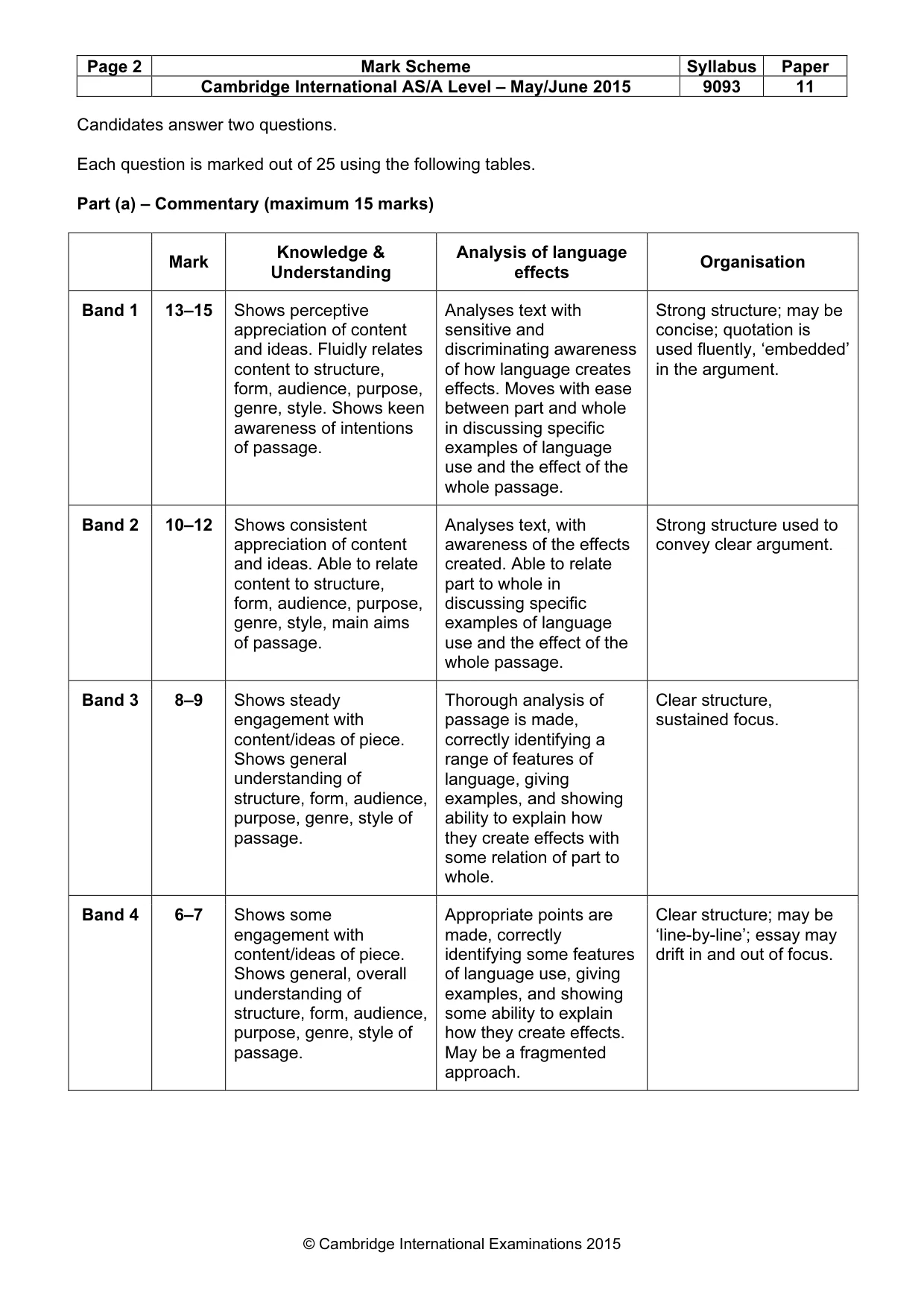
Page 2 Mark Scheme Syllabus Paper Cambridge International AS/A Level – May/June 2015 9093 11 © Cambridge International Examinations 2015 Candidates answer two questions. Each question is marked out of 25 using the following tables. Part (a) – Commentary (maximum 15 marks) Mark Knowledge & Understanding Analysis of language effects Organisation Band 1 13–15 Shows perceptive appreciation of content and ideas. Fluidly relates content to structure, form, audience, purpose, genre, style. Shows keen awareness of intentions of passage. Analyses text with sensitive and discriminating awareness of how language creates effects. Moves with ease between part and whole in discussing specific examples of language use and the effect of the whole passage. Strong structure; may be concise; quotation is used fluently, ‘embedded’ in the argument. Band 2 10–12 Shows consistent appreciation of content and ideas. Able to relate content to structure, form, audience, purpose, genre, style, main aims of passage. Analyses text, with awareness of the effects created. Able to relate part to whole in discussing specific examples of language use and the effect of the whole passage. Strong structure used to convey clear argument. Band 3 8–9 Shows steady engagement with content/ideas of piece. Shows general understanding of structure, form, audience, purpose, genre, style of passage. Thorough analysis of passage is made, correctly identifying a range of features of language, giving examples, and showing ability to explain how they create effects with some relation of part to whole. Clear structure, sustained focus. Band 4 6–7 Shows some engagement with content/ideas of piece. Shows general, overall understanding of structure, form, audience, purpose, genre, style of passage. Appropriate points are made, correctly identifying some features of language use, giving examples, and showing some ability to explain how they create effects. May be a fragmented approach. Clear structure; may be ‘line-by-line’; essay may drift in and out of focus.
Mark scheme, page 3
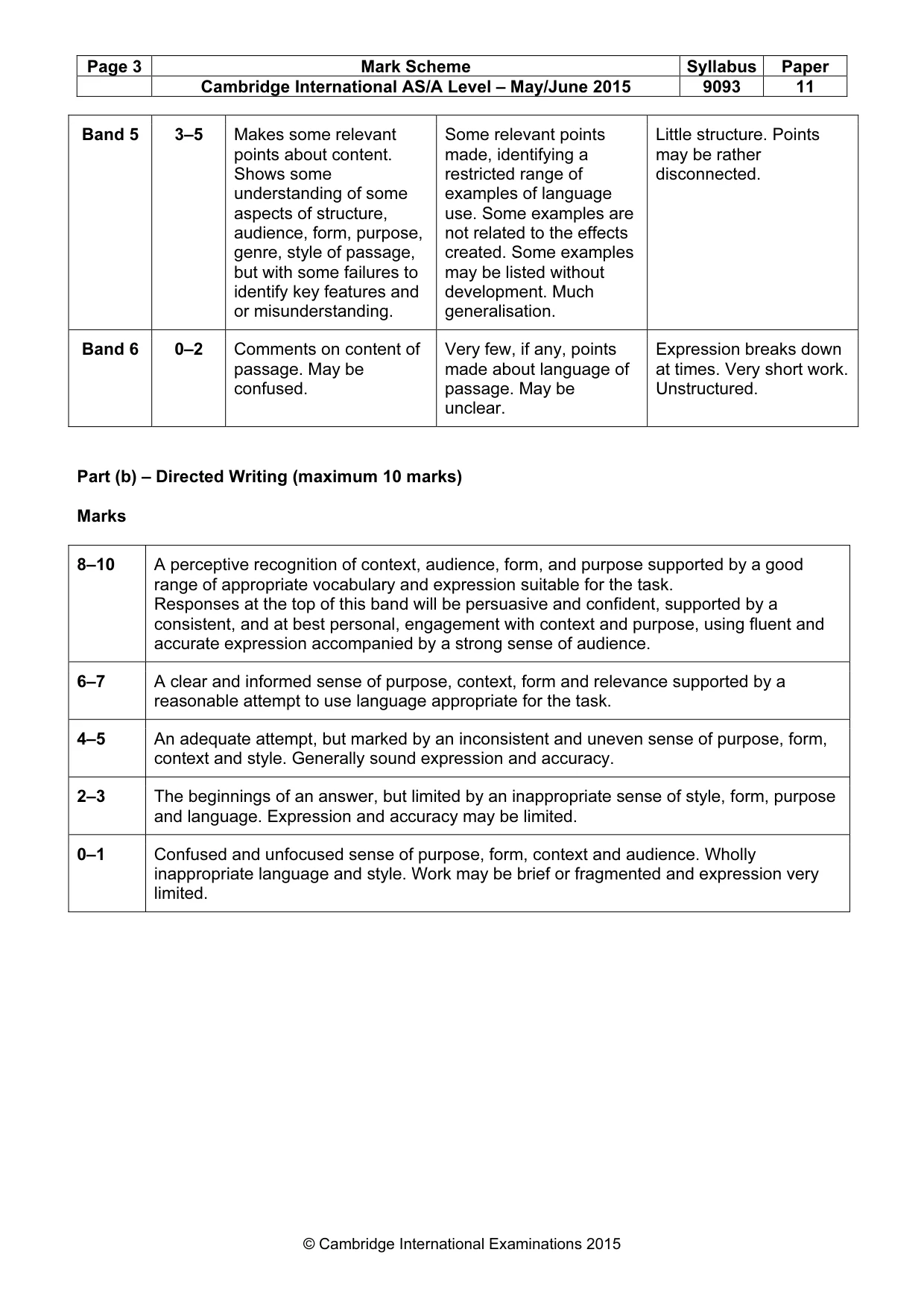
Page 3 Mark Scheme Syllabus Paper Cambridge International AS/A Level – May/June 2015 9093 11 © Cambridge International Examinations 2015 Band 5 3–5 Makes some relevant points about content. Shows some understanding of some aspects of structure, audience, form, purpose, genre, style of passage, but with some failures to identify key features and or misunderstanding. Some relevant points made, identifying a restricted range of examples of language use. Some examples are not related to the effects created. Some examples may be listed without development. Much generalisation. Little structure. Points may be rather disconnected. Band 6 0–2 Comments on content of passage. May be confused. Very few, if any, points made about language of passage. May be unclear. Expression breaks down at times. Very short work. Unstructured. Part (b) – Directed Writing (maximum 10 marks) Marks 8–10 A perceptive recognition of context, audience, form, and purpose supported by a good range of appropriate vocabulary and expression suitable for the task. Responses at the top of this band will be persuasive and confident, supported by a consistent, and at best personal, engagement with context and purpose, using fluent and accurate expression accompanied by a strong sense of audience. 6–7 A clear and informed sense of purpose, context, form and relevance supported by a reasonable attempt to use language appropriate for the task. 4–5 An adequate attempt, but marked by an inconsistent and uneven sense of purpose, form, context and style. Generally sound expression and accuracy. 2–3 The beginnings of an answer, but limited by an inappropriate sense of style, form, purpose and language. Expression and accuracy may be limited. 0–1 Confused and unfocused sense of purpose, form, context and audience. Wholly inappropriate language and style. Work may be brief or fragmented and expression very limited.
What you needed in this session
Cambridge’s own grade thresholds for 2015 May/June, Paper 1 · Variant 1. A higher threshold means an easier paper — the bar moves with how the cohort did.