Cambridge A Level English - Language AS and A Level (from 2014) 9093 — 2015 May/June Paper 1 · Variant 2
9093/12/M/J/15 · 50 marks · ≈56 min
The question paper and its mark scheme, free to read here and free to download. This is Cambridge’s own paper, exactly as it was sat.
Question paper8 pages
Mark scheme3 pages
Answers below. Sit the paper first if you are practising.
Paper as text
Question paper, page 1
This document consists of 7 printed pages, 1 blank page and 1 insert. DC RCL (KM) 93692/4 © UCLES 2015 [Turn over Cambridge International Examinations Cambridge International Advanced Subsidiary and Advanced Level * 2 0 7 8 9 7 8 3 0 2 * ENGLISH LANGUAGE 9093/12 Paper 1 Passages May/June 2015 2 hours 15 minutes No Additional Materials are required. READ THESE INSTRUCTIONS FIRST An answer booklet is provided inside this question paper. You should follow the instructions on the front cover of the answer booklet. If you need additional answer paper ask the invigilator for a continuation booklet. Answer two questions: Question 1 and either Question 2 or Question 3. You should spend about 15 minutes reading the passages and questions before you start writing your answers. You are reminded of the need for good English and clear presentation in your answers. The number of marks is given in brackets [ ] at the end of each question or part question.
Question paper, page 2
2 9093/12/M/J/15 © UCLES 2015 Answer Question 1 and either Question 2 or Question 3. 1 The following extract is taken from a speech to the Organisation of African Unity given by Kwame Nkrumah, President of Ghana, in 1963. (a) Comment on the ways in which language and style are used to persuade the audience. [15] (b) Continue the speech (between 120–150 words). You do not have to bring it to a close. Base your answer closely on the style and features of the original extract. [10] Our objective is African union now. There is no time to waste. We must unite now or perish. African unity is, above all, a political kingdom which can only be gained by political means. Our people supported us in our fight for independence because they believed that African governments could cure the ills of the past in a way which could never be accomplished under colonial rule. If, therefore, now that we are independent we allow the same conditions to exist that existed in colonial days, all the resentment which overthrew colonialism will be mobilised against us. The resources are there. It is for us to marshal them in the active service of our people. Unless we do this by our concerted efforts, within the framework of our combined planning, we shall not progress at the tempo demanded by today’s events and the mood of our people. The symptoms of our troubles will grow, and the troubles themselves become chronic. It will then be too late for pan- African unity to secure for us stability and tranquillity in our labours for a continent of social justice and material wellbeing. What need is there for us to remain hewers of wood and drawers of water for the industrialised areas of the world? It is said, of course, that we have no capital, no industrial skill, no communications, and no internal markets, and that we cannot even agree among ourselves how best to utilise our resources for our own social needs. Yet all stock exchanges in the world are preoccupied with Africa’s gold, diamonds, uranium, platinum, copper and iron ore. Our capital flows out in streams to irrigate the whole system of Western economy. Africa provides more than 60% of the world’s gold. A great deal of the uranium for nuclear power, of copper for electronics, of titanium for supersonic projectiles, of iron and steel for heavy industries, of other minerals and raw materials for lighter industries – the basic economic might of the foreign powers – comes from our continent. Are you afraid to tackle the bull by the horn? For centuries, Africa has been the milch cow1 of the Western world. Was it not our continent that helped the Western world to build up its accumulated wealth? We have the resources. It was colonialism in the first place that prevented us from accumulating the effective capital; but we ourselves have failed to make full use of our power in independence to mobilise our resources for the most effective take-off into thorough-going economic and social development. We have been too busy nursing our separate states to understand fully the basic need of our union, rooted in common purpose, common planning and common endeavour. A union that ignores these fundamental necessities will be but a sham. 5 10 15 20 25 30 35
Question paper, page 3
3 9093/12/M/J/15 © UCLES 2015 [Turn over It is only by uniting our productive capacity and the resultant production that we can amass capital. And once we start, the momentum will increase. With capital controlled by our own banks, harnessed to our own true industrial and agricultural development, we shall make our advance. We shall accumulate machinery and establish steel works, iron foundries and factories; we shall link the various states of our continent with communications by land, sea, and air. We shall cable from one place to another, phone from one place to the other and astound the world with our hydro-electric power; we shall drain marshes and swamps, clear infested areas, feed the undernourished, and rid our people of parasites and disease. 1 milch cow : milking cow 40 45
Question paper, page 4
4 9093/12/M/J/15 © UCLES 2015 2 The following text is taken from a travel book. It describes the writer’s experience of staying in Tahiti, an island in French Polynesia, an area of the southern Pacific Ocean. (a) Comment on the ways in which language and style are used to create a sense of mood and place. [15] (b) Later in her book, the writer describes a different type of location which has also affected her thoughts and feelings. Write a section (between 120–150 words) of this description. Base your answer closely on the style and features of the writing in the original extract. [10] My trip began in paradise. In Tahiti. It was one week before the French nuclear tests on the Mururoa atoll1, one week before protestors’ riots and looting ripped apart the Tahitian capital, Papeete. I saw none of that coming. I had never been to a more peaceful place. I was staying in a youth hostel, and it wasn’t long before a grubby group of us invaded the Hyatt Regency Hotel, occupying the terrace restaurant and securing seats overlooking the sea. We wanted to improve on our view. We wanted beer, nuts and cocktails at eight dollars a shot, and the feeling of life being as close to perfect as it could ever be. It came close that night. A magnificent South Pacific sunset graced our efforts. Gilded waves, a blazing sky containing every shade of red imaginable. We gaped at the west, our eyes never leaving it as we talked lazily about many things. Why Americans never travel anywhere. Why Germans always do. Didn’t Marlon Brando2 have an island somewhere around there? Didn’t his daughter kill herself? We all looked over at the dreadlocked Brit who asked this last question and admonished him with our gazes: inappropriate subject. We would not tolerate such questions. Not now. Not in front of such perfection. Every day in Tahiti ended with sentimental perfection, as if it were always the last day before the end of the world. Beauty was ostentatious there. The air reeked of tiare3 and orange blossoms like a land wearing too much perfume; walking the streets meant treading on flowers shed like autumnal leaves. I wondered absently when I’d be dropped to earth again, a mortal. Too soon, surely. And I wasn’t yet prepared for the sobering jolt. The quietest of the group, I was surprised when the others joined me in silence. To the west, the night was taking over, creating an edge to the colors and slowly blowing out the scene. Mauve. Dark maroon. Slowly, slowly. The sky and sea joining. A slice of moon asserting itself. The sounds of insects. A cooler ocean breeze. And night. Something akin to disappointment overtook us. The beers and cocktails became much too expensive for us. The Hyatt Regency Hotel too stuffy. We counted out our loose change, piled it on the table, and left to the relief of the hotel staff. Heading to the youth hostel with everyone in the back of an old truck, I felt like one of Tahiti’s tupapau—ghosts—which people believed wandered endlessly and could only be persuaded to rest by lighting a kerosene lamp in the night. I was already feeling anxious to leave Tahiti. Inexplicably, I always needed to be somewhere else. I’d left behind so much this time. Graduate school, my teaching job, my chance at 5 10 15 20 25 30 35
Question paper, page 5
5 9093/12/M/J/15 © UCLES 2015 [Turn over having some savings. A boyfriend who loved me and whom I might have allowed myself to love back. The stars above, for all of the truck’s speed, didn’t seem to move. The wind lashed our hair back, sent our clothes beating upon us. Tahiti and its people appeared in glimpses of light: an old man walking beneath a street lamp, a pale ocean, a mother on her front steps calling to a child. I looked at the young people around me. Most of them had been in Tahiti for months, glorying like Fletcher Christian’s mutineers4 in how successfully they had evaded the rest of the world and its responsibilities. They lived, as I did, out of a backpack. They spent their nights getting Polynesian tattoos and drinking beer around bonfires on the sand, a society of merry vagabonds. I was always tentative about joining them, sitting on the fringe of the circle of light. I liked to watch them, wondering what happened when paradise officially became one’s home. Did the escapes stop then? Did one live a charmed life? For their lives, these happy people’s, indeed seemed charmed. I’d found that the most paradisiacal places in the world only distracted me for a few blessed days. It was like having an out-of-body experience: I stepped away from myself and my past, and resided in turquoise waters and white sands, pretending I wouldn’t ever have to return to anything. Rest and relaxation, people called it. I called it hope. 1 atoll : coral island 2 Marlon Brando : a Hollywood film star 3 tiare : a type of gardenia plant 4 Fletcher Christian’s mutineers : sailors, led by Fletcher Christian, who rebelled against their commanding officer on an expedition to Tahiti in the eighteenth century 40 45 50 55
Question paper, page 6
6 9093/12/M/J/15 © UCLES 2015 3 The following text describes how the writer, an English tutor, tries to help one of her students to take life less seriously. They are sitting in a Japanese sushi restaurant where food travels by conveyor belt. (a) Comment on the ways in which language and style are used to present the characters and the setting. [15] (b) Later, Yumiko records her thoughts and feelings about the evening in her diary. Write a section (between 120–150 words) of the diary entry. Base your answer closely on the material of the original extract. [10] That night at the cheap sushi place, Yumiko was complaining about her boyfriend. Yumiko didn’t really love him. He was boring. A purple running shoe rounded the bend behind a tub of wasabi1. I blinked and it was still there, unhurriedly cruising the conveyor belt. “… but love is not everything and I am getting old.” She bit her glossy lower lip. “You understand, Natalie?” Maguro2, shrimp, melon slice, wasabi, shoe. Yumiko saw it too. The running shoe crept by, its frayed laces dangling over the edge of the counter. Laughing, I turned to look at the other diners. The room was wide and white, with four rows of blood-orange seats lining the snakelike progression of the sushi track. The ceiling spewed out fluorescent light over the constant noise—children squealing, waiters singing welcome, men barking orders into tableside speakers. “I wonder what kind of person wears a purple shoe,” Yumiko said without smiling. She paused to brush her long braid over her shoulder. I was still laughing. “This is truly awesome.” “It’s not funny.” “Don’t worry,” I said. “Yes, you’re right,” she said, and relief spilled over her face. She scooped a heap of ginger out of a plastic bin on the table. I peeked across the restaurant. A few people were smiling and pointing. She looked across the restaurant. “My father thinks Satoshi will be a good husband.” I shoved a thick slab of salmon and rice into my mouth. The fish was a little oily, and everything melted on my tongue. I reached for another piece while I was still chewing, then realized Yumiko was waiting for me to say something. I swallowed. I saw the high heel only as it reached Yumiko’s right shoulder. It was black and it reflected stripes of light. She gasped. “We should leave, maybe.” I laughed, listening as the key of the restaurant changed from flat to sharp, with high-pitched tones of wonder winding through the place. “No way we’re leaving now! 5 10 15 20 25 30
Question paper, page 7
7 9093/12/M/J/15 © UCLES 2015 Look!” Across the aisle, a woman was wiping the face of a tiny baby in a booster seat. The little girl behind her had slipped off her shoe and was reaching up toward the moving belt. Her smile, stretched to its limits, burst into a shriek of laughter as she carefully set the shoe down. She stood up on the bright plastic seat and leaned over the plates of sushi to watch it disappear. “I cannot believe that girl!” Yumiko said. “Just watch what her mother will say.” The mother finally did turn back to the girl, who was still leaning against the counter. She looked at her daughter standing in the seat, and took one look at her bare foot before she threw her head back, giggling. She spun back to the baby in the booster seat, who was now kicking his feet, riding an imaginary bicycle. Off came a green knitted bootie. From mother’s hand to daughter’s, and onto the belt between two pieces of eel. I grinned at Yumiko, who was still chewing absently, and bent down. “No! Stop! Don’t do it please.” Her voice was desperate. “What’s wrong? This is funny. Come on, everyone’s laughing.” I patted a passing green tennis shoe. “I think I’m going to call Satoshi.” She reached for her phone. Her hand trembled. I reached across the table and touched her arm. “Yumiko, come on. No one’s getting hurt.” All around us, groups were shouting, laughing, taking plates off the conveyor belt in order to make more room for the shoes that were beginning to crowd it. Waitresses continued buzzing, whisking beers and soup bowls with the efficiency of worker bees. As the noise level of the restaurant billowed up towards hysterical, Yumiko smiled. Her phone rang. She looked at me; we both looked at the phone. The room broke into applause and instead of answering the call she swung her legs around to stand up on her seat along with me and some other customers. We whistled and whooped. Her phone was still ringing. 1 wasabi : spicy vegetable sauce 2 maguro: tuna sushi dish 35 40 45 50 55
Question paper, page 8
8 9093/12/M/J/15 © UCLES 2015 BLANK PAGE Permission to reproduce items where third-party owned material protected by copyright is included has been sought and cleared where possible. Every reasonable effort has been made by the publisher (UCLES) to trace copyright holders, but if any items requiring clearance have unwittingly been included, the publisher will be pleased to make amends at the earliest possible opportunity. To avoid the issue of disclosure of answer-related information to candidates, all copyright acknowledgements are reproduced online in the Cambridge International Examinations Copyright Acknowledgements Booklet. This is produced for each series of examinations and is freely available to download at www.cie.org.uk after the live examination series. Cambridge International Examinations is part of the Cambridge Assessment Group. Cambridge Assessment is the brand name of University of Cambridge Local Examinations Syndicate (UCLES), which is itself a department of the University of Cambridge.
Mark scheme, page 1
® IGCSE is the registered trademark of Cambridge International Examinations. CAMBRIDGE INTERNATIONAL EXAMINATIONS Cambridge International Advanced Subsidiary and Advanced Level MARK SCHEME for the May/June 2015 series 9093 ENGLISH LANGUAGE 9093/12 Paper 1 (Passages), maximum raw mark 50 This mark scheme is published as an aid to teachers and candidates, to indicate the requirements of the examination. It shows the basis on which Examiners were instructed to award marks. It does not indicate the details of the discussions that took place at an Examiners’ meeting before marking began, which would have considered the acceptability of alternative answers. Mark schemes should be read in conjunction with the question paper and the Principal Examiner Report for Teachers. Cambridge will not enter into discussions about these mark schemes. Cambridge is publishing the mark schemes for the May/June 2015 series for most Cambridge IGCSE®, Cambridge International A and AS Level components and some Cambridge O Level components.
Mark scheme, page 2
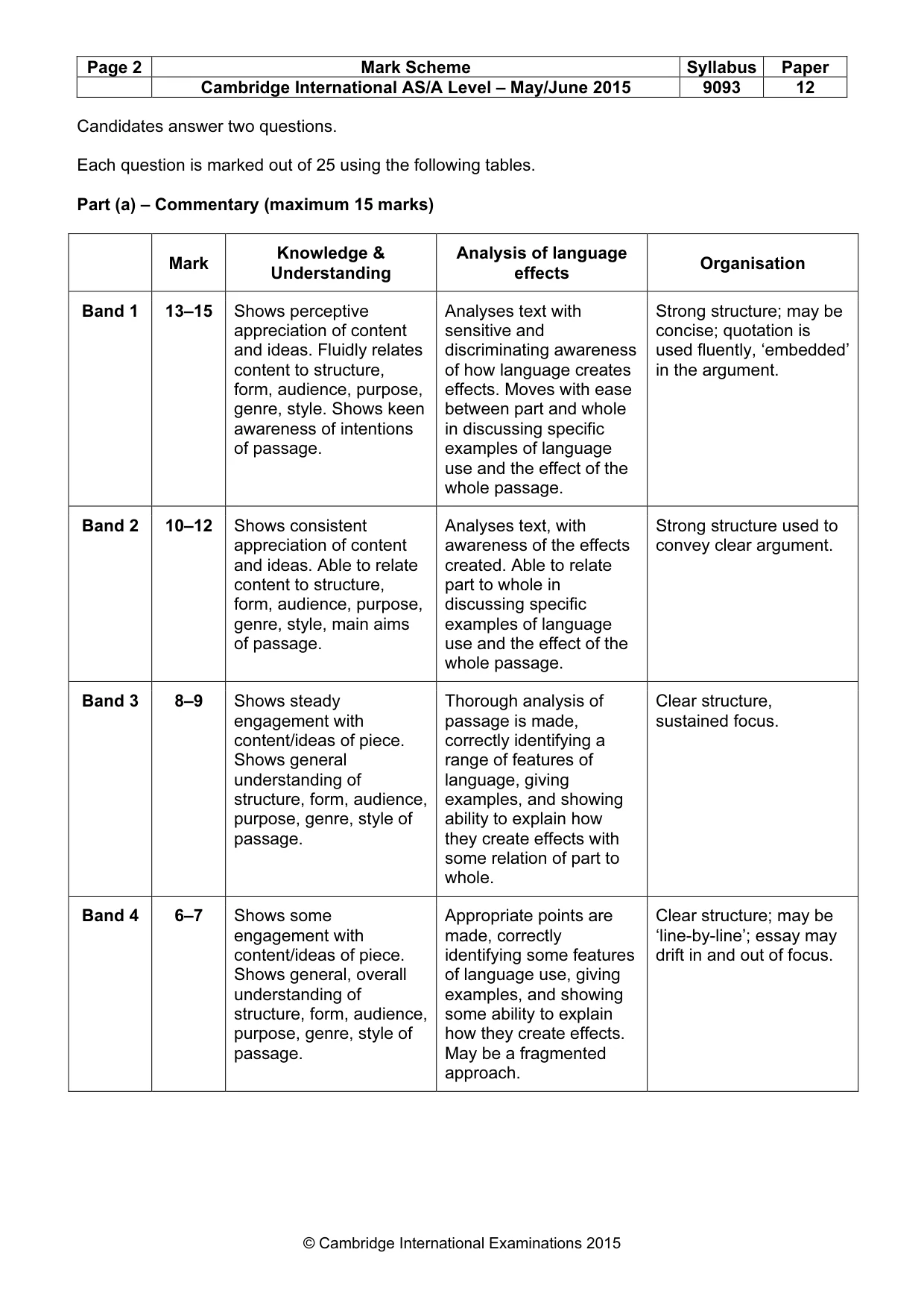
Page 2 Mark Scheme Syllabus Paper Cambridge International AS/A Level – May/June 2015 9093 12 © Cambridge International Examinations 2015 Candidates answer two questions. Each question is marked out of 25 using the following tables. Part (a) – Commentary (maximum 15 marks) Mark Knowledge & Understanding Analysis of language effects Organisation Band 1 13–15 Shows perceptive appreciation of content and ideas. Fluidly relates content to structure, form, audience, purpose, genre, style. Shows keen awareness of intentions of passage. Analyses text with sensitive and discriminating awareness of how language creates effects. Moves with ease between part and whole in discussing specific examples of language use and the effect of the whole passage. Strong structure; may be concise; quotation is used fluently, ‘embedded’ in the argument. Band 2 10–12 Shows consistent appreciation of content and ideas. Able to relate content to structure, form, audience, purpose, genre, style, main aims of passage. Analyses text, with awareness of the effects created. Able to relate part to whole in discussing specific examples of language use and the effect of the whole passage. Strong structure used to convey clear argument. Band 3 8–9 Shows steady engagement with content/ideas of piece. Shows general understanding of structure, form, audience, purpose, genre, style of passage. Thorough analysis of passage is made, correctly identifying a range of features of language, giving examples, and showing ability to explain how they create effects with some relation of part to whole. Clear structure, sustained focus. Band 4 6–7 Shows some engagement with content/ideas of piece. Shows general, overall understanding of structure, form, audience, purpose, genre, style of passage. Appropriate points are made, correctly identifying some features of language use, giving examples, and showing some ability to explain how they create effects. May be a fragmented approach. Clear structure; may be ‘line-by-line’; essay may drift in and out of focus.
Mark scheme, page 3
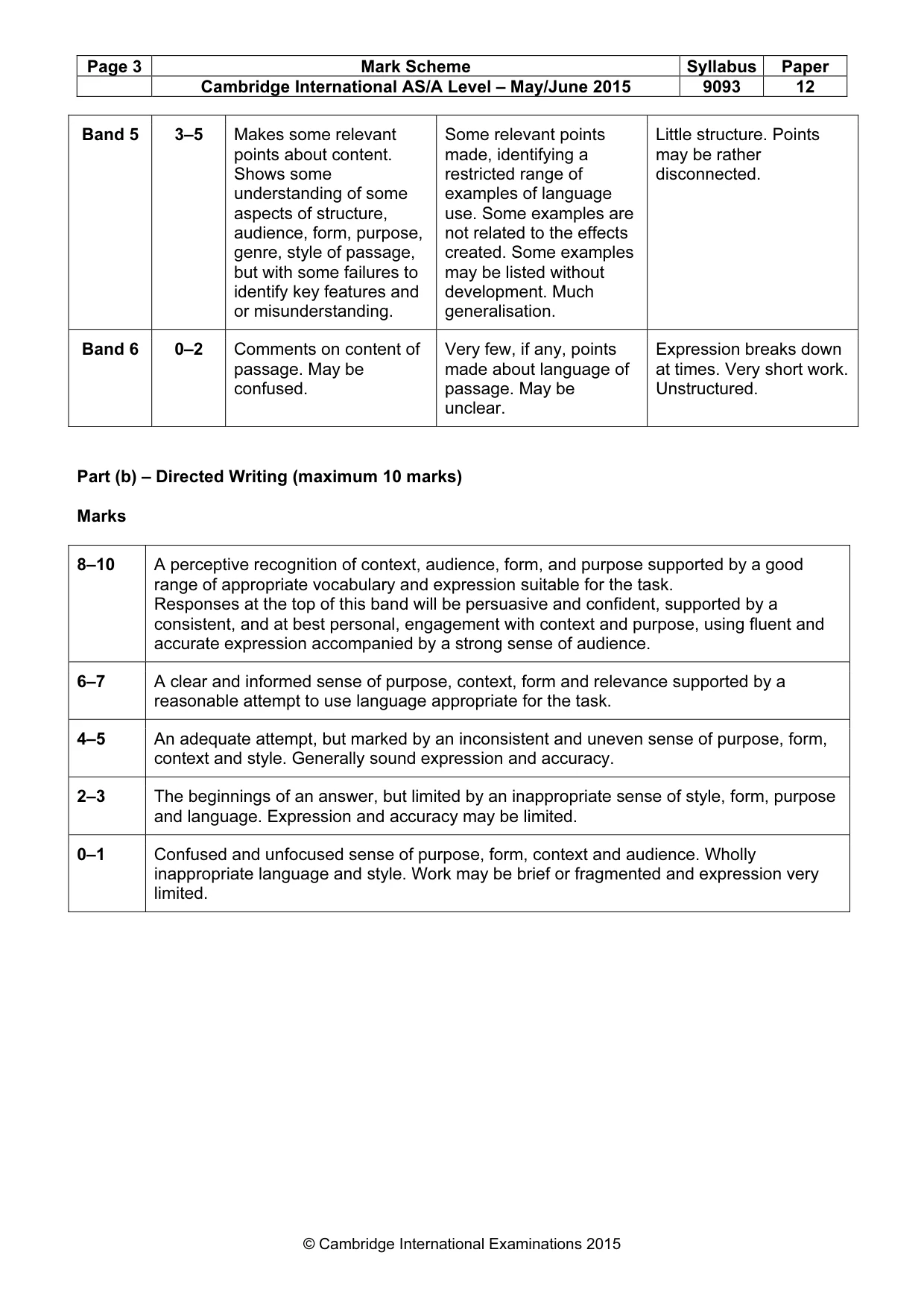
Page 3 Mark Scheme Syllabus Paper Cambridge International AS/A Level – May/June 2015 9093 12 © Cambridge International Examinations 2015 Band 5 3–5 Makes some relevant points about content. Shows some understanding of some aspects of structure, audience, form, purpose, genre, style of passage, but with some failures to identify key features and or misunderstanding. Some relevant points made, identifying a restricted range of examples of language use. Some examples are not related to the effects created. Some examples may be listed without development. Much generalisation. Little structure. Points may be rather disconnected. Band 6 0–2 Comments on content of passage. May be confused. Very few, if any, points made about language of passage. May be unclear. Expression breaks down at times. Very short work. Unstructured. Part (b) – Directed Writing (maximum 10 marks) Marks 8–10 A perceptive recognition of context, audience, form, and purpose supported by a good range of appropriate vocabulary and expression suitable for the task. Responses at the top of this band will be persuasive and confident, supported by a consistent, and at best personal, engagement with context and purpose, using fluent and accurate expression accompanied by a strong sense of audience. 6–7 A clear and informed sense of purpose, context, form and relevance supported by a reasonable attempt to use language appropriate for the task. 4–5 An adequate attempt, but marked by an inconsistent and uneven sense of purpose, form, context and style. Generally sound expression and accuracy. 2–3 The beginnings of an answer, but limited by an inappropriate sense of style, form, purpose and language. Expression and accuracy may be limited. 0–1 Confused and unfocused sense of purpose, form, context and audience. Wholly inappropriate language and style. Work may be brief or fragmented and expression very limited.
What you needed in this session
Cambridge’s own grade thresholds for 2015 May/June, Paper 1 · Variant 2. A higher threshold means an easier paper — the bar moves with how the cohort did.