Cambridge A Level English - Language and Literature (AS Level only, from 2016) 8695 — 2020 Oct/Nov Paper 2 · Variant 3
8695/23/O/N/20 · 50 marks · ≈56 min
The question paper and its mark scheme, free to read here and free to download. This is Cambridge’s own paper, exactly as it was sat.
Question paper4 pages
Mark scheme7 pages
Answers below. Sit the paper first if you are practising.
Paper as text
Question paper, page 1
Cambridge International AS Level * 9 7 9 9 5 1 5 4 8 3 * DC (KS) 198828 © UCLES 2020 [Turn over This document has 4 pages. Blank pages are indicated. LANGUAGE AND LITERATURE IN ENGLISH 8695/23 Paper 2 Writing October/November 2020 2 hours You must answer on the enclosed answer booklet. You will need: Answer booklet (enclosed) INSTRUCTIONS ● Answer two questions in total: Section A: answer one question. Section B: answer one question. ● Follow the instructions on the front cover of the answer booklet. If you need additional answer paper, ask the invigilator for a continuation booklet. ● You are reminded of the need for good English and clear presentation in your answers. INFORMATION ● The total mark for this paper is 50. ● All questions are worth equal marks.
Question paper, page 2
2 8695/23/O/N/20 © UCLES 2020 Answer one question from Section A and one question from Section B. All questions carry equal marks. You should write 600–900 words for each question. Section A: Imaginative writing 1 Write the opening to a story called What could possibly go wrong? about an event that had been carefully planned. In your writing, create a sense of drama and anticipation. 2 Write two contrasting blogs (300–450 words each) about the launch of a space shuttle: the first by an astronaut who was on board the space shuttle; and the second by a person who watched it take off. In your writing, create a sense of mood and atmosphere. 3 Write a descriptive piece called The Carnival. In your writing, focus on colour, sound and movement to help your reader imagine the scene. Section B: Writing for an audience 4 In class, you have been discussing whether society should encourage young people to be competitive. Write an article for your school magazine, giving your opinion on the topic. 5 A local newspaper recently published an article challenging people to avoid using any digital devices for a week. Readers were invited to take up the challenge and to write letters about their experience. Write two contrasting letters (300–450 words each): one by a person whose experience was positive, and the other by a person whose experience was negative. 6 Write the voiceover script for part of a television documentary about the world’s greatest inventions. The documentary is aimed at a teenage audience, and aims to show how these inventions have shaped the world we live in. In your writing, create a sense of interest and enthusiasm.
Question paper, page 3
3 8695/23/O/N/20 © UCLES 2020 BLANK PAGE
Question paper, page 4
4 8695/23/O/N/20 © UCLES 2020 Permission to reproduce items where third-party owned material protected by copyright is included has been sought and cleared where possible. Every reasonable effort has been made by the publisher (UCLES) to trace copyright holders, but if any items requiring clearance have unwittingly been included, the publisher will be pleased to make amends at the earliest possible opportunity. To avoid the issue of disclosure of answer-related information to candidates, all copyright acknowledgements are reproduced online in the Cambridge Assessment International Education Copyright Acknowledgements Booklet. This is produced for each series of examinations and is freely available to download at www.cambridgeinternational.org after the live examination series. Cambridge Assessment International Education is part of the Cambridge Assessment Group. Cambridge Assessment is the brand name of the University of Cambridge Local Examinations Syndicate (UCLES), which itself is a department of the University of Cambridge. BLANK PAGE
Mark scheme, page 1
This document consists of 7 printed pages. © UCLES 2020 [Turn over Cambridge International AS Level LANGUAGE AND LITERATURE IN ENGLISH 8695/23 Paper 2 Writing October/November 2020 MARK SCHEME Maximum Mark: 50 Published This mark scheme is published as an aid to teachers and candidates, to indicate the requirements of the examination. It shows the basis on which Examiners were instructed to award marks. It does not indicate the details of the discussions that took place at an Examiners’ meeting before marking began, which would have considered the acceptability of alternative answers. Mark schemes should be read in conjunction with the question paper and the Principal Examiner Report for Teachers. Cambridge International will not enter into discussions about these mark schemes. Cambridge International is publishing the mark schemes for the October/November 2020 series for most Cambridge IGCSE™, Cambridge International A and AS Level and Cambridge Pre-U components, and some Cambridge O Level components.
Mark scheme, page 2
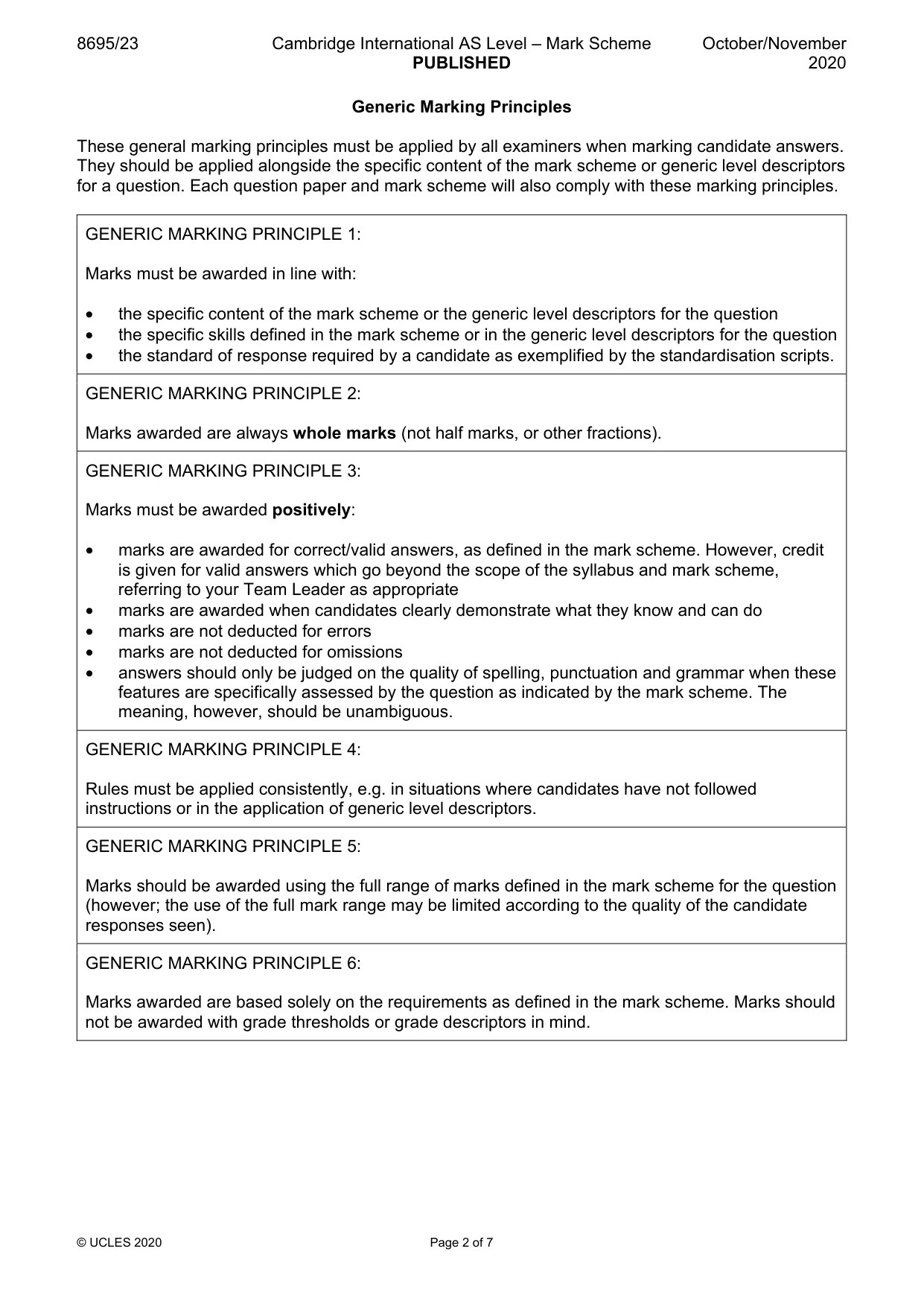
8695/23 Cambridge International AS Level – Mark Scheme PUBLISHED October/November 2020 © UCLES 2020 Page 2 of 7 Generic Marking Principles These general marking principles must be applied by all examiners when marking candidate answers. They should be applied alongside the specific content of the mark scheme or generic level descriptors for a question. Each question paper and mark scheme will also comply with these marking principles. GENERIC MARKING PRINCIPLE 1: Marks must be awarded in line with: • the specific content of the mark scheme or the generic level descriptors for the question • the specific skills defined in the mark scheme or in the generic level descriptors for the question • the standard of response required by a candidate as exemplified by the standardisation scripts. GENERIC MARKING PRINCIPLE 2: Marks awarded are always whole marks (not half marks, or other fractions). GENERIC MARKING PRINCIPLE 3: Marks must be awarded positively: • marks are awarded for correct/valid answers, as defined in the mark scheme. However, credit is given for valid answers which go beyond the scope of the syllabus and mark scheme, referring to your Team Leader as appropriate • marks are awarded when candidates clearly demonstrate what they know and can do • marks are not deducted for errors • marks are not deducted for omissions • answers should only be judged on the quality of spelling, punctuation and grammar when these features are specifically assessed by the question as indicated by the mark scheme. The meaning, however, should be unambiguous. GENERIC MARKING PRINCIPLE 4: Rules must be applied consistently, e.g. in situations where candidates have not followed instructions or in the application of generic level descriptors. GENERIC MARKING PRINCIPLE 5: Marks should be awarded using the full range of marks defined in the mark scheme for the question (however; the use of the full mark range may be limited according to the quality of the candidate responses seen). GENERIC MARKING PRINCIPLE 6: Marks awarded are based solely on the requirements as defined in the mark scheme. Marks should not be awarded with grade thresholds or grade descriptors in mind.
Mark scheme, page 3
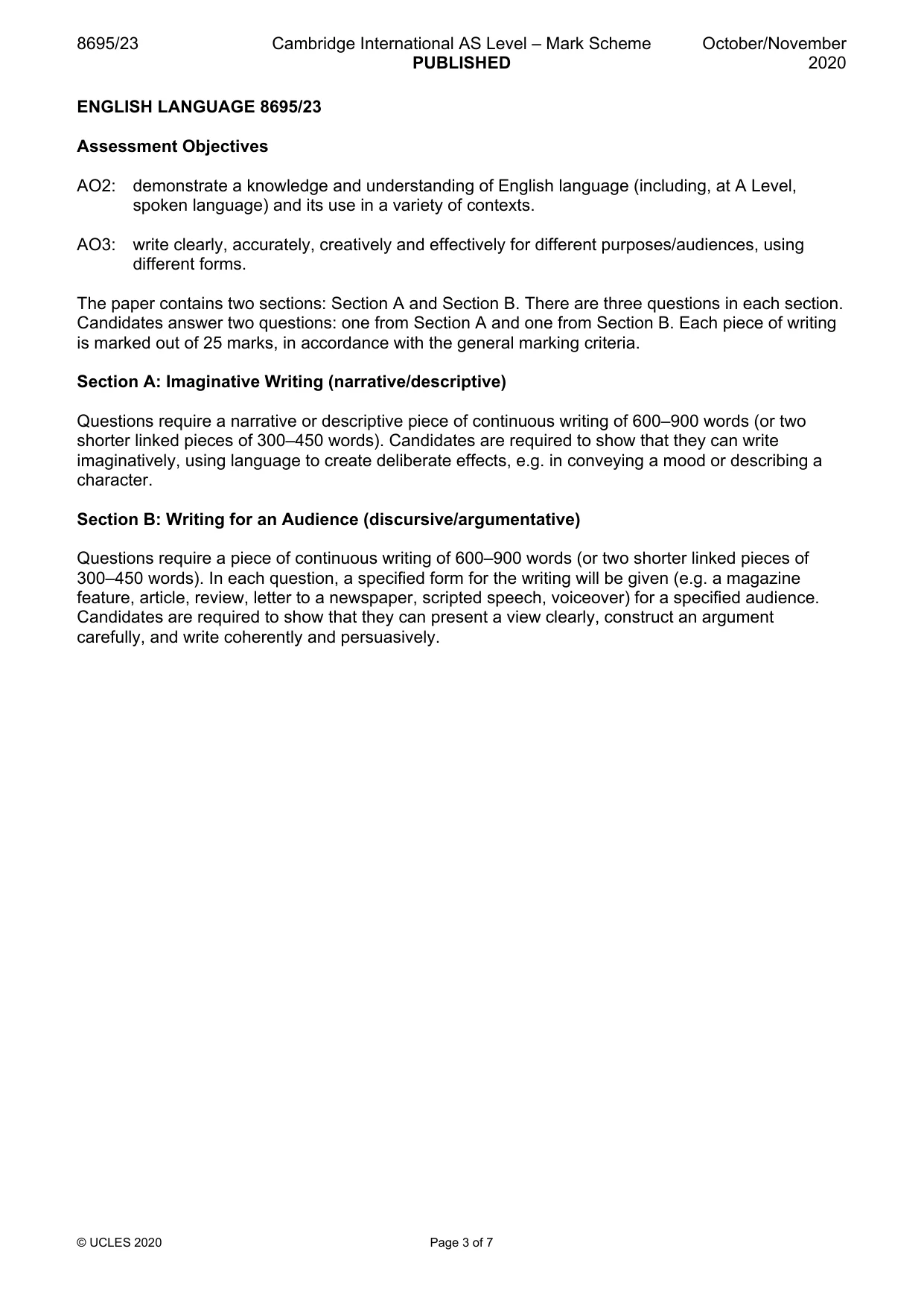
8695/23 Cambridge International AS Level – Mark Scheme PUBLISHED October/November 2020 © UCLES 2020 Page 3 of 7 ENGLISH LANGUAGE 8695/23 Assessment Objectives AO2: demonstrate a knowledge and understanding of English language (including, at A Level, spoken language) and its use in a variety of contexts. AO3: write clearly, accurately, creatively and effectively for different purposes/audiences, using different forms. The paper contains two sections: Section A and Section B. There are three questions in each section. Candidates answer two questions: one from Section A and one from Section B. Each piece of writing is marked out of 25 marks, in accordance with the general marking criteria. Section A: Imaginative Writing (narrative/descriptive) Questions require a narrative or descriptive piece of continuous writing of 600–900 words (or two shorter linked pieces of 300–450 words). Candidates are required to show that they can write imaginatively, using language to create deliberate effects, e.g. in conveying a mood or describing a character. Section B: Writing for an Audience (discursive/argumentative) Questions require a piece of continuous writing of 600–900 words (or two shorter linked pieces of 300–450 words). In each question, a specified form for the writing will be given (e.g. a magazine feature, article, review, letter to a newspaper, scripted speech, voiceover) for a specified audience. Candidates are required to show that they can present a view clearly, construct an argument carefully, and write coherently and persuasively.
Mark scheme, page 4
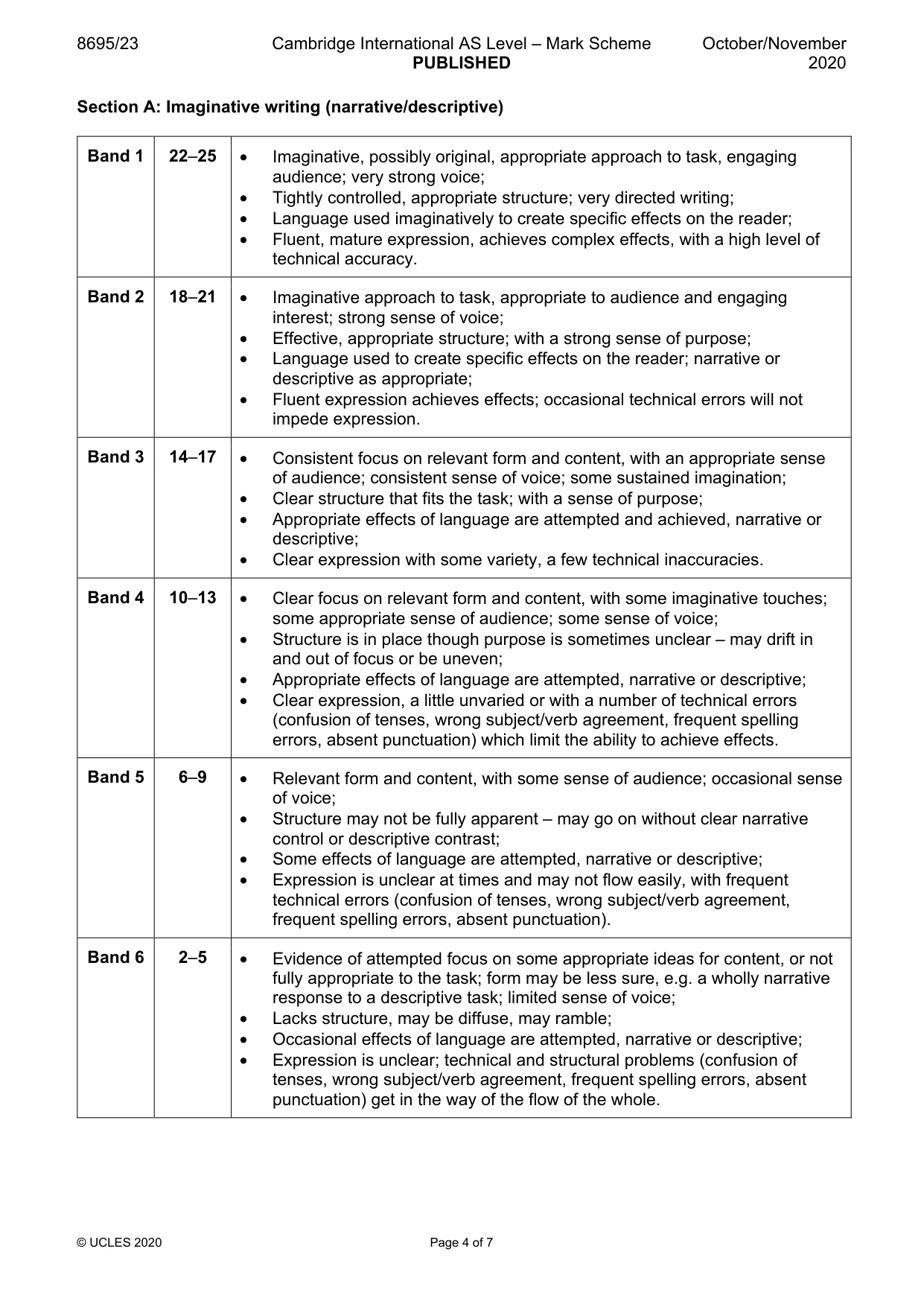
8695/23 Cambridge International AS Level – Mark Scheme PUBLISHED October/November 2020 © UCLES 2020 Page 4 of 7 Section A: Imaginative writing (narrative/descriptive) Band 1 22–25 • Imaginative, possibly original, appropriate approach to task, engaging audience; very strong voice; • Tightly controlled, appropriate structure; very directed writing; • Language used imaginatively to create specific effects on the reader; • Fluent, mature expression, achieves complex effects, with a high level of technical accuracy. Band 2 18–21 • Imaginative approach to task, appropriate to audience and engaging interest; strong sense of voice; • Effective, appropriate structure; with a strong sense of purpose; • Language used to create specific effects on the reader; narrative or descriptive as appropriate; • Fluent expression achieves effects; occasional technical errors will not impede expression. Band 3 14–17 • Consistent focus on relevant form and content, with an appropriate sense of audience; consistent sense of voice; some sustained imagination; • Clear structure that fits the task; with a sense of purpose; • Appropriate effects of language are attempted and achieved, narrative or descriptive; • Clear expression with some variety, a few technical inaccuracies. Band 4 10–13 • Clear focus on relevant form and content, with some imaginative touches; some appropriate sense of audience; some sense of voice; • Structure is in place though purpose is sometimes unclear – may drift in and out of focus or be uneven; • Appropriate effects of language are attempted, narrative or descriptive; • Clear expression, a little unvaried or with a number of technical errors (confusion of tenses, wrong subject/verb agreement, frequent spelling errors, absent punctuation) which limit the ability to achieve effects. Band 5 6–9 • Relevant form and content, with some sense of audience; occasional sense of voice; • Structure may not be fully apparent – may go on without clear narrative control or descriptive contrast; • Some effects of language are attempted, narrative or descriptive; • Expression is unclear at times and may not flow easily, with frequent technical errors (confusion of tenses, wrong subject/verb agreement, frequent spelling errors, absent punctuation). Band 6 2–5 • Evidence of attempted focus on some appropriate ideas for content, or not fully appropriate to the task; form may be less sure, e.g. a wholly narrative response to a descriptive task; limited sense of voice; • Lacks structure, may be diffuse, may ramble; • Occasional effects of language are attempted, narrative or descriptive; • Expression is unclear; technical and structural problems (confusion of tenses, wrong subject/verb agreement, frequent spelling errors, absent punctuation) get in the way of the flow of the whole.
Mark scheme, page 5
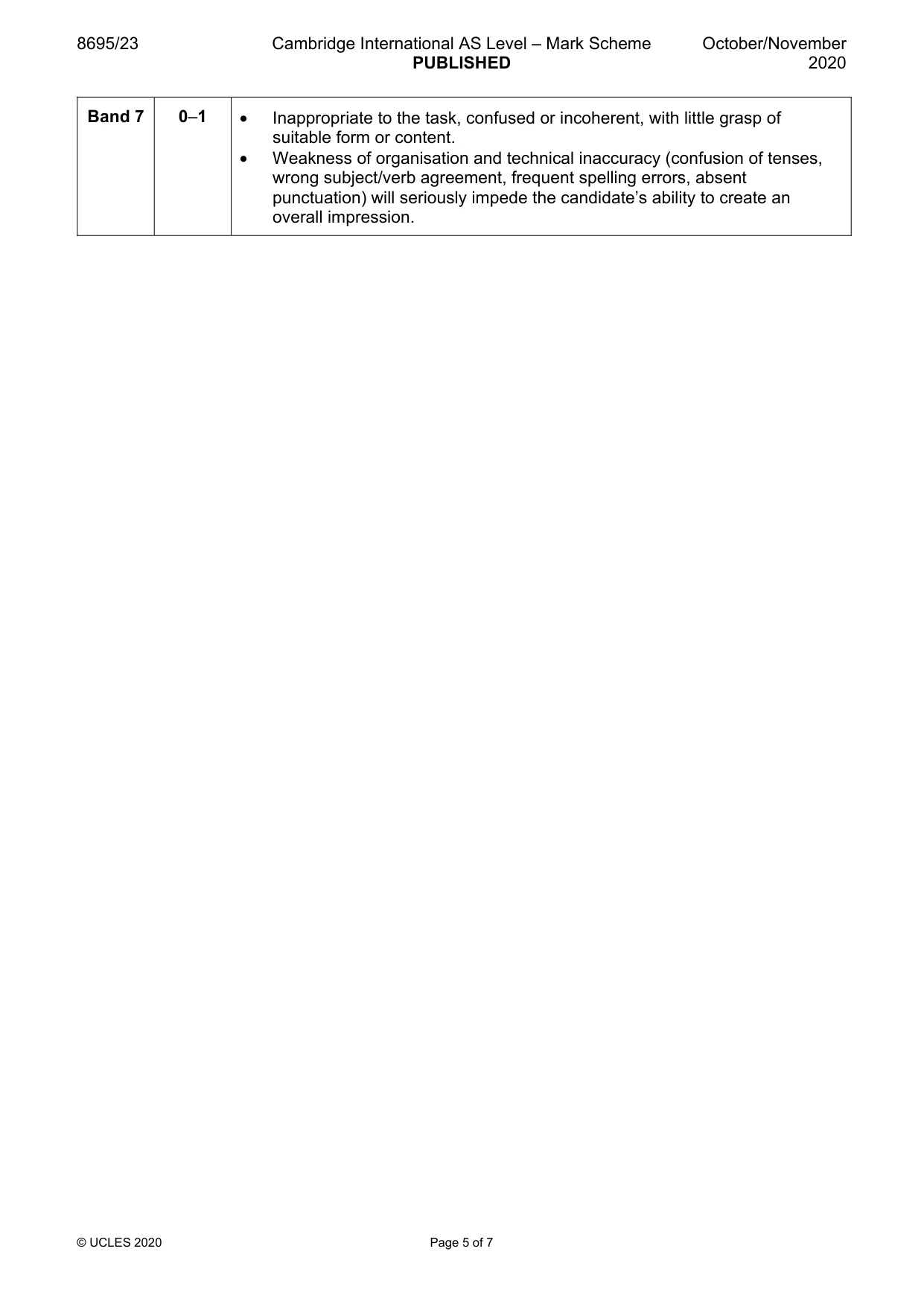
8695/23 Cambridge International AS Level – Mark Scheme PUBLISHED October/November 2020 © UCLES 2020 Page 5 of 7 Band 7 0–1 • Inappropriate to the task, confused or incoherent, with little grasp of suitable form or content. • Weakness of organisation and technical inaccuracy (confusion of tenses, wrong subject/verb agreement, frequent spelling errors, absent punctuation) will seriously impede the candidate’s ability to create an overall impression.
Mark scheme, page 6
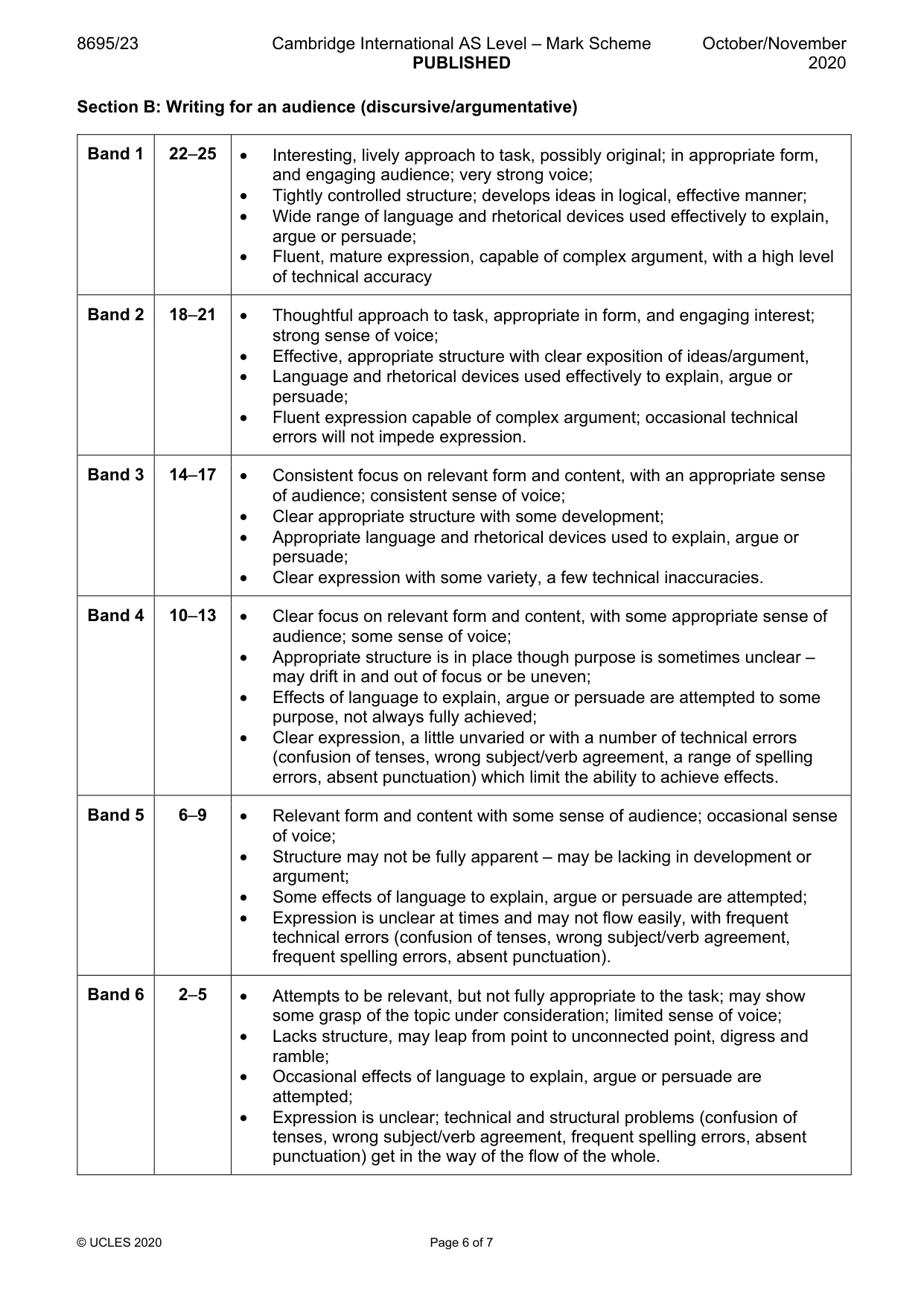
8695/23 Cambridge International AS Level – Mark Scheme PUBLISHED October/November 2020 © UCLES 2020 Page 6 of 7 Section B: Writing for an audience (discursive/argumentative) Band 1 22–25 • Interesting, lively approach to task, possibly original; in appropriate form, and engaging audience; very strong voice; • Tightly controlled structure; develops ideas in logical, effective manner; • Wide range of language and rhetorical devices used effectively to explain, argue or persuade; • Fluent, mature expression, capable of complex argument, with a high level of technical accuracy Band 2 18–21 • Thoughtful approach to task, appropriate in form, and engaging interest; strong sense of voice; • Effective, appropriate structure with clear exposition of ideas/argument, • Language and rhetorical devices used effectively to explain, argue or persuade; • Fluent expression capable of complex argument; occasional technical errors will not impede expression. Band 3 14–17 • Consistent focus on relevant form and content, with an appropriate sense of audience; consistent sense of voice; • Clear appropriate structure with some development; • Appropriate language and rhetorical devices used to explain, argue or persuade; • Clear expression with some variety, a few technical inaccuracies. Band 4 10–13 • Clear focus on relevant form and content, with some appropriate sense of audience; some sense of voice; • Appropriate structure is in place though purpose is sometimes unclear – may drift in and out of focus or be uneven; • Effects of language to explain, argue or persuade are attempted to some purpose, not always fully achieved; • Clear expression, a little unvaried or with a number of technical errors (confusion of tenses, wrong subject/verb agreement, a range of spelling errors, absent punctuation) which limit the ability to achieve effects. Band 5 6–9 • Relevant form and content with some sense of audience; occasional sense of voice; • Structure may not be fully apparent – may be lacking in development or argument; • Some effects of language to explain, argue or persuade are attempted; • Expression is unclear at times and may not flow easily, with frequent technical errors (confusion of tenses, wrong subject/verb agreement, frequent spelling errors, absent punctuation). Band 6 2–5 • Attempts to be relevant, but not fully appropriate to the task; may show some grasp of the topic under consideration; limited sense of voice; • Lacks structure, may leap from point to unconnected point, digress and ramble; • Occasional effects of language to explain, argue or persuade are attempted; • Expression is unclear; technical and structural problems (confusion of tenses, wrong subject/verb agreement, frequent spelling errors, absent punctuation) get in the way of the flow of the whole.
Mark scheme, page 7
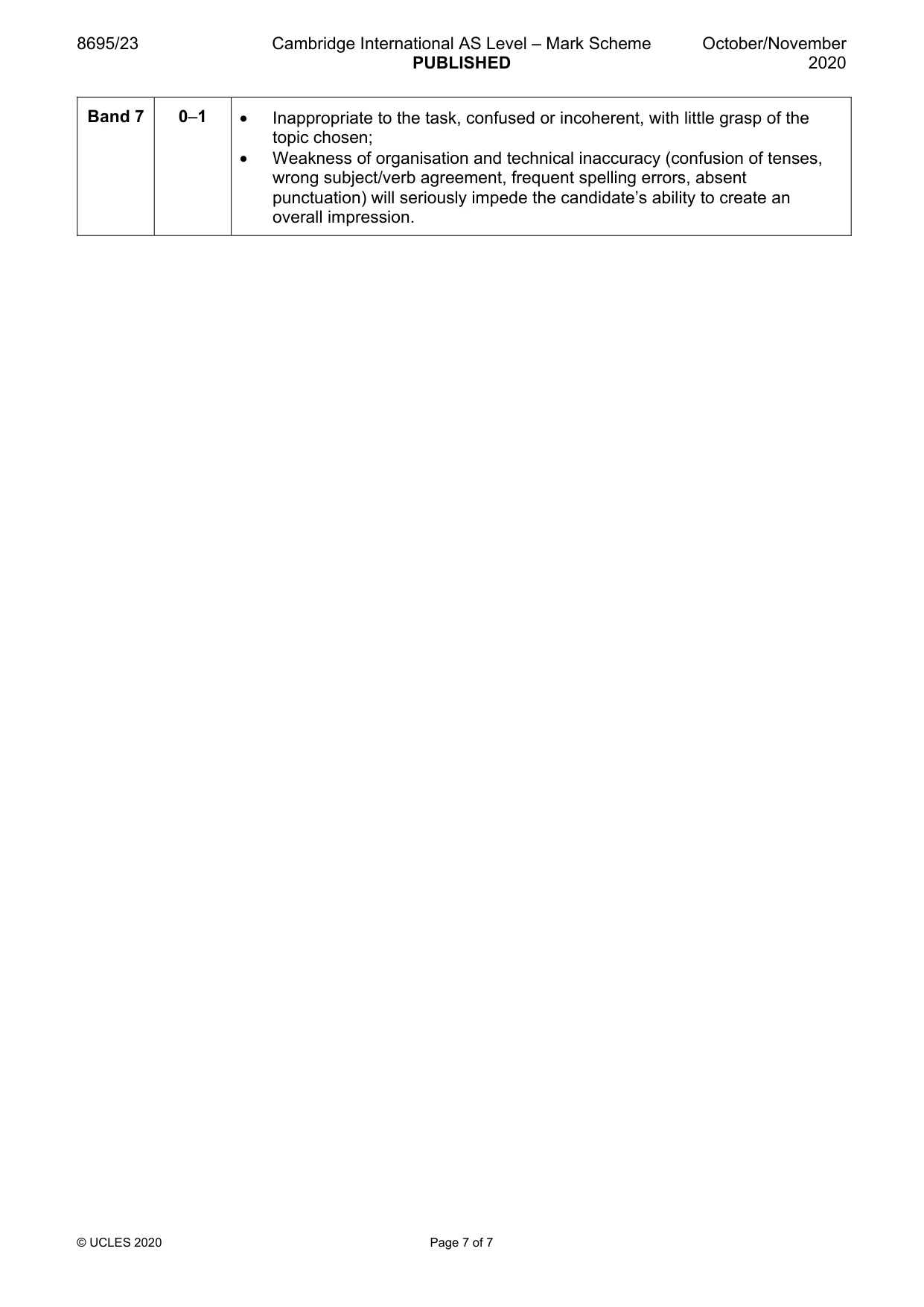
8695/23 Cambridge International AS Level – Mark Scheme PUBLISHED October/November 2020 © UCLES 2020 Page 7 of 7 Band 7 0–1 • Inappropriate to the task, confused or incoherent, with little grasp of the topic chosen; • Weakness of organisation and technical inaccuracy (confusion of tenses, wrong subject/verb agreement, frequent spelling errors, absent punctuation) will seriously impede the candidate’s ability to create an overall impression.
What you needed in this session
Cambridge’s own grade thresholds for 2020 Oct/Nov, Paper 2 · Variant 3. A higher threshold means an easier paper — the bar moves with how the cohort did.