Cambridge A Level English - Language and Literature (AS Level only, from 2016) 8695 — 2012 May/June Paper 2 · Variant 1
8695/21/M/J/12 · 50 marks · ≈56 min
The question paper and its mark scheme, free to read here and free to download. This is Cambridge’s own paper, exactly as it was sat.
Question paper2 pages
Mark scheme4 pages
Answers below. Sit the paper first if you are practising.
Paper as text
Question paper, page 1
This document consists of 2 printed pages. DC (CW) 58616 © UCLES 2012 [Turn over UNIVERSITY OF CAMBRIDGE INTERNATIONAL EXAMINATIONS General Certificate of Education Advanced Subsidiary Level and Advanced Level LANGUAGE AND LITERATURE IN ENGLISH 8695/21 Paper 2 Composition May/June 2012 2 hours Additional Materials: Answer Booklet/Paper READ THESE INSTRUCTIONS FIRST If you have been given an Answer Booklet, follow the instructions on the front cover of the Booklet. Write your Centre number, candidate number and name on all the work you hand in. Write in dark blue or black pen. Do not use staples, paper clips, highlighters, glue or correction fluid. Answer one question from Section A and one question from Section B. You are reminded of the need for good English and clear presentation in your answers. At the end of the examination, fasten all your work securely together. All questions in this paper carry equal marks. * 9 4 3 5 1 7 6 8 5 8 *
Question paper, page 2
2 8695/21/M/J/12 © UCLES 2012 Permission to reproduce items where third-party owned material protected by copyright is included has been sought and cleared where possible. Every reasonable effort has been made by the publisher (UCLES) to trace copyright holders, but if any items requiring clearance have unwittingly been included, the publisher will be pleased to make amends at the earliest possible opportunity. University of Cambridge International Examinations is part of the Cambridge Assessment Group. Cambridge Assessment is the brand name of University of Cambridge Local Examinations Syndicate (UCLES), which is itself a department of the University of Cambridge. Answer one question from Section A and one question from Section B. You should write between 600 and 900 words for each composition. Section A: Narrative/Descriptive/Imaginative Writing 1 Write a descriptive piece called Ghost Town. In your writing create a sense of mood and place. 2 Write the short opening chapter of a novel called The Coach Trip. In your writing create two contrasting characters who have different reasons for being on the journey. 3 Write a contemporary version of a well-known myth, legend or fairy tale. 4 Write two contrasting monologues (between 300–450 words each). In the first monologue the speaker describes a life without money. In the second monologue the same speaker describes how a substantial win on a lottery has affected her or his life. In your writing create a sense of contrasting attitudes and emotions. Section B: Discursive/Argumentative Writing 5 ‘Capitalism only makes the rich richer and the poor poorer.’ What do you think – and why? 6 Write a letter to a ten-year-old relative in which you offer advice on how to prepare for and cope with life as a teenager. 7 ‘Feminism is a thing of the past.’ What do you think – and why? 8 A magazine publishes two contrasting articles, one called ‘Marriage is now an outdated concept’, the other called ‘Marriage is still the foundation of society’. Write the two articles (between 300– 450 words each).
Mark scheme, page 1
UNIVERSITY OF CAMBRIDGE INTERNATIONAL EXAMINATIONS GCE Advanced Subsidiary Level MARK SCHEME for the May/June 2012 question paper for the guidance of teachers 8695 LANGUAGE AND LITERATURE IN ENGLISH 8695/21 Paper 21 (Composition), maximum raw mark 50 This mark scheme is published as an aid to teachers and candidates, to indicate the requirements of the examination. It shows the basis on which Examiners were instructed to award marks. It does not indicate the details of the discussions that took place at an Examiners’ meeting before marking began, which would have considered the acceptability of alternative answers. Mark schemes must be read in conjunction with the question papers and the report on the examination. • Cambridge will not enter into discussions or correspondence in connection with these mark schemes. Cambridge is publishing the mark schemes for the May/June 2012 question papers for most IGCSE, GCE Advanced Level and Advanced Subsidiary Level syllabuses and some Ordinary Level syllabuses.
Mark scheme, page 2
Page 2 Mark Scheme: Teachers’ version Syllabus Paper GCE AS LEVEL – May/June 2012 8695 21 © University of Cambridge International Examinations 2012 Assessment Objectives • Knowledge and understanding of features of English Language. • Ability to write clearly, accurately and effectively for a particular purpose or audience. Each composition is marked out of 25 marks, in accordance with the following general marking criteria. To achieve Band 5 or above, work needs to address the task chosen appropriately. Candidates need to observe the 600–900 word length for each section of the paper. If the question involves two parts, this should be interpreted as 300–450 words for each. If they produce short work, candidates will inevitably limit the marks that can be awarded for their answer(s).
Mark scheme, page 3
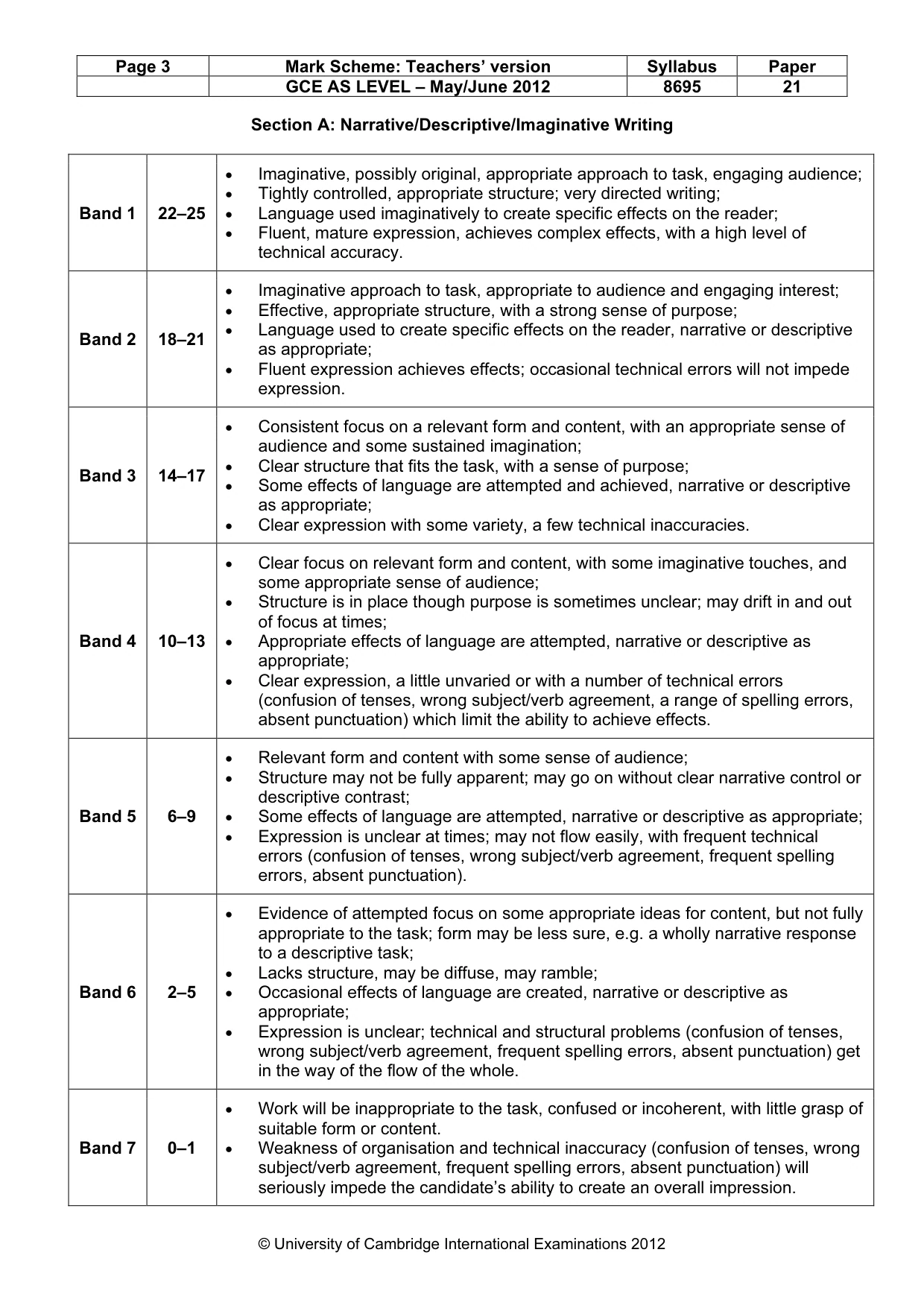
Page 3 Mark Scheme: Teachers’ version Syllabus Paper GCE AS LEVEL – May/June 2012 8695 21 © University of Cambridge International Examinations 2012 Section A: Narrative/Descriptive/Imaginative Writing Band 1 22–25 • Imaginative, possibly original, appropriate approach to task, engaging audience; • Tightly controlled, appropriate structure; very directed writing; • Language used imaginatively to create specific effects on the reader; • Fluent, mature expression, achieves complex effects, with a high level of technical accuracy. Band 2 18–21 • Imaginative approach to task, appropriate to audience and engaging interest; • Effective, appropriate structure, with a strong sense of purpose; • Language used to create specific effects on the reader, narrative or descriptive as appropriate; • Fluent expression achieves effects; occasional technical errors will not impede expression. Band 3 14–17 • Consistent focus on a relevant form and content, with an appropriate sense of audience and some sustained imagination; • Clear structure that fits the task, with a sense of purpose; • Some effects of language are attempted and achieved, narrative or descriptive as appropriate; • Clear expression with some variety, a few technical inaccuracies. Band 4 10–13 • Clear focus on relevant form and content, with some imaginative touches, and some appropriate sense of audience; • Structure is in place though purpose is sometimes unclear; may drift in and out of focus at times; • Appropriate effects of language are attempted, narrative or descriptive as appropriate; • Clear expression, a little unvaried or with a number of technical errors (confusion of tenses, wrong subject/verb agreement, a range of spelling errors, absent punctuation) which limit the ability to achieve effects. Band 5 6–9 • Relevant form and content with some sense of audience; • Structure may not be fully apparent; may go on without clear narrative control or descriptive contrast; • Some effects of language are attempted, narrative or descriptive as appropriate; • Expression is unclear at times; may not flow easily, with frequent technical errors (confusion of tenses, wrong subject/verb agreement, frequent spelling errors, absent punctuation). Band 6 2–5 • Evidence of attempted focus on some appropriate ideas for content, but not fully appropriate to the task; form may be less sure, e.g. a wholly narrative response to a descriptive task; • Lacks structure, may be diffuse, may ramble; • Occasional effects of language are created, narrative or descriptive as appropriate; • Expression is unclear; technical and structural problems (confusion of tenses, wrong subject/verb agreement, frequent spelling errors, absent punctuation) get in the way of the flow of the whole. Band 7 0–1 • Work will be inappropriate to the task, confused or incoherent, with little grasp of suitable form or content. • Weakness of organisation and technical inaccuracy (confusion of tenses, wrong subject/verb agreement, frequent spelling errors, absent punctuation) will seriously impede the candidate’s ability to create an overall impression.
Mark scheme, page 4
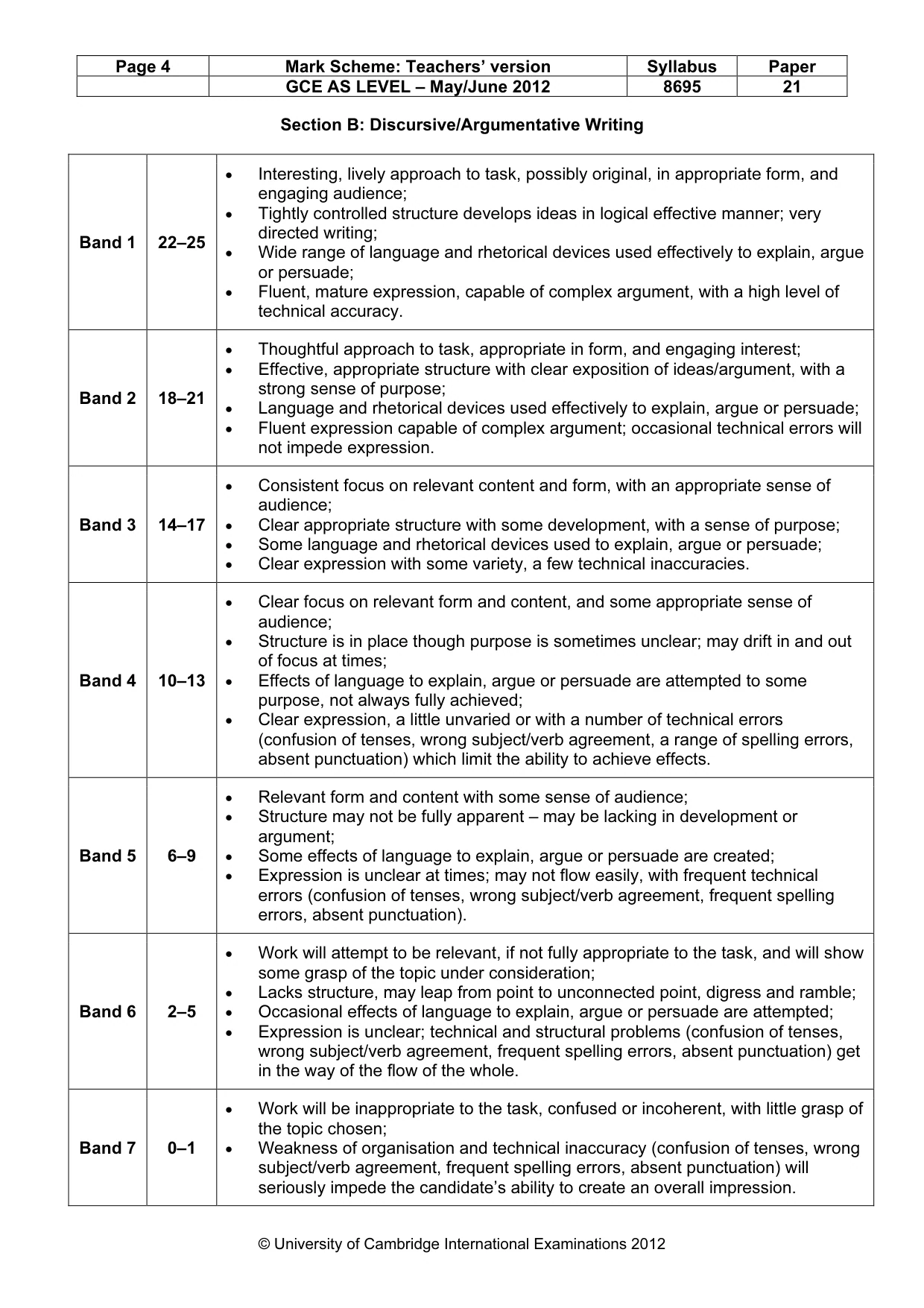
Page 4 Mark Scheme: Teachers’ version Syllabus Paper GCE AS LEVEL – May/June 2012 8695 21 © University of Cambridge International Examinations 2012 Section B: Discursive/Argumentative Writing Band 1 22–25 • Interesting, lively approach to task, possibly original, in appropriate form, and engaging audience; • Tightly controlled structure develops ideas in logical effective manner; very directed writing; • Wide range of language and rhetorical devices used effectively to explain, argue or persuade; • Fluent, mature expression, capable of complex argument, with a high level of technical accuracy. Band 2 18–21 • Thoughtful approach to task, appropriate in form, and engaging interest; • Effective, appropriate structure with clear exposition of ideas/argument, with a strong sense of purpose; • Language and rhetorical devices used effectively to explain, argue or persuade; • Fluent expression capable of complex argument; occasional technical errors will not impede expression. Band 3 14–17 • Consistent focus on relevant content and form, with an appropriate sense of audience; • Clear appropriate structure with some development, with a sense of purpose; • Some language and rhetorical devices used to explain, argue or persuade; • Clear expression with some variety, a few technical inaccuracies. Band 4 10–13 • Clear focus on relevant form and content, and some appropriate sense of audience; • Structure is in place though purpose is sometimes unclear; may drift in and out of focus at times; • Effects of language to explain, argue or persuade are attempted to some purpose, not always fully achieved; • Clear expression, a little unvaried or with a number of technical errors (confusion of tenses, wrong subject/verb agreement, a range of spelling errors, absent punctuation) which limit the ability to achieve effects. Band 5 6–9 • Relevant form and content with some sense of audience; • Structure may not be fully apparent – may be lacking in development or argument; • Some effects of language to explain, argue or persuade are created; • Expression is unclear at times; may not flow easily, with frequent technical errors (confusion of tenses, wrong subject/verb agreement, frequent spelling errors, absent punctuation). Band 6 2–5 • Work will attempt to be relevant, if not fully appropriate to the task, and will show some grasp of the topic under consideration; • Lacks structure, may leap from point to unconnected point, digress and ramble; • Occasional effects of language to explain, argue or persuade are attempted; • Expression is unclear; technical and structural problems (confusion of tenses, wrong subject/verb agreement, frequent spelling errors, absent punctuation) get in the way of the flow of the whole. Band 7 0–1 • Work will be inappropriate to the task, confused or incoherent, with little grasp of the topic chosen; • Weakness of organisation and technical inaccuracy (confusion of tenses, wrong subject/verb agreement, frequent spelling errors, absent punctuation) will seriously impede the candidate’s ability to create an overall impression.
What you needed in this session
Cambridge’s own grade thresholds for 2012 May/June, Paper 2 · Variant 1. A higher threshold means an easier paper — the bar moves with how the cohort did.