Cambridge A Level English - Language and Literature (AS Level only, from 2016) 8695 — 2011 Oct/Nov Paper 9 · Variant 2
8695/92/O/N/11 · 50 marks · ≈56 min
The question paper and its mark scheme, free to read here and free to download. This is Cambridge’s own paper, exactly as it was sat.
Question paper17 pages

Mark scheme5 pages
Answers below. Sit the paper first if you are practising.
Paper as text
Question paper, page 1
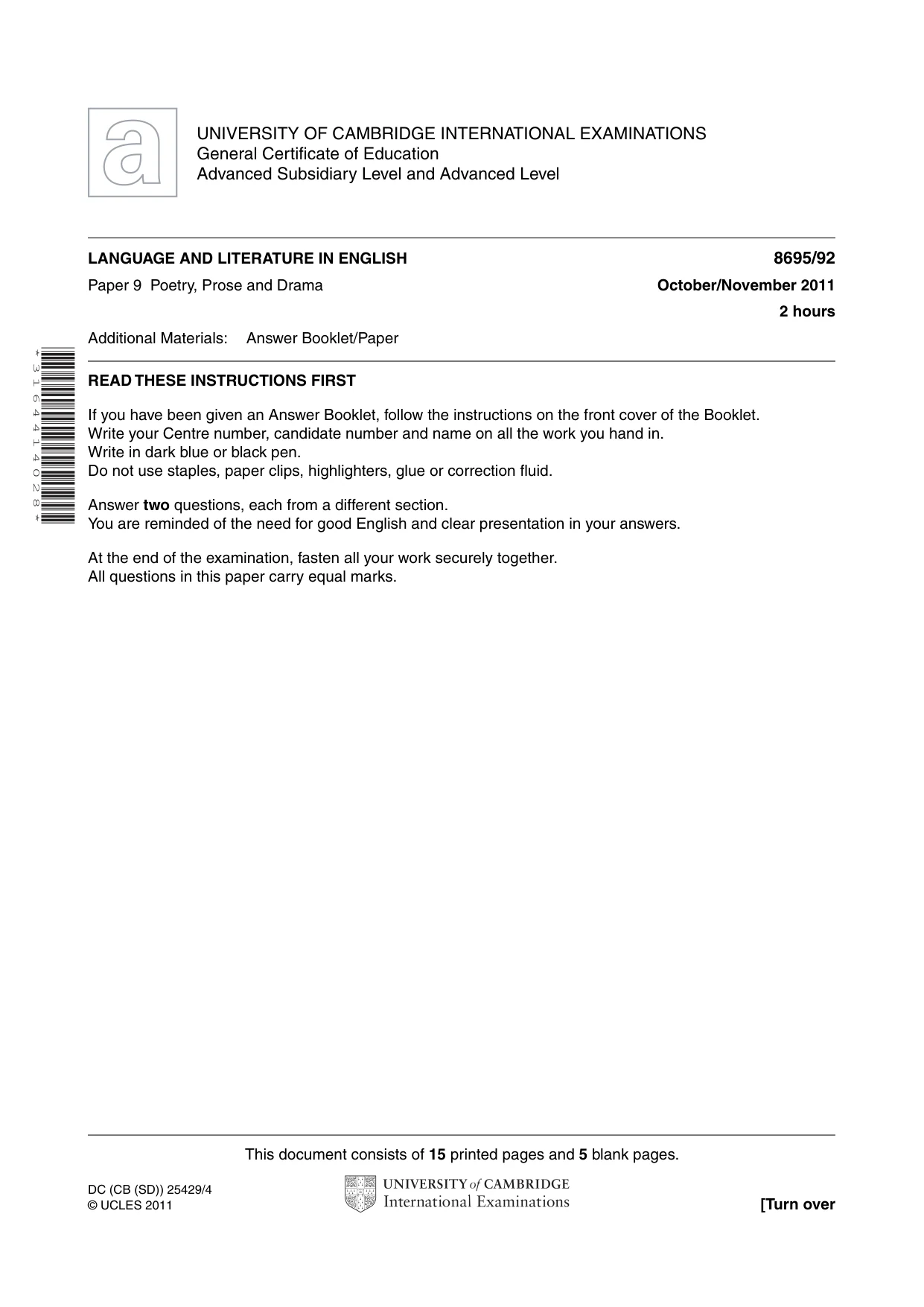
This document consists of 15 printed pages and 5 blank pages. DC (CB (SD)) 25429/4 © UCLES 2011 [Turn over UNIVERSITY OF CAMBRIDGE INTERNATIONAL EXAMINATIONS General Certificate of Education Advanced Subsidiary Level and Advanced Level * 3 1 6 4 4 1 4 0 2 8 * LANGUAGE AND LITERATURE IN ENGLISH 8695/92 Paper 9 Poetry, Prose and Drama October/November 2011 2 hours Additional Materials: Answer Booklet/Paper READ THESE INSTRUCTIONS FIRST If you have been given an Answer Booklet, follow the instructions on the front cover of the Booklet. Write your Centre number, candidate number and name on all the work you hand in. Write in dark blue or black pen. Do not use staples, paper clips, highlighters, glue or correction fluid. Answer two questions, each from a different section. You are reminded of the need for good English and clear presentation in your answers. At the end of the examination, fasten all your work securely together. All questions in this paper carry equal marks.
Question paper, page 2
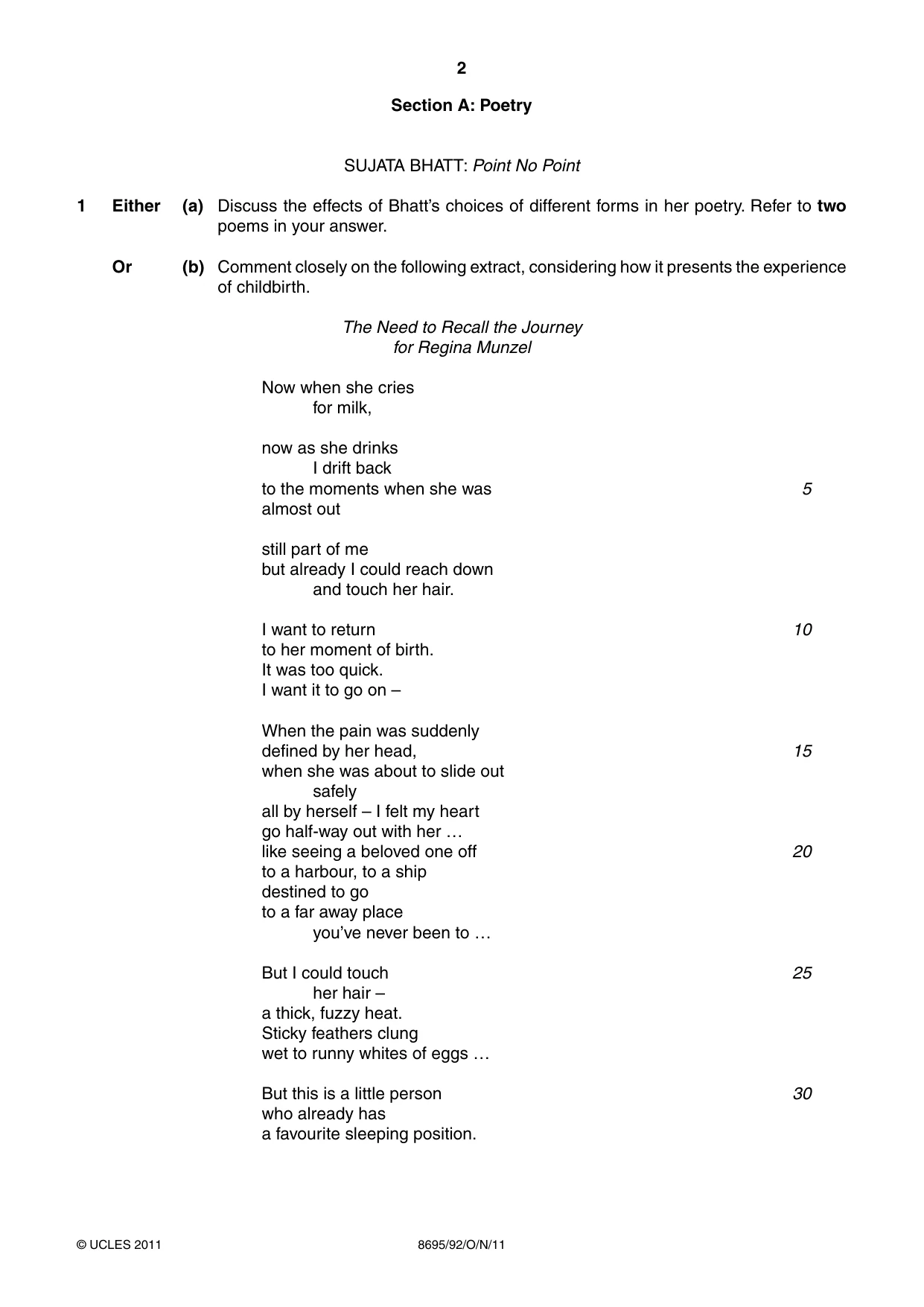
2 8695/92/O/N/11 © UCLES 2011 Section A: Poetry SUJATA BHATT: Point No Point 1 Either (a) Discuss the effects of Bhatt’s choices of different forms in her poetry. Refer to two poems in your answer. Or (b) Comment closely on the following extract, considering how it presents the experience of childbirth. The Need to Recall the Journey for Regina Munzel Now when she cries for milk, now as she drinks I drift back to the moments when she was 5 almost out still part of me but already I could reach down and touch her hair. I want to return 10 to her moment of birth. It was too quick. I want it to go on – When the pain was suddenly defined by her head, 15 when she was about to slide out safely all by herself – I felt my heart go half-way out with her … like seeing a beloved one off 20 to a harbour, to a ship destined to go to a far away place you’ve never been to … But I could touch 25 her hair – a thick, fuzzy heat. Sticky feathers clung wet to runny whites of eggs … But this is a little person 30 who already has a favourite sleeping position.
Question paper, page 3
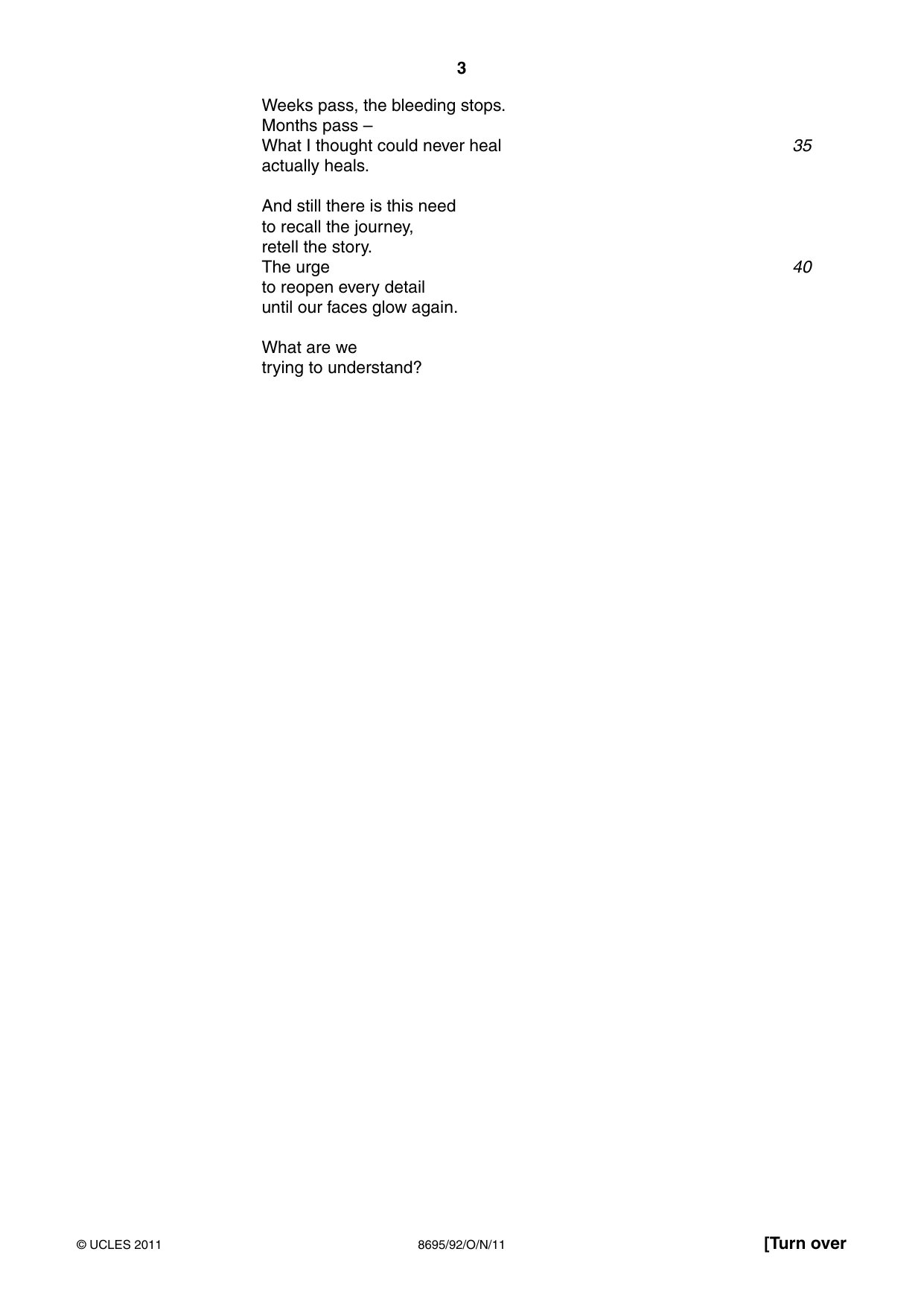
3 8695/92/O/N/11 © UCLES 2011 [Turn over Weeks pass, the bleeding stops. Months pass – What I thought could never heal 35 actually heals. And still there is this need to recall the journey, retell the story. The urge 40 to reopen every detail until our faces glow again. What are we trying to understand?
Question paper, page 4
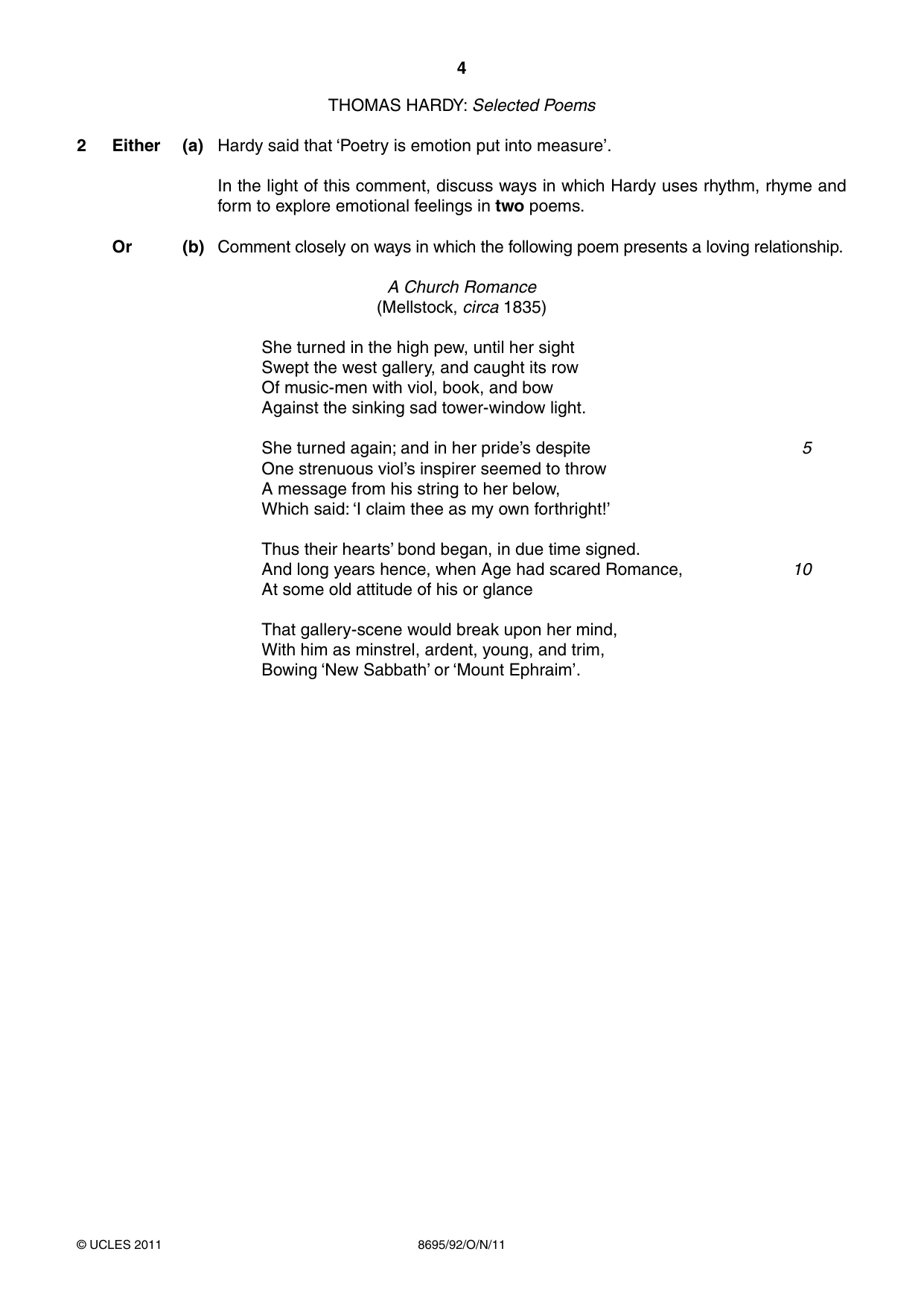
4 8695/92/O/N/11 © UCLES 2011 THOMAS HARDY: Selected Poems 2 Either (a) Hardy said that ‘Poetry is emotion put into measure’. In the light of this comment, discuss ways in which Hardy uses rhythm, rhyme and form to explore emotional feelings in two poems. Or (b) Comment closely on ways in which the following poem presents a loving relationship. A Church Romance (Mellstock, circa 1835) She turned in the high pew, until her sight Swept the west gallery, and caught its row Of music-men with viol, book, and bow Against the sinking sad tower-window light. She turned again; and in her pride’s despite 5 One strenuous viol’s inspirer seemed to throw A message from his string to her below, Which said: ‘I claim thee as my own forthright!’ Thus their hearts’ bond began, in due time signed. And long years hence, when Age had scared Romance, 10 At some old attitude of his or glance That gallery-scene would break upon her mind, With him as minstrel, ardent, young, and trim, Bowing ‘New Sabbath’ or ‘Mount Ephraim’.
Question paper, page 5
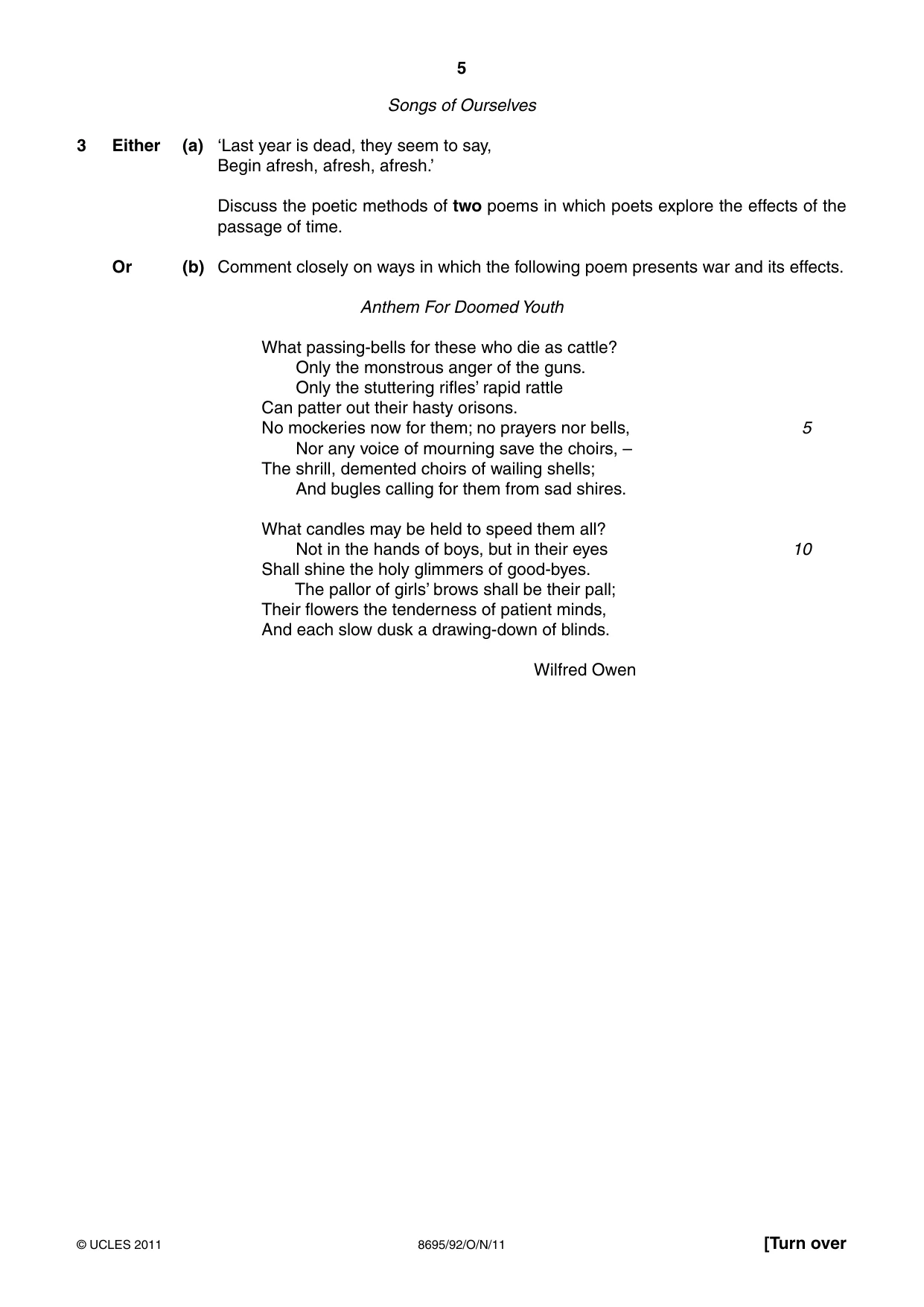
5 8695/92/O/N/11 © UCLES 2011 [Turn over Songs of Ourselves 3 Either (a) ‘Last year is dead, they seem to say, Begin afresh, afresh, afresh.’ Discuss the poetic methods of two poems in which poets explore the effects of the passage of time. Or (b) Comment closely on ways in which the following poem presents war and its effects. Anthem For Doomed Youth What passing-bells for these who die as cattle? Only the monstrous anger of the guns. Only the stuttering rifles’ rapid rattle Can patter out their hasty orisons. No mockeries now for them; no prayers nor bells, 5 Nor any voice of mourning save the choirs, – The shrill, demented choirs of wailing shells; And bugles calling for them from sad shires. What candles may be held to speed them all? Not in the hands of boys, but in their eyes 10 Shall shine the holy glimmers of good-byes. The pallor of girls’ brows shall be their pall; Their flowers the tenderness of patient minds, And each slow dusk a drawing-down of blinds. Wilfred Owen
Question paper, page 6
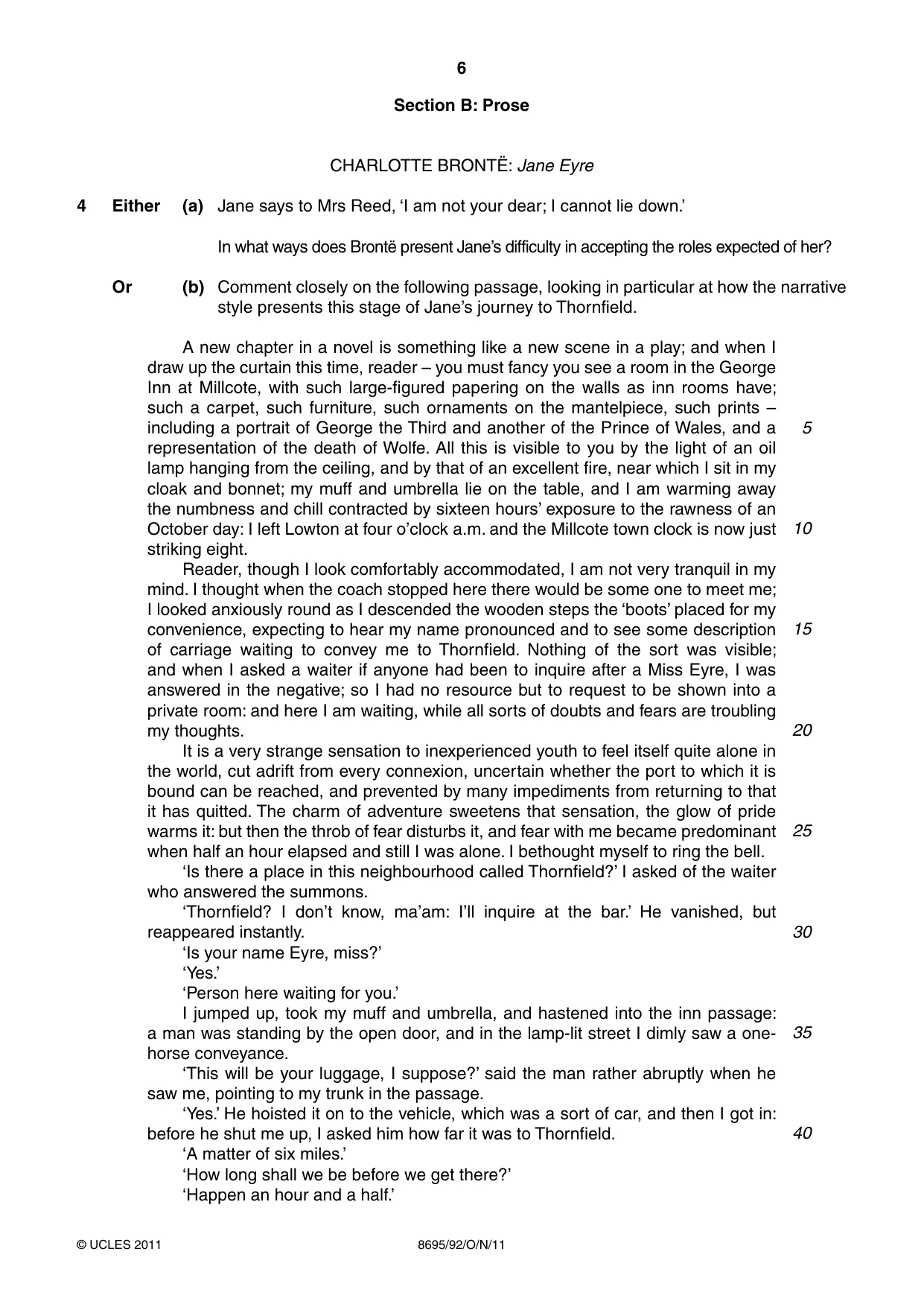
6 8695/92/O/N/11 © UCLES 2011 Section B: Prose CHARLOTTE BRONTË: Jane Eyre 4 Either (a) Jane says to Mrs Reed, ‘I am not your dear; I cannot lie down.’ In what ways does Brontë present Jane’s difficulty in accepting the roles expected of her? Or (b) Comment closely on the following passage, looking in particular at how the narrative style presents this stage of Jane’s journey to Thornfield. A new chapter in a novel is something like a new scene in a play; and when I draw up the curtain this time, reader – you must fancy you see a room in the George Inn at Millcote, with such large-figured papering on the walls as inn rooms have; such a carpet, such furniture, such ornaments on the mantelpiece, such prints – including a portrait of George the Third and another of the Prince of Wales, and a representation of the death of Wolfe. All this is visible to you by the light of an oil lamp hanging from the ceiling, and by that of an excellent fire, near which I sit in my cloak and bonnet; my muff and umbrella lie on the table, and I am warming away the numbness and chill contracted by sixteen hours’ exposure to the rawness of an October day: I left Lowton at four o’clock a.m. and the Millcote town clock is now just striking eight. Reader, though I look comfortably accommodated, I am not very tranquil in my mind. I thought when the coach stopped here there would be some one to meet me; I looked anxiously round as I descended the wooden steps the ‘boots’ placed for my convenience, expecting to hear my name pronounced and to see some description of carriage waiting to convey me to Thornfield. Nothing of the sort was visible; and when I asked a waiter if anyone had been to inquire after a Miss Eyre, I was answered in the negative; so I had no resource but to request to be shown into a private room: and here I am waiting, while all sorts of doubts and fears are troubling my thoughts. It is a very strange sensation to inexperienced youth to feel itself quite alone in the world, cut adrift from every connexion, uncertain whether the port to which it is bound can be reached, and prevented by many impediments from returning to that it has quitted. The charm of adventure sweetens that sensation, the glow of pride warms it: but then the throb of fear disturbs it, and fear with me became predominant when half an hour elapsed and still I was alone. I bethought myself to ring the bell. ‘Is there a place in this neighbourhood called Thornfield?’ I asked of the waiter who answered the summons. ‘Thornfield? I don’t know, ma’am: I’ll inquire at the bar.’ He vanished, but reappeared instantly. ‘Is your name Eyre, miss?’ ‘Yes.’ ‘Person here waiting for you.’ I jumped up, took my muff and umbrella, and hastened into the inn passage: a man was standing by the open door, and in the lamp-lit street I dimly saw a one- horse conveyance. ‘This will be your luggage, I suppose?’ said the man rather abruptly when he saw me, pointing to my trunk in the passage. ‘Yes.’ He hoisted it on to the vehicle, which was a sort of car, and then I got in: before he shut me up, I asked him how far it was to Thornfield. ‘A matter of six miles.’ ‘How long shall we be before we get there?’ ‘Happen an hour and a half.’ 5 10 15 20 25 30 35 40
Question paper, page 7
7 8695/92/O/N/11 © UCLES 2011 [Turn over He fastened the car door, and climbed to his own seat outside, and we set off. Our progress was leisurely, and gave me ample time to reflect: I was content to be at length so near the end of my journey; and as I leaned back in the comfortable though not elegant conveyance, I meditated much at my ease. Chapter 11 45
Question paper, page 8
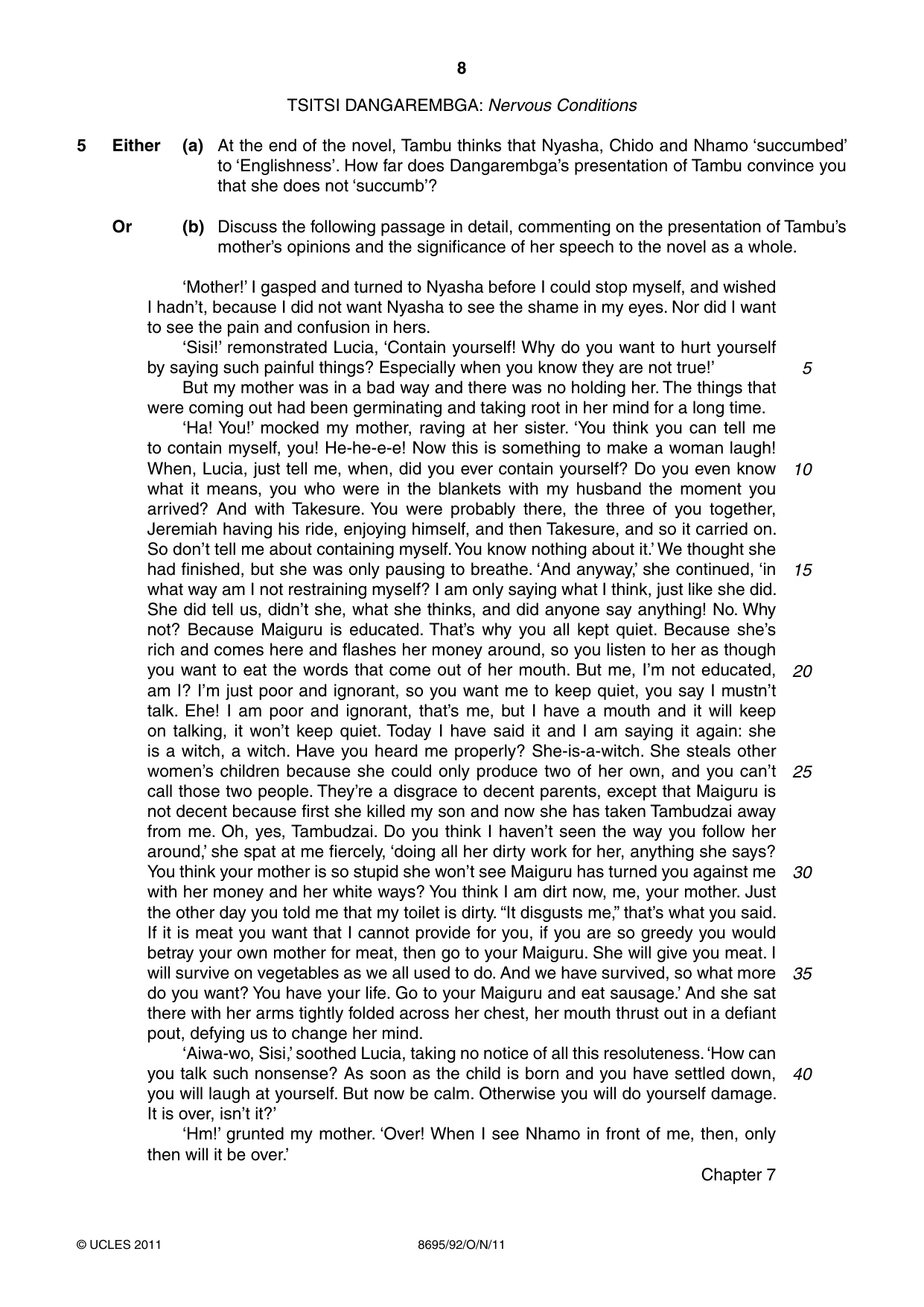
8 8695/92/O/N/11 © UCLES 2011 TSITSI DANGAREMBGA: Nervous Conditions 5 Either (a) At the end of the novel, Tambu thinks that Nyasha, Chido and Nhamo ‘succumbed’ to ‘Englishness’. How far does Dangarembga’s presentation of Tambu convince you that she does not ‘succumb’? Or (b) Discuss the following passage in detail, commenting on the presentation of Tambu’s mother’s opinions and the significance of her speech to the novel as a whole. ‘Mother!’ I gasped and turned to Nyasha before I could stop myself, and wished I hadn’t, because I did not want Nyasha to see the shame in my eyes. Nor did I want to see the pain and confusion in hers. ‘Sisi!’ remonstrated Lucia, ‘Contain yourself! Why do you want to hurt yourself by saying such painful things? Especially when you know they are not true!’ But my mother was in a bad way and there was no holding her. The things that were coming out had been germinating and taking root in her mind for a long time. ‘Ha! You!’ mocked my mother, raving at her sister. ‘You think you can tell me to contain myself, you! He-he-e-e! Now this is something to make a woman laugh! When, Lucia, just tell me, when, did you ever contain yourself? Do you even know what it means, you who were in the blankets with my husband the moment you arrived? And with Takesure. You were probably there, the three of you together, Jeremiah having his ride, enjoying himself, and then Takesure, and so it carried on. So don’t tell me about containing myself. You know nothing about it.’ We thought she had finished, but she was only pausing to breathe. ‘And anyway,’ she continued, ‘in what way am I not restraining myself? I am only saying what I think, just like she did. She did tell us, didn’t she, what she thinks, and did anyone say anything! No. Why not? Because Maiguru is educated. That’s why you all kept quiet. Because she’s rich and comes here and flashes her money around, so you listen to her as though you want to eat the words that come out of her mouth. But me, I’m not educated, am I? I’m just poor and ignorant, so you want me to keep quiet, you say I mustn’t talk. Ehe! I am poor and ignorant, that’s me, but I have a mouth and it will keep on talking, it won’t keep quiet. Today I have said it and I am saying it again: she is a witch, a witch. Have you heard me properly? She-is-a-witch. She steals other women’s children because she could only produce two of her own, and you can’t call those two people. They’re a disgrace to decent parents, except that Maiguru is not decent because first she killed my son and now she has taken Tambudzai away from me. Oh, yes, Tambudzai. Do you think I haven’t seen the way you follow her around,’ she spat at me fiercely, ‘doing all her dirty work for her, anything she says? You think your mother is so stupid she won’t see Maiguru has turned you against me with her money and her white ways? You think I am dirt now, me, your mother. Just the other day you told me that my toilet is dirty. “It disgusts me,” that’s what you said. If it is meat you want that I cannot provide for you, if you are so greedy you would betray your own mother for meat, then go to your Maiguru. She will give you meat. I will survive on vegetables as we all used to do. And we have survived, so what more do you want? You have your life. Go to your Maiguru and eat sausage.’ And she sat there with her arms tightly folded across her chest, her mouth thrust out in a defiant pout, defying us to change her mind. ‘Aiwa-wo, Sisi,’ soothed Lucia, taking no notice of all this resoluteness. ‘How can you talk such nonsense? As soon as the child is born and you have settled down, you will laugh at yourself. But now be calm. Otherwise you will do yourself damage. It is over, isn’t it?’ ‘Hm!’ grunted my mother. ‘Over! When I see Nhamo in front of me, then, only then will it be over.’ Chapter 7 5 10 15 20 25 30 35 40
Question paper, page 9
9 8695/92/O/N/11 © UCLES 2011 [Turn over BLANK PAGE Turn to page 10 for Question 6.
Question paper, page 10
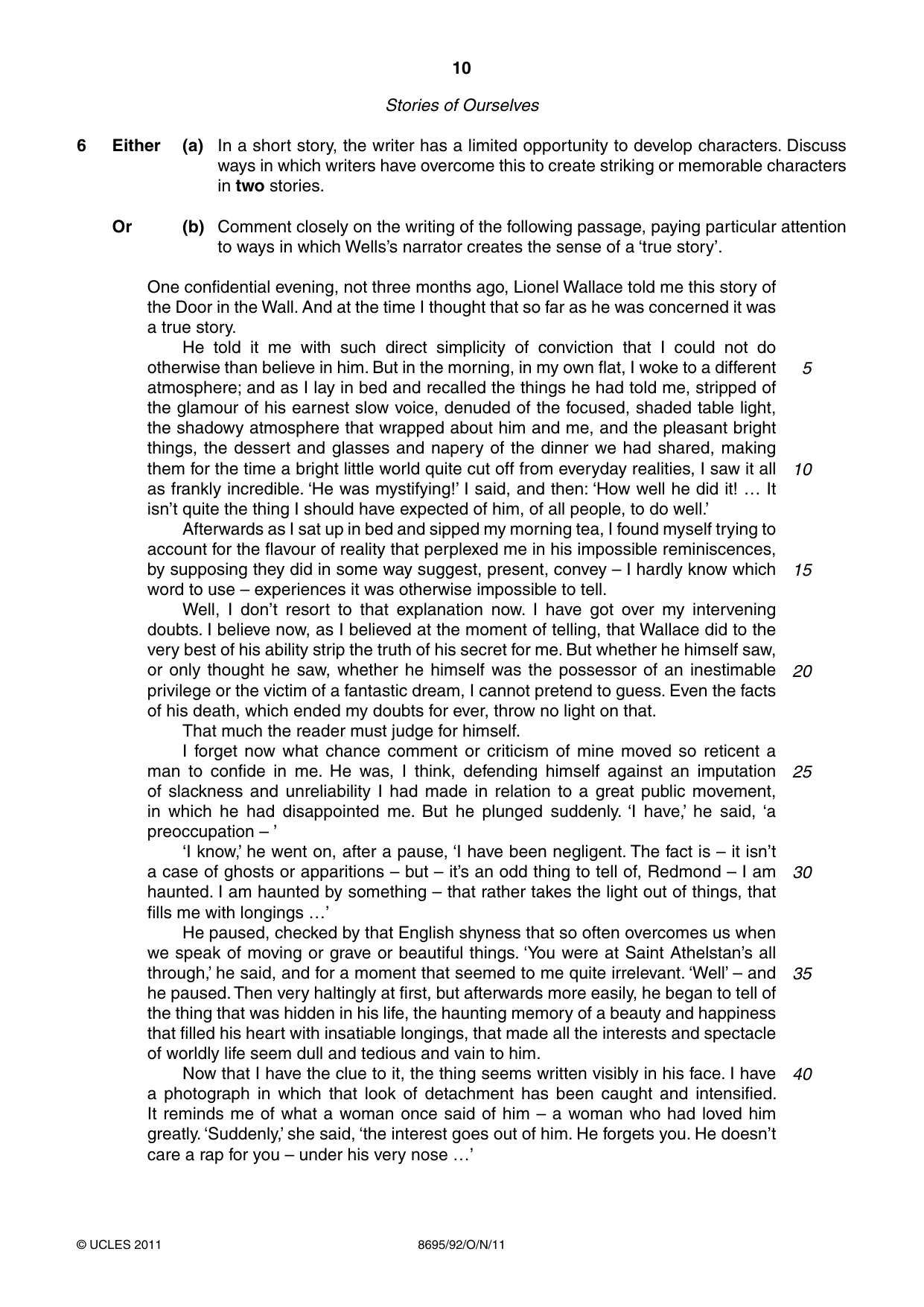
10 8695/92/O/N/11 © UCLES 2011 Stories of Ourselves 6 Either (a) In a short story, the writer has a limited opportunity to develop characters. Discuss ways in which writers have overcome this to create striking or memorable characters in two stories. Or (b) Comment closely on the writing of the following passage, paying particular attention to ways in which Wells’s narrator creates the sense of a ‘true story’. One confidential evening, not three months ago, Lionel Wallace told me this story of the Door in the Wall. And at the time I thought that so far as he was concerned it was a true story. He told it me with such direct simplicity of conviction that I could not do otherwise than believe in him. But in the morning, in my own flat, I woke to a different atmosphere; and as I lay in bed and recalled the things he had told me, stripped of the glamour of his earnest slow voice, denuded of the focused, shaded table light, the shadowy atmosphere that wrapped about him and me, and the pleasant bright things, the dessert and glasses and napery of the dinner we had shared, making them for the time a bright little world quite cut off from everyday realities, I saw it all as frankly incredible. ‘He was mystifying!’ I said, and then: ‘How well he did it! … It isn’t quite the thing I should have expected of him, of all people, to do well.’ Afterwards as I sat up in bed and sipped my morning tea, I found myself trying to account for the flavour of reality that perplexed me in his impossible reminiscences, by supposing they did in some way suggest, present, convey – I hardly know which word to use – experiences it was otherwise impossible to tell. Well, I don’t resort to that explanation now. I have got over my intervening doubts. I believe now, as I believed at the moment of telling, that Wallace did to the very best of his ability strip the truth of his secret for me. But whether he himself saw, or only thought he saw, whether he himself was the possessor of an inestimable privilege or the victim of a fantastic dream, I cannot pretend to guess. Even the facts of his death, which ended my doubts for ever, throw no light on that. That much the reader must judge for himself. I forget now what chance comment or criticism of mine moved so reticent a man to confide in me. He was, I think, defending himself against an imputation of slackness and unreliability I had made in relation to a great public movement, in which he had disappointed me. But he plunged suddenly. ‘I have,’ he said, ‘a preoccupation – ’ ‘I know,’ he went on, after a pause, ‘I have been negligent. The fact is – it isn’t a case of ghosts or apparitions – but – it’s an odd thing to tell of, Redmond – I am haunted. I am haunted by something – that rather takes the light out of things, that fills me with longings …’ He paused, checked by that English shyness that so often overcomes us when we speak of moving or grave or beautiful things. ‘You were at Saint Athelstan’s all through,’ he said, and for a moment that seemed to me quite irrelevant. ‘Well’ – and he paused. Then very haltingly at first, but afterwards more easily, he began to tell of the thing that was hidden in his life, the haunting memory of a beauty and happiness that filled his heart with insatiable longings, that made all the interests and spectacle of worldly life seem dull and tedious and vain to him. Now that I have the clue to it, the thing seems written visibly in his face. I have a photograph in which that look of detachment has been caught and intensified. It reminds me of what a woman once said of him – a woman who had loved him greatly. ‘Suddenly,’ she said, ‘the interest goes out of him. He forgets you. He doesn’t care a rap for you – under his very nose …’ 5 10 15 20 25 30 35 40
Question paper, page 11
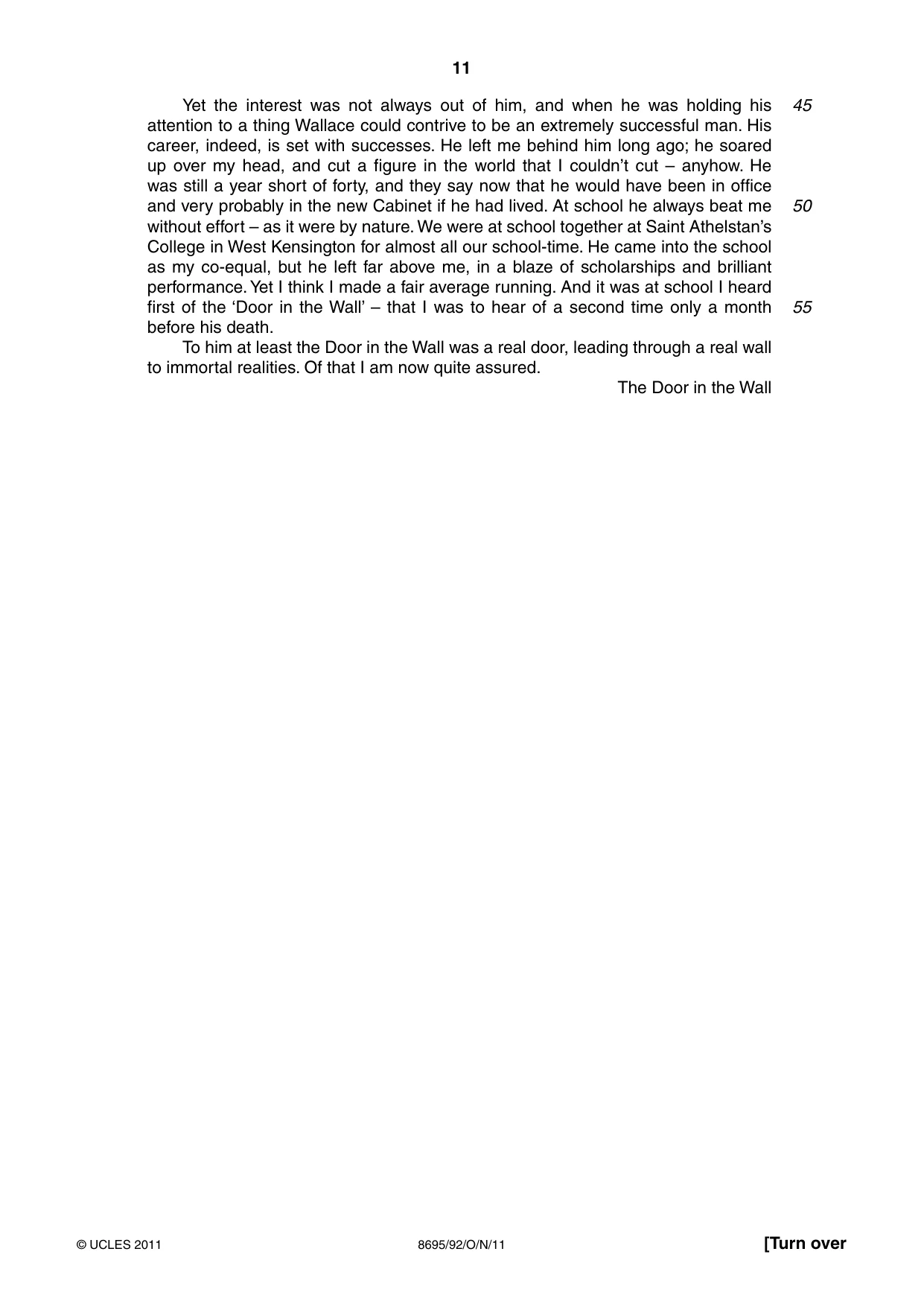
11 8695/92/O/N/11 © UCLES 2011 [Turn over Yet the interest was not always out of him, and when he was holding his attention to a thing Wallace could contrive to be an extremely successful man. His career, indeed, is set with successes. He left me behind him long ago; he soared up over my head, and cut a figure in the world that I couldn’t cut – anyhow. He was still a year short of forty, and they say now that he would have been in office and very probably in the new Cabinet if he had lived. At school he always beat me without effort – as it were by nature. We were at school together at Saint Athelstan’s College in West Kensington for almost all our school-time. He came into the school as my co-equal, but he left far above me, in a blaze of scholarships and brilliant performance. Yet I think I made a fair average running. And it was at school I heard first of the ‘Door in the Wall’ – that I was to hear of a second time only a month before his death. To him at least the Door in the Wall was a real door, leading through a real wall to immortal realities. Of that I am now quite assured. The Door in the Wall 45 50 55
Question paper, page 12
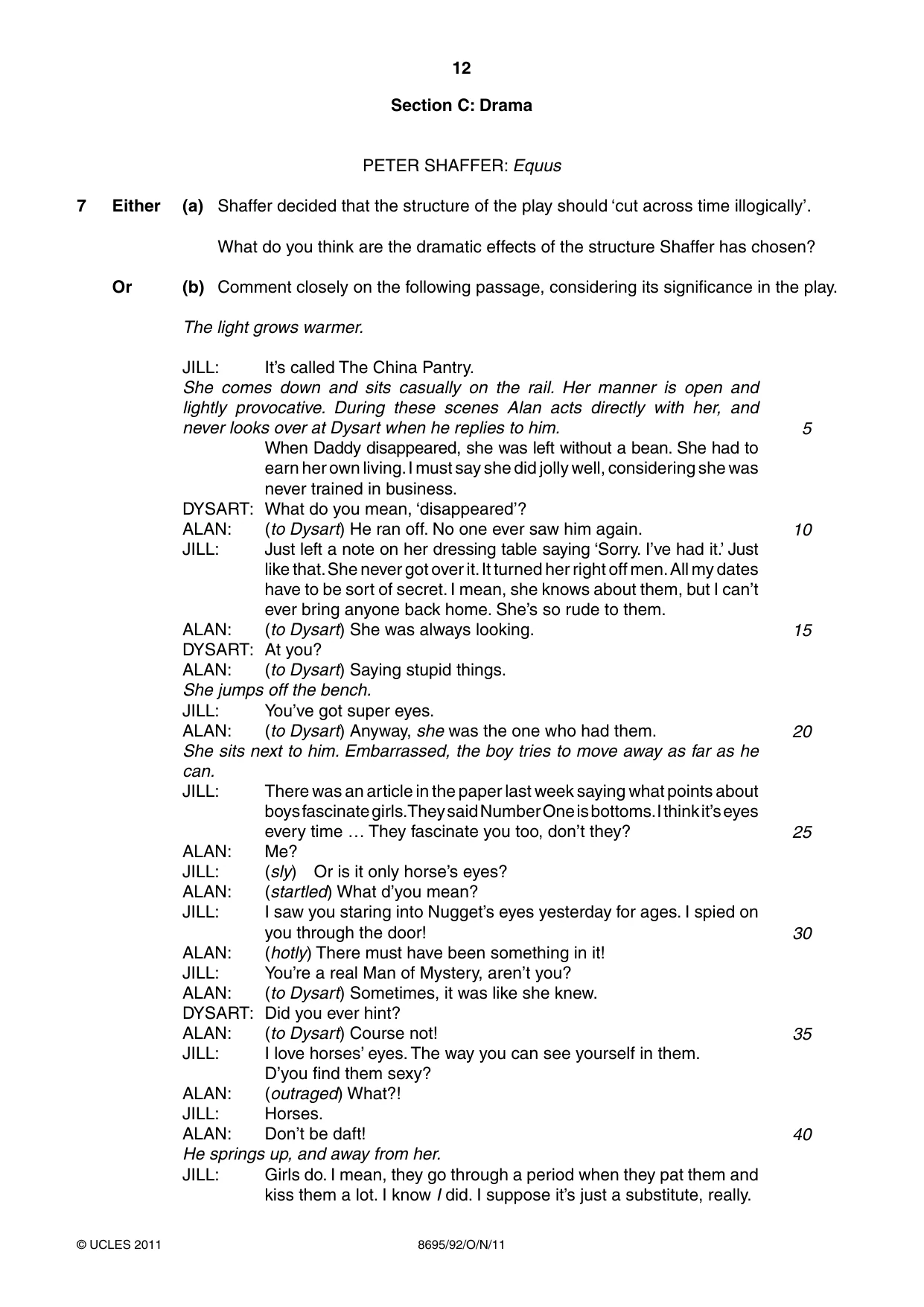
12 8695/92/O/N/11 © UCLES 2011 Section C: Drama PETER SHAFFER: Equus 7 Either (a) Shaffer decided that the structure of the play should ‘cut across time illogically’. What do you think are the dramatic effects of the structure Shaffer has chosen? Or (b) Comment closely on the following passage, considering its significance in the play. The light grows warmer. JILL: It’s called The China Pantry. She comes down and sits casually on the rail. Her manner is open and lightly provocative. During these scenes Alan acts directly with her, and never looks over at Dysart when he replies to him. When Daddy disappeared, she was left without a bean. She had to earn her own living. I must say she did jolly well, considering she was never trained in business. DYSART: What do you mean, ‘disappeared’? ALAN: (to Dysart) He ran off. No one ever saw him again. JILL: Just left a note on her dressing table saying ‘Sorry. I’ve had it.’ Just like that. She never got over it. It turned her right off men. All my dates have to be sort of secret. I mean, she knows about them, but I can’t ever bring anyone back home. She’s so rude to them. ALAN: (to Dysart) She was always looking. DYSART: At you? ALAN: (to Dysart) Saying stupid things. She jumps off the bench. JILL: You’ve got super eyes. ALAN: (to Dysart) Anyway, she was the one who had them. She sits next to him. Embarrassed, the boy tries to move away as far as he can. JILL: There was an article in the paper last week saying what points about boys fascinate girls. They said Number One is bottoms. I think it’s eyes every time … They fascinate you too, don’t they? ALAN: Me? JILL: (sly) Or is it only horse’s eyes? ALAN: (startled) What d’you mean? JILL: I saw you staring into Nugget’s eyes yesterday for ages. I spied on you through the door! ALAN: (hotly) There must have been something in it! JILL: You’re a real Man of Mystery, aren’t you? ALAN: (to Dysart) Sometimes, it was like she knew. DYSART: Did you ever hint? ALAN: (to Dysart) Course not! JILL: I love horses’ eyes. The way you can see yourself in them. D’you find them sexy? ALAN: (outraged) What?! JILL: Horses. ALAN: Don’t be daft! He springs up, and away from her. JILL: Girls do. I mean, they go through a period when they pat them and kiss them a lot. I know I did. I suppose it’s just a substitute, really. 5 10 15 20 25 30 35 40
Question paper, page 13
13 8695/92/O/N/11 © UCLES 2011 [Turn over ALAN: (to Dysart) That kind of thing, all the time. Until one night … DYSART: Yes? What? ALAN: (to Dysart: defensively) She did it! Not me. It was her idea, the whole thing! … She got me into it! DYSART: What are you saying? ‘One night’: go on from there. A pause. ALAN: (to Dysart) Saturday night. We were just closing up. JILL: How would you like to take me out? ALAN: What? JILL: (coolly) How would you like to take me out tonight? ALAN: I’ve got to go home. JILL: What for? He tries to escape upstage. ALAN: They expect me. JILL: Ring up and say you’re going out. ALAN: I can’t. JILL: Why? ALAN: They expect me. JILL: Look. Either we go out together and have some fun, or you go back to your boring home, as usual, and I go back to mine. That’s the situation, isn’t it? ALAN: Well … where would we go? JILL: The pictures! There’s a skinflick over in Winchester! I’ve never seen one, have you? ALAN: No. JILL: Wouldn’t you like to? I would. Act 2, Scene 28 45 50 55 60 65
Question paper, page 14
14 8695/92/O/N/11 © UCLES 2011 WILLIAM SHAKESPEARE: Henry IV Part 1 8 Either (a) King Henry compares Hotspur, ‘the theme of honour’s tongue’, with his own son, on whom he sees stains of ‘riot and dishonour’. How does Shakespeare develop this contrast between Hotspur and Prince Henry in the play? Or (b) Comment closely on the following passage, focusing on ways in which Shakespeare creates the comedy of the scene. Enter Sheriff and the Carrier. PRINCE: Now, master sheriff, what is your will with me? SHERIFF: First, pardon me, my lord. A hue and cry Hath followed certain men unto this house. PRINCE: What men? SHERIFF: One of them is well known, my gracious lord – A gross fat man. CARRIER: As fat as butter. PRINCE: The man, I do assure you, is not here, For I myself at this time have employ’d him, And, sheriff, I will engage my word to thee That I will, by to-morrow dinner-time, Send him to answer thee, or any man, For any thing he shall be charg’d withal; And so let me entreat you leave the house. SHERIFF: I will, my lord. There are two gentlemen Have in this robbery lost three hundred marks. PRINCE: It may be so; if he have robb’d these men He shall be answerable; and so, farewell. SHERIFF: Good night, my noble lord. PRINCE: I think it is good morrow, is it not? SHERIFF: Indeed, my lord, I think it be two o’clock. [Exeunt Sheriff and Carrier. PRINCE: This oily rascal is known as well as Paul’s. Go, call him forth. PETO: Falstaff! Fast asleep behind the arras, and snorting like a horse. PRINCE: Hark how hard he fetches breath. Search his pockets. [He searcheth his pocket, and findeth certain papers] What hast thou found? PETO: Nothing but papers, my lord. PRINCE: Let’s see what they be: read them. PETO: [Reads] Item, A capon . . . . . . . . . . . . . . . . . . . . . . 2s. 2d. Item, Sauce . . . . . . . . . . . . . . . . . . . . . . . . . . 4d. Item, Sack, two gallons . . . . . . . . . . . . . . 5s. 8d. Item, Anchovies and sack after supper . . 2s. 6d. Item, Bread . . . . . . . . . . . . . . . . . . . . . . . . . . ob. PRINCE: O monstrous! but one halfpenny-worth of bread to this intolerable deal of sack! What there is else, keep close; we’ll read it at more advantage. There let him sleep till day. I’ll to the court in the morning. We must all to the wars, and thy place shall be honourable. I’ll procure this fat rogue a charge of foot; and I know his death will be a march of twelve-score. The money shall be paid back again with advantage. Be with me betimes in the morning; and so, good morrow, Peto. Act 2, Scene 4 5 10 15 20 25 30 35 40
Question paper, page 15
15 8695/92/O/N/11 © UCLES 2011 [Turn over BLANK PAGE Turn to page 16 for Question 9.
Question paper, page 16
16 8695/92/O/N/11 © UCLES 2011 TENNESSEE WILLIAMS: A Streetcar Named Desire 9 Either (a) How far does Williams’s characterisation of Blanche invite you to feel sympathy for her? Or (b) Comment closely on the language and action of the following passage, discussing its significance to the play. STANLEY: Well, what do you think of it? Content removed due to copyright restrictions. STELLA: I said, Is Mitch through with her? Scene 7
Question paper, page 17
20 8695/92/O/N/11 © UCLES 2011 Copyright Acknowledgements: Question 1b © Sujata Bhatt; Point No Point; Carcanet Press; 1997. Question 5b © Tsitsi Dangarembga; Nervous Conditions; Ayesia Clarke Publishing; 2004. Question 7b © Peter Shaffer; Equus; Penguin Books Ltd; 1977. Question 9b © Tennessee Williams; A Streetcar Named Desire; Penguin; 1983. Permission to reproduce items where third-party owned material protected by copyright is included has been sought and cleared where possible. Every reasonable effort has been made by the publisher (UCLES) to trace copyright holders, but if any items requiring clearance have unwittingly been included, the publisher will be pleased to make amends at the earliest possible opportunity. University of Cambridge International Examinations is part of the Cambridge Assessment Group. Cambridge Assessment is the brand name of University of Cambridge Local Examinations Syndicate (UCLES), which is itself a department of the University of Cambridge. BLANK PAGE
Mark scheme, page 1
UNIVERSITY OF CAMBRIDGE INTERNATIONAL EXAMINATIONS GCE Advanced Subsidiary Level and GCE Advanced Level MARK SCHEME for the October/November 2011 question paper for the guidance of teachers 8695 LANGUAGE AND LITERATURE IN ENGLISH 8695/92 Paper 9 (Poetry, Prose, Drama), maximum raw mark 50 This mark scheme is published as an aid to teachers and candidates, to indicate the requirements of the examination. It shows the basis on which Examiners were instructed to award marks. It does not indicate the details of the discussions that took place at an Examiners’ meeting before marking began, which would have considered the acceptability of alternative answers. Mark schemes must be read in conjunction with the question papers and the report on the examination. • Cambridge will not enter into discussions or correspondence in connection with these mark schemes. Cambridge is publishing the mark schemes for the October/November 2011 question papers for most IGCSE, GCE Advanced Level and Advanced Subsidiary Level syllabuses and some Ordinary Level syllabuses.
Mark scheme, page 2
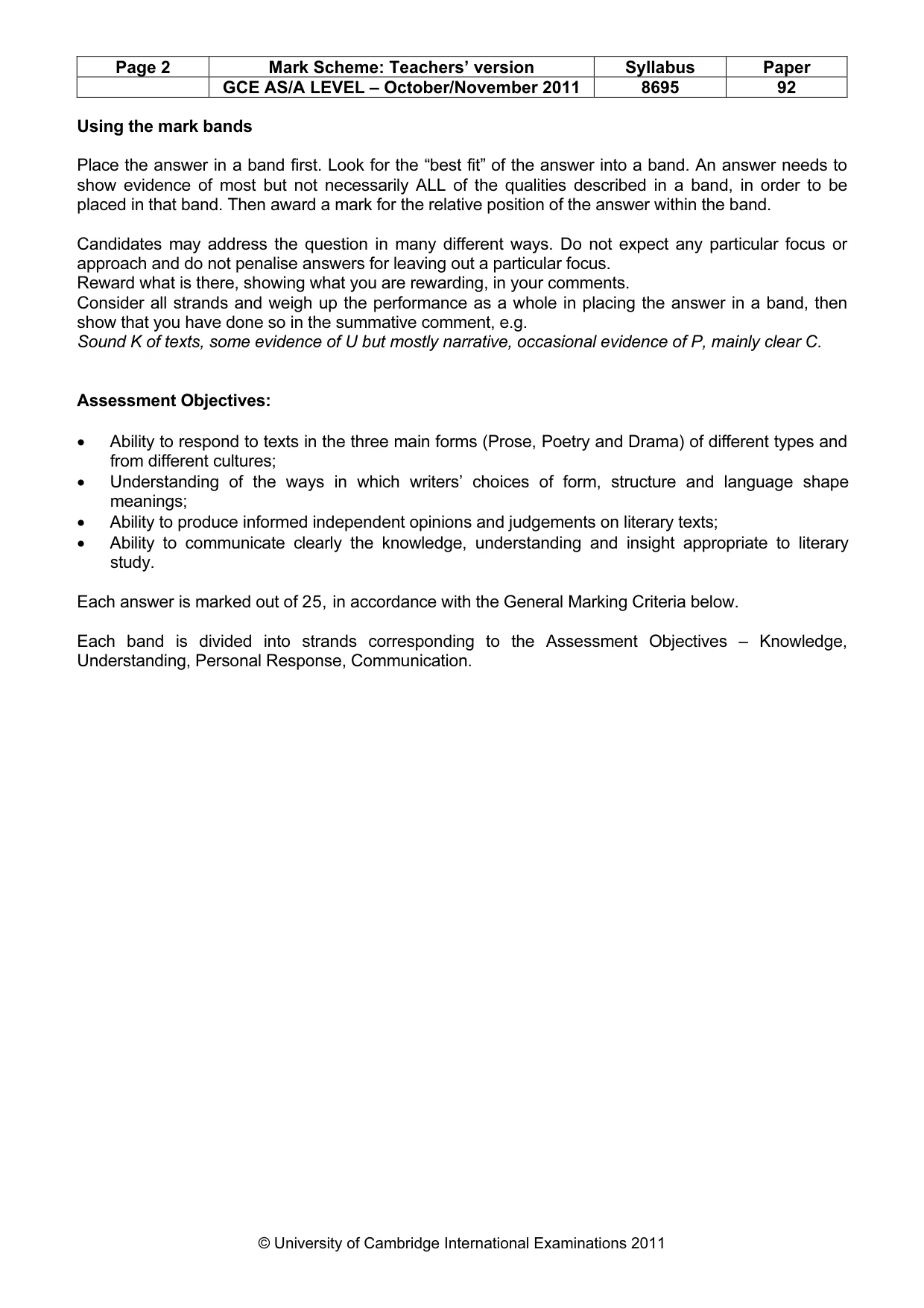
Page 2 Mark Scheme: Teachers’ version Syllabus Paper GCE AS/A LEVEL – October/November 2011 8695 92 © University of Cambridge International Examinations 2011 Using the mark bands Place the answer in a band first. Look for the “best fit” of the answer into a band. An answer needs to show evidence of most but not necessarily ALL of the qualities described in a band, in order to be placed in that band. Then award a mark for the relative position of the answer within the band. Candidates may address the question in many different ways. Do not expect any particular focus or approach and do not penalise answers for leaving out a particular focus. Reward what is there, showing what you are rewarding, in your comments. Consider all strands and weigh up the performance as a whole in placing the answer in a band, then show that you have done so in the summative comment, e.g. Sound K of texts, some evidence of U but mostly narrative, occasional evidence of P, mainly clear C. Assessment Objectives: • Ability to respond to texts in the three main forms (Prose, Poetry and Drama) of different types and from different cultures; • Understanding of the ways in which writers’ choices of form, structure and language shape meanings; • Ability to produce informed independent opinions and judgements on literary texts; • Ability to communicate clearly the knowledge, understanding and insight appropriate to literary study. Each answer is marked out of 25, in accordance with the General Marking Criteria below. Each band is divided into strands corresponding to the Assessment Objectives – Knowledge, Understanding, Personal Response, Communication.
Mark scheme, page 3
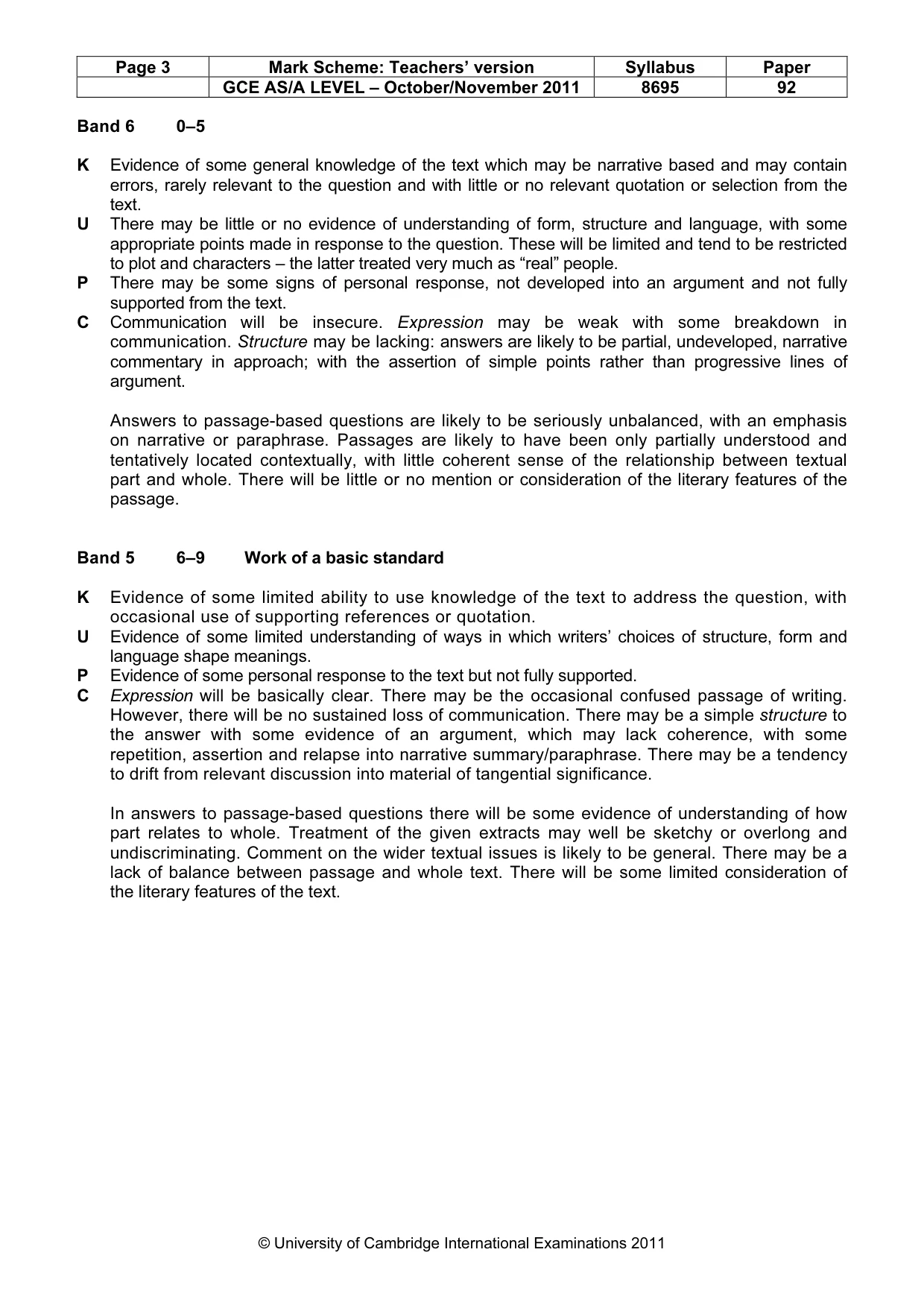
Page 3 Mark Scheme: Teachers’ version Syllabus Paper GCE AS/A LEVEL – October/November 2011 8695 92 © University of Cambridge International Examinations 2011 Band 6 0–5 K Evidence of some general knowledge of the text which may be narrative based and may contain errors, rarely relevant to the question and with little or no relevant quotation or selection from the text. U There may be little or no evidence of understanding of form, structure and language, with some appropriate points made in response to the question. These will be limited and tend to be restricted to plot and characters – the latter treated very much as “real” people. P There may be some signs of personal response, not developed into an argument and not fully supported from the text. C Communication will be insecure. Expression may be weak with some breakdown in communication. Structure may be lacking: answers are likely to be partial, undeveloped, narrative commentary in approach; with the assertion of simple points rather than progressive lines of argument. Answers to passage-based questions are likely to be seriously unbalanced, with an emphasis on narrative or paraphrase. Passages are likely to have been only partially understood and tentatively located contextually, with little coherent sense of the relationship between textual part and whole. There will be little or no mention or consideration of the literary features of the passage. Band 5 6–9 Work of a basic standard K Evidence of some limited ability to use knowledge of the text to address the question, with occasional use of supporting references or quotation. U Evidence of some limited understanding of ways in which writers’ choices of structure, form and language shape meanings. P Evidence of some personal response to the text but not fully supported. C Expression will be basically clear. There may be the occasional confused passage of writing. However, there will be no sustained loss of communication. There may be a simple structure to the answer with some evidence of an argument, which may lack coherence, with some repetition, assertion and relapse into narrative summary/paraphrase. There may be a tendency to drift from relevant discussion into material of tangential significance. In answers to passage-based questions there will be some evidence of understanding of how part relates to whole. Treatment of the given extracts may well be sketchy or overlong and undiscriminating. Comment on the wider textual issues is likely to be general. There may be a lack of balance between passage and whole text. There will be some limited consideration of the literary features of the text.
Mark scheme, page 4
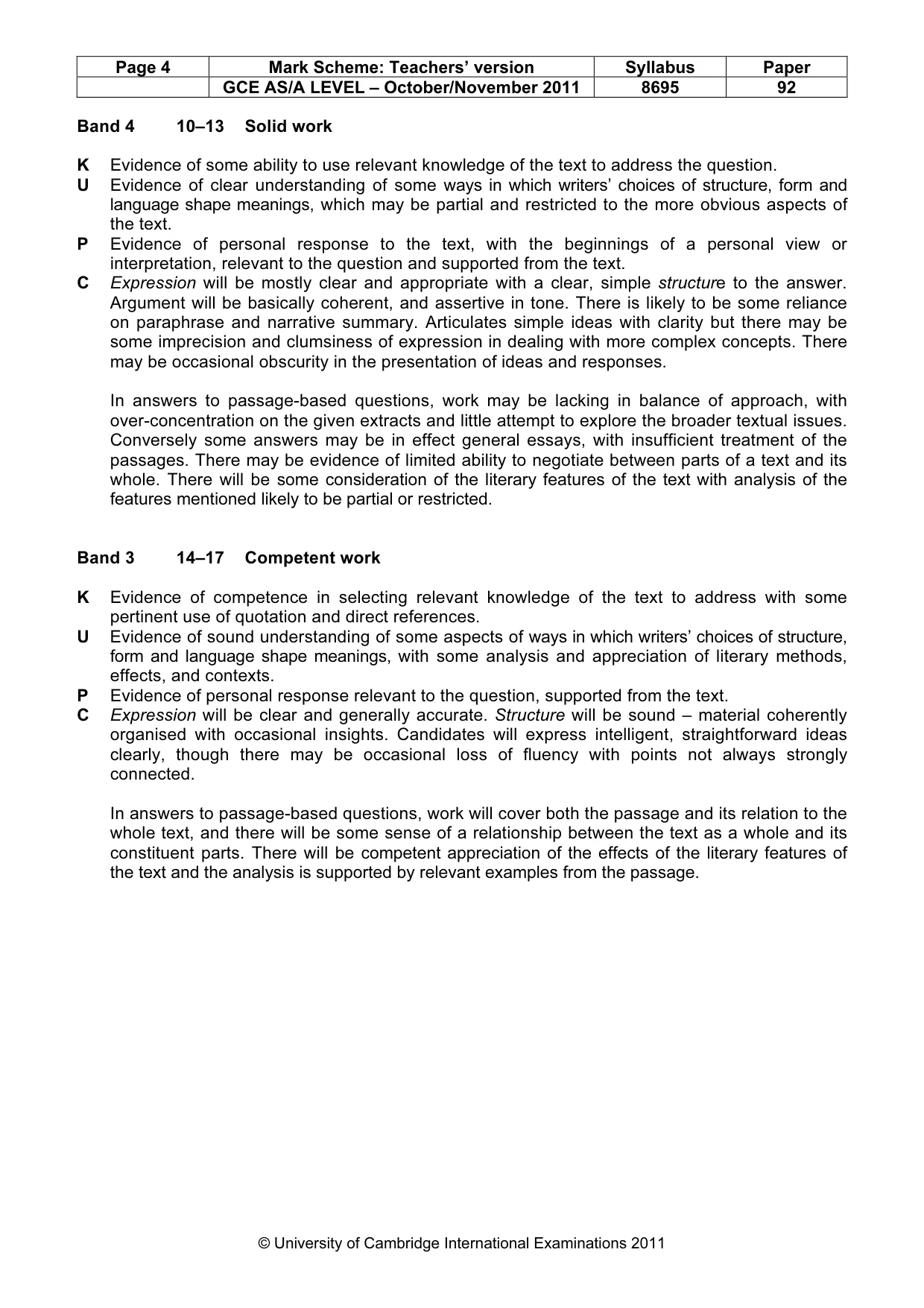
Page 4 Mark Scheme: Teachers’ version Syllabus Paper GCE AS/A LEVEL – October/November 2011 8695 92 © University of Cambridge International Examinations 2011 Band 4 10–13 Solid work K Evidence of some ability to use relevant knowledge of the text to address the question. U Evidence of clear understanding of some ways in which writers’ choices of structure, form and language shape meanings, which may be partial and restricted to the more obvious aspects of the text. P Evidence of personal response to the text, with the beginnings of a personal view or interpretation, relevant to the question and supported from the text. C Expression will be mostly clear and appropriate with a clear, simple structure to the answer. Argument will be basically coherent, and assertive in tone. There is likely to be some reliance on paraphrase and narrative summary. Articulates simple ideas with clarity but there may be some imprecision and clumsiness of expression in dealing with more complex concepts. There may be occasional obscurity in the presentation of ideas and responses. In answers to passage-based questions, work may be lacking in balance of approach, with over-concentration on the given extracts and little attempt to explore the broader textual issues. Conversely some answers may be in effect general essays, with insufficient treatment of the passages. There may be evidence of limited ability to negotiate between parts of a text and its whole. There will be some consideration of the literary features of the text with analysis of the features mentioned likely to be partial or restricted. Band 3 14–17 Competent work K Evidence of competence in selecting relevant knowledge of the text to address with some pertinent use of quotation and direct references. U Evidence of sound understanding of some aspects of ways in which writers’ choices of structure, form and language shape meanings, with some analysis and appreciation of literary methods, effects, and contexts. P Evidence of personal response relevant to the question, supported from the text. C Expression will be clear and generally accurate. Structure will be sound – material coherently organised with occasional insights. Candidates will express intelligent, straightforward ideas clearly, though there may be occasional loss of fluency with points not always strongly connected. In answers to passage-based questions, work will cover both the passage and its relation to the whole text, and there will be some sense of a relationship between the text as a whole and its constituent parts. There will be competent appreciation of the effects of the literary features of the text and the analysis is supported by relevant examples from the passage.
Mark scheme, page 5
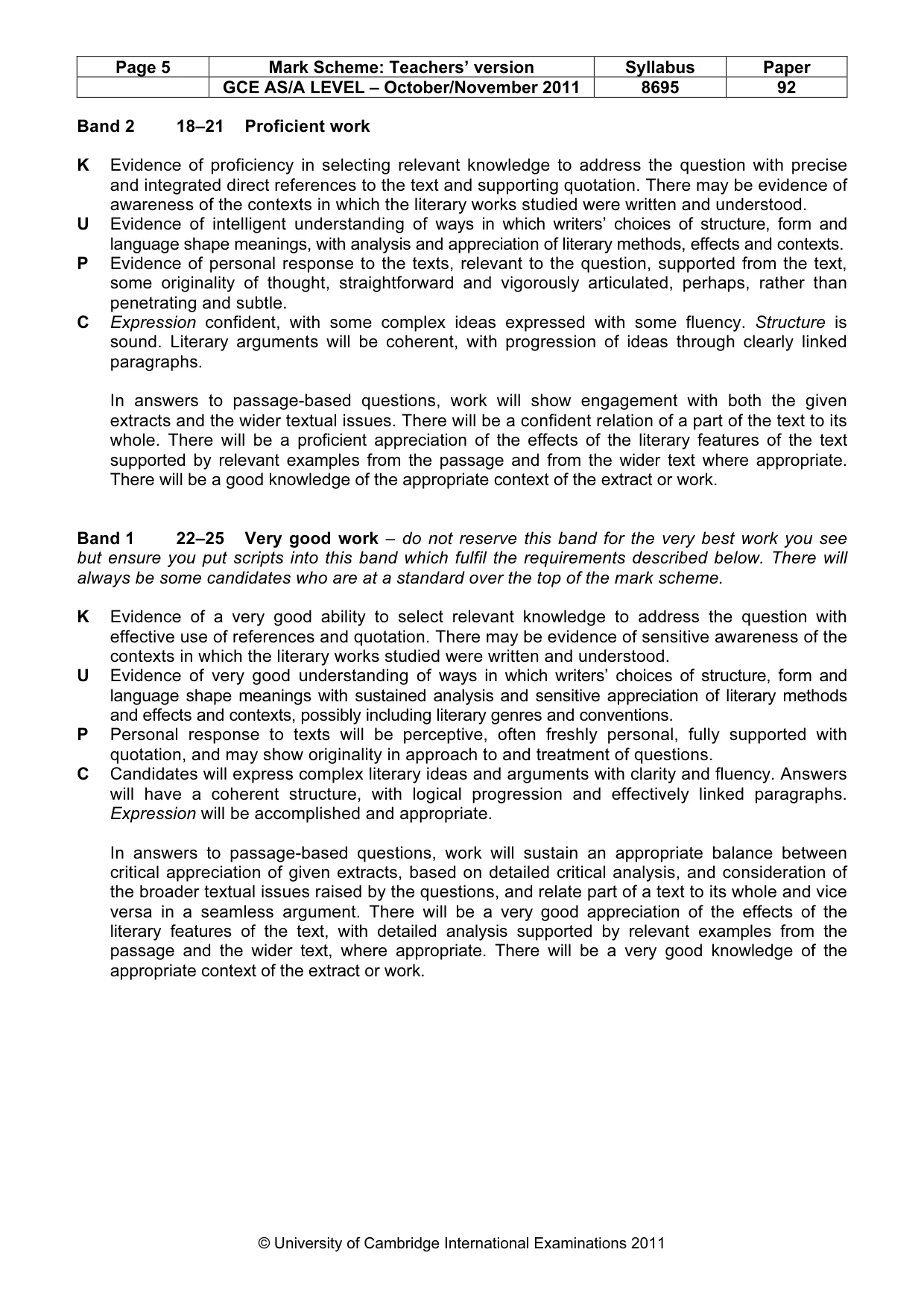
Page 5 Mark Scheme: Teachers’ version Syllabus Paper GCE AS/A LEVEL – October/November 2011 8695 92 © University of Cambridge International Examinations 2011 Band 2 18–21 Proficient work K Evidence of proficiency in selecting relevant knowledge to address the question with precise and integrated direct references to the text and supporting quotation. There may be evidence of awareness of the contexts in which the literary works studied were written and understood. U Evidence of intelligent understanding of ways in which writers’ choices of structure, form and language shape meanings, with analysis and appreciation of literary methods, effects and contexts. P Evidence of personal response to the texts, relevant to the question, supported from the text, some originality of thought, straightforward and vigorously articulated, perhaps, rather than penetrating and subtle. C Expression confident, with some complex ideas expressed with some fluency. Structure is sound. Literary arguments will be coherent, with progression of ideas through clearly linked paragraphs. In answers to passage-based questions, work will show engagement with both the given extracts and the wider textual issues. There will be a confident relation of a part of the text to its whole. There will be a proficient appreciation of the effects of the literary features of the text supported by relevant examples from the passage and from the wider text where appropriate. There will be a good knowledge of the appropriate context of the extract or work. Band 1 22–25 Very good work – do not reserve this band for the very best work you see but ensure you put scripts into this band which fulfil the requirements described below. There will always be some candidates who are at a standard over the top of the mark scheme. K Evidence of a very good ability to select relevant knowledge to address the question with effective use of references and quotation. There may be evidence of sensitive awareness of the contexts in which the literary works studied were written and understood. U Evidence of very good understanding of ways in which writers’ choices of structure, form and language shape meanings with sustained analysis and sensitive appreciation of literary methods and effects and contexts, possibly including literary genres and conventions. P Personal response to texts will be perceptive, often freshly personal, fully supported with quotation, and may show originality in approach to and treatment of questions. C Candidates will express complex literary ideas and arguments with clarity and fluency. Answers will have a coherent structure, with logical progression and effectively linked paragraphs. Expression will be accomplished and appropriate. In answers to passage-based questions, work will sustain an appropriate balance between critical appreciation of given extracts, based on detailed critical analysis, and consideration of the broader textual issues raised by the questions, and relate part of a text to its whole and vice versa in a seamless argument. There will be a very good appreciation of the effects of the literary features of the text, with detailed analysis supported by relevant examples from the passage and the wider text, where appropriate. There will be a very good knowledge of the appropriate context of the extract or work.
What you needed in this session
Cambridge’s own grade thresholds for 2011 Oct/Nov, Paper 9 · Variant 2. A higher threshold means an easier paper — the bar moves with how the cohort did.