Cambridge A Level English - Language and Literature (AS Level only, from 2016) 8695 — 2010 Oct/Nov Paper 9 · Variant 2
8695/92/O/N/10 · 50 marks · ≈56 min
The question paper and its mark scheme, free to read here and free to download. This is Cambridge’s own paper, exactly as it was sat.
Question paper16 pages
Mark scheme5 pages
Answers below. Sit the paper first if you are practising.
Paper as text
Question paper, page 1
This document consists of 16 printed pages. DC (SM) 22050/2 © UCLES 2010 [Turn over UNIVERSITY OF CAMBRIDGE INTERNATIONAL EXAMINATIONS General Certificate of Education Advanced Subsidiary Level and Advanced Level READ THESE INSTRUCTIONS FIRST If you have been given an Answer Booklet, follow the instructions on the front cover of the Booklet. Write your Centre number, candidate number and name on all the work you hand in. Write in dark blue or black pen. Do not use staples, paper clips, highlighters, glue or correction fluid. Answer two questions, each from a different section. You are reminded of the need for good English and clear presentation in your answers. At the end of the examination, fasten all your work securely together. All questions in this paper carry equal marks. * 5 4 3 8 0 6 2 8 2 0 * LANGUAGE AND LITERATURE IN ENGLISH 8695/92 Paper 9 Poetry, Prose and Drama October/November 2010 2 hours Additional Materials: Answer Booklet/Paper
Question paper, page 2
2 8695/92/O/N/10 © UCLES 2010 Section A: Poetry SUJATA BHATT: Point No Point 1 Either (a) Referring to two poems, discuss ways in which Bhatt uses observations of the natural world to make comments about human experience. Or (b) Comment closely on the following poem, saying how far you find it characteristic of Bhatt’s poetry. For Nanabhai Bhatt In this dream my grandfather comes to comfort me. He stands apart silent and in his face I see 5 the patience of his trees on hot typhoid days that promise no rain. His eyes the colour of a crow’s feather in children’s mud, 10 yet filled with sharp mountain-top light. I’m sure this was the face the true bald man, Gandhiji saw when he confessed about the Harijan girl, the six-year-old he adopted and tried to educate. 15 I’m sure these were the eyes the true hermaphrodite, Gandhiji saw while he explained how this girl cared too much for clothes, how one day she went and had her hair bobbed, the latest fashion, she said. 20 It was too much. She had to be set straight, the sooner the better. So he had her head shaved to teach her 25 not to look in mirrors so often. At this point Gandhiji turned towards my grandfather and allowed, so softly: ‘But she cried. I couldn’t stop her crying. 30 She didn’t touch dinner. She cried all night. I brought her to my room, tucked her in my bed, sang her bhajans, but she still cried. 35 I stayed awake beside her. So this morning I can’t think clearly, I can’t discuss our plans for building schools in villages.’ And my grandfather 40 looked at him with the same face he shows in my dream.
Question paper, page 3
3 8695/92/O/N/10 © UCLES 2010 [Turn over Songs of Ourselves 2 Either (a) Discuss ways in which the presentation of landscape is important to two poems from your selection. Or (b) Comment closely on ways in which Halligan develops his observations of the cockroach in the following poem. The Cockroach I watched a giant cockroach start to pace, Skirting a ball of dust that rode the floor. At first he seemed quite satisfied to trace A path between the wainscot and the door, But soon he turned to jog in crooked rings, 5 Circling the rusty table leg and back, And flipping right over to scratch his wings – As if the victim of a mild attack Of restlessness that worsened over time. After a while, he climbed an open shelf 10 And stopped. He looked uncertain where to go. Was this due payment for some vicious crime A former life had led to? I don’t know, Except I thought I recognised myself. Kevin Halligan
Question paper, page 4
4 8695/92/O/N/10 © UCLES 2010 WILLIAM WORDSWORTH: Selected Poems 3 Either (a) ‘The still, sad music of humanity …’ How far do you find Wordsworth’s presentation of human life pessimistic? Or (b) Comment closely on ways Wordsworth develops tone and mood in the following poem. Nutting ————————It seems a day, One of those heavenly days which cannot die, When forth I sallied from our cottage-door, And with a wallet o’er my shoulder slung, A nutting crook in hand, I turned my steps 5 Towards the distant woods, a Figure quaint, Tricked out in proud disguise of Beggar’s weeds Put on for the occasion, by advice And exhortation of my frugal Dame. Motley accoutrements! of power to smile 10 At thorns, and brakes, and brambles, and, in truth, More ragged than need was. Among the woods, And o’er the pathless rocks, I forced my way Until, at length, I came to one dear nook Unvisited, where not a broken bough 15 Drooped with its withered leaves, ungracious sign Of devastation, but the hazels rose Tall and erect, with milk-white clusters hung, A virgin scene!—A little while I stood, Breathing with such suppression of the heart 20 As joy delights in; and with wise restraint Voluptuous, fearless of a rival, eyed The banquet, or beneath the trees I sate Among the flowers, and with the flowers I played; A temper known to those, who, after long 25 And weary expectation, have been blessed With sudden happiness beyond all hope.— —Perhaps it was a bower beneath whose leaves The violets of five seasons re-appear And fade, unseen by any human eye, 30 Where fairy water-breaks do murmur on For ever, and I saw the sparkling foam, And with my cheek on one of those green stones That, fleeced with moss, beneath the shady trees, Lay round me scattered like a flock of sheep, 35 I heard the murmur and the murmuring sound, In that sweet mood when pleasure loves to pay Tribute to ease, and, of its joy secure The heart luxuriates with indifferent things, Wasting its kindliness on stocks and stones, 40 And on the vacant air. Then up I rose, And dragged to earth both branch and bough, with crash And merciless ravage; and the shady nook Of hazels, and the green and mossy bower,
Question paper, page 5
5 8695/92/O/N/10 © UCLES 2010 [Turn over Deformed and sullied, patiently gave up 45 Their quiet being: and unless I now Confound my present feelings with the past, Even then, when from the bower I turned away, Exulting, rich beyond the wealth of kings I felt a sense of pain when I beheld 50 The silent trees and the intruding sky.— Then, dearest Maiden! move along these shades In gentleness of heart; with gentle hand Touch,—for there is a Spirit in the woods.
Question paper, page 6
6 8695/92/O/N/10 © UCLES 2010 Section B: Prose CHARLOTTE BRONTË: Jane Eyre 4 Either (a) ‘The growth and development of Rochester’s character is as important to the novel as that of Jane.’ How far do you agree with this assessment? Or (b) Discuss the following passage in detail, discussing ways in which Brontë presents the character of Miss Temple. Having invited Helen and me to approach the table, and placed before each of us a cup of tea with one delicious but thin morsel of toast, she got up, unlocked a drawer, and taking from it a parcel wrapped in paper, disclosed presently to our eyes a good-sized seed-cake. ‘I meant to give each of you some of this to take with you,’ said she; ‘but as there is so little toast, you must have it now,’ and she proceeded to cut slices with a generous hand. We feasted that evening as on nectar and ambrosia; and not the least delight of the entertainment was the smile of gratification with which our hostess regarded us, as we satisfied our famished appetites on the delicate fare she liberally supplied. Tea over and the tray removed, she again summoned us to the fire; we sat one on each side of her, and now a conversation followed between her and Helen, which it was indeed a privilege to be admitted to hear. Miss Temple had always something of serenity in her air, of state in her mien, of refined propriety in her language, which precluded deviation into the ardent, the excited, the eager: something which chastened the pleasure of those who looked on her, and listened to her, by a controlling sense of awe; and such was my feeling now: but as to Helen Burns, I was struck with wonder. The refreshing meal, the brilliant fire, the presence and kindness of her beloved instructress, or, perhaps, more than all these, something in her own unique mind, had roused her powers within her. They woke, they kindled: first, they glowed in the bright tint of her cheek, which till this hour I had never seen but pale and bloodless; then they shone in the liquid lustre of her eyes, which had suddenly acquired a beauty more singular than that of Miss Temple’s – a beauty neither of fine colour nor long eyelash, nor pencilled brow, but of meaning, of movement, of radiance. Then her soul sat on her lips, and language flowed, from what source I cannot tell; has a girl of fourteen a heart large enough, vigorous enough to hold the swelling spring of pure, full, fervid eloquence? Such was the characteristic of Helen’s discourse on that, to me, memorable evening; her spirit seemed hastening to live within a very brief span as much as many live during a protracted existence. They conversed of things I had never heard of; of nations and times past; of countries far away; of secrets of nature discovered or guessed at: they spoke of books: how many they had read! What stores of knowledge they possessed! Then they seemed so familiar with French names and French authors: but my amazement reached its climax when Miss Temple asked Helen if she sometimes snatched a moment to recall the Latin her father had taught her, and, taking a book from a shelf, bade her read and construe a page of Virgil; and Helen obeyed, my organ of veneration expanding at every sounding line. She had scarcely finished ere the bell announced bedtime; no delay could be admitted; Miss Temple embraced us both, saying, as she drew us to her heart – ‘God bless you, my children!’ 5 10 15 20 25 30 35 40
Question paper, page 7
7 8695/92/O/N/10 © UCLES 2010 [Turn over Helen she held a little longer than me; she let her go more reluctantly. It was Helen her eye followed to the door; it was for her she a second time breathed a sad sigh; for her she wiped a tear from her cheek. Chapter 8
Question paper, page 8
8 8695/92/O/N/10 © UCLES 2010 TSITSI DANGAREMBGA: Nervous Conditions 5 Either (a) ‘Babamukuru was indeed a man of consequence however you measured him.’ Explore Dangarembga’s characterisation of Babamukuru and his role in the novel. Or (b) Comment closely on the following passage, considering the significance of this episode to the novel. The old woman looked at me shaking her head. ‘Ts-ts-ts-ts!’ she clicked. ‘Come, Doris,’ the man said, anxiously grasping her elbow. ‘We don’t need any mealies.’ ‘Shocking, simply shocking,’ protested Doris. ‘I’d be shocking myself if I walked by and didn’t say anything, George! Oi, young man, yes you!’ she said, raising her voice to address Mr Matimba. ‘Is she your little girl?’ Without waiting for an answer she gave him a piece of her mind. ‘Child labour. Slavery! That’s what it is. And I’m sure you don’t need to make the poor mite work. You are natty enough, but look at the mite, all rags and tears.’ Doris’ husband turned down the corners of his mouth at Mr Matimba, apologetically, embarrassed, annoyed. ‘Come now, Doris, it’s none of our business.’ This appeared to be the opinion of the other Whites in the street. They crossed over before they reached us. Some did walk by, but I think they did not speak English; in fact no one spoke at all except for one beefy youth. ‘What’s the matter, lady? The munt being cheeky?’ A crowd of black people gathered. ‘What’s the matter with the old ones?’ asked a young man in sunglasses and a tweed cap irrepressibly set over one eye. He spiked the beefy youth with a vigilant eye. I was obliged to tell him that I did not know because I did not speak English. But, I assured him, I was going to learn English when I went back to school. Doris would not keep quiet. ‘The child ought to be in school, learning her tables and keeping out of mischief,’ she railed. ‘Now, don’t tell me there aren’t any schools, young man, because I know the Governor is doing a lot for the natives in the way of education.’ ‘They’re kaffirs,’ interjected the youth. ‘They don’t want to learn anything. Too much like hard work.’ ‘Speak up for yourself, now,’ Doris commanded Mr Matimba. Mr Matimba did speak for himself. He spoke most sorrowfully and most beseechingly. Doris darkened like a chameleon. Money changed hands, paper money from Doris’ hands to Mr Matimba’s. The beefy youth was disgusted. ‘That’s more than two crates of shumba. Wasted on a kaffir!’ Doris allowed her husband to lead her away. I offered my basket, repeating my slogan, for her to choose the biggest cobs. She patted my head and called me a plucky piccannin. Some of the crowd cheered, saying she was more human than most of her kind. Others muttered that white people could afford to be, in fact ought to be, generous. ‘What is good is not given,’ warned the man in the cap. ‘What will she do when the money runs out. Look for another old White?’ He spat on the pavement. I did not know why he was so angry, but Mr Matimba was smiling conspiratorially, so I knew that everything was all right. ‘There is no reason to stay,’ he said. ‘Pack the maize and we will go.’ I did as I was told, although I was worried that we had not sold any maize. In the truck Mr Matimba explained what had happened, how Doris had accused him of making me work instead of sending me to school and how he had told her that I was an orphan, taken in by my father’s brother but, being the thirteenth child under their roof, had not been sent to school for lack of fees. He had said that I was very clever, very hardworking and was selling mealies to raise my school fees with his assistance. 5 10 15 20 25 30 35 40 45
Question paper, page 9
9 8695/92/O/N/10 © UCLES 2010 [Turn over He told me that Doris had commended him for trying to help me, had donated ten pounds towards my school fees. He showed me the money, the crisp clean note. Ten pounds. We never even talked about that much money at home. Now here I was holding it in my hands! The money, the money, no thought for the method. Chapter 2 50
Question paper, page 10
10 8695/92/O/N/10 © UCLES 2010 Stories of Ourselves 6 Either (a) Discuss the presentation of conflicting ideals in two stories. Or (b) Comment closely on the following passage, considering in particular ways in which Wells presents the fantasy world of the garden. ‘All I remember is the happiness and two dear playfellows who were most with me … Then presently came a sombre dark woman, with a grave, pale face and dreamy eyes, a sombre woman, wearing a soft long robe of pale purple, who carried a book, and beckoned and took me aside with her into a gallery above a hall – though my playmates were loth to have me go, and ceased their game and stood watching as I was carried away. “Come back to us!” they cried. “Come back to us soon!” I looked up at her face, but she heeded them not at all. Her face was very gentle and grave. She took me to a seat in the gallery, and I stood beside her, ready to look at her book as she opened it upon her knee. The pages fell open. She pointed, and I looked, marvelling, for in the living pages of that book I saw myself, it was a story about myself, and in it were all the things that had happened to me since ever I was born … ‘It was wonderful to me, because the pages of that book were not pictures, you understand, but realities.’ Wallace paused gravely – looked at me doubtfully. ‘Go on,’ I said. ‘I understand.’ ‘They were realities – yes, they must have been; people moved and things came and went in them; my dear mother, whom I had near forgotten; then my father, stern and upright, the servants, the nursery, all the familiar things of home. Then the front door and the busy streets, with traffic to and fro. I looked and marvelled, and looked half doubtfully again into the woman’s face and turned the pages over, skipping this and that, to see more of this book and more, and so at last I came to myself hovering and hesitating outside the green door in the long white wall, and felt again the conflict and the fear. ‘ “And next?” I cried, and would have turned on, but the cool hand of the grave woman delayed me. ‘ “Next?” I insisted, and struggled gently with her hand, pulling up her fingers with all my childish strength, and as she yielded and the page came over she bent down upon me like a shadow and kissed my brow. ‘But the page did not show the enchanted garden, nor the panthers, nor the girl who had led me by the hand, nor the playfellows who had been so loth to let me go. It showed a long grey street in West Kensington, in that chill hour of afternoon before the lamps are lit; and I was there, a wretched little figure, weeping aloud, for all that I could do to restrain myself, and I was weeping because I could not return to my dear playfellows who had called after me, “Come back to us! Come back to us soon!” I was there. This was no page in a book, but harsh reality; that enchanted place and the restraining hand of the grave mother at whose knee I stood had gone – whither had they gone?’ He halted again, and remained for a time staring into the fire. ‘Oh! the woefulness of that return!’ he murmured. ‘Well?’ I said, after a minute or so. ‘Poor little wretch I was! – brought back to this grey world again! As I realised the fullness of what had happened to me, I gave way to quite ungovernable grief. And the shame and humiliation of that public weeping and my disgraceful home-coming remain with me still. I see again the benevolent-looking old gentleman in gold spectacles who stopped and spoke to me – prodding me first with his umbrella. 5 10 15 20 25 30 35 40 45
Question paper, page 11
11 8695/92/O/N/10 © UCLES 2010 [Turn over “Poor little chap,” said he; “and are you lost then?” – and me a London boy of five and more! And he must needs bring in a kindly young policeman and make a crowd of me, and so march me home. Sobbing, conspicuous, and frightened, I came back from the enchanted garden to the steps of my father’s house.’ The Door in the Wall 50
Question paper, page 12
12 8695/92/O/N/10 © UCLES 2010 Section C: Drama ARTHUR MILLER: A View from the Bridge 7 Either (a) In what ways does the play explore the tension between personal justice and the law? Or (b) Comment closely on the following extract, paying particular attention to the dramatic methods by which Miller structures the action across these scenes. CATHERINE [rushing to RODOLPHO] Eddie! EDDIE Why? I didn’t hurt him. Did I hurt you, kid? [He rubs the back of his hand across his mouth.] RODOLPHO No, no, he didn’t hurt me. [To EDDIE with a certain gleam and a smile ] I was only surprised. BEATRICE [ pulling EDDIE down into the rocker ] That’s enough, Eddie; he did pretty good, though. EDDIE Yeah. [Rubbing his fists together ] He could be very good, Marco. I’ll teach him again. [MARCO nods at him dubiously.] RODOLPHO Dance, Catherine. Come. [He takes her hand; they go to phonograph and start it. It plays Paper Doll. RODOLPHO takes her in his arms. They dance. EDDIE in thought sits in his chair, and MARCO takes a chair, places it in front of EDDIE, and looks down at it. BEATRICE and EDDIE watch him.] MARCO Can you lift this chair? EDDIE What do you mean? MARCO From here. [He gets on one knee with one hand behind his back, and grasps the bottom of one of the chair legs but does not raise it.] EDDIE Sure, why not? [He comes to the chair, kneels, grasps the leg, raises the chair one inch, but it leans over to the floor. ] Gee, that’s hard, I never knew that. [He tries again, and again fails.] It’s on an angle, that’s why, heh? MARCO Here. [He kneels, grasps, and with strain slowly raises the chair higher and higher, getting to his feet now. RODOLPHO and CATHERINE have stopped dancing as MARCO raises the chair over his head. MARCO is face to face with EDDIE, a strained tension gripping his eyes and jaw, his neck stiff, the chair raised like a weapon over EDDIE’s head – and he transforms what might appear like a glare of warning into a smile of triumph, and EDDIE’s grin vanishes as he absorbs his look.] CURTAIN 5 10 15 20 25 30 35
Question paper, page 13
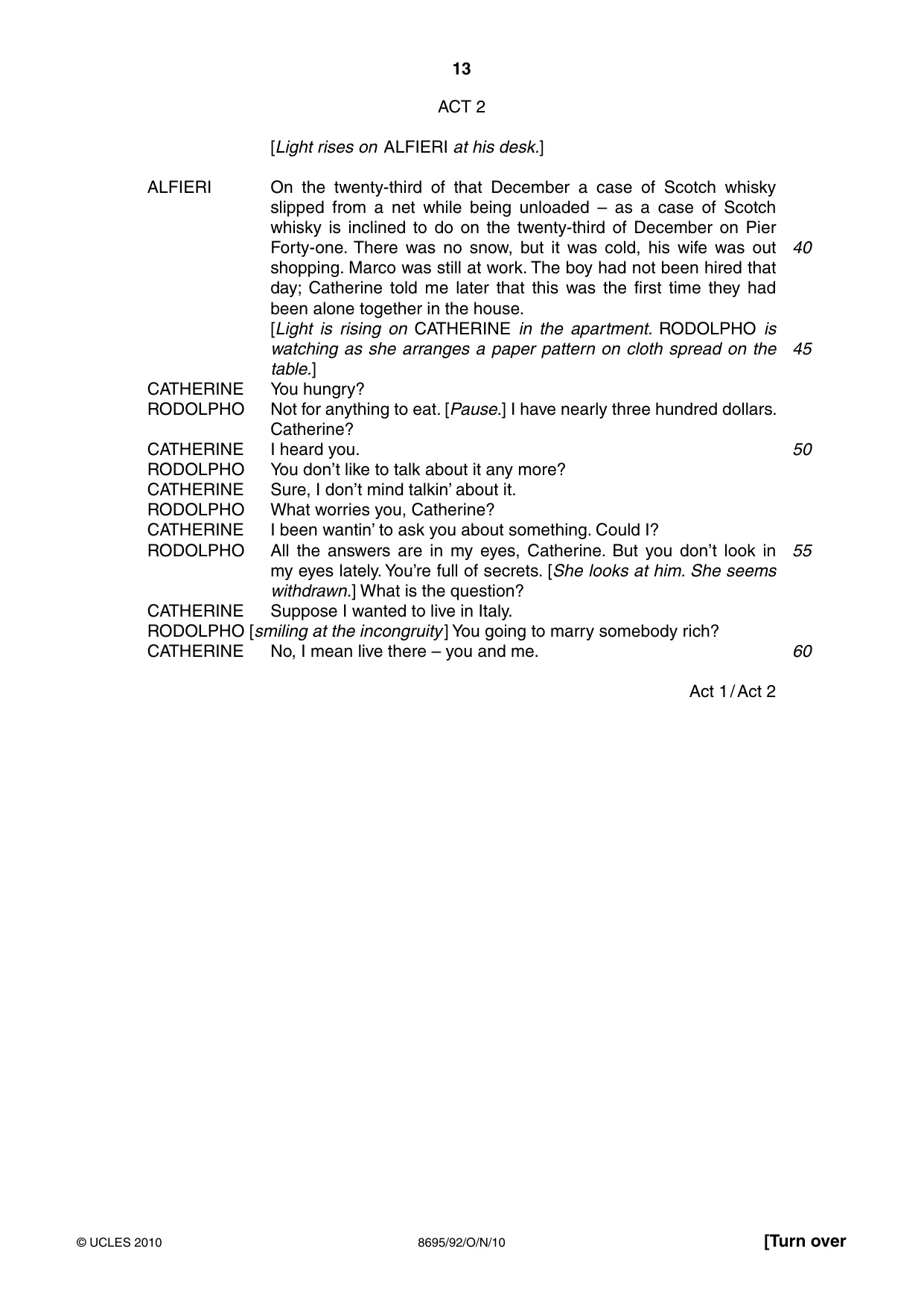
13 8695/92/O/N/10 © UCLES 2010 [Turn over ACT 2 [Light rises on ALFIERI at his desk.] ALFIERI On the twenty-third of that December a case of Scotch whisky slipped from a net while being unloaded – as a case of Scotch whisky is inclined to do on the twenty-third of December on Pier Forty-one. There was no snow, but it was cold, his wife was out shopping. Marco was still at work. The boy had not been hired that day; Catherine told me later that this was the first time they had been alone together in the house. [Light is rising on CATHERINE in the apartment. RODOLPHO is watching as she arranges a paper pattern on cloth spread on the table.] CATHERINE You hungry? RODOLPHO Not for anything to eat. [Pause.] I have nearly three hundred dollars. Catherine? CATHERINE I heard you. RODOLPHO You don’t like to talk about it any more? CATHERINE Sure, I don’t mind talkin’ about it. RODOLPHO What worries you, Catherine? CATHERINE I been wantin’ to ask you about something. Could I? RODOLPHO All the answers are in my eyes, Catherine. But you don’t look in my eyes lately. You’re full of secrets. [She looks at him. She seems withdrawn.] What is the question? CATHERINE Suppose I wanted to live in Italy. RODOLPHO [smiling at the incongruity ] You going to marry somebody rich? CATHERINE No, I mean live there – you and me. Act 1 / Act 2 40 45 50 55 60
Question paper, page 14
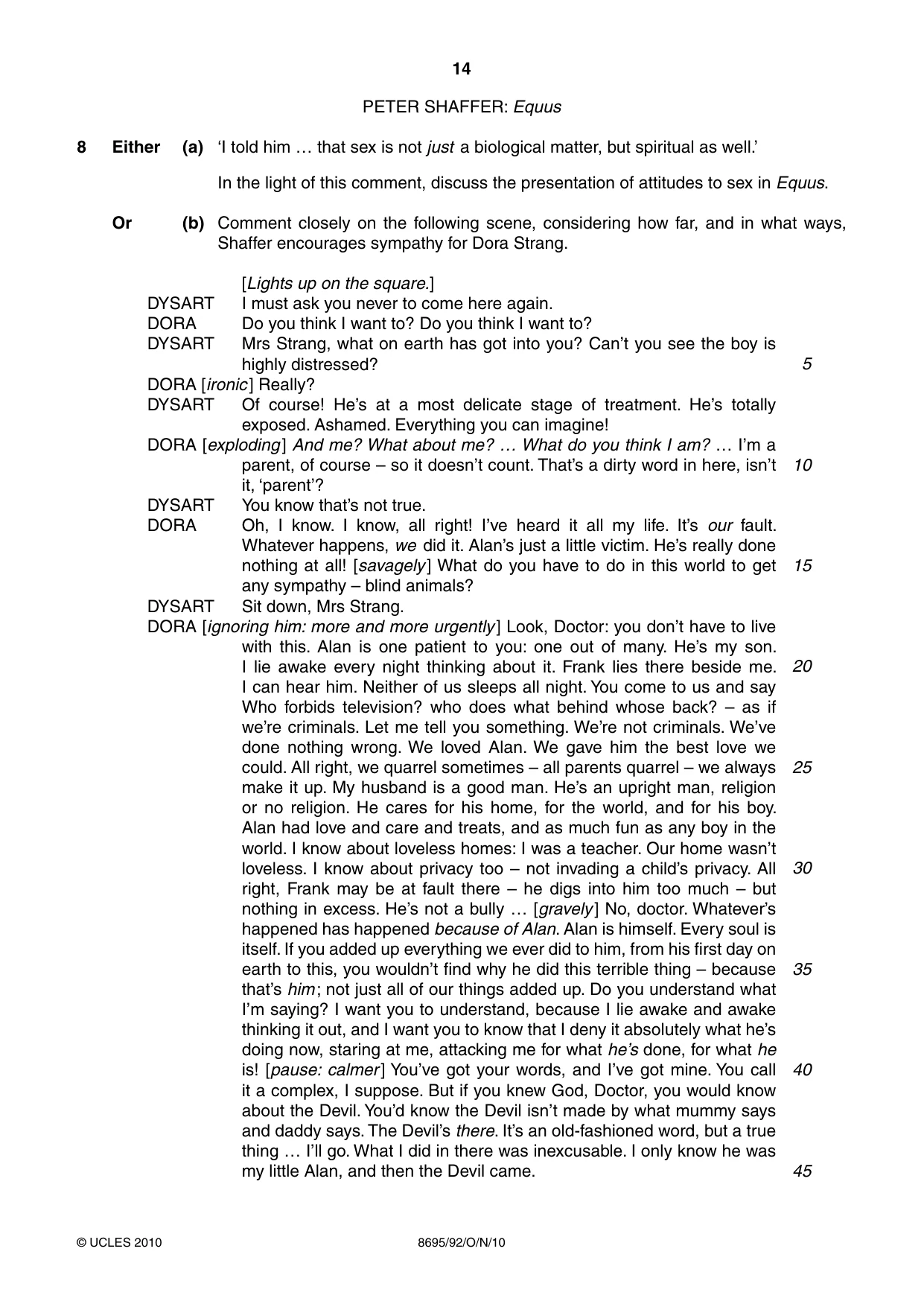
14 8695/92/O/N/10 © UCLES 2010 PETER SHAFFER: Equus 8 Either (a) ‘I told him … that sex is not just a biological matter, but spiritual as well.’ In the light of this comment, discuss the presentation of attitudes to sex in Equus. Or (b) Comment closely on the following scene, considering how far, and in what ways, Shaffer encourages sympathy for Dora Strang. [Lights up on the square.] DYSART I must ask you never to come here again. DORA Do you think I want to? Do you think I want to? DYSART Mrs Strang, what on earth has got into you? Can’t you see the boy is highly distressed? DORA [ironic ] Really? DYSART Of course! He’s at a most delicate stage of treatment. He’s totally exposed. Ashamed. Everything you can imagine! DORA [exploding ] And me? What about me? … What do you think I am? … I’m a parent, of course – so it doesn’t count. That’s a dirty word in here, isn’t it, ‘parent’? DYSART You know that’s not true. DORA Oh, I know. I know, all right! I’ve heard it all my life. It’s our fault. Whatever happens, we did it. Alan’s just a little victim. He’s really done nothing at all! [savagely ] What do you have to do in this world to get any sympathy – blind animals? DYSART Sit down, Mrs Strang. DORA [ignoring him: more and more urgently ] Look, Doctor: you don’t have to live with this. Alan is one patient to you: one out of many. He’s my son. I lie awake every night thinking about it. Frank lies there beside me. I can hear him. Neither of us sleeps all night. You come to us and say Who forbids television? who does what behind whose back? – as if we’re criminals. Let me tell you something. We’re not criminals. We’ve done nothing wrong. We loved Alan. We gave him the best love we could. All right, we quarrel sometimes – all parents quarrel – we always make it up. My husband is a good man. He’s an upright man, religion or no religion. He cares for his home, for the world, and for his boy. Alan had love and care and treats, and as much fun as any boy in the world. I know about loveless homes: I was a teacher. Our home wasn’t loveless. I know about privacy too – not invading a child’s privacy. All right, Frank may be at fault there – he digs into him too much – but nothing in excess. He’s not a bully … [gravely ] No, doctor. Whatever’s happened has happened because of Alan. Alan is himself. Every soul is itself. If you added up everything we ever did to him, from his first day on earth to this, you wouldn’t find why he did this terrible thing – because that’s him ; not just all of our things added up. Do you understand what I’m saying? I want you to understand, because I lie awake and awake thinking it out, and I want you to know that I deny it absolutely what he’s doing now, staring at me, attacking me for what he’s done, for what he is! [pause: calmer ] You’ve got your words, and I’ve got mine. You call it a complex, I suppose. But if you knew God, Doctor, you would know about the Devil. You’d know the Devil isn’t made by what mummy says and daddy says. The Devil’s there. It’s an old-fashioned word, but a true thing … I’ll go. What I did in there was inexcusable. I only know he was my little Alan, and then the Devil came. 5 10 15 20 25 30 35 40 45
Question paper, page 15
15 8695/92/O/N/10 © UCLES 2010 [Turn over [She leaves the square, and resumes her place. DYSART watches her go, then leaves himself by the opposite entrance, and approaches ALAN.] Act 2, Scene 23
Question paper, page 16
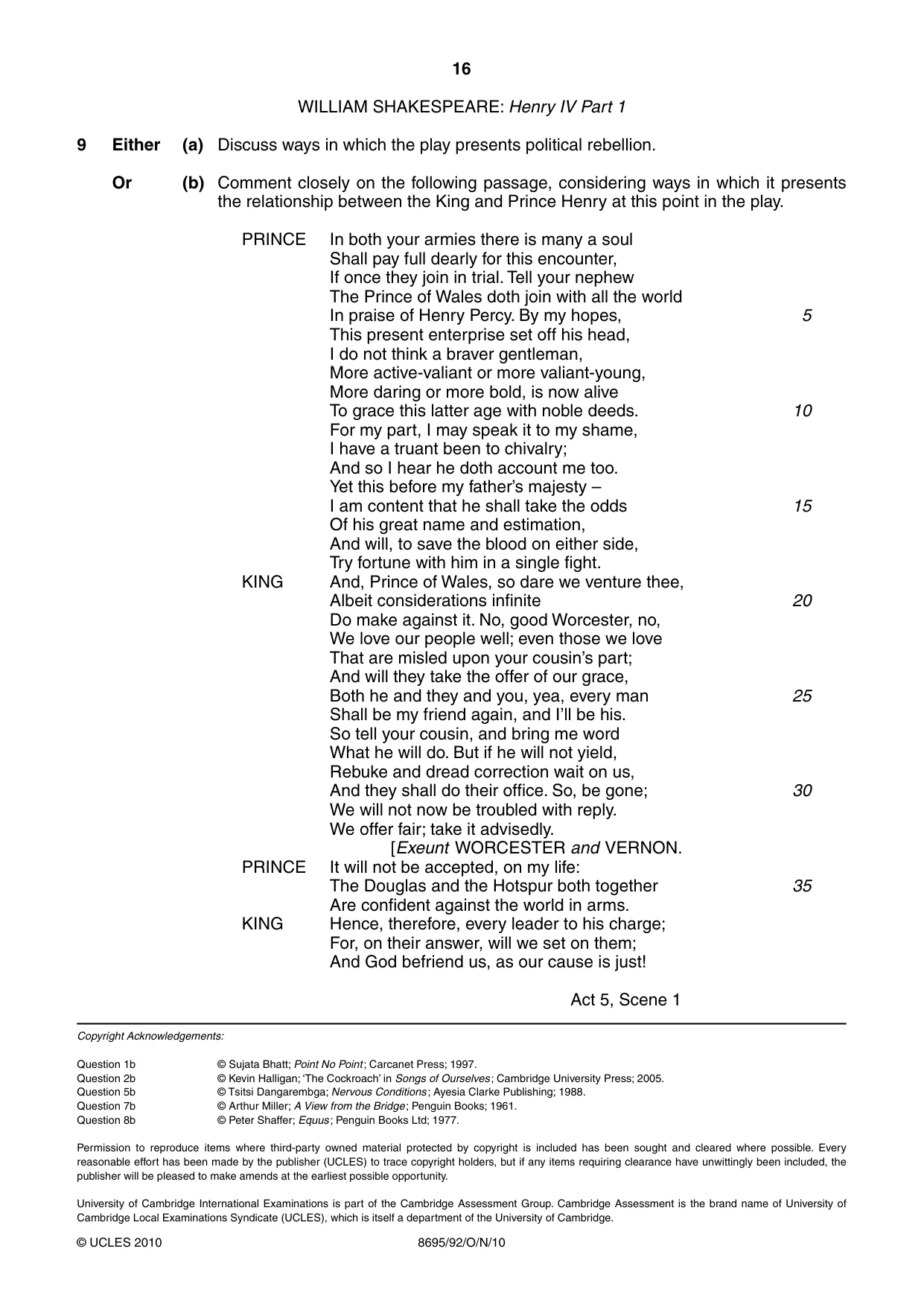
16 8695/92/O/N/10 © UCLES 2010 WILLIAM SHAKESPEARE: Henry IV Part 1 9 Either (a) Discuss ways in which the play presents political rebellion. Or (b) Comment closely on the following passage, considering ways in which it presents the relationship between the King and Prince Henry at this point in the play. PRINCE In both your armies there is many a soul Shall pay full dearly for this encounter, If once they join in trial. Tell your nephew The Prince of Wales doth join with all the world In praise of Henry Percy. By my hopes, 5 This present enterprise set off his head, I do not think a braver gentleman, More active-valiant or more valiant-young, More daring or more bold, is now alive To grace this latter age with noble deeds. 10 For my part, I may speak it to my shame, I have a truant been to chivalry; And so I hear he doth account me too. Yet this before my father’s majesty – I am content that he shall take the odds 15 Of his great name and estimation, And will, to save the blood on either side, Try fortune with him in a single fight. KING And, Prince of Wales, so dare we venture thee, Albeit considerations infinite 20 Do make against it. No, good Worcester, no, We love our people well; even those we love That are misled upon your cousin’s part; And will they take the offer of our grace, Both he and they and you, yea, every man 25 Shall be my friend again, and I’ll be his. So tell your cousin, and bring me word What he will do. But if he will not yield, Rebuke and dread correction wait on us, And they shall do their office. So, be gone; 30 We will not now be troubled with reply. We offer fair; take it advisedly. [Exeunt WORCESTER and VERNON. PRINCE It will not be accepted, on my life: The Douglas and the Hotspur both together 35 Are confident against the world in arms. KING Hence, therefore, every leader to his charge; For, on their answer, will we set on them; And God befriend us, as our cause is just! Act 5, Scene 1 Copyright Acknowledgements: Question 1b © Sujata Bhatt; Point No Point ; Carcanet Press; 1997. Question 2b © Kevin Halligan; ‘The Cockroach’ in Songs of Ourselves ; Cambridge University Press; 2005. Question 5b © Tsitsi Dangarembga; Nervous Conditions ; Ayesia Clarke Publishing; 1988. Question 7b © Arthur Miller; A View from the Bridge ; Penguin Books; 1961. Question 8b © Peter Shaffer; Equus ; Penguin Books Ltd; 1977. Permission to reproduce items where third-party owned material protected by copyright is included has been sought and cleared where possible. Every reasonable effort has been made by the publisher (UCLES) to trace copyright holders, but if any items requiring clearance have unwittingly been included, the publisher will be pleased to make amends at the earliest possible opportunity. University of Cambridge International Examinations is part of the Cambridge Assessment Group. Cambridge Assessment is the brand name of University of Cambridge Local Examinations Syndicate (UCLES), which is itself a department of the University of Cambridge.
Mark scheme, page 1
UNIVERSITY OF CAMBRIDGE INTERNATIONAL EXAMINATIONS GCE Advanced Subsidiary Level and GCE Advanced Level MARK SCHEME for the October/November 2010 question paper for the guidance of teachers 8695 LANGUAGE AND LITERATURE IN ENGLISH 8695/92 Paper 9 (Poetry, Prose, Drama), maximum raw mark 50 This mark scheme is published as an aid to teachers and candidates, to indicate the requirements of the examination. It shows the basis on which Examiners were instructed to award marks. It does not indicate the details of the discussions that took place at an Examiners’ meeting before marking began, which would have considered the acceptability of alternative answers. Mark schemes must be read in conjunction with the question papers and the report on the examination. • CIE will not enter into discussions or correspondence in connection with these mark schemes. CIE is publishing the mark schemes for the October/November 2010 question papers for most IGCSE, GCE Advanced Level and Advanced Subsidiary Level syllabuses and some Ordinary Level syllabuses.
Mark scheme, page 2
Page 2 Mark Scheme: Teachers’ version Syllabus Paper GCE A/AS LEVEL – October/November 2010 8695 92 © UCLES 2010 Using the mark bands Place the answer in a band first. Look for the “best fit” of the answer into a band. An answer needs to show evidence of most but not necessarily ALL of the qualities described in a band, in order to be placed in that band. Then award a mark for the relative position of the answer within the band. Candidates may address the question in many different ways. Do not expect any particular focus or approach and do not penalise answers for leaving out a particular focus. Reward what is there, showing what you are rewarding, in your comments. Consider all strands and weigh up the performance as a whole in placing the answer in a band, then show that you have done so in the summative comment, e.g. Sound K of texts, some evidence of U but mostly narrative, occasional evidence of P, mainly clear C. Assessment Objectives: • Ability to respond to texts in the three main forms (Prose, Poetry and Drama) of different types and from different cultures; • Understanding of the ways in which writers’ choices of form, structure and language shape meanings; • Ability to produce informed independent opinions and judgements on literary texts; • Ability to communicate clearly the knowledge, understanding and insight appropriate to literary study. Each answer is marked out of 25, in accordance with the General Marking Criteria below. Each band is divided into strands corresponding to the Assessment Objectives –Knowledge, Understanding, Personal Response, Communication.
Mark scheme, page 3
Page 3 Mark Scheme: Teachers’ version Syllabus Paper GCE A/AS LEVEL – October/November 2010 8695 92 © UCLES 2010 Band 6 0–5 K Evidence of some general knowledge of the text which may be narrative based and may contain errors, rarely relevant to the question and with little or no relevant quotation or selection from the text. U There may be little or no evidence of understanding of form, structure and language, with some appropriate points made in response to the question. These will be limited and tend to be restricted to plot and characters – the latter treated very much as “real” people. P There may be some signs of personal response, not developed into an argument and not fully supported from the text. C Communication will be insecure. Expression may be weak with some breakdown in communication. Structure may be lacking: answers are likely to be partial, undeveloped, narrative commentary in approach; with the assertion of simple points rather than progressive lines of argument. Answers to passage-based questions are likely to be seriously unbalanced, with an emphasis on narrative or paraphrase. Passages are likely to have been only partially understood and tentatively located contextually, with little coherent sense of the relationship between textual part and whole. There will be little or no mention or consideration of the literary features of the passage. Band 5 6–9 Work of a basic standard K Evidence of some limited ability to use knowledge of the text to address the question, with occasional use of supporting references or quotation. U Evidence of some limited understanding of ways in which writers’ choices of structure, form and language shape meanings. P Evidence of some personal response to the text but not fully supported. C Expression will be basically clear. There may be the occasional confused passage of writing. However, there will be no sustained loss of communication. There may be a simple structure to the answer with some evidence of an argument, which may lack coherence, with some repetition, assertion and relapse into narrative summary/paraphrase. There may be a tendency to drift from relevant discussion into material of tangential significance. In answers to passage-based questions there will be some evidence of understanding of how part relates to whole. Treatment of the given extracts may well be sketchy or overlong and undiscriminating. Comment on the wider textual issues is likely to be general. There may be a lack of balance between passage and whole text. There will be some limited consideration of the literary features of the text.
Mark scheme, page 4
Page 4 Mark Scheme: Teachers’ version Syllabus Paper GCE A/AS LEVEL – October/November 2010 8695 92 © UCLES 2010 Band 4 10–13 Solid work K Evidence of some ability to use relevant knowledge of the text to address the question. U Evidence of clear understanding of some ways in which writers’ choices of structure, form and language shape meanings, which may be partial and restricted to the more obvious aspects of the text. P Evidence of personal response to the text, with the beginnings of a personal view or interpretation, relevant to the question and supported from the text. C Expression will be mostly clear and appropriate with a clear, simple structure to the answer. Argument will be basically coherent, and assertive in tone. There is likely to be some reliance on paraphrase and narrative summary. Articulates simple ideas with clarity but there may be some imprecision and clumsiness of expression in dealing with more complex concepts. There may be occasional obscurity in the presentation of ideas and responses. In answers to passage-based questions, work may be lacking in balance of approach, with over- concentration on the given extracts and little attempt to explore the broader textual issues. Conversely some answers may be in effect general essays, with insufficient treatment of the passages. There may be evidence of limited ability to negotiate between parts of a text and its whole. There will be some consideration of the literary features of the text with analysis of the features mentioned likely to be partial or restricted. Band 3 14–17 Competent work K Evidence of competence in selecting relevant knowledge of the text to address with some pertinent use of quotation and direct references. U Evidence of sound understanding of some aspects of ways in which writers’ choices of structure, form and language shape meanings, with some analysis and appreciation of literary methods, effects, and contexts. P Evidence of personal response relevant to the question, supported from the text. C Expression will be clear and generally accurate. Structure will be sound – material coherently organised with occasional insights. Candidates will express intelligent, straightforward ideas clearly, though there may be occasional loss of fluency with points not always strongly connected. In answers to passage-based questions, work will cover both the passage and its relation to the whole text, and there will be some sense of a relationship between the text as a whole and its constituent parts. There will be competent appreciation of the effects of the literary features of the text and the analysis is supported by relevant examples from the passage.
Mark scheme, page 5
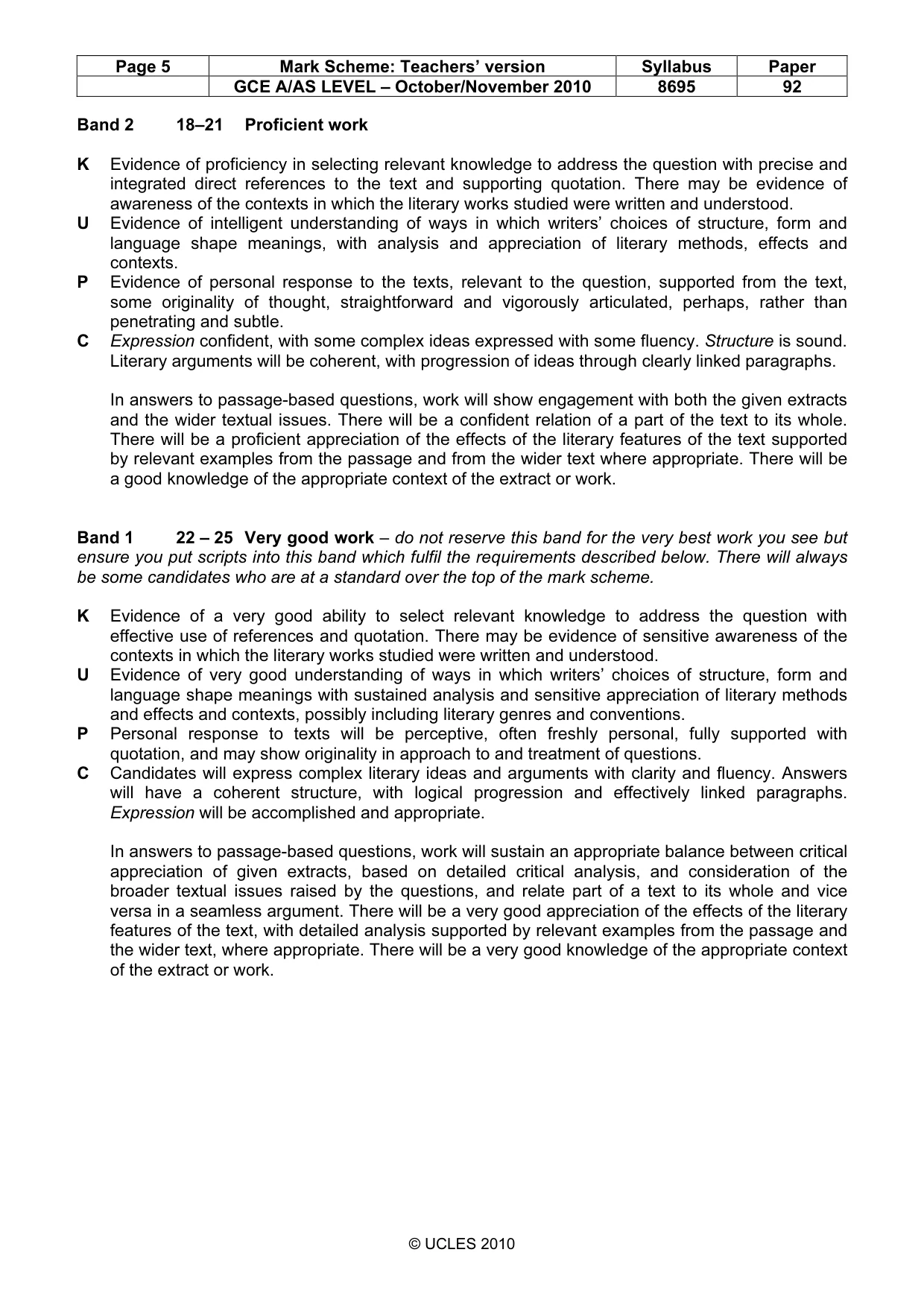
Page 5 Mark Scheme: Teachers’ version Syllabus Paper GCE A/AS LEVEL – October/November 2010 8695 92 © UCLES 2010 Band 2 18–21 Proficient work K Evidence of proficiency in selecting relevant knowledge to address the question with precise and integrated direct references to the text and supporting quotation. There may be evidence of awareness of the contexts in which the literary works studied were written and understood. U Evidence of intelligent understanding of ways in which writers’ choices of structure, form and language shape meanings, with analysis and appreciation of literary methods, effects and contexts. P Evidence of personal response to the texts, relevant to the question, supported from the text, some originality of thought, straightforward and vigorously articulated, perhaps, rather than penetrating and subtle. C Expression confident, with some complex ideas expressed with some fluency. Structure is sound. Literary arguments will be coherent, with progression of ideas through clearly linked paragraphs. In answers to passage-based questions, work will show engagement with both the given extracts and the wider textual issues. There will be a confident relation of a part of the text to its whole. There will be a proficient appreciation of the effects of the literary features of the text supported by relevant examples from the passage and from the wider text where appropriate. There will be a good knowledge of the appropriate context of the extract or work. Band 1 22 – 25 Very good work – do not reserve this band for the very best work you see but ensure you put scripts into this band which fulfil the requirements described below. There will always be some candidates who are at a standard over the top of the mark scheme. K Evidence of a very good ability to select relevant knowledge to address the question with effective use of references and quotation. There may be evidence of sensitive awareness of the contexts in which the literary works studied were written and understood. U Evidence of very good understanding of ways in which writers’ choices of structure, form and language shape meanings with sustained analysis and sensitive appreciation of literary methods and effects and contexts, possibly including literary genres and conventions. P Personal response to texts will be perceptive, often freshly personal, fully supported with quotation, and may show originality in approach to and treatment of questions. C Candidates will express complex literary ideas and arguments with clarity and fluency. Answers will have a coherent structure, with logical progression and effectively linked paragraphs. Expression will be accomplished and appropriate. In answers to passage-based questions, work will sustain an appropriate balance between critical appreciation of given extracts, based on detailed critical analysis, and consideration of the broader textual issues raised by the questions, and relate part of a text to its whole and vice versa in a seamless argument. There will be a very good appreciation of the effects of the literary features of the text, with detailed analysis supported by relevant examples from the passage and the wider text, where appropriate. There will be a very good knowledge of the appropriate context of the extract or work.
What you needed in this session
Cambridge’s own grade thresholds for 2010 Oct/Nov, Paper 9 · Variant 2. A higher threshold means an easier paper — the bar moves with how the cohort did.