Cambridge A Level English - Language and Literature (AS Level only, from 2016) 8695 — 2010 May/June Paper 9 · Variant 1
8695/91/M/J/10 · 50 marks · ≈56 min
The question paper and its mark scheme, free to read here and free to download. This is Cambridge’s own paper, exactly as it was sat.
Question paper16 pages


Mark scheme4 pages
Answers below. Sit the paper first if you are practising.
Paper as text
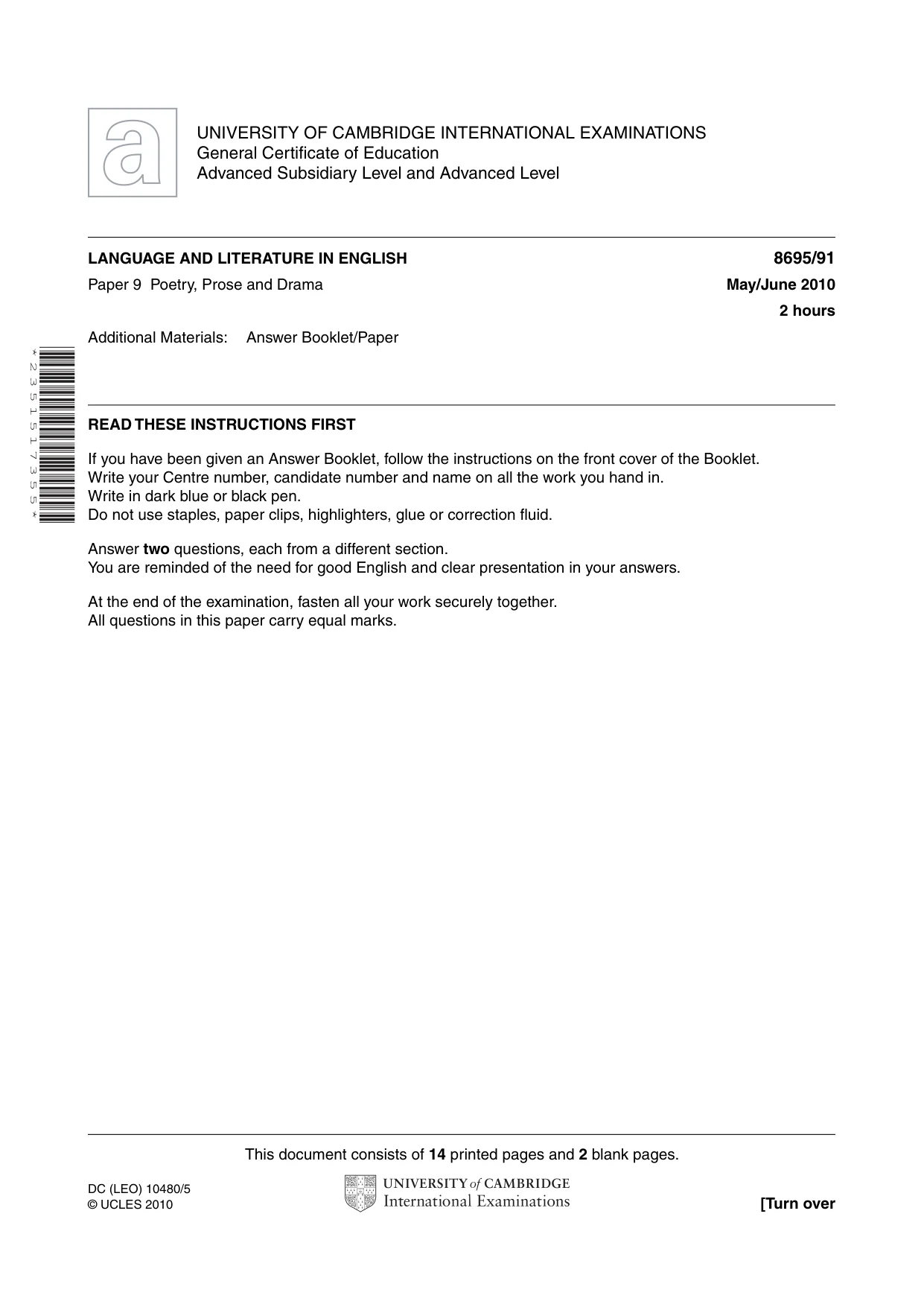
Question paper, page 1
This document consists of 14 printed pages and 2 blank pages. DC (LEO) 10480/5 © UCLES 2010 [Turn over UNIVERSITY OF CAMBRIDGE INTERNATIONAL EXAMINATIONS General Certificate of Education Advanced Subsidiary Level and Advanced Level READ THESE INSTRUCTIONS FIRST If you have been given an Answer Booklet, follow the instructions on the front cover of the Booklet. Write your Centre number, candidate number and name on all the work you hand in. Write in dark blue or black pen. Do not use staples, paper clips, highlighters, glue or correction fluid. Answer two questions, each from a different section. You are reminded of the need for good English and clear presentation in your answers. At the end of the examination, fasten all your work securely together. All questions in this paper carry equal marks. * 2 3 5 1 5 1 7 3 5 5 * LANGUAGE AND LITERATURE IN ENGLISH 8695/91 Paper 9 Poetry, Prose and Drama May/June 2010 2 hours Additional Materials: Answer Booklet/Paper
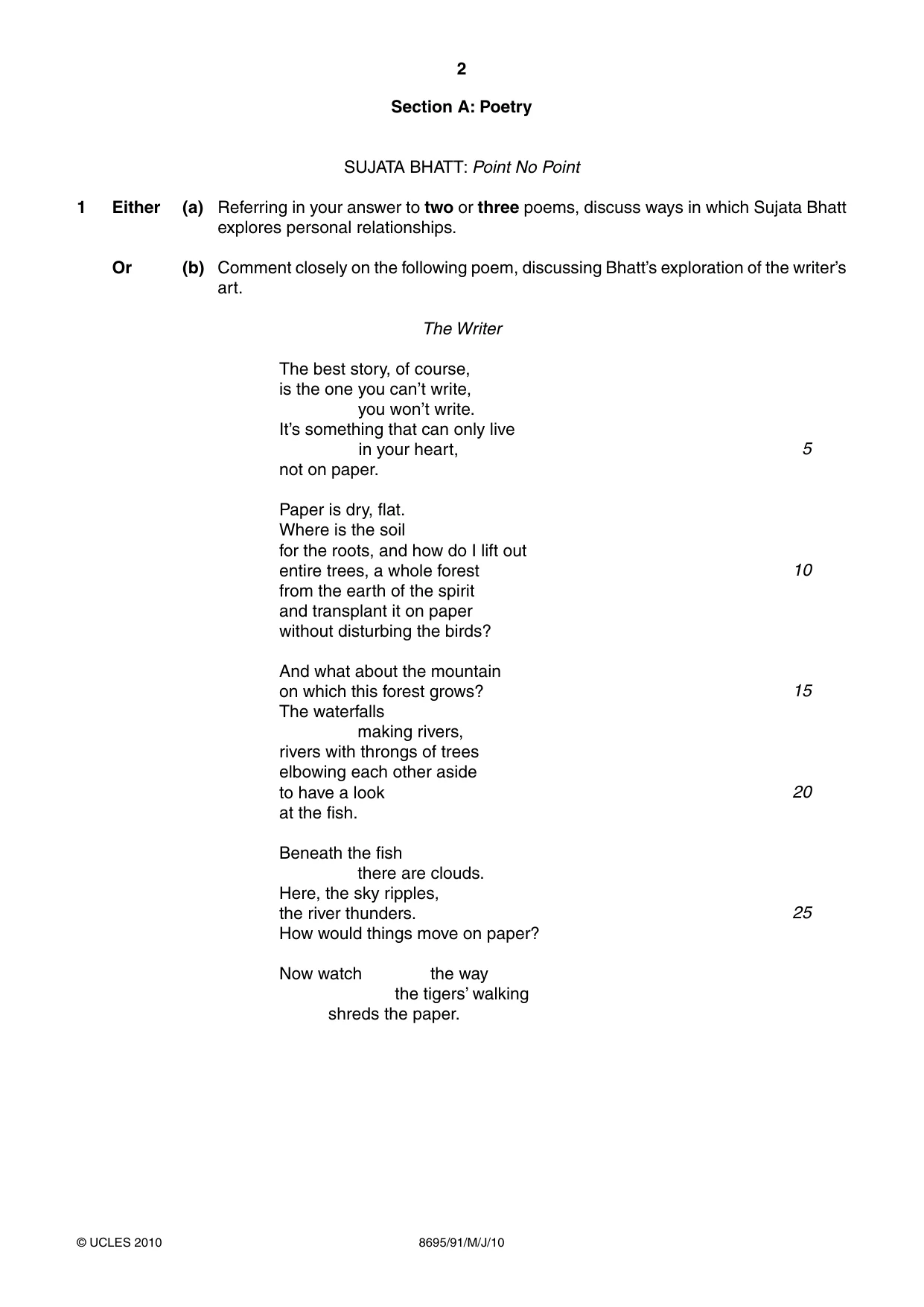
Question paper, page 2
2 8695/91/M/J/10 © UCLES 2010 Section A: Poetry SUJATA BHATT: Point No Point 1 Either (a) Referring in your answer to two or three poems, discuss ways in which Sujata Bhatt explores personal relationships. Or (b) Comment closely on the following poem, discussing Bhatt’s exploration of the writer’s art. The Writer The best story, of course, is the one you can’t write, you won’t write. It’s something that can only live in your heart, not on paper. Paper is dry, flat. Where is the soil for the roots, and how do I lift out entire trees, a whole forest from the earth of the spirit and transplant it on paper without disturbing the birds? And what about the mountain on which this forest grows? The waterfalls making rivers, rivers with throngs of trees elbowing each other aside to have a look at the fish. Beneath the fish there are clouds. Here, the sky ripples, the river thunders. How would things move on paper? Now watch the way the tigers’ walking shreds the paper. 5 10 15 20 25
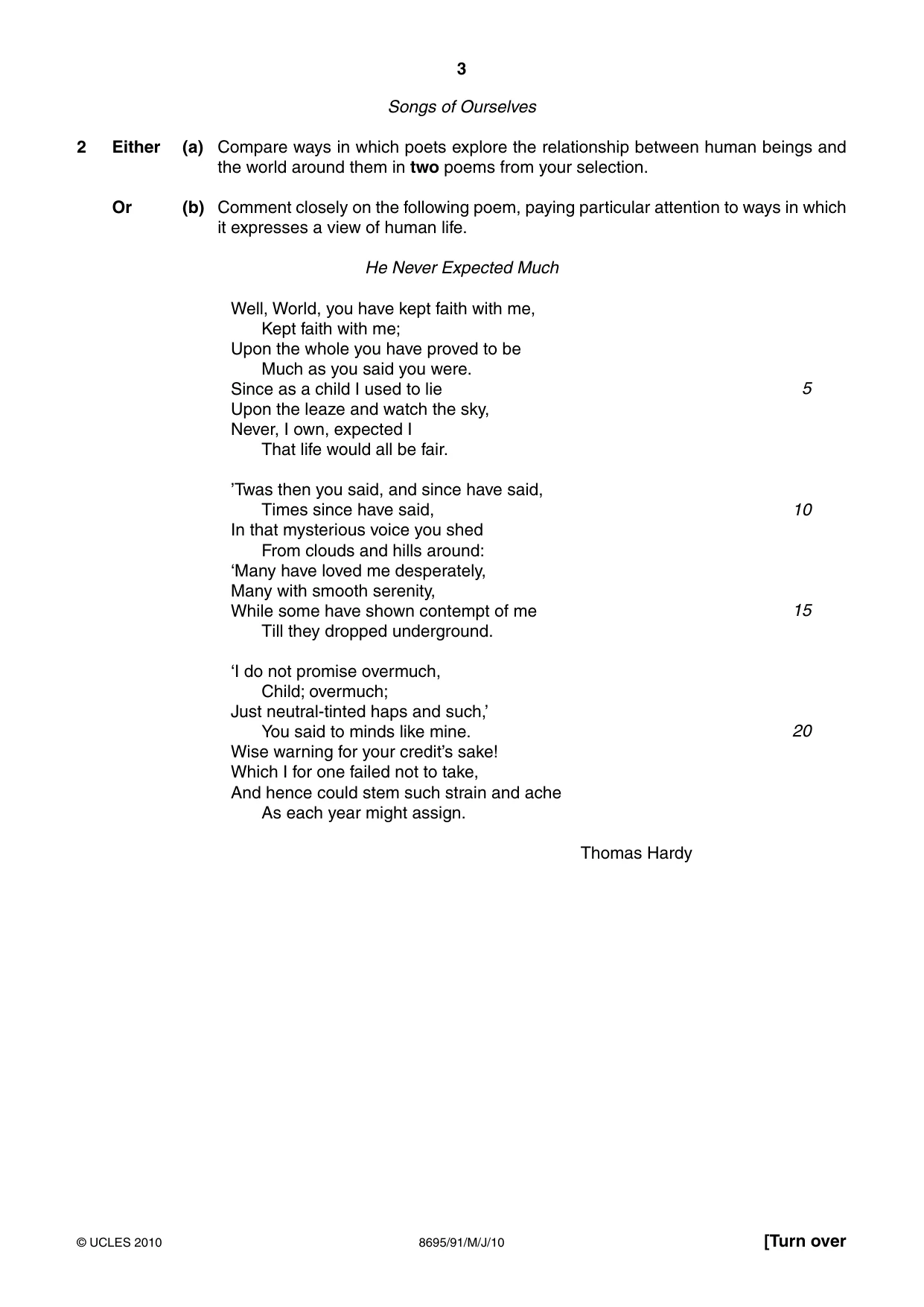
Question paper, page 3
3 8695/91/M/J/10 © UCLES 2010 [Turn over Songs of Ourselves 2 Either (a) Compare ways in which poets explore the relationship between human beings and the world around them in two poems from your selection. Or (b) Comment closely on the following poem, paying particular attention to ways in which it expresses a view of human life. He Never Expected Much Well, World, you have kept faith with me, Kept faith with me; Upon the whole you have proved to be Much as you said you were. Since as a child I used to lie Upon the leaze and watch the sky, Never, I own, expected I That life would all be fair. ’Twas then you said, and since have said, Times since have said, In that mysterious voice you shed From clouds and hills around: ‘Many have loved me desperately, Many with smooth serenity, While some have shown contempt of me Till they dropped underground. ‘I do not promise overmuch, Child; overmuch; Just neutral-tinted haps and such,’ You said to minds like mine. Wise warning for your credit’s sake! Which I for one failed not to take, And hence could stem such strain and ache As each year might assign. Thomas Hardy 5 10 15 20
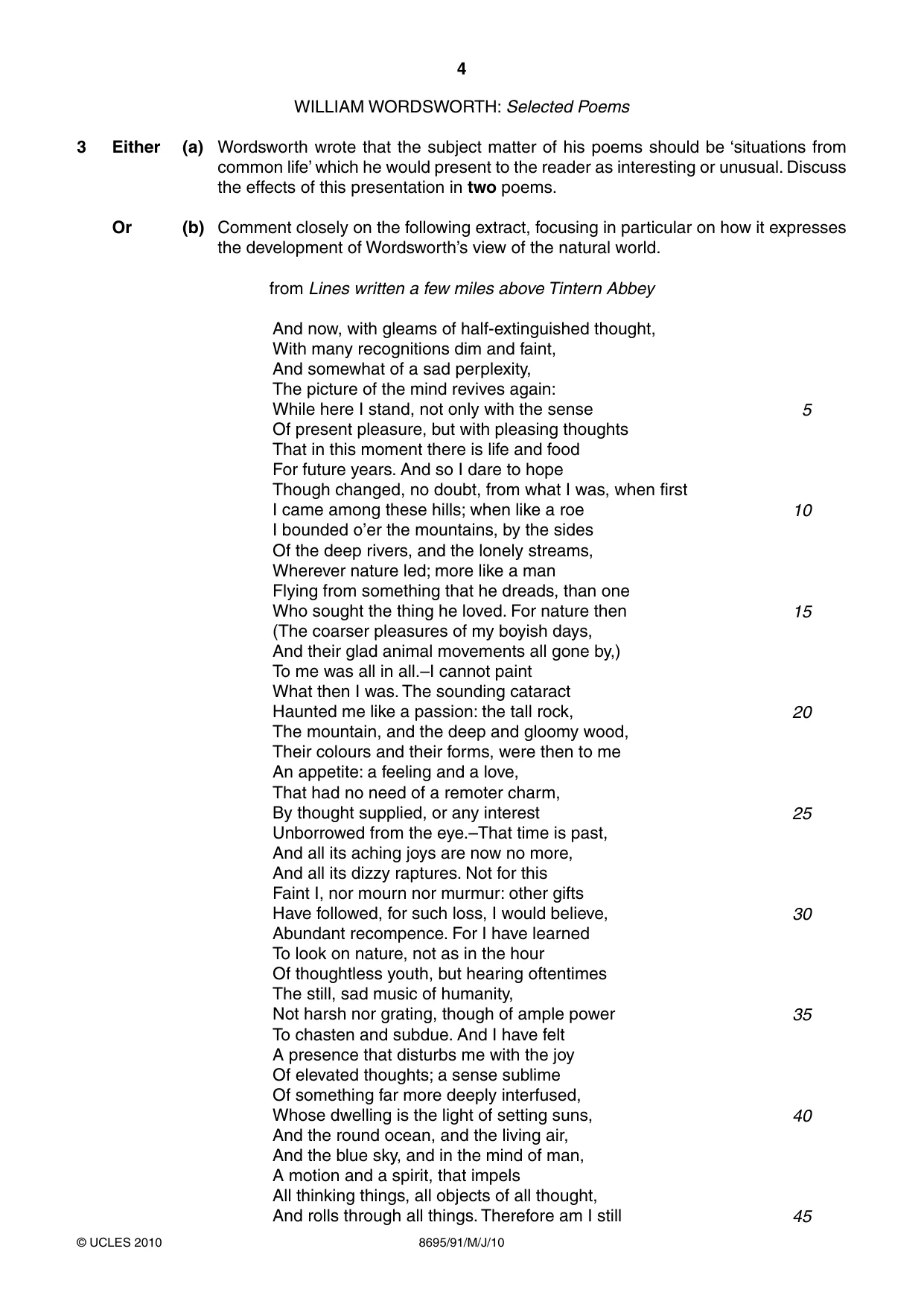
Question paper, page 4
4 8695/91/M/J/10 © UCLES 2010 WILLIAM WORDSWORTH: Selected Poems 3 Either (a) Wordsworth wrote that the subject matter of his poems should be ‘situations from common life’ which he would present to the reader as interesting or unusual. Discuss the effects of this presentation in two poems. Or (b) Comment closely on the following extract, focusing in particular on how it expresses the development of Wordsworth’s view of the natural world. from Lines written a few miles above Tintern Abbey And now, with gleams of half-extinguished thought, With many recognitions dim and faint, And somewhat of a sad perplexity, The picture of the mind revives again: While here I stand, not only with the sense Of present pleasure, but with pleasing thoughts That in this moment there is life and food For future years. And so I dare to hope Though changed, no doubt, from what I was, when first I came among these hills; when like a roe I bounded o’er the mountains, by the sides Of the deep rivers, and the lonely streams, Wherever nature led; more like a man Flying from something that he dreads, than one Who sought the thing he loved. For nature then (The coarser pleasures of my boyish days, And their glad animal movements all gone by,) To me was all in all.–I cannot paint What then I was. The sounding cataract Haunted me like a passion: the tall rock, The mountain, and the deep and gloomy wood, Their colours and their forms, were then to me An appetite: a feeling and a love, That had no need of a remoter charm, By thought supplied, or any interest Unborrowed from the eye.–That time is past, And all its aching joys are now no more, And all its dizzy raptures. Not for this Faint I, nor mourn nor murmur: other gifts Have followed, for such loss, I would believe, Abundant recompence. For I have learned To look on nature, not as in the hour Of thoughtless youth, but hearing oftentimes The still, sad music of humanity, Not harsh nor grating, though of ample power To chasten and subdue. And I have felt A presence that disturbs me with the joy Of elevated thoughts; a sense sublime Of something far more deeply interfused, Whose dwelling is the light of setting suns, And the round ocean, and the living air, And the blue sky, and in the mind of man, A motion and a spirit, that impels All thinking things, all objects of all thought, And rolls through all things. Therefore am I still 5 10 15 20 25 30 35 40 45
Question paper, page 5
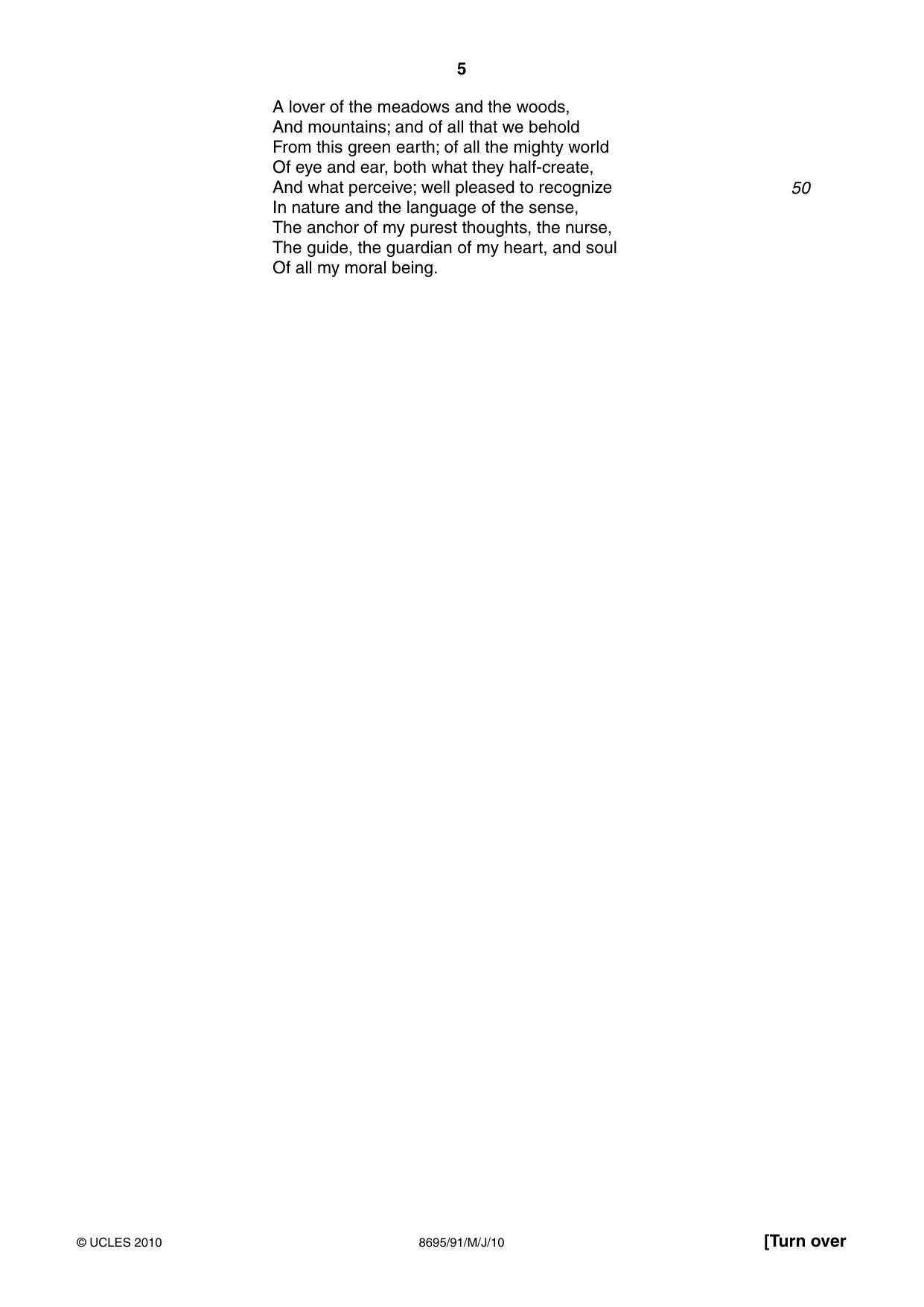
5 8695/91/M/J/10 © UCLES 2010 [Turn over A lover of the meadows and the woods, And mountains; and of all that we behold From this green earth; of all the mighty world Of eye and ear, both what they half-create, And what perceive; well pleased to recognize In nature and the language of the sense, The anchor of my purest thoughts, the nurse, The guide, the guardian of my heart, and soul Of all my moral being. 50
Question paper, page 6
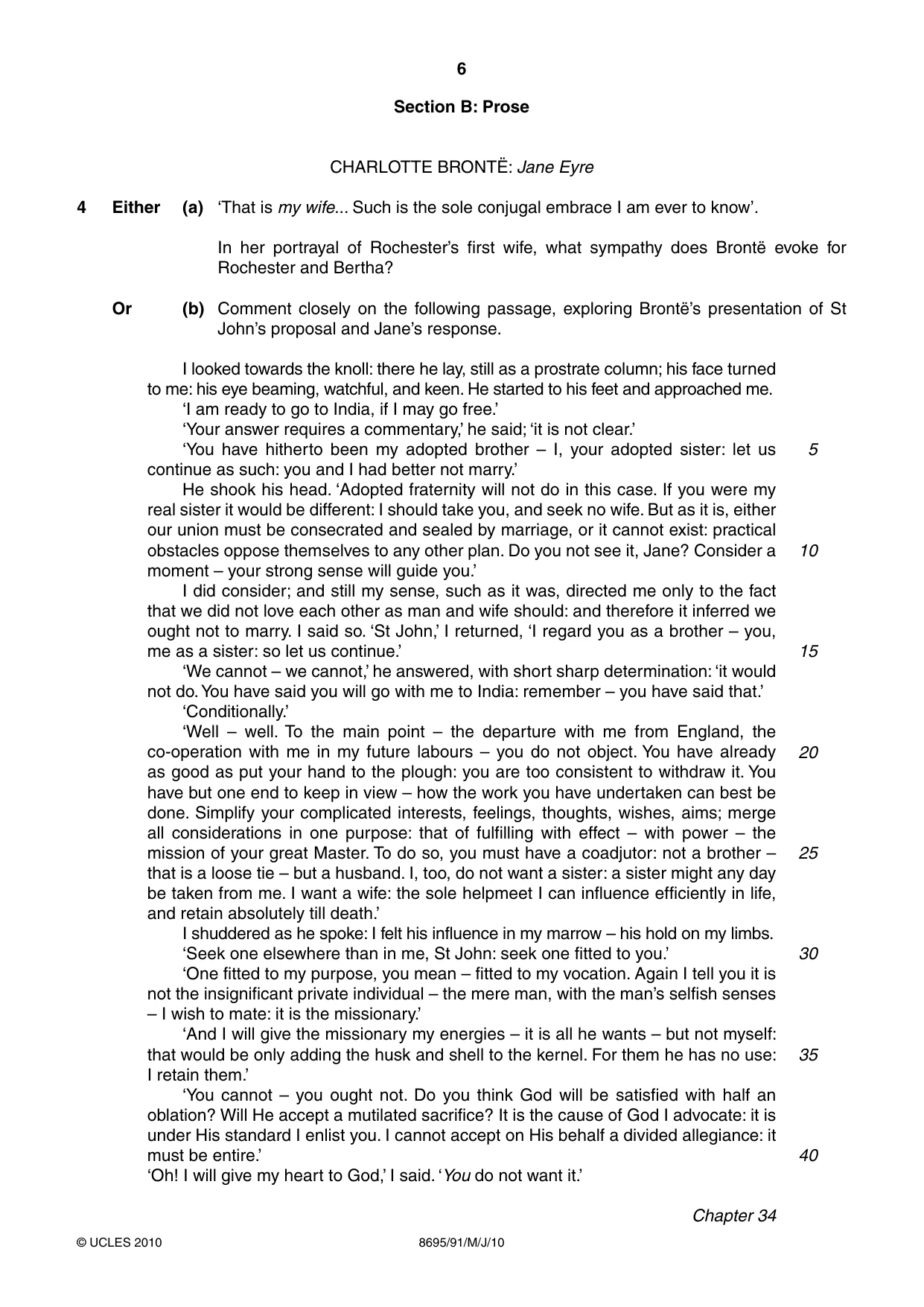
6 8695/91/M/J/10 © UCLES 2010 Section B: Prose CHARLOTTE BRONTË: Jane Eyre 4 Either (a) ‘That is my wife... Such is the sole conjugal embrace I am ever to know’. In her portrayal of Rochester’s first wife, what sympathy does Brontë evoke for Rochester and Bertha? Or (b) Comment closely on the following passage, exploring Brontë’s presentation of St John’s proposal and Jane’s response. I looked towards the knoll: there he lay, still as a prostrate column; his face turned to me: his eye beaming, watchful, and keen. He started to his feet and approached me. ‘I am ready to go to India, if I may go free.’ ‘Your answer requires a commentary,’ he said; ‘it is not clear.’ ‘You have hitherto been my adopted brother – I, your adopted sister: let us continue as such: you and I had better not marry.’ He shook his head. ‘Adopted fraternity will not do in this case. If you were my real sister it would be different: I should take you, and seek no wife. But as it is, either our union must be consecrated and sealed by marriage, or it cannot exist: practical obstacles oppose themselves to any other plan. Do you not see it, Jane? Consider a moment – your strong sense will guide you.’ I did consider; and still my sense, such as it was, directed me only to the fact that we did not love each other as man and wife should: and therefore it inferred we ought not to marry. I said so. ‘St John,’ I returned, ‘I regard you as a brother – you, me as a sister: so let us continue.’ ‘We cannot – we cannot,’ he answered, with short sharp determination: ‘it would not do. You have said you will go with me to India: remember – you have said that.’ ‘Conditionally.’ ‘Well – well. To the main point – the departure with me from England, the co-operation with me in my future labours – you do not object. You have already as good as put your hand to the plough: you are too consistent to withdraw it. You have but one end to keep in view – how the work you have undertaken can best be done. Simplify your complicated interests, feelings, thoughts, wishes, aims; merge all considerations in one purpose: that of fulfilling with effect – with power – the mission of your great Master. To do so, you must have a coadjutor: not a brother – that is a loose tie – but a husband. I, too, do not want a sister: a sister might any day be taken from me. I want a wife: the sole helpmeet I can influence efficiently in life, and retain absolutely till death.’ I shuddered as he spoke: I felt his influence in my marrow – his hold on my limbs. ‘Seek one elsewhere than in me, St John: seek one fitted to you.’ ‘One fitted to my purpose, you mean – fitted to my vocation. Again I tell you it is not the insignificant private individual – the mere man, with the man’s selfish senses – I wish to mate: it is the missionary.’ ‘And I will give the missionary my energies – it is all he wants – but not myself: that would be only adding the husk and shell to the kernel. For them he has no use: I retain them.’ ‘You cannot – you ought not. Do you think God will be satisfied with half an oblation? Will He accept a mutilated sacrifice? It is the cause of God I advocate: it is under His standard I enlist you. I cannot accept on His behalf a divided allegiance: it must be entire.’ ‘Oh! I will give my heart to God,’ I said. ‘You do not want it.’ Chapter 34 5 10 15 20 25 30 35 40
Question paper, page 7
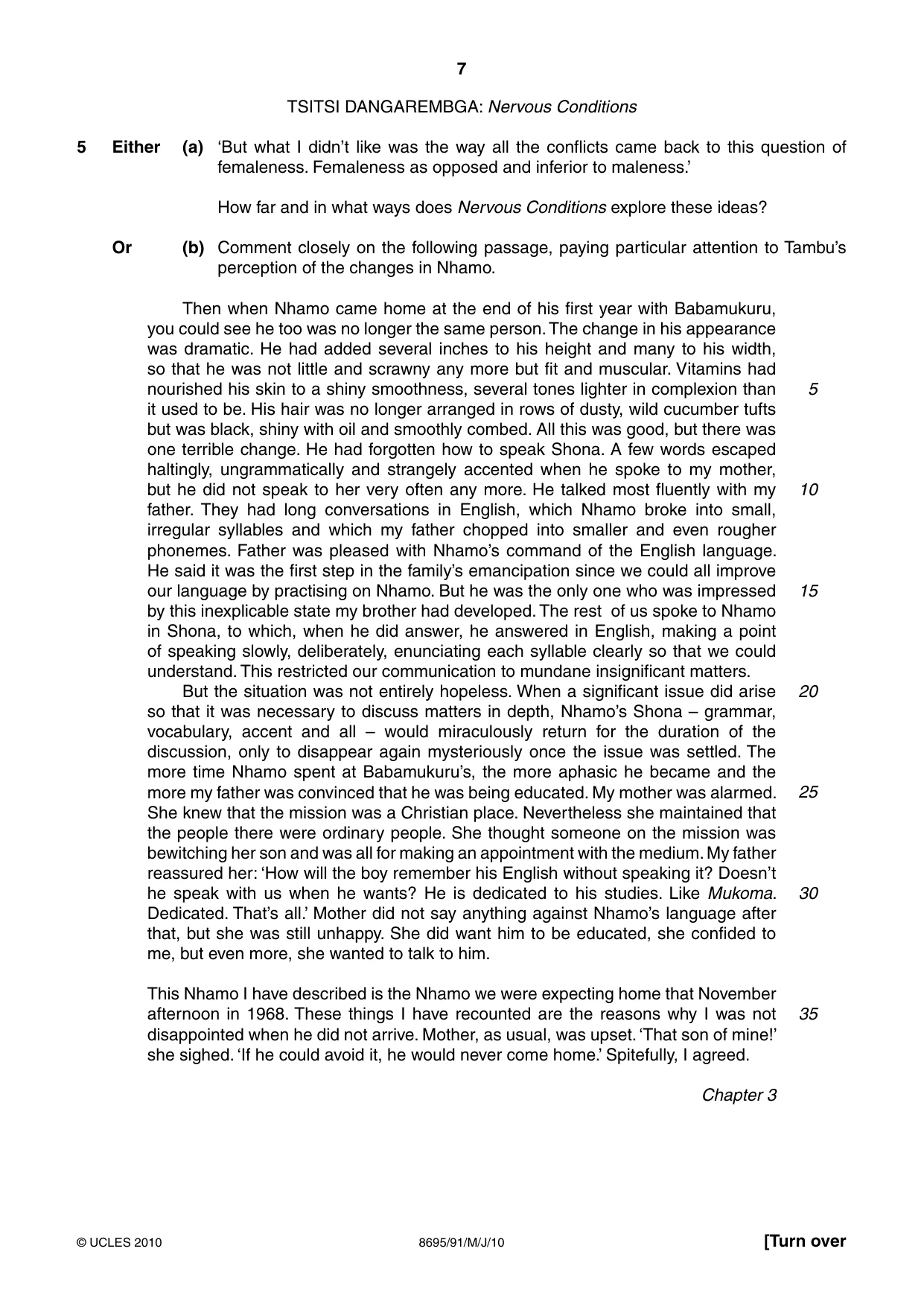
7 8695/91/M/J/10 © UCLES 2010 [Turn over TSITSI DANGAREMBGA: Nervous Conditions 5 Either (a) ‘But what I didn’t like was the way all the conflicts came back to this question of femaleness. Femaleness as opposed and inferior to maleness.’ How far and in what ways does Nervous Conditions explore these ideas? Or (b) Comment closely on the following passage, paying particular attention to Tambu’s perception of the changes in Nhamo. Then when Nhamo came home at the end of his first year with Babamukuru, you could see he too was no longer the same person. The change in his appearance was dramatic. He had added several inches to his height and many to his width, so that he was not little and scrawny any more but fit and muscular. Vitamins had nourished his skin to a shiny smoothness, several tones lighter in complexion than it used to be. His hair was no longer arranged in rows of dusty, wild cucumber tufts but was black, shiny with oil and smoothly combed. All this was good, but there was one terrible change. He had forgotten how to speak Shona. A few words escaped haltingly, ungrammatically and strangely accented when he spoke to my mother, but he did not speak to her very often any more. He talked most fluently with my father. They had long conversations in English, which Nhamo broke into small, irregular syllables and which my father chopped into smaller and even rougher phonemes. Father was pleased with Nhamo’s command of the English language. He said it was the first step in the family’s emancipation since we could all improve our language by practising on Nhamo. But he was the only one who was impressed by this inexplicable state my brother had developed. The rest of us spoke to Nhamo in Shona, to which, when he did answer, he answered in English, making a point of speaking slowly, deliberately, enunciating each syllable clearly so that we could understand. This restricted our communication to mundane insignificant matters. But the situation was not entirely hopeless. When a significant issue did arise so that it was necessary to discuss matters in depth, Nhamo’s Shona – grammar, vocabulary, accent and all – would miraculously return for the duration of the discussion, only to disappear again mysteriously once the issue was settled. The more time Nhamo spent at Babamukuru’s, the more aphasic he became and the more my father was convinced that he was being educated. My mother was alarmed. She knew that the mission was a Christian place. Nevertheless she maintained that the people there were ordinary people. She thought someone on the mission was bewitching her son and was all for making an appointment with the medium. My father reassured her: ‘How will the boy remember his English without speaking it? Doesn’t he speak with us when he wants? He is dedicated to his studies. Like Mukoma. Dedicated. That’s all.’ Mother did not say anything against Nhamo’s language after that, but she was still unhappy. She did want him to be educated, she confided to me, but even more, she wanted to talk to him. This Nhamo I have described is the Nhamo we were expecting home that November afternoon in 1968. These things I have recounted are the reasons why I was not disappointed when he did not arrive. Mother, as usual, was upset. ‘That son of mine!’ she sighed. ‘If he could avoid it, he would never come home.’ Spitefully, I agreed. Chapter 3 5 10 15 20 25 30 35
Question paper, page 8
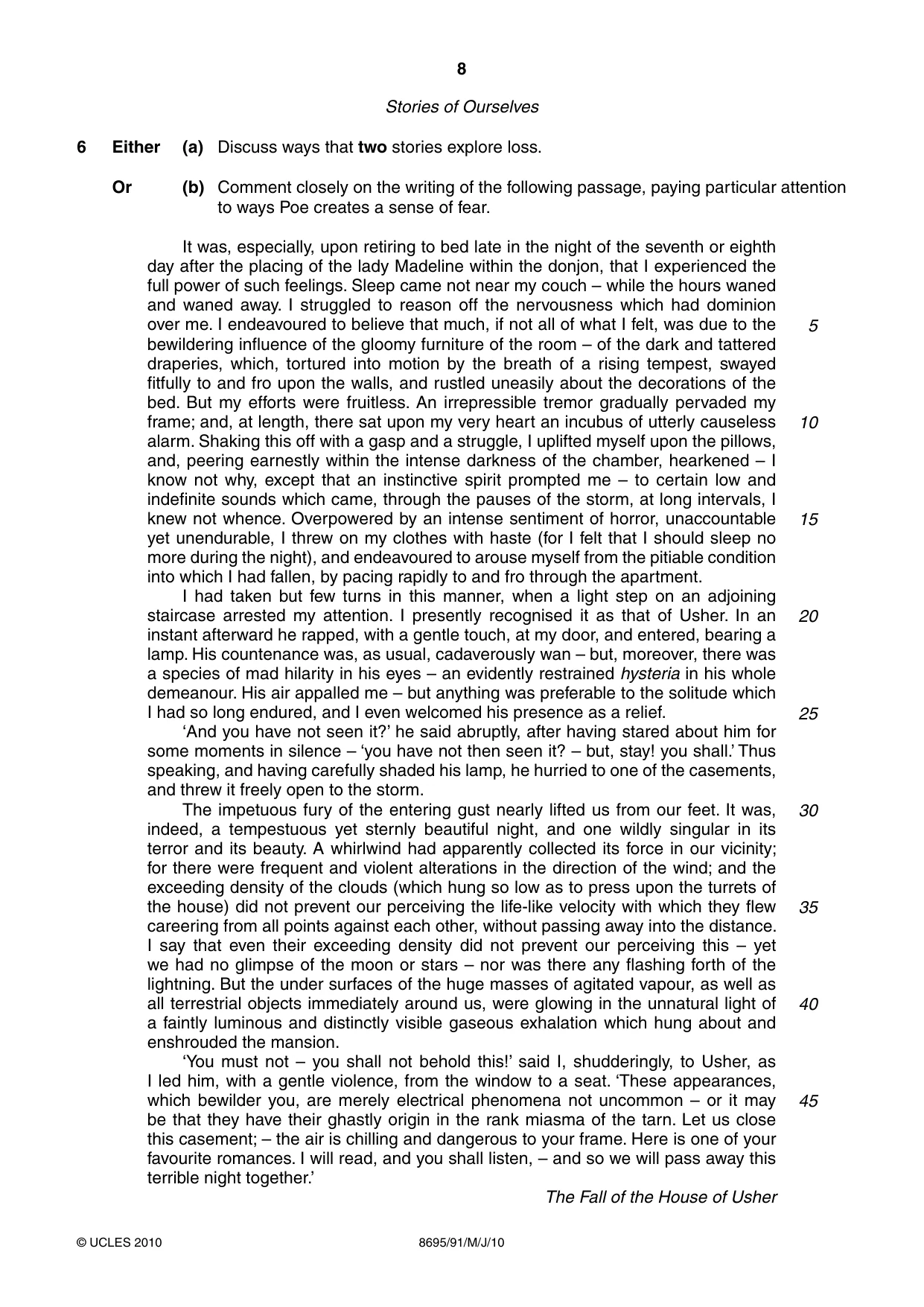
8 8695/91/M/J/10 © UCLES 2010 Stories of Ourselves 6 Either (a) Discuss ways that two stories explore loss. Or (b) Comment closely on the writing of the following passage, paying particular attention to ways Poe creates a sense of fear. It was, especially, upon retiring to bed late in the night of the seventh or eighth day after the placing of the lady Madeline within the donjon, that I experienced the full power of such feelings. Sleep came not near my couch – while the hours waned and waned away. I struggled to reason off the nervousness which had dominion over me. I endeavoured to believe that much, if not all of what I felt, was due to the bewildering influence of the gloomy furniture of the room – of the dark and tattered draperies, which, tortured into motion by the breath of a rising tempest, swayed fitfully to and fro upon the walls, and rustled uneasily about the decorations of the bed. But my efforts were fruitless. An irrepressible tremor gradually pervaded my frame; and, at length, there sat upon my very heart an incubus of utterly causeless alarm. Shaking this off with a gasp and a struggle, I uplifted myself upon the pillows, and, peering earnestly within the intense darkness of the chamber, hearkened – I know not why, except that an instinctive spirit prompted me – to certain low and indefinite sounds which came, through the pauses of the storm, at long intervals, I knew not whence. Overpowered by an intense sentiment of horror, unaccountable yet unendurable, I threw on my clothes with haste (for I felt that I should sleep no more during the night), and endeavoured to arouse myself from the pitiable condition into which I had fallen, by pacing rapidly to and fro through the apartment. I had taken but few turns in this manner, when a light step on an adjoining staircase arrested my attention. I presently recognised it as that of Usher. In an instant afterward he rapped, with a gentle touch, at my door, and entered, bearing a lamp. His countenance was, as usual, cadaverously wan – but, moreover, there was a species of mad hilarity in his eyes – an evidently restrained hysteria in his whole demeanour. His air appalled me – but anything was preferable to the solitude which I had so long endured, and I even welcomed his presence as a relief. ‘And you have not seen it?’ he said abruptly, after having stared about him for some moments in silence – ‘you have not then seen it? – but, stay! you shall.’ Thus speaking, and having carefully shaded his lamp, he hurried to one of the casements, and threw it freely open to the storm. The impetuous fury of the entering gust nearly lifted us from our feet. It was, indeed, a tempestuous yet sternly beautiful night, and one wildly singular in its terror and its beauty. A whirlwind had apparently collected its force in our vicinity; for there were frequent and violent alterations in the direction of the wind; and the exceeding density of the clouds (which hung so low as to press upon the turrets of the house) did not prevent our perceiving the life-like velocity with which they flew careering from all points against each other, without passing away into the distance. I say that even their exceeding density did not prevent our perceiving this – yet we had no glimpse of the moon or stars – nor was there any flashing forth of the lightning. But the under surfaces of the huge masses of agitated vapour, as well as all terrestrial objects immediately around us, were glowing in the unnatural light of a faintly luminous and distinctly visible gaseous exhalation which hung about and enshrouded the mansion. ‘You must not – you shall not behold this!’ said I, shudderingly, to Usher, as I led him, with a gentle violence, from the window to a seat. ‘These appearances, which bewilder you, are merely electrical phenomena not uncommon – or it may be that they have their ghastly origin in the rank miasma of the tarn. Let us close this casement; – the air is chilling and dangerous to your frame. Here is one of your favourite romances. I will read, and you shall listen, – and so we will pass away this terrible night together.’ The Fall of the House of Usher 5 10 15 20 25 30 35 40 45
Question paper, page 9
9 8695/91/M/J/10 © UCLES 2010 [Turn over BLANK PAGE Turn to page 10 for Question 7.
Question paper, page 10
10 8695/91/M/J/10 © UCLES 2010 Section C: Drama ARTHUR MILLER: A View from the Bridge 7 Either (a) Eddie is convinced that Rodolpho ‘ain’t right’. In what ways does Miller explore views of masculinity in the play? Or (b) Comment closely on the ways the following passage presents the relationships between Eddie, Beatrice and Catherine at the beginning of the play. EDDIE Look, did I ask you for money? I supported you this long, I support you a little more. Please, do me a favour, will ya? I want you to be with different kind of people. I want you to be in a nice office. Maybe a lawyer’s office someplace in New York in one of them nice buildings. I mean if you’re gonna get outa here then get out; don’t go practically in the same kind of neighbourhood. [Pause. CATHERINE lowers her eyes.] BEATRICE Go, Baby, bring in the supper. [CATHERINE goes out.] Think about it a little bit, Eddie. Please. She’s crazy to start work. It’s not a little shop, it’s a big company. Some day she could be a secretary. They picked her out of the whole class. [He is silent, staring down at the tablecloth fingering the pattern.] What are you worried about? She could take care of herself. She’ll get out of the subway and be in the office in two minutes. EDDIE [somehow sickened] I know that neighbourhood, B., I don’t like it. BEATRICE Listen, if nothin’ happened to her in this neighbourhood it ain’t gonna happen noplace else. [She turns his face to her.] Look, you gotta get used to it, she’s no baby no more. Tell her to take it. [He turns his head away.] You hear me? [She is angering.] I don’t understand you; she’s seventeen years old, you gonna keep her in the house all her life? EDDIE [insulted] What kinda remark is that? BEATRICE [with sympathy but insistent force] Well, I don’t understand when it ends. First it was gonna be when she graduated high-school, so she graduated high-school. Then it was gonna be when she learned stenographer, so she learned stenographer. So, what’re we gonna wait for now? I mean it, Eddie, sometimes I don’t understand you; they picked her out of the whole class, it’s an honour for her. [CATHERINE enters with food, which she silently sets on the table. After a moment of watching her face, EDDIE breaks into a smile, but it almost seems that tears will form in his eyes.] EDDIE With your hair that way you look like a madonna, you know that? You’re the madonna type. [She doesn’t look at him, but continues ladling out food on to the plates.] You wanna go to work, heh, Madonna? CATHERINE [softly] Yeah. EDDIE [with a sense of her childhood, her babyhood, and the years] All right, go to work. [She looks at him, then rushes and hugs him.] Hey, hey! Take it easy! [He holds her face away from him to look at her.] What’re you cryin’ about? [He is affected by her, but smiles his emotion away.] CATHERINE [sitting at her place] I just – [Bursting out ] I’m gonna buy all new dishes with my first pay! [They laugh warmly.] I mean it. I’ll fix up the whole house! I’ll buy a rug! EDDIE And then you’ll move away. 5 10 15 20 25 30 35 40 45
Question paper, page 11
11 8695/91/M/J/10 © UCLES 2010 [Turn over CATHERINE No, Eddie! EDDIE [grinning] Why not? That’s life. And you’ll come visit on Sundays, then once a month, then Christmas and New Years, finally. CATHERINE [grasping his arm to reassure him and to erase the accusation] No, please! EDDIE [smiling but hurt] I only ask you one thing – don’t trust nobody. You got a good aunt but she’s got too big a heart, you learned bad from her. Believe me. BEATRICE Be the way you are, Katie, don’t listen to him. EDDIE [to BEATRICE – strangely and quickly resentful ] You lived in a house all your life, what do you know about it? You never worked in your life. Act 1 50 55
Question paper, page 12
12 8695/91/M/J/10 © UCLES 2010 PETER SHAFFER: Equus 8 Either (a) ‘Tramping is heard. Three actors playing horses rise from their places. Together they unhook three horse masks from the ladders to left and right, put them on with rigid timing, and walk with swaying movements into the square. Their metal hooves stamp on the wood.’ What dramatic contribution to the play is made by Shaffer’s presentation of the horse chorus? Or (b) Comment closely on the following passage, discussing the significance of this debate to the play. HESTHER I mean he’s in pain, Martin. He’s been in pain for most of his life. That much, at least , you know. DYSART Possibly. HESTHER Possibly?!... That cut-off little figure you just described must have been in pain for years. DYSART [doggedly] Possibly. HESTHER And you can take it away. DYSART Still – possibly. HESTHER Then that’s enough. That simply has to be enough for you, surely? DYSART No! HESTHER Why not? DYSART Because it’s his. HESTHER I don’t understand. DYSART His pain. His own. He made it. Pause. [earnestly] Look... to go through life and call it yours – your life – you first have to get your own pain. Pain that’s unique to you. You can’t just dip into the common bin and say ‘That’s enough!’... He’s done that. All right, he’s sick. He’s full of misery and fear. He was dangerous, and could be again, though I doubt it. But that boy has known a passion more ferocious than I have felt in any second of my life. And let me tell you something: I envy it. HESTHER You can’t. DYSART [vehemently] Don’t you see? That’s the Accusation! That’s what his stare has been saying to me all this time. ‘At least I galloped! When did you?’... [simply] I’m jealous, Hesther. Jealous of Alan Strang. HESTHER That’s absurd. DYSART Is it?... I go on about my wife. That smug woman by the fire. Have you thought of the fellow on the other side of it? The finicky, critical husband looking through his art books on mythical Greece. What worship has he ever known? Real worship! Without worship you shrink, it’s as brutal as that... I shrank my own life. No one can do it for you. I settled for being pallid and provincial, out of my own eternal timidity. The old story of bluster, and do bugger-all... I imply that we can’t have children: but actually, it’s only me. I had myself tested behind her back. The lowest sperm count you could find. And I never told her. That’s all I need – her sympathy mixed with resentment... I tell everyone Magaret’s the puritan, I’m the pagan. Some pagan! Such wild returns I make to the womb of civilization. Three weeks a year in the Peleponnese, every bed booked in advance, every meal paid for by vouchers, cautious jaunts in hired Fiats, suitcase crammed with Kao-Pectate! Such a fantastic surrender to the primitive. And I use that word endlessly: ‘primitive’. ‘Oh, the primitive world,’ I say. 5 10 15 20 25 30 35 40
Question paper, page 13
13 8695/91/M/J/10 © UCLES 2010 [Turn over ‘What instinctual truths were lost with it!’ And while I sit there, baiting a poor unimaginative woman with the word, that freaky boy tries to conjure the reality! I sit looking at pages of centaurs trampling the soil of Argos – and outside my window he is trying to become one, in a Hampshire field!... I watch that woman knitting, night after night – a woman I haven’t kissed in six years – and he stands in the dark for an hour, sucking the sweat off his God’s hairy cheek! [pause] Then in the morning, I put away my books on the cultural shelf, close up the Kodachrome snaps of Mount Olympus, touch my reproduction statue of Dionysus for luck – and go off to hospital to treat him for insanity. Do you see? HESTHER The boy’s in pain, Martin. That’s all I see. In the end... I’m sorry. Act 2, Scene 25 45 50 55
Question paper, page 14
14 8695/91/M/J/10 © UCLES 2010 WILLIAM SHAKESPEARE: Henry IV Part 1 9 Either (a) What are the dramatic effects of the play’s frequent contrasts between the world of the court and the world of the tavern? Or (b) Comment closely on the following passage, looking in particular at what it contributes to the characterisation of King Henry IV. KING God pardon thee! Yet let me wonder, Harry, At thy affections, which do hold a wing Quite from the flight of all thy ancestors. Thy place in council thou hast rudely lost, Which by thy younger brother is supplied, And art almost an alien to the hearts Of all the court and princes of my blood. The hope and expectation of thy time Is ruin’d, and the soul of every man Prophetically do forethink thy fall. Had I so lavish of my presence been, So common-hackney’d in the eyes of men, So stale and cheap to vulgar company, Opinion, that did help me to the crown, Had still kept loyal to possession And left me in reputeless banishment A fellow of no mark nor likelihood. By being seldom seen, I could not stir But, like a comet, I was wond’red at; That men would tell their children ‘This is he’; Others would say ‘Where, which is Bolingbroke?’ And then I stole all courtesy from heaven, And dress’d myself in such humility That I did pluck allegiance from men’s hearts, Loud shouts and salutations from their mouths, Even in the presence of the crowned King. Thus did I keep my person fresh and new, My presence, like a robe pontifical, Ne’er seen but wond’red at, and so my state, Seldom but sumptuous, show’d like a feast And won by rareness such solemnity. The skipping King, he ambled up and down With shallow jesters and rash bavin wits, Soon kindled and soon burnt; carded his state, Mingled his royalty with cap’ring fools; Had his great name profaned with their scorns, And gave his countenance, against his name, To laugh at gibing boys and stand the push Of every beardless vain comparative; Grew a companion to the common streets, Enfeoff’d himself to popularity; That, being daily swallowed by men’s eyes, They surfeited with honey and began To loathe the taste of sweetness, whereof a little More than a little is by much too much. So, when he had occasion to be seen, He was but as the cuckoo is in June, Heard, not regarded, seen, but with such eyes 5 10 15 20 25 30 35 40 45
Question paper, page 15
15 8695/91/M/J/10 © UCLES 2010 As, sick and blunted with community, Afford no extraordinary gaze, Such as is bent on sun-like majesty When it shines seldom in admiring eyes; But rather drowz’d and hung their eyelids down, Slept in his face, and rend’red such aspect As cloudy men use to their adversaries, Being with his presence glutted, gorg’d, and full. And in that very line, Harry, standest thou; For thou hast lost thy princely privilege With vile participation. Not an eye But is aweary of thy common sight, Save mine, which hath desir’d to see thee more; Which now doth that I would not have it do – Make blind itself with foolish tenderness. PRINCE I shall hereafter, my thrice-gracious lord, Be more myself. Act 3, Scene 2 50 55 60 65
Question paper, page 16
16 8695/91/M/J/10 © UCLES 2010 BLANK PAGE Copyright Acknowledgements: Question 1b © Sujata Bhatt; Point No Point ; Carcanet Press; 1997. Question 5b © Tsitsi Dangarembga; Nervous Conditions ; Ayesia Clarke Publishing; 1988. Question 7b © Arthur Miller; A View from the Bridge ; The Wylie Agency; 1984. Question 8b © Peter Shaffer; Equus ; Penguin Books Ltd; 1993. Permission to reproduce items where third-party owned material protected by copyright is included has been sought and cleared where possible. Every reasonable effort has been made by the publisher (UCLES) to trace copyright holders, but if any items requiring clearance have unwittingly been included, the publisher will be pleased to make amends at the earliest possible opportunity. University of Cambridge International Examinations is part of the Cambridge Assessment Group. Cambridge Assessment is the brand name of University of Cambridge Local Examinations Syndicate (UCLES), which is itself a department of the University of Cambridge.
Mark scheme, page 1
UNIVERSITY OF CAMBRIDGE INTERNATIONAL EXAMINATIONS GCE Advanced Subsidiary Level and GCE Advanced Level MARK SCHEME for the May/June 2010 question paper for the guidance of teachers 8695 LANGUAGE AND LITERATURE IN ENGLISH 8695/91 Paper 91 (Poetry, Prose, Drama), maximum raw mark 50 This mark scheme is published as an aid to teachers and candidates, to indicate the requirements of the examination. It shows the basis on which Examiners were instructed to award marks. It does not indicate the details of the discussions that took place at an Examiners’ meeting before marking began, which would have considered the acceptability of alternative answers. Mark schemes must be read in conjunction with the question papers and the report on the examination. • CIE will not enter into discussions or correspondence in connection with these mark schemes. CIE is publishing the mark schemes for the May/June 2010 question papers for most IGCSE, GCE Advanced Level and Advanced Subsidiary Level syllabuses and some Ordinary Level syllabuses.
Mark scheme, page 2
Page 2 Mark Scheme: Teachers’ version Syllabus Paper GCE A/AS LEVEL – May/June 2010 8695 91 © UCLES 2010 Using the mark bands Place the answer in a band first. Look for the “best fit” of the answer into a band. An answer needs to show evidence of most but not necessarily ALL of the qualities described in a band, in order to be placed in that band. Then award a mark for the relative position of the answer within the band. Candidates may address the question in many different ways. Do not expect any particular focus or approach and do not penalise answers for leaving out a particular focus. Reward what is there, showing what you are rewarding, in your comments. Consider all strands and weigh up the performance as a whole in placing the answer in a band, then show that you have done so in the summative comment, e.g. Sound K of texts, some evidence of U but mostly narrative, occasional evidence of P, mainly clear C Assessment Objectives: • Ability to respond to texts in the three main forms (Prose, Poetry and Drama) of different types and from different cultures; • Understanding of the ways in which writers' choices of form, structure and language shape meanings; • Ability to produce informed independent opinions and judgements on literary texts; • Ability to communicate clearly the knowledge, understanding and insight appropriate to literary study. Each answer is marked out of 25, in accordance with the General Marking Criteria below. Each band is divided into strands corresponding to the Assessment Objectives – Knowledge, Understanding, Personal Response, Communication. Band 6 0–5 K Some textual knowledge which may be narrative based and may contain errors. U Limited understanding of form, structure and language will be demonstrated. Some appropriate points made in response to the question. These will be limited and tend to be restricted to levels of plot and characters – the latter treated very much as "real" people. P There may be some signs of personal response, not developed into an argument, not fully supported from the text. C Communication will be insecure. Expression may be weak with multiple errors and some breakdown in communication. Structure may be lacking: answers are likely to be partial, undeveloped, narrative commentary in approach; with the assertion of simple points rather than progressive lines of argument. Answers to passage-based questions are likely to be seriously unbalanced, with an emphasis on narrative or paraphrase. Passages are likely to have been only partially understood and tentatively located contextually, with little coherent sense of the relationship between textual part and whole.
Mark scheme, page 3
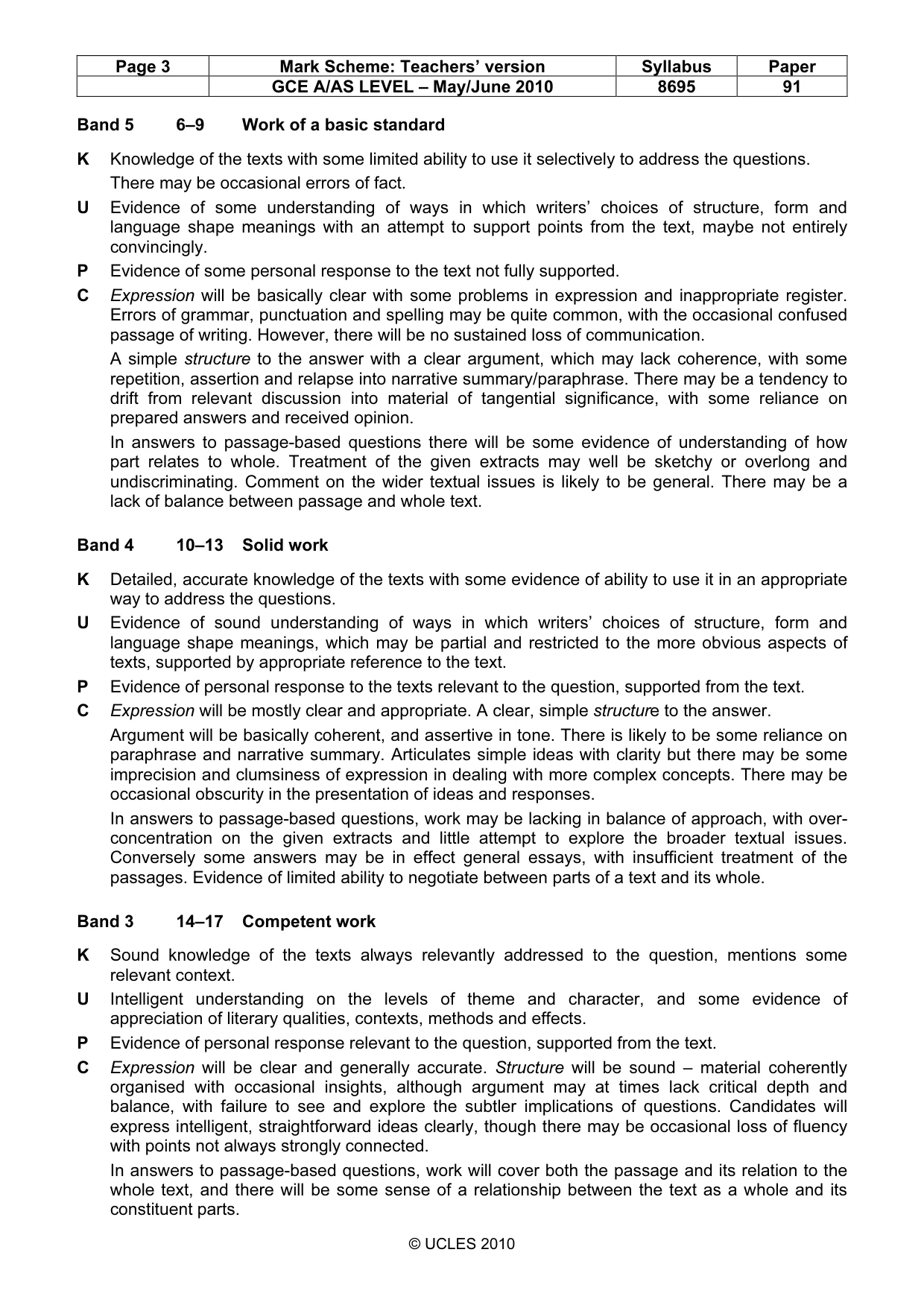
Page 3 Mark Scheme: Teachers’ version Syllabus Paper GCE A/AS LEVEL – May/June 2010 8695 91 © UCLES 2010 Band 5 6–9 Work of a basic standard K Knowledge of the texts with some limited ability to use it selectively to address the questions. There may be occasional errors of fact. U Evidence of some understanding of ways in which writers’ choices of structure, form and language shape meanings with an attempt to support points from the text, maybe not entirely convincingly. P Evidence of some personal response to the text not fully supported. C Expression will be basically clear with some problems in expression and inappropriate register. Errors of grammar, punctuation and spelling may be quite common, with the occasional confused passage of writing. However, there will be no sustained loss of communication. A simple structure to the answer with a clear argument, which may lack coherence, with some repetition, assertion and relapse into narrative summary/paraphrase. There may be a tendency to drift from relevant discussion into material of tangential significance, with some reliance on prepared answers and received opinion. In answers to passage-based questions there will be some evidence of understanding of how part relates to whole. Treatment of the given extracts may well be sketchy or overlong and undiscriminating. Comment on the wider textual issues is likely to be general. There may be a lack of balance between passage and whole text. Band 4 10–13 Solid work K Detailed, accurate knowledge of the texts with some evidence of ability to use it in an appropriate way to address the questions. U Evidence of sound understanding of ways in which writers’ choices of structure, form and language shape meanings, which may be partial and restricted to the more obvious aspects of texts, supported by appropriate reference to the text. P Evidence of personal response to the texts relevant to the question, supported from the text. C Expression will be mostly clear and appropriate. A clear, simple structure to the answer. Argument will be basically coherent, and assertive in tone. There is likely to be some reliance on paraphrase and narrative summary. Articulates simple ideas with clarity but there may be some imprecision and clumsiness of expression in dealing with more complex concepts. There may be occasional obscurity in the presentation of ideas and responses. In answers to passage-based questions, work may be lacking in balance of approach, with over- concentration on the given extracts and little attempt to explore the broader textual issues. Conversely some answers may be in effect general essays, with insufficient treatment of the passages. Evidence of limited ability to negotiate between parts of a text and its whole. Band 3 14–17 Competent work K Sound knowledge of the texts always relevantly addressed to the question, mentions some relevant context. U Intelligent understanding on the levels of theme and character, and some evidence of appreciation of literary qualities, contexts, methods and effects. P Evidence of personal response relevant to the question, supported from the text. C Expression will be clear and generally accurate. Structure will be sound – material coherently organised with occasional insights, although argument may at times lack critical depth and balance, with failure to see and explore the subtler implications of questions. Candidates will express intelligent, straightforward ideas clearly, though there may be occasional loss of fluency with points not always strongly connected. In answers to passage-based questions, work will cover both the passage and its relation to the whole text, and there will be some sense of a relationship between the text as a whole and its constituent parts.
Mark scheme, page 4
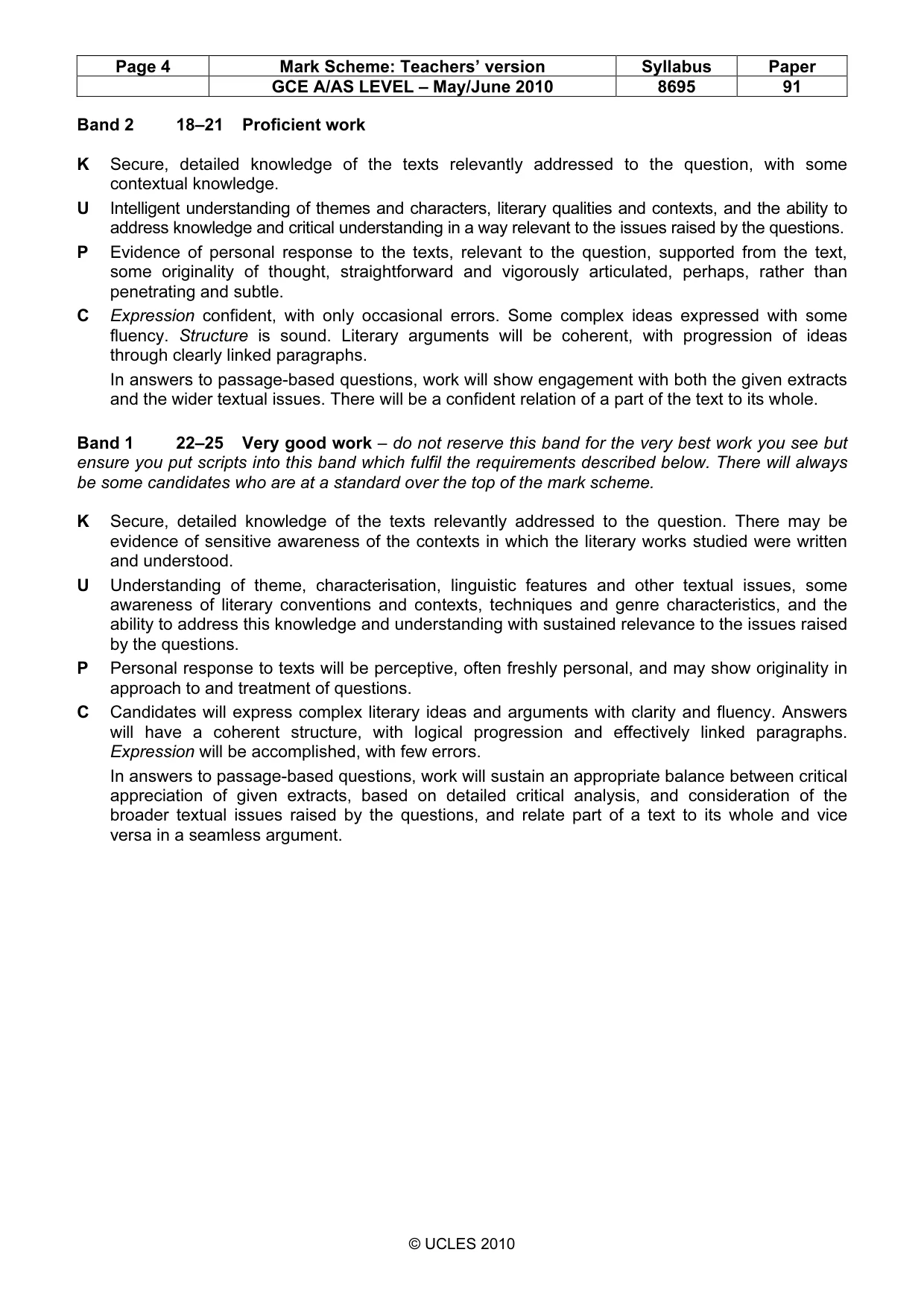
Page 4 Mark Scheme: Teachers’ version Syllabus Paper GCE A/AS LEVEL – May/June 2010 8695 91 © UCLES 2010 Band 2 18–21 Proficient work K Secure, detailed knowledge of the texts relevantly addressed to the question, with some contextual knowledge. U Intelligent understanding of themes and characters, literary qualities and contexts, and the ability to address knowledge and critical understanding in a way relevant to the issues raised by the questions. P Evidence of personal response to the texts, relevant to the question, supported from the text, some originality of thought, straightforward and vigorously articulated, perhaps, rather than penetrating and subtle. C Expression confident, with only occasional errors. Some complex ideas expressed with some fluency. Structure is sound. Literary arguments will be coherent, with progression of ideas through clearly linked paragraphs. In answers to passage-based questions, work will show engagement with both the given extracts and the wider textual issues. There will be a confident relation of a part of the text to its whole. Band 1 22–25 Very good work – do not reserve this band for the very best work you see but ensure you put scripts into this band which fulfil the requirements described below. There will always be some candidates who are at a standard over the top of the mark scheme. K Secure, detailed knowledge of the texts relevantly addressed to the question. There may be evidence of sensitive awareness of the contexts in which the literary works studied were written and understood. U Understanding of theme, characterisation, linguistic features and other textual issues, some awareness of literary conventions and contexts, techniques and genre characteristics, and the ability to address this knowledge and understanding with sustained relevance to the issues raised by the questions. P Personal response to texts will be perceptive, often freshly personal, and may show originality in approach to and treatment of questions. C Candidates will express complex literary ideas and arguments with clarity and fluency. Answers will have a coherent structure, with logical progression and effectively linked paragraphs. Expression will be accomplished, with few errors. In answers to passage-based questions, work will sustain an appropriate balance between critical appreciation of given extracts, based on detailed critical analysis, and consideration of the broader textual issues raised by the questions, and relate part of a text to its whole and vice versa in a seamless argument.
What you needed in this session
Cambridge’s own grade thresholds for 2010 May/June, Paper 9 · Variant 1. A higher threshold means an easier paper — the bar moves with how the cohort did.