Cambridge A Level English General Paper 8021 — 2022 May/June Paper 1 · Variant 1
8021/11/M/J/22 · 30 marks · ≈34 min
The question paper and its mark scheme, free to read here and free to download. This is Cambridge’s own paper, exactly as it was sat.
Question paper4 pages


Mark scheme16 pages
Answers below. Sit the paper first if you are practising.
Paper as text
Question paper, page 1
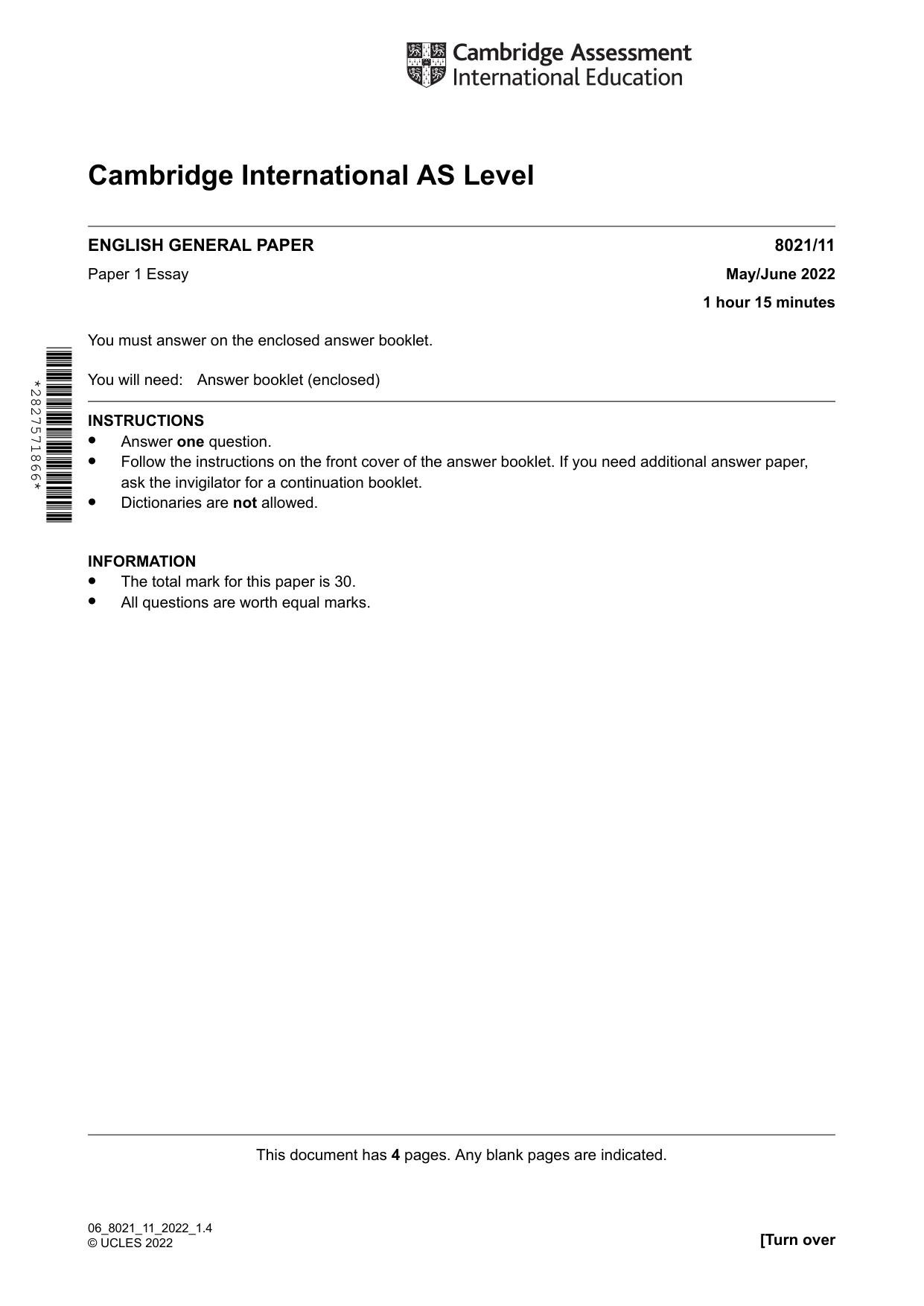
Cambridge International AS Level 8021/11 May/June 2022 1 hour 15 minutes ENGLISH GENERAL PAPER Paper 1 Essay You must answer on the enclosed answer booklet. You will need: Answer booklet (enclosed) INSTRUCTIONS • Answer one question. • Follow the instructions on the front cover of the answer booklet. If you need additional answer paper, ask the invigilator for a continuation booklet. • Dictionaries are not allowed. INFORMATION • The total mark for this paper is 30. • All questions are worth equal marks. This document has 4 pages. Any blank pages are indicated. [Turn over 06_8021_11_2022_1.4 © UCLES 2022 *2827571866*
Question paper, page 2
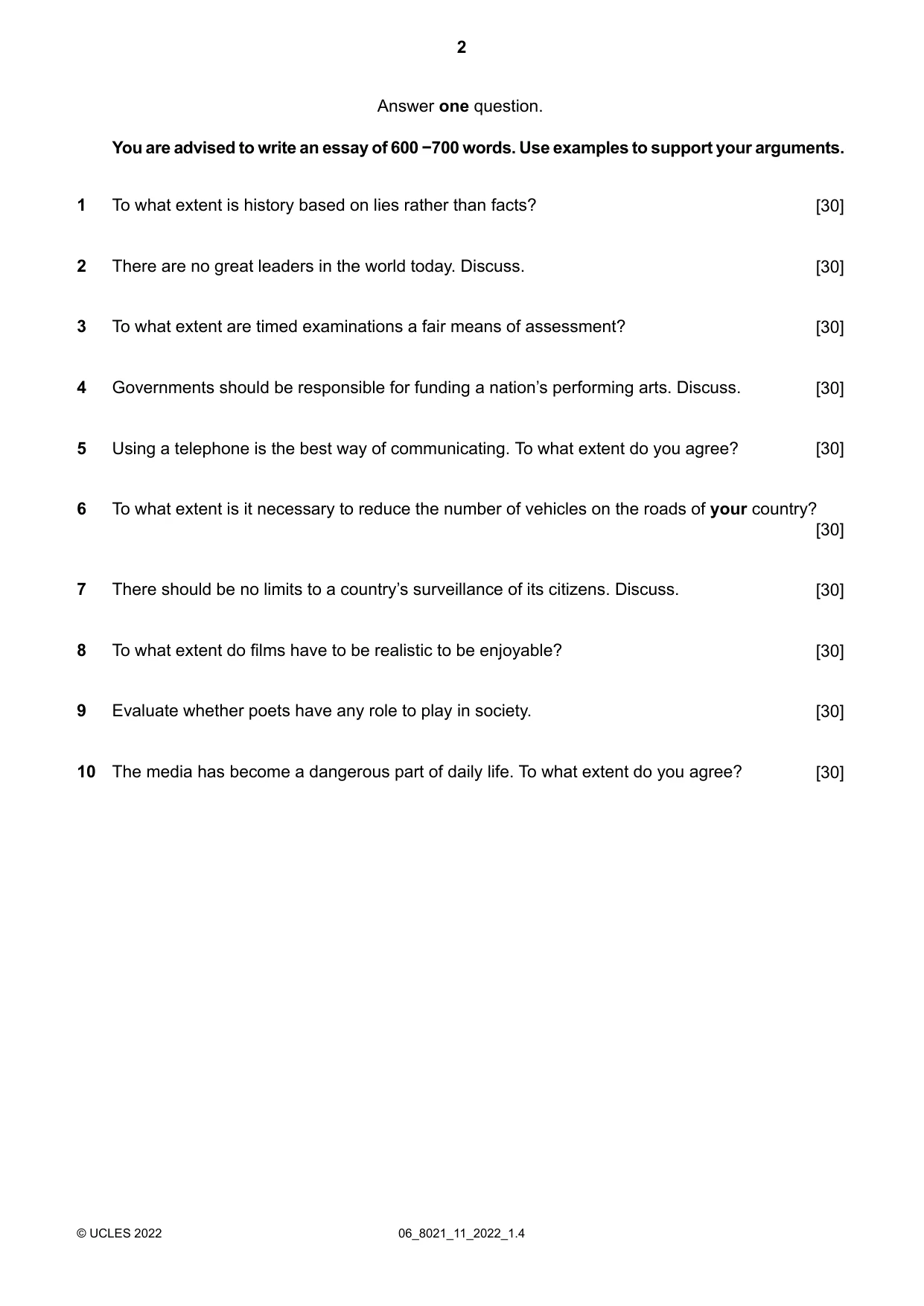
Answer one question. You are advised to write an essay of 600 −700 words. Use examples to support your arguments. To what extent is history based on lies rather than facts? [30] 1 There are no great leaders in the world today. Discuss. [30] 2 To what extent are timed examinations a fair means of assessment? [30] 3 Governments should be responsible for funding a nation’s performing arts. Discuss. [30] 4 Using a telephone is the best way of communicating. To what extent do you agree? [30] 5 To what extent is it necessary to reduce the number of vehicles on the roads of your country? [30] 6 There should be no limits to a country’s surveillance of its citizens. Discuss. [30] 7 To what extent do films have to be realistic to be enjoyable? [30] 8 Evaluate whether poets have any role to play in society. [30] 9 The media has become a dangerous part of daily life. To what extent do you agree? [30] 10 06_8021_11_2022_1.4 © UCLES 2022 2
Question paper, page 3
BLANK PAGE 06_8021_11_2022_1.4 © UCLES 2022 3
Question paper, page 4
BLANK PAGE Permission to reproduce items where third-party owned material protected by copyright is included has been sought and cleared where possible. Every reasonable effort has been made by the publisher (UCLES) to trace copyright holders, but if any items requiring clearance have unwittingly been included, the publisher will be pleased to make amends at the earliest possible opportunity. To avoid the issue of disclosure of answer-related information to candidates, all copyright acknowledgements are reproduced online in the Cambridge Assessment International Education Copyright Acknowledgements Booklet. This is produced for each series of examinations and is freely available to download at www.cambridgeinternational.org after the live examination series. Cambridge Assessment International Education is part of Cambridge Assessment. Cambridge Assessment is the brand name of the University of Cambridge Local Examinations Syndicate (UCLES), which is a department of the University of Cambridge. 06_8021_11_2022_1.4 © UCLES 2022 4
Mark scheme, page 1
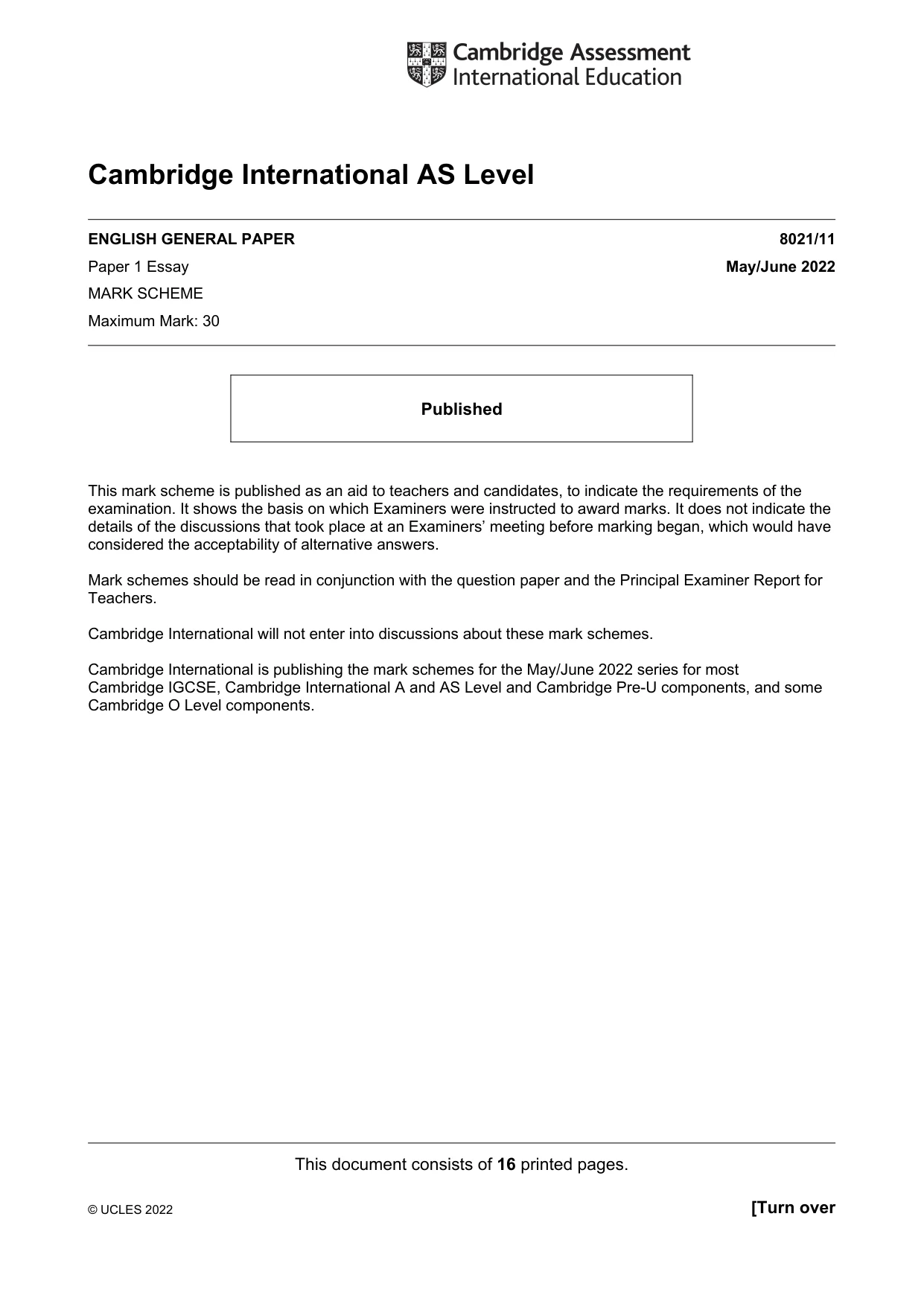
This document consists of 16 printed pages. © UCLES 2022 [Turn over Cambridge International AS Level ENGLISH GENERAL PAPER 8021/11 Paper 1 Essay May/June 2022 MARK SCHEME Maximum Mark: 30 Published This mark scheme is published as an aid to teachers and candidates, to indicate the requirements of the examination. It shows the basis on which Examiners were instructed to award marks. It does not indicate the details of the discussions that took place at an Examiners’ meeting before marking began, which would have considered the acceptability of alternative answers. Mark schemes should be read in conjunction with the question paper and the Principal Examiner Report for Teachers. Cambridge International will not enter into discussions about these mark schemes. Cambridge International is publishing the mark schemes for the May/June 2022 series for most Cambridge IGCSE, Cambridge International A and AS Level and Cambridge Pre-U components, and some Cambridge O Level components.
Mark scheme, page 2
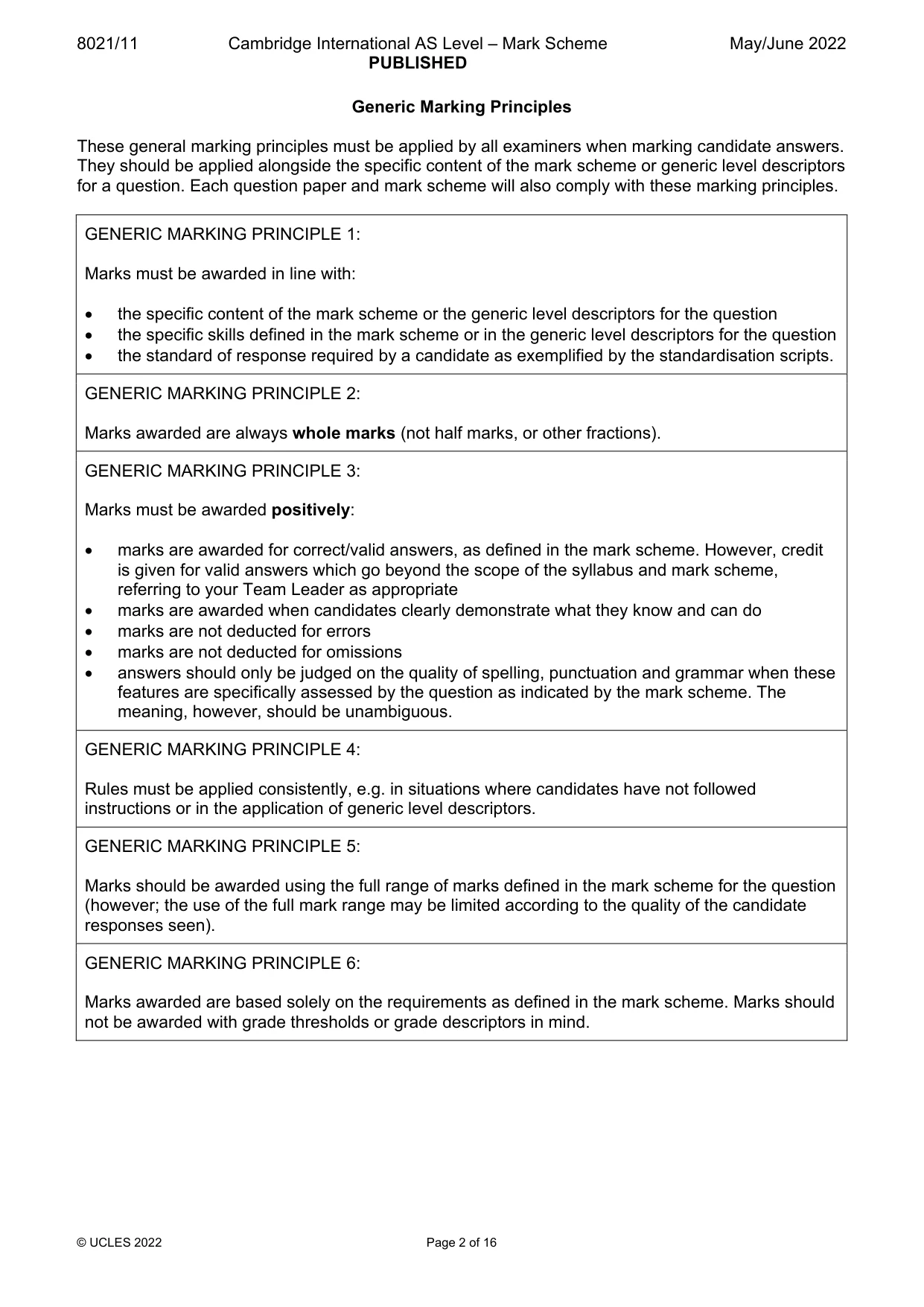
8021/11 Cambridge International AS Level – Mark Scheme PUBLISHED May/June 2022 © UCLES 2022 Page 2 of 16 Generic Marking Principles These general marking principles must be applied by all examiners when marking candidate answers. They should be applied alongside the specific content of the mark scheme or generic level descriptors for a question. Each question paper and mark scheme will also comply with these marking principles. GENERIC MARKING PRINCIPLE 1: Marks must be awarded in line with: the specific content of the mark scheme or the generic level descriptors for the question the specific skills defined in the mark scheme or in the generic level descriptors for the question the standard of response required by a candidate as exemplified by the standardisation scripts. GENERIC MARKING PRINCIPLE 2: Marks awarded are always whole marks (not half marks, or other fractions). GENERIC MARKING PRINCIPLE 3: Marks must be awarded positively: marks are awarded for correct/valid answers, as defined in the mark scheme. However, credit is given for valid answers which go beyond the scope of the syllabus and mark scheme, referring to your Team Leader as appropriate marks are awarded when candidates clearly demonstrate what they know and can do marks are not deducted for errors marks are not deducted for omissions answers should only be judged on the quality of spelling, punctuation and grammar when these features are specifically assessed by the question as indicated by the mark scheme. The meaning, however, should be unambiguous. GENERIC MARKING PRINCIPLE 4: Rules must be applied consistently, e.g. in situations where candidates have not followed instructions or in the application of generic level descriptors. GENERIC MARKING PRINCIPLE 5: Marks should be awarded using the full range of marks defined in the mark scheme for the question (however; the use of the full mark range may be limited according to the quality of the candidate responses seen). GENERIC MARKING PRINCIPLE 6: Marks awarded are based solely on the requirements as defined in the mark scheme. Marks should not be awarded with grade thresholds or grade descriptors in mind.
Mark scheme, page 3
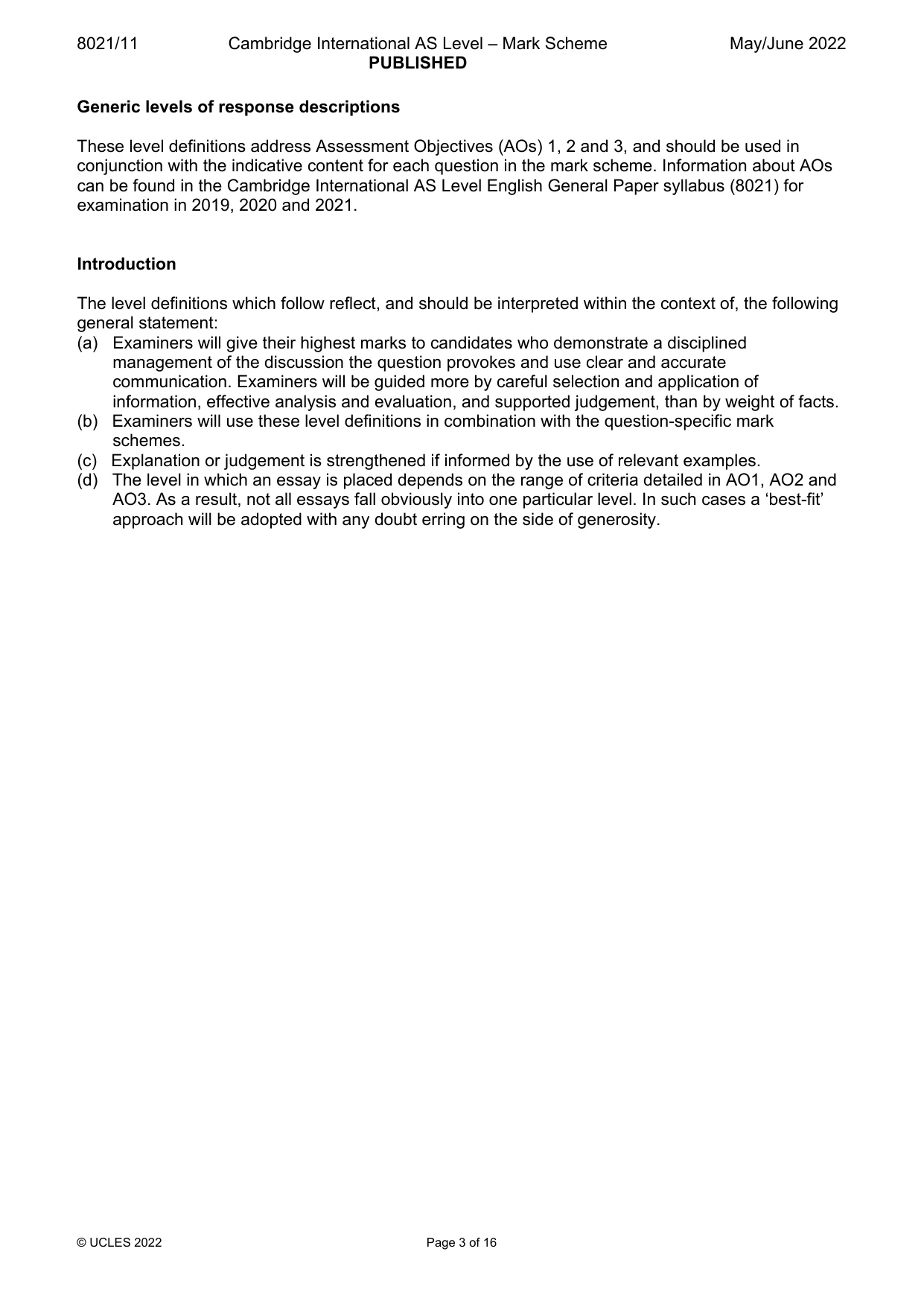
8021/11 Cambridge International AS Level – Mark Scheme PUBLISHED May/June 2022 © UCLES 2022 Page 3 of 16 Generic levels of response descriptions These level definitions address Assessment Objectives (AOs) 1, 2 and 3, and should be used in conjunction with the indicative content for each question in the mark scheme. Information about AOs can be found in the Cambridge International AS Level English General Paper syllabus (8021) for examination in 2019, 2020 and 2021. Introduction The level definitions which follow reflect, and should be interpreted within the context of, the following general statement: (a) Examiners will give their highest marks to candidates who demonstrate a disciplined management of the discussion the question provokes and use clear and accurate communication. Examiners will be guided more by careful selection and application of information, effective analysis and evaluation, and supported judgement, than by weight of facts. (b) Examiners will use these level definitions in combination with the question-specific mark schemes. (c) Explanation or judgement is strengthened if informed by the use of relevant examples. (d) The level in which an essay is placed depends on the range of criteria detailed in AO1, AO2 and AO3. As a result, not all essays fall obviously into one particular level. In such cases a ‘best-fit’ approach will be adopted with any doubt erring on the side of generosity.
Mark scheme, page 4
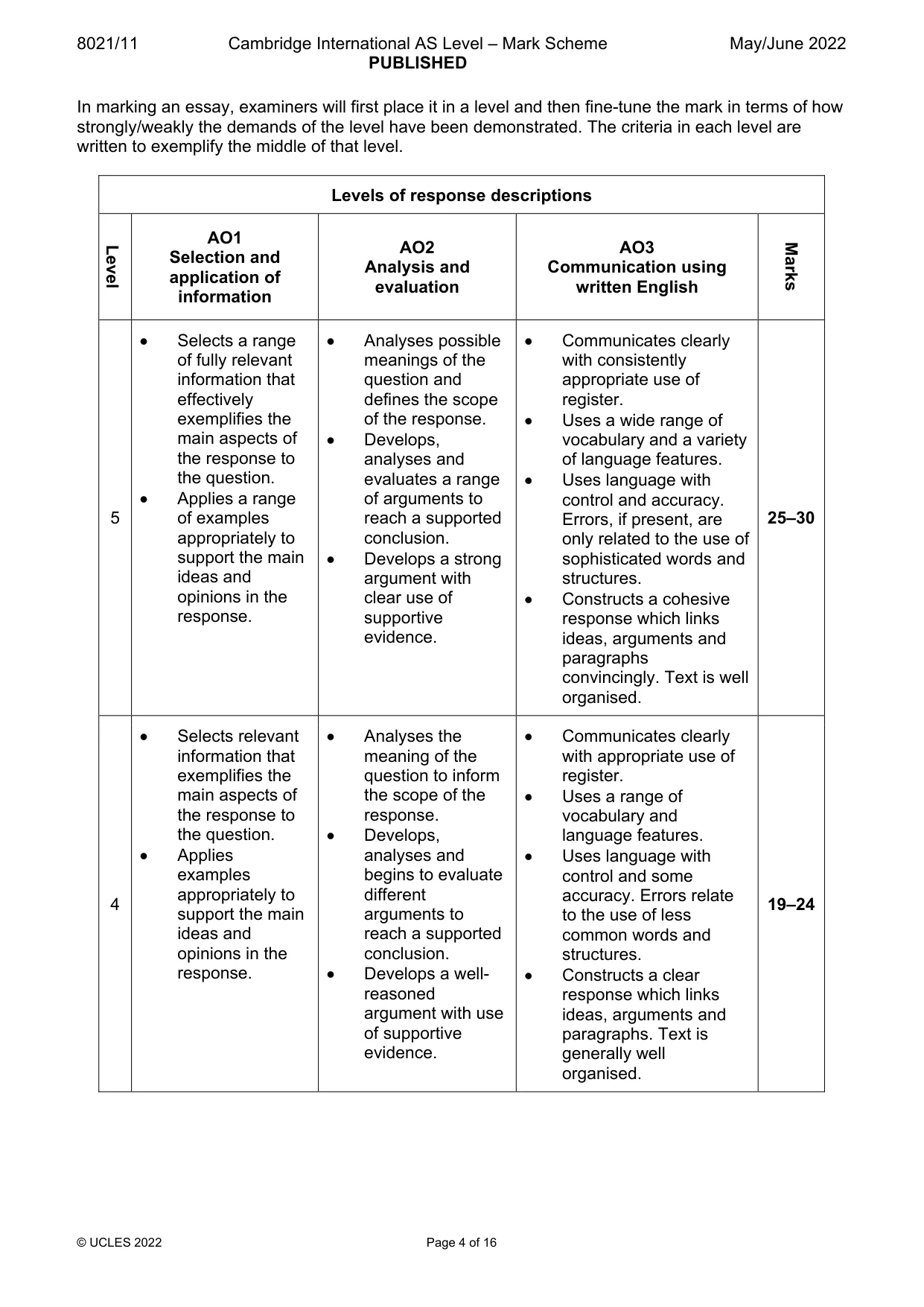
8021/11 Cambridge International AS Level – Mark Scheme PUBLISHED May/June 2022 © UCLES 2022 Page 4 of 16 In marking an essay, examiners will first place it in a level and then fine-tune the mark in terms of how strongly/weakly the demands of the level have been demonstrated. The criteria in each level are written to exemplify the middle of that level. Levels of response descriptions Level AO1 Selection and application of information AO2 Analysis and evaluation AO3 Communication using written English Marks 5 Selects a range of fully relevant information that effectively exemplifies the main aspects of the response to the question. Applies a range of examples appropriately to support the main ideas and opinions in the response. Analyses possible meanings of the question and defines the scope of the response. Develops, analyses and evaluates a range of arguments to reach a supported conclusion. Develops a strong argument with clear use of supportive evidence. Communicates clearly with consistently appropriate use of register. Uses a wide range of vocabulary and a variety of language features. Uses language with control and accuracy. Errors, if present, are only related to the use of sophisticated words and structures. Constructs a cohesive response which links ideas, arguments and paragraphs convincingly. Text is well organised. 25–30 4 Selects relevant information that exemplifies the main aspects of the response to the question. Applies examples appropriately to support the main ideas and opinions in the response. Analyses the meaning of the question to inform the scope of the response. Develops, analyses and begins to evaluate different arguments to reach a supported conclusion. Develops a well- reasoned argument with use of supportive evidence. Communicates clearly with appropriate use of register. Uses a range of vocabulary and language features. Uses language with control and some accuracy. Errors relate to the use of less common words and structures. Constructs a clear response which links ideas, arguments and paragraphs. Text is generally well organised. 19–24
Mark scheme, page 5
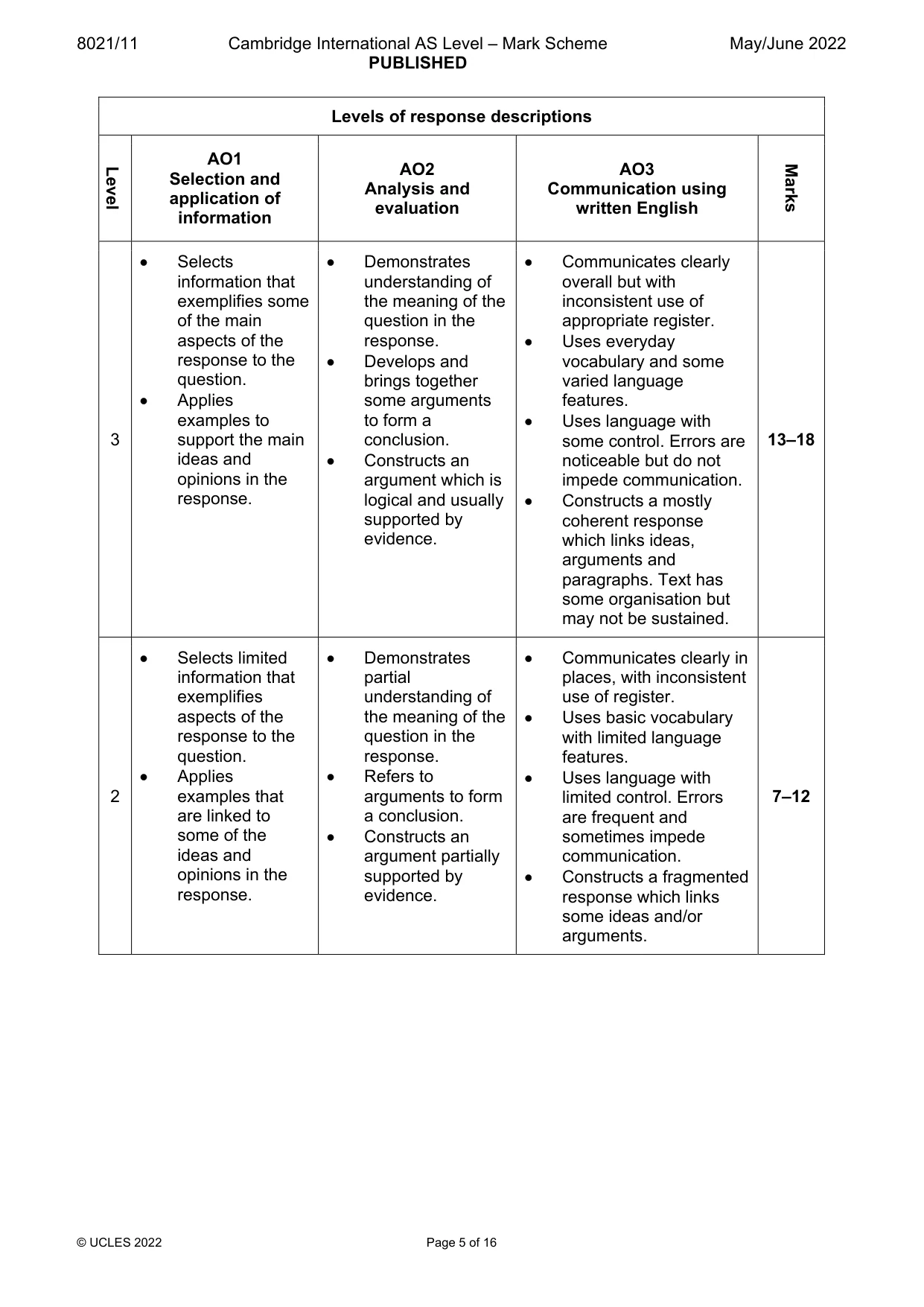
8021/11 Cambridge International AS Level – Mark Scheme PUBLISHED May/June 2022 © UCLES 2022 Page 5 of 16 Levels of response descriptions Level AO1 Selection and application of information AO2 Analysis and evaluation AO3 Communication using written English Marks 3 Selects information that exemplifies some of the main aspects of the response to the question. Applies examples to support the main ideas and opinions in the response. Demonstrates understanding of the meaning of the question in the response. Develops and brings together some arguments to form a conclusion. Constructs an argument which is logical and usually supported by evidence. Communicates clearly overall but with inconsistent use of appropriate register. Uses everyday vocabulary and some varied language features. Uses language with some control. Errors are noticeable but do not impede communication. Constructs a mostly coherent response which links ideas, arguments and paragraphs. Text has some organisation but may not be sustained. 13–18 2 Selects limited information that exemplifies aspects of the response to the question. Applies examples that are linked to some of the ideas and opinions in the response. Demonstrates partial understanding of the meaning of the question in the response. Refers to arguments to form a conclusion. Constructs an argument partially supported by evidence. Communicates clearly in places, with inconsistent use of register. Uses basic vocabulary with limited language features. Uses language with limited control. Errors are frequent and sometimes impede communication. Constructs a fragmented response which links some ideas and/or arguments. 7–12
Mark scheme, page 6
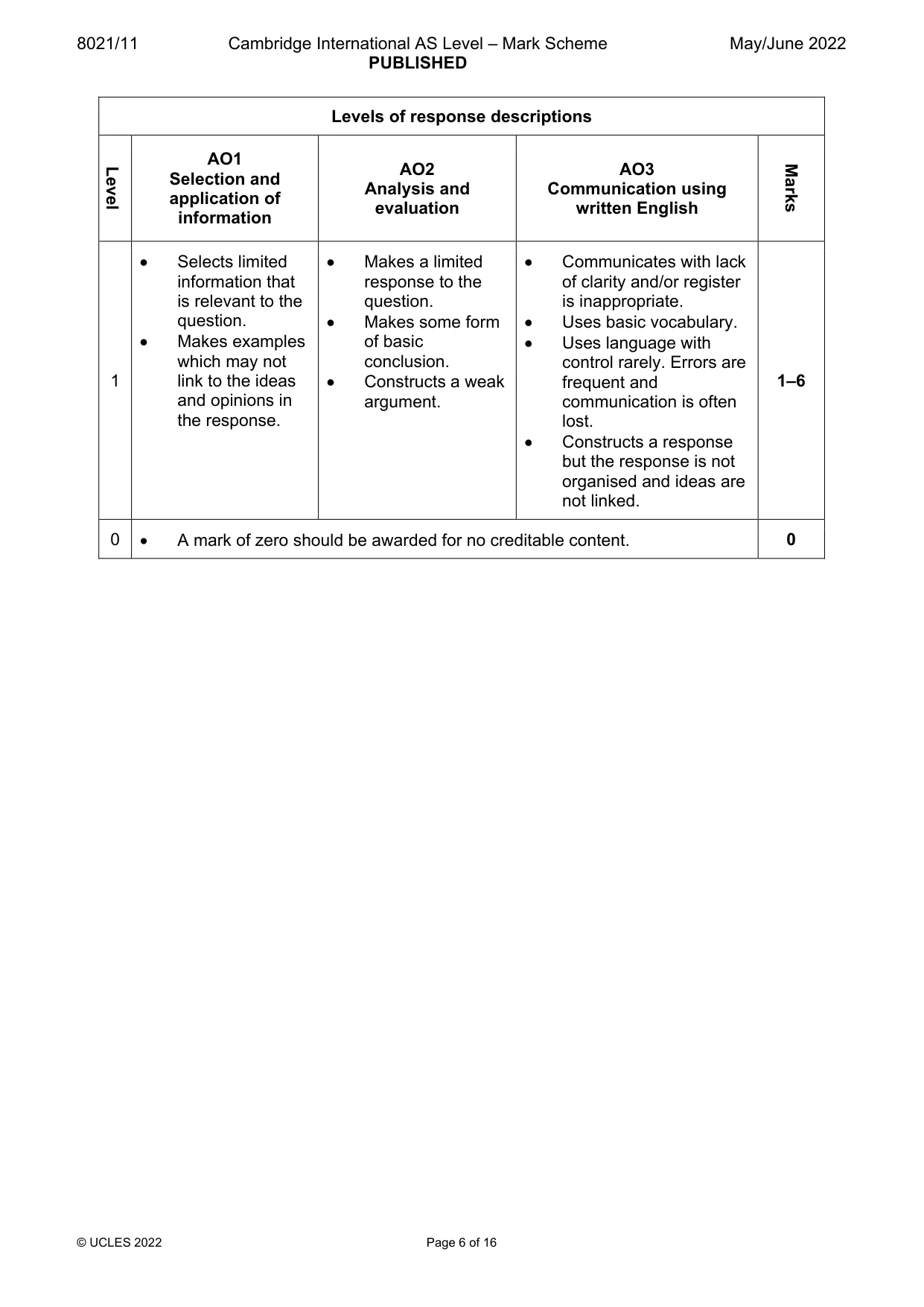
8021/11 Cambridge International AS Level – Mark Scheme PUBLISHED May/June 2022 © UCLES 2022 Page 6 of 16 Levels of response descriptions Level AO1 Selection and application of information AO2 Analysis and evaluation AO3 Communication using written English Marks 1 Selects limited information that is relevant to the question. Makes examples which may not link to the ideas and opinions in the response. Makes a limited response to the question. Makes some form of basic conclusion. Constructs a weak argument. Communicates with lack of clarity and/or register is inappropriate. Uses basic vocabulary. Uses language with control rarely. Errors are frequent and communication is often lost. Constructs a response but the response is not organised and ideas are not linked. 1–6 0 A mark of zero should be awarded for no creditable content. 0
Mark scheme, page 7
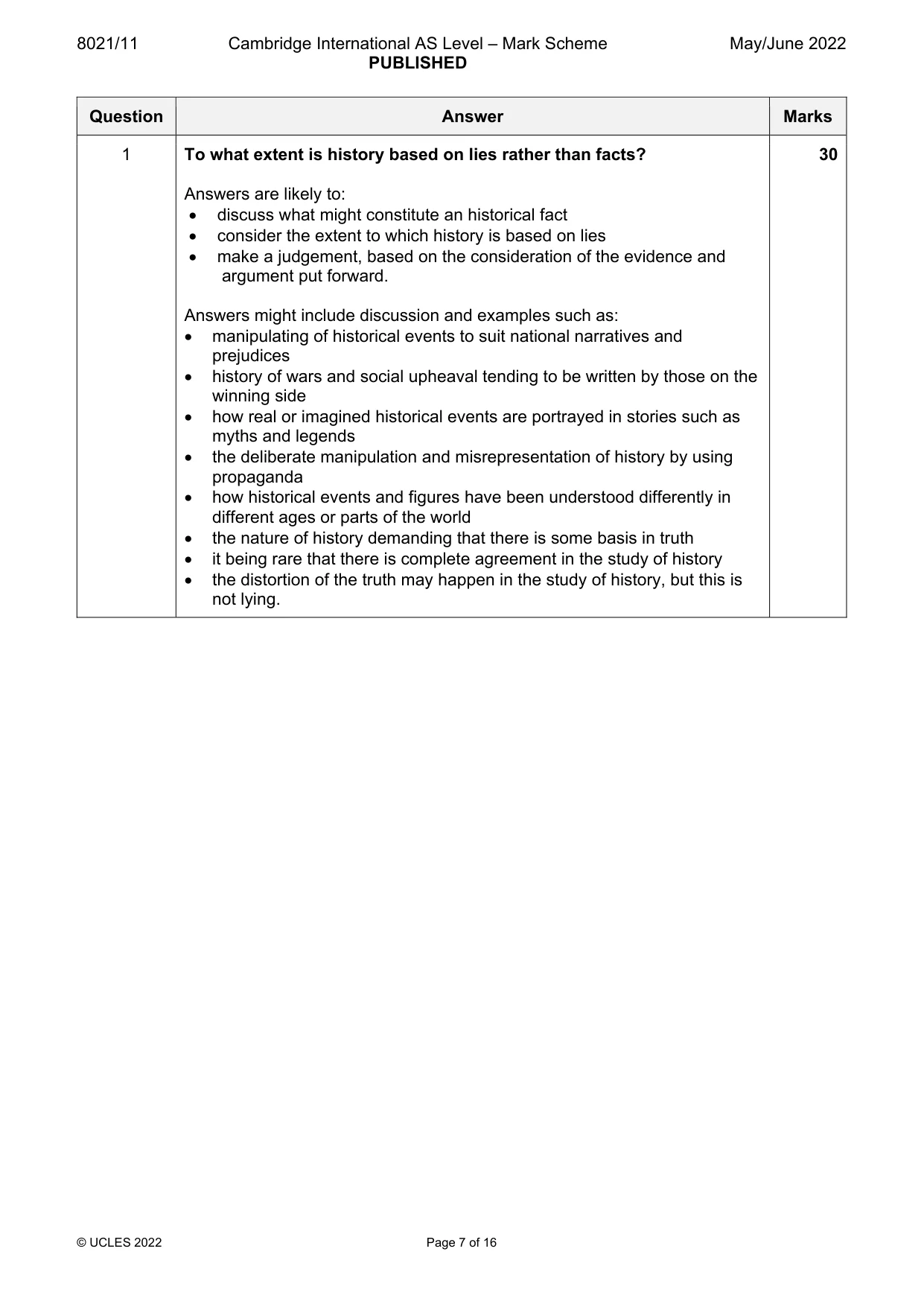
8021/11 Cambridge International AS Level – Mark Scheme PUBLISHED May/June 2022 © UCLES 2022 Page 7 of 16 Question Answer Marks 1 To what extent is history based on lies rather than facts? Answers are likely to: discuss what might constitute an historical fact consider the extent to which history is based on lies make a judgement, based on the consideration of the evidence and argument put forward. Answers might include discussion and examples such as: manipulating of historical events to suit national narratives and prejudices history of wars and social upheaval tending to be written by those on the winning side how real or imagined historical events are portrayed in stories such as myths and legends the deliberate manipulation and misrepresentation of history by using propaganda how historical events and figures have been understood differently in different ages or parts of the world the nature of history demanding that there is some basis in truth it being rare that there is complete agreement in the study of history the distortion of the truth may happen in the study of history, but this is not lying. 30
Mark scheme, page 8
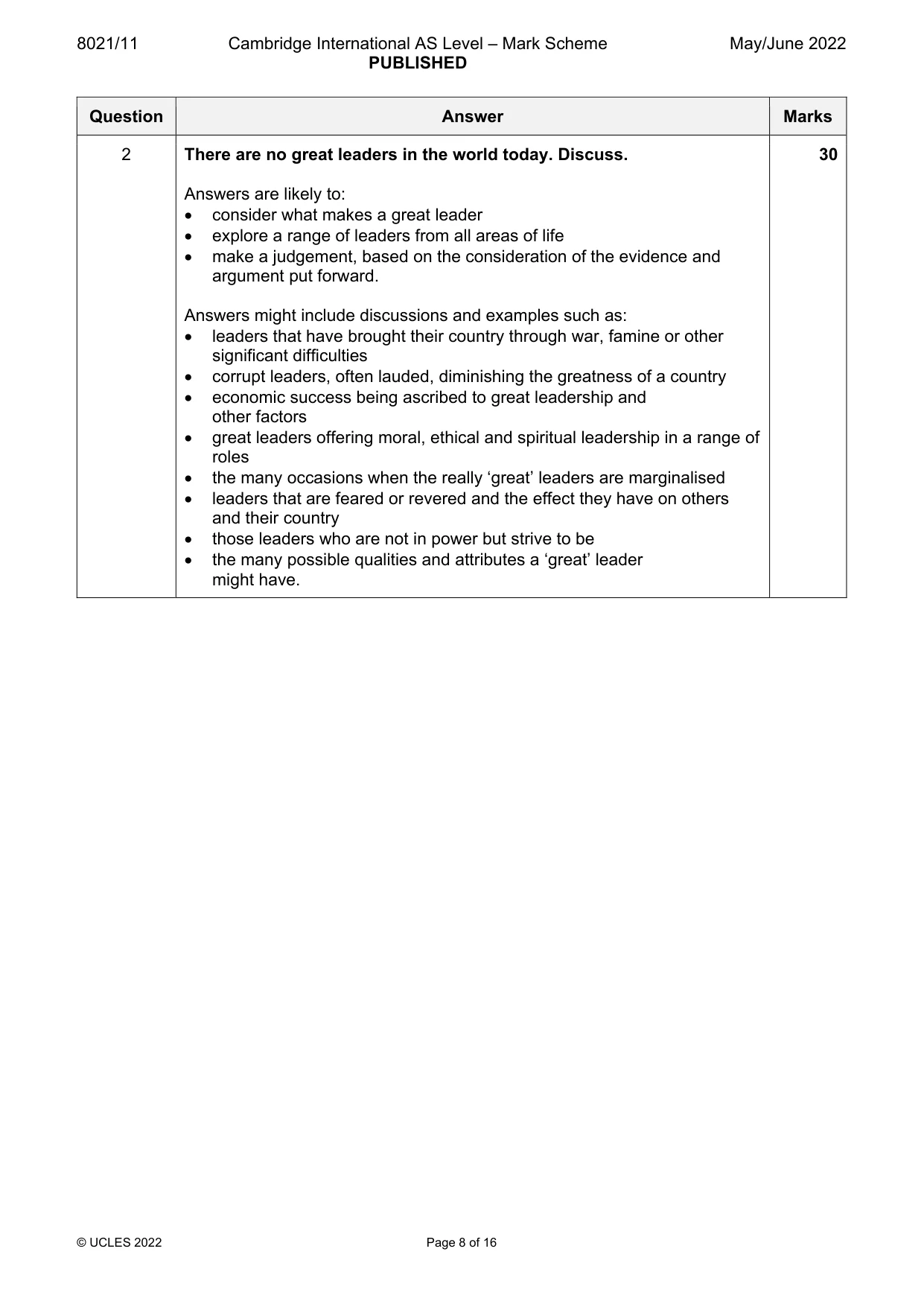
8021/11 Cambridge International AS Level – Mark Scheme PUBLISHED May/June 2022 © UCLES 2022 Page 8 of 16 Question Answer Marks 2 There are no great leaders in the world today. Discuss. Answers are likely to: consider what makes a great leader explore a range of leaders from all areas of life make a judgement, based on the consideration of the evidence and argument put forward. Answers might include discussions and examples such as: leaders that have brought their country through war, famine or other significant difficulties corrupt leaders, often lauded, diminishing the greatness of a country economic success being ascribed to great leadership and other factors great leaders offering moral, ethical and spiritual leadership in a range of roles the many occasions when the really ‘great’ leaders are marginalised leaders that are feared or revered and the effect they have on others and their country those leaders who are not in power but strive to be the many possible qualities and attributes a ‘great’ leader might have. 30
Mark scheme, page 9
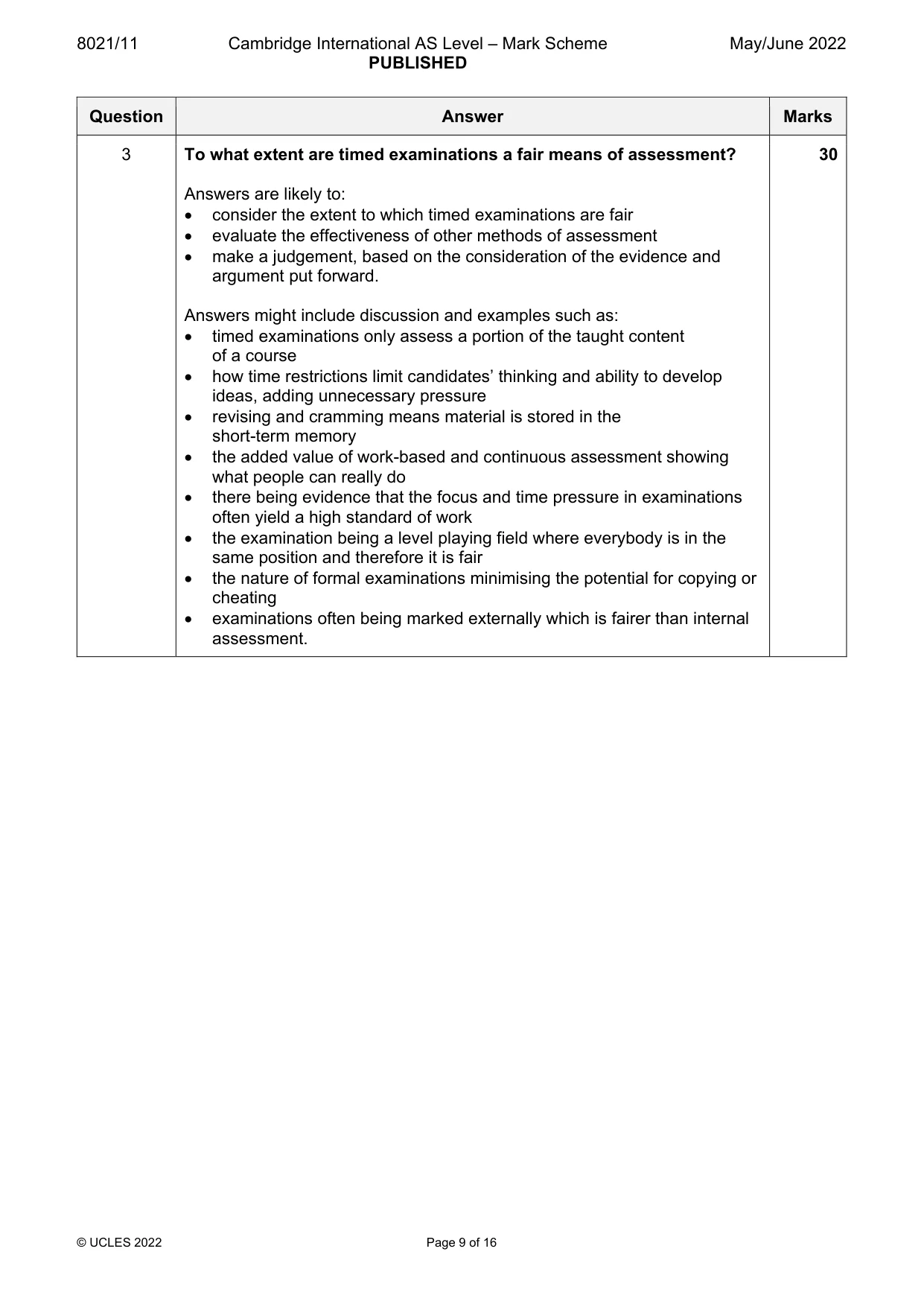
8021/11 Cambridge International AS Level – Mark Scheme PUBLISHED May/June 2022 © UCLES 2022 Page 9 of 16 Question Answer Marks 3 To what extent are timed examinations a fair means of assessment? Answers are likely to: consider the extent to which timed examinations are fair evaluate the effectiveness of other methods of assessment make a judgement, based on the consideration of the evidence and argument put forward. Answers might include discussion and examples such as: timed examinations only assess a portion of the taught content of a course how time restrictions limit candidates’ thinking and ability to develop ideas, adding unnecessary pressure revising and cramming means material is stored in the short-term memory the added value of work-based and continuous assessment showing what people can really do there being evidence that the focus and time pressure in examinations often yield a high standard of work the examination being a level playing field where everybody is in the same position and therefore it is fair the nature of formal examinations minimising the potential for copying or cheating examinations often being marked externally which is fairer than internal assessment. 30
Mark scheme, page 10
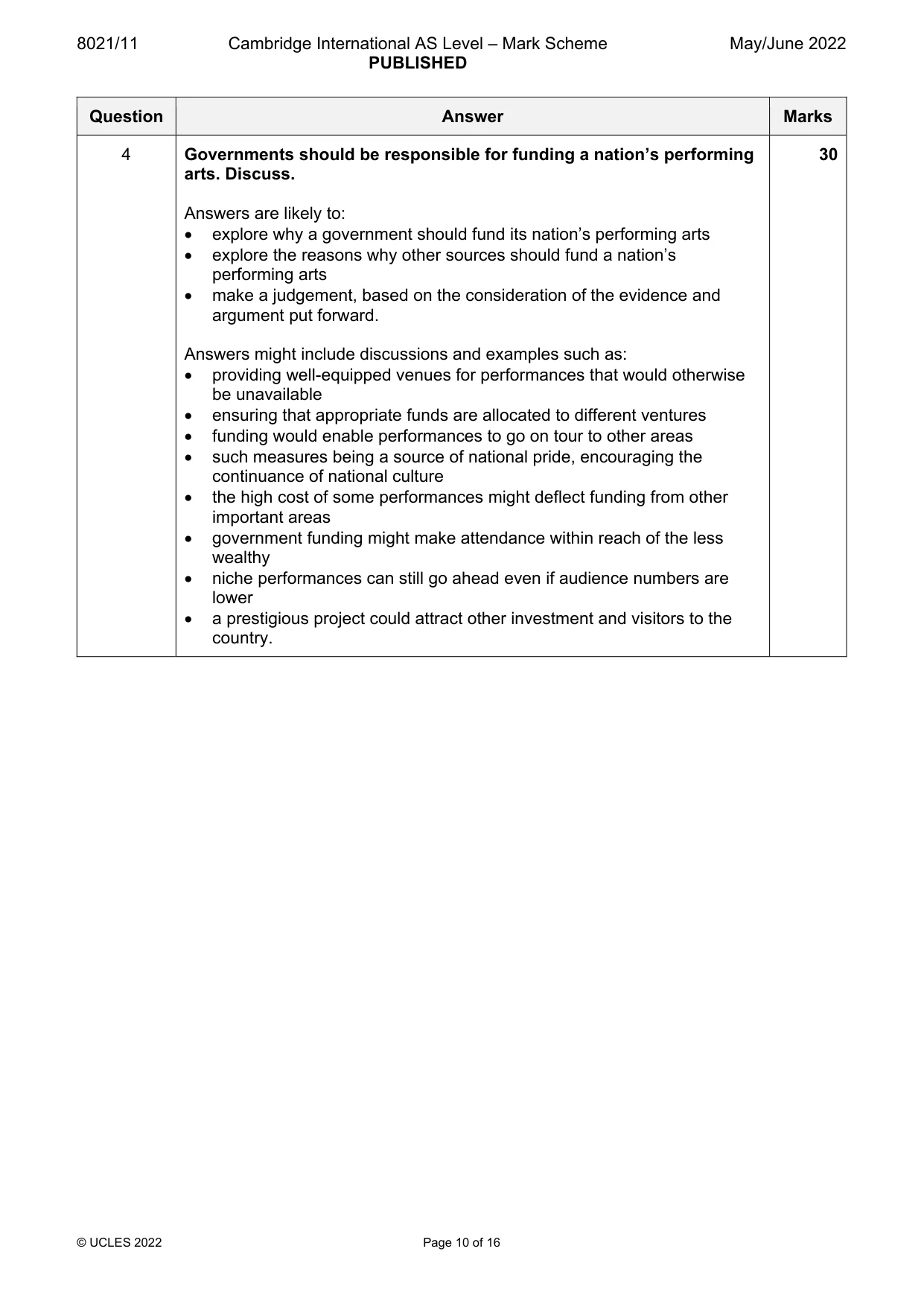
8021/11 Cambridge International AS Level – Mark Scheme PUBLISHED May/June 2022 © UCLES 2022 Page 10 of 16 Question Answer Marks 4 Governments should be responsible for funding a nation’s performing arts. Discuss. Answers are likely to: explore why a government should fund its nation’s performing arts explore the reasons why other sources should fund a nation’s performing arts make a judgement, based on the consideration of the evidence and argument put forward. Answers might include discussions and examples such as: providing well-equipped venues for performances that would otherwise be unavailable ensuring that appropriate funds are allocated to different ventures funding would enable performances to go on tour to other areas such measures being a source of national pride, encouraging the continuance of national culture the high cost of some performances might deflect funding from other important areas government funding might make attendance within reach of the less wealthy niche performances can still go ahead even if audience numbers are lower a prestigious project could attract other investment and visitors to the country. 30
Mark scheme, page 11
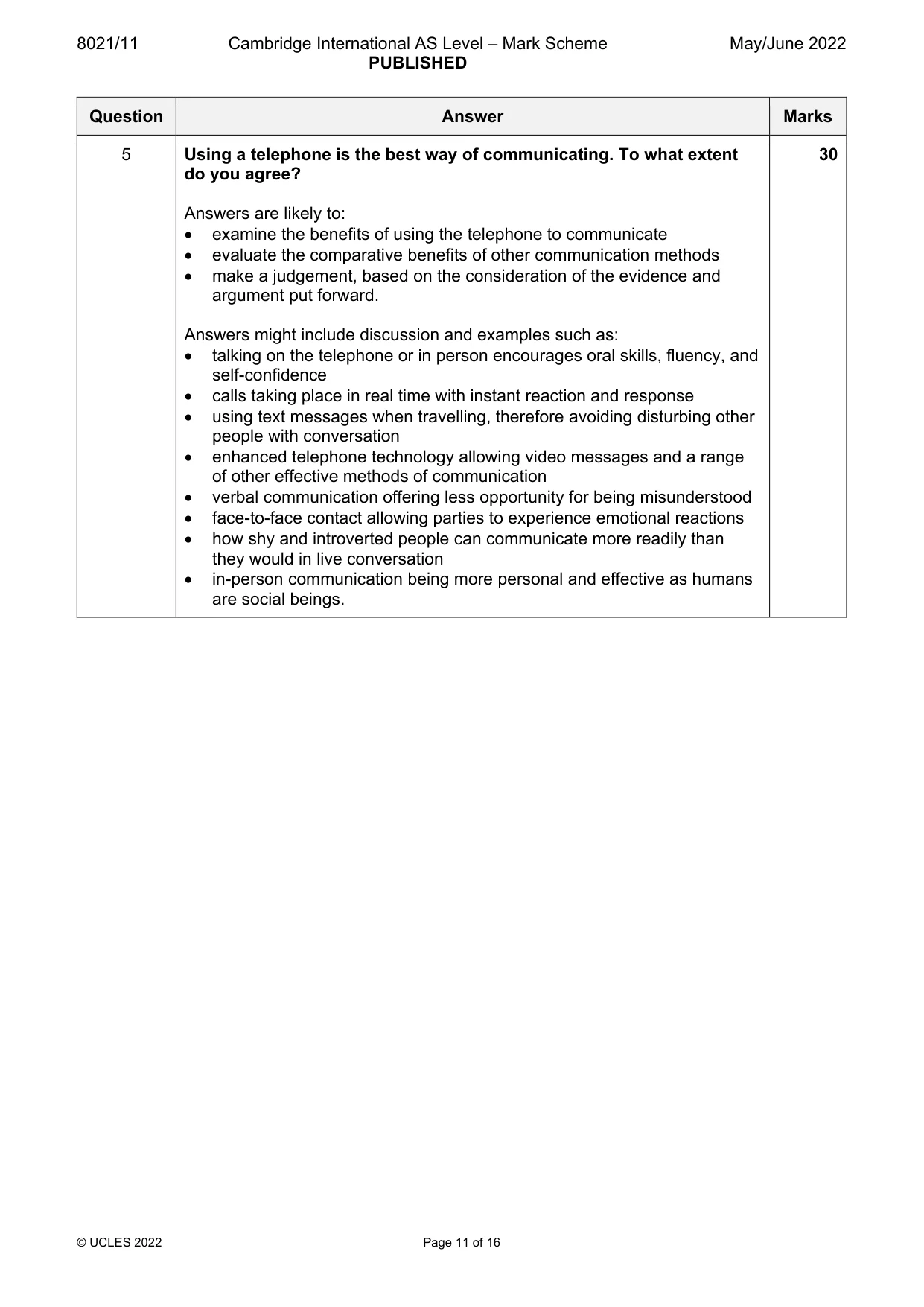
8021/11 Cambridge International AS Level – Mark Scheme PUBLISHED May/June 2022 © UCLES 2022 Page 11 of 16 Question Answer Marks 5 Using a telephone is the best way of communicating. To what extent do you agree? Answers are likely to: examine the benefits of using the telephone to communicate evaluate the comparative benefits of other communication methods make a judgement, based on the consideration of the evidence and argument put forward. Answers might include discussion and examples such as: talking on the telephone or in person encourages oral skills, fluency, and self-confidence calls taking place in real time with instant reaction and response using text messages when travelling, therefore avoiding disturbing other people with conversation enhanced telephone technology allowing video messages and a range of other effective methods of communication verbal communication offering less opportunity for being misunderstood face-to-face contact allowing parties to experience emotional reactions how shy and introverted people can communicate more readily than they would in live conversation in-person communication being more personal and effective as humans are social beings. 30
Mark scheme, page 12
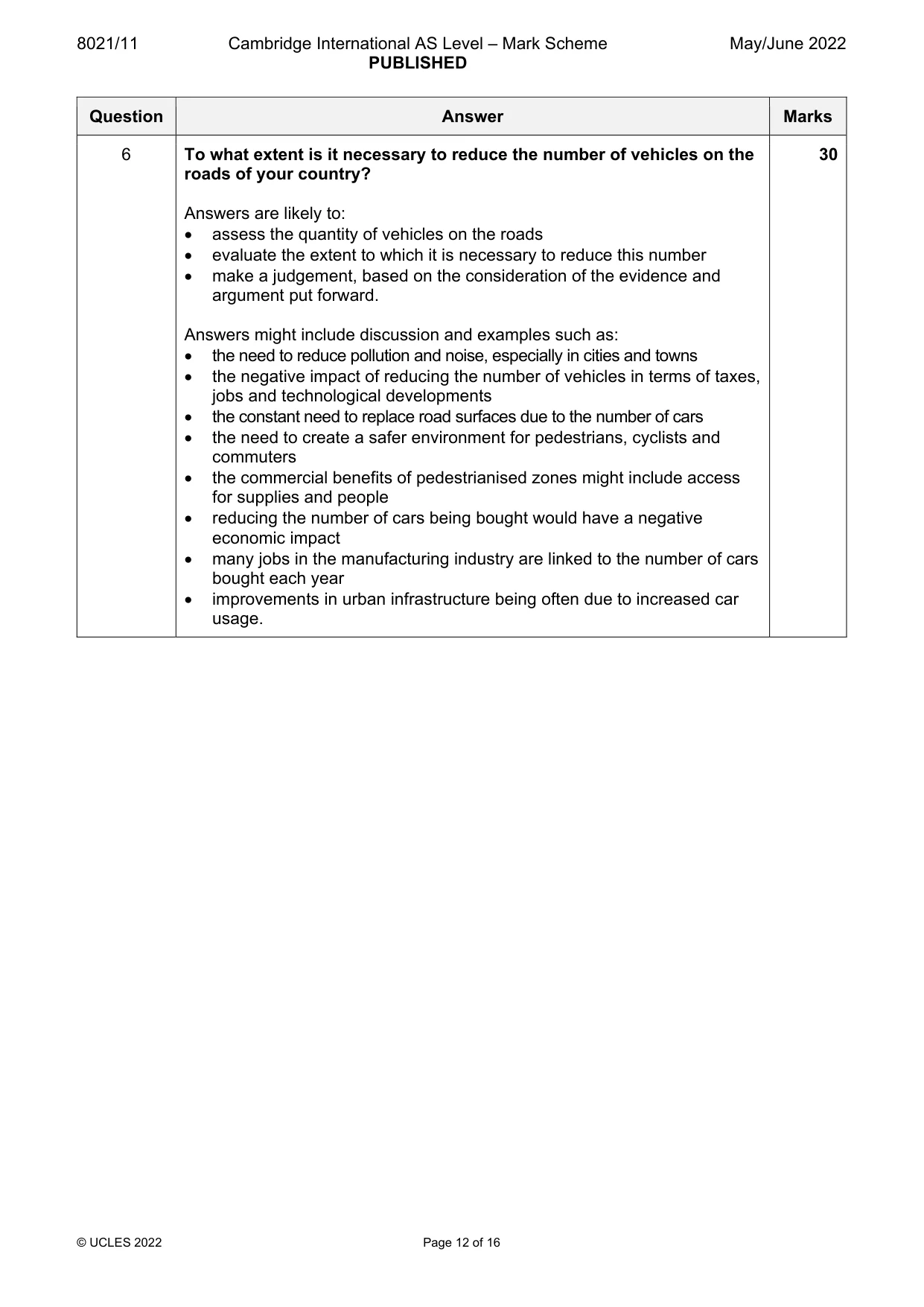
8021/11 Cambridge International AS Level – Mark Scheme PUBLISHED May/June 2022 © UCLES 2022 Page 12 of 16 Question Answer Marks 6 To what extent is it necessary to reduce the number of vehicles on the roads of your country? Answers are likely to: assess the quantity of vehicles on the roads evaluate the extent to which it is necessary to reduce this number make a judgement, based on the consideration of the evidence and argument put forward. Answers might include discussion and examples such as: the need to reduce pollution and noise, especially in cities and towns the negative impact of reducing the number of vehicles in terms of taxes, jobs and technological developments the constant need to replace road surfaces due to the number of cars the need to create a safer environment for pedestrians, cyclists and commuters the commercial benefits of pedestrianised zones might include access for supplies and people reducing the number of cars being bought would have a negative economic impact many jobs in the manufacturing industry are linked to the number of cars bought each year improvements in urban infrastructure being often due to increased car usage. 30
Mark scheme, page 13
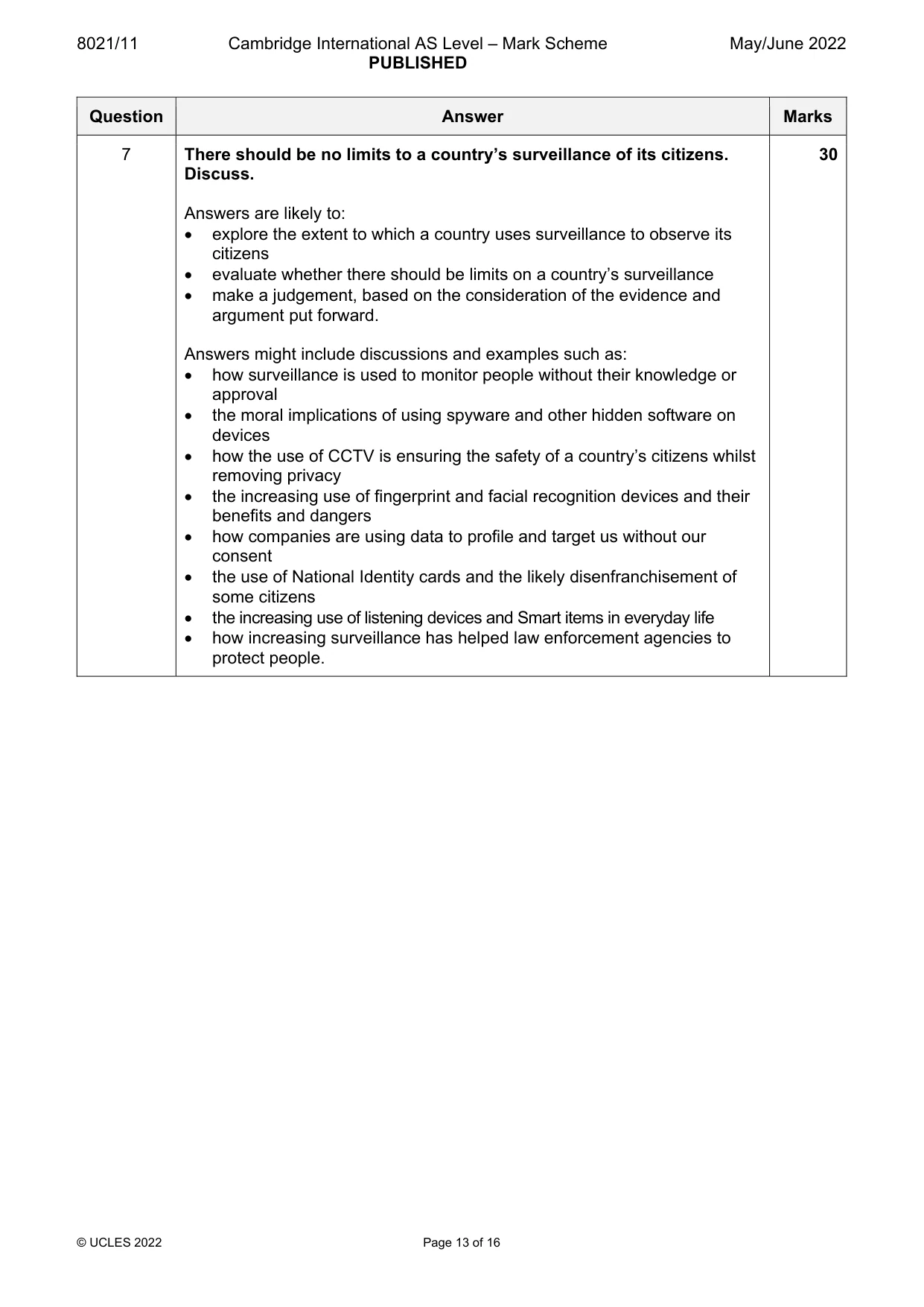
8021/11 Cambridge International AS Level – Mark Scheme PUBLISHED May/June 2022 © UCLES 2022 Page 13 of 16 Question Answer Marks 7 There should be no limits to a country’s surveillance of its citizens. Discuss. Answers are likely to: explore the extent to which a country uses surveillance to observe its citizens evaluate whether there should be limits on a country’s surveillance make a judgement, based on the consideration of the evidence and argument put forward. Answers might include discussions and examples such as: how surveillance is used to monitor people without their knowledge or approval the moral implications of using spyware and other hidden software on devices how the use of CCTV is ensuring the safety of a country’s citizens whilst removing privacy the increasing use of fingerprint and facial recognition devices and their benefits and dangers how companies are using data to profile and target us without our consent the use of National Identity cards and the likely disenfranchisement of some citizens the increasing use of listening devices and Smart items in everyday life how increasing surveillance has helped law enforcement agencies to protect people. 30
Mark scheme, page 14
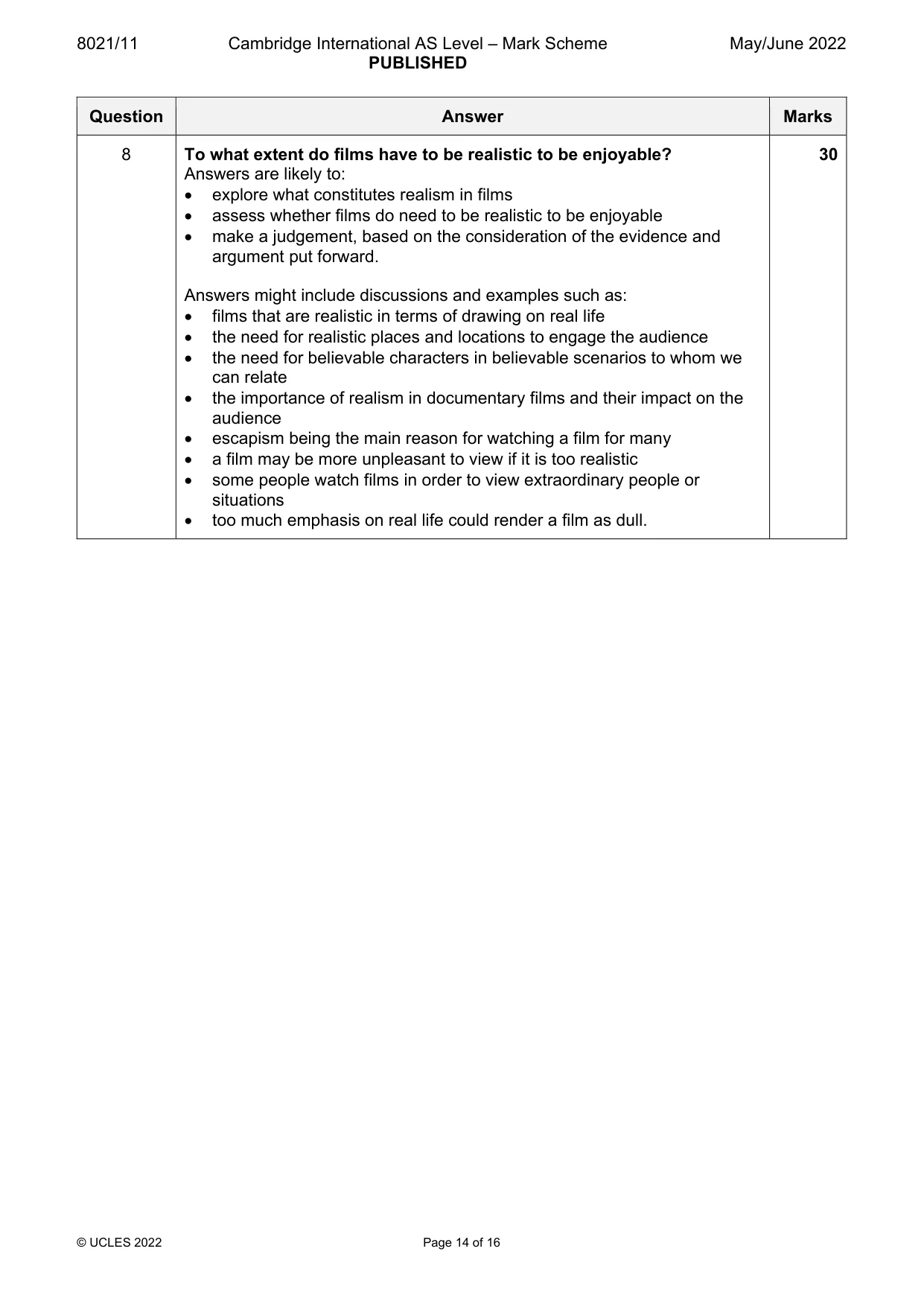
8021/11 Cambridge International AS Level – Mark Scheme PUBLISHED May/June 2022 © UCLES 2022 Page 14 of 16 Question Answer Marks 8 To what extent do films have to be realistic to be enjoyable? Answers are likely to: explore what constitutes realism in films assess whether films do need to be realistic to be enjoyable make a judgement, based on the consideration of the evidence and argument put forward. Answers might include discussions and examples such as: films that are realistic in terms of drawing on real life the need for realistic places and locations to engage the audience the need for believable characters in believable scenarios to whom we can relate the importance of realism in documentary films and their impact on the audience escapism being the main reason for watching a film for many a film may be more unpleasant to view if it is too realistic some people watch films in order to view extraordinary people or situations too much emphasis on real life could render a film as dull. 30
Mark scheme, page 15
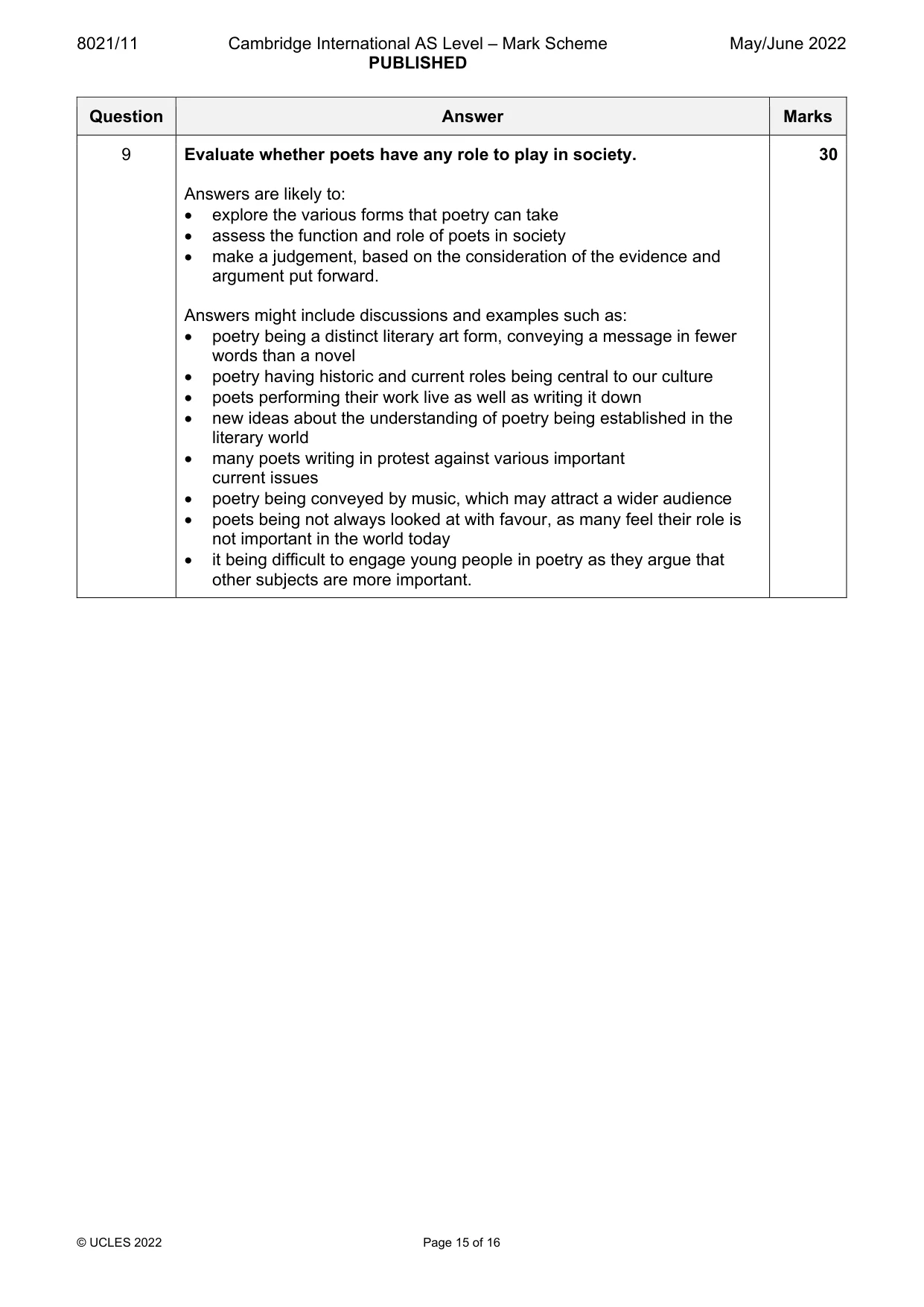
8021/11 Cambridge International AS Level – Mark Scheme PUBLISHED May/June 2022 © UCLES 2022 Page 15 of 16 Question Answer Marks 9 Evaluate whether poets have any role to play in society. Answers are likely to: explore the various forms that poetry can take assess the function and role of poets in society make a judgement, based on the consideration of the evidence and argument put forward. Answers might include discussions and examples such as: poetry being a distinct literary art form, conveying a message in fewer words than a novel poetry having historic and current roles being central to our culture poets performing their work live as well as writing it down new ideas about the understanding of poetry being established in the literary world many poets writing in protest against various important current issues poetry being conveyed by music, which may attract a wider audience poets being not always looked at with favour, as many feel their role is not important in the world today it being difficult to engage young people in poetry as they argue that other subjects are more important. 30
Mark scheme, page 16
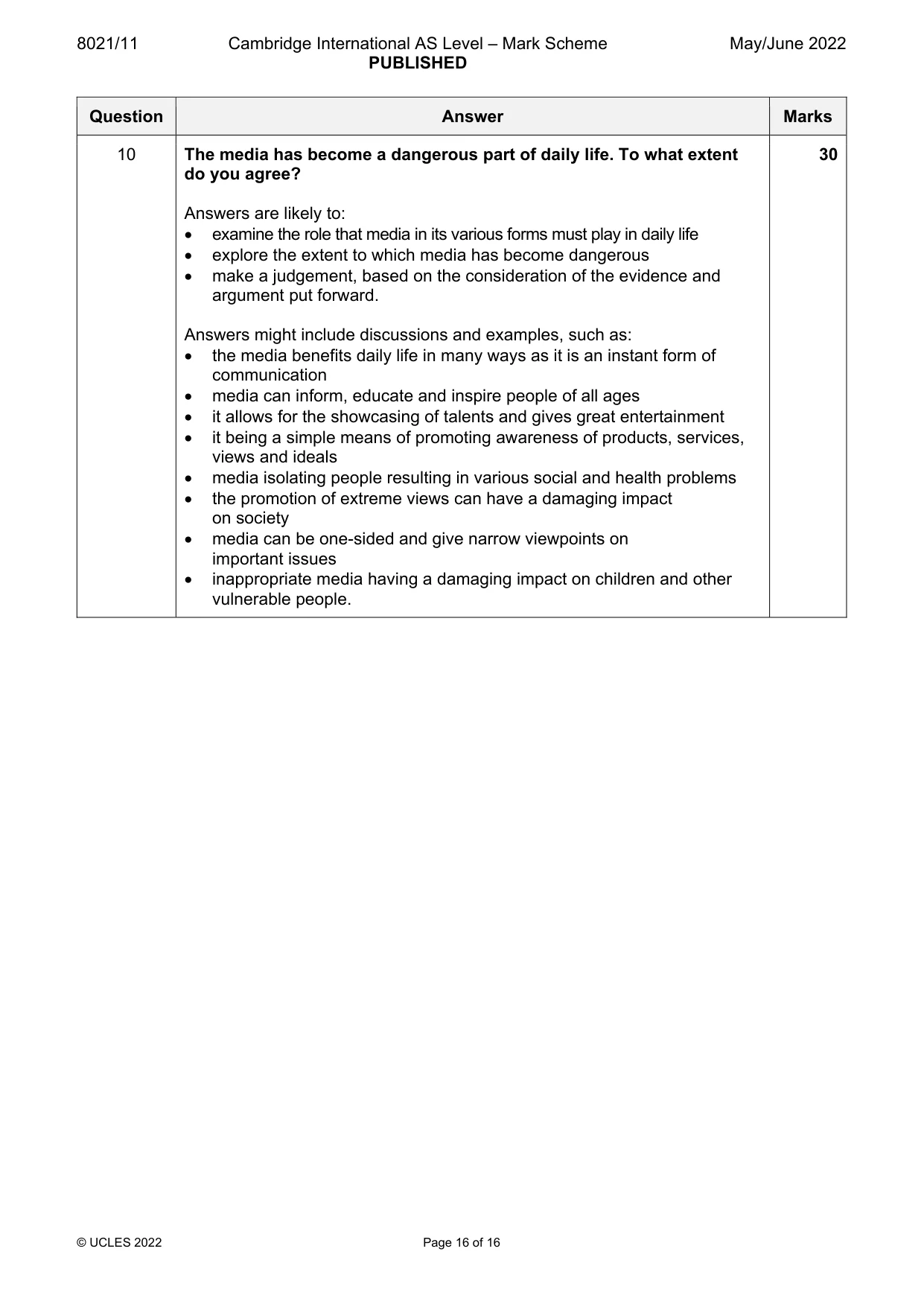
8021/11 Cambridge International AS Level – Mark Scheme PUBLISHED May/June 2022 © UCLES 2022 Page 16 of 16 Question Answer Marks 10 The media has become a dangerous part of daily life. To what extent do you agree? Answers are likely to: examine the role that media in its various forms must play in daily life explore the extent to which media has become dangerous make a judgement, based on the consideration of the evidence and argument put forward. Answers might include discussions and examples, such as: the media benefits daily life in many ways as it is an instant form of communication media can inform, educate and inspire people of all ages it allows for the showcasing of talents and gives great entertainment it being a simple means of promoting awareness of products, services, views and ideals media isolating people resulting in various social and health problems the promotion of extreme views can have a damaging impact on society media can be one-sided and give narrow viewpoints on important issues inappropriate media having a damaging impact on children and other vulnerable people. 30
What you needed in this session
Cambridge’s own grade thresholds for 2022 May/June, Paper 1 · Variant 1. A higher threshold means an easier paper — the bar moves with how the cohort did.