Questions as text
Q1 · Out of any addition to national income, 20 % is spent on imports, 15 % is paid in taxes… 9708/31 Oct/Nov 2009
20 Out of any addition to national income, 20 % is spent on imports, 15 % is paid in taxes, 5 % is saved and the rest is spent on domestically-produced goods. What is the value of the multiplier? A 2.5 B 5 C 6 D 20
1 marks
Answer: A
This question in 9708/31 Oct/Nov 2009
Q2 · The information in the table is taken from a country’s national income accounts 9708/32 Oct/Nov 2009
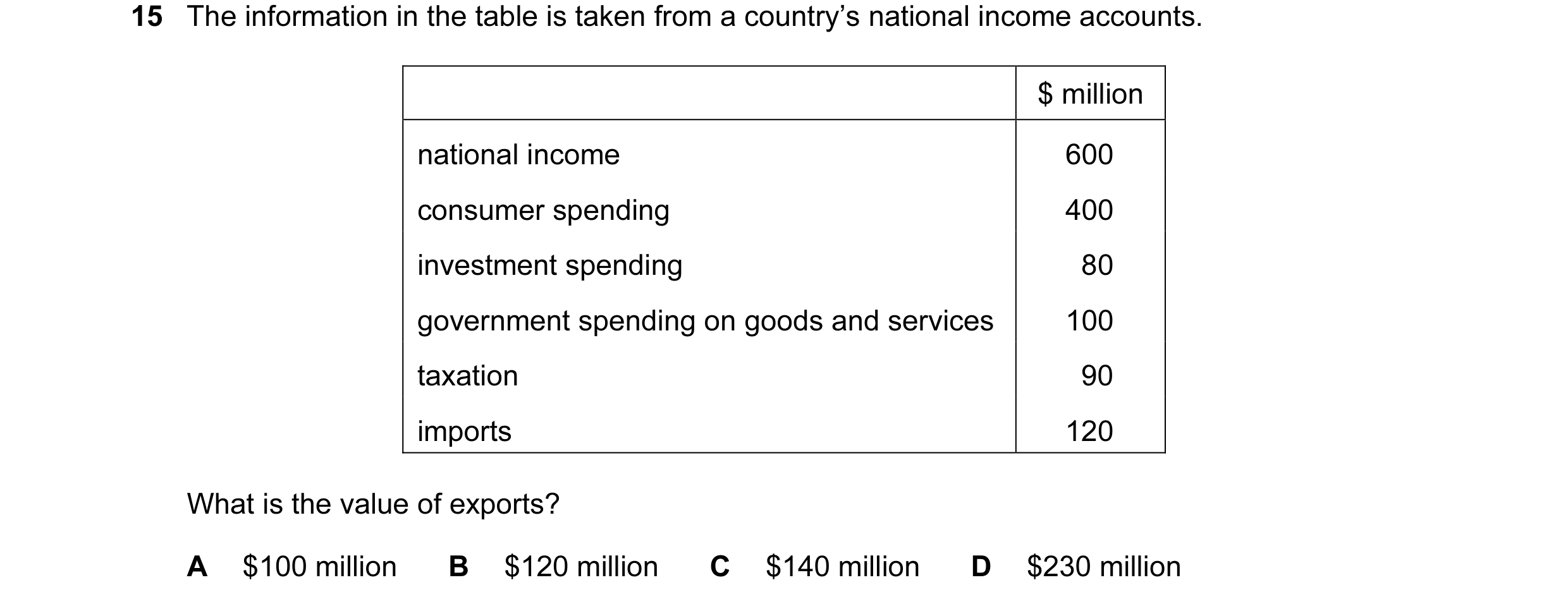
15 The information in the table is taken from a country’s national income accounts. $ million national income 600 consumer spending 400 investment spending 80 government spending on goods and services 100 taxation 90 imports 120 What is the value of exports? A $100 million B $120 million C $140 million D $230 million
1 marks
Answer: C
This question in 9708/32 Oct/Nov 2009
Q3 · Out of any addition to national income, 20 % is spent on imports, 15 % is paid in taxes… 9708/32 Oct/Nov 2009
19 Out of any addition to national income, 20 % is spent on imports, 15 % is paid in taxes, 5 % is saved and the rest is spent on domestically-produced goods. What is the value of the multiplier? A 2.5 B 5 C 6 D 20
1 marks
Answer: A
This question in 9708/32 Oct/Nov 2009
Q4 · The diagram shows a number of expenditure functions 9708/32 Oct/Nov 2009
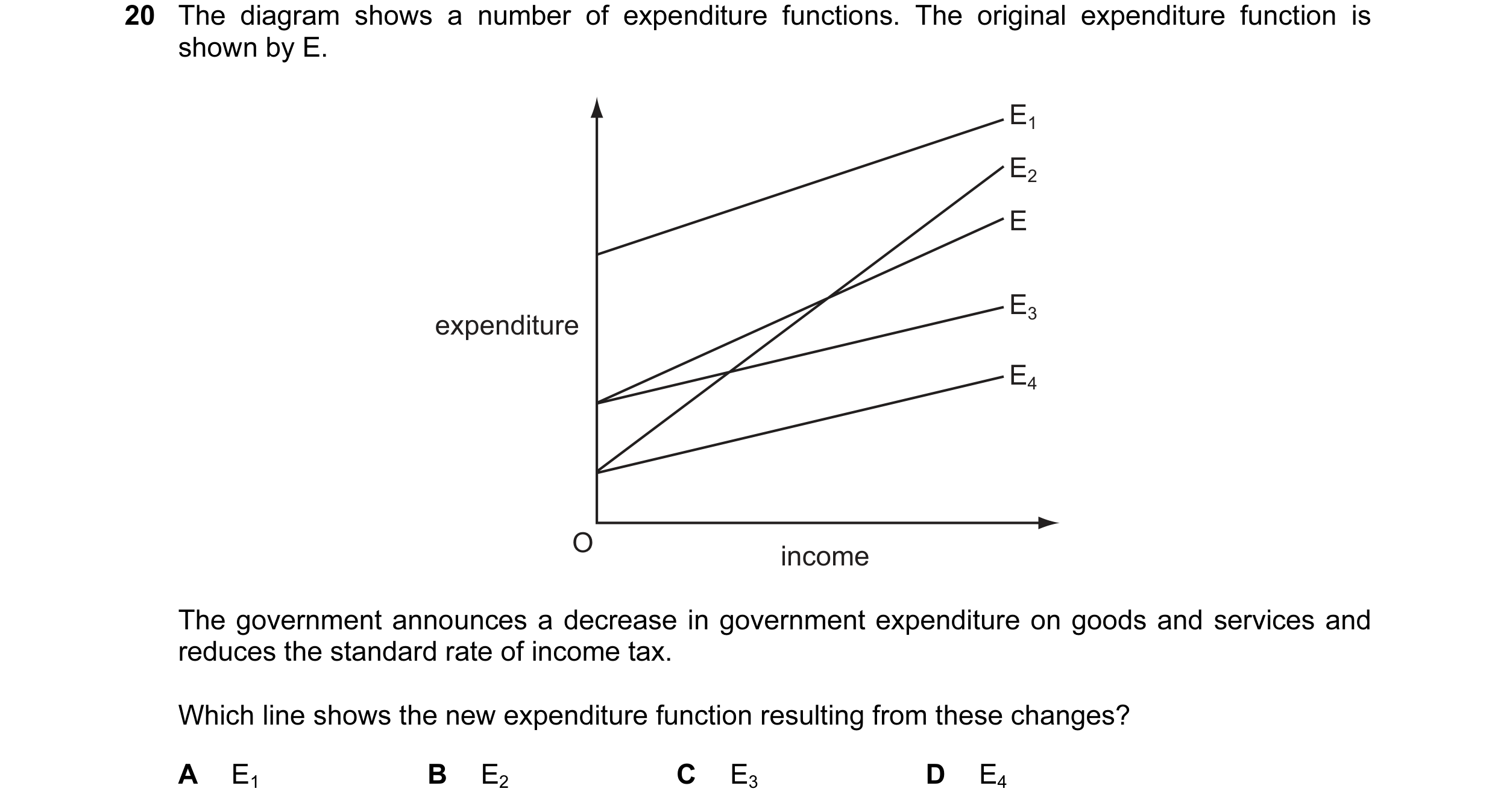
20 The diagram shows a number of expenditure functions. The original expenditure function is shown by E. E1 E2 E E3 expenditure E4 O income The government announces a decrease in government expenditure on goods and services and reduces the standard rate of income tax. Which line shows the new expenditure function resulting from these changes? A E1 B E2 C E3 D E4
1 marks
Answer: B
This question in 9708/32 Oct/Nov 2009
Q5 · The diagram shows a consumption function for a closed economy with no government 9708/32 May/June 2010
18 The diagram shows a consumption function for a closed economy with no government. C consumption 45° O Y income What can be concluded from the diagram? A At income levels below OY, saving is negative. B At income levels below OY, there is an inflationary gap. C The equilibrium level of income is OY. D The marginal propensity to consume increases as income increases.
1 marks
Answer: A
This question in 9708/32 May/June 2010
Q6 · In the diagram, C1 shows the relationship between consumption and national income 9708/33 Oct/Nov 2011
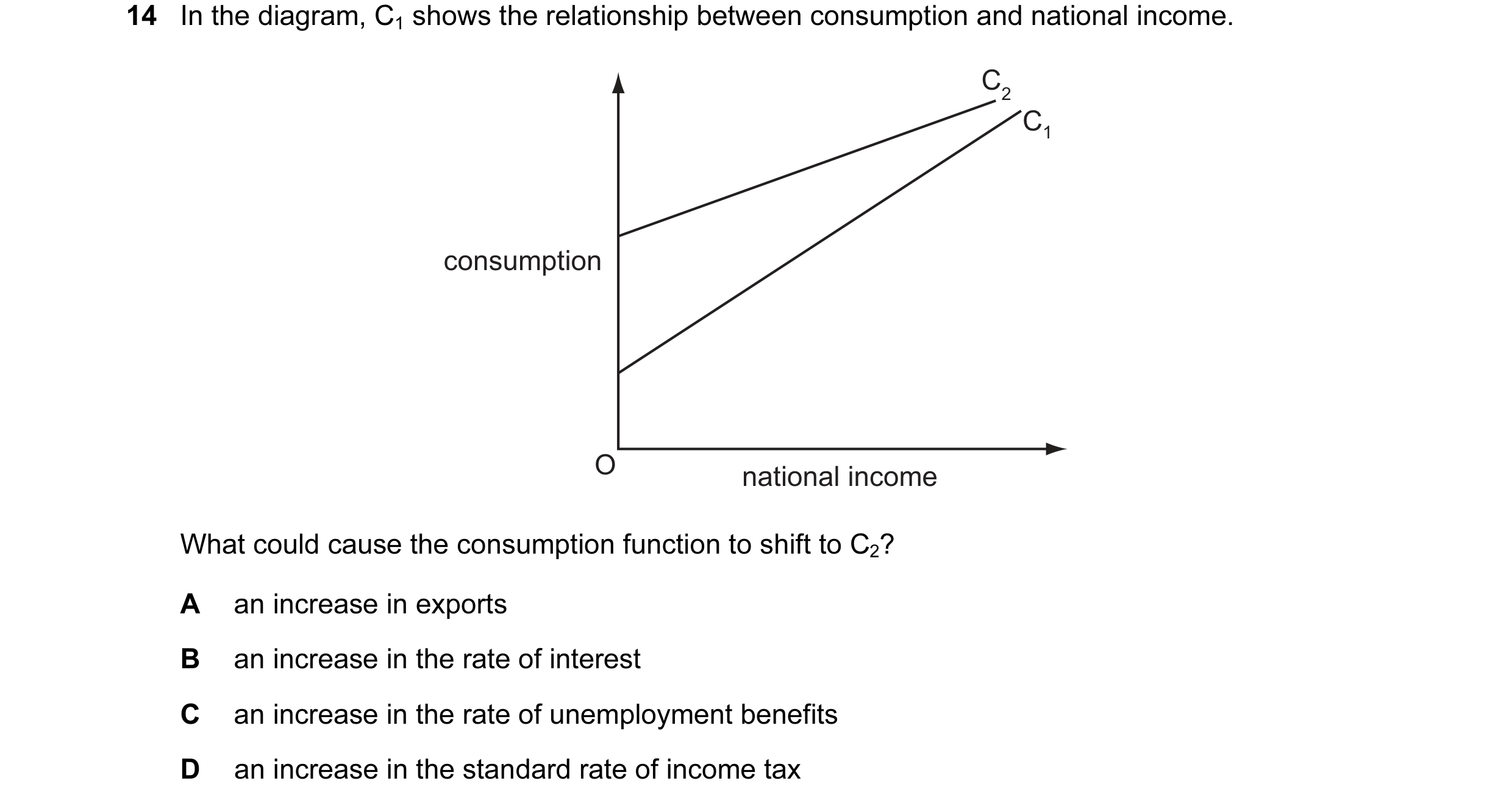
14 In the diagram, C1 shows the relationship between consumption and national income. C2 C1 consumption O national income What could cause the consumption function to shift to C2? A an increase in exports B an increase in the rate of interest C an increase in the rate of unemployment benefits D an increase in the standard rate of income tax
1 marks
Answer: C
This question in 9708/33 Oct/Nov 2011
Q7 · Which represents an injection into an economy’s circular flow of income? 9708/31 May/June 2012
19 Which represents an injection into an economy’s circular flow of income? A a balance of trade surplus B a government budget surplus C the retained profits of private companies D household saving
1 marks
Answer: A
This question in 9708/31 May/June 2012
Q8 · Which represents an injection into an economy’s circular flow of income? 9708/32 May/June 2012
19 Which represents an injection into an economy’s circular flow of income? A a balance of trade surplus B a government budget surplus C the retained profits of private companies D household saving
1 marks
Answer: A
This question in 9708/32 May/June 2012
Q9 · Which represents a leakage from a country’s circular flow of income? 9708/33 May/June 2012
18 Which represents a leakage from a country’s circular flow of income? A a government budget deficit B bank loans to private companies C the purchase of foreign assets by the country’s households D unemployment benefits
1 marks
Answer: C
This question in 9708/33 May/June 2012
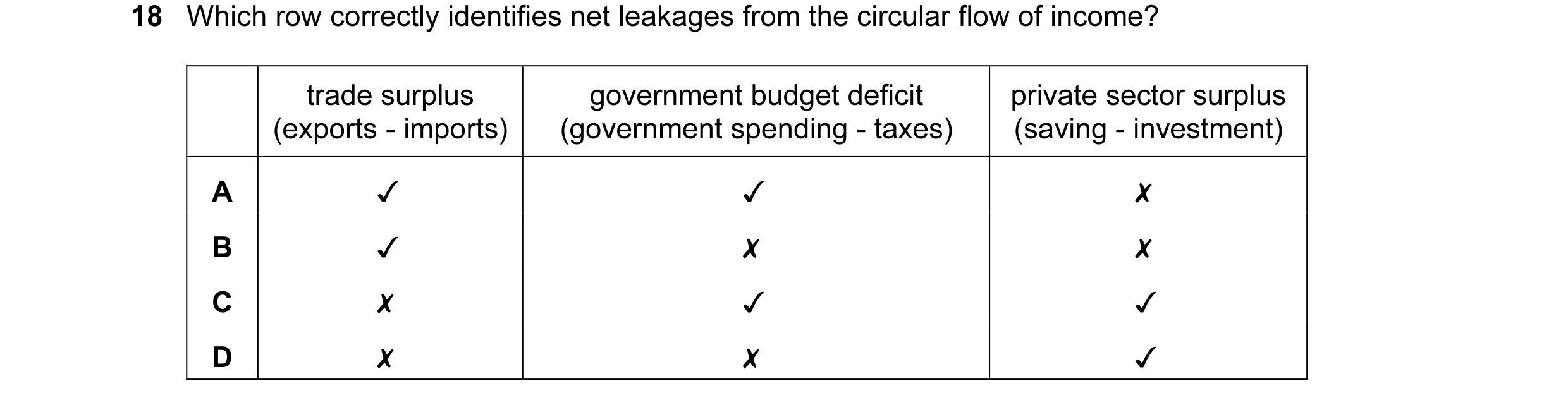
Q10 · Which row correctly identifies net leakages from the circular flow of income? 9708/33 Oct/Nov 2012
18 Which row correctly identifies net leakages from the circular flow of income?
trade surplus
(exports - imports)
government budget deficit
(government spending - taxes)
private sector surplus
(saving - investment)
0 ON WD >
v
v
x
x
v
x
v
x
<< x x
1 marks
This question in 9708/33 Oct/Nov 2012
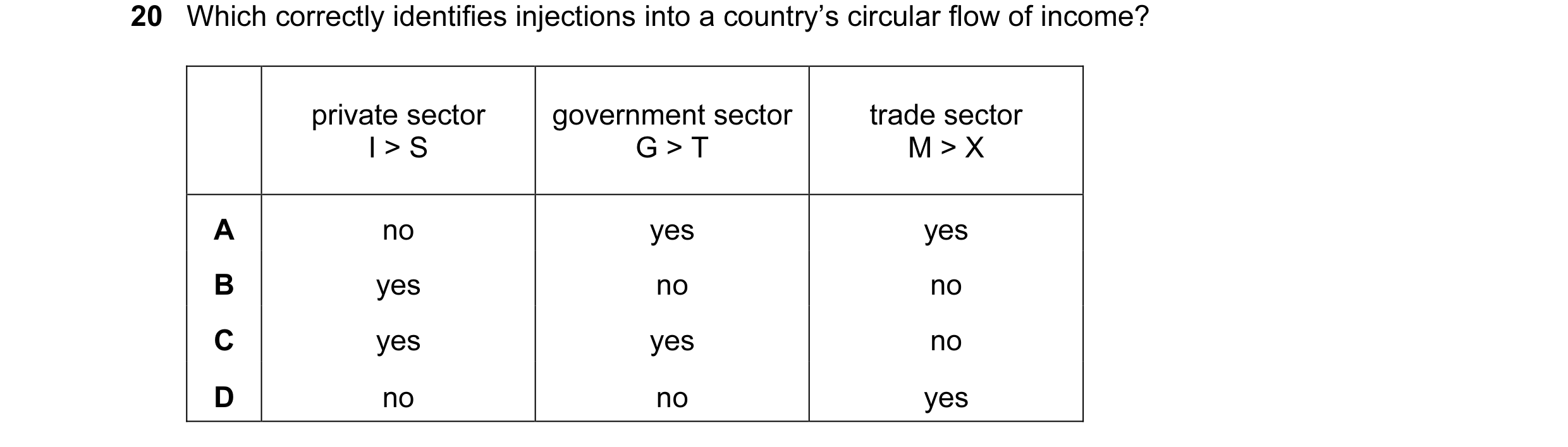
Q11 · Which correctly identifies injections into a country’s circular flow of income? 9708/32 May/June 2013
20 Which correctly identifies injections into a country’s circular flow of income? private sector government sector trade sector I > S G > T M > X A no yes yes B yes no no C yes yes no D no no yes
1 marks
Answer: C
This question in 9708/32 May/June 2013
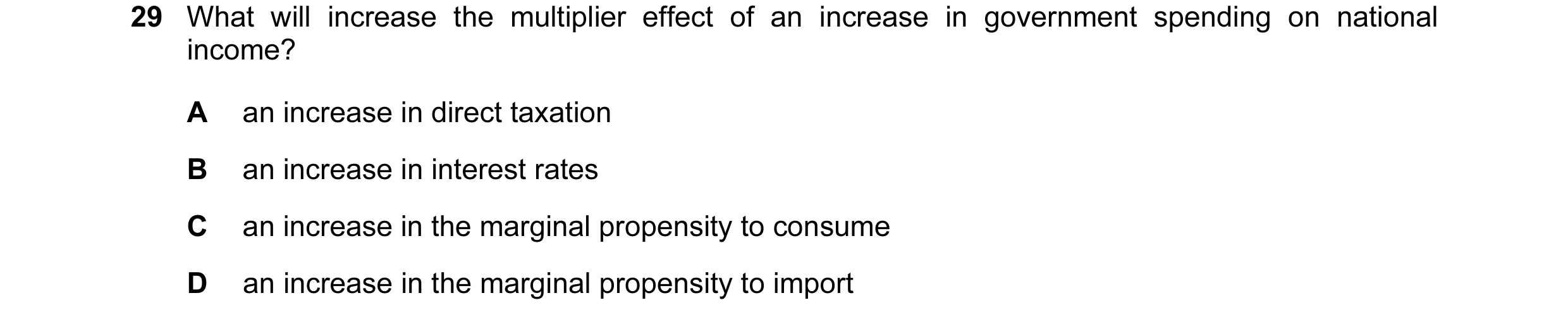
Q12 · What will increase the multiplier effect of an increase in government spending on… 9708/32 May/June 2013
29 What will increase the multiplier effect of an increase in government spending on national income? A an increase in direct taxation B an increase in interest rates C an increase in the marginal propensity to consume D an increase in the marginal propensity to import
1 marks
Answer: C
This question in 9708/32 May/June 2013
Q13 · Which correctly identifies injections into a country’s circular flow of income? 9708/33 May/June 2013
16 Which correctly identifies injections into a country’s circular flow of income? private sector public sector trade sector (S > I) (T > G) (X > M) A no no no B no no yes C yes no no D yes yes yes
1 marks
Answer: B
This question in 9708/33 May/June 2013
Q14 · A closed economy with no government has a marginal propensity to consume of 0.9 9708/33 May/June 2013
17 A closed economy with no government has a marginal propensity to consume of 0.9. Its full employment national income is $60 000 m. Its current national income is $40 000 m. To achieve full employment, by how much must investment be increased? A $2000 m B $6000 m C $18 000 m D $20 000 m
1 marks
Answer: A
This question in 9708/33 May/June 2013
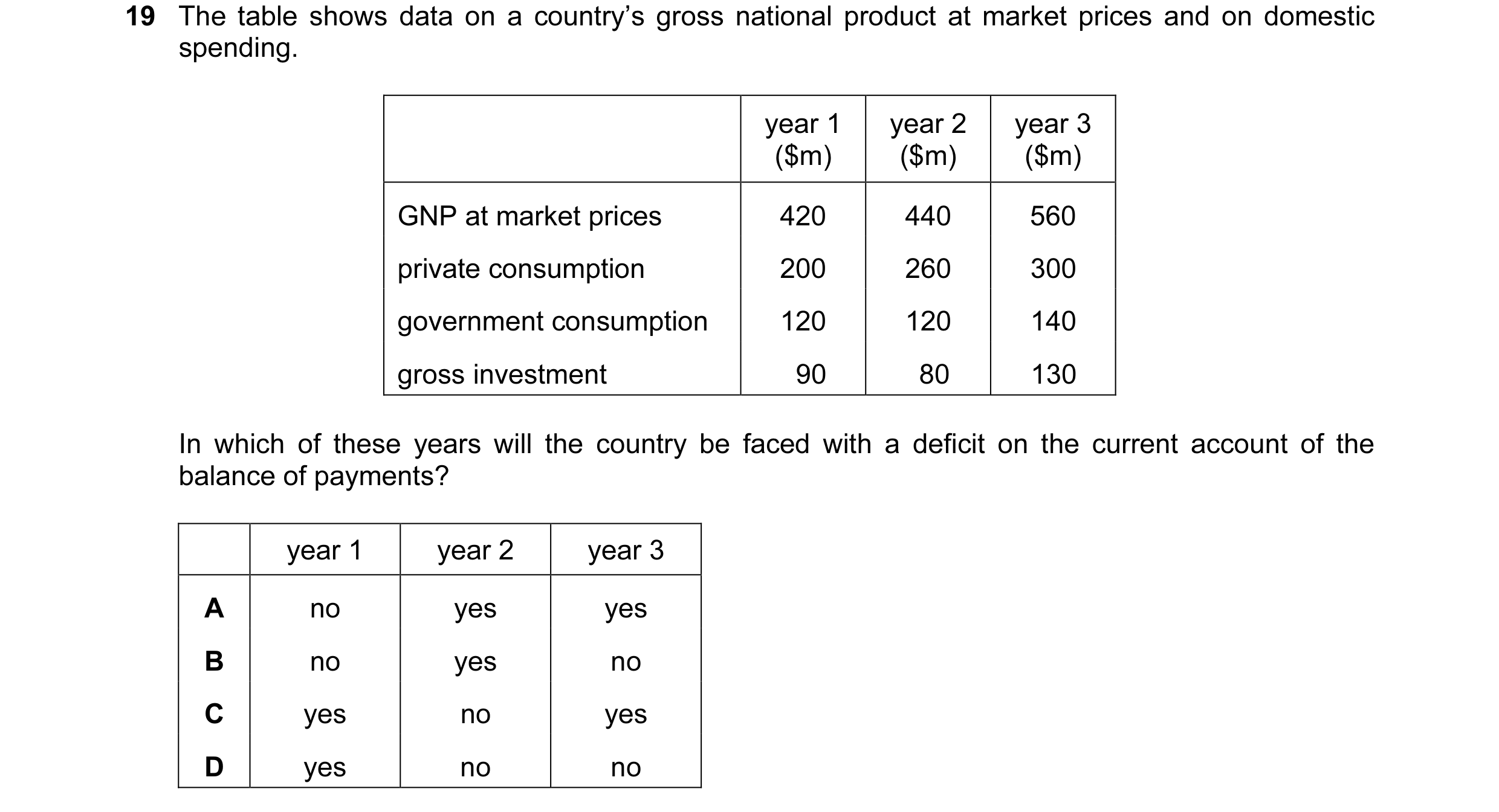
Q15 · The table shows data on a country’s gross national product at market prices and on… 9708/33 Oct/Nov 2014
19 The table shows data on a country’s gross national product at market prices and on domestic spending. year 1 year 2 year 3 ($m) ($m) ($m) GNP at market prices 420 440 560 private consumption 200 260 300 government consumption 120 120 140 gross investment 90 80 130 In which of these years will the country be faced with a deficit on the current account of the balance of payments? year 1 year 2 year 3 A no yes yes B no yes no C yes no yes D yes no no
1 marks
Answer: A
This question in 9708/33 Oct/Nov 2014
Q16 · The table shows the level of consumption at various levels of national income for a… 9708/33 Oct/Nov 2015
18 The table shows the level of consumption at various levels of national income for a closed economy with no government. national income consumption ($ million) ($ million) 20 15 24 18 28 21 32 24 36 27 40 30 What happens to the average and marginal propensities to consume as income increases? average propensity marginal propensity to consume to consume A constant constant B falls constant C falls falls D rises falls
1 marks
Answer: A
This question in 9708/33 Oct/Nov 2015
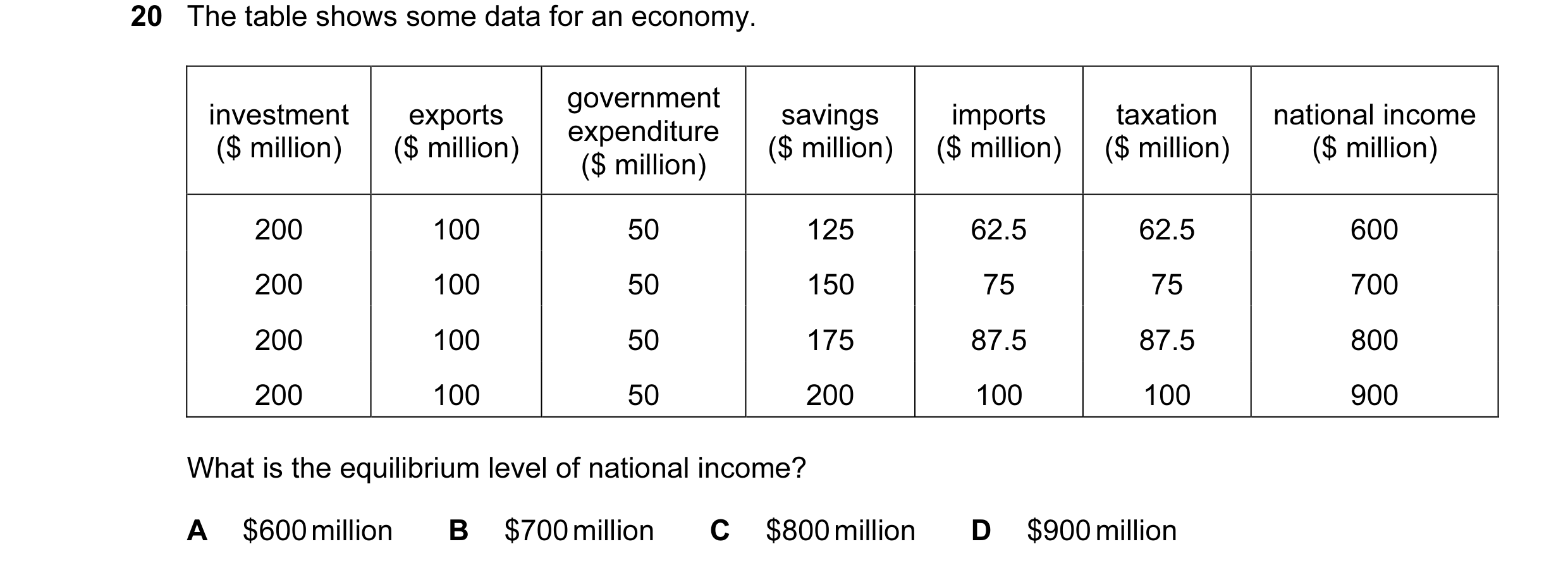
Q17 · The table shows some data for an economy 9708/33 Oct/Nov 2015
20 The table shows some data for an economy. government investment exports savings imports taxation national income expenditure ($ million) ($ million) ($ million) ($ million) ($ million) ($ million) ($ million) 200 100 50 125 62.5 62.5 600 200 100 50 150 75 75 700 200 100 50 175 87.5 87.5 800 200 100 50 200 100 100 900 What is the equilibrium level of national income? A $600 million B $700 million C $800 million D $900 million
1 marks
Answer: C
This question in 9708/33 Oct/Nov 2015
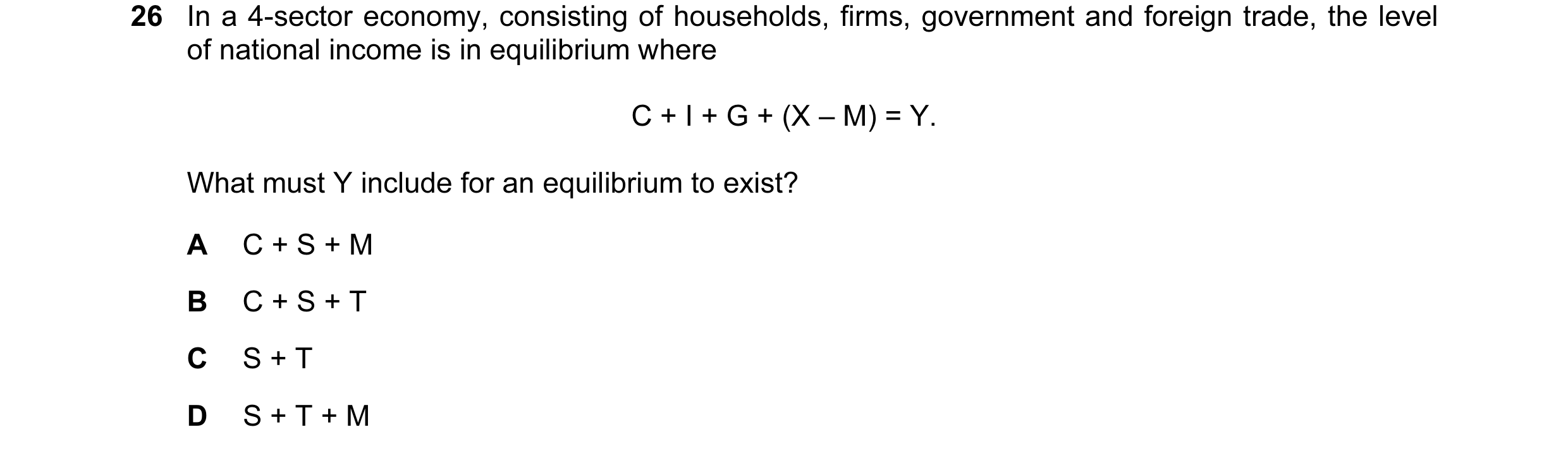
Q18 · In a 4-sector economy, consisting of households, firms, government and foreign trade, the… 9708/32 May/June 2016
26 In a 4-sector economy, consisting of households, firms, government and foreign trade, the level of national income is in equilibrium where C + I + G + (X – M) = Y. What must Y include for an equilibrium to exist? A C + S + M B C + S + T C S + T D S + T + M
1 marks
Answer: B
This question in 9708/32 May/June 2016
Q19 · What will increase the multiplier effect of an increase in government spending on… 9708/32 May/June 2016
30 What will increase the multiplier effect of an increase in government spending on national income? A an increase in direct taxation B an increase in interest rates C an increase in the marginal propensity to consume D an increase in the marginal propensity to import
1 marks
Answer: C
This question in 9708/32 May/June 2016
Q20 · The table shows the levels of consumption expenditure for given family incomes 9708/32 May/June 2017
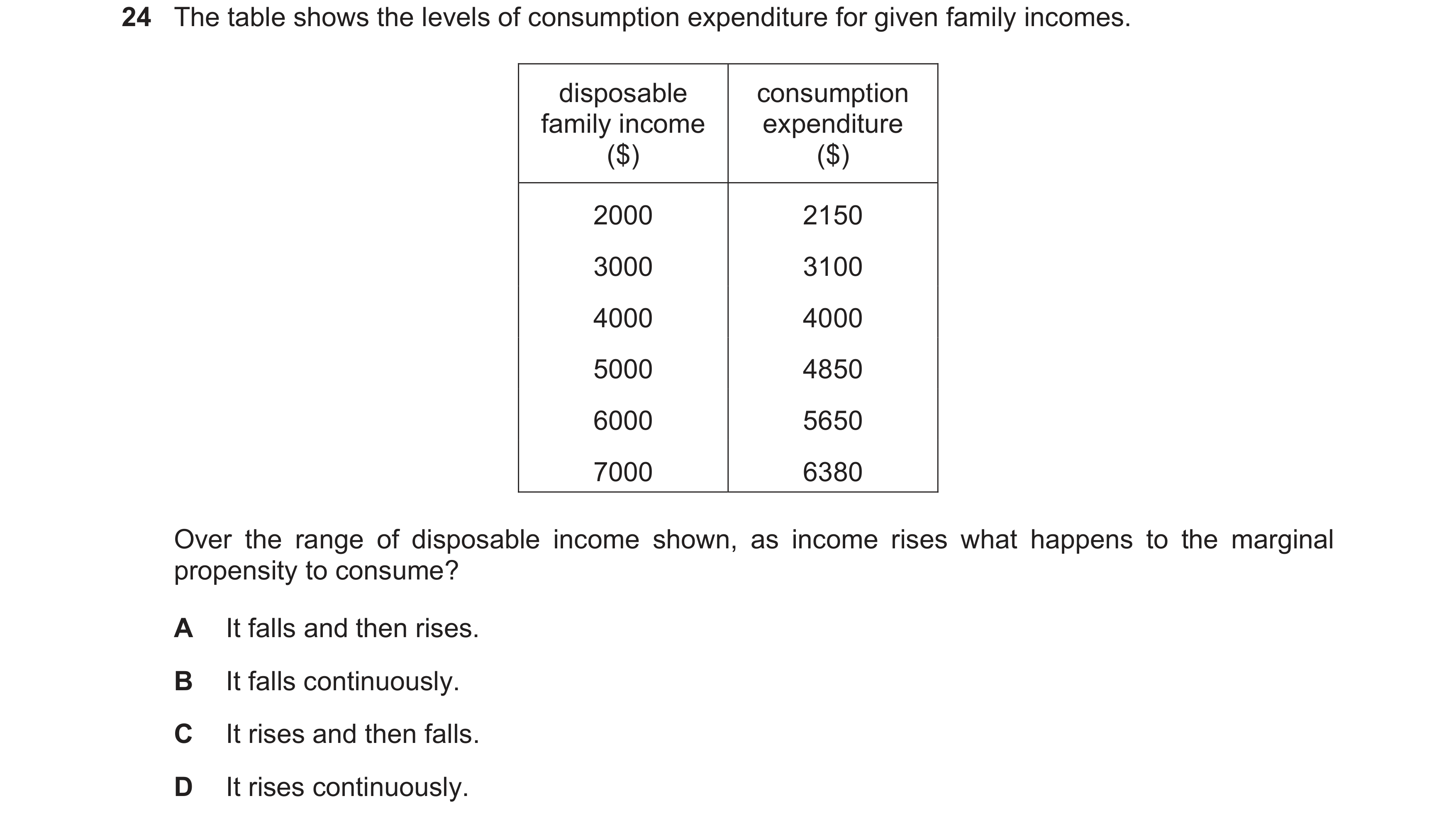
24 The table shows the levels of consumption expenditure for given family incomes. disposable consumption family income expenditure ($) ($) 2000 2150 3000 3100 4000 4000 5000 4850 6000 5650 7000 6380 Over the range of disposable income shown, as income rises what happens to the marginal propensity to consume? A It falls and then rises. B It falls continuously. C It rises and then falls. D It rises continuously.
1 marks
Answer: B
This question in 9708/32 May/June 2017
Q21 · In an economy with unemployed resources the government increases its expenditure 9708/32 May/June 2017
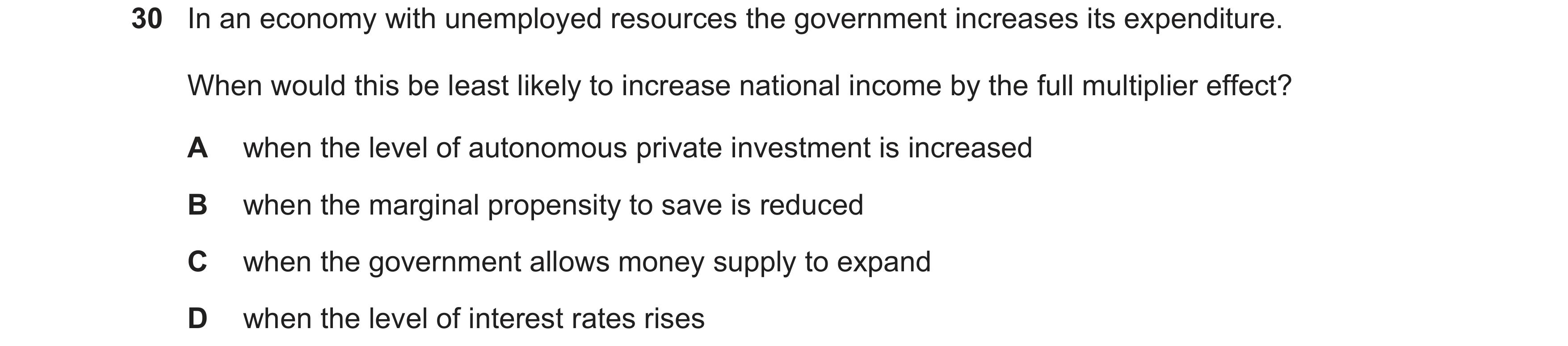
30 In an economy with unemployed resources the government increases its expenditure. When would this be least likely to increase national income by the full multiplier effect? A when the level of autonomous private investment is increased B when the marginal propensity to save is reduced C when the government allows money supply to expand D when the level of interest rates rises
1 marks
Answer: D
This question in 9708/32 May/June 2017
Q22 · The information in the table is taken from a country’s national income accounts 9708/32 Feb/March 2019
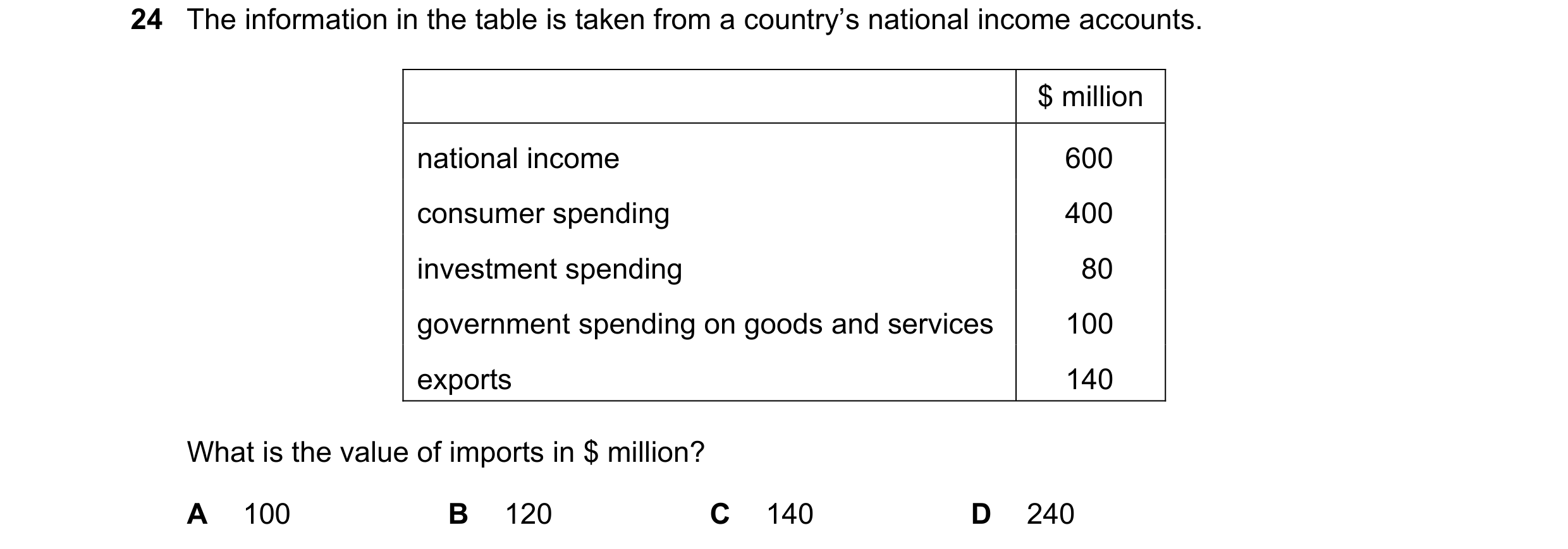
24 The information in the table is taken from a country’s national income accounts. $ million national income 600 consumer spending 400 investment spending 80 government spending on goods and services 100 exports 140 What is the value of imports in $ million? A 100 B 120 C 140 D 240
1 marks
Answer: B
This question in 9708/32 Feb/March 2019
Q23 · Which row correctly identifies leakages from a country’s circular flow of income? 9708/32 May/June 2019
24 Which row correctly identifies leakages from a country’s circular flow of income? private sector public sector trade sector (S > I) (T > G) (X > M) A no no yes B no yes yes C yes no no D yes yes no
1 marks
Answer: D
This question in 9708/32 May/June 2019
Q24 · What represents an injection into a country’s circular flow of income? 9708/32 Oct/Nov 2019
22 What represents an injection into a country’s circular flow of income? A corporate taxes B interest payments on government bonds C the payment of dividends to foreign shareholders D the repayment of bank loans
1 marks
Answer: B
This question in 9708/32 Oct/Nov 2019
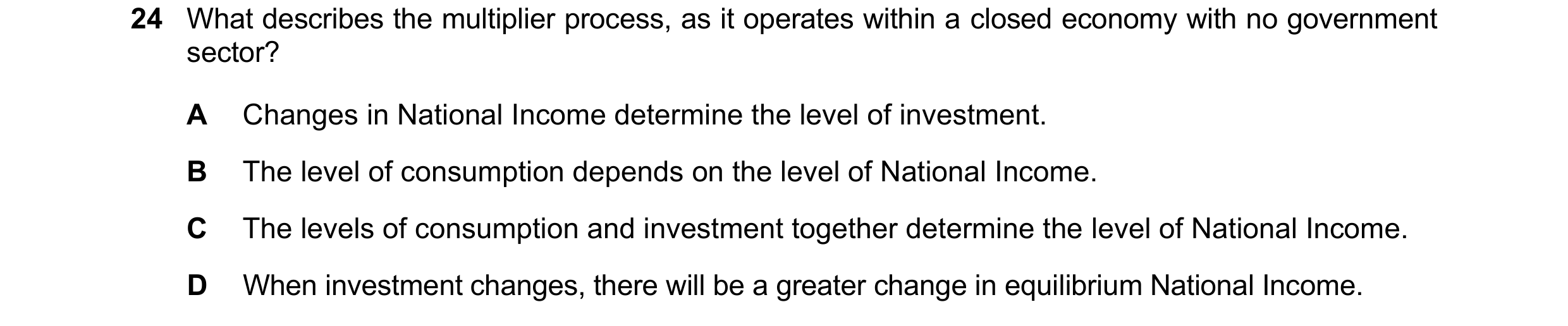
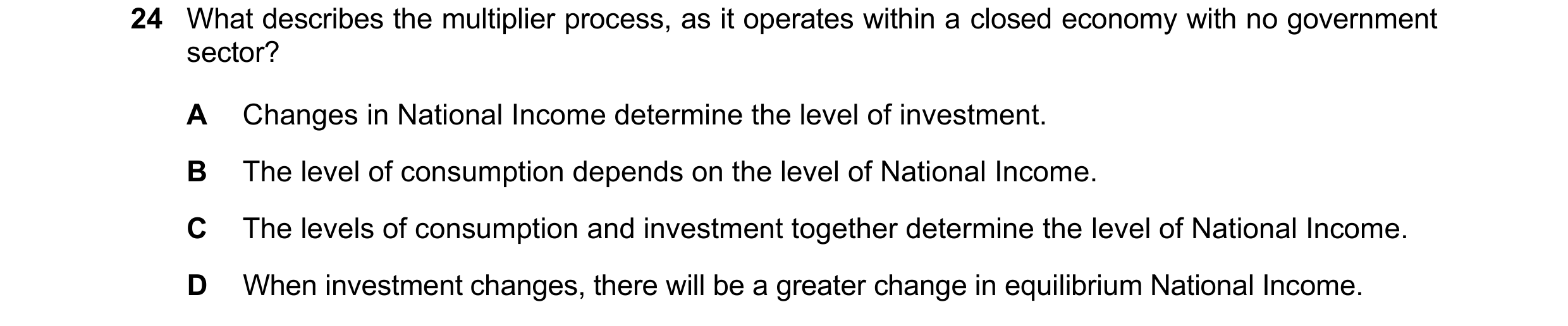
Q25 · What describes the multiplier process, as it operates within a closed economy with no… 9708/31 May/June 2021
24 What describes the multiplier process, as it operates within a closed economy with no government sector? A Changes in National Income determine the level of investment. B The level of consumption depends on the level of National Income. C The levels of consumption and investment together determine the level of National Income. D When investment changes, there will be a greater change in equilibrium National Income.
1 marks
Answer: D
This question in 9708/31 May/June 2021
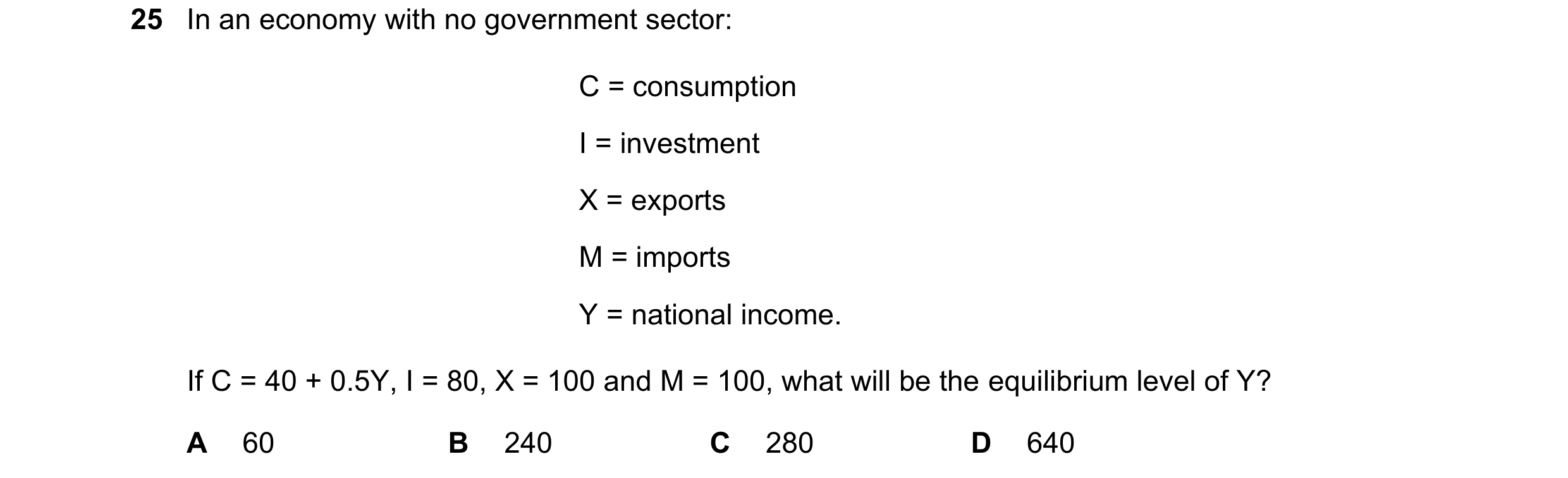
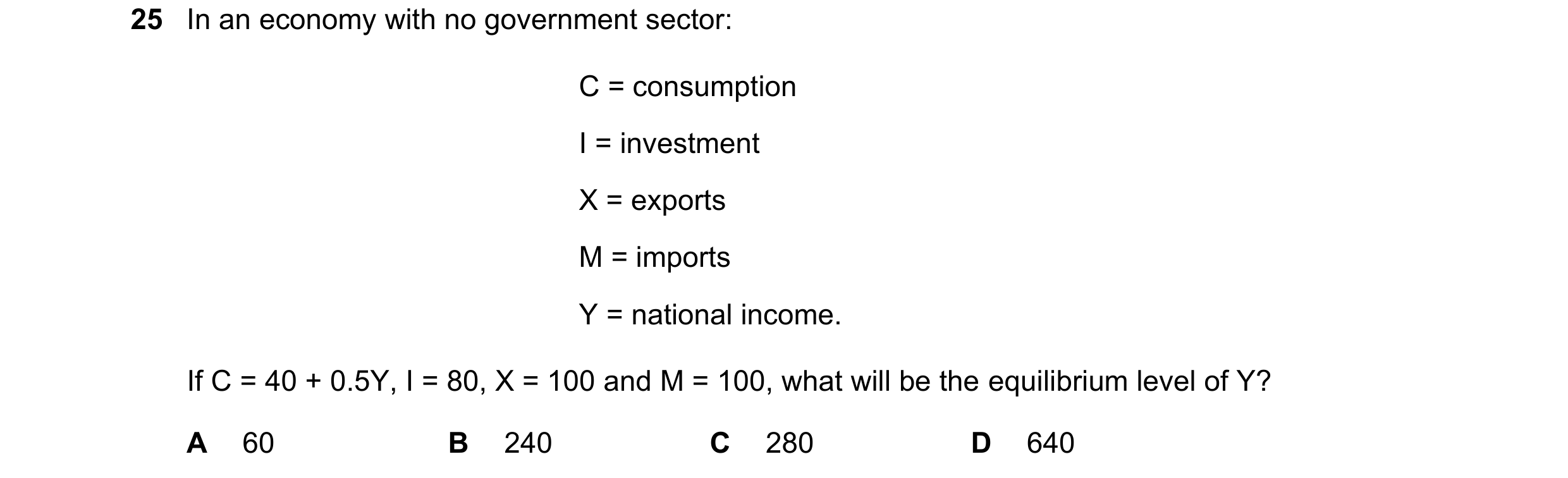
Q26 · In an economy with no government sector: C = consumption I = investment X = exports M =… 9708/31 May/June 2021
25 In an economy with no government sector: C = consumption I = investment X = exports M = imports Y = national income. If C = 40 + 0.5Y, I = 80, X = 100 and M = 100, what will be the equilibrium level of Y? A 60 B 240 C 280 D 640
1 marks
Answer: B
This question in 9708/31 May/June 2021
Q27 · What would be an increase in leakages or withdrawals from the circular flow of income? 9708/31 May/June 2021
27 What would be an increase in leakages or withdrawals from the circular flow of income? A increase in government spending on anti-smoking campaigns B increase in spending on imports of luxury cars C increase in spending on transfer payments D increase in wages paid to government employees
1 marks
Answer: B
This question in 9708/31 May/June 2021
Q28 · Government spending in an economy increases by $4000 whilst at the same time investment… 9708/32 May/June 2021
24 Government spending in an economy increases by $4000 whilst at the same time investment falls by $1500. marginal propensity to save = 1 10 marginal propensity to tax = 1 5 marginal propensity to import = 1 10 What will be the increase in national income following these changes? A $2500 B $6250 C $10 000 D $25 000
1 marks
Answer: B
This question in 9708/32 May/June 2021
Q29 · What describes the multiplier process, as it operates within a closed economy with no… 9708/33 May/June 2021
24 What describes the multiplier process, as it operates within a closed economy with no government sector? A Changes in National Income determine the level of investment. B The level of consumption depends on the level of National Income. C The levels of consumption and investment together determine the level of National Income. D When investment changes, there will be a greater change in equilibrium National Income.
1 marks
Answer: D
This question in 9708/33 May/June 2021
Q30 · In an economy with no government sector: C = consumption I = investment X = exports M =… 9708/33 May/June 2021
25 In an economy with no government sector: C = consumption I = investment X = exports M = imports Y = national income. If C = 40 + 0.5Y, I = 80, X = 100 and M = 100, what will be the equilibrium level of Y? A 60 B 240 C 280 D 640
1 marks
Answer: B
This question in 9708/33 May/June 2021
Q31 · What would be an increase in leakages or withdrawals from the circular flow of income? 9708/33 May/June 2021
27 What would be an increase in leakages or withdrawals from the circular flow of income? A increase in government spending on anti-smoking campaigns B increase in spending on imports of luxury cars C increase in spending on transfer payments D increase in wages paid to government employees
1 marks
Answer: B
This question in 9708/33 May/June 2021
Q32 · The aggregate demand in country X is calculated by the equation AD = C + I + (X – M) 9708/31 Oct/Nov 2021
18 The aggregate demand in country X is calculated by the equation AD = C + I + (X – M). Four students are asked to fill in the two gaps in the following sentence describing the economy of country X. ‘Country X is … 1 … economy … 2 … a government.’ Which student is correct? gap 1 gap 2 A a closed with B a closed without C an open with D an open without
1 marks
Answer: D
This question in 9708/31 Oct/Nov 2021
Q33 · In a closed economy with no government there is an initial equilibrium level of national… 9708/31 Oct/Nov 2021
24 In a closed economy with no government there is an initial equilibrium level of national income of $500 billion. The economy’s households always spend a constant fraction of every $1 of income they receive. When investment spending increases by $20 billion the economy moves to a new equilibrium level of national income of $600 billion. What is the marginal propensity to consume of the economy’s households? A 0.20 B 0.80 C 0.83 D 1.00
1 marks
Answer: B
This question in 9708/31 Oct/Nov 2021
Q34 · In a closed economy with no government sector the marginal propensity to consume is 0.6… 9708/32 Oct/Nov 2021
25 In a closed economy with no government sector the marginal propensity to consume is 0.6 at all levels of income. There is an increase in private sector investment of $100 million. What will be the increase in national income? A $60 million B $100 million C $166 million D $250 million
1 marks
Answer: D
This question in 9708/32 Oct/Nov 2021


 1 / 9
1 / 9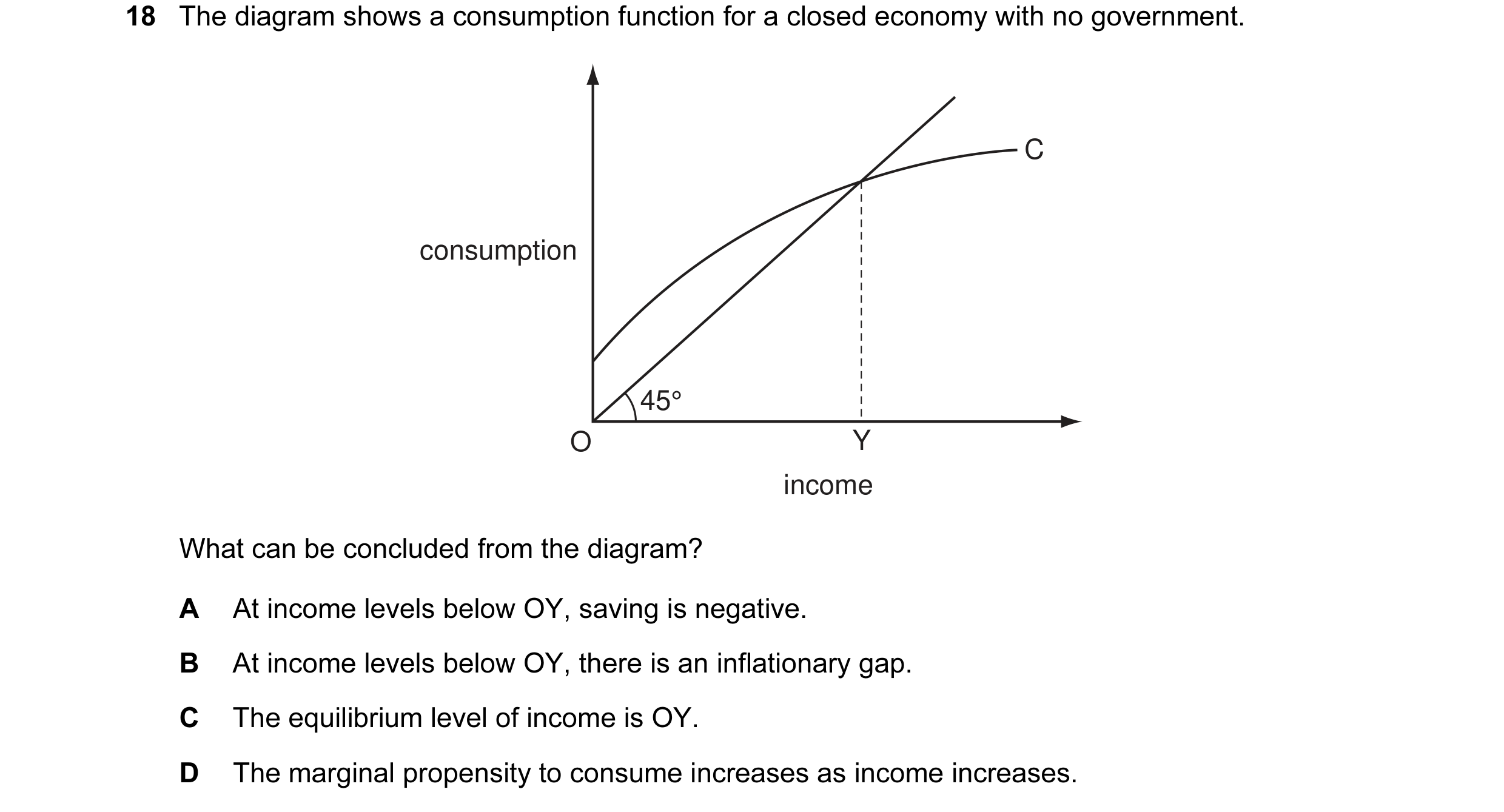
 2 / 9
2 / 9

 3 / 9
3 / 9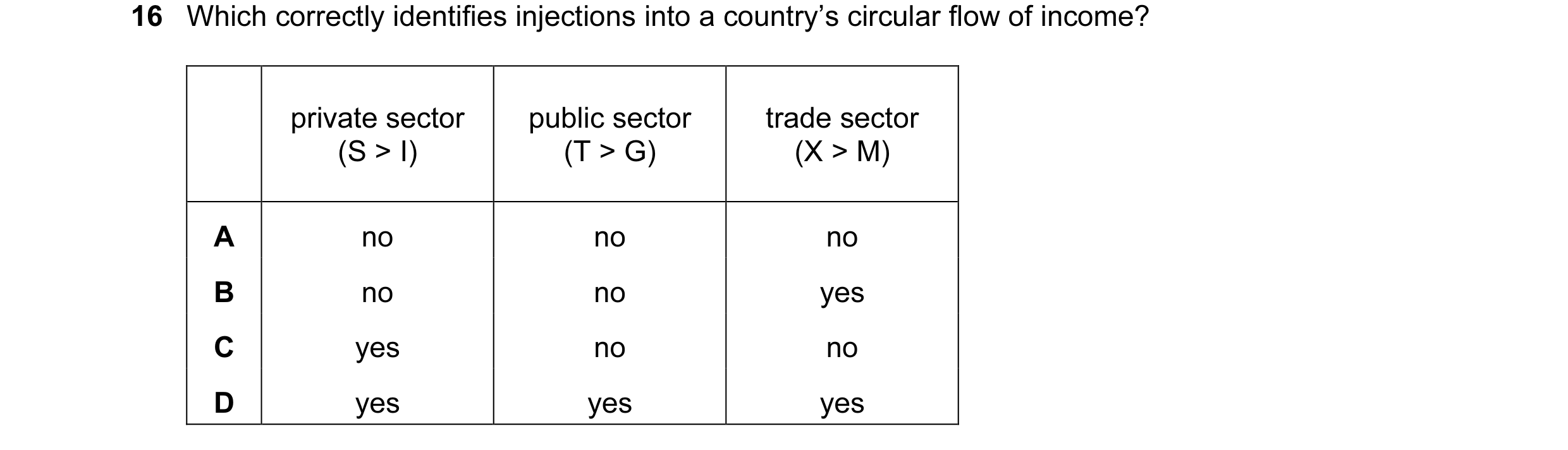

 4 / 9
4 / 9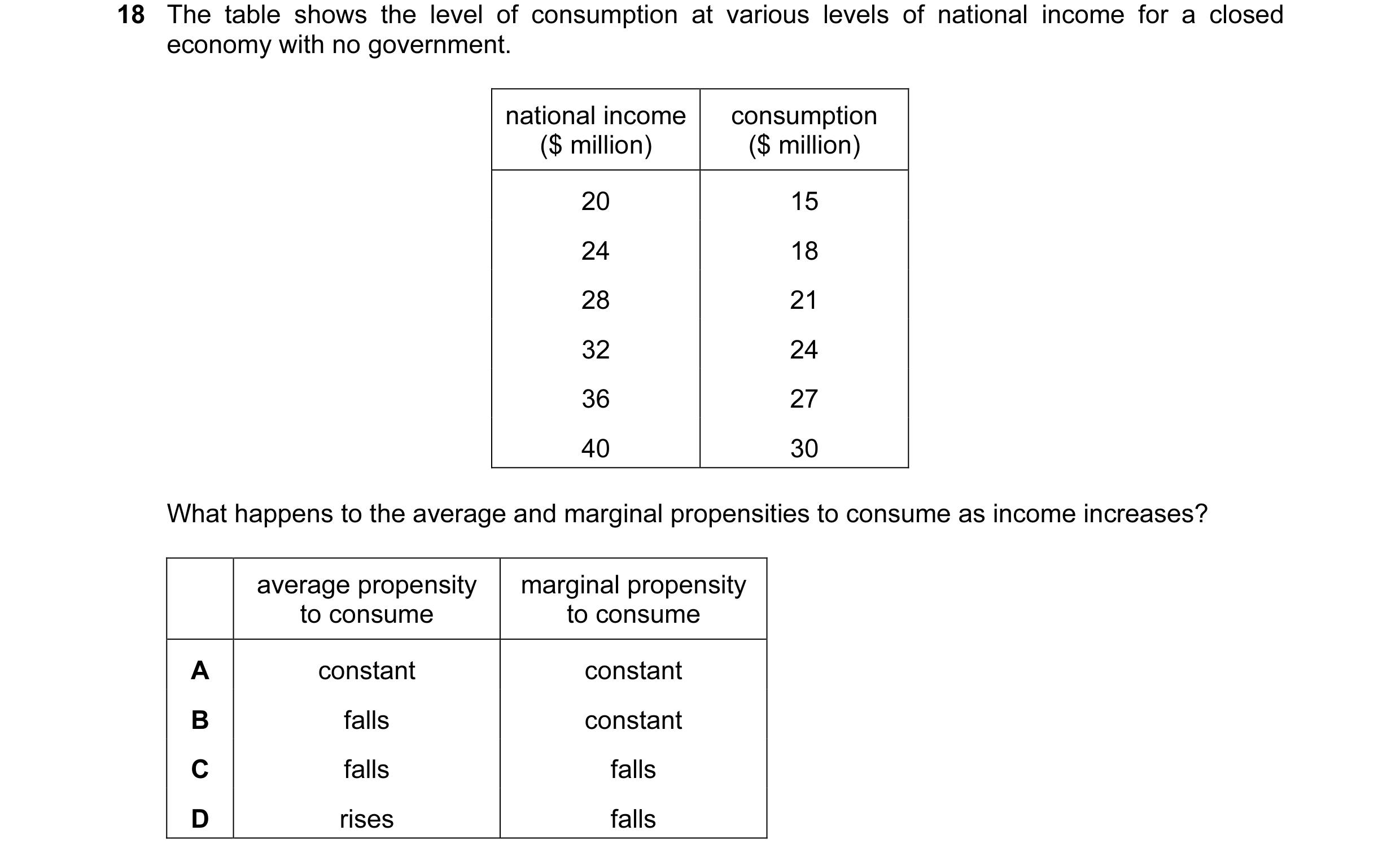
 5 / 9
5 / 9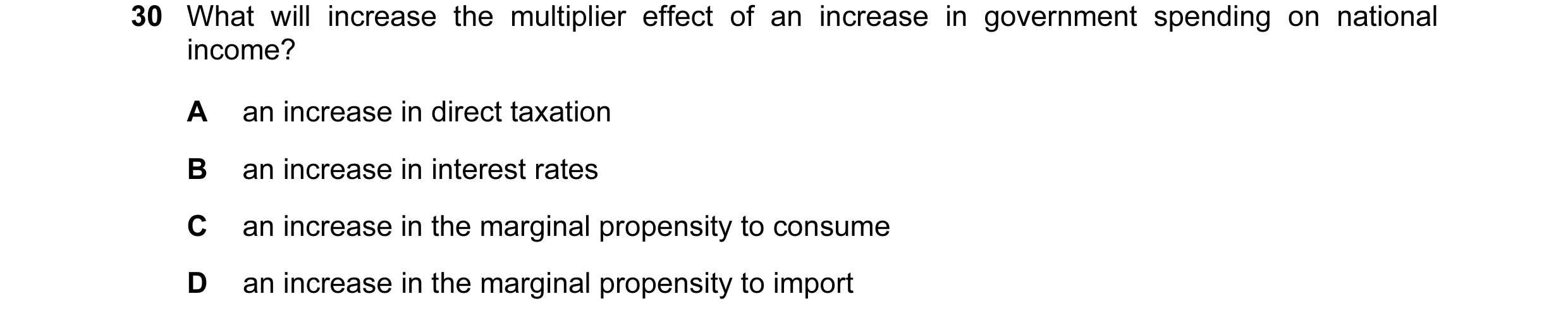
 6 / 9
6 / 9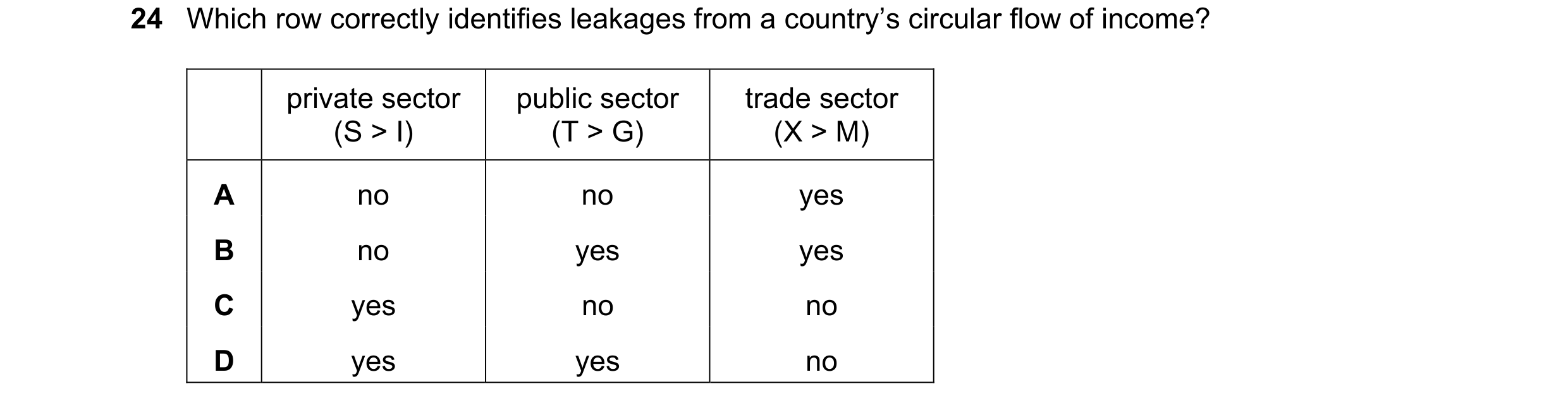

 7 / 9
7 / 9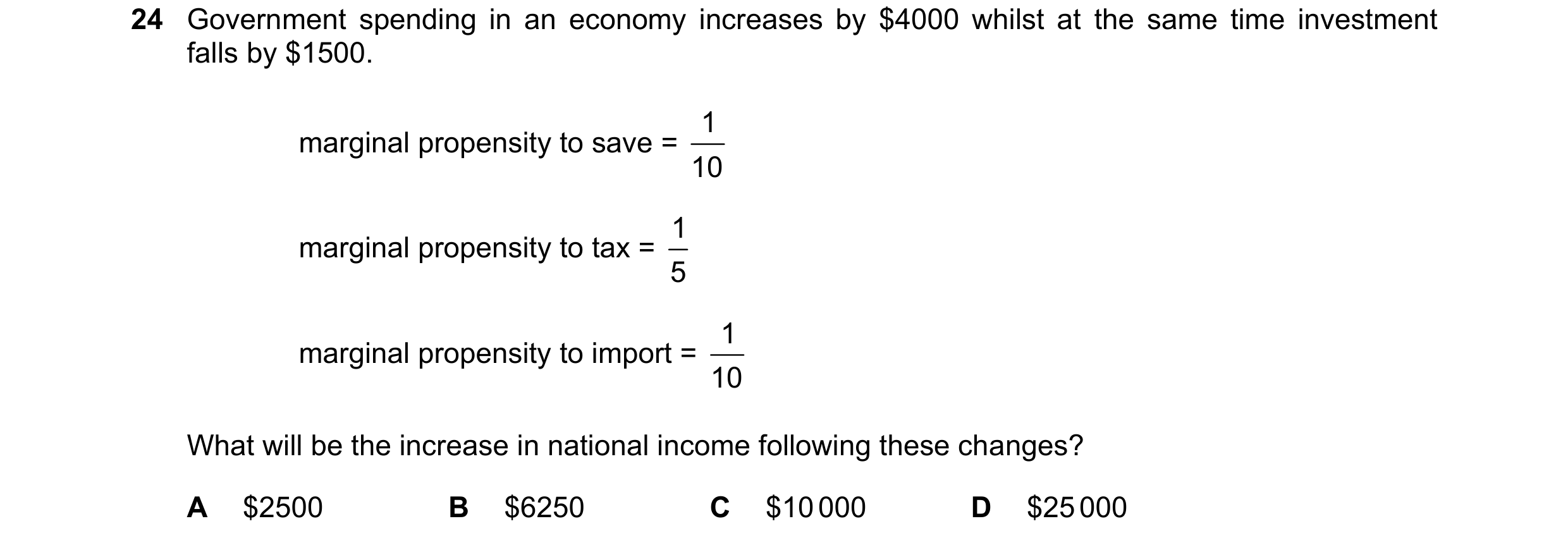
 8 / 9
8 / 9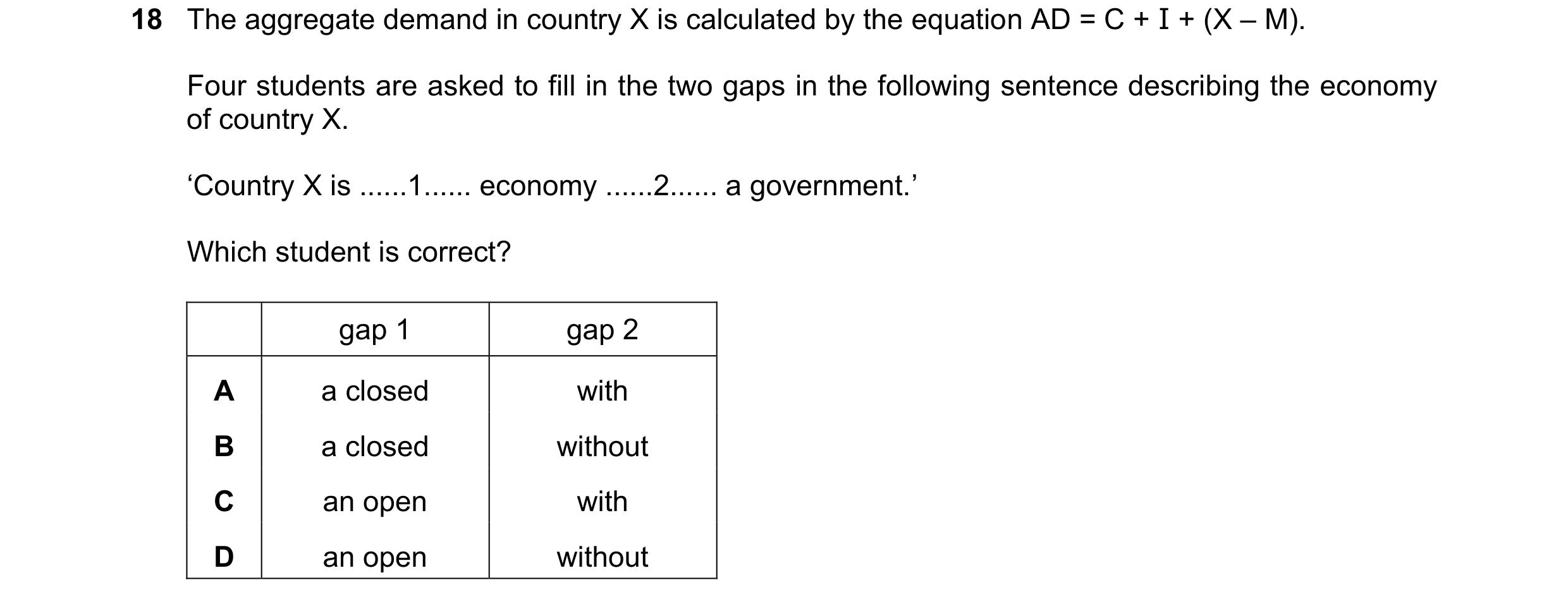

 9 / 9
9 / 9