Cambridge A Level Economics 9708 — 2023 Feb/March Paper 2 · Variant 2
9708/22/F/M/23 · 5 questions · 60 marks · ≈68 min
The question paper and its mark scheme, free to read here and free to download. This is Cambridge’s own paper, exactly as it was sat.
Question paper4 pages
Mark scheme19 pages
Answers below. Sit the paper first if you are practising.


Questions as text
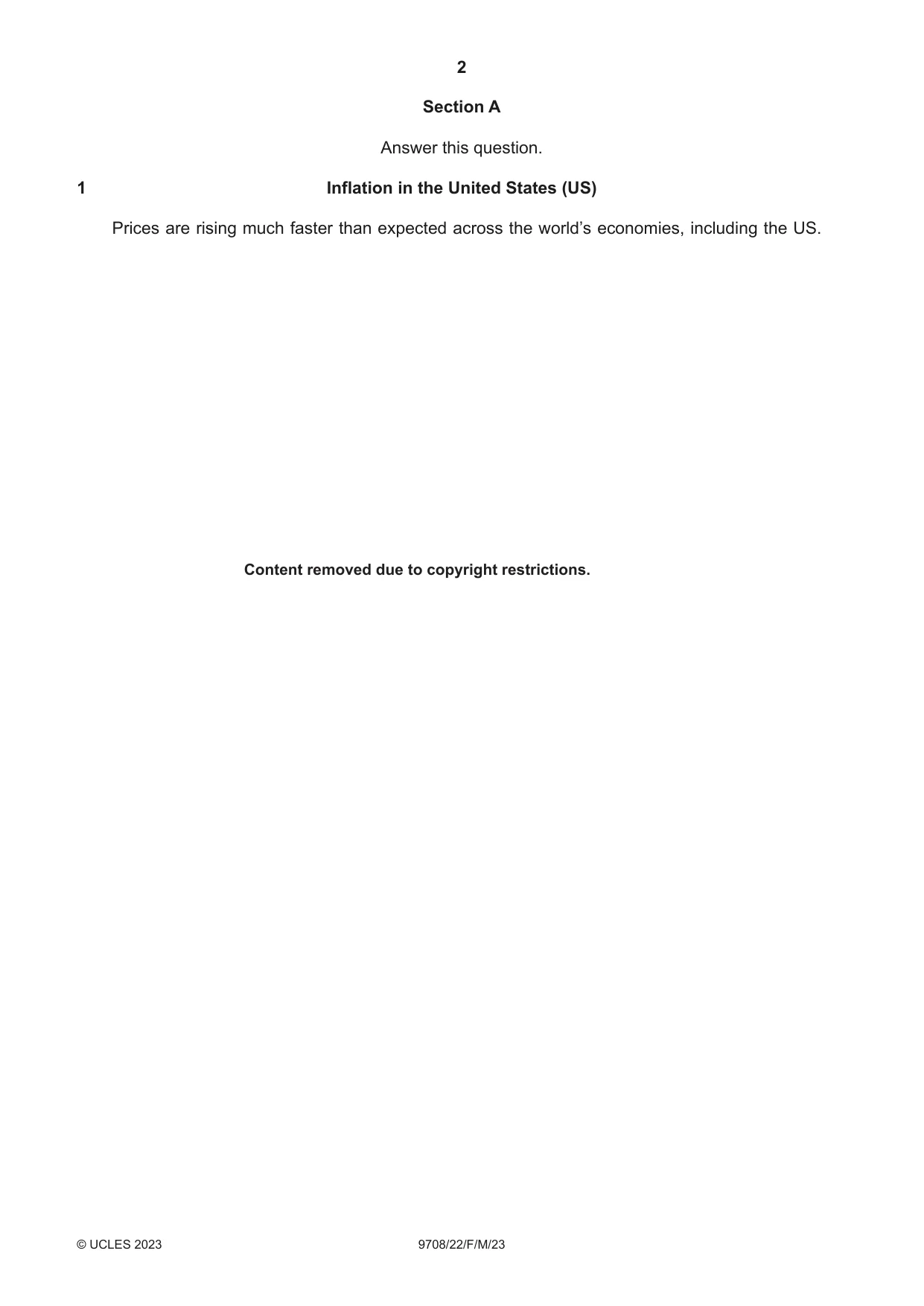
Q1 · Inflation in the United States (US) Prices are rising much faster than expected across…
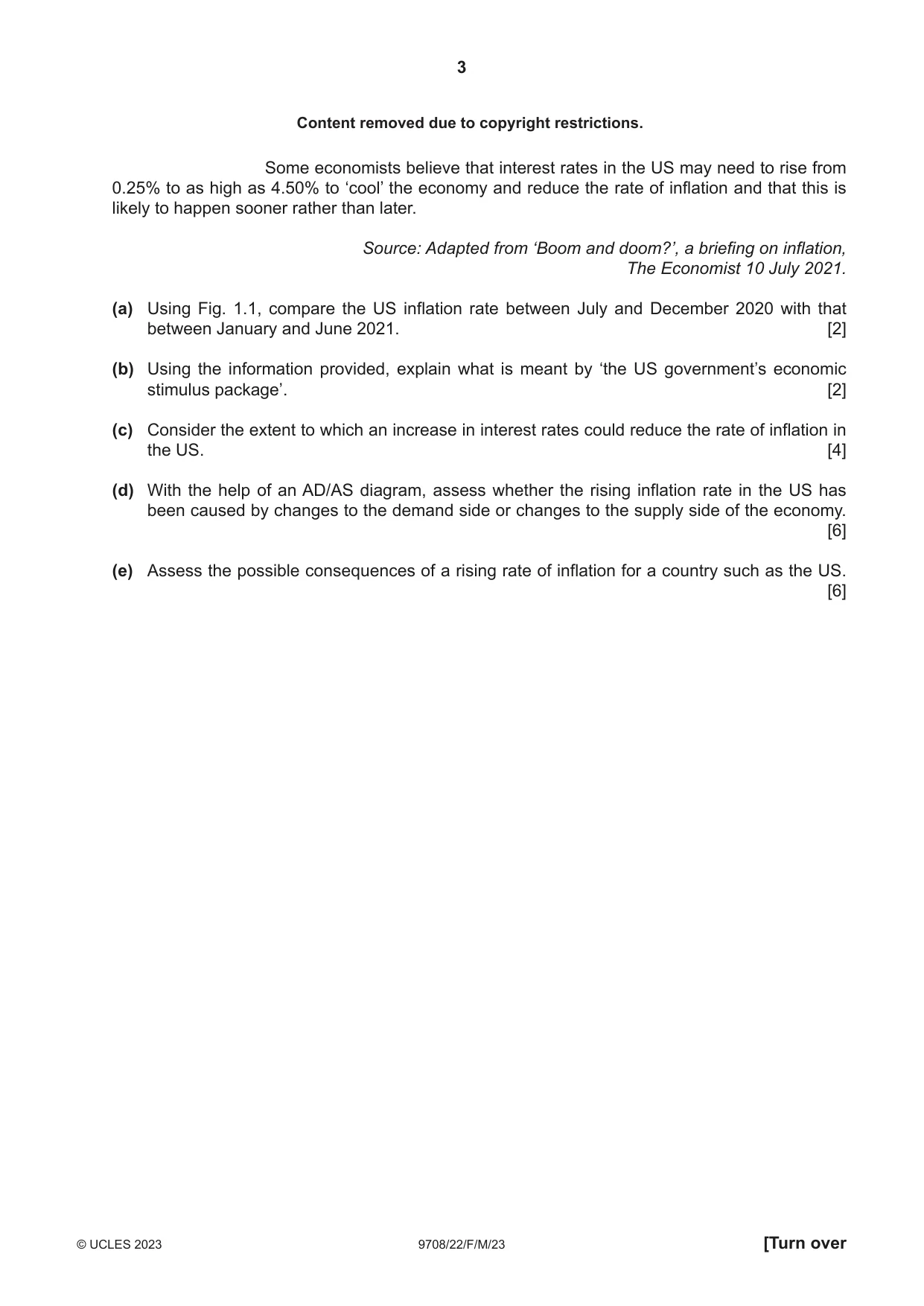
1 Inflation in the United States (US) Prices are rising much faster than expected across the world’s economies, including the US. Content removed due to copyright restrictions. Content removed due to copyright restrictions. Some economists believe that interest rates in the US may need to rise from 0.25% to as high as 4.50% to ‘cool’ the economy and reduce the rate of inflation and that this is likely to happen sooner rather than later. Source: Adapted from ‘Boom and doom?’, a briefing on inflation, The Economist 10 July 2021. (a) Using Fig. 1.1, compare the US inflation rate between July and December 2020 with that between January and June 2021. [2] (b) Using the information provided, explain what is meant by ‘the US government’s economic stimulus package’. [2] (c) Consider the extent to which an increase in interest rates could reduce the rate of inflation in the US. [4] (d) With the help of an AD/AS diagram, assess whether the rising inflation rate in the US has been caused by changes to the demand side or changes to the supply side of the economy. [6] (e) Assess the possible consequences of a rising rate of inflation for a country such as the US. [6]
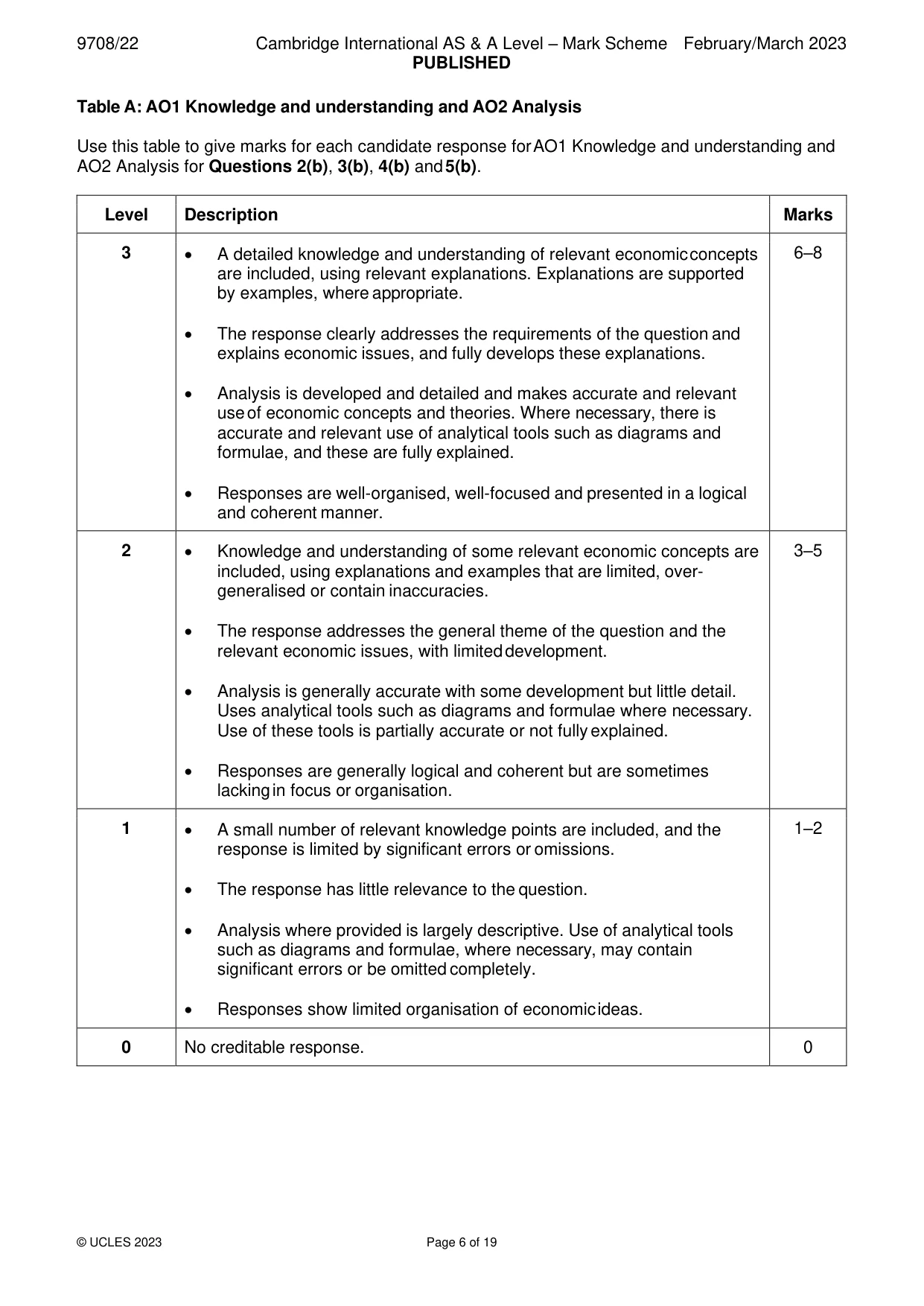
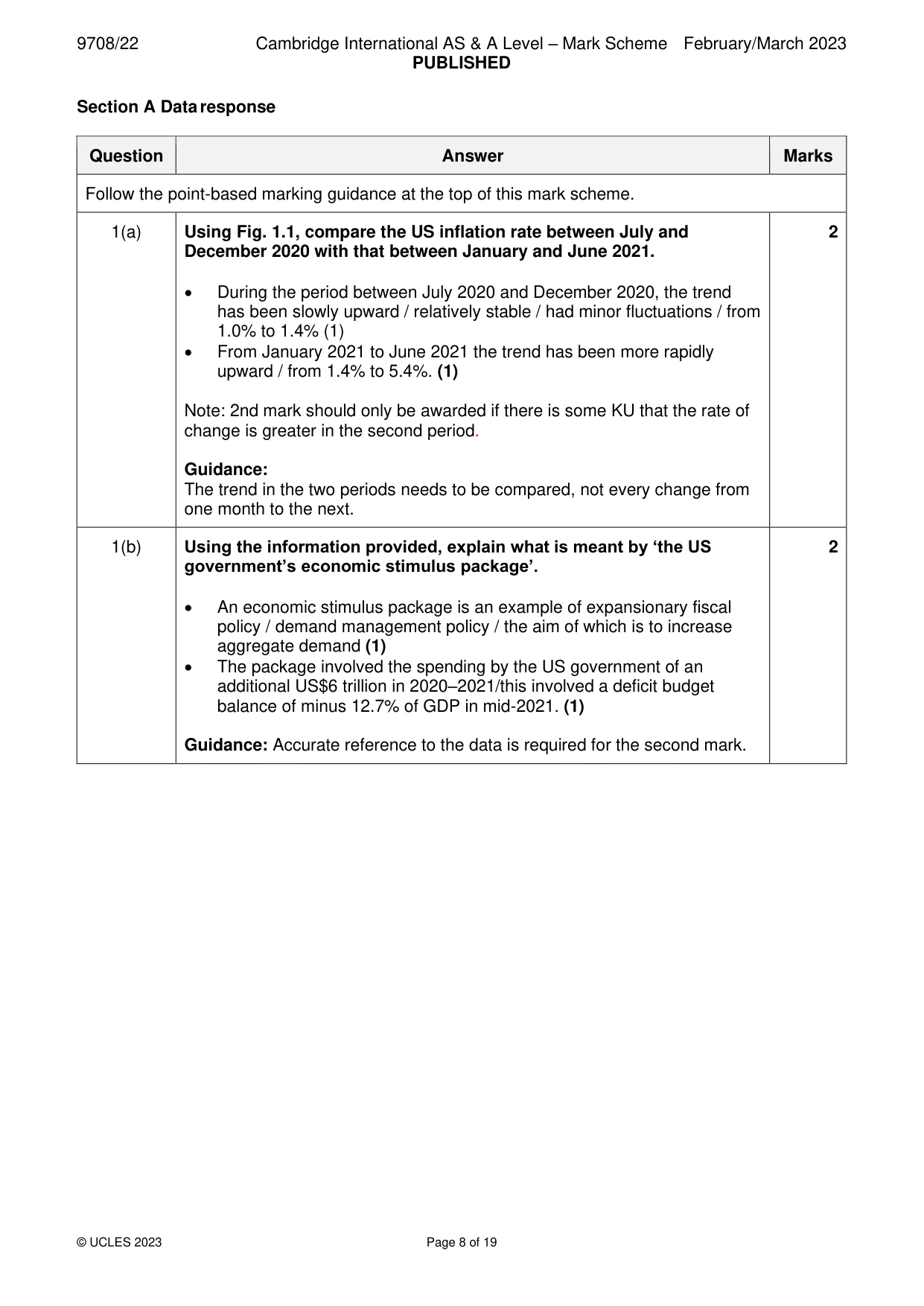
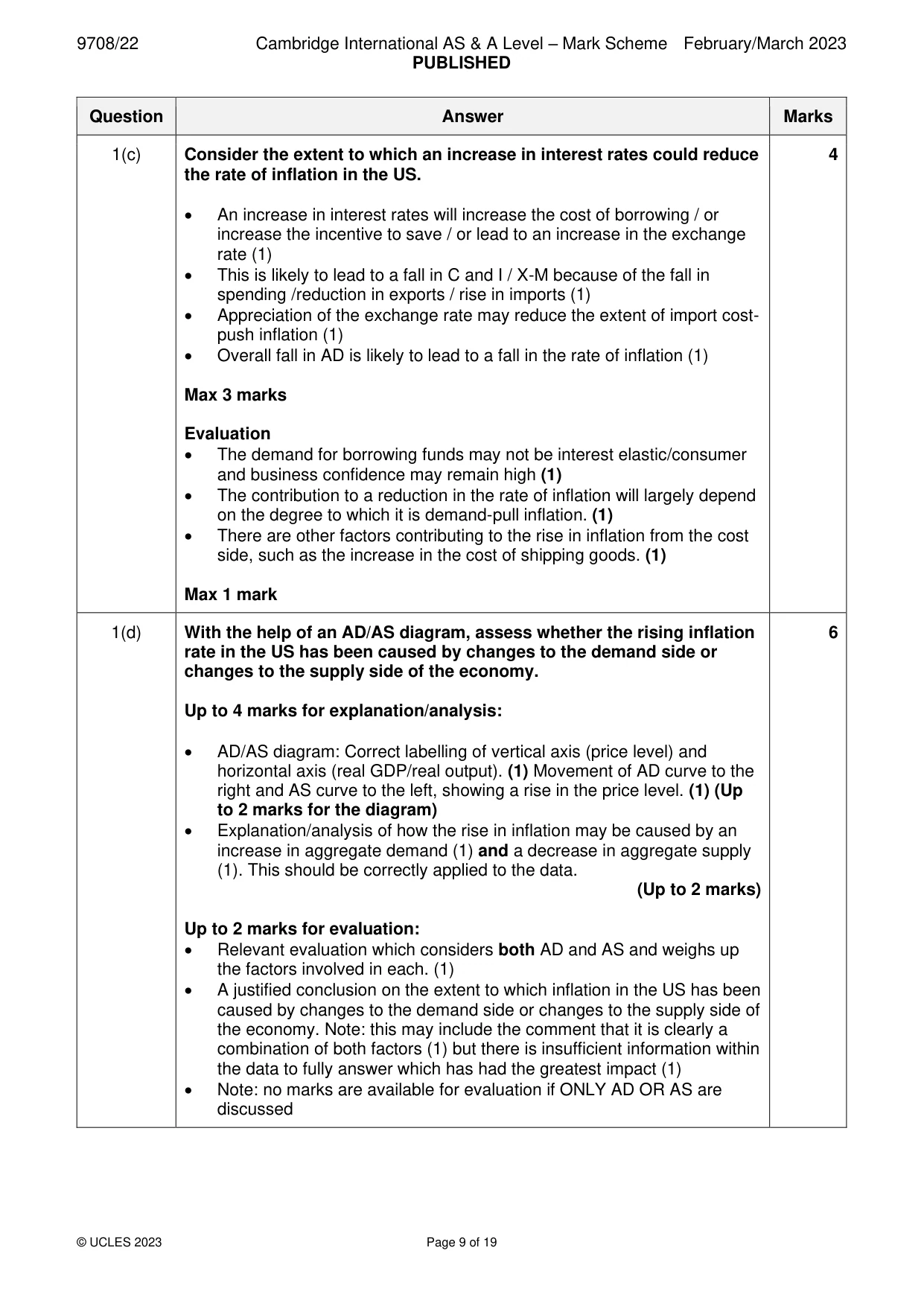
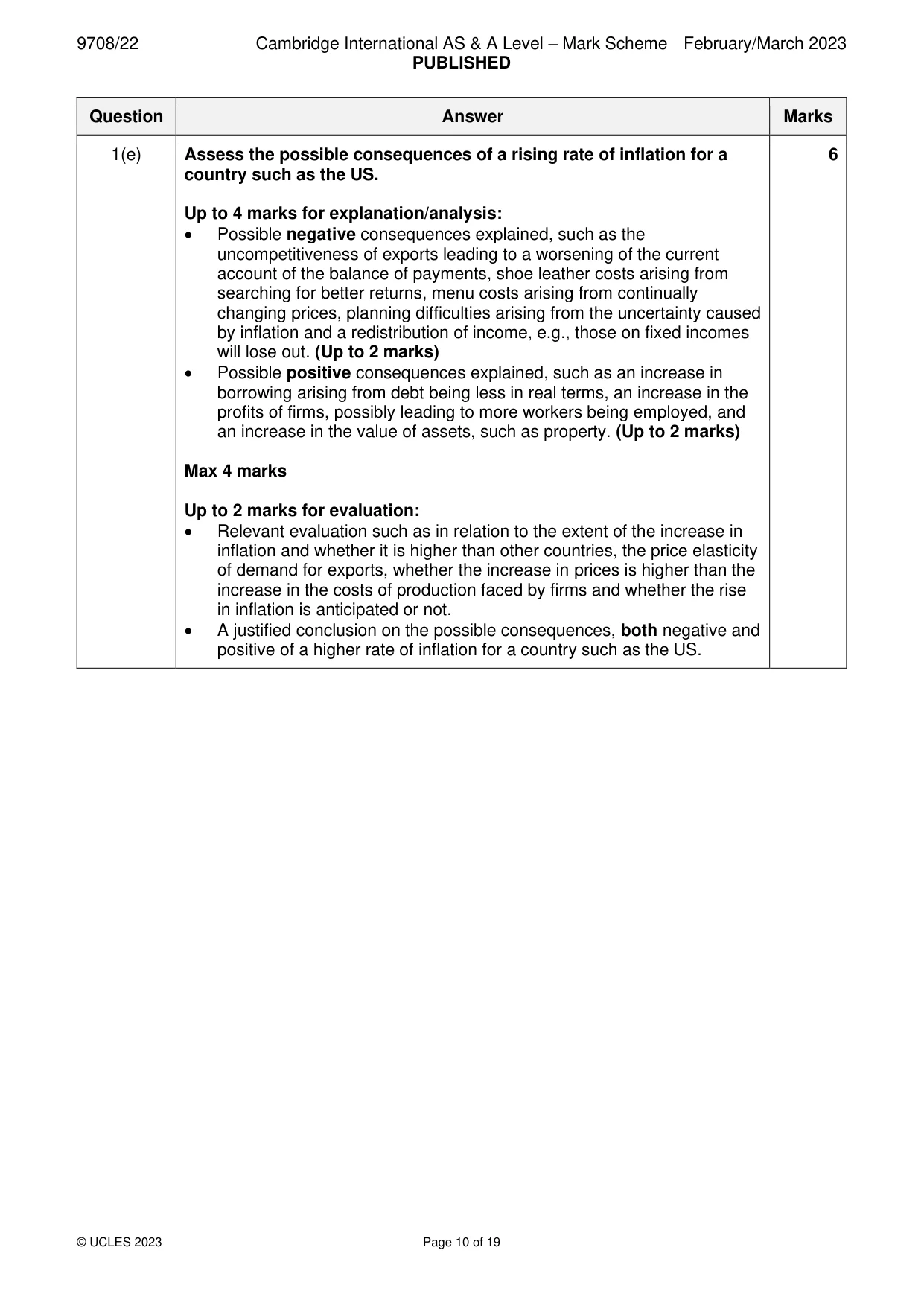
Mark scheme: Question Answer Marks Follow the point-based marking guidance at the top of this mark scheme. 1(a) Using Fig. 1.1, compare the US inflation rate between July and 2 December 2020 with that between January and June 2021. • During the period between July 2020 and December 2020, the trend has been slowly upward / relatively stable / had minor fluctuations / from 1.0% to 1.4% (1) • From January 2021 to June 2021 the trend has been more rapidly upward / from 1.4% to 5.4%. (1) Note: 2nd mark should only be awarded if there is some KU that the rate of change is greater in the second period. Guidance: The trend in the two periods needs to be compared, not every change from one month to the next. 1(b) Using the information provided, explain what is meant by ‘the US 2 government’s economic stimulus package’. • An economic stimulus package is an example of expansionary fiscal policy / demand management policy / the aim of which is to increase aggregate demand (1) • The package involved the spending by the US government of an additional US$6 trillion in 2020–2021/this involved a deficit budget balance of minus 12.7% of GDP in mid-2021. (1) Guidance: Accurate reference to the data is required for the second mark. 1(c) Consider the extent to which an increase in interest rates could reduce 4 the rate of inflation in the US. • An increase in interest rates will increase the cost of borrowing / or increase the incentive to save / or lead to an increase in the exchange rate (1) • This is likely to lead to a fall in C and I / X-M because of the fall in spending /reduction in exports / rise in imports (1) • Appreciation of the exchange rate may reduce the extent of import cost- push inflation (1) • Overall fall in AD is likely to lead to a fall in the rate of inflation (1) Max 3 marks Evaluation • The demand for borrowing funds may not be interest elastic/consumer and business confidence may remain high (1) • The contribution to a reduction in the rate of inflation will largely depend on the degree to which it is demand-pull inflation. (1) • There are other factors contributing to the rise in inflation from the cost side, such as the increase in the cost of shipping goods. (1) Max 1 mark 1(d) With the help of an AD/AS diagram, assess whether the rising inflation 6 rate in the US has been caused by changes to the demand side or changes to the supply side of the economy. Up to 4 marks for explanation/analysis: • AD/AS diagram: Correct labelling of vertical axis (price level) and horizontal axis (real GDP/real output). (1) Movement of AD curve to the right and AS curve to the left, showing a rise in the price level. (1) (Up to 2 marks for the diagram) • Explanation/analysis of how the rise in inflation may be caused by an increase in aggregate demand (1) and a decrease in aggregate supply (1). This should be correctly applied to the data. (Up to 2 marks) Up to 2 marks for evaluation: • Relevant evaluation which considers both AD and AS and weighs up the factors involved in each. (1) • A justified conclusion on the extent to which inflation in the US has been caused by changes to the demand side or changes to the supply side of the economy. Note: this may include the comment that it is clearly a combination of both factors (1) but there is insufficient information within the data to fully answer which has had the greatest impact (1) • Note: no marks are available for evaluation if ONLY AD OR AS are discussed 1(e) Assess the possible consequences of a rising rate of inflation for a 6 country such as the US. Up to 4 marks for explanation/analysis: • Possible negative consequences explained, such as the uncompetitiveness of exports leading to a worsening of the current account of the balance of payments, shoe leather costs arising from searching for better returns, menu costs arising from continually changing prices, planning difficulties arising from the uncertainty caused by inflation and a redistribution of income, e.g., those on fixed incomes will lose out. (Up to 2 marks) • Possible positive consequences explained, such as an increase in borrowing arising from debt being less in real terms, an increase in the profits of firms, possibly leading to more workers being employed, and an increase in the value of assets, such as property. (Up to 2 marks) Max 4 marks Up to 2 marks for evaluation: • Relevant evaluation such as in relation to the extent of the increase in inflation and whether it is higher than other countries, the price elasticity of demand for exports, whether the increase in prices is higher than the increase in the costs of production faced by firms and whether the rise in inflation is anticipated or not. • A justified conclusion on the possible consequences, both negative and positive of a higher rate of inflation for a country such as the US.
Q2 · Explain the functions of price in resource allocation and consider the importance of…
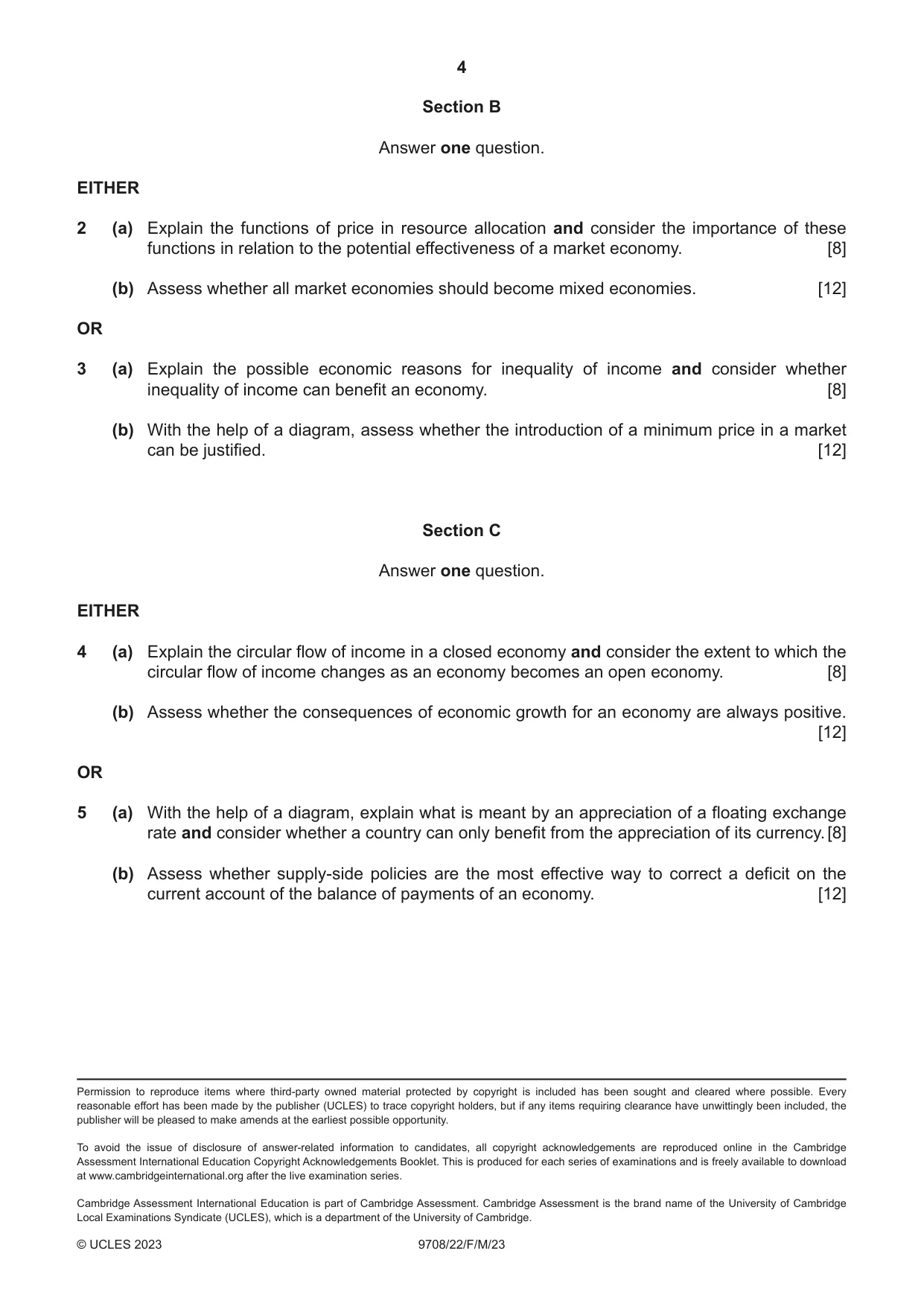
2 (a) Explain the functions of price in resource allocation and consider the importance of these functions in relation to the potential effectiveness of a market economy. [8] (b) Assess whether all market economies should become mixed economies. [12] OR
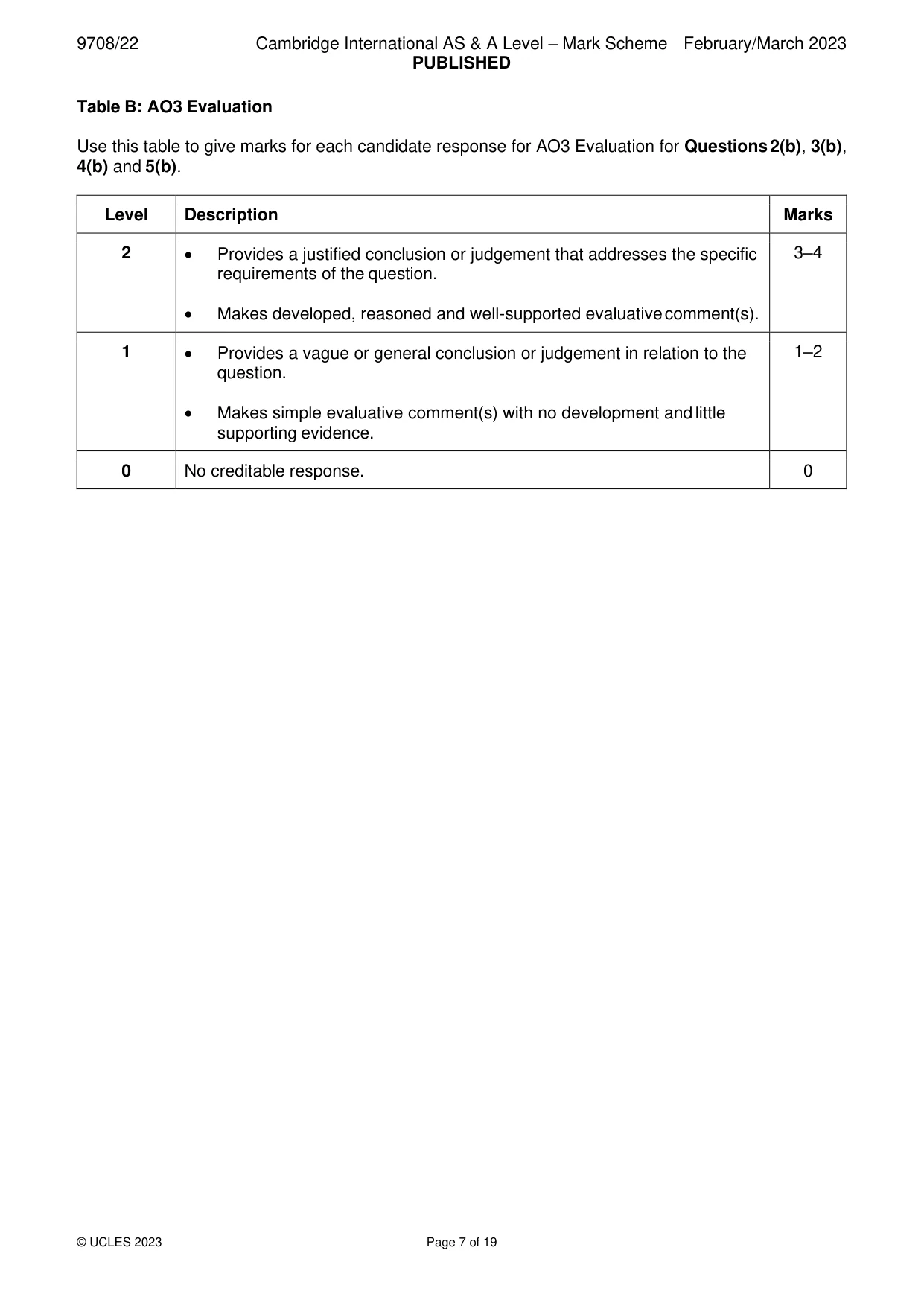
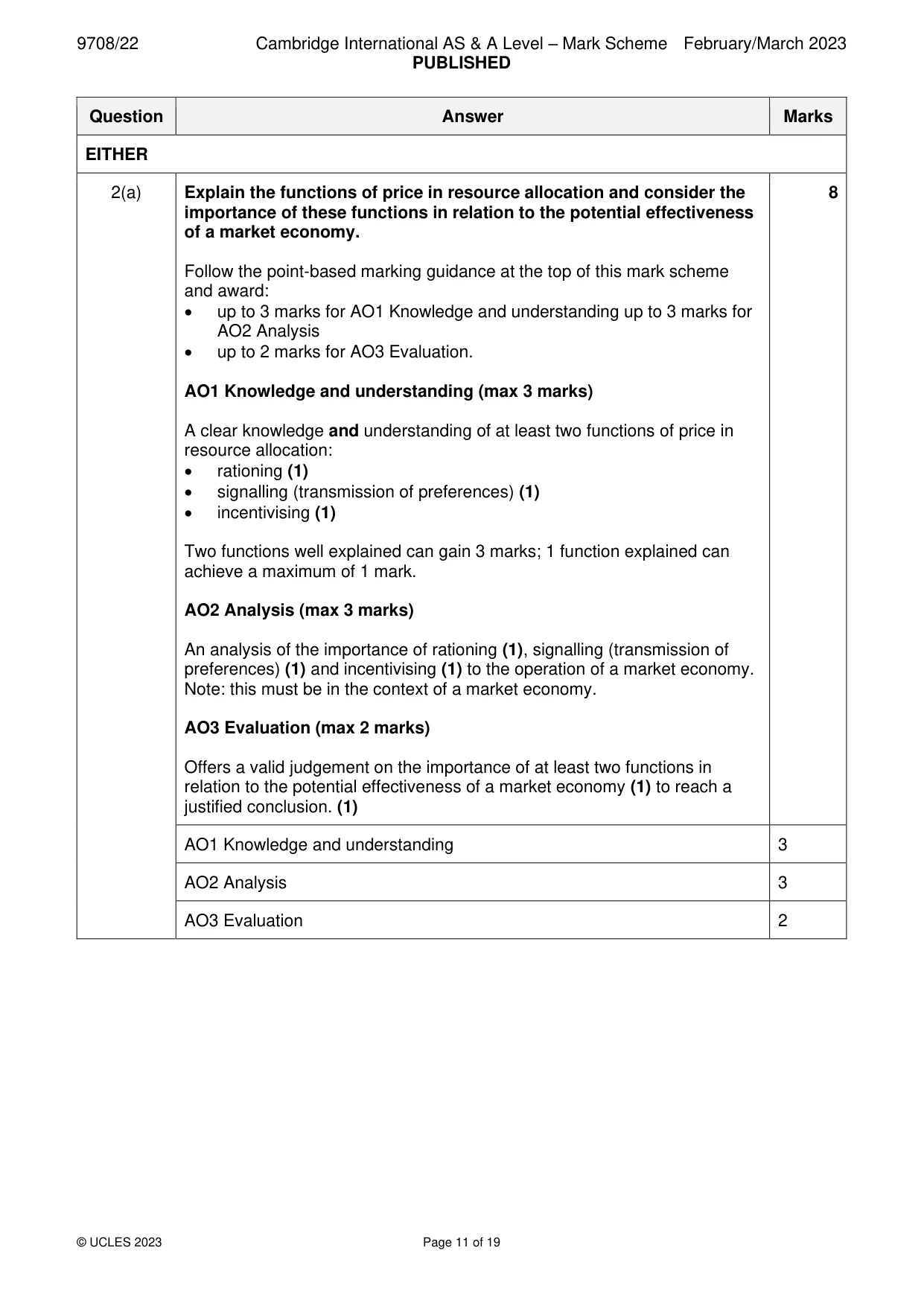
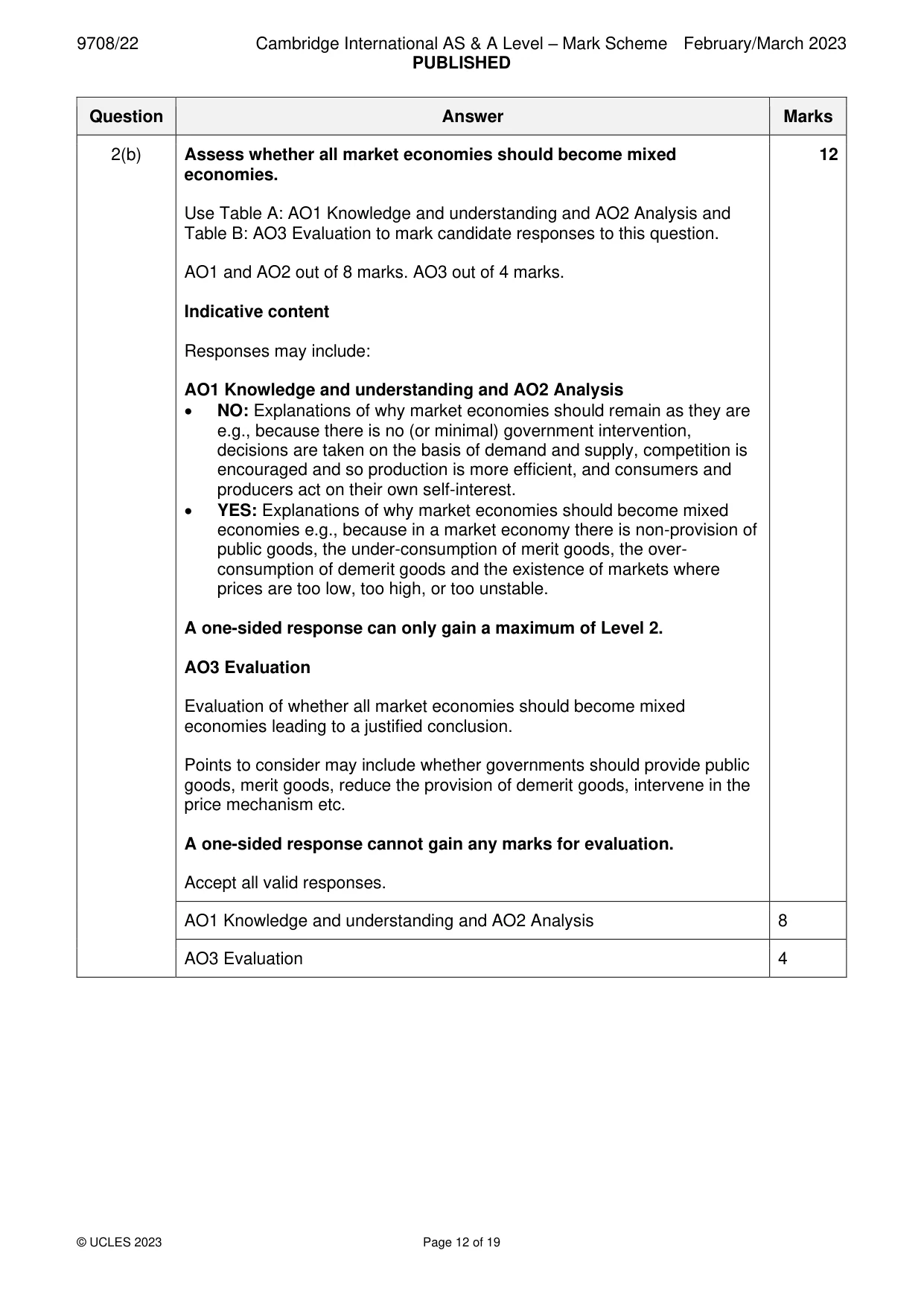
Mark scheme: 2(a) Explain the functions of price in resource allocation and consider the 8 importance of these functions in relation to the potential effectiveness of a market economy. Follow the point-based marking guidance at the top of this mark scheme and award: • up to 3 marks for AO1 Knowledge and understanding up to 3 marks for AO2 Analysis • up to 2 marks for AO3 Evaluation. AO1 Knowledge and understanding (max 3 marks) A clear knowledge and understanding of at least two functions of price in resource allocation: • rationing (1) • signalling (transmission of preferences) (1) • incentivising (1) Two functions well explained can gain 3 marks; 1 function explained can achieve a maximum of 1 mark. AO2 Analysis (max 3 marks) An analysis of the importance of rationing (1), signalling (transmission of preferences) (1) and incentivising (1) to the operation of a market economy. Note: this must be in the context of a market economy. AO3 Evaluation (max 2 marks) Offers a valid judgement on the importance of at least two functions in relation to the potential effectiveness of a market economy (1) to reach a justified conclusion. (1) AO1 Knowledge and understanding 3 AO2 Analysis 3 AO3 Evaluation 2 2(b) Assess whether all market economies should become mixed 12 economies. Use Table A: AO1 Knowledge and understanding and AO2 Analysis and Table B: AO3 Evaluation to mark candidate responses to this question. AO1 and AO2 out of 8 marks. AO3 out of 4 marks. Indicative content Responses may include: AO1 Knowledge and understanding and AO2 Analysis • NO: Explanations of why market economies should remain as they are e.g., because there is no (or minimal) government intervention, decisions are taken on the basis of demand and supply, competition is encouraged and so production is more efficient, and consumers and producers act on their own self-interest. • YES: Explanations of why market economies should become mixed economies e.g., because in a market economy there is non-provision of public goods, the under-consumption of merit goods, the over- consumption of demerit goods and the existence of markets where prices are too low, too high, or too unstable. A one-sided response can only gain a maximum of Level 2. AO3 Evaluation Evaluation of whether all market economies should become mixed economies leading to a justified conclusion. Points to consider may include whether governments should provide public goods, merit goods, reduce the provision of demerit goods, intervene in the price mechanism etc. A one-sided response cannot gain any marks for evaluation. Accept all valid responses. AO1 Knowledge and understanding and AO2 Analysis 8 AO3 Evaluation 4
More questions on Resource allocation in different economic systems
Q3 · Explain the possible economic reasons for inequality of income and consider whether…
3 (a) Explain the possible economic reasons for inequality of income and consider whether inequality of income can benefit an economy. [8] (b) With the help of a diagram, assess whether the introduction of a minimum price in a market can be justified. [12] Section C Answer one question. EITHER
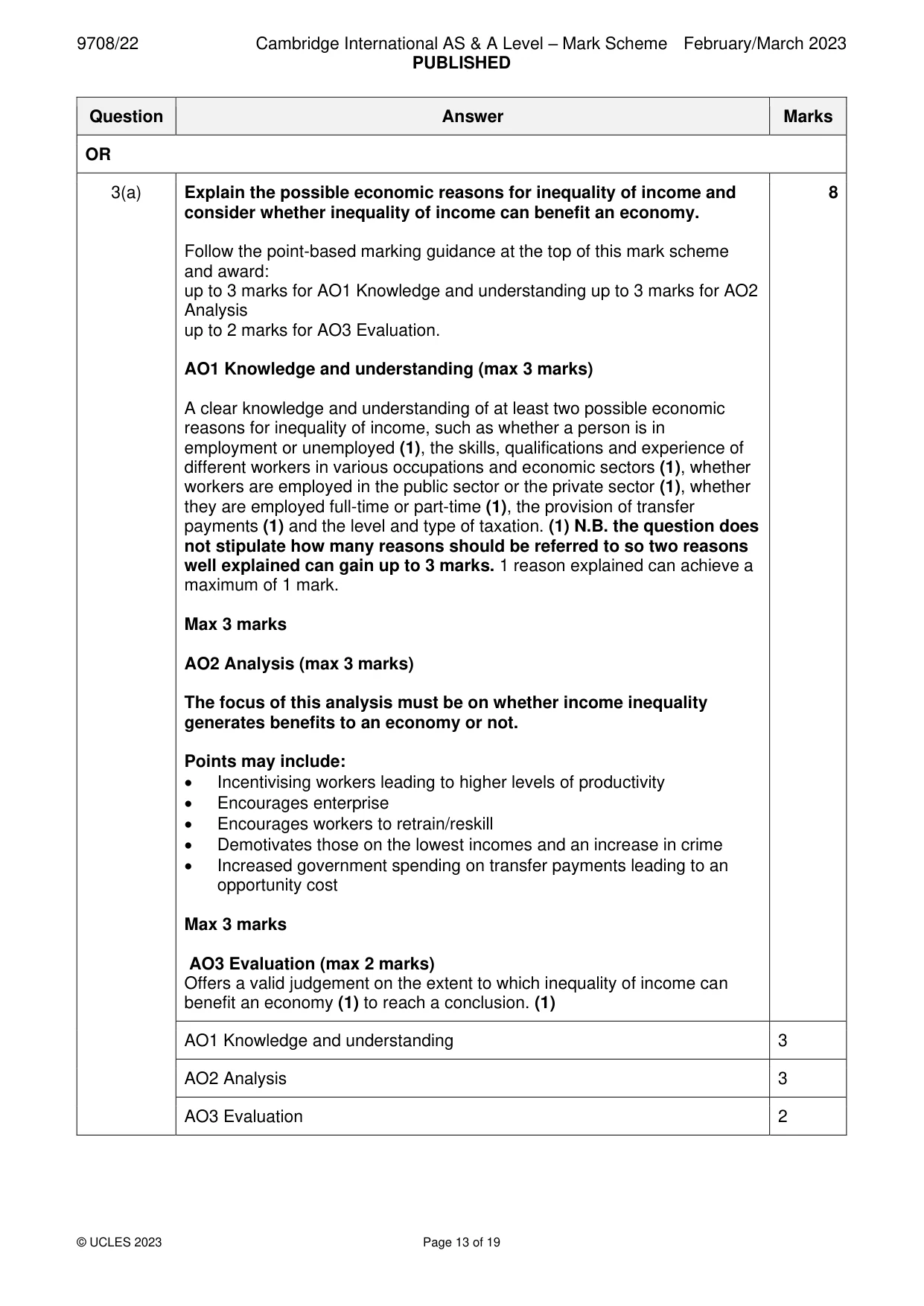
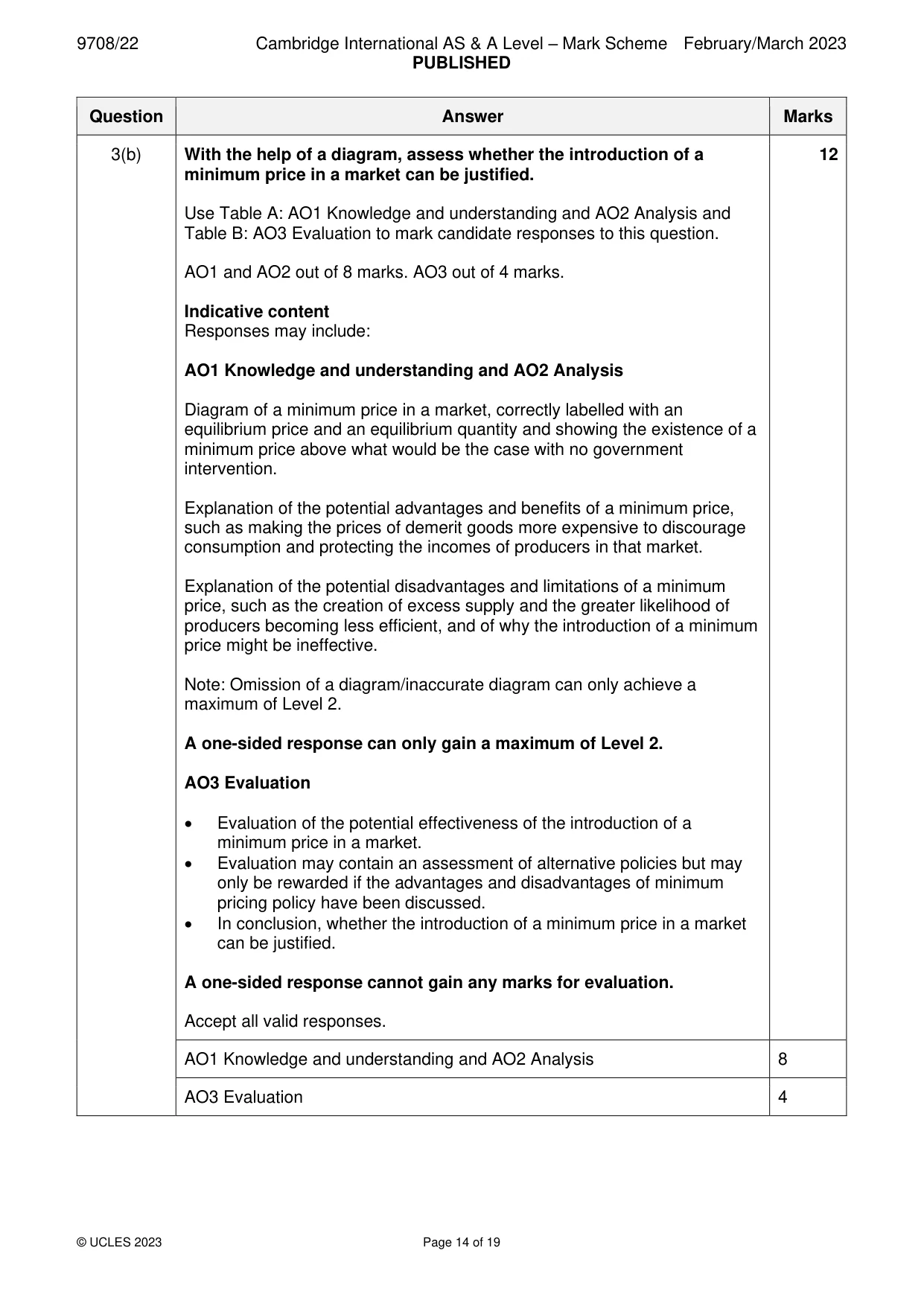
Mark scheme: 3(a) Explain the possible economic reasons for inequality of income and 8 consider whether inequality of income can benefit an economy. Follow the point-based marking guidance at the top of this mark scheme and award: up to 3 marks for AO1 Knowledge and understanding up to 3 marks for AO2 Analysis up to 2 marks for AO3 Evaluation. AO1 Knowledge and understanding (max 3 marks) A clear knowledge and understanding of at least two possible economic reasons for inequality of income, such as whether a person is in employment or unemployed (1), the skills, qualifications and experience of different workers in various occupations and economic sectors (1), whether workers are employed in the public sector or the private sector (1), whether they are employed full-time or part-time (1), the provision of transfer payments (1) and the level and type of taxation. (1) N.B. the question does not stipulate how many reasons should be referred to so two reasons well explained can gain up to 3 marks. 1 reason explained can achieve a maximum of 1 mark. Max 3 marks AO2 Analysis (max 3 marks) The focus of this analysis must be on whether income inequality generates benefits to an economy or not. Points may include: • Incentivising workers leading to higher levels of productivity • Encourages enterprise • Encourages workers to retrain/reskill • Demotivates those on the lowest incomes and an increase in crime • Increased government spending on transfer payments leading to an opportunity cost Max 3 marks AO3 Evaluation (max 2 marks) Offers a valid judgement on the extent to which inequality of income can benefit an economy (1) to reach a conclusion. (1) AO1 Knowledge and understanding 3 AO2 Analysis 3 AO3 Evaluation 2 3(b) With the help of a diagram, assess whether the introduction of a 12 minimum price in a market can be justified. Use Table A: AO1 Knowledge and understanding and AO2 Analysis and Table B: AO3 Evaluation to mark candidate responses to this question. AO1 and AO2 out of 8 marks. AO3 out of 4 marks. Indicative content Responses may include: AO1 Knowledge and understanding and AO2 Analysis Diagram of a minimum price in a market, correctly labelled with an equilibrium price and an equilibrium quantity and showing the existence of a minimum price above what would be the case with no government intervention. Explanation of the potential advantages and benefits of a minimum price, such as making the prices of demerit goods more expensive to discourage consumption and protecting the incomes of producers in that market. Explanation of the potential disadvantages and limitations of a minimum price, such as the creation of excess supply and the greater likelihood of producers becoming less efficient, and of why the introduction of a minimum price might be ineffective. Note: Omission of a diagram/inaccurate diagram can only achieve a maximum of Level 2. A one-sided response can only gain a maximum of Level 2. AO3 Evaluation • Evaluation of the potential effectiveness of the introduction of a minimum price in a market. • Evaluation may contain an assessment of alternative policies but may only be rewarded if the advantages and disadvantages of minimum pricing policy have been discussed. • In conclusion, whether the introduction of a minimum price in a market can be justified. A one-sided response cannot gain any marks for evaluation. Accept all valid responses. AO1 Knowledge and understanding and AO2 Analysis 8 AO3 Evaluation 4
More questions on Methods and effects of government intervention in markets
Q4 · Explain the circular flow of income in a closed economy and consider the extent to which…
4 (a) Explain the circular flow of income in a closed economy and consider the extent to which the circular flow of income changes as an economy becomes an open economy. [8] (b) Assess whether the consequences of economic growth for an economy are always positive. [12] OR
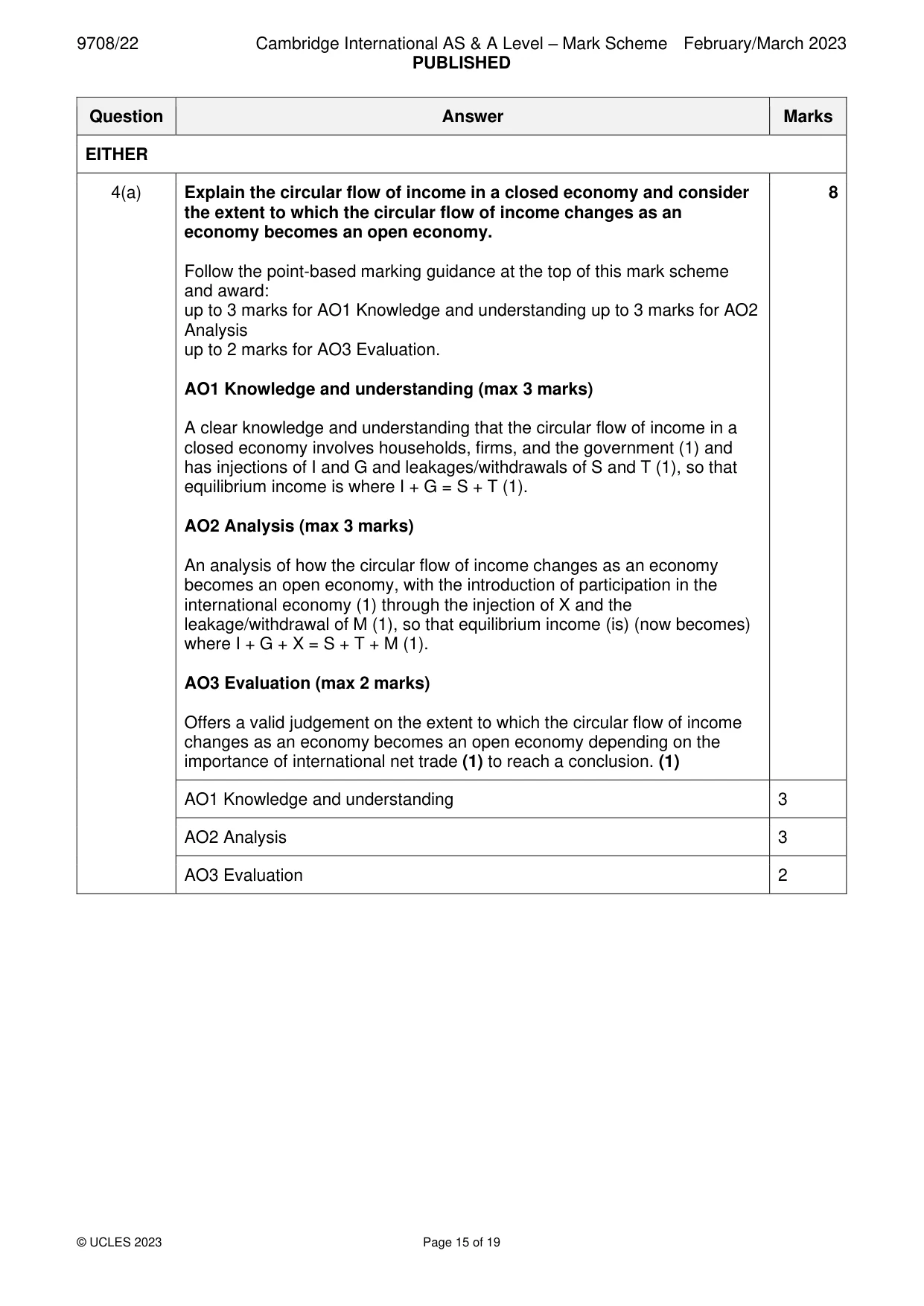
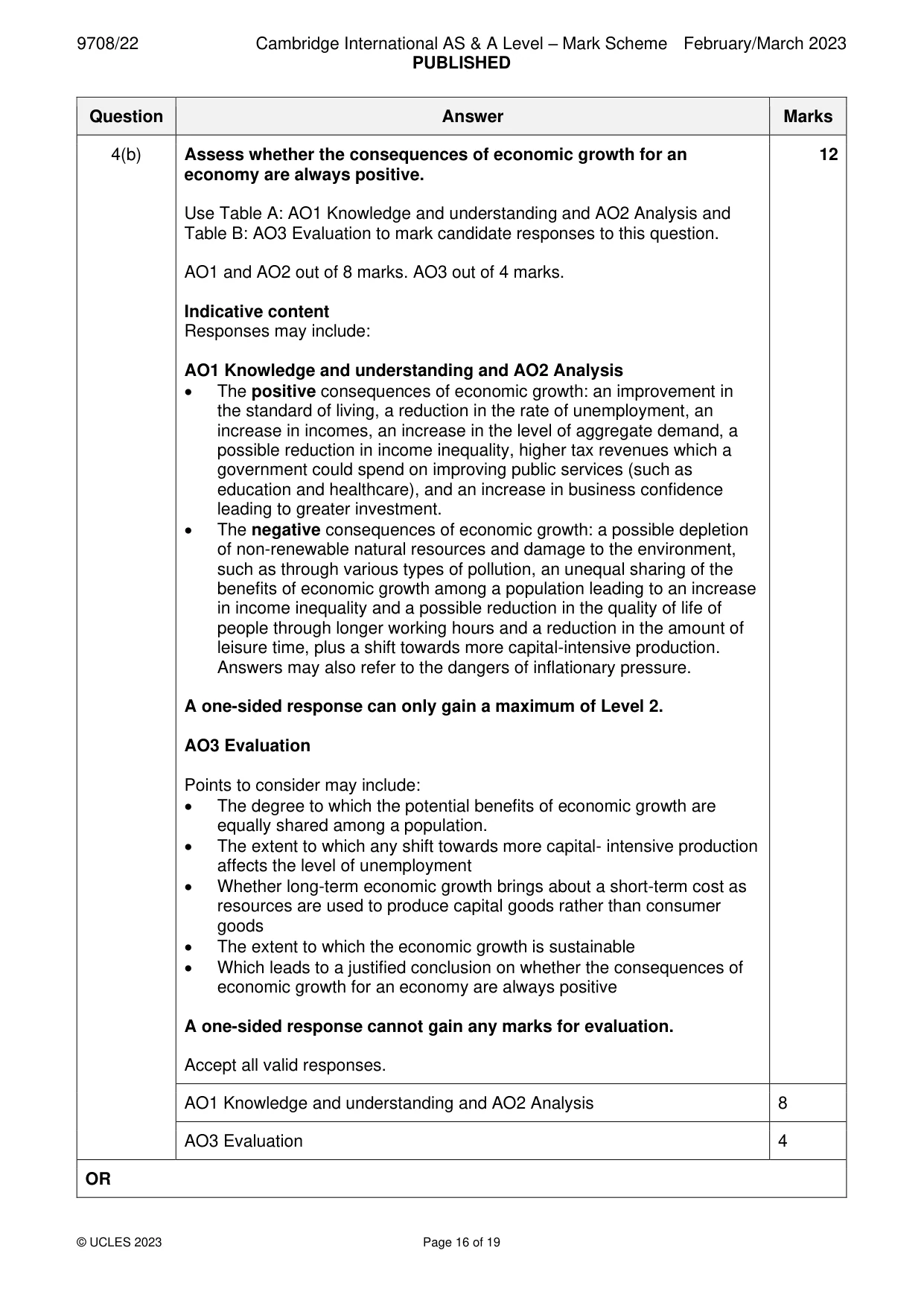
Mark scheme: 4(a) Explain the circular flow of income in a closed economy and consider 8 the extent to which the circular flow of income changes as an economy becomes an open economy. Follow the point-based marking guidance at the top of this mark scheme and award: up to 3 marks for AO1 Knowledge and understanding up to 3 marks for AO2 Analysis up to 2 marks for AO3 Evaluation. AO1 Knowledge and understanding (max 3 marks) A clear knowledge and understanding that the circular flow of income in a closed economy involves households, firms, and the government (1) and has injections of I and G and leakages/withdrawals of S and T (1), so that equilibrium income is where I + G = S + T (1). AO2 Analysis (max 3 marks) An analysis of how the circular flow of income changes as an economy becomes an open economy, with the introduction of participation in the international economy (1) through the injection of X and the leakage/withdrawal of M (1), so that equilibrium income (is) (now becomes) where I + G + X = S + T + M (1). AO3 Evaluation (max 2 marks) Offers a valid judgement on the extent to which the circular flow of income changes as an economy becomes an open economy depending on the importance of international net trade (1) to reach a conclusion. (1) AO1 Knowledge and understanding 3 AO2 Analysis 3 AO3 Evaluation 2 4(b) Assess whether the consequences of economic growth for an 12 economy are always positive. Use Table A: AO1 Knowledge and understanding and AO2 Analysis and Table B: AO3 Evaluation to mark candidate responses to this question. AO1 and AO2 out of 8 marks. AO3 out of 4 marks. Indicative content Responses may include: AO1 Knowledge and understanding and AO2 Analysis • The positive consequences of economic growth: an improvement in the standard of living, a reduction in the rate of unemployment, an increase in incomes, an increase in the level of aggregate demand, a possible reduction in income inequality, higher tax revenues which a government could spend on improving public services (such as education and healthcare), and an increase in business confidence leading to greater investment. • The negative consequences of economic growth: a possible depletion of non-renewable natural resources and damage to the environment, such as through various types of pollution, an unequal sharing of the benefits of economic growth among a population leading to an increase in income inequality and a possible reduction in the quality of life of people through longer working hours and a reduction in the amount of leisure time, plus a shift towards more capital-intensive production. Answers may also refer to the dangers of inflationary pressure. A one-sided response can only gain a maximum of Level 2. AO3 Evaluation Points to consider may include: • The degree to which the potential benefits of economic growth are equally shared among a population. • The extent to which any shift towards more capital- intensive production affects the level of unemployment • Whether long-term economic growth brings about a short-term cost as resources are used to produce capital goods rather than consumer goods • The extent to which the economic growth is sustainable • Which leads to a justified conclusion on whether the consequences of economic growth for an economy are always positive A one-sided response cannot gain any marks for evaluation. Accept all valid responses. AO1 Knowledge and understanding and AO2 Analysis 8 AO3 Evaluation 4 OR
Q5 · With the help of a diagram, explain what is meant by an appreciation of a floating…
5 (a) With the help of a diagram, explain what is meant by an appreciation of a floating exchange rate and consider whether a country can only benefit from the appreciation of its currency. [8] (b) Assess whether supply-side policies are the most effective way to correct a deficit on the current account of the balance of payments of an economy. [12]
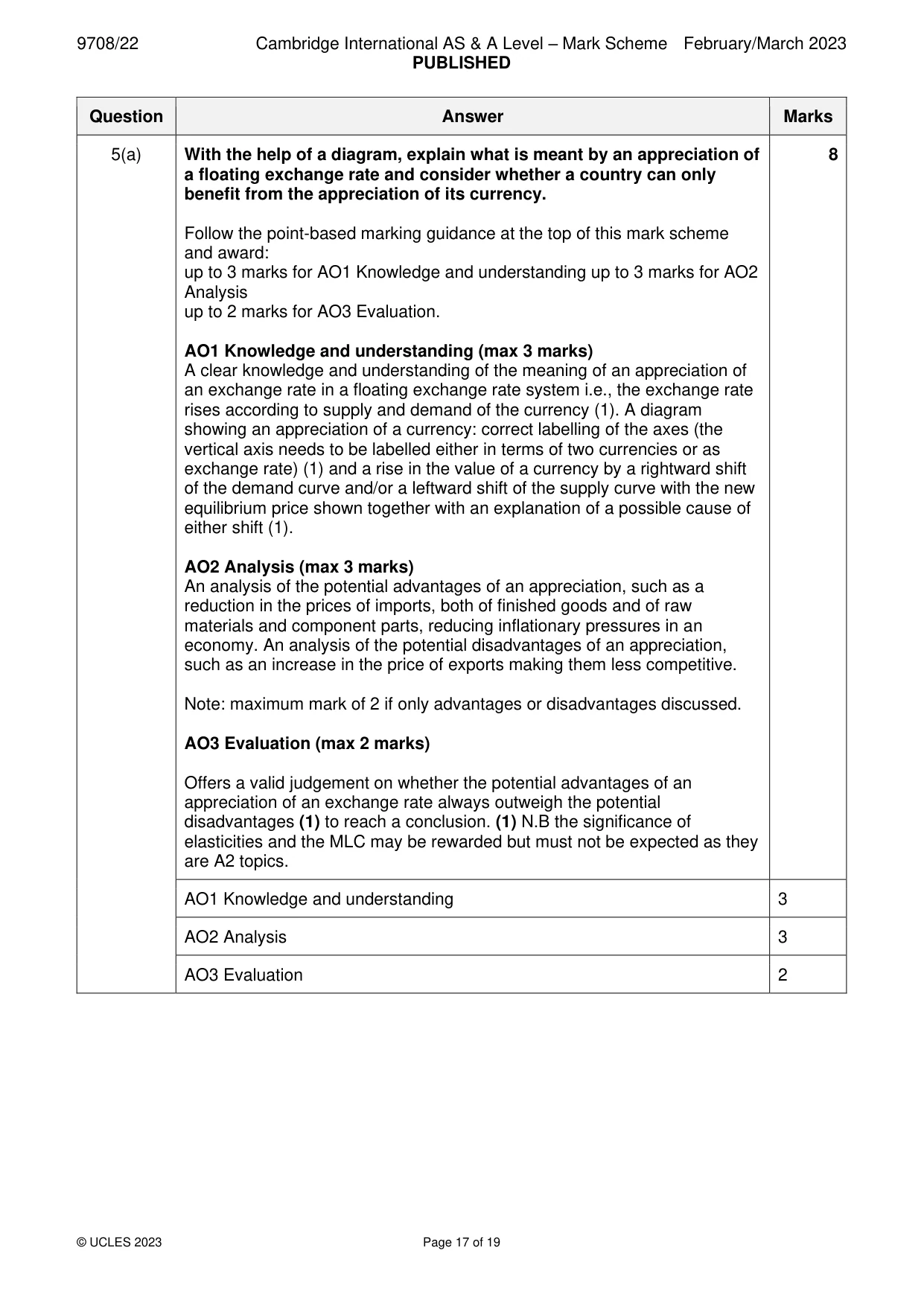
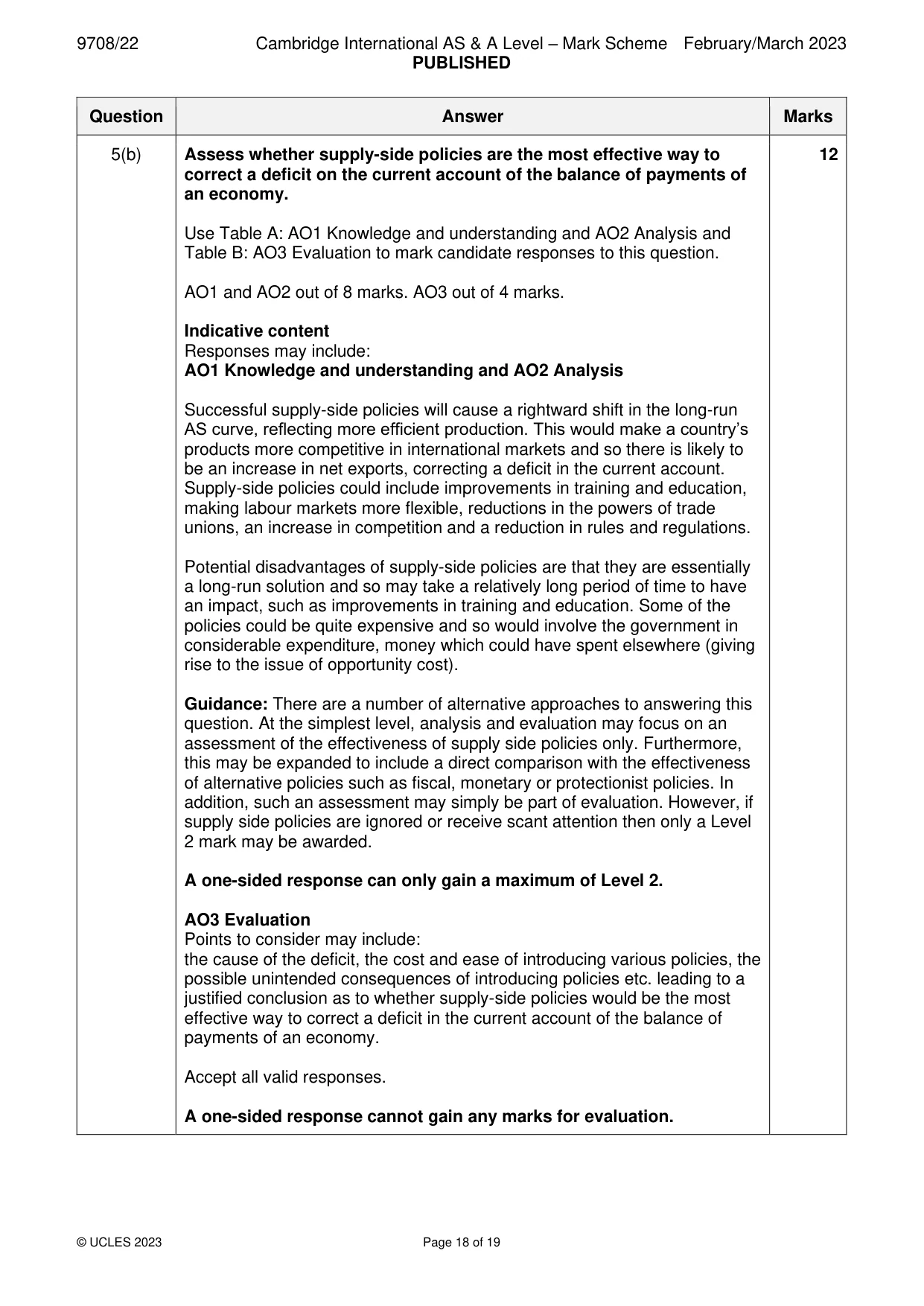
Mark scheme: 5(a) With the help of a diagram, explain what is meant by an appreciation of 8 a floating exchange rate and consider whether a country can only benefit from the appreciation of its currency. Follow the point-based marking guidance at the top of this mark scheme and award: up to 3 marks for AO1 Knowledge and understanding up to 3 marks for AO2 Analysis up to 2 marks for AO3 Evaluation. AO1 Knowledge and understanding (max 3 marks) A clear knowledge and understanding of the meaning of an appreciation of an exchange rate in a floating exchange rate system i.e., the exchange rate rises according to supply and demand of the currency (1). A diagram showing an appreciation of a currency: correct labelling of the axes (the vertical axis needs to be labelled either in terms of two currencies or as exchange rate) (1) and a rise in the value of a currency by a rightward shift of the demand curve and/or a leftward shift of the supply curve with the new equilibrium price shown together with an explanation of a possible cause of either shift (1). AO2 Analysis (max 3 marks) An analysis of the potential advantages of an appreciation, such as a reduction in the prices of imports, both of finished goods and of raw materials and component parts, reducing inflationary pressures in an economy. An analysis of the potential disadvantages of an appreciation, such as an increase in the price of exports making them less competitive. Note: maximum mark of 2 if only advantages or disadvantages discussed. AO3 Evaluation (max 2 marks) Offers a valid judgement on whether the potential advantages of an appreciation of an exchange rate always outweigh the potential disadvantages (1) to reach a conclusion. (1) N.B the significance of elasticities and the MLC may be rewarded but must not be expected as they are A2 topics. AO1 Knowledge and understanding 3 AO2 Analysis 3 AO3 Evaluation 2 5(b) Assess whether supply-side policies are the most effective way to 12 correct a deficit on the current account of the balance of payments of an economy. Use Table A: AO1 Knowledge and understanding and AO2 Analysis and Table B: AO3 Evaluation to mark candidate responses to this question. AO1 and AO2 out of 8 marks. AO3 out of 4 marks. Indicative content Responses may include: AO1 Knowledge and understanding and AO2 Analysis Successful supply-side policies will cause a rightward shift in the long-run AS curve, reflecting more efficient production. This would make a country’s products more competitive in international markets and so there is likely to be an increase in net exports, correcting a deficit in the current account. Supply-side policies could include improvements in training and education, making labour markets more flexible, reductions in the powers of trade unions, an increase in competition and a reduction in rules and regulations. Potential disadvantages of supply-side policies are that they are essentially a long-run solution and so may take a relatively long period of time to have an impact, such as improvements in training and education. Some of the policies could be quite expensive and so would involve the government in considerable expenditure, money which could have spent elsewhere (giving rise to the issue of opportunity cost). Guidance: There are a number of alternative approaches to answering this question. At the simplest level, analysis and evaluation may focus on an assessment of the effectiveness of supply side policies only. Furthermore, this may be expanded to include a direct comparison with the effectiveness of alternative policies such as fiscal, monetary or protectionist policies. In addition, such an assessment may simply be part of evaluation. However, if supply side policies are ignored or receive scant attention then only a Level 2 mark may be awarded. A one-sided response can only gain a maximum of Level 2. AO3 Evaluation Points to consider may include: the cause of the deficit, the cost and ease of introducing various policies, the possible unintended consequences of introducing policies etc. leading to a justified conclusion as to whether supply-side policies would be the most effective way to correct a deficit in the current account of the balance of payments of an economy. Accept all valid responses. A one-sided response cannot gain any marks for evaluation. 5(b) AO1 Knowledge and Understanding and AO2 Analysis 8 AO1 Knowledge and understanding and AO2 Analysis AO3 Evaluation 4
More questions on Policies to correct imbalances in the current account of the balance of payments
What was in this paper
The subtopics covered by these 5 questions, and how many questions each got. Open one in a new tab to see every Cambridge question on it.
What you needed in this session
Cambridge’s own grade thresholds for 2023 Feb/March, Paper 2 · Variant 2. A higher threshold means an easier paper — the bar moves with how the cohort did.