Cambridge A Level Economics 9708 — 2022 Feb/March Paper 2 · Variant 2
9708/22/F/M/22 · 4 questions · 40 marks · ≈45 min
The question paper and its mark scheme, free to read here and free to download. This is Cambridge’s own paper, exactly as it was sat.
Question paper4 pages
Mark scheme12 pages
Answers below. Sit the paper first if you are practising.
Questions as text
Q1 · Aspects of Turkey’s macroeconomic performance and monetary policy Figs 1.1,1.2 and 1.3…
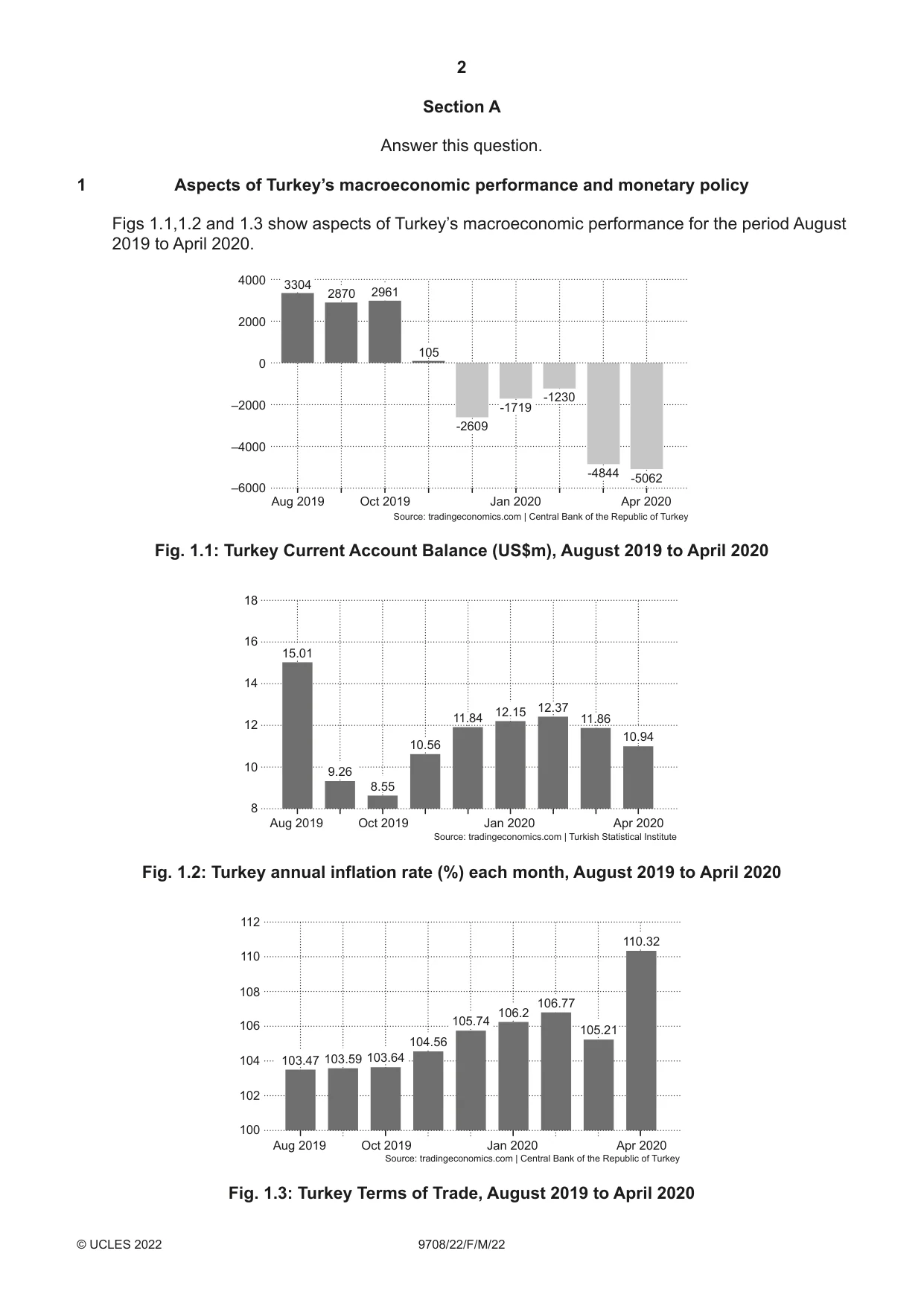
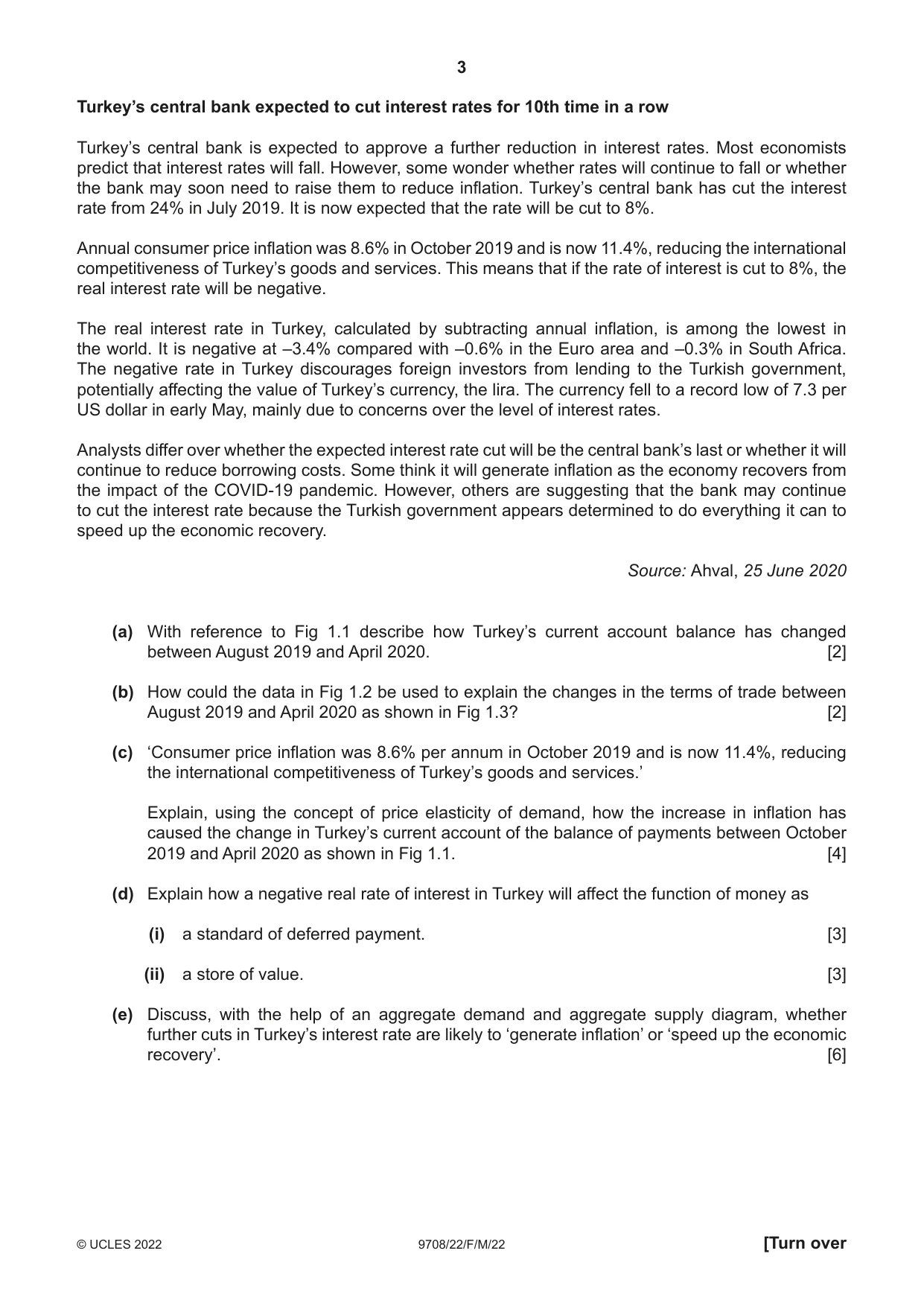
1 Aspects of Turkey’s macroeconomic performance and monetary policy Figs 1.1,1.2 and 1.3 show aspects of Turkey’s macroeconomic performance for the period August 2019 to April 2020. 4000 3304 2870 2961 2000 105 0 -1230 –2000 -1719 -2609 –4000 -4844 -5062 –6000 Aug 2019 Oct 2019 Jan 2020 Apr 2020 Source: tradingeconomics.com | Central Bank of the Republic of Turkey Fig. 1.1: Turkey Current Account Balance (US$m), August 2019 to April 2020 18 16 15.01 14 12.15 12.37 11.84 11.86 12 10.94 10.56 10 9.26 8.55 8 Aug 2019 Oct 2019 Jan 2020 Apr 2020 Source: tradingeconomics.com | Turkish Statistical Institute Fig. 1.2: Turkey annual inflation rate (%) each month, August 2019 to April 2020 112 110.32 110 108 106.77 106.2 106 105.74 105.21 104.56 104 103.47 103.59 103.64 102 100 Aug 2019 Oct 2019 Jan 2020 Apr 2020 Source: tradingeconomics.com | Central Bank of the Republic of Turkey Fig. 1.3: Turkey Terms of Trade, August 2019 to April 2020 Turkey’s central bank expected to cut interest rates for 10th time in a row Turkey’s central bank is expected to approve a further reduction in interest rates. Most economists predict that interest rates will fall. However, some wonder whether rates will continue to fall or whether the bank may soon need to raise them to reduce inflation. Turkey’s central bank has cut the interest rate from 24% in July 2019. It is now expected that the rate will be cut to 8%. Annual consumer price inflation was 8.6% in October 2019 and is now 11.4%, reducing the international competitiveness of Turkey’s goods and services. This means that if the rate of interest is cut to 8%, the real interest rate will be negative. The real interest rate in Turkey, calculated by subtracting annual inflation, is among the lowest in the world. It is negative at –3.4% compared with –0.6% in the Euro area and –0.3% in South Africa. The negative rate in Turkey discourages foreign investors from lending to the Turkish government, potentially affecting the value of Turkey’s currency, the lira. The currency fell to a record low of 7.3 per US dollar in early May, mainly due to concerns over the level of interest rates. Analysts differ over whether the expected interest rate cut will be the central bank’s last or whether it will continue to reduce borrowing costs. Some think it will generate inflation as the economy recovers from the impact of the COVID-19 pandemic. However, others are suggesting that the bank may continue to cut the interest rate because the Turkish government appears determined to do everything it can to speed up the economic recovery. Source: Ahval, 25 June 2020 (a) With reference to Fig 1.1 describe how Turkey’s current account balance has changed between August 2019 and April 2020. [2] (b) How could the data in Fig 1.2 be used to explain the changes in the terms of trade between August 2019 and April 2020 as shown in Fig 1.3? [2] (c) ‘Consumer price inflation was 8.6% per annum in October 2019 and is now 11.4%, reducing the international competitiveness of Turkey’s goods and services.’ Explain, using the concept of price elasticity of demand, how the increase in inflation has caused the change in Turkey’s current account of the balance of payments between October 2019 and April 2020 as shown in Fig 1.1. [4] (d) Explain how a negative real rate of interest in Turkey will affect the function of money as (i) a standard of deferred payment. [3] (ii) a store of value. [3] (e) Discuss, with the help of an aggregate demand and aggregate supply diagram, whether further cuts in Turkey’s interest rate are likely to ‘generate inflation’ or ‘speed up the economic recovery’. [6]
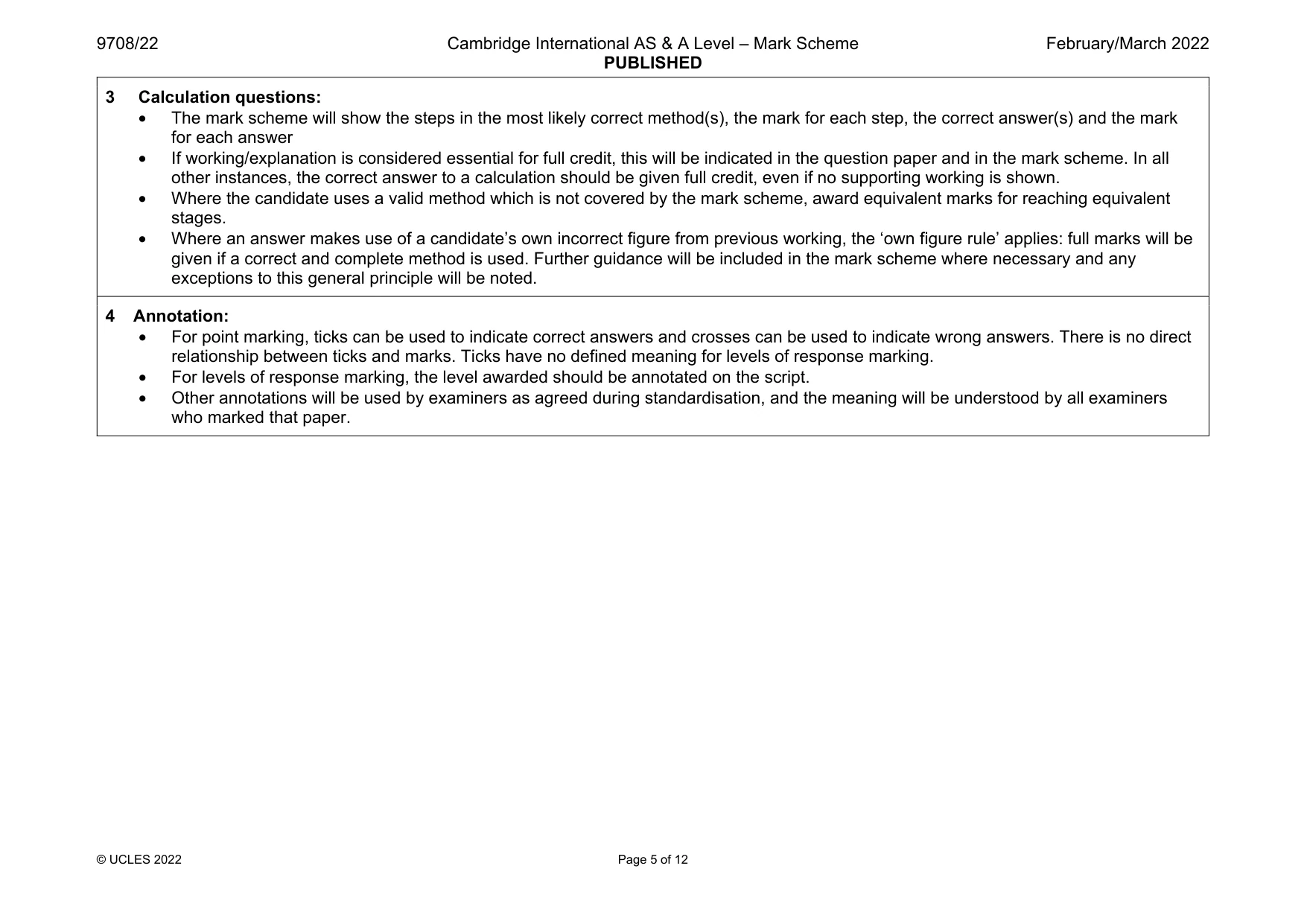
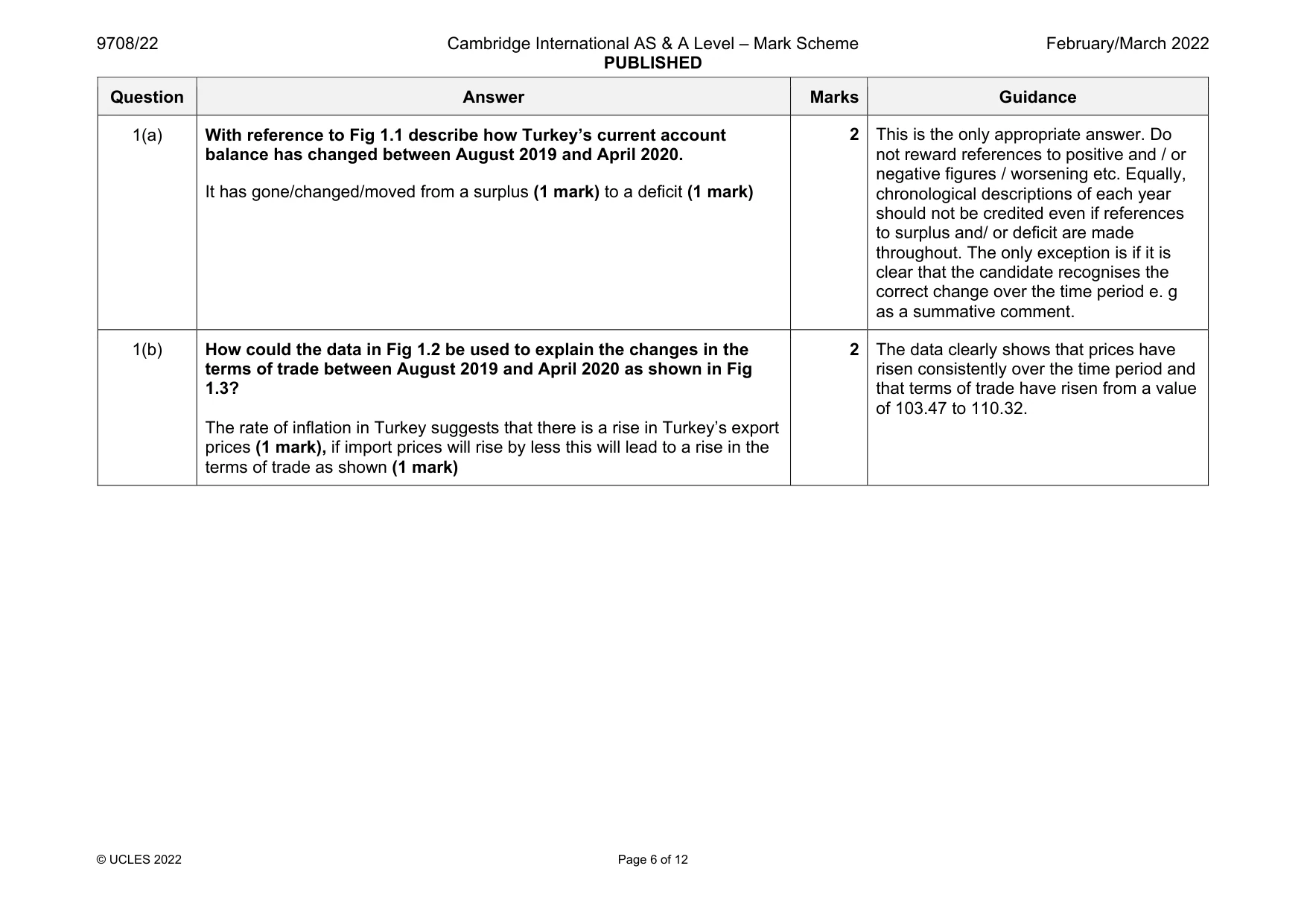
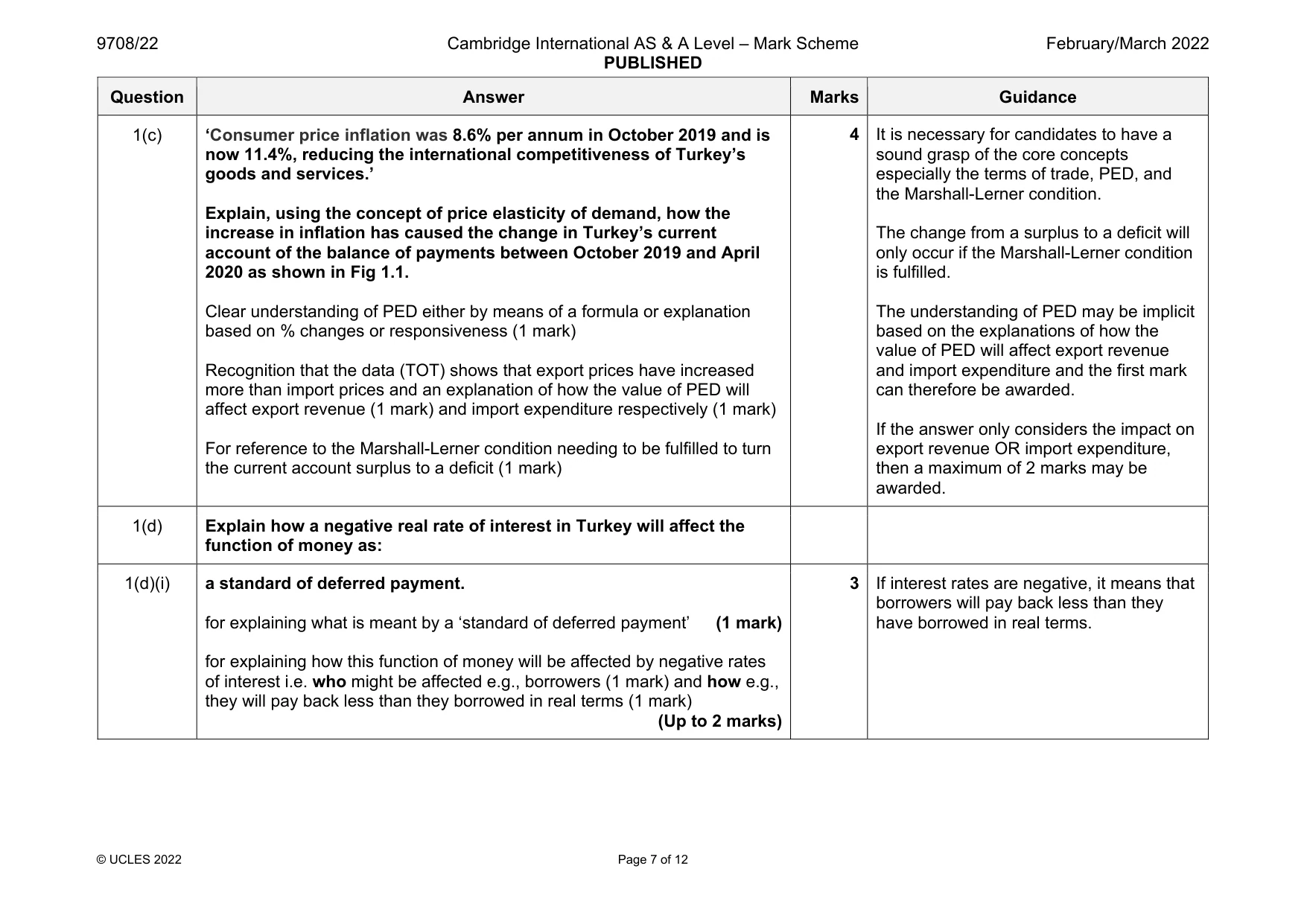
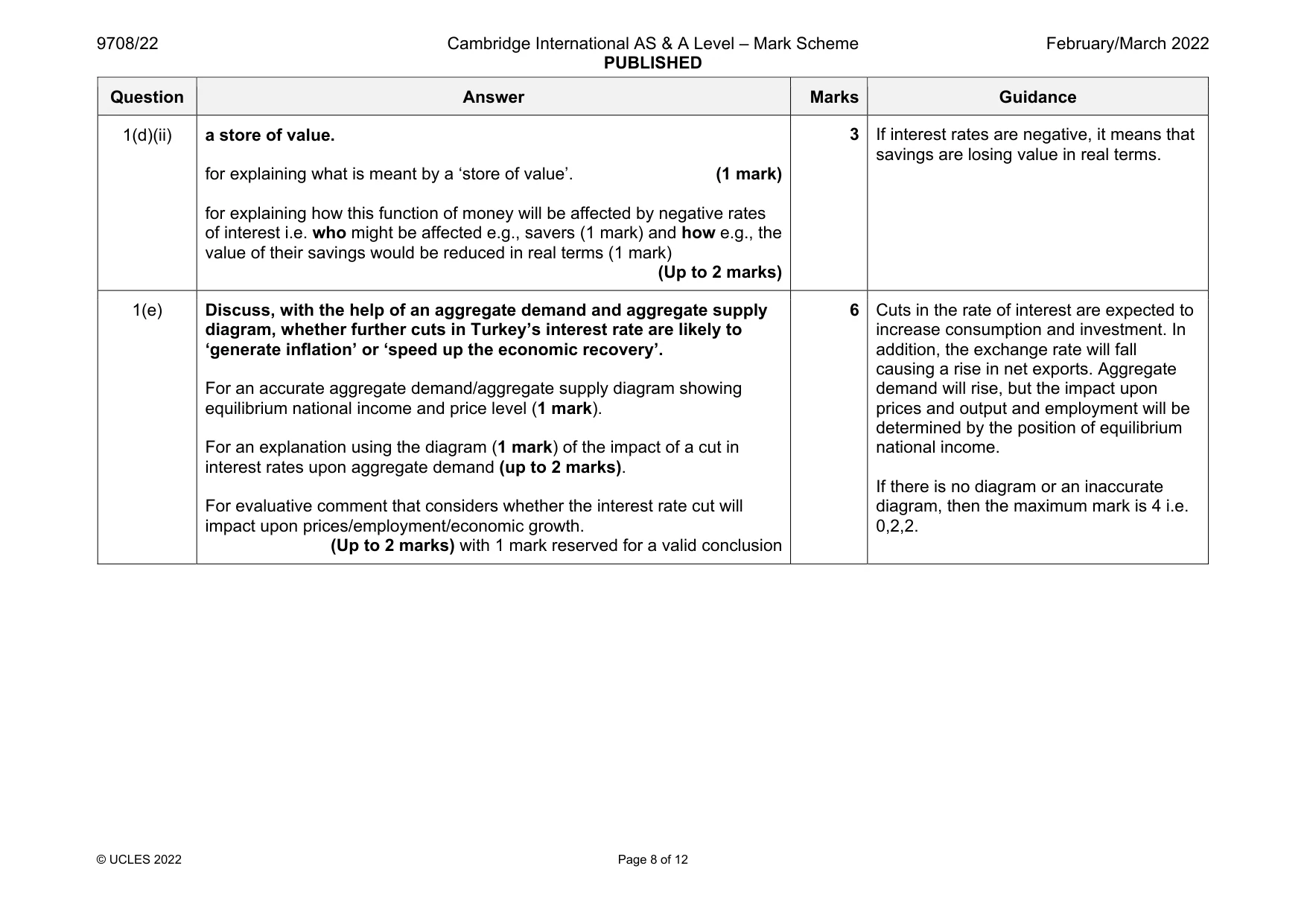
Mark scheme: 1(a) With reference to Fig 1.1 describe how Turkey’s current account balance has changed between August 2019 and April 2020. It has gone/changed/moved from a surplus (1 mark) to a deficit (1 mark) not reward references to positive and / or negative figures / worsening etc. Equally, chronological descriptions of each year should not be credited even if references to surplus and/ or deficit are made throughout. The only exception is if it is clear that the candidate recognises the correct change over the time period e. g as a summative comment. 1(b) How could the data in Fig 1.2 be used to explain the changes in the terms of trade between August 2019 and April 2020 as shown in Fig 1.3? The rate of inflation in Turkey suggests that there is a rise in Turkey’s export prices (1 mark), if import prices will rise by less this will lead to a rise in the terms of trade as shown (1 mark) 2 The data clearly shows that prices have risen consistently over the time period and that terms of trade have risen from a value of 103.47 to 110.32. Question Answer Marks Guidance 1(c) ‘Consumer price inflation was 8.6% per annum in October 2019 and is now 11.4%, reducing the international competitiveness of Turkey’s goods and services.’ Explain, using the concept of price elasticity of demand, how the increase in inflation has caused the change in Turkey’s current account of the balance of payments between October 2019 and April 2020 as shown in Fig 1.1. Clear understanding of PED either by means of a formula or explanation based on % changes or responsiveness (1 mark) Recognition that the data (TOT) shows that export prices have increased more than import prices and an explanation of how the value of PED will affect export revenue (1 mark) and import expenditure respectively (1 mark) For reference to the Marshall-Lerner condition needing to be fulfilled to turn the current account surplus to a deficit (1 mark) 4 It is necessary for candidates to have a sound grasp of the core concepts especially the terms of trade, PED, and the Marshall-Lerner condition. The change from a surplus to a deficit will only occur if the Marshall-Lerner condition is fulfilled. The understanding of PED may be implicit based on the explanations of how the value of PED will affect export revenue and import expenditure and the first mark can therefore be awarded. If the answer only considers the impact on export revenue OR import expenditure, then a maximum of 2 marks may be awarded. 1(d) Explain how a negative real rate of interest in Turkey will affect the function of money as: 1(d)(i) a standard of deferred payment. for explaining what is meant by a ‘standard of deferred payment’ (1 mark) for explaining how this function of money will be affected by negative rates of interest i.e. who might be affected e.g., borrowers (1 mark) and how e.g., they will pay back less than they borrowed in real terms (1 mark) (Up to 2 marks) 3 If interest rates are negative, it means that borrowers will pay back less than they have borrowed in real terms. Question Answer Marks Guidance 1(d)(ii) a store of value. for explaining what is meant by a ‘store of value’. (1 mark) for explaining how this function of money will be affected by negative rates of interest i.e. who might be affected e.g., savers (1 mark) and how e.g., the value of their savings would be reduced in real terms (1 mark) (Up to 2 marks) 3 If interest rates are negative, it means that savings are losing value in real terms. 1(e) Discuss, with the help of an aggregate demand and aggregate supply diagram, whether further cuts in Turkey’s interest rate are likely to ‘generate inflation’ or ‘speed up the economic recovery’. For an accurate aggregate demand/aggregate supply diagram showing equilibrium national income and price level (1 mark). For an explanation using the diagram (1 mark) of the impact of a cut in interest rates upon aggregate demand (up to 2 marks). For evaluative comment that considers whether the interest rate cut will impact upon prices/employment/economic growth. (Up to 2 marks) with 1 mark reserved for a valid conclusion 6 Cuts in the rate of interest are expected to increase consumption and investment. In addition, the exchange rate will fall causing a rise in net exports. Aggregate demand will rise, but the impact upon prices and output and employment will be determined by the position of equilibrium national income. If there is no diagram or an inaccurate diagram, then the maximum mark is 4 i.e. 0,2,2.
Q2 · Explain with the help of a production possibility curve diagram(s) how a decision to…
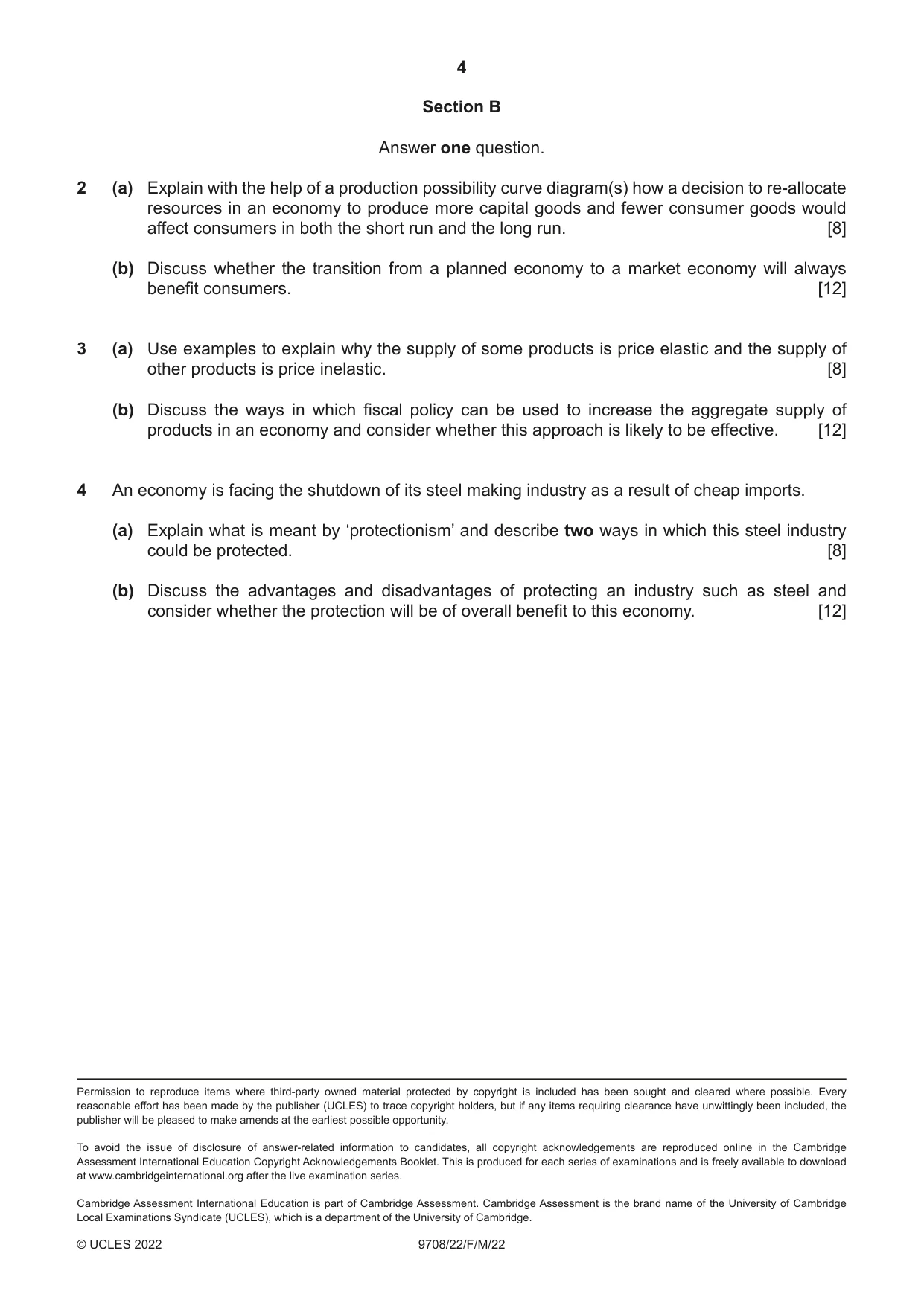
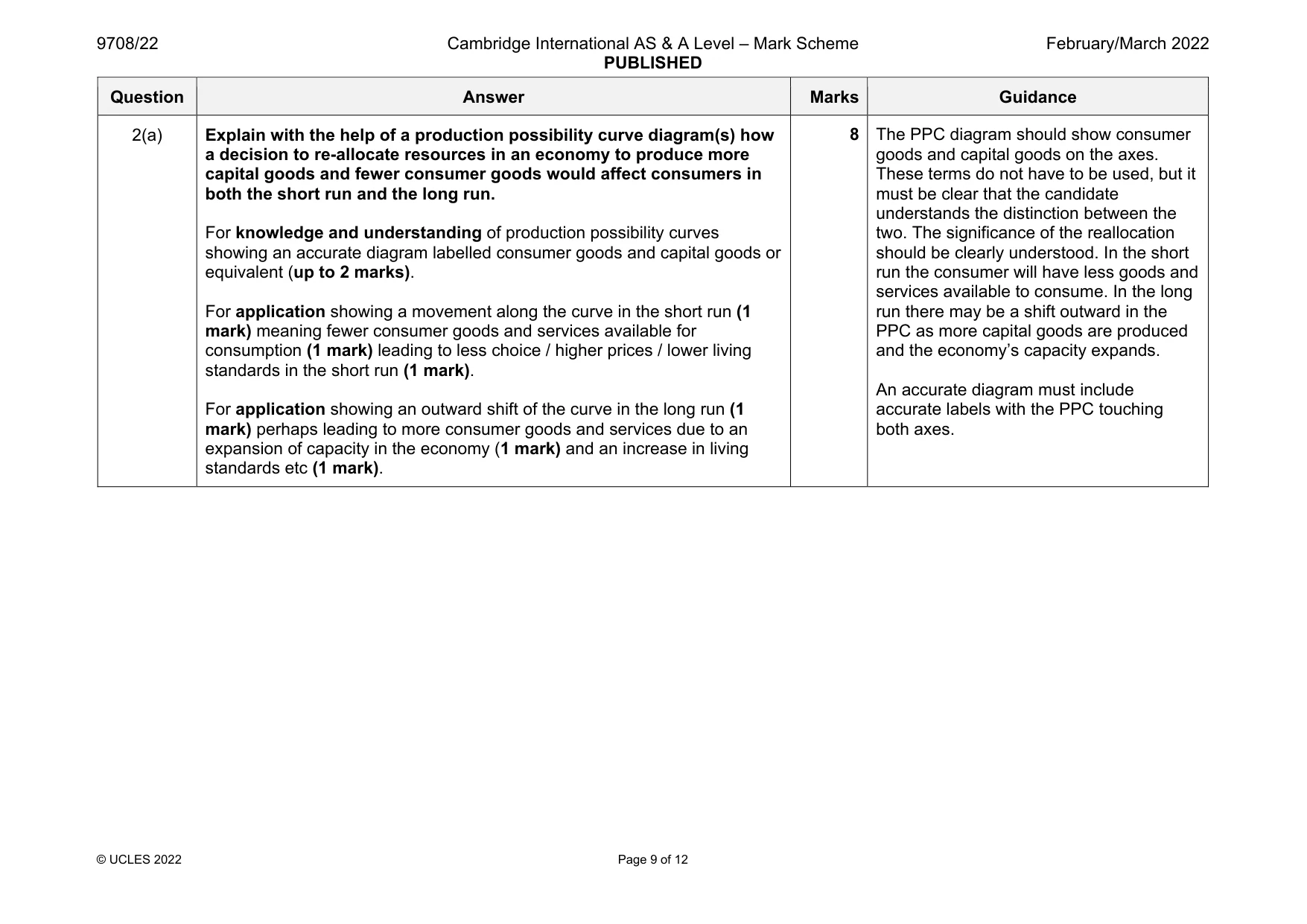
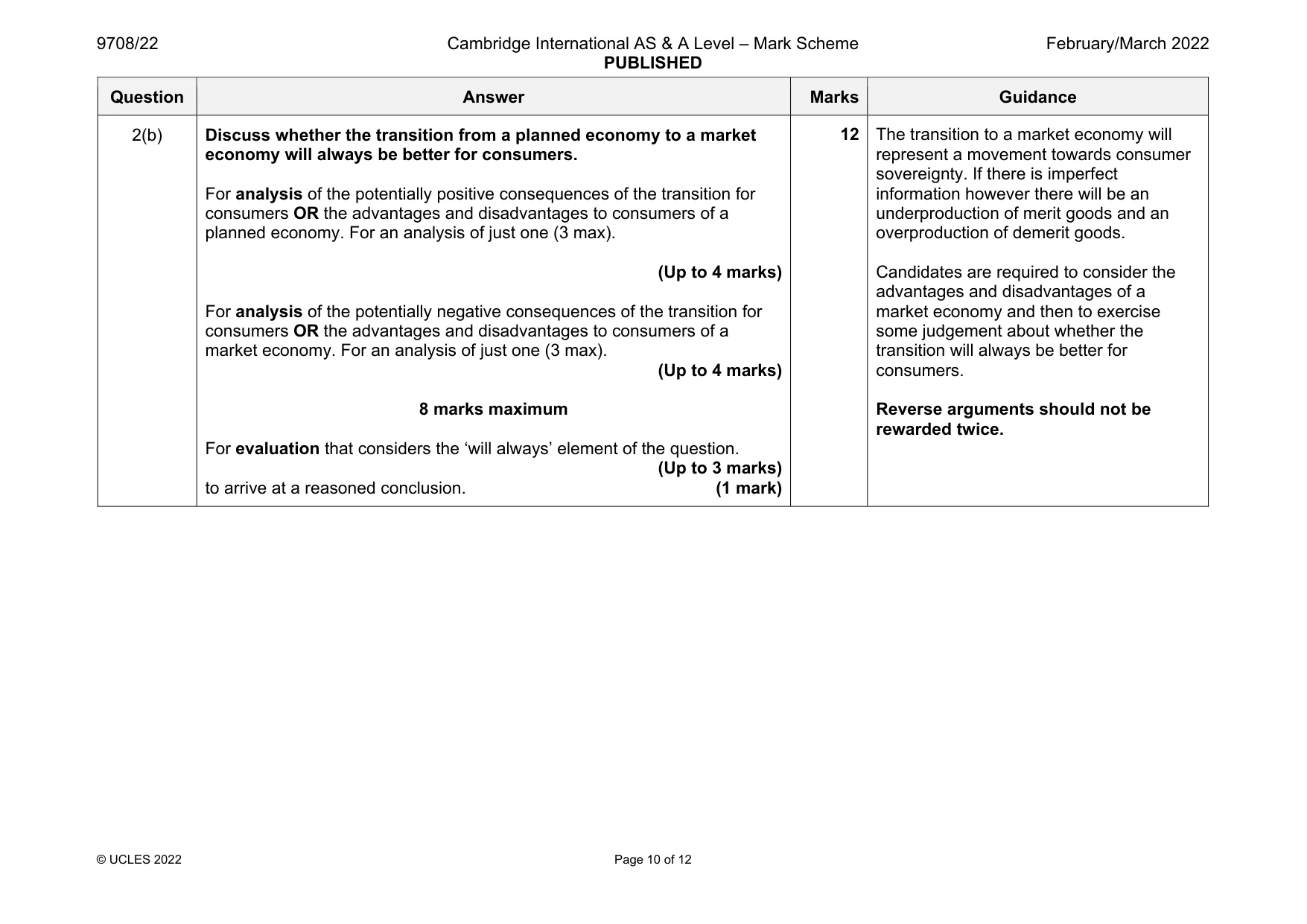
2 (a) Explain with the help of a production possibility curve diagram(s) how a decision to re-allocate resources in an economy to produce more capital goods and fewer consumer goods would affect consumers in both the short run and the long run. [8] (b) Discuss whether the transition from a planned economy to a market economy will always benefit consumers. [12]
Mark scheme: 2(a) Explain with the help of a production possibility curve diagram(s) how a decision to re-allocate resources in an economy to produce more capital goods and fewer consumer goods would affect consumers in both the short run and the long run. For knowledge and understanding of production possibility curves showing an accurate diagram labelled consumer goods and capital goods or equivalent (up to 2 marks). For application showing a movement along the curve in the short run (1 mark) meaning fewer consumer goods and services available for consumption (1 mark) leading to less choice / higher prices / lower living standards in the short run (1 mark). For application showing an outward shift of the curve in the long run (1 mark) perhaps leading to more consumer goods and services due to an expansion of capacity in the economy (1 mark) and an increase in living standards etc (1 mark). goods and capital goods on the axes. These terms do not have to be used, but it must be clear that the candidate understands the distinction between the two. The significance of the reallocation should be clearly understood. In the short run the consumer will have less goods and services available to consume. In the long run there may be a shift outward in the PPC as more capital goods are produced and the economy’s capacity expands. An accurate diagram must include accurate labels with the PPC touching both axes. Question Answer Marks Guidance 2(b) Discuss whether the transition from a planned economy to a market economy will always be better for consumers. For analysis of the potentially positive consequences of the transition for consumers OR the advantages and disadvantages to consumers of a planned economy. For an analysis of just one (3 max). (Up to 4 marks) For analysis of the potentially negative consequences of the transition for consumers OR the advantages and disadvantages to consumers of a market economy. For an analysis of just one (3 max). (Up to 4 marks) 8 marks maximum For evaluation that considers the ‘will always’ element of the question. (Up to 3 marks) to arrive at a reasoned conclusion. (1 mark) 12 The transition to a market economy will represent a movement towards consumer sovereignty. If there is imperfect information however there will be an underproduction of merit goods and an overproduction of demerit goods. Candidates are required to consider the advantages and disadvantages of a market economy and then to exercise some judgement about whether the transition will always be better for consumers. Reverse arguments should not be rewarded twice.
More questions on Resource allocation in different economic systems
Q3 · Use examples to explain why the supply of some products is price elastic and the supply…
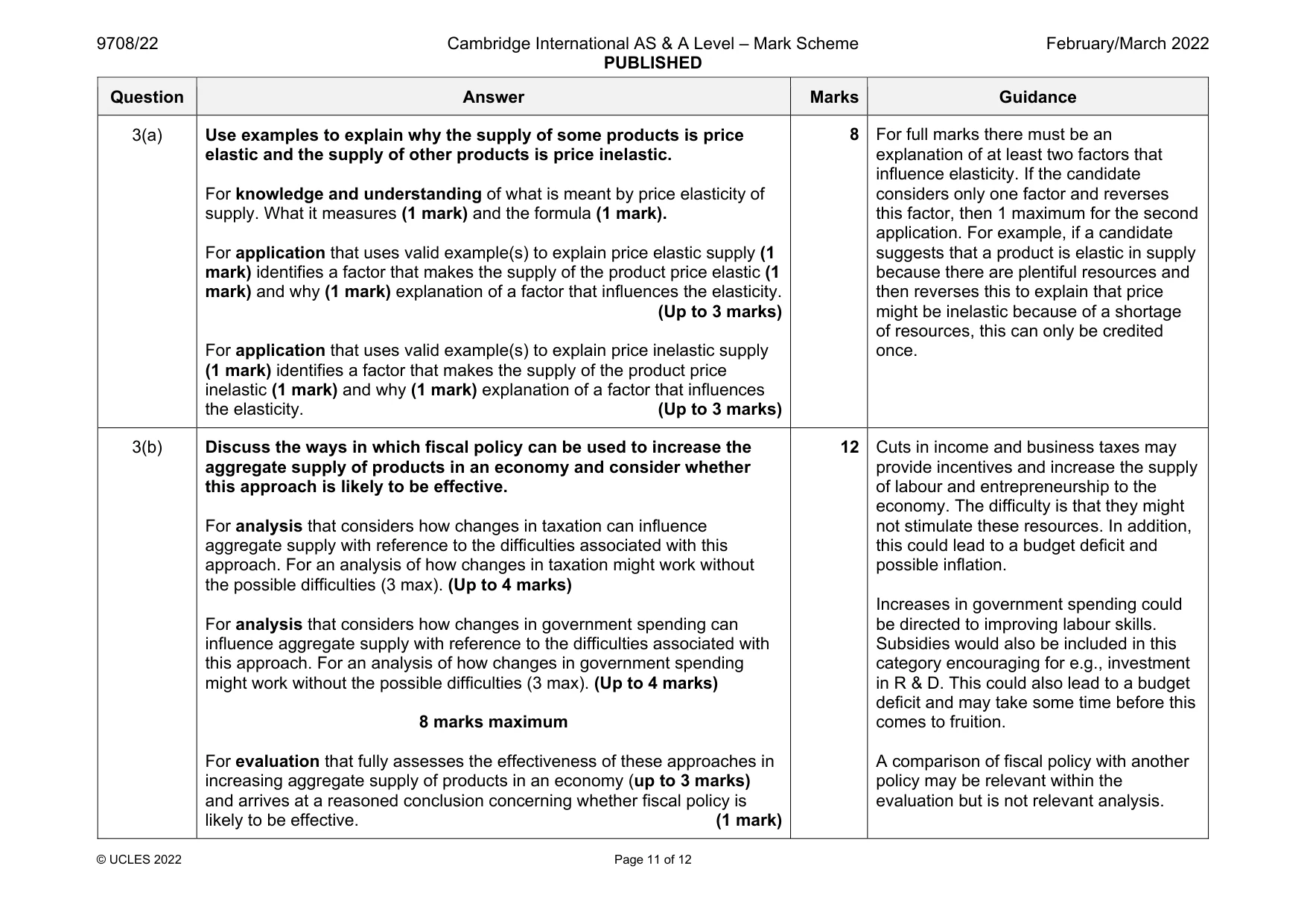
3 (a) Use examples to explain why the supply of some products is price elastic and the supply of other products is price inelastic. [8] (b) Discuss the ways in which fiscal policy can be used to increase the aggregate supply of products in an economy and consider whether this approach is likely to be effective. [12]
Mark scheme: 3(a) Use examples to explain why the supply of some products is price elastic and the supply of other products is price inelastic. For knowledge and understanding of what is meant by price elasticity of supply. What it measures (1 mark) and the formula (1 mark). For application that uses valid example(s) to explain price elastic supply (1 mark) identifies a factor that makes the supply of the product price elastic (1 mark) and why (1 mark) explanation of a factor that influences the elasticity. (Up to 3 marks) For application that uses valid example(s) to explain price inelastic supply (1 mark) identifies a factor that makes the supply of the product price inelastic (1 mark) and why (1 mark) explanation of a factor that influences the elasticity. (Up to 3 marks) explanation of at least two factors that influence elasticity. If the candidate considers only one factor and reverses this factor, then 1 maximum for the second application. For example, if a candidate suggests that a product is elastic in supply because there are plentiful resources and then reverses this to explain that price might be inelastic because of a shortage of resources, this can only be credited once. 3(b) Discuss the ways in which fiscal policy can be used to increase the aggregate supply of products in an economy and consider whether this approach is likely to be effective. For analysis that considers how changes in taxation can influence aggregate supply with reference to the difficulties associated with this approach. For an analysis of how changes in taxation might work without the possible difficulties (3 max). (Up to 4 marks) For analysis that considers how changes in government spending can influence aggregate supply with reference to the difficulties associated with this approach. For an analysis of how changes in government spending might work without the possible difficulties (3 max). (Up to 4 marks) 8 marks maximum For evaluation that fully assesses the effectiveness of these approaches in increasing aggregate supply of products in an economy (up to 3 marks) and arrives at a reasoned conclusion concerning whether fiscal policy is likely to be effective. (1 mark) 12 Cuts in income and business taxes may provide incentives and increase the supply of labour and entrepreneurship to the economy. The difficulty is that they might not stimulate these resources. In addition, this could lead to a budget deficit and possible inflation. Increases in government spending could be directed to improving labour skills. Subsidies would also be included in this category encouraging for e.g., investment in R & D. This could also lead to a budget deficit and may take some time before this comes to fruition. A comparison of fiscal policy with another policy may be relevant within the evaluation but is not relevant analysis.
Q4 · An economy is facing the shutdown of its steel making industry as a result of cheap…
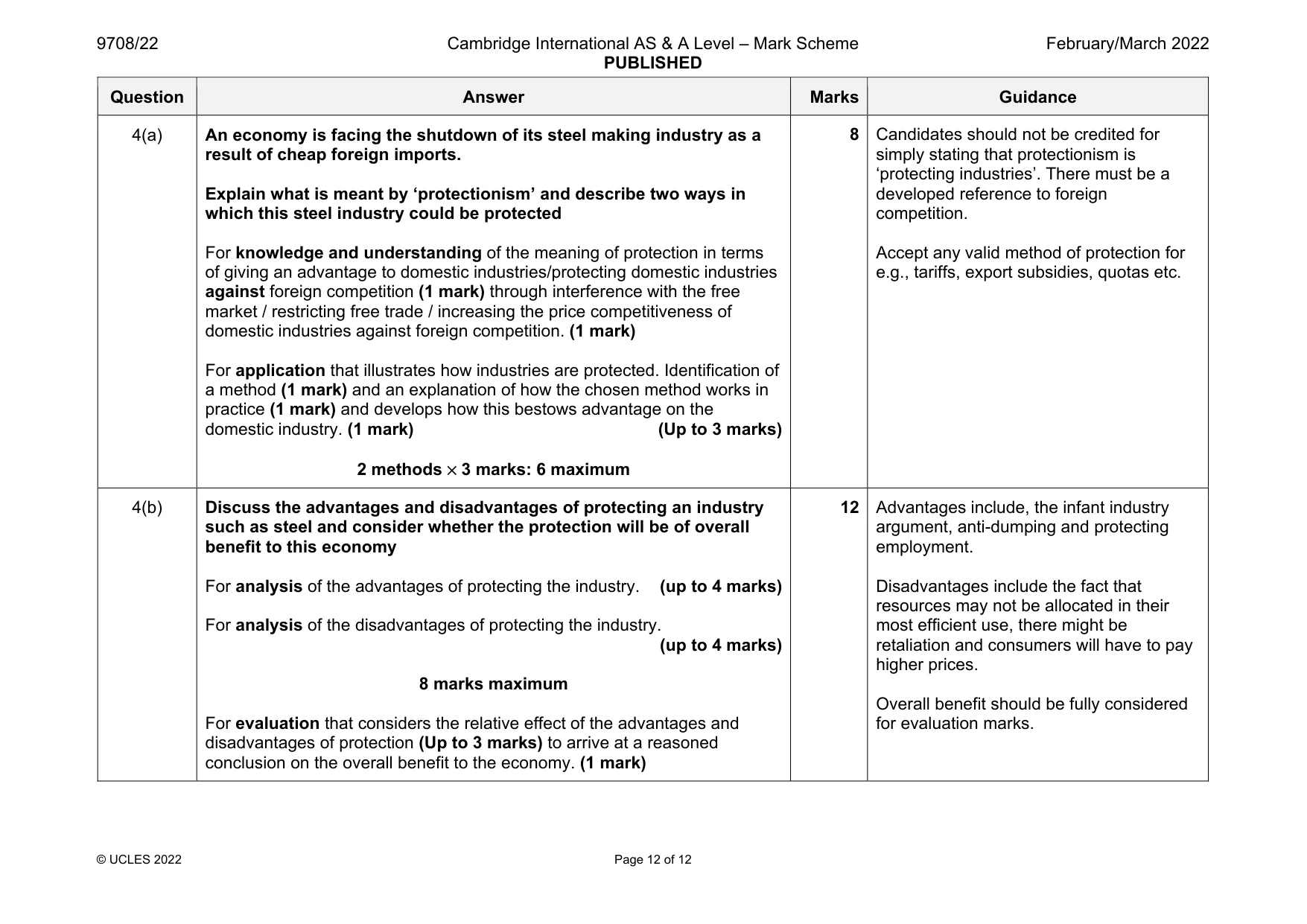
4 An economy is facing the shutdown of its steel making industry as a result of cheap imports. (a) Explain what is meant by ‘protectionism’ and describe two ways in which this steel industry could be protected. [8] (b) Discuss the advantages and disadvantages of protecting an industry such as steel and consider whether the protection will be of overall benefit to this economy. [12]
Mark scheme: 4(a) An economy is facing the shutdown of its steel making industry as a result of cheap foreign imports. Explain what is meant by ‘protectionism’ and describe two ways in which this steel industry could be protected For knowledge and understanding of the meaning of protection in terms of giving an advantage to domestic industries/protecting domestic industries against foreign competition (1 mark) through interference with the free market / restricting free trade / increasing the price competitiveness of domestic industries against foreign competition. (1 mark) For application that illustrates how industries are protected. Identification of a method (1 mark) and an explanation of how the chosen method works in practice (1 mark) and develops how this bestows advantage on the domestic industry. (1 mark) (Up to 3 marks) 2 methods × 3 marks: 6 maximum simply stating that protectionism is ‘protecting industries’. There must be a developed reference to foreign competition. Accept any valid method of protection for e.g., tariffs, export subsidies, quotas etc. 4(b) Discuss the advantages and disadvantages of protecting an industry such as steel and consider whether the protection will be of overall benefit to this economy For analysis of the advantages of protecting the industry. (up to 4 marks) For analysis of the disadvantages of protecting the industry. (up to 4 marks) 8 marks maximum For evaluation that considers the relative effect of the advantages and disadvantages of protection (Up to 3 marks) to arrive at a reasoned conclusion on the overall benefit to the economy. (1 mark) 12 Advantages include, the infant industry argument, anti-dumping and protecting employment. Disadvantages include the fact that resources may not be allocated in their most efficient use, there might be retaliation and consumers will have to pay higher prices. Overall benefit should be fully considered for evaluation marks.
What was in this paper
The subtopics covered by these 4 questions, and how many questions each got. Open one in a new tab to see every Cambridge question on it.
What you needed in this session
Cambridge’s own grade thresholds for 2022 Feb/March, Paper 2 · Variant 2. A higher threshold means an easier paper — the bar moves with how the cohort did.