Cambridge A Level Economics 9708 — 2021 May/June Paper 4 · Variant 2
9708/42/M/J/21 · 7 questions · 70 marks · ≈79 min
The question paper and its mark scheme, free to read here and free to download. This is Cambridge’s own paper, exactly as it was sat.
Question paper4 pages
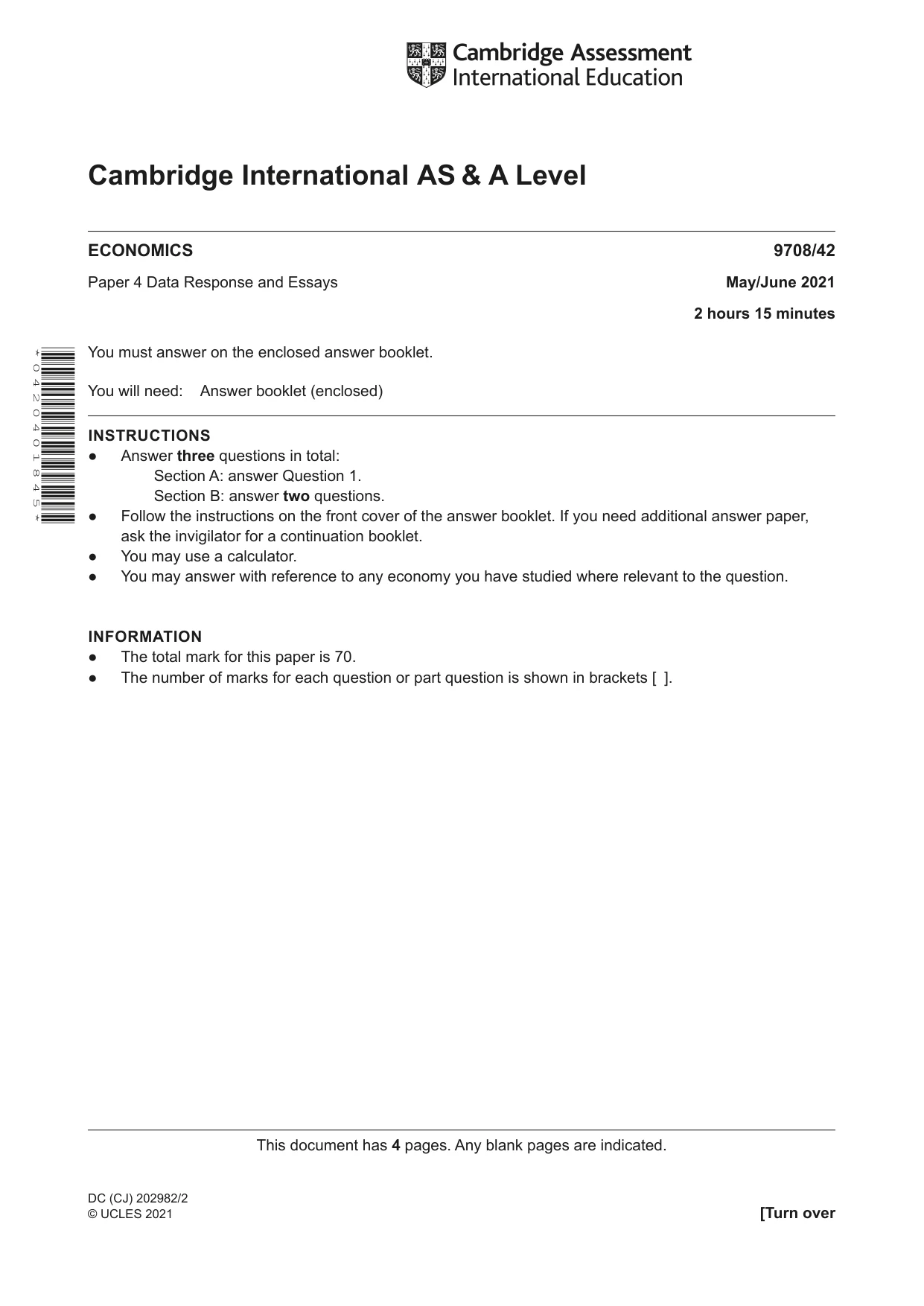
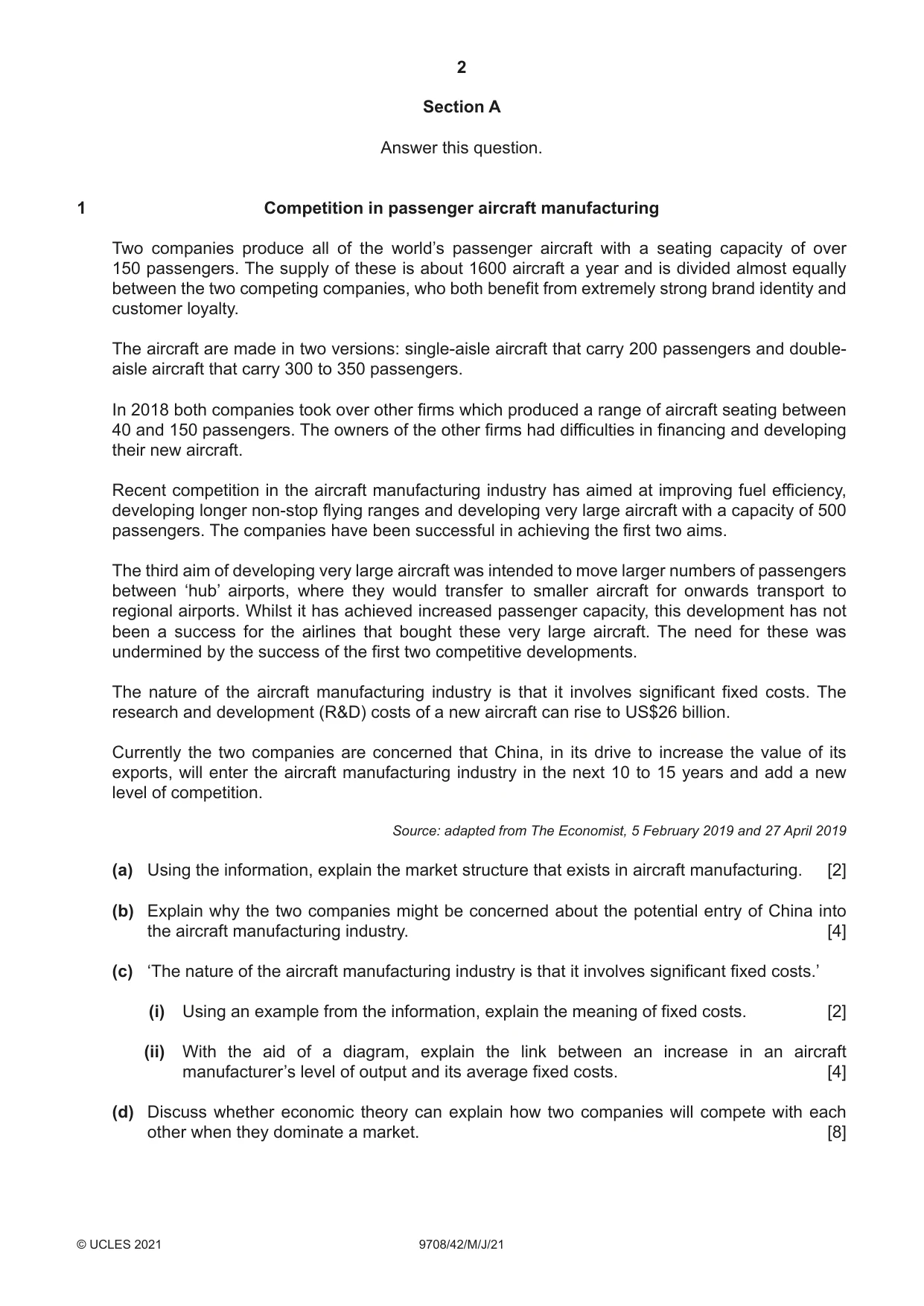
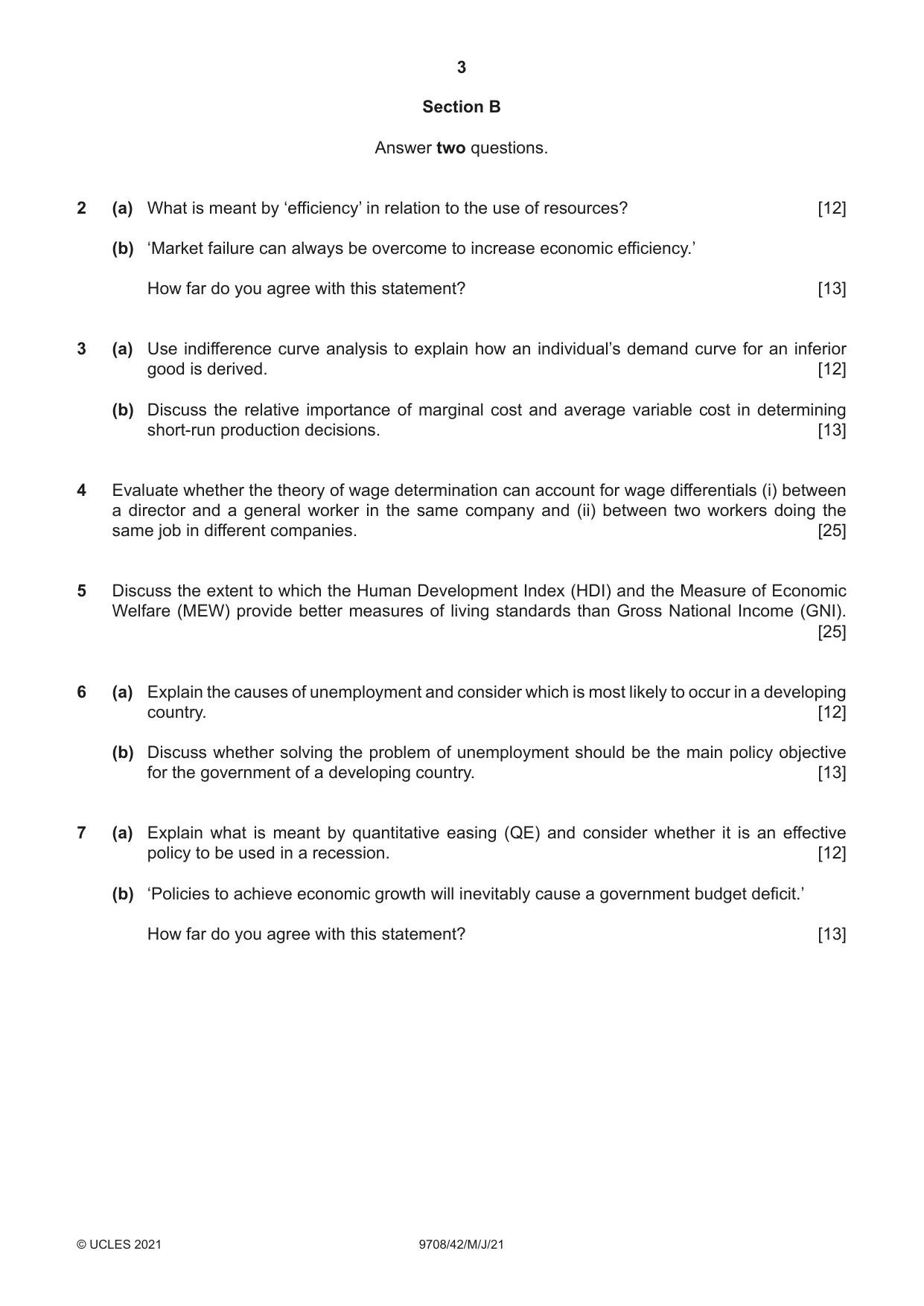

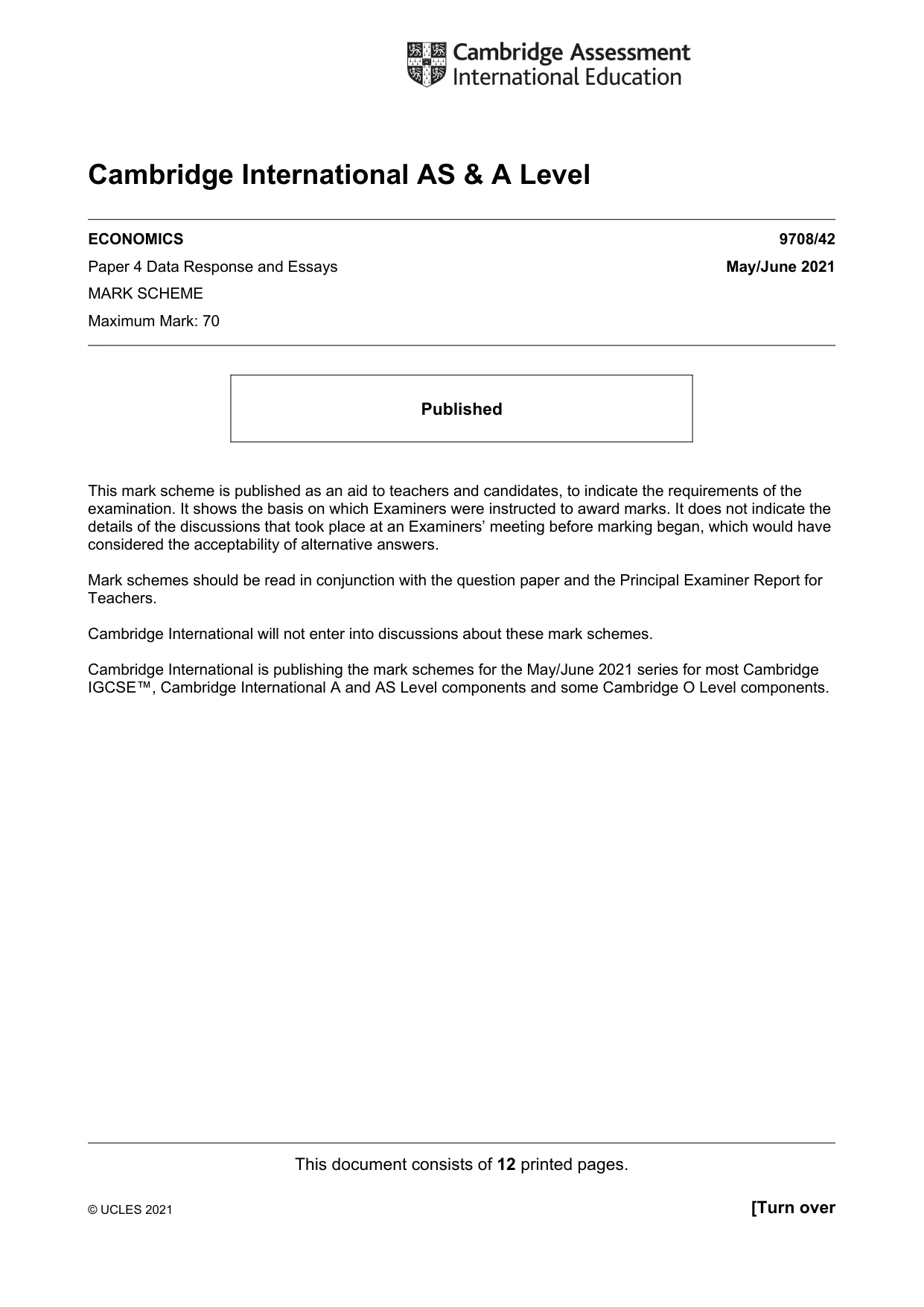
Mark scheme12 pages
Answers below. Sit the paper first if you are practising.


Questions as text
Q1 · Competition in passenger aircraft manufacturing Two companies produce all of the world’s…
1 Competition in passenger aircraft manufacturing Two companies produce all of the world’s passenger aircraft with a seating capacity of over 150 passengers. The supply of these is about 1600 aircraft a year and is divided almost equally between the two competing companies, who both benefit from extremely strong brand identity and customer loyalty. The aircraft are made in two versions: single-aisle aircraft that carry 200 passengers and double- aisle aircraft that carry 300 to 350 passengers. In 2018 both companies took over other firms which produced a range of aircraft seating between 40 and 150 passengers. The owners of the other firms had difficulties in financing and developing their new aircraft. Recent competition in the aircraft manufacturing industry has aimed at improving fuel efficiency, developing longer non-stop flying ranges and developing very large aircraft with a capacity of 500 passengers. The companies have been successful in achieving the first two aims. The third aim of developing very large aircraft was intended to move larger numbers of passengers between ‘hub’ airports, where they would transfer to smaller aircraft for onwards transport to regional airports. Whilst it has achieved increased passenger capacity, this development has not been a success for the airlines that bought these very large aircraft. The need for these was undermined by the success of the first two competitive developments. The nature of the aircraft manufacturing industry is that it involves significant fixed costs. The research and development (R&D) costs of a new aircraft can rise to US$26 billion. Currently the two companies are concerned that China, in its drive to increase the value of its exports, will enter the aircraft manufacturing industry in the next 10 to 15 years and add a new level of competition. Source: adapted from The Economist, 5 February 2019 and 27 April 2019 (a) Using the information, explain the market structure that exists in aircraft manufacturing. [2] (b) Explain why the two companies might be concerned about the potential entry of China into the aircraft manufacturing industry. [4] (c) ‘The nature of the aircraft manufacturing industry is that it involves significant fixed costs.’ (i) Using an example from the information, explain the meaning of fixed costs. [2] (ii) With the aid of a diagram, explain the link between an increase in an aircraft manufacturer’s level of output and its average fixed costs. [4] (d) Discuss whether economic theory can explain how two companies will compete with each other when they dominate a market. [8]
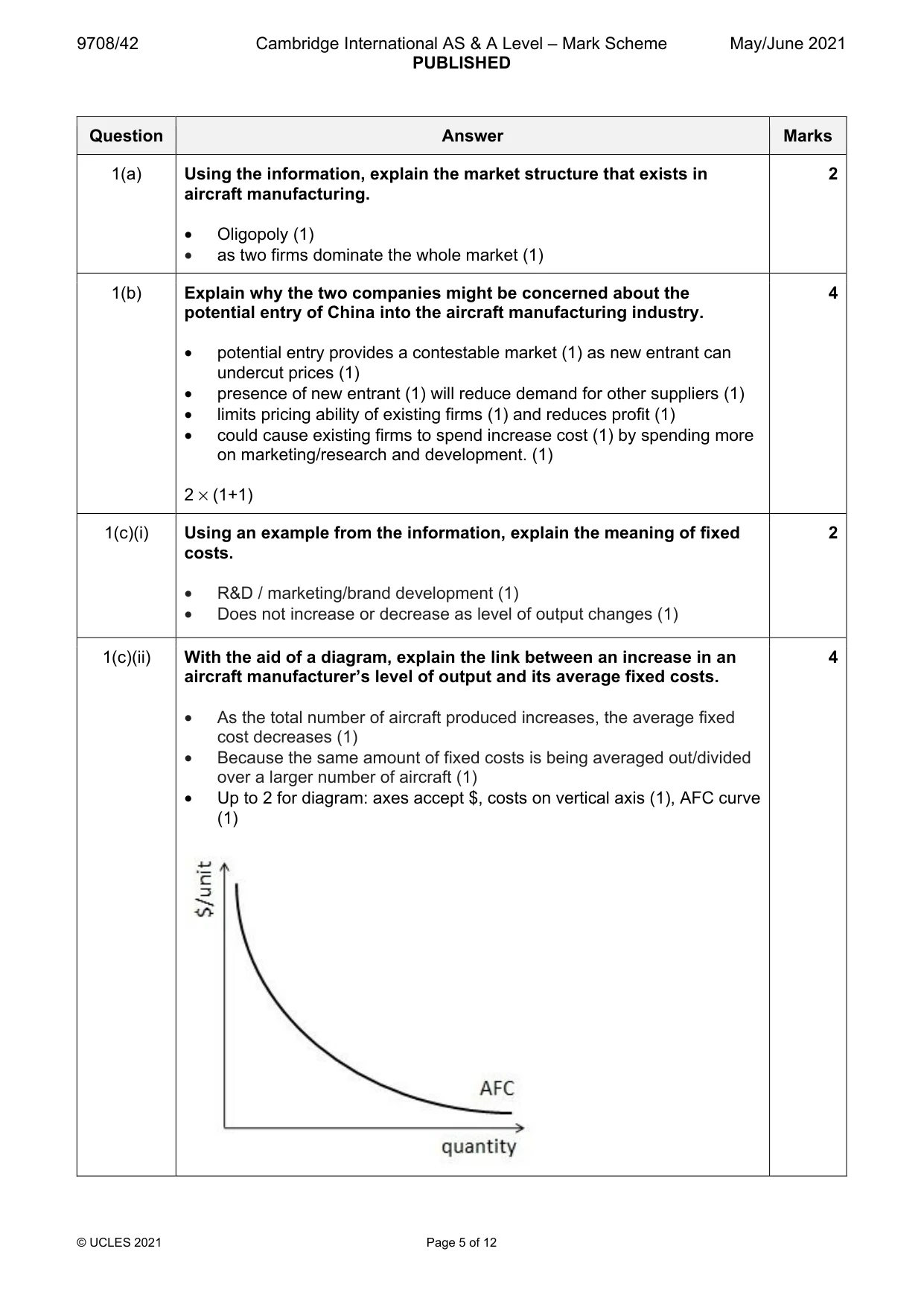
Mark scheme: Question Answer Marks 1(a) Using the information, explain the market structure that exists in 2 aircraft manufacturing. • Oligopoly (1) • as two firms dominate the whole market (1) 1(b) Explain why the two companies might be concerned about the 4 potential entry of China into the aircraft manufacturing industry. • potential entry provides a contestable market (1) as new entrant can undercut prices (1) • presence of new entrant (1) will reduce demand for other suppliers (1) • limits pricing ability of existing firms (1) and reduces profit (1) • could cause existing firms to spend increase cost (1) by spending more on marketing/research and development. (1) 2 × (1+1) 1(c)(i) Using an example from the information, explain the meaning of fixed 2 costs. • R&D / marketing/brand development (1) • Does not increase or decrease as level of output changes (1) 1(c)(ii) With the aid of a diagram, explain the link between an increase in an 4 aircraft manufacturer’s level of output and its average fixed costs. • As the total number of aircraft produced increases, the average fixed cost decreases (1) • Because the same amount of fixed costs is being averaged out/divided over a larger number of aircraft (1) • Up to 2 for diagram: axes accept $, costs on vertical axis (1), AFC curve (1) 1(d) Discuss whether economic theory can explain how two companies will 8 compete with each other when they dominate a market. Future competition possible through A brief discussion of competitive strategy/behaviour • price competition e.g. price wars, kinked demand curve, game theory approach • non-price competition product innovation, marketing • answer based on alternative objectives: sales revenue maximisation/satisficing Up to 4 marks per argument At least 2 arguments are needed for 7 marks. Plus Conclusion – 1 mark
More questions on Types of cost, revenue and profit, short-run and long-run production
Q2 · What is meant by ‘efficiency’ in relation to the use of resources?
2 (a) What is meant by ‘efficiency’ in relation to the use of resources? [12] (b) ‘Market failure can always be overcome to increase economic efficiency.’ How far do you agree with this statement? [13]
Mark scheme: 2(a) What is meant by ‘efficiency’ in relation to the use of resources? 12 Definitions and explanations of productive efficiency operating on the lowest average cost curve and allocative efficiency where Price = Marginal Cost (MC). The relationship between resource use and PE and the allocation of resources and AE. L4 (9–12 marks) For an answer which has a full discussion of 2 from productive, allocative, dynamic or Pareto efficiency. Needs reference to resources. 9/10 if resources linked to one form of efficiency and 11/12 if reference is made to both forms of efficiency. L3 (7–8 marks) For an answer which is a full analysis of one efficiency and a description of another. L2 (5–6 marks) For an answer which is good description of one form of efficiency or a limited description of 2 forms of efficiency. L1 (1–4 marks) For an answer which has some basic correct facts but includes irrelevancies. Errors of theory or omissions of analysis will be substantial. 2(b) ‘Market failure can always be overcome to increase economic 13 efficiency.’ How far do you agree with this statement? Explanation of forms of market failure. Methods of reducing market failure: indirect taxation or subsidies, direct provision or legislation. Problems of imperfect government information. L4 (9–13 marks) For an answer which identifies two forms of market failure and which discusses two methods of improving efficiency. A conclusion is reached for 12/13 marks. L3 (7–8 marks) For an answer which identifies one form of market failure and which analyses one method of improving efficiency and a description of another. L2 (5–6 marks) For an answer which describes methods of improving efficiency. L1 (1–4 marks) For an answer which shows some knowledge but does not indicate that the question has been fully grasped. The answer will have some correct facts but include irrelevancies. Errors of theory or omissions of analysis will be substantial.
Q3 · Use indifference curve analysis to explain how an individual’s demand curve for an…
3 (a) Use indifference curve analysis to explain how an individual’s demand curve for an inferior good is derived. [12] (b) Discuss the relative importance of marginal cost and average variable cost in determining short-run production decisions. [13]
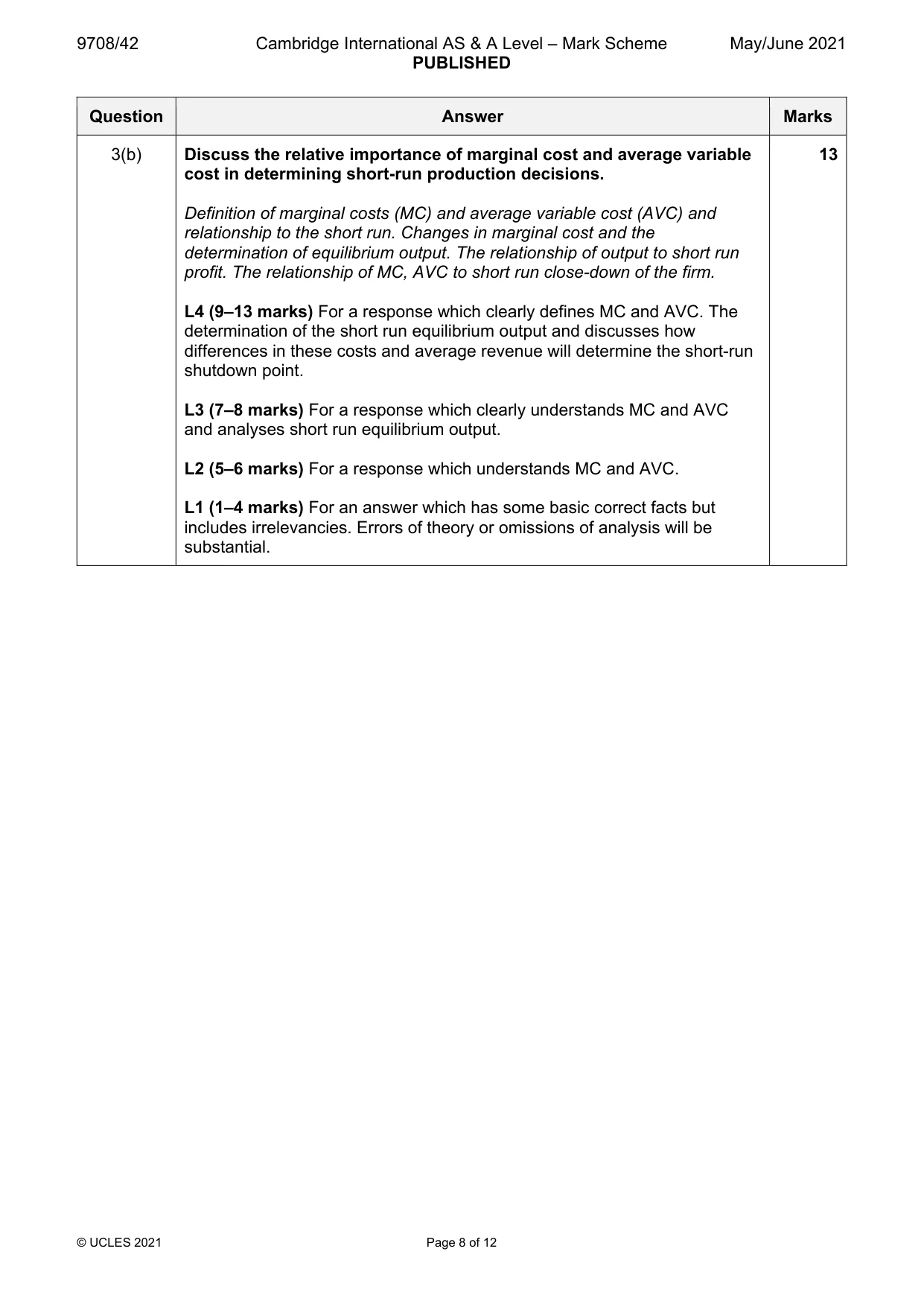
Mark scheme: 3(a) Use indifference curve analysis to explain how an individual’s demand 12 curve for an inferior good is derived. Definitions and explanations of Indifference curves (IC) and budget line (BL). The use of tangency of IC to BL to determine demand. The shift of the BL to reflect price change. The connection of changes in price to the shape of the demand curve, or candidates may suggest a change in income and the budget line shift causing a shift in the demand curve for an inferior good. L4 (9–12 marks) For an answer which explains the meaning of indifference curves and budget line. The analysis of the effect of a change in price shifting the BL and the effect on demand. The derivation of the demand curve is explicit using reference to the income and substitution effects, or a shift of the demand curve for a change in income. L3 (7–8 marks) For an answer which explains the meaning of indifference curves and budget line. The analysis of the effect of a change in price shifting the BL or a shift in the BL. L2 (5–6 marks) For an answer which explains the meaning of indifference curves and budget line. L1 (1–4 marks) For an answer which has some basic correct facts but includes irrelevancies. Errors of theory or omissions of analysis will be substantial. 3(b) Discuss the relative importance of marginal cost and average variable 13 cost in determining short-run production decisions. Definition of marginal costs (MC) and average variable cost (AVC) and relationship to the short run. Changes in marginal cost and the determination of equilibrium output. The relationship of output to short run profit. The relationship of MC, AVC to short run close-down of the firm. L4 (9–13 marks) For a response which clearly defines MC and AVC. The determination of the short run equilibrium output and discusses how differences in these costs and average revenue will determine the short-run shutdown point. L3 (7–8 marks) For a response which clearly understands MC and AVC and analyses short run equilibrium output. L2 (5–6 marks) For a response which understands MC and AVC. L1 (1–4 marks) For an answer which has some basic correct facts but includes irrelevancies. Errors of theory or omissions of analysis will be substantial.
More questions on Types of cost, revenue and profit, short-run and long-run production
Q4 · Evaluate whether the theory of wage determination can account for wage differentials (i)…
4 Evaluate whether the theory of wage determination can account for wage differentials (i) between a director and a general worker in the same company and (ii) between two workers doing the same job in different companies. [25]
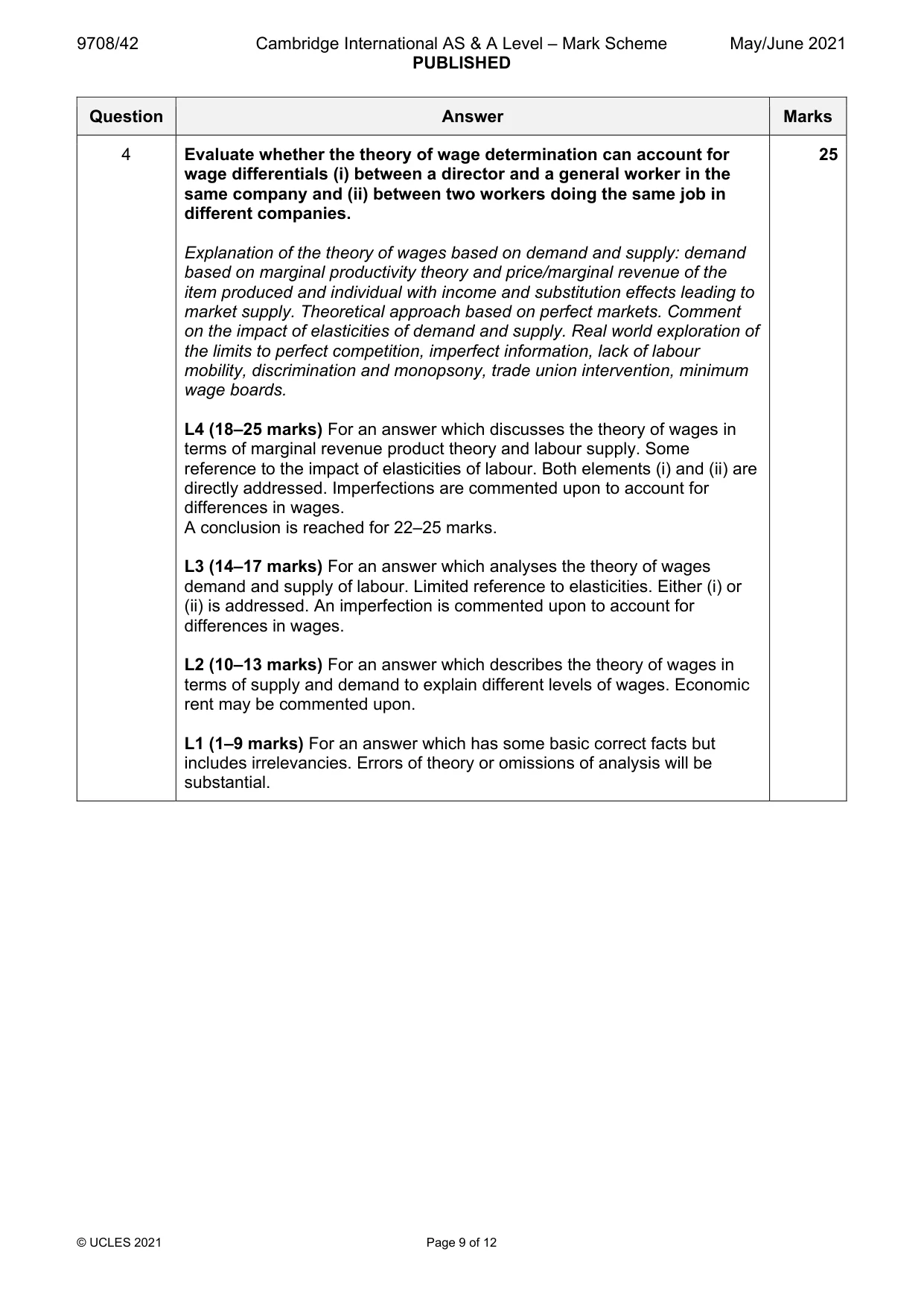
Mark scheme: 4 Evaluate whether the theory of wage determination can account for 25 wage differentials (i) between a director and a general worker in the same company and (ii) between two workers doing the same job in different companies. Explanation of the theory of wages based on demand and supply: demand based on marginal productivity theory and price/marginal revenue of the item produced and individual with income and substitution effects leading to market supply. Theoretical approach based on perfect markets. Comment on the impact of elasticities of demand and supply. Real world exploration of the limits to perfect competition, imperfect information, lack of labour mobility, discrimination and monopsony, trade union intervention, minimum wage boards. L4 (18–25 marks) For an answer which discusses the theory of wages in terms of marginal revenue product theory and labour supply. Some reference to the impact of elasticities of labour. Both elements (i) and (ii) are directly addressed. Imperfections are commented upon to account for differences in wages. A conclusion is reached for 22–25 marks. L3 (14–17 marks) For an answer which analyses the theory of wages demand and supply of labour. Limited reference to elasticities. Either (i) or (ii) is addressed. An imperfection is commented upon to account for differences in wages. L2 (10–13 marks) For an answer which describes the theory of wages in terms of supply and demand to explain different levels of wages. Economic rent may be commented upon. L1 (1–9 marks) For an answer which has some basic correct facts but includes irrelevancies. Errors of theory or omissions of analysis will be substantial.
More questions on Labour market forces and government intervention
Q5 · Discuss the extent to which the Human Development Index (HDI) and the Measure of Economic…
5 Discuss the extent to which the Human Development Index (HDI) and the Measure of Economic Welfare (MEW) provide better measures of living standards than Gross National Income (GNI). [25]
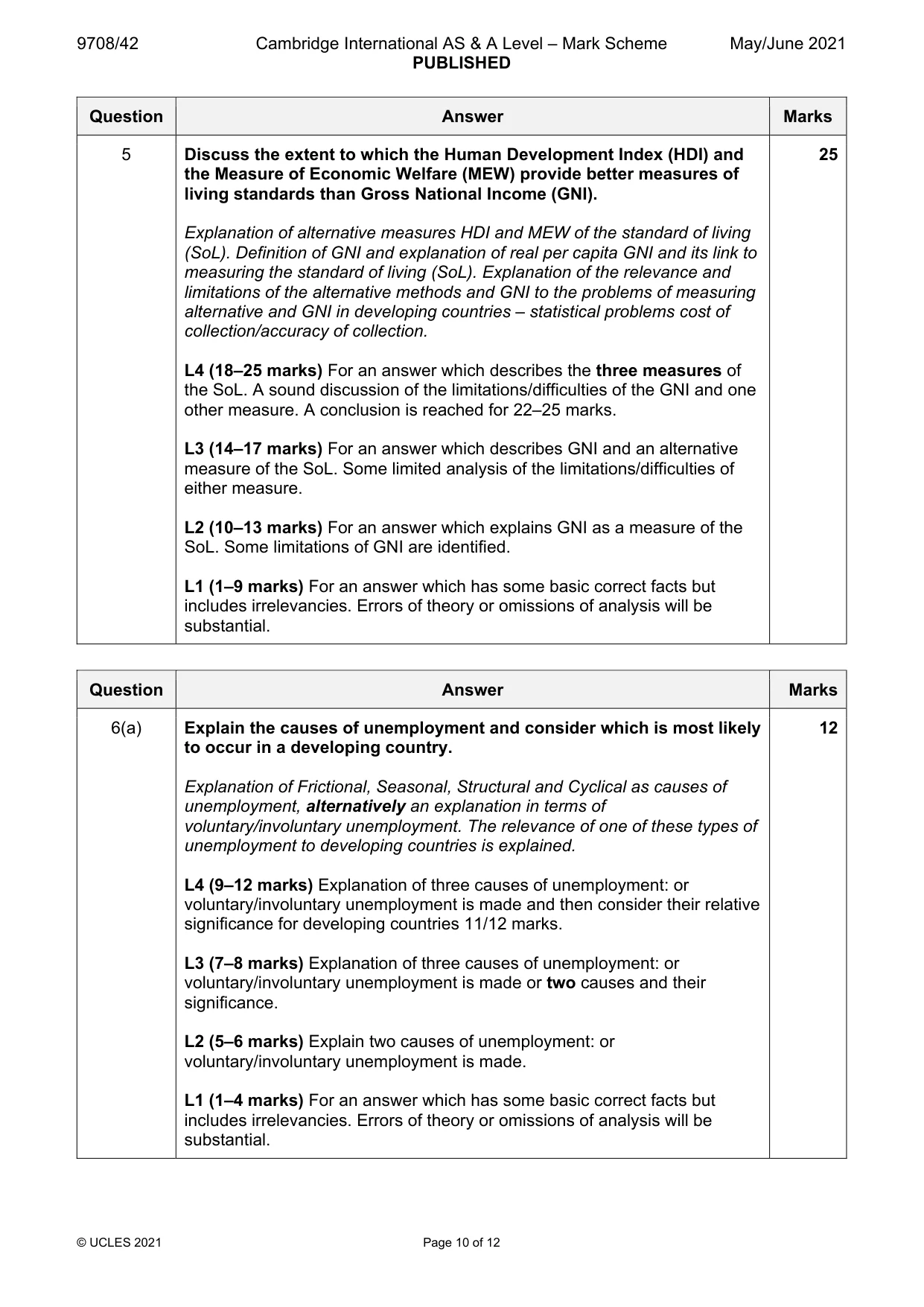
Mark scheme: 5 Discuss the extent to which the Human Development Index (HDI) and 25 the Measure of Economic Welfare (MEW) provide better measures of living standards than Gross National Income (GNI). Explanation of alternative measures HDI and MEW of the standard of living (SoL). Definition of GNI and explanation of real per capita GNI and its link to measuring the standard of living (SoL). Explanation of the relevance and limitations of the alternative methods and GNI to the problems of measuring alternative and GNI in developing countries – statistical problems cost of collection/accuracy of collection. L4 (18–25 marks) For an answer which describes the three measures of the SoL. A sound discussion of the limitations/difficulties of the GNI and one other measure. A conclusion is reached for 22–25 marks. L3 (14–17 marks) For an answer which describes GNI and an alternative measure of the SoL. Some limited analysis of the limitations/difficulties of either measure. L2 (10–13 marks) For an answer which explains GNI as a measure of the SoL. Some limitations of GNI are identified. L1 (1–9 marks) For an answer which has some basic correct facts but includes irrelevancies. Errors of theory or omissions of analysis will be substantial.
Q6 · Explain the causes of unemployment and consider which is most likely to occur in a…
6 (a) Explain the causes of unemployment and consider which is most likely to occur in a developing country. [12] (b) Discuss whether solving the problem of unemployment should be the main policy objective for the government of a developing country. [13]
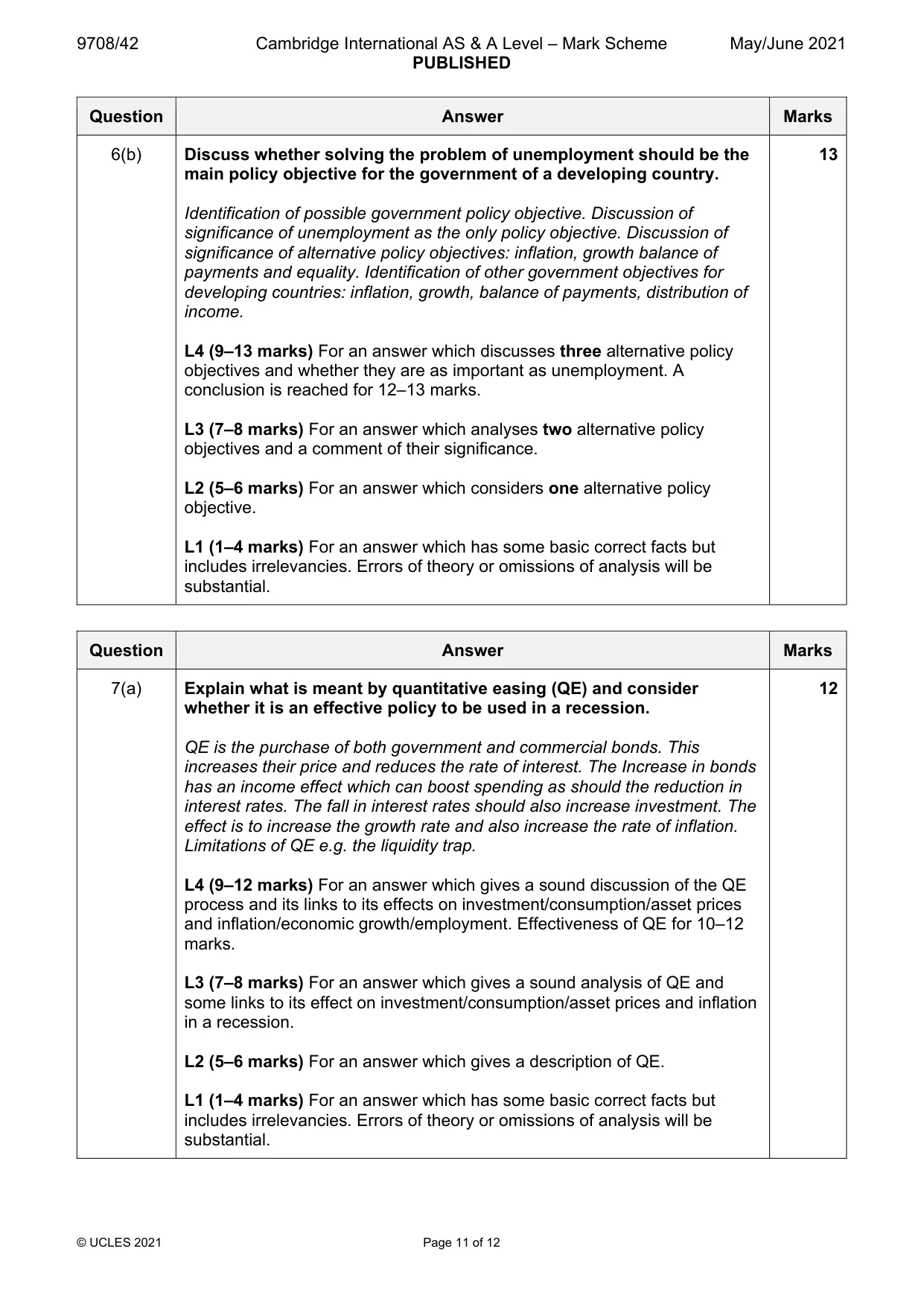
Mark scheme: 6(a) Explain the causes of unemployment and consider which is most likely 12 to occur in a developing country. Explanation of Frictional, Seasonal, Structural and Cyclical as causes of unemployment, alternatively an explanation in terms of voluntary/involuntary unemployment. The relevance of one of these types of unemployment to developing countries is explained. L4 (9–12 marks) Explanation of three causes of unemployment: or voluntary/involuntary unemployment is made and then consider their relative significance for developing countries 11/12 marks. L3 (7–8 marks) Explanation of three causes of unemployment: or voluntary/involuntary unemployment is made or two causes and their significance. L2 (5–6 marks) Explain two causes of unemployment: or voluntary/involuntary unemployment is made. L1 (1–4 marks) For an answer which has some basic correct facts but includes irrelevancies. Errors of theory or omissions of analysis will be substantial. 6(b) Discuss whether solving the problem of unemployment should be the 13 main policy objective for the government of a developing country. Identification of possible government policy objective. Discussion of significance of unemployment as the only policy objective. Discussion of significance of alternative policy objectives: inflation, growth balance of payments and equality. Identification of other government objectives for developing countries: inflation, growth, balance of payments, distribution of income. L4 (9–13 marks) For an answer which discusses three alternative policy objectives and whether they are as important as unemployment. A conclusion is reached for 12–13 marks. L3 (7–8 marks) For an answer which analyses two alternative policy objectives and a comment of their significance. L2 (5–6 marks) For an answer which considers one alternative policy objective. L1 (1–4 marks) For an answer which has some basic correct facts but includes irrelevancies. Errors of theory or omissions of analysis will be substantial.
More questions on Government macroeconomic policy objectives
Q7 · Explain what is meant by quantitative easing (QE) and consider whether it is an effective…
7 (a) Explain what is meant by quantitative easing (QE) and consider whether it is an effective policy to be used in a recession. [12] (b) ‘Policies to achieve economic growth will inevitably cause a government budget deficit.’ How far do you agree with this statement? [13]
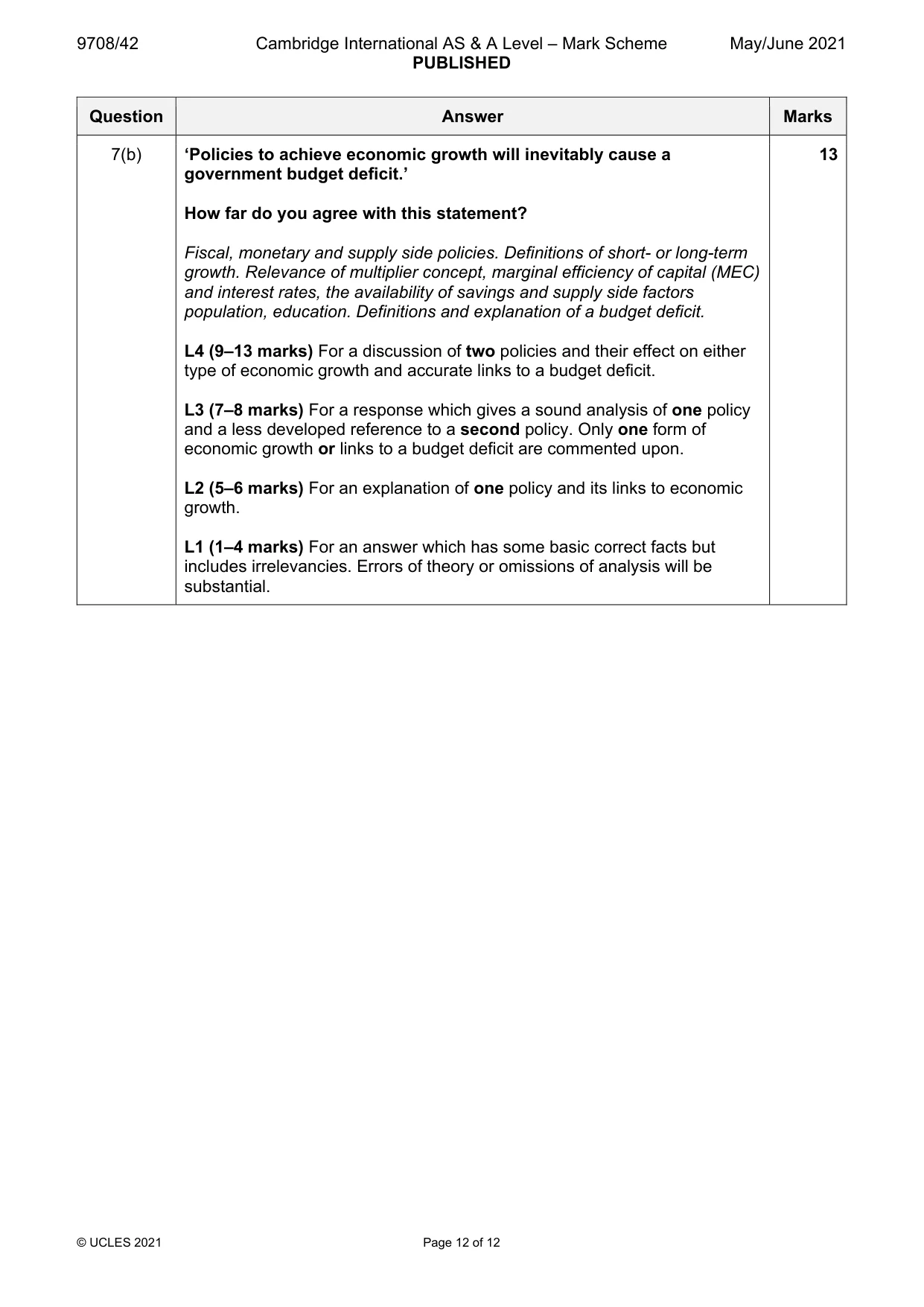
Mark scheme: 7(a) Explain what is meant by quantitative easing (QE) and consider 12 whether it is an effective policy to be used in a recession. QE is the purchase of both government and commercial bonds. This increases their price and reduces the rate of interest. The Increase in bonds has an income effect which can boost spending as should the reduction in interest rates. The fall in interest rates should also increase investment. The effect is to increase the growth rate and also increase the rate of inflation. Limitations of QE e.g. the liquidity trap. L4 (9–12 marks) For an answer which gives a sound discussion of the QE process and its links to its effects on investment/consumption/asset prices and inflation/economic growth/employment. Effectiveness of QE for 10–12 marks. L3 (7–8 marks) For an answer which gives a sound analysis of QE and some links to its effect on investment/consumption/asset prices and inflation in a recession. L2 (5–6 marks) For an answer which gives a description of QE. L1 (1–4 marks) For an answer which has some basic correct facts but includes irrelevancies. Errors of theory or omissions of analysis will be substantial. 7(b) ‘Policies to achieve economic growth will inevitably cause a 13 government budget deficit.’ How far do you agree with this statement? Fiscal, monetary and supply side policies. Definitions of short- or long-term growth. Relevance of multiplier concept, marginal efficiency of capital (MEC) and interest rates, the availability of savings and supply side factors population, education. Definitions and explanation of a budget deficit. L4 (9–13 marks) For a discussion of two policies and their effect on either type of economic growth and accurate links to a budget deficit. L3 (7–8 marks) For a response which gives a sound analysis of one policy and a less developed reference to a second policy. Only one form of economic growth or links to a budget deficit are commented upon. L2 (5–6 marks) For an explanation of one policy and its links to economic growth. L1 (1–4 marks) For an answer which has some basic correct facts but includes irrelevancies. Errors of theory or omissions of analysis will be substantial.
What was in this paper
The subtopics covered by these 7 questions, and how many questions each got. Open one in a new tab to see every Cambridge question on it.
What you needed in this session
Cambridge’s own grade thresholds for 2021 May/June, Paper 4 · Variant 2. A higher threshold means an easier paper — the bar moves with how the cohort did.