Cambridge A Level Economics 9708 — 2021 May/June Paper 2 · Variant 1
9708/21/M/J/21 · 4 questions · 40 marks · ≈45 min
The question paper and its mark scheme, free to read here and free to download. This is Cambridge’s own paper, exactly as it was sat.
Question paper4 pages
Mark scheme14 pages
Answers below. Sit the paper first if you are practising.
Questions as text
Q1 · Vietnam’s exports of fruit and vegetables to exceed US$4 billion The value of Vietnam’s…
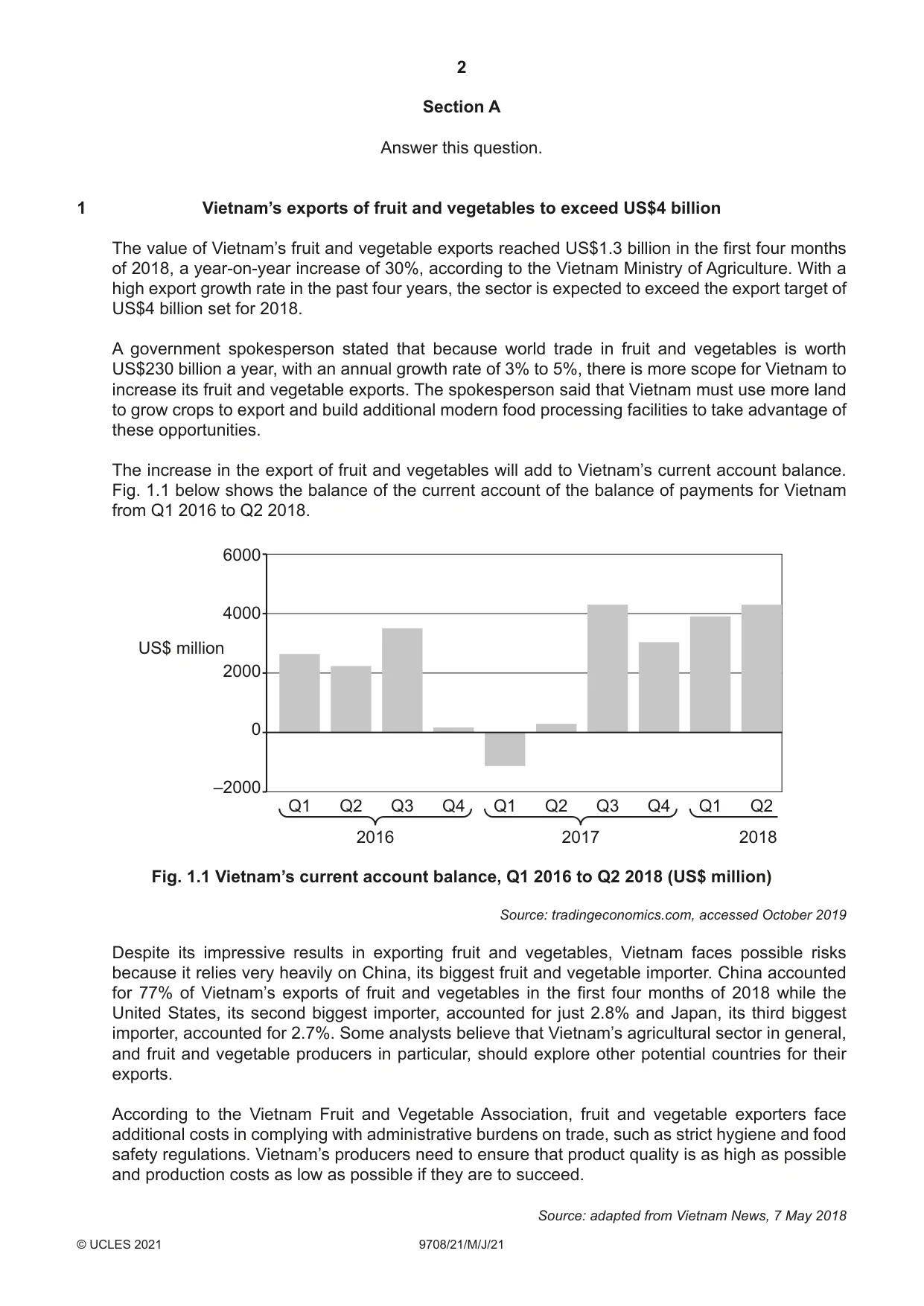
1 Vietnam’s exports of fruit and vegetables to exceed US$4 billion The value of Vietnam’s fruit and vegetable exports reached US$1.3 billion in the first four months of 2018, a year-on-year increase of 30%, according to the Vietnam Ministry of Agriculture. With a high export growth rate in the past four years, the sector is expected to exceed the export target of US$4 billion set for 2018. A government spokesperson stated that because world trade in fruit and vegetables is worth US$230 billion a year, with an annual growth rate of 3% to 5%, there is more scope for Vietnam to increase its fruit and vegetable exports. The spokesperson said that Vietnam must use more land to grow crops to export and build additional modern food processing facilities to take advantage of these opportunities. The increase in the export of fruit and vegetables will add to Vietnam’s current account balance. Fig. 1.1 below shows the balance of the current account of the balance of payments for Vietnam from Q1 2016 to Q2 2018. 6000 4000 US$ million 2000 0 –2000 Q1 Q2 Q3 Q4 Q1 Q2 Q3 Q4 Q1 Q2 2016 2017 2018 Fig. 1.1 Vietnam’s current account balance, Q1 2016 to Q2 2018 (US$ million) Source: tradingeconomics.com, accessed October 2019 Despite its impressive results in exporting fruit and vegetables, Vietnam faces possible risks because it relies very heavily on China, its biggest fruit and vegetable importer. China accounted for 77% of Vietnam’s exports of fruit and vegetables in the first four months of 2018 while the United States, its second biggest importer, accounted for just 2.8% and Japan, its third biggest importer, accounted for 2.7%. Some analysts believe that Vietnam’s agricultural sector in general, and fruit and vegetable producers in particular, should explore other potential countries for their exports. According to the Vietnam Fruit and Vegetable Association, fruit and vegetable exporters face additional costs in complying with administrative burdens on trade, such as strict hygiene and food safety regulations. Vietnam’s producers need to ensure that product quality is as high as possible and production costs as low as possible if they are to succeed. Source: adapted from Vietnam News, 7 May 2018 (a) (i) Describe the overall trend in Vietnam’s current account balance between Q1 2017 and Q2 2018. [1] (ii) Calculate the value of Vietnam’s exports of fruit and vegetables to China in the first four months of 2018. [1] (b) Explain one possible demand factor and one possible supply factor that could have caused the increase in Vietnam’s export sales of fruit and vegetables. [4] (c) Explain how complying with administrative burdens on trade will affect Vietnam’s supply of fruit and vegetables for export. [2] (d) Discuss whether the risks of Vietnam relying very heavily on the Chinese market for the export of its fruit and vegetables are greater than the potential benefits. [6] (e) Using aggregate demand and aggregate supply analysis, discuss the possible impact on Vietnam’s economy of a sustained increase in its net exports. [6]
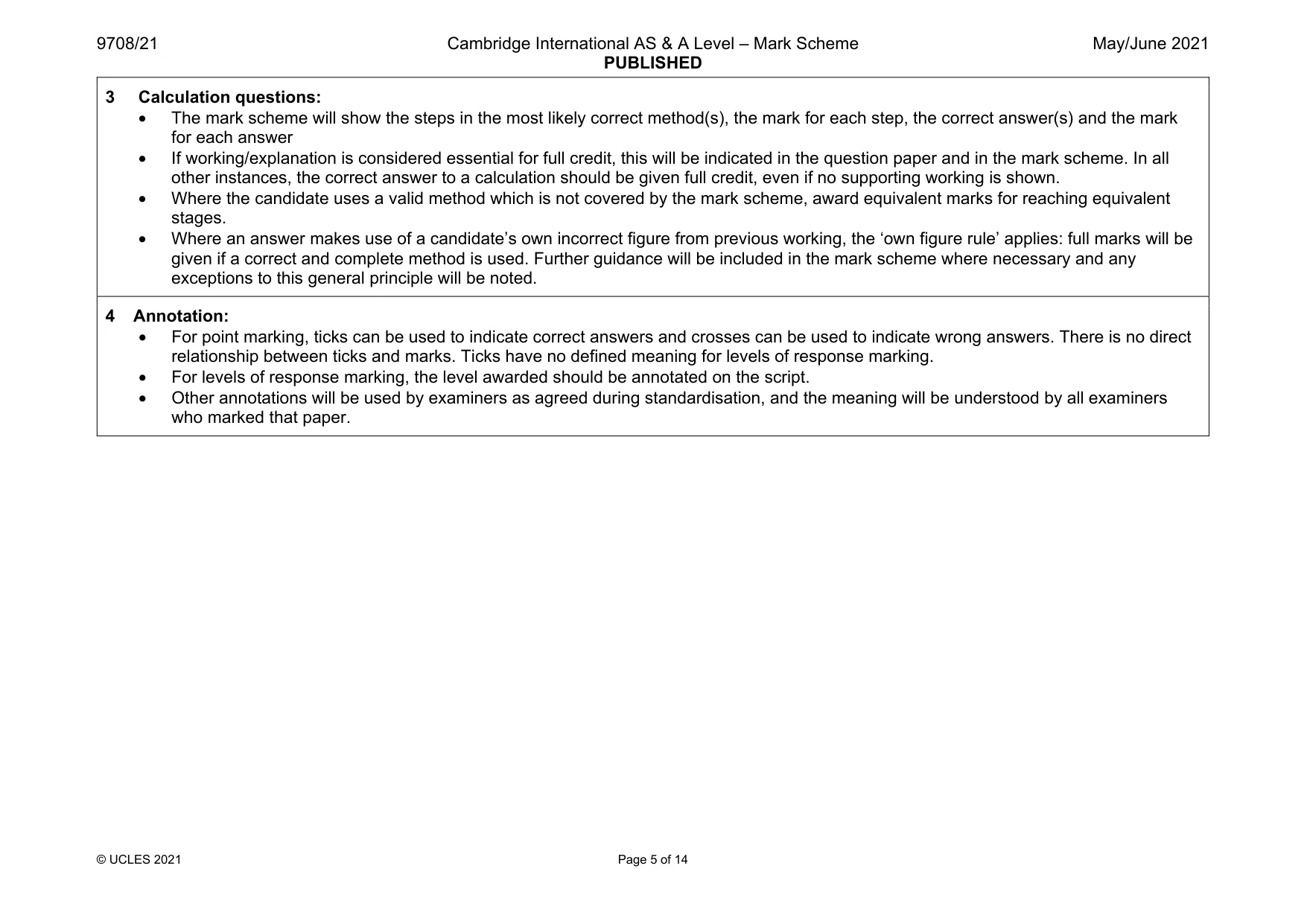
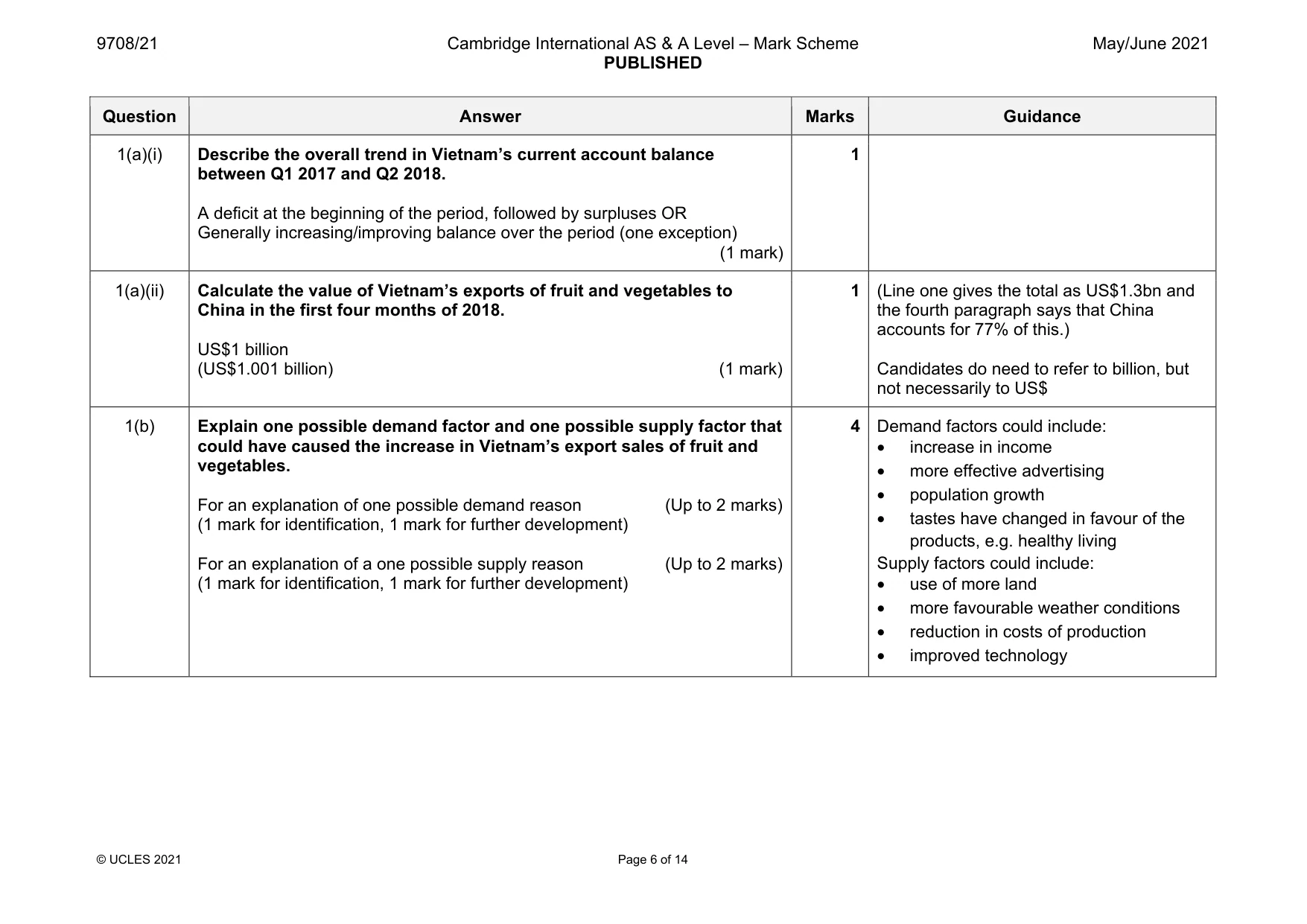
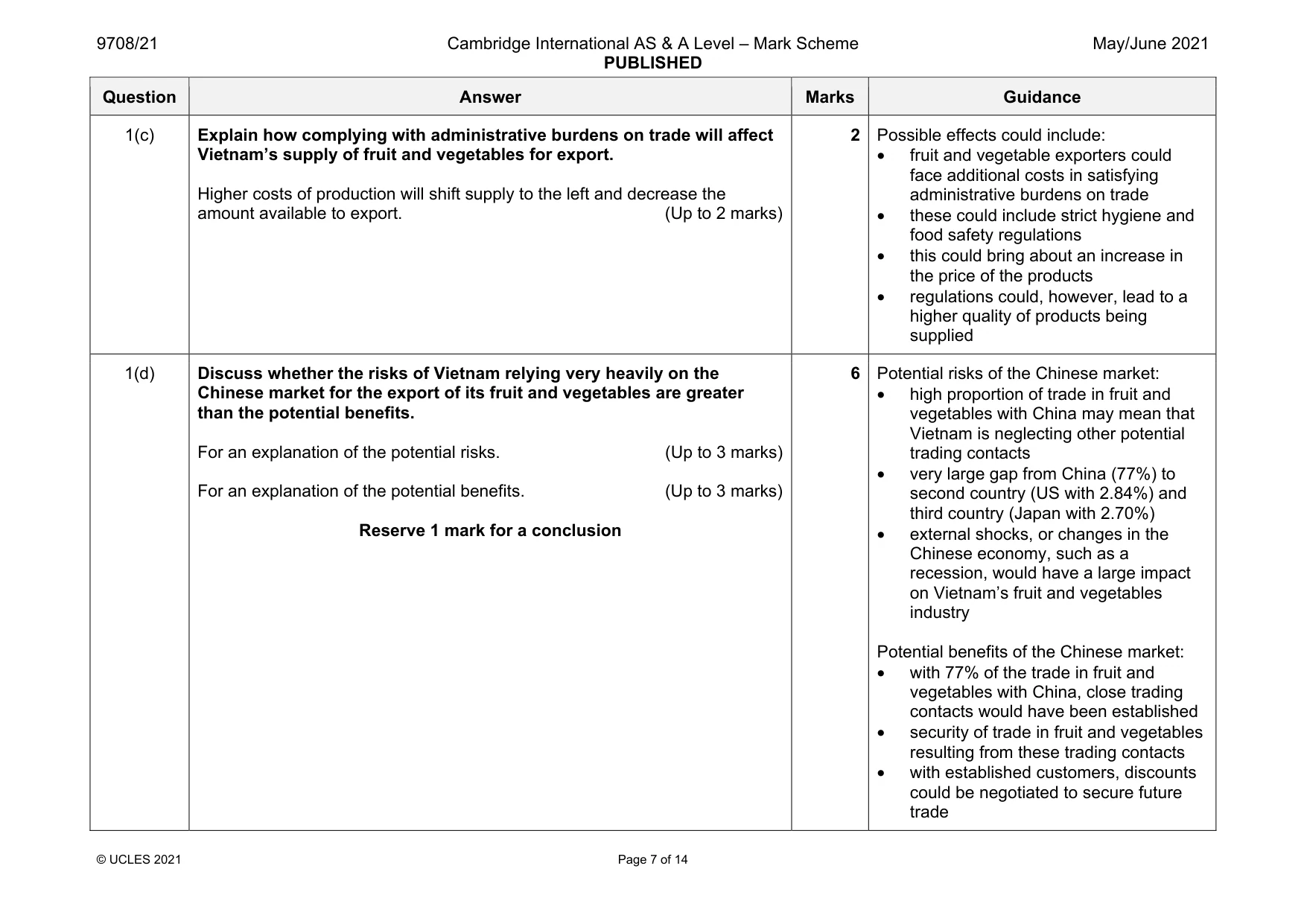
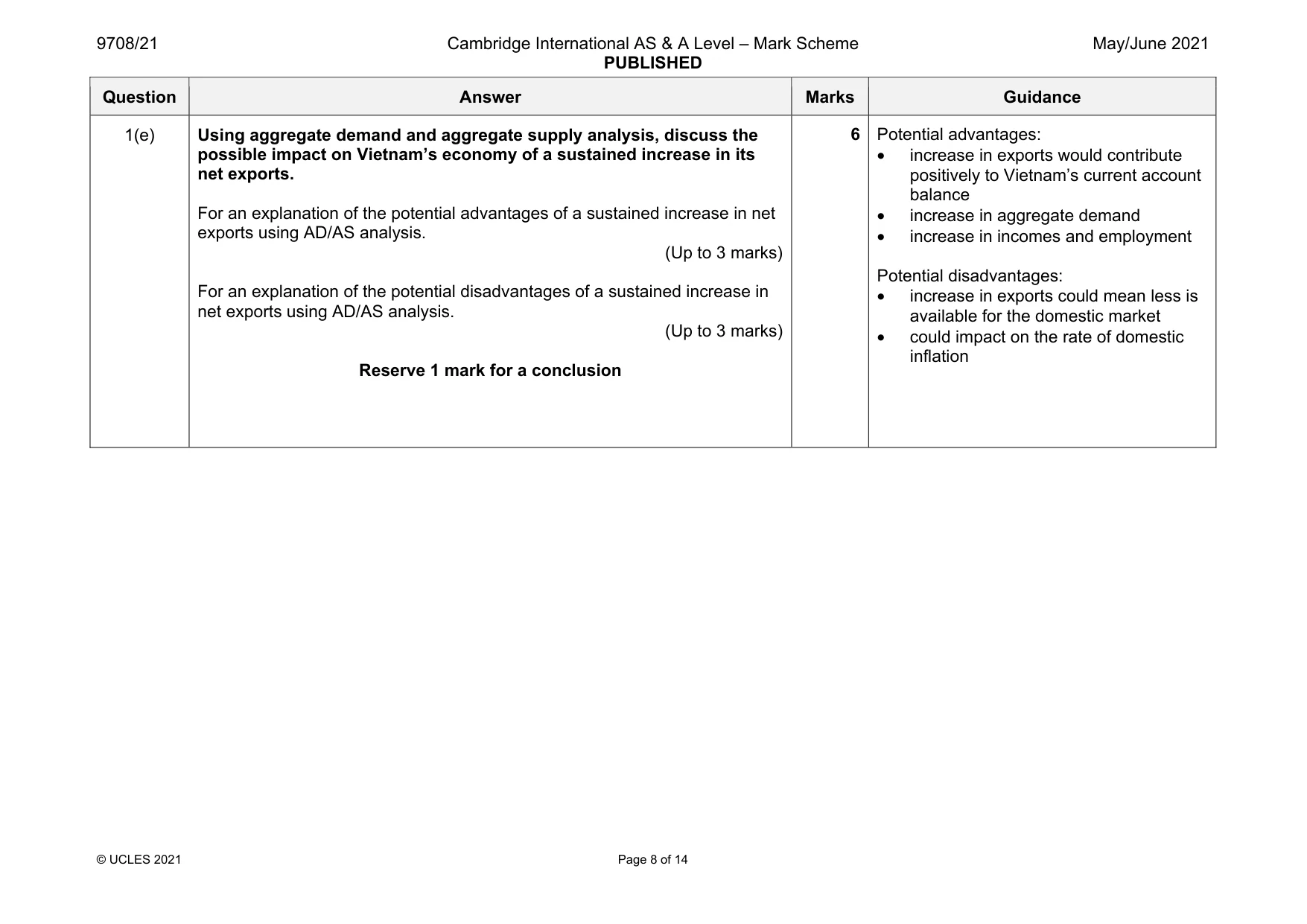
Mark scheme: 1(a)(i) Describe the overall trend in Vietnam’s current account balance between Q1 2017 and Q2 2018. A deficit at the beginning of the period, followed by surpluses OR Generally increasing/improving balance over the period (one exception) (1 mark) 1(a)(ii) Calculate the value of Vietnam’s exports of fruit and vegetables to China in the first four months of 2018. US$1 billion (US$1.001 billion) (1 mark) 1 (Line one gives the total as US$1.3bn and the fourth paragraph says that China accounts for 77% of this.) Candidates do need to refer to billion, but not necessarily to US$ 1(b) Explain one possible demand factor and one possible supply factor that could have caused the increase in Vietnam’s export sales of fruit and vegetables. For an explanation of one possible demand reason (Up to 2 marks) (1 mark for identification, 1 mark for further development) For an explanation of a one possible supply reason (Up to 2 marks) (1 mark for identification, 1 mark for further development) 4 Demand factors could include: • increase in income • more effective advertising • population growth • tastes have changed in favour of the products, e.g. healthy living Supply factors could include: • use of more land • more favourable weather conditions • reduction in costs of production • improved technology Question Answer Marks Guidance 1(c) Explain how complying with administrative burdens on trade will affect Vietnam’s supply of fruit and vegetables for export. Higher costs of production will shift supply to the left and decrease the amount available to export. (Up to 2 marks) 2 Possible effects could include: • fruit and vegetable exporters could face additional costs in satisfying administrative burdens on trade • these could include strict hygiene and food safety regulations • this could bring about an increase in the price of the products • regulations could, however, lead to a higher quality of products being supplied 1(d) Discuss whether the risks of Vietnam relying very heavily on the Chinese market for the export of its fruit and vegetables are greater than the potential benefits. For an explanation of the potential risks. (Up to 3 marks) For an explanation of the potential benefits. (Up to 3 marks) Reserve 1 mark for a conclusion 6 Potential risks of the Chinese market: • high proportion of trade in fruit and vegetables with China may mean that Vietnam is neglecting other potential trading contacts • very large gap from China (77%) to second country (US with 2.84%) and third country (Japan with 2.70%) • external shocks, or changes in the Chinese economy, such as a recession, would have a large impact on Vietnam’s fruit and vegetables industry Potential benefits of the Chinese market: • with 77% of the trade in fruit and vegetables with China, close trading contacts would have been established • security of trade in fruit and vegetables resulting from these trading contacts • with established customers, discounts could be negotiated to secure future trade Question Answer Marks Guidance 1(e) Using aggregate demand and aggregate supply analysis, discuss the possible impact on Vietnam’s economy of a sustained increase in its net exports. For an explanation of the potential advantages of a sustained increase in net exports using AD/AS analysis. (Up to 3 marks) For an explanation of the potential disadvantages of a sustained increase in net exports using AD/AS analysis. (Up to 3 marks) Reserve 1 mark for a conclusion 6 Potential advantages: • increase in exports would contribute positively to Vietnam’s current account balance • increase in aggregate demand • increase in incomes and employment Potential disadvantages: • increase in exports could mean less is available for the domestic market • could impact on the rate of domestic inflation
More questions on Current account of the balance of payments
Q2 · Explain whether private goods, free goods and public goods will all be sold in a free…
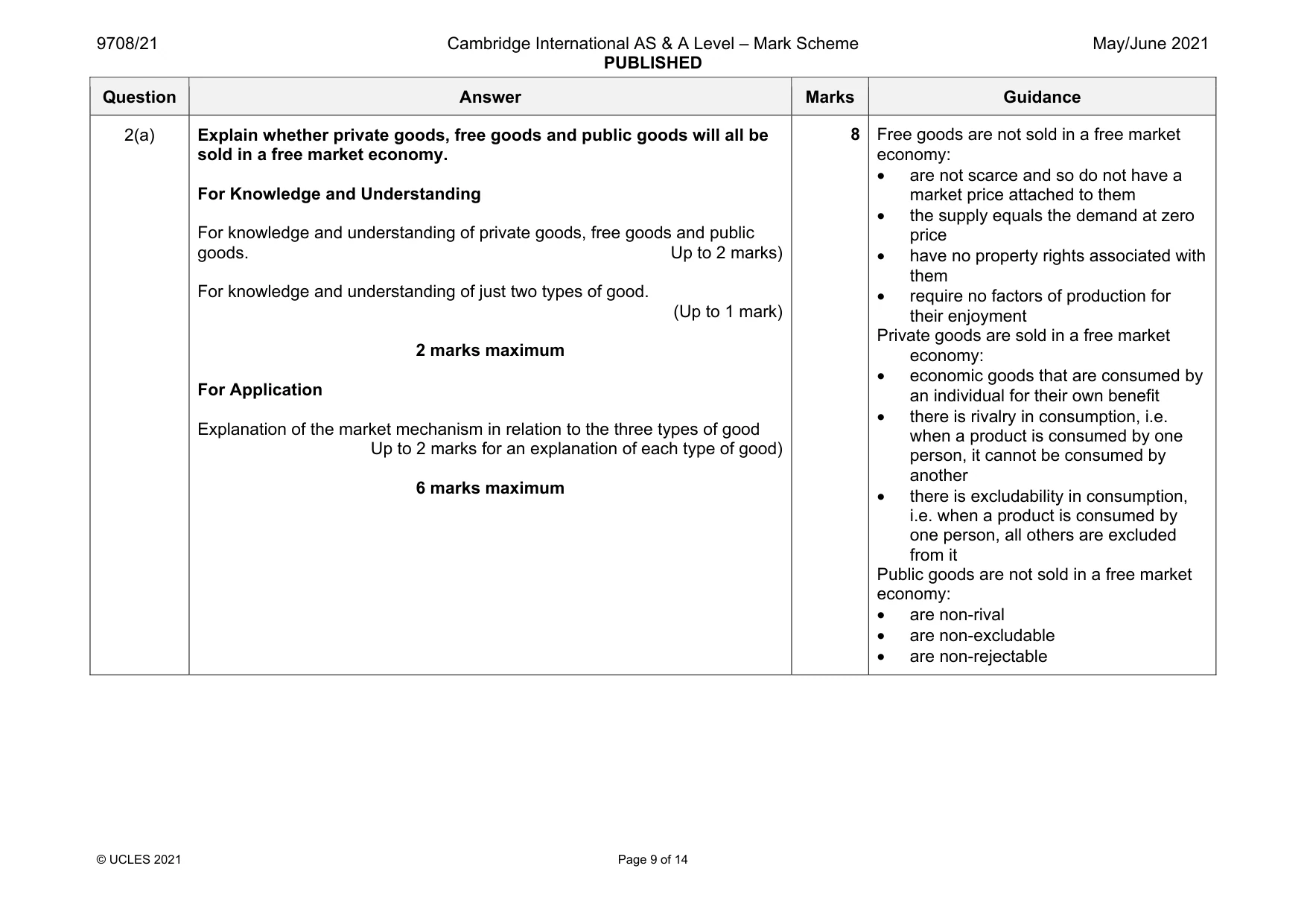
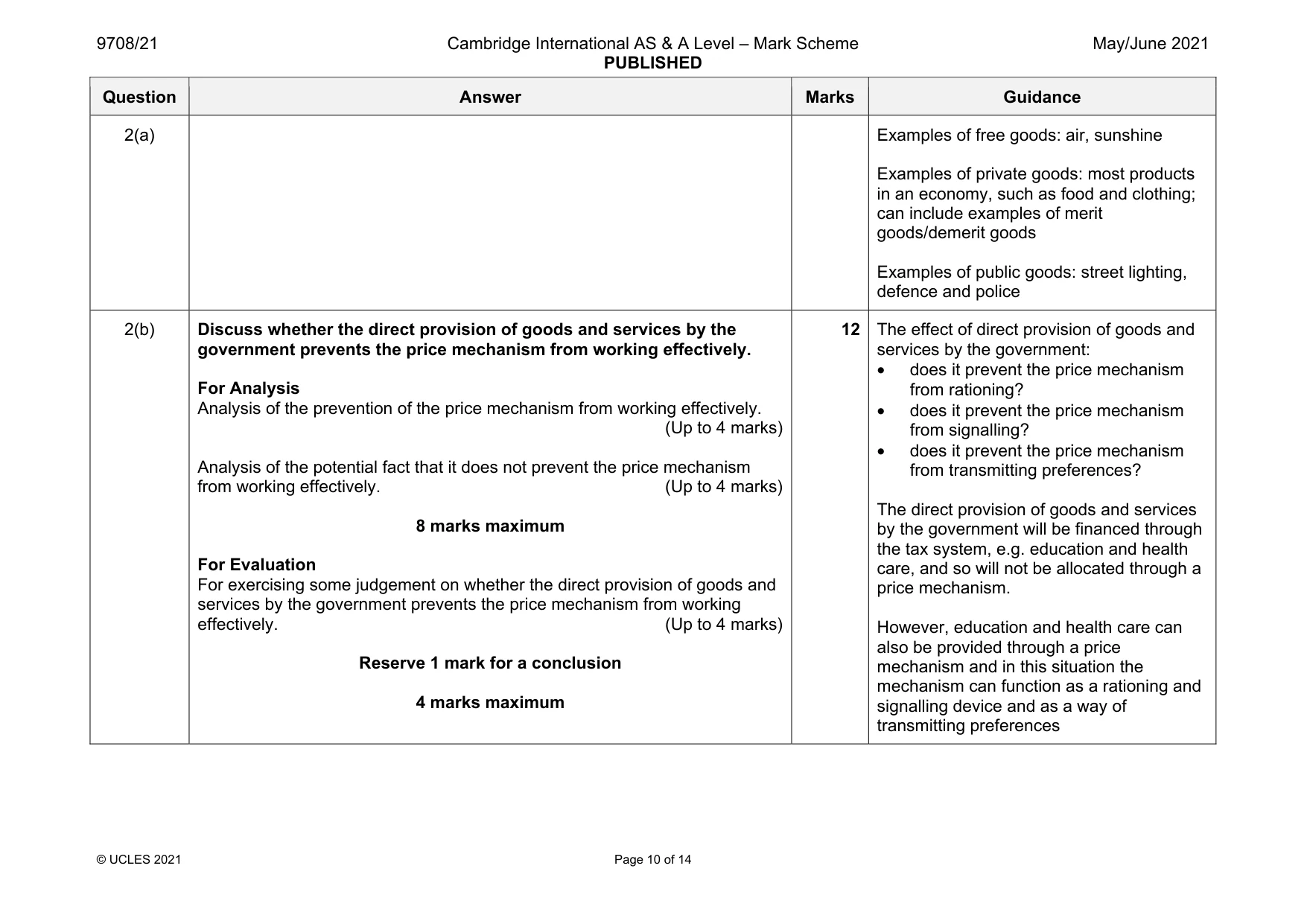
2 (a) Explain whether private goods, free goods and public goods will all be sold in a free market economy. [8] (b) Discuss whether the direct provision of goods and services by the government prevents the price mechanism from working effectively. [12]
Mark scheme: 2(a) Explain whether private goods, free goods and public goods will all be sold in a free market economy. For Knowledge and Understanding For knowledge and understanding of private goods, free goods and public goods. Up to 2 marks) For knowledge and understanding of just two types of good. (Up to 1 mark) 2 marks maximum For Application Explanation of the market mechanism in relation to the three types of good Up to 2 marks for an explanation of each type of good) 6 marks maximum economy: • are not scarce and so do not have a market price attached to them • the supply equals the demand at zero price • have no property rights associated with them • require no factors of production for their enjoyment Private goods are sold in a free market economy: • economic goods that are consumed by an individual for their own benefit • there is rivalry in consumption, i.e. when a product is consumed by one person, it cannot be consumed by another • there is excludability in consumption, i.e. when a product is consumed by one person, all others are excluded from it Public goods are not sold in a free market economy: • are non-rival • are non-excludable • are non-rejectable Question Answer Marks Guidance 2(a) Examples of free goods: air, sunshine Examples of private goods: most products in an economy, such as food and clothing; can include examples of merit goods/demerit goods Examples of public goods: street lighting, defence and police 2(b) Discuss whether the direct provision of goods and services by the government prevents the price mechanism from working effectively. For Analysis Analysis of the prevention of the price mechanism from working effectively. (Up to 4 marks) Analysis of the potential fact that it does not prevent the price mechanism from working effectively. (Up to 4 marks) 8 marks maximum For Evaluation For exercising some judgement on whether the direct provision of goods and services by the government prevents the price mechanism from working effectively. (Up to 4 marks) Reserve 1 mark for a conclusion 4 marks maximum 12 The effect of direct provision of goods and services by the government: • does it prevent the price mechanism from rationing? • does it prevent the price mechanism from signalling? • does it prevent the price mechanism from transmitting preferences? The direct provision of goods and services by the government will be financed through the tax system, e.g. education and health care, and so will not be allocated through a price mechanism. However, education and health care can also be provided through a price mechanism and in this situation the mechanism can function as a rationing and signalling device and as a way of transmitting preferences
More questions on Methods and effects of government intervention in markets
Q3 · With the aid of diagrams, explain how consumer surplus is affected by a decrease in the…
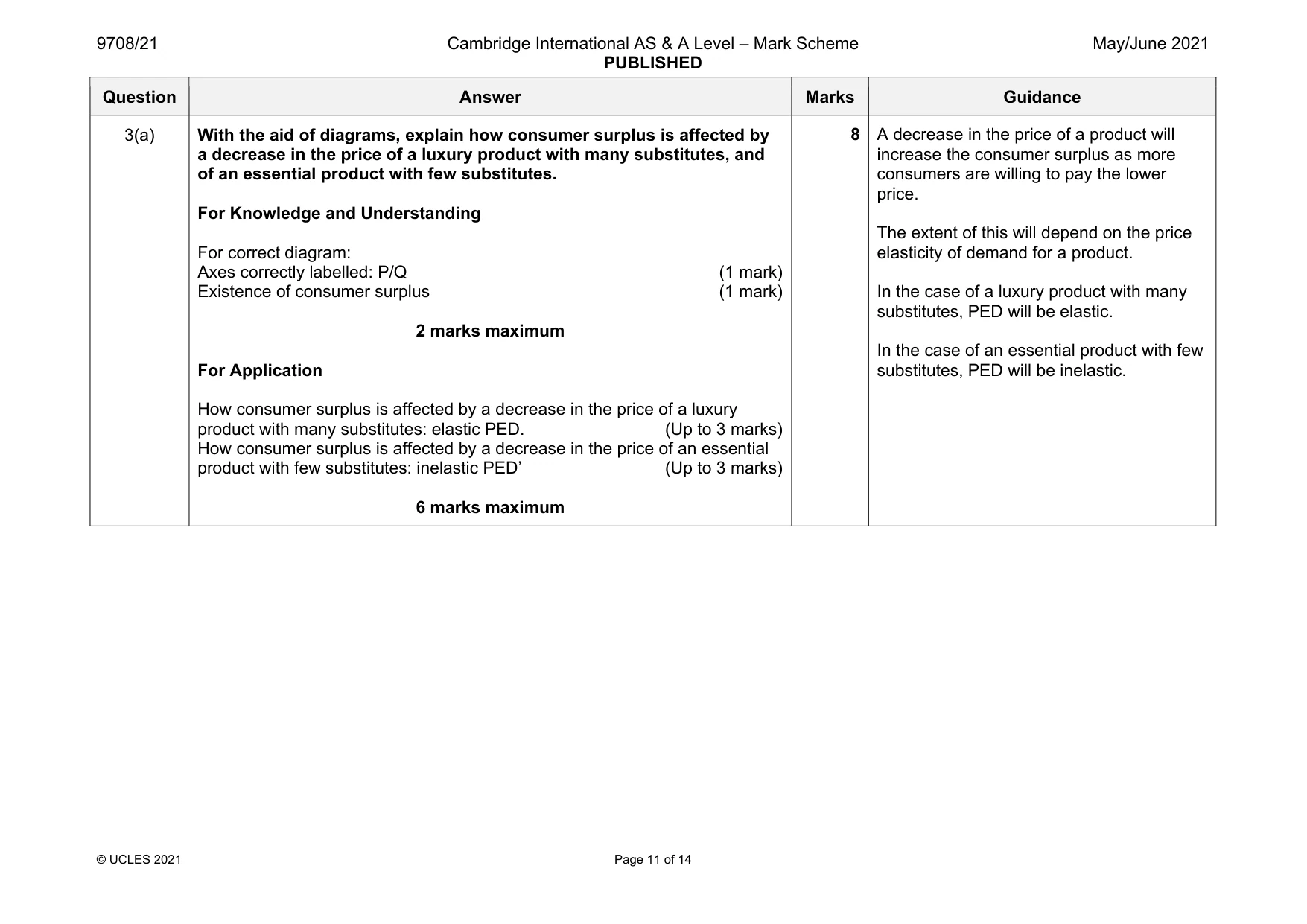
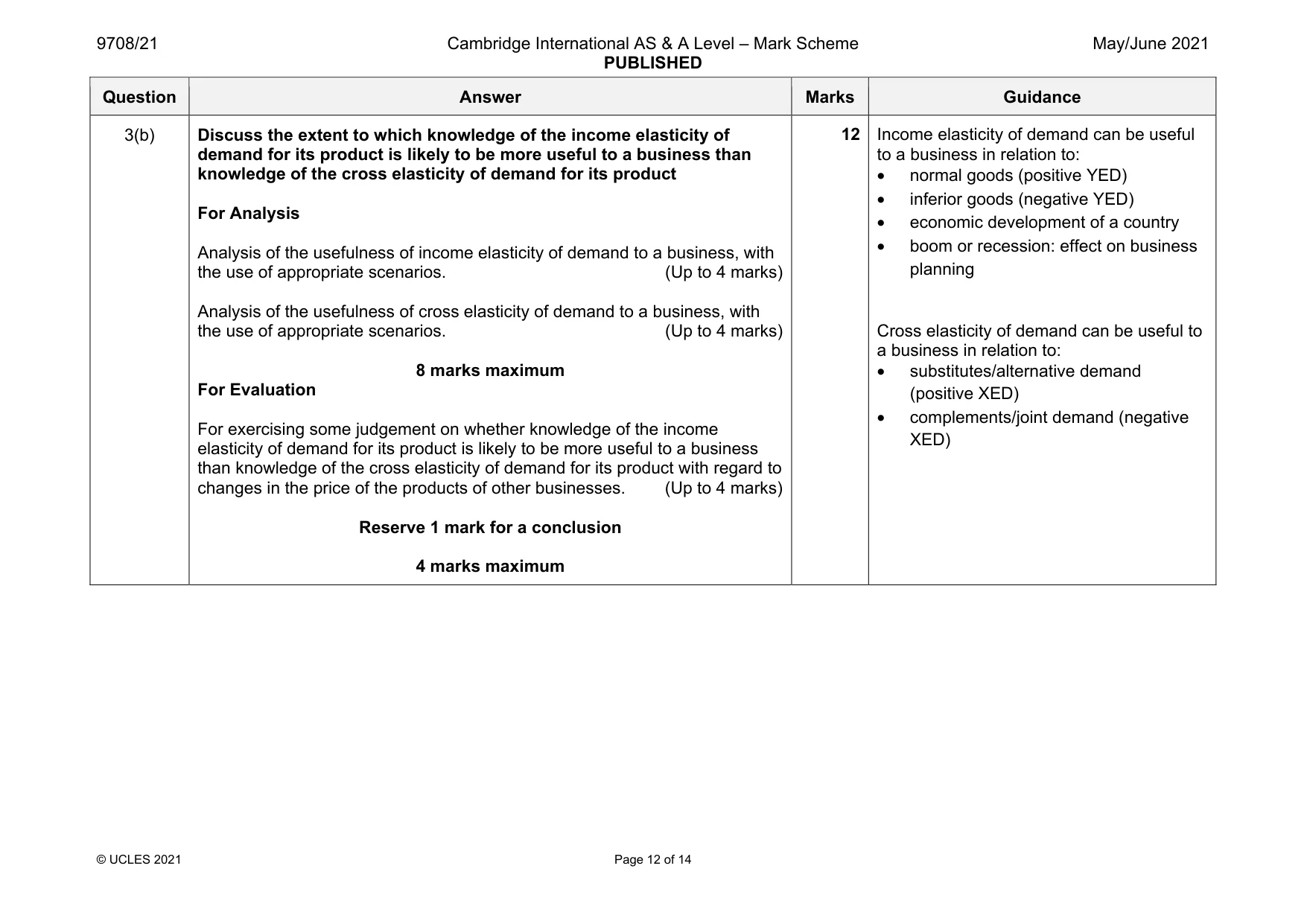
3 (a) With the aid of diagrams, explain how consumer surplus is affected by a decrease in the price of a luxury product with many substitutes, and of an essential product with few substitutes. [8] (b) Discuss the extent to which knowledge of the income elasticity of demand for its product is likely to be more useful to a business than knowledge of the cross elasticity of demand for its product. [12]
Mark scheme: 3(a) With the aid of diagrams, explain how consumer surplus is affected by a decrease in the price of a luxury product with many substitutes, and of an essential product with few substitutes. For Knowledge and Understanding For correct diagram: Axes correctly labelled: P/Q (1 mark) Existence of consumer surplus (1 mark) 2 marks maximum For Application How consumer surplus is affected by a decrease in the price of a luxury product with many substitutes: elastic PED. (Up to 3 marks) How consumer surplus is affected by a decrease in the price of an essential product with few substitutes: inelastic PED’ (Up to 3 marks) 6 marks maximum increase the consumer surplus as more consumers are willing to pay the lower price. The extent of this will depend on the price elasticity of demand for a product. In the case of a luxury product with many substitutes, PED will be elastic. In the case of an essential product with few substitutes, PED will be inelastic. Question Answer Marks Guidance 3(b) Discuss the extent to which knowledge of the income elasticity of demand for its product is likely to be more useful to a business than knowledge of the cross elasticity of demand for its product For Analysis Analysis of the usefulness of income elasticity of demand to a business, with the use of appropriate scenarios. (Up to 4 marks) Analysis of the usefulness of cross elasticity of demand to a business, with the use of appropriate scenarios. (Up to 4 marks) 8 marks maximum For Evaluation For exercising some judgement on whether knowledge of the income elasticity of demand for its product is likely to be more useful to a business than knowledge of the cross elasticity of demand for its product with regard to changes in the price of the products of other businesses. (Up to 4 marks) Reserve 1 mark for a conclusion 4 marks maximum 12 Income elasticity of demand can be useful to a business in relation to: • normal goods (positive YED) • inferior goods (negative YED) • economic development of a country • boom or recession: effect on business planning Cross elasticity of demand can be useful to a business in relation to: • substitutes/alternative demand (positive XED) • complements/joint demand (negative XED)
More questions on Price elasticity, income elasticity and cross elasticity of demand
Q4 · With the aid of a diagram(s), explain one demand factor and one supply factor that would…
4 (a) With the aid of a diagram(s), explain one demand factor and one supply factor that would cause the value of a currency in a floating exchange rate system to depreciate. [8] (b) Discuss how likely it is that monetary policy would be successful in reducing inflation in an economy with a floating exchange rate. [12]
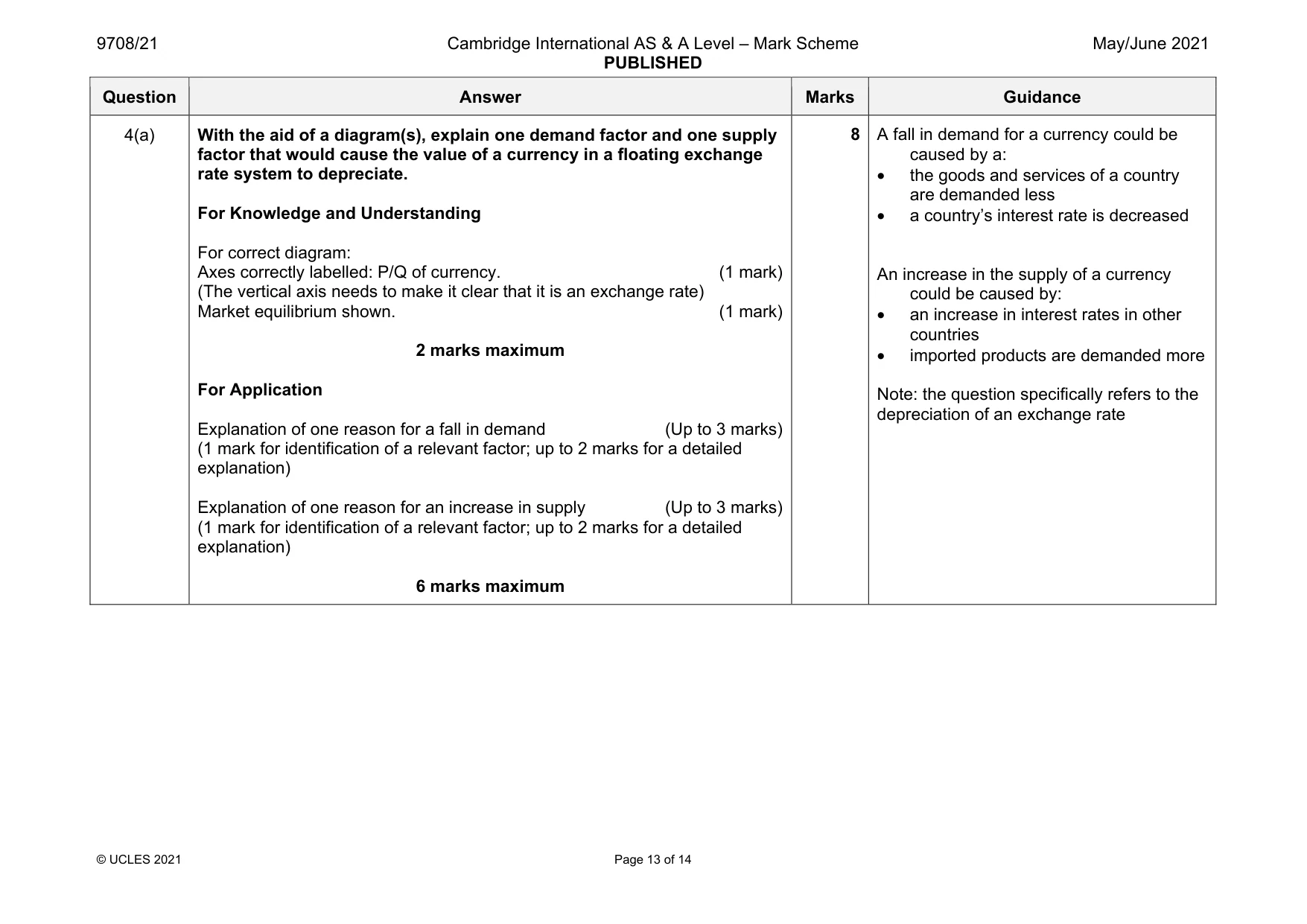
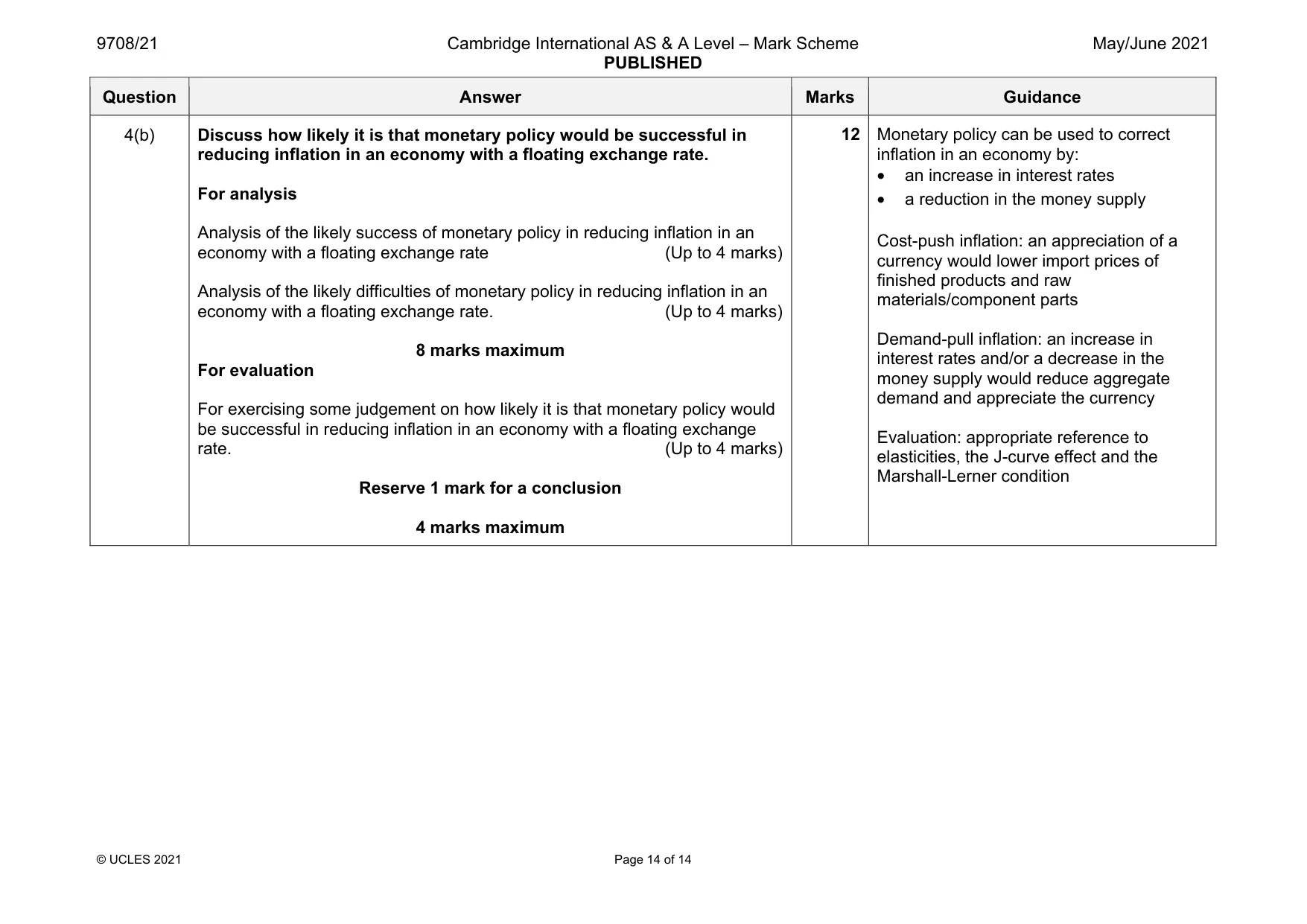
Mark scheme: 4(a) With the aid of a diagram(s), explain one demand factor and one supply factor that would cause the value of a currency in a floating exchange rate system to depreciate. For Knowledge and Understanding For correct diagram: Axes correctly labelled: P/Q of currency. (1 mark) (The vertical axis needs to make it clear that it is an exchange rate) Market equilibrium shown. (1 mark) 2 marks maximum For Application Explanation of one reason for a fall in demand (Up to 3 marks) (1 mark for identification of a relevant factor; up to 2 marks for a detailed explanation) Explanation of one reason for an increase in supply (Up to 3 marks) (1 mark for identification of a relevant factor; up to 2 marks for a detailed explanation) 6 marks maximum caused by a: • the goods and services of a country are demanded less • a country’s interest rate is decreased An increase in the supply of a currency could be caused by: • an increase in interest rates in other countries • imported products are demanded more Note: the question specifically refers to the depreciation of an exchange rate Question Answer Marks Guidance 4(b) Discuss how likely it is that monetary policy would be successful in reducing inflation in an economy with a floating exchange rate. For analysis Analysis of the likely success of monetary policy in reducing inflation in an economy with a floating exchange rate (Up to 4 marks) Analysis of the likely difficulties of monetary policy in reducing inflation in an economy with a floating exchange rate. (Up to 4 marks) 8 marks maximum For evaluation For exercising some judgement on how likely it is that monetary policy would be successful in reducing inflation in an economy with a floating exchange rate. (Up to 4 marks) Reserve 1 mark for a conclusion 4 marks maximum 12 Monetary policy can be used to correct inflation in an economy by: • an increase in interest rates • a reduction in the money supply Cost-push inflation: an appreciation of a currency would lower import prices of finished products and raw materials/component parts Demand-pull inflation: an increase in interest rates and/or a decrease in the money supply would reduce aggregate demand and appreciate the currency Evaluation: appropriate reference to elasticities, the J-curve effect and the Marshall-Lerner condition
More questions on Effectiveness of policy options to meet all macroeconomic objectives
What was in this paper
The subtopics covered by these 4 questions, and how many questions each got. Open one in a new tab to see every Cambridge question on it.
What you needed in this session
Cambridge’s own grade thresholds for 2021 May/June, Paper 2 · Variant 1. A higher threshold means an easier paper — the bar moves with how the cohort did.