Cambridge A Level Economics 9708 — 2021 Feb/March Paper 4 · Variant 2
9708/42/F/M/21 · 7 questions · 70 marks · ≈79 min
The question paper and its mark scheme, free to read here and free to download. This is Cambridge’s own paper, exactly as it was sat.
Question paper4 pages


Mark scheme20 pages
Answers below. Sit the paper first if you are practising.











Questions as text
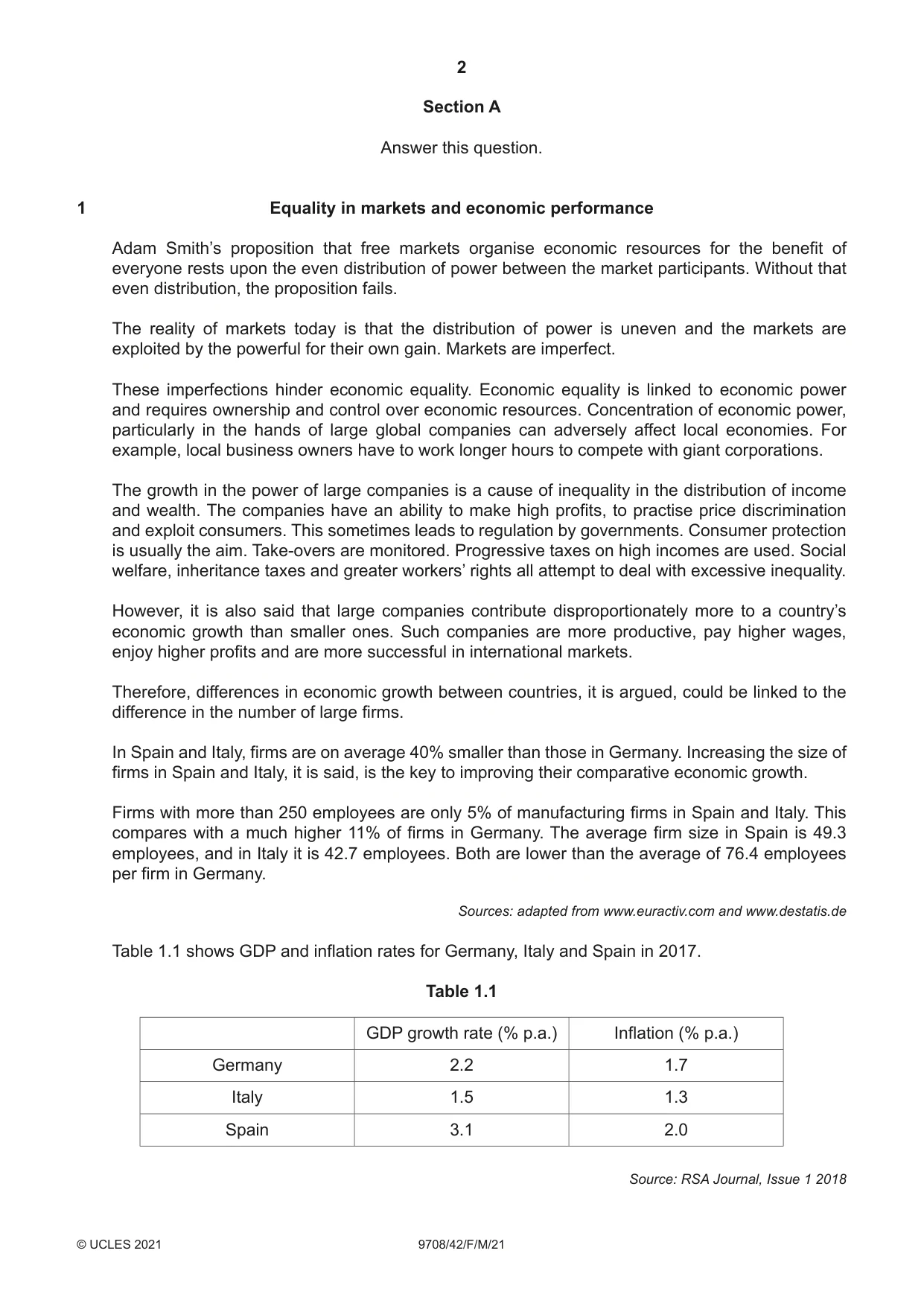
Q1 · Equality in markets and economic performance Adam Smith’s proposition that free markets…
1 Equality in markets and economic performance Adam Smith’s proposition that free markets organise economic resources for the benefit of everyone rests upon the even distribution of power between the market participants. Without that even distribution, the proposition fails. The reality of markets today is that the distribution of power is uneven and the markets are exploited by the powerful for their own gain. Markets are imperfect. These imperfections hinder economic equality. Economic equality is linked to economic power and requires ownership and control over economic resources. Concentration of economic power, particularly in the hands of large global companies can adversely affect local economies. For example, local business owners have to work longer hours to compete with giant corporations. The growth in the power of large companies is a cause of inequality in the distribution of income and wealth. The companies have an ability to make high profits, to practise price discrimination and exploit consumers. This sometimes leads to regulation by governments. Consumer protection is usually the aim. Take-overs are monitored. Progressive taxes on high incomes are used. Social welfare, inheritance taxes and greater workers’ rights all attempt to deal with excessive inequality. However, it is also said that large companies contribute disproportionately more to a country’s economic growth than smaller ones. Such companies are more productive, pay higher wages, enjoy higher profits and are more successful in international markets. Therefore, differences in economic growth between countries, it is argued, could be linked to the difference in the number of large firms. In Spain and Italy, firms are on average 40% smaller than those in Germany. Increasing the size of firms in Spain and Italy, it is said, is the key to improving their comparative economic growth. Firms with more than 250 employees are only 5% of manufacturing firms in Spain and Italy. This compares with a much higher 11% of firms in Germany. The average firm size in Spain is 49.3 employees, and in Italy it is 42.7 employees. Both are lower than the average of 76.4 employees per firm in Germany. Sources: adapted from www.euractiv.com and www.destatis.de Table 1.1 shows GDP and inflation rates for Germany, Italy and Spain in 2017. Table 1.1 GDP growth rate (% p.a.) Inflation (% p.a.) Germany 2.2 1.7 Italy 1.5 1.3 Spain 3.1 2.0 Source: RSA Journal, Issue 1 2018 (a) Explain what is meant by ‘a free market organises economic resources for the benefit of everyone’. [4] (b) Analyse why the article says that some markets are ‘imperfect’. [4] (c) Distinguish between equality and equity and use the information to give two examples of policy measures that might promote equality in the distribution of income. [4] (d) Some argue that large firms are beneficial. Consider whether the evidence in the information supports their opinion. [8]
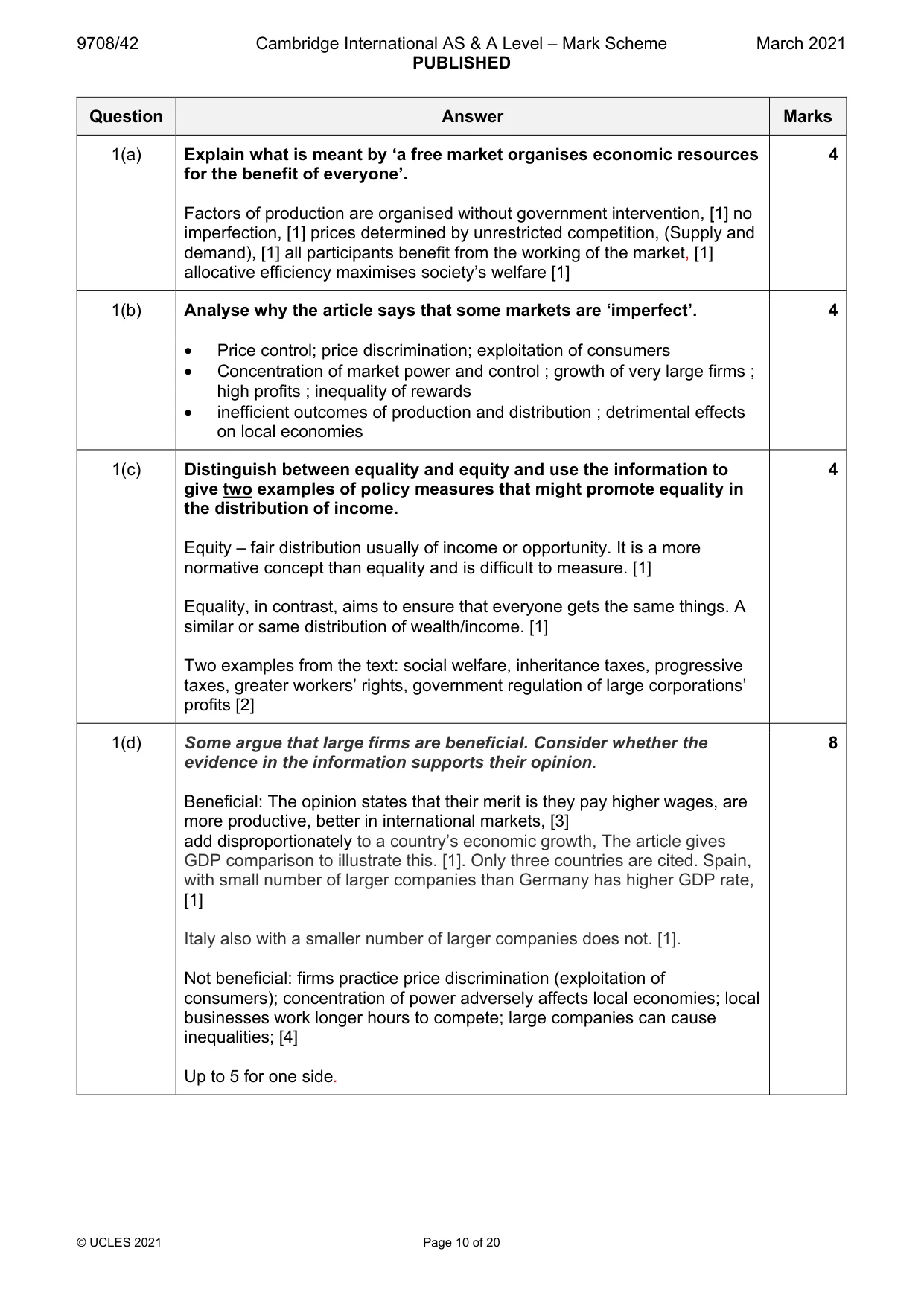
Mark scheme: Question Answer Marks 1(a) Explain what is meant by ‘a free market organises economic resources 4 for the benefit of everyone’. Factors of production are organised without government intervention, [1] no imperfection, [1] prices determined by unrestricted competition, (Supply and demand), [1] all participants benefit from the working of the market, [1] allocative efficiency maximises society’s welfare [1] 1(b) Analyse why the article says that some markets are ‘imperfect’. 4 • Price control; price discrimination; exploitation of consumers • Concentration of market power and control ; growth of very large firms ; high profits ; inequality of rewards • inefficient outcomes of production and distribution ; detrimental effects on local economies 1(c) Distinguish between equality and equity and use the information to 4 give two examples of policy measures that might promote equality in the distribution of income. Equity – fair distribution usually of income or opportunity. It is a more normative concept than equality and is difficult to measure. [1] Equality, in contrast, aims to ensure that everyone gets the same things. A similar or same distribution of wealth/income. [1] Two examples from the text: social welfare, inheritance taxes, progressive taxes, greater workers’ rights, government regulation of large corporations’ profits [2] 1(d) Some argue that large firms are beneficial. Consider whether the 8 evidence in the information supports their opinion. Beneficial: The opinion states that their merit is they pay higher wages, are more productive, better in international markets, [3] add disproportionately to a country’s economic growth, The article gives GDP comparison to illustrate this. [1]. Only three countries are cited. Spain, with small number of larger companies than Germany has higher GDP rate, [1] Italy also with a smaller number of larger companies does not. [1]. Not beneficial: firms practice price discrimination (exploitation of consumers); concentration of power adversely affects local economies; local businesses work longer hours to compete; large companies can cause inequalities; [4] Up to 5 for one side.
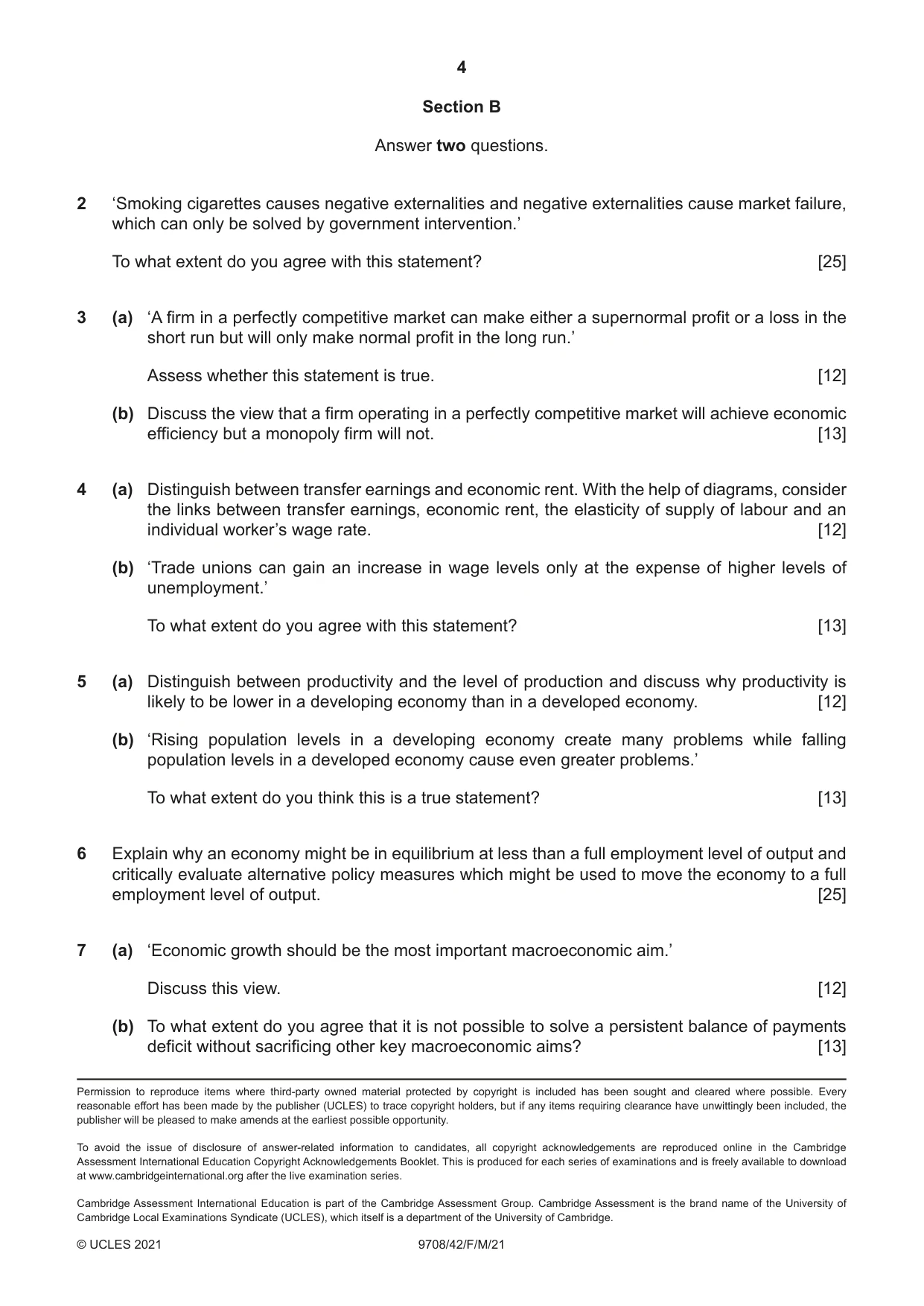
Q2 · ‘Smoking cigarettes causes negative externalities and negative externalities cause market…
2 ‘Smoking cigarettes causes negative externalities and negative externalities cause market failure, which can only be solved by government intervention.’ To what extent do you agree with this statement? [25]
Mark scheme: 2 ‘Smoking cigarettes causes negative externalities and negative 25 externalities cause market failure which can only be solved by government intervention.’ To what extent do you agree with this statement? There are three parts to this question. Answers should provide a clear explanation of the meaning of a negative externality and the link between the definition and asymmetric information and negative spill-over effects. Analysis should be then used to explain why negative externalities cause market failure. In this case market failure would be identified as an allocatively inefficient use of resources. Further analysis of the link between government intervention and the solution to this type of market failure should be provided. Alternative solutions to this type of market failure should be considered and a conclusion provided which examines whether government intervention is the only possible solution to this type of market failure. L4 (18–25 marks): For a reasoned and clear discussion which links each of the three separate parts of the question. Analysis of the links will be combined with some evaluative comment relating to the effectiveness of government intervention. A reasoned conclusion should be provided. 21 max no conclusion. L3 (14–17 marks): For a competent comment together with limited elaboration of the analysis or imprecise links in the argument. There will be some discussion but the evaluation will not be fully developed or extensive. L2 (10–13 marks): For a brief explanation but weak or ill-explained links. The explanation will be undeveloped with some attempt at analysis but the emphasis will be on descriptive comment or not all of the three elements of the question will be addressed. L1 (1–9 marks): For an answer that has some basic correct facts but includes irrelevancies and errors of theory.
More questions on Private costs and benefits, externalities and social costs and benefits
Q3 · ‘A firm in a perfectly competitive market can make either a supernormal profit or a loss…
3 (a) ‘A firm in a perfectly competitive market can make either a supernormal profit or a loss in the short run but will only make normal profit in the long run.’ Assess whether this statement is true. [12] (b) Discuss the view that a firm operating in a perfectly competitive market will achieve economic efficiency but a monopoly firm will not. [13]
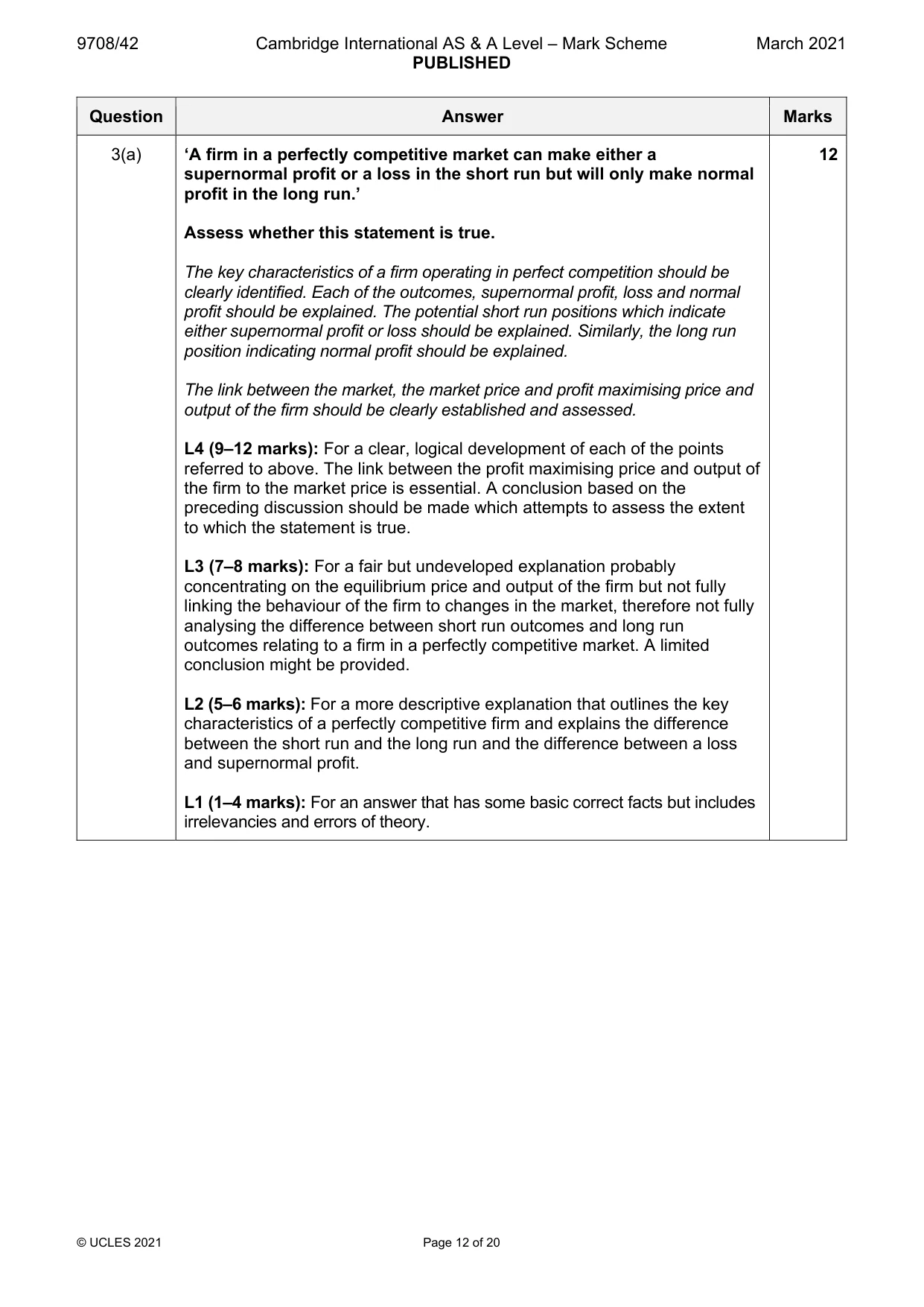
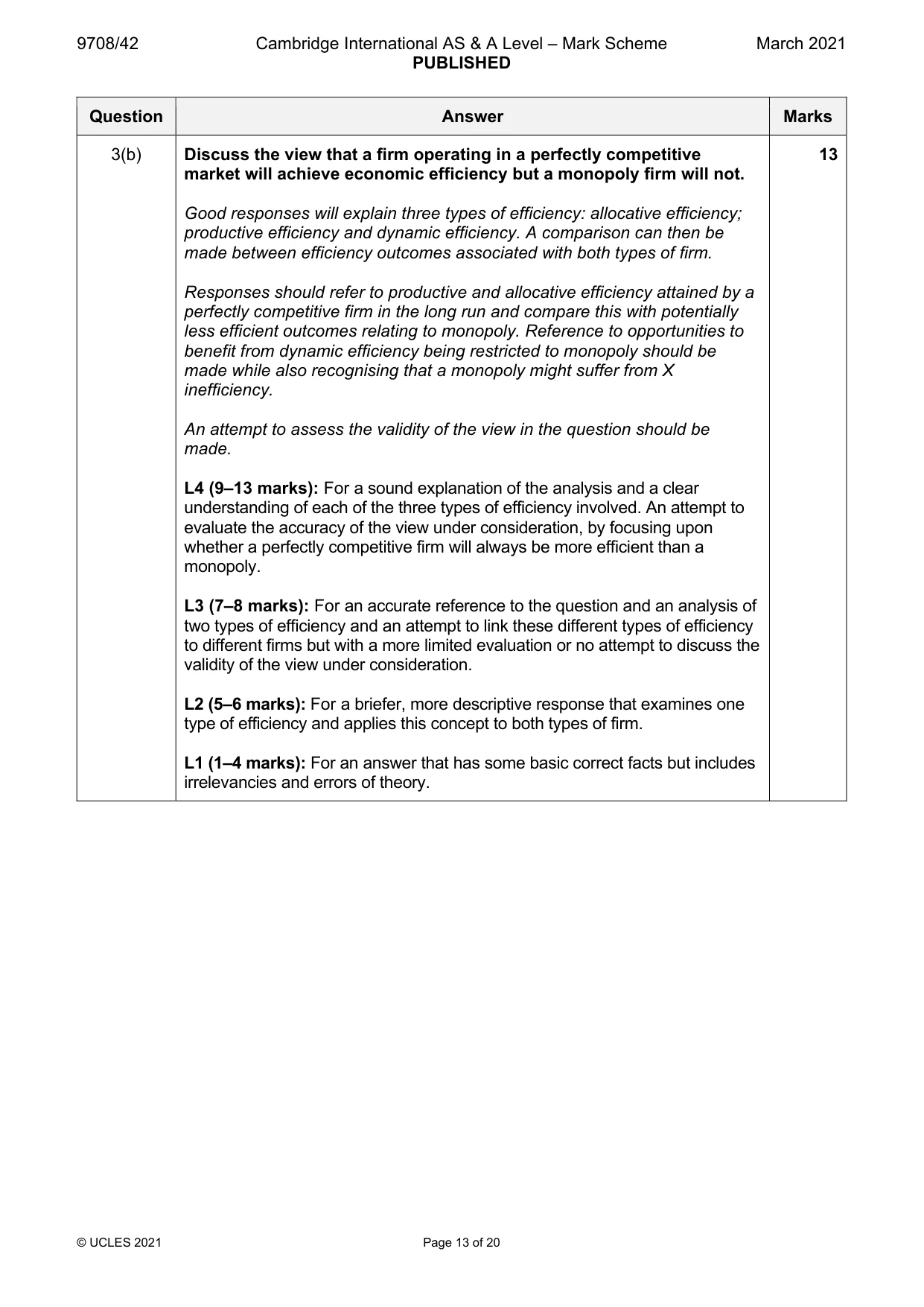
Mark scheme: 3(a) ‘A firm in a perfectly competitive market can make either a 12 supernormal profit or a loss in the short run but will only make normal profit in the long run.’ Assess whether this statement is true. The key characteristics of a firm operating in perfect competition should be clearly identified. Each of the outcomes, supernormal profit, loss and normal profit should be explained. The potential short run positions which indicate either supernormal profit or loss should be explained. Similarly, the long run position indicating normal profit should be explained. The link between the market, the market price and profit maximising price and output of the firm should be clearly established and assessed. L4 (9–12 marks): For a clear, logical development of each of the points referred to above. The link between the profit maximising price and output of the firm to the market price is essential. A conclusion based on the preceding discussion should be made which attempts to assess the extent to which the statement is true. L3 (7–8 marks): For a fair but undeveloped explanation probably concentrating on the equilibrium price and output of the firm but not fully linking the behaviour of the firm to changes in the market, therefore not fully analysing the difference between short run outcomes and long run outcomes relating to a firm in a perfectly competitive market. A limited conclusion might be provided. L2 (5–6 marks): For a more descriptive explanation that outlines the key characteristics of a perfectly competitive firm and explains the difference between the short run and the long run and the difference between a loss and supernormal profit. L1 (1–4 marks): For an answer that has some basic correct facts but includes irrelevancies and errors of theory. 3(b) Discuss the view that a firm operating in a perfectly competitive 13 market will achieve economic efficiency but a monopoly firm will not. Good responses will explain three types of efficiency: allocative efficiency; productive efficiency and dynamic efficiency. A comparison can then be made between efficiency outcomes associated with both types of firm. Responses should refer to productive and allocative efficiency attained by a perfectly competitive firm in the long run and compare this with potentially less efficient outcomes relating to monopoly. Reference to opportunities to benefit from dynamic efficiency being restricted to monopoly should be made while also recognising that a monopoly might suffer from X inefficiency. An attempt to assess the validity of the view in the question should be made. L4 (9–13 marks): For a sound explanation of the analysis and a clear understanding of each of the three types of efficiency involved. An attempt to evaluate the accuracy of the view under consideration, by focusing upon whether a perfectly competitive firm will always be more efficient than a monopoly. L3 (7–8 marks): For an accurate reference to the question and an analysis of two types of efficiency and an attempt to link these different types of efficiency to different firms but with a more limited evaluation or no attempt to discuss the validity of the view under consideration. L2 (5–6 marks): For a briefer, more descriptive response that examines one type of efficiency and applies this concept to both types of firm. L1 (1–4 marks): For an answer that has some basic correct facts but includes irrelevancies and errors of theory.
Q4 · Distinguish between transfer earnings and economic rent
4 (a) Distinguish between transfer earnings and economic rent. With the help of diagrams, consider the links between transfer earnings, economic rent, the elasticity of supply of labour and an individual worker’s wage rate. [12] (b) ‘Trade unions can gain an increase in wage levels only at the expense of higher levels of unemployment.’ To what extent do you agree with this statement? [13]
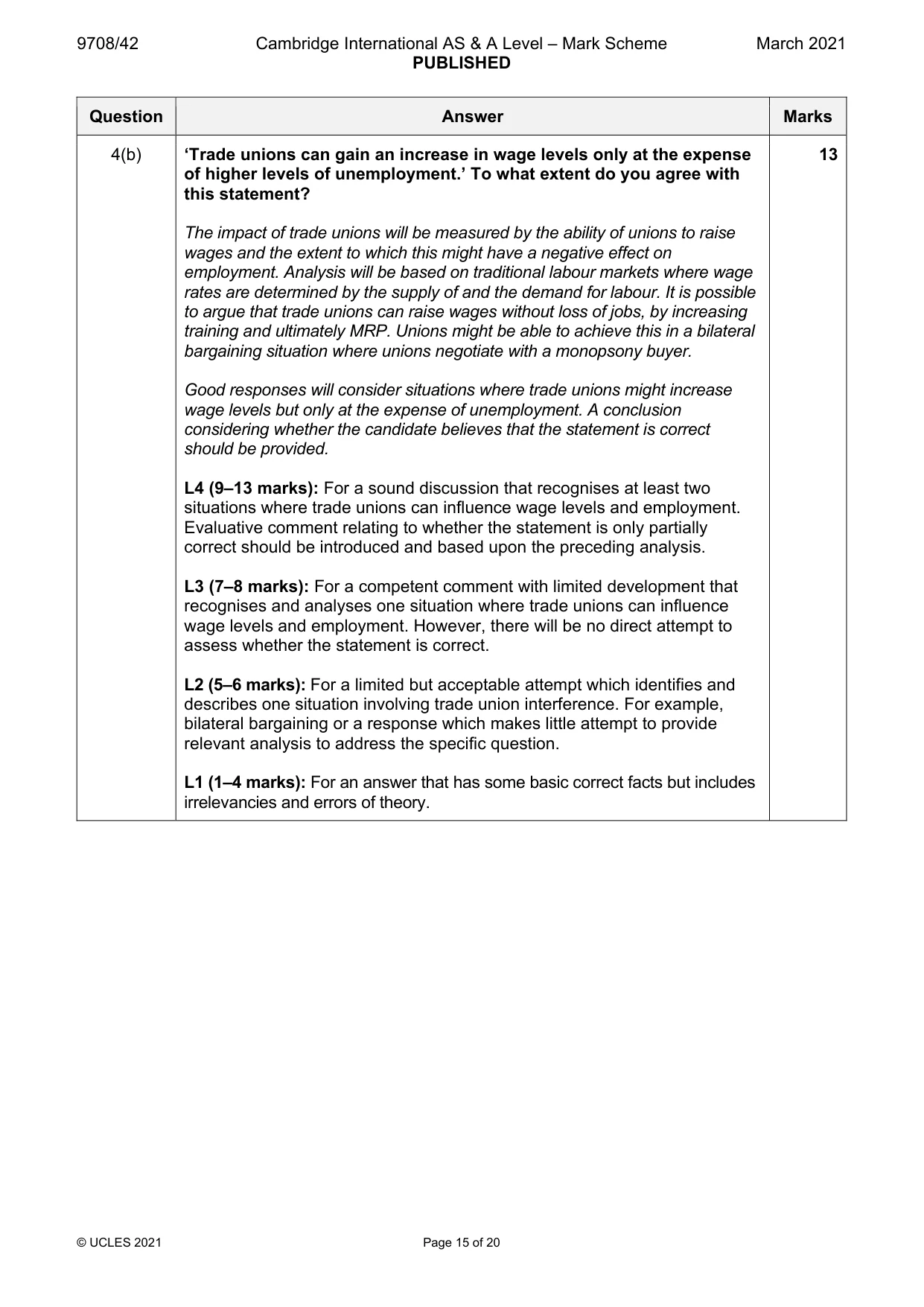
Mark scheme: 4(a) Distinguish between transfer earnings and economic rent. With the 12 help of diagrams, consider the links between transfer earnings, economic rent, the elasticity of supply of labour and an individual worker’s wage rate. Answers should clearly define the concepts of transfer earning and economic rent and establish the key difference between the two. Diagrams are required to illustrate the difference between the two concepts. The meaning of the term elasticity of supply of labour should be clearly expressed and linked to the concepts of rent and transfer earnings, reference to diagrams might be made. The determination of an individual’s wage rate using the supply of and demand for labour analysis can then be explained. Some discussion might attempt to evaluate the strength of the links outlined. L4 (9–12 marks): For a response which addresses all three elements of the question. Also, a clear link will be established between the elasticity of supply of labour and the individual’s wage rate. The extent of the link should be questioned by considering other factors which might influence this link and making some attempt to produce a reasoned, developed conclusion. L3 (7–8 marks): For a competent analysis of the importance of each of the three elements referred to in the question and showing how they might be linked but no attempt made to consider the extent of the links. L2 (5–6 marks): For a descriptive comment of each of the three or elements of the question but only a very brief attempt to establish any links. L1 (1–4 marks): For an answer that has some basic correct facts but includes irrelevancies and errors of theory. 4(b) ‘Trade unions can gain an increase in wage levels only at the expense 13 of higher levels of unemployment.’ To what extent do you agree with this statement? The impact of trade unions will be measured by the ability of unions to raise wages and the extent to which this might have a negative effect on employment. Analysis will be based on traditional labour markets where wage rates are determined by the supply of and the demand for labour. It is possible to argue that trade unions can raise wages without loss of jobs, by increasing training and ultimately MRP. Unions might be able to achieve this in a bilateral bargaining situation where unions negotiate with a monopsony buyer. Good responses will consider situations where trade unions might increase wage levels but only at the expense of unemployment. A conclusion considering whether the candidate believes that the statement is correct should be provided. L4 (9–13 marks): For a sound discussion that recognises at least two situations where trade unions can influence wage levels and employment. Evaluative comment relating to whether the statement is only partially correct should be introduced and based upon the preceding analysis. L3 (7–8 marks): For a competent comment with limited development that recognises and analyses one situation where trade unions can influence wage levels and employment. However, there will be no direct attempt to assess whether the statement is correct. L2 (5–6 marks): For a limited but acceptable attempt which identifies and describes one situation involving trade union interference. For example, bilateral bargaining or a response which makes little attempt to provide relevant analysis to address the specific question. L1 (1–4 marks): For an answer that has some basic correct facts but includes irrelevancies and errors of theory.
More questions on Labour market forces and government intervention
Q5 · Distinguish between productivity and the level of production and discuss why productivity…
5 (a) Distinguish between productivity and the level of production and discuss why productivity is likely to be lower in a developing economy than in a developed economy. [12] (b) ‘Rising population levels in a developing economy create many problems while falling population levels in a developed economy cause even greater problems.’ To what extent do you think this is a true statement? [13]
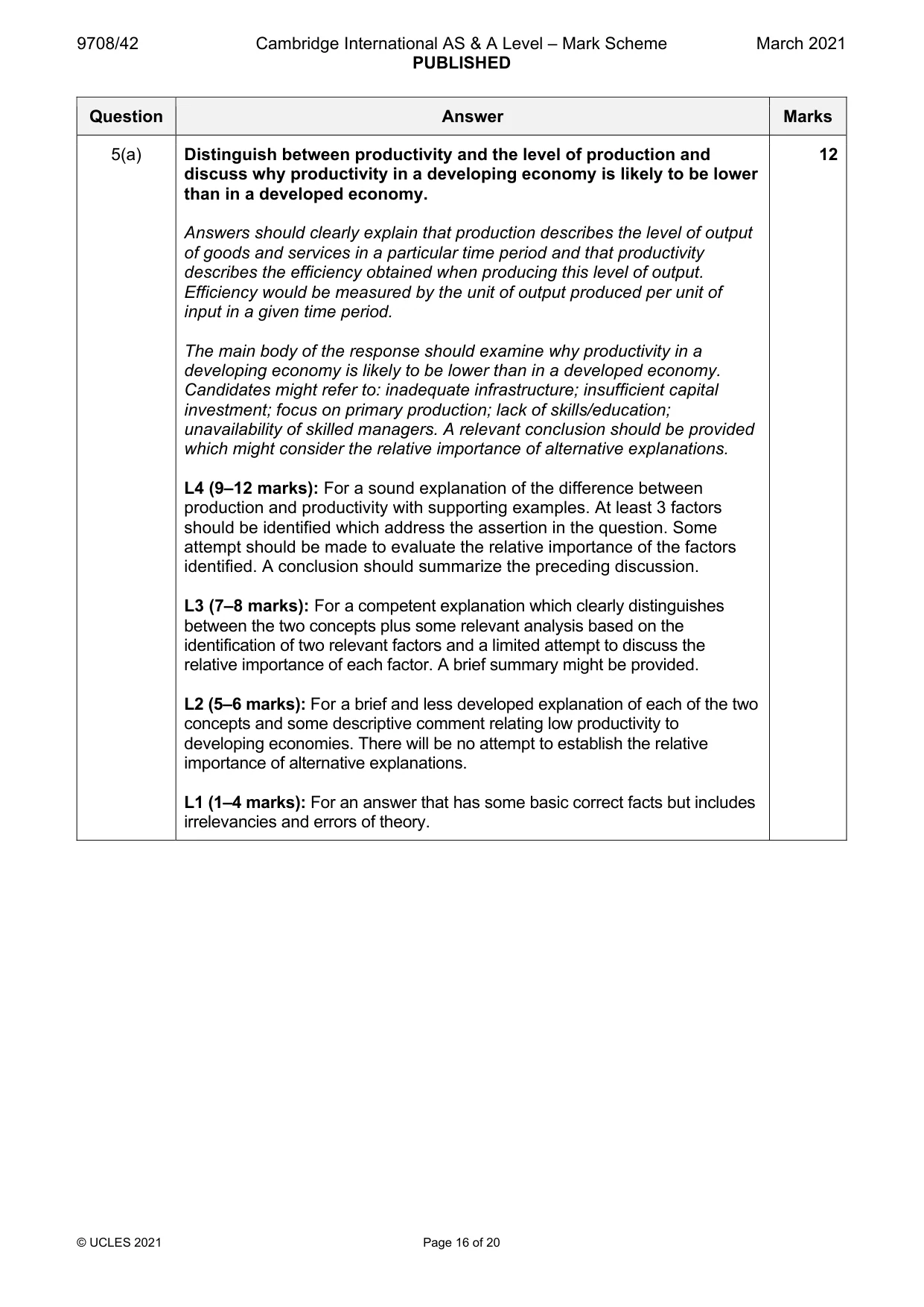
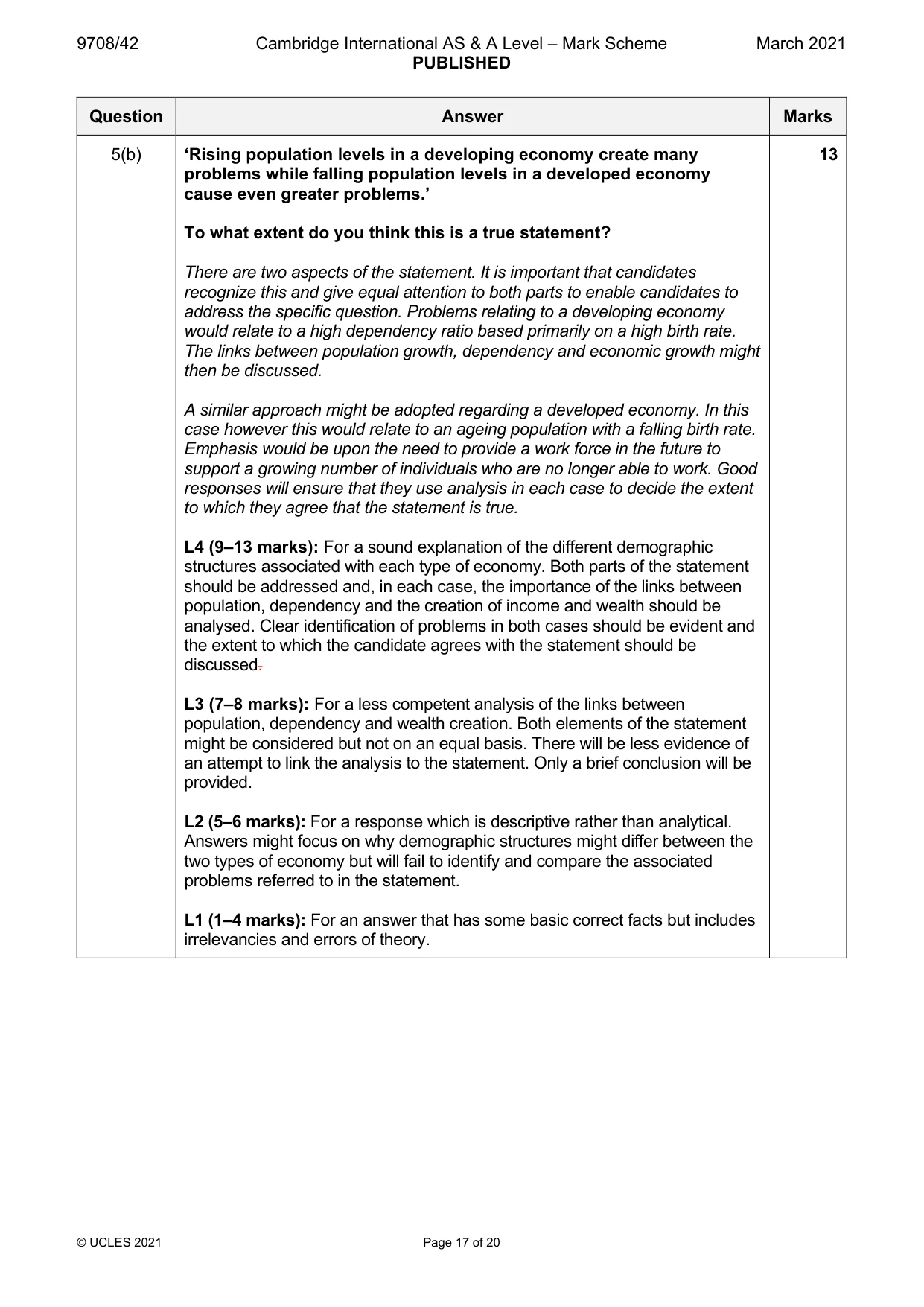
Mark scheme: 5(a) Distinguish between productivity and the level of production and 12 discuss why productivity in a developing economy is likely to be lower than in a developed economy. Answers should clearly explain that production describes the level of output of goods and services in a particular time period and that productivity describes the efficiency obtained when producing this level of output. Efficiency would be measured by the unit of output produced per unit of input in a given time period. The main body of the response should examine why productivity in a developing economy is likely to be lower than in a developed economy. Candidates might refer to: inadequate infrastructure; insufficient capital investment; focus on primary production; lack of skills/education; unavailability of skilled managers. A relevant conclusion should be provided which might consider the relative importance of alternative explanations. L4 (9–12 marks): For a sound explanation of the difference between production and productivity with supporting examples. At least 3 factors should be identified which address the assertion in the question. Some attempt should be made to evaluate the relative importance of the factors identified. A conclusion should summarize the preceding discussion. L3 (7–8 marks): For a competent explanation which clearly distinguishes between the two concepts plus some relevant analysis based on the identification of two relevant factors and a limited attempt to discuss the relative importance of each factor. A brief summary might be provided. L2 (5–6 marks): For a brief and less developed explanation of each of the two concepts and some descriptive comment relating low productivity to developing economies. There will be no attempt to establish the relative importance of alternative explanations. L1 (1–4 marks): For an answer that has some basic correct facts but includes irrelevancies and errors of theory. 5(b) ‘Rising population levels in a developing economy create many 13 problems while falling population levels in a developed economy cause even greater problems.’ To what extent do you think this is a true statement? There are two aspects of the statement. It is important that candidates recognize this and give equal attention to both parts to enable candidates to address the specific question. Problems relating to a developing economy would relate to a high dependency ratio based primarily on a high birth rate. The links between population growth, dependency and economic growth might then be discussed. A similar approach might be adopted regarding a developed economy. In this case however this would relate to an ageing population with a falling birth rate. Emphasis would be upon the need to provide a work force in the future to support a growing number of individuals who are no longer able to work. Good responses will ensure that they use analysis in each case to decide the extent to which they agree that the statement is true. L4 (9–13 marks): For a sound explanation of the different demographic structures associated with each type of economy. Both parts of the statement should be addressed and, in each case, the importance of the links between population, dependency and the creation of income and wealth should be analysed. Clear identification of problems in both cases should be evident and the extent to which the candidate agrees with the statement should be discussed. L3 (7–8 marks): For a less competent analysis of the links between population, dependency and wealth creation. Both elements of the statement might be considered but not on an equal basis. There will be less evidence of an attempt to link the analysis to the statement. Only a brief conclusion will be provided. L2 (5–6 marks): For a response which is descriptive rather than analytical. Answers might focus on why demographic structures might differ between the two types of economy but will fail to identify and compare the associated problems referred to in the statement. L1 (1–4 marks): For an answer that has some basic correct facts but includes irrelevancies and errors of theory.
More questions on Characteristics of countries at different levels of development
Q6 · Explain why an economy might be in equilibrium at less than a full employment level of…
6 Explain why an economy might be in equilibrium at less than a full employment level of output and critically evaluate alternative policy measures which might be used to move the economy to a full employment level of output. [25]
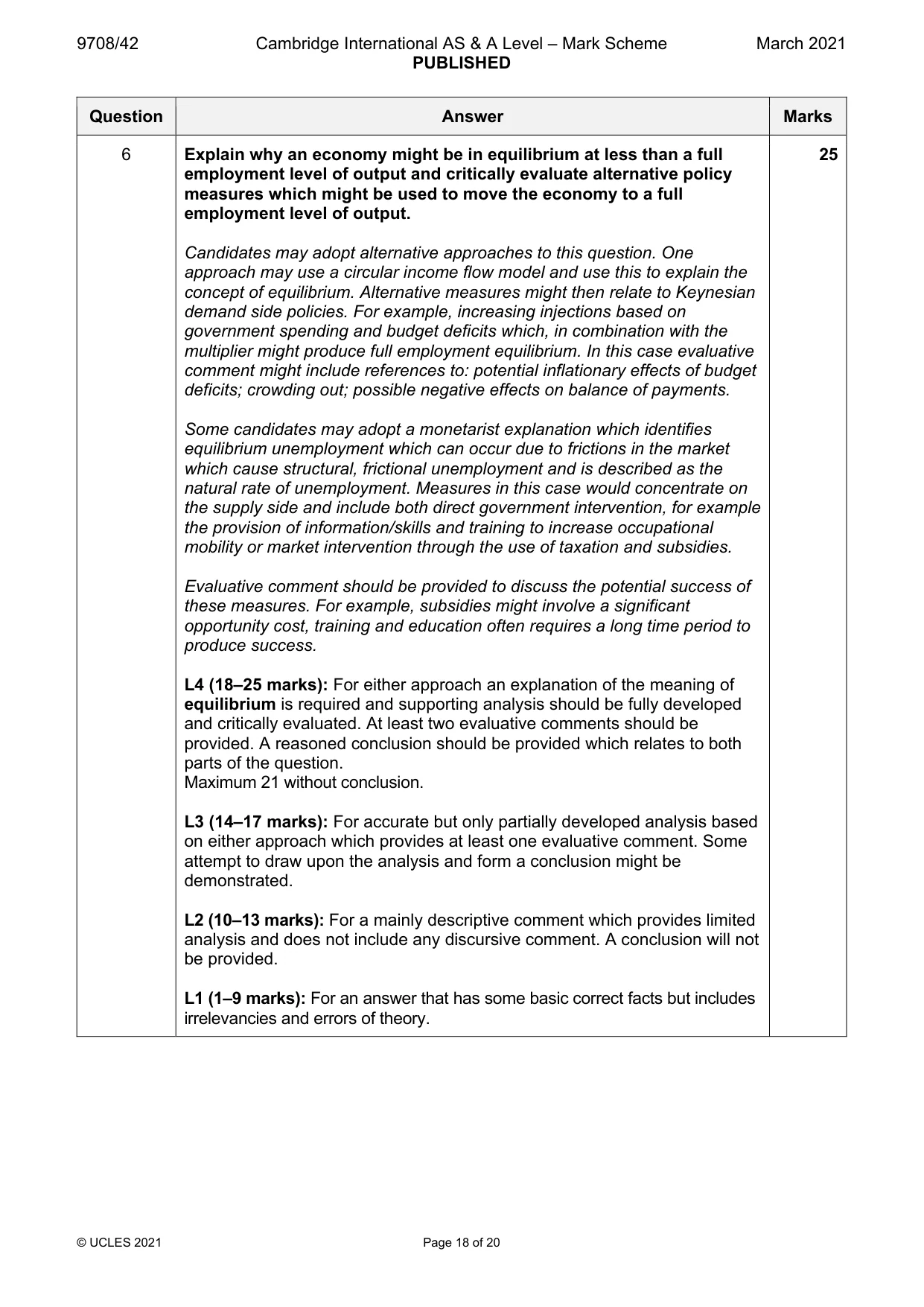
Mark scheme: 6 Explain why an economy might be in equilibrium at less than a full 25 employment level of output and critically evaluate alternative policy measures which might be used to move the economy to a full employment level of output. Candidates may adopt alternative approaches to this question. One approach may use a circular income flow model and use this to explain the concept of equilibrium. Alternative measures might then relate to Keynesian demand side policies. For example, increasing injections based on government spending and budget deficits which, in combination with the multiplier might produce full employment equilibrium. In this case evaluative comment might include references to: potential inflationary effects of budget deficits; crowding out; possible negative effects on balance of payments. Some candidates may adopt a monetarist explanation which identifies equilibrium unemployment which can occur due to frictions in the market which cause structural, frictional unemployment and is described as the natural rate of unemployment. Measures in this case would concentrate on the supply side and include both direct government intervention, for example the provision of information/skills and training to increase occupational mobility or market intervention through the use of taxation and subsidies. Evaluative comment should be provided to discuss the potential success of these measures. For example, subsidies might involve a significant opportunity cost, training and education often requires a long time period to produce success. L4 (18–25 marks): For either approach an explanation of the meaning of equilibrium is required and supporting analysis should be fully developed and critically evaluated. At least two evaluative comments should be provided. A reasoned conclusion should be provided which relates to both parts of the question. Maximum 21 without conclusion. L3 (14–17 marks): For accurate but only partially developed analysis based on either approach which provides at least one evaluative comment. Some attempt to draw upon the analysis and form a conclusion might be demonstrated. L2 (10–13 marks): For a mainly descriptive comment which provides limited analysis and does not include any discursive comment. A conclusion will not be provided. L1 (1–9 marks): For an answer that has some basic correct facts but includes irrelevancies and errors of theory.
More questions on Effectiveness of policy options to meet all macroeconomic objectives
Q7 · ‘Economic growth should be the most important macroeconomic aim.’ Discuss this view
7 (a) ‘Economic growth should be the most important macroeconomic aim.’ Discuss this view. [12] (b) To what extent do you agree that it is not possible to solve a persistent balance of payments deficit without sacrificing other key macroeconomic aims? [13]
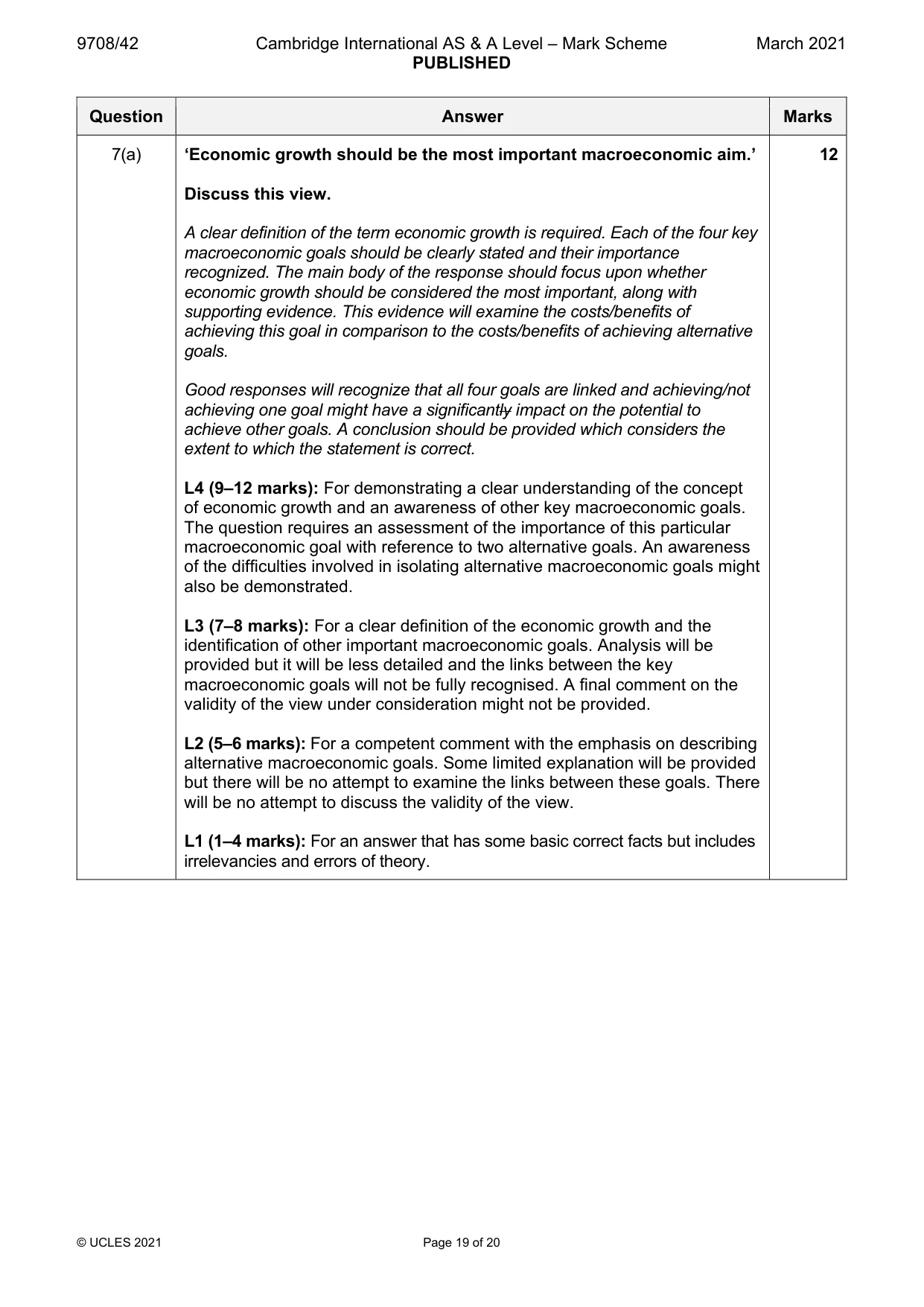
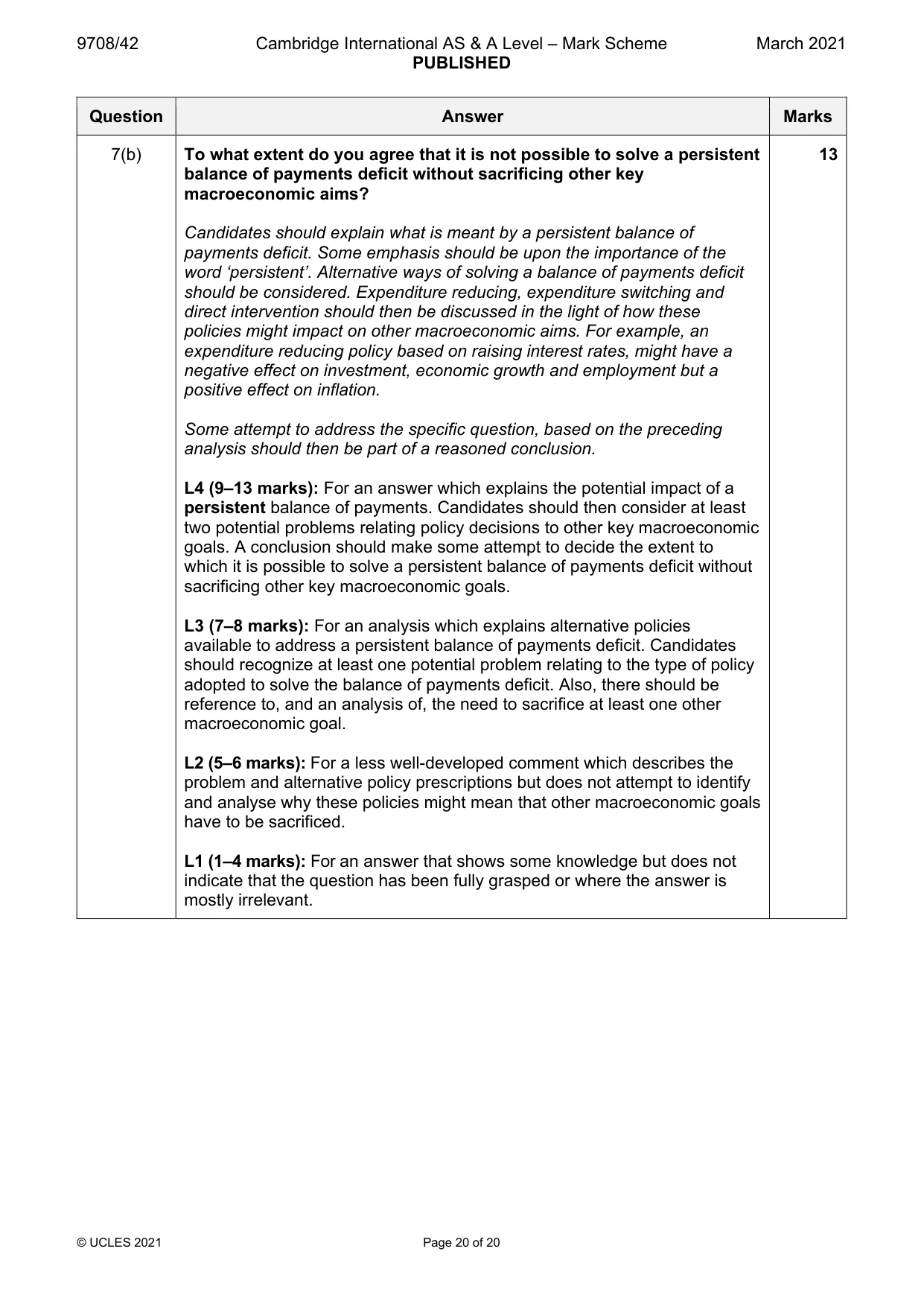
Mark scheme: 7(a) ‘Economic growth should be the most important macroeconomic aim.’ 12 Discuss this view. A clear definition of the term economic growth is required. Each of the four key macroeconomic goals should be clearly stated and their importance recognized. The main body of the response should focus upon whether economic growth should be considered the most important, along with supporting evidence. This evidence will examine the costs/benefits of achieving this goal in comparison to the costs/benefits of achieving alternative goals. Good responses will recognize that all four goals are linked and achieving/not achieving one goal might have a significantly impact on the potential to achieve other goals. A conclusion should be provided which considers the extent to which the statement is correct. L4 (9–12 marks): For demonstrating a clear understanding of the concept of economic growth and an awareness of other key macroeconomic goals. The question requires an assessment of the importance of this particular macroeconomic goal with reference to two alternative goals. An awareness of the difficulties involved in isolating alternative macroeconomic goals might also be demonstrated. L3 (7–8 marks): For a clear definition of the economic growth and the identification of other important macroeconomic goals. Analysis will be provided but it will be less detailed and the links between the key macroeconomic goals will not be fully recognised. A final comment on the validity of the view under consideration might not be provided. L2 (5–6 marks): For a competent comment with the emphasis on describing alternative macroeconomic goals. Some limited explanation will be provided but there will be no attempt to examine the links between these goals. There will be no attempt to discuss the validity of the view. L1 (1–4 marks): For an answer that has some basic correct facts but includes irrelevancies and errors of theory. 7(b) To what extent do you agree that it is not possible to solve a persistent 13 balance of payments deficit without sacrificing other key macroeconomic aims? Candidates should explain what is meant by a persistent balance of payments deficit. Some emphasis should be upon the importance of the word ‘persistent’. Alternative ways of solving a balance of payments deficit should be considered. Expenditure reducing, expenditure switching and direct intervention should then be discussed in the light of how these policies might impact on other macroeconomic aims. For example, an expenditure reducing policy based on raising interest rates, might have a negative effect on investment, economic growth and employment but a positive effect on inflation. Some attempt to address the specific question, based on the preceding analysis should then be part of a reasoned conclusion. L4 (9–13 marks): For an answer which explains the potential impact of a persistent balance of payments. Candidates should then consider at least two potential problems relating policy decisions to other key macroeconomic goals. A conclusion should make some attempt to decide the extent to which it is possible to solve a persistent balance of payments deficit without sacrificing other key macroeconomic goals. L3 (7–8 marks): For an analysis which explains alternative policies available to address a persistent balance of payments deficit. Candidates should recognize at least one potential problem relating to the type of policy adopted to solve the balance of payments deficit. Also, there should be reference to, and an analysis of, the need to sacrifice at least one other macroeconomic goal. L2 (5–6 marks): For a less well-developed comment which describes the problem and alternative policy prescriptions but does not attempt to identify and analyse why these policies might mean that other macroeconomic goals have to be sacrificed. L1 (1–4 marks): For an answer that shows some knowledge but does not indicate that the question has been fully grasped or where the answer is mostly irrelevant.
More questions on Policies to correct disequilibrium in the balance of payments
What was in this paper
The subtopics covered by these 7 questions, and how many questions each got. Open one in a new tab to see every Cambridge question on it.
1Different market structures1Effectiveness of policy options to meet all macroeconomic objectives1Growth and survival of firms1Labour market forces and government intervention1Policies to correct disequilibrium in the balance of payments1Private costs and benefits, externalities and social costs and benefits1What you needed in this session
Cambridge’s own grade thresholds for 2021 Feb/March, Paper 4 · Variant 2. A higher threshold means an easier paper — the bar moves with how the cohort did.