Cambridge A Level Economics 9708 — 2019 Feb/March Paper 2 · Variant 2
9708/22/F/M/19 · 4 questions · 40 marks · ≈45 min
The question paper and its mark scheme, free to read here and free to download. This is Cambridge’s own paper, exactly as it was sat.
Question paper4 pages
Mark scheme9 pages
Answers below. Sit the paper first if you are practising.
Questions as text
Q1 · Poland: a growing economy Extract 1: Poland’s successful transition from a planned…
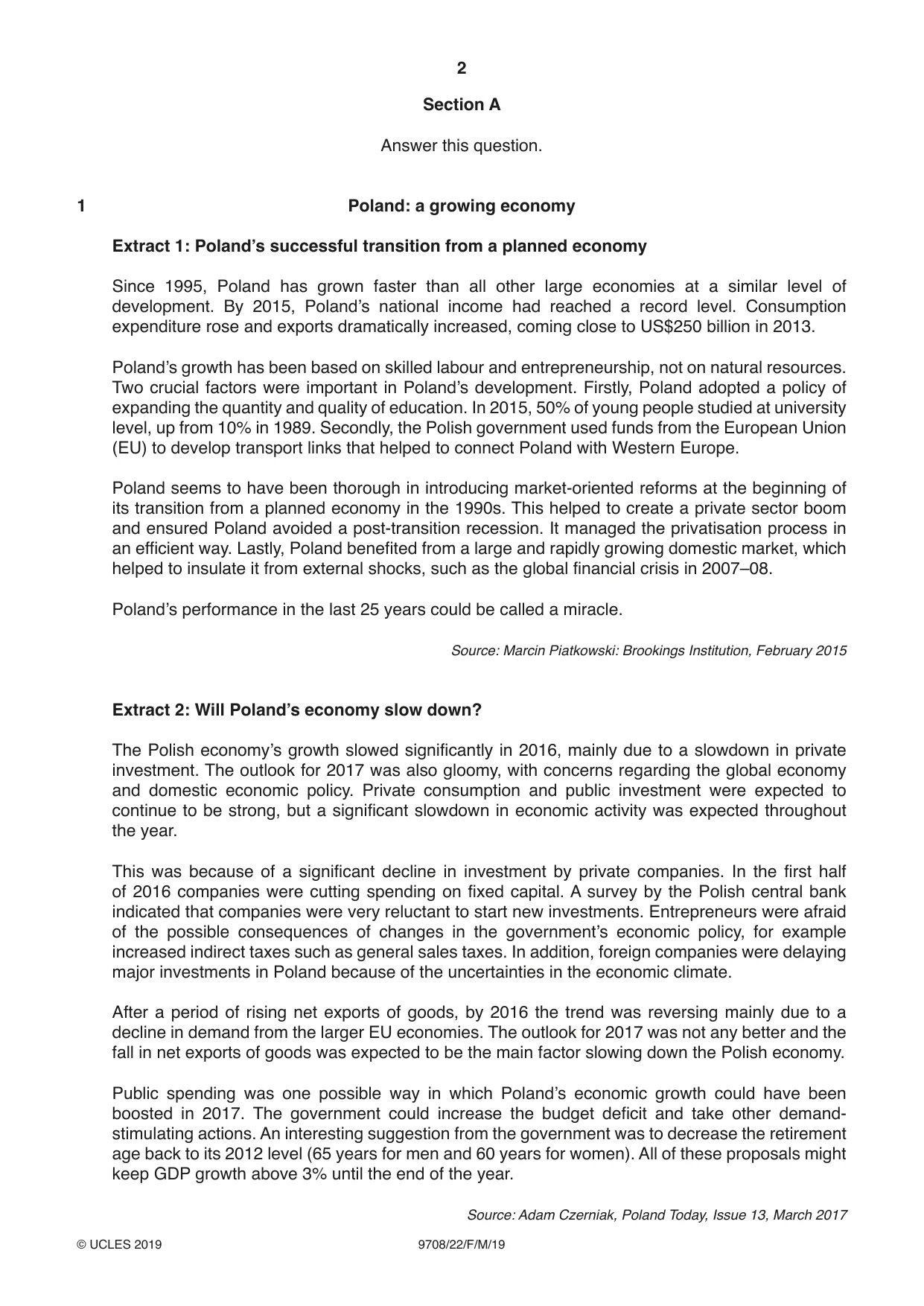
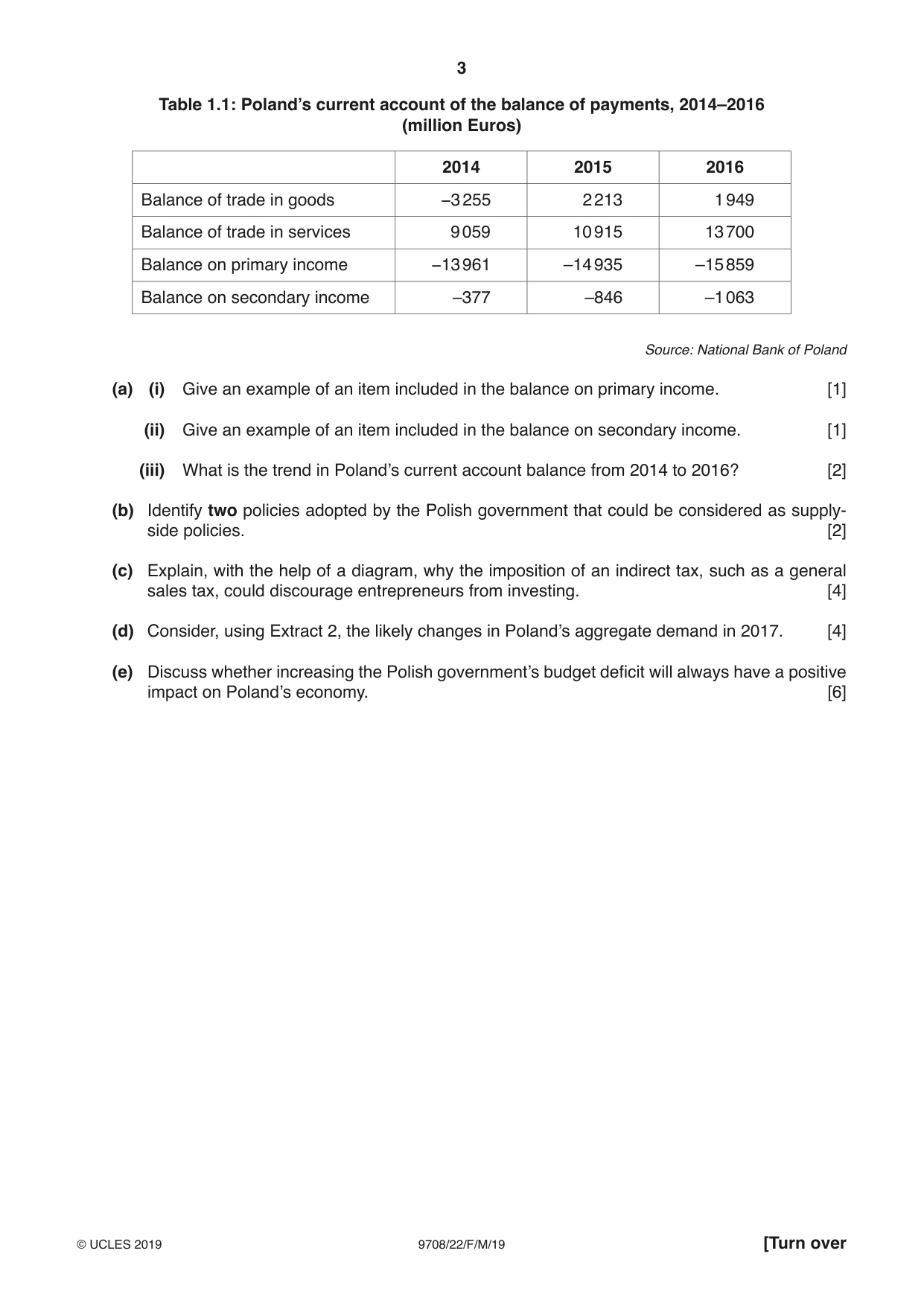
1 Poland: a growing economy Extract 1: Poland’s successful transition from a planned economy Since 1995, Poland has grown faster than all other large economies at a similar level of development. By 2015, Poland’s national income had reached a record level. Consumption expenditure rose and exports dramatically increased, coming close to US$250 billion in 2013. Poland’s growth has been based on skilled labour and entrepreneurship, not on natural resources. Two crucial factors were important in Poland’s development. Firstly, Poland adopted a policy of expanding the quantity and quality of education. In 2015, 50% of young people studied at university level, up from 10% in 1989. Secondly, the Polish government used funds from the European Union (EU) to develop transport links that helped to connect Poland with Western Europe. Poland seems to have been thorough in introducing market-oriented reforms at the beginning of its transition from a planned economy in the 1990s. This helped to create a private sector boom and ensured Poland avoided a post-transition recession. It managed the privatisation process in an efficient way. Lastly, Poland benefited from a large and rapidly growing domestic market, which helped to insulate it from external shocks, such as the global financial crisis in 2007–08. Poland’s performance in the last 25 years could be called a miracle. Source: Marcin Piatkowski: Brookings Institution, February 2015 Extract 2: Will Poland’s economy slow down? The Polish economy’s growth slowed significantly in 2016, mainly due to a slowdown in private investment. The outlook for 2017 was also gloomy, with concerns regarding the global economy and domestic economic policy. Private consumption and public investment were expected to continue to be strong, but a significant slowdown in economic activity was expected throughout the year. This was because of a significant decline in investment by private companies. In the first half of 2016 companies were cutting spending on fixed capital. A survey by the Polish central bank indicated that companies were very reluctant to start new investments. Entrepreneurs were afraid of the possible consequences of changes in the government’s economic policy, for example increased indirect taxes such as general sales taxes. In addition, foreign companies were delaying major investments in Poland because of the uncertainties in the economic climate. After a period of rising net exports of goods, by 2016 the trend was reversing mainly due to a decline in demand from the larger EU economies. The outlook for 2017 was not any better and the fall in net exports of goods was expected to be the main factor slowing down the Polish economy. Public spending was one possible way in which Poland’s economic growth could have been boosted in 2017. The government could increase the budget deficit and take other demand- stimulating actions. An interesting suggestion from the government was to decrease the retirement age back to its 2012 level (65 years for men and 60 years for women). All of these proposals might keep GDP growth above 3% until the end of the year. Source: Adam Czerniak, Poland Today, Issue 13, March 2017 Table 1.1: Poland’s current account of the balance of payments, 2014–2016 (million Euros) 2014 2015 2016 Balance of trade in goods −3 255 2 213 1 949 Balance of trade in services 9 059 10 915 13 700 Balance on primary income −13 961 –14 935 –15 859 Balance on secondary income –377 –846 –1 063 Source: National Bank of Poland (a) (i) Give an example of an item included in the balance on primary income. [1] (ii) Give an example of an item included in the balance on secondary income. [1] (iii) What is the trend in Poland’s current account balance from 2014 to 2016? [2] (b) Identify two policies adopted by the Polish government that could be considered as supply- side policies. [2] (c) Explain, with the help of a diagram, why the imposition of an indirect tax, such as a general sales tax, could discourage entrepreneurs from investing. [4] (d) Consider, using Extract 2, the likely changes in Poland’s aggregate demand in 2017. [4] (e) Discuss whether increasing the Polish government’s budget deficit will always have a positive impact on Poland’s economy. [6]
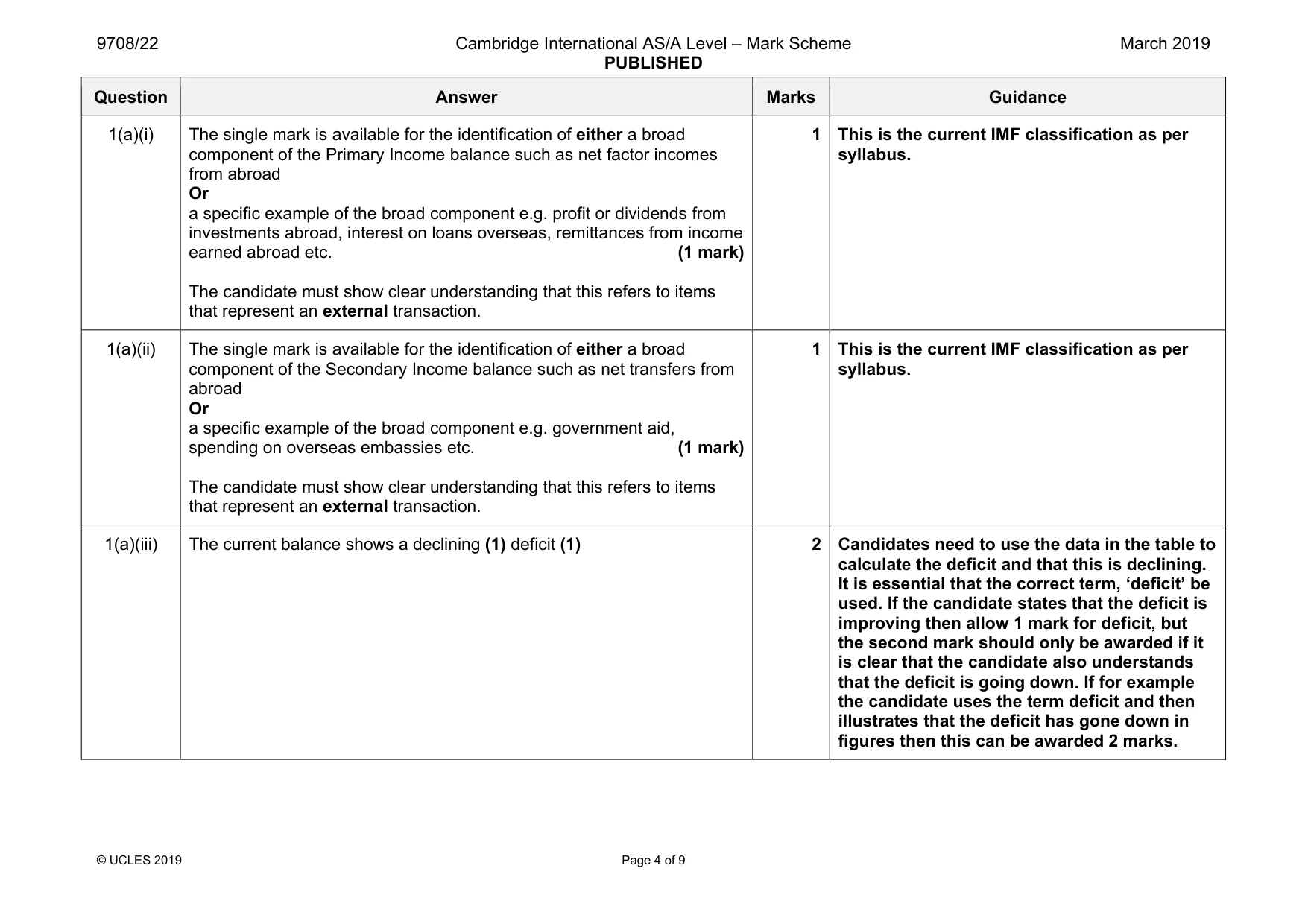
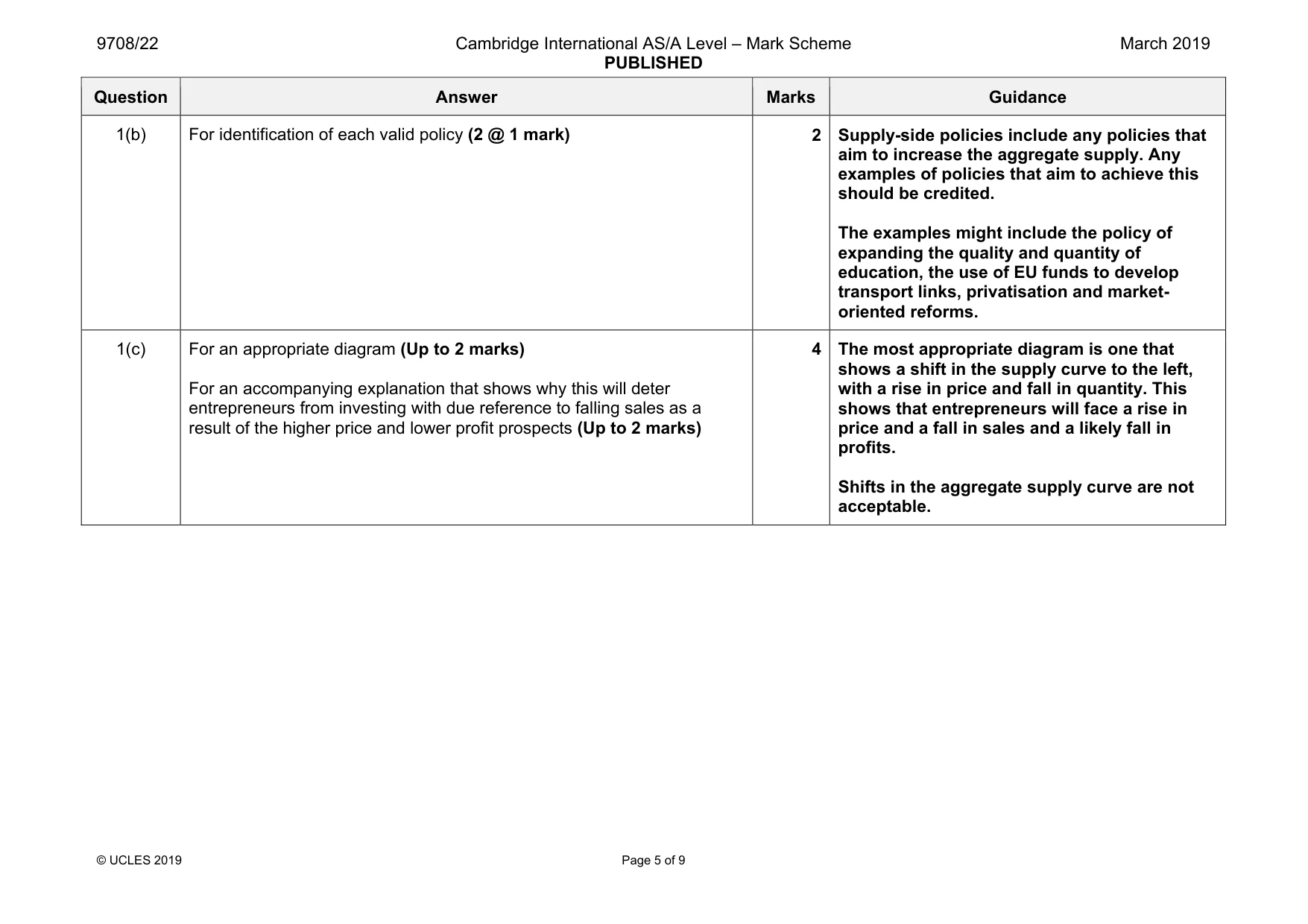
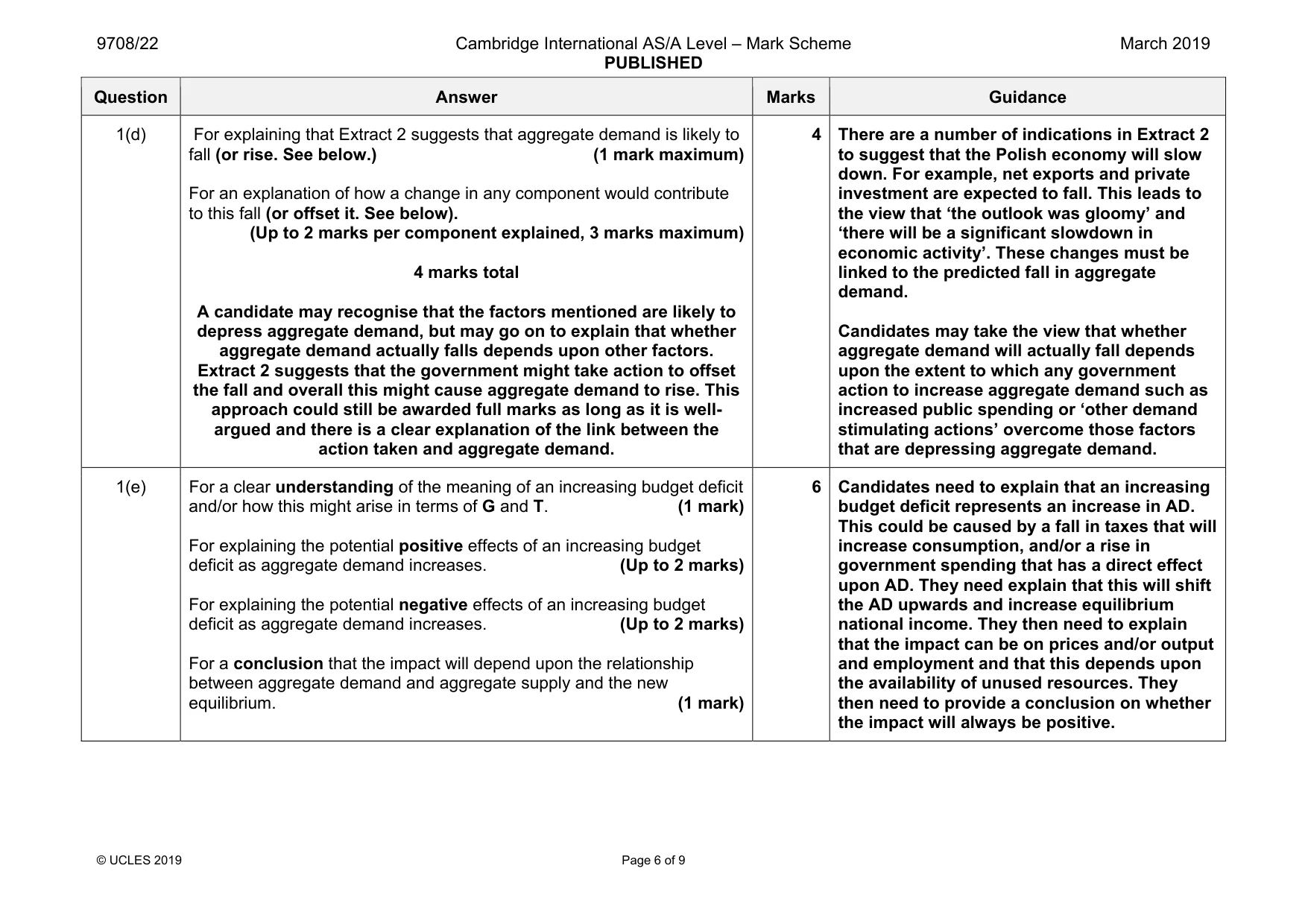
Mark scheme: 1(a)(i) The single mark is available for the identification of either a broad component of the Primary Income balance such as net factor incomes from abroad Or a specific example of the broad component e.g. profit or dividends from investments abroad, interest on loans overseas, remittances from income earned abroad etc. (1 mark) The candidate must show clear understanding that this refers to items that represent an external transaction. 1 This is the current IMF classification as per syllabus. 1(a)(ii) The single mark is available for the identification of either a broad component of the Secondary Income balance such as net transfers from abroad Or a specific example of the broad component e.g. government aid, spending on overseas embassies etc. (1 mark) The candidate must show clear understanding that this refers to items that represent an external transaction. 1 This is the current IMF classification as per syllabus. 1(a)(iii) The current balance shows a declining (1) deficit (1) 2 Candidates need to use the data in the table to calculate the deficit and that this is declining. It is essential that the correct term, ‘deficit’ be used. If the candidate states that the deficit is improving then allow 1 mark for deficit, but the second mark should only be awarded if it is clear that the candidate also understands that the deficit is going down. If for example the candidate uses the term deficit and then illustrates that the deficit has gone down in figures then this can be awarded 2 marks. Question Answer Marks Guidance 1(b) For identification of each valid policy (2 @ 1 mark) 2 Supply-side policies include any policies that aim to increase the aggregate supply. Any examples of policies that aim to achieve this should be credited. The examples might include the policy of expanding the quality and quantity of education, the use of EU funds to develop transport links, privatisation and market- oriented reforms. 1(c) For an appropriate diagram (Up to 2 marks) For an accompanying explanation that shows why this will deter entrepreneurs from investing with due reference to falling sales as a result of the higher price and lower profit prospects (Up to 2 marks) 4 The most appropriate diagram is one that shows a shift in the supply curve to the left, with a rise in price and fall in quantity. This shows that entrepreneurs will face a rise in price and a fall in sales and a likely fall in profits. Shifts in the aggregate supply curve are not acceptable. Question Answer Marks Guidance 1(d) For explaining that Extract 2 suggests that aggregate demand is likely to fall (or rise. See below.) (1 mark maximum) For an explanation of how a change in any component would contribute to this fall (or offset it. See below). (Up to 2 marks per component explained, 3 marks maximum) 4 marks total A candidate may recognise that the factors mentioned are likely to depress aggregate demand, but may go on to explain that whether aggregate demand actually falls depends upon other factors. Extract 2 suggests that the government might take action to offset the fall and overall this might cause aggregate demand to rise. This approach could still be awarded full marks as long as it is well- argued and there is a clear explanation of the link between the action taken and aggregate demand. 4 There are a number of indications in Extract 2 to suggest that the Polish economy will slow down. For example, net exports and private investment are expected to fall. This leads to the view that ‘the outlook was gloomy’ and ‘there will be a significant slowdown in economic activity’. These changes must be linked to the predicted fall in aggregate demand. Candidates may take the view that whether aggregate demand will actually fall depends upon the extent to which any government action to increase aggregate demand such as increased public spending or ‘other demand stimulating actions’ overcome those factors that are depressing aggregate demand. 1(e) For a clear understanding of the meaning of an increasing budget deficit and/or how this might arise in terms of G and T. (1 mark) For explaining the potential positive effects of an increasing budget deficit as aggregate demand increases. (Up to 2 marks) For explaining the potential negative effects of an increasing budget deficit as aggregate demand increases. (Up to 2 marks) For a conclusion that the impact will depend upon the relationship between aggregate demand and aggregate supply and the new equilibrium. (1 mark) 6 Candidates need to explain that an increasing budget deficit represents an increase in AD. This could be caused by a fall in taxes that will increase consumption, and/or a rise in government spending that has a direct effect upon AD. They need explain that this will shift the AD upwards and increase equilibrium national income. They then need to explain that the impact can be on prices and/or output and employment and that this depends upon the availability of unused resources. They then need to provide a conclusion on whether the impact will always be positive.
More questions on Current account of the balance of payments
Q2 · Show how a production possibility curve can be used to explain scarcity, choice and…
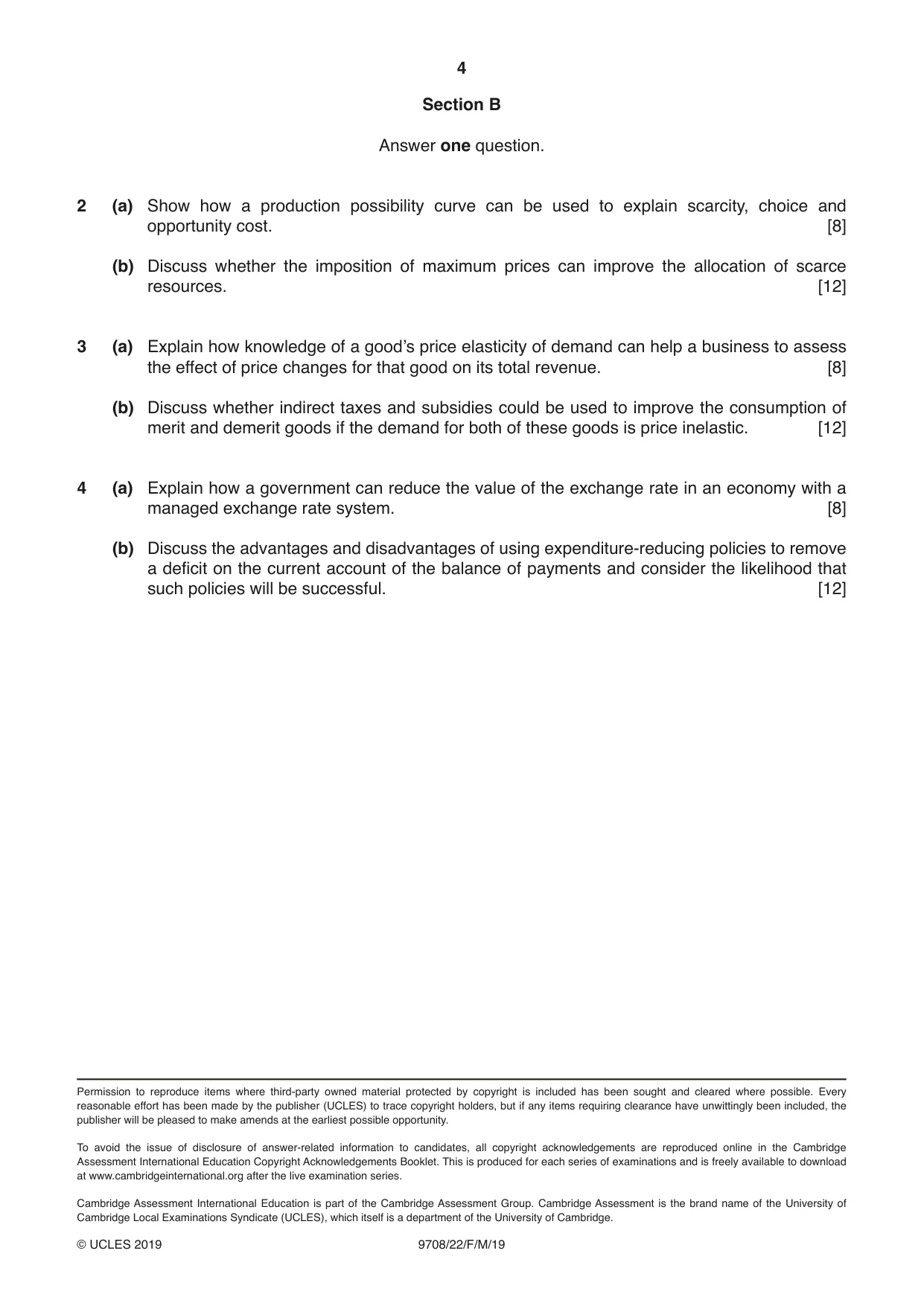
2 (a) Show how a production possibility curve can be used to explain scarcity, choice and opportunity cost. [8] (b) Discuss whether the imposition of maximum prices can improve the allocation of scarce resources. [12]
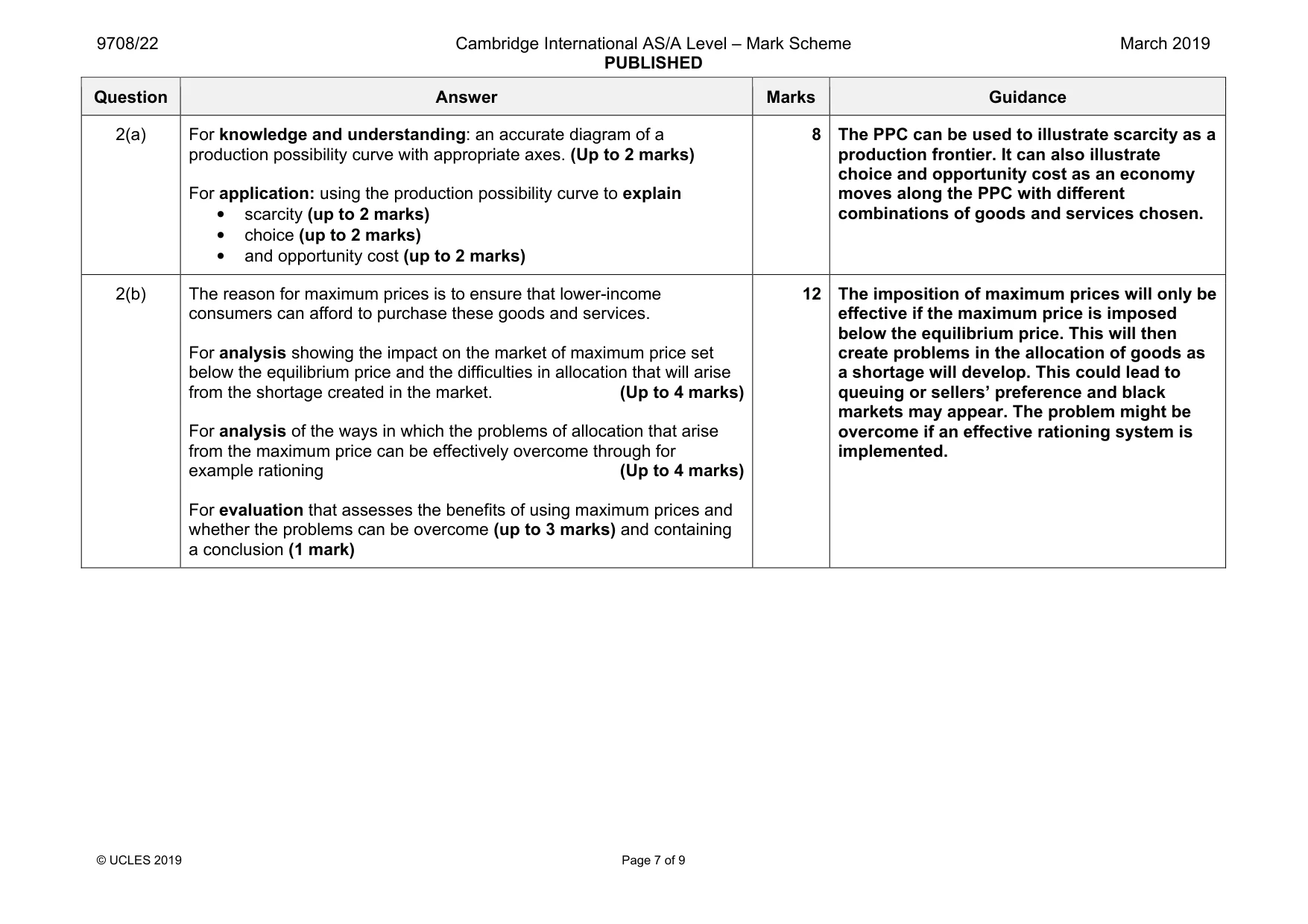
Mark scheme: 2(a) For knowledge and understanding: an accurate diagram of a production possibility curve with appropriate axes. (Up to 2 marks) For application: using the production possibility curve to explain • scarcity (up to 2 marks) • choice (up to 2 marks) • and opportunity cost (up to 2 marks) 8 The PPC can be used to illustrate scarcity as a production frontier. It can also illustrate choice and opportunity cost as an economy moves along the PPC with different combinations of goods and services chosen. 2(b) The reason for maximum prices is to ensure that lower-income consumers can afford to purchase these goods and services. For analysis showing the impact on the market of maximum price set below the equilibrium price and the difficulties in allocation that will arise from the shortage created in the market. (Up to 4 marks) For analysis of the ways in which the problems of allocation that arise from the maximum price can be effectively overcome through for example rationing (Up to 4 marks) For evaluation that assesses the benefits of using maximum prices and whether the problems can be overcome (up to 3 marks) and containing a conclusion (1 mark) 12 The imposition of maximum prices will only be effective if the maximum price is imposed below the equilibrium price. This will then create problems in the allocation of goods as a shortage will develop. This could lead to queuing or sellers’ preference and black markets may appear. The problem might be overcome if an effective rationing system is implemented.
More questions on Methods and effects of government intervention in markets
Q3 · Explain how knowledge of a good’s price elasticity of demand can help a business to…
3 (a) Explain how knowledge of a good’s price elasticity of demand can help a business to assess the effect of price changes for that good on its total revenue. [8] (b) Discuss whether indirect taxes and subsidies could be used to improve the consumption of merit and demerit goods if the demand for both of these goods is price inelastic. [12]
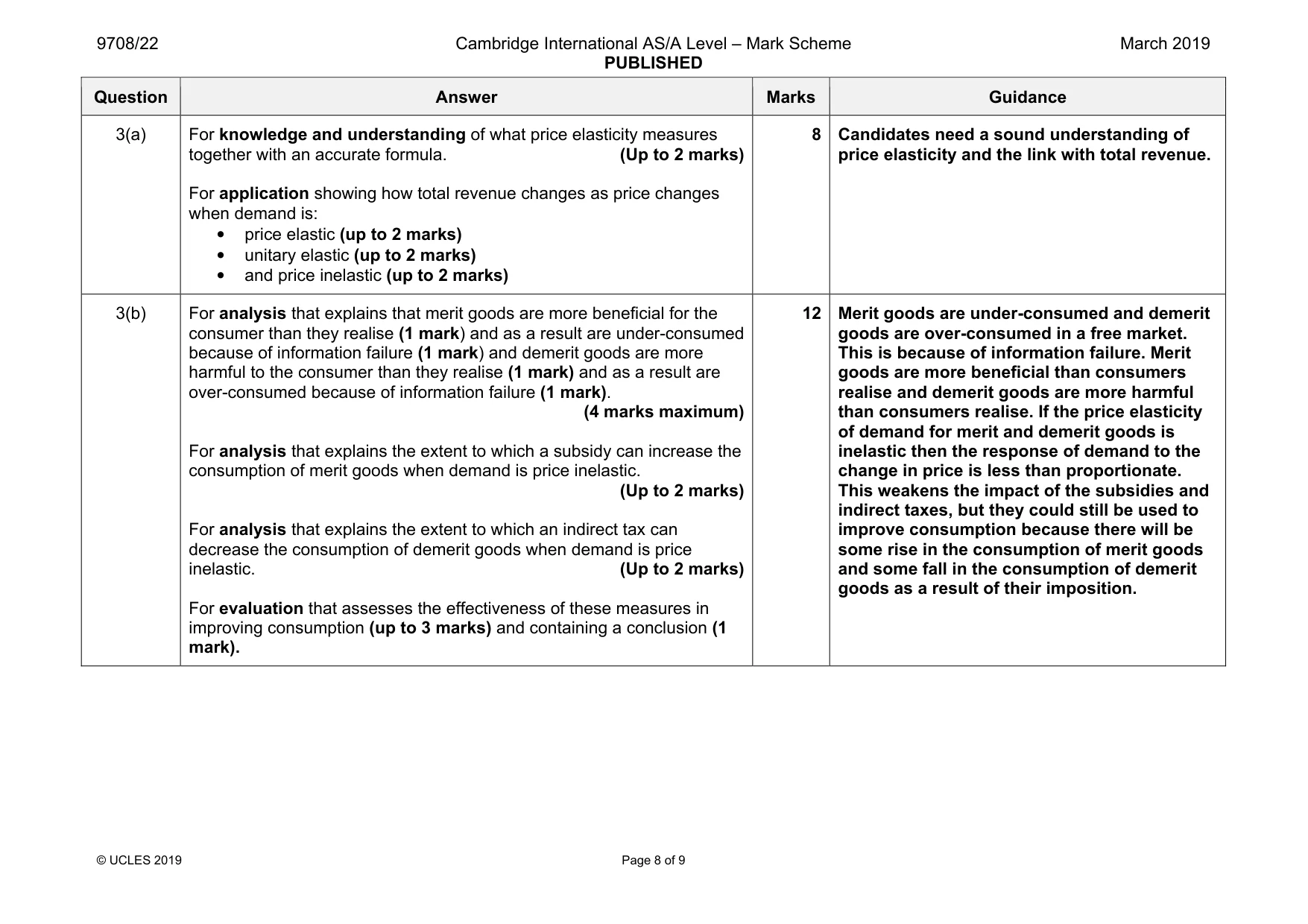
Mark scheme: 3(a) For knowledge and understanding of what price elasticity measures together with an accurate formula. (Up to 2 marks) For application showing how total revenue changes as price changes when demand is: • price elastic (up to 2 marks) • unitary elastic (up to 2 marks) • and price inelastic (up to 2 marks) 8 Candidates need a sound understanding of price elasticity and the link with total revenue. 3(b) For analysis that explains that merit goods are more beneficial for the consumer than they realise (1 mark) and as a result are under-consumed because of information failure (1 mark) and demerit goods are more harmful to the consumer than they realise (1 mark) and as a result are over-consumed because of information failure (1 mark). (4 marks maximum) For analysis that explains the extent to which a subsidy can increase the consumption of merit goods when demand is price inelastic. (Up to 2 marks) For analysis that explains the extent to which an indirect tax can decrease the consumption of demerit goods when demand is price inelastic. (Up to 2 marks) For evaluation that assesses the effectiveness of these measures in improving consumption (up to 3 marks) and containing a conclusion (1 mark). 12 Merit goods are under-consumed and demerit goods are over-consumed in a free market. This is because of information failure. Merit goods are more beneficial than consumers realise and demerit goods are more harmful than consumers realise. If the price elasticity of demand for merit and demerit goods is inelastic then the response of demand to the change in price is less than proportionate. This weakens the impact of the subsidies and indirect taxes, but they could still be used to improve consumption because there will be some rise in the consumption of merit goods and some fall in the consumption of demerit goods as a result of their imposition.
More questions on Methods and effects of government intervention in markets
Q4 · Explain how a government can reduce the value of the exchange rate in an economy with a…
4 (a) Explain how a government can reduce the value of the exchange rate in an economy with a managed exchange rate system. [8] (b) Discuss the advantages and disadvantages of using expenditure-reducing policies to remove a deficit on the current account of the balance of payments and consider the likelihood that such policies will be successful. [12]
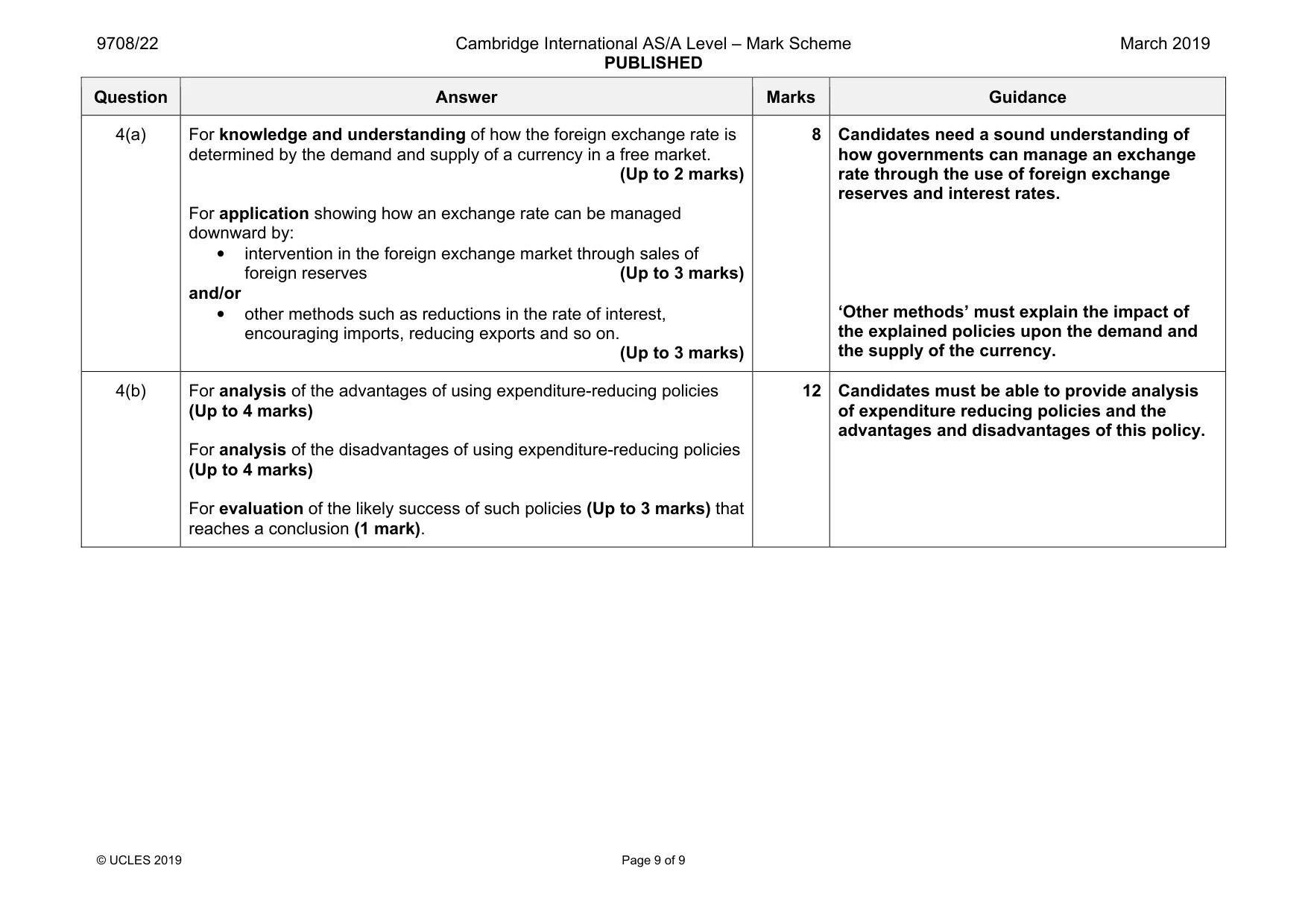
Mark scheme: 4(a) For knowledge and understanding of how the foreign exchange rate is determined by the demand and supply of a currency in a free market. (Up to 2 marks) For application showing how an exchange rate can be managed downward by: • intervention in the foreign exchange market through sales of foreign reserves (Up to 3 marks) and/or • other methods such as reductions in the rate of interest, encouraging imports, reducing exports and so on. (Up to 3 marks) 8 Candidates need a sound understanding of how governments can manage an exchange rate through the use of foreign exchange reserves and interest rates. ‘Other methods’ must explain the impact of the explained policies upon the demand and the supply of the currency. 4(b) For analysis of the advantages of using expenditure-reducing policies (Up to 4 marks) For analysis of the disadvantages of using expenditure-reducing policies (Up to 4 marks) For evaluation of the likely success of such policies (Up to 3 marks) that reaches a conclusion (1 mark). 12 Candidates must be able to provide analysis of expenditure reducing policies and the advantages and disadvantages of this policy.
More questions on Policies to correct imbalances in the current account of the balance of payments
What was in this paper
The subtopics covered by these 4 questions, and how many questions each got. Open one in a new tab to see every Cambridge question on it.
What you needed in this session
Cambridge’s own grade thresholds for 2019 Feb/March, Paper 2 · Variant 2. A higher threshold means an easier paper — the bar moves with how the cohort did.