Cambridge A Level Economics 9708 — 2018 Feb/March Paper 4 · Variant 2
9708/42/F/M/18 · 7 questions · 70 marks · ≈79 min
The question paper and its mark scheme, free to read here and free to download. This is Cambridge’s own paper, exactly as it was sat.
Question paper4 pages

Mark scheme13 pages
Answers below. Sit the paper first if you are practising.



Questions as text
Q1 · Problems in the steel industry By 2016, China’s steel industry had expanded rapidly and…
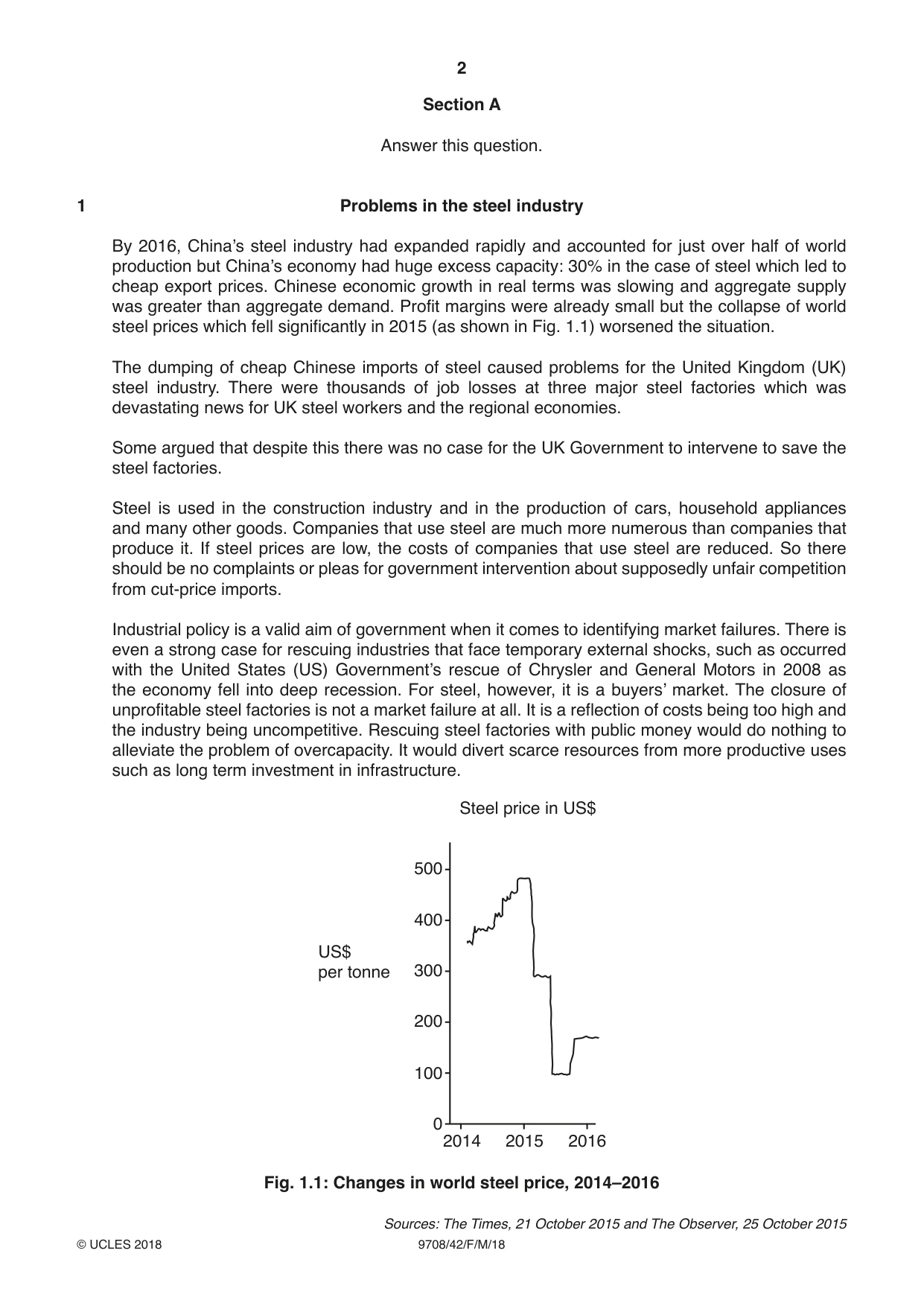
1 Problems in the steel industry By 2016, China’s steel industry had expanded rapidly and accounted for just over half of world production but China’s economy had huge excess capacity: 30% in the case of steel which led to cheap export prices. Chinese economic growth in real terms was slowing and aggregate supply was greater than aggregate demand. Profit margins were already small but the collapse of world steel prices which fell significantly in 2015 (as shown in Fig. 1.1) worsened the situation. The dumping of cheap Chinese imports of steel caused problems for the United Kingdom (UK) steel industry. There were thousands of job losses at three major steel factories which was devastating news for UK steel workers and the regional economies. Some argued that despite this there was no case for the UK Government to intervene to save the steel factories. Steel is used in the construction industry and in the production of cars, household appliances and many other goods. Companies that use steel are much more numerous than companies that produce it. If steel prices are low, the costs of companies that use steel are reduced. So there should be no complaints or pleas for government intervention about supposedly unfair competition from cut-price imports. Industrial policy is a valid aim of government when it comes to identifying market failures. There is even a strong case for rescuing industries that face temporary external shocks, such as occurred with the United States (US) Government’s rescue of Chrysler and General Motors in 2008 as the economy fell into deep recession. For steel, however, it is a buyers’ market. The closure of unprofitable steel factories is not a market failure at all. It is a reflection of costs being too high and the industry being uncompetitive. Rescuing steel factories with public money would do nothing to alleviate the problem of overcapacity. It would divert scarce resources from more productive uses such as long term investment in infrastructure. Steel price in US$ 500 400 US$ per tonne 300 200 100 0 2014 2015 2016 Fig. 1.1: Changes in world steel price, 2014–2016 Sources: The Times, 21 October 2015 and The Observer, 25 October 2015 (a) What is meant by economic growth per capita in real terms? [4] (b) Explain the difference between a firm’s variable costs and fixed costs. Consider which would be changed as a result of the changes in steel prices in 2015. [4] (c) Why is the market for steel described in the article as “a buyers’ market”? [4] (d) Explain what is meant by market failure. Discuss whether there is any evidence in the information that the government should support the steel industry because there is market failure. [8]
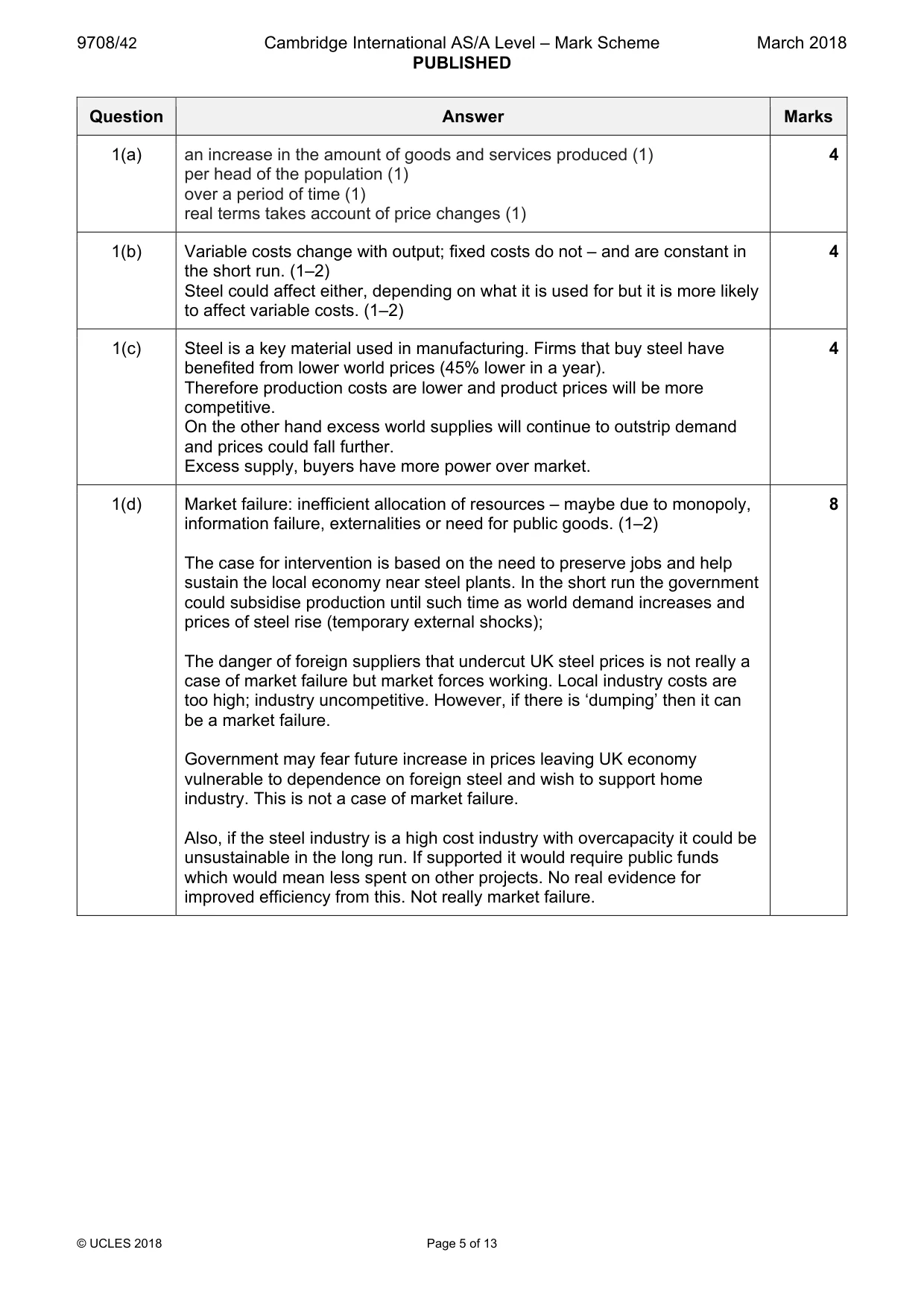
Mark scheme: Question Answer Marks 1(a) an increase in the amount of goods and services produced (1) 4 per head of the population (1) over a period of time (1) real terms takes account of price changes (1) 1(b) Variable costs change with output; fixed costs do not – and are constant in 4 the short run. (1–2) Steel could affect either, depending on what it is used for but it is more likely to affect variable costs. (1–2) 1(c) Steel is a key material used in manufacturing. Firms that buy steel have 4 benefited from lower world prices (45% lower in a year). Therefore production costs are lower and product prices will be more competitive. On the other hand excess world supplies will continue to outstrip demand and prices could fall further. Excess supply, buyers have more power over market. 1(d) Market failure: inefficient allocation of resources – maybe due to monopoly, 8 information failure, externalities or need for public goods. (1–2) The case for intervention is based on the need to preserve jobs and help sustain the local economy near steel plants. In the short run the government could subsidise production until such time as world demand increases and prices of steel rise (temporary external shocks); The danger of foreign suppliers that undercut UK steel prices is not really a case of market failure but market forces working. Local industry costs are too high; industry uncompetitive. However, if there is ‘dumping’ then it can be a market failure. Government may fear future increase in prices leaving UK economy vulnerable to dependence on foreign steel and wish to support home industry. This is not a case of market failure. Also, if the steel industry is a high cost industry with overcapacity it could be unsustainable in the long run. If supported it would require public funds which would mean less spent on other projects. No real evidence for improved efficiency from this. Not really market failure.
Q2 · The UK Government has established a behavioural insight team known as the ‘nudge unit,’…
2 The UK Government has established a behavioural insight team known as the ‘nudge unit,’ which attempts to change consumer behaviour by persuasion. Explain how indifference curve theory predicts a consumer will react to changes in income and changes in the price of a product in order to maximise satisfaction. Consider whether the use of ‘nudge’ theory (persuasion) conflicts with this theory of maximising satisfaction. [25]
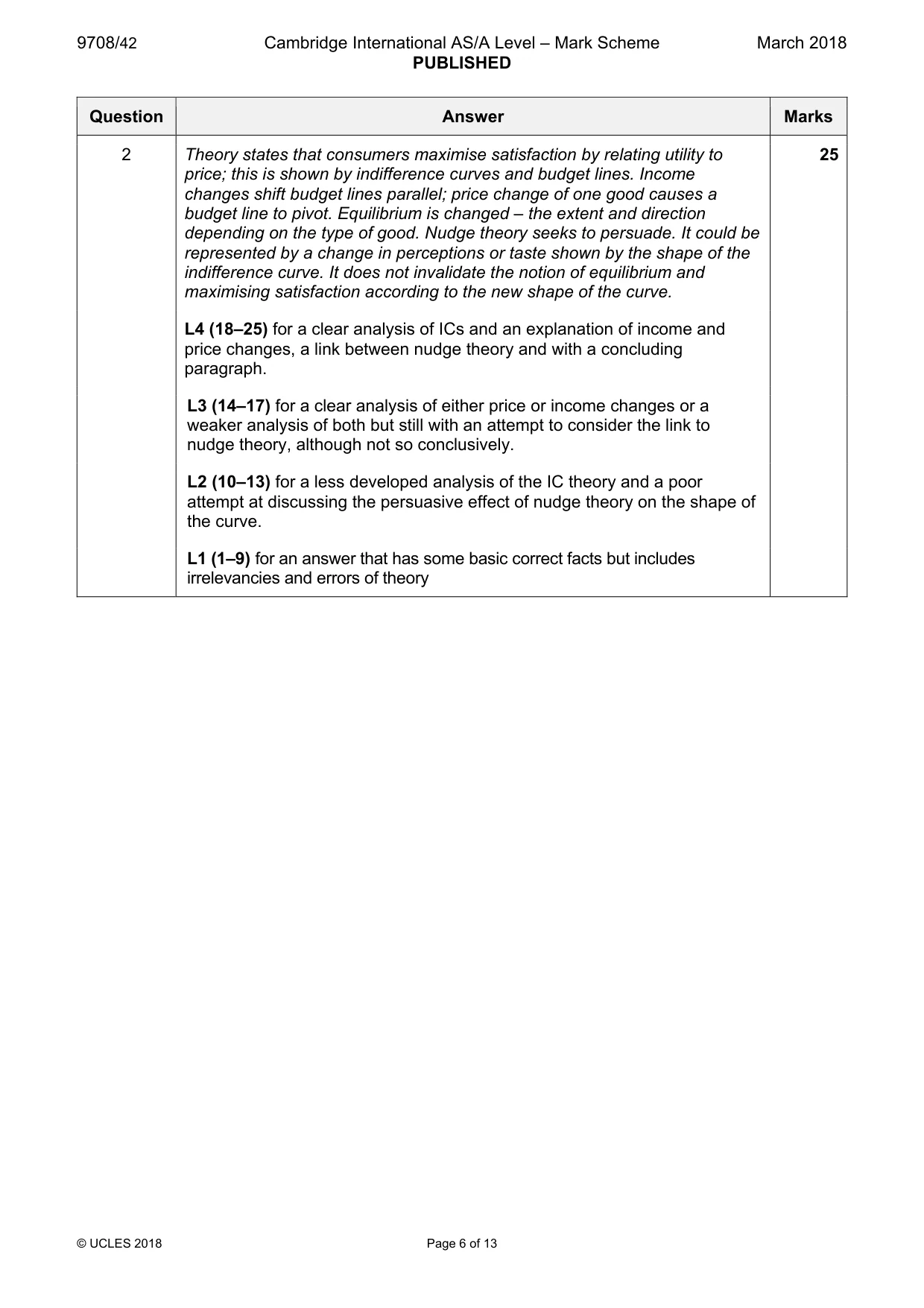
Mark scheme: 2 Theory states that consumers maximise satisfaction by relating utility to 25 price; this is shown by indifference curves and budget lines. Income changes shift budget lines parallel; price change of one good causes a budget line to pivot. Equilibrium is changed – the extent and direction depending on the type of good. Nudge theory seeks to persuade. It could be represented by a change in perceptions or taste shown by the shape of the indifference curve. It does not invalidate the notion of equilibrium and maximising satisfaction according to the new shape of the curve. L4 (18–25) for a clear analysis of ICs and an explanation of income and price changes, a link between nudge theory and with a concluding paragraph. L3 (14–17) for a clear analysis of either price or income changes or a weaker analysis of both but still with an attempt to consider the link to nudge theory, although not so conclusively. L2 (10–13) for a less developed analysis of the IC theory and a poor attempt at discussing the persuasive effect of nudge theory on the shape of the curve. L1 (1–9) for an answer that has some basic correct facts but includes irrelevancies and errors of theory
Q3 · Explain what is meant by equity, allocative efficiency and Pareto optimality
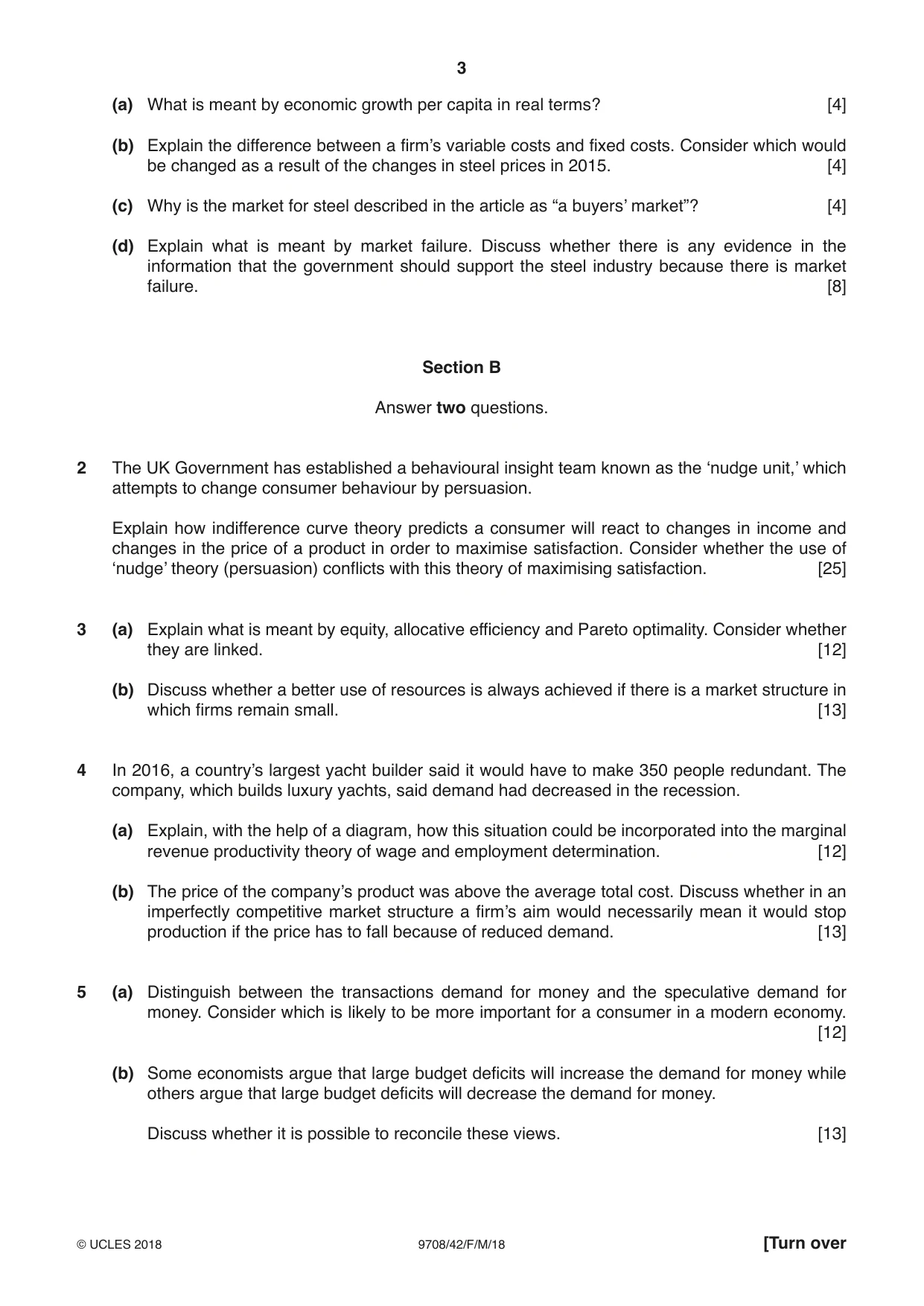
3 (a) Explain what is meant by equity, allocative efficiency and Pareto optimality. Consider whether they are linked. [12] (b) Discuss whether a better use of resources is always achieved if there is a market structure in which firms remain small. [13]
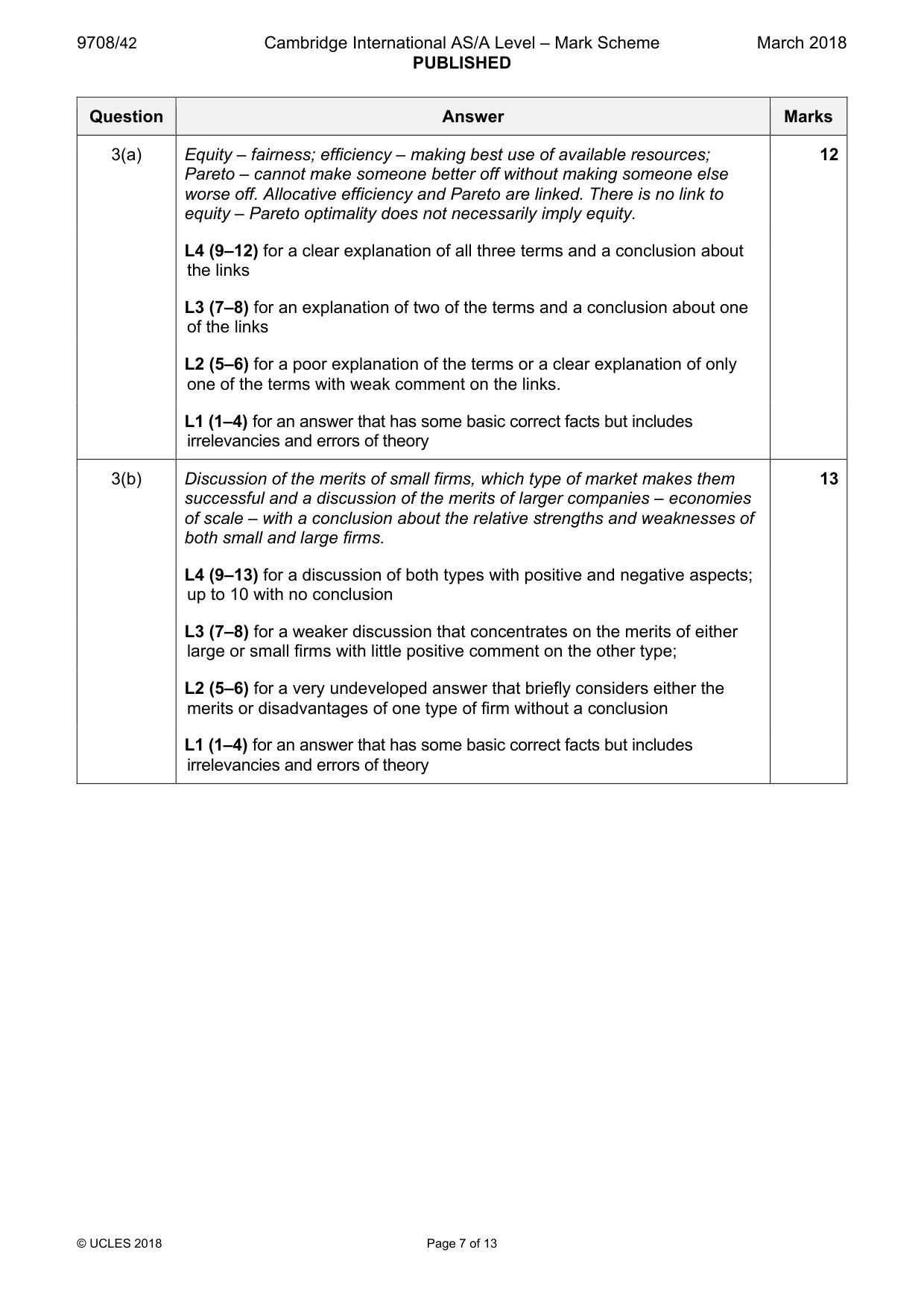
Mark scheme: 3(a) Equity – fairness; efficiency – making best use of available resources; 12 Pareto – cannot make someone better off without making someone else worse off. Allocative efficiency and Pareto are linked. There is no link to equity – Pareto optimality does not necessarily imply equity. L4 (9–12) for a clear explanation of all three terms and a conclusion about the links L3 (7–8) for an explanation of two of the terms and a conclusion about one of the links L2 (5–6) for a poor explanation of the terms or a clear explanation of only one of the terms with weak comment on the links. L1 (1–4) for an answer that has some basic correct facts but includes irrelevancies and errors of theory 3(b) Discussion of the merits of small firms, which type of market makes them 13 successful and a discussion of the merits of larger companies – economies of scale – with a conclusion about the relative strengths and weaknesses of both small and large firms. L4 (9–13) for a discussion of both types with positive and negative aspects; up to 10 with no conclusion L3 (7–8) for a weaker discussion that concentrates on the merits of either large or small firms with little positive comment on the other type; L2 (5–6) for a very undeveloped answer that briefly considers either the merits or disadvantages of one type of firm without a conclusion L1 (1–4) for an answer that has some basic correct facts but includes irrelevancies and errors of theory
Q4 · In 2016, a country’s largest yacht builder said it would have to make 350 people redundant
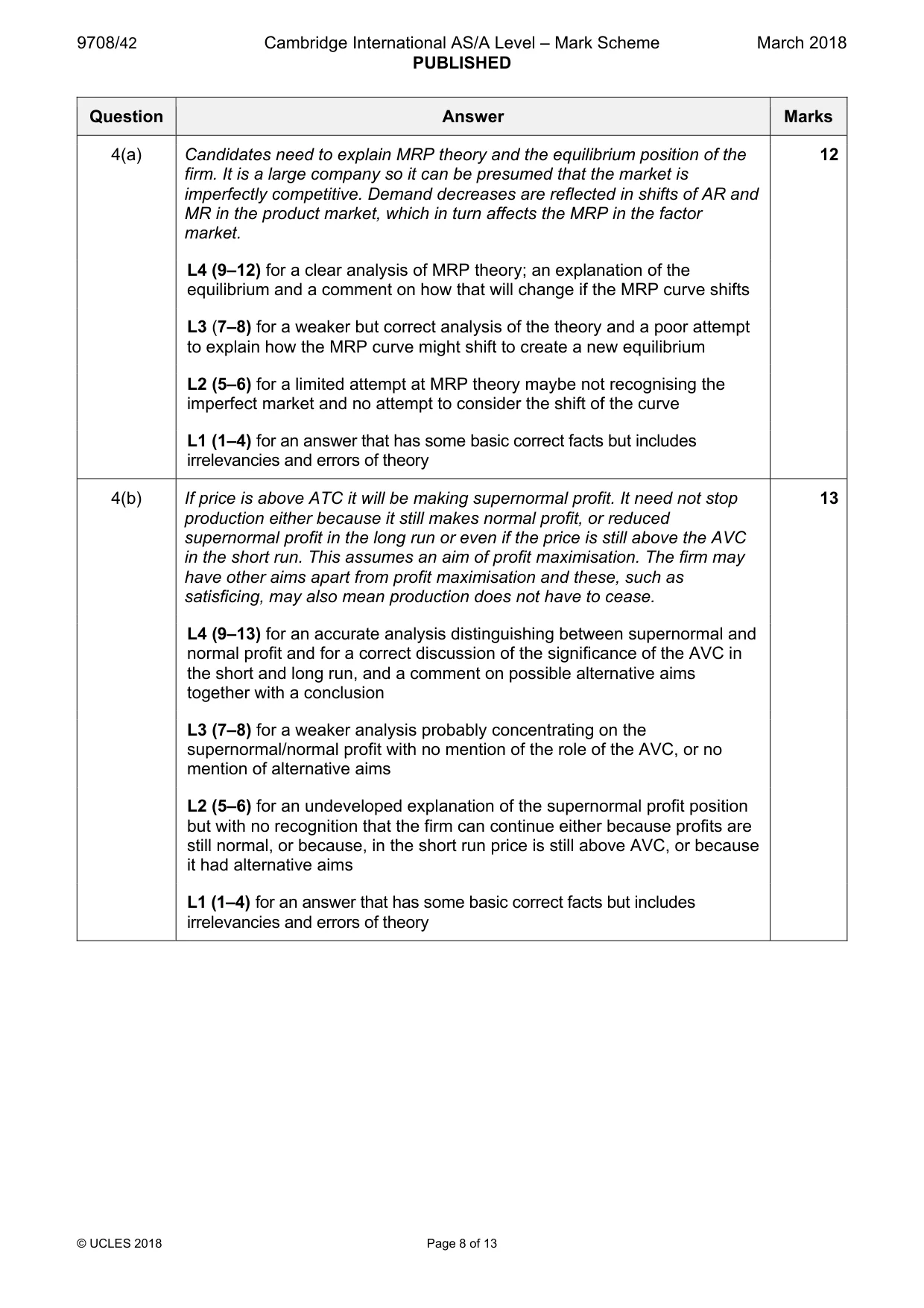
4 In 2016, a country’s largest yacht builder said it would have to make 350 people redundant. The company, which builds luxury yachts, said demand had decreased in the recession. (a) Explain, with the help of a diagram, how this situation could be incorporated into the marginal revenue productivity theory of wage and employment determination. [12] (b) The price of the company’s product was above the average total cost. Discuss whether in an imperfectly competitive market structure a firm’s aim would necessarily mean it would stop production if the price has to fall because of reduced demand. [13]
Mark scheme: 4(a) Candidates need to explain MRP theory and the equilibrium position of the 12 firm. It is a large company so it can be presumed that the market is imperfectly competitive. Demand decreases are reflected in shifts of AR and MR in the product market, which in turn affects the MRP in the factor market. L4 (9–12) for a clear analysis of MRP theory; an explanation of the equilibrium and a comment on how that will change if the MRP curve shifts L3 (7–8) for a weaker but correct analysis of the theory and a poor attempt to explain how the MRP curve might shift to create a new equilibrium L2 (5–6) for a limited attempt at MRP theory maybe not recognising the imperfect market and no attempt to consider the shift of the curve L1 (1–4) for an answer that has some basic correct facts but includes irrelevancies and errors of theory 4(b) If price is above ATC it will be making supernormal profit. It need not stop 13 production either because it still makes normal profit, or reduced supernormal profit in the long run or even if the price is still above the AVC in the short run. This assumes an aim of profit maximisation. The firm may have other aims apart from profit maximisation and these, such as satisficing, may also mean production does not have to cease. L4 (9–13) for an accurate analysis distinguishing between supernormal and normal profit and for a correct discussion of the significance of the AVC in the short and long run, and a comment on possible alternative aims together with a conclusion L3 (7–8) for a weaker analysis probably concentrating on the supernormal/normal profit with no mention of the role of the AVC, or no mention of alternative aims L2 (5–6) for an undeveloped explanation of the supernormal profit position but with no recognition that the firm can continue either because profits are still normal, or because, in the short run price is still above AVC, or because it had alternative aims L1 (1–4) for an answer that has some basic correct facts but includes irrelevancies and errors of theory
Q5 · Distinguish between the transactions demand for money and the speculative demand for money
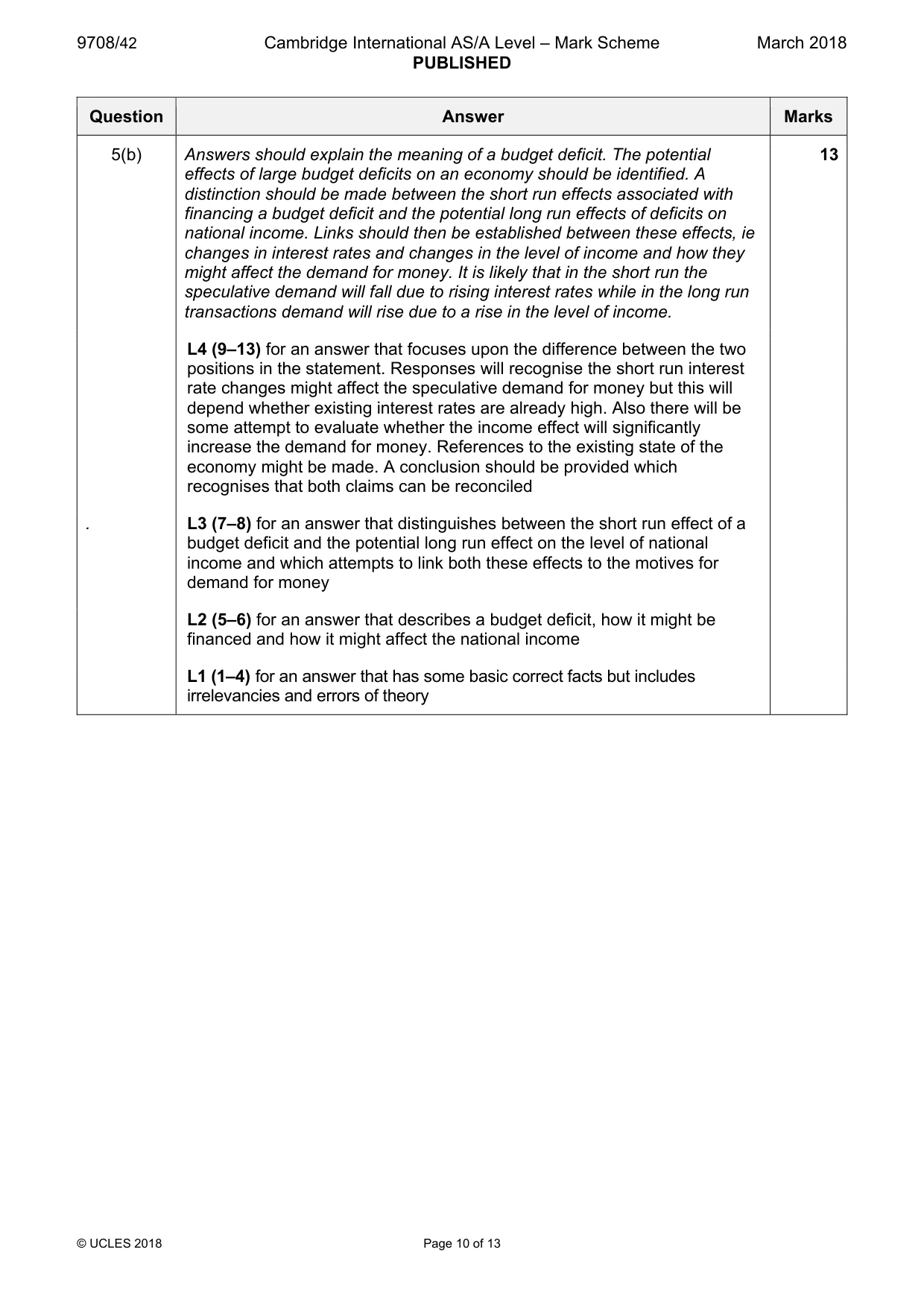
5 (a) Distinguish between the transactions demand for money and the speculative demand for money. Consider which is likely to be more important for a consumer in a modern economy. [12] (b) Some economists argue that large budget deficits will increase the demand for money while others argue that large budget deficits will decrease the demand for money. Discuss whether it is possible to reconcile these views. [13]
Mark scheme: 5(a) Transactions demand is a demand for an active balance. It depends upon the 12 level of income and the frequency of income payments. It is interest inelastic. Speculative demand for money is determined by expectations of the future rate of interest of long term government securities. These are known as idle balances and closely related to changes in the rate of interest. Importance will vary depending upon the state of economy, the level of income and the rate of interest. L4 (9–12) for an answer that attempt to discuss the relative importance of each type of demand in an economy. For example, in a recession when incomes are low and interest rates are low, it is likely that the speculative demand for money would be more important than the transactions demand. L3 (7–8) for an answer that provides a detailed account of the key differences between the two types of demand for money and which attempt to analyse the link between different changes in an economy and their impact on both the transactions and speculative demand. L2 (5–6) for answer that explains the difference between the transactions demand and the speculative demand for money but is not fully developed L1 (1–4) for an answer that shows some knowledge but does not indicate that the question has been fully grasped or where the answer is mostly irrelevant 5(b) Answers should explain the meaning of a budget deficit. The potential 13 effects of large budget deficits on an economy should be identified. A distinction should be made between the short run effects associated with financing a budget deficit and the potential long run effects of deficits on national income. Links should then be established between these effects, ie changes in interest rates and changes in the level of income and how they might affect the demand for money. It is likely that in the short run the speculative demand will fall due to rising interest rates while in the long run transactions demand will rise due to a rise in the level of income. L4 (9–13) for an answer that focuses upon the difference between the two positions in the statement. Responses will recognise the short run interest rate changes might affect the speculative demand for money but this will depend whether existing interest rates are already high. Also there will be some attempt to evaluate whether the income effect will significantly increase the demand for money. References to the existing state of the economy might be made. A conclusion should be provided which recognises that both claims can be reconciled . L3 (7–8) for an answer that distinguishes between the short run effect of a budget deficit and the potential long run effect on the level of national income and which attempts to link both these effects to the motives for demand for money L2 (5–6) for an answer that describes a budget deficit, how it might be financed and how it might affect the national income L1 (1–4) for an answer that has some basic correct facts but includes irrelevancies and errors of theory
Q6 · Explain the difference between autonomous investment and induced investment
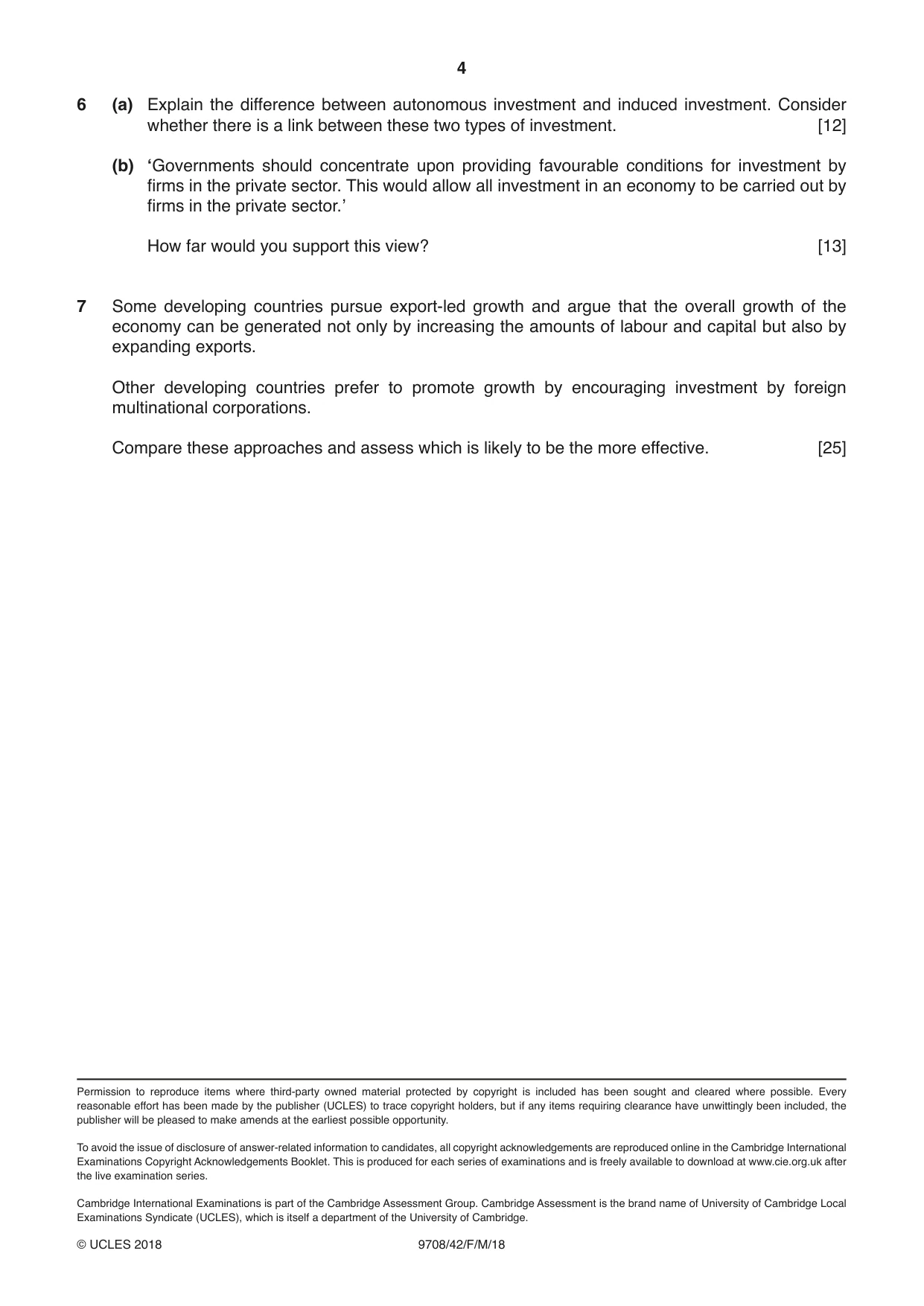
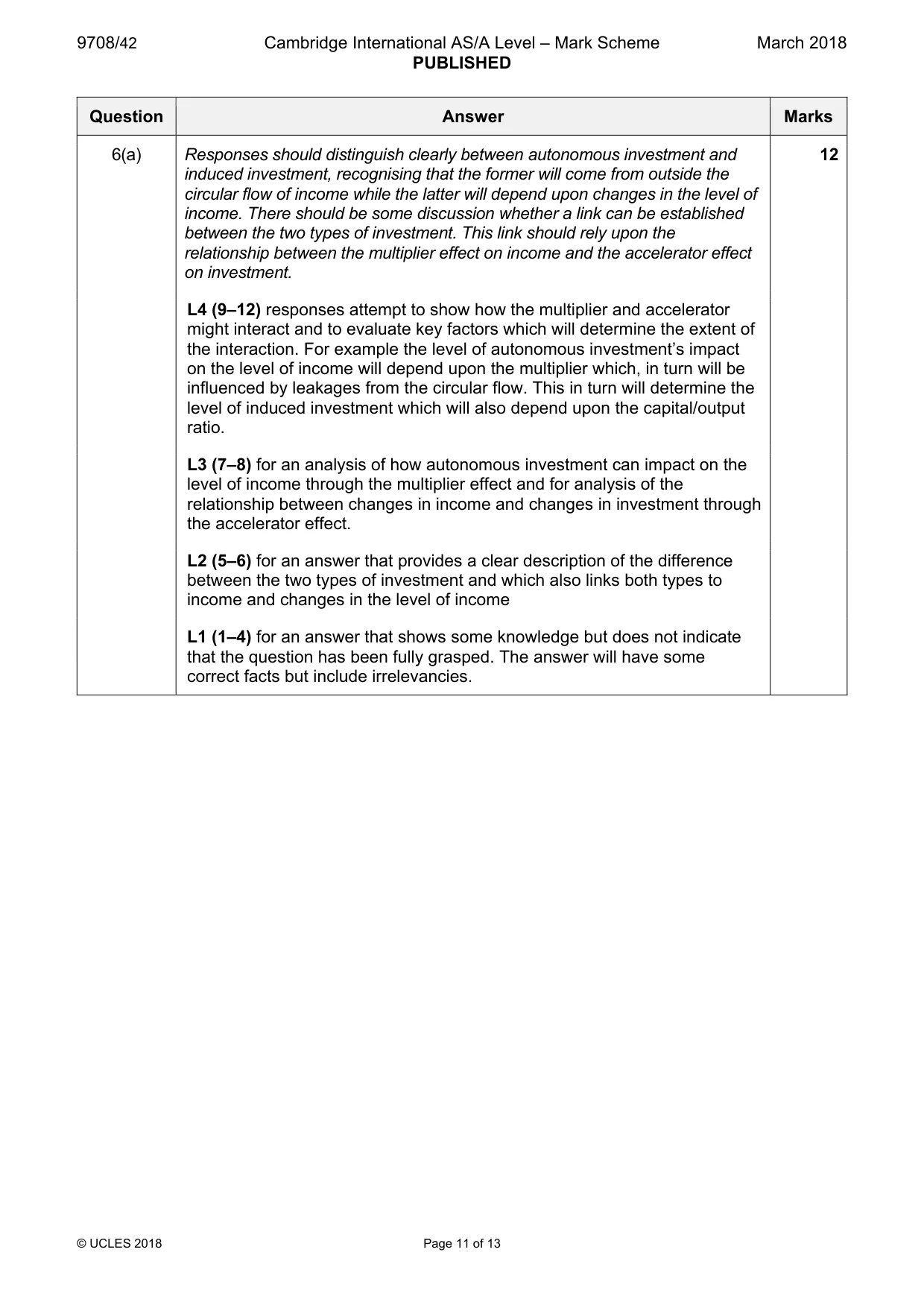
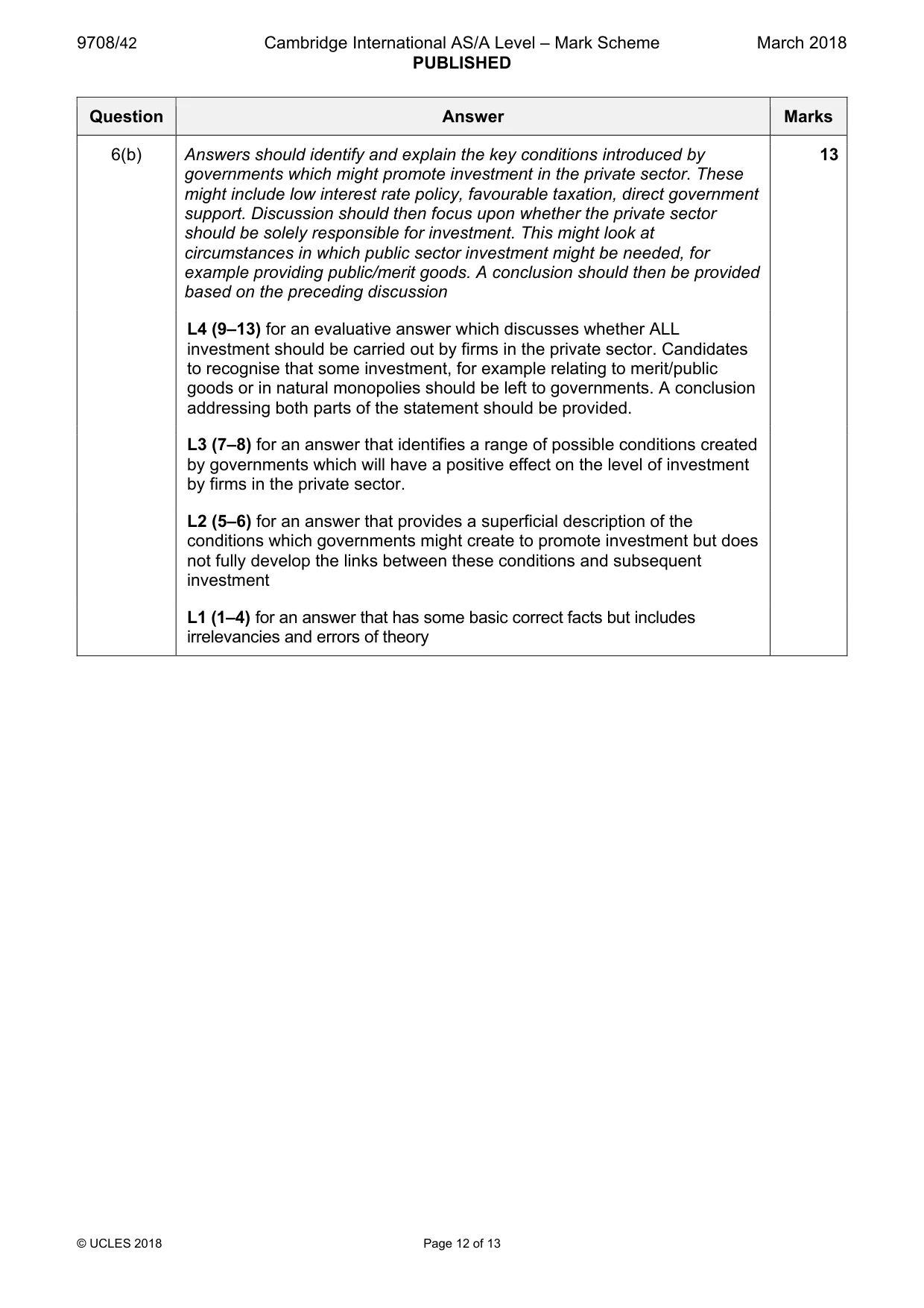
6 (a) Explain the difference between autonomous investment and induced investment. Consider whether there is a link between these two types of investment. [12] (b) ‘Governments should concentrate upon providing favourable conditions for investment by firms in the private sector. This would allow all investment in an economy to be carried out by firms in the private sector.’ How far would you support this view? [13]
Mark scheme: 6(a) Responses should distinguish clearly between autonomous investment and 12 induced investment, recognising that the former will come from outside the circular flow of income while the latter will depend upon changes in the level of income. There should be some discussion whether a link can be established between the two types of investment. This link should rely upon the relationship between the multiplier effect on income and the accelerator effect on investment. L4 (9–12) responses attempt to show how the multiplier and accelerator might interact and to evaluate key factors which will determine the extent of the interaction. For example the level of autonomous investment’s impact on the level of income will depend upon the multiplier which, in turn will be influenced by leakages from the circular flow. This in turn will determine the level of induced investment which will also depend upon the capital/output ratio. L3 (7–8) for an analysis of how autonomous investment can impact on the level of income through the multiplier effect and for analysis of the relationship between changes in income and changes in investment through the accelerator effect. L2 (5–6) for an answer that provides a clear description of the difference between the two types of investment and which also links both types to income and changes in the level of income L1 (1–4) for an answer that shows some knowledge but does not indicate that the question has been fully grasped. The answer will have some correct facts but include irrelevancies. 6(b) Answers should identify and explain the key conditions introduced by 13 governments which might promote investment in the private sector. These might include low interest rate policy, favourable taxation, direct government support. Discussion should then focus upon whether the private sector should be solely responsible for investment. This might look at circumstances in which public sector investment might be needed, for example providing public/merit goods. A conclusion should then be provided based on the preceding discussion L4 (9–13) for an evaluative answer which discusses whether ALL investment should be carried out by firms in the private sector. Candidates to recognise that some investment, for example relating to merit/public goods or in natural monopolies should be left to governments. A conclusion addressing both parts of the statement should be provided. L3 (7–8) for an answer that identifies a range of possible conditions created by governments which will have a positive effect on the level of investment by firms in the private sector. L2 (5–6) for an answer that provides a superficial description of the conditions which governments might create to promote investment but does not fully develop the links between these conditions and subsequent investment L1 (1–4) for an answer that has some basic correct facts but includes irrelevancies and errors of theory
Q7 · Some developing countries pursue export-led growth and argue that the overall growth of…
7 Some developing countries pursue export-led growth and argue that the overall growth of the economy can be generated not only by increasing the amounts of labour and capital but also by expanding exports. Other developing countries prefer to promote growth by encouraging investment by foreign multinational corporations. Compare these approaches and assess which is likely to be the more effective. [25]
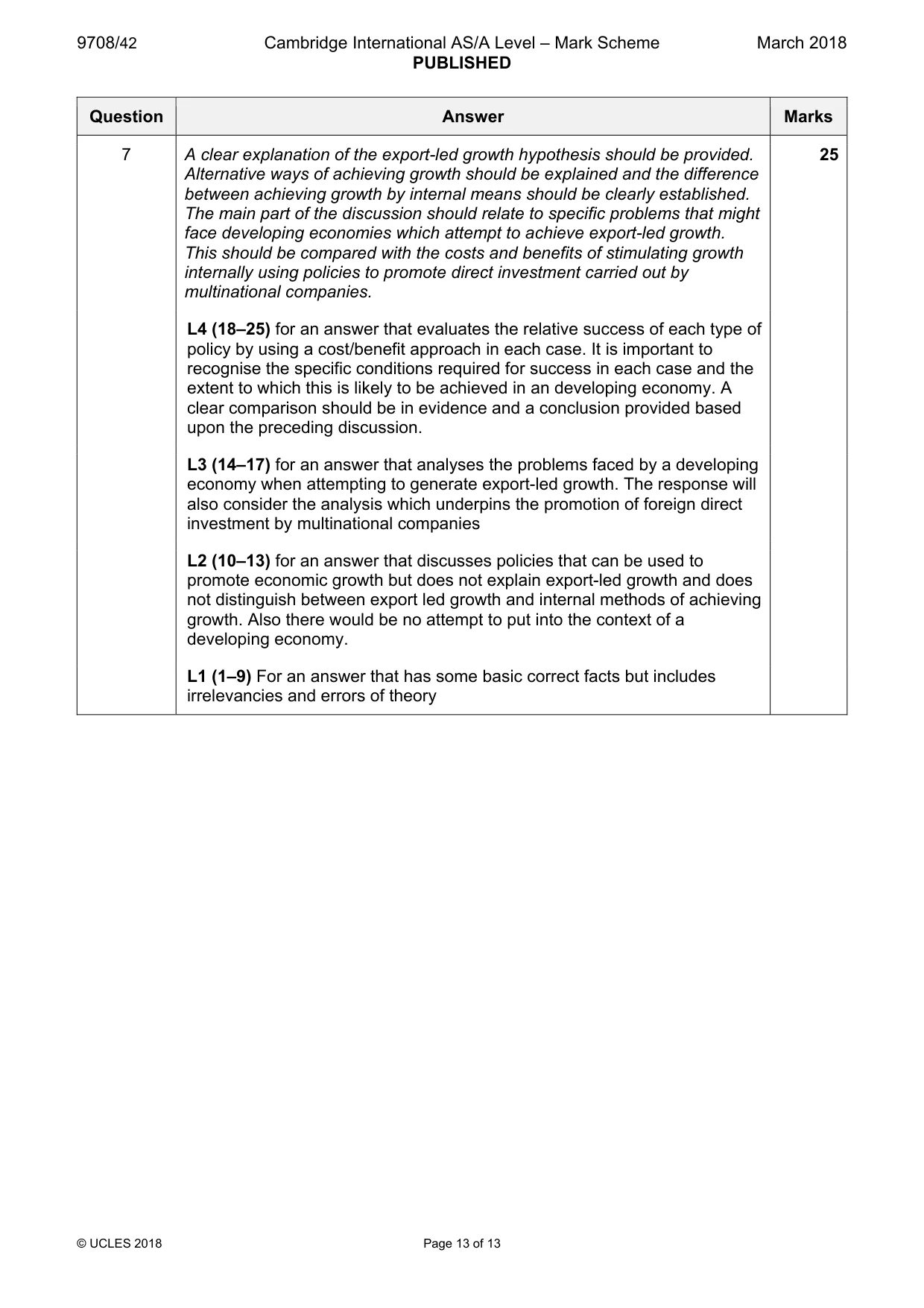
Mark scheme: 7 A clear explanation of the export-led growth hypothesis should be provided. 25 Alternative ways of achieving growth should be explained and the difference between achieving growth by internal means should be clearly established. The main part of the discussion should relate to specific problems that might face developing economies which attempt to achieve export-led growth. This should be compared with the costs and benefits of stimulating growth internally using policies to promote direct investment carried out by multinational companies. L4 (18–25) for an answer that evaluates the relative success of each type of policy by using a cost/benefit approach in each case. It is important to recognise the specific conditions required for success in each case and the extent to which this is likely to be achieved in an developing economy. A clear comparison should be in evidence and a conclusion provided based upon the preceding discussion. L3 (14–17) for an answer that analyses the problems faced by a developing economy when attempting to generate export-led growth. The response will also consider the analysis which underpins the promotion of foreign direct investment by multinational companies L2 (10–13) for an answer that discusses policies that can be used to promote economic growth but does not explain export-led growth and does not distinguish between export led growth and internal methods of achieving growth. Also there would be no attempt to put into the context of a developing economy. L1 (1–9) For an answer that has some basic correct facts but includes irrelevancies and errors of theory
What was in this paper
The subtopics covered by these 7 questions, and how many questions each got. Open one in a new tab to see every Cambridge question on it.
What you needed in this session
Cambridge’s own grade thresholds for 2018 Feb/March, Paper 4 · Variant 2. A higher threshold means an easier paper — the bar moves with how the cohort did.