Cambridge A Level Economics 9708 — 2013 Oct/Nov Paper 2 · Variant 1
9708/21/O/N/13 · 40 marks · ≈45 min
The question paper and its mark scheme, free to read here and free to download. This is Cambridge’s own paper, exactly as it was sat.
Question paper4 pages
Mark scheme5 pages
Answers below. Sit the paper first if you are practising.
Paper as text
Question paper, page 1
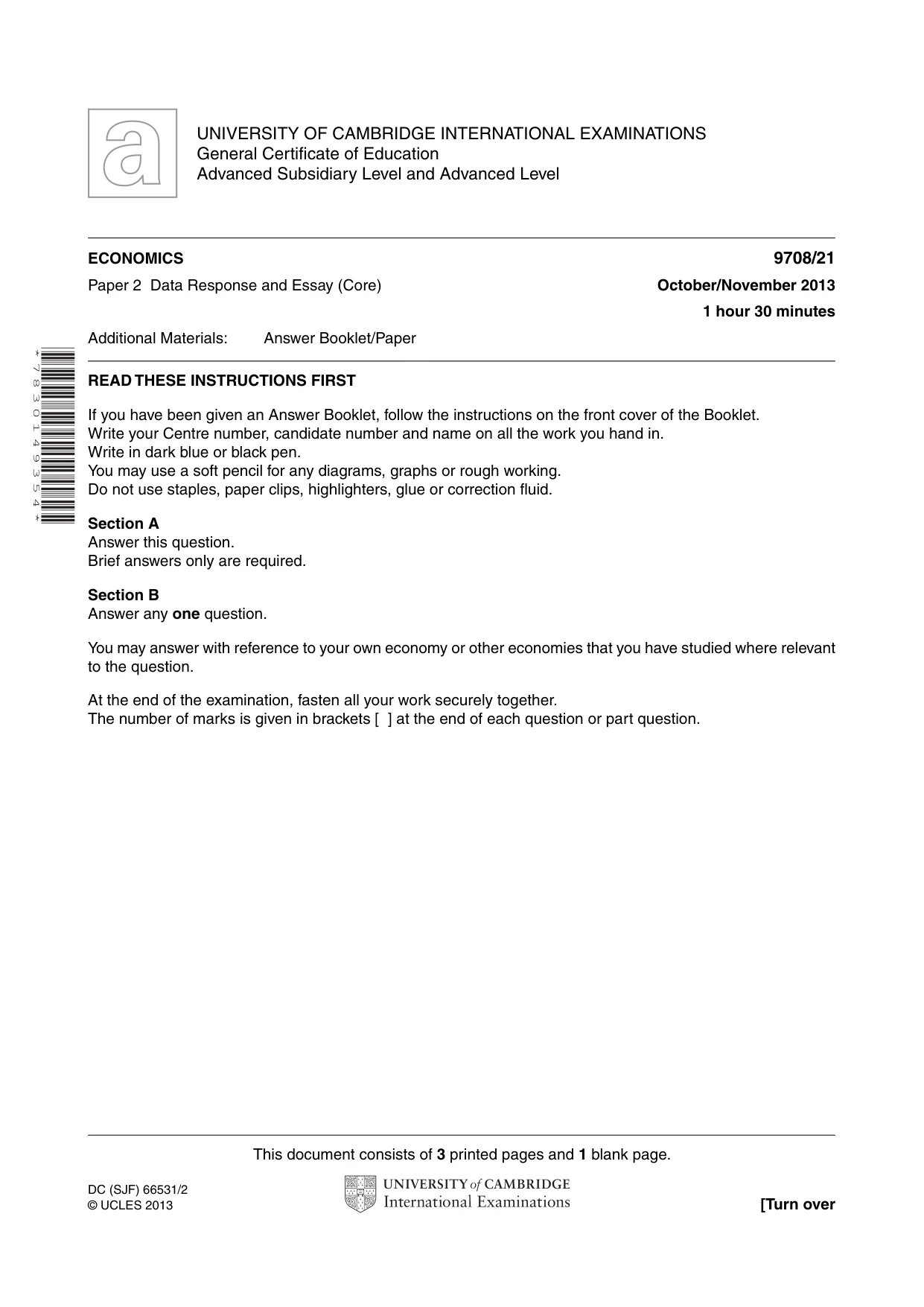
This document consists of 3 printed pages and 1 blank page. DC (SJF) 66531/2 © UCLES 2013 [Turn over UNIVERSITY OF CAMBRIDGE INTERNATIONAL EXAMINATIONS General Certificate of Education Advanced Subsidiary Level and Advanced Level READ THESE INSTRUCTIONS FIRST If you have been given an Answer Booklet, follow the instructions on the front cover of the Booklet. Write your Centre number, candidate number and name on all the work you hand in. Write in dark blue or black pen. You may use a soft pencil for any diagrams, graphs or rough working. Do not use staples, paper clips, highlighters, glue or correction fluid. Section A Answer this question. Brief answers only are required. Section B Answer any one question. You may answer with reference to your own economy or other economies that you have studied where relevant to the question. At the end of the examination, fasten all your work securely together. The number of marks is given in brackets [ ] at the end of each question or part question. * 7 8 3 0 1 4 9 3 5 4 * ECONOMICS 9708/21 Paper 2 Data Response and Essay (Core) October/November 2013 1 hour 30 minutes Additional Materials: Answer Booklet/Paper
Question paper, page 2
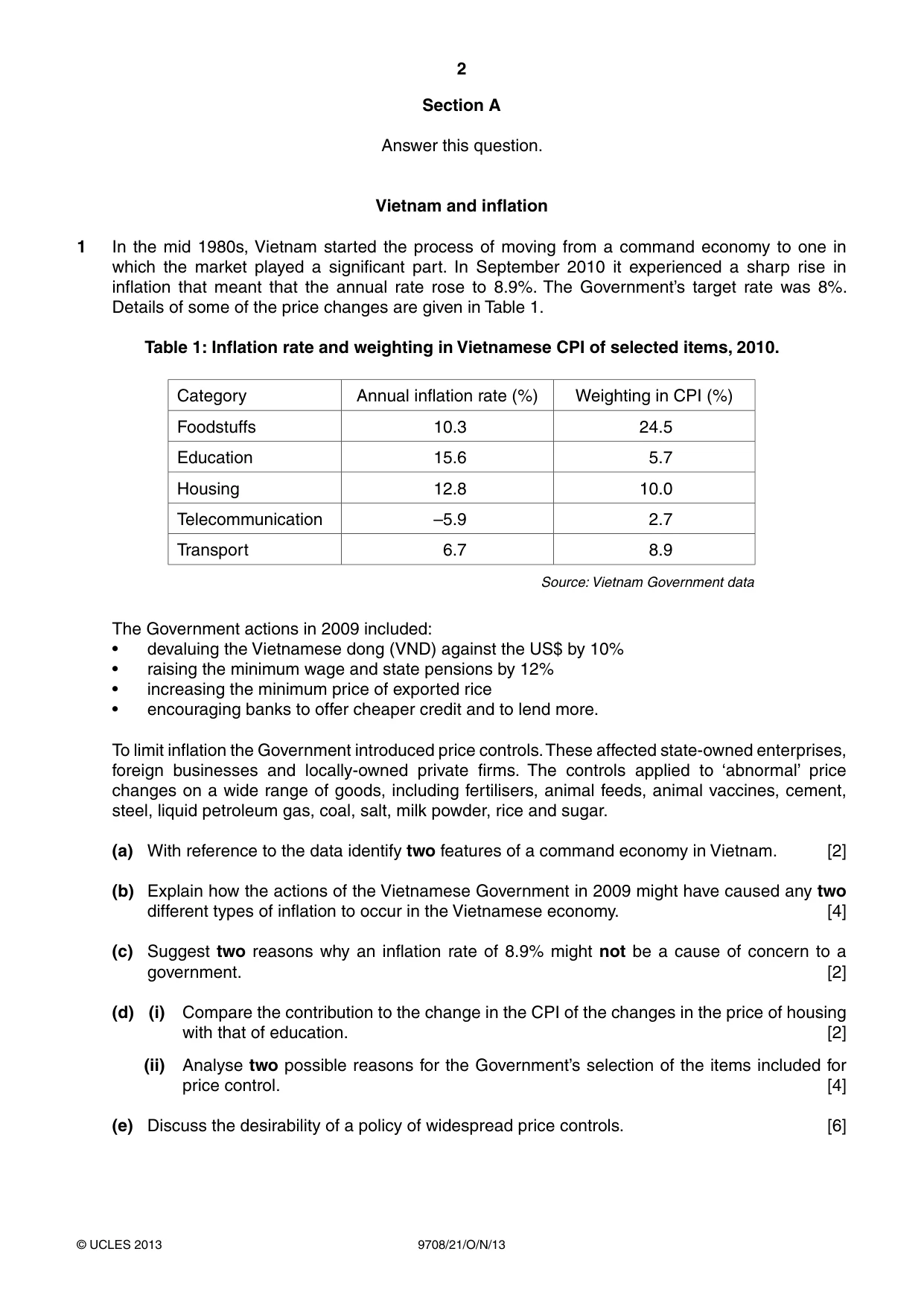
2 9708/21/O/N/13 © UCLES 2013 Section A Answer this question. Vietnam and inflation 1 In the mid 1980s, Vietnam started the process of moving from a command economy to one in which the market played a significant part. In September 2010 it experienced a sharp rise in inflation that meant that the annual rate rose to 8.9%. The Government’s target rate was 8%. Details of some of the price changes are given in Table 1. Table 1: Inflation rate and weighting in Vietnamese CPI of selected items, 2010. Category Annual inflation rate (%) Weighting in CPI (%) Foodstuffs 10.3 24.5 Education 15.6 5.7 Housing 12.8 10.0 Telecommunication –5.9 2.7 Transport 6.7 8.9 Source: Vietnam Government data The Government actions in 2009 included: • devaluing the Vietnamese dong (VND) against the US$ by 10% • raising the minimum wage and state pensions by 12% • increasing the minimum price of exported rice • encouraging banks to offer cheaper credit and to lend more. To limit inflation the Government introduced price controls. These affected state-owned enterprises, foreign businesses and locally-owned private firms. The controls applied to ‘abnormal’ price changes on a wide range of goods, including fertilisers, animal feeds, animal vaccines, cement, steel, liquid petroleum gas, coal, salt, milk powder, rice and sugar. (a) With reference to the data identify two features of a command economy in Vietnam. [2] (b) Explain how the actions of the Vietnamese Government in 2009 might have caused any two different types of inflation to occur in the Vietnamese economy. [4] (c) Suggest two reasons why an inflation rate of 8.9% might not be a cause of concern to a government. [2] (d) (i) Compare the contribution to the change in the CPI of the changes in the price of housing with that of education. [2] (ii) Analyse two possible reasons for the Government’s selection of the items included for price control. [4] (e) Discuss the desirability of a policy of widespread price controls. [6]
Question paper, page 3
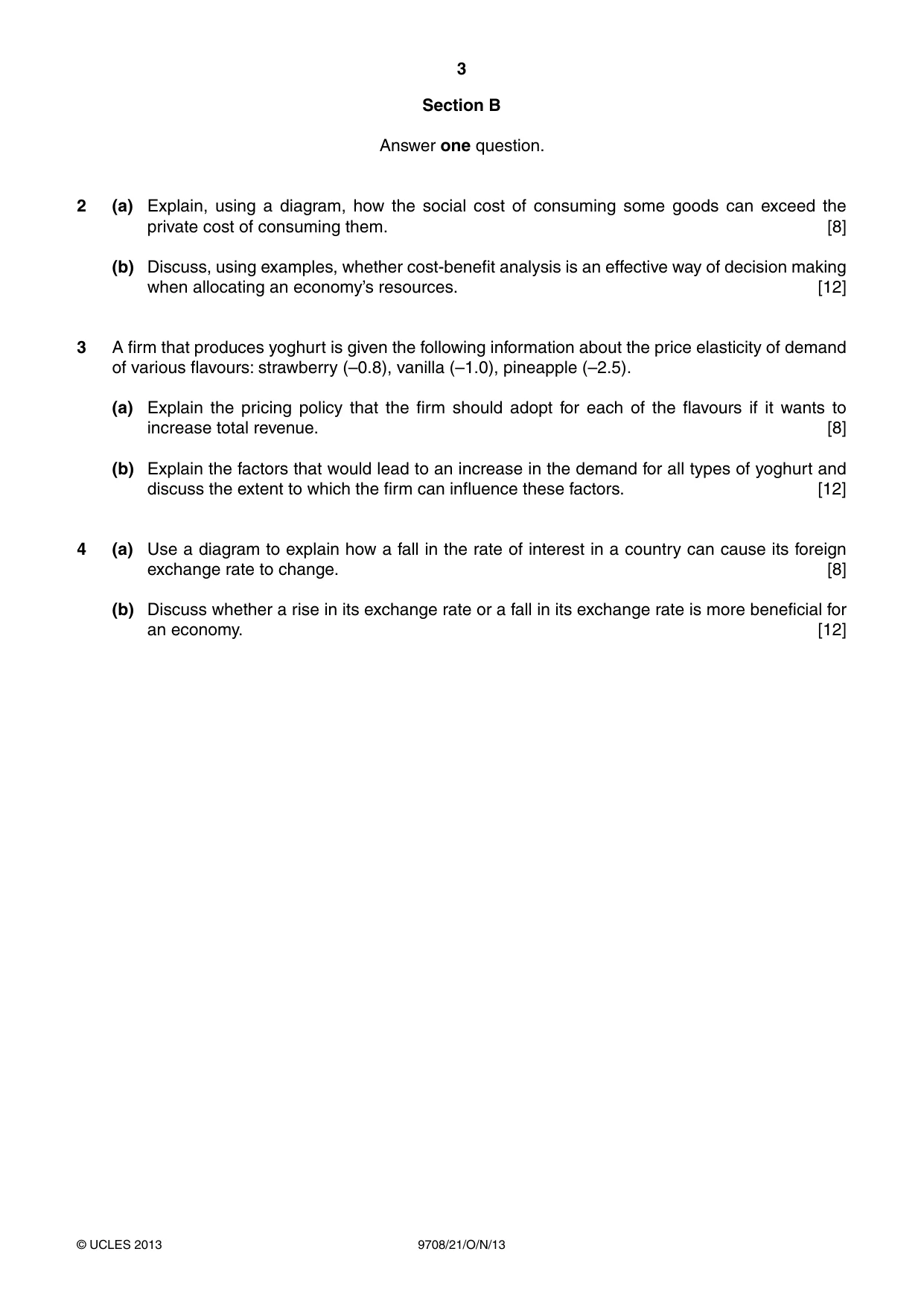
3 9708/21/O/N/13 © UCLES 2013 Section B Answer one question. 2 (a) Explain, using a diagram, how the social cost of consuming some goods can exceed the private cost of consuming them. [8] (b) Discuss, using examples, whether cost-benefit analysis is an effective way of decision making when allocating an economy’s resources. [12] 3 A firm that produces yoghurt is given the following information about the price elasticity of demand of various flavours: strawberry (–0.8), vanilla (–1.0), pineapple (–2.5). (a) Explain the pricing policy that the firm should adopt for each of the flavours if it wants to increase total revenue. [8] (b) Explain the factors that would lead to an increase in the demand for all types of yoghurt and discuss the extent to which the firm can influence these factors. [12] 4 (a) Use a diagram to explain how a fall in the rate of interest in a country can cause its foreign exchange rate to change. [8] (b) Discuss whether a rise in its exchange rate or a fall in its exchange rate is more beneficial for an economy. [12]
Question paper, page 4
4 9708/21/O/N/13 © UCLES 2013 BLANK PAGE Copyright Acknowledgements: Question 1 © The National Assembly of The Socialist Republic of Vietnam. Permission to reproduce items where third-party owned material protected by copyright is included has been sought and cleared where possible. Every reasonable effort has been made by the publisher (UCLES) to trace copyright holders, but if any items requiring clearance have unwittingly been included, the publisher will be pleased to make amends at the earliest possible opportunity. Cambridge International Examinations is part of the Cambridge Assessment Group. Cambridge Assessment is the brand name of University of Cambridge Local Examinations Syndicate (UCLES), which is itself a department of the University of Cambridge.
Mark scheme, page 1
CAMBRIDGE INTERNATIONAL EXAMINATIONS GCE Advanced Subsidiary Level and GCE Advanced Level MARK SCHEME for the October/November 2013 series 9708 ECONOMICS 9708/21 Paper 2 (Data Response and Essay – Core), maximum raw mark 40 This mark scheme is published as an aid to teachers and candidates, to indicate the requirements of the examination. It shows the basis on which Examiners were instructed to award marks. It does not indicate the details of the discussions that took place at an Examiners’ meeting before marking began, which would have considered the acceptability of alternative answers. Mark schemes should be read in conjunction with the question paper and the Principal Examiner Report for Teachers. Cambridge will not enter into discussions about these mark schemes. Cambridge is publishing the mark schemes for the October/November 2013 series for most IGCSE, GCE Advanced Level and Advanced Subsidiary Level components and some Ordinary Level components.
Mark scheme, page 2
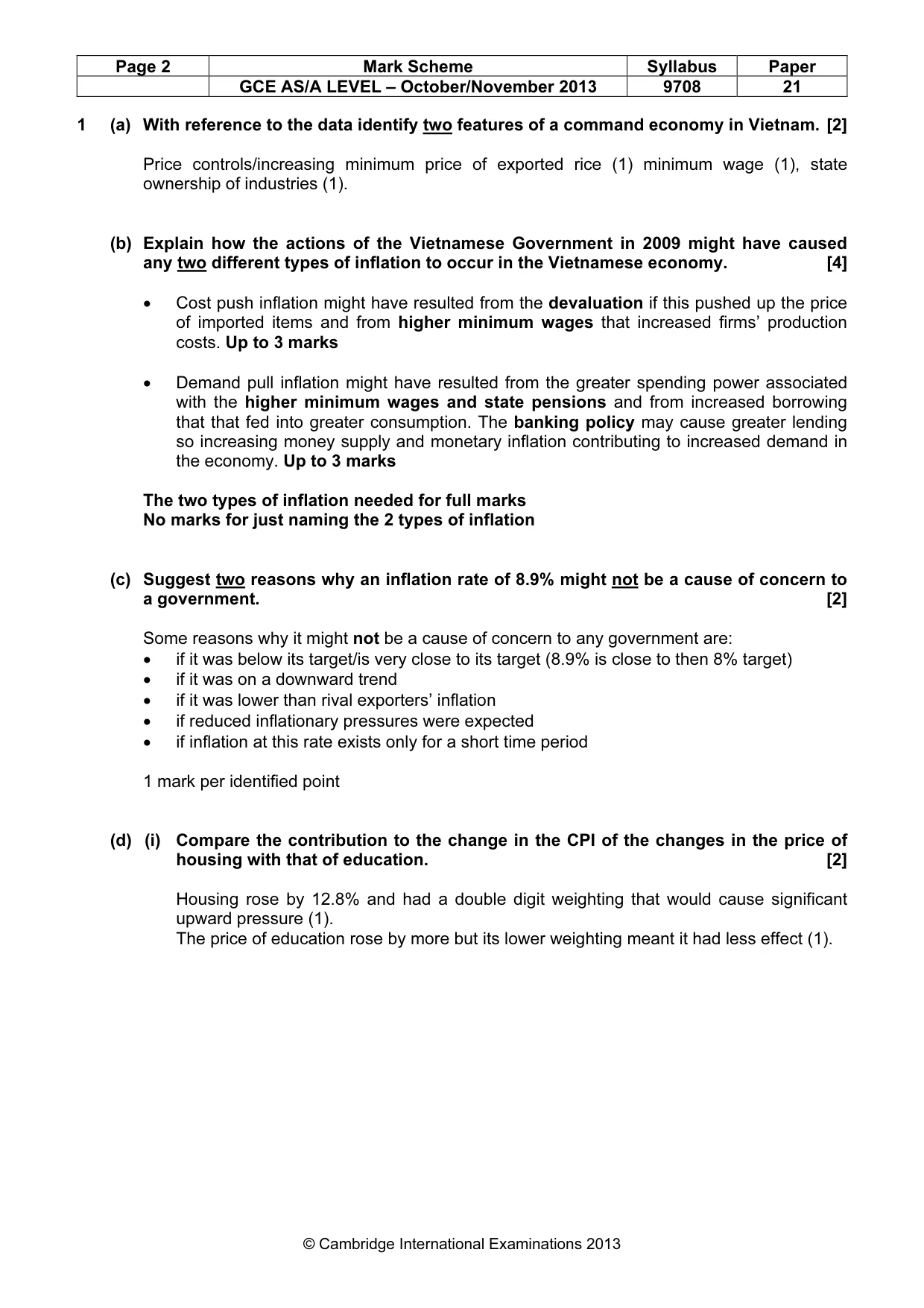
Page 2 Mark Scheme Syllabus Paper GCE AS/A LEVEL – October/November 2013 9708 21 © Cambridge International Examinations 2013 1 (a) With reference to the data identify two features of a command economy in Vietnam. [2] Price controls/increasing minimum price of exported rice (1) minimum wage (1), state ownership of industries (1). (b) Explain how the actions of the Vietnamese Government in 2009 might have caused any two different types of inflation to occur in the Vietnamese economy. [4] • Cost push inflation might have resulted from the devaluation if this pushed up the price of imported items and from higher minimum wages that increased firms’ production costs. Up to 3 marks • Demand pull inflation might have resulted from the greater spending power associated with the higher minimum wages and state pensions and from increased borrowing that that fed into greater consumption. The banking policy may cause greater lending so increasing money supply and monetary inflation contributing to increased demand in the economy. Up to 3 marks The two types of inflation needed for full marks No marks for just naming the 2 types of inflation (c) Suggest two reasons why an inflation rate of 8.9% might not be a cause of concern to a government. [2] Some reasons why it might not be a cause of concern to any government are: • if it was below its target/is very close to its target (8.9% is close to then 8% target) • if it was on a downward trend • if it was lower than rival exporters’ inflation • if reduced inflationary pressures were expected • if inflation at this rate exists only for a short time period 1 mark per identified point (d) (i) Compare the contribution to the change in the CPI of the changes in the price of housing with that of education. [2] Housing rose by 12.8% and had a double digit weighting that would cause significant upward pressure (1). The price of education rose by more but its lower weighting meant it had less effect (1).
Mark scheme, page 3
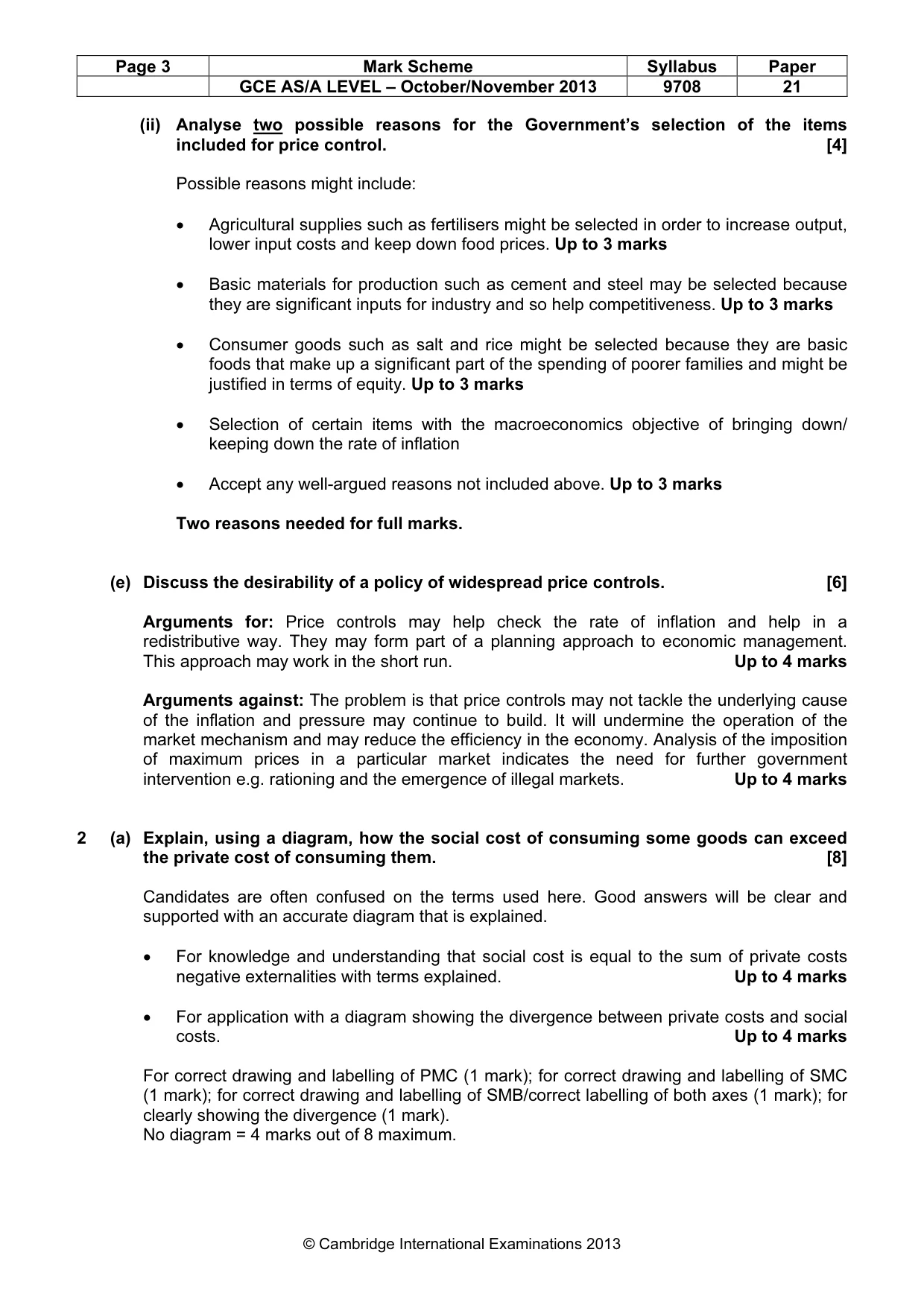
Page 3 Mark Scheme Syllabus Paper GCE AS/A LEVEL – October/November 2013 9708 21 © Cambridge International Examinations 2013 (ii) Analyse two possible reasons for the Government’s selection of the items included for price control. [4] Possible reasons might include: • Agricultural supplies such as fertilisers might be selected in order to increase output, lower input costs and keep down food prices. Up to 3 marks • Basic materials for production such as cement and steel may be selected because they are significant inputs for industry and so help competitiveness. Up to 3 marks • Consumer goods such as salt and rice might be selected because they are basic foods that make up a significant part of the spending of poorer families and might be justified in terms of equity. Up to 3 marks • Selection of certain items with the macroeconomics objective of bringing down/ keeping down the rate of inflation • Accept any well-argued reasons not included above. Up to 3 marks Two reasons needed for full marks. (e) Discuss the desirability of a policy of widespread price controls. [6] Arguments for: Price controls may help check the rate of inflation and help in a redistributive way. They may form part of a planning approach to economic management. This approach may work in the short run. Up to 4 marks Arguments against: The problem is that price controls may not tackle the underlying cause of the inflation and pressure may continue to build. It will undermine the operation of the market mechanism and may reduce the efficiency in the economy. Analysis of the imposition of maximum prices in a particular market indicates the need for further government intervention e.g. rationing and the emergence of illegal markets. Up to 4 marks 2 (a) Explain, using a diagram, how the social cost of consuming some goods can exceed the private cost of consuming them. [8] Candidates are often confused on the terms used here. Good answers will be clear and supported with an accurate diagram that is explained. • For knowledge and understanding that social cost is equal to the sum of private costs negative externalities with terms explained. Up to 4 marks • For application with a diagram showing the divergence between private costs and social costs. Up to 4 marks For correct drawing and labelling of PMC (1 mark); for correct drawing and labelling of SMC (1 mark); for correct drawing and labelling of SMB/correct labelling of both axes (1 mark); for clearly showing the divergence (1 mark). No diagram = 4 marks out of 8 maximum.
Mark scheme, page 4
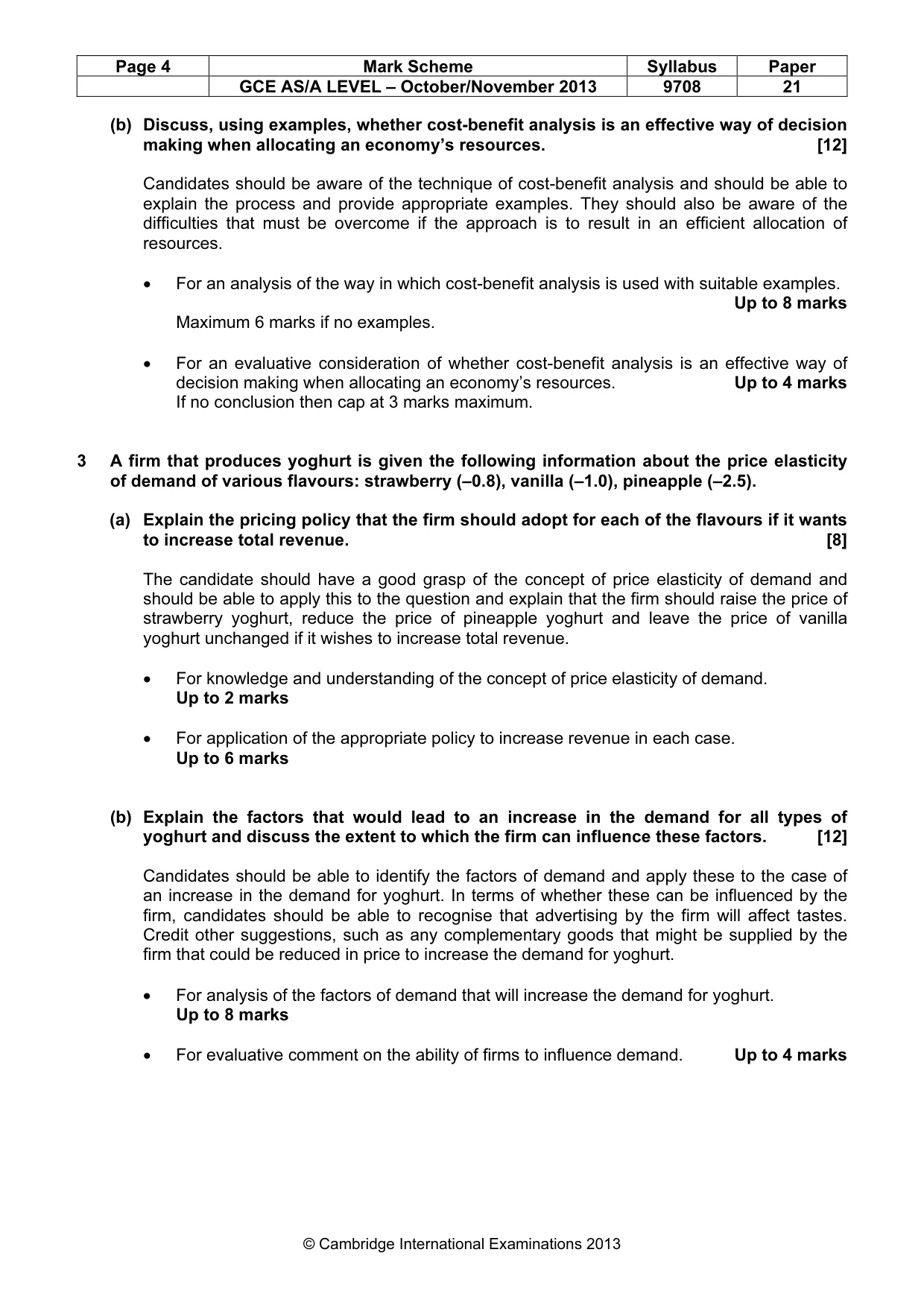
Page 4 Mark Scheme Syllabus Paper GCE AS/A LEVEL – October/November 2013 9708 21 © Cambridge International Examinations 2013 (b) Discuss, using examples, whether cost-benefit analysis is an effective way of decision making when allocating an economy’s resources. [12] Candidates should be aware of the technique of cost-benefit analysis and should be able to explain the process and provide appropriate examples. They should also be aware of the difficulties that must be overcome if the approach is to result in an efficient allocation of resources. • For an analysis of the way in which cost-benefit analysis is used with suitable examples. Up to 8 marks Maximum 6 marks if no examples. • For an evaluative consideration of whether cost-benefit analysis is an effective way of decision making when allocating an economy’s resources. Up to 4 marks If no conclusion then cap at 3 marks maximum. 3 A firm that produces yoghurt is given the following information about the price elasticity of demand of various flavours: strawberry (–0.8), vanilla (–1.0), pineapple (–2.5). (a) Explain the pricing policy that the firm should adopt for each of the flavours if it wants to increase total revenue. [8] The candidate should have a good grasp of the concept of price elasticity of demand and should be able to apply this to the question and explain that the firm should raise the price of strawberry yoghurt, reduce the price of pineapple yoghurt and leave the price of vanilla yoghurt unchanged if it wishes to increase total revenue. • For knowledge and understanding of the concept of price elasticity of demand. Up to 2 marks • For application of the appropriate policy to increase revenue in each case. Up to 6 marks (b) Explain the factors that would lead to an increase in the demand for all types of yoghurt and discuss the extent to which the firm can influence these factors. [12] Candidates should be able to identify the factors of demand and apply these to the case of an increase in the demand for yoghurt. In terms of whether these can be influenced by the firm, candidates should be able to recognise that advertising by the firm will affect tastes. Credit other suggestions, such as any complementary goods that might be supplied by the firm that could be reduced in price to increase the demand for yoghurt. • For analysis of the factors of demand that will increase the demand for yoghurt. Up to 8 marks • For evaluative comment on the ability of firms to influence demand. Up to 4 marks
Mark scheme, page 5
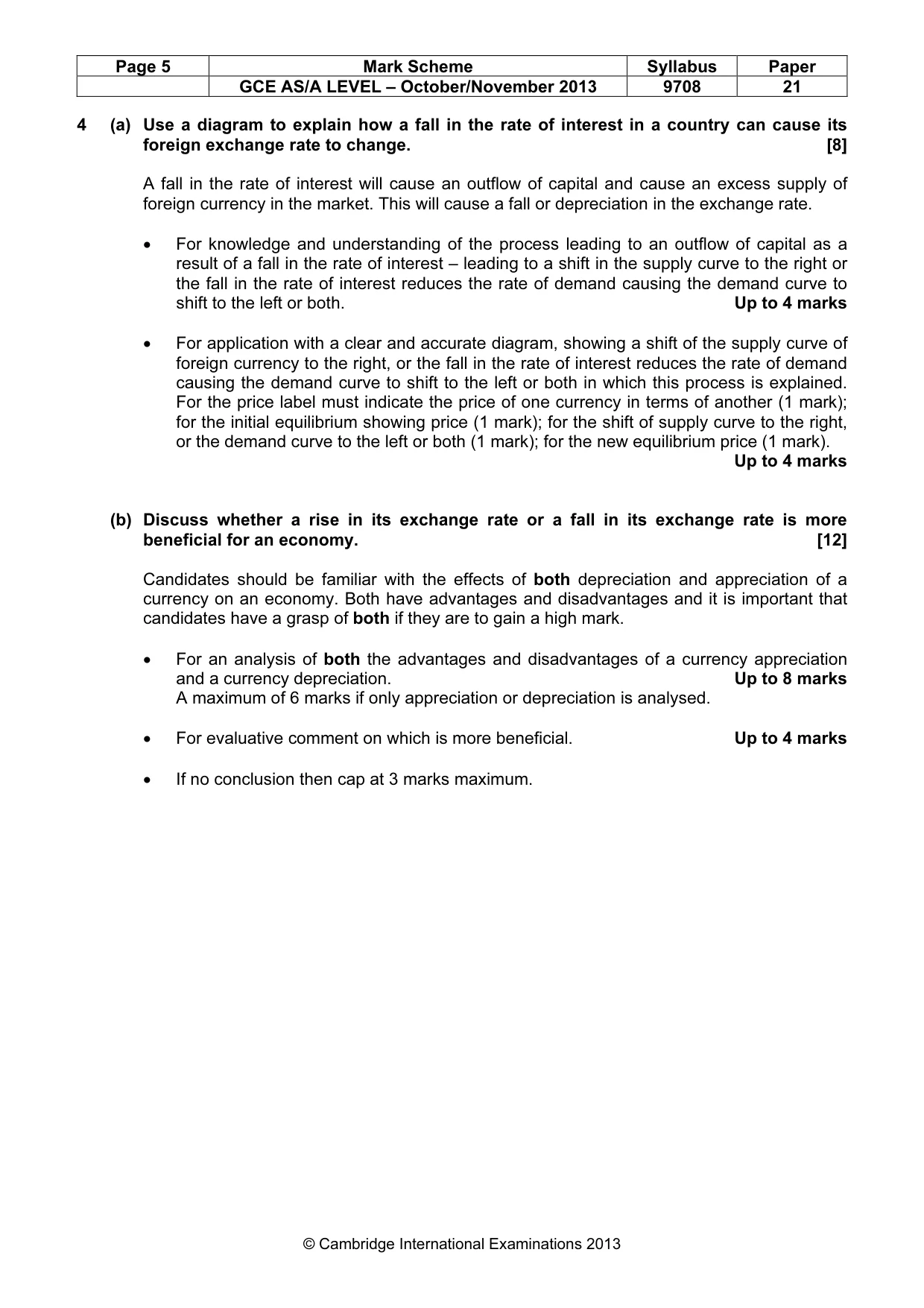
Page 5 Mark Scheme Syllabus Paper GCE AS/A LEVEL – October/November 2013 9708 21 © Cambridge International Examinations 2013 4 (a) Use a diagram to explain how a fall in the rate of interest in a country can cause its foreign exchange rate to change. [8] A fall in the rate of interest will cause an outflow of capital and cause an excess supply of foreign currency in the market. This will cause a fall or depreciation in the exchange rate. • For knowledge and understanding of the process leading to an outflow of capital as a result of a fall in the rate of interest – leading to a shift in the supply curve to the right or the fall in the rate of interest reduces the rate of demand causing the demand curve to shift to the left or both. Up to 4 marks • For application with a clear and accurate diagram, showing a shift of the supply curve of foreign currency to the right, or the fall in the rate of interest reduces the rate of demand causing the demand curve to shift to the left or both in which this process is explained. For the price label must indicate the price of one currency in terms of another (1 mark); for the initial equilibrium showing price (1 mark); for the shift of supply curve to the right, or the demand curve to the left or both (1 mark); for the new equilibrium price (1 mark). Up to 4 marks (b) Discuss whether a rise in its exchange rate or a fall in its exchange rate is more beneficial for an economy. [12] Candidates should be familiar with the effects of both depreciation and appreciation of a currency on an economy. Both have advantages and disadvantages and it is important that candidates have a grasp of both if they are to gain a high mark. • For an analysis of both the advantages and disadvantages of a currency appreciation and a currency depreciation. Up to 8 marks A maximum of 6 marks if only appreciation or depreciation is analysed. • For evaluative comment on which is more beneficial. Up to 4 marks • If no conclusion then cap at 3 marks maximum.
What you needed in this session
Cambridge’s own grade thresholds for 2013 Oct/Nov, Paper 2 · Variant 1. A higher threshold means an easier paper — the bar moves with how the cohort did.