Cambridge A Level Economics 9708 — 2012 May/June Paper 2 · Variant 1
9708/21/M/J/12 · 40 marks · ≈45 min
The question paper and its mark scheme, free to read here and free to download. This is Cambridge’s own paper, exactly as it was sat.
Question paper4 pages

Mark scheme4 pages
Answers below. Sit the paper first if you are practising.
Paper as text
Question paper, page 1
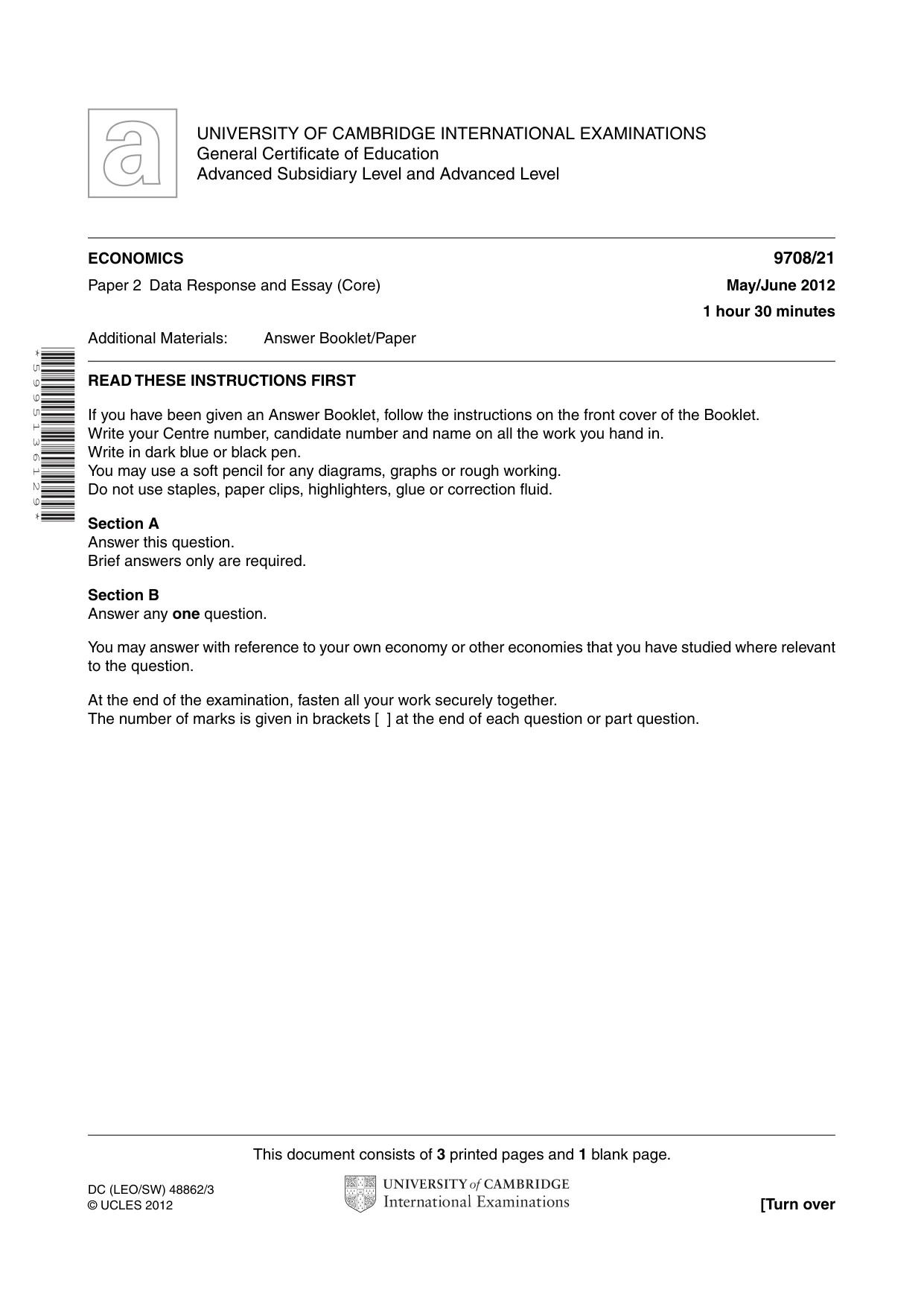
This document consists of 3 printed pages and 1 blank page. DC (LEO/SW) 48862/3 © UCLES 2012 [Turn over UNIVERSITY OF CAMBRIDGE INTERNATIONAL EXAMINATIONS General Certificate of Education Advanced Subsidiary Level and Advanced Level ECONOMICS 9708/21 Paper 2 Data Response and Essay (Core) May/June 2012 1 hour 30 minutes Additional Materials: Answer Booklet/Paper READ THESE INSTRUCTIONS FIRST If you have been given an Answer Booklet, follow the instructions on the front cover of the Booklet. Write your Centre number, candidate number and name on all the work you hand in. Write in dark blue or black pen. You may use a soft pencil for any diagrams, graphs or rough working. Do not use staples, paper clips, highlighters, glue or correction fluid. Section A Answer this question. Brief answers only are required. Section B Answer any one question. You may answer with reference to your own economy or other economies that you have studied where relevant to the question. At the end of the examination, fasten all your work securely together. The number of marks is given in brackets [ ] at the end of each question or part question. * 5 9 9 5 1 3 6 1 2 9 *
Question paper, page 2
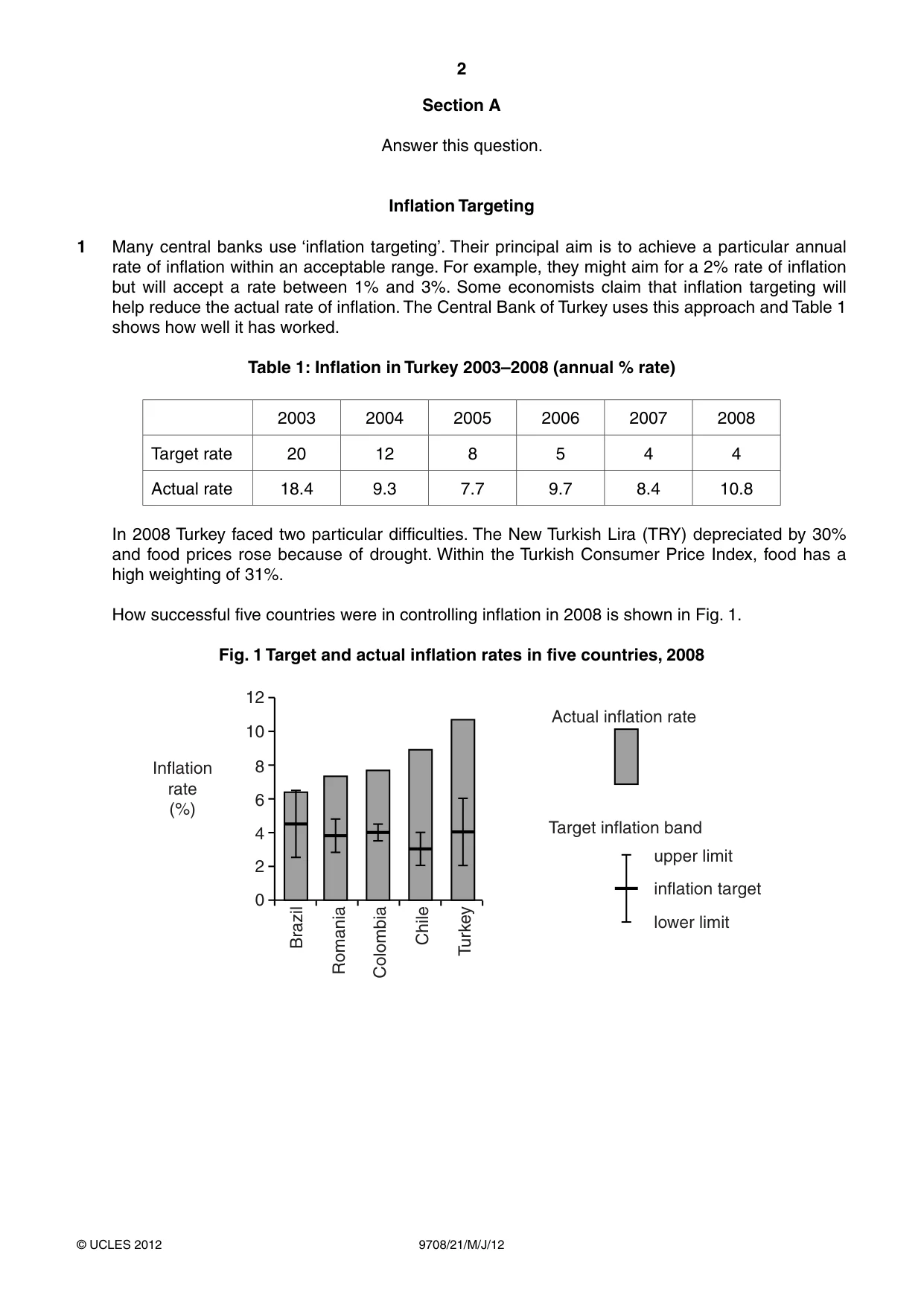
2 9708/21/M/J/12 © UCLES 2012 Section A Answer this question. Inflation Targeting 1 Many central banks use ‘inflation targeting’. Their principal aim is to achieve a particular annual rate of inflation within an acceptable range. For example, they might aim for a 2% rate of inflation but will accept a rate between 1% and 3%. Some economists claim that inflation targeting will help reduce the actual rate of inflation. The Central Bank of Turkey uses this approach and Table 1 shows how well it has worked. Table 1: Inflation in Turkey 2003–2008 (annual % rate) 2003 2004 2005 2006 2007 2008 Target rate 20 12 8 5 4 4 Actual rate 18.4 9.3 7.7 9.7 8.4 10.8 In 2008 Turkey faced two particular difficulties. The New Turkish Lira (TRY) depreciated by 30% and food prices rose because of drought. Within the Turkish Consumer Price Index, food has a high weighting of 31%. How successful five countries were in controlling inflation in 2008 is shown in Fig. 1. Fig. 1 Target and actual inflation rates in five countries, 2008 12 10 8 6 Inflation rate (%) 4 2 0 Brazil Romania Colombia Chile Turkey Actual inflation rate Target inflation band upper limit inflation target lower limit
Question paper, page 3
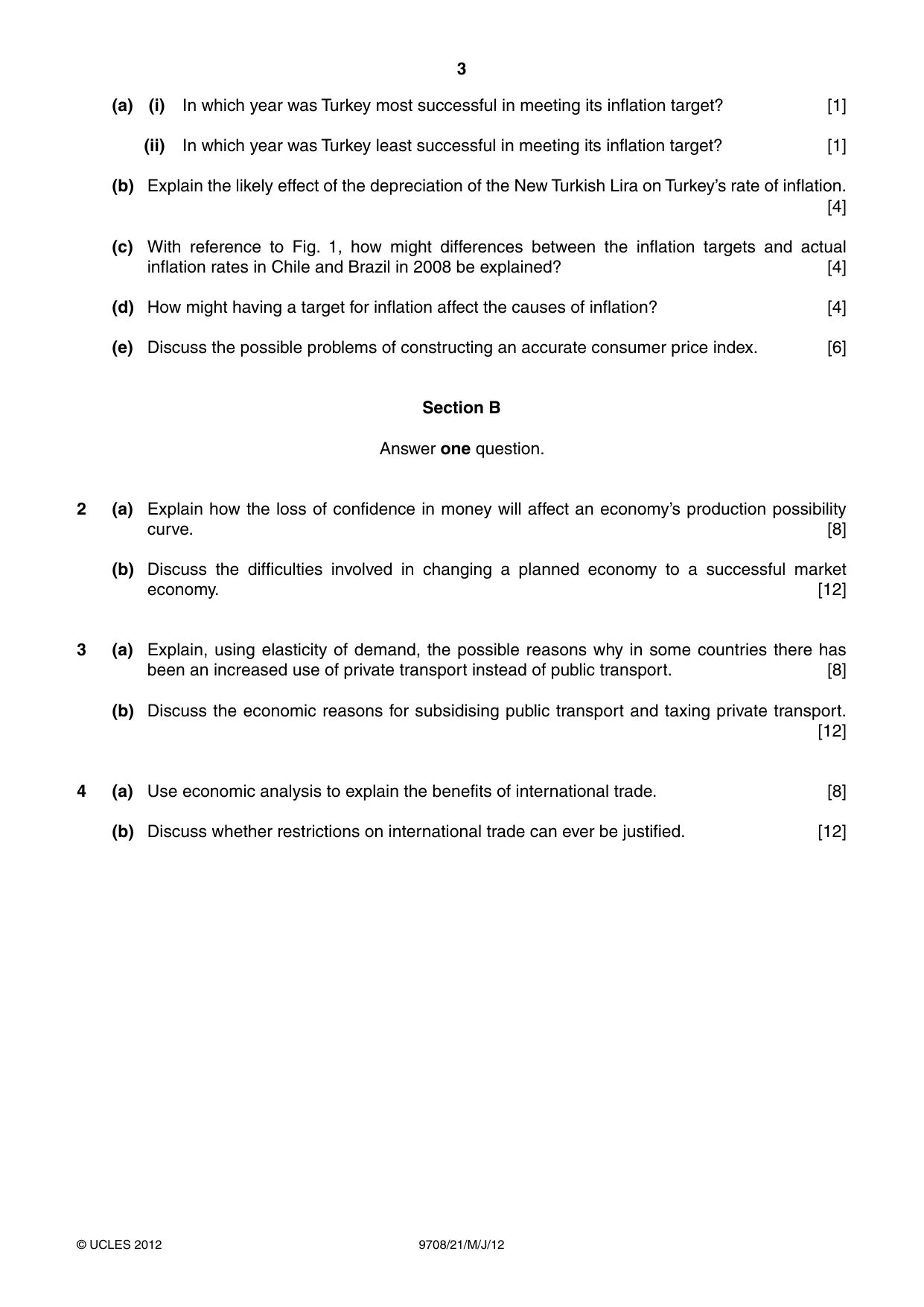
3 9708/21/M/J/12 © UCLES 2012 (a) (i) In which year was Turkey most successful in meeting its inflation target? [1] (ii) In which year was Turkey least successful in meeting its inflation target? [1] (b) Explain the likely effect of the depreciation of the New Turkish Lira on Turkey’s rate of inflation. [4] (c) With reference to Fig. 1, how might differences between the inflation targets and actual inflation rates in Chile and Brazil in 2008 be explained? [4] (d) How might having a target for inflation affect the causes of inflation? [4] (e) Discuss the possible problems of constructing an accurate consumer price index. [6] Section B Answer one question. 2 (a) Explain how the loss of confidence in money will affect an economy’s production possibility curve. [8] (b) Discuss the difficulties involved in changing a planned economy to a successful market economy. [12] 3 (a) Explain, using elasticity of demand, the possible reasons why in some countries there has been an increased use of private transport instead of public transport. [8] (b) Discuss the economic reasons for subsidising public transport and taxing private transport. [12] 4 (a) Use economic analysis to explain the benefits of international trade. [8] (b) Discuss whether restrictions on international trade can ever be justified. [12]
Question paper, page 4
4 9708/21/M/J/12 © UCLES 2012 BLANK PAGE Copyright Acknowledgements: Question 1 © Durmus Yilmaz; Turkey’s Monetary & Exchange Rate Policy for 2009 ; Bank for International Settlements Review; March 2009; www.bis.org/review/r09-115d.pdf. Permission to reproduce items where third-party owned material protected by copyright is included has been sought and cleared where possible. Every reasonable effort has been made by the publisher (UCLES) to trace copyright holders, but if any items requiring clearance have unwittingly been included, the publisher will be pleased to make amends at the earliest possible opportunity. University of Cambridge International Examinations is part of the Cambridge Assessment Group. Cambridge Assessment is the brand name of University of Cambridge Local Examinations Syndicate (UCLES), which is itself a department of the University of Cambridge.
Mark scheme, page 1
UNIVERSITY OF CAMBRIDGE INTERNATIONAL EXAMINATIONS GCE Advanced Subsidiary Level and GCE Advanced Level MARK SCHEME for the May/June 2012 question paper for the guidance of teachers 9708 ECONOMICS 9708/21 Paper 2 (Data Response and Essay – Core), maximum raw mark 40 This mark scheme is published as an aid to teachers and candidates, to indicate the requirements of the examination. It shows the basis on which Examiners were instructed to award marks. It does not indicate the details of the discussions that took place at an Examiners’ meeting before marking began, which would have considered the acceptability of alternative answers. Mark schemes must be read in conjunction with the question papers and the report on the examination. • Cambridge will not enter into discussions or correspondence in connection with these mark schemes. Cambridge is publishing the mark schemes for the May/June 2012 question papers for most IGCSE, GCE Advanced Level and Advanced Subsidiary Level syllabuses and some Ordinary Level syllabuses.
Mark scheme, page 2
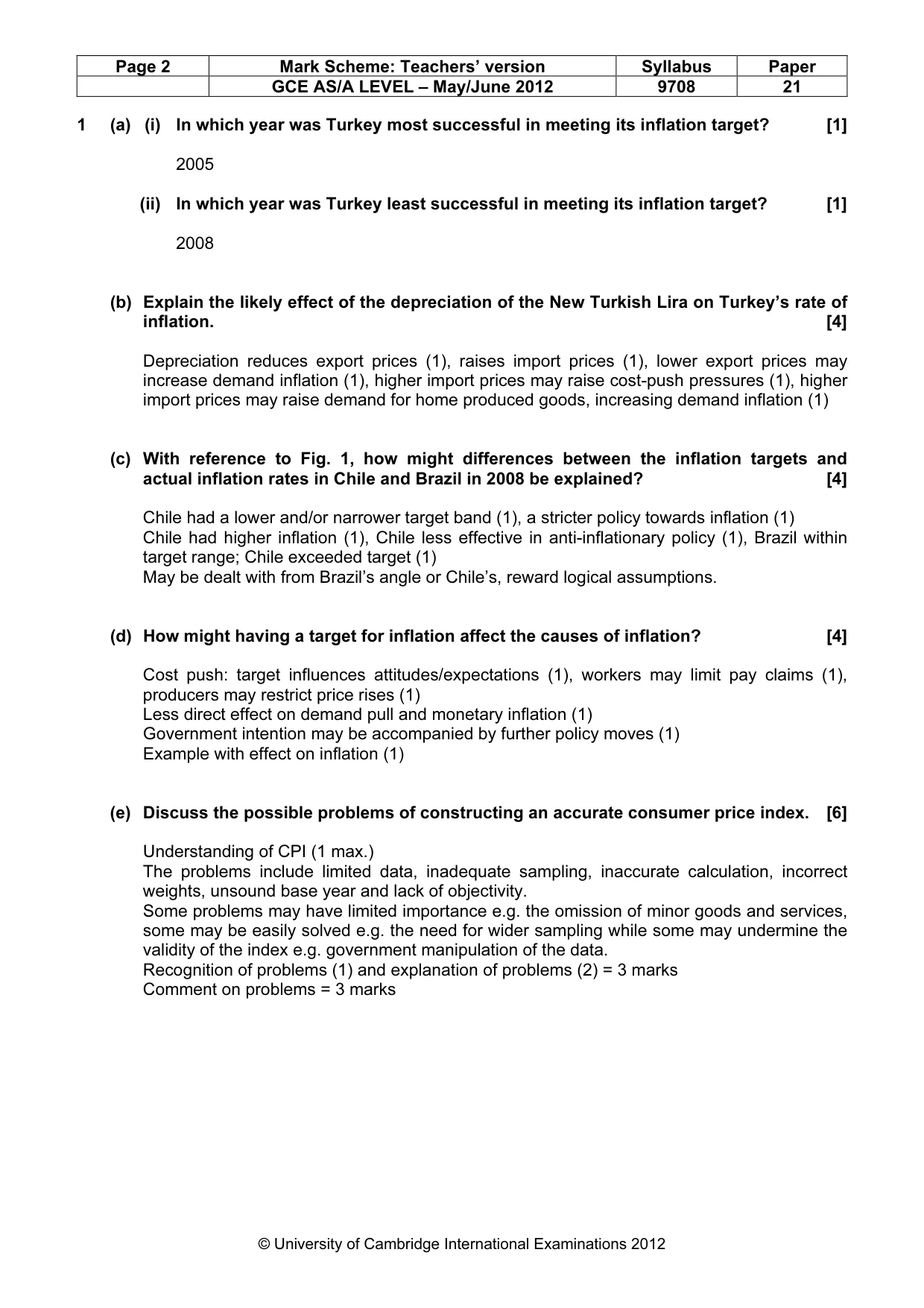
Page 2 Mark Scheme: Teachers’ version Syllabus Paper GCE AS/A LEVEL – May/June 2012 9708 21 © University of Cambridge International Examinations 2012 1 (a) (i) In which year was Turkey most successful in meeting its inflation target? [1] 2005 (ii) In which year was Turkey least successful in meeting its inflation target? [1] 2008 (b) Explain the likely effect of the depreciation of the New Turkish Lira on Turkey’s rate of inflation. [4] Depreciation reduces export prices (1), raises import prices (1), lower export prices may increase demand inflation (1), higher import prices may raise cost-push pressures (1), higher import prices may raise demand for home produced goods, increasing demand inflation (1) (c) With reference to Fig. 1, how might differences between the inflation targets and actual inflation rates in Chile and Brazil in 2008 be explained? [4] Chile had a lower and/or narrower target band (1), a stricter policy towards inflation (1) Chile had higher inflation (1), Chile less effective in anti-inflationary policy (1), Brazil within target range; Chile exceeded target (1) May be dealt with from Brazil’s angle or Chile’s, reward logical assumptions. (d) How might having a target for inflation affect the causes of inflation? [4] Cost push: target influences attitudes/expectations (1), workers may limit pay claims (1), producers may restrict price rises (1) Less direct effect on demand pull and monetary inflation (1) Government intention may be accompanied by further policy moves (1) Example with effect on inflation (1) (e) Discuss the possible problems of constructing an accurate consumer price index. [6] Understanding of CPI (1 max.) The problems include limited data, inadequate sampling, inaccurate calculation, incorrect weights, unsound base year and lack of objectivity. Some problems may have limited importance e.g. the omission of minor goods and services, some may be easily solved e.g. the need for wider sampling while some may undermine the validity of the index e.g. government manipulation of the data. Recognition of problems (1) and explanation of problems (2) = 3 marks Comment on problems = 3 marks
Mark scheme, page 3
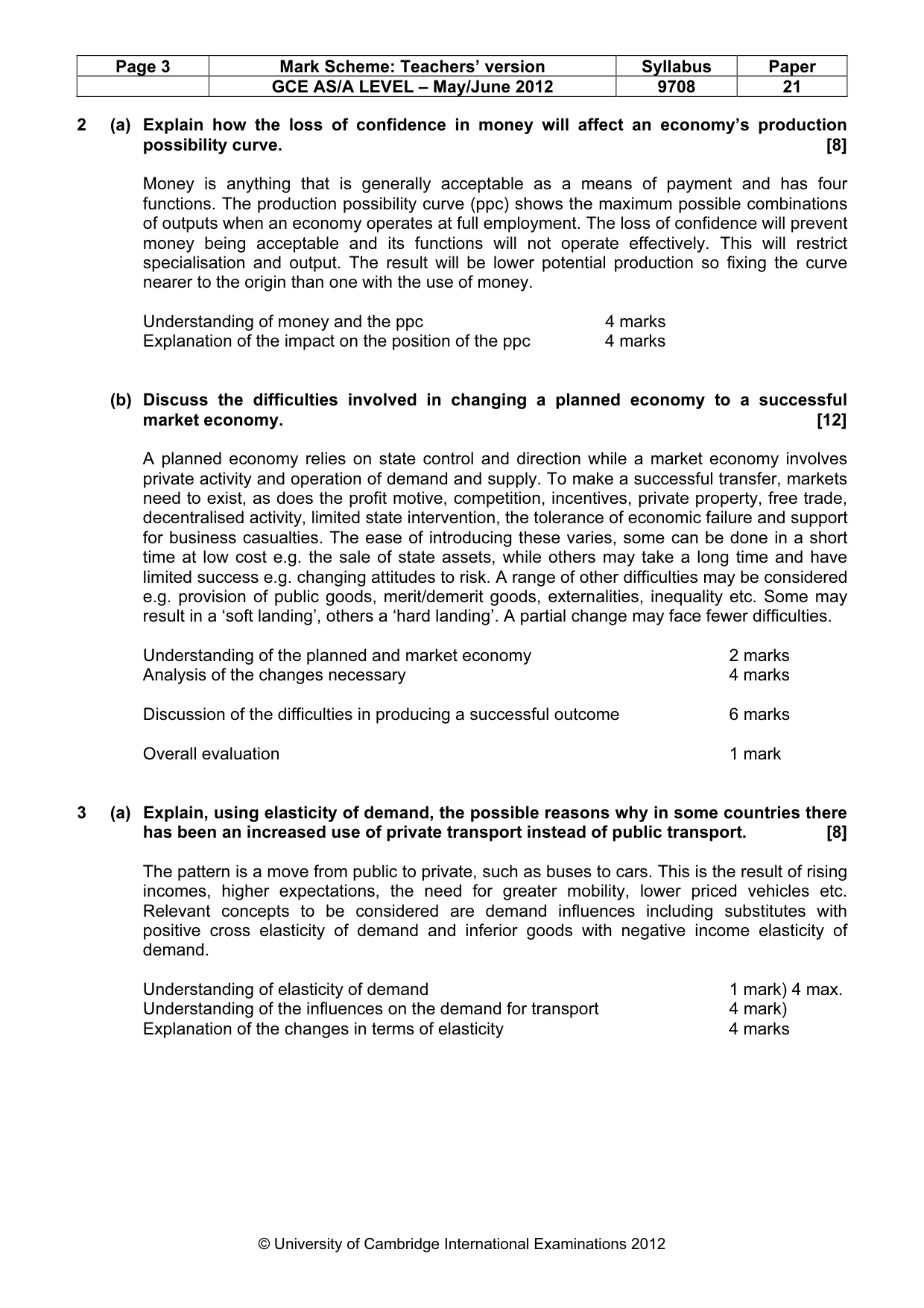
Page 3 Mark Scheme: Teachers’ version Syllabus Paper GCE AS/A LEVEL – May/June 2012 9708 21 © University of Cambridge International Examinations 2012 2 (a) Explain how the loss of confidence in money will affect an economy’s production possibility curve. [8] Money is anything that is generally acceptable as a means of payment and has four functions. The production possibility curve (ppc) shows the maximum possible combinations of outputs when an economy operates at full employment. The loss of confidence will prevent money being acceptable and its functions will not operate effectively. This will restrict specialisation and output. The result will be lower potential production so fixing the curve nearer to the origin than one with the use of money. Understanding of money and the ppc 4 marks Explanation of the impact on the position of the ppc 4 marks (b) Discuss the difficulties involved in changing a planned economy to a successful market economy. [12] A planned economy relies on state control and direction while a market economy involves private activity and operation of demand and supply. To make a successful transfer, markets need to exist, as does the profit motive, competition, incentives, private property, free trade, decentralised activity, limited state intervention, the tolerance of economic failure and support for business casualties. The ease of introducing these varies, some can be done in a short time at low cost e.g. the sale of state assets, while others may take a long time and have limited success e.g. changing attitudes to risk. A range of other difficulties may be considered e.g. provision of public goods, merit/demerit goods, externalities, inequality etc. Some may result in a ‘soft landing’, others a ‘hard landing’. A partial change may face fewer difficulties. Understanding of the planned and market economy 2 marks Analysis of the changes necessary 4 marks Discussion of the difficulties in producing a successful outcome 6 marks Overall evaluation 1 mark 3 (a) Explain, using elasticity of demand, the possible reasons why in some countries there has been an increased use of private transport instead of public transport. [8] The pattern is a move from public to private, such as buses to cars. This is the result of rising incomes, higher expectations, the need for greater mobility, lower priced vehicles etc. Relevant concepts to be considered are demand influences including substitutes with positive cross elasticity of demand and inferior goods with negative income elasticity of demand. Understanding of elasticity of demand 1 mark) 4 max. Understanding of the influences on the demand for transport 4 mark) Explanation of the changes in terms of elasticity 4 marks
Mark scheme, page 4
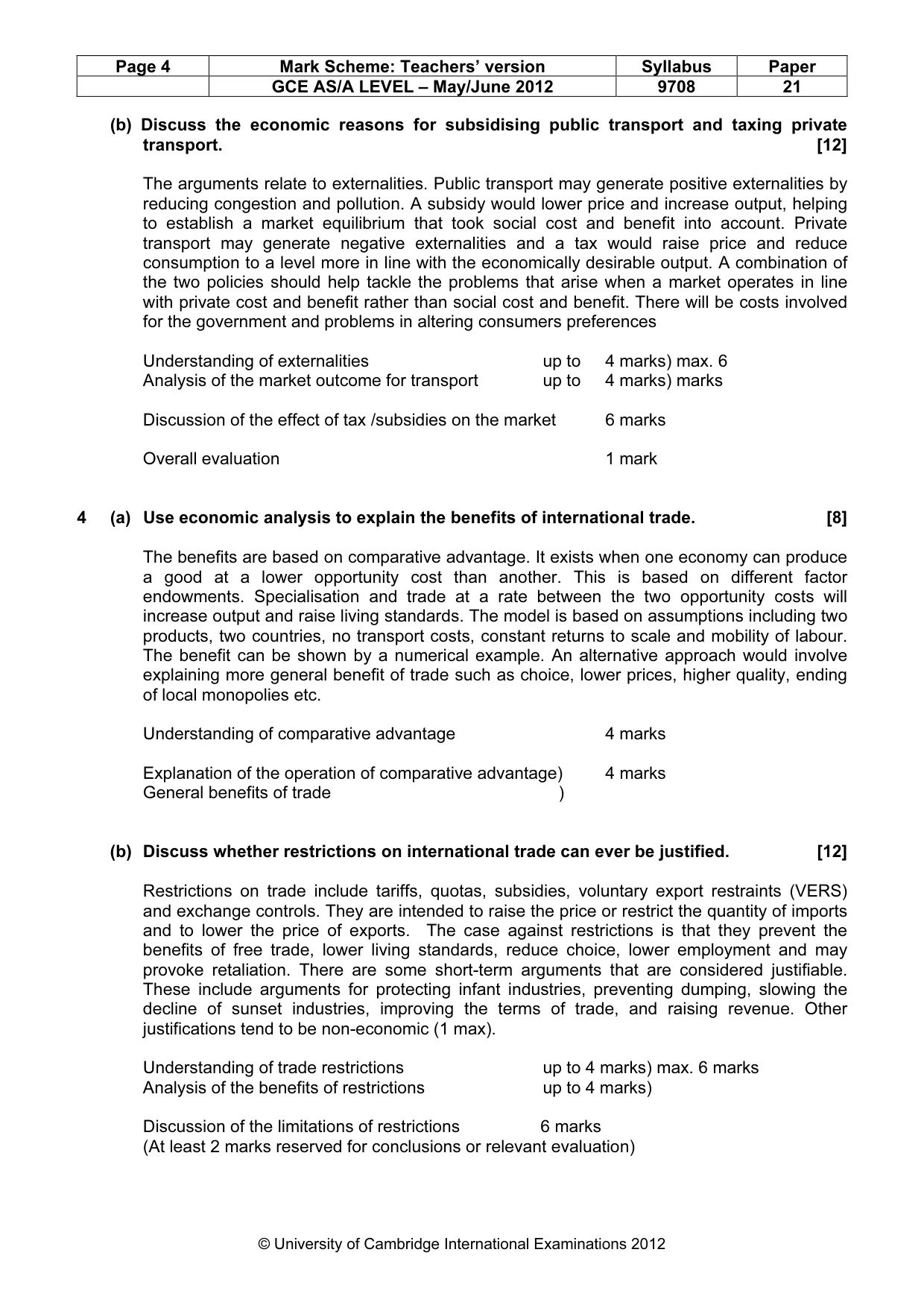
Page 4 Mark Scheme: Teachers’ version Syllabus Paper GCE AS/A LEVEL – May/June 2012 9708 21 © University of Cambridge International Examinations 2012 (b) Discuss the economic reasons for subsidising public transport and taxing private transport. [12] The arguments relate to externalities. Public transport may generate positive externalities by reducing congestion and pollution. A subsidy would lower price and increase output, helping to establish a market equilibrium that took social cost and benefit into account. Private transport may generate negative externalities and a tax would raise price and reduce consumption to a level more in line with the economically desirable output. A combination of the two policies should help tackle the problems that arise when a market operates in line with private cost and benefit rather than social cost and benefit. There will be costs involved for the government and problems in altering consumers preferences Understanding of externalities up to 4 marks) max. 6 Analysis of the market outcome for transport up to 4 marks) marks Discussion of the effect of tax /subsidies on the market 6 marks Overall evaluation 1 mark 4 (a) Use economic analysis to explain the benefits of international trade. [8] The benefits are based on comparative advantage. It exists when one economy can produce a good at a lower opportunity cost than another. This is based on different factor endowments. Specialisation and trade at a rate between the two opportunity costs will increase output and raise living standards. The model is based on assumptions including two products, two countries, no transport costs, constant returns to scale and mobility of labour. The benefit can be shown by a numerical example. An alternative approach would involve explaining more general benefit of trade such as choice, lower prices, higher quality, ending of local monopolies etc. Understanding of comparative advantage 4 marks Explanation of the operation of comparative advantage) 4 marks General benefits of trade ) (b) Discuss whether restrictions on international trade can ever be justified. [12] Restrictions on trade include tariffs, quotas, subsidies, voluntary export restraints (VERS) and exchange controls. They are intended to raise the price or restrict the quantity of imports and to lower the price of exports. The case against restrictions is that they prevent the benefits of free trade, lower living standards, reduce choice, lower employment and may provoke retaliation. There are some short-term arguments that are considered justifiable. These include arguments for protecting infant industries, preventing dumping, slowing the decline of sunset industries, improving the terms of trade, and raising revenue. Other justifications tend to be non-economic (1 max). Understanding of trade restrictions up to 4 marks) max. 6 marks Analysis of the benefits of restrictions up to 4 marks) Discussion of the limitations of restrictions 6 marks (At least 2 marks reserved for conclusions or relevant evaluation)
What you needed in this session
Cambridge’s own grade thresholds for 2012 May/June, Paper 2 · Variant 1. A higher threshold means an easier paper — the bar moves with how the cohort did.