Cambridge A Level Economics 9708 — 2010 May/June Paper 2 · Variant 1
9708/21/M/J/10 · 40 marks · ≈45 min
The question paper and its mark scheme, free to read here and free to download. This is Cambridge’s own paper, exactly as it was sat.
Question paper4 pages

Mark scheme5 pages
Answers below. Sit the paper first if you are practising.
Paper as text
Question paper, page 1
This document consists of 4 printed pages. DC (SM/SW) 17091/2 © UCLES 2010 [Turn over UNIVERSITY OF CAMBRIDGE INTERNATIONAL EXAMINATIONS General Certificate of Education Advanced Subsidiary Level and Advanced Level READ THESE INSTRUCTIONS FIRST If you have been given an Answer Booklet, follow the instructions on the front cover of the Booklet. Write your Centre number, candidate number and name on all the work you hand in. Write in dark blue or black pen. You may use a soft pencil for any diagrams, graphs or rough working. Do not use staples, paper clips, highlighters, glue or correction fluid. Section A Answer this question. Brief answers only are required. Section B Answer any one question. You may answer with reference to your own economy or other economies that you have studied where relevant to the question. At the end of the examination, fasten all your work securely together. The number of marks is given in brackets [ ] at the end of each question or part question. * 0 9 3 2 1 0 0 3 1 0 * ECONOMICS 9708/21 Paper 2 Data Response and Essay (Core) May/June 2010 1 hour 30 minutes Additional Materials: Answer Booklet/Paper
Question paper, page 2
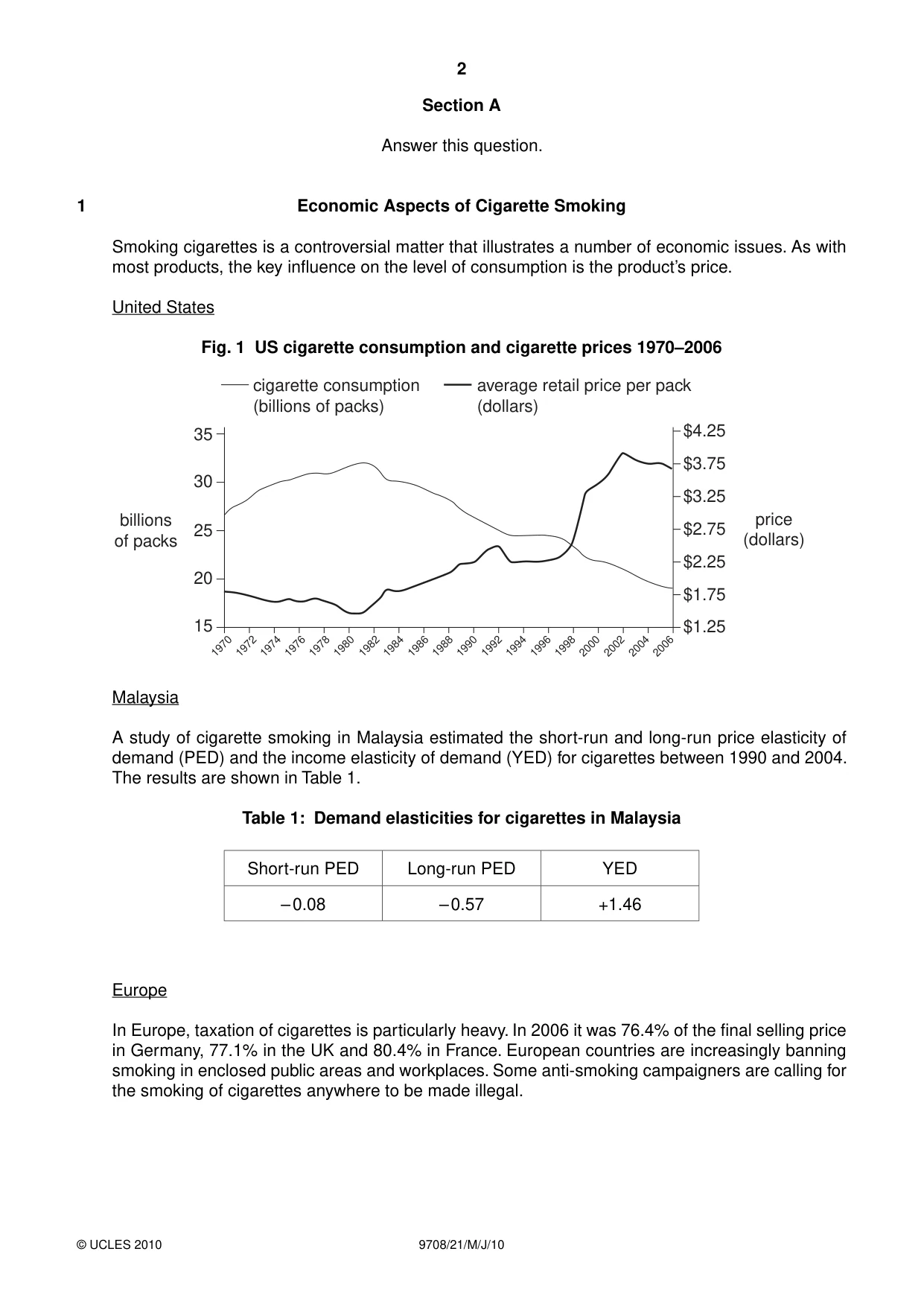
2 9708/21/M/J/10 © UCLES 2010 Section A Answer this question. 1 Economic Aspects of Cigarette Smoking Smoking cigarettes is a controversial matter that illustrates a number of economic issues. As with most products, the key influence on the level of consumption is the product’s price. United States Fig. 1 US cigarette consumption and cigarette prices 1970–2006 35 $4.25 $3.75 $3.25 price (dollars) billions of packs cigarette consumption (billions of packs) average retail price per pack (dollars) $2.75 $2.25 $1.75 $1.25 30 25 20 15 1970 1972 1974 1976 1978 1980 1982 1984 1986 1988 1990 1992 1994 1996 1998 2000 2002 2004 2006 Malaysia A study of cigarette smoking in Malaysia estimated the short-run and long-run price elasticity of demand (PED) and the income elasticity of demand (YED) for cigarettes between 1990 and 2004. The results are shown in Table 1. Table 1: Demand elasticities for cigarettes in Malaysia Short-run PED Long-run PED YED – 0.08 – 0.57 +1.46 Europe In Europe, taxation of cigarettes is particularly heavy. In 2006 it was 76.4% of the final selling price in Germany, 77.1% in the UK and 80.4% in France. European countries are increasingly banning smoking in enclosed public areas and workplaces. Some anti-smoking campaigners are calling for the smoking of cigarettes anywhere to be made illegal.
Question paper, page 3
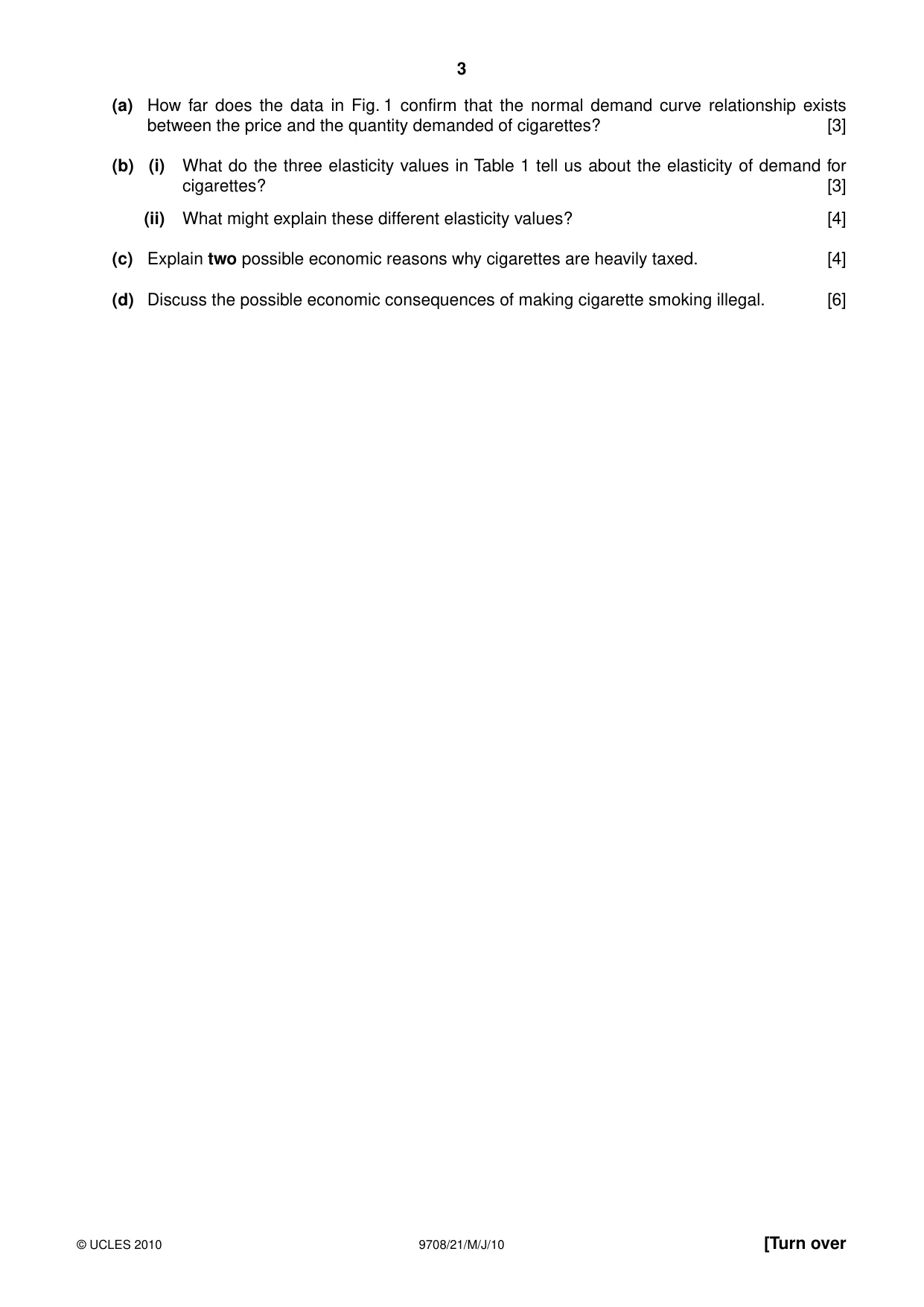
3 9708/21/M/J/10 © UCLES 2010 [Turn over (a) How far does the data in Fig. 1 confirm that the normal demand curve relationship exists between the price and the quantity demanded of cigarettes? [3] (b) (i) What do the three elasticity values in Table 1 tell us about the elasticity of demand for cigarettes? [3] (ii) What might explain these different elasticity values? [4] (c) Explain two possible economic reasons why cigarettes are heavily taxed. [4] (d) Discuss the possible economic consequences of making cigarette smoking illegal. [6]
Question paper, page 4
4 9708/21/M/J/10 © UCLES 2010 Section B Answer one question. 2 (a) Explain how division of labour can affect labour productivity. [8] (b) Discuss how the operation of a barter economy would be affected by the introduction of money. [12] 3 (a) ‘A free market price operates as a rationing and allocating mechanism.’ Explain how it does this. [8] (b) Discuss why certain goods and services are usually supplied directly by the government rather than through the market. [12] 4 (a) With the aid of a diagram, explain why an economy’s floating exchange rate may depreciate. [8] (b) Discuss whether a current account deficit is always a serious economic problem for a country. [12] Copyright Acknowledgements: Question 1 © Raising cigarette taxes reduces smoking especially among kids and the cigarette companies know it; http://tobaccofreekids.org; 2/01/2008. Question 1 © Ross & Al Sadat; Demand analysis of tobacco consumption in Malaysia; Nicotine and Tobacco Research; Vol. 9, Issue 11, November 2007. Permission to reproduce items where third-party owned material protected by copyright is included has been sought and cleared where possible. Every reasonable effort has been made by the publisher (UCLES) to trace copyright holders, but if any items requiring clearance have unwittingly been included, the publisher will be pleased to make amends at the earliest possible opportunity. University of Cambridge International Examinations is part of the Cambridge Assessment Group. Cambridge Assessment is the brand name of University of Cambridge Local Examinations Syndicate (UCLES), which is itself a department of the University of Cambridge.
Mark scheme, page 1
UNIVERSITY OF CAMBRIDGE INTERNATIONAL EXAMINATIONS GCE Advanced Subsidiary Level and GCE Advanced Level MARK SCHEME for the May/June 2010 question paper for the guidance of teachers 9708 ECONOMICS 9708/21 Paper 21 (Data Response and Essay), maximum raw mark 40 This mark scheme is published as an aid to teachers and candidates, to indicate the requirements of the examination. It shows the basis on which Examiners were instructed to award marks. It does not indicate the details of the discussions that took place at an Examiners’ meeting before marking began, which would have considered the acceptability of alternative answers. Mark schemes must be read in conjunction with the question papers and the report on the examination. • CIE will not enter into discussions or correspondence in connection with these mark schemes. CIE is publishing the mark schemes for the May/June 2010 question papers for most IGCSE, GCE Advanced Level and Advanced Subsidiary Level syllabuses and some Ordinary Level syllabuses.
Mark scheme, page 2
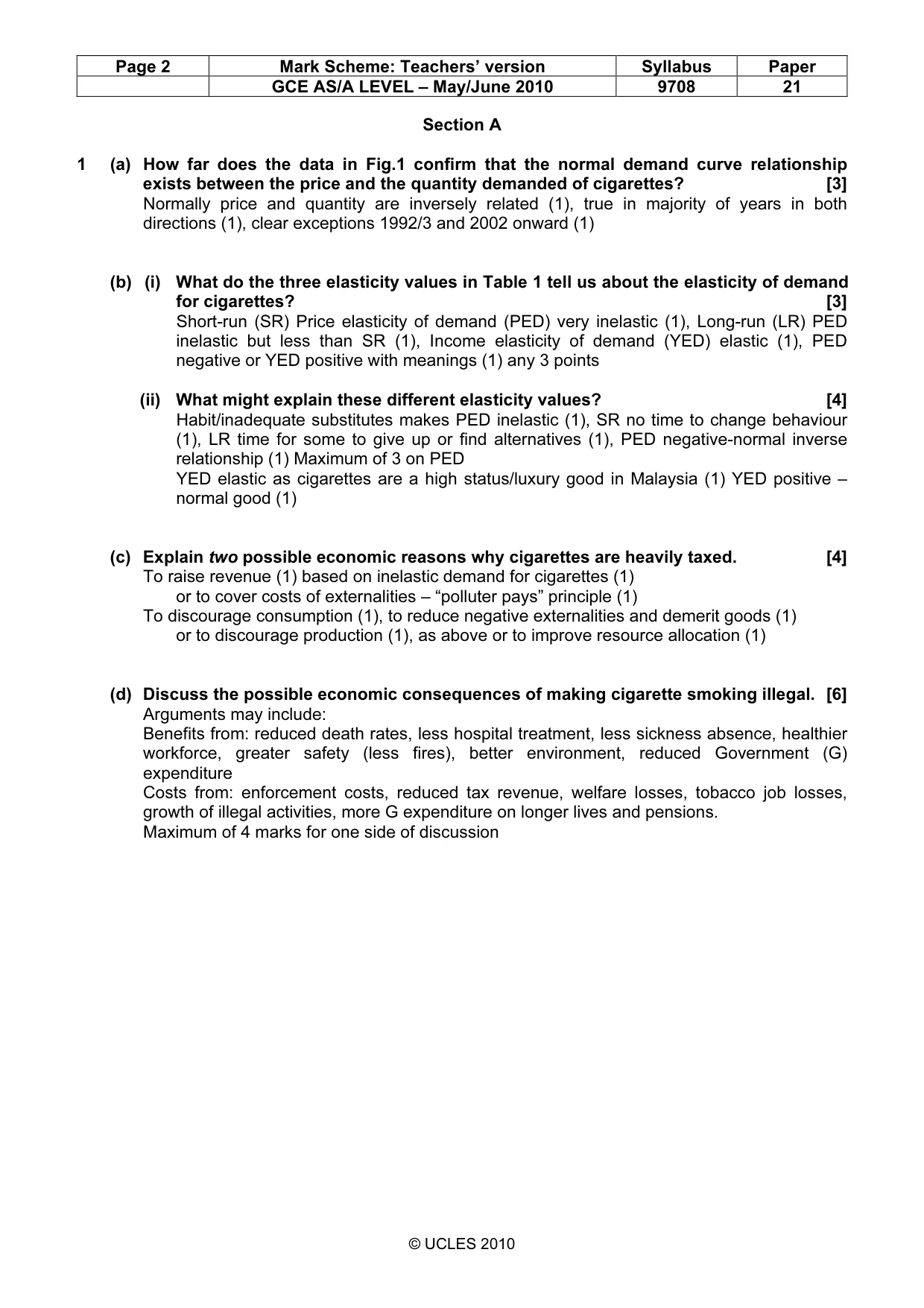
Page 2 Mark Scheme: Teachers’ version Syllabus Paper GCE AS/A LEVEL – May/June 2010 9708 21 © UCLES 2010 Section A 1 (a) How far does the data in Fig.1 confirm that the normal demand curve relationship exists between the price and the quantity demanded of cigarettes? [3] Normally price and quantity are inversely related (1), true in majority of years in both directions (1), clear exceptions 1992/3 and 2002 onward (1) (b) (i) What do the three elasticity values in Table 1 tell us about the elasticity of demand for cigarettes? [3] Short-run (SR) Price elasticity of demand (PED) very inelastic (1), Long-run (LR) PED inelastic but less than SR (1), Income elasticity of demand (YED) elastic (1), PED negative or YED positive with meanings (1) any 3 points (ii) What might explain these different elasticity values? [4] Habit/inadequate substitutes makes PED inelastic (1), SR no time to change behaviour (1), LR time for some to give up or find alternatives (1), PED negative-normal inverse relationship (1) Maximum of 3 on PED YED elastic as cigarettes are a high status/luxury good in Malaysia (1) YED positive – normal good (1) (c) Explain two possible economic reasons why cigarettes are heavily taxed. [4] To raise revenue (1) based on inelastic demand for cigarettes (1) or to cover costs of externalities – “polluter pays” principle (1) To discourage consumption (1), to reduce negative externalities and demerit goods (1) or to discourage production (1), as above or to improve resource allocation (1) (d) Discuss the possible economic consequences of making cigarette smoking illegal. [6] Arguments may include: Benefits from: reduced death rates, less hospital treatment, less sickness absence, healthier workforce, greater safety (less fires), better environment, reduced Government (G) expenditure Costs from: enforcement costs, reduced tax revenue, welfare losses, tobacco job losses, growth of illegal activities, more G expenditure on longer lives and pensions. Maximum of 4 marks for one side of discussion
Mark scheme, page 3
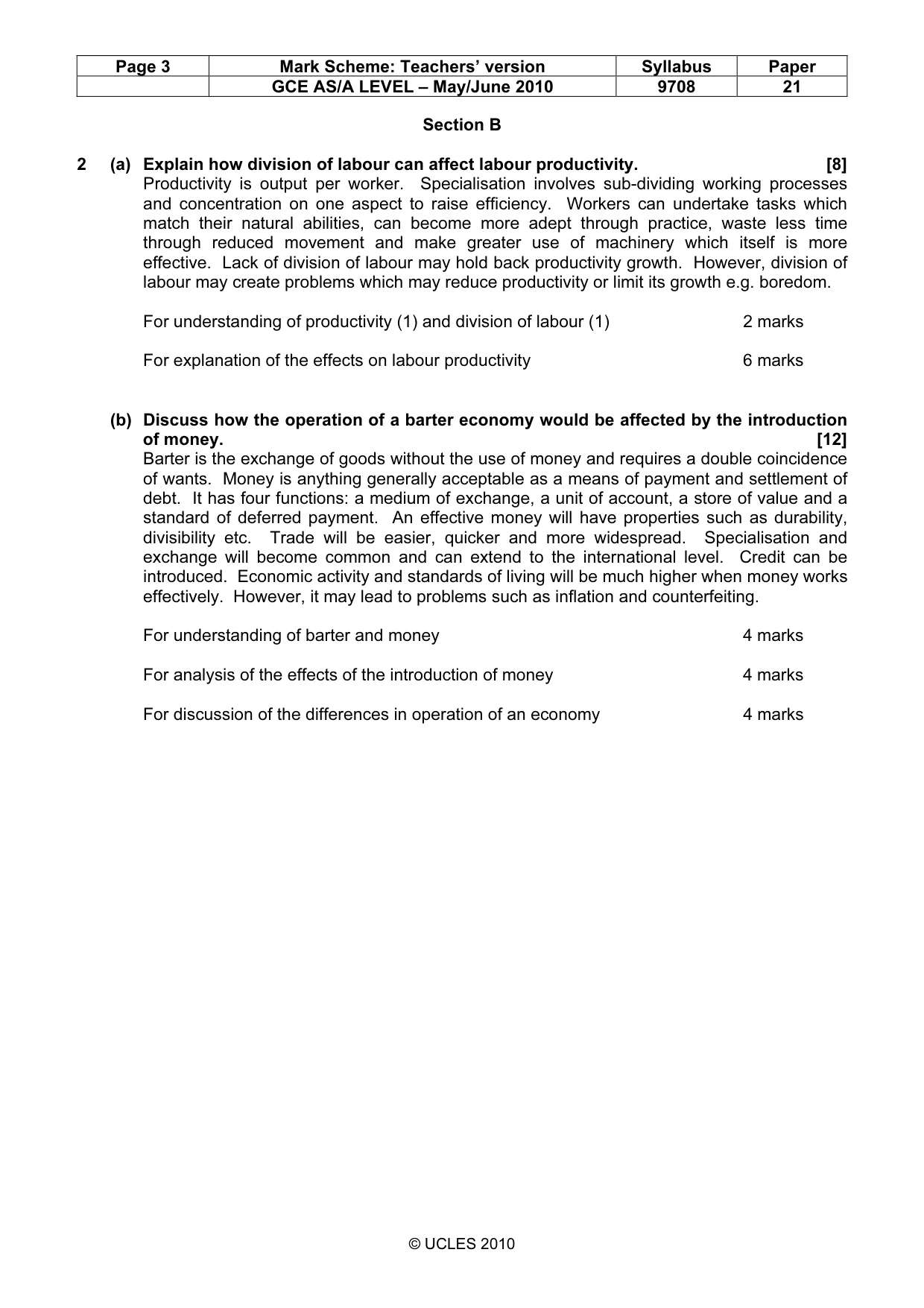
Page 3 Mark Scheme: Teachers’ version Syllabus Paper GCE AS/A LEVEL – May/June 2010 9708 21 © UCLES 2010 Section B 2 (a) Explain how division of labour can affect labour productivity. [8] Productivity is output per worker. Specialisation involves sub-dividing working processes and concentration on one aspect to raise efficiency. Workers can undertake tasks which match their natural abilities, can become more adept through practice, waste less time through reduced movement and make greater use of machinery which itself is more effective. Lack of division of labour may hold back productivity growth. However, division of labour may create problems which may reduce productivity or limit its growth e.g. boredom. For understanding of productivity (1) and division of labour (1) 2 marks For explanation of the effects on labour productivity 6 marks (b) Discuss how the operation of a barter economy would be affected by the introduction of money. [12] Barter is the exchange of goods without the use of money and requires a double coincidence of wants. Money is anything generally acceptable as a means of payment and settlement of debt. It has four functions: a medium of exchange, a unit of account, a store of value and a standard of deferred payment. An effective money will have properties such as durability, divisibility etc. Trade will be easier, quicker and more widespread. Specialisation and exchange will become common and can extend to the international level. Credit can be introduced. Economic activity and standards of living will be much higher when money works effectively. However, it may lead to problems such as inflation and counterfeiting. For understanding of barter and money 4 marks For analysis of the effects of the introduction of money 4 marks For discussion of the differences in operation of an economy 4 marks
Mark scheme, page 4
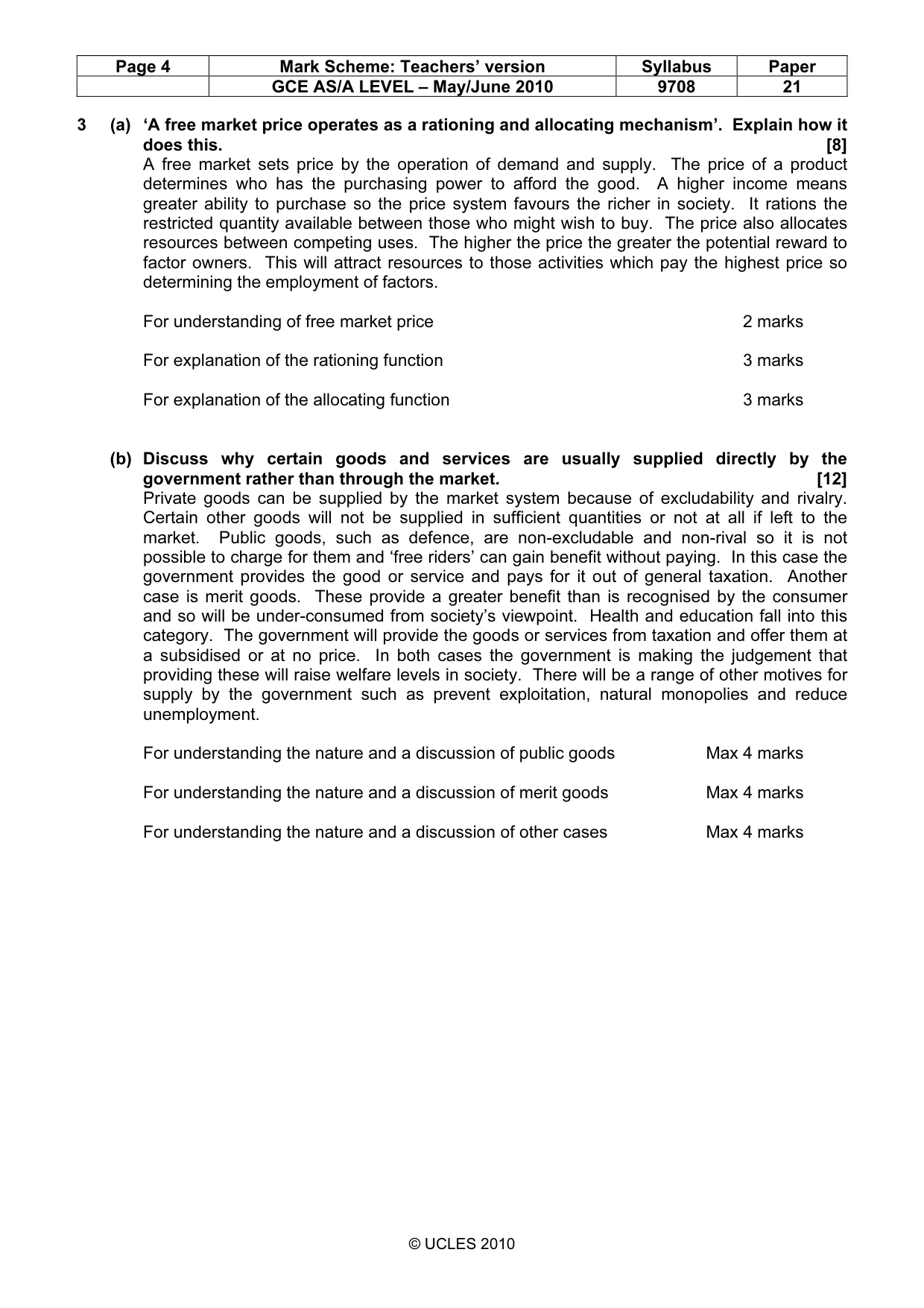
Page 4 Mark Scheme: Teachers’ version Syllabus Paper GCE AS/A LEVEL – May/June 2010 9708 21 © UCLES 2010 3 (a) ‘A free market price operates as a rationing and allocating mechanism’. Explain how it does this. [8] A free market sets price by the operation of demand and supply. The price of a product determines who has the purchasing power to afford the good. A higher income means greater ability to purchase so the price system favours the richer in society. It rations the restricted quantity available between those who might wish to buy. The price also allocates resources between competing uses. The higher the price the greater the potential reward to factor owners. This will attract resources to those activities which pay the highest price so determining the employment of factors. For understanding of free market price 2 marks For explanation of the rationing function 3 marks For explanation of the allocating function 3 marks (b) Discuss why certain goods and services are usually supplied directly by the government rather than through the market. [12] Private goods can be supplied by the market system because of excludability and rivalry. Certain other goods will not be supplied in sufficient quantities or not at all if left to the market. Public goods, such as defence, are non-excludable and non-rival so it is not possible to charge for them and ‘free riders’ can gain benefit without paying. In this case the government provides the good or service and pays for it out of general taxation. Another case is merit goods. These provide a greater benefit than is recognised by the consumer and so will be under-consumed from society’s viewpoint. Health and education fall into this category. The government will provide the goods or services from taxation and offer them at a subsidised or at no price. In both cases the government is making the judgement that providing these will raise welfare levels in society. There will be a range of other motives for supply by the government such as prevent exploitation, natural monopolies and reduce unemployment. For understanding the nature and a discussion of public goods Max 4 marks For understanding the nature and a discussion of merit goods Max 4 marks For understanding the nature and a discussion of other cases Max 4 marks
Mark scheme, page 5
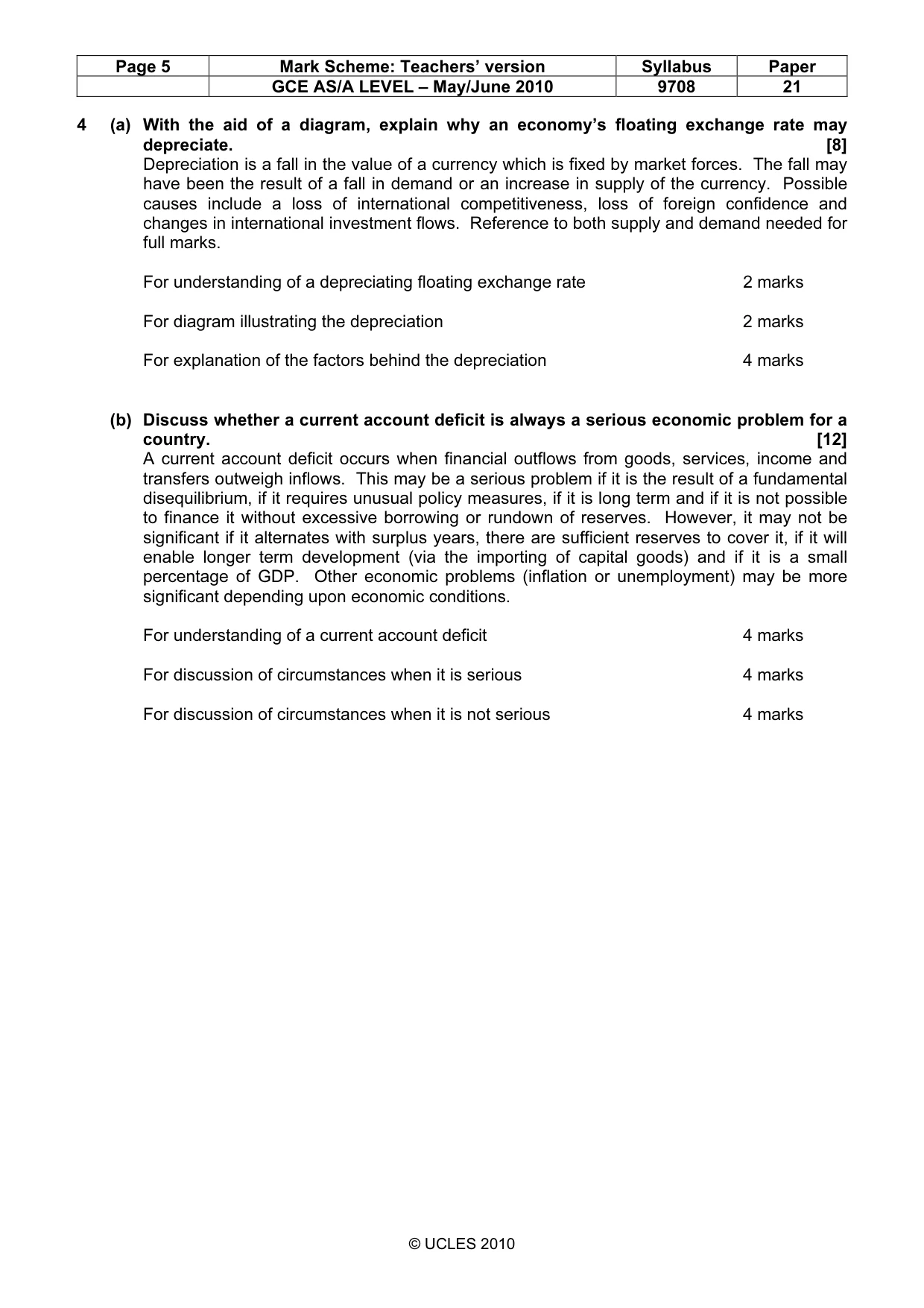
Page 5 Mark Scheme: Teachers’ version Syllabus Paper GCE AS/A LEVEL – May/June 2010 9708 21 © UCLES 2010 4 (a) With the aid of a diagram, explain why an economy’s floating exchange rate may depreciate. [8] Depreciation is a fall in the value of a currency which is fixed by market forces. The fall may have been the result of a fall in demand or an increase in supply of the currency. Possible causes include a loss of international competitiveness, loss of foreign confidence and changes in international investment flows. Reference to both supply and demand needed for full marks. For understanding of a depreciating floating exchange rate 2 marks For diagram illustrating the depreciation 2 marks For explanation of the factors behind the depreciation 4 marks (b) Discuss whether a current account deficit is always a serious economic problem for a country. [12] A current account deficit occurs when financial outflows from goods, services, income and transfers outweigh inflows. This may be a serious problem if it is the result of a fundamental disequilibrium, if it requires unusual policy measures, if it is long term and if it is not possible to finance it without excessive borrowing or rundown of reserves. However, it may not be significant if it alternates with surplus years, there are sufficient reserves to cover it, if it will enable longer term development (via the importing of capital goods) and if it is a small percentage of GDP. Other economic problems (inflation or unemployment) may be more significant depending upon economic conditions. For understanding of a current account deficit 4 marks For discussion of circumstances when it is serious 4 marks For discussion of circumstances when it is not serious 4 marks
What you needed in this session
Cambridge’s own grade thresholds for 2010 May/June, Paper 2 · Variant 1. A higher threshold means an easier paper — the bar moves with how the cohort did.