Cambridge A Level Economics 9708 — 2009 Oct/Nov Paper 2 · Variant 1
9708/21/O/N/09 · 40 marks · ≈45 min
The question paper and its mark scheme, free to read here and free to download. This is Cambridge’s own paper, exactly as it was sat.
Question paper4 pages


Mark scheme4 pages
Answers below. Sit the paper first if you are practising.
Paper as text
Question paper, page 1
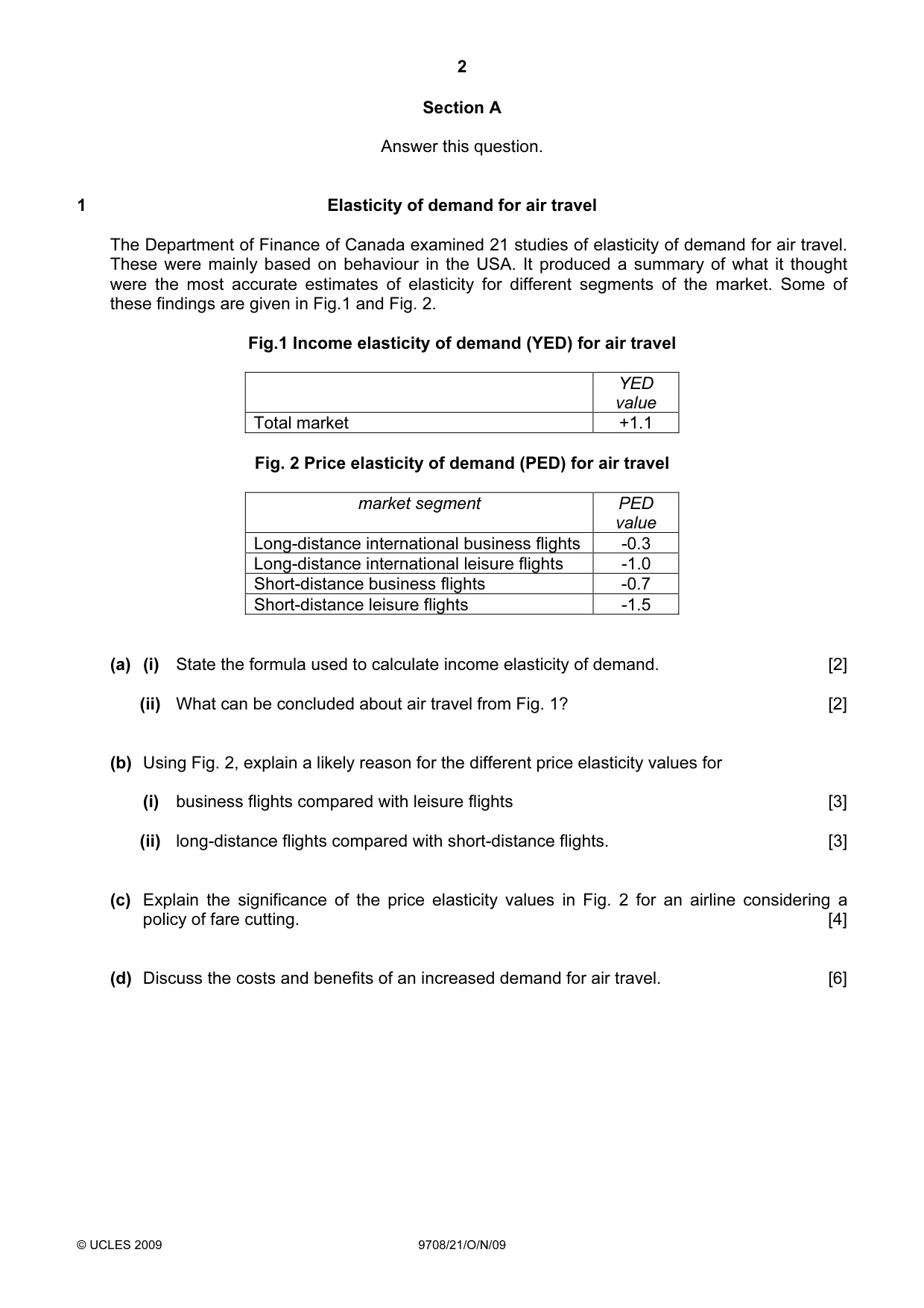
This document consists of 3 printed pages and 1 blank page. IB09 11_9708_21/4RP © UCLES 2009 [Turn over *9023114786* UNIVERSITY OF CAMBRIDGE INTERNATIONAL EXAMINATIONS General Certificate of Education Advanced Subsidiary Level and Advanced Level ECONOMICS 9708/21 Paper 2 Data Response and Essay (Core) October/November 2009 1 hour 30 minutes Additional Materials: Answer Booklet/Paper READ THESE INSTRUCTIONS FIRST If you have been given an Answer Booklet, follow the instructions on the front cover of the Booklet. Write your Centre number, candidate number and name on all the work you hand in. Write in dark blue or black pen. You may use a soft pencil for any diagrams, graphs or rough working. Do not use staples, paper clips, highlighters, glue or correction fluid. Section A Answer this question. Brief answers only are required. Section B Answer any one question. You may answer with reference to your own economy or other economies that you have studied where relevant to the question. At the end of the examination, fasten all your work securely together. The number of marks is given in brackets [ ] at the end of each question or part question.
Question paper, page 2
2 © UCLES 2009 9708/21/O/N/09 Section A Answer this question. 1 Elasticity of demand for air travel The Department of Finance of Canada examined 21 studies of elasticity of demand for air travel. These were mainly based on behaviour in the USA. It produced a summary of what it thought were the most accurate estimates of elasticity for different segments of the market. Some of these findings are given in Fig.1 and Fig. 2. Fig.1 Income elasticity of demand (YED) for air travel YED value Total market +1.1 Fig. 2 Price elasticity of demand (PED) for air travel market segment PED value Long-distance international business flights -0.3 Long-distance international leisure flights -1.0 Short-distance business flights -0.7 Short-distance leisure flights -1.5 (a) (i) State the formula used to calculate income elasticity of demand. [2] (ii) What can be concluded about air travel from Fig. 1? [2] (b) Using Fig. 2, explain a likely reason for the different price elasticity values for (i) business flights compared with leisure flights [3] (ii) long-distance flights compared with short-distance flights. [3] (c) Explain the significance of the price elasticity values in Fig. 2 for an airline considering a policy of fare cutting. [4] (d) Discuss the costs and benefits of an increased demand for air travel. [6]
Question paper, page 3
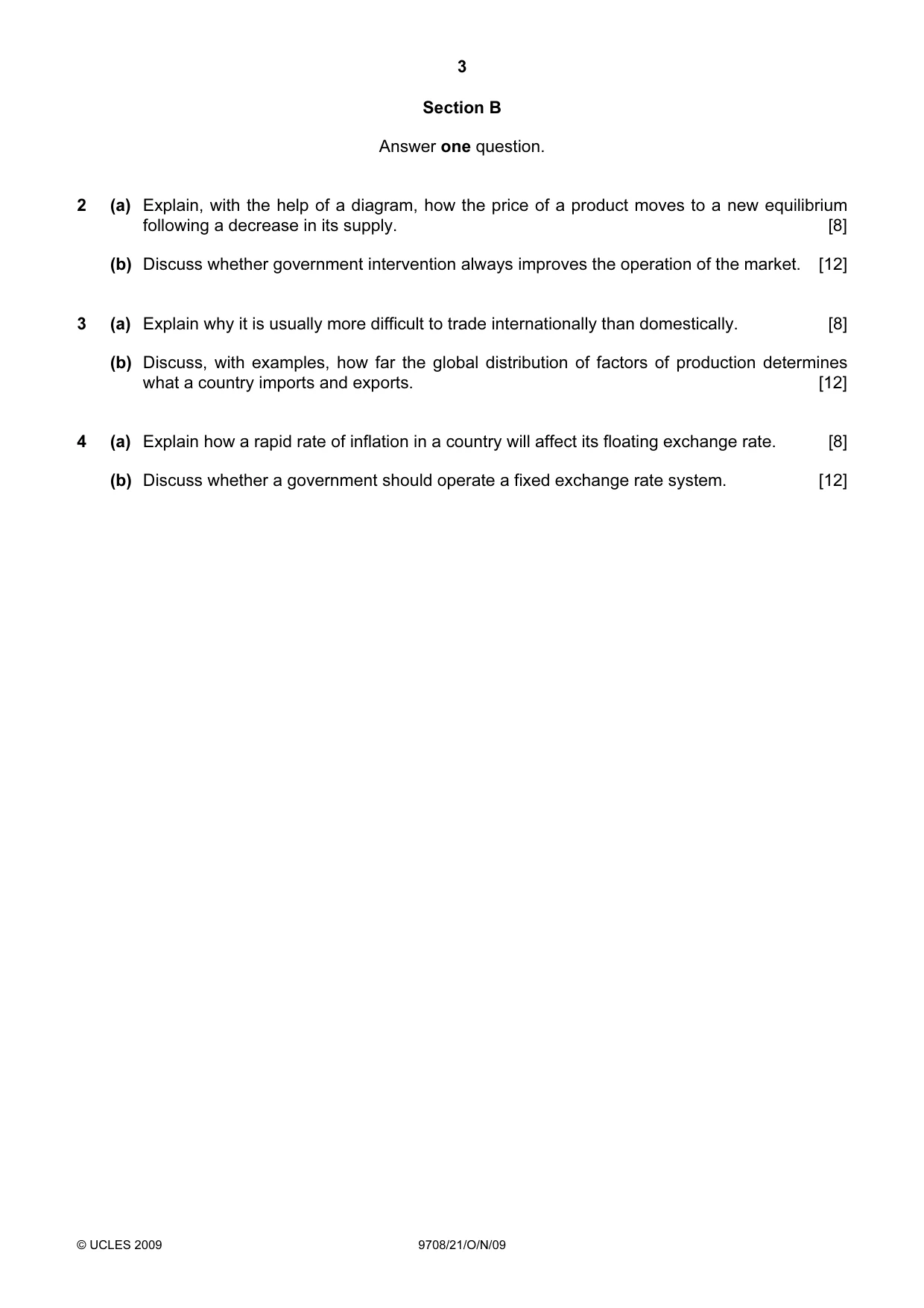
3 © UCLES 2009 9708/21/O/N/09 Section B Answer one question. 2 (a) Explain, with the help of a diagram, how the price of a product moves to a new equilibrium following a decrease in its supply. [8] (b) Discuss whether government intervention always improves the operation of the market. [12] 3 (a) Explain why it is usually more difficult to trade internationally than domestically. [8] (b) Discuss, with examples, how far the global distribution of factors of production determines what a country imports and exports. [12] 4 (a) Explain how a rapid rate of inflation in a country will affect its floating exchange rate. [8] (b) Discuss whether a government should operate a fixed exchange rate system. [12]
Question paper, page 4
4 BLANK PAGE Permission to reproduce items where third-party owned material protected by copyright is included has been sought and cleared where possible. Every reasonable effort has been made by the publisher (UCLES) to trace copyright holders, but if any items requiring clearance have unwittingly been included, the publisher will be pleased to make amends at the earliest possible opportunity. University of Cambridge International Examinations is part of the Cambridge Assessment Group. Cambridge Assessment is the brand name of University of Cambridge Local Examinations Syndicate (UCLES), which is itself a department of the University of Cambridge. 9708/21/O/N/09
Mark scheme, page 1
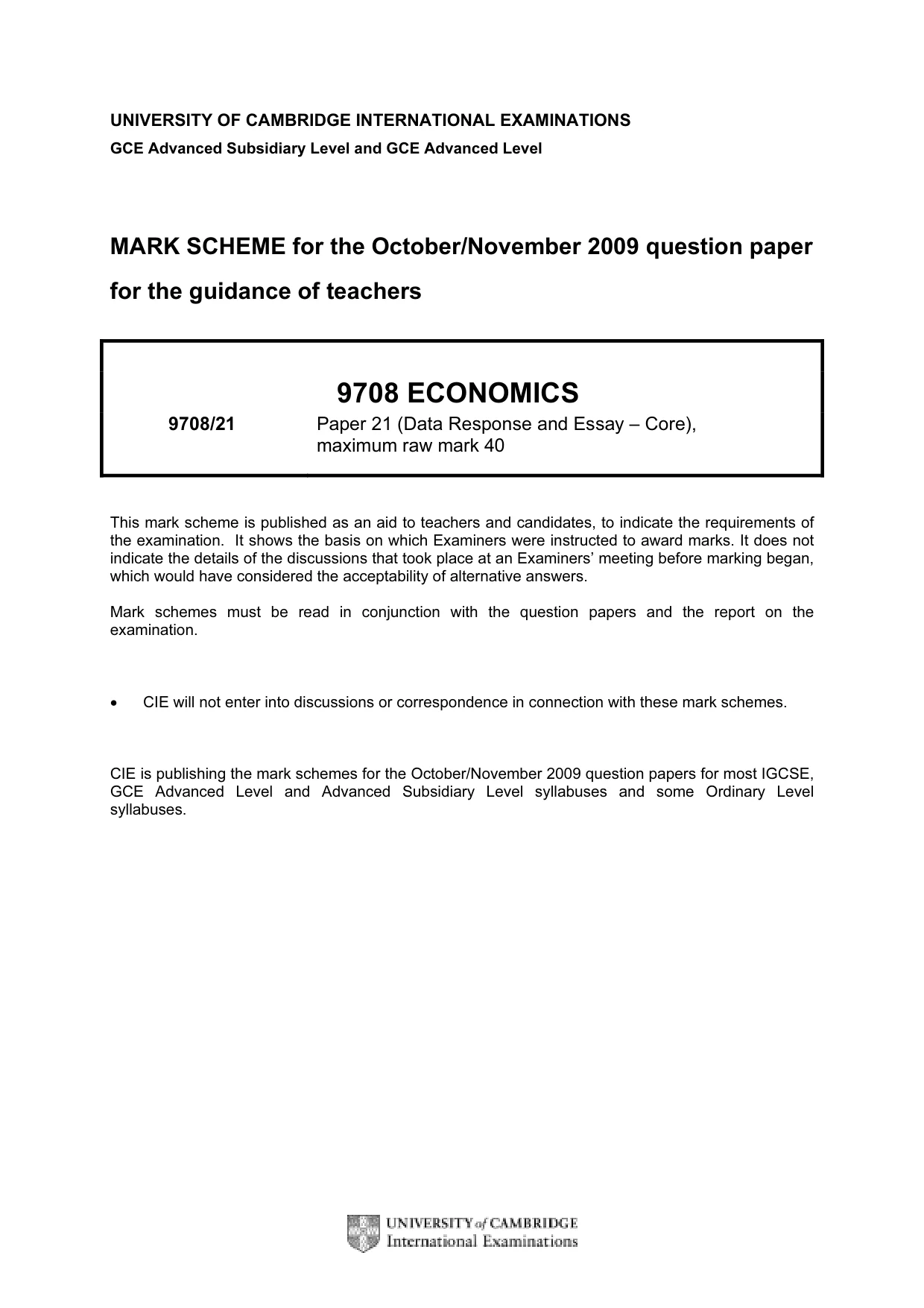
UNIVERSITY OF CAMBRIDGE INTERNATIONAL EXAMINATIONS GCE Advanced Subsidiary Level and GCE Advanced Level MARK SCHEME for the October/November 2009 question paper for the guidance of teachers 9708 ECONOMICS 9708/21 Paper 21 (Data Response and Essay – Core), maximum raw mark 40 This mark scheme is published as an aid to teachers and candidates, to indicate the requirements of the examination. It shows the basis on which Examiners were instructed to award marks. It does not indicate the details of the discussions that took place at an Examiners’ meeting before marking began, which would have considered the acceptability of alternative answers. Mark schemes must be read in conjunction with the question papers and the report on the examination. • CIE will not enter into discussions or correspondence in connection with these mark schemes. CIE is publishing the mark schemes for the October/November 2009 question papers for most IGCSE, GCE Advanced Level and Advanced Subsidiary Level syllabuses and some Ordinary Level syllabuses.
Mark scheme, page 2
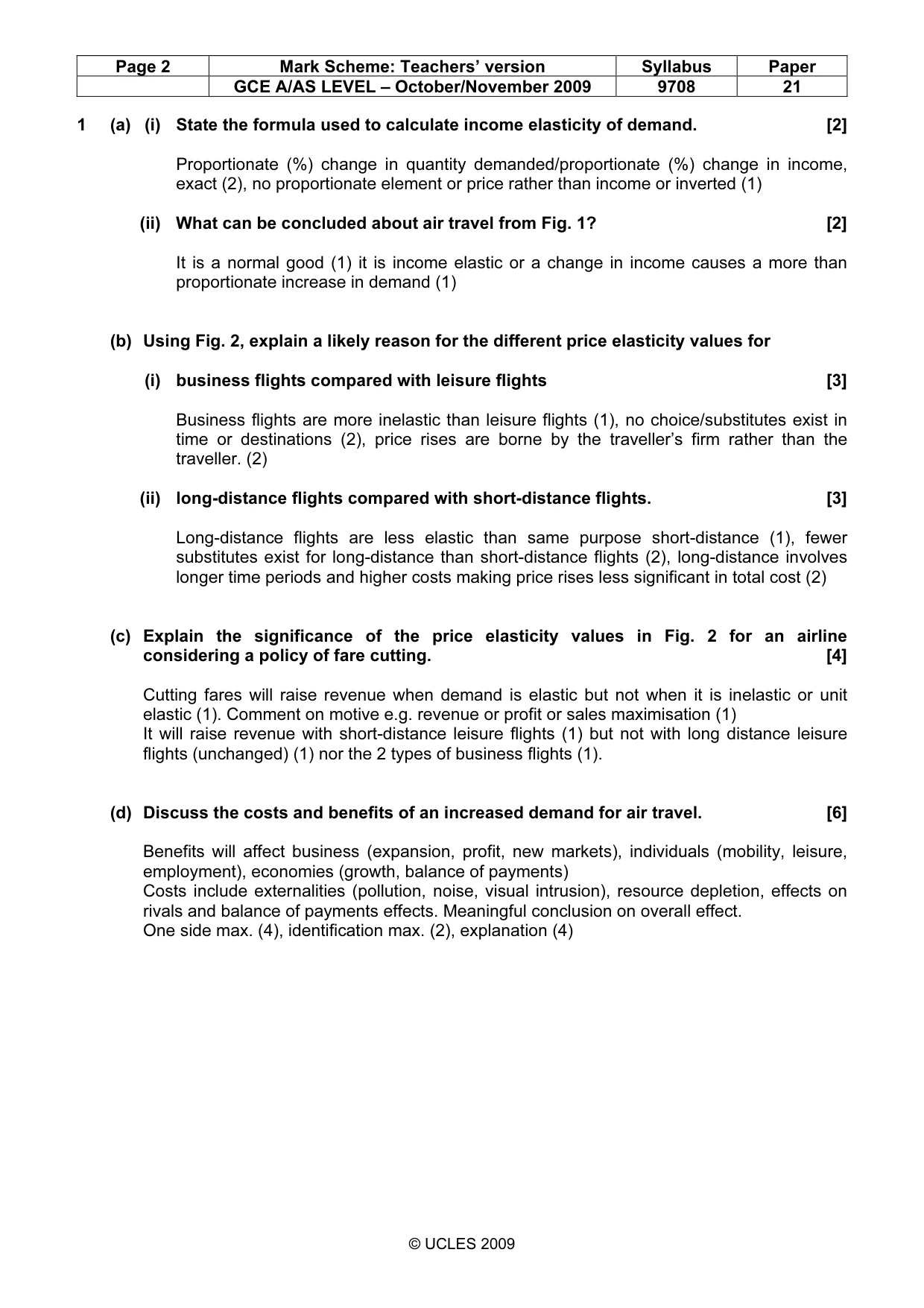
Page 2 Mark Scheme: Teachers’ version Syllabus Paper GCE A/AS LEVEL – October/November 2009 9708 21 © UCLES 2009 1 (a) (i) State the formula used to calculate income elasticity of demand. [2] Proportionate (%) change in quantity demanded/proportionate (%) change in income, exact (2), no proportionate element or price rather than income or inverted (1) (ii) What can be concluded about air travel from Fig. 1? [2] It is a normal good (1) it is income elastic or a change in income causes a more than proportionate increase in demand (1) (b) Using Fig. 2, explain a likely reason for the different price elasticity values for (i) business flights compared with leisure flights [3] Business flights are more inelastic than leisure flights (1), no choice/substitutes exist in time or destinations (2), price rises are borne by the traveller’s firm rather than the traveller. (2) (ii) long-distance flights compared with short-distance flights. [3] Long-distance flights are less elastic than same purpose short-distance (1), fewer substitutes exist for long-distance than short-distance flights (2), long-distance involves longer time periods and higher costs making price rises less significant in total cost (2) (c) Explain the significance of the price elasticity values in Fig. 2 for an airline considering a policy of fare cutting. [4] Cutting fares will raise revenue when demand is elastic but not when it is inelastic or unit elastic (1). Comment on motive e.g. revenue or profit or sales maximisation (1) It will raise revenue with short-distance leisure flights (1) but not with long distance leisure flights (unchanged) (1) nor the 2 types of business flights (1). (d) Discuss the costs and benefits of an increased demand for air travel. [6] Benefits will affect business (expansion, profit, new markets), individuals (mobility, leisure, employment), economies (growth, balance of payments) Costs include externalities (pollution, noise, visual intrusion), resource depletion, effects on rivals and balance of payments effects. Meaningful conclusion on overall effect. One side max. (4), identification max. (2), explanation (4)
Mark scheme, page 3
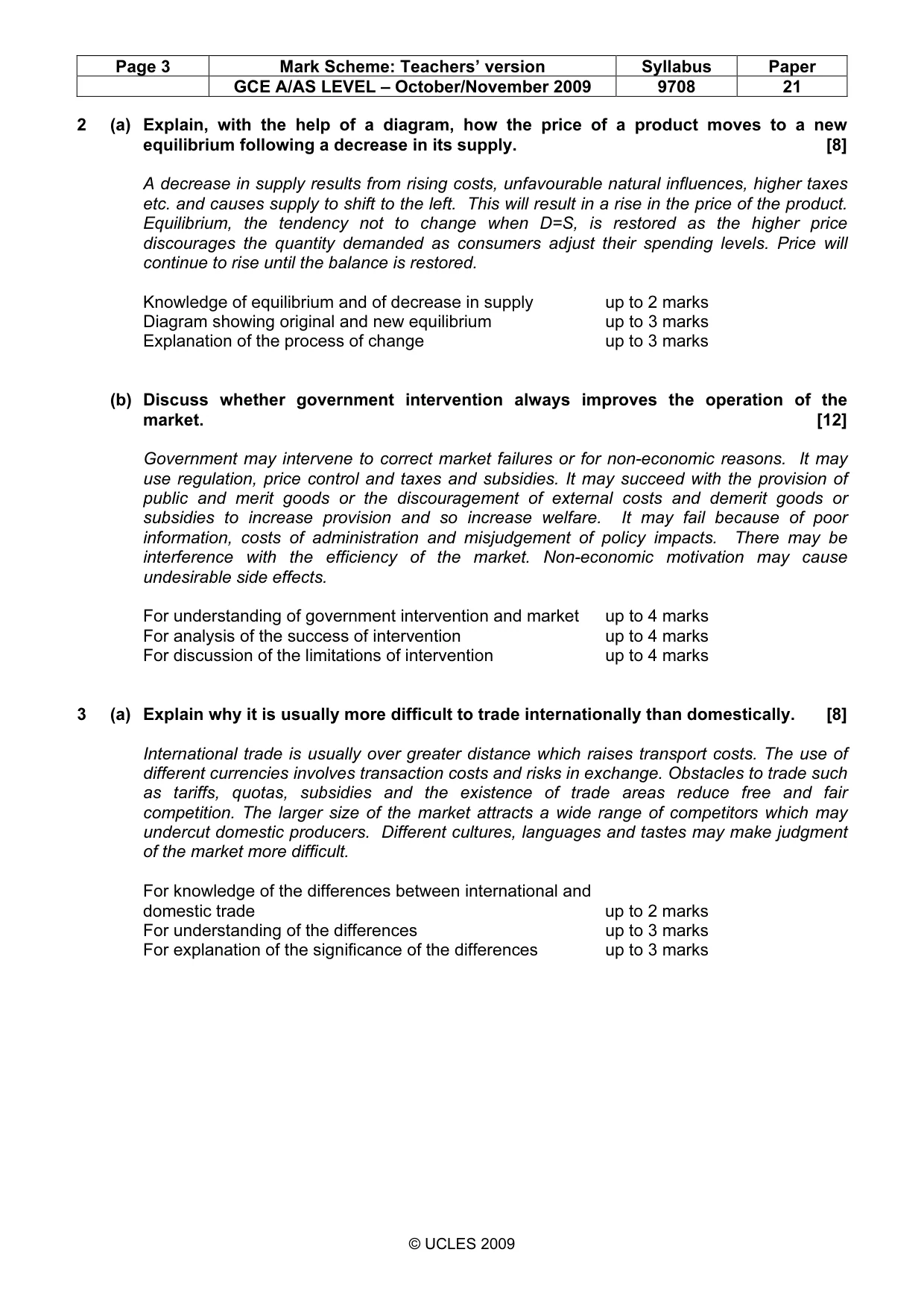
Page 3 Mark Scheme: Teachers’ version Syllabus Paper GCE A/AS LEVEL – October/November 2009 9708 21 © UCLES 2009 2 (a) Explain, with the help of a diagram, how the price of a product moves to a new equilibrium following a decrease in its supply. [8] A decrease in supply results from rising costs, unfavourable natural influences, higher taxes etc. and causes supply to shift to the left. This will result in a rise in the price of the product. Equilibrium, the tendency not to change when D=S, is restored as the higher price discourages the quantity demanded as consumers adjust their spending levels. Price will continue to rise until the balance is restored. Knowledge of equilibrium and of decrease in supply up to 2 marks Diagram showing original and new equilibrium up to 3 marks Explanation of the process of change up to 3 marks (b) Discuss whether government intervention always improves the operation of the market. [12] Government may intervene to correct market failures or for non-economic reasons. It may use regulation, price control and taxes and subsidies. It may succeed with the provision of public and merit goods or the discouragement of external costs and demerit goods or subsidies to increase provision and so increase welfare. It may fail because of poor information, costs of administration and misjudgement of policy impacts. There may be interference with the efficiency of the market. Non-economic motivation may cause undesirable side effects. For understanding of government intervention and market up to 4 marks For analysis of the success of intervention up to 4 marks For discussion of the limitations of intervention up to 4 marks 3 (a) Explain why it is usually more difficult to trade internationally than domestically. [8] International trade is usually over greater distance which raises transport costs. The use of different currencies involves transaction costs and risks in exchange. Obstacles to trade such as tariffs, quotas, subsidies and the existence of trade areas reduce free and fair competition. The larger size of the market attracts a wide range of competitors which may undercut domestic producers. Different cultures, languages and tastes may make judgment of the market more difficult. For knowledge of the differences between international and domestic trade up to 2 marks For understanding of the differences up to 3 marks For explanation of the significance of the differences up to 3 marks
Mark scheme, page 4
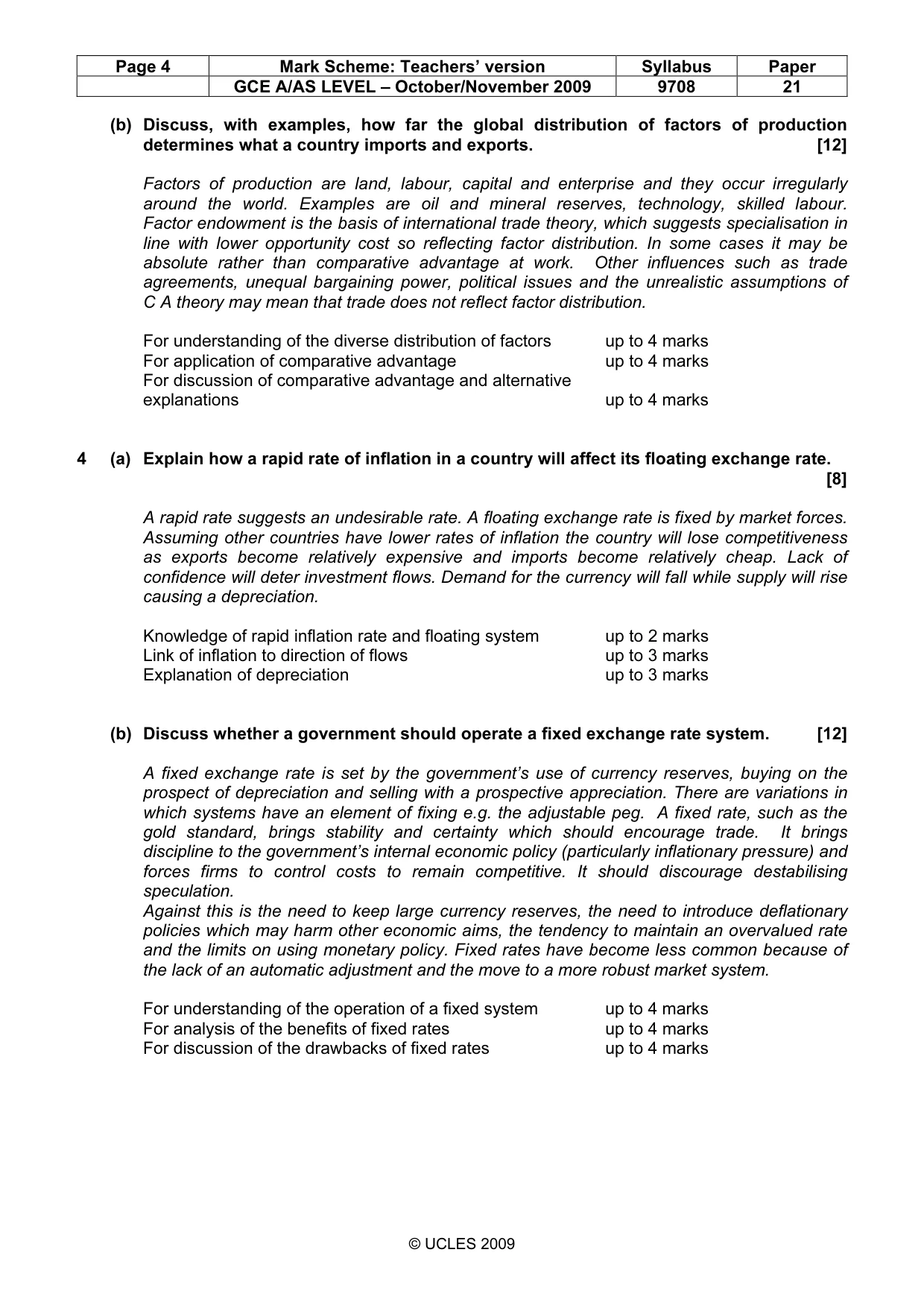
Page 4 Mark Scheme: Teachers’ version Syllabus Paper GCE A/AS LEVEL – October/November 2009 9708 21 © UCLES 2009 (b) Discuss, with examples, how far the global distribution of factors of production determines what a country imports and exports. [12] Factors of production are land, labour, capital and enterprise and they occur irregularly around the world. Examples are oil and mineral reserves, technology, skilled labour. Factor endowment is the basis of international trade theory, which suggests specialisation in line with lower opportunity cost so reflecting factor distribution. In some cases it may be absolute rather than comparative advantage at work. Other influences such as trade agreements, unequal bargaining power, political issues and the unrealistic assumptions of C A theory may mean that trade does not reflect factor distribution. For understanding of the diverse distribution of factors up to 4 marks For application of comparative advantage up to 4 marks For discussion of comparative advantage and alternative explanations up to 4 marks 4 (a) Explain how a rapid rate of inflation in a country will affect its floating exchange rate. [8] A rapid rate suggests an undesirable rate. A floating exchange rate is fixed by market forces. Assuming other countries have lower rates of inflation the country will lose competitiveness as exports become relatively expensive and imports become relatively cheap. Lack of confidence will deter investment flows. Demand for the currency will fall while supply will rise causing a depreciation. Knowledge of rapid inflation rate and floating system up to 2 marks Link of inflation to direction of flows up to 3 marks Explanation of depreciation up to 3 marks (b) Discuss whether a government should operate a fixed exchange rate system. [12] A fixed exchange rate is set by the government’s use of currency reserves, buying on the prospect of depreciation and selling with a prospective appreciation. There are variations in which systems have an element of fixing e.g. the adjustable peg. A fixed rate, such as the gold standard, brings stability and certainty which should encourage trade. It brings discipline to the government’s internal economic policy (particularly inflationary pressure) and forces firms to control costs to remain competitive. It should discourage destabilising speculation. Against this is the need to keep large currency reserves, the need to introduce deflationary policies which may harm other economic aims, the tendency to maintain an overvalued rate and the limits on using monetary policy. Fixed rates have become less common because of the lack of an automatic adjustment and the move to a more robust market system. For understanding of the operation of a fixed system up to 4 marks For analysis of the benefits of fixed rates up to 4 marks For discussion of the drawbacks of fixed rates up to 4 marks
What you needed in this session
Cambridge’s own grade thresholds for 2009 Oct/Nov, Paper 2 · Variant 1. A higher threshold means an easier paper — the bar moves with how the cohort did.