Cambridge A Level Economics 9708 — 2008 Oct/Nov Paper 2 · Variant 1
9708/21/O/N/08 · 40 marks · ≈45 min
The question paper and its mark scheme, free to read here and free to download. This is Cambridge’s own paper, exactly as it was sat.
Question paper4 pages


Mark scheme4 pages
Answers below. Sit the paper first if you are practising.
Paper as text
Question paper, page 1
This document consists of 3 printed pages and 1 blank page. IB08 11_9708_02/2RP © UCLES 2008 [Turn over *2344042456* UNIVERSITY OF CAMBRIDGE INTERNATIONAL EXAMINATIONS General Certificate of Education Advanced Subsidiary Level and Advanced Level ECONOMICS 9708/02 Paper 2 Data Response and Essay (Core) October/November 2008 1 hour 30 minutes Additional Materials: Answer Booklet/Paper READ THESE INSTRUCTIONS FIRST If you have been given an Answer Booklet, follow the instructions on the front cover of the Booklet. Write your Centre number, candidate number and name on all the work you hand in. Write in dark blue or black pen. You may use a soft pencil for any diagrams, graphs or rough working. Do not use staples, paper clips, highlighters, glue or correction fluid. Section A Answer this question. Brief answers only are required. Section B Answer any one question. You may answer with reference to your own economy or other economies that you have studied where relevant to the question. At the end of the examination, fasten all your work securely together. The number of marks is given in brackets [ ] at the end of each question or part question.
Question paper, page 2
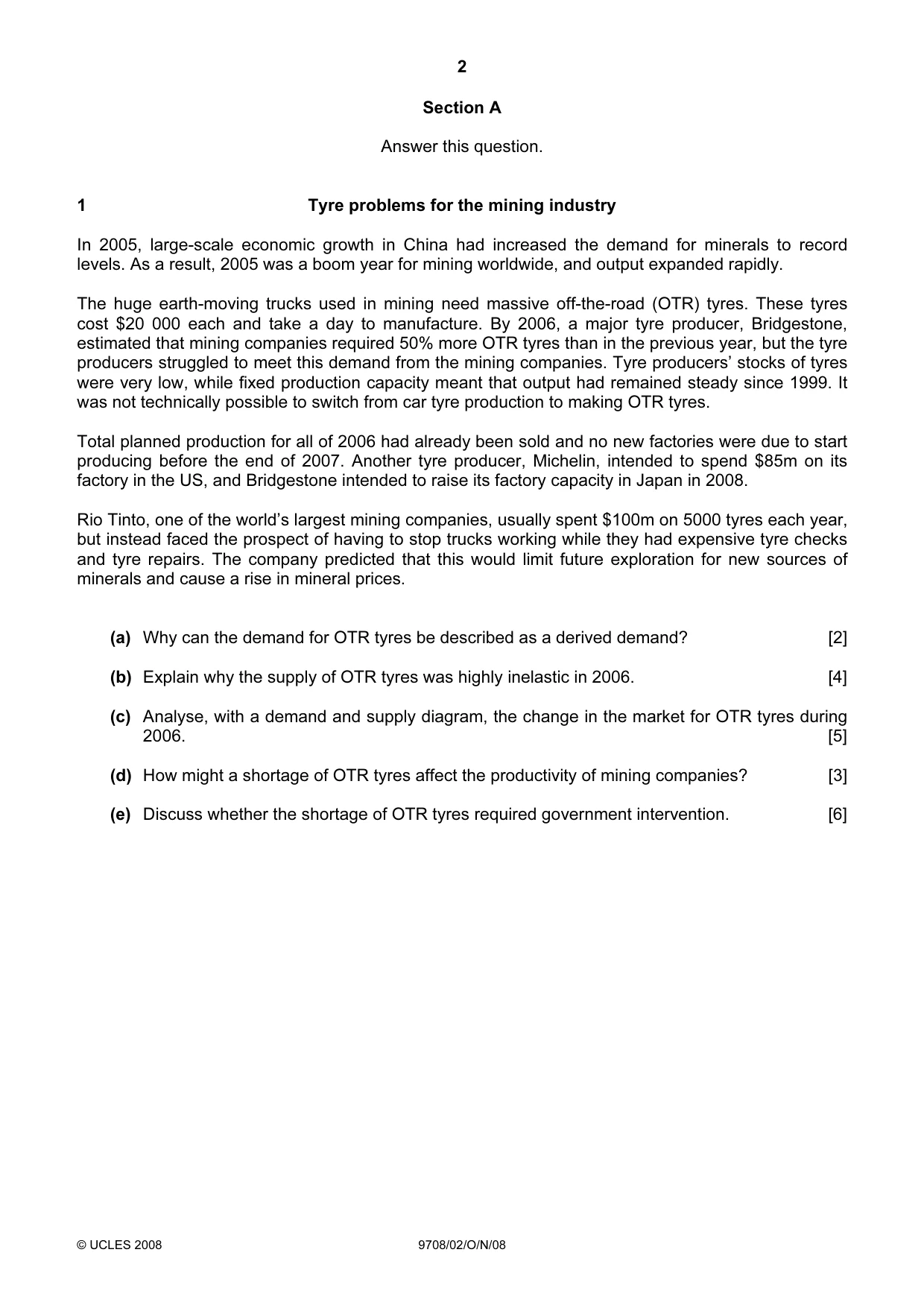
2 © UCLES 2008 9708/02/O/N/08 Section A Answer this question. 1 Tyre problems for the mining industry In 2005, large-scale economic growth in China had increased the demand for minerals to record levels. As a result, 2005 was a boom year for mining worldwide, and output expanded rapidly. The huge earth-moving trucks used in mining need massive off-the-road (OTR) tyres. These tyres cost $20 000 each and take a day to manufacture. By 2006, a major tyre producer, Bridgestone, estimated that mining companies required 50% more OTR tyres than in the previous year, but the tyre producers struggled to meet this demand from the mining companies. Tyre producers’ stocks of tyres were very low, while fixed production capacity meant that output had remained steady since 1999. It was not technically possible to switch from car tyre production to making OTR tyres. Total planned production for all of 2006 had already been sold and no new factories were due to start producing before the end of 2007. Another tyre producer, Michelin, intended to spend $85m on its factory in the US, and Bridgestone intended to raise its factory capacity in Japan in 2008. Rio Tinto, one of the world’s largest mining companies, usually spent $100m on 5000 tyres each year, but instead faced the prospect of having to stop trucks working while they had expensive tyre checks and tyre repairs. The company predicted that this would limit future exploration for new sources of minerals and cause a rise in mineral prices. (a) Why can the demand for OTR tyres be described as a derived demand? [2] (b) Explain why the supply of OTR tyres was highly inelastic in 2006. [4] (c) Analyse, with a demand and supply diagram, the change in the market for OTR tyres during 2006. [5] (d) How might a shortage of OTR tyres affect the productivity of mining companies? [3] (e) Discuss whether the shortage of OTR tyres required government intervention. [6]
Question paper, page 3
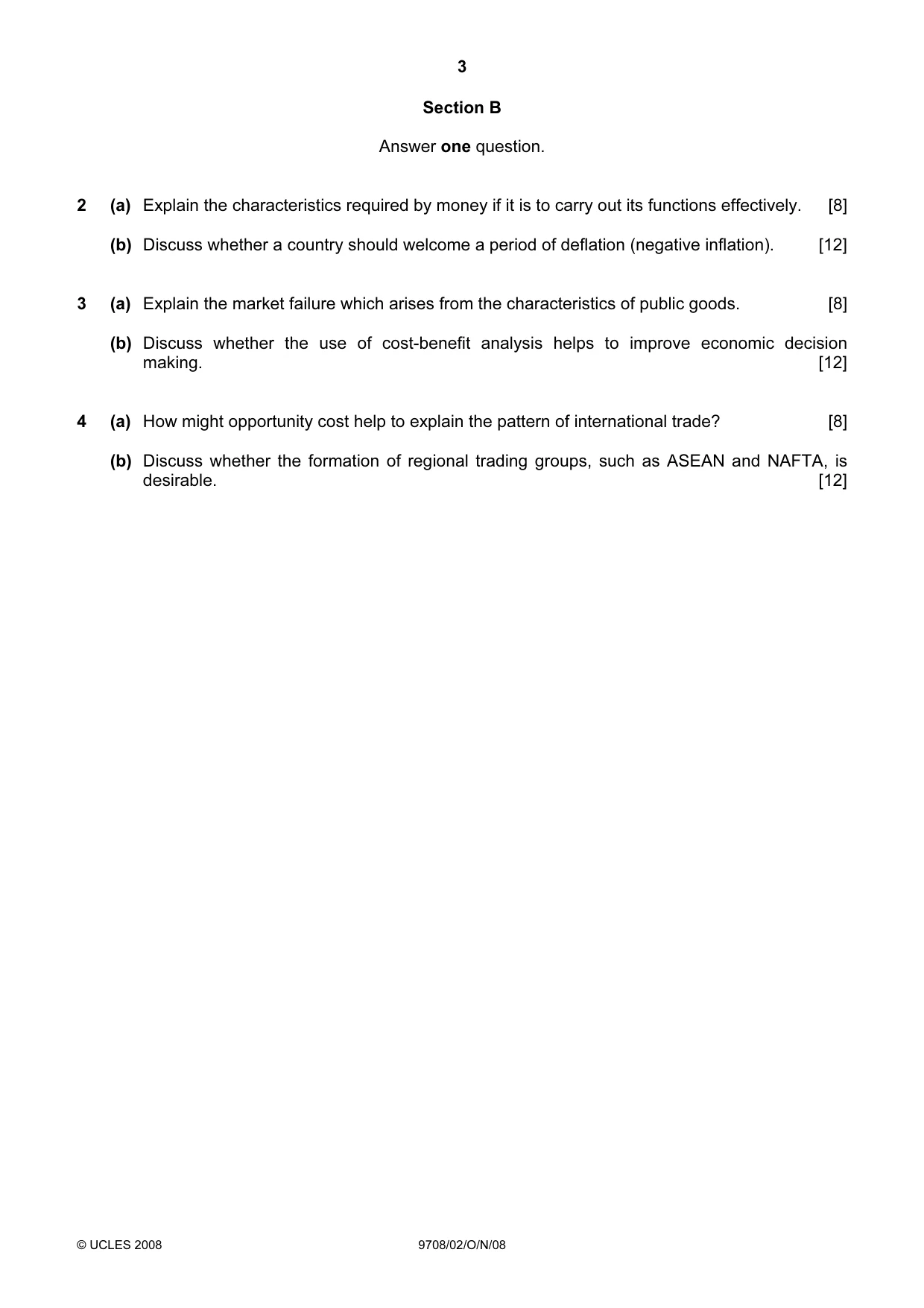
3 © UCLES 2008 9708/02/O/N/08 Section B Answer one question. 2 (a) Explain the characteristics required by money if it is to carry out its functions effectively. [8] (b) Discuss whether a country should welcome a period of deflation (negative inflation). [12] 3 (a) Explain the market failure which arises from the characteristics of public goods. [8] (b) Discuss whether the use of cost-benefit analysis helps to improve economic decision making. [12] 4 (a) How might opportunity cost help to explain the pattern of international trade? [8] (b) Discuss whether the formation of regional trading groups, such as ASEAN and NAFTA, is desirable. [12]
Question paper, page 4
4 BLANK PAGE Copyright Acknowledgements: Question 1 © Christopher Hope; Daily Telegraph, December 2005. Permission to reproduce items where third-party owned material protected by copyright is included has been sought and cleared where possible. Every reasonable effort has been made by the publisher (UCLES) to trace copyright holders, but if any items requiring clearance have unwittingly been included, the publisher will be pleased to make amends at the earliest possible opportunity. University of Cambridge International Examinations is part of the Cambridge Assessment Group. Cambridge Assessment is the brand name of University of Cambridge Local Examinations Syndicate (UCLES), which is itself a department of the University of Cambridge. 9708/02/O/N/08
Mark scheme, page 1
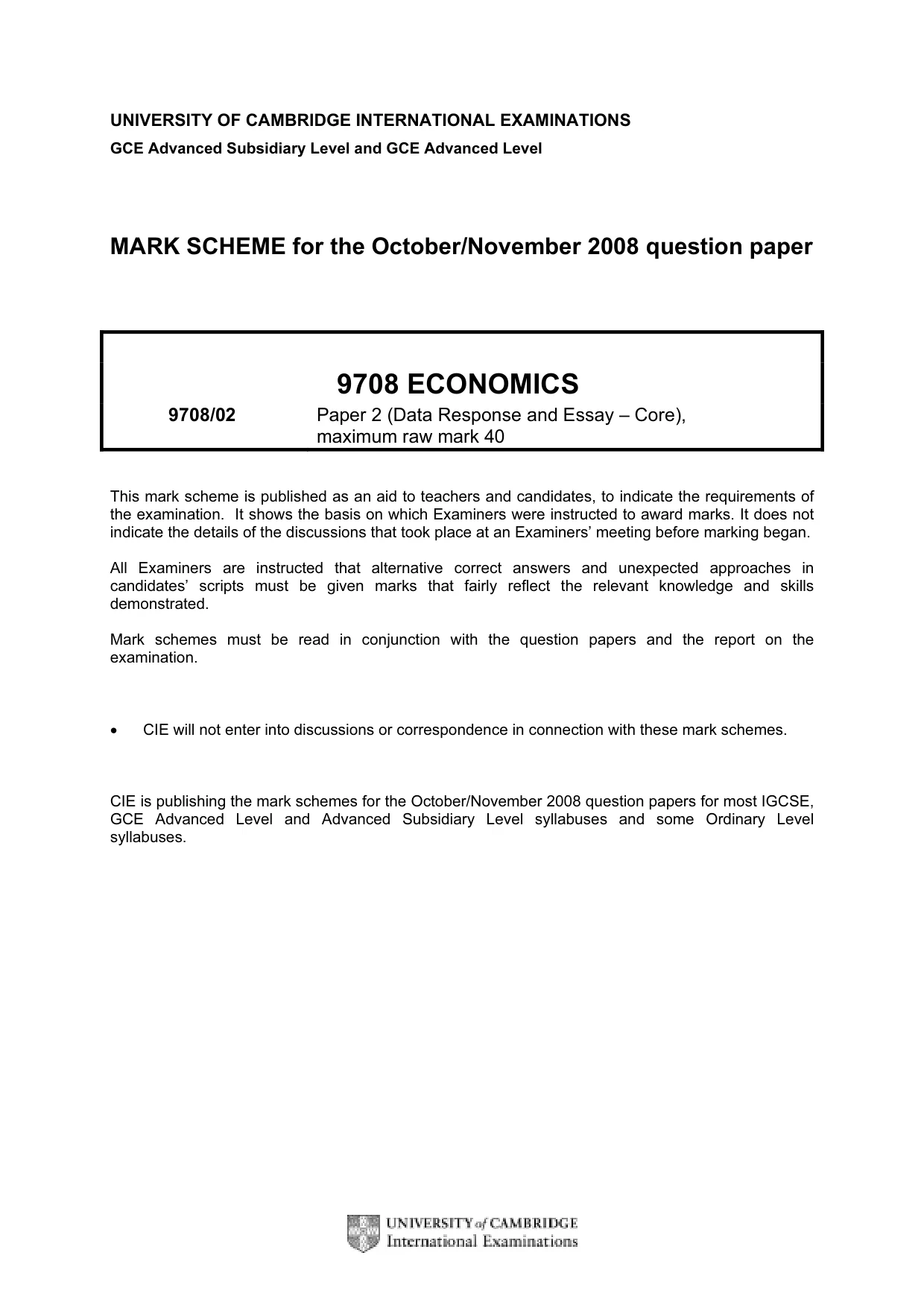
UNIVERSITY OF CAMBRIDGE INTERNATIONAL EXAMINATIONS GCE Advanced Subsidiary Level and GCE Advanced Level MARK SCHEME for the October/November 2008 question paper 9708 ECONOMICS 9708/02 Paper 2 (Data Response and Essay – Core), maximum raw mark 40 This mark scheme is published as an aid to teachers and candidates, to indicate the requirements of the examination. It shows the basis on which Examiners were instructed to award marks. It does not indicate the details of the discussions that took place at an Examiners’ meeting before marking began. All Examiners are instructed that alternative correct answers and unexpected approaches in candidates’ scripts must be given marks that fairly reflect the relevant knowledge and skills demonstrated. Mark schemes must be read in conjunction with the question papers and the report on the examination. • CIE will not enter into discussions or correspondence in connection with these mark schemes. CIE is publishing the mark schemes for the October/November 2008 question papers for most IGCSE, GCE Advanced Level and Advanced Subsidiary Level syllabuses and some Ordinary Level syllabuses.
Mark scheme, page 2
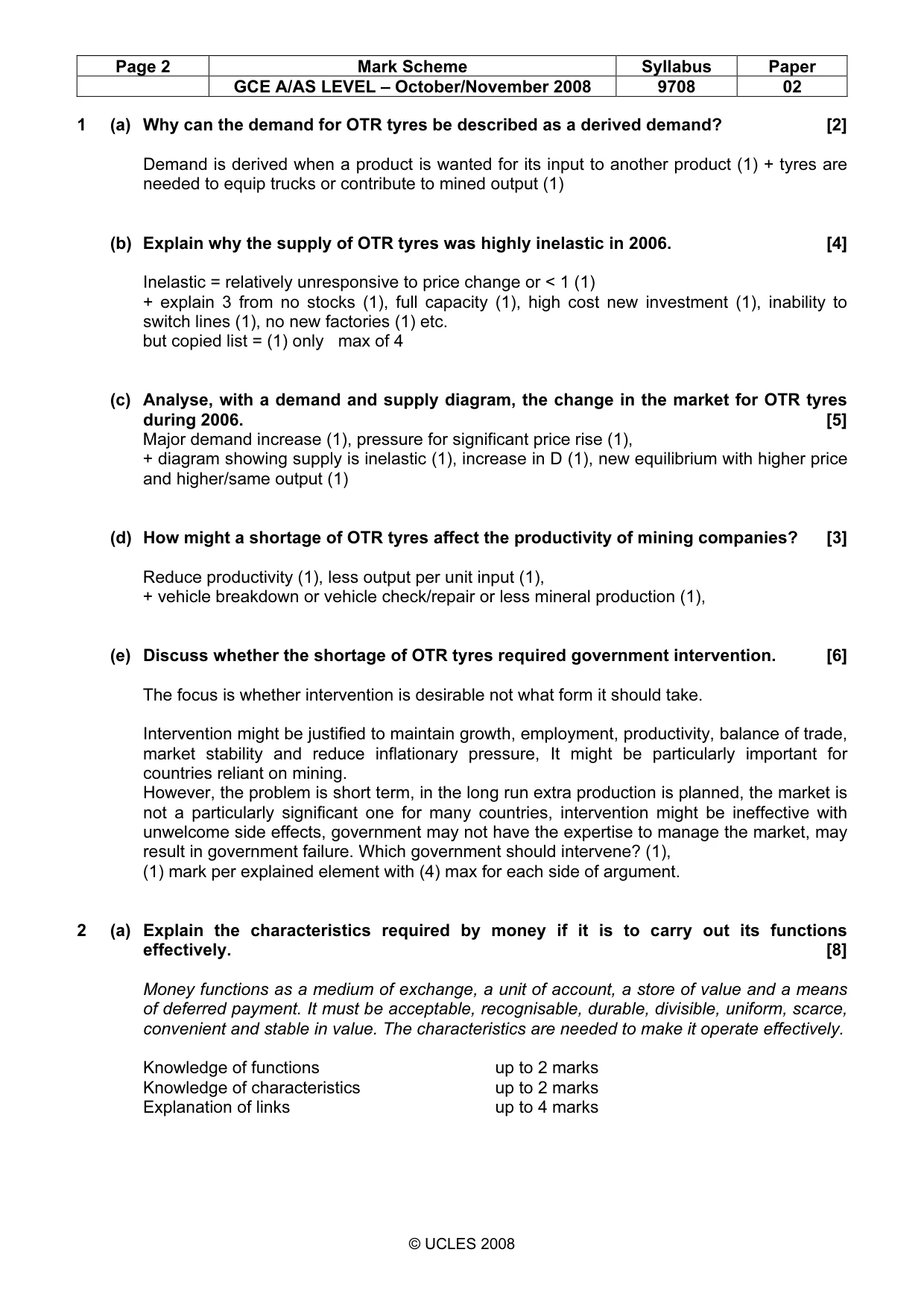
Page 2 Mark Scheme Syllabus Paper GCE A/AS LEVEL – October/November 2008 9708 02 © UCLES 2008 1 (a) Why can the demand for OTR tyres be described as a derived demand? [2] Demand is derived when a product is wanted for its input to another product (1) + tyres are needed to equip trucks or contribute to mined output (1) (b) Explain why the supply of OTR tyres was highly inelastic in 2006. [4] Inelastic = relatively unresponsive to price change or < 1 (1) + explain 3 from no stocks (1), full capacity (1), high cost new investment (1), inability to switch lines (1), no new factories (1) etc. but copied list = (1) only max of 4 (c) Analyse, with a demand and supply diagram, the change in the market for OTR tyres during 2006. [5] Major demand increase (1), pressure for significant price rise (1), + diagram showing supply is inelastic (1), increase in D (1), new equilibrium with higher price and higher/same output (1) (d) How might a shortage of OTR tyres affect the productivity of mining companies? [3] Reduce productivity (1), less output per unit input (1), + vehicle breakdown or vehicle check/repair or less mineral production (1), (e) Discuss whether the shortage of OTR tyres required government intervention. [6] The focus is whether intervention is desirable not what form it should take. Intervention might be justified to maintain growth, employment, productivity, balance of trade, market stability and reduce inflationary pressure, It might be particularly important for countries reliant on mining. However, the problem is short term, in the long run extra production is planned, the market is not a particularly significant one for many countries, intervention might be ineffective with unwelcome side effects, government may not have the expertise to manage the market, may result in government failure. Which government should intervene? (1), (1) mark per explained element with (4) max for each side of argument. 2 (a) Explain the characteristics required by money if it is to carry out its functions effectively. [8] Money functions as a medium of exchange, a unit of account, a store of value and a means of deferred payment. It must be acceptable, recognisable, durable, divisible, uniform, scarce, convenient and stable in value. The characteristics are needed to make it operate effectively. Knowledge of functions up to 2 marks Knowledge of characteristics up to 2 marks Explanation of links up to 4 marks
Mark scheme, page 3
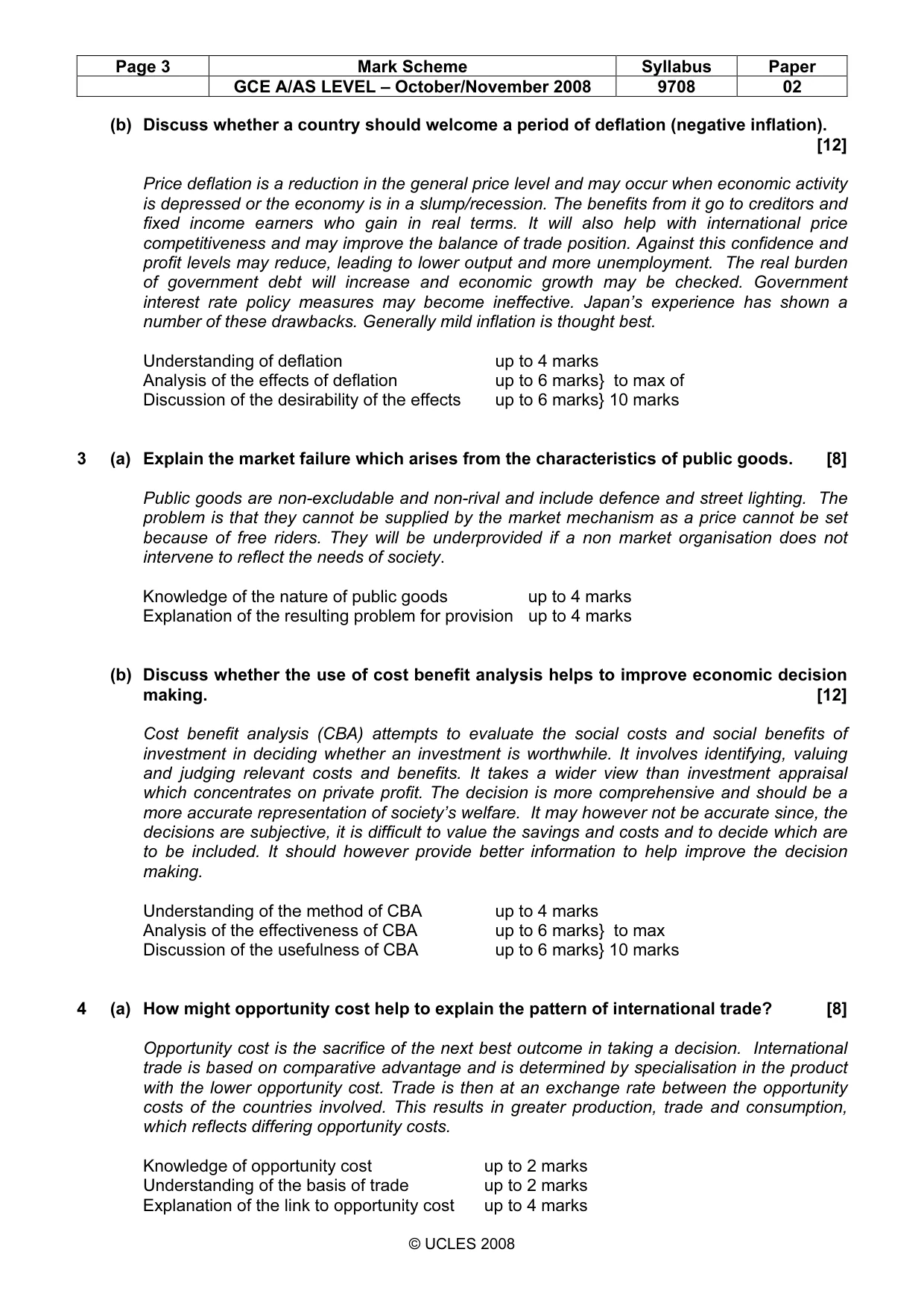
Page 3 Mark Scheme Syllabus Paper GCE A/AS LEVEL – October/November 2008 9708 02 © UCLES 2008 (b) Discuss whether a country should welcome a period of deflation (negative inflation). [12] Price deflation is a reduction in the general price level and may occur when economic activity is depressed or the economy is in a slump/recession. The benefits from it go to creditors and fixed income earners who gain in real terms. It will also help with international price competitiveness and may improve the balance of trade position. Against this confidence and profit levels may reduce, leading to lower output and more unemployment. The real burden of government debt will increase and economic growth may be checked. Government interest rate policy measures may become ineffective. Japan’s experience has shown a number of these drawbacks. Generally mild inflation is thought best. Understanding of deflation up to 4 marks Analysis of the effects of deflation up to 6 marks} to max of Discussion of the desirability of the effects up to 6 marks} 10 marks 3 (a) Explain the market failure which arises from the characteristics of public goods. [8] Public goods are non-excludable and non-rival and include defence and street lighting. The problem is that they cannot be supplied by the market mechanism as a price cannot be set because of free riders. They will be underprovided if a non market organisation does not intervene to reflect the needs of society. Knowledge of the nature of public goods up to 4 marks Explanation of the resulting problem for provision up to 4 marks (b) Discuss whether the use of cost benefit analysis helps to improve economic decision making. [12] Cost benefit analysis (CBA) attempts to evaluate the social costs and social benefits of investment in deciding whether an investment is worthwhile. It involves identifying, valuing and judging relevant costs and benefits. It takes a wider view than investment appraisal which concentrates on private profit. The decision is more comprehensive and should be a more accurate representation of society’s welfare. It may however not be accurate since, the decisions are subjective, it is difficult to value the savings and costs and to decide which are to be included. It should however provide better information to help improve the decision making. Understanding of the method of CBA up to 4 marks Analysis of the effectiveness of CBA up to 6 marks} to max Discussion of the usefulness of CBA up to 6 marks} 10 marks 4 (a) How might opportunity cost help to explain the pattern of international trade? [8] Opportunity cost is the sacrifice of the next best outcome in taking a decision. International trade is based on comparative advantage and is determined by specialisation in the product with the lower opportunity cost. Trade is then at an exchange rate between the opportunity costs of the countries involved. This results in greater production, trade and consumption, which reflects differing opportunity costs. Knowledge of opportunity cost up to 2 marks Understanding of the basis of trade up to 2 marks Explanation of the link to opportunity cost up to 4 marks
Mark scheme, page 4
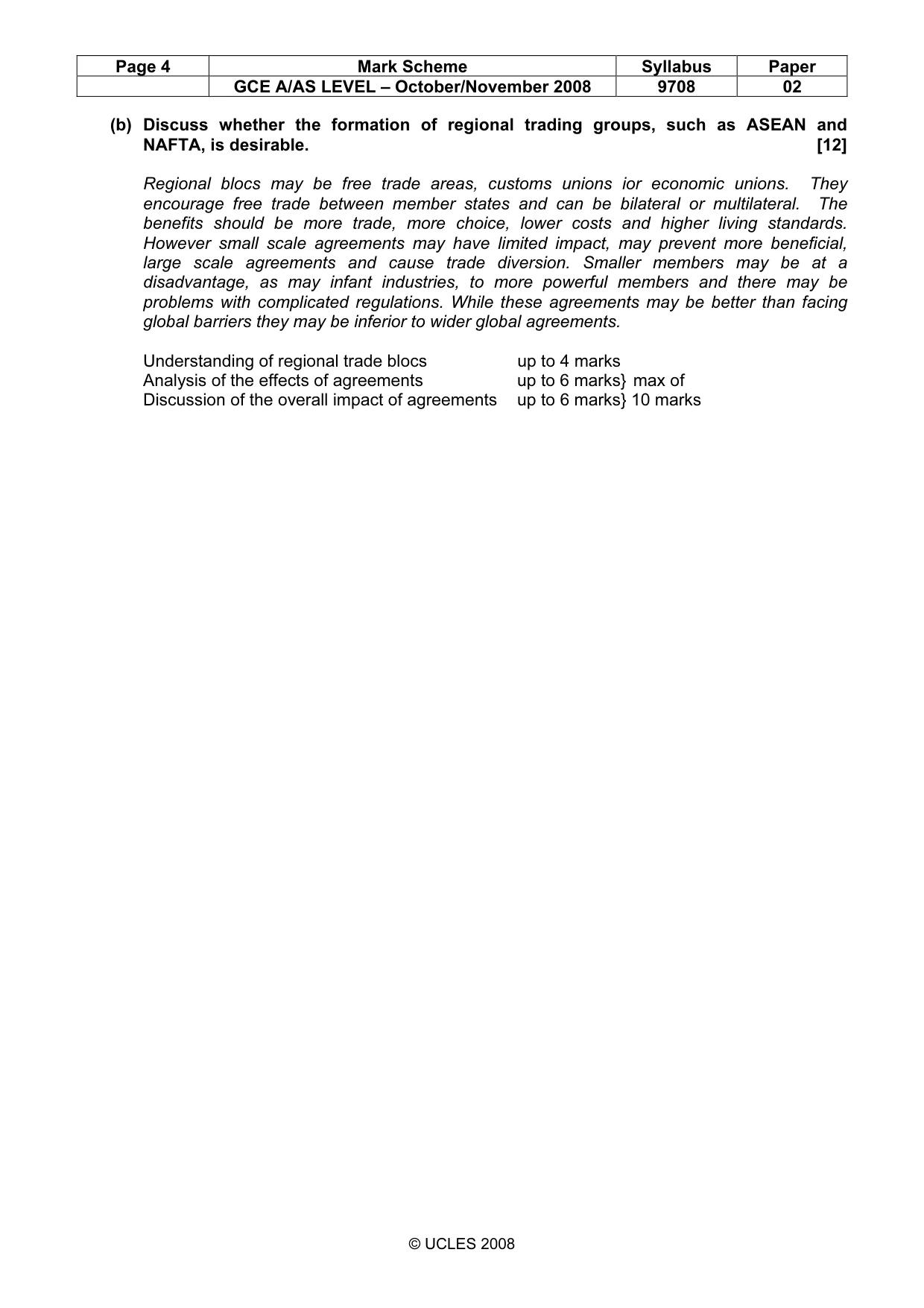
Page 4 Mark Scheme Syllabus Paper GCE A/AS LEVEL – October/November 2008 9708 02 © UCLES 2008 (b) Discuss whether the formation of regional trading groups, such as ASEAN and NAFTA, is desirable. [12] Regional blocs may be free trade areas, customs unions ior economic unions. They encourage free trade between member states and can be bilateral or multilateral. The benefits should be more trade, more choice, lower costs and higher living standards. However small scale agreements may have limited impact, may prevent more beneficial, large scale agreements and cause trade diversion. Smaller members may be at a disadvantage, as may infant industries, to more powerful members and there may be problems with complicated regulations. While these agreements may be better than facing global barriers they may be inferior to wider global agreements. Understanding of regional trade blocs up to 4 marks Analysis of the effects of agreements up to 6 marks} max of Discussion of the overall impact of agreements up to 6 marks} 10 marks
What you needed in this session
Cambridge’s own grade thresholds for 2008 Oct/Nov, Paper 2 · Variant 1. A higher threshold means an easier paper — the bar moves with how the cohort did.