Cambridge A Level Economics 9708 — 2006 Oct/Nov Paper 2 · Variant 1
9708/21/O/N/06 · 40 marks · ≈45 min
The question paper and its mark scheme, free to read here and free to download. This is Cambridge’s own paper, exactly as it was sat.
Question paper4 pages
Mark scheme4 pages
Answers below. Sit the paper first if you are practising.
Paper as text
Question paper, page 1
This document consists of 3 printed pages and 1 blank page. SP (SJF3882) T03110/3 © UCLES 2006 [Turn over UNIVERSITY OF CAMBRIDGE INTERNATIONAL EXAMINATIONS General Certificate of Education Advanced Subsidiary Level and Advanced Level ECONOMICS 9708/02 Paper 2 Data Response and Essay (Core) October/November 2006 1 hour 30 minutes Additional Materials: Answer Booklet/Paper READ THESE INSTRUCTIONS FIRST If you have been given an Answer Booklet, follow the instructions on the front cover of the Booklet. Write your Centre number, candidate number and name on all the work you hand in. Write in dark blue or black pen. You may use a soft pencil for any diagrams, graphs or rough working. Do not use staples, paper clips, highlighters, glue or correction fluid. Section A Answer this question. Brief answers only are required. Section B Answer any one question. You may answer with reference to your own economy or other economies that you have studied where relevant to the question. At the end of the examination, fasten all your work securely together. The number of marks is given in brackets [ ] at the end of each question or part question.
Question paper, page 2
2 9708/02/O/N/06 Section A Answer this question. 1 The market for onions in Bangladesh In Bangladesh the prices of essential foodstuffs usually rise in the period before religious festivals. In October 2003 the price of onions increased sharply. To deal with this the Government took three steps: • It removed the 22.5% duty on imported onions. • It introduced a maximum price ceiling of 18 Taka (Tk) per kilo. • It set up a committee which monitored market prices twice each day. A Government Minister said ‘a kilo of imported onions should cost no more than Tk14. Then the importer adds a profit of Tk1 per kilo, the wholesaler Tk0.30 and the retailer Tk2 – this should reflect a just price.’ However, towards the end of October 2003, the maximum price ceiling was ineffective. Onions were selling on average for Tk28 per kilo, which was • 90% above the October 2002 price, • 50% above the September 2003 price and • Tk10 above the Government maximum price. Traders argued that the price increase was the result of low domestic production and reduced imports. Consumers said that supplies were normal and that traders had created an artificial crisis, because of the rise in demand before the Holy Month of Ramadan. (a) (i) Calculate the approximate price per kilo of onions in September 2003. [2] (ii) Identify two reasons why prices might normally be expected to rise before the Holy Month of Ramadan. [2] (iii) What might the Minister have meant by ‘a just price’? [2] (b) (i) With the aid of a demand and supply diagram, explain how traders may benefit from reducing the supply of essential foodstuffs. [4] (ii) With the aid of a demand and supply diagram, analyse the effect on the market for onions of the introduction of an effective maximum price. [4] (c) Discuss the desirability of the Government’s intervention in the market for onions. [6] © UCLES 2006
Question paper, page 3
3 9708/02/O/N/06 Section B Answer one question. 2 (a) Explain how production possibility curves might be used in assessing a country’s economic performance. [8] (b) Discuss whether a mixed economy is the best way for a country to deal with the basic economic problem. [12] 3 (a) Explain the difference between absolute and comparative advantage. [10] (b) Discuss whether the principle of comparative advantage is a satisfactory explanation of the trade pattern of an economy with which you are familiar. [10] 4 (a) Explain the difference between cost-push inflation and demand-pull inflation. [8] (b) Discuss whether a country experiencing inflation will always have a balance of payments problem. [12] © UCLES 2006
Question paper, page 4
4 9708/02/O/N/06 BLANK PAGE Permission to reproduce items where third-party owned material protected by copyright is included has been sought and cleared where possible. Every reasonable effort has been made by the publisher (UCLES) to trace copyright holders, but if any items requiring clearance have unwittingly been included, the publisher will be pleased to make amends at the earliest possible opportunity. University of Cambridge International Examinations is part of the University of Cambridge Local Examinations Syndicate (UCLES), which is itself a department of the University of Cambridge.
Mark scheme, page 1
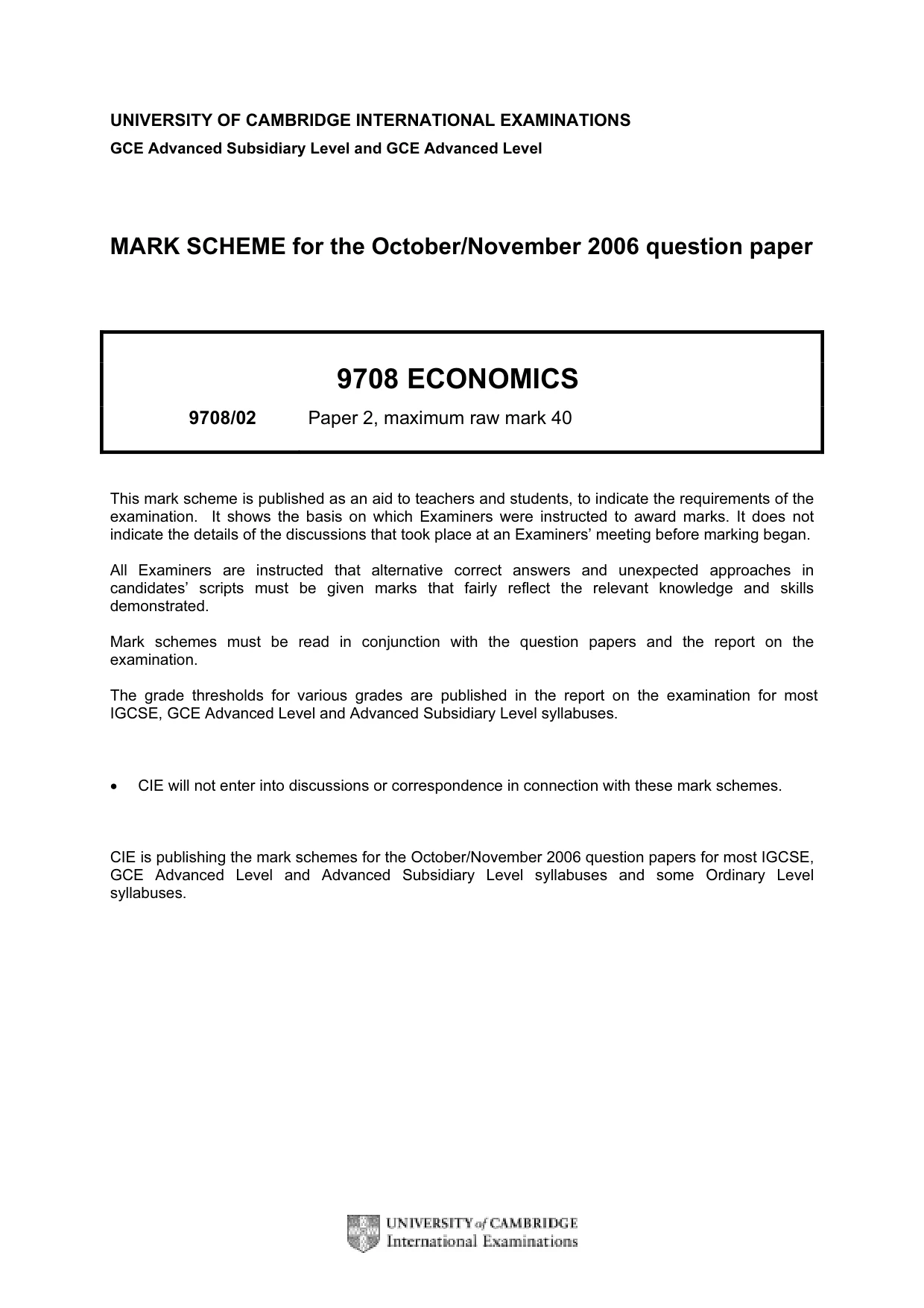
UNIVERSITY OF CAMBRIDGE INTERNATIONAL EXAMINATIONS GCE Advanced Subsidiary Level and GCE Advanced Level MARK SCHEME for the October/November 2006 question paper 9708 ECONOMICS 9708/02 Paper 2, maximum raw mark 40 This mark scheme is published as an aid to teachers and students, to indicate the requirements of the examination. It shows the basis on which Examiners were instructed to award marks. It does not indicate the details of the discussions that took place at an Examiners’ meeting before marking began. All Examiners are instructed that alternative correct answers and unexpected approaches in candidates’ scripts must be given marks that fairly reflect the relevant knowledge and skills demonstrated. Mark schemes must be read in conjunction with the question papers and the report on the examination. The grade thresholds for various grades are published in the report on the examination for most IGCSE, GCE Advanced Level and Advanced Subsidiary Level syllabuses. • CIE will not enter into discussions or correspondence in connection with these mark schemes. CIE is publishing the mark schemes for the October/November 2006 question papers for most IGCSE, GCE Advanced Level and Advanced Subsidiary Level syllabuses and some Ordinary Level syllabuses.
Mark scheme, page 2
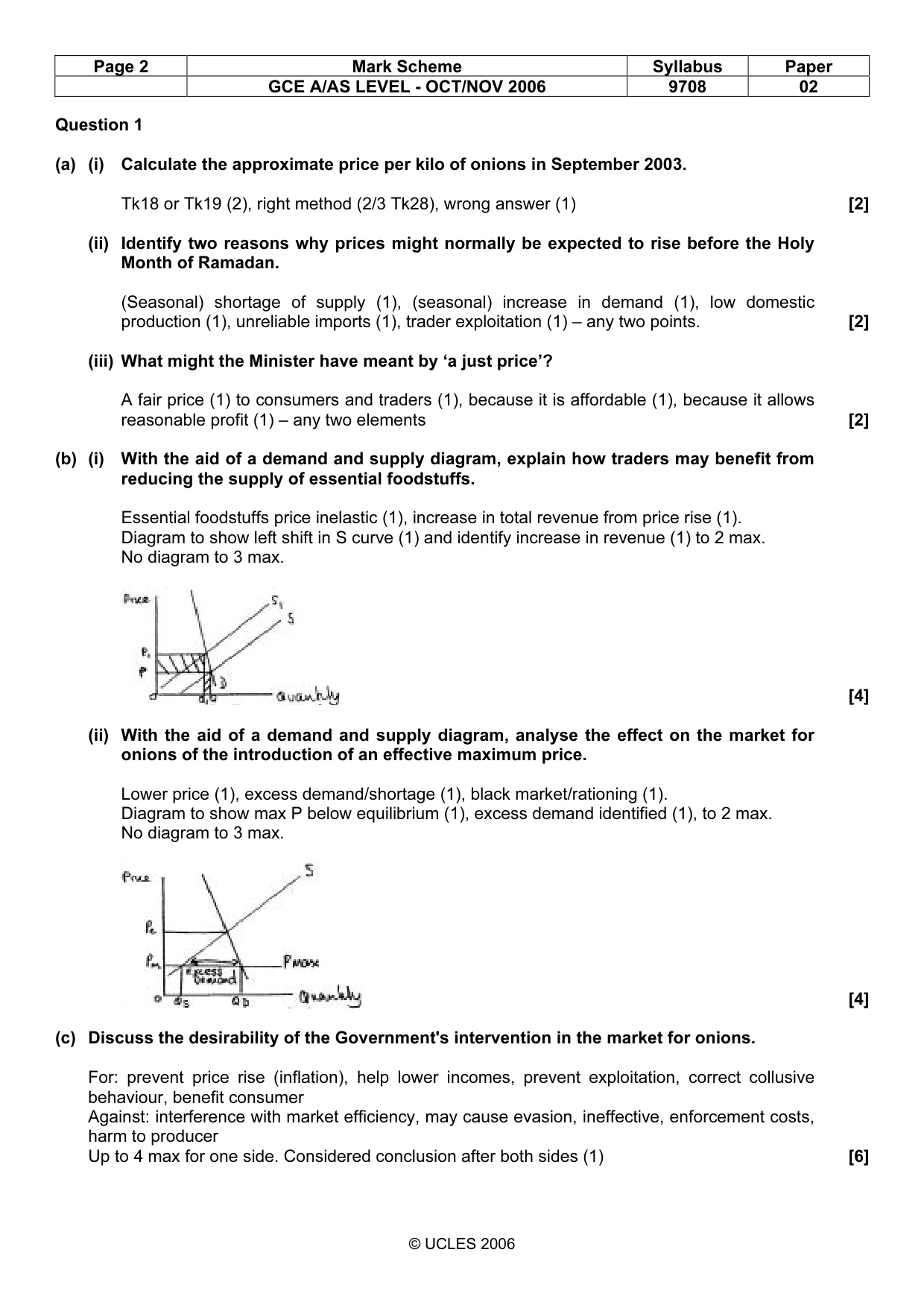
Page 2 Mark Scheme Syllabus Paper GCE A/AS LEVEL - OCT/NOV 2006 9708 02 © UCLES 2006 Question 1 (a) (i) Calculate the approximate price per kilo of onions in September 2003. Tk18 or Tk19 (2), right method (2/3 Tk28), wrong answer (1) [2] (ii) Identify two reasons why prices might normally be expected to rise before the Holy Month of Ramadan. (Seasonal) shortage of supply (1), (seasonal) increase in demand (1), low domestic production (1), unreliable imports (1), trader exploitation (1) – any two points. [2] (iii) What might the Minister have meant by ‘a just price’? A fair price (1) to consumers and traders (1), because it is affordable (1), because it allows reasonable profit (1) – any two elements [2] (b) (i) With the aid of a demand and supply diagram, explain how traders may benefit from reducing the supply of essential foodstuffs. Essential foodstuffs price inelastic (1), increase in total revenue from price rise (1). Diagram to show left shift in S curve (1) and identify increase in revenue (1) to 2 max. No diagram to 3 max. [4] (ii) With the aid of a demand and supply diagram, analyse the effect on the market for onions of the introduction of an effective maximum price. Lower price (1), excess demand/shortage (1), black market/rationing (1). Diagram to show max P below equilibrium (1), excess demand identified (1), to 2 max. No diagram to 3 max. [4] (c) Discuss the desirability of the Government's intervention in the market for onions. For: prevent price rise (inflation), help lower incomes, prevent exploitation, correct collusive behaviour, benefit consumer Against: interference with market efficiency, may cause evasion, ineffective, enforcement costs, harm to producer Up to 4 max for one side. Considered conclusion after both sides (1) [6]
Mark scheme, page 3
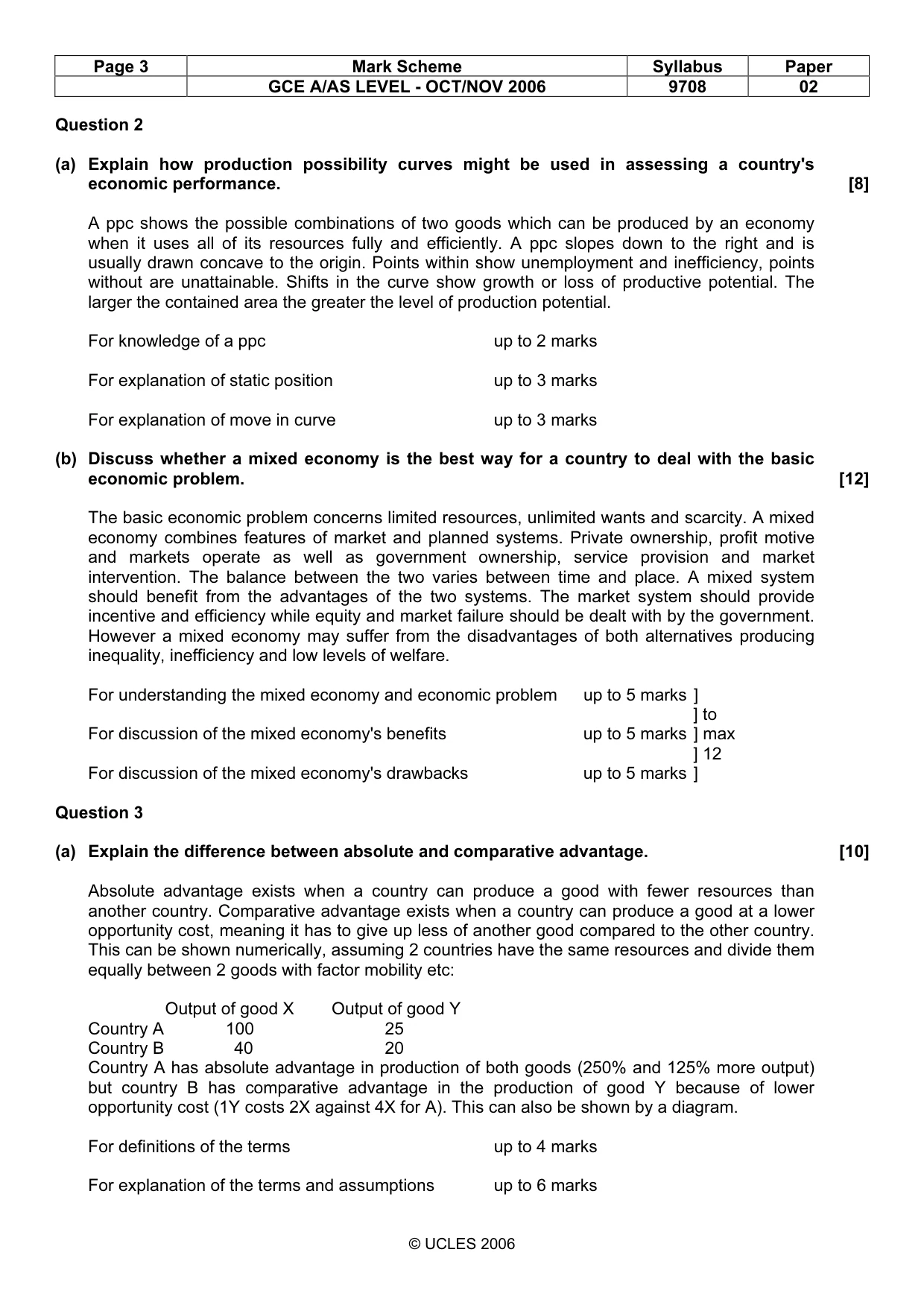
Page 3 Mark Scheme Syllabus Paper GCE A/AS LEVEL - OCT/NOV 2006 9708 02 © UCLES 2006 Question 2 (a) Explain how production possibility curves might be used in assessing a country's economic performance. [8] A ppc shows the possible combinations of two goods which can be produced by an economy when it uses all of its resources fully and efficiently. A ppc slopes down to the right and is usually drawn concave to the origin. Points within show unemployment and inefficiency, points without are unattainable. Shifts in the curve show growth or loss of productive potential. The larger the contained area the greater the level of production potential. For knowledge of a ppc up to 2 marks For explanation of static position up to 3 marks For explanation of move in curve up to 3 marks (b) Discuss whether a mixed economy is the best way for a country to deal with the basic economic problem. [12] The basic economic problem concerns limited resources, unlimited wants and scarcity. A mixed economy combines features of market and planned systems. Private ownership, profit motive and markets operate as well as government ownership, service provision and market intervention. The balance between the two varies between time and place. A mixed system should benefit from the advantages of the two systems. The market system should provide incentive and efficiency while equity and market failure should be dealt with by the government. However a mixed economy may suffer from the disadvantages of both alternatives producing inequality, inefficiency and low levels of welfare. For understanding the mixed economy and economic problem up to 5 marks ] ] to For discussion of the mixed economy's benefits up to 5 marks ] max ] 12 For discussion of the mixed economy's drawbacks up to 5 marks ] Question 3 (a) Explain the difference between absolute and comparative advantage. [10] Absolute advantage exists when a country can produce a good with fewer resources than another country. Comparative advantage exists when a country can produce a good at a lower opportunity cost, meaning it has to give up less of another good compared to the other country. This can be shown numerically, assuming 2 countries have the same resources and divide them equally between 2 goods with factor mobility etc: Output of good X Output of good Y Country A 100 25 Country B 40 20 Country A has absolute advantage in production of both goods (250% and 125% more output) but country B has comparative advantage in the production of good Y because of lower opportunity cost (1Y costs 2X against 4X for A). This can also be shown by a diagram. For definitions of the terms up to 4 marks For explanation of the terms and assumptions up to 6 marks
Mark scheme, page 4
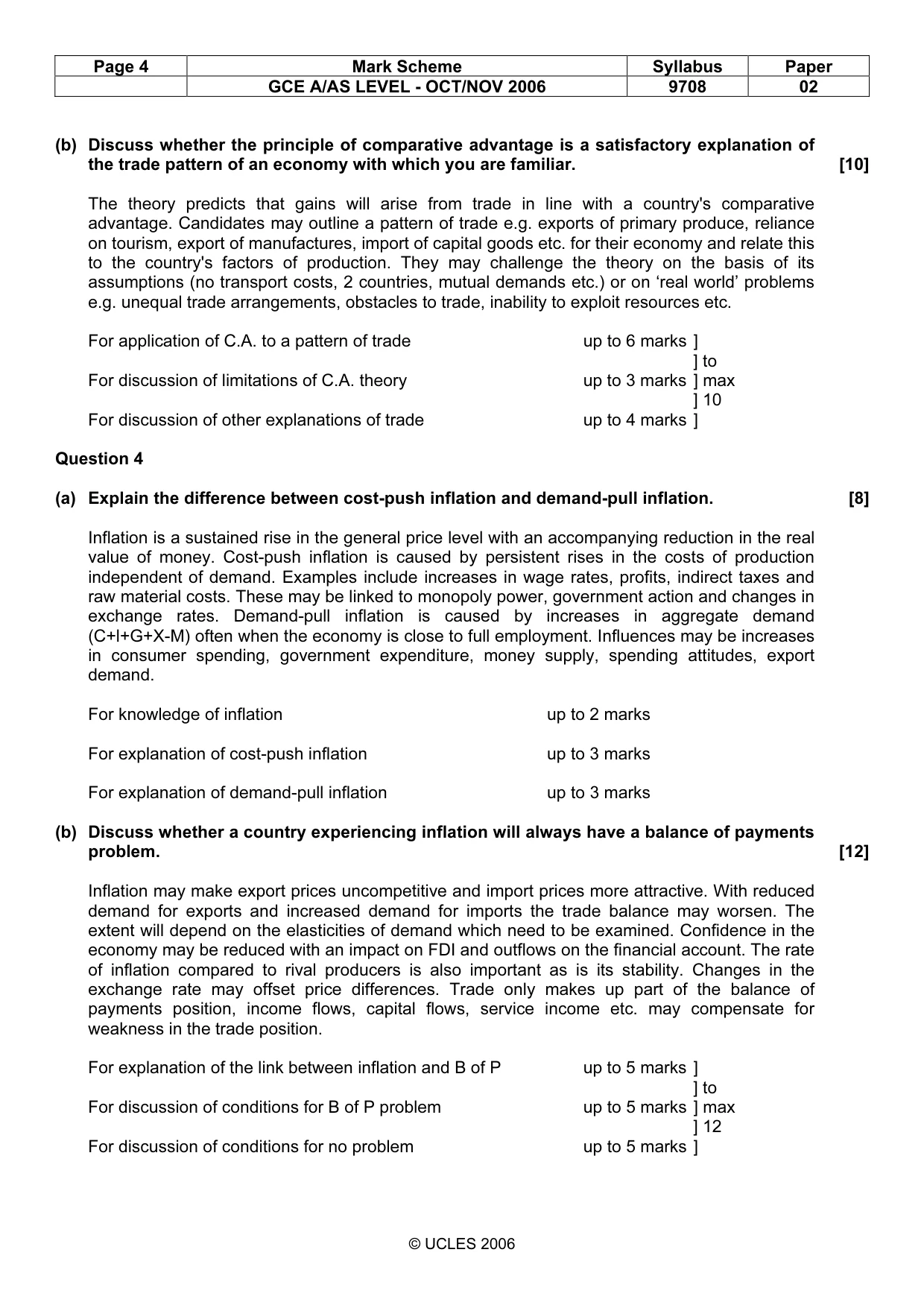
Page 4 Mark Scheme Syllabus Paper GCE A/AS LEVEL - OCT/NOV 2006 9708 02 © UCLES 2006 (b) Discuss whether the principle of comparative advantage is a satisfactory explanation of the trade pattern of an economy with which you are familiar. [10] The theory predicts that gains will arise from trade in line with a country's comparative advantage. Candidates may outline a pattern of trade e.g. exports of primary produce, reliance on tourism, export of manufactures, import of capital goods etc. for their economy and relate this to the country's factors of production. They may challenge the theory on the basis of its assumptions (no transport costs, 2 countries, mutual demands etc.) or on ‘real world’ problems e.g. unequal trade arrangements, obstacles to trade, inability to exploit resources etc. For application of C.A. to a pattern of trade up to 6 marks ] ] to For discussion of limitations of C.A. theory up to 3 marks ] max ] 10 For discussion of other explanations of trade up to 4 marks ] Question 4 (a) Explain the difference between cost-push inflation and demand-pull inflation. [8] Inflation is a sustained rise in the general price level with an accompanying reduction in the real value of money. Cost-push inflation is caused by persistent rises in the costs of production independent of demand. Examples include increases in wage rates, profits, indirect taxes and raw material costs. These may be linked to monopoly power, government action and changes in exchange rates. Demand-pull inflation is caused by increases in aggregate demand (C+l+G+X-M) often when the economy is close to full employment. Influences may be increases in consumer spending, government expenditure, money supply, spending attitudes, export demand. For knowledge of inflation up to 2 marks For explanation of cost-push inflation up to 3 marks For explanation of demand-pull inflation up to 3 marks (b) Discuss whether a country experiencing inflation will always have a balance of payments problem. [12] Inflation may make export prices uncompetitive and import prices more attractive. With reduced demand for exports and increased demand for imports the trade balance may worsen. The extent will depend on the elasticities of demand which need to be examined. Confidence in the economy may be reduced with an impact on FDI and outflows on the financial account. The rate of inflation compared to rival producers is also important as is its stability. Changes in the exchange rate may offset price differences. Trade only makes up part of the balance of payments position, income flows, capital flows, service income etc. may compensate for weakness in the trade position. For explanation of the link between inflation and B of P up to 5 marks ] ] to For discussion of conditions for B of P problem up to 5 marks ] max ] 12 For discussion of conditions for no problem up to 5 marks ]
What you needed in this session
Cambridge’s own grade thresholds for 2006 Oct/Nov, Paper 2 · Variant 1. A higher threshold means an easier paper — the bar moves with how the cohort did.