Cambridge A Level Economics 9708 — 2005 May/June Paper 2 · Variant 1
9708/21/M/J/05
The question paper and its mark scheme, free to read here and free to download. This is Cambridge’s own paper, exactly as it was sat.
Question paper4 pages
Mark scheme7 pages
Answers below. Sit the paper first if you are practising.
Paper as text
Question paper, page 1
This document consists of 4 printed pages. SP (KN) S77892/3 © UCLES 2005 [Turn over UNIVERSITY OF CAMBRIDGE INTERNATIONAL EXAMINATIONS General Certificate of Education Advanced Subsidiary Level and Advanced Level ECONOMICS 9708/02 Paper 2 Data Response and Essay (Core) May/June 2005 1 hour 30 minutes Additional Materials: Answer Booklet/Paper READ THESE INSTRUCTIONS FIRST If you have been given an Answer Booklet, follow the instructions on the front cover of the Booklet. Write your Centre number, candidate number and name on all the work you hand in. Write in dark blue or black pen on both sides of the paper. You may use a soft pencil for any diagrams, graphs or rough working. Do not use staples, paper clips, highlighters, glue or correction fluid. Section A Answer this question. Brief answers only are required. Section B Answer any one question. At the end of the examination, fasten all your work securely together. The number of marks is given in brackets [ ] at the end of each question or part question. You may answer with reference to your own economy or other economies that you have studied where relevant to the question.
Question paper, page 2
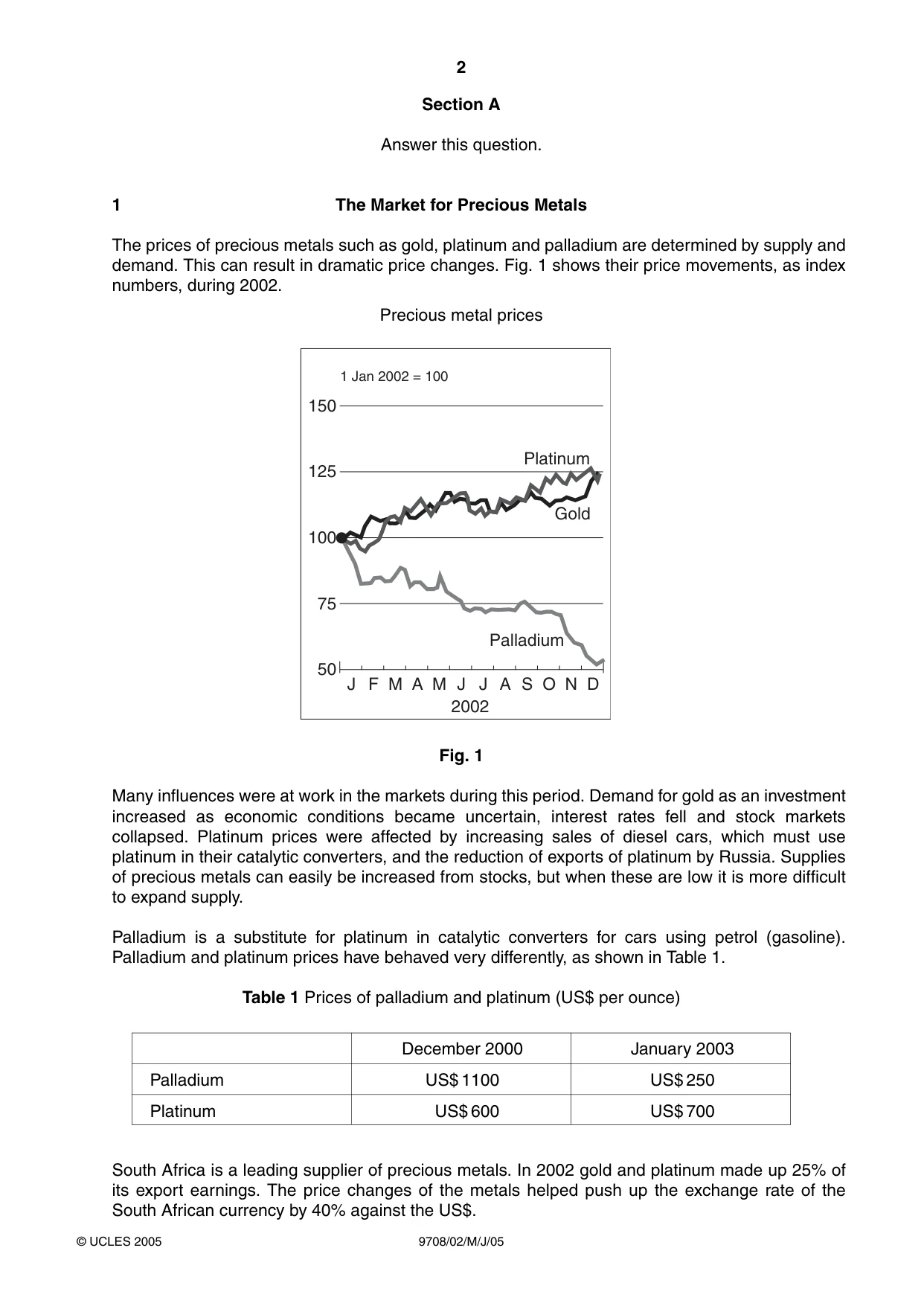
2 9708/02/M/J/05 © UCLES 2005 Section A Answer this question. 1 The Market for Precious Metals The prices of precious metals such as gold, platinum and palladium are determined by supply and demand. This can result in dramatic price changes. Fig. 1 shows their price movements, as index numbers, during 2002. Precious metal prices Fig. 1 Many influences were at work in the markets during this period. Demand for gold as an investment increased as economic conditions became uncertain, interest rates fell and stock markets collapsed. Platinum prices were affected by increasing sales of diesel cars, which must use platinum in their catalytic converters, and the reduction of exports of platinum by Russia. Supplies of precious metals can easily be increased from stocks, but when these are low it is more difficult to expand supply. Palladium is a substitute for platinum in catalytic converters for cars using petrol (gasoline). Palladium and platinum prices have behaved very differently, as shown in Table 1. Table 1 Prices of palladium and platinum (US$ per ounce) South Africa is a leading supplier of precious metals. In 2002 gold and platinum made up 25% of its export earnings. The price changes of the metals helped push up the exchange rate of the South African currency by 40% against the US$. J F M A M J J 2002 A S O N D 150 1 Jan 2002 = 100 125 100 75 50 Gold Palladium Platinum December 2000 January 2003 Palladium US$ 1100 US$ 250 Platinum US$ 600 US$ 700
Question paper, page 3
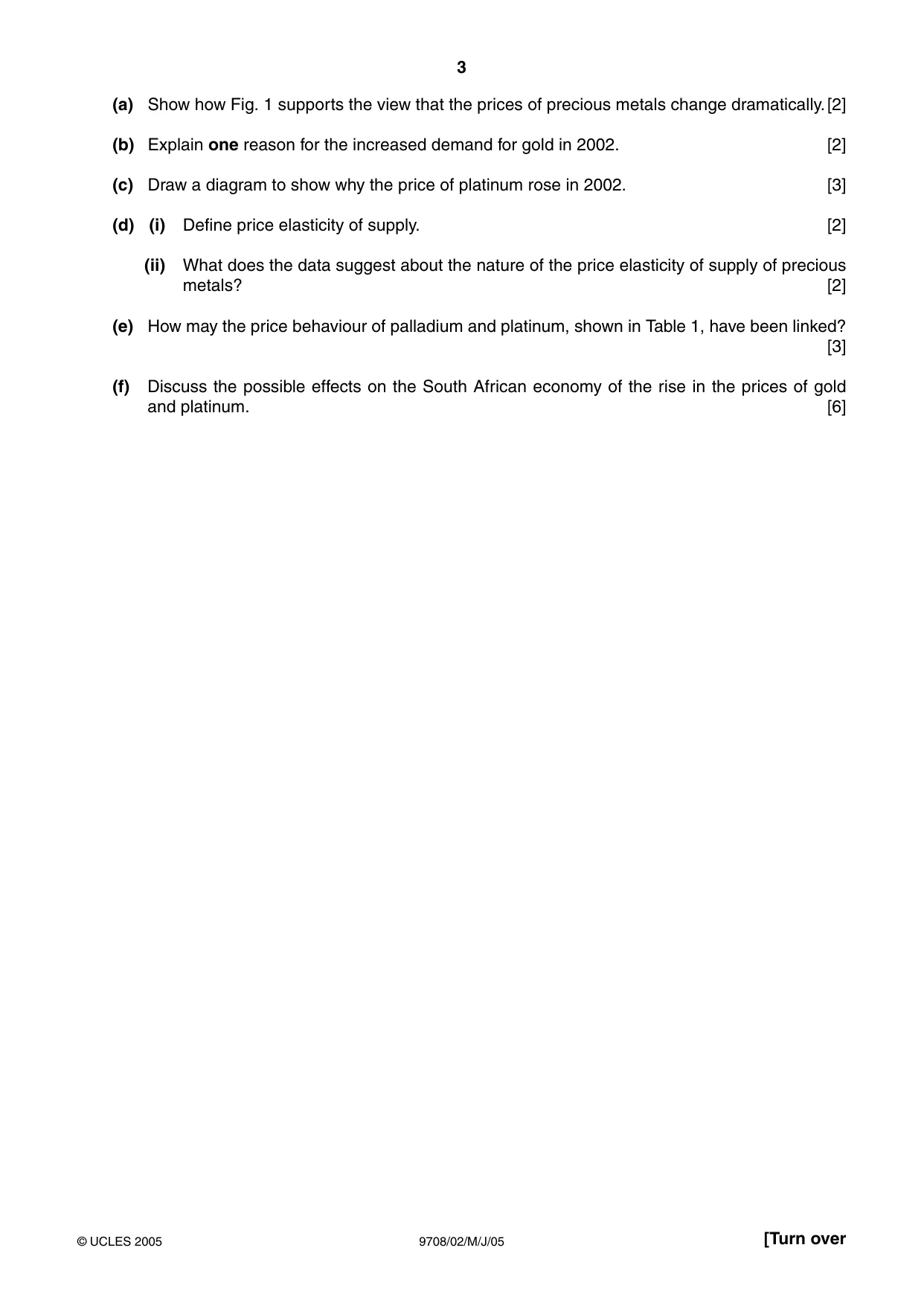
3 9708/02/M/J/05 © UCLES 2005 [Turn over (a) Show how Fig. 1 supports the view that the prices of precious metals change dramatically.[2] (b) Explain one reason for the increased demand for gold in 2002. [2] (c) Draw a diagram to show why the price of platinum rose in 2002. [3] (d) (i) Define price elasticity of supply. [2] (ii) What does the data suggest about the nature of the price elasticity of supply of precious metals? [2] (e) How may the price behaviour of palladium and platinum, shown in Table 1, have been linked? [3] (f) Discuss the possible effects on the South African economy of the rise in the prices of gold and platinum. [6]
Question paper, page 4
4 9708/02/M/J/05 © UCLES 2005 Section B Answer one question. 2 (a) Explain the differences in the features of a market economy and a planned economy. [8] (b) Discuss the desirability of the direct provision of goods and services by the government. [12] 3 (a) Explain why economies make use of money. [8] (b) Discuss whether stability in the domestic value of money is essential for a country’s economic well-being. [12] 4 (a) Explain how a country’s balance of payments is organised to account for all its international transactions. [8] (b) A country has a deficit on the current account of its balance of payments. Discuss whether this is necessarily harmful to the country. [12] Copyright Acknowledgements: Question 1 © The Economist Newspaper Limited, London (February 2003) Permission to reproduce items where third-party owned material protected by copyright is included has been sought and cleared where possible. Every reasonable effort has been made by the publisher (UCLES) to trace copyright holders, but if any items requiring clearance have unwittingly been included, the publisher will be pleased to make amends at the earliest possible opportunity. University of Cambridge International Examinations is part of the University of Cambridge Local Examinations Syndicate (UCLES), which is itself a department of the University of Cambridge.
Mark scheme, page 1
UNIVERSITY OF CAMBRIDGE INTERNATIONAL EXAMINATIONS GCE Advanced Subsidiary and Advanced Level MARK SCHEME for the June 2005 question paper 9708 ECONOMICS 9708/02 Paper 2 Data Response and Essay (Core), maximum raw mark 40 This mark scheme is published as an aid to teachers and students, to indicate the requirements of the examination. It shows the basis on which Examiners were initially instructed to award marks. It does not indicate the details of the discussions that took place at an Examiners’ meeting before marking began. Any substantial changes to the mark scheme that arose from these discussions will be recorded in the published Report on the Examination. All Examiners are instructed that alternative correct answers and unexpected approaches in candidates’ scripts must be given marks that fairly reflect the relevant knowledge and skills demonstrated. Mark schemes must be read in conjunction with the question papers and the Report on the Examination. • CIE will not enter into discussion or correspondence in connection with these mark schemes. CIE is publishing the mark schemes for the June 2005 question papers for most IGCSE and GCE Advanced Level and Advanced Subsidiary Level syllabuses and some Ordinary Level syllabuses.
Mark scheme, page 2
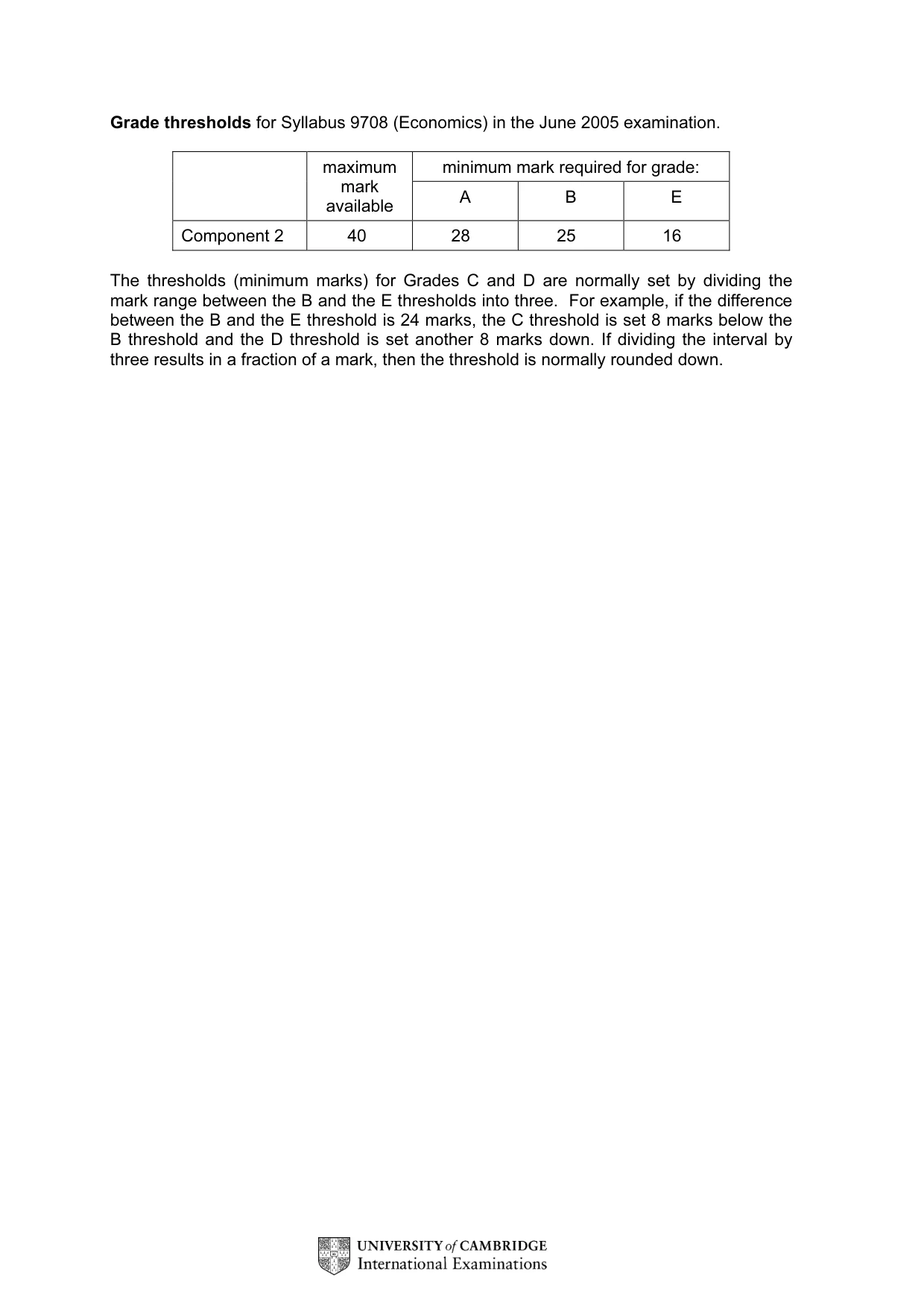
Grade thresholds for Syllabus 9708 (Economics) in the June 2005 examination. minimum mark required for grade: maximum mark available A B E Component 2 40 28 25 16 The thresholds (minimum marks) for Grades C and D are normally set by dividing the mark range between the B and the E thresholds into three. For example, if the difference between the B and the E threshold is 24 marks, the C threshold is set 8 marks below the B threshold and the D threshold is set another 8 marks down. If dividing the interval by three results in a fraction of a mark, then the threshold is normally rounded down.
Mark scheme, page 3
June 2005 GCE AS/A LEVEL MARK SCHEME MAXIMUM MARK: 40 SYLLABUS/COMPONENT: 9708/02 ECONOMICS Paper 2 Data Response and Essay (Core)
Mark scheme, page 4
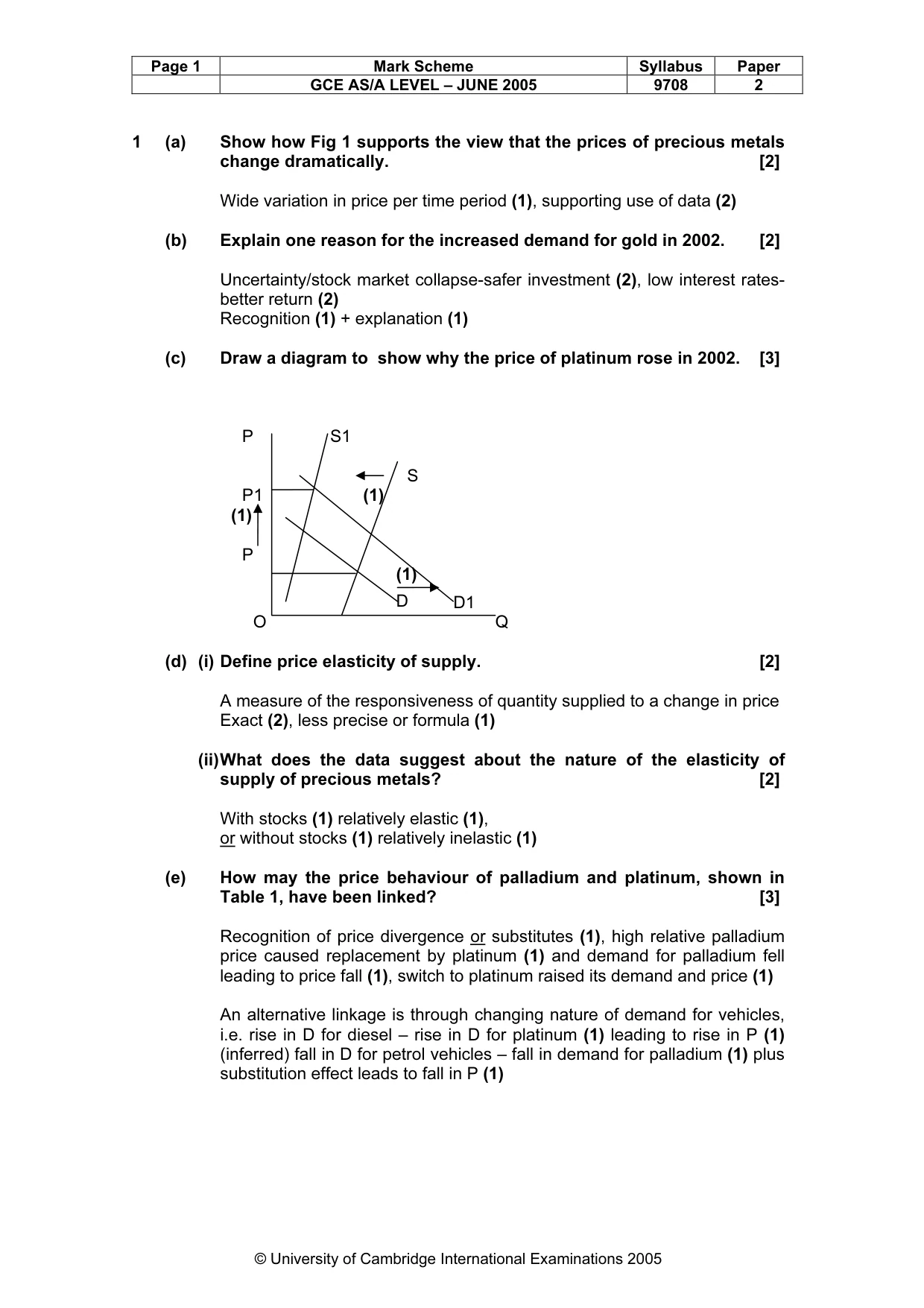
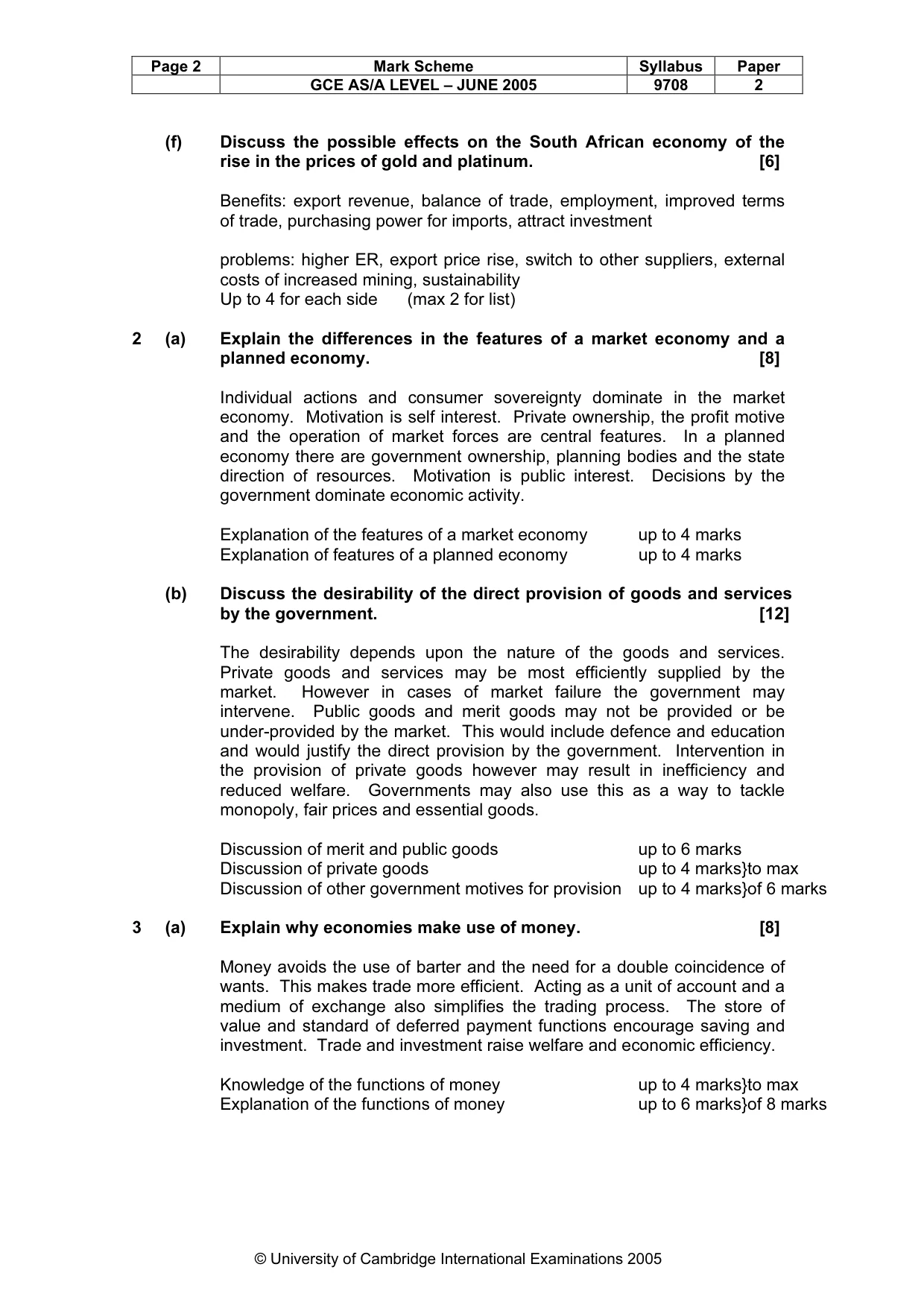
Page 1 Mark Scheme Syllabus Paper GCE AS/A LEVEL – JUNE 2005 9708 2 © University of Cambridge International Examinations 2005 1 (a) Show how Fig 1 supports the view that the prices of precious metals change dramatically. [2] Wide variation in price per time period (1), supporting use of data (2) (b) Explain one reason for the increased demand for gold in 2002. [2] Uncertainty/stock market collapse-safer investment (2), low interest rates- better return (2) Recognition (1) + explanation (1) (c) Draw a diagram to show why the price of platinum rose in 2002. [3] P S1 S P1 (1) (1) P (1) D D1 O Q (d) (i) Define price elasticity of supply. [2] A measure of the responsiveness of quantity supplied to a change in price Exact (2), less precise or formula (1) (ii) What does the data suggest about the nature of the elasticity of supply of precious metals? [2] With stocks (1) relatively elastic (1), or without stocks (1) relatively inelastic (1) (e) How may the price behaviour of palladium and platinum, shown in Table 1, have been linked? [3] Recognition of price divergence or substitutes (1), high relative palladium price caused replacement by platinum (1) and demand for palladium fell leading to price fall (1), switch to platinum raised its demand and price (1) An alternative linkage is through changing nature of demand for vehicles, i.e. rise in D for diesel – rise in D for platinum (1) leading to rise in P (1) (inferred) fall in D for petrol vehicles – fall in demand for palladium (1) plus substitution effect leads to fall in P (1)
Mark scheme, page 5
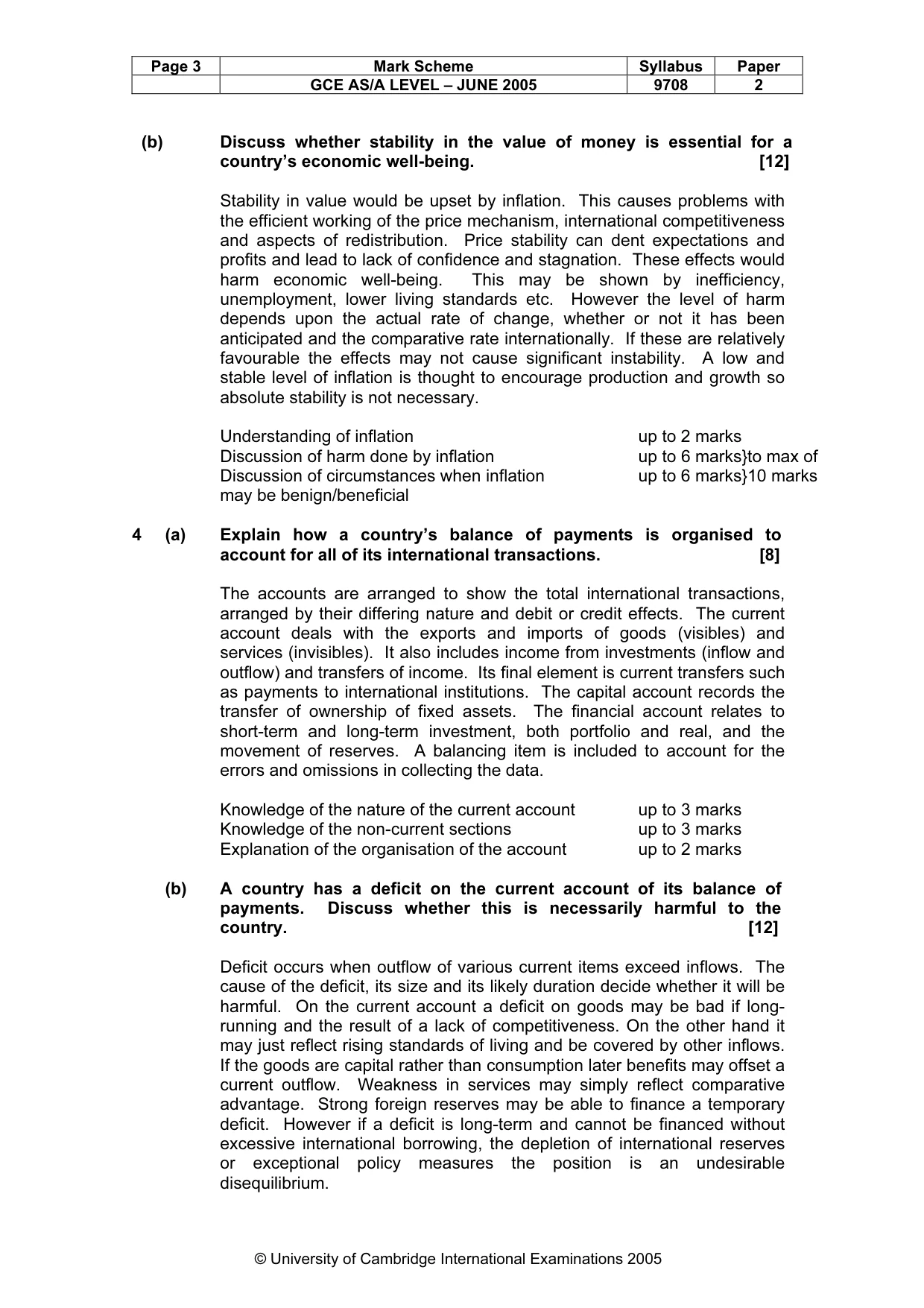
Page 2 Mark Scheme Syllabus Paper GCE AS/A LEVEL – JUNE 2005 9708 2 © University of Cambridge International Examinations 2005 (f) Discuss the possible effects on the South African economy of the rise in the prices of gold and platinum. [6] Benefits: export revenue, balance of trade, employment, improved terms of trade, purchasing power for imports, attract investment problems: higher ER, export price rise, switch to other suppliers, external costs of increased mining, sustainability Up to 4 for each side (max 2 for list) 2 (a) Explain the differences in the features of a market economy and a planned economy. [8] Individual actions and consumer sovereignty dominate in the market economy. Motivation is self interest. Private ownership, the profit motive and the operation of market forces are central features. In a planned economy there are government ownership, planning bodies and the state direction of resources. Motivation is public interest. Decisions by the government dominate economic activity. Explanation of the features of a market economy up to 4 marks Explanation of features of a planned economy up to 4 marks (b) Discuss the desirability of the direct provision of goods and services by the government. [12] The desirability depends upon the nature of the goods and services. Private goods and services may be most efficiently supplied by the market. However in cases of market failure the government may intervene. Public goods and merit goods may not be provided or be under-provided by the market. This would include defence and education and would justify the direct provision by the government. Intervention in the provision of private goods however may result in inefficiency and reduced welfare. Governments may also use this as a way to tackle monopoly, fair prices and essential goods. Discussion of merit and public goods up to 6 marks Discussion of private goods up to 4 marks}to max Discussion of other government motives for provision up to 4 marks}of 6 marks 3 (a) Explain why economies make use of money. [8] Money avoids the use of barter and the need for a double coincidence of wants. This makes trade more efficient. Acting as a unit of account and a medium of exchange also simplifies the trading process. The store of value and standard of deferred payment functions encourage saving and investment. Trade and investment raise welfare and economic efficiency. Knowledge of the functions of money up to 4 marks}to max Explanation of the functions of money up to 6 marks}of 8 marks
Mark scheme, page 6
Page 3 Mark Scheme Syllabus Paper GCE AS/A LEVEL – JUNE 2005 9708 2 © University of Cambridge International Examinations 2005 (b) Discuss whether stability in the value of money is essential for a country’s economic well-being. [12] Stability in value would be upset by inflation. This causes problems with the efficient working of the price mechanism, international competitiveness and aspects of redistribution. Price stability can dent expectations and profits and lead to lack of confidence and stagnation. These effects would harm economic well-being. This may be shown by inefficiency, unemployment, lower living standards etc. However the level of harm depends upon the actual rate of change, whether or not it has been anticipated and the comparative rate internationally. If these are relatively favourable the effects may not cause significant instability. A low and stable level of inflation is thought to encourage production and growth so absolute stability is not necessary. Understanding of inflation up to 2 marks Discussion of harm done by inflation up to 6 marks}to max of Discussion of circumstances when inflation up to 6 marks}10 marks may be benign/beneficial 4 (a) Explain how a country’s balance of payments is organised to account for all of its international transactions. [8] The accounts are arranged to show the total international transactions, arranged by their differing nature and debit or credit effects. The current account deals with the exports and imports of goods (visibles) and services (invisibles). It also includes income from investments (inflow and outflow) and transfers of income. Its final element is current transfers such as payments to international institutions. The capital account records the transfer of ownership of fixed assets. The financial account relates to short-term and long-term investment, both portfolio and real, and the movement of reserves. A balancing item is included to account for the errors and omissions in collecting the data. Knowledge of the nature of the current account up to 3 marks Knowledge of the non-current sections up to 3 marks Explanation of the organisation of the account up to 2 marks (b) A country has a deficit on the current account of its balance of payments. Discuss whether this is necessarily harmful to the country. [12] Deficit occurs when outflow of various current items exceed inflows. The cause of the deficit, its size and its likely duration decide whether it will be harmful. On the current account a deficit on goods may be bad if long- running and the result of a lack of competitiveness. On the other hand it may just reflect rising standards of living and be covered by other inflows. If the goods are capital rather than consumption later benefits may offset a current outflow. Weakness in services may simply reflect comparative advantage. Strong foreign reserves may be able to finance a temporary deficit. However if a deficit is long-term and cannot be financed without excessive international borrowing, the depletion of international reserves or exceptional policy measures the position is an undesirable disequilibrium.
Mark scheme, page 7
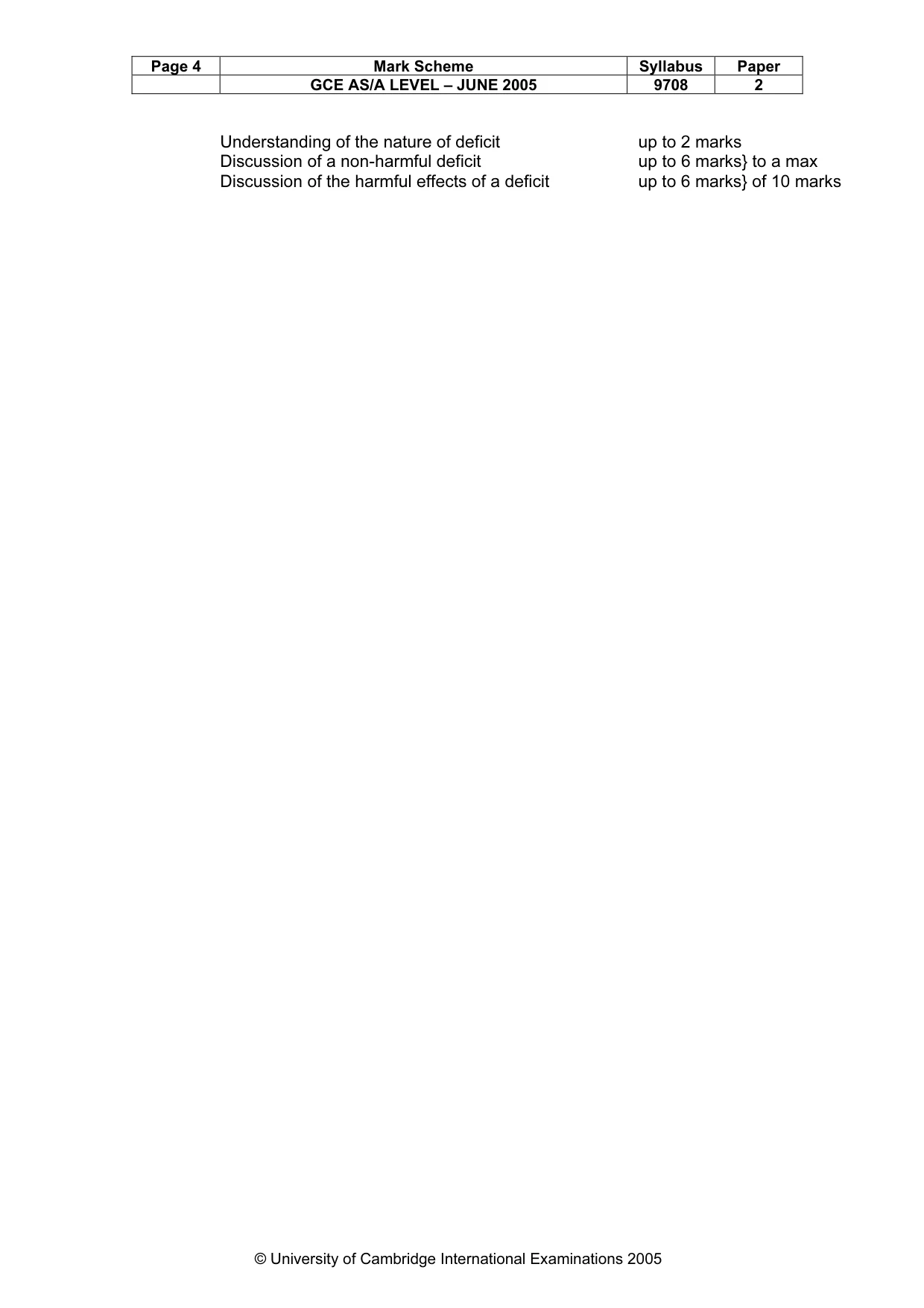
Page 4 Mark Scheme Syllabus Paper GCE AS/A LEVEL – JUNE 2005 9708 2 © University of Cambridge International Examinations 2005 Understanding of the nature of deficit up to 2 marks Discussion of a non-harmful deficit up to 6 marks} to a max Discussion of the harmful effects of a deficit up to 6 marks} of 10 marks