Cambridge A Level Drama 9482 — 2021 May/June Paper 1 · Variant 3
9482/13/M/J/21 · 60 marks · ≈68 min
The question paper and its mark scheme, free to read here and free to download. This is Cambridge’s own paper, exactly as it was sat.
Question paper8 pages


Mark scheme27 pages
Answers below. Sit the paper first if you are practising.
Paper as text
Question paper, page 1
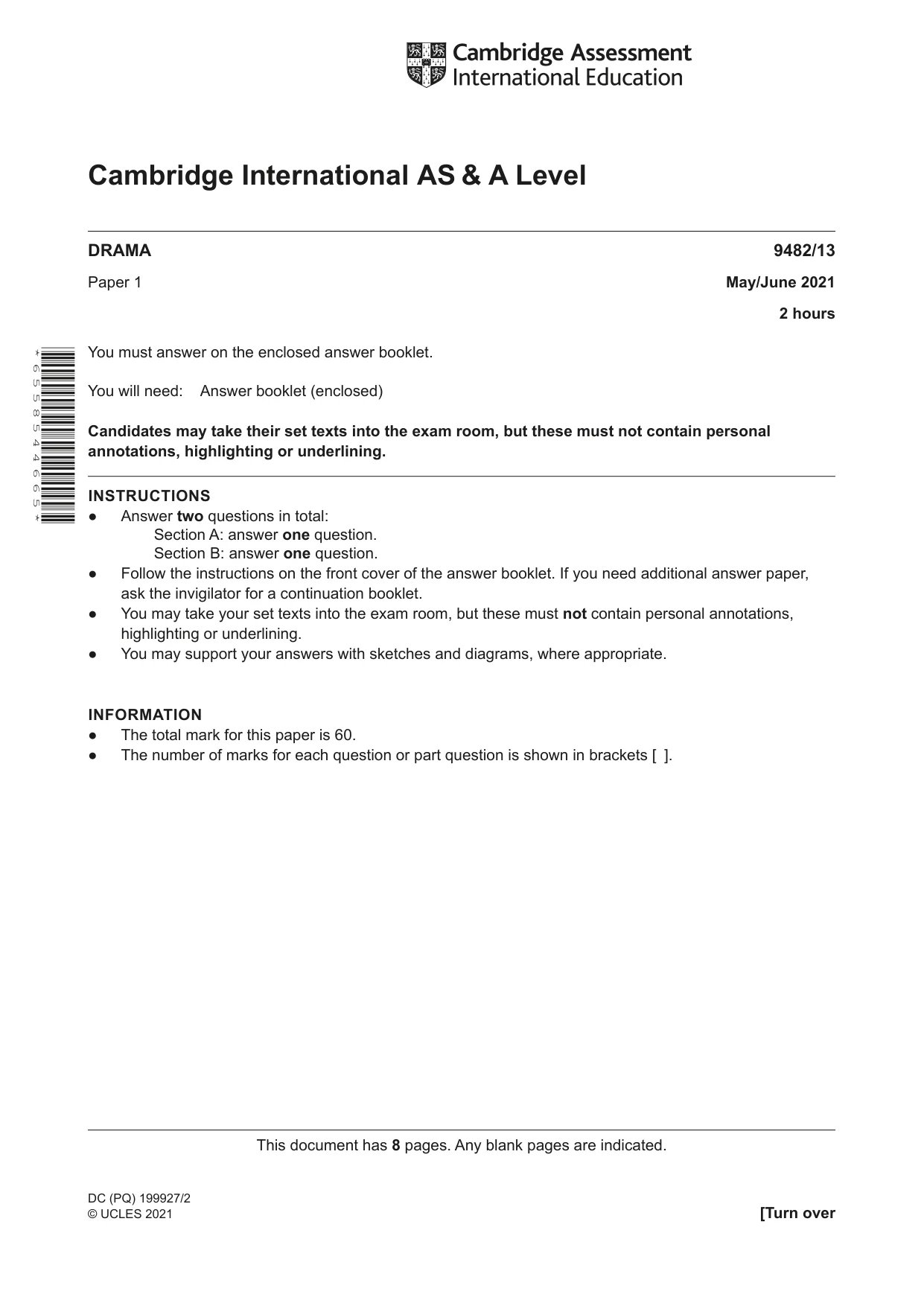
This document has 8 pages. Any blank pages are indicated. Cambridge International AS & A Level DC (PQ) 199927/2 © UCLES 2021 [Turn over * 6 5 5 8 5 4 4 6 6 5 * DRAMA 9482/13 Paper 1 May/June 2021 2 hours You must answer on the enclosed answer booklet. You will need: Answer booklet (enclosed) Candidates may take their set texts into the exam room, but these must not contain personal annotations, highlighting or underlining. INSTRUCTIONS ● Answer two questions in total: Section A: answer one question. Section B: answer one question. ● Follow the instructions on the front cover of the answer booklet. If you need additional answer paper, ask the invigilator for a continuation booklet. ● You may take your set texts into the exam room, but these must not contain personal annotations, highlighting or underlining. ● You may support your answers with sketches and diagrams, where appropriate. INFORMATION ● The total mark for this paper is 60. ● The number of marks for each question or part question is shown in brackets [ ].
Question paper, page 2
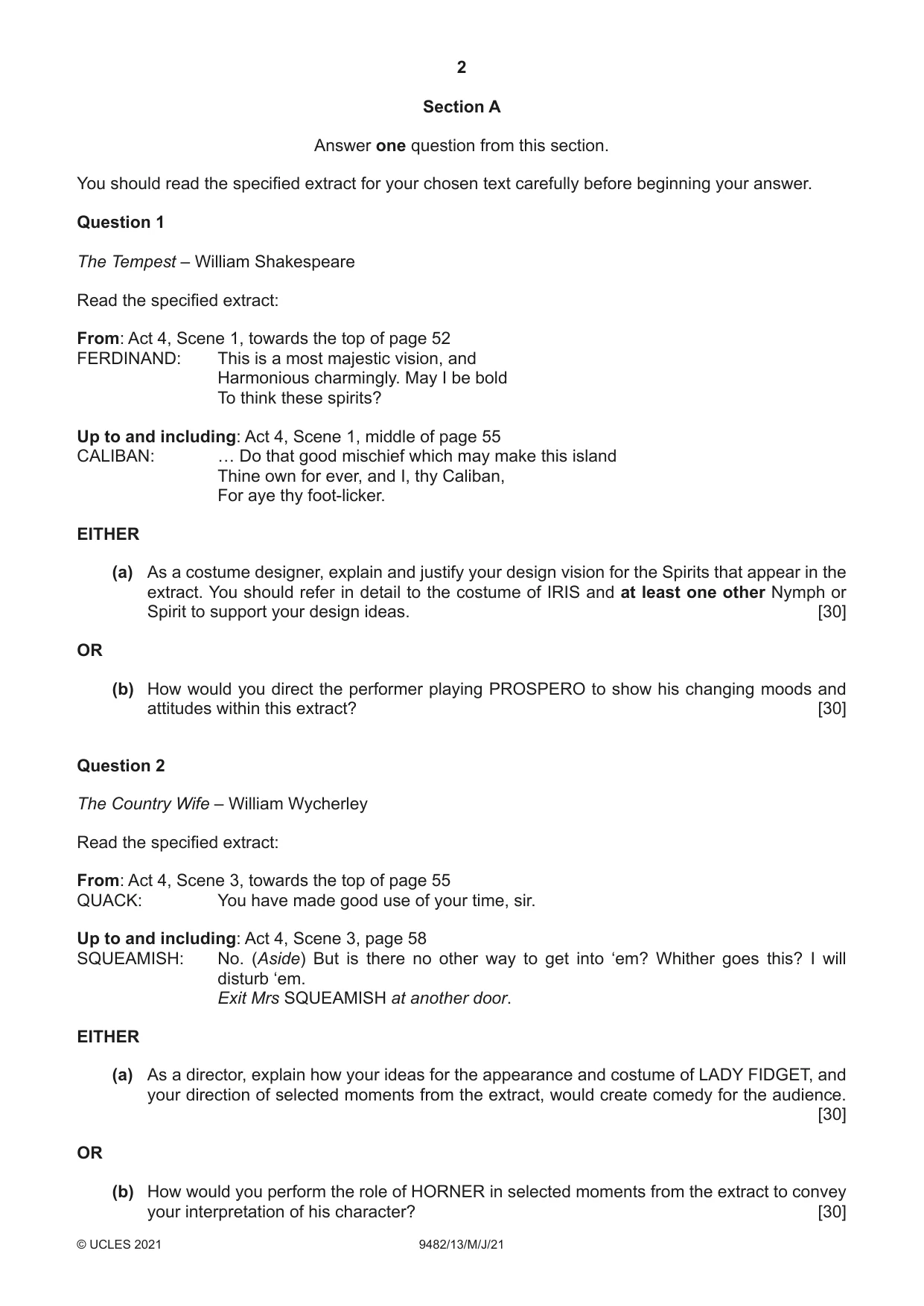
2 9482/13/M/J/21 © UCLES 2021 Section A Answer one question from this section. You should read the specified extract for your chosen text carefully before beginning your answer. Question 1 The Tempest – William Shakespeare Read the specified extract: From: Act 4, Scene 1, towards the top of page 52 FERDINAND: This is a most majestic vision, and Harmonious charmingly. May I be bold To think these spirits? Up to and including: Act 4, Scene 1, middle of page 55 CALIBAN: … Do that good mischief which may make this island Thine own for ever, and I, thy Caliban, For aye thy foot-licker. EITHER (a) As a costume designer, explain and justify your design vision for the Spirits that appear in the extract. You should refer in detail to the costume of IRIS and at least one other Nymph or Spirit to support your design ideas. [30] OR (b) How would you direct the performer playing PROSPERO to show his changing moods and attitudes within this extract? [30] Question 2 The Country Wife – William Wycherley Read the specified extract: From: Act 4, Scene 3, towards the top of page 55 QUACK: You have made good use of your time, sir. Up to and including: Act 4, Scene 3, page 58 SQUEAMISH: No. (Aside) But is there no other way to get into ‘em? Whither goes this? I will disturb ‘em. Exit Mrs SQUEAMISH at another door. EITHER (a) As a director, explain how your ideas for the appearance and costume of LADY FIDGET, and your direction of selected moments from the extract, would create comedy for the audience. [30] OR (b) How would you perform the role of HORNER in selected moments from the extract to convey your interpretation of his character? [30]
Question paper, page 3
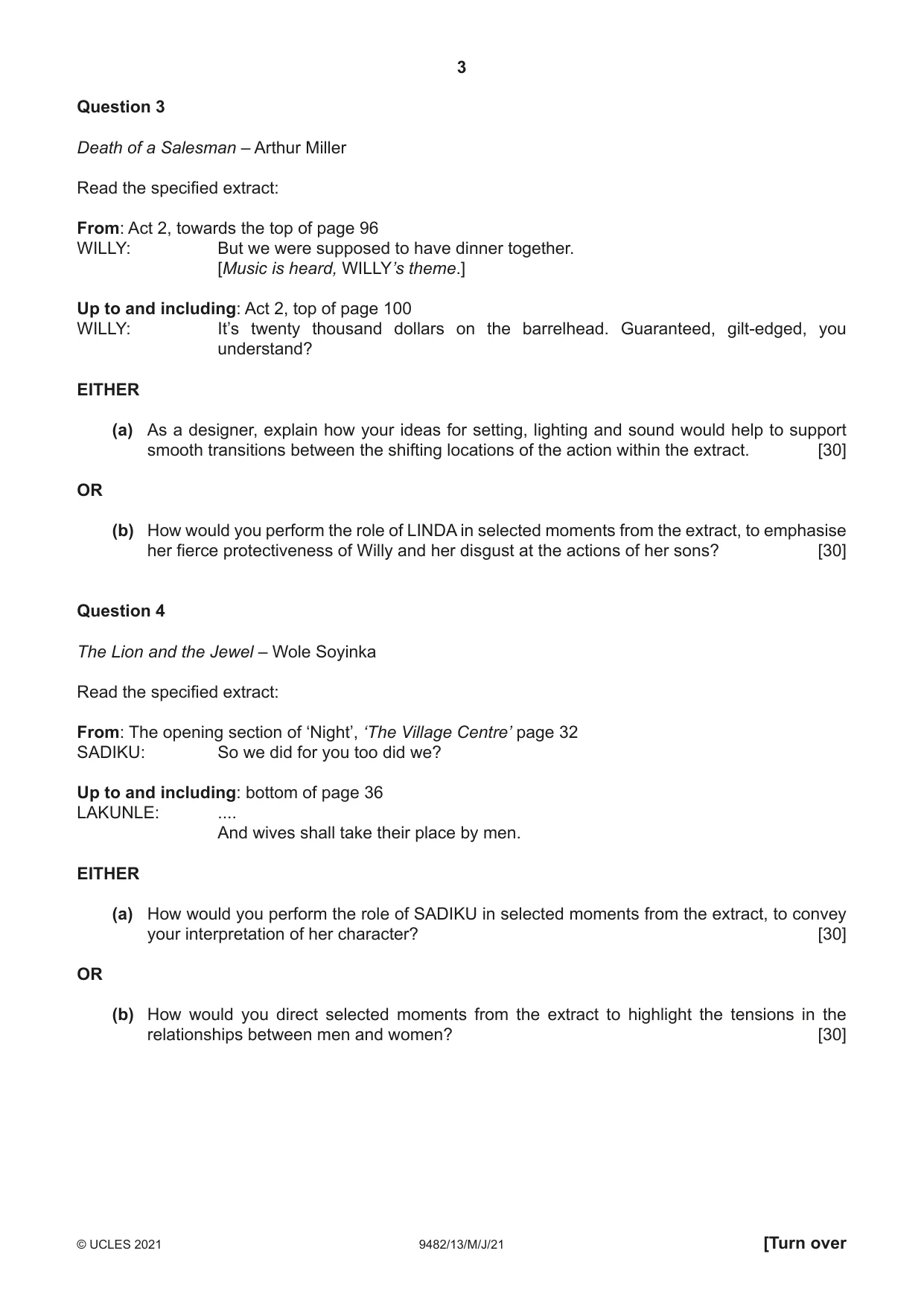
3 9482/13/M/J/21 © UCLES 2021 [Turn over Question 3 Death of a Salesman – Arthur Miller Read the specified extract: From: Act 2, towards the top of page 96 WILLY: But we were supposed to have dinner together. [Music is heard, WILLY’s theme.] Up to and including: Act 2, top of page 100 WILLY: It’s twenty thousand dollars on the barrelhead. Guaranteed, gilt-edged, you understand? EITHER (a) As a designer, explain how your ideas for setting, lighting and sound would help to support smooth transitions between the shifting locations of the action within the extract. [30] OR (b) How would you perform the role of LINDA in selected moments from the extract, to emphasise her fierce protectiveness of Willy and her disgust at the actions of her sons? [30] Question 4 The Lion and the Jewel – Wole Soyinka Read the specified extract: From: The opening section of ‘Night’, ‘The Village Centre’ page 32 SADIKU: So we did for you too did we? Up to and including: bottom of page 36 LAKUNLE: … And wives shall take their place by men. EITHER (a) How would you perform the role of SADIKU in selected moments from the extract, to convey your interpretation of her character? [30] OR (b) How would you direct selected moments from the extract to highlight the tensions in the relationships between men and women? [30]
Question paper, page 4
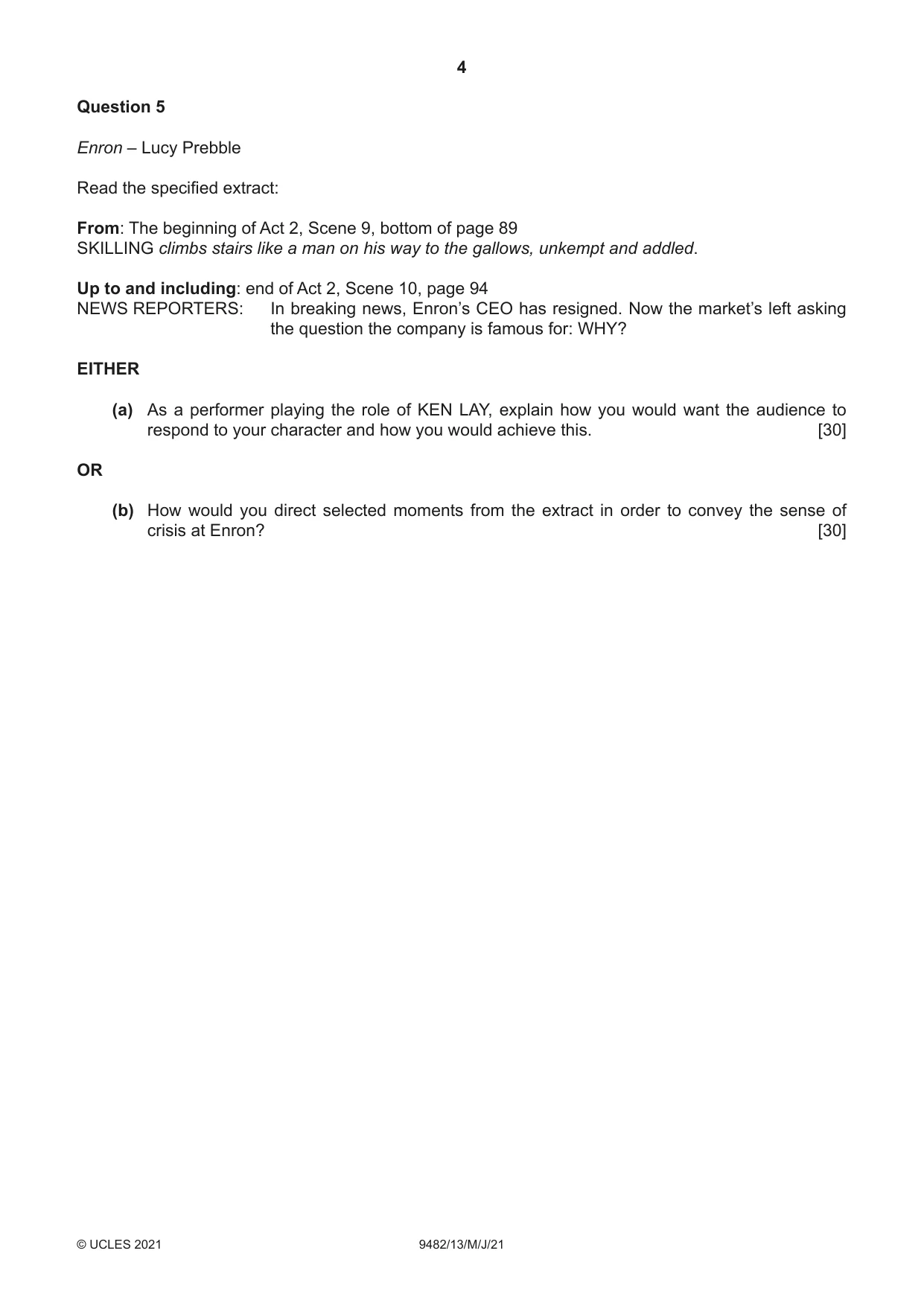
4 9482/13/M/J/21 © UCLES 2021 Question 5 Enron – Lucy Prebble Read the specified extract: From: The beginning of Act 2, Scene 9, bottom of page 89 SKILLING climbs stairs like a man on his way to the gallows, unkempt and addled. Up to and including: end of Act 2, Scene 10, page 94 NEWS REPORTERS: In breaking news, Enron’s CEO has resigned. Now the market’s left asking the question the company is famous for: WHY? EITHER (a) As a performer playing the role of KEN LAY, explain how you would want the audience to respond to your character and how you would achieve this. [30] OR (b) How would you direct selected moments from the extract in order to convey the sense of crisis at Enron? [30]
Question paper, page 5
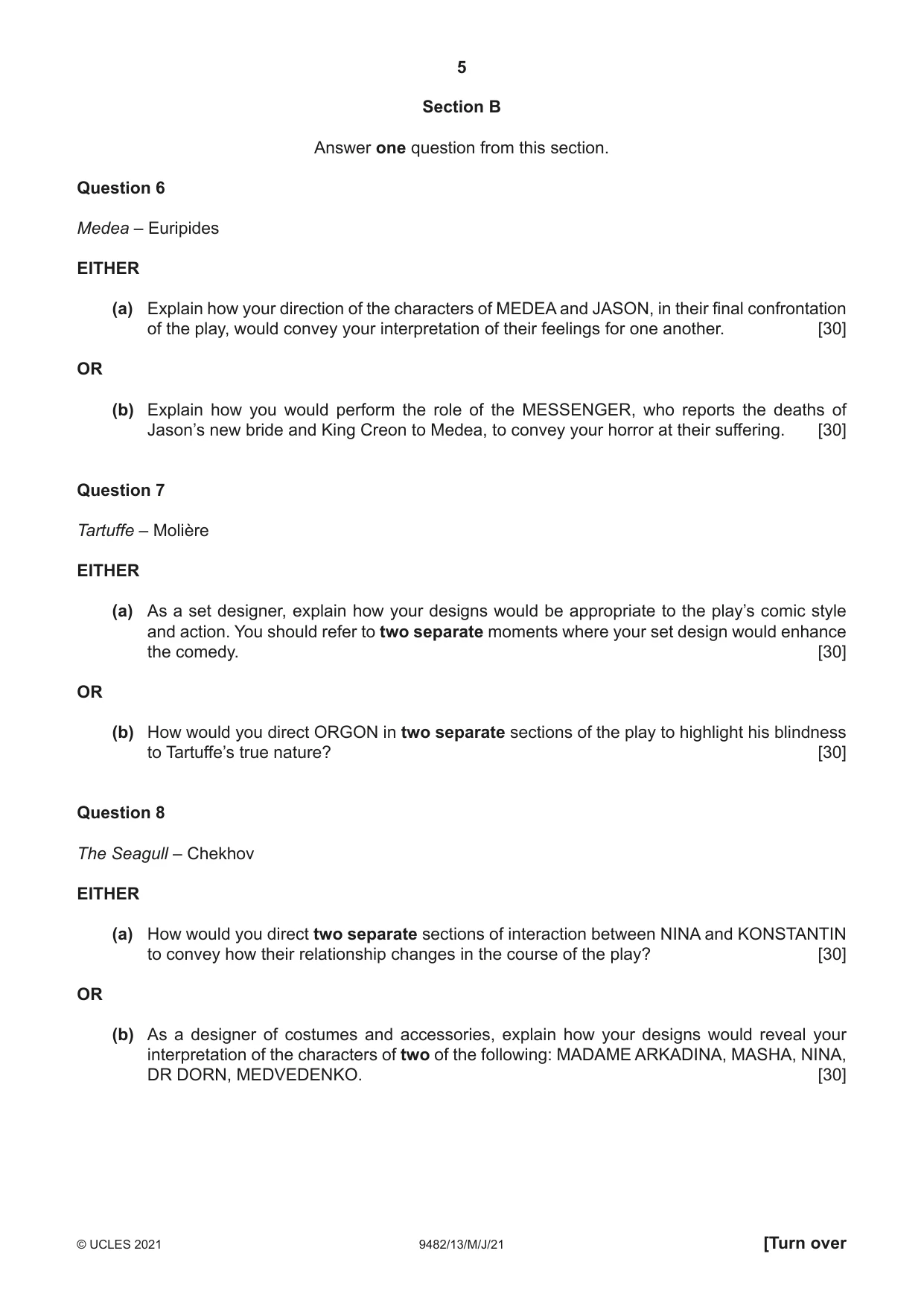
5 9482/13/M/J/21 © UCLES 2021 [Turn over Section B Answer one question from this section. Question 6 Medea – Euripides EITHER (a) Explain how your direction of the characters of MEDEA and JASON, in their final confrontation of the play, would convey your interpretation of their feelings for one another. [30] OR (b) Explain how you would perform the role of the MESSENGER, who reports the deaths of Jason’s new bride and King Creon to Medea, to convey your horror at their suffering. [30] Question 7 Tartuffe – Molière EITHER (a) As a set designer, explain how your designs would be appropriate to the play’s comic style and action. You should refer to two separate moments where your set design would enhance the comedy. [30] OR (b) How would you direct ORGON in two separate sections of the play to highlight his blindness to Tartuffe’s true nature? [30] Question 8 The Seagull – Chekhov EITHER (a) How would you direct two separate sections of interaction between NINA and KONSTANTIN to convey how their relationship changes in the course of the play? [30] OR (b) As a designer of costumes and accessories, explain how your designs would reveal your interpretation of the characters of two of the following: MADAME ARKADINA, MASHA, NINA, DR DORN, MEDVEDENKO. [30]
Question paper, page 6
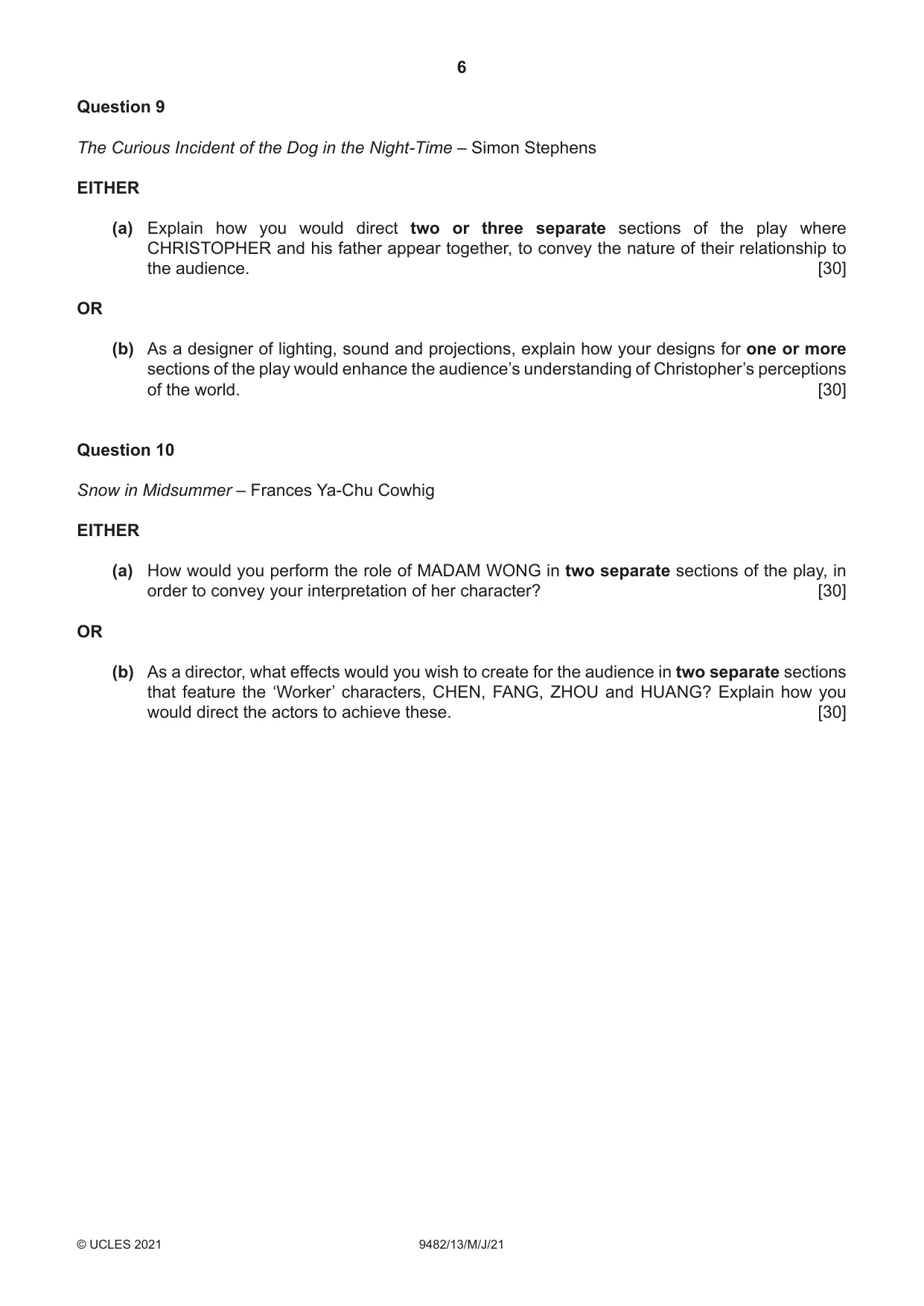
6 9482/13/M/J/21 © UCLES 2021 Question 9 The Curious Incident of the Dog in the Night-Time – Simon Stephens EITHER (a) Explain how you would direct two or three separate sections of the play where CHRISTOPHER and his father appear together, to convey the nature of their relationship to the audience. [30] OR (b) As a designer of lighting, sound and projections, explain how your designs for one or more sections of the play would enhance the audience’s understanding of Christopher’s perceptions of the world. [30] Question 10 Snow in Midsummer – Frances Ya-Chu Cowhig EITHER (a) How would you perform the role of MADAM WONG in two separate sections of the play, in order to convey your interpretation of her character? [30] OR (b) As a director, what effects would you wish to create for the audience in two separate sections that feature the ‘Worker’ characters, CHEN, FANG, ZHOU and HUANG? Explain how you would direct the actors to achieve these. [30]
Question paper, page 7
7 9482/13/M/J/21 © UCLES 2021 BLANK PAGE
Question paper, page 8
8 9482/13/M/J/21 © UCLES 2021 Permission to reproduce items where third-party owned material protected by copyright is included has been sought and cleared where possible. Every reasonable effort has been made by the publisher (UCLES) to trace copyright holders, but if any items requiring clearance have unwittingly been included, the publisher will be pleased to make amends at the earliest possible opportunity. To avoid the issue of disclosure of answer-related information to candidates, all copyright acknowledgements are reproduced online in the Cambridge Assessment International Education Copyright Acknowledgements Booklet. This is produced for each series of examinations and is freely available to download at www.cambridgeinternational.org after the live examination series. Cambridge Assessment International Education is part of the Cambridge Assessment Group. Cambridge Assessment is the brand name of the University of Cambridge Local Examinations Syndicate (UCLES), which itself is a department of the University of Cambridge. BLANK PAGE
Mark scheme, page 1
This document consists of 27 printed pages. © UCLES 2021 [Turn over Cambridge International AS & A Level DRAMA 9482/13 Paper 1 Open-Book Written Examination 13 May/June 2021 MARK SCHEME Maximum Mark: 60 Published This mark scheme is published as an aid to teachers and candidates, to indicate the requirements of the examination. It shows the basis on which Examiners were instructed to award marks. It does not indicate the details of the discussions that took place at an Examiners’ meeting before marking began, which would have considered the acceptability of alternative answers. Mark schemes should be read in conjunction with the question paper and the Principal Examiner Report for Teachers. Cambridge International will not enter into discussions about these mark schemes. Cambridge International is publishing the mark schemes for the May/June 2021 series for most Cambridge IGCSE™, Cambridge International A and AS Level components and some Cambridge O Level components.
Mark scheme, page 2
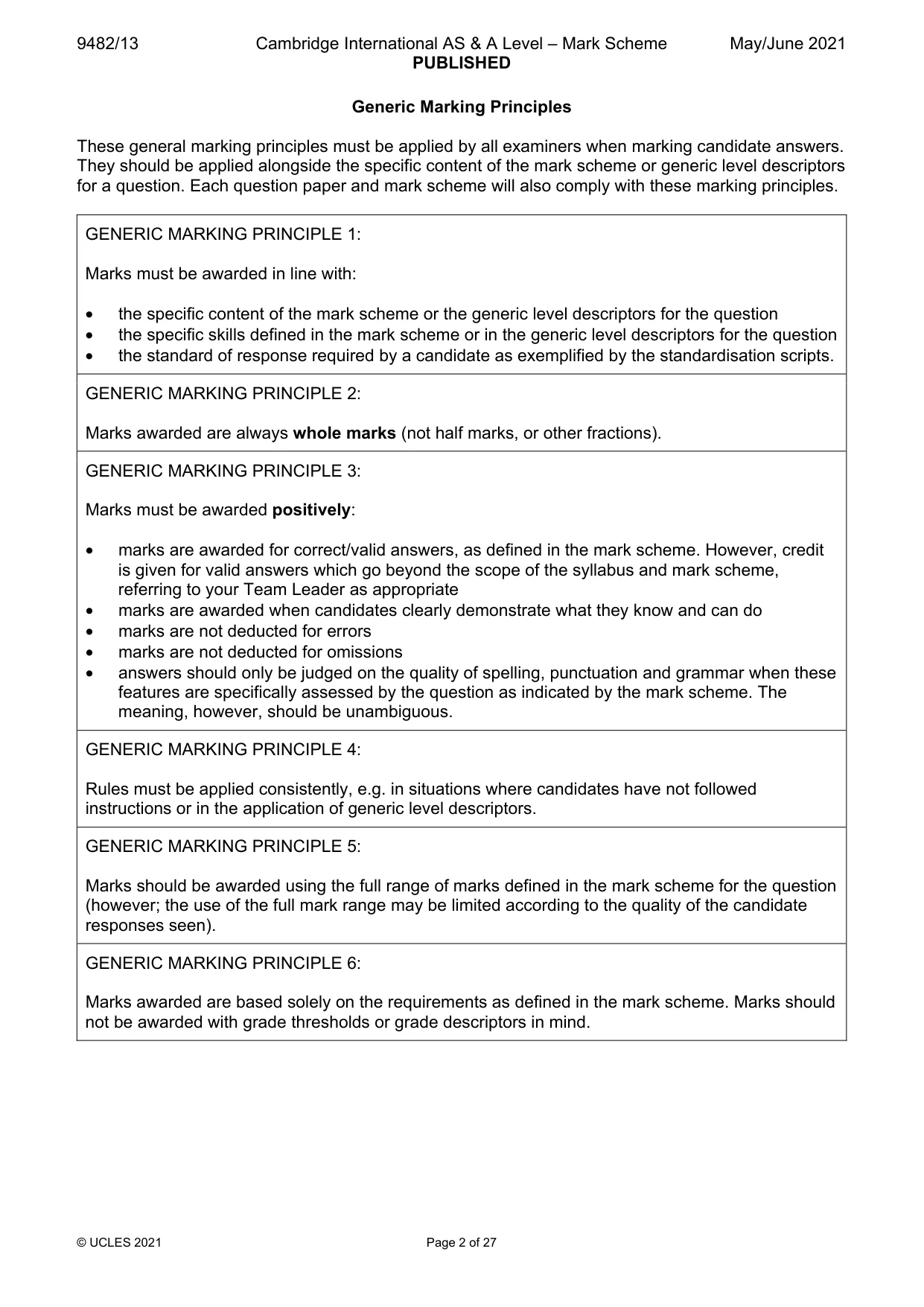
9482/13 Cambridge International AS & A Level – Mark Scheme PUBLISHED May/June 2021 © UCLES 2021 Page 2 of 27 Generic Marking Principles These general marking principles must be applied by all examiners when marking candidate answers. They should be applied alongside the specific content of the mark scheme or generic level descriptors for a question. Each question paper and mark scheme will also comply with these marking principles. GENERIC MARKING PRINCIPLE 1: Marks must be awarded in line with: • the specific content of the mark scheme or the generic level descriptors for the question • the specific skills defined in the mark scheme or in the generic level descriptors for the question • the standard of response required by a candidate as exemplified by the standardisation scripts. GENERIC MARKING PRINCIPLE 2: Marks awarded are always whole marks (not half marks, or other fractions). GENERIC MARKING PRINCIPLE 3: Marks must be awarded positively: • marks are awarded for correct/valid answers, as defined in the mark scheme. However, credit is given for valid answers which go beyond the scope of the syllabus and mark scheme, referring to your Team Leader as appropriate • marks are awarded when candidates clearly demonstrate what they know and can do • marks are not deducted for errors • marks are not deducted for omissions • answers should only be judged on the quality of spelling, punctuation and grammar when these features are specifically assessed by the question as indicated by the mark scheme. The meaning, however, should be unambiguous. GENERIC MARKING PRINCIPLE 4: Rules must be applied consistently, e.g. in situations where candidates have not followed instructions or in the application of generic level descriptors. GENERIC MARKING PRINCIPLE 5: Marks should be awarded using the full range of marks defined in the mark scheme for the question (however; the use of the full mark range may be limited according to the quality of the candidate responses seen). GENERIC MARKING PRINCIPLE 6: Marks awarded are based solely on the requirements as defined in the mark scheme. Marks should not be awarded with grade thresholds or grade descriptors in mind.
Mark scheme, page 3
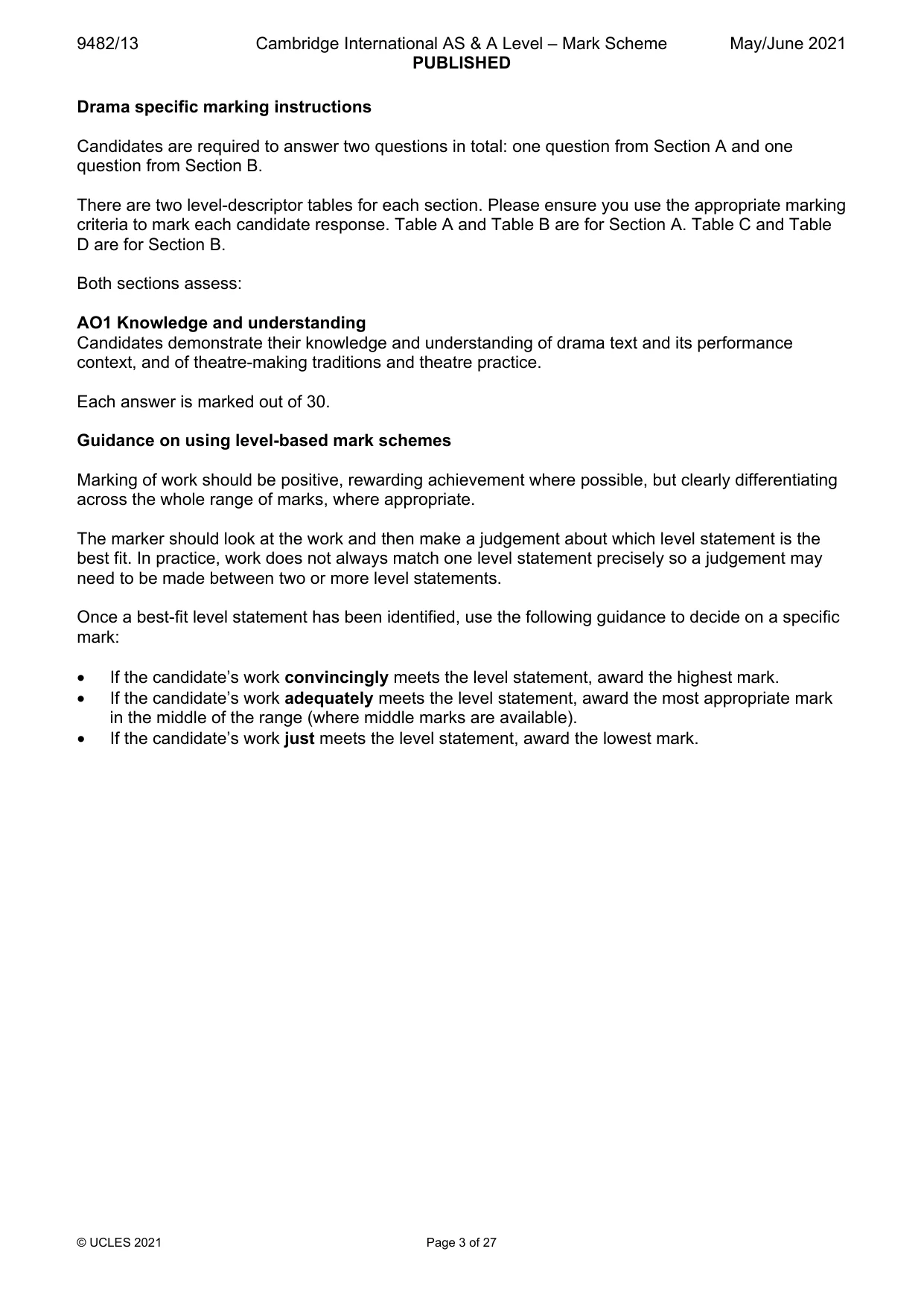
9482/13 Cambridge International AS & A Level – Mark Scheme PUBLISHED May/June 2021 © UCLES 2021 Page 3 of 27 Drama specific marking instructions Candidates are required to answer two questions in total: one question from Section A and one question from Section B. There are two level-descriptor tables for each section. Please ensure you use the appropriate marking criteria to mark each candidate response. Table A and Table B are for Section A. Table C and Table D are for Section B. Both sections assess: AO1 Knowledge and understanding Candidates demonstrate their knowledge and understanding of drama text and its performance context, and of theatre-making traditions and theatre practice. Each answer is marked out of 30. Guidance on using level-based mark schemes Marking of work should be positive, rewarding achievement where possible, but clearly differentiating across the whole range of marks, where appropriate. The marker should look at the work and then make a judgement about which level statement is the best fit. In practice, work does not always match one level statement precisely so a judgement may need to be made between two or more level statements. Once a best-fit level statement has been identified, use the following guidance to decide on a specific mark: • If the candidate’s work convincingly meets the level statement, award the highest mark. • If the candidate’s work adequately meets the level statement, award the most appropriate mark in the middle of the range (where middle marks are available). • If the candidate’s work just meets the level statement, award the lowest mark.
Mark scheme, page 4
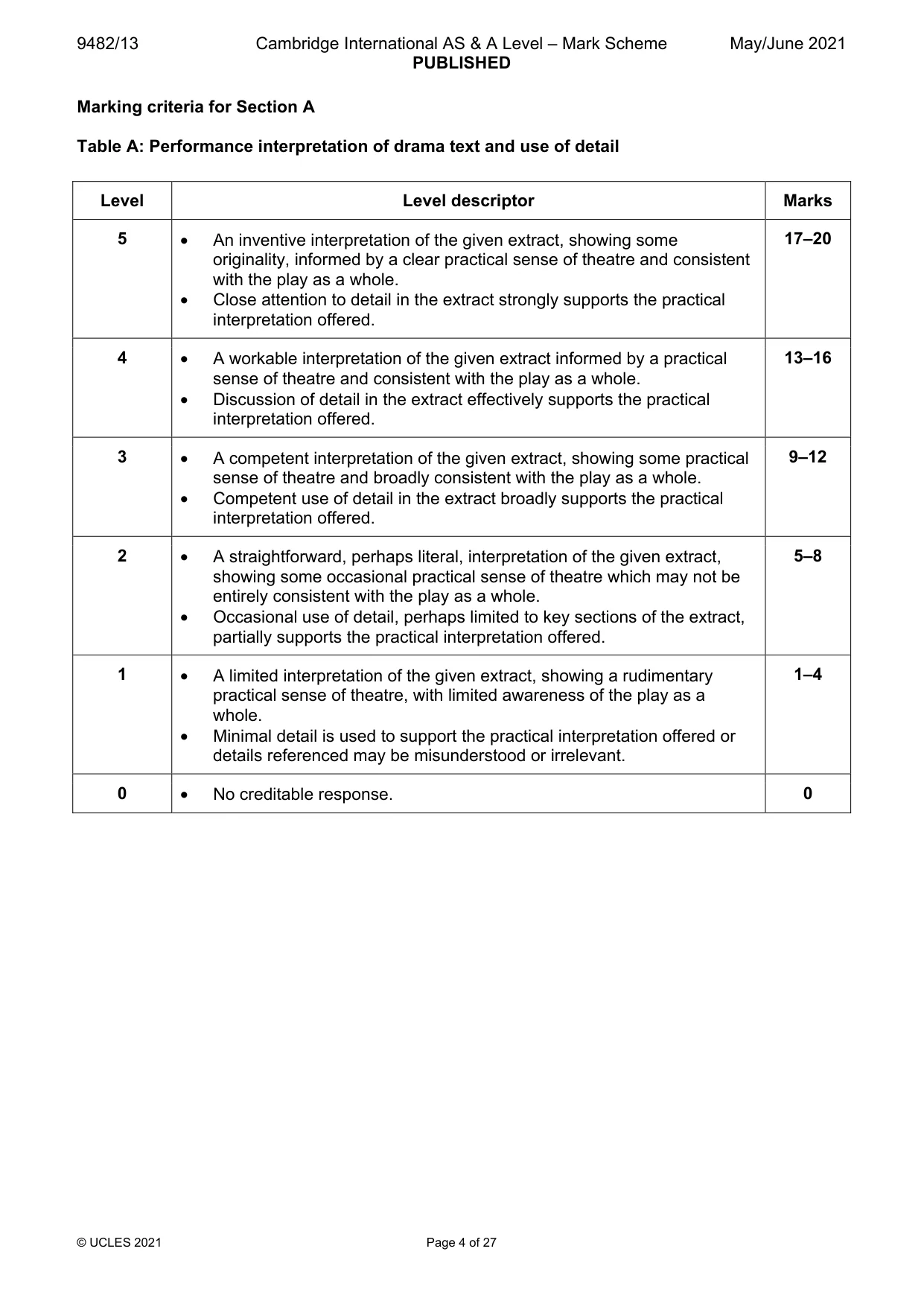
9482/13 Cambridge International AS & A Level – Mark Scheme PUBLISHED May/June 2021 © UCLES 2021 Page 4 of 27 Marking criteria for Section A Table A: Performance interpretation of drama text and use of detail Level Level descriptor Marks 5 • An inventive interpretation of the given extract, showing some originality, informed by a clear practical sense of theatre and consistent with the play as a whole. • Close attention to detail in the extract strongly supports the practical interpretation offered. 17–20 4 • A workable interpretation of the given extract informed by a practical sense of theatre and consistent with the play as a whole. • Discussion of detail in the extract effectively supports the practical interpretation offered. 13–16 3 • A competent interpretation of the given extract, showing some practical sense of theatre and broadly consistent with the play as a whole. • Competent use of detail in the extract broadly supports the practical interpretation offered. 9–12 2 • A straightforward, perhaps literal, interpretation of the given extract, showing some occasional practical sense of theatre which may not be entirely consistent with the play as a whole. • Occasional use of detail, perhaps limited to key sections of the extract, partially supports the practical interpretation offered. 5–8 1 • A limited interpretation of the given extract, showing a rudimentary practical sense of theatre, with limited awareness of the play as a whole. • Minimal detail is used to support the practical interpretation offered or details referenced may be misunderstood or irrelevant. 1–4 0 • No creditable response. 0
Mark scheme, page 5
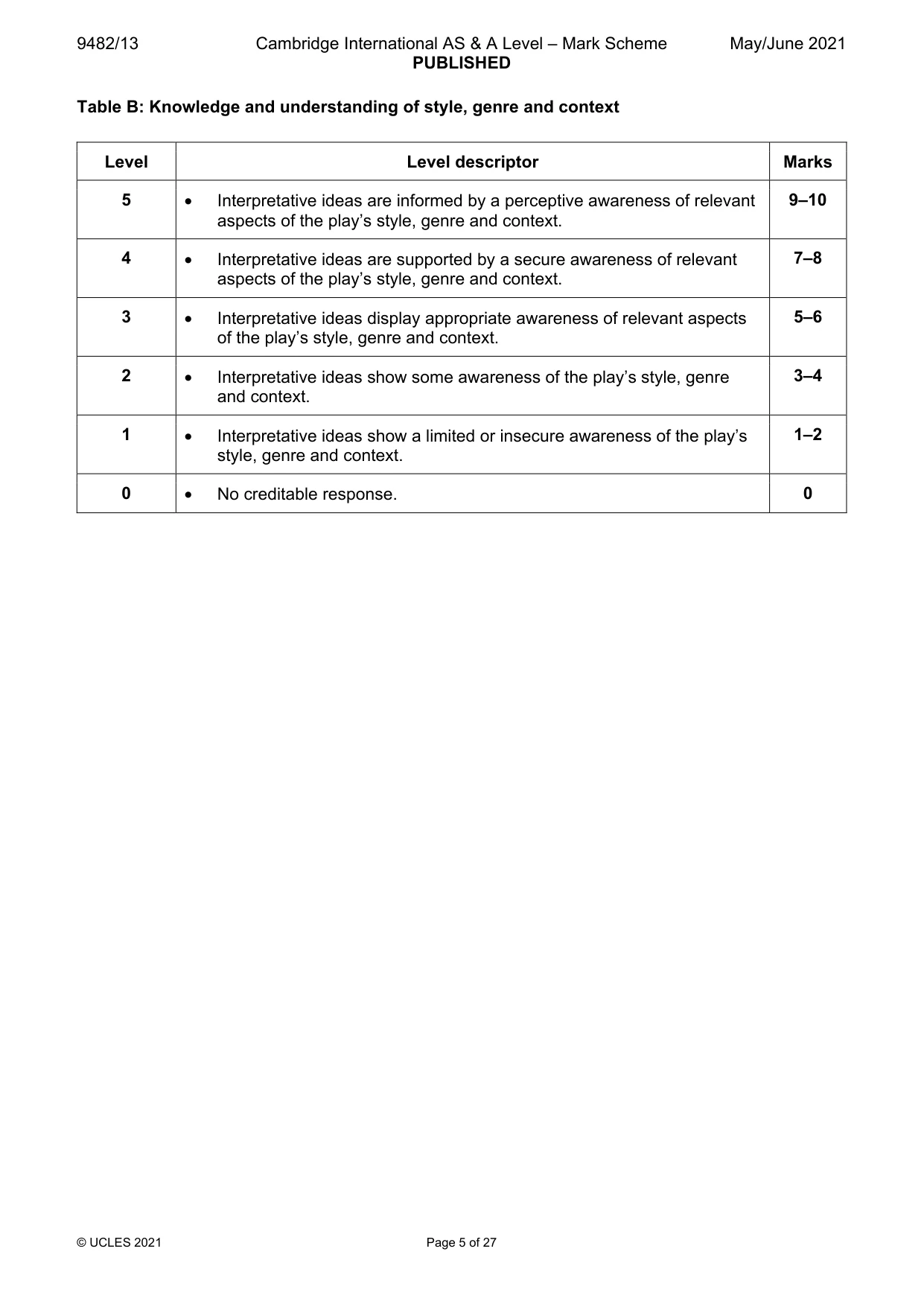
9482/13 Cambridge International AS & A Level – Mark Scheme PUBLISHED May/June 2021 © UCLES 2021 Page 5 of 27 Table B: Knowledge and understanding of style, genre and context Level Level descriptor Marks 5 • Interpretative ideas are informed by a perceptive awareness of relevant aspects of the play’s style, genre and context. 9–10 4 • Interpretative ideas are supported by a secure awareness of relevant aspects of the play’s style, genre and context. 7–8 3 • Interpretative ideas display appropriate awareness of relevant aspects of the play’s style, genre and context. 5–6 2 • Interpretative ideas show some awareness of the play’s style, genre and context. 3–4 1 • Interpretative ideas show a limited or insecure awareness of the play’s style, genre and context. 1–2 0 • No creditable response. 0
Mark scheme, page 6
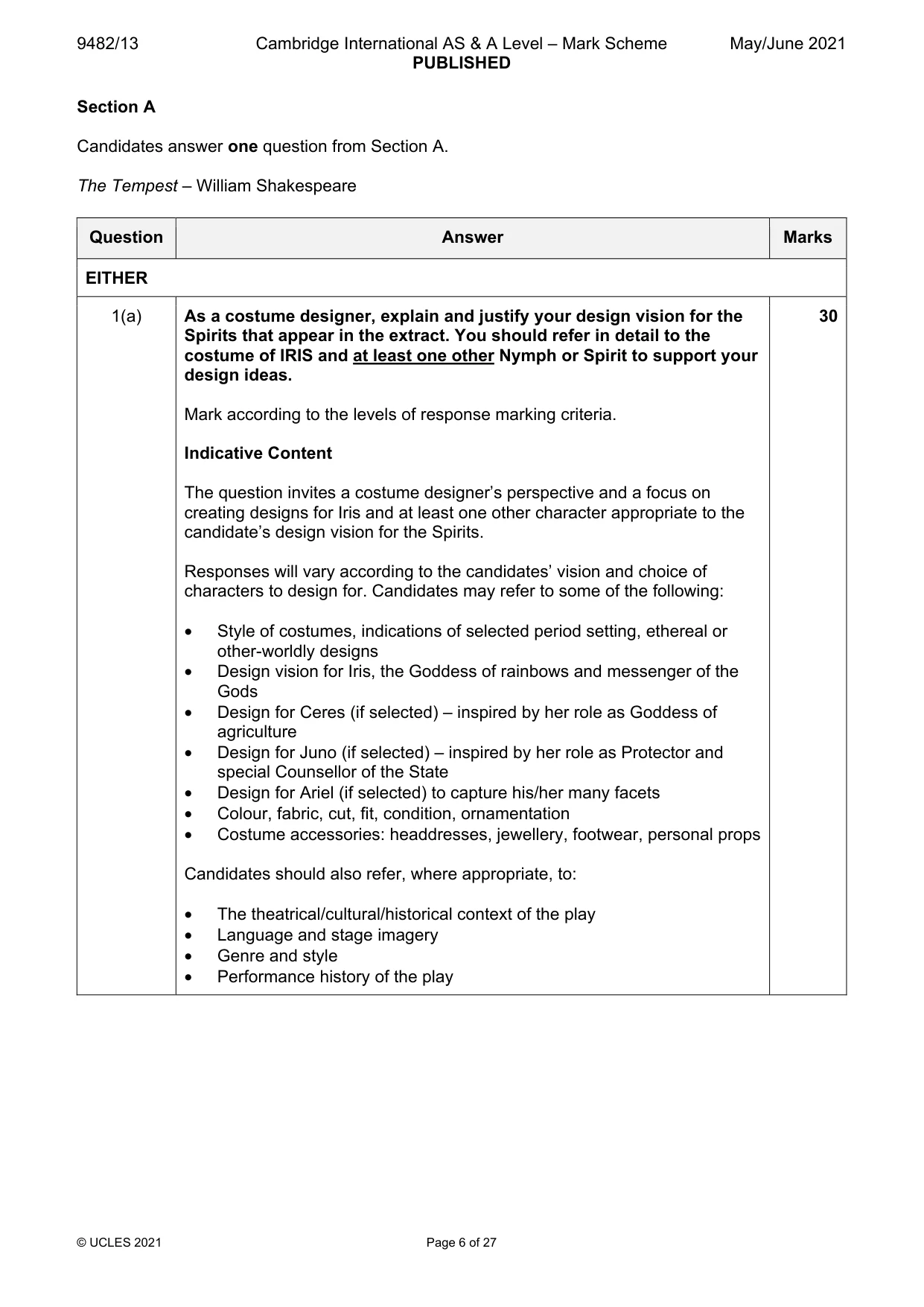
9482/13 Cambridge International AS & A Level – Mark Scheme PUBLISHED May/June 2021 © UCLES 2021 Page 6 of 27 Section A Candidates answer one question from Section A. The Tempest – William Shakespeare Question Answer Marks EITHER 1(a) As a costume designer, explain and justify your design vision for the Spirits that appear in the extract. You should refer in detail to the costume of IRIS and at least one other Nymph or Spirit to support your design ideas. Mark according to the levels of response marking criteria. Indicative Content The question invites a costume designer’s perspective and a focus on creating designs for Iris and at least one other character appropriate to the candidate’s design vision for the Spirits. Responses will vary according to the candidates’ vision and choice of characters to design for. Candidates may refer to some of the following: • Style of costumes, indications of selected period setting, ethereal or other-worldly designs • Design vision for Iris, the Goddess of rainbows and messenger of the Gods • Design for Ceres (if selected) – inspired by her role as Goddess of agriculture • Design for Juno (if selected) – inspired by her role as Protector and special Counsellor of the State • Design for Ariel (if selected) to capture his/her many facets • Colour, fabric, cut, fit, condition, ornamentation • Costume accessories: headdresses, jewellery, footwear, personal props Candidates should also refer, where appropriate, to: • The theatrical/cultural/historical context of the play • Language and stage imagery • Genre and style • Performance history of the play 30
Mark scheme, page 7
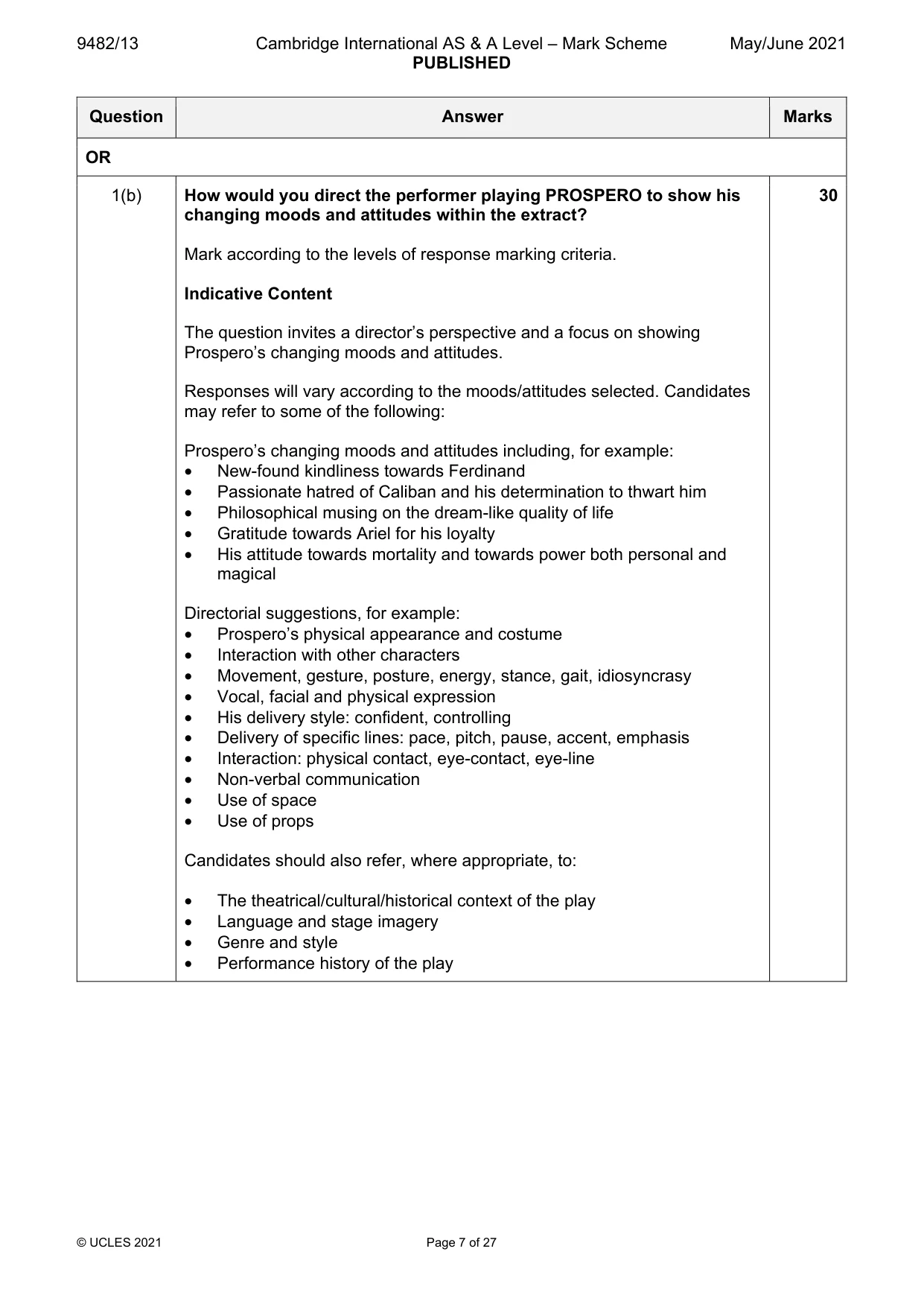
9482/13 Cambridge International AS & A Level – Mark Scheme PUBLISHED May/June 2021 © UCLES 2021 Page 7 of 27 Question Answer Marks OR 1(b) How would you direct the performer playing PROSPERO to show his changing moods and attitudes within the extract? Mark according to the levels of response marking criteria. Indicative Content The question invites a director’s perspective and a focus on showing Prospero’s changing moods and attitudes. Responses will vary according to the moods/attitudes selected. Candidates may refer to some of the following: Prospero’s changing moods and attitudes including, for example: • New-found kindliness towards Ferdinand • Passionate hatred of Caliban and his determination to thwart him • Philosophical musing on the dream-like quality of life • Gratitude towards Ariel for his loyalty • His attitude towards mortality and towards power both personal and magical Directorial suggestions, for example: • Prospero’s physical appearance and costume • Interaction with other characters • Movement, gesture, posture, energy, stance, gait, idiosyncrasy • Vocal, facial and physical expression • His delivery style: confident, controlling • Delivery of specific lines: pace, pitch, pause, accent, emphasis • Interaction: physical contact, eye-contact, eye-line • Non-verbal communication • Use of space • Use of props Candidates should also refer, where appropriate, to: • The theatrical/cultural/historical context of the play • Language and stage imagery • Genre and style • Performance history of the play 30
Mark scheme, page 8
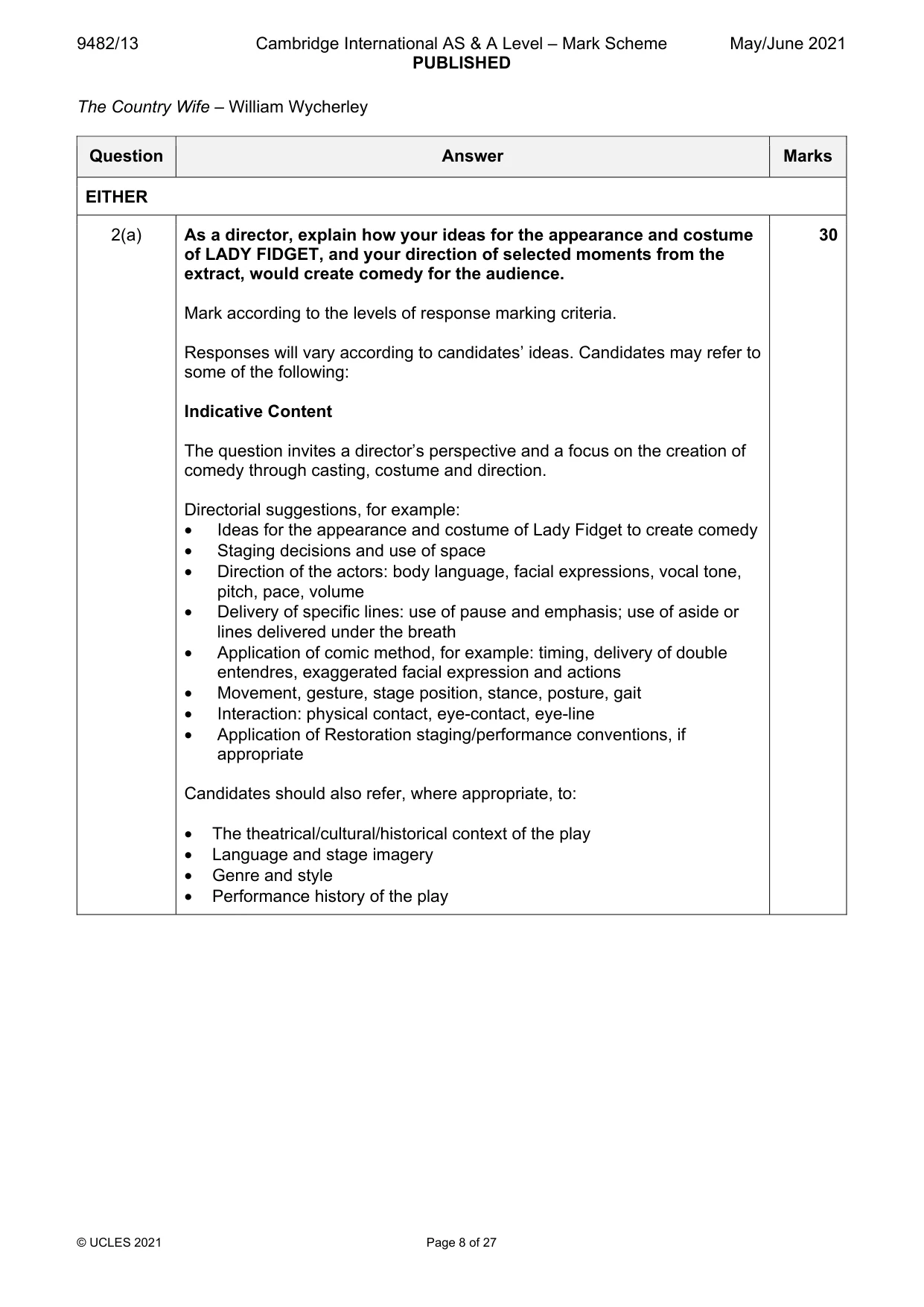
9482/13 Cambridge International AS & A Level – Mark Scheme PUBLISHED May/June 2021 © UCLES 2021 Page 8 of 27 The Country Wife – William Wycherley Question Answer Marks EITHER 2(a) As a director, explain how your ideas for the appearance and costume of LADY FIDGET, and your direction of selected moments from the extract, would create comedy for the audience. Mark according to the levels of response marking criteria. Responses will vary according to candidates’ ideas. Candidates may refer to some of the following: Indicative Content The question invites a director’s perspective and a focus on the creation of comedy through casting, costume and direction. Directorial suggestions, for example: • Ideas for the appearance and costume of Lady Fidget to create comedy • Staging decisions and use of space • Direction of the actors: body language, facial expressions, vocal tone, pitch, pace, volume • Delivery of specific lines: use of pause and emphasis; use of aside or lines delivered under the breath • Application of comic method, for example: timing, delivery of double entendres, exaggerated facial expression and actions • Movement, gesture, stage position, stance, posture, gait • Interaction: physical contact, eye-contact, eye-line • Application of Restoration staging/performance conventions, if appropriate Candidates should also refer, where appropriate, to: • The theatrical/cultural/historical context of the play • Language and stage imagery • Genre and style • Performance history of the play 30
Mark scheme, page 9
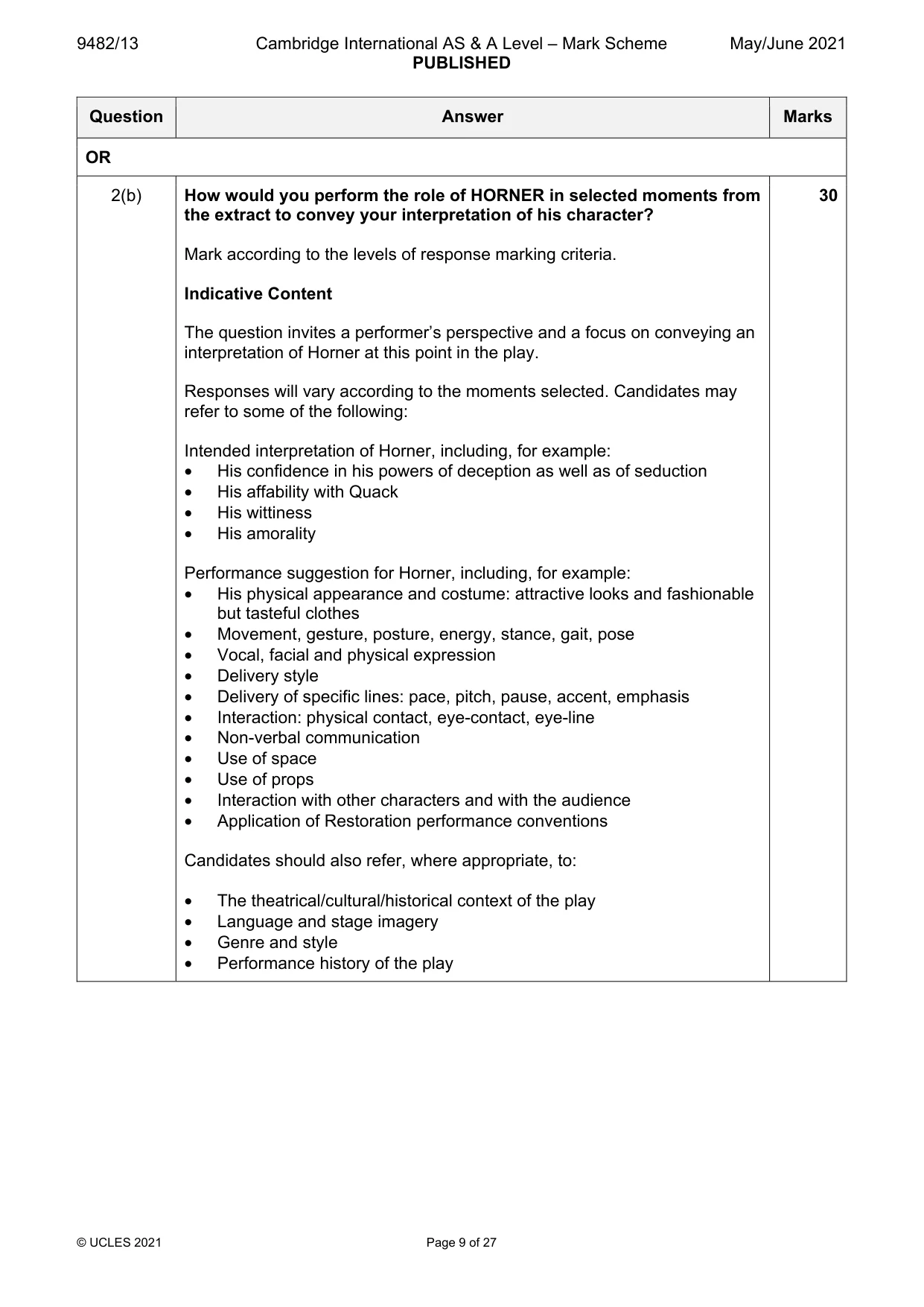
9482/13 Cambridge International AS & A Level – Mark Scheme PUBLISHED May/June 2021 © UCLES 2021 Page 9 of 27 Question Answer Marks OR 2(b) How would you perform the role of HORNER in selected moments from the extract to convey your interpretation of his character? Mark according to the levels of response marking criteria. Indicative Content The question invites a performer’s perspective and a focus on conveying an interpretation of Horner at this point in the play. Responses will vary according to the moments selected. Candidates may refer to some of the following: Intended interpretation of Horner, including, for example: • His confidence in his powers of deception as well as of seduction • His affability with Quack • His wittiness • His amorality Performance suggestion for Horner, including, for example: • His physical appearance and costume: attractive looks and fashionable but tasteful clothes • Movement, gesture, posture, energy, stance, gait, pose • Vocal, facial and physical expression • Delivery style • Delivery of specific lines: pace, pitch, pause, accent, emphasis • Interaction: physical contact, eye-contact, eye-line • Non-verbal communication • Use of space • Use of props • Interaction with other characters and with the audience • Application of Restoration performance conventions Candidates should also refer, where appropriate, to: • The theatrical/cultural/historical context of the play • Language and stage imagery • Genre and style • Performance history of the play 30
Mark scheme, page 10
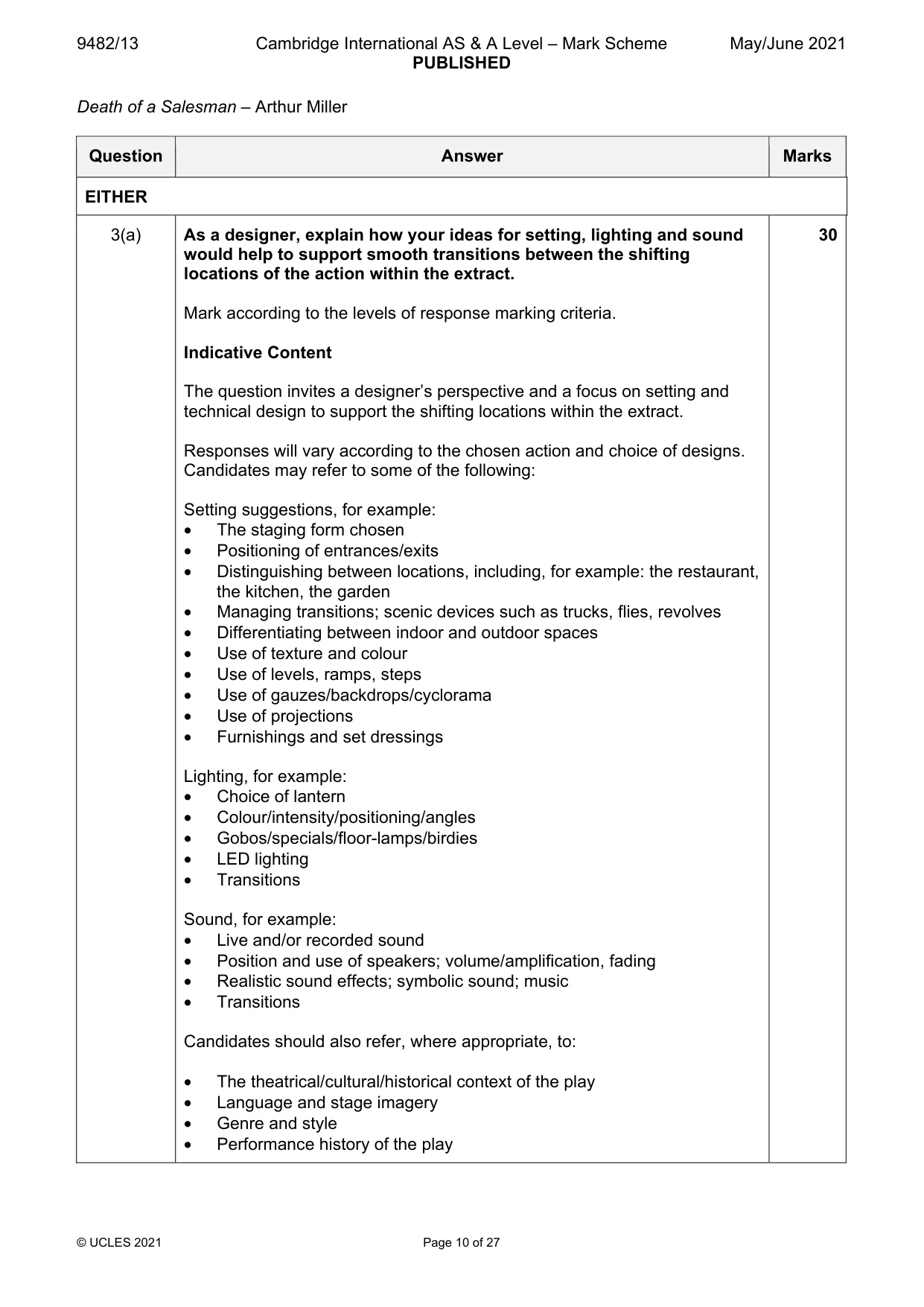
9482/13 Cambridge International AS & A Level – Mark Scheme PUBLISHED May/June 2021 © UCLES 2021 Page 10 of 27 Death of a Salesman – Arthur Miller Question Answer Marks EITHER 3(a) As a designer, explain how your ideas for setting, lighting and sound would help to support smooth transitions between the shifting locations of the action within the extract. Mark according to the levels of response marking criteria. Indicative Content The question invites a designer’s perspective and a focus on setting and technical design to support the shifting locations within the extract. Responses will vary according to the chosen action and choice of designs. Candidates may refer to some of the following: Setting suggestions, for example: • The staging form chosen • Positioning of entrances/exits • Distinguishing between locations, including, for example: the restaurant, the kitchen, the garden • Managing transitions; scenic devices such as trucks, flies, revolves • Differentiating between indoor and outdoor spaces • Use of texture and colour • Use of levels, ramps, steps • Use of gauzes/backdrops/cyclorama • Use of projections • Furnishings and set dressings Lighting, for example: • Choice of lantern • Colour/intensity/positioning/angles • Gobos/specials/floor-lamps/birdies • LED lighting • Transitions Sound, for example: • Live and/or recorded sound • Position and use of speakers; volume/amplification, fading • Realistic sound effects; symbolic sound; music • Transitions Candidates should also refer, where appropriate, to: • The theatrical/cultural/historical context of the play • Language and stage imagery • Genre and style • Performance history of the play 30
Mark scheme, page 11
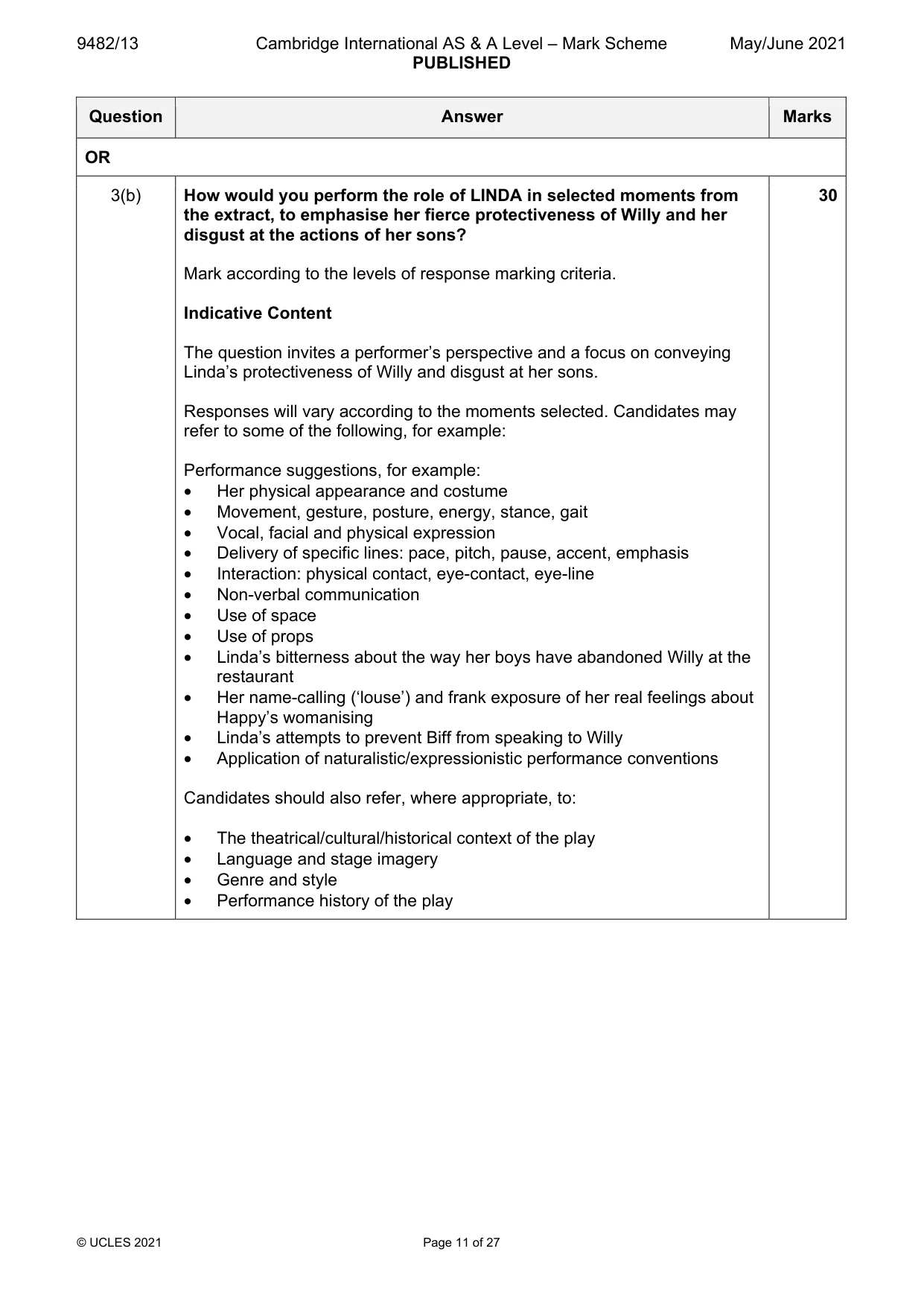
9482/13 Cambridge International AS & A Level – Mark Scheme PUBLISHED May/June 2021 © UCLES 2021 Page 11 of 27 Question Answer Marks OR 3(b) How would you perform the role of LINDA in selected moments from the extract, to emphasise her fierce protectiveness of Willy and her disgust at the actions of her sons? Mark according to the levels of response marking criteria. Indicative Content The question invites a performer’s perspective and a focus on conveying Linda’s protectiveness of Willy and disgust at her sons. Responses will vary according to the moments selected. Candidates may refer to some of the following, for example: Performance suggestions, for example: • Her physical appearance and costume • Movement, gesture, posture, energy, stance, gait • Vocal, facial and physical expression • Delivery of specific lines: pace, pitch, pause, accent, emphasis • Interaction: physical contact, eye-contact, eye-line • Non-verbal communication • Use of space • Use of props • Linda’s bitterness about the way her boys have abandoned Willy at the restaurant • Her name-calling (‘louse’) and frank exposure of her real feelings about Happy’s womanising • Linda’s attempts to prevent Biff from speaking to Willy • Application of naturalistic/expressionistic performance conventions Candidates should also refer, where appropriate, to: • The theatrical/cultural/historical context of the play • Language and stage imagery • Genre and style • Performance history of the play 30
Mark scheme, page 12
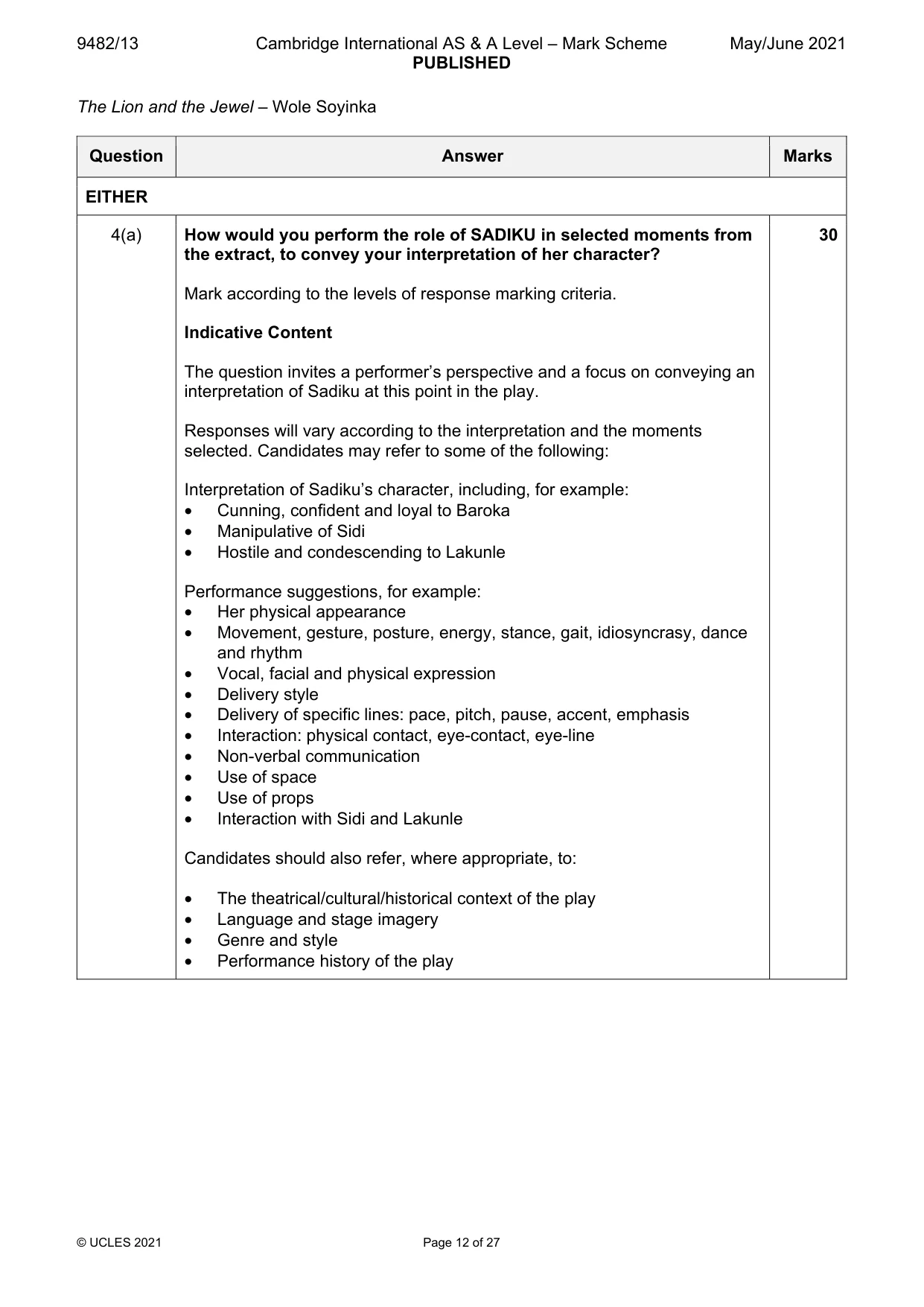
9482/13 Cambridge International AS & A Level – Mark Scheme PUBLISHED May/June 2021 © UCLES 2021 Page 12 of 27 The Lion and the Jewel – Wole Soyinka Question Answer Marks EITHER 4(a) How would you perform the role of SADIKU in selected moments from the extract, to convey your interpretation of her character? Mark according to the levels of response marking criteria. Indicative Content The question invites a performer’s perspective and a focus on conveying an interpretation of Sadiku at this point in the play. Responses will vary according to the interpretation and the moments selected. Candidates may refer to some of the following: Interpretation of Sadiku’s character, including, for example: • Cunning, confident and loyal to Baroka • Manipulative of Sidi • Hostile and condescending to Lakunle Performance suggestions, for example: • Her physical appearance • Movement, gesture, posture, energy, stance, gait, idiosyncrasy, dance and rhythm • Vocal, facial and physical expression • Delivery style • Delivery of specific lines: pace, pitch, pause, accent, emphasis • Interaction: physical contact, eye-contact, eye-line • Non-verbal communication • Use of space • Use of props • Interaction with Sidi and Lakunle Candidates should also refer, where appropriate, to: • The theatrical/cultural/historical context of the play • Language and stage imagery • Genre and style • Performance history of the play 30
Mark scheme, page 13
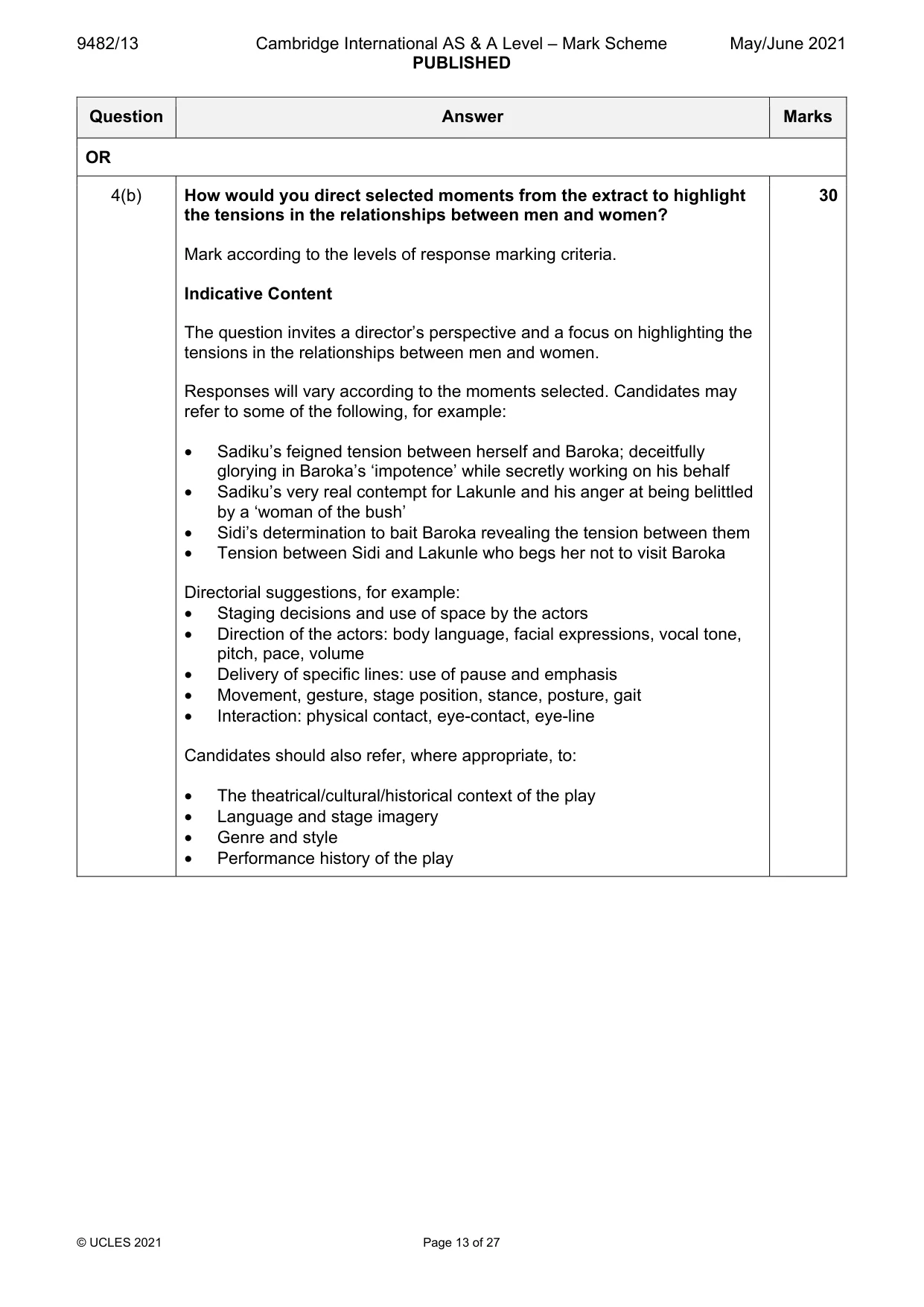
9482/13 Cambridge International AS & A Level – Mark Scheme PUBLISHED May/June 2021 © UCLES 2021 Page 13 of 27 Question Answer Marks OR 4(b) How would you direct selected moments from the extract to highlight the tensions in the relationships between men and women? Mark according to the levels of response marking criteria. Indicative Content The question invites a director’s perspective and a focus on highlighting the tensions in the relationships between men and women. Responses will vary according to the moments selected. Candidates may refer to some of the following, for example: • Sadiku’s feigned tension between herself and Baroka; deceitfully glorying in Baroka’s ‘impotence’ while secretly working on his behalf • Sadiku’s very real contempt for Lakunle and his anger at being belittled by a ‘woman of the bush’ • Sidi’s determination to bait Baroka revealing the tension between them • Tension between Sidi and Lakunle who begs her not to visit Baroka Directorial suggestions, for example: • Staging decisions and use of space by the actors • Direction of the actors: body language, facial expressions, vocal tone, pitch, pace, volume • Delivery of specific lines: use of pause and emphasis • Movement, gesture, stage position, stance, posture, gait • Interaction: physical contact, eye-contact, eye-line Candidates should also refer, where appropriate, to: • The theatrical/cultural/historical context of the play • Language and stage imagery • Genre and style • Performance history of the play 30
Mark scheme, page 14
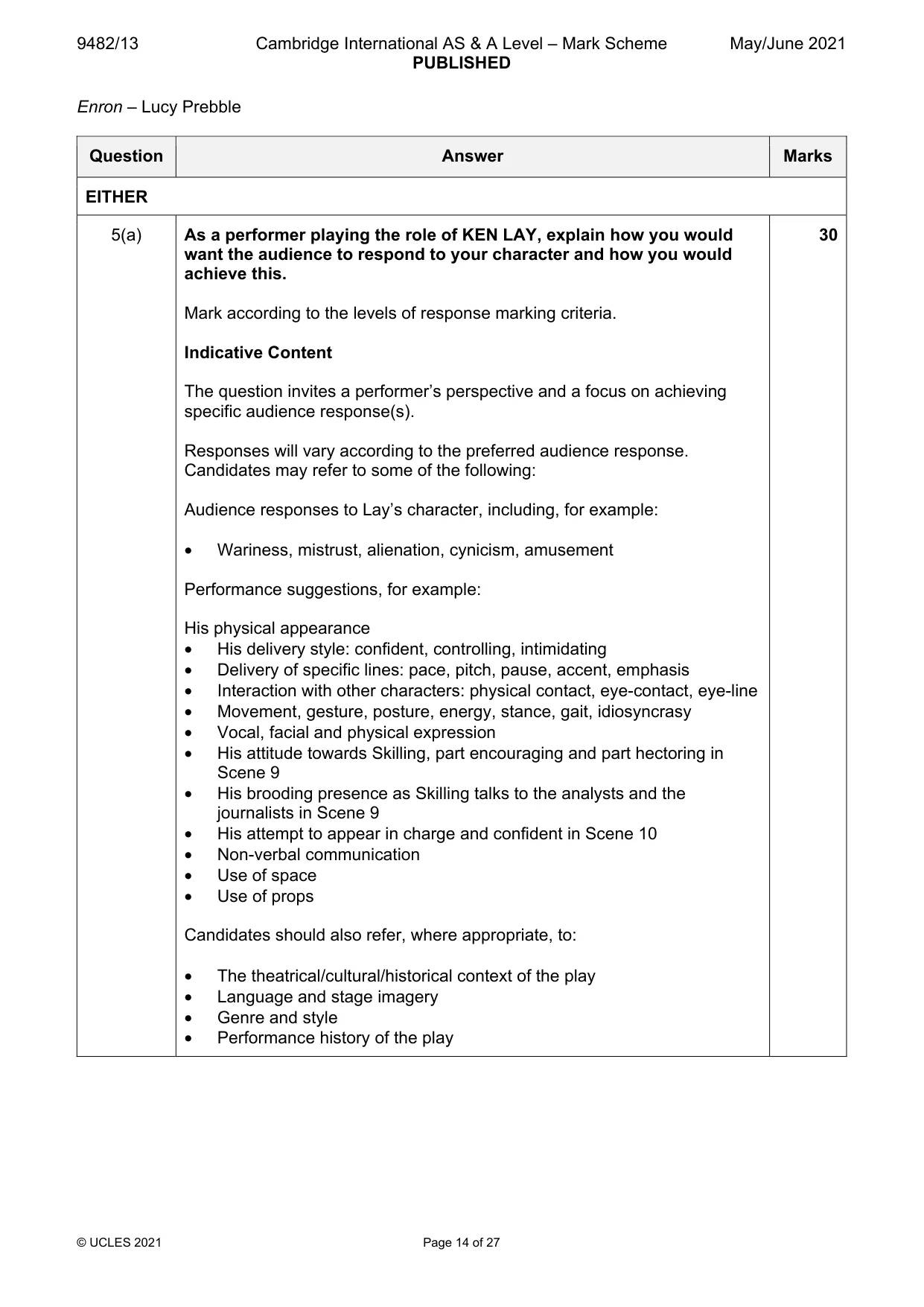
9482/13 Cambridge International AS & A Level – Mark Scheme PUBLISHED May/June 2021 © UCLES 2021 Page 14 of 27 Enron – Lucy Prebble Question Answer Marks EITHER 5(a) As a performer playing the role of KEN LAY, explain how you would want the audience to respond to your character and how you would achieve this. Mark according to the levels of response marking criteria. Indicative Content The question invites a performer’s perspective and a focus on achieving specific audience response(s). Responses will vary according to the preferred audience response. Candidates may refer to some of the following: Audience responses to Lay’s character, including, for example: • Wariness, mistrust, alienation, cynicism, amusement Performance suggestions, for example: His physical appearance • His delivery style: confident, controlling, intimidating • Delivery of specific lines: pace, pitch, pause, accent, emphasis • Interaction with other characters: physical contact, eye-contact, eye-line • Movement, gesture, posture, energy, stance, gait, idiosyncrasy • Vocal, facial and physical expression • His attitude towards Skilling, part encouraging and part hectoring in Scene 9 • His brooding presence as Skilling talks to the analysts and the journalists in Scene 9 • His attempt to appear in charge and confident in Scene 10 • Non-verbal communication • Use of space • Use of props Candidates should also refer, where appropriate, to: • The theatrical/cultural/historical context of the play • Language and stage imagery • Genre and style • Performance history of the play 30
Mark scheme, page 15
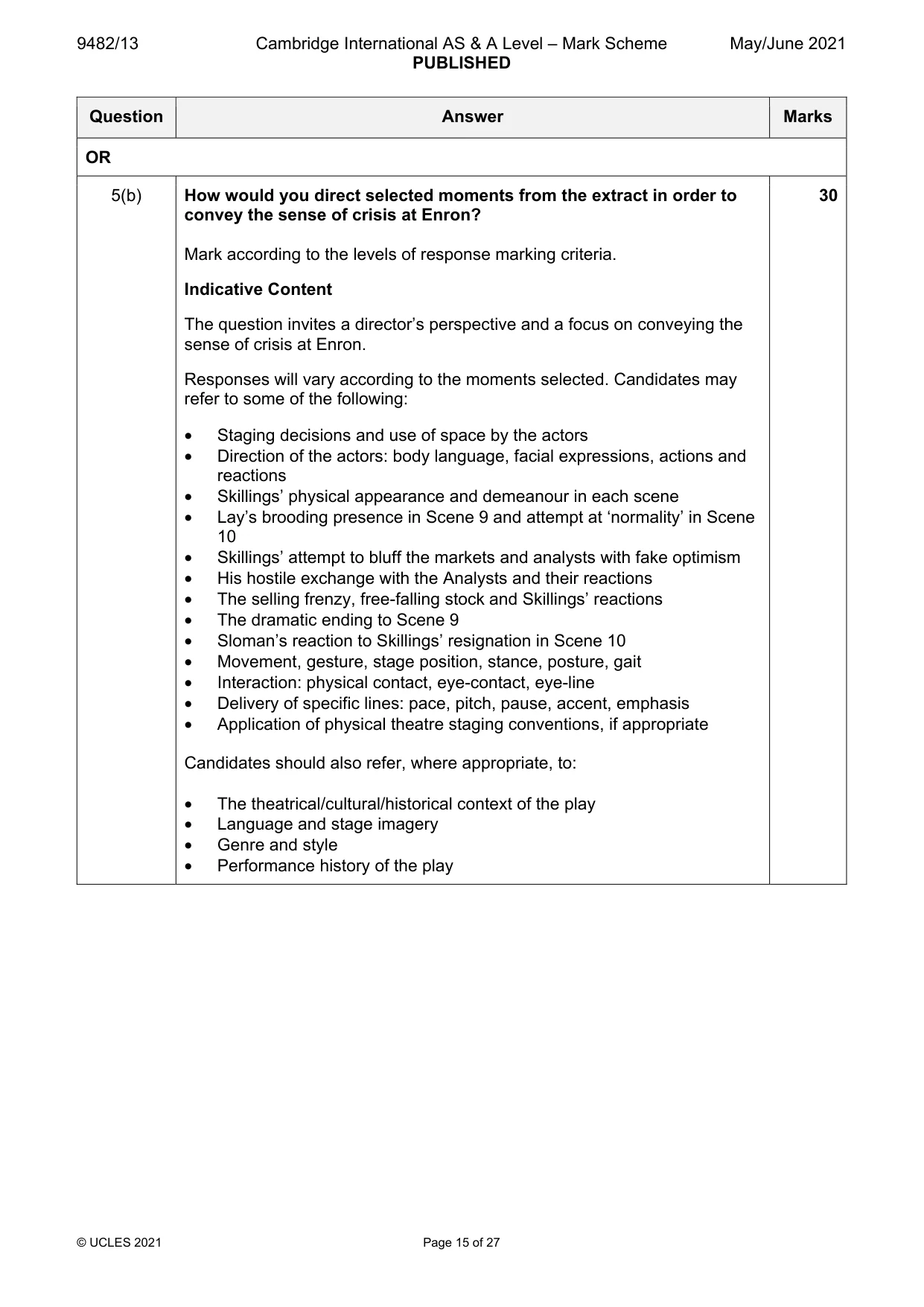
9482/13 Cambridge International AS & A Level – Mark Scheme PUBLISHED May/June 2021 © UCLES 2021 Page 15 of 27 Question Answer Marks OR 5(b) How would you direct selected moments from the extract in order to convey the sense of crisis at Enron? Mark according to the levels of response marking criteria. Indicative Content The question invites a director’s perspective and a focus on conveying the sense of crisis at Enron. Responses will vary according to the moments selected. Candidates may refer to some of the following: • Staging decisions and use of space by the actors • Direction of the actors: body language, facial expressions, actions and reactions • Skillings’ physical appearance and demeanour in each scene • Lay’s brooding presence in Scene 9 and attempt at ‘normality’ in Scene 10 • Skillings’ attempt to bluff the markets and analysts with fake optimism • His hostile exchange with the Analysts and their reactions • The selling frenzy, free-falling stock and Skillings’ reactions • The dramatic ending to Scene 9 • Sloman’s reaction to Skillings’ resignation in Scene 10 • Movement, gesture, stage position, stance, posture, gait • Interaction: physical contact, eye-contact, eye-line • Delivery of specific lines: pace, pitch, pause, accent, emphasis • Application of physical theatre staging conventions, if appropriate Candidates should also refer, where appropriate, to: • The theatrical/cultural/historical context of the play • Language and stage imagery • Genre and style • Performance history of the play 30
Mark scheme, page 16
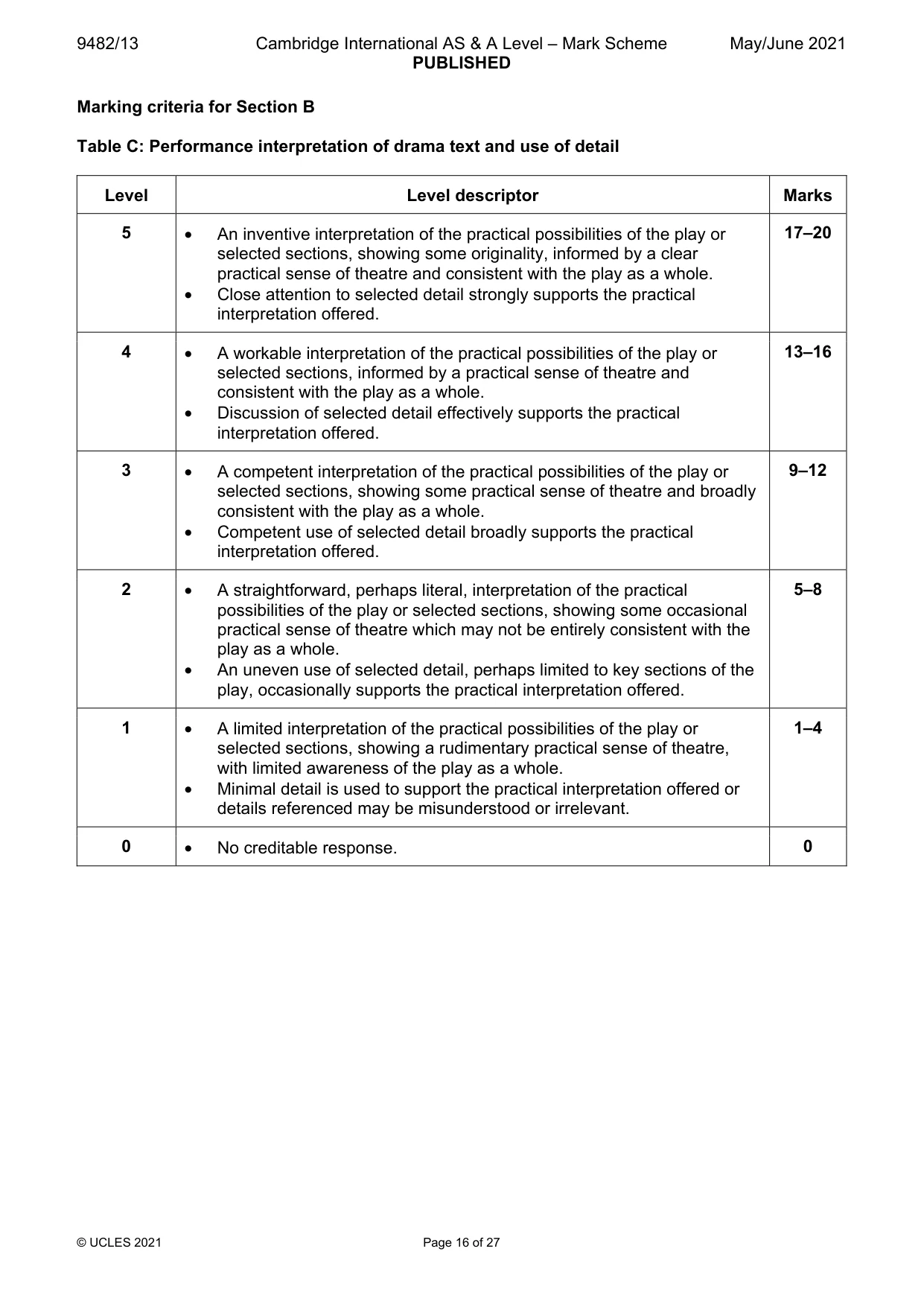
9482/13 Cambridge International AS & A Level – Mark Scheme PUBLISHED May/June 2021 © UCLES 2021 Page 16 of 27 Marking criteria for Section B Table C: Performance interpretation of drama text and use of detail Level Level descriptor Marks 5 • An inventive interpretation of the practical possibilities of the play or selected sections, showing some originality, informed by a clear practical sense of theatre and consistent with the play as a whole. • Close attention to selected detail strongly supports the practical interpretation offered. 17–20 4 • A workable interpretation of the practical possibilities of the play or selected sections, informed by a practical sense of theatre and consistent with the play as a whole. • Discussion of selected detail effectively supports the practical interpretation offered. 13–16 3 • A competent interpretation of the practical possibilities of the play or selected sections, showing some practical sense of theatre and broadly consistent with the play as a whole. • Competent use of selected detail broadly supports the practical interpretation offered. 9–12 2 • A straightforward, perhaps literal, interpretation of the practical possibilities of the play or selected sections, showing some occasional practical sense of theatre which may not be entirely consistent with the play as a whole. • An uneven use of selected detail, perhaps limited to key sections of the play, occasionally supports the practical interpretation offered. 5–8 1 • A limited interpretation of the practical possibilities of the play or selected sections, showing a rudimentary practical sense of theatre, with limited awareness of the play as a whole. • Minimal detail is used to support the practical interpretation offered or details referenced may be misunderstood or irrelevant. 1–4 0 • No creditable response. 0
Mark scheme, page 17
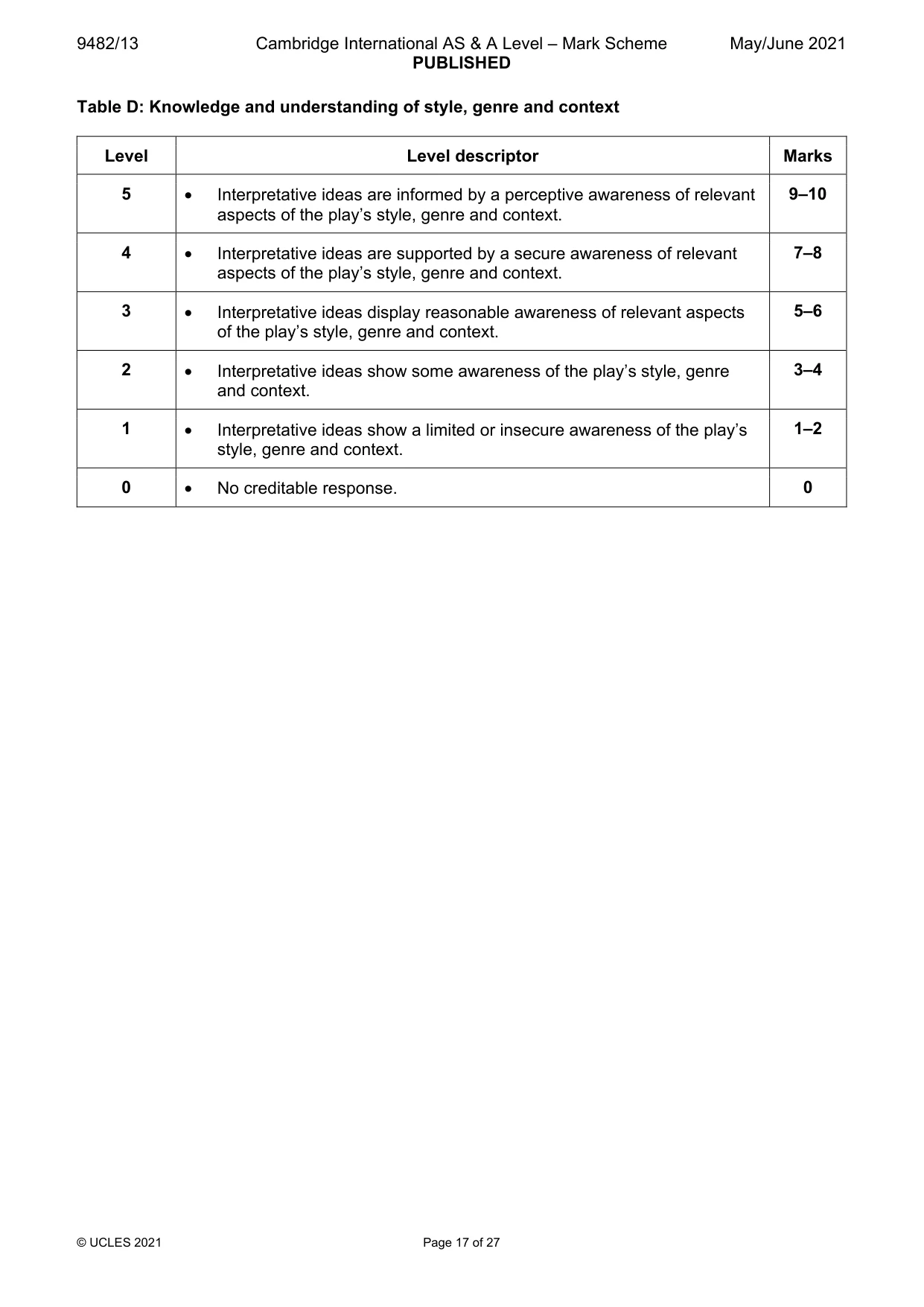
9482/13 Cambridge International AS & A Level – Mark Scheme PUBLISHED May/June 2021 © UCLES 2021 Page 17 of 27 Table D: Knowledge and understanding of style, genre and context Level Level descriptor Marks 5 • Interpretative ideas are informed by a perceptive awareness of relevant aspects of the play’s style, genre and context. 9–10 4 • Interpretative ideas are supported by a secure awareness of relevant aspects of the play’s style, genre and context. 7–8 3 • Interpretative ideas display reasonable awareness of relevant aspects of the play’s style, genre and context. 5–6 2 • Interpretative ideas show some awareness of the play’s style, genre and context. 3–4 1 • Interpretative ideas show a limited or insecure awareness of the play’s style, genre and context. 1–2 0 • No creditable response. 0
Mark scheme, page 18
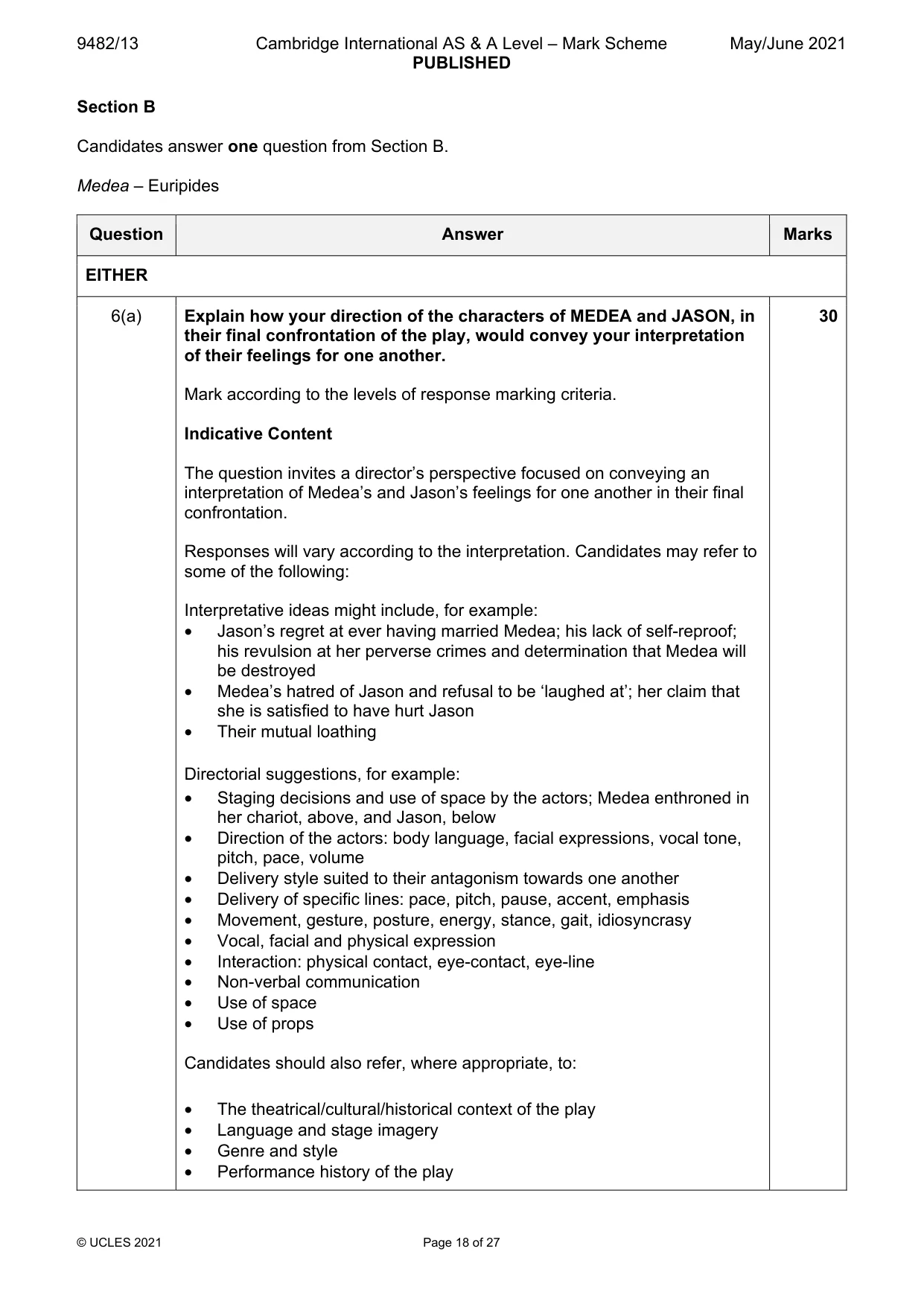
9482/13 Cambridge International AS & A Level – Mark Scheme PUBLISHED May/June 2021 © UCLES 2021 Page 18 of 27 Section B Candidates answer one question from Section B. Medea – Euripides Question Answer Marks EITHER 6(a) Explain how your direction of the characters of MEDEA and JASON, in their final confrontation of the play, would convey your interpretation of their feelings for one another. Mark according to the levels of response marking criteria. Indicative Content The question invites a director’s perspective focused on conveying an interpretation of Medea’s and Jason’s feelings for one another in their final confrontation. Responses will vary according to the interpretation. Candidates may refer to some of the following: Interpretative ideas might include, for example: • Jason’s regret at ever having married Medea; his lack of self-reproof; his revulsion at her perverse crimes and determination that Medea will be destroyed • Medea’s hatred of Jason and refusal to be ‘laughed at’; her claim that she is satisfied to have hurt Jason • Their mutual loathing Directorial suggestions, for example: • Staging decisions and use of space by the actors; Medea enthroned in her chariot, above, and Jason, below • Direction of the actors: body language, facial expressions, vocal tone, pitch, pace, volume • Delivery style suited to their antagonism towards one another • Delivery of specific lines: pace, pitch, pause, accent, emphasis • Movement, gesture, posture, energy, stance, gait, idiosyncrasy • Vocal, facial and physical expression • Interaction: physical contact, eye-contact, eye-line • Non-verbal communication • Use of space • Use of props Candidates should also refer, where appropriate, to: • The theatrical/cultural/historical context of the play • Language and stage imagery • Genre and style • Performance history of the play 30
Mark scheme, page 19
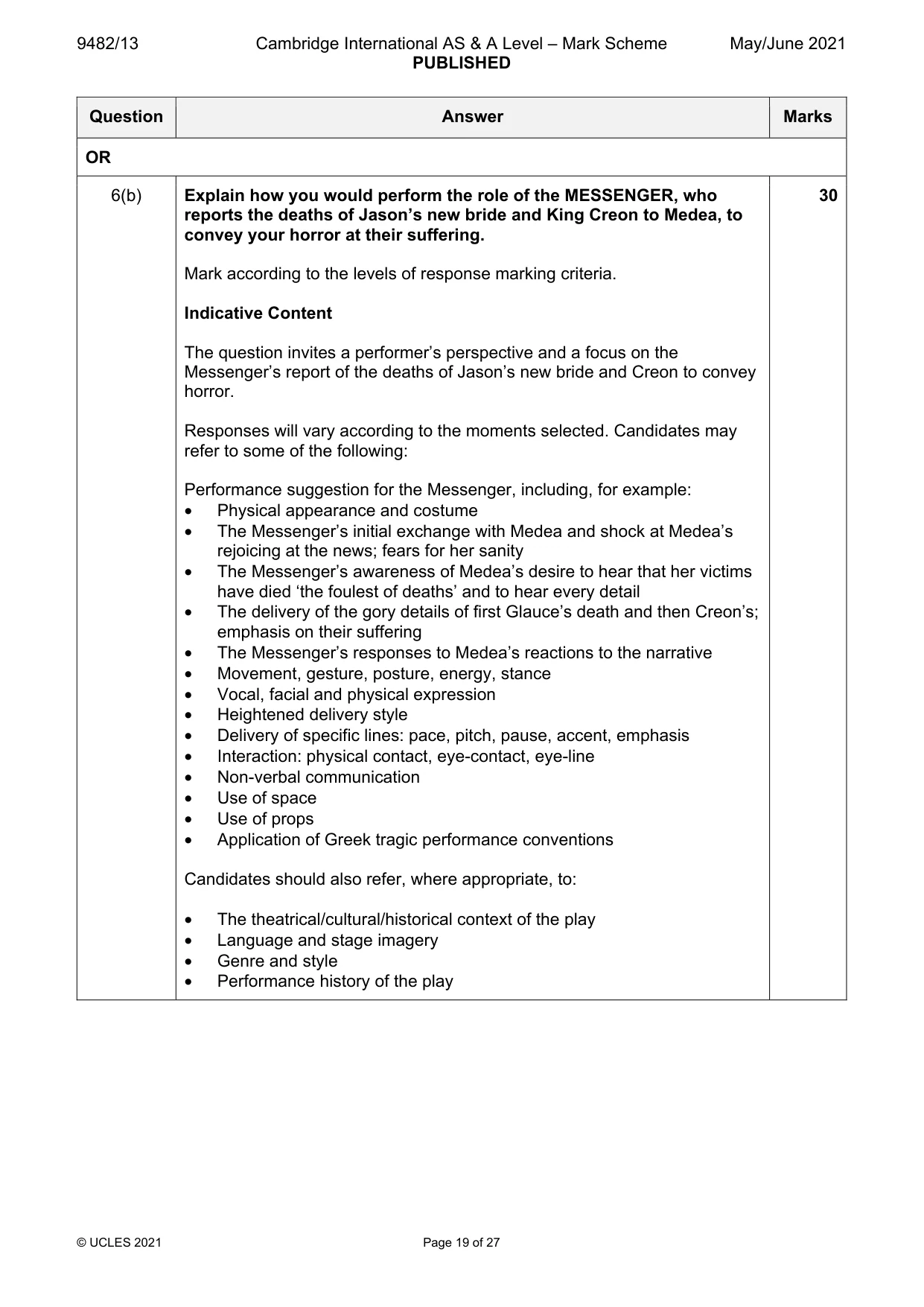
9482/13 Cambridge International AS & A Level – Mark Scheme PUBLISHED May/June 2021 © UCLES 2021 Page 19 of 27 Question Answer Marks OR 6(b) Explain how you would perform the role of the MESSENGER, who reports the deaths of Jason’s new bride and King Creon to Medea, to convey your horror at their suffering. Mark according to the levels of response marking criteria. Indicative Content The question invites a performer’s perspective and a focus on the Messenger’s report of the deaths of Jason’s new bride and Creon to convey horror. Responses will vary according to the moments selected. Candidates may refer to some of the following: Performance suggestion for the Messenger, including, for example: • Physical appearance and costume • The Messenger’s initial exchange with Medea and shock at Medea’s rejoicing at the news; fears for her sanity • The Messenger’s awareness of Medea’s desire to hear that her victims have died ‘the foulest of deaths’ and to hear every detail • The delivery of the gory details of first Glauce’s death and then Creon’s; emphasis on their suffering • The Messenger’s responses to Medea’s reactions to the narrative • Movement, gesture, posture, energy, stance • Vocal, facial and physical expression • Heightened delivery style • Delivery of specific lines: pace, pitch, pause, accent, emphasis • Interaction: physical contact, eye-contact, eye-line • Non-verbal communication • Use of space • Use of props • Application of Greek tragic performance conventions Candidates should also refer, where appropriate, to: • The theatrical/cultural/historical context of the play • Language and stage imagery • Genre and style • Performance history of the play 30
Mark scheme, page 20
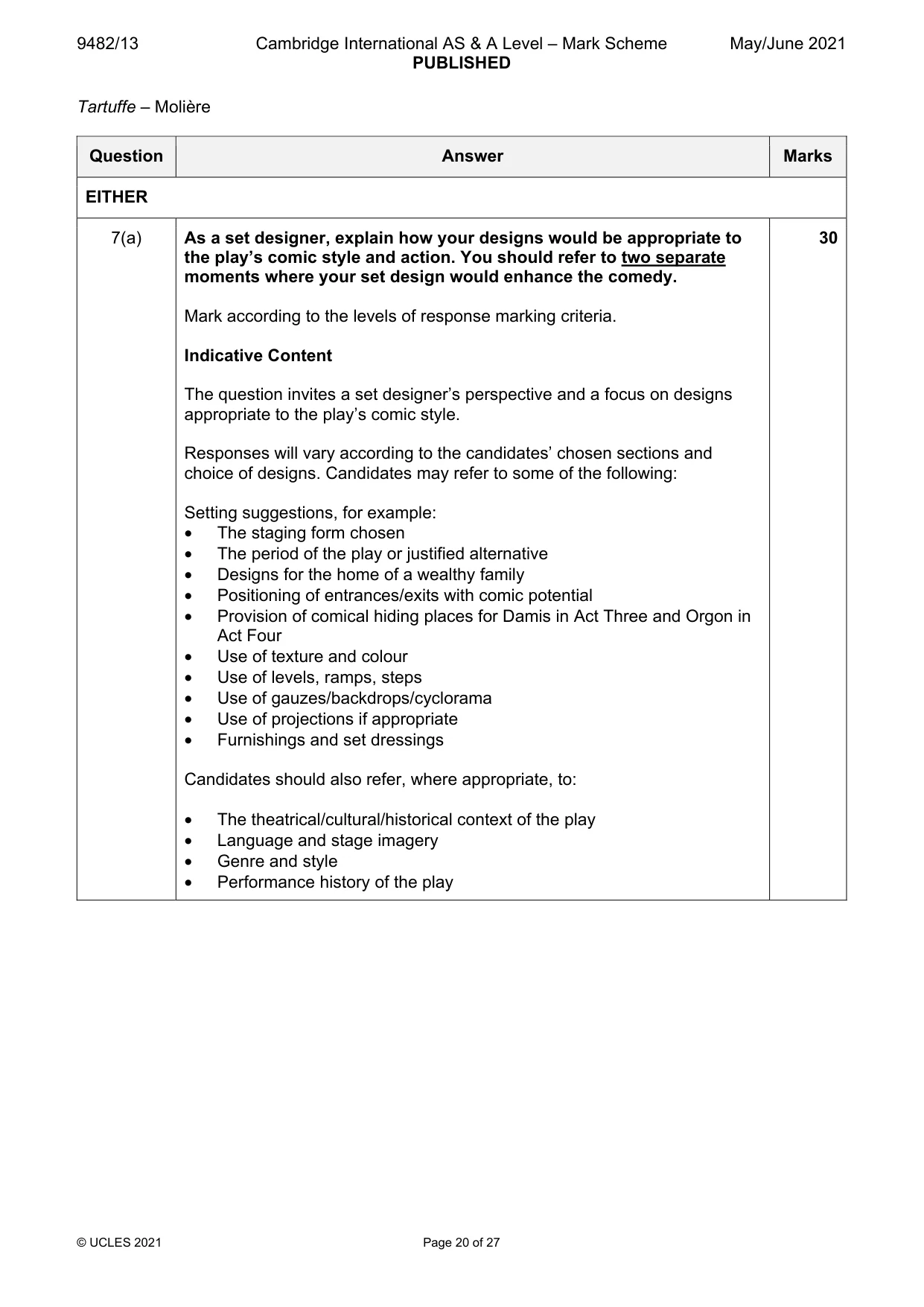
9482/13 Cambridge International AS & A Level – Mark Scheme PUBLISHED May/June 2021 © UCLES 2021 Page 20 of 27 Tartuffe – Molière Question Answer Marks EITHER 7(a) As a set designer, explain how your designs would be appropriate to the play’s comic style and action. You should refer to two separate moments where your set design would enhance the comedy. Mark according to the levels of response marking criteria. Indicative Content The question invites a set designer’s perspective and a focus on designs appropriate to the play’s comic style. Responses will vary according to the candidates’ chosen sections and choice of designs. Candidates may refer to some of the following: Setting suggestions, for example: • The staging form chosen • The period of the play or justified alternative • Designs for the home of a wealthy family • Positioning of entrances/exits with comic potential • Provision of comical hiding places for Damis in Act Three and Orgon in Act Four • Use of texture and colour • Use of levels, ramps, steps • Use of gauzes/backdrops/cyclorama • Use of projections if appropriate • Furnishings and set dressings Candidates should also refer, where appropriate, to: • The theatrical/cultural/historical context of the play • Language and stage imagery • Genre and style • Performance history of the play 30
Mark scheme, page 21
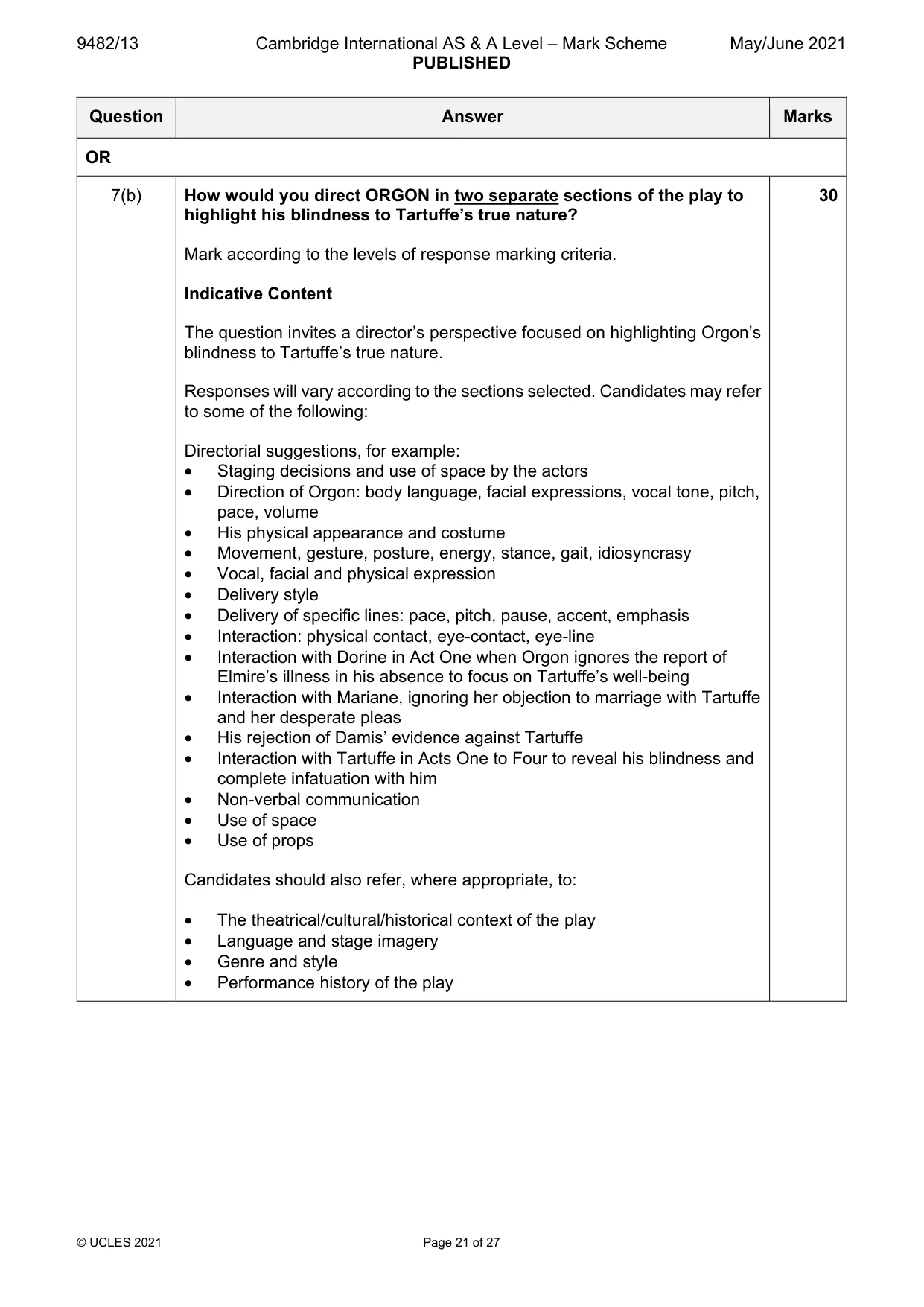
9482/13 Cambridge International AS & A Level – Mark Scheme PUBLISHED May/June 2021 © UCLES 2021 Page 21 of 27 Question Answer Marks OR 7(b) How would you direct ORGON in two separate sections of the play to highlight his blindness to Tartuffe’s true nature? Mark according to the levels of response marking criteria. Indicative Content The question invites a director’s perspective focused on highlighting Orgon’s blindness to Tartuffe’s true nature. Responses will vary according to the sections selected. Candidates may refer to some of the following: Directorial suggestions, for example: • Staging decisions and use of space by the actors • Direction of Orgon: body language, facial expressions, vocal tone, pitch, pace, volume • His physical appearance and costume • Movement, gesture, posture, energy, stance, gait, idiosyncrasy • Vocal, facial and physical expression • Delivery style • Delivery of specific lines: pace, pitch, pause, accent, emphasis • Interaction: physical contact, eye-contact, eye-line • Interaction with Dorine in Act One when Orgon ignores the report of Elmire’s illness in his absence to focus on Tartuffe’s well-being • Interaction with Mariane, ignoring her objection to marriage with Tartuffe and her desperate pleas • His rejection of Damis’ evidence against Tartuffe • Interaction with Tartuffe in Acts One to Four to reveal his blindness and complete infatuation with him • Non-verbal communication • Use of space • Use of props Candidates should also refer, where appropriate, to: • The theatrical/cultural/historical context of the play • Language and stage imagery • Genre and style • Performance history of the play 30
Mark scheme, page 22
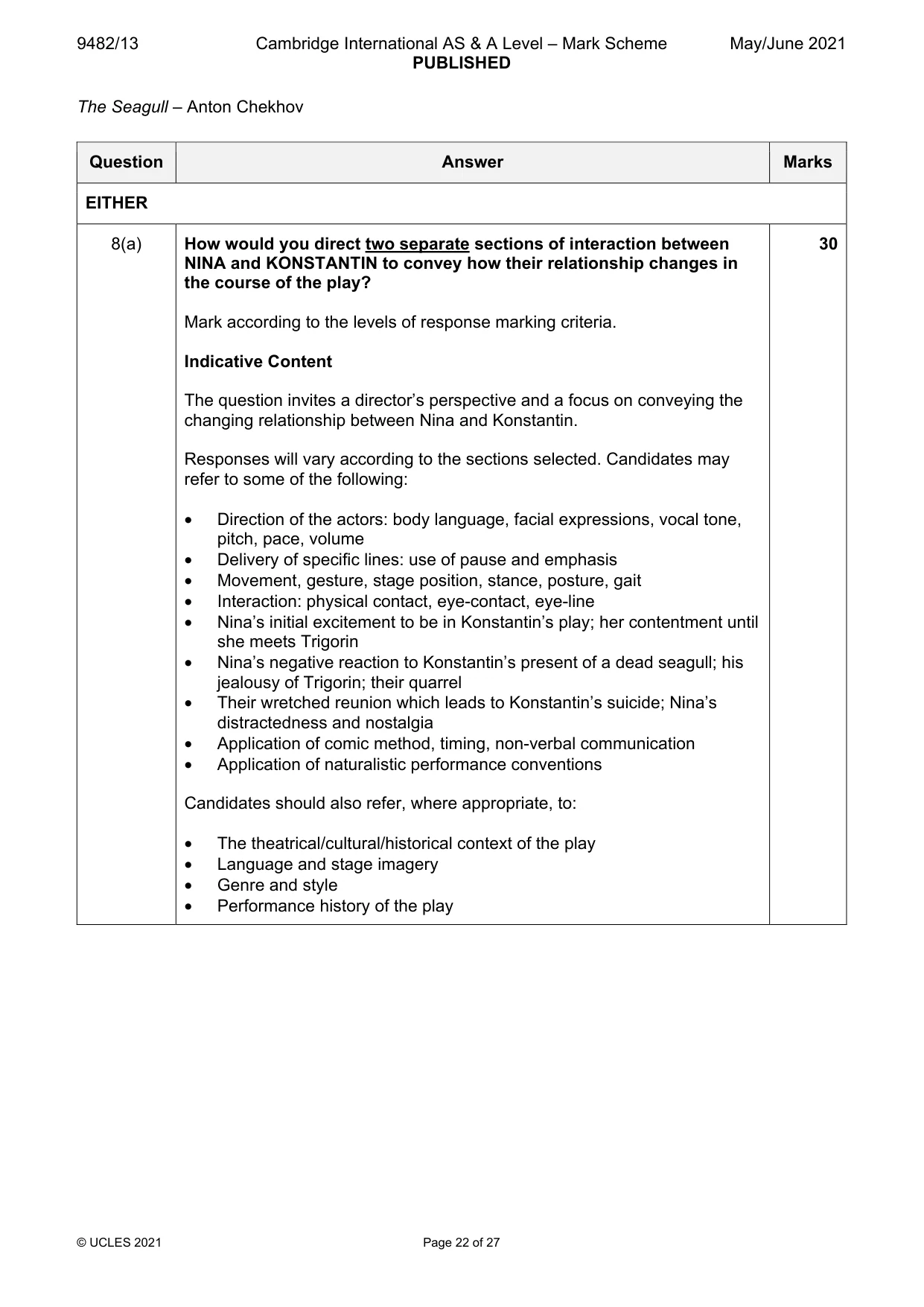
9482/13 Cambridge International AS & A Level – Mark Scheme PUBLISHED May/June 2021 © UCLES 2021 Page 22 of 27 The Seagull – Anton Chekhov Question Answer Marks EITHER 8(a) How would you direct two separate sections of interaction between NINA and KONSTANTIN to convey how their relationship changes in the course of the play? Mark according to the levels of response marking criteria. Indicative Content The question invites a director’s perspective and a focus on conveying the changing relationship between Nina and Konstantin. Responses will vary according to the sections selected. Candidates may refer to some of the following: • Direction of the actors: body language, facial expressions, vocal tone, pitch, pace, volume • Delivery of specific lines: use of pause and emphasis • Movement, gesture, stage position, stance, posture, gait • Interaction: physical contact, eye-contact, eye-line • Nina’s initial excitement to be in Konstantin’s play; her contentment until she meets Trigorin • Nina’s negative reaction to Konstantin’s present of a dead seagull; his jealousy of Trigorin; their quarrel • Their wretched reunion which leads to Konstantin’s suicide; Nina’s distractedness and nostalgia • Application of comic method, timing, non-verbal communication • Application of naturalistic performance conventions Candidates should also refer, where appropriate, to: • The theatrical/cultural/historical context of the play • Language and stage imagery • Genre and style • Performance history of the play 30
Mark scheme, page 23
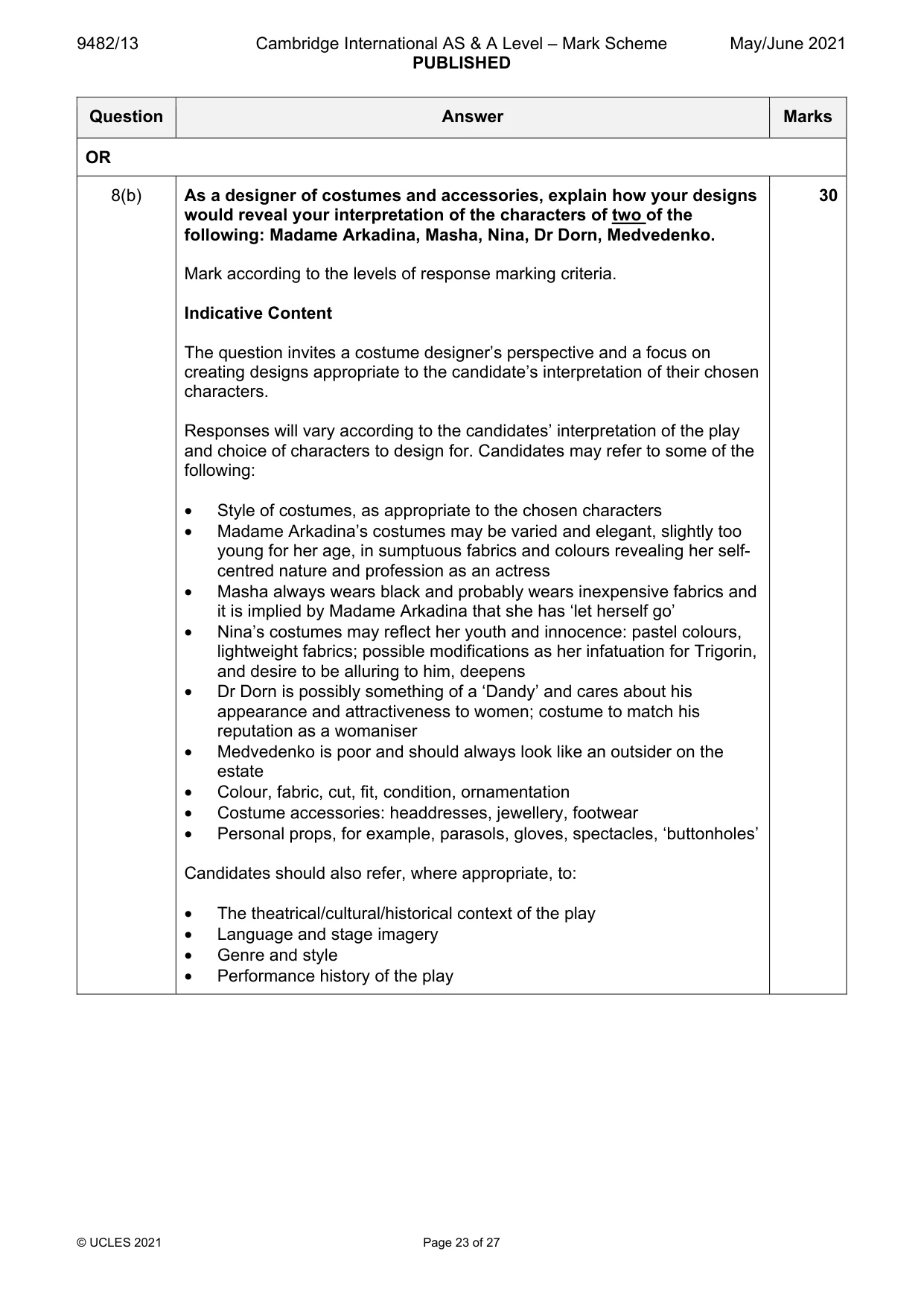
9482/13 Cambridge International AS & A Level – Mark Scheme PUBLISHED May/June 2021 © UCLES 2021 Page 23 of 27 Question Answer Marks OR 8(b) As a designer of costumes and accessories, explain how your designs would reveal your interpretation of the characters of two of the following: Madame Arkadina, Masha, Nina, Dr Dorn, Medvedenko. Mark according to the levels of response marking criteria. Indicative Content The question invites a costume designer’s perspective and a focus on creating designs appropriate to the candidate’s interpretation of their chosen characters. Responses will vary according to the candidates’ interpretation of the play and choice of characters to design for. Candidates may refer to some of the following: • Style of costumes, as appropriate to the chosen characters • Madame Arkadina’s costumes may be varied and elegant, slightly too young for her age, in sumptuous fabrics and colours revealing her self- centred nature and profession as an actress • Masha always wears black and probably wears inexpensive fabrics and it is implied by Madame Arkadina that she has ‘let herself go’ • Nina’s costumes may reflect her youth and innocence: pastel colours, lightweight fabrics; possible modifications as her infatuation for Trigorin, and desire to be alluring to him, deepens • Dr Dorn is possibly something of a ‘Dandy’ and cares about his appearance and attractiveness to women; costume to match his reputation as a womaniser • Medvedenko is poor and should always look like an outsider on the estate • Colour, fabric, cut, fit, condition, ornamentation • Costume accessories: headdresses, jewellery, footwear • Personal props, for example, parasols, gloves, spectacles, ‘buttonholes’ Candidates should also refer, where appropriate, to: • The theatrical/cultural/historical context of the play • Language and stage imagery • Genre and style • Performance history of the play 30
Mark scheme, page 24
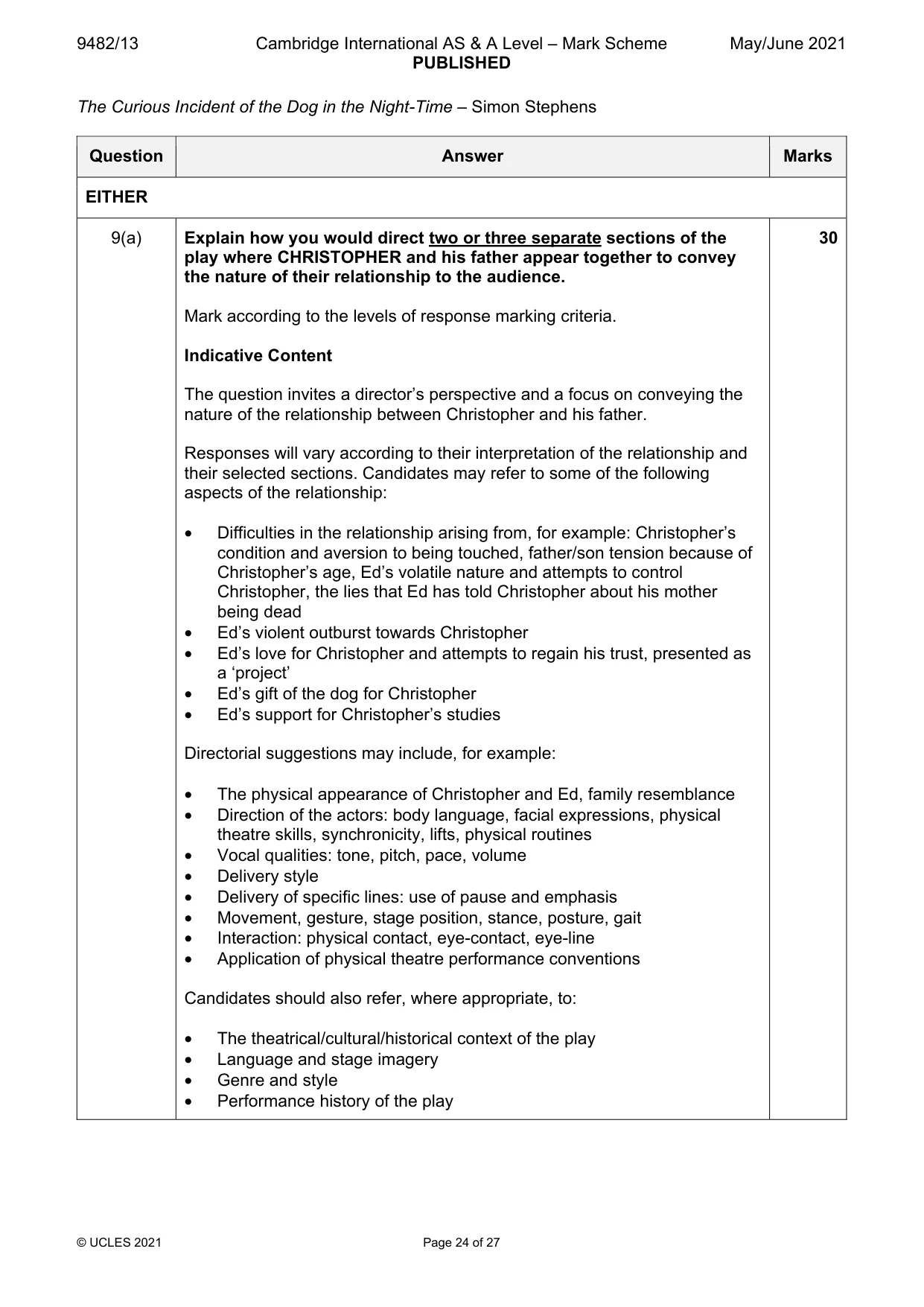
9482/13 Cambridge International AS & A Level – Mark Scheme PUBLISHED May/June 2021 © UCLES 2021 Page 24 of 27 The Curious Incident of the Dog in the Night-Time – Simon Stephens Question Answer Marks EITHER 9(a) Explain how you would direct two or three separate sections of the play where CHRISTOPHER and his father appear together to convey the nature of their relationship to the audience. Mark according to the levels of response marking criteria. Indicative Content The question invites a director’s perspective and a focus on conveying the nature of the relationship between Christopher and his father. Responses will vary according to their interpretation of the relationship and their selected sections. Candidates may refer to some of the following aspects of the relationship: • Difficulties in the relationship arising from, for example: Christopher’s condition and aversion to being touched, father/son tension because of Christopher’s age, Ed’s volatile nature and attempts to control Christopher, the lies that Ed has told Christopher about his mother being dead • Ed’s violent outburst towards Christopher • Ed’s love for Christopher and attempts to regain his trust, presented as a ‘project’ • Ed’s gift of the dog for Christopher • Ed’s support for Christopher’s studies Directorial suggestions may include, for example: • The physical appearance of Christopher and Ed, family resemblance • Direction of the actors: body language, facial expressions, physical theatre skills, synchronicity, lifts, physical routines • Vocal qualities: tone, pitch, pace, volume • Delivery style • Delivery of specific lines: use of pause and emphasis • Movement, gesture, stage position, stance, posture, gait • Interaction: physical contact, eye-contact, eye-line • Application of physical theatre performance conventions Candidates should also refer, where appropriate, to: • The theatrical/cultural/historical context of the play • Language and stage imagery • Genre and style • Performance history of the play 30
Mark scheme, page 25
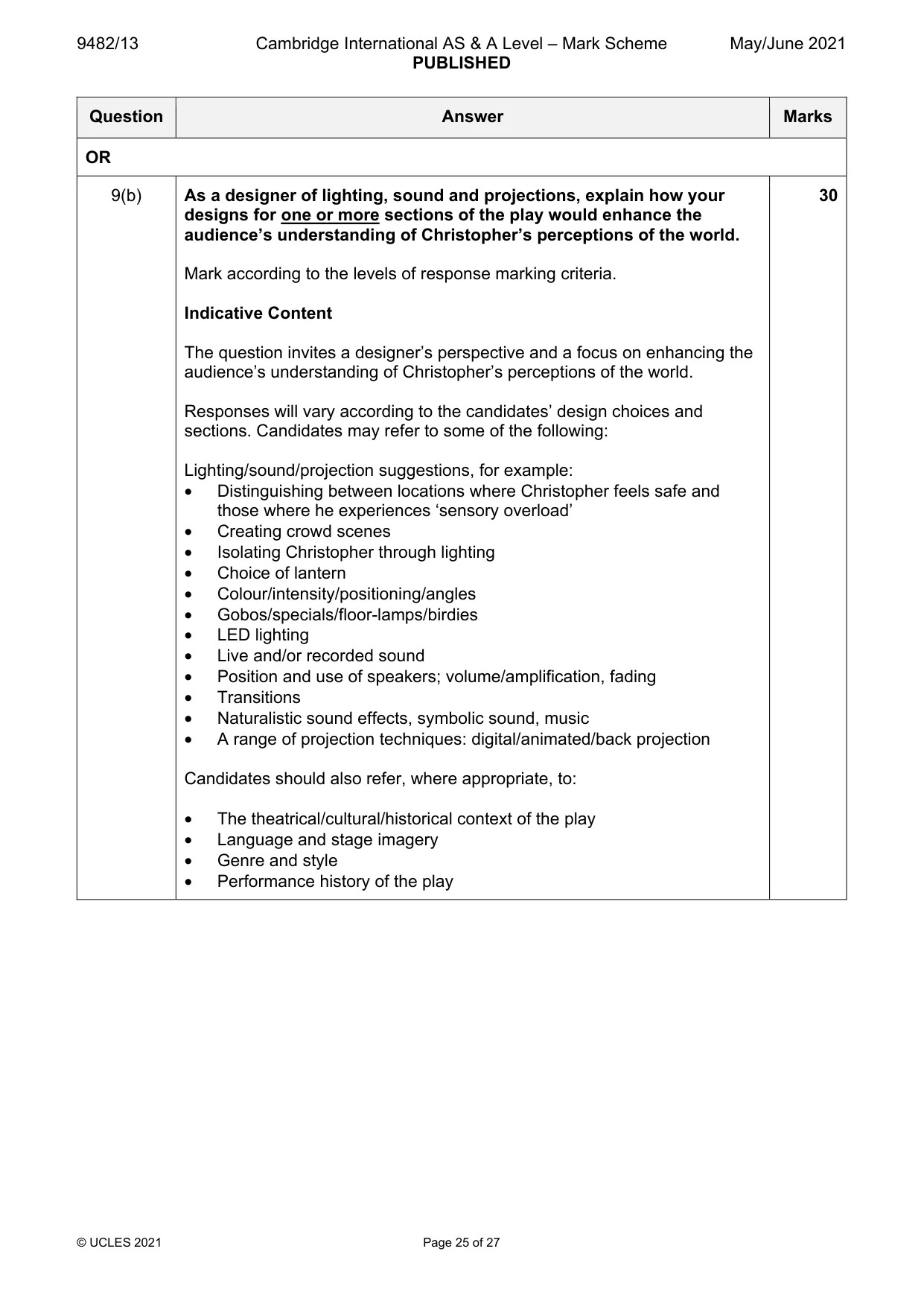
9482/13 Cambridge International AS & A Level – Mark Scheme PUBLISHED May/June 2021 © UCLES 2021 Page 25 of 27 Question Answer Marks OR 9(b) As a designer of lighting, sound and projections, explain how your designs for one or more sections of the play would enhance the audience’s understanding of Christopher’s perceptions of the world. Mark according to the levels of response marking criteria. Indicative Content The question invites a designer’s perspective and a focus on enhancing the audience’s understanding of Christopher’s perceptions of the world. Responses will vary according to the candidates’ design choices and sections. Candidates may refer to some of the following: Lighting/sound/projection suggestions, for example: • Distinguishing between locations where Christopher feels safe and those where he experiences ‘sensory overload’ • Creating crowd scenes • Isolating Christopher through lighting • Choice of lantern • Colour/intensity/positioning/angles • Gobos/specials/floor-lamps/birdies • LED lighting • Live and/or recorded sound • Position and use of speakers; volume/amplification, fading • Transitions • Naturalistic sound effects, symbolic sound, music • A range of projection techniques: digital/animated/back projection Candidates should also refer, where appropriate, to: • The theatrical/cultural/historical context of the play • Language and stage imagery • Genre and style • Performance history of the play 30
Mark scheme, page 26
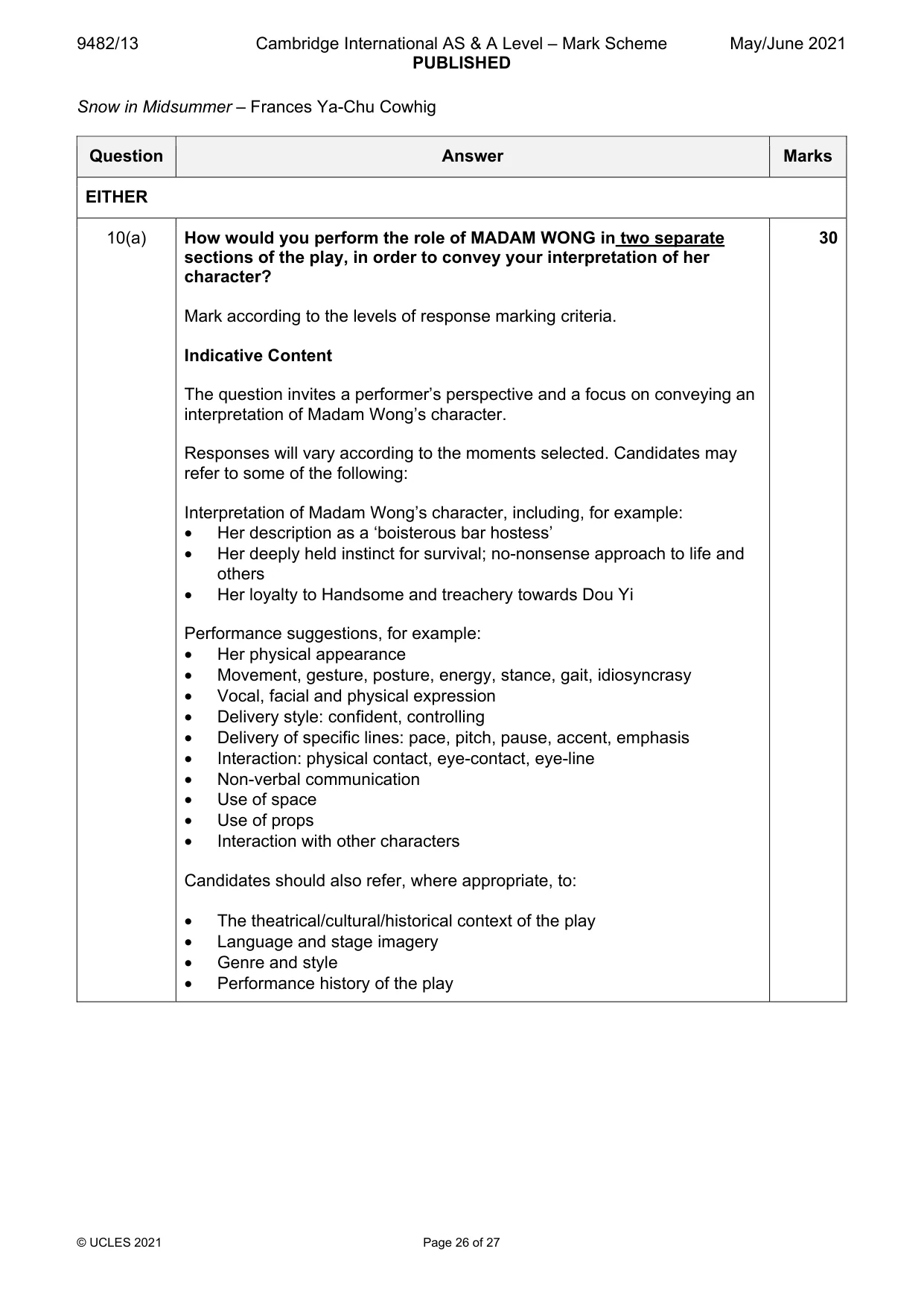
9482/13 Cambridge International AS & A Level – Mark Scheme PUBLISHED May/June 2021 © UCLES 2021 Page 26 of 27 Snow in Midsummer – Frances Ya-Chu Cowhig Question Answer Marks EITHER 10(a) How would you perform the role of MADAM WONG in two separate sections of the play, in order to convey your interpretation of her character? Mark according to the levels of response marking criteria. Indicative Content The question invites a performer’s perspective and a focus on conveying an interpretation of Madam Wong’s character. Responses will vary according to the moments selected. Candidates may refer to some of the following: Interpretation of Madam Wong’s character, including, for example: • Her description as a ‘boisterous bar hostess’ • Her deeply held instinct for survival; no-nonsense approach to life and others • Her loyalty to Handsome and treachery towards Dou Yi Performance suggestions, for example: • Her physical appearance • Movement, gesture, posture, energy, stance, gait, idiosyncrasy • Vocal, facial and physical expression • Delivery style: confident, controlling • Delivery of specific lines: pace, pitch, pause, accent, emphasis • Interaction: physical contact, eye-contact, eye-line • Non-verbal communication • Use of space • Use of props • Interaction with other characters Candidates should also refer, where appropriate, to: • The theatrical/cultural/historical context of the play • Language and stage imagery • Genre and style • Performance history of the play 30
Mark scheme, page 27
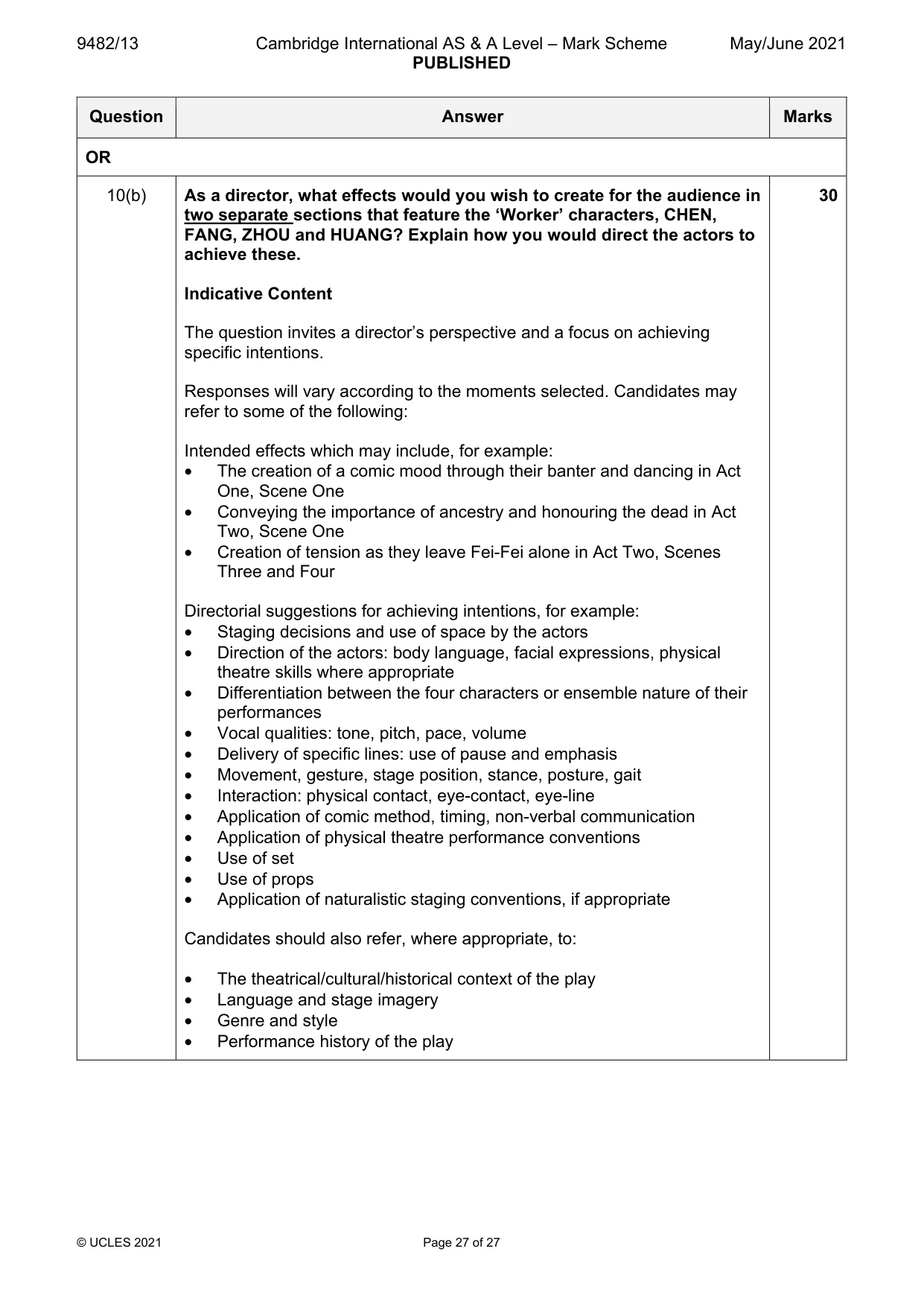
9482/13 Cambridge International AS & A Level – Mark Scheme PUBLISHED May/June 2021 © UCLES 2021 Page 27 of 27 Question Answer Marks OR 10(b) As a director, what effects would you wish to create for the audience in two separate sections that feature the ‘Worker’ characters, CHEN, FANG, ZHOU and HUANG? Explain how you would direct the actors to achieve these. Indicative Content The question invites a director’s perspective and a focus on achieving specific intentions. Responses will vary according to the moments selected. Candidates may refer to some of the following: Intended effects which may include, for example: • The creation of a comic mood through their banter and dancing in Act One, Scene One • Conveying the importance of ancestry and honouring the dead in Act Two, Scene One • Creation of tension as they leave Fei-Fei alone in Act Two, Scenes Three and Four Directorial suggestions for achieving intentions, for example: • Staging decisions and use of space by the actors • Direction of the actors: body language, facial expressions, physical theatre skills where appropriate • Differentiation between the four characters or ensemble nature of their performances • Vocal qualities: tone, pitch, pace, volume • Delivery of specific lines: use of pause and emphasis • Movement, gesture, stage position, stance, posture, gait • Interaction: physical contact, eye-contact, eye-line • Application of comic method, timing, non-verbal communication • Application of physical theatre performance conventions • Use of set • Use of props • Application of naturalistic staging conventions, if appropriate Candidates should also refer, where appropriate, to: • The theatrical/cultural/historical context of the play • Language and stage imagery • Genre and style • Performance history of the play 30
What you needed in this session
Cambridge’s own grade thresholds for 2021 May/June, Paper 1 · Variant 3. A higher threshold means an easier paper — the bar moves with how the cohort did.