Cambridge A Level Classical Studies 9274 — 2014 Oct/Nov Paper 2 · Variant 1
9274/21/O/N/14 · 50 marks · ≈56 min
The question paper and its mark scheme, free to read here and free to download. This is Cambridge’s own paper, exactly as it was sat.
Question paper8 pages

Mark scheme13 pages
Answers below. Sit the paper first if you are practising.
Paper as text
Question paper, page 1
This document consists of 7 printed pages and 1 blank page. DC (HB (EL/CW)) 79711/4 © UCLES 2014 [Turn over Cambridge International Examinations Cambridge International Advanced Subsidiary and Advanced Level * 5 7 8 5 0 9 0 4 0 5 * CLASSICAL STUDIES 9274/21 Paper 2 Roman Civilisation October/November 2014 1 hour 30 minutes Additional Materials: Answer Booklet/Paper READ THESE INSTRUCTIONS FIRST If you have been given an Answer Booklet, follow the instructions on the front cover of the Booklet. Write your Centre number, candidate number and name on all the work you hand in. Write in dark blue or black pen. You may use an HB pencil for any diagrams or graphs. Do not use staples, paper clips, glue or correction fluid. DO NOT WRITE IN ANY BARCODES. There are four sections in this paper. Each section is worth 25 marks. You must answer two questions. Choose one question from two different sections. You should spend 45 minutes on each section. You are reminded of the need for good English and clear presentation in your answer. At the end of the examination, fasten all your work securely together. The number of marks is given in brackets [ ] at the end of each question or part question.
Question paper, page 2
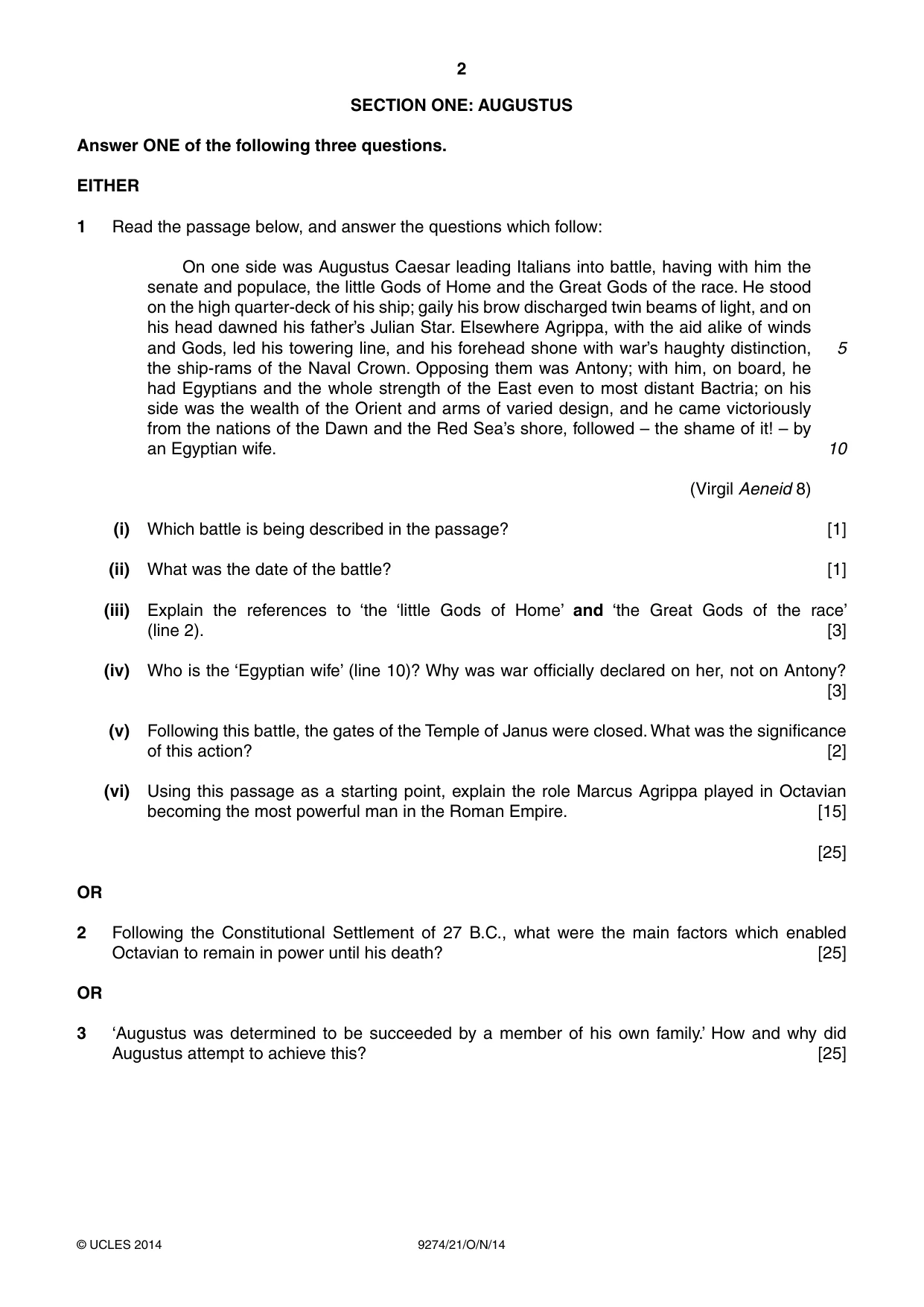
2 9274/21/O/N/14 © UCLES 2014 SECTION ONE: AUGUSTUS Answer ONE of the following three questions. EITHER 1 Read the passage below, and answer the questions which follow: On one side was Augustus Caesar leading Italians into battle, having with him the senate and populace, the little Gods of Home and the Great Gods of the race. He stood on the high quarter-deck of his ship; gaily his brow discharged twin beams of light, and on his head dawned his father’s Julian Star. Elsewhere Agrippa, with the aid alike of winds and Gods, led his towering line, and his forehead shone with war’s haughty distinction, the ship-rams of the Naval Crown. Opposing them was Antony; with him, on board, he had Egyptians and the whole strength of the East even to most distant Bactria; on his side was the wealth of the Orient and arms of varied design, and he came victoriously from the nations of the Dawn and the Red Sea’s shore, followed – the shame of it! – by an Egyptian wife. (Virgil Aeneid 8) 5 10 (i) Which battle is being described in the passage? [1] (ii) What was the date of the battle? [1] (iii) Explain the references to ‘the ‘little Gods of Home’ and ‘the Great Gods of the race’ (line 2). [3] (iv) Who is the ‘Egyptian wife’ (line 10)? Why was war officially declared on her, not on Antony? [3] (v) Following this battle, the gates of the Temple of Janus were closed. What was the significance of this action? [2] (vi) Using this passage as a starting point, explain the role Marcus Agrippa played in Octavian becoming the most powerful man in the Roman Empire. [15] [25] OR 2 Following the Constitutional Settlement of 27 B.C., what were the main factors which enabled Octavian to remain in power until his death? [25] OR 3 ‘Augustus was determined to be succeeded by a member of his own family.’ How and why did Augustus attempt to achieve this? [25]
Question paper, page 3
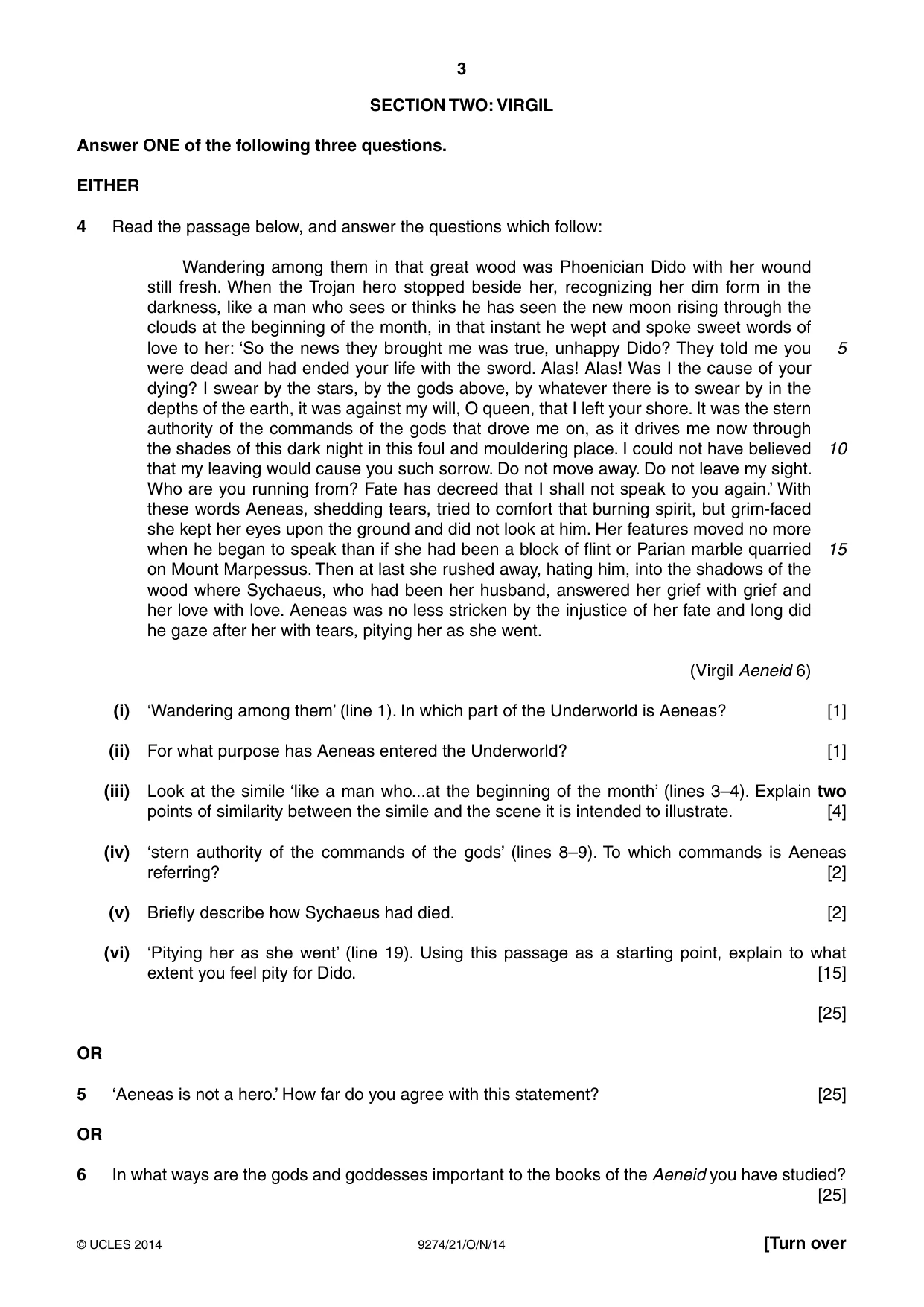
3 9274/21/O/N/14 © UCLES 2014 [Turn over SECTION TWO: VIRGIL Answer ONE of the following three questions. EITHER 4 Read the passage below, and answer the questions which follow: Wandering among them in that great wood was Phoenician Dido with her wound still fresh. When the Trojan hero stopped beside her, recognizing her dim form in the darkness, like a man who sees or thinks he has seen the new moon rising through the clouds at the beginning of the month, in that instant he wept and spoke sweet words of love to her: ‘So the news they brought me was true, unhappy Dido? They told me you were dead and had ended your life with the sword. Alas! Alas! Was I the cause of your dying? I swear by the stars, by the gods above, by whatever there is to swear by in the depths of the earth, it was against my will, O queen, that I left your shore. It was the stern authority of the commands of the gods that drove me on, as it drives me now through the shades of this dark night in this foul and mouldering place. I could not have believed that my leaving would cause you such sorrow. Do not move away. Do not leave my sight. Who are you running from? Fate has decreed that I shall not speak to you again.’ With these words Aeneas, shedding tears, tried to comfort that burning spirit, but grim-faced she kept her eyes upon the ground and did not look at him. Her features moved no more when he began to speak than if she had been a block of flint or Parian marble quarried on Mount Marpessus. Then at last she rushed away, hating him, into the shadows of the wood where Sychaeus, who had been her husband, answered her grief with grief and her love with love. Aeneas was no less stricken by the injustice of her fate and long did he gaze after her with tears, pitying her as she went. (Virgil Aeneid 6) 5 10 15 (i) ‘Wandering among them’ (line 1). In which part of the Underworld is Aeneas? [1] (ii) For what purpose has Aeneas entered the Underworld? [1] (iii) Look at the simile ‘like a man who...at the beginning of the month’ (lines 3–4). Explain two points of similarity between the simile and the scene it is intended to illustrate. [4] (iv) ‘stern authority of the commands of the gods’ (lines 8–9). To which commands is Aeneas referring? [2] (v) Briefly describe how Sychaeus had died. [2] (vi) ‘Pitying her as she went’ (line 19). Using this passage as a starting point, explain to what extent you feel pity for Dido. [15] [25] OR 5 ‘Aeneas is not a hero.’ How far do you agree with this statement? [25] OR 6 In what ways are the gods and goddesses important to the books of the Aeneid you have studied? [25]
Question paper, page 4
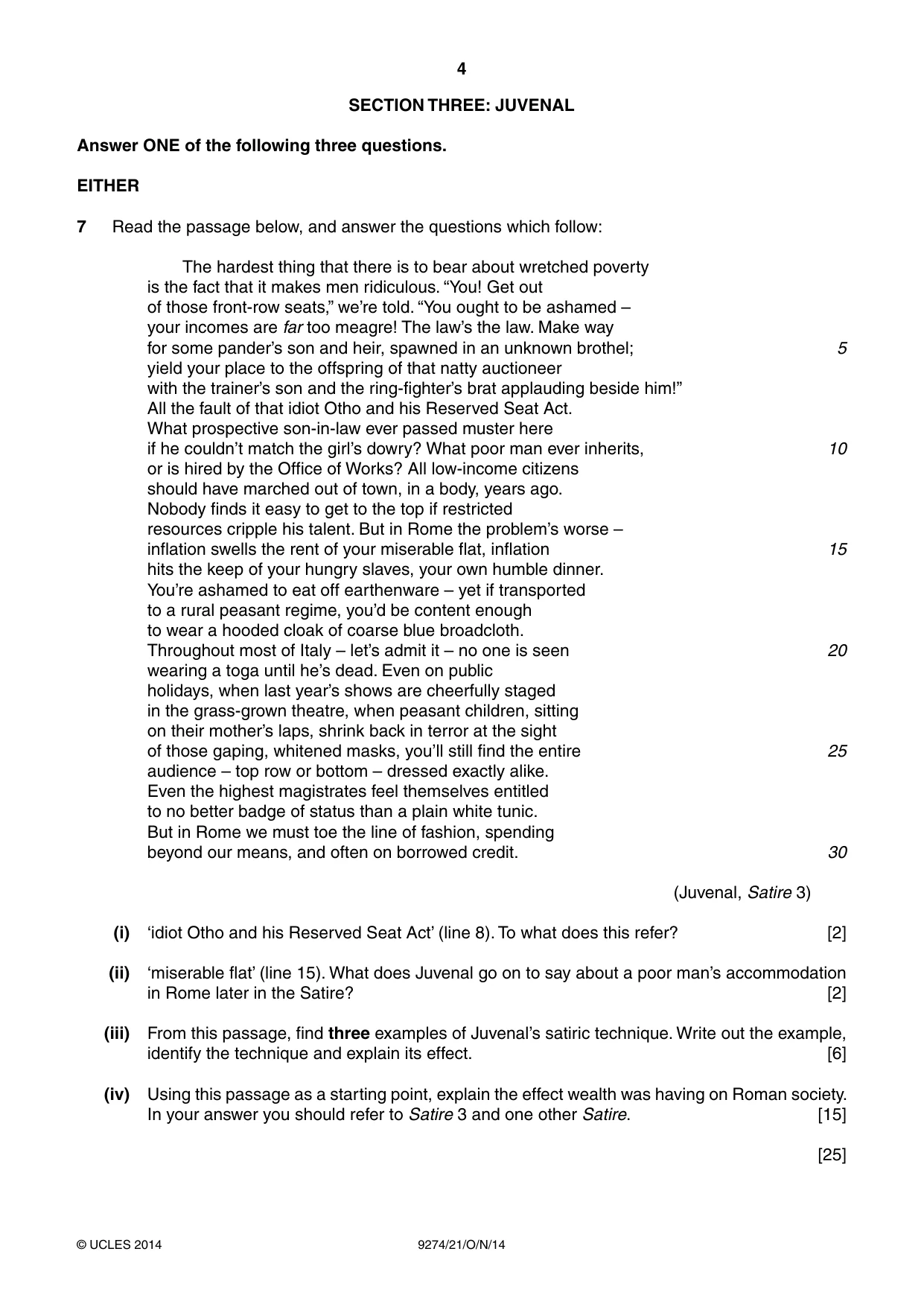
4 9274/21/O/N/14 © UCLES 2014 SECTION THREE: JUVENAL Answer ONE of the following three questions. EITHER 7 Read the passage below, and answer the questions which follow: The hardest thing that there is to bear about wretched poverty is the fact that it makes men ridiculous. “You! Get out of those front-row seats,” we’re told. “You ought to be ashamed – your incomes are far too meagre! The law’s the law. Make way for some pander’s son and heir, spawned in an unknown brothel; yield your place to the offspring of that natty auctioneer with the trainer’s son and the ring-fighter’s brat applauding beside him!” All the fault of that idiot Otho and his Reserved Seat Act. What prospective son-in-law ever passed muster here if he couldn’t match the girl’s dowry? What poor man ever inherits, or is hired by the Office of Works? All low-income citizens should have marched out of town, in a body, years ago. Nobody finds it easy to get to the top if restricted resources cripple his talent. But in Rome the problem’s worse – inflation swells the rent of your miserable flat, inflation hits the keep of your hungry slaves, your own humble dinner. You’re ashamed to eat off earthenware – yet if transported to a rural peasant regime, you’d be content enough to wear a hooded cloak of coarse blue broadcloth. Throughout most of Italy – let’s admit it – no one is seen wearing a toga until he’s dead. Even on public holidays, when last year’s shows are cheerfully staged in the grass-grown theatre, when peasant children, sitting on their mother’s laps, shrink back in terror at the sight of those gaping, whitened masks, you’ll still find the entire audience – top row or bottom – dressed exactly alike. Even the highest magistrates feel themselves entitled to no better badge of status than a plain white tunic. But in Rome we must toe the line of fashion, spending beyond our means, and often on borrowed credit. (Juvenal, Satire 3) 5 10 15 20 25 30 (i) ‘idiot Otho and his Reserved Seat Act’ (line 8). To what does this refer? [2] (ii) ‘miserable flat’ (line 15). What does Juvenal go on to say about a poor man’s accommodation in Rome later in the Satire? [2] (iii) From this passage, find three examples of Juvenal’s satiric technique. Write out the example, identify the technique and explain its effect. [6] (iv) Using this passage as a starting point, explain the effect wealth was having on Roman society. In your answer you should refer to Satire 3 and one other Satire. [15] [25]
Question paper, page 5
5 9274/21/O/N/14 © UCLES 2014 [Turn over OR 8 ‘The pursuit of happiness is a pointless pursuit.’ To what extent does Juvenal show this to be true in his Satires? [25] OR 9 How useful a picture of the life and society in Rome do the Satires of Juvenal provide? You should make reference to at least two Satires. [25]
Question paper, page 6
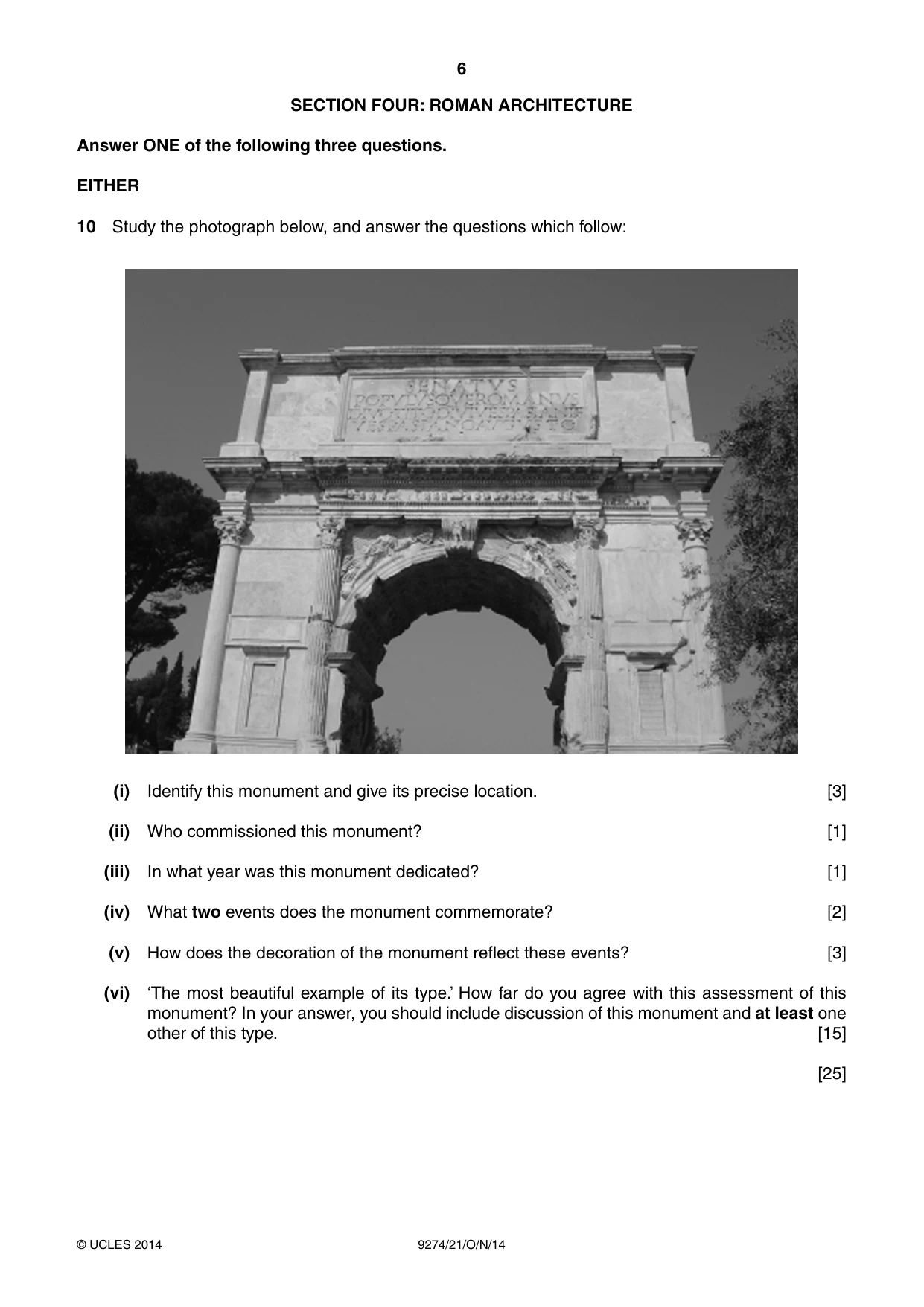
6 9274/21/O/N/14 © UCLES 2014 SECTION FOUR: ROMAN ARCHITECTURE Answer ONE of the following three questions. EITHER 10 Study the photograph below, and answer the questions which follow: (i) Identify this monument and give its precise location. [3] (ii) Who commissioned this monument? [1] (iii) In what year was this monument dedicated? [1] (iv) What two events does the monument commemorate? [2] (v) How does the decoration of the monument reflect these events? [3] (vi) ‘The most beautiful example of its type.’ How far do you agree with this assessment of this monument? In your answer, you should include discussion of this monument and at least one other of this type. [15] [25]
Question paper, page 7
7 9274/21/O/N/14 © UCLES 2014 OR 11 ‘The invention of Roman concrete was vital for the development of Roman architecture.’ To what extent do you agree with this opinion? In your answer, you should include discussion of specific buildings you have studied. [25] OR 12 How well did the design of Roman theatres reflect the needs of the audience? In your answer you should refer to at least two theatres which you have studied. [25]
Question paper, page 8
8 9274/21/O/N/14 © UCLES 2014 Copyright Acknowledgements: Question 1 © trans. W F Jackson Knight; Virgil; The Aeneid; Penguin Books Ltd; 1956. Question 4 © trans. D West; Virgil; The Aeneid; Penguin Books Ltd; 1991. Question 7 © trans. P Green; Juvenal; The Sixteen Satires; Penguin Books Ltd; 1998. Question 10 J Welsby © UCLES. Permission to reproduce items where third-party owned material protected by copyright is included has been sought and cleared where possible. Every reasonable effort has been made by the publisher (UCLES) to trace copyright holders, but if any items requiring clearance have unwittingly been included, the publisher will be pleased to make amends at the earliest possible opportunity. Cambridge International Examinations is part of the Cambridge Assessment Group. Cambridge Assessment is the brand name of University of Cambridge Local Examinations Syndicate (UCLES), which is itself a department of the University of Cambridge. BLANK PAGE
Mark scheme, page 1
® IGCSE is the registered trademark of Cambridge International Examinations. CAMBRIDGE INTERNATIONAL EXAMINATIONS Cambridge International Advanced Subsidiary and Advanced Level MARK SCHEME for the October/November 2014 series 9274 CLASSICAL STUDIES 9274/21 Paper 2 (Roman Civilisation), maximum raw mark 50 This mark scheme is published as an aid to teachers and candidates, to indicate the requirements of the examination. It shows the basis on which Examiners were instructed to award marks. It does not indicate the details of the discussions that took place at an Examiners’ meeting before marking began, which would have considered the acceptability of alternative answers. Mark schemes should be read in conjunction with the question paper and the Principal Examiner Report for Teachers. Cambridge will not enter into discussions about these mark schemes. Cambridge is publishing the mark schemes for the October/November 2014 series for most Cambridge IGCSE®, Cambridge International A and AS Level components and some Cambridge O Level components.
Mark scheme, page 2
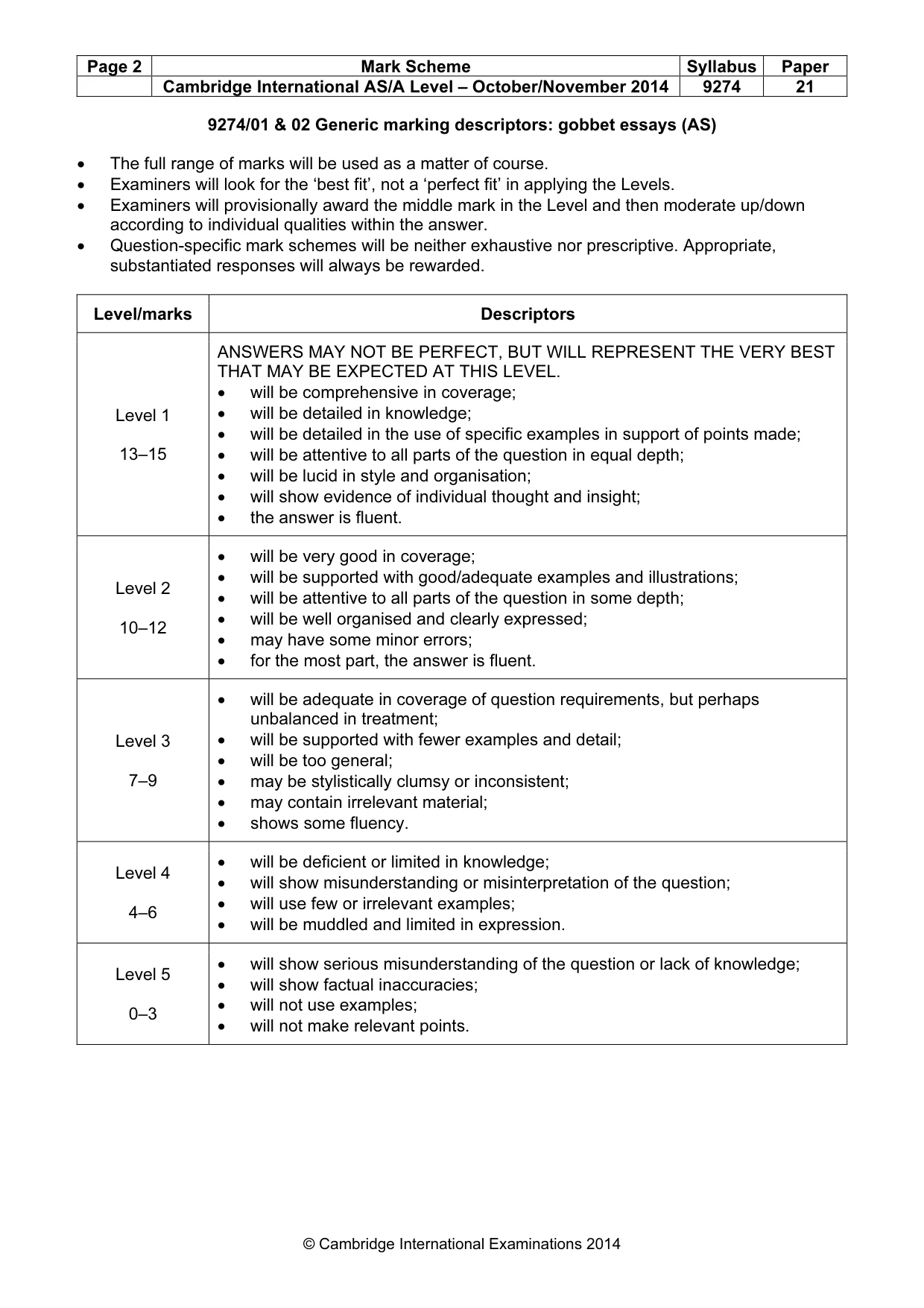
Page 2 Mark Scheme Syllabus Paper Cambridge International AS/A Level – October/November 2014 9274 21 © Cambridge International Examinations 2014 9274/01 & 02 Generic marking descriptors: gobbet essays (AS) • The full range of marks will be used as a matter of course. • Examiners will look for the ‘best fit’, not a ‘perfect fit’ in applying the Levels. • Examiners will provisionally award the middle mark in the Level and then moderate up/down according to individual qualities within the answer. • Question-specific mark schemes will be neither exhaustive nor prescriptive. Appropriate, substantiated responses will always be rewarded. Level/marks Descriptors Level 1 13–15 ANSWERS MAY NOT BE PERFECT, BUT WILL REPRESENT THE VERY BEST THAT MAY BE EXPECTED AT THIS LEVEL. • will be comprehensive in coverage; • will be detailed in knowledge; • will be detailed in the use of specific examples in support of points made; • will be attentive to all parts of the question in equal depth; • will be lucid in style and organisation; • will show evidence of individual thought and insight; • the answer is fluent. Level 2 10–12 • will be very good in coverage; • will be supported with good/adequate examples and illustrations; • will be attentive to all parts of the question in some depth; • will be well organised and clearly expressed; • may have some minor errors; • for the most part, the answer is fluent. Level 3 7–9 • will be adequate in coverage of question requirements, but perhaps unbalanced in treatment; • will be supported with fewer examples and detail; • will be too general; • may be stylistically clumsy or inconsistent; • may contain irrelevant material; • shows some fluency. Level 4 4–6 • will be deficient or limited in knowledge; • will show misunderstanding or misinterpretation of the question; • will use few or irrelevant examples; • will be muddled and limited in expression. Level 5 0–3 • will show serious misunderstanding of the question or lack of knowledge; • will show factual inaccuracies; • will not use examples; • will not make relevant points.
Mark scheme, page 3
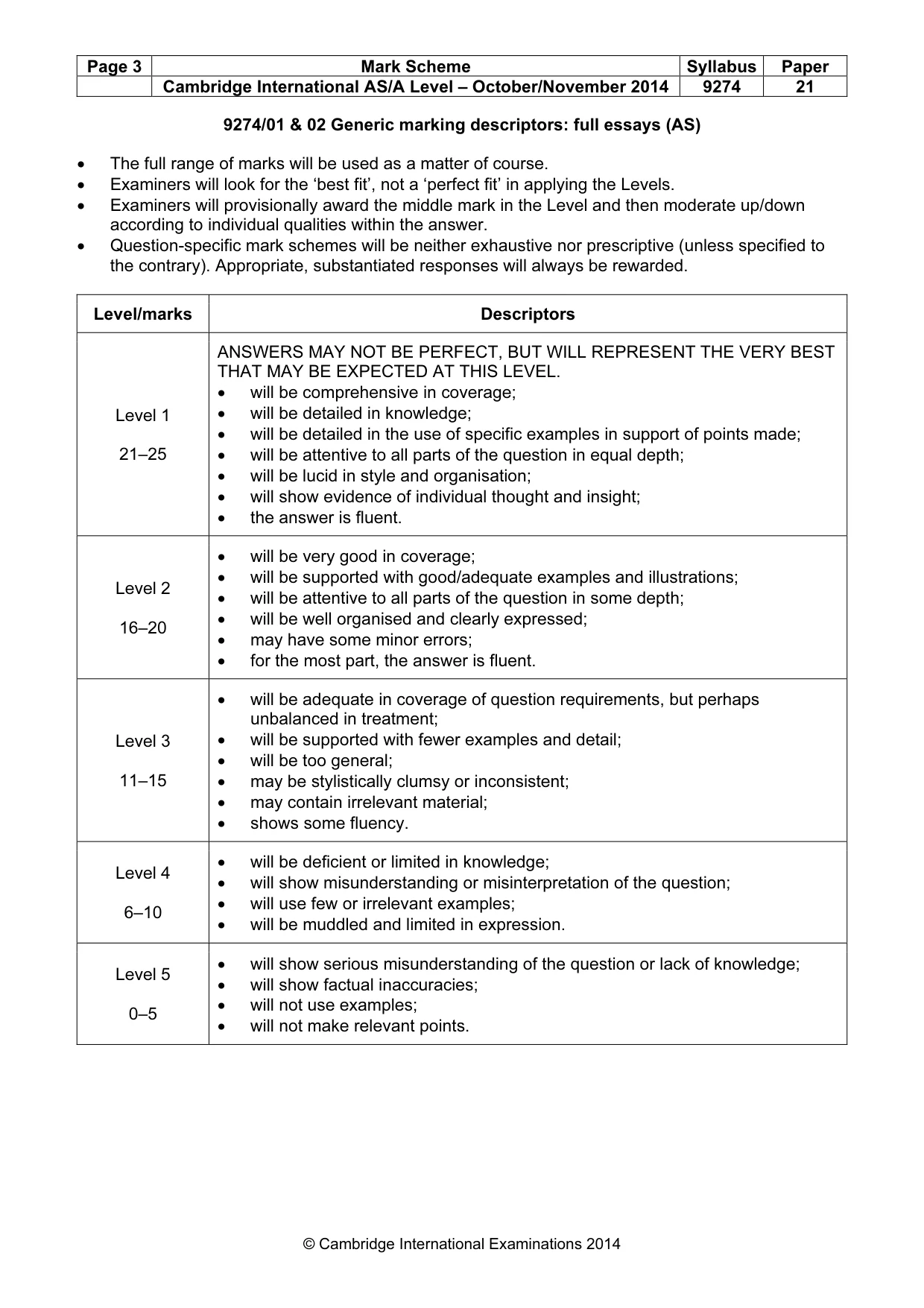
Page 3 Mark Scheme Syllabus Paper Cambridge International AS/A Level – October/November 2014 9274 21 © Cambridge International Examinations 2014 9274/01 & 02 Generic marking descriptors: full essays (AS) • The full range of marks will be used as a matter of course. • Examiners will look for the ‘best fit’, not a ‘perfect fit’ in applying the Levels. • Examiners will provisionally award the middle mark in the Level and then moderate up/down according to individual qualities within the answer. • Question-specific mark schemes will be neither exhaustive nor prescriptive (unless specified to the contrary). Appropriate, substantiated responses will always be rewarded. Level/marks Descriptors Level 1 21–25 ANSWERS MAY NOT BE PERFECT, BUT WILL REPRESENT THE VERY BEST THAT MAY BE EXPECTED AT THIS LEVEL. • will be comprehensive in coverage; • will be detailed in knowledge; • will be detailed in the use of specific examples in support of points made; • will be attentive to all parts of the question in equal depth; • will be lucid in style and organisation; • will show evidence of individual thought and insight; • the answer is fluent. Level 2 16–20 • will be very good in coverage; • will be supported with good/adequate examples and illustrations; • will be attentive to all parts of the question in some depth; • will be well organised and clearly expressed; • may have some minor errors; • for the most part, the answer is fluent. Level 3 11–15 • will be adequate in coverage of question requirements, but perhaps unbalanced in treatment; • will be supported with fewer examples and detail; • will be too general; • may be stylistically clumsy or inconsistent; • may contain irrelevant material; • shows some fluency. Level 4 6–10 • will be deficient or limited in knowledge; • will show misunderstanding or misinterpretation of the question; • will use few or irrelevant examples; • will be muddled and limited in expression. Level 5 0–5 • will show serious misunderstanding of the question or lack of knowledge; • will show factual inaccuracies; • will not use examples; • will not make relevant points.
Mark scheme, page 4
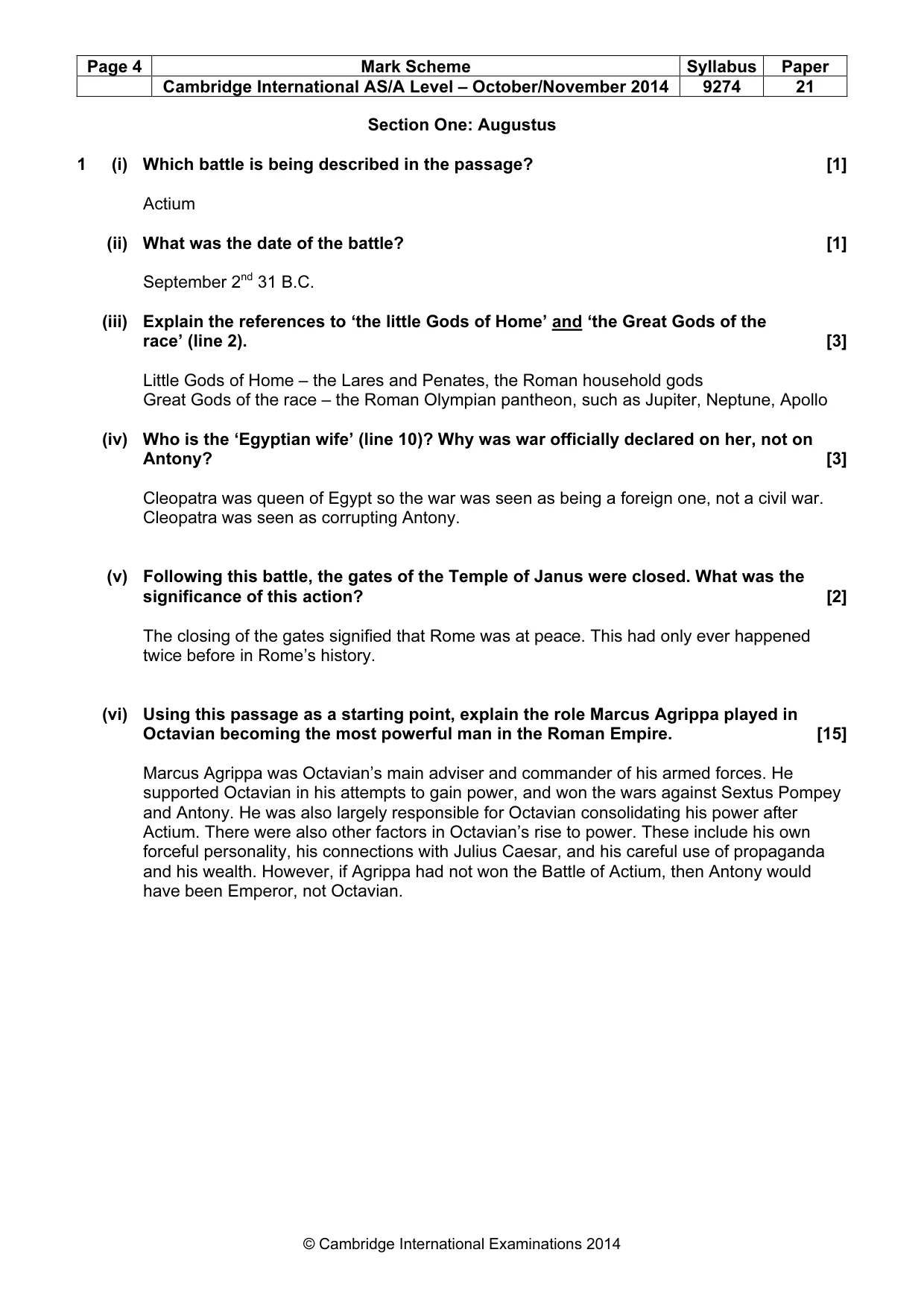
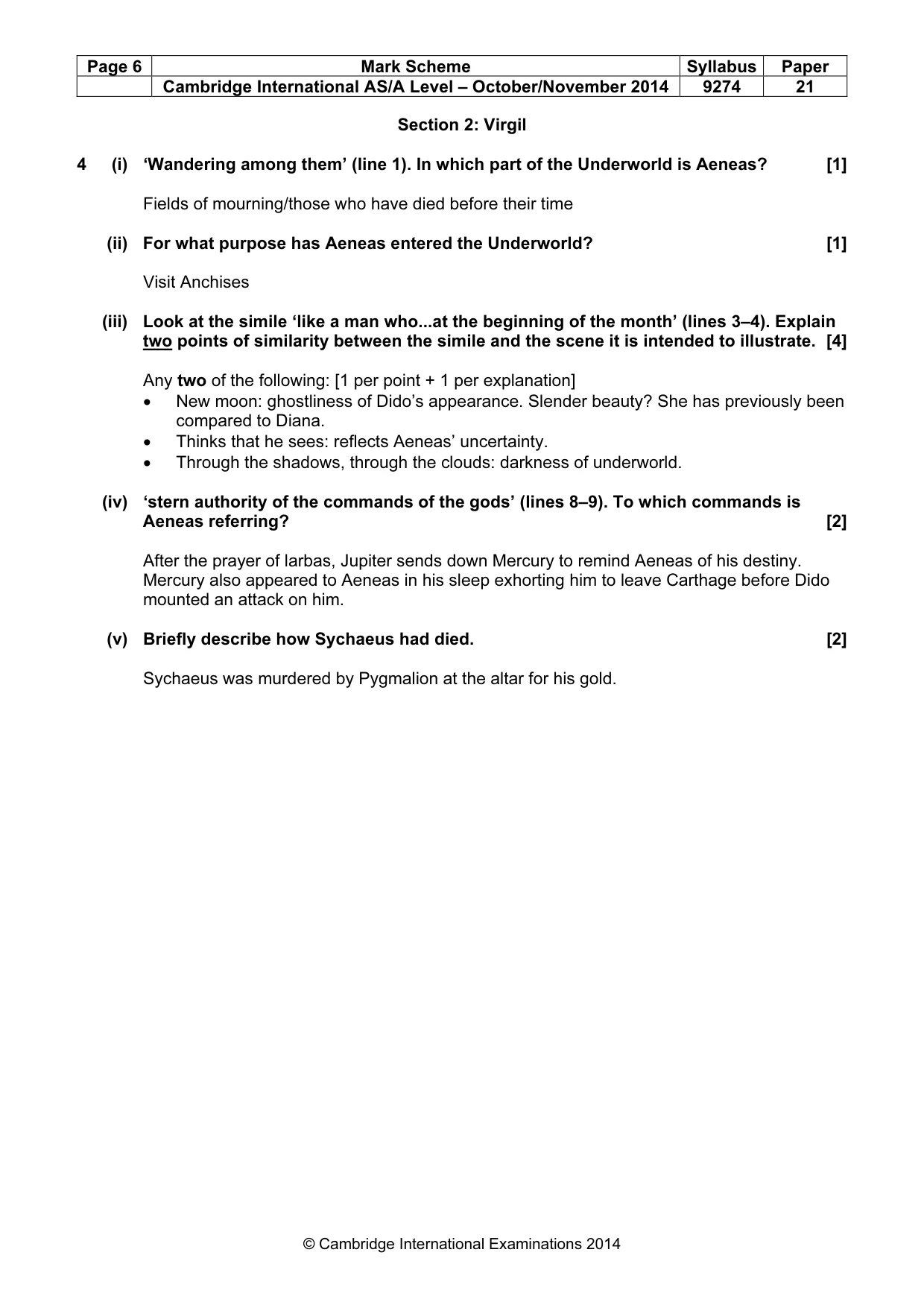
Page 4 Mark Scheme Syllabus Paper Cambridge International AS/A Level – October/November 2014 9274 21 © Cambridge International Examinations 2014 Section One: Augustus 1 (i) Which battle is being described in the passage? [1] Actium (ii) What was the date of the battle? [1] September 2nd 31 B.C. (iii) Explain the references to ‘the little Gods of Home’ and ‘the Great Gods of the race’ (line 2). [3] Little Gods of Home – the Lares and Penates, the Roman household gods Great Gods of the race – the Roman Olympian pantheon, such as Jupiter, Neptune, Apollo (iv) Who is the ‘Egyptian wife’ (line 10)? Why was war officially declared on her, not on Antony? [3] Cleopatra was queen of Egypt so the war was seen as being a foreign one, not a civil war. Cleopatra was seen as corrupting Antony. (v) Following this battle, the gates of the Temple of Janus were closed. What was the significance of this action? [2] The closing of the gates signified that Rome was at peace. This had only ever happened twice before in Rome’s history. (vi) Using this passage as a starting point, explain the role Marcus Agrippa played in Octavian becoming the most powerful man in the Roman Empire. [15] Marcus Agrippa was Octavian’s main adviser and commander of his armed forces. He supported Octavian in his attempts to gain power, and won the wars against Sextus Pompey and Antony. He was also largely responsible for Octavian consolidating his power after Actium. There were also other factors in Octavian’s rise to power. These include his own forceful personality, his connections with Julius Caesar, and his careful use of propaganda and his wealth. However, if Agrippa had not won the Battle of Actium, then Antony would have been Emperor, not Octavian.
Mark scheme, page 5
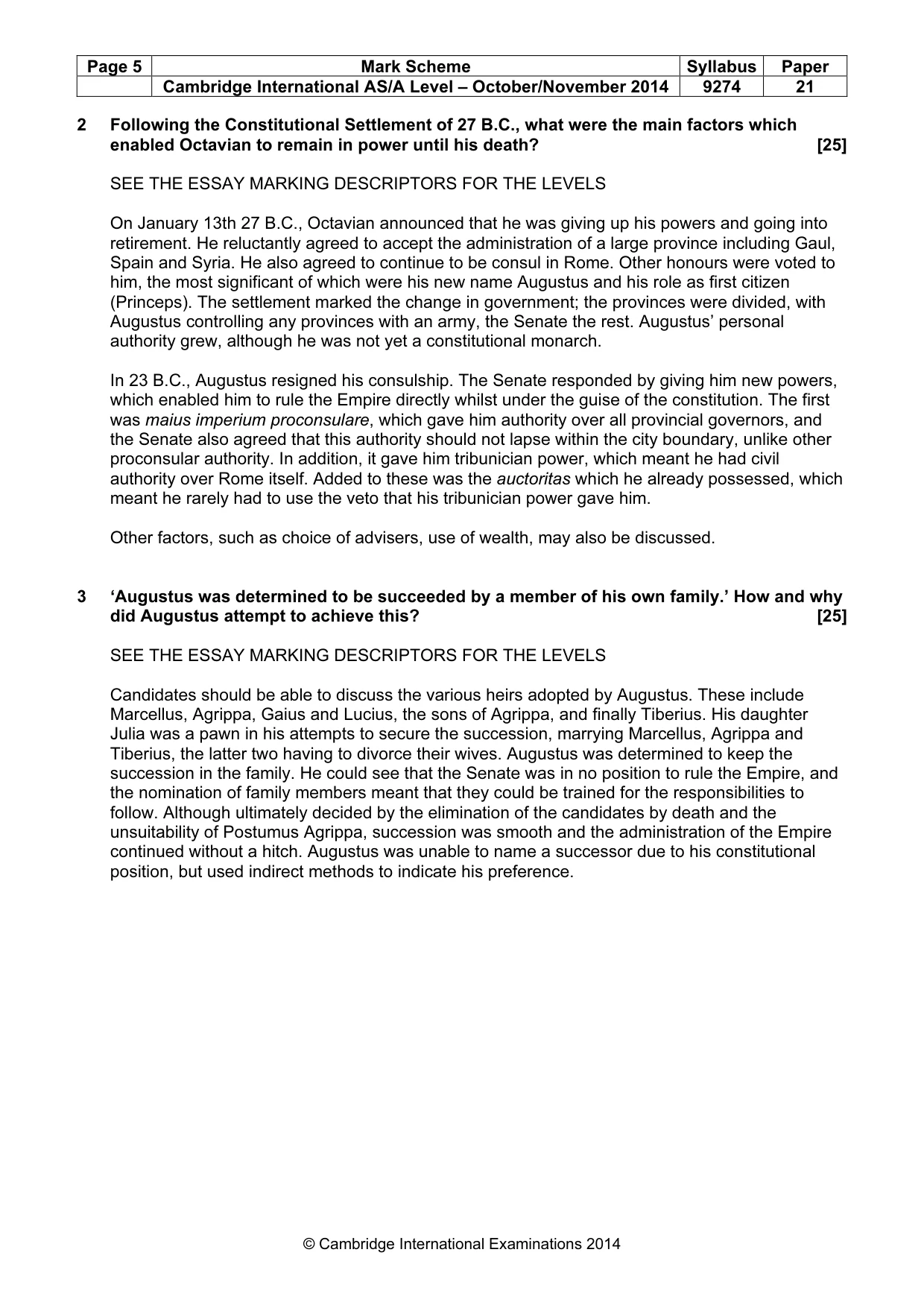
Page 5 Mark Scheme Syllabus Paper Cambridge International AS/A Level – October/November 2014 9274 21 © Cambridge International Examinations 2014 2 Following the Constitutional Settlement of 27 B.C., what were the main factors which enabled Octavian to remain in power until his death? [25] SEE THE ESSAY MARKING DESCRIPTORS FOR THE LEVELS On January 13th 27 B.C., Octavian announced that he was giving up his powers and going into retirement. He reluctantly agreed to accept the administration of a large province including Gaul, Spain and Syria. He also agreed to continue to be consul in Rome. Other honours were voted to him, the most significant of which were his new name Augustus and his role as first citizen (Princeps). The settlement marked the change in government; the provinces were divided, with Augustus controlling any provinces with an army, the Senate the rest. Augustus’ personal authority grew, although he was not yet a constitutional monarch. In 23 B.C., Augustus resigned his consulship. The Senate responded by giving him new powers, which enabled him to rule the Empire directly whilst under the guise of the constitution. The first was maius imperium proconsulare, which gave him authority over all provincial governors, and the Senate also agreed that this authority should not lapse within the city boundary, unlike other proconsular authority. In addition, it gave him tribunician power, which meant he had civil authority over Rome itself. Added to these was the auctoritas which he already possessed, which meant he rarely had to use the veto that his tribunician power gave him. Other factors, such as choice of advisers, use of wealth, may also be discussed. 3 ‘Augustus was determined to be succeeded by a member of his own family.’ How and why did Augustus attempt to achieve this? [25] SEE THE ESSAY MARKING DESCRIPTORS FOR THE LEVELS Candidates should be able to discuss the various heirs adopted by Augustus. These include Marcellus, Agrippa, Gaius and Lucius, the sons of Agrippa, and finally Tiberius. His daughter Julia was a pawn in his attempts to secure the succession, marrying Marcellus, Agrippa and Tiberius, the latter two having to divorce their wives. Augustus was determined to keep the succession in the family. He could see that the Senate was in no position to rule the Empire, and the nomination of family members meant that they could be trained for the responsibilities to follow. Although ultimately decided by the elimination of the candidates by death and the unsuitability of Postumus Agrippa, succession was smooth and the administration of the Empire continued without a hitch. Augustus was unable to name a successor due to his constitutional position, but used indirect methods to indicate his preference.
Mark scheme, page 6
Page 6 Mark Scheme Syllabus Paper Cambridge International AS/A Level – October/November 2014 9274 21 © Cambridge International Examinations 2014 Section 2: Virgil 4 (i) ‘Wandering among them’ (line 1). In which part of the Underworld is Aeneas? [1] Fields of mourning/those who have died before their time (ii) For what purpose has Aeneas entered the Underworld? [1] Visit Anchises (iii) Look at the simile ‘like a man who...at the beginning of the month’ (lines 3–4). Explain two points of similarity between the simile and the scene it is intended to illustrate. [4] Any two of the following: [1 per point + 1 per explanation] • New moon: ghostliness of Dido’s appearance. Slender beauty? She has previously been compared to Diana. • Thinks that he sees: reflects Aeneas’ uncertainty. • Through the shadows, through the clouds: darkness of underworld. (iv) ‘stern authority of the commands of the gods’ (lines 8–9). To which commands is Aeneas referring? [2] After the prayer of larbas, Jupiter sends down Mercury to remind Aeneas of his destiny. Mercury also appeared to Aeneas in his sleep exhorting him to leave Carthage before Dido mounted an attack on him. (v) Briefly describe how Sychaeus had died. [2] Sychaeus was murdered by Pygmalion at the altar for his gold.
Mark scheme, page 7
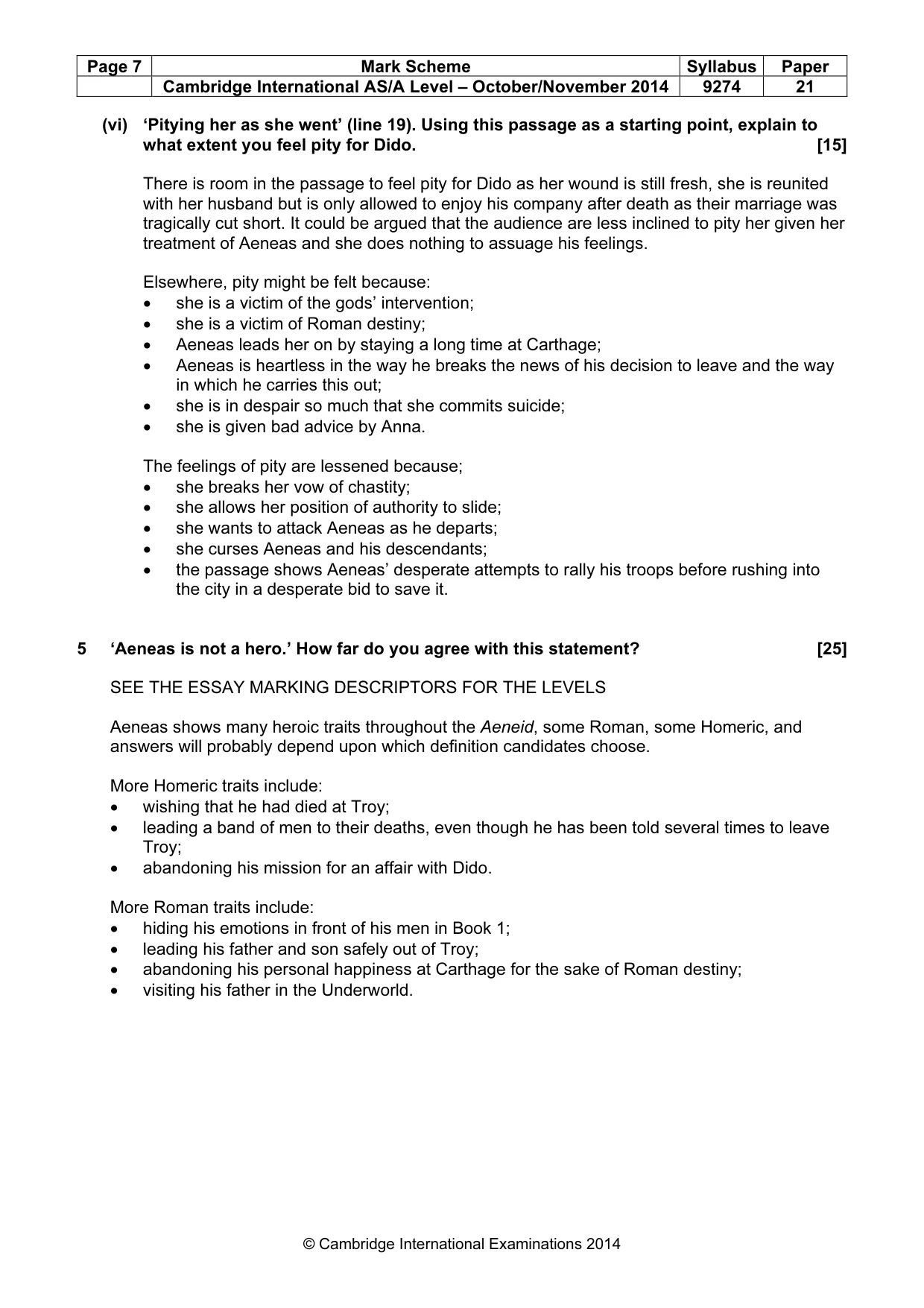
Page 7 Mark Scheme Syllabus Paper Cambridge International AS/A Level – October/November 2014 9274 21 © Cambridge International Examinations 2014 (vi) ‘Pitying her as she went’ (line 19). Using this passage as a starting point, explain to what extent you feel pity for Dido. [15] There is room in the passage to feel pity for Dido as her wound is still fresh, she is reunited with her husband but is only allowed to enjoy his company after death as their marriage was tragically cut short. It could be argued that the audience are less inclined to pity her given her treatment of Aeneas and she does nothing to assuage his feelings. Elsewhere, pity might be felt because: • she is a victim of the gods’ intervention; • she is a victim of Roman destiny; • Aeneas leads her on by staying a long time at Carthage; • Aeneas is heartless in the way he breaks the news of his decision to leave and the way in which he carries this out; • she is in despair so much that she commits suicide; • she is given bad advice by Anna. The feelings of pity are lessened because; • she breaks her vow of chastity; • she allows her position of authority to slide; • she wants to attack Aeneas as he departs; • she curses Aeneas and his descendants; • the passage shows Aeneas’ desperate attempts to rally his troops before rushing into the city in a desperate bid to save it. 5 ‘Aeneas is not a hero.’ How far do you agree with this statement? [25] SEE THE ESSAY MARKING DESCRIPTORS FOR THE LEVELS Aeneas shows many heroic traits throughout the Aeneid, some Roman, some Homeric, and answers will probably depend upon which definition candidates choose. More Homeric traits include: • wishing that he had died at Troy; • leading a band of men to their deaths, even though he has been told several times to leave Troy; • abandoning his mission for an affair with Dido. More Roman traits include: • hiding his emotions in front of his men in Book 1; • leading his father and son safely out of Troy; • abandoning his personal happiness at Carthage for the sake of Roman destiny; • visiting his father in the Underworld.
Mark scheme, page 8
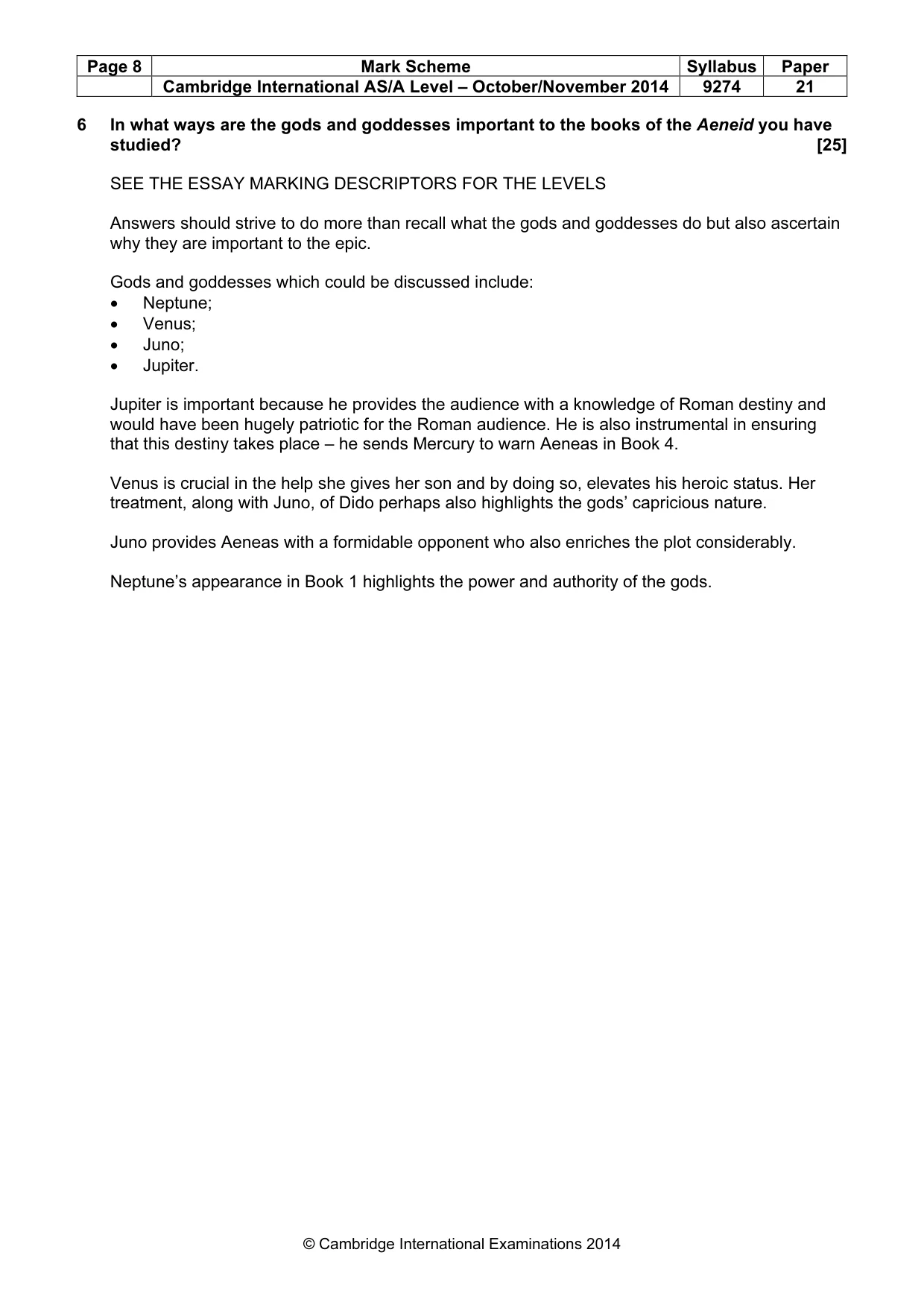
Page 8 Mark Scheme Syllabus Paper Cambridge International AS/A Level – October/November 2014 9274 21 © Cambridge International Examinations 2014 6 In what ways are the gods and goddesses important to the books of the Aeneid you have studied? [25] SEE THE ESSAY MARKING DESCRIPTORS FOR THE LEVELS Answers should strive to do more than recall what the gods and goddesses do but also ascertain why they are important to the epic. Gods and goddesses which could be discussed include: • Neptune; • Venus; • Juno; • Jupiter. Jupiter is important because he provides the audience with a knowledge of Roman destiny and would have been hugely patriotic for the Roman audience. He is also instrumental in ensuring that this destiny takes place – he sends Mercury to warn Aeneas in Book 4. Venus is crucial in the help she gives her son and by doing so, elevates his heroic status. Her treatment, along with Juno, of Dido perhaps also highlights the gods’ capricious nature. Juno provides Aeneas with a formidable opponent who also enriches the plot considerably. Neptune’s appearance in Book 1 highlights the power and authority of the gods.
Mark scheme, page 9
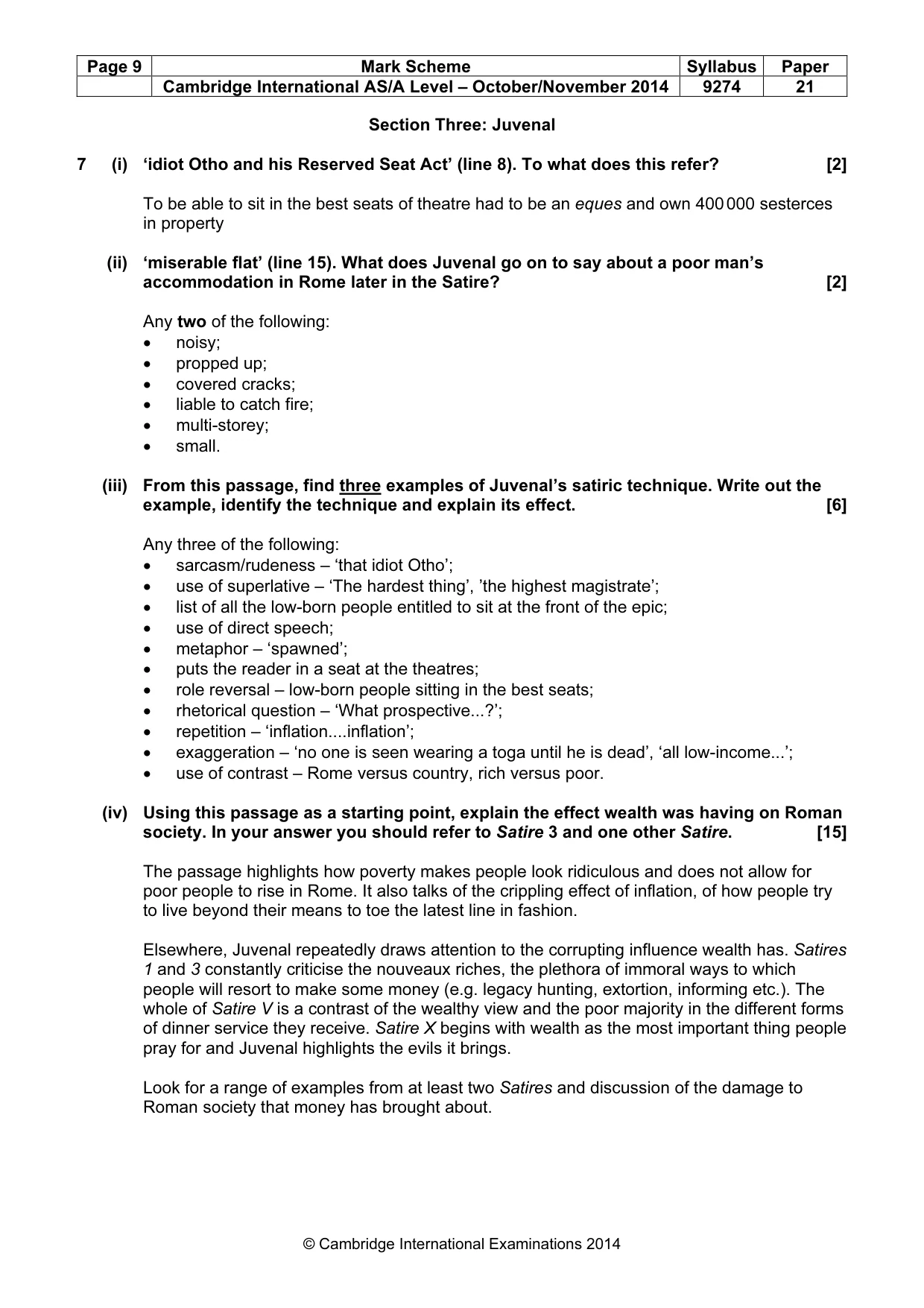
Page 9 Mark Scheme Syllabus Paper Cambridge International AS/A Level – October/November 2014 9274 21 © Cambridge International Examinations 2014 Section Three: Juvenal 7 (i) ‘idiot Otho and his Reserved Seat Act’ (line 8). To what does this refer? [2] To be able to sit in the best seats of theatre had to be an eques and own 400 000 sesterces in property (ii) ‘miserable flat’ (line 15). What does Juvenal go on to say about a poor man’s accommodation in Rome later in the Satire? [2] Any two of the following: • noisy; • propped up; • covered cracks; • liable to catch fire; • multi-storey; • small. (iii) From this passage, find three examples of Juvenal’s satiric technique. Write out the example, identify the technique and explain its effect. [6] Any three of the following: • sarcasm/rudeness – ‘that idiot Otho’; • use of superlative – ‘The hardest thing’, ’the highest magistrate’; • list of all the low-born people entitled to sit at the front of the epic; • use of direct speech; • metaphor – ‘spawned’; • puts the reader in a seat at the theatres; • role reversal – low-born people sitting in the best seats; • rhetorical question – ‘What prospective...?’; • repetition – ‘inflation…inflation’; • exaggeration – ‘no one is seen wearing a toga until he is dead’, ‘all low-income...’; • use of contrast – Rome versus country, rich versus poor. (iv) Using this passage as a starting point, explain the effect wealth was having on Roman society. In your answer you should refer to Satire 3 and one other Satire. [15] The passage highlights how poverty makes people look ridiculous and does not allow for poor people to rise in Rome. It also talks of the crippling effect of inflation, of how people try to live beyond their means to toe the latest line in fashion. Elsewhere, Juvenal repeatedly draws attention to the corrupting influence wealth has. Satires 1 and 3 constantly criticise the nouveaux riches, the plethora of immoral ways to which people will resort to make some money (e.g. legacy hunting, extortion, informing etc.). The whole of Satire V is a contrast of the wealthy view and the poor majority in the different forms of dinner service they receive. Satire X begins with wealth as the most important thing people pray for and Juvenal highlights the evils it brings. Look for a range of examples from at least two Satires and discussion of the damage to Roman society that money has brought about.
Mark scheme, page 10
Page 10 Mark Scheme Syllabus Paper Cambridge International AS/A Level – October/November 2014 9274 21 © Cambridge International Examinations 2014 8 ‘The pursuit of happiness is a pointless pursuit.’ To what extent does Juvenal show this to be true in his Satires? [25] SEE THE ESSAY MARKING DESCRIPTORS FOR THE LEVELS Juvenal certainly draws attention to the many pitfalls in Roman society, and there is considerable evidence to suggest that the pursuit of happiness is a pointless task. This is particularly evident in Satire 10 which highlights the disadvantages of the things (old age, wealth etc.) which people often pray for. The picture of Rome in Satire 3 is also very damning and the dinner party and Imperial Court are mercilessly satirised. However, it should also be noted that Juvenal does offer some advice for helping people to lead happier lives. Areas for consideration might include: • the virtues of living in the countryside; • the need to abandon living in Rome; • the degradation the client has to endure and that the salutatio is not worth the effort; • the list of things not to pray for; • the concluding advice on what to pray for. 9 How useful a picture of the life and society in Rome do the Satires of Juvenal provide? You should make reference to at least two Satires. [25] SEE THE ESSAY MARKING DESCRIPTORS FOR THE LEVELS Juvenal’s Satires make comment on the following areas: • wealth; • emperors; • living conditions; • dinner parties; • foreigners; • women; • slaves; • freedmen; • nobility; • attitudes to the gods. As for how effective the Satires are as a source, they should certainly be treated with care as the picture Juvenal draws is certainly a distorted one for the sake of his satiric purposes. They are likely to exaggerate for the sake of humour, entertainment, making a point. However, that is not to say that Juvenal’s picture is so distorted that a Roman audience would fail to see their own society in it, and as such, it could be used carefully in helping to reconstruct an understanding of Roman life and society.
Mark scheme, page 11
Page 11 Mark Scheme Syllabus Paper Cambridge International AS/A Level – October/November 2014 9274 21 © Cambridge International Examinations 2014 Section Four: Roman Architecture 10 (i) Identify this monument and give its precise location. [3] Arch of Titus Sacra Via/Forum Rome (ii) Who commissioned this monument? [1] Emperor Domitian (iii) In what year was this monument dedicated? [1] 81 A.D. (iv) What two events does the monument commemorate? [2] • the triumph of Vespasian and Titus after their victory in the Jewish War in 71 A.D.; • Titus’s apotheosis. (v) How does the decoration of the monument reflect these events? [3] • sculpted panel depicting soldiers carrying the treasure of the Jews from the temple in Jerusalem; • sculpted panel depicting Titus in a chariot in the triumphal procession; • sculpted panel depicting Titus being carried heavenward on the back of a large eagle.
Mark scheme, page 12
Page 12 Mark Scheme Syllabus Paper Cambridge International AS/A Level – October/November 2014 9274 21 © Cambridge International Examinations 2014 (vi) ‘The most beautiful example of its type.’ How far do you agree with this assessment of this monument? In your answer, you should include discussion of this monument and at least one other of this type. [15] The Arch of Titus stands on the Via Sacra, close to the Colosseum. It was erected and dedicated by Domitian as a monument to his dead brother and predecessor as Emperor, Titus, and to commemorate the victory in the Jewish Wars. Much of the sculptural decoration on the Arch of Titus shows scenes from the triumphal procession celebrating the victory over the Jews: • the booty from the temple at Jerusalem being carried by Romans; • the Emperor Titus himself parading in a chariot. The arch also had: • an inscription, containing the dedication to Titus; • a relief panel showing Titus being carried towards heaven on the back of an eagle; • a bronze quadriga on top of the arch. The Arch of Titus was noted for its fine proportions (50 feet/15metres high and 40 feet/12 metres wide) which, combined with the use of Pentelic marble, the quality of the relief sculpture and its understated decoration (in comparison to other surviving triumphal arches), make it an elegant structure. It is only a single arched gateway unlike other arches which have smaller vaulted corridors flanking the central archway. Whether it is more beautiful, simple and elegant than other triumphal arches is for the candidates to decide. 11 ‘The invention of Roman concrete was vital for the development of Roman architecture.’ To what extent do you agree with this opinion? In your answer, you should include discussion of specific buildings you have studied. [25] SEE THE ESSAY MARKING DESCRIPTORS FOR THE LEVELS There is no model answer to this question because much depends on the buildings studied by individual candidates and then employed in answer to this question. It does not matter whether candidates choose to agree with the quotation or not, provided there is a reasoned argument based on specific, recognisable buildings. Candidates discuss the Romans’ innovative use of concrete in many of the buildings they have studied. Expect discussion of arches and domes and how concrete was used to construct these elements of particular buildings or structures. Candidates may refer to the Colosseum, the Pantheon, the arch of Titus, and other buildings or structures known to them.
Mark scheme, page 13
Page 13 Mark Scheme Syllabus Paper Cambridge International AS/A Level – October/November 2014 9274 21 © Cambridge International Examinations 2014 12 How well did the design of Roman theatres reflect the needs of the audience? In your answer, you should refer to at least two theatres which you have studied. [25] SEE THE ESSAY MARKING DESCRIPTORS FOR THE LEVELS A Roman architect had a number of practical considerations to take into account when designing a theatre: • size of the audience to be accommodated – affected size of building and the site chosen; • easy access/egress – spectators needed to find seats easily and get out easily; • comfort of the spectators – the nature of the seats, the materials used, facilities for use by the spectators; • nature of the different types of shows held there – safety of spectators; • acoustics of the building; • awning for comfort of spectators; • sight lines for the spectators – ease of viewing from any seat for spectators of different classes; • appearance of the building – aesthetically pleasing for the spectators. Candidates should refer to at least two theatres in order to explain their answers. The theatre at Leptis Magna is on the specification; other possibilities include the theatre of Marcellus at Rome and the large theatre at Pompeii.
What you needed in this session
Cambridge’s own grade thresholds for 2014 Oct/Nov, Paper 2 · Variant 1. A higher threshold means an easier paper — the bar moves with how the cohort did.