Cambridge A Level Chemistry 9701 — 2021 May/June Paper 2 · Variant 2
9701/22/M/J/21 · 5 questions · 60 marks · ≈68 min
The question paper and its mark scheme, free to read here and free to download. This is Cambridge’s own paper, exactly as it was sat.
Question paper12 pages
Mark scheme12 pages
Answers below. Sit the paper first if you are practising.
Questions as text
Q1 · A Group 2 metal combines with bromine to form a crystalline solid, MBr2
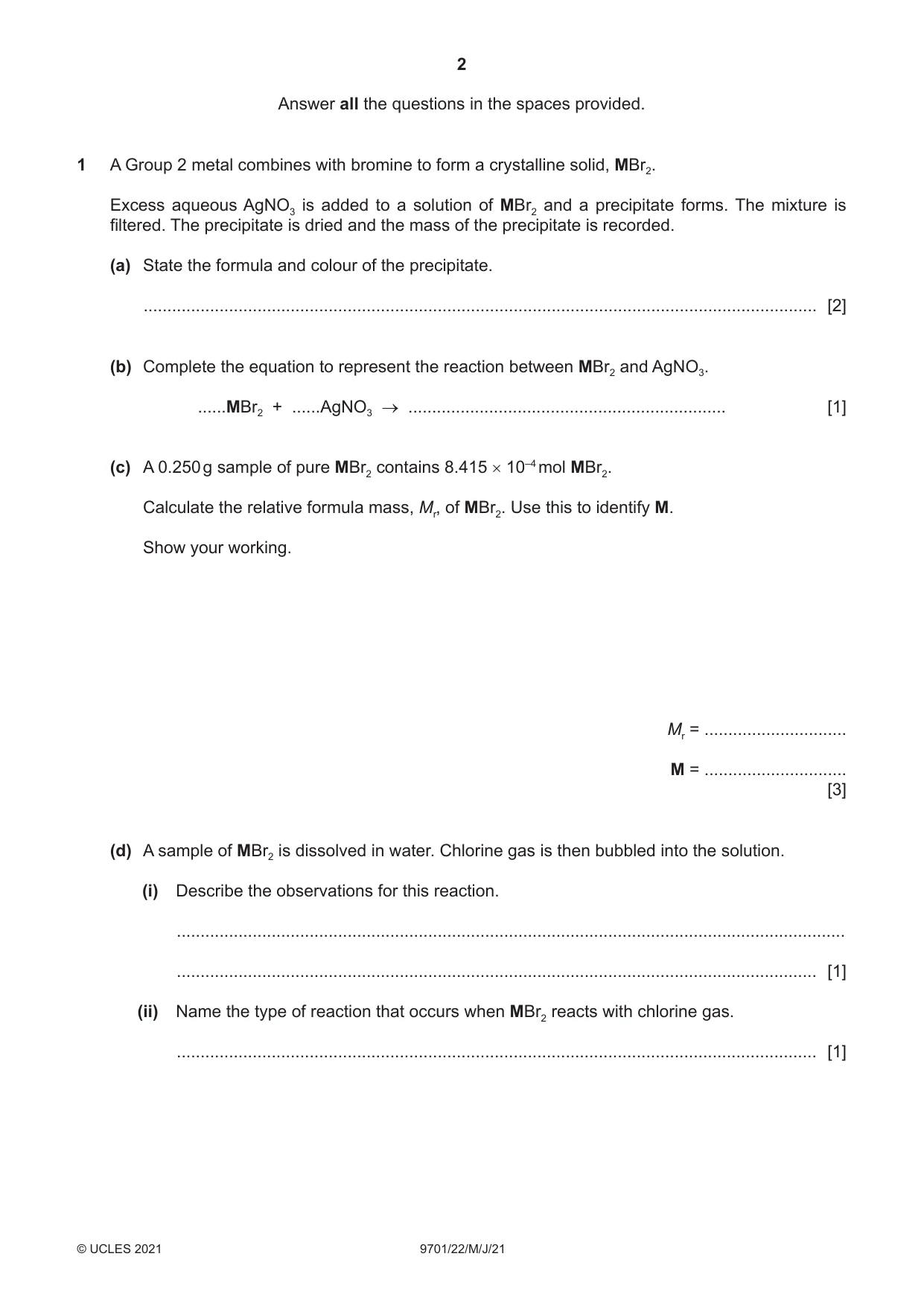
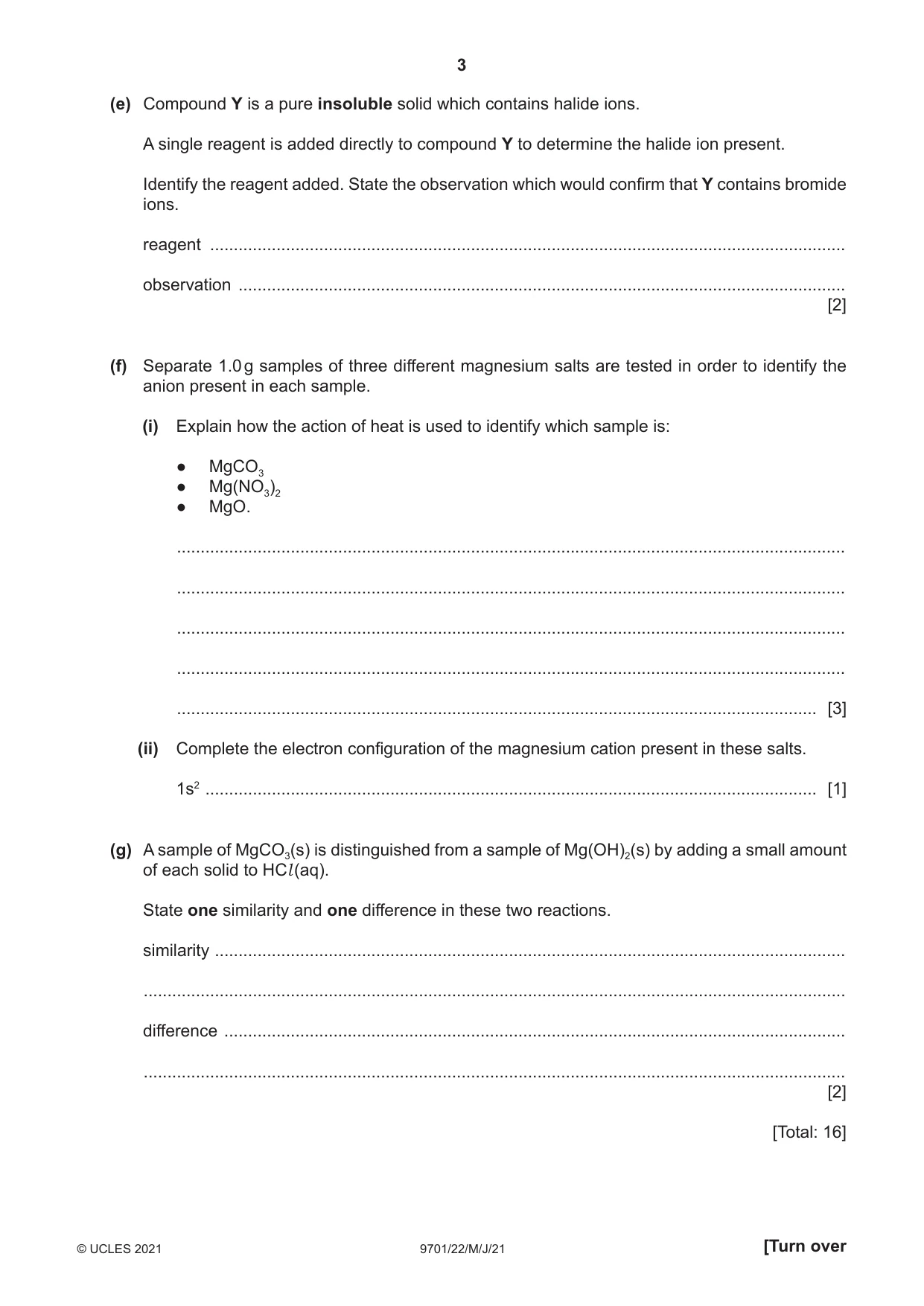
1 A Group 2 metal combines with bromine to form a crystalline solid, MBr2. Excess aqueous AgNO3 is added to a solution of MBr2 and a precipitate forms. The mixture is filtered. The precipitate is dried and the mass of the precipitate is recorded. (a) State the formula and colour of the precipitate. .............................................................................................................................................. [2] (b) Complete the equation to represent the reaction between MBr2 and AgNO3. ......MBr2 + ......AgNO3 → ................................................................... [1] (c) A 0.250 g sample of pure MBr2 contains 8.415 × 10⁻⁴ mol MBr2. Calculate the relative formula mass, Mr, of MBr2. Use this to identify M. Show your working. Mr = .............................. M = .............................. [3] (d) A sample of MBr2 is dissolved in water. Chlorine gas is then bubbled into the solution. (i) Describe the observations for this reaction. ............................................................................................................................................. ....................................................................................................................................... [1] (ii) Name the type of reaction that occurs when MBr2 reacts with chlorine gas. ....................................................................................................................................... [1] (e) Compound Y is a pure insoluble solid which contains halide ions. A single reagent is added directly to compound Y to determine the halide ion present. Identify the reagent added. State the observation which would confirm that Y contains bromide ions. reagent ....................................................................................................................................... observation ................................................................................................................................. [2] (f) Separate 1.0 g samples of three different magnesium salts are tested in order to identify the anion present in each sample. (i) Explain how the action of heat is used to identify which sample is: ● MgCO3 ● Mg(NO3)2 ● MgO. ............................................................................................................................................. ............................................................................................................................................. ............................................................................................................................................. ............................................................................................................................................. ....................................................................................................................................... [3] (ii) Complete the electron configuration of the magnesium cation present in these salts. 1s2 ................................................................................................................................. [1] (g) A sample of MgCO3(s) is distinguished from a sample of Mg(OH)2(s) by adding a small amount of each solid to HCl (aq). State one similarity and one difference in these two reactions. similarity ..................................................................................................................................... .................................................................................................................................................... difference ................................................................................................................................... .................................................................................................................................................... [2] [Total: 16]
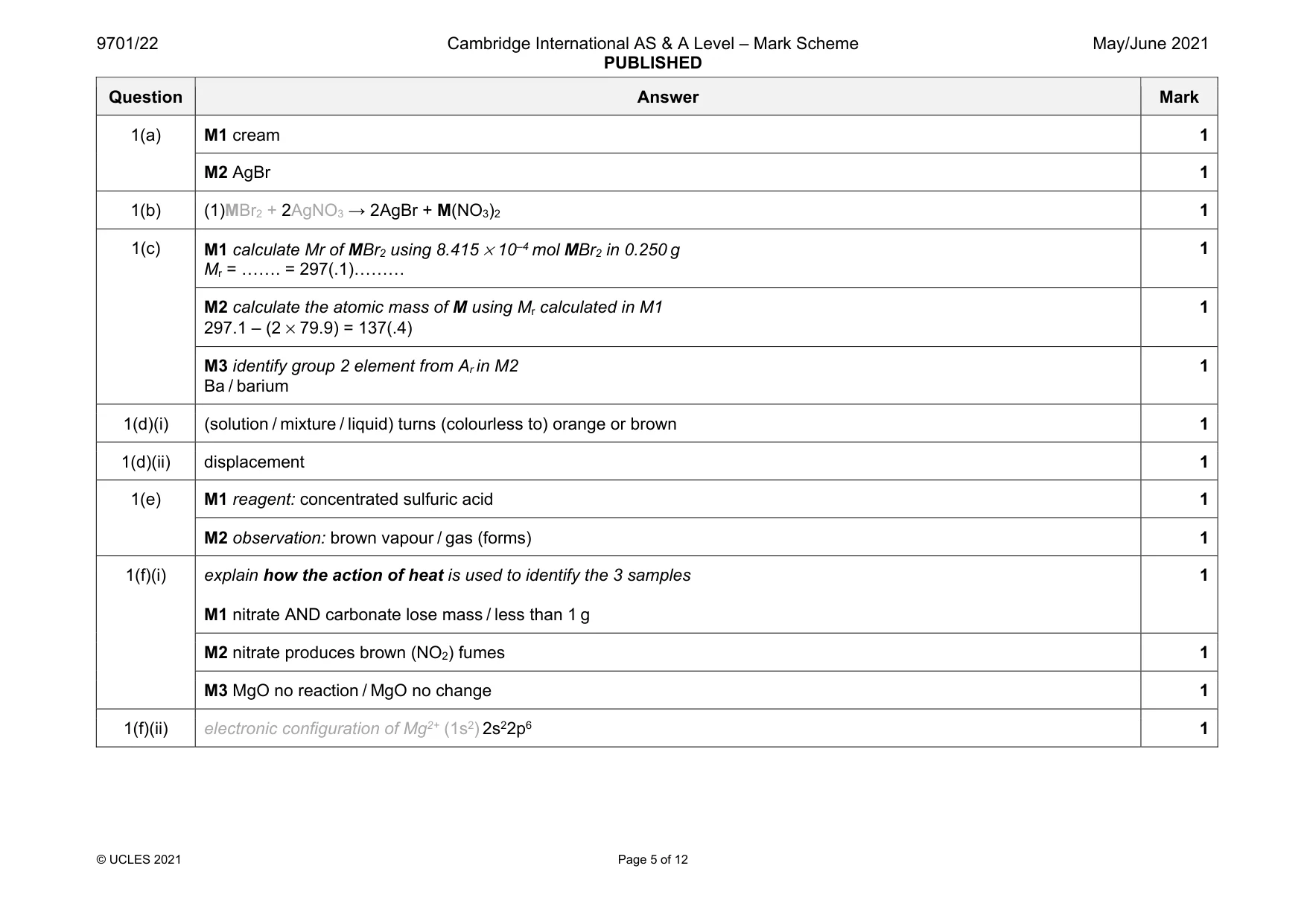
Mark scheme: 1(a) M1 cream 1 M2 AgBr 1 1(b) (1)MBr2 + 2AgNO3 → 2AgBr + M(NO3)2 1 1(c) M1 calculate Mr of MBr2 using 8.415 × 10⁻⁴ mol MBr2 in 0.250 g Mr = ……. = 297(.1)……… 1 M2 calculate the atomic mass of M using Mr calculated in M1 297.1 – (2 × 79.9) = 137(.4) 1 M3 identify group 2 element from Ar in M2 Ba / barium 1 1(d)(i) (solution / mixture / liquid) turns (colourless to) orange or brown 1 1(d)(ii) displacement 1 1(e) M1 reagent: concentrated sulfuric acid 1 M2 observation: brown vapour / gas (forms) 1 1(f)(i) explain how the action of heat is used to identify the 3 samples M1 nitrate AND carbonate lose mass / less than 1 g 1 M2 nitrate produces brown (NO2) fumes 1 M3 MgO no reaction / MgO no change 1 1(f)(ii) electronic configuration of Mg2+ (1s2) 2s22p6 1 Question Answer Mark 1(g) One similarity M1 solid(s) disappear(s) 1 One difference M2 MgCO3 fizzes (due to CO2) OR no fizzing with Mg(OH)2 1
Q2 · The strength of interaction between particles determines whether the substance is a…
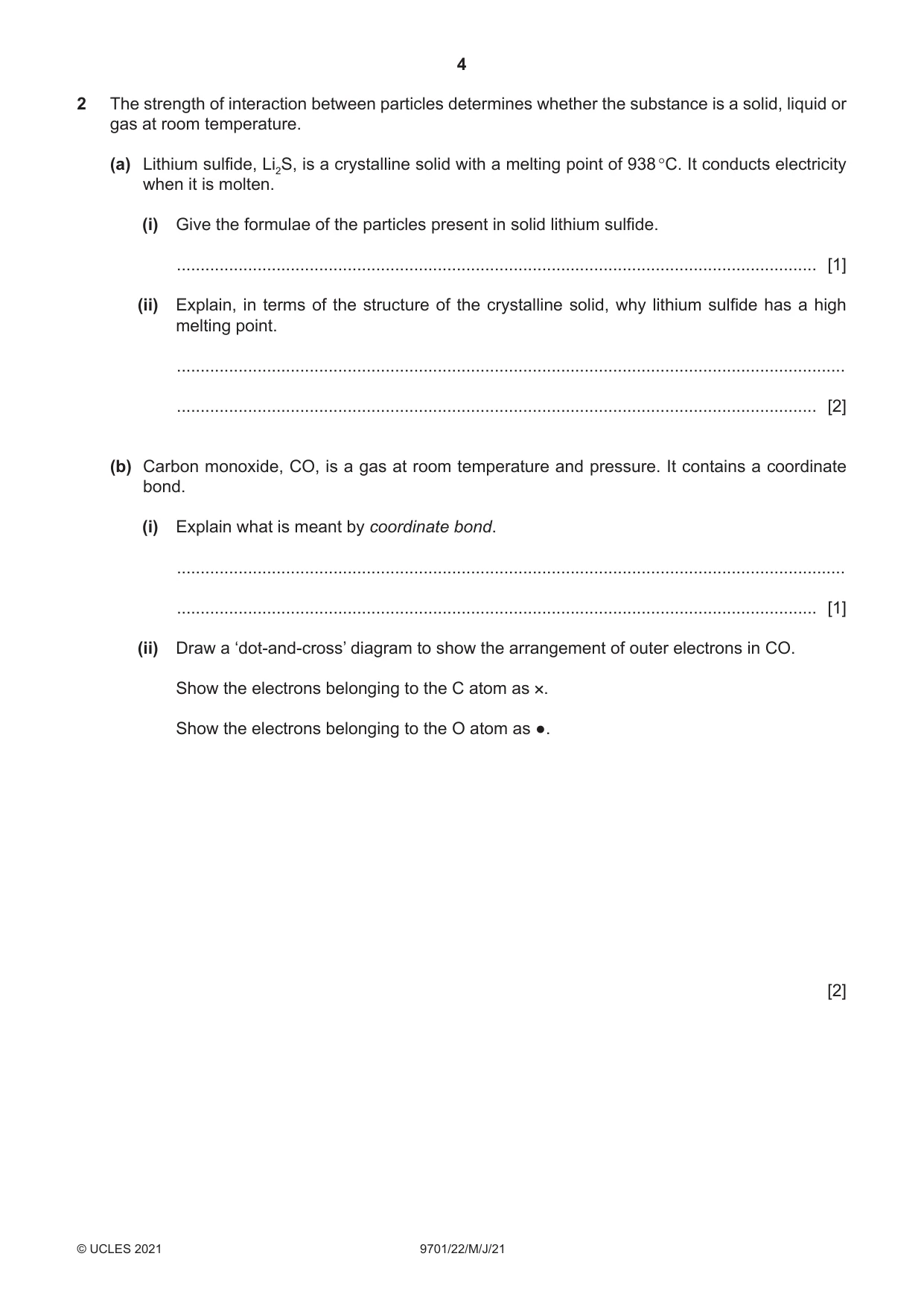
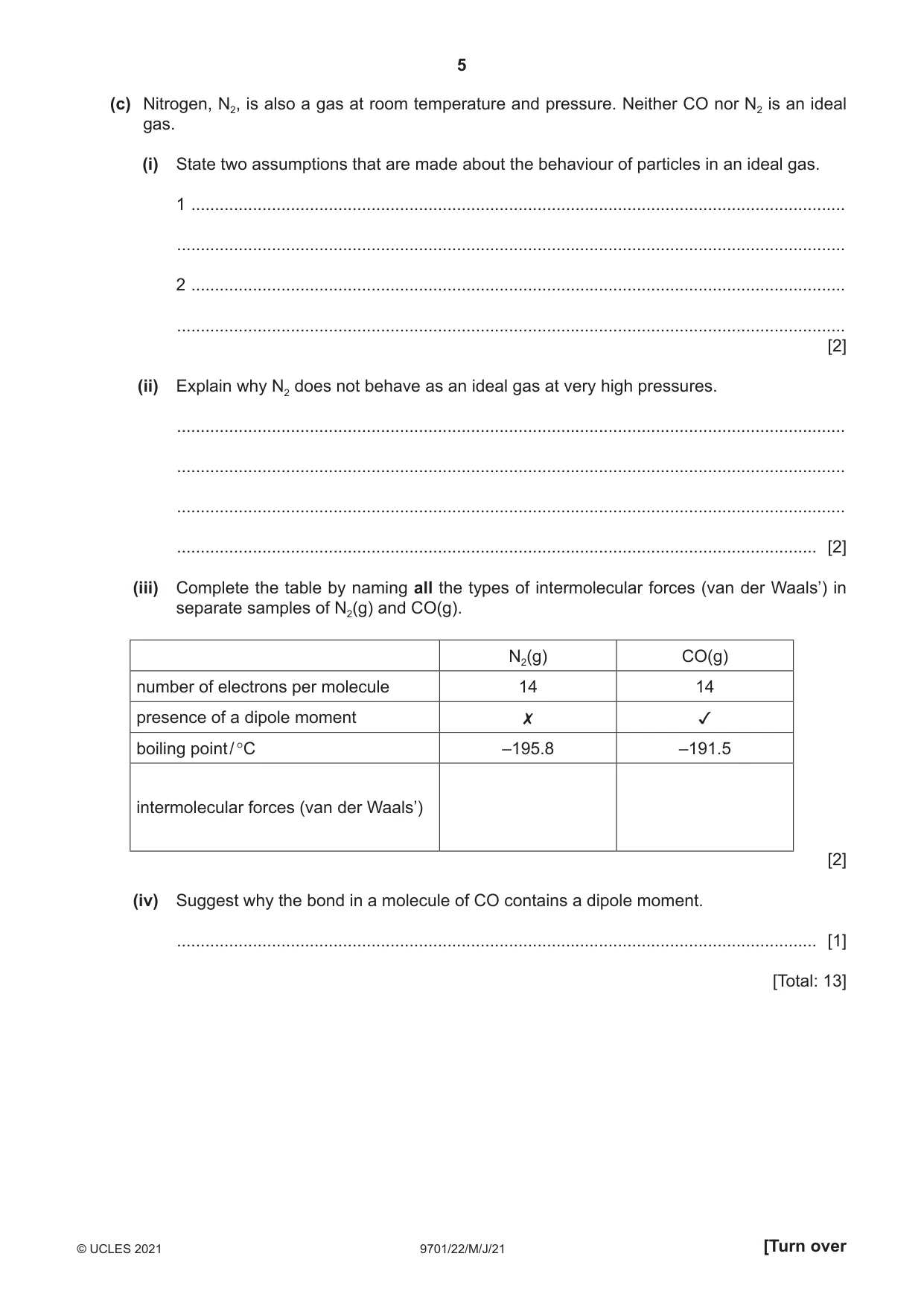
2 The strength of interaction between particles determines whether the substance is a solid, liquid or gas at room temperature. (a) Lithium sulfide, Li2S, is a crystalline solid with a melting point of 938 °C. It conducts electricity when it is molten. (i) Give the formulae of the particles present in solid lithium sulfide. ....................................................................................................................................... [1] (ii) Explain, in terms of the structure of the crystalline solid, why lithium sulfide has a high melting point. ............................................................................................................................................. ....................................................................................................................................... [2] (b) Carbon monoxide, CO, is a gas at room temperature and pressure. It contains a coordinate bond. (i) Explain what is meant by coordinate bond. ............................................................................................................................................. ....................................................................................................................................... [1] (ii) Draw a ‘dot-and-cross’ diagram to show the arrangement of outer electrons in CO. Show the electrons belonging to the C atom as ×. Show the electrons belonging to the O atom as ●. [2] (c) Nitrogen, N2, is also a gas at room temperature and pressure. Neither CO nor N2 is an ideal gas. (i) State two assumptions that are made about the behaviour of particles in an ideal gas. 1 .......................................................................................................................................... ............................................................................................................................................. 2 .......................................................................................................................................... ............................................................................................................................................. [2] (ii) Explain why N2 does not behave as an ideal gas at very high pressures. ............................................................................................................................................. ............................................................................................................................................. ............................................................................................................................................. ....................................................................................................................................... [2] (iii) Complete the table by naming all the types of intermolecular forces (van der Waals’) in separate samples of N2(g) and CO(g). N2(g) CO(g) number of electrons per molecule 14 14 presence of a dipole moment boiling point / °C –195.8 –191.5 intermolecular forces (van der Waals’) [2] (iv) Suggest why the bond in a molecule of CO contains a dipole moment. ....................................................................................................................................... [1] [Total: 13]
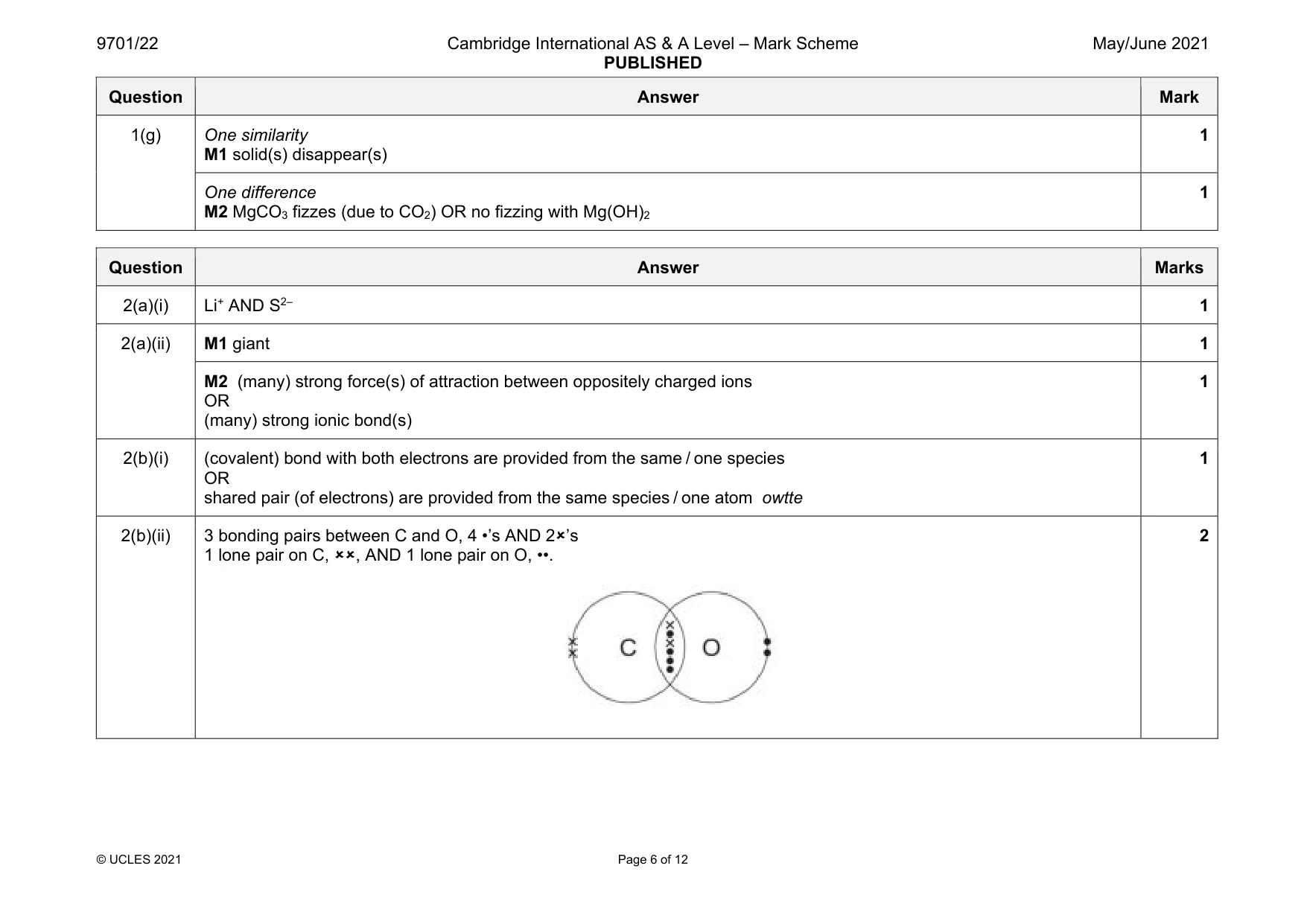
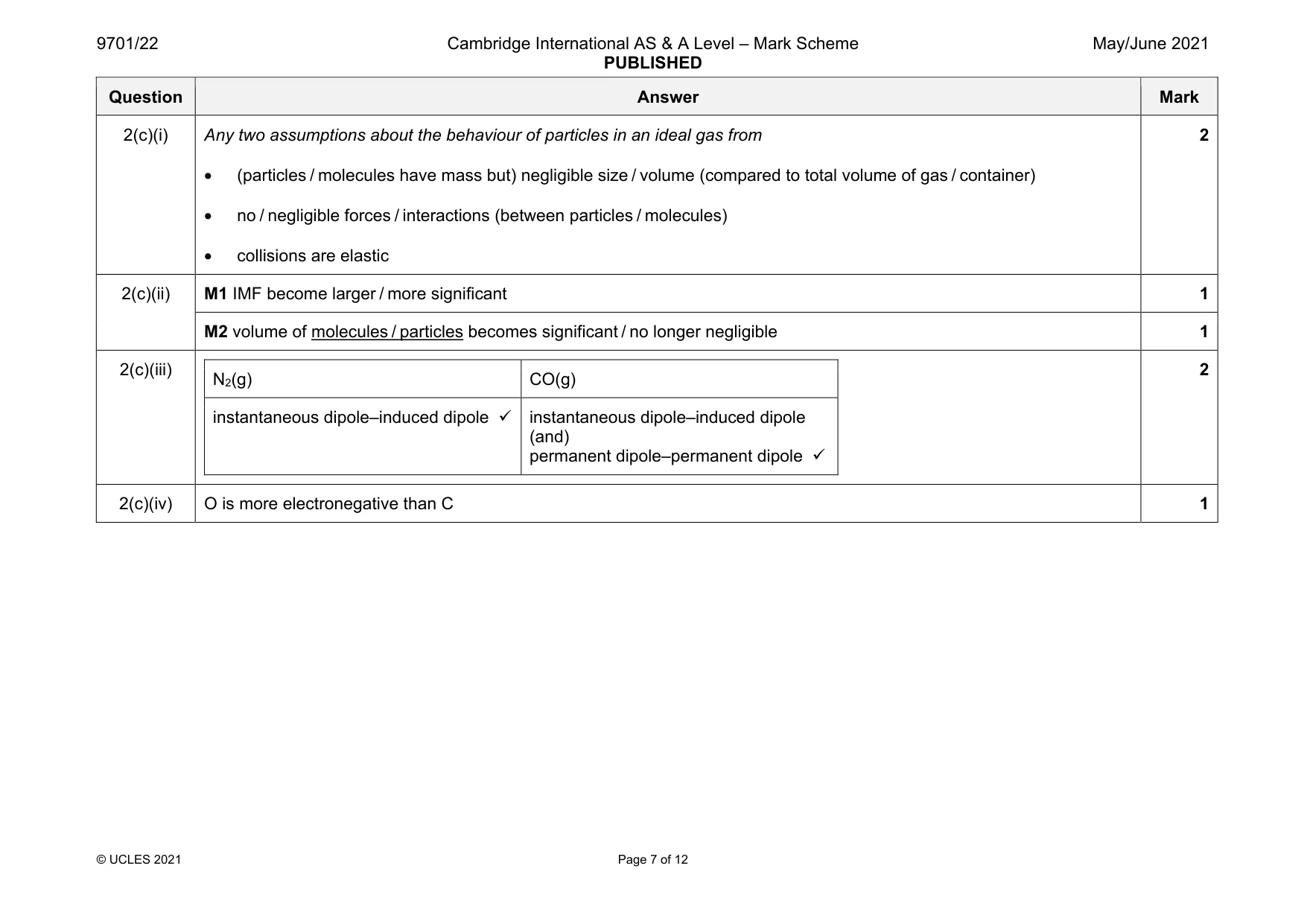
Mark scheme: 2(a)(i) Li+ AND S2– 1 2(a)(ii) M1 giant 1 M2 (many) strong force(s) of attraction between oppositely charged ions OR (many) strong ionic bond(s) 1 2(b)(i) (covalent) bond with both electrons are provided from the same / one species OR shared pair (of electrons) are provided from the same species / one atom owtte 1 2(b)(ii) 3 bonding pairs between C and O, 4 •’s AND 2’s 1 lone pair on C, , AND 1 lone pair on O, ••. 2 Question Answer Mark 2(c)(i) Any two assumptions about the behaviour of particles in an ideal gas from • (particles / molecules have mass but) negligible size / volume (compared to total volume of gas / container) • no / negligible forces / interactions (between particles / molecules) • collisions are elastic 2 2(c)(ii) M1 IMF become larger / more significant 1 M2 volume of molecules / particles becomes significant / no longer negligible 1 2(c)(iii) N2(g) CO(g) instantaneous dipole–induced dipole instantaneous dipole–induced dipole (and) permanent dipole–permanent dipole 2 2(c)(iv) O is more electronegative than C 1
More questions on Covalent bonding and coordinate (dative covalent) bonding
Q3 · A large excess of 2-bromo-2-methylpropane is added to 0.0010 mol of NaOH(aq), which…
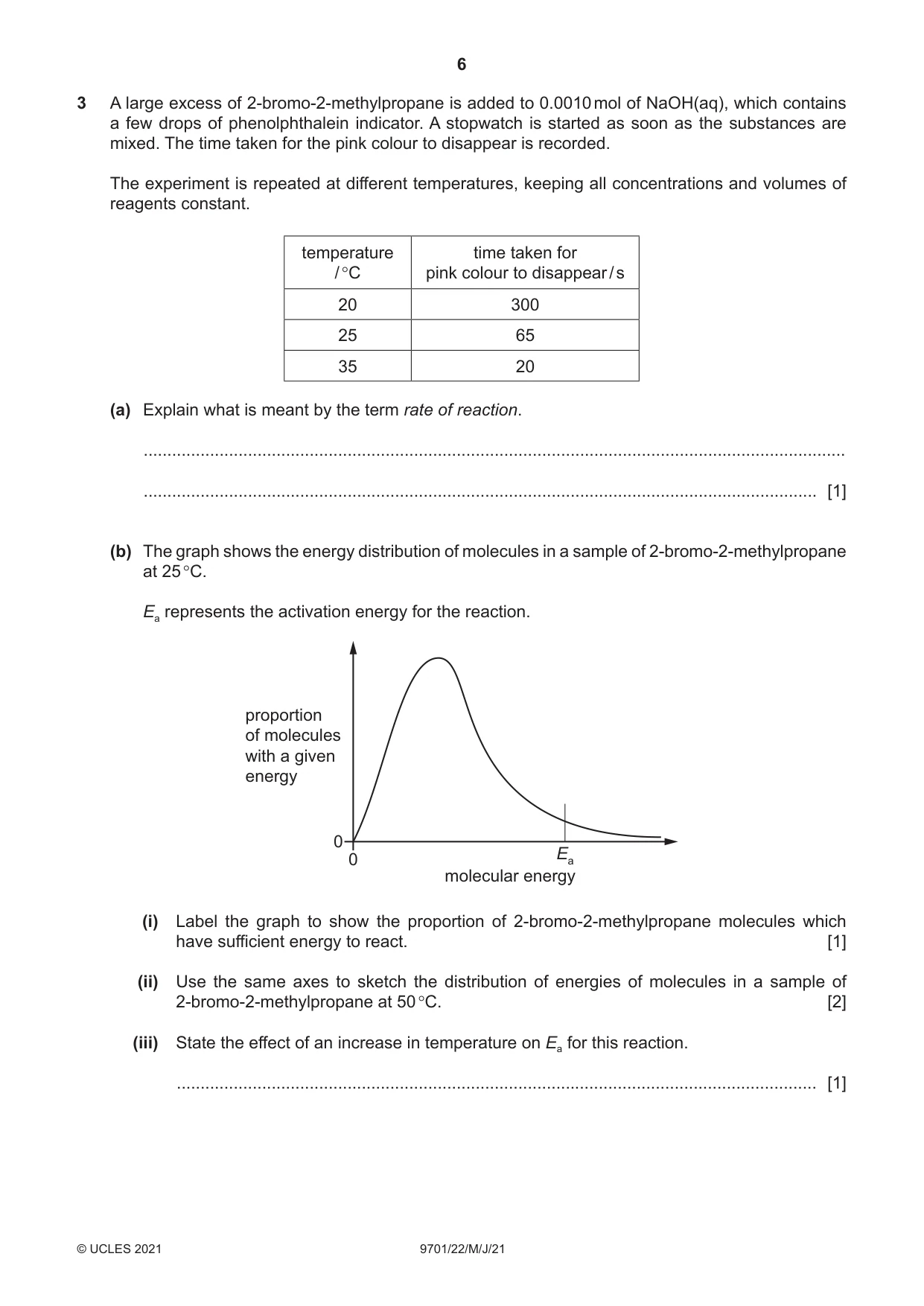
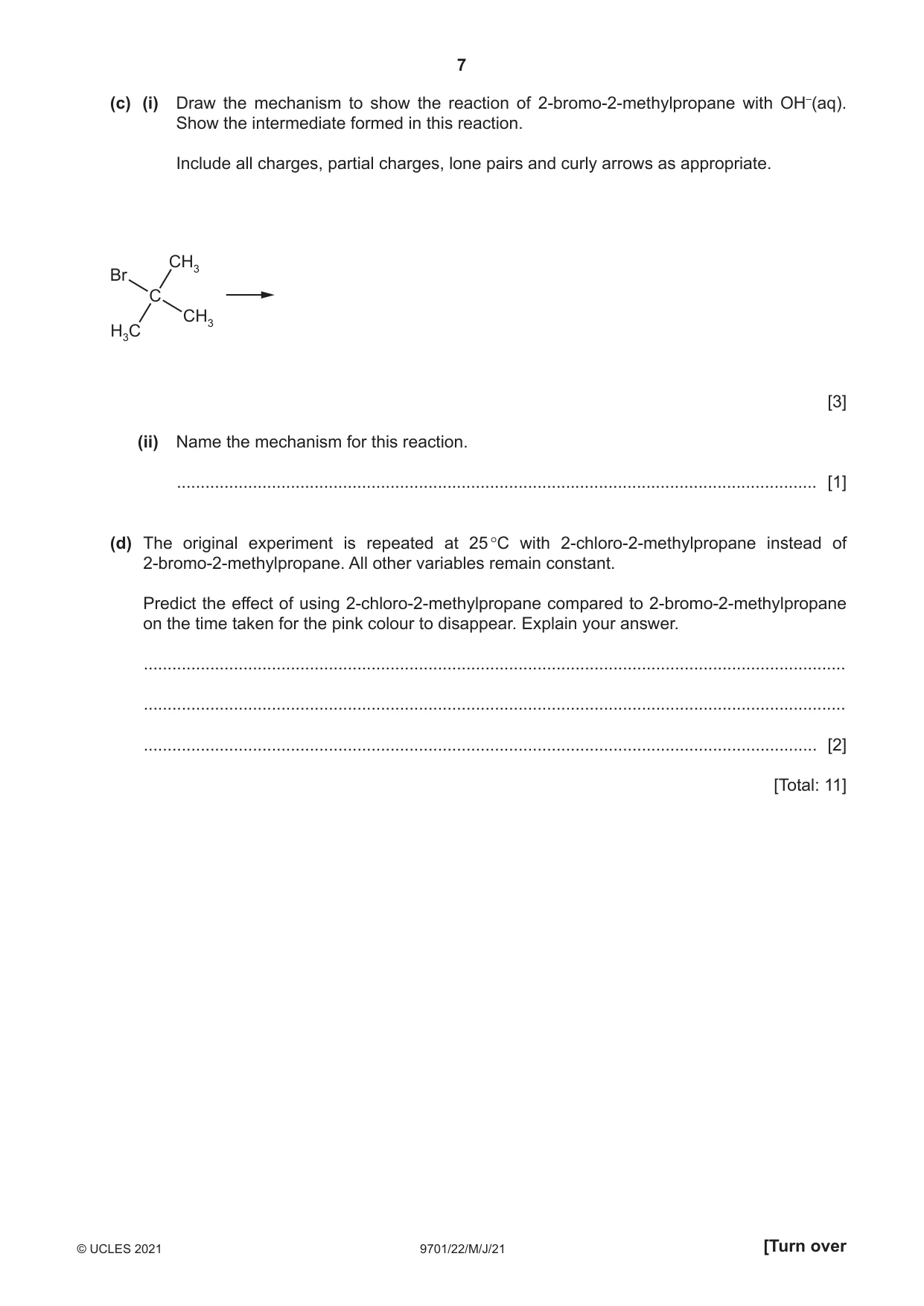
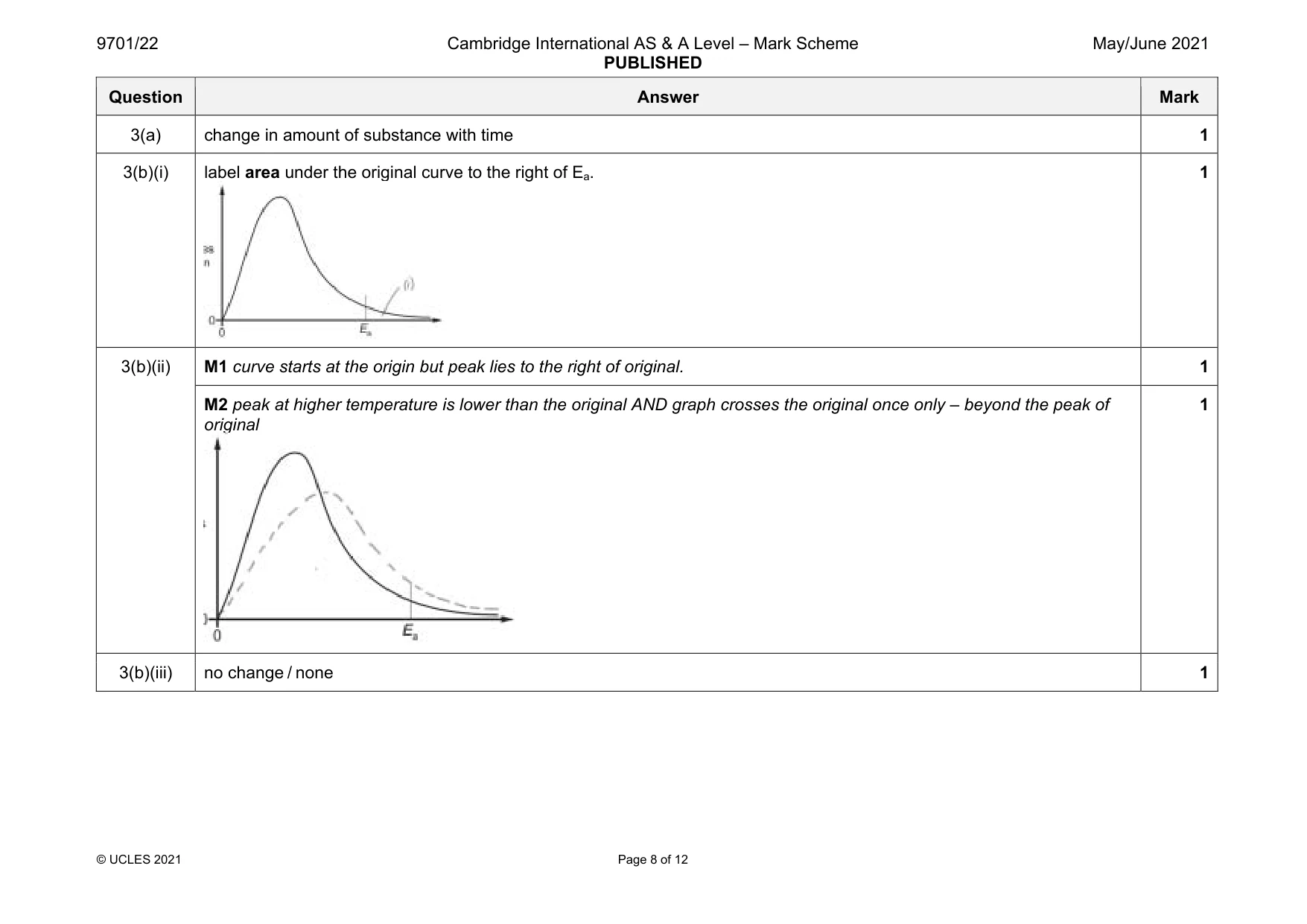
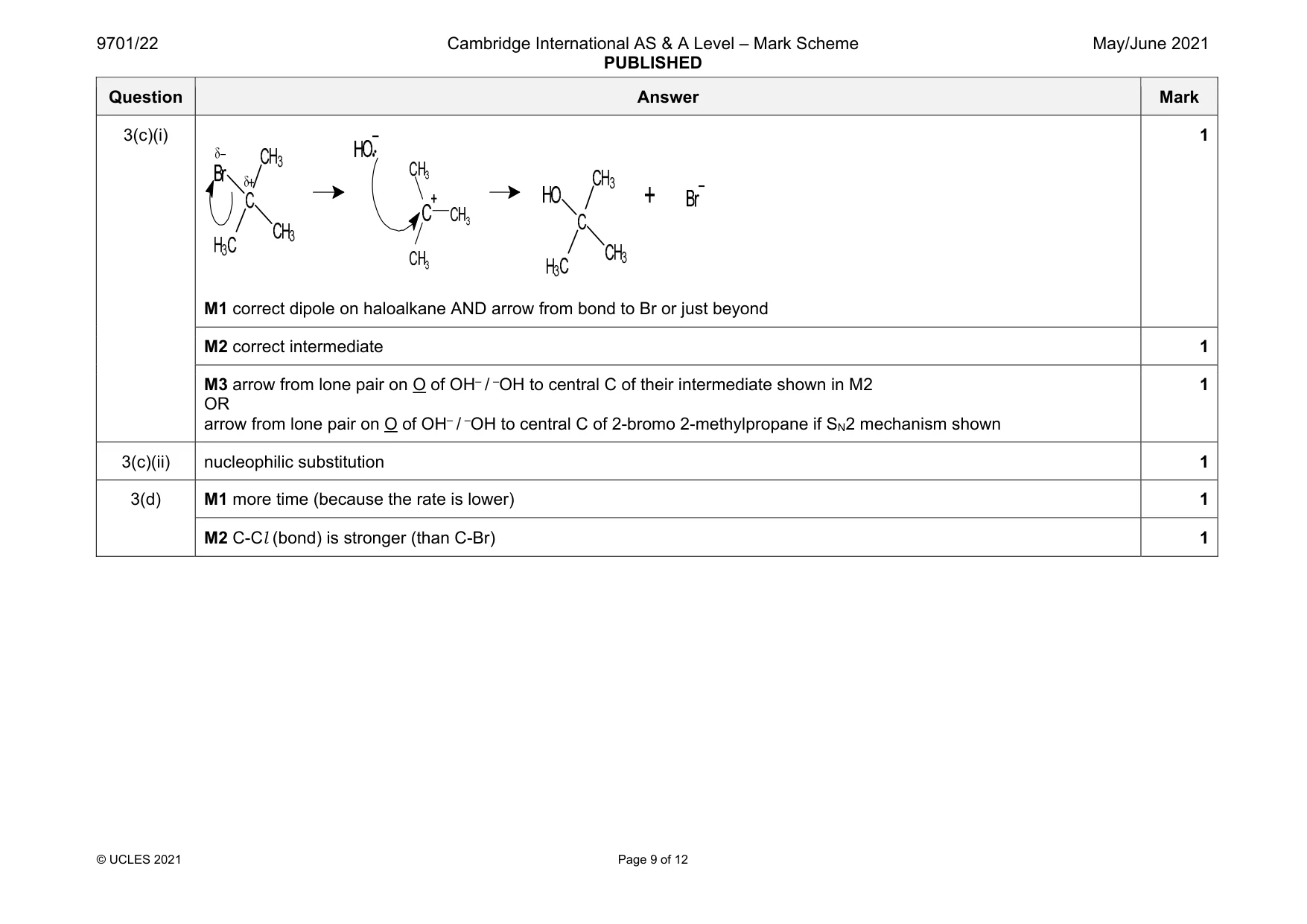
3 A large excess of 2-bromo-2-methylpropane is added to 0.0010 mol of NaOH(aq), which contains a few drops of phenolphthalein indicator. A stopwatch is started as soon as the substances are mixed. The time taken for the pink colour to disappear is recorded. The experiment is repeated at different temperatures, keeping all concentrations and volumes of reagents constant. temperature time taken for / °C pink colour to disappear / s 20 300 25 65 35 20 (a) Explain what is meant by the term rate of reaction. .................................................................................................................................................... .............................................................................................................................................. [1] (b) The graph shows the energy distribution of molecules in a sample of 2‑bromo‑2‑methylpropane at 25 °C. Ea represents the activation energy for the reaction. proportion of molecules with a given energy 0 0 Ea molecular energy (i) Label the graph to show the proportion of 2‑bromo‑2‑methylpropane molecules which have sufficient energy to react. [1] (ii) Use the same axes to sketch the distribution of energies of molecules in a sample of 2‑bromo‑2‑methylpropane at 50 °C. [2] (iii) State the effect of an increase in temperature on Ea for this reaction. ....................................................................................................................................... [1] (c) (i) Draw the mechanism to show the reaction of 2‑bromo‑2‑methylpropane with OH–(aq). Show the intermediate formed in this reaction. Include all charges, partial charges, lone pairs and curly arrows as appropriate. CH3Br C CH3 H3C [3] (ii) Name the mechanism for this reaction. ....................................................................................................................................... [1] (d) The original experiment is repeated at 25 °C with 2‑chloro‑2‑methylpropane instead of 2‑bromo‑2‑methylpropane. All other variables remain constant. Predict the effect of using 2‑chloro‑2‑methylpropane compared to 2‑bromo‑2‑methylpropane on the time taken for the pink colour to disappear. Explain your answer. .................................................................................................................................................... .................................................................................................................................................... .............................................................................................................................................. [2] [Total: 11]
Mark scheme: 3(a) change in amount of substance with time 1 3(b)(i) label area under the original curve to the right of Ea. 1 3(b)(ii) M1 curve starts at the origin but peak lies to the right of original. 1 M2 peak at higher temperature is lower than the original AND graph crosses the original once only – beyond the peak of original 1 3(b)(iii) no change / none 1 Question Answer Mark 3(c)(i) M1 correct dipole on haloalkane AND arrow from bond to Br or just beyond 1 M2 correct intermediate 1 M3 arrow from lone pair on O of OH– / –OH to central C of their intermediate shown in M2 OR arrow from lone pair on O of OH– / –OH to central C of 2-bromo 2-methylpropane if SN2 mechanism shown 1 3(c)(ii) nucleophilic substitution 1 3(d) M1 more time (because the rate is lower) 1 M2 C-Cl (bond) is stronger (than C-Br) 1
Q4 · The table shows the structural formulae of four compounds, A, B, C and D, with molecular…
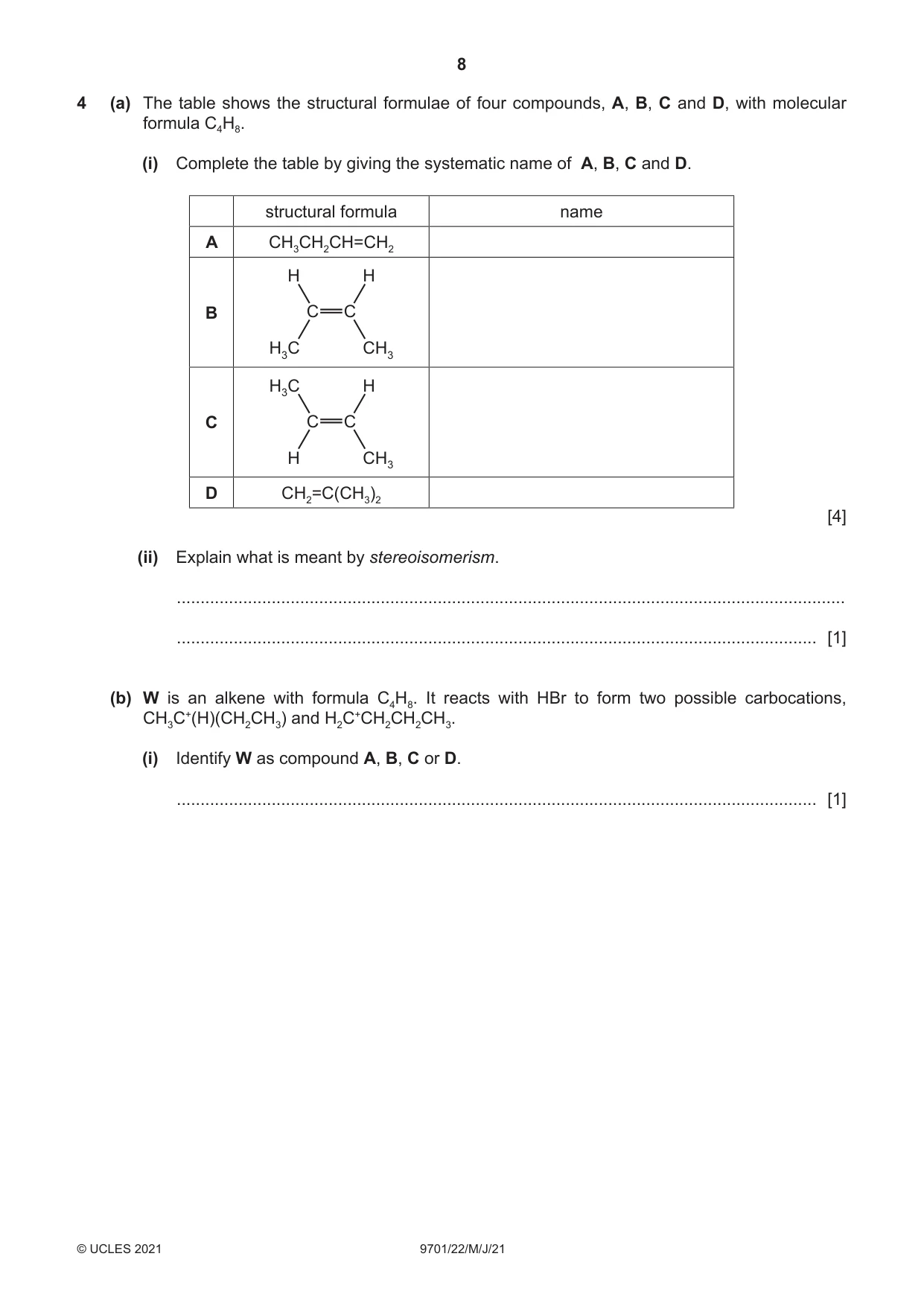
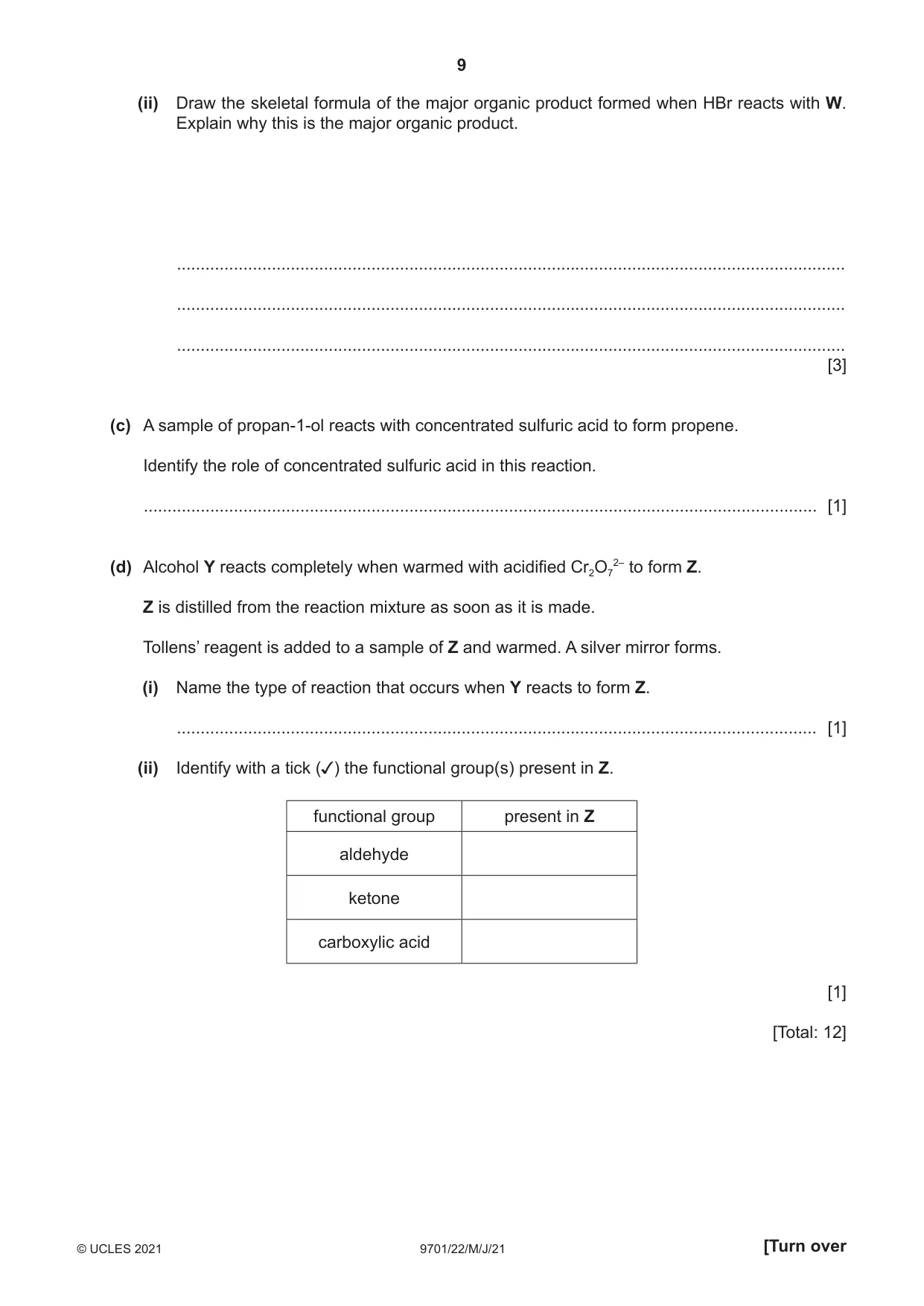
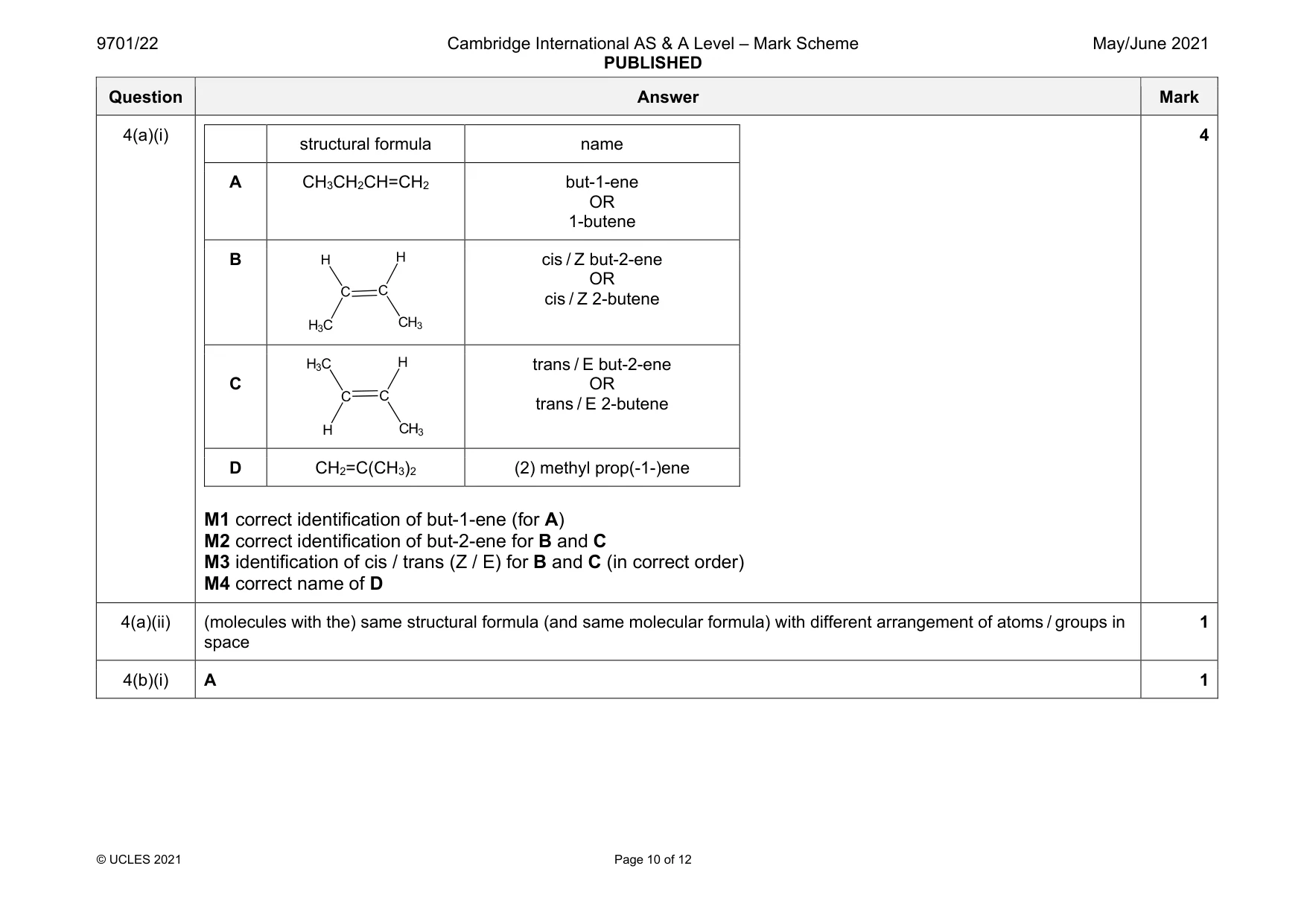
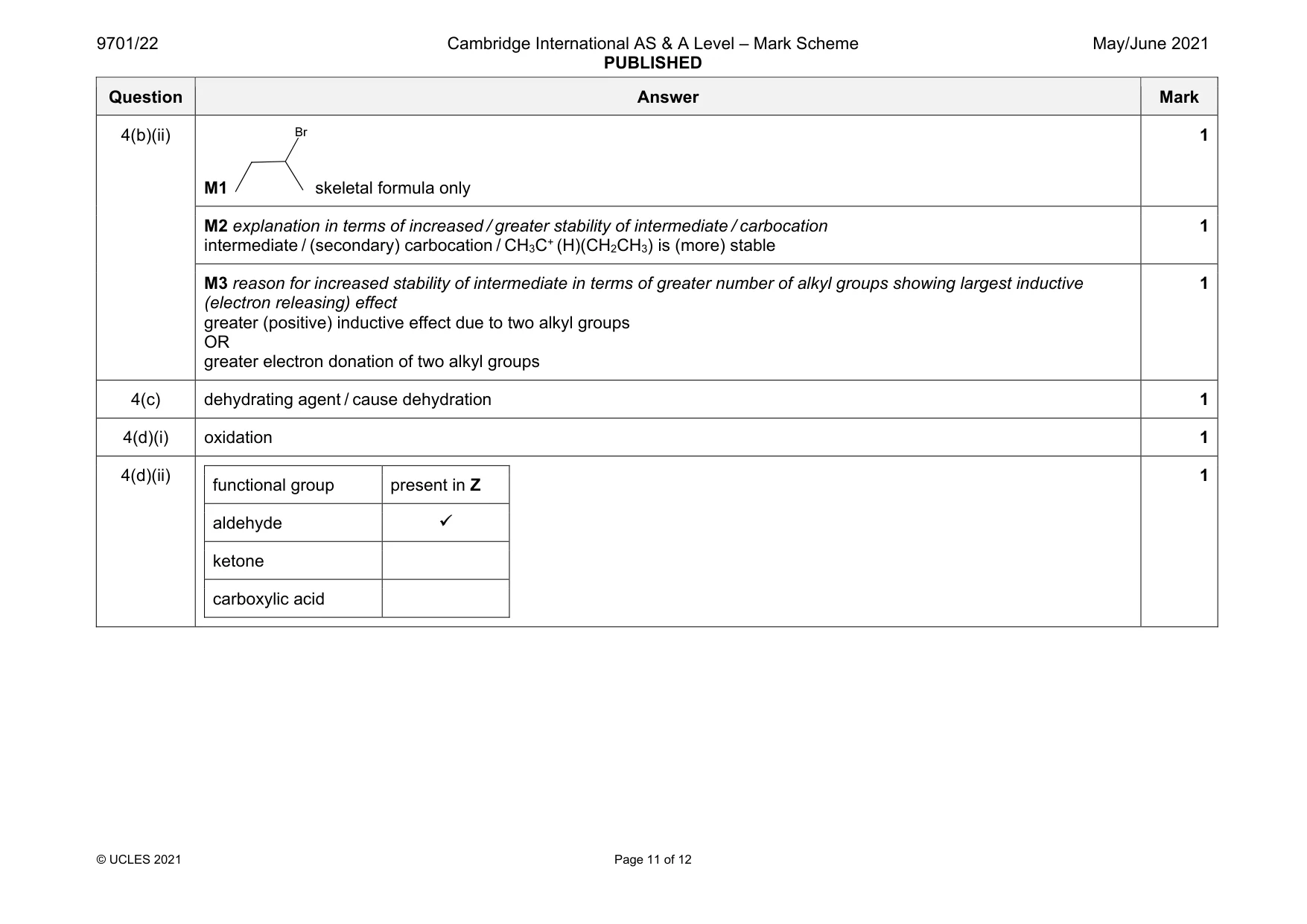
4 (a) The table shows the structural formulae of four compounds, A, B, C and D, with molecular formula C4H8. (i) Complete the table by giving the systematic name of A, B, C and D. structural formula name A CH3CH2CH=CH2 H H B C C H3C CH3 H3C H C C C H CH3 D CH2=C(CH3)2 [4] (ii) Explain what is meant by stereoisomerism. ............................................................................................................................................. ....................................................................................................................................... [1] (b) W is an alkene with formula C4H8. It reacts with HBr to form two possible carbocations, CH3C+(H)(CH2CH3) and H2C+CH2CH2CH3. (i) Identify W as compound A, B, C or D. ....................................................................................................................................... [1] (ii) Draw the skeletal formula of the major organic product formed when HBr reacts with W. Explain why this is the major organic product. ............................................................................................................................................. ............................................................................................................................................. ............................................................................................................................................. [3] (c) A sample of propan‑1‑ol reacts with concentrated sulfuric acid to form propene. Identify the role of concentrated sulfuric acid in this reaction. .............................................................................................................................................. [1] (d) Alcohol Y reacts completely when warmed with acidified Cr2O72– to form Z. Z is distilled from the reaction mixture as soon as it is made. Tollens’ reagent is added to a sample of Z and warmed. A silver mirror forms. (i) Name the type of reaction that occurs when Y reacts to form Z. ....................................................................................................................................... [1] (ii) Identify with a tick () the functional group(s) present in Z. functional group present in Z aldehyde ketone carboxylic acid [1] [Total: 12]
Mark scheme: 4(a)(i) structural formula name A CH3CH2CH=CH2 but-1-ene OR 1-butene B cis / Z but-2-ene OR cis / Z 2-butene C trans / E but-2-ene OR trans / E 2-butene D CH2=C(CH3)2 (2) methyl prop(-1-)ene M1 correct identification of but-1-ene (for A) M2 correct identification of but-2-ene for B and C M3 identification of cis / trans (Z / E) for B and C (in correct order) M4 correct name of D 4 4(a)(ii) (molecules with the) same structural formula (and same molecular formula) with different arrangement of atoms / groups in space 1 4(b)(i) A 1 Question Answer Mark 4(b)(ii) M1 skeletal formula only 1 M2 explanation in terms of increased / greater stability of intermediate / carbocation intermediate / (secondary) carbocation / CH3C+ (H)(CH2CH3) is (more) stable 1 M3 reason for increased stability of intermediate in terms of greater number of alkyl groups showing largest inductive (electron releasing) effect greater (positive) inductive effect due to two alkyl groups OR greater electron donation of two alkyl groups 1 4(c) dehydrating agent / cause dehydration 1 4(d)(i) oxidation 1 4(d)(ii) functional group present in Z aldehyde ketone carboxylic acid 1
More questions on Formulas, functional groups and the naming of organic compounds
Q5 · S is a secondary alcohol with molecular formula C4H10O
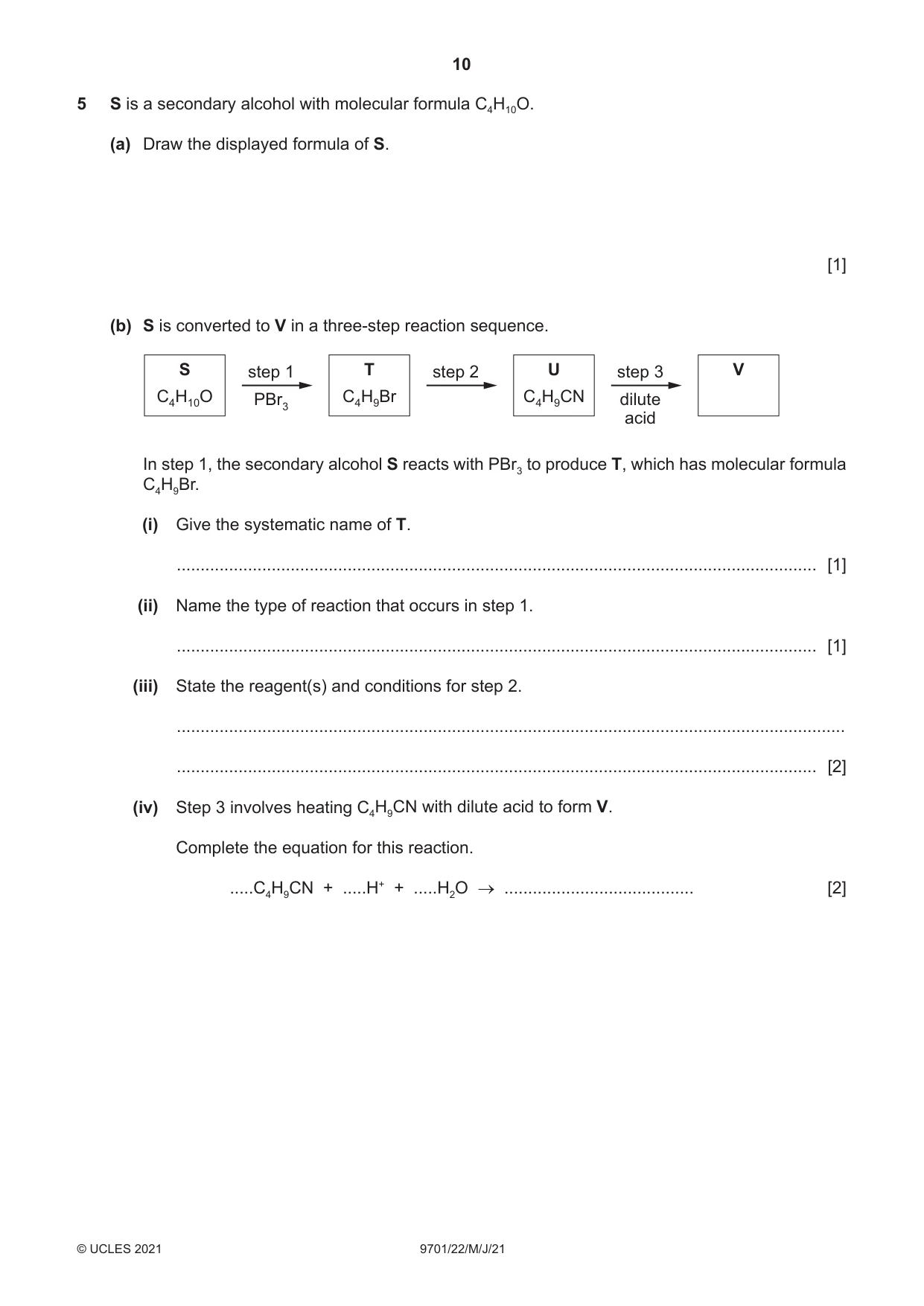
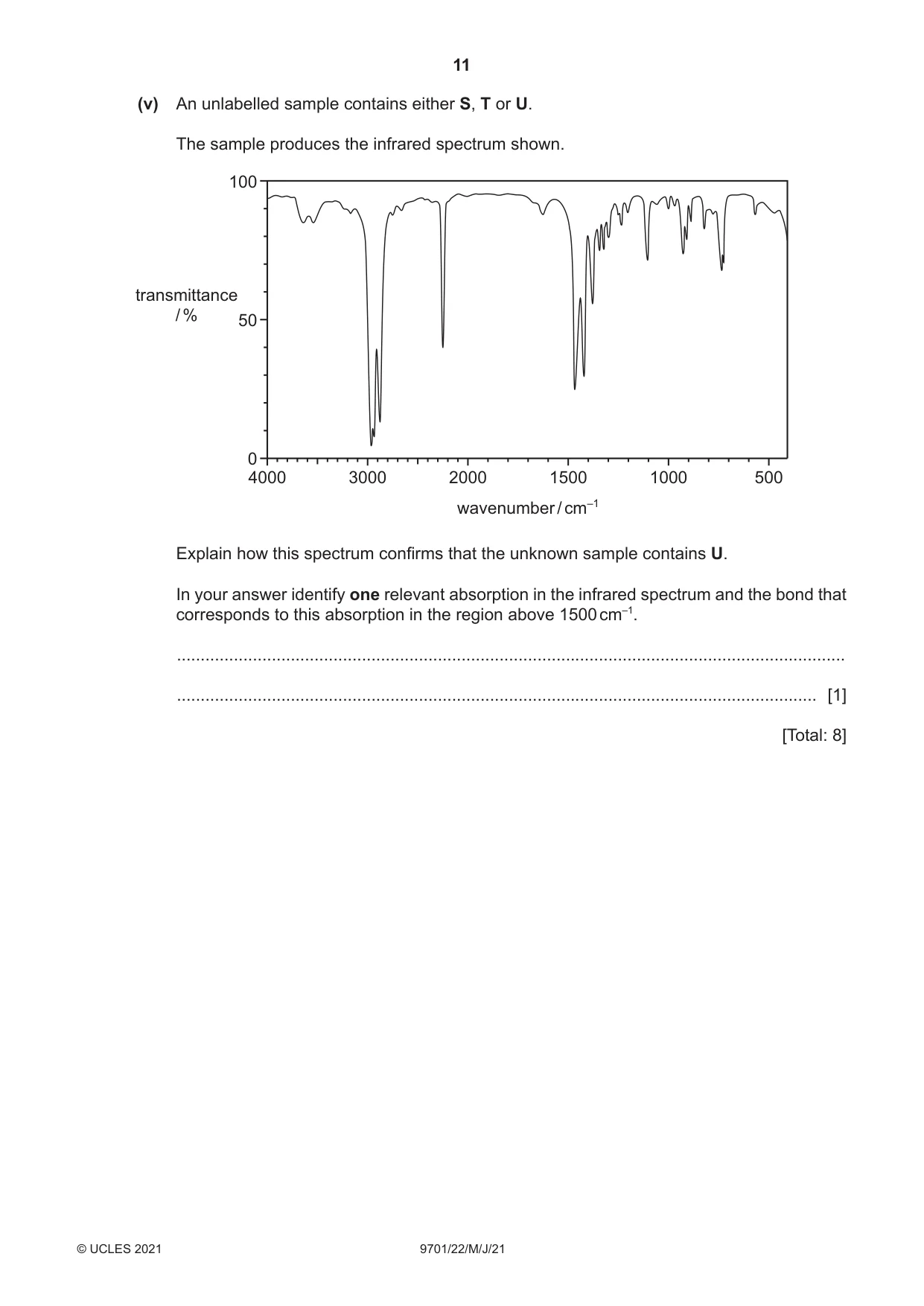
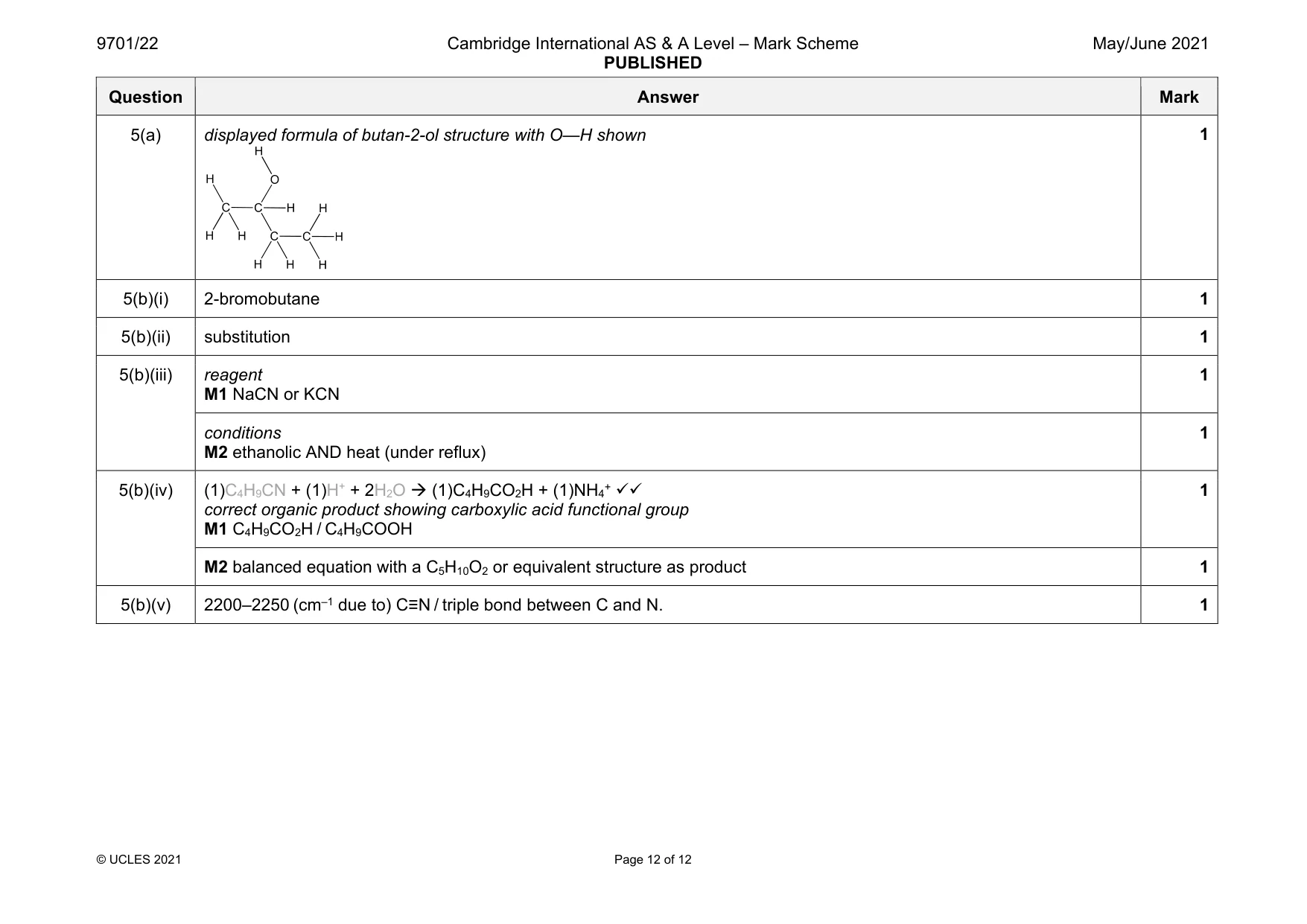
5 S is a secondary alcohol with molecular formula C4H10O. (a) Draw the displayed formula of S. [1] (b) S is converted to V in a three‑step reaction sequence. S step 1 T step 2 U step 3 V C4H10O PBr3 C4H9Br C4H9CN dilute acid In step 1, the secondary alcohol S reacts with PBr3 to produce T, which has molecular formula C4H9Br. (i) Give the systematic name of T. ....................................................................................................................................... [1] (ii) Name the type of reaction that occurs in step 1. ....................................................................................................................................... [1] (iii) State the reagent(s) and conditions for step 2. ............................................................................................................................................. ....................................................................................................................................... [2] (iv) Step 3 involves heating C4H9CN with dilute acid to form V. Complete the equation for this reaction. .....C4H9CN + .....H+ + .....H2O → ........................................ [2] (v) An unlabelled sample contains either S, T or U. The sample produces the infrared spectrum shown. 100 transmittance / % 50 0 4000 3000 2000 1500 1000 500 wavenumber / cm–1 Explain how this spectrum confirms that the unknown sample contains U. In your answer identify one relevant absorption in the infrared spectrum and the bond that corresponds to this absorption in the region above 1500 cm–1. ............................................................................................................................................. ....................................................................................................................................... [1] [Total: 8]
Mark scheme: 5(a) displayed formula of butan-2-ol structure with O—H shown 5(b)(i) 2-bromobutane 1 5(b)(ii) substitution 1 5(b)(iii) reagent M1 NaCN or KCN 1 conditions M2 ethanolic AND heat (under reflux) 1 5(b)(iv) (1)C4H9CN + (1)H+ + 2H2O (1)C4H9CO2H + (1)NH4+ correct organic product showing carboxylic acid functional group M1 C4H9CO2H / C4H9COOH 1 M2 balanced equation with a C5H10O2 or equivalent structure as product 1 5(b)(v) 2200–2250 (cm–1 due to) C≡N / triple bond between C and N. 1
What was in this paper
The subtopics covered by these 5 questions, and how many questions each got. Open one in a new tab to see every Cambridge question on it.
What you needed in this session
Cambridge’s own grade thresholds for 2021 May/June, Paper 2 · Variant 2. A higher threshold means an easier paper — the bar moves with how the cohort did.