Cambridge A Level Chemistry 9701 — 2021 Feb/March Paper 5 · Variant 2
9701/52/F/M/21 · 2 questions · 30 marks · ≈34 min
The question paper and its mark scheme, free to read here and free to download. This is Cambridge’s own paper, exactly as it was sat.
Question paper8 pages
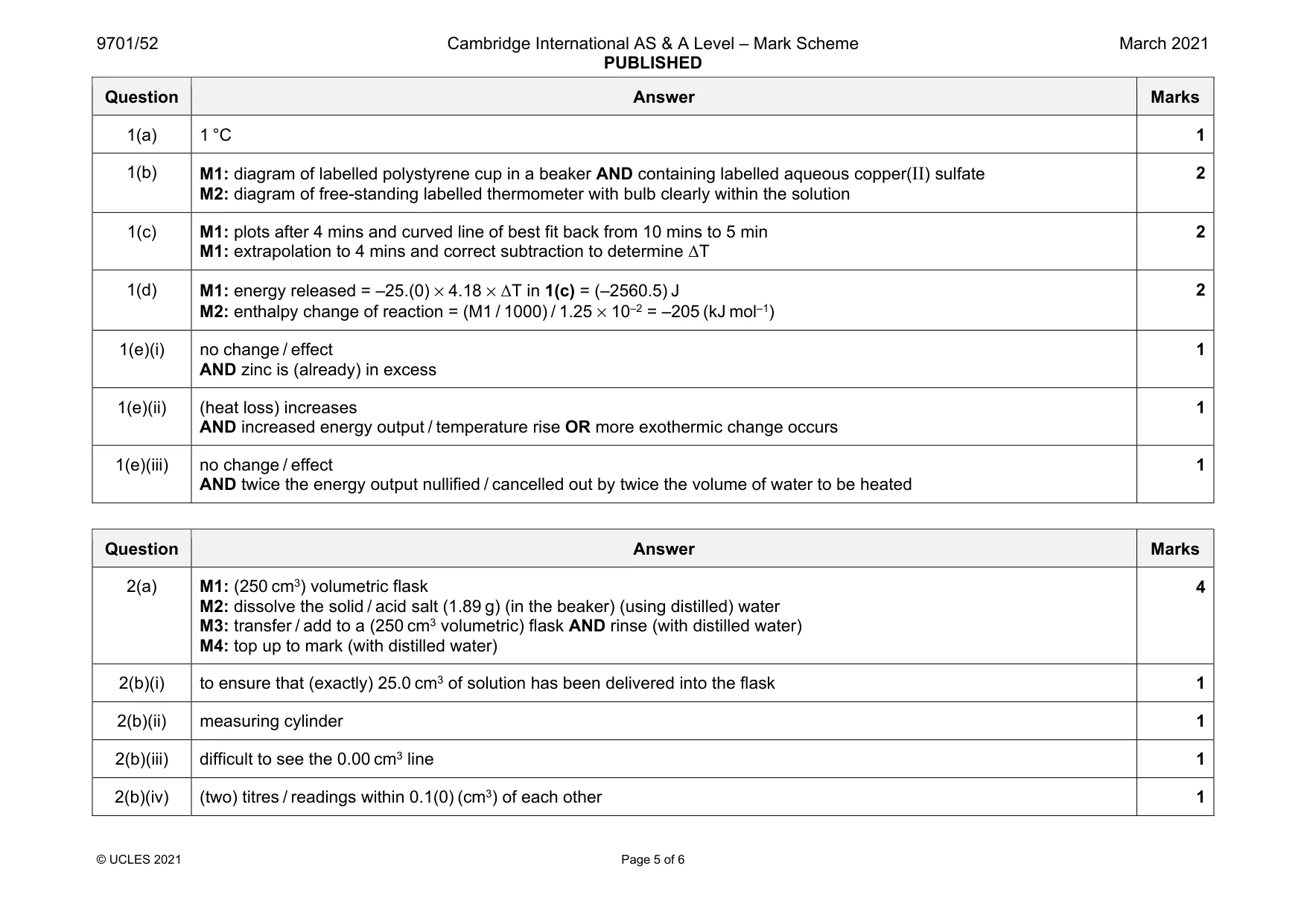
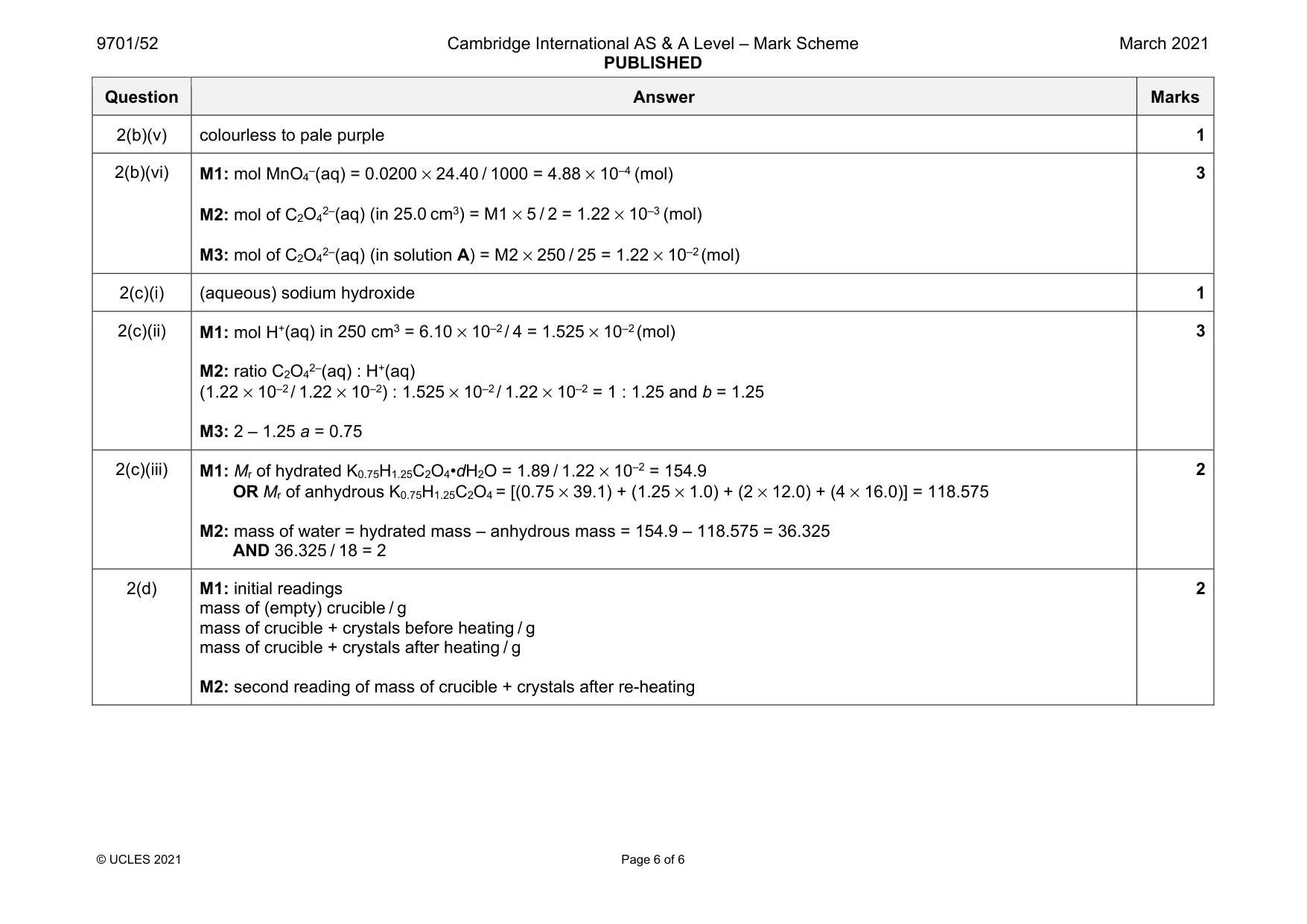
Mark scheme6 pages
Answers below. Sit the paper first if you are practising.
Questions as text
Q1 · Zinc metal reacts with aqueous copper(II) sulfate
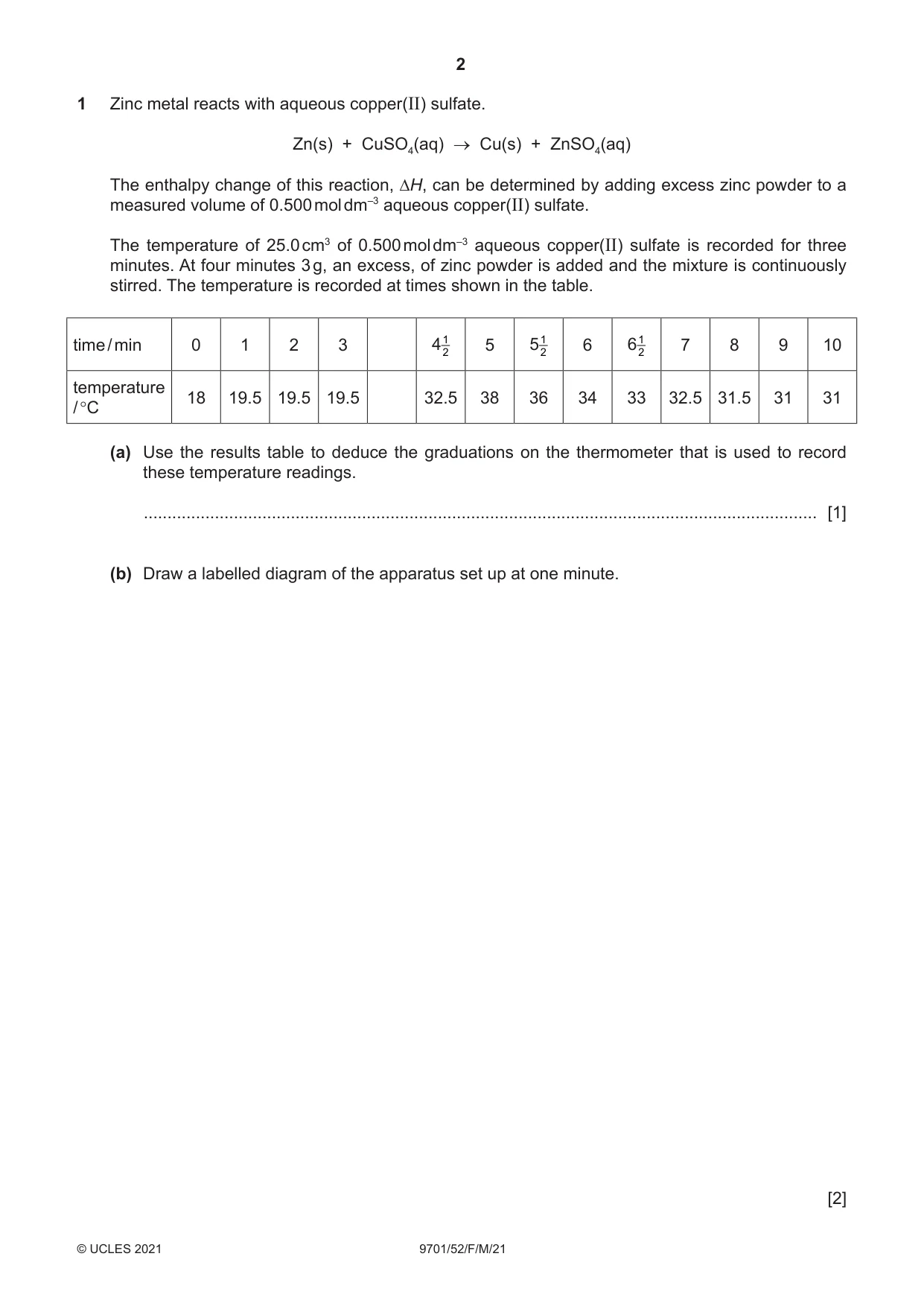
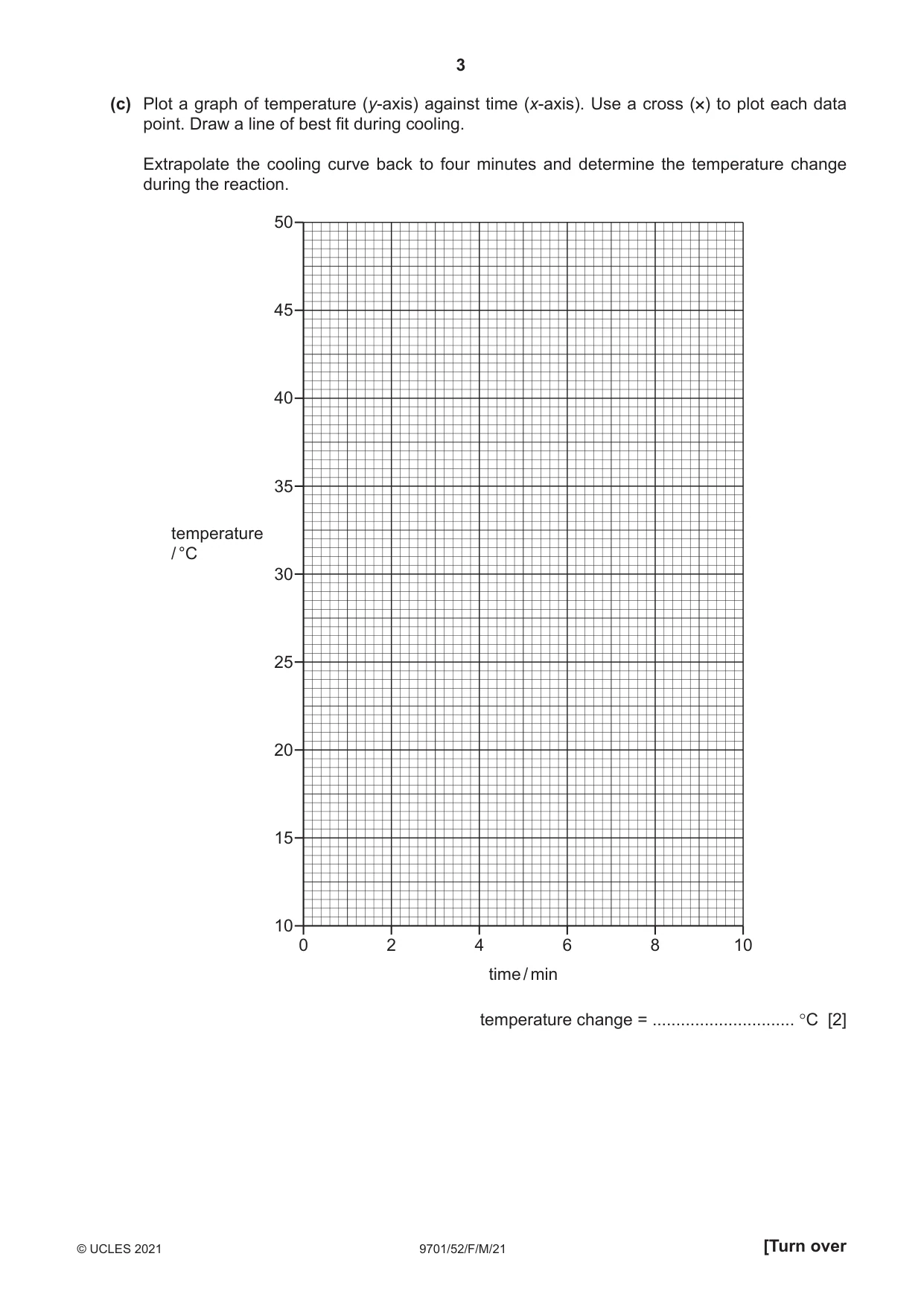
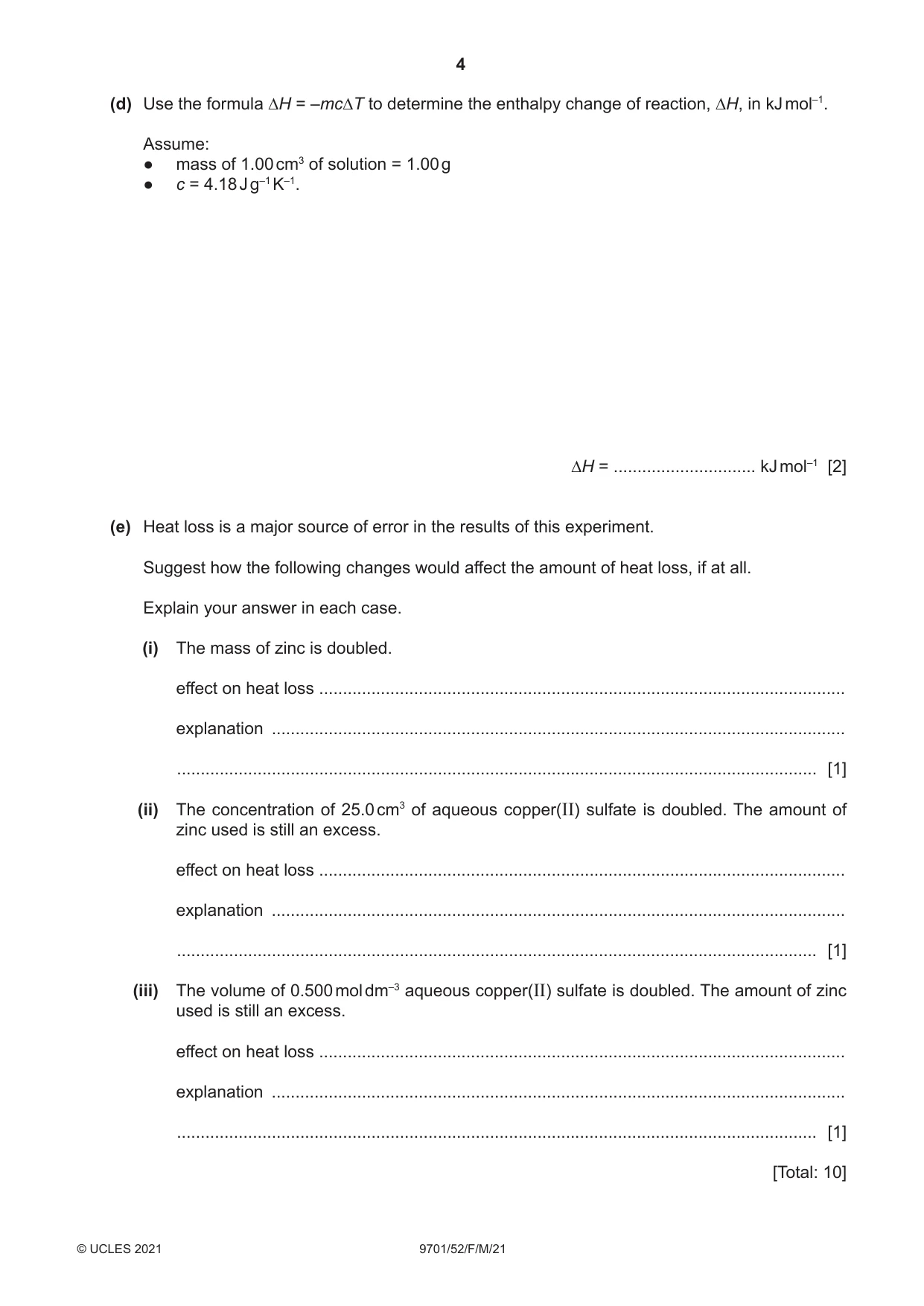
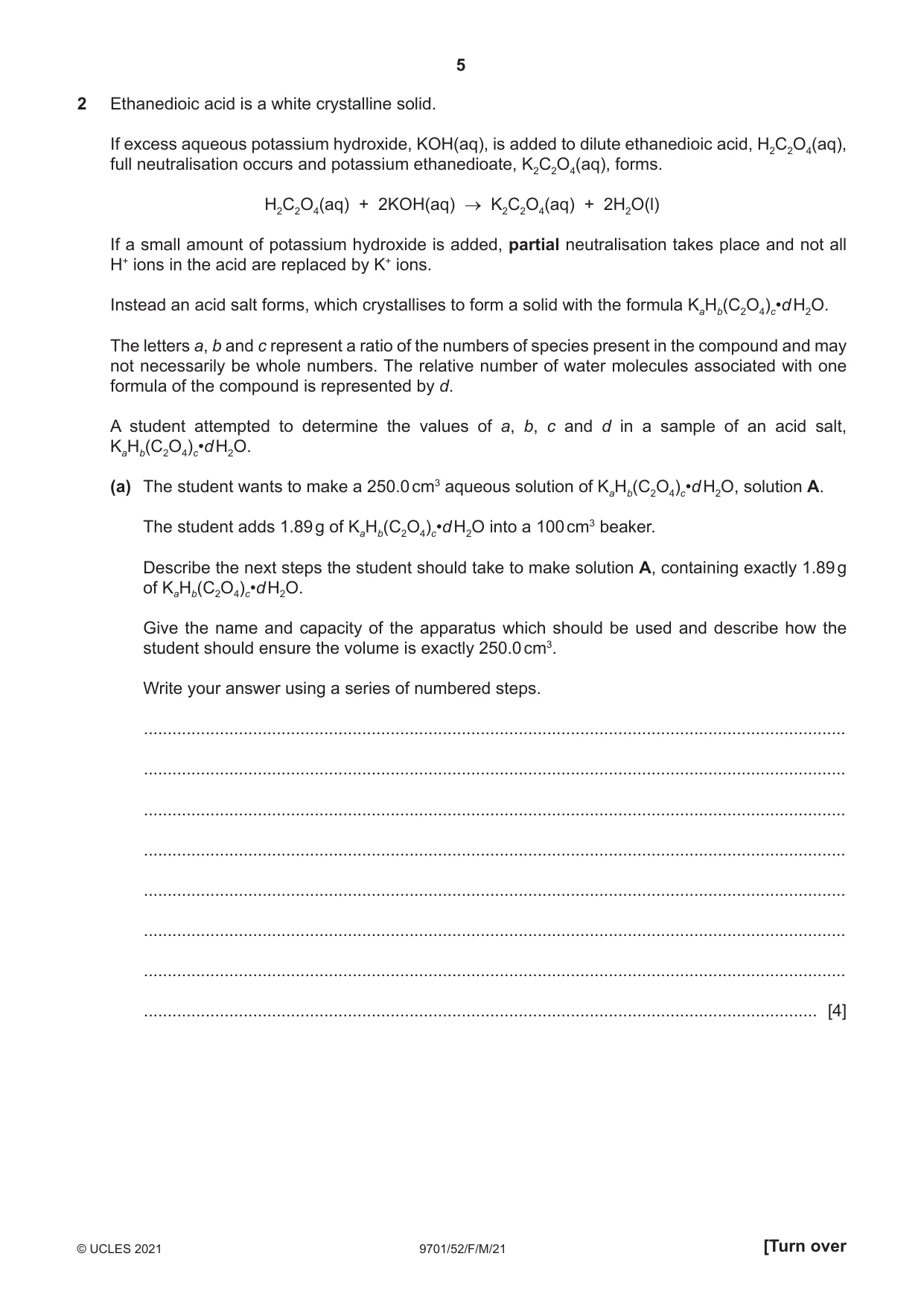
1 Zinc metal reacts with aqueous copper(II) sulfate. Zn(s) + CuSO4(aq) → Cu(s) + ZnSO4(aq) The enthalpy change of this reaction, ∆H, can be determined by adding excess zinc powder to a measured volume of 0.500 mol dm–3 aqueous copper(II) sulfate. The temperature of 25.0 cm3 of 0.500 mol dm–3 aqueous copper(II) sulfate is recorded for three minutes. At four minutes 3 g, an excess, of zinc powder is added and the mixture is continuously stirred. The temperature is recorded at times shown in the table. time / min 0 1 2 3 412 5 512 6 612 7 8 9 10 temperature 18 19.5 19.5 19.5 32.5 38 36 34 33 32.5 31.5 31 31/ °C (a) Use the results table to deduce the graduations on the thermometer that is used to record these temperature readings. .............................................................................................................................................. [1] (b) Draw a labelled diagram of the apparatus set up at one minute. [2] (c) Plot a graph of temperature (y-axis) against time (x-axis). Use a cross (×) to plot each data point. Draw a line of best fit during cooling. Extrapolate the cooling curve back to four minutes and determine the temperature change during the reaction. 50 45 40 35 temperature / °C 30 25 20 15 10 0 2 4 6 8 10 time / min temperature change = .............................. °C [2] (d) Use the formula ∆H = –mc∆T to determine the enthalpy change of reaction, ∆H, in kJ mol–1. Assume: ● mass of 1.00 cm3 of solution = 1.00 g ● c = 4.18 J g–1 K–1. ∆H = .............................. kJ mol–1 [2] (e) Heat loss is a major source of error in the results of this experiment. Suggest how the following changes would affect the amount of heat loss, if at all. Explain your answer in each case. (i) The mass of zinc is doubled. effect on heat loss ............................................................................................................... explanation .......................................................................................................................... ....................................................................................................................................... [1] (ii) The concentration of 25.0 cm3 of aqueous copper(II) sulfate is doubled. The amount of zinc used is still an excess. effect on heat loss ............................................................................................................... explanation .......................................................................................................................... ....................................................................................................................................... [1] (iii) The volume of 0.500 mol dm–3 aqueous copper(II) sulfate is doubled. The amount of zinc used is still an excess. effect on heat loss ............................................................................................................... explanation .......................................................................................................................... ....................................................................................................................................... [1] [Total: 10]
Mark scheme: 1(a) 1 °C 1 1(b) M1: diagram of labelled polystyrene cup in a beaker AND containing labelled aqueous copper(II) sulfate M2: diagram of free-standing labelled thermometer with bulb clearly within the solution 2 1(c) M1: plots after 4 mins and curved line of best fit back from 10 mins to 5 min M1: extrapolation to 4 mins and correct subtraction to determine ΔT 2 1(d) M1: energy released = –25.(0) × 4.18 × ΔT in 1(c) = (–2560.5) J M2: enthalpy change of reaction = (M1 / 1000) / 1.25 × 10–2 = –205 (kJ mol–1) 2 1(e)(i) no change / effect AND zinc is (already) in excess 1 1(e)(ii) (heat loss) increases AND increased energy output / temperature rise OR more exothermic change occurs 1 1(e)(iii) no change / effect AND twice the energy output nullified / cancelled out by twice the volume of water to be heated 1
Q2 · Ethanedioic acid is a white crystalline solid
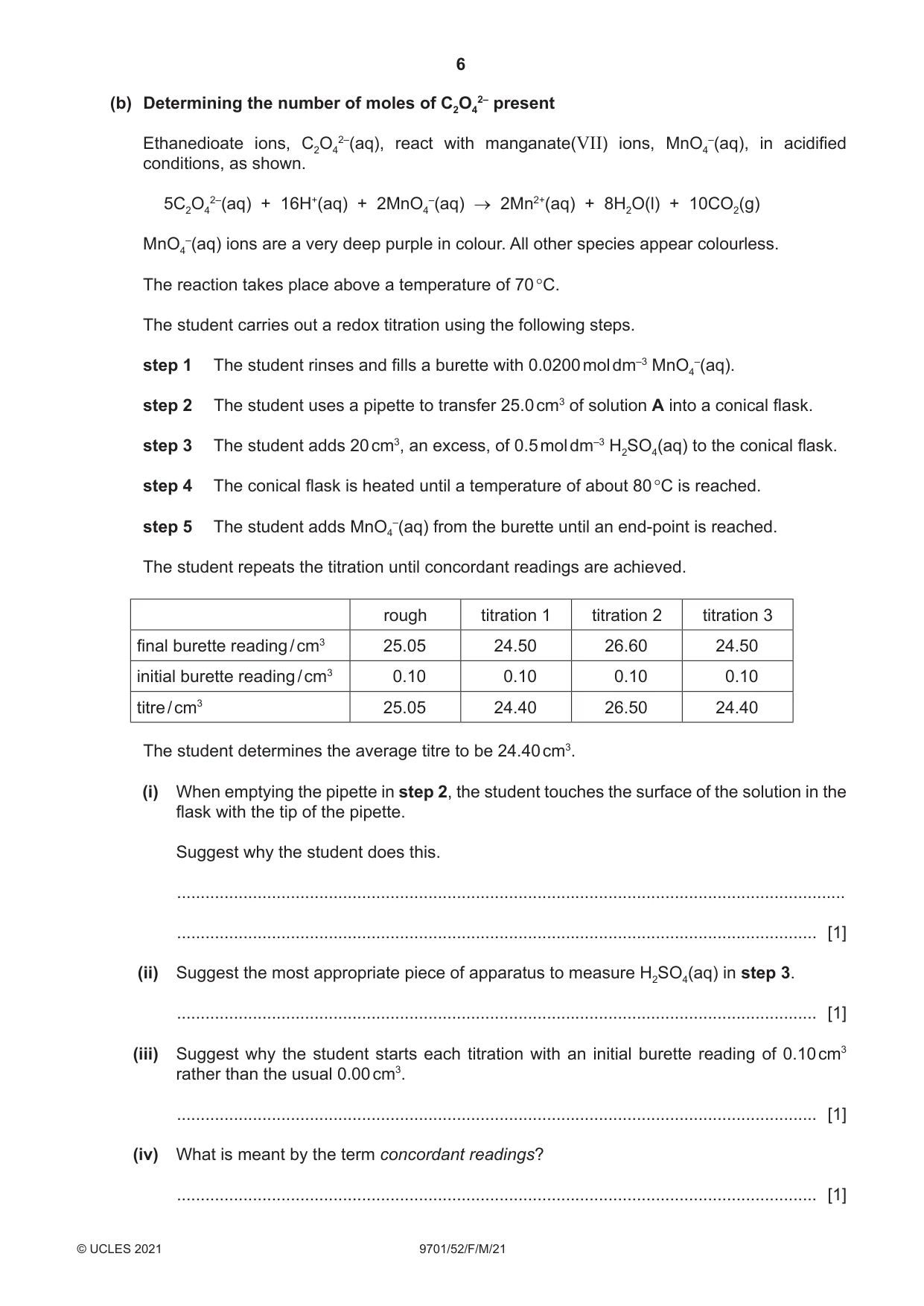
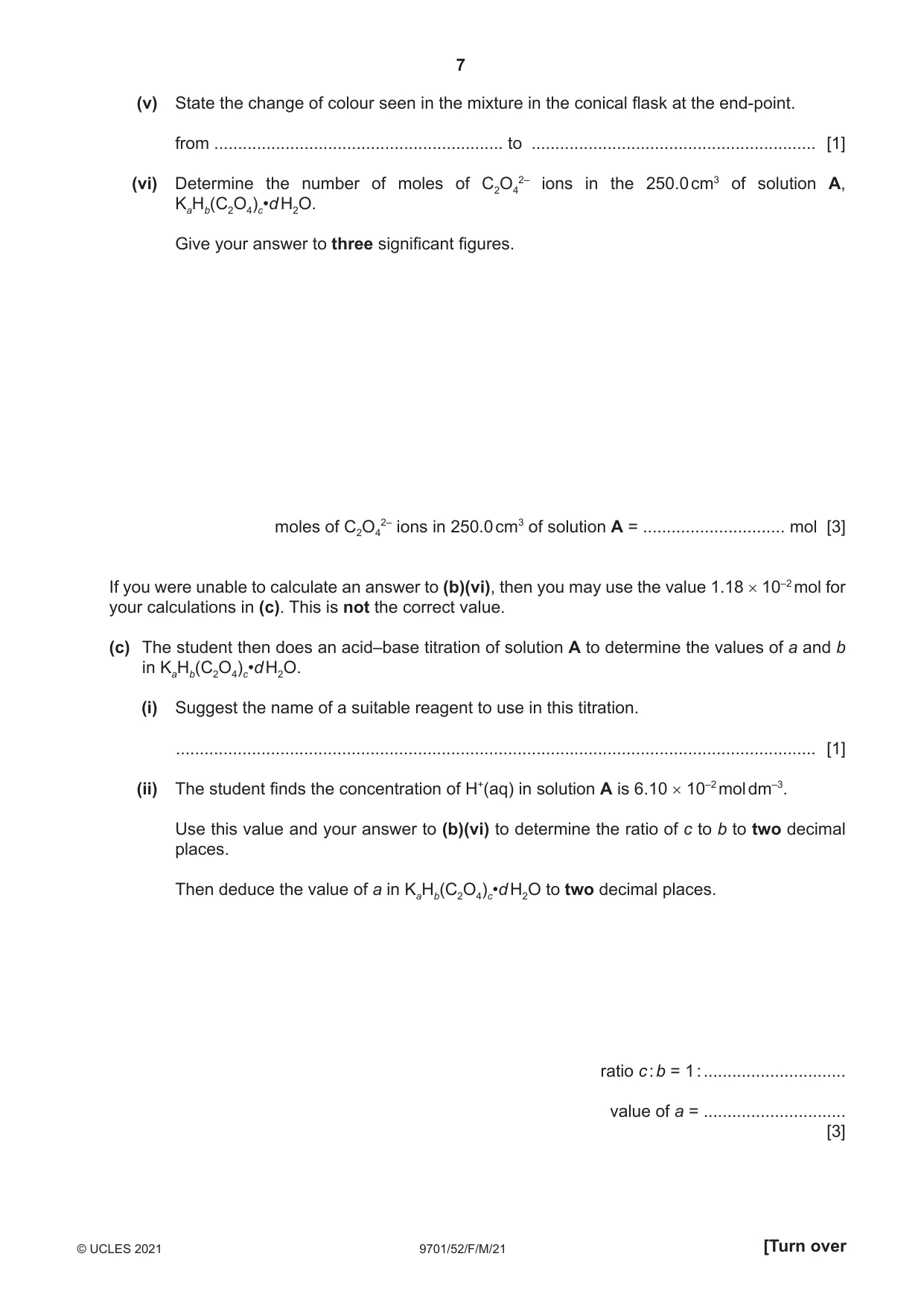
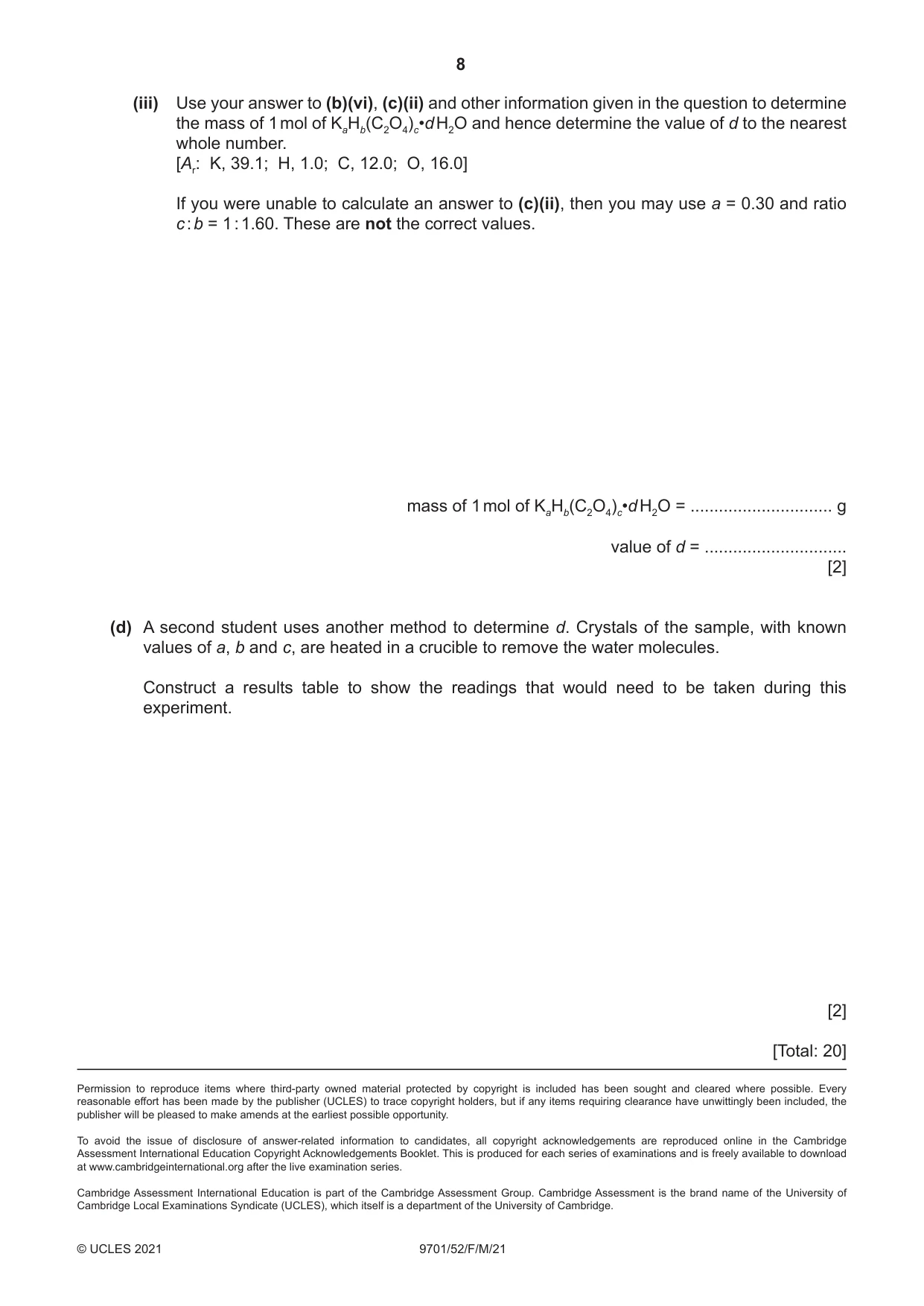
2 Ethanedioic acid is a white crystalline solid. If excess aqueous potassium hydroxide, KOH(aq), is added to dilute ethanedioic acid, H2C2O4(aq), full neutralisation occurs and potassium ethanedioate, K2C2O4(aq), forms. H2C2O4(aq) + 2KOH(aq) → K2C2O4(aq) + 2H2O(l) If a small amount of potassium hydroxide is added, partial neutralisation takes place and not all H+ ions in the acid are replaced by K+ ions. Instead an acid salt forms, which crystallises to form a solid with the formula KaHb(C2O4)c•d H2O. The letters a, b and c represent a ratio of the numbers of species present in the compound and may not necessarily be whole numbers. The relative number of water molecules associated with one formula of the compound is represented by d. A student attempted to determine the values of a, b, c and d in a sample of an acid salt, KaHb(C2O4)c•d H2O. (a) The student wants to make a 250.0 cm3 aqueous solution of KaHb(C2O4)c•d H2O, solution A. The student adds 1.89 g of KaHb(C2O4)c•d H2O into a 100 cm3 beaker. Describe the next steps the student should take to make solution A, containing exactly 1.89 g of KaHb(C2O4)c•d H2O. Give the name and capacity of the apparatus which should be used and describe how the student should ensure the volume is exactly 250.0 cm3. Write your answer using a series of numbered steps. .................................................................................................................................................... .................................................................................................................................................... .................................................................................................................................................... .................................................................................................................................................... .................................................................................................................................................... .................................................................................................................................................... .................................................................................................................................................... .............................................................................................................................................. [4] (b) Determining the number of moles of C2O42– present Ethanedioate ions, C2O42–(aq), react with manganate(VII) ions, MnO4–(aq), in acidified conditions, as shown. 5C2O42–(aq) + 16H+(aq) + 2MnO4–(aq) → 2Mn2+(aq) + 8H2O(l) + 10CO2(g) MnO4–(aq) ions are a very deep purple in colour. All other species appear colourless. The reaction takes place above a temperature of 70 °C. The student carries out a redox titration using the following steps. step 1 The student rinses and fills a burette with 0.0200 mol dm–3 MnO4–(aq). step 2 The student uses a pipette to transfer 25.0 cm3 of solution A into a conical flask. step 3 The student adds 20 cm3, an excess, of 0.5 mol dm–3 H2SO4(aq) to the conical flask. step 4 The conical flask is heated until a temperature of about 80 °C is reached. step 5 The student adds MnO4–(aq) from the burette until an end-point is reached. The student repeats the titration until concordant readings are achieved. rough titration 1 titration 2 titration 3 final burette reading / cm3 25.05 24.50 26.60 24.50 initial burette reading / cm3 0.10 0.10 0.10 0.10 titre / cm3 25.05 24.40 26.50 24.40 The student determines the average titre to be 24.40 cm3. (i) When emptying the pipette in step 2, the student touches the surface of the solution in the flask with the tip of the pipette. Suggest why the student does this. ............................................................................................................................................. ....................................................................................................................................... [1] (ii) Suggest the most appropriate piece of apparatus to measure H2SO4(aq) in step 3. ....................................................................................................................................... [1] (iii) Suggest why the student starts each titration with an initial burette reading of 0.10 cm3 rather than the usual 0.00 cm3. ....................................................................................................................................... [1] (iv) What is meant by the term concordant readings? ....................................................................................................................................... [1] (v) State the change of colour seen in the mixture in the conical flask at the end-point. from ............................................................. to ............................................................. [1] (vi) Determine the number of moles of C2O42– ions in the 250.0 cm3 of solution A, KaHb(C2O4)c•d H2O. Give your answer to three significant figures. moles of C2O42– ions in 250.0 cm3 of solution A = .............................. mol [3] If you were unable to calculate an answer to (b)(vi), then you may use the value 1.18 × 10⁻² mol for your calculations in (c). This is not the correct value. (c) The student then does an acid–base titration of solution A to determine the values of a and b in KaHb(C2O4)c•d H2O. (i) Suggest the name of a suitable reagent to use in this titration. ....................................................................................................................................... [1] (ii) The student finds the concentration of H+(aq) in solution A is 6.10 × 10⁻² mol dm–3. Use this value and your answer to (b)(vi) to determine the ratio of c to b to two decimal places. Then deduce the value of a in KaHb(C2O4)c•d H2O to two decimal places. ratio c : b = 1 : .............................. value of a = .............................. [3]
Mark scheme: 2(a) M1: (250 cm3) volumetric flask M2: dissolve the solid / acid salt (1.89 g) (in the beaker) (using distilled) water M3: transfer / add to a (250 cm3 volumetric) flask AND rinse (with distilled water) M4: top up to mark (with distilled water) 4 2(b)(i) to ensure that (exactly) 25.0 cm3 of solution has been delivered into the flask 1 2(b)(ii) measuring cylinder 1 2(b)(iii) difficult to see the 0.00 cm3 line 1 2(b)(iv) (two) titres / readings within 0.1(0) (cm3) of each other 1 Question Answer Marks 2(b)(v) colourless to pale purple 1 2(b)(vi) M1: mol MnO4–(aq) = 0.0200 × 24.40 / 1000 = 4.88 × 10⁻⁴ (mol) M2: mol of C2O42–(aq) (in 25.0 cm3) = M1 × 5 / 2 = 1.22 × 10⁻³ (mol) M3: mol of C2O42–(aq) (in solution A) = M2 × 250 / 25 = 1.22 × 10⁻² (mol) 3 2(c)(i) (aqueous) sodium hydroxide 1 2(c)(ii) M1: mol H+(aq) in 250 cm3 = 6.10 × 10⁻² / 4 = 1.525 × 10⁻² (mol) M2: ratio C2O42–(aq) : H+(aq) (1.22 × 10⁻² / 1.22 × 10⁻²) : 1.525 × 10⁻² / 1.22 × 10–2 = 1 : 1.25 and b = 1.25 M3: 2 – 1.25 a = 0.75 3 2(c)(iii) M1: Mr of hydrated K0.75H1.25C2O4•dH2O = 1.89 / 1.22 × 10–2 = 154.9 OR Mr of anhydrous K0.75H1.25C2O4 = [(0.75 × 39.1) + (1.25 × 1.0) + (2 × 12.0) + (4 × 16.0)] = 118.575 M2: mass of water = hydrated mass – anhydrous mass = 154.9 – 118.575 = 36.325 AND 36.325 / 18 = 2 2 2(d) M1: initial readings mass of (empty) crucible / g mass of crucible + crystals before heating / g mass of crucible + crystals after heating / g M2: second reading of mass of crucible + crystals after re-heating 2
What was in this paper
The subtopics covered by these 2 questions, and how many questions each got. Open one in a new tab to see every Cambridge question on it.
What you needed in this session
Cambridge’s own grade thresholds for 2021 Feb/March, Paper 5 · Variant 2. A higher threshold means an easier paper — the bar moves with how the cohort did.