Cambridge A Level Chemistry 9701 — 2018 Oct/Nov Paper 2 · Variant 2
9701/22/O/N/18 · 4 questions · 60 marks · ≈68 min
The question paper and its mark scheme, free to read here and free to download. This is Cambridge’s own paper, exactly as it was sat.
Question paper16 pages


Mark scheme10 pages
Answers below. Sit the paper first if you are practising.
Questions as text
Q1 · The model of the nuclear atom was first proposed by Ernest Rutherford
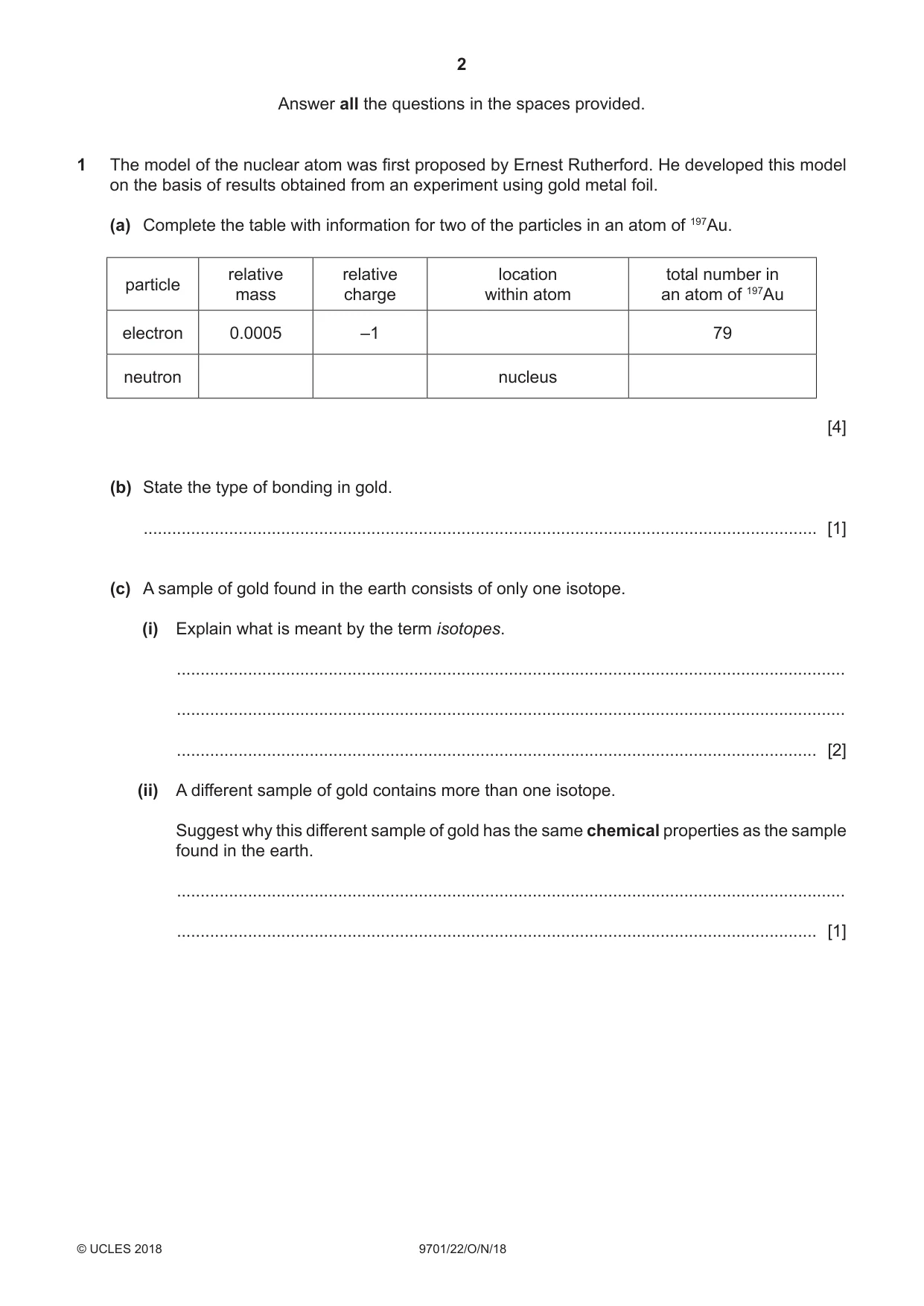
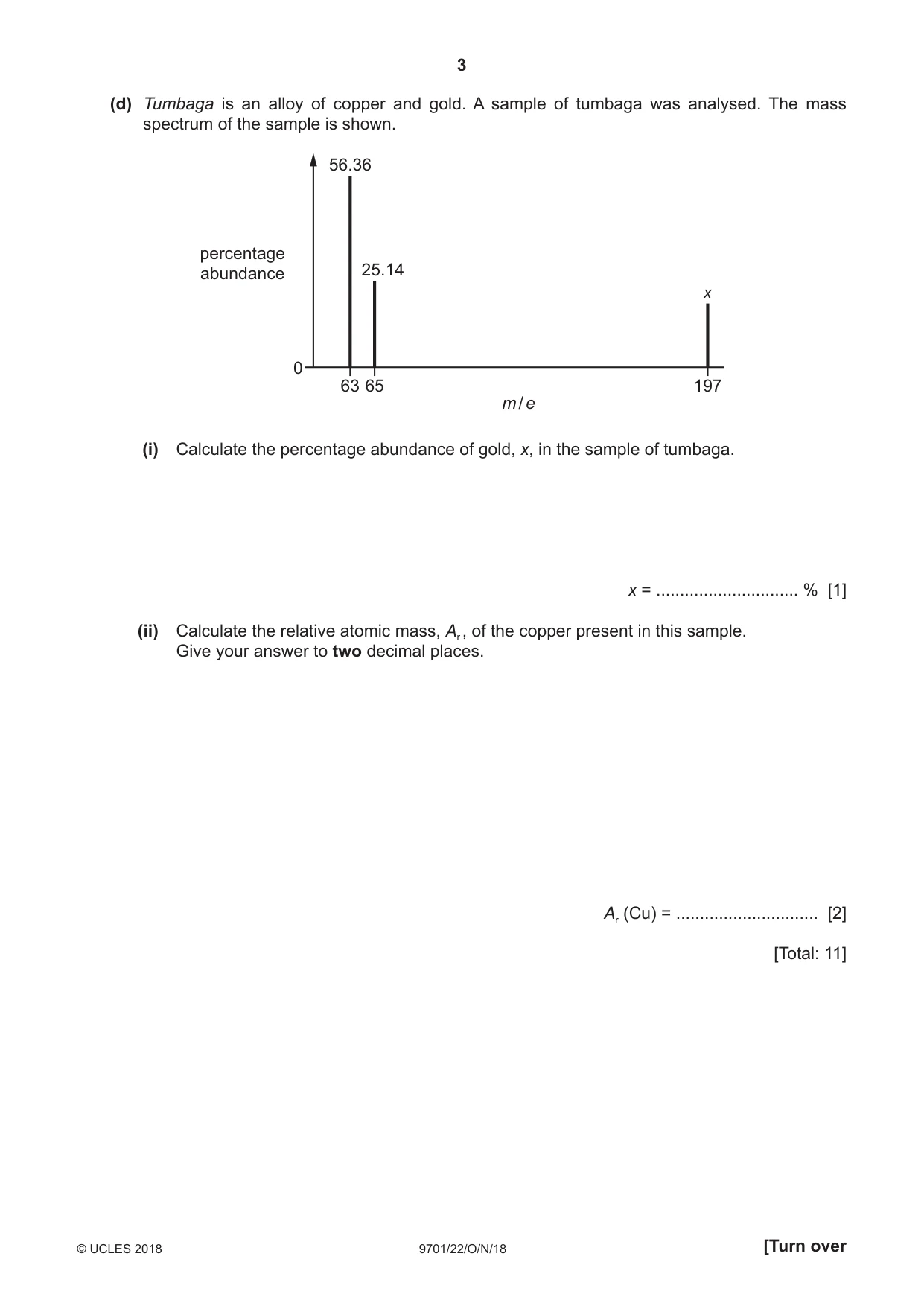
1 The model of the nuclear atom was first proposed by Ernest Rutherford. He developed this model on the basis of results obtained from an experiment using gold metal foil. (a) Complete the table with information for two of the particles in an atom of 197Au. relative relative location total number in particle mass charge within atom an atom of 197Au electron 0.0005 –1 79 neutron nucleus [4] (b) State the type of bonding in gold. .............................................................................................................................................. [1] (c) A sample of gold found in the earth consists of only one isotope. (i) Explain what is meant by the term isotopes. ............................................................................................................................................. ............................................................................................................................................. ....................................................................................................................................... [2] (ii) A different sample of gold contains more than one isotope. Suggest why this different sample of gold has the same chemical properties as the sample found in the earth. ............................................................................................................................................. ....................................................................................................................................... [1] (d) Tumbaga is an alloy of copper and gold. A sample of tumbaga was analysed. The mass spectrum of the sample is shown. 56.36 percentage abundance 25.14 x 0 63 65 197 m / e (i) Calculate the percentage abundance of gold, x, in the sample of tumbaga. x = .............................. % [1] (ii) Calculate the relative atomic mass, Ar , of the copper present in this sample. Give your answer to two decimal places. Ar (Cu) = .............................. [2] [Total: 11]
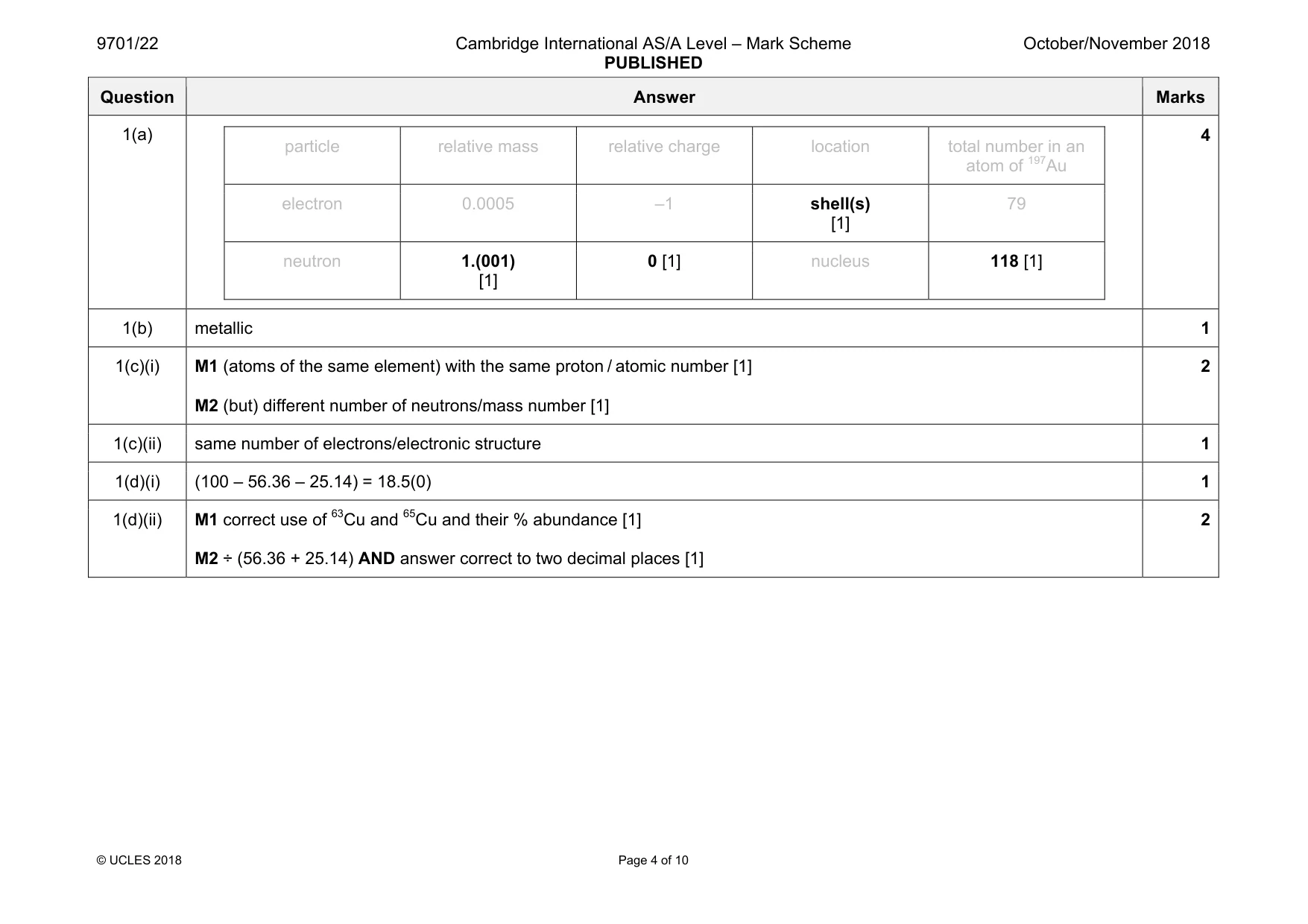
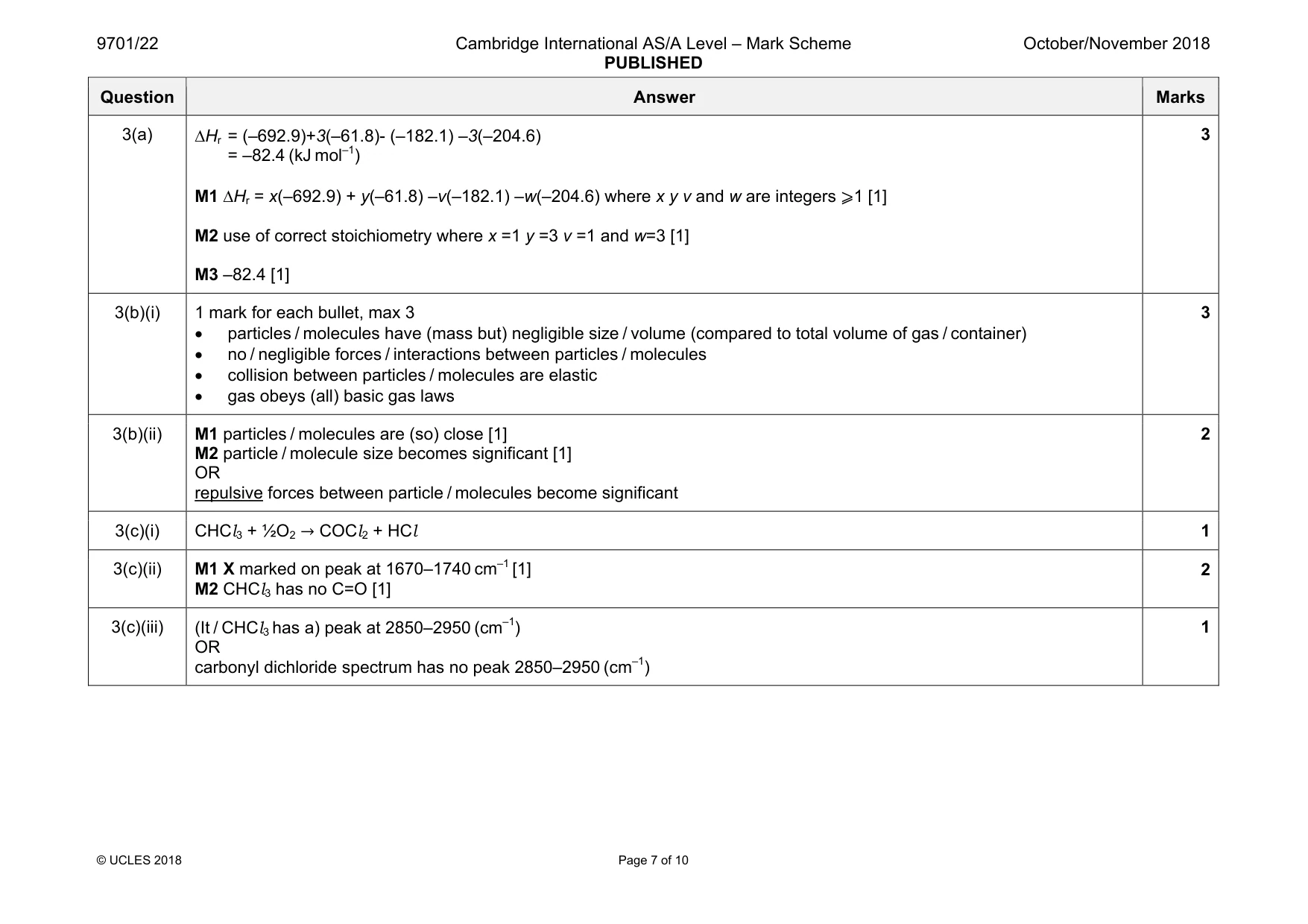
Mark scheme: 1(a) particle relative mass relative charge location total number in an atom of 197Au electron 0.0005 –1 shell(s) [1] 79 neutron 1.(001) [1] 0 [1] nucleus 118 [1] 4 1(b) metallic 1 1(c)(i) M1 (atoms of the same element) with the same proton / atomic number [1] M2 (but) different number of neutrons/mass number [1] 2 1(c)(ii) same number of electrons/electronic structure 1 1(d)(i) (100 – 56.36 – 25.14) = 18.5(0) 1 1(d)(ii) M1 correct use of 63Cu and 65Cu and their % abundance [1] M2 ÷ (56.36 + 25.14) AND answer correct to two decimal places [1] 2 Qu uestion Answer Mar rks
Q2 · The table gives some data for elements in the third period and some of their compounds
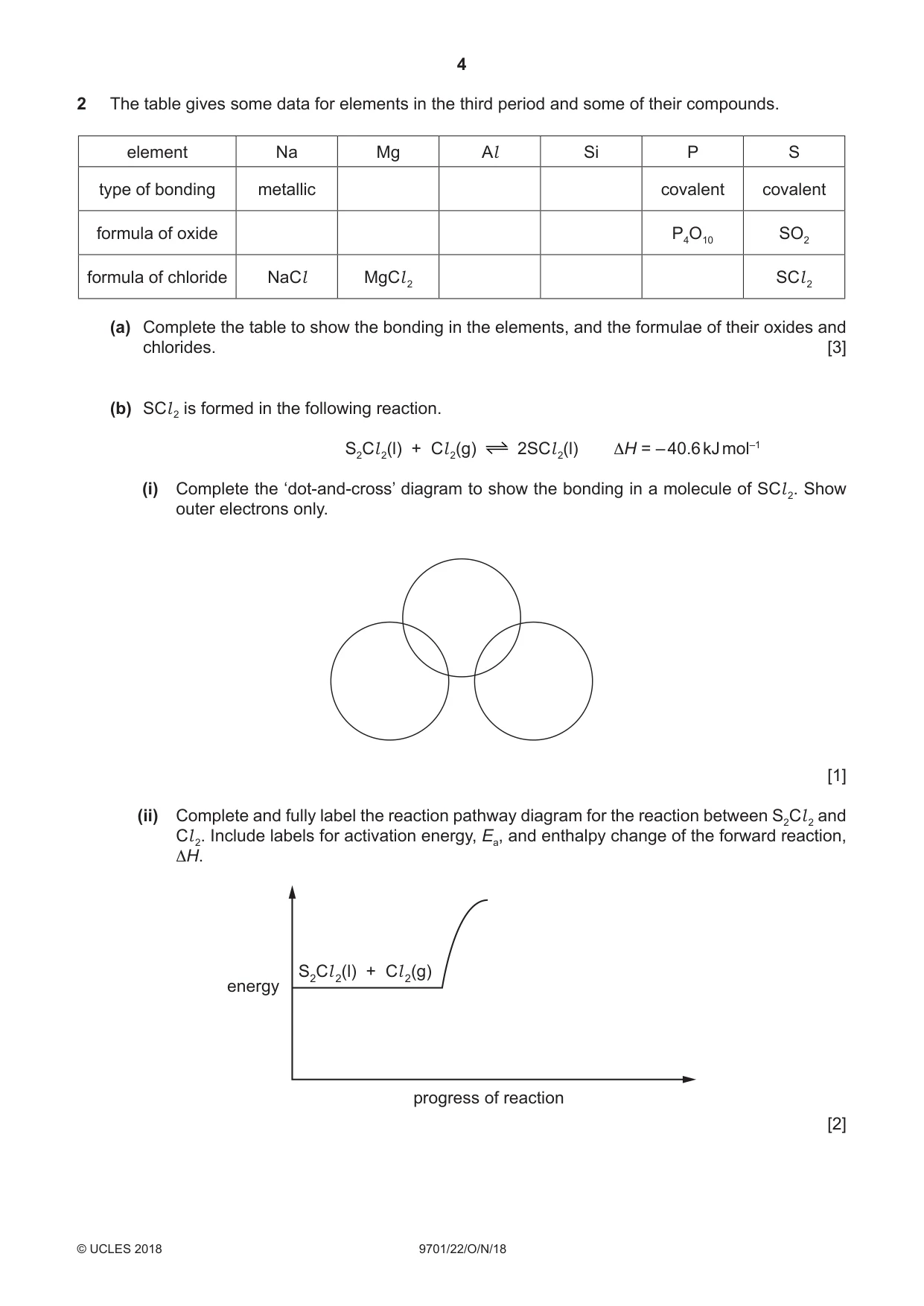
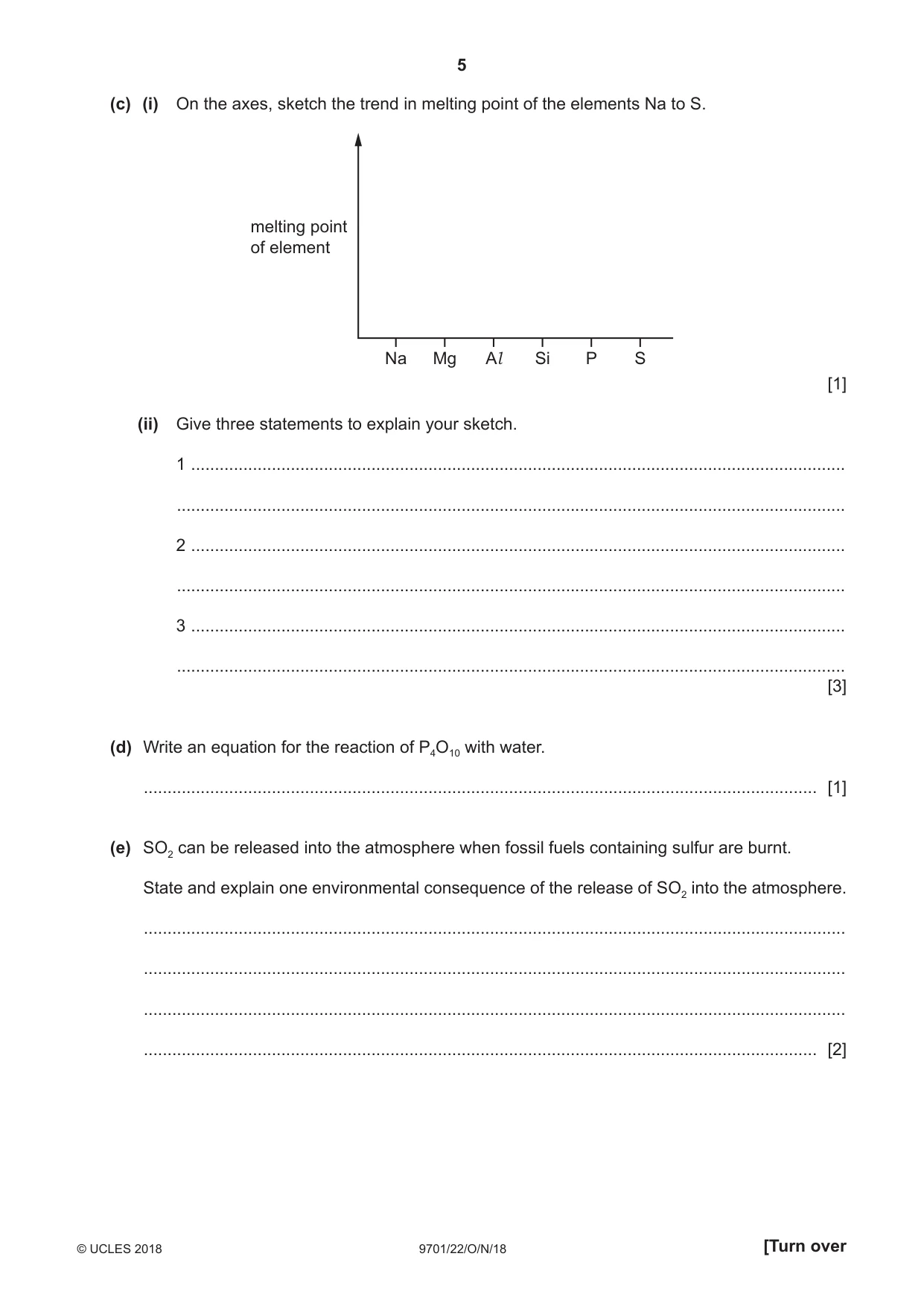
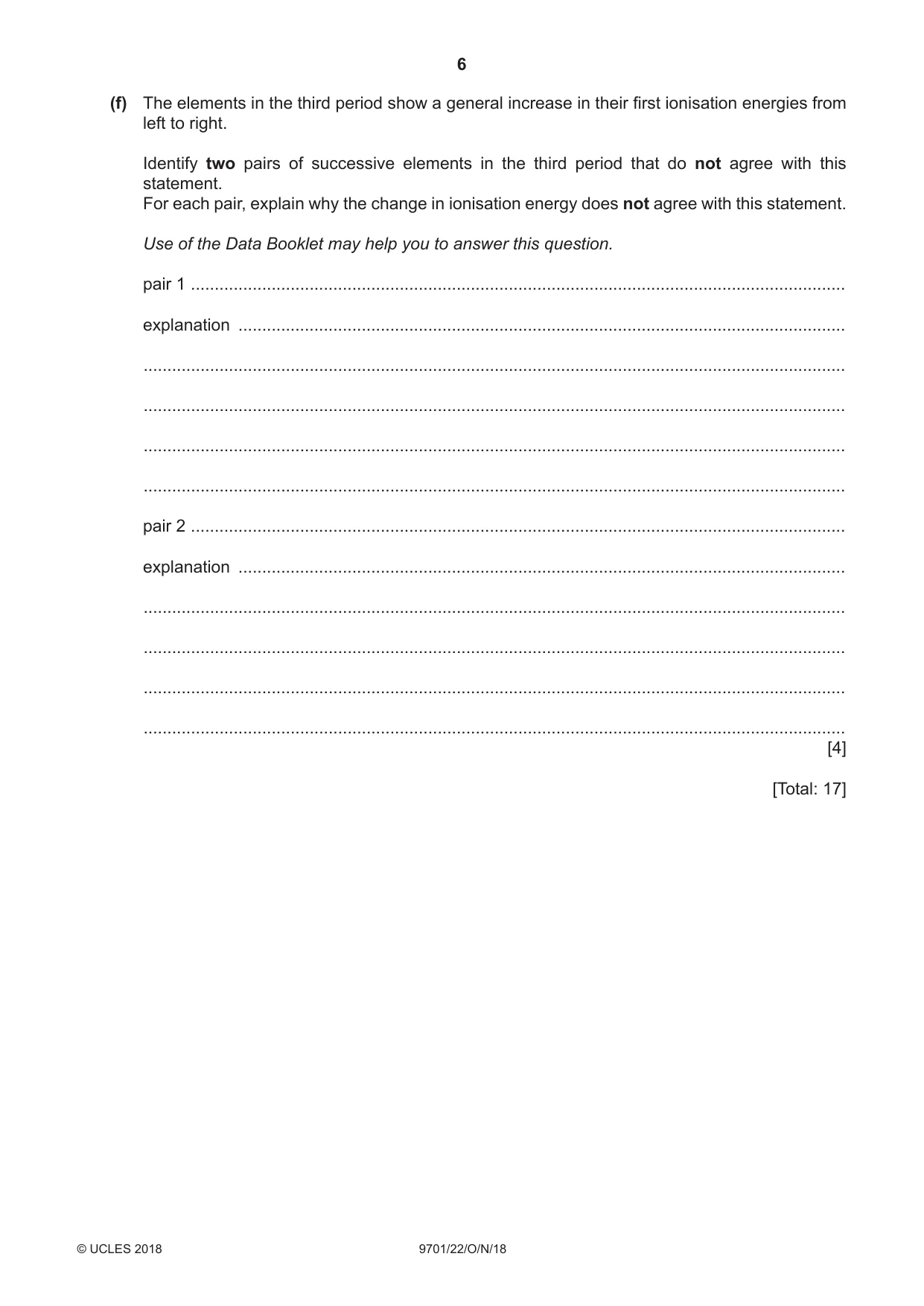
2 The table gives some data for elements in the third period and some of their compounds. element Na Mg Al Si P S type of bonding metallic covalent covalent formula of oxide P4O10 SO2 formula of chloride NaCl MgCl 2 SCl 2 (a) Complete the table to show the bonding in the elements, and the formulae of their oxides and chlorides. [3] (b) SCl 2 is formed in the following reaction. S2Cl 2(l) + Cl 2(g) 2SCl 2(l) ΔH = – 40.6 kJ mol–1 (i) Complete the ‘dot-and-cross’ diagram to show the bonding in a molecule of SCl 2. Show outer electrons only. [1] (ii) Complete and fully label the reaction pathway diagram for the reaction between S2Cl 2 and Cl 2. Include labels for activation energy, Ea, and enthalpy change of the forward reaction, ΔH. S2Cl 2(l) + Cl 2(g) energy progress of reaction [2] (c) (i) On the axes, sketch the trend in melting point of the elements Na to S. melting point of element Na Mg Al Si P S [1] (ii) Give three statements to explain your sketch. 1 .......................................................................................................................................... ............................................................................................................................................. 2 .......................................................................................................................................... ............................................................................................................................................. 3 .......................................................................................................................................... ............................................................................................................................................. [3] (d) Write an equation for the reaction of P4O10 with water. .............................................................................................................................................. [1] (e) SO2 can be released into the atmosphere when fossil fuels containing sulfur are burnt. State and explain one environmental consequence of the release of SO2 into the atmosphere. .................................................................................................................................................... .................................................................................................................................................... .................................................................................................................................................... .............................................................................................................................................. [2] (f) The elements in the third period show a general increase in their first ionisation energies from left to right. Identify two pairs of successive elements in the third period that do not agree with this statement. For each pair, explain why the change in ionisation energy does not agree with this statement. Use of the Data Booklet may help you to answer this question. pair 1 .......................................................................................................................................... explanation ................................................................................................................................. .................................................................................................................................................... .................................................................................................................................................... .................................................................................................................................................... .................................................................................................................................................... pair 2 .......................................................................................................................................... explanation ................................................................................................................................. .................................................................................................................................................... .................................................................................................................................................... .................................................................................................................................................... .................................................................................................................................................... [4] [Total: 17]
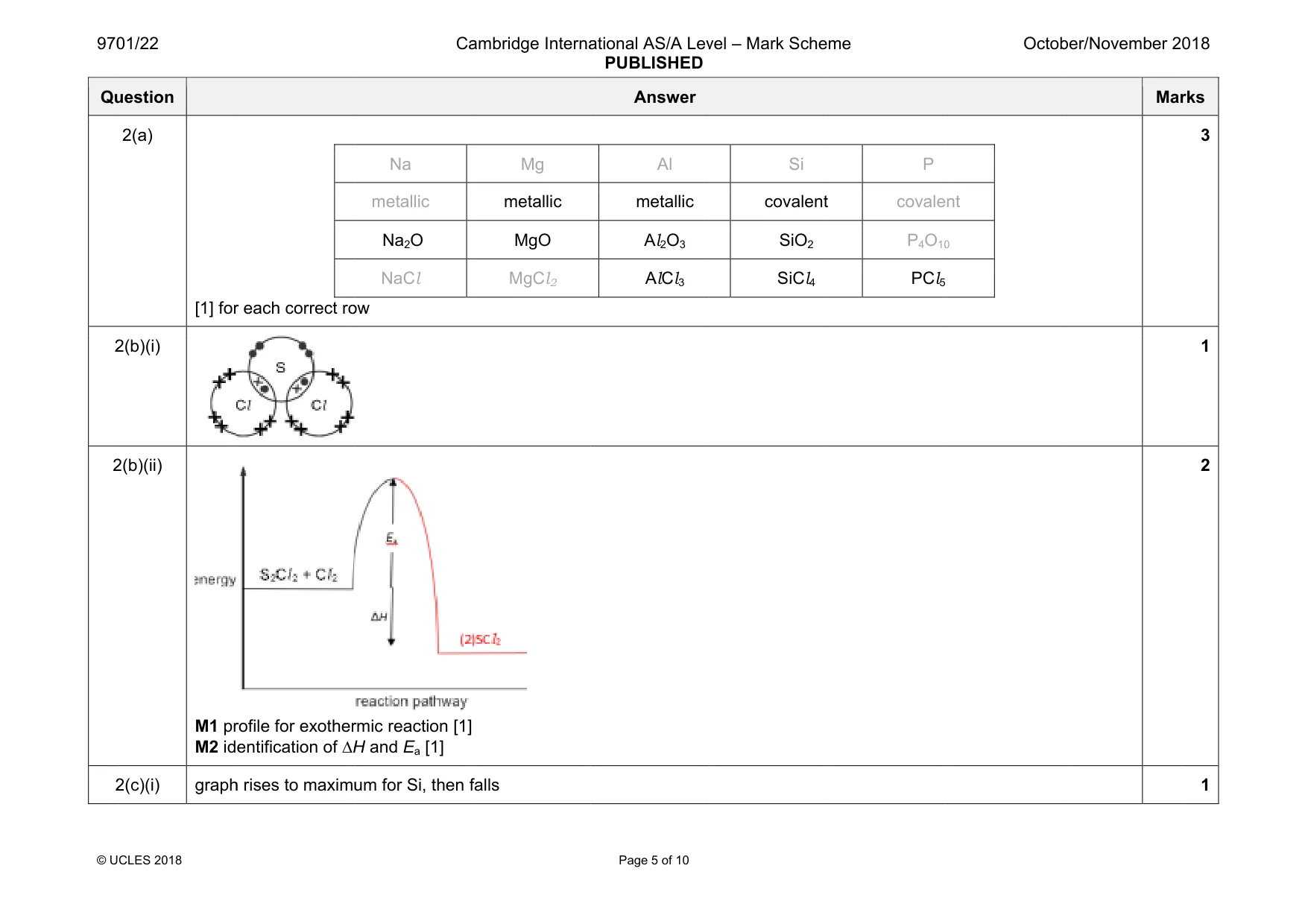
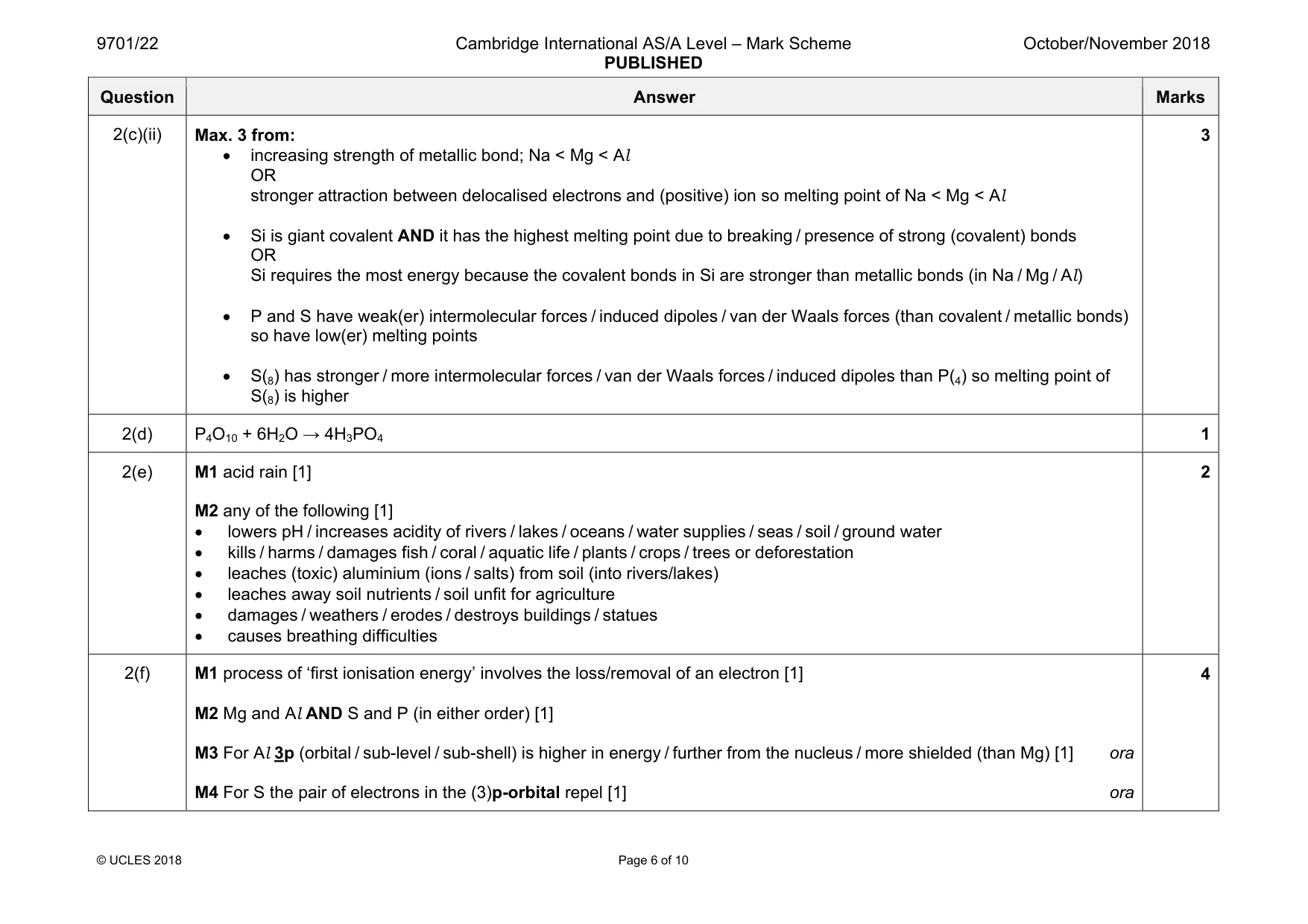
Mark scheme: 2 2 2 2(a) [1] for 2(b)(i) 2(b)(ii) M1 pr M2 id 2(c)(i) graph r each correct ro rofile for exother entification of ∆H h rises to maximu Na metallic Na2O NaCl ow rmic reaction [1] H and Ea [1] um for Si, then f Mg metallic MgO MgCl2 falls Al metallic Al2O3 AlCl3 Si covalent SiO2 SiCl4 P t covale P4O10 PCl5 ent 0 3 1 2 1 Question Answer Marks 2(c)(ii) Max. 3 from: • increasing strength of metallic bond; Na < Mg < Al OR stronger attraction between delocalised electrons and (positive) ion so melting point of Na < Mg < Al • Si is giant covalent AND it has the highest melting point due to breaking / presence of strong (covalent) bonds OR Si requires the most energy because the covalent bonds in Si are stronger than metallic bonds (in Na / Mg / Al) • P and S have weak(er) intermolecular forces / induced dipoles / van der Waals forces (than covalent / metallic bonds) so have low(er) melting points • S(8) has stronger / more intermolecular forces / van der Waals forces / induced dipoles than P(4) so melting point of S(8) is higher 3 2(d) P4O10 + 6H2O → 4H3PO4 1 2(e) M1 acid rain [1] M2 any of the following [1] • lowers pH / increases acidity of rivers / lakes / oceans / water supplies / seas / soil / ground water • kills / harms / damages fish / coral / aquatic life / plants / crops / trees or deforestation • leaches (toxic) aluminium (ions / salts) from soil (into rivers/lakes) • leaches away soil nutrients / soil unfit for agriculture • damages / weathers / erodes / destroys buildings / statues • causes breathing difficulties 2 2(f) M1 process of ‘first ionisation energy’ involves the loss/removal of an electron [1] M2 Mg and Al AND S and P (in either order) [1] M3 For Al 3p (orbital / sub-level / sub-shell) is higher in energy / further from the nucleus / more shielded (than Mg) [1] ora M4 For S the pair of electrons in the (3)p-orbital repel [1] ora 4
Q3 · Trihalomethanes are organic molecules in which three of the hydrogen atoms of methane are…
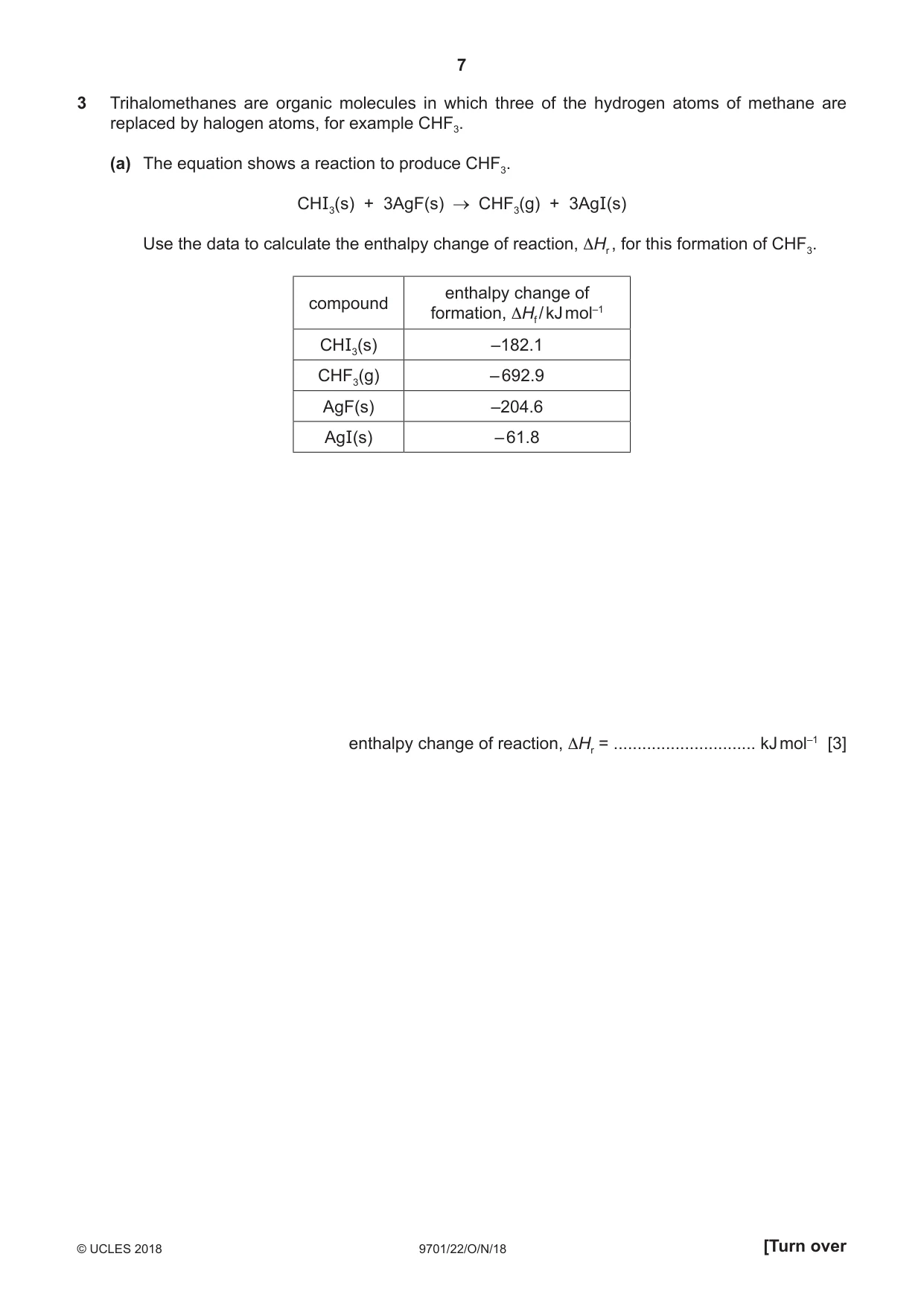
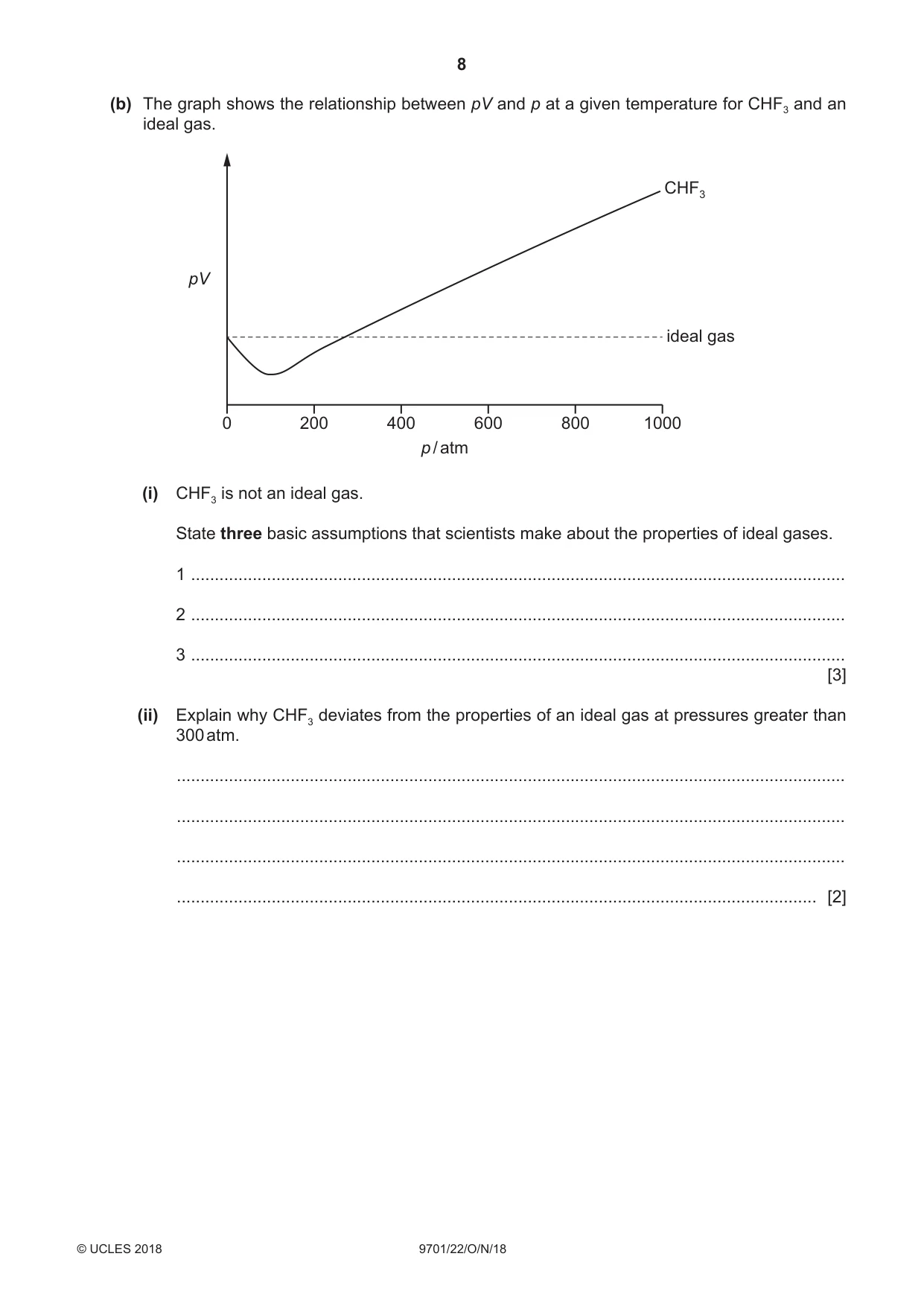
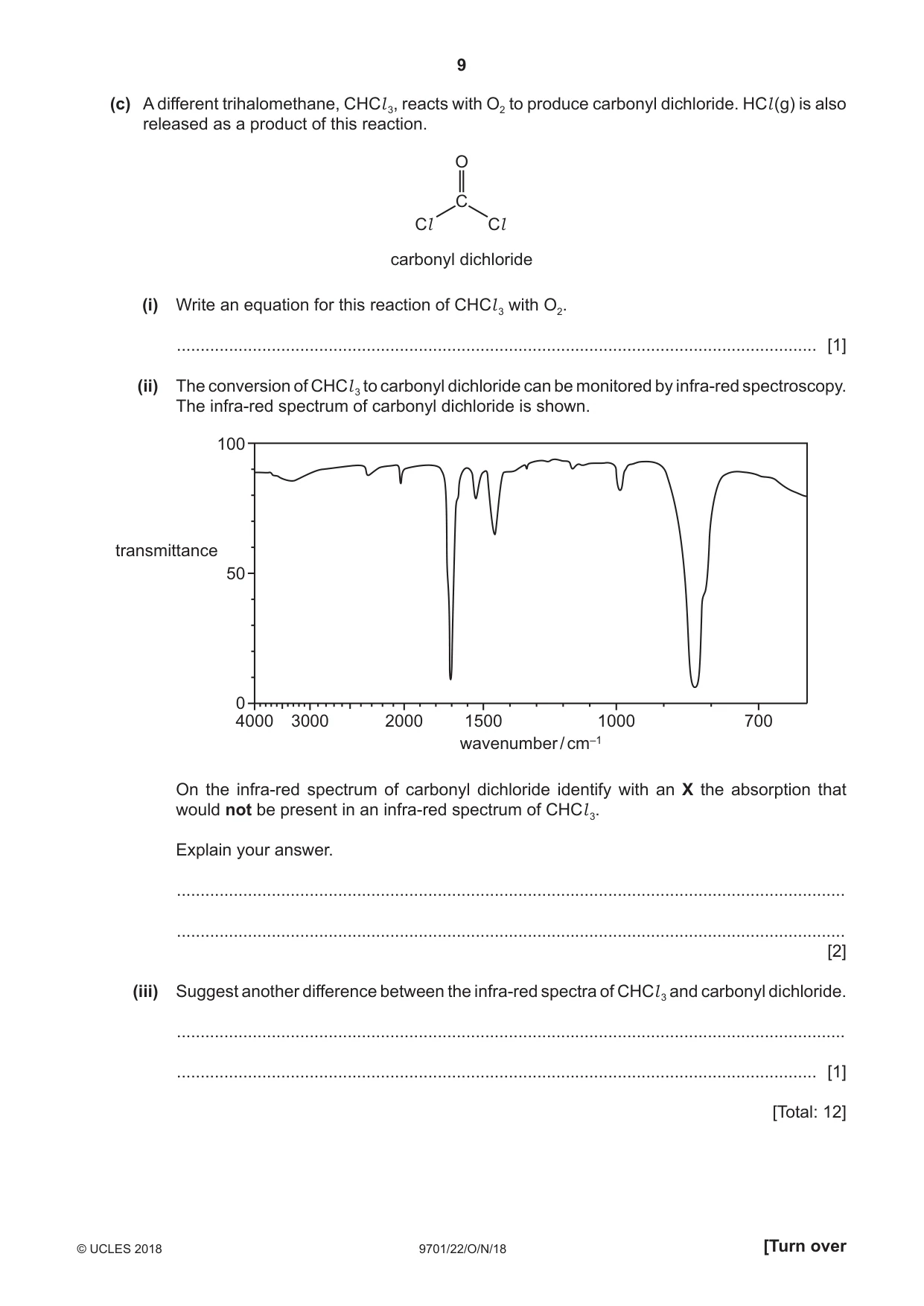
3 Trihalomethanes are organic molecules in which three of the hydrogen atoms of methane are replaced by halogen atoms, for example CHF3. (a) The equation shows a reaction to produce CHF3. CHI3(s) + 3AgF(s) CHF3(g) + 3AgI(s) Use the data to calculate the enthalpy change of reaction, ΔHr , for this formation of CHF3. enthalpy change of compound formation, ΔHf / kJ mol–1 CHI3(s) –182.1 CHF3(g) – 692.9 AgF(s) –204.6 AgI(s) – 61.8 enthalpy change of reaction, ΔHr = .............................. kJ mol–1 [3] (b) The graph shows the relationship between pV and p at a given temperature for CHF3 and an ideal gas. CHF3 pV ideal gas 0 200 400 600 800 1000 p / atm (i) CHF3 is not an ideal gas. State three basic assumptions that scientists make about the properties of ideal gases. 1 .......................................................................................................................................... 2 .......................................................................................................................................... 3 .......................................................................................................................................... [3] (ii) Explain why CHF3 deviates from the properties of an ideal gas at pressures greater than 300 atm. ............................................................................................................................................. ............................................................................................................................................. ............................................................................................................................................. ....................................................................................................................................... [2] (c) A different trihalomethane, CHCl 3, reacts with O2 to produce carbonyl dichloride. HCl (g) is also released as a product of this reaction. O C Cl Cl carbonyl dichloride (i) Write an equation for this reaction of CHCl 3 with O2. ....................................................................................................................................... [1] (ii) The conversion of CHCl 3 to carbonyl dichloride can be monitored by infra-red spectroscopy. The infra-red spectrum of carbonyl dichloride is shown. 100 transmittance 50 0 4000 3000 2000 1500 1000 700 wavenumber / cm–1 On the infra-red spectrum of carbonyl dichloride identify with an X the absorption that would not be present in an infra-red spectrum of CHCl 3. Explain your answer. ............................................................................................................................................. ............................................................................................................................................. [2] (iii) Suggest another difference between the infra-red spectra of CHCl 3 and carbonyl dichloride. ............................................................................................................................................. ....................................................................................................................................... [1] [Total: 12]
Mark scheme: 3(a) = –82.4 (kJ mol–1) M1 ∆Hr = x(–692.9) + y(–61.8) –v(–182.1) –w(–204.6) where x y v and w are integers ⩾1 [1] M2 use of correct stoichiometry where x =1 y =3 v =1 and w=3 [1] M3 –82.4 [1] 3 3(b)(i) 1 mark for each bullet, max 3 • particles / molecules have (mass but) negligible size / volume (compared to total volume of gas / container) • no / negligible forces / interactions between particles / molecules • collision between particles / molecules are elastic • gas obeys (all) basic gas laws 3 3(b)(ii) M1 particles / molecules are (so) close [1] M2 particle / molecule size becomes significant [1] OR repulsive forces between particle / molecules become significant 2 3(c)(i) CHCl3 + ½O2 → COCl2 + HCl 1 3(c)(ii) M1 X marked on peak at 1670–1740 cm–1 [1] M2 CHCl3 has no C=O [1] 2 3(c)(iii) (It / CHCl3 has a) peak at 2850–2950 (cm–1) OR carbonyl dichloride spectrum has no peak 2850–2950 (cm–1) 1
More questions on The gaseous state: ideal and real gases and pV = nRT
Q4 · The diagram shows a reaction sequence starting from ethanal
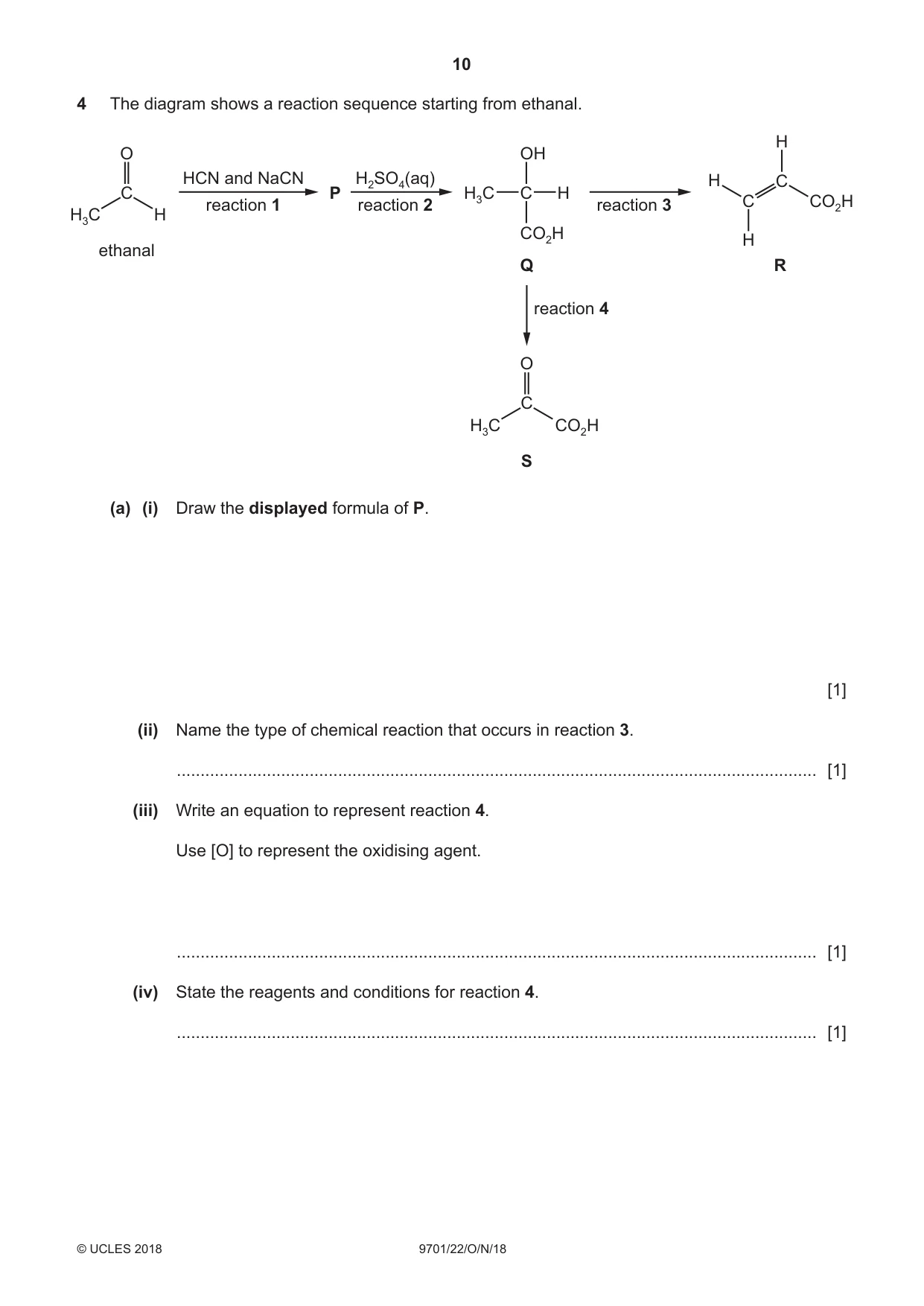
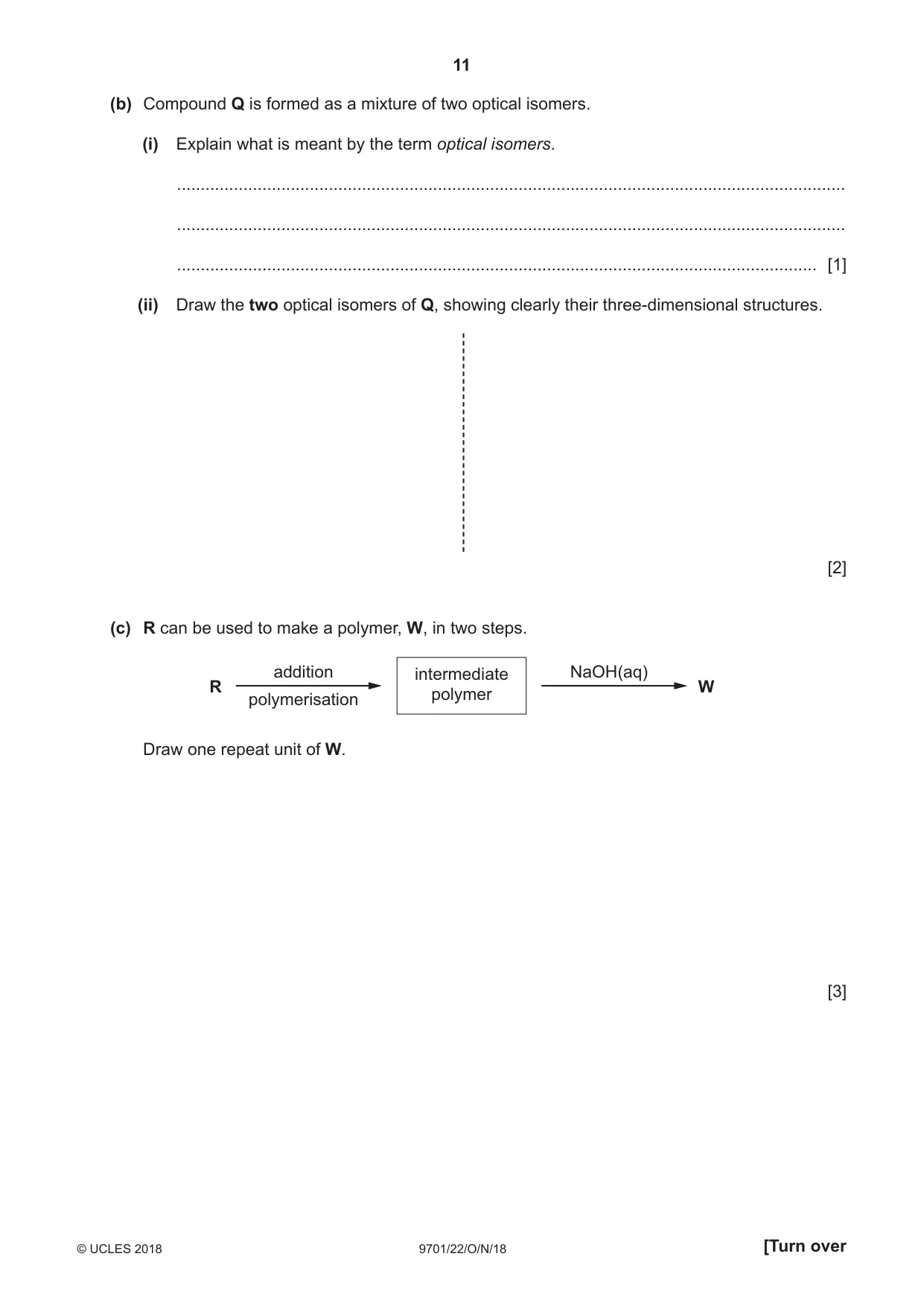
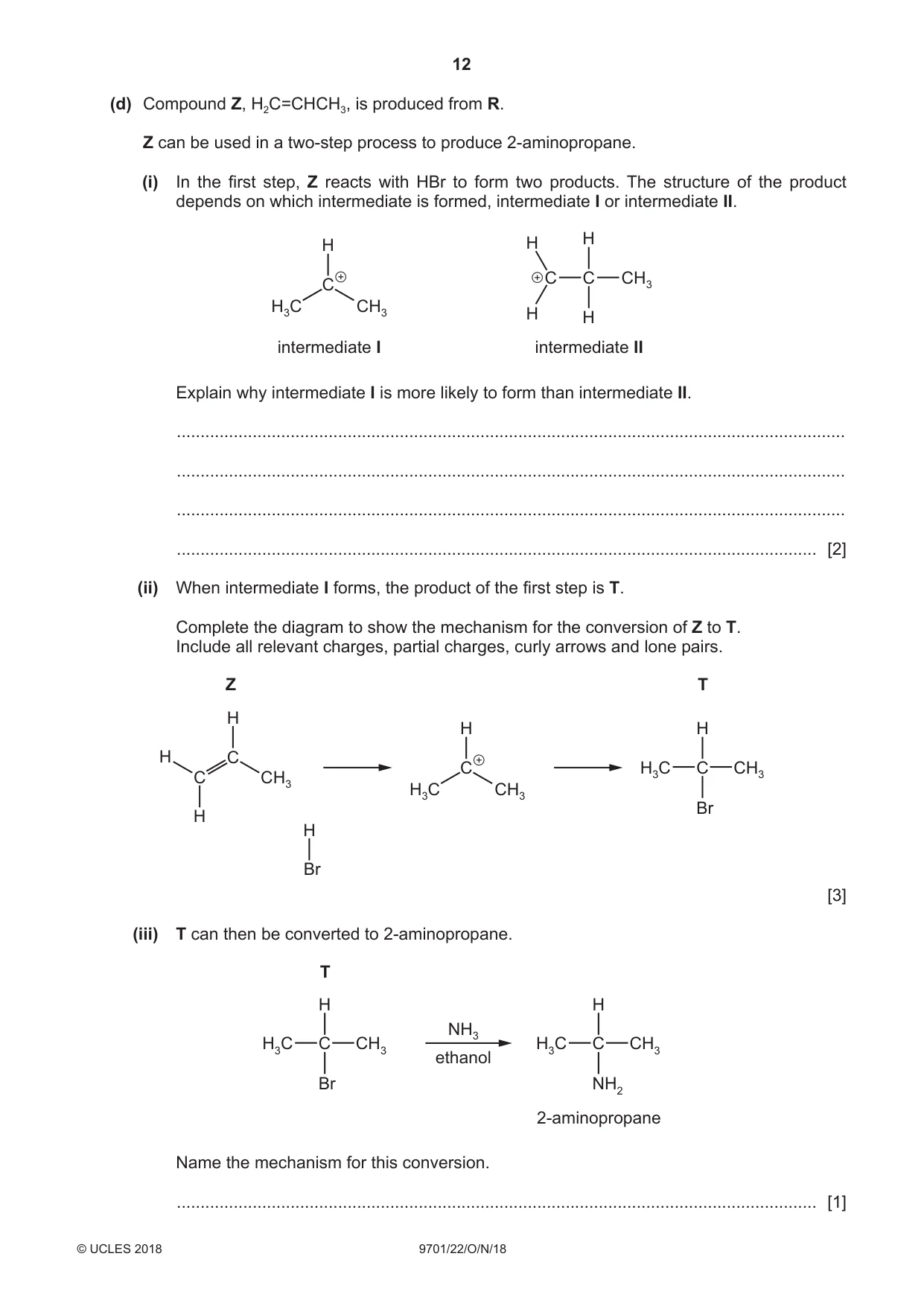
4 The diagram shows a reaction sequence starting from ethanal. H O OH HCN and NaCN H2SO4(aq) H C C P H3C C H reaction 1 reaction 2 reaction 3 C CO2HH3C H CO2H H ethanal Q R reaction 4 O C H3C CO2H S (a) (i) Draw the displayed formula of P. [1] (ii) Name the type of chemical reaction that occurs in reaction 3. ....................................................................................................................................... [1] (iii) Write an equation to represent reaction 4. Use [O] to represent the oxidising agent. ....................................................................................................................................... [1] (iv) State the reagents and conditions for reaction 4. ....................................................................................................................................... [1] (b) Compound Q is formed as a mixture of two optical isomers. (i) Explain what is meant by the term optical isomers. ............................................................................................................................................. ............................................................................................................................................. ....................................................................................................................................... [1] (ii) Draw the two optical isomers of Q, showing clearly their three‑dimensional structures. [2] (c) R can be used to make a polymer, W, in two steps. addition intermediate NaOH(aq) R W polymer polymerisation Draw one repeat unit of W. [3] (d) Compound Z, H2C=CHCH3, is produced from R. Z can be used in a two-step process to produce 2-aminopropane. (i) In the first step, Z reacts with HBr to form two products. The structure of the product depends on which intermediate is formed, intermediate I or intermediate II. H H H C + + C C CH3 H3C CH3 H H intermediate I intermediate II Explain why intermediate I is more likely to form than intermediate II. ............................................................................................................................................. ............................................................................................................................................. ............................................................................................................................................. ....................................................................................................................................... [2] (ii) When intermediate I forms, the product of the first step is T. Complete the diagram to show the mechanism for the conversion of Z to T. Include all relevant charges, partial charges, curly arrows and lone pairs. Z T H H H H C + C H3C C CH3 C CH3 H3C CH3 Br H H Br [3] (iii) T can then be converted to 2-aminopropane. T H H NH3 H3C C CH3 H3C C CH3 ethanol Br NH2 2-aminopropane Name the mechanism for this conversion. ....................................................................................................................................... [1]
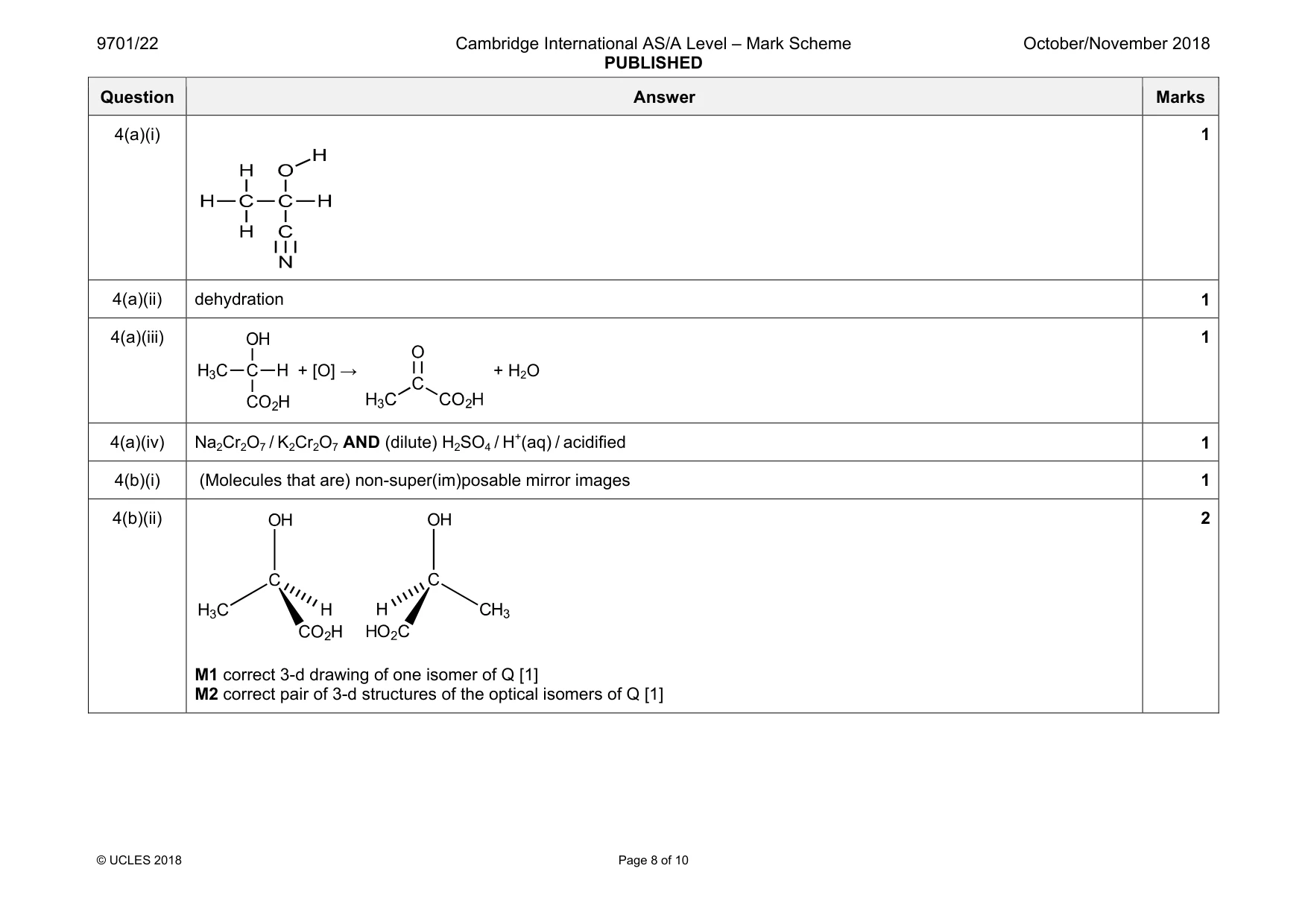
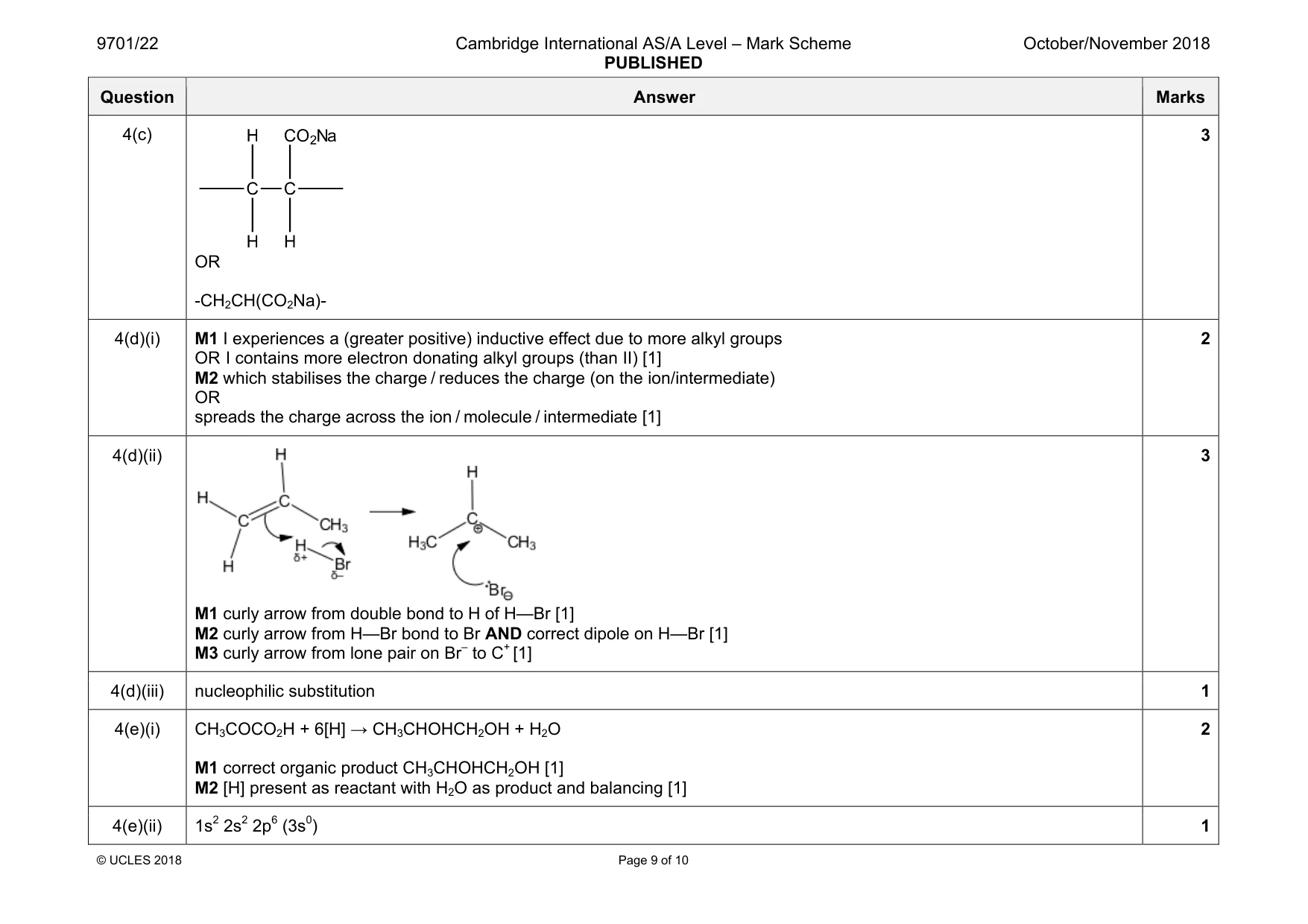
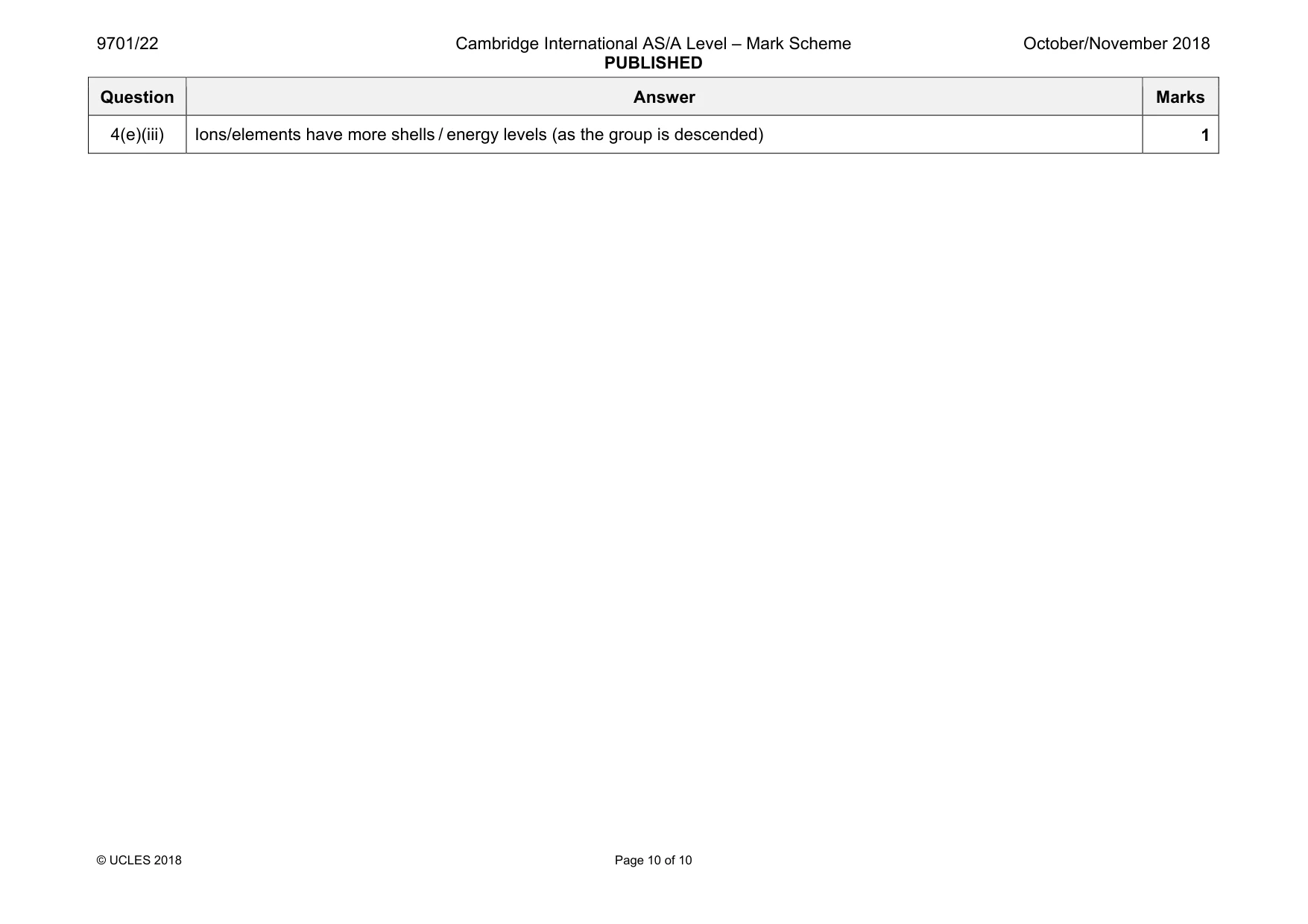
Mark scheme: 4(a)(i) 1 4(a)(ii) dehydration 1 4(a)(iii) + [O] → + H2O 1 4(a)(iv) Na2Cr2O7 / K2Cr2O7 AND (dilute) H2SO4 / H+(aq) / acidified 1 4(b)(i) (Molecules that are) non-super(im)posable mirror images 1 4(b)(ii) M1 correct 3-d drawing of one isomer of Q [1] M2 correct pair of 3-d structures of the optical isomers of Q [1] 2 Question Answer Marks 4(c) OR -CH2CH(CO2Na)- 3 4(d)(i) M1 I experiences a (greater positive) inductive effect due to more alkyl groups OR I contains more electron donating alkyl groups (than II) [1] M2 which stabilises the charge / reduces the charge (on the ion/intermediate) OR spreads the charge across the ion / molecule / intermediate [1] 2 4(d)(ii) M1 curly arrow from double bond to H of H—Br [1] M2 curly arrow from H—Br bond to Br AND correct dipole on H—Br [1] M3 curly arrow from lone pair on Br– to C+ [1] 3 4(d)(iii) nucleophilic substitution 1 4(e)(i) CH3COCO2H + 6[H] → CH3CHOHCH2OH + H2O M1 correct organic product CH3CHOHCH2OH [1] M2 [H] present as reactant with H2O as product and balancing [1] 2 4(e)(ii) 1s2 2s2 2p6 (3s0) 1 Question Answer Marks 4(e)(iii) Ions/elements have more shells / energy levels (as the group is descended) 1
What was in this paper
The subtopics covered by these 4 questions, and how many questions each got. Open one in a new tab to see every Cambridge question on it.
What you needed in this session
Cambridge’s own grade thresholds for 2018 Oct/Nov, Paper 2 · Variant 2. A higher threshold means an easier paper — the bar moves with how the cohort did.