Cambridge A Level Chemistry 9701 — 2018 Feb/March Paper 5 · Variant 2
9701/52/F/M/18 · 2 questions · 30 marks · ≈34 min
The question paper and its mark scheme, free to read here and free to download. This is Cambridge’s own paper, exactly as it was sat.
Question paper12 pages

Mark scheme6 pages
Answers below. Sit the paper first if you are practising.
Questions as text
Q1 · When a solute is added to a solvent the freezing point of the solution is lower than that…
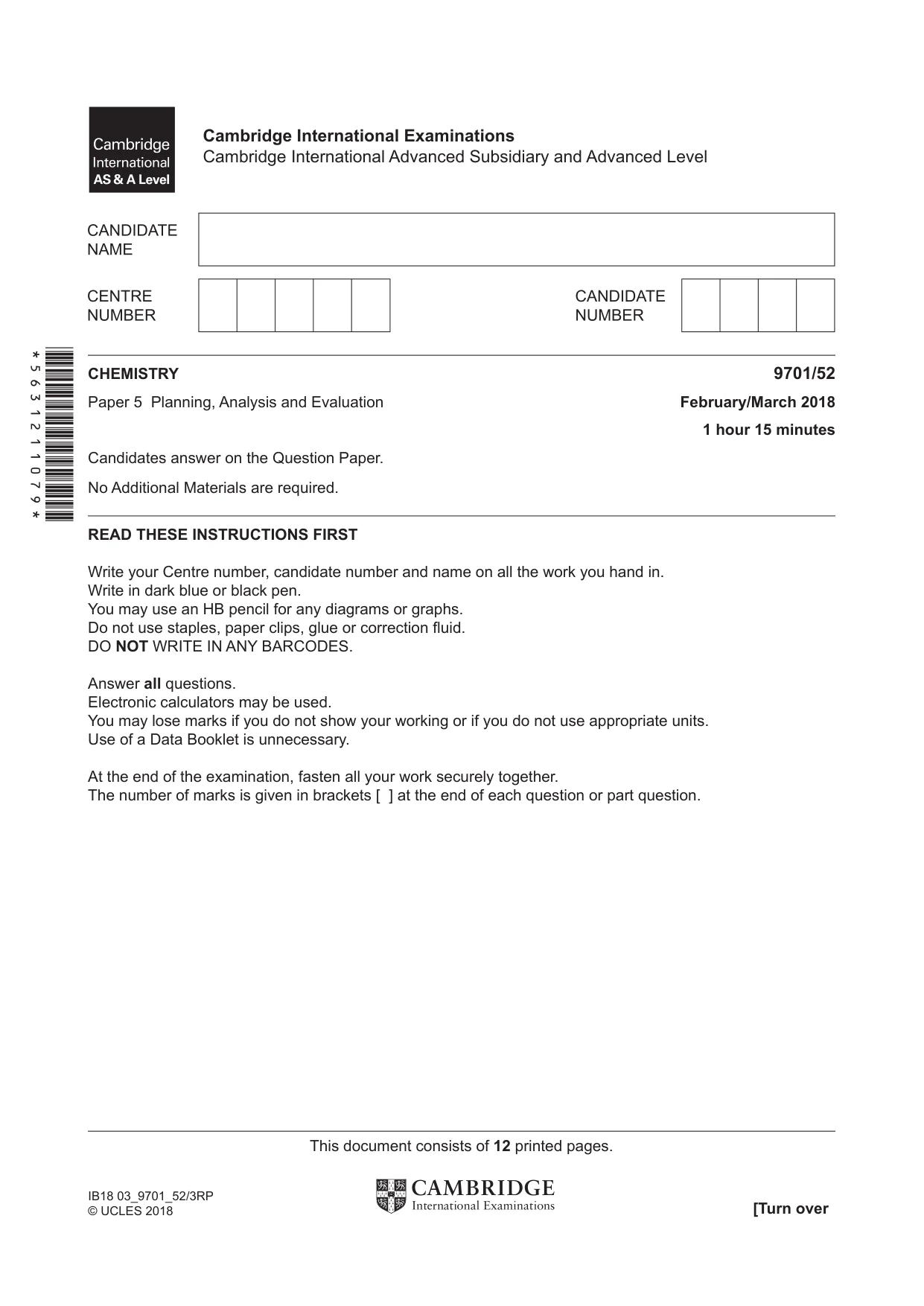
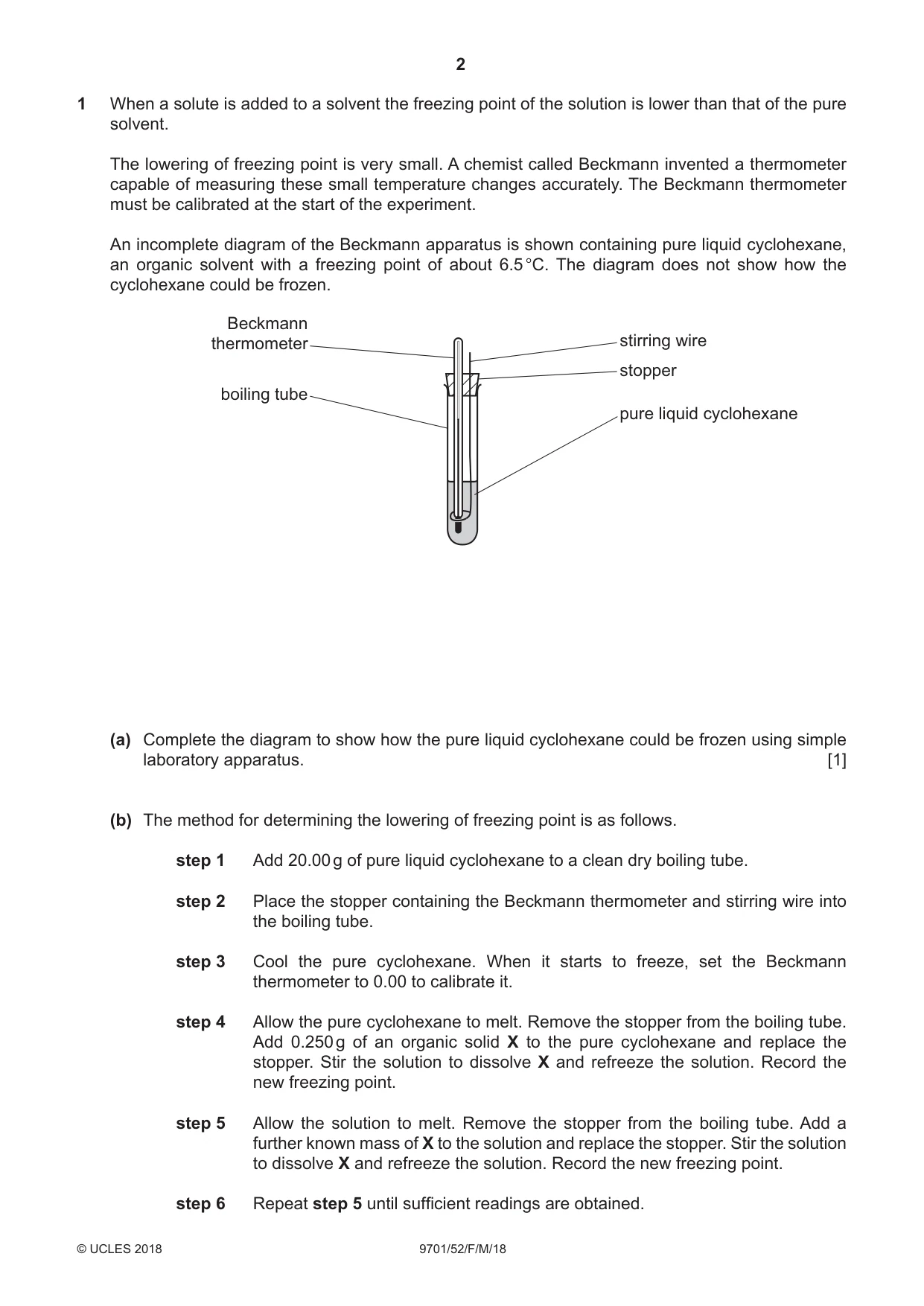
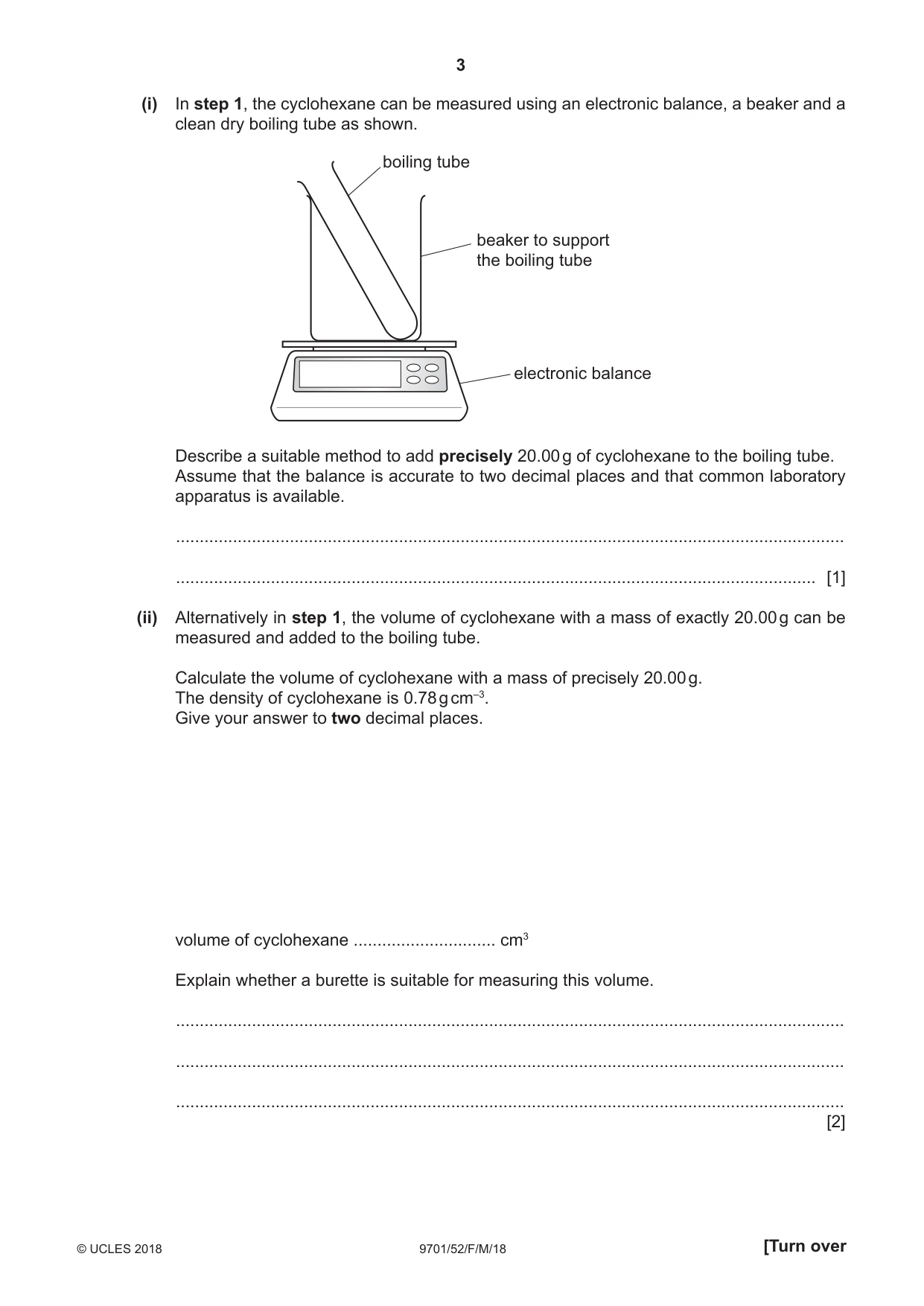
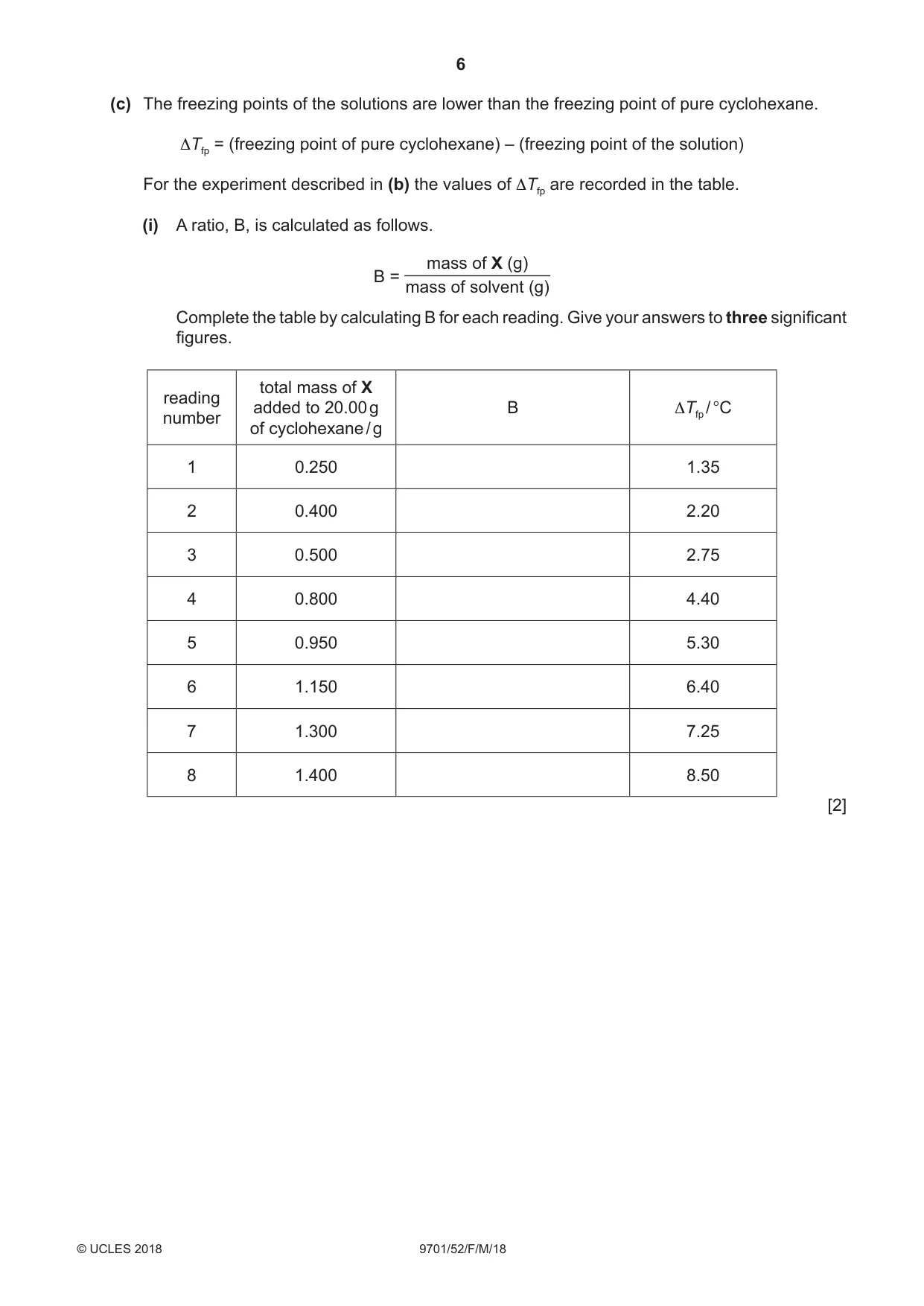
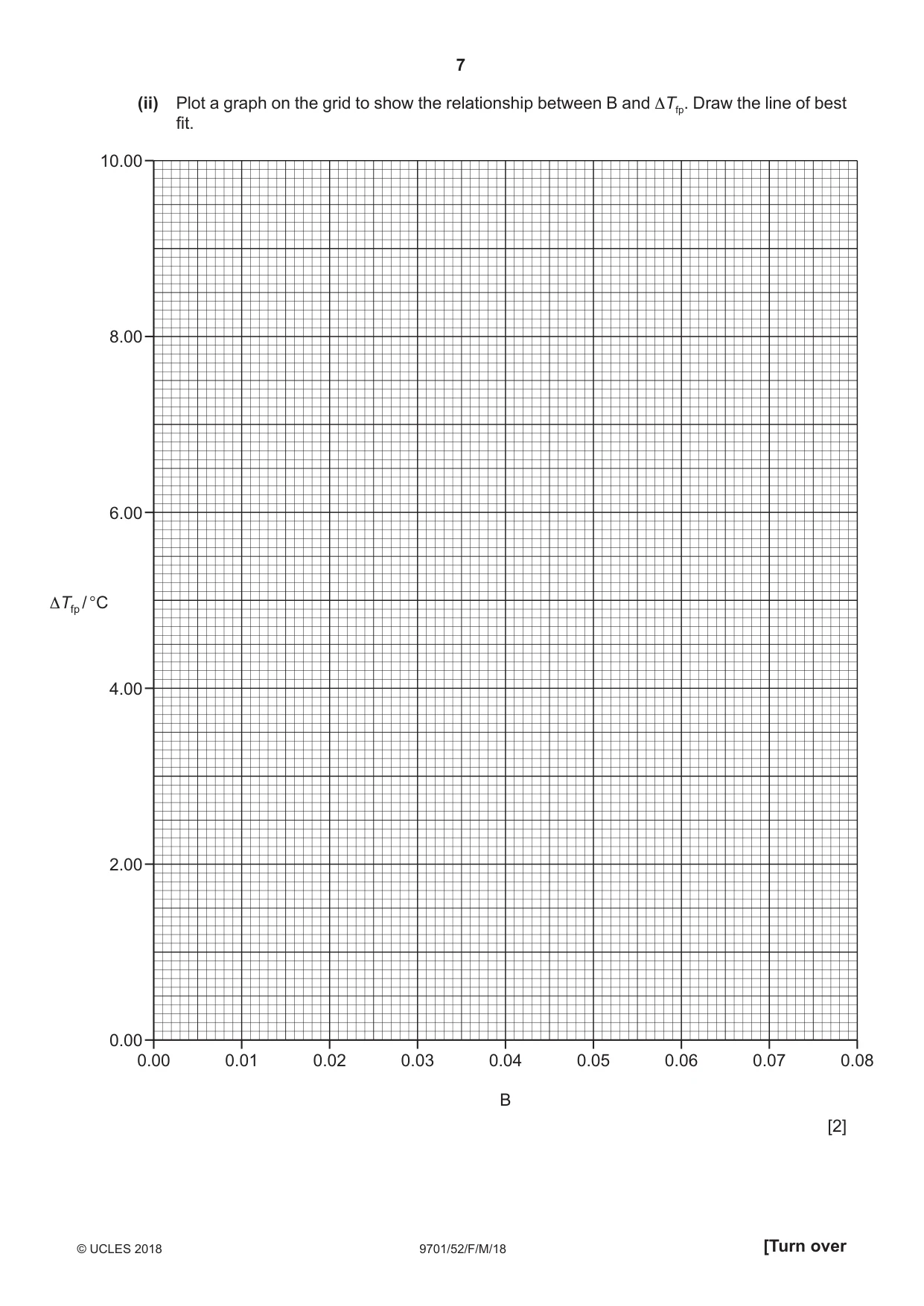
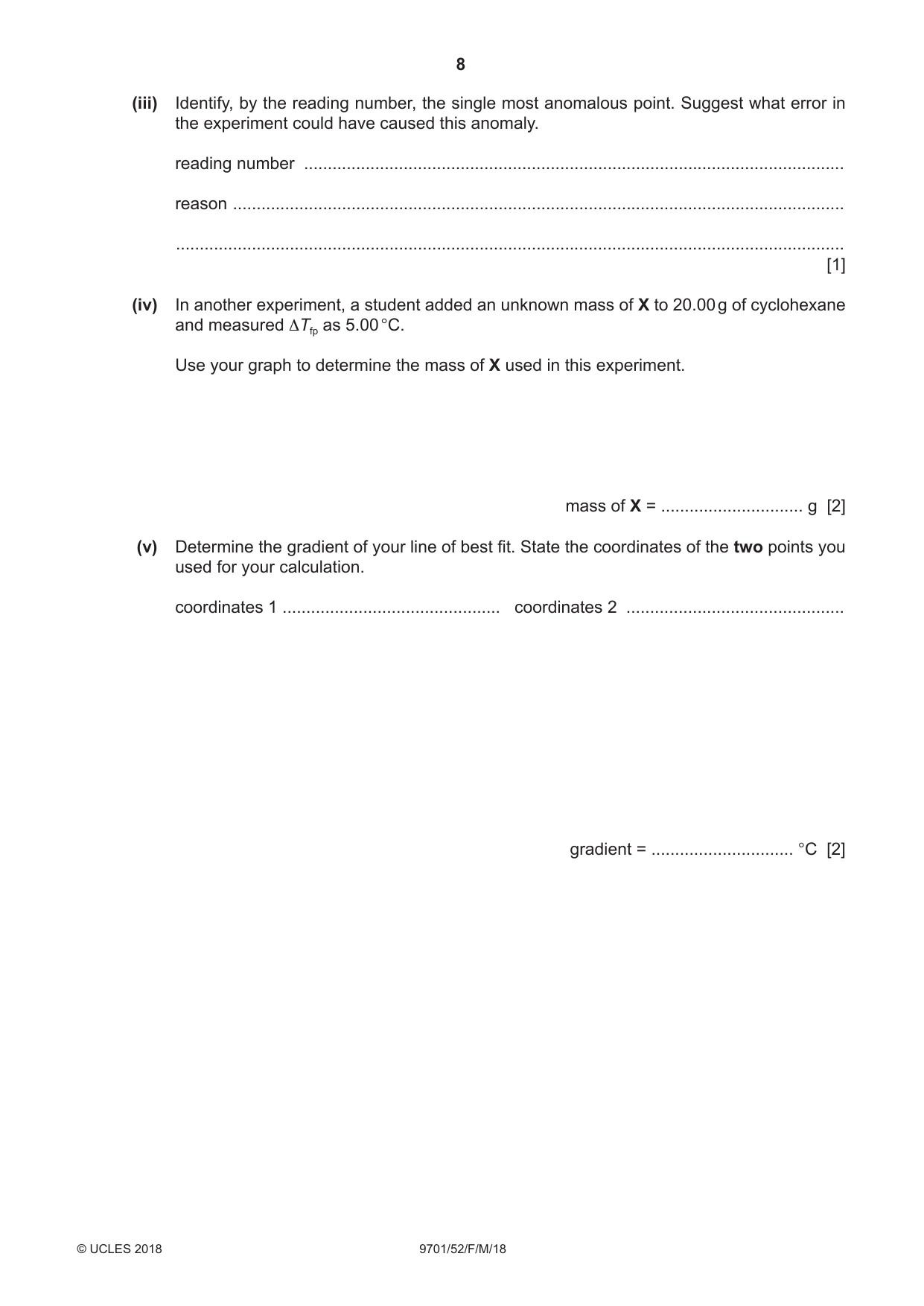
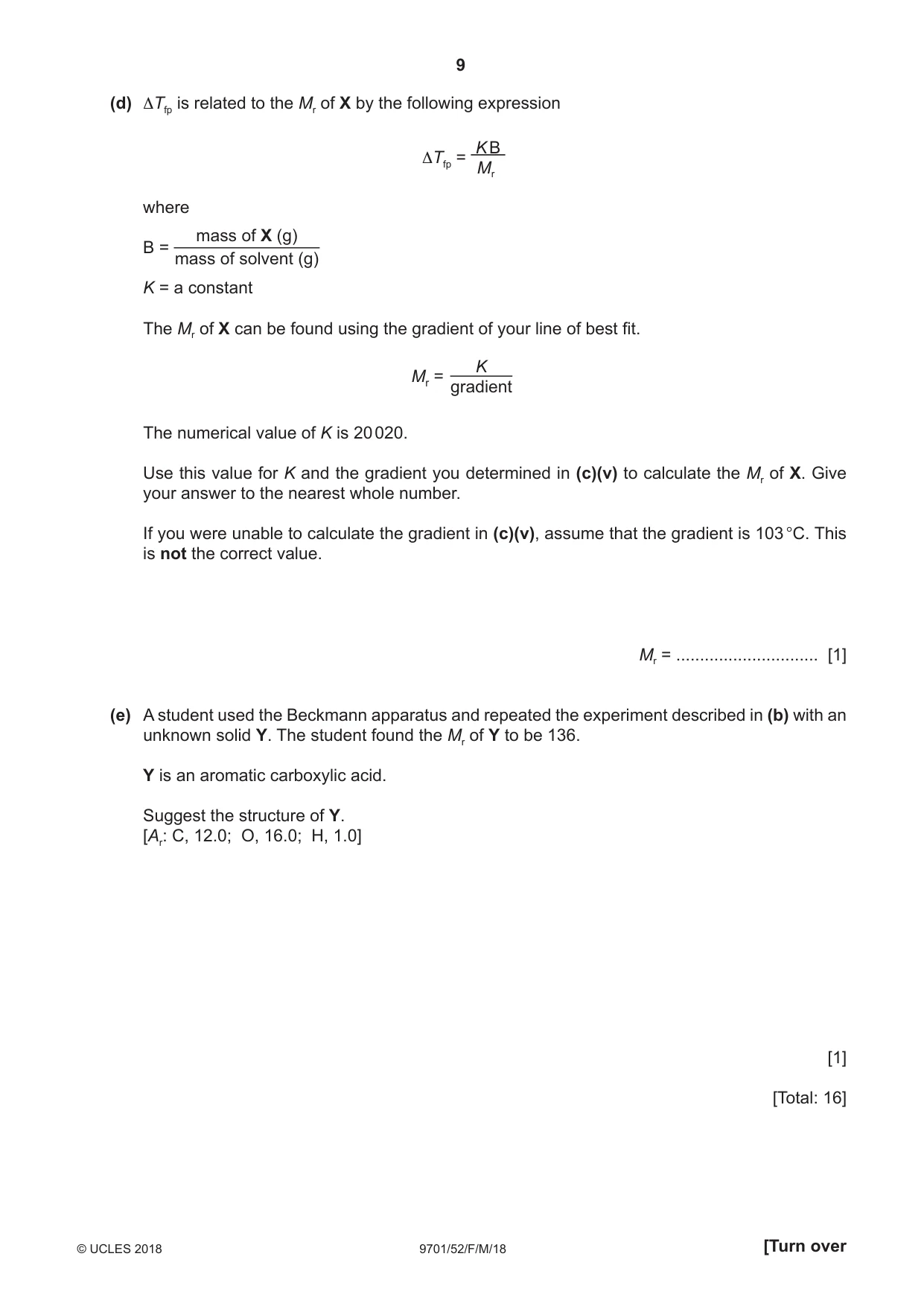
1 When a solute is added to a solvent the freezing point of the solution is lower than that of the pure solvent. The lowering of freezing point is very small. A chemist called Beckmann invented a thermometer capable of measuring these small temperature changes accurately. The Beckmann thermometer must be calibrated at the start of the experiment. An incomplete diagram of the Beckmann apparatus is shown containing pure liquid cyclohexane, an organic solvent with a freezing point of about 6.5 °C. The diagram does not show how the cyclohexane could be frozen. Beckmann thermometer stirring wire stopper boiling tube pure liquid cyclohexane (a) Complete the diagram to show how the pure liquid cyclohexane could be frozen using simple laboratory apparatus. [1] (b) The method for determining the lowering of freezing point is as follows. step 1 Add 20.00 g of pure liquid cyclohexane to a clean dry boiling tube. step 2 Place the stopper containing the Beckmann thermometer and stirring wire into the boiling tube. step 3 Cool the pure cyclohexane. When it starts to freeze, set the Beckmann thermometer to 0.00 to calibrate it. step 4 Allow the pure cyclohexane to melt. Remove the stopper from the boiling tube. Add 0.250 g of an organic solid X to the pure cyclohexane and replace the stopper. Stir the solution to dissolve X and refreeze the solution. Record the new freezing point. step 5 Allow the solution to melt. Remove the stopper from the boiling tube. Add a further known mass of X to the solution and replace the stopper. Stir the solution to dissolve X and refreeze the solution. Record the new freezing point. step 6 Repeat step 5 until sufficient readings are obtained. (i) In step 1, the cyclohexane can be measured using an electronic balance, a beaker and a clean dry boiling tube as shown. boiling tube beaker to support the boiling tube electronic balance Describe a suitable method to add precisely 20.00 g of cyclohexane to the boiling tube. Assume that the balance is accurate to two decimal places and that common laboratory apparatus is available. ............................................................................................................................................. ....................................................................................................................................... [1] (ii) Alternatively in step 1, the volume of cyclohexane with a mass of exactly 20.00 g can be measured and added to the boiling tube. Calculate the volume of cyclohexane with a mass of precisely 20.00 g. The density of cyclohexane is 0.78 g cm–3. Give your answer to two decimal places. volume of cyclohexane .............................. cm3 Explain whether a burette is suitable for measuring this volume. ............................................................................................................................................. ............................................................................................................................................. ............................................................................................................................................. [2] (iii) In step 4 the mass of X is measured on an electronic balance accurate to three decimal places before adding it to the cyclohexane. A student suggests the following technique. ● An empty container is placed on the electronic balance. ● The mass of the empty container is recorded to three decimal places. ● 0.250 g of X is added to the container. ● X is tipped from the container into the cyclohexane. Explain why this technique would not be accurate for adding 0.250 g of X to the cyclohexane. ............................................................................................................................................. ............................................................................................................................................. ....................................................................................................................................... [1] Question 1 continues on the next page. (c) The freezing points of the solutions are lower than the freezing point of pure cyclohexane. ΔTfp = (freezing point of pure cyclohexane) – (freezing point of the solution) For the experiment described in (b) the values of ΔTfp are recorded in the table. (i) A ratio, B, is calculated as follows. mass of X (g) B = mass of solvent (g) Complete the table by calculating B for each reading. Give your answers to three significant figures. total mass of X reading added to 20.00 g B ΔTfp / °C number of cyclohexane / g 1 0.250 1.35 2 0.400 2.20 3 0.500 2.75 4 0.800 4.40 5 0.950 5.30 6 1.150 6.40 7 1.300 7.25 8 1.400 8.50 [2] (iii) Identify, by the reading number, the single most anomalous point. Suggest what error in the experiment could have caused this anomaly. reading number ................................................................................................................... reason ................................................................................................................................. ............................................................................................................................................. [1] (iv) In another experiment, a student added an unknown mass of X to 20.00 g of cyclohexane and measured ΔTfp as 5.00 °C. Use your graph to determine the mass of X used in this experiment. mass of X = .............................. g [2] (v) Determine the gradient of your line of best fit. State the coordinates of the two points you used for your calculation. coordinates 1 .............................................. coordinates 2 ............................................... gradient = .............................. °C [2] (d) ΔTfp is related to the Mr of X by the following expression K B ΔTfp = Mr where mass of X (g) B = mass of solvent (g) K = a constant The Mr of X can be found using the gradient of your line of best fit. K Mr = gradient The numerical value of K is 20 020. Use this value for K and the gradient you determined in (c)(v) to calculate the Mr of X. Give your answer to the nearest whole number. If you were unable to calculate the gradient in (c)(v), assume that the gradient is 103 °C. This is not the correct value. Mr = .............................. [1] (e) A student used the Beckmann apparatus and repeated the experiment described in (b) with an unknown solid Y. The student found the Mr of Y to be 136. Y is an aromatic carboxylic acid. Suggest the structure of Y. [Ar: C, 12.0; O, 16.0; H, 1.0] [1] [Total: 16]
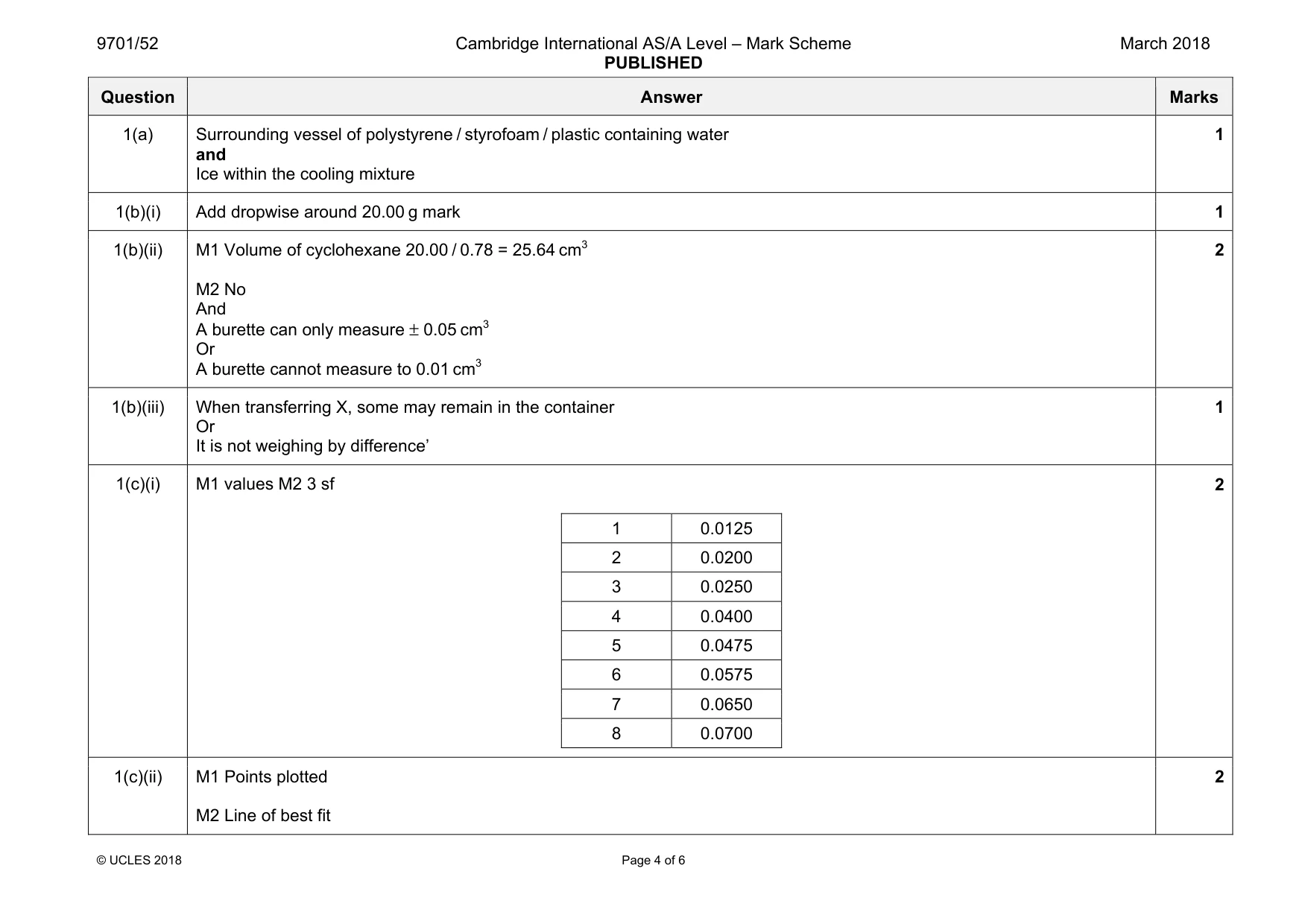
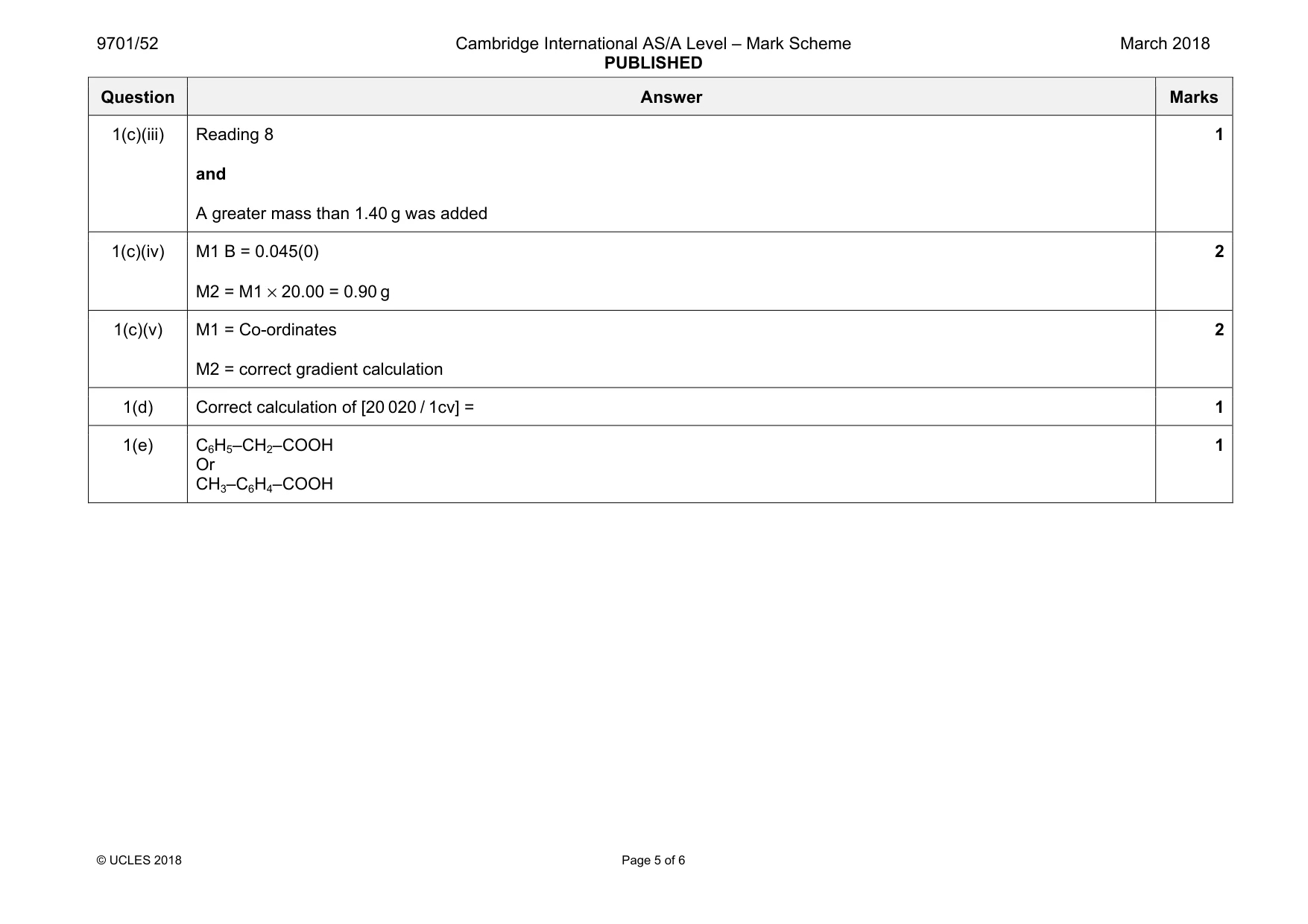
Mark scheme: 1(a) Surrounding vessel of polystyrene / styrofoam / plastic containing water and Ice within the cooling mixture 1 1(b)(i) Add dropwise around 20.00 g mark 1 1(b)(ii) M1 Volume of cyclohexane 20.00 / 0.78 = 25.64 cm3 M2 No And A burette can only measure ± 0.05 cm3 Or A burette cannot measure to 0.01 cm3 2 1(b)(iii) When transferring X, some may remain in the container Or It is not weighing by difference’ 1 1(c)(i) M1 values M2 3 sf 1 0.0125 2 0.0200 3 0.0250 4 0.0400 5 0.0475 6 0.0575 7 0.0650 8 0.0700 2 1(c)(ii) M1 Points plotted M2 Line of best fit 2 Question Answer Marks 1(c)(iii) Reading 8 and A greater mass than 1.40 g was added 1 1(c)(iv) M1 B = 0.045(0) M2 = M1 × 20.00 = 0.90 g 2 1(c)(v) M1 = Co-ordinates M2 = correct gradient calculation 2 1(d) Correct calculation of [20 020 / 1cv] = 1 1(e) C6H5–CH2–COOH Or CH3–C6H4–COOH 1
More questions on Reacting masses and volumes (of solutions and gases)
Q2 · ‘Lawn sand’ is spread over the grass in gardens to reduce the growth of moss
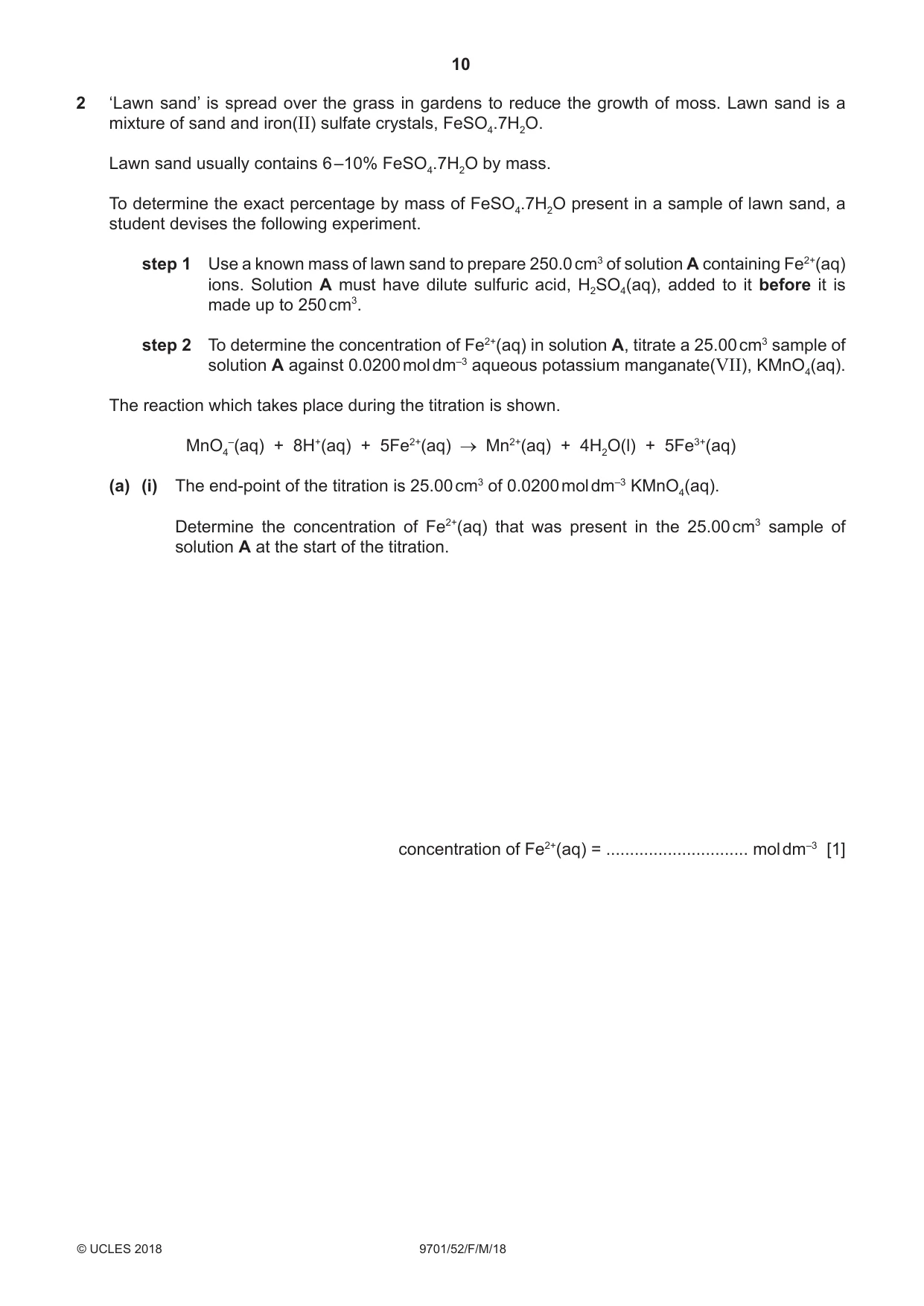
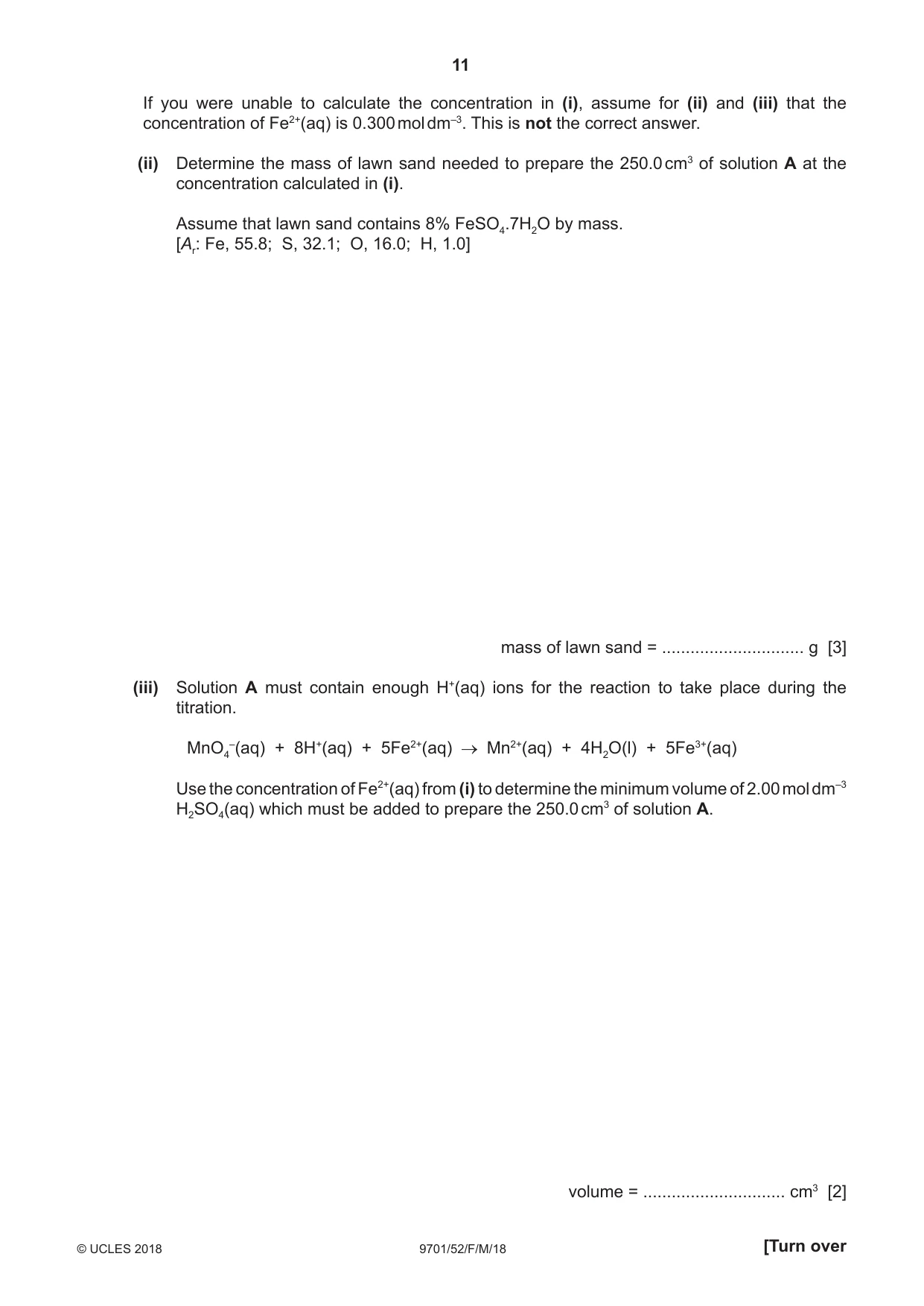
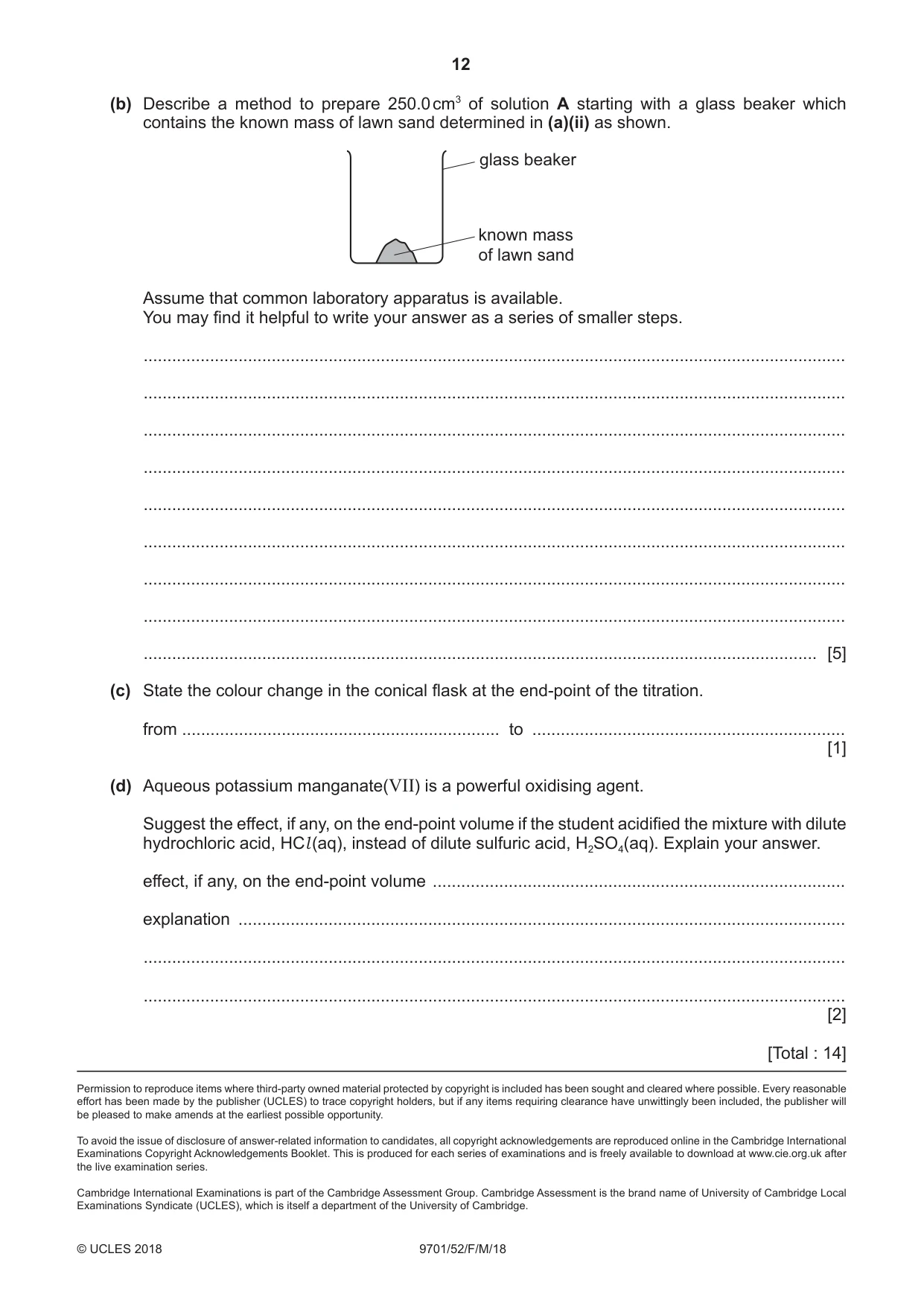
2 ‘Lawn sand’ is spread over the grass in gardens to reduce the growth of moss. Lawn sand is a mixture of sand and iron(II) sulfate crystals, FeSO4.7H2O. Lawn sand usually contains 6 –10% FeSO4.7H2O by mass. To determine the exact percentage by mass of FeSO4.7H2O present in a sample of lawn sand, a student devises the following experiment. step 1 Use a known mass of lawn sand to prepare 250.0 cm3 of solution A containing Fe2+(aq) ions. Solution A must have dilute sulfuric acid, H2SO4(aq), added to it before it is made up to 250 cm3. step 2 To determine the concentration of Fe2+(aq) in solution A, titrate a 25.00 cm3 sample of solution A against 0.0200 mol dm–3 aqueous potassium manganate(VII), KMnO4(aq). The reaction which takes place during the titration is shown. MnO4–(aq) + 8H+(aq) + 5Fe2+(aq) Mn2+(aq) + 4H2O(l) + 5Fe3+(aq) (a) (i) The end-point of the titration is 25.00 cm3 of 0.0200 mol dm–3 KMnO4(aq). Determine the concentration of Fe2+(aq) that was present in the 25.00 cm3 sample of solution A at the start of the titration. concentration of Fe2+(aq) = .............................. mol dm–3 [1] If you were unable to calculate the concentration in (i), assume for (ii) and (iii) that the concentration of Fe2+(aq) is 0.300 mol dm–3. This is not the correct answer. (ii) Determine the mass of lawn sand needed to prepare the 250.0 cm3 of solution A at the concentration calculated in (i). Assume that lawn sand contains 8% FeSO4.7H2O by mass. [Ar: Fe, 55.8; S, 32.1; O, 16.0; H, 1.0] mass of lawn sand = .............................. g [3] (iii) Solution A must contain enough H+(aq) ions for the reaction to take place during the titration. MnO4–(aq) + 8H+(aq) + 5Fe2+(aq) Mn2+(aq) + 4H2O(l) + 5Fe3+(aq) Use the concentration of Fe2+(aq) from (i) to determine the minimum volume of 2.00 mol dm–3 H2SO4(aq) which must be added to prepare the 250.0 cm3 of solution A. volume = .............................. cm3 [2] (b) Describe a method to prepare 250.0 cm3 of solution A starting with a glass beaker which contains the known mass of lawn sand determined in (a)(ii) as shown. glass beaker known mass of lawn sand Assume that common laboratory apparatus is available. You may find it helpful to write your answer as a series of smaller steps. .................................................................................................................................................... .................................................................................................................................................... .................................................................................................................................................... .................................................................................................................................................... .................................................................................................................................................... .................................................................................................................................................... .................................................................................................................................................... .................................................................................................................................................... .............................................................................................................................................. [5] (c) State the colour change in the conical flask at the end-point of the titration. from ................................................................... to ������������������������������������������������������������������ [1] (d) Aqueous potassium manganate(VII) is a powerful oxidising agent. Suggest the effect, if any, on the end-point volume if the student acidified the mixture with dilute hydrochloric acid, HCl (aq), instead of dilute sulfuric acid, H2SO4(aq). Explain your answer. effect, if any, on the end-point volume ........................................................................................ explanation ................................................................................................................................. .................................................................................................................................................... .................................................................................................................................................... [2] [Total : 14]
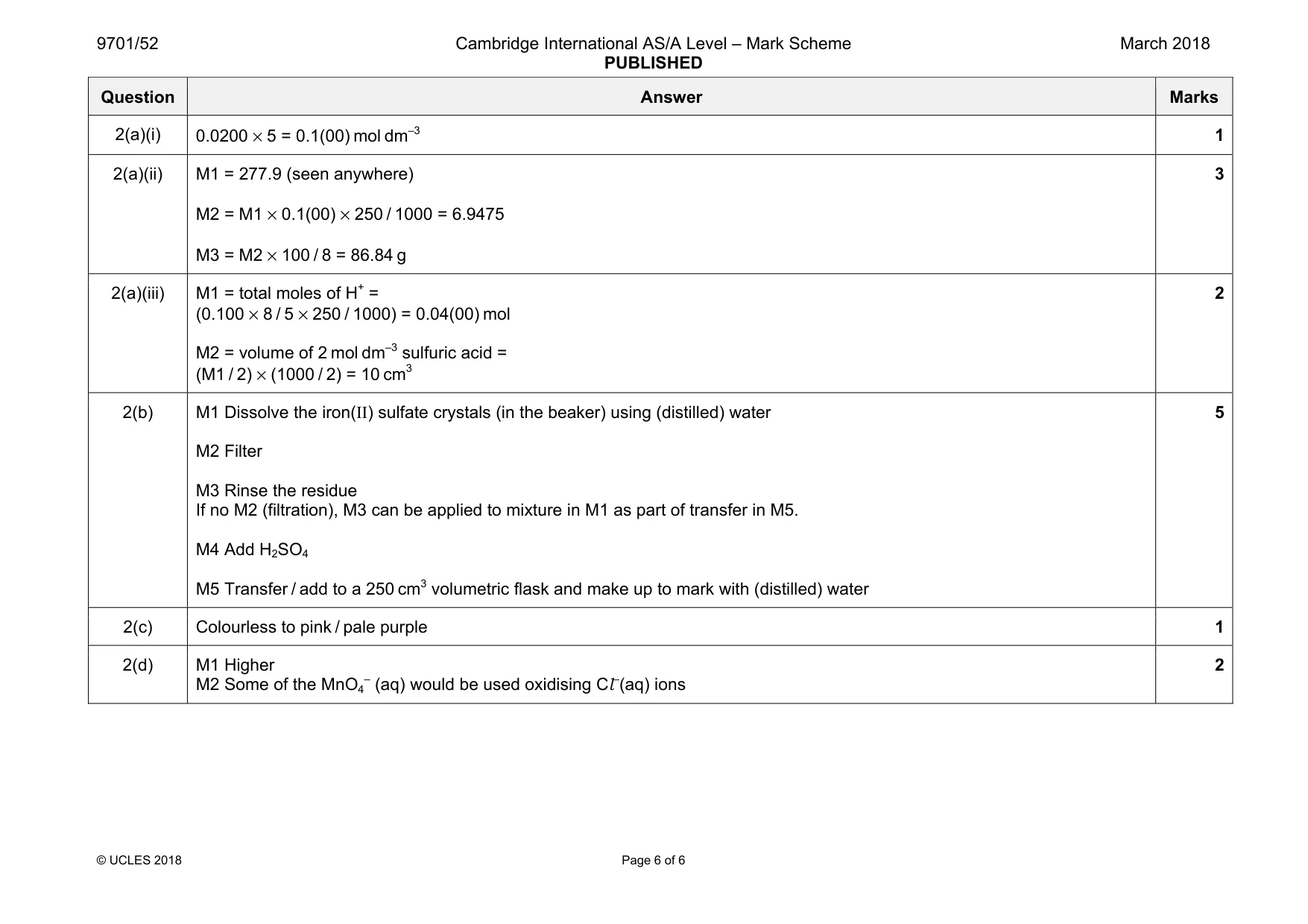
Mark scheme: 2(a)(i) 1 2(a)(ii) M1 = 277.9 (seen anywhere) M2 = M1 × 0.1(00) × 250 / 1000 = 6.9475 M3 = M2 × 100 / 8 = 86.84 g 3 2(a)(iii) M1 = total moles of H+ = (0.100 × 8 / 5 × 250 / 1000) = 0.04(00) mol M2 = volume of 2 mol dm–3 sulfuric acid = (M1 / 2) × (1000 / 2) = 10 cm3 2 2(b) M1 Dissolve the iron(II) sulfate crystals (in the beaker) using (distilled) water M2 Filter M3 Rinse the residue If no M2 (filtration), M3 can be applied to mixture in M1 as part of transfer in M5. M4 Add H2SO4 M5 Transfer / add to a 250 cm3 volumetric flask and make up to mark with (distilled) water 5 2(c) Colourless to pink / pale purple 1 2(d) M1 Higher M2 Some of the MnO4 – (aq) would be used oxidising Cl–(aq) ions 2
More questions on Reacting masses and volumes (of solutions and gases)
What was in this paper
The subtopics covered by these 2 questions, and how many questions each got. Open one in a new tab to see every Cambridge question on it.
What you needed in this session
Cambridge’s own grade thresholds for 2018 Feb/March, Paper 5 · Variant 2. A higher threshold means an easier paper — the bar moves with how the cohort did.