Cambridge A Level Chemistry 9701 — 2017 Feb/March Paper 5 · Variant 2
9701/52/F/M/17 · 2 questions · 30 marks · ≈34 min
The question paper and its mark scheme, free to read here and free to download. This is Cambridge’s own paper, exactly as it was sat.
Question paper12 pages
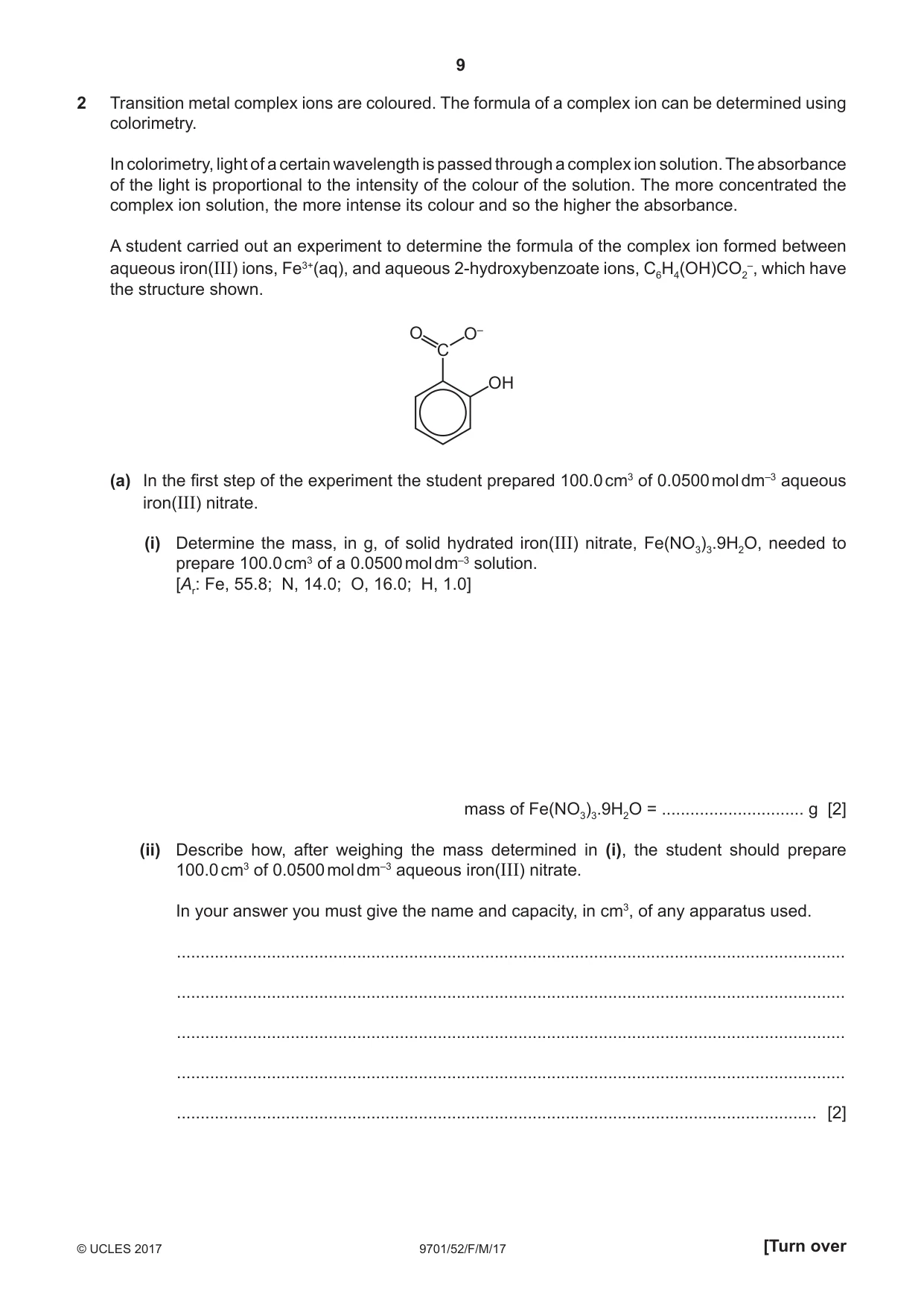
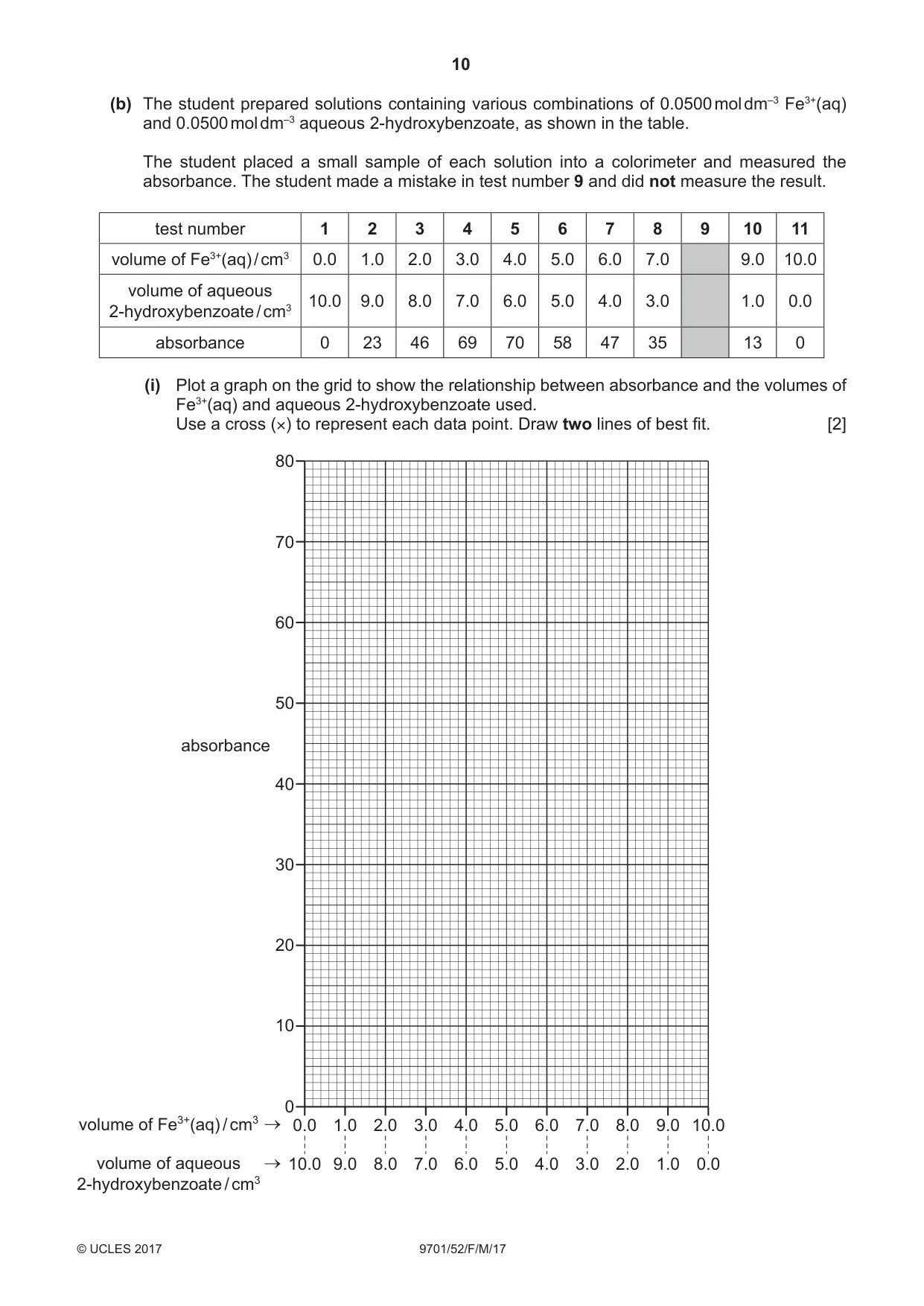
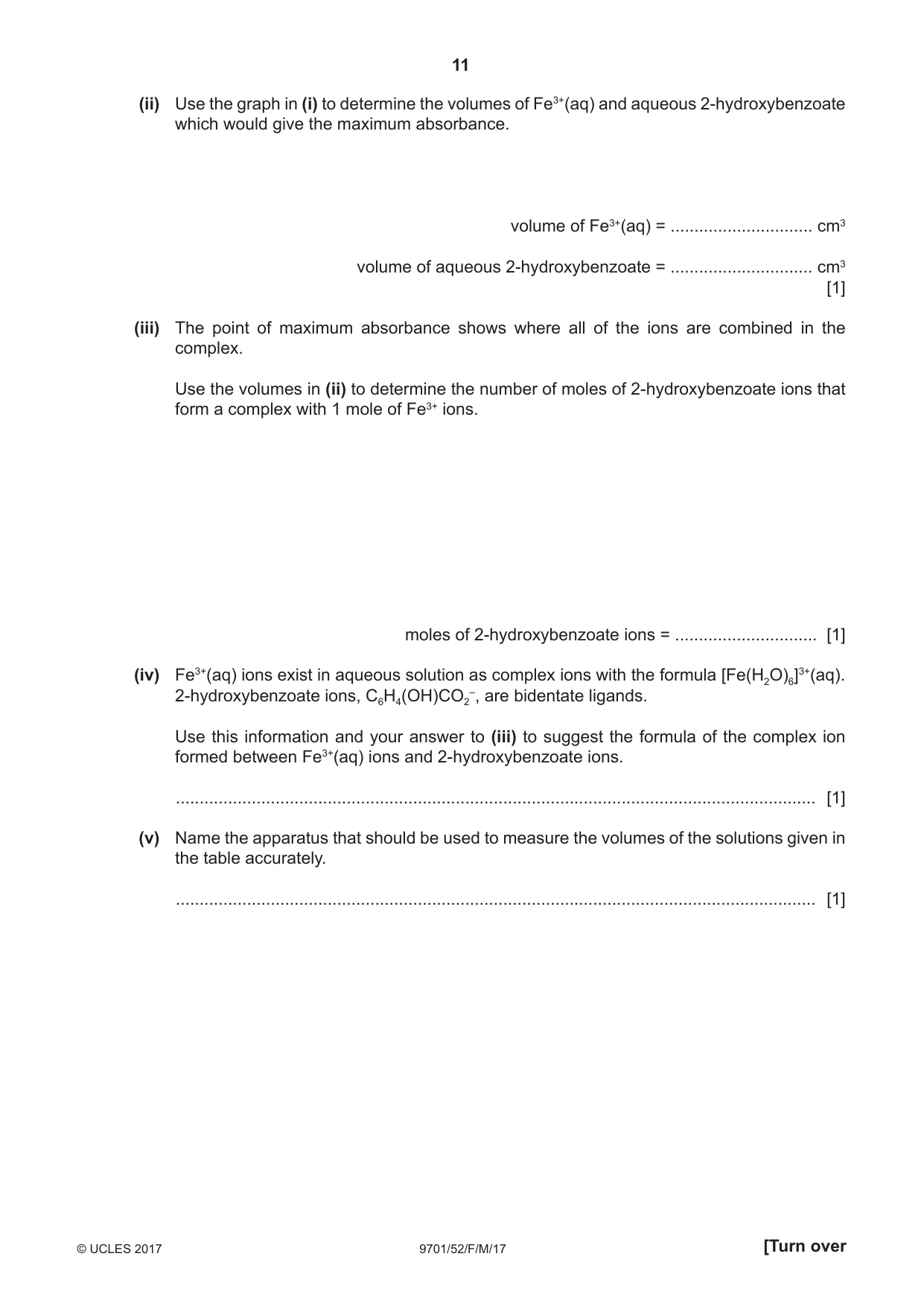
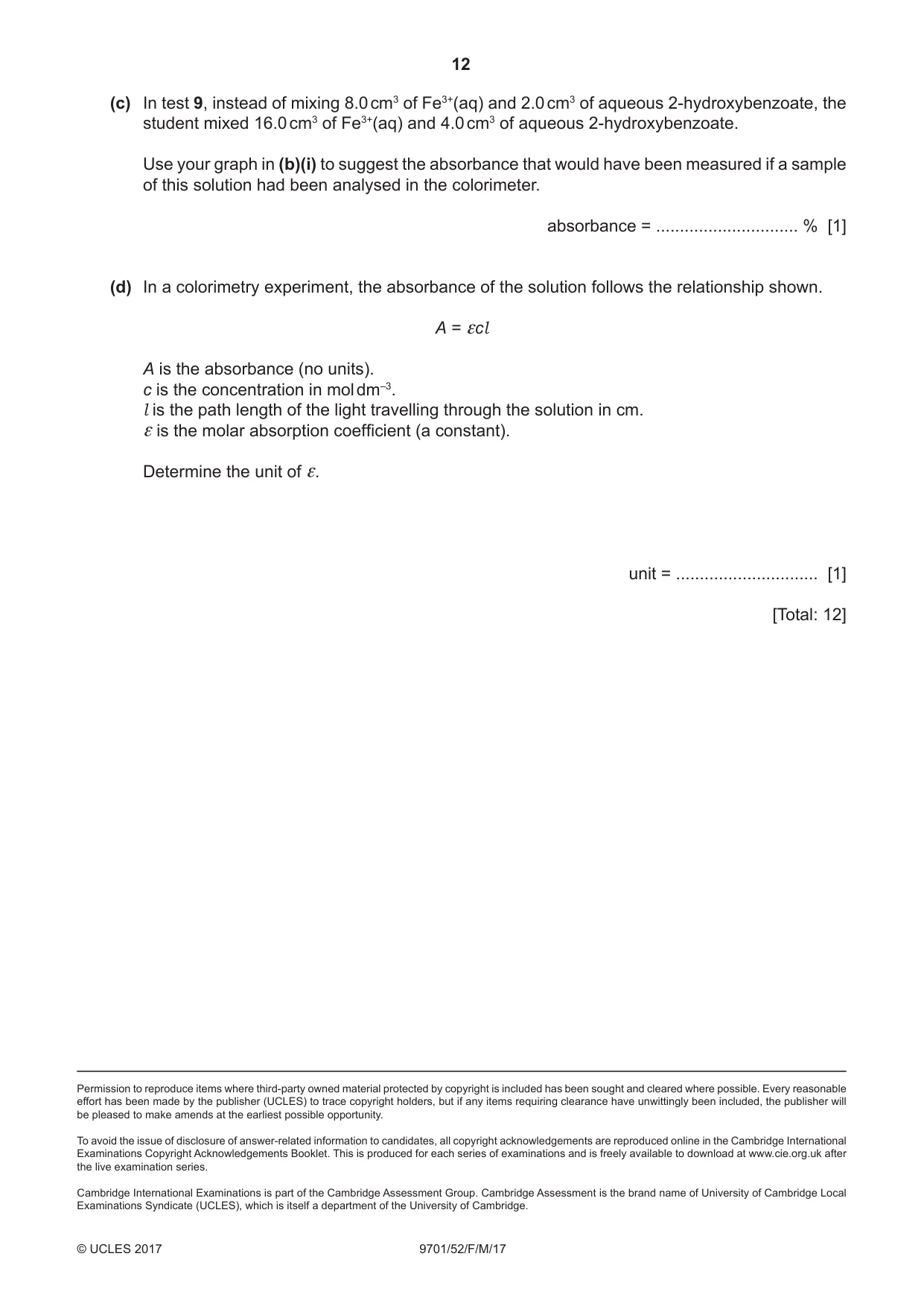
Mark scheme4 pages
Answers below. Sit the paper first if you are practising.
Questions as text
Q1 · The enthalpy change of reaction, ΔHr, for the decomposition of sodium hydrogencarbonate…
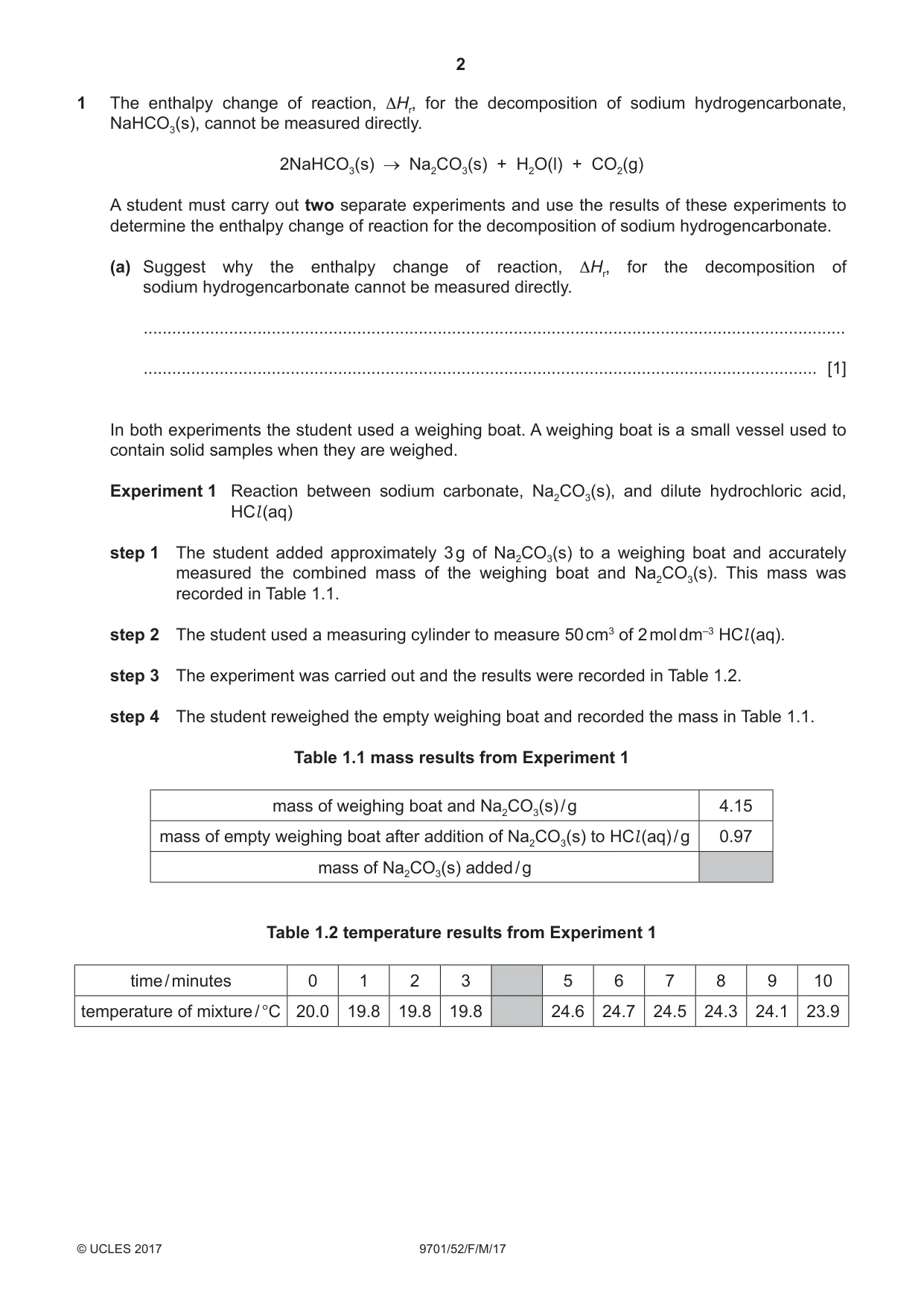
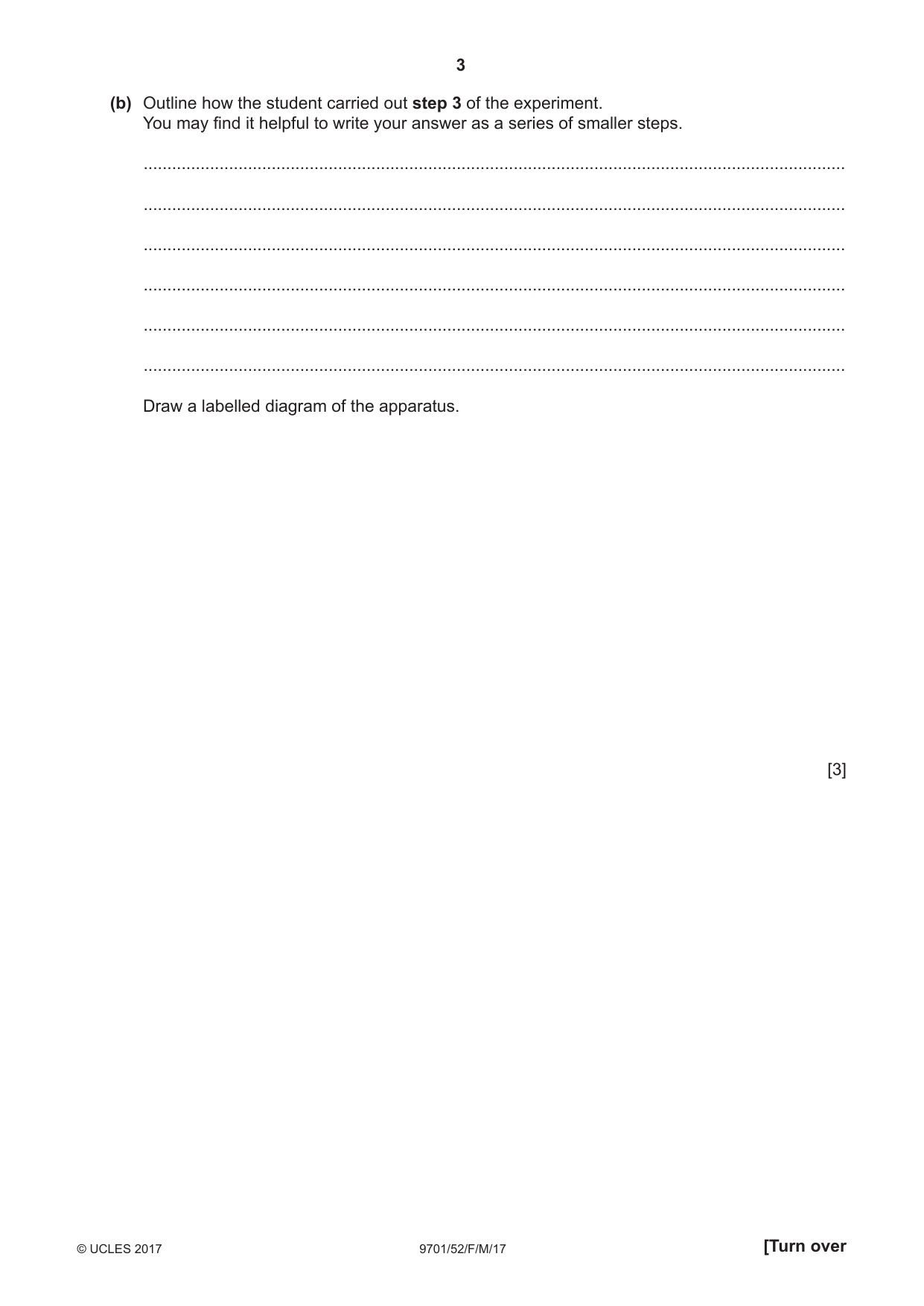
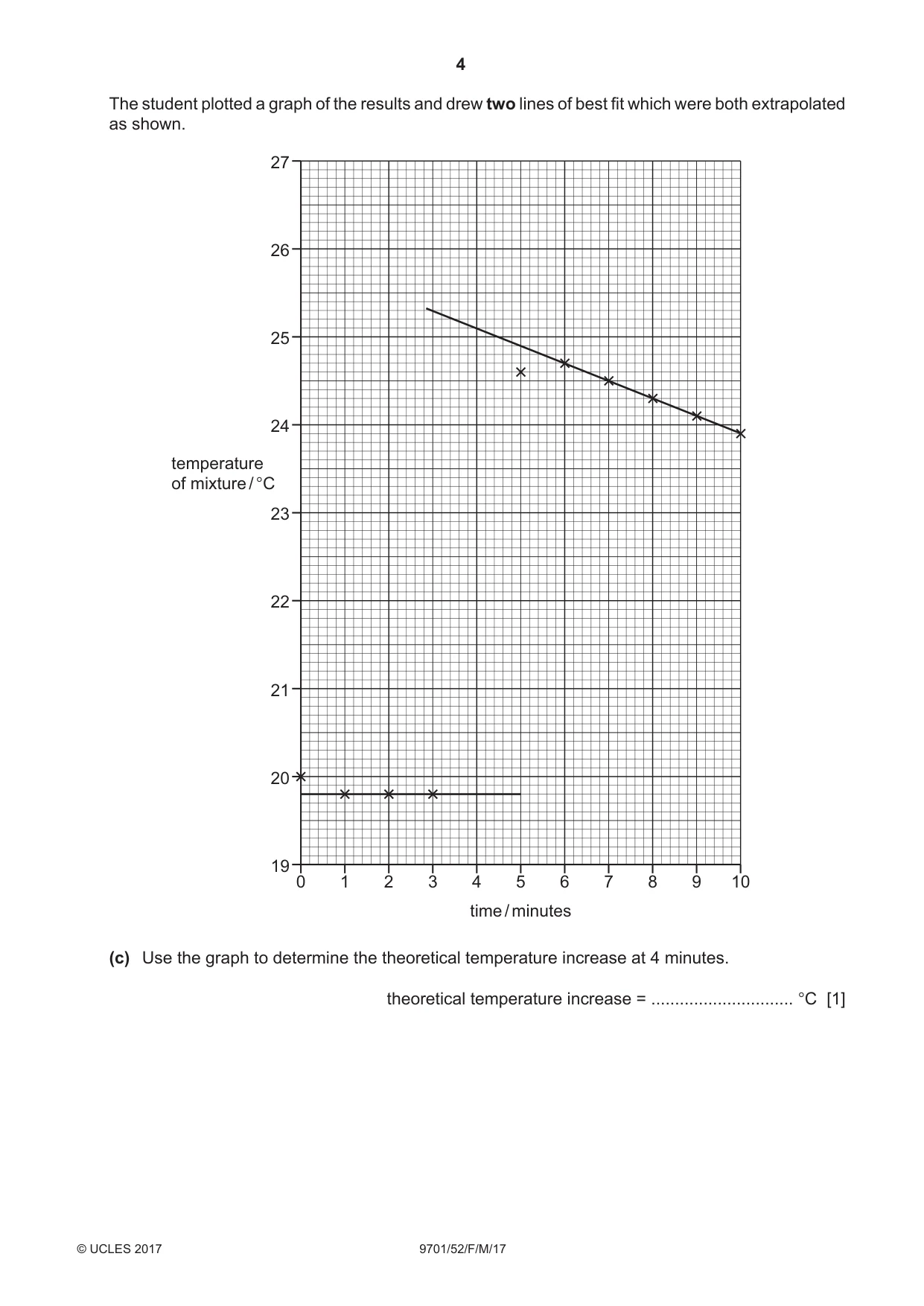
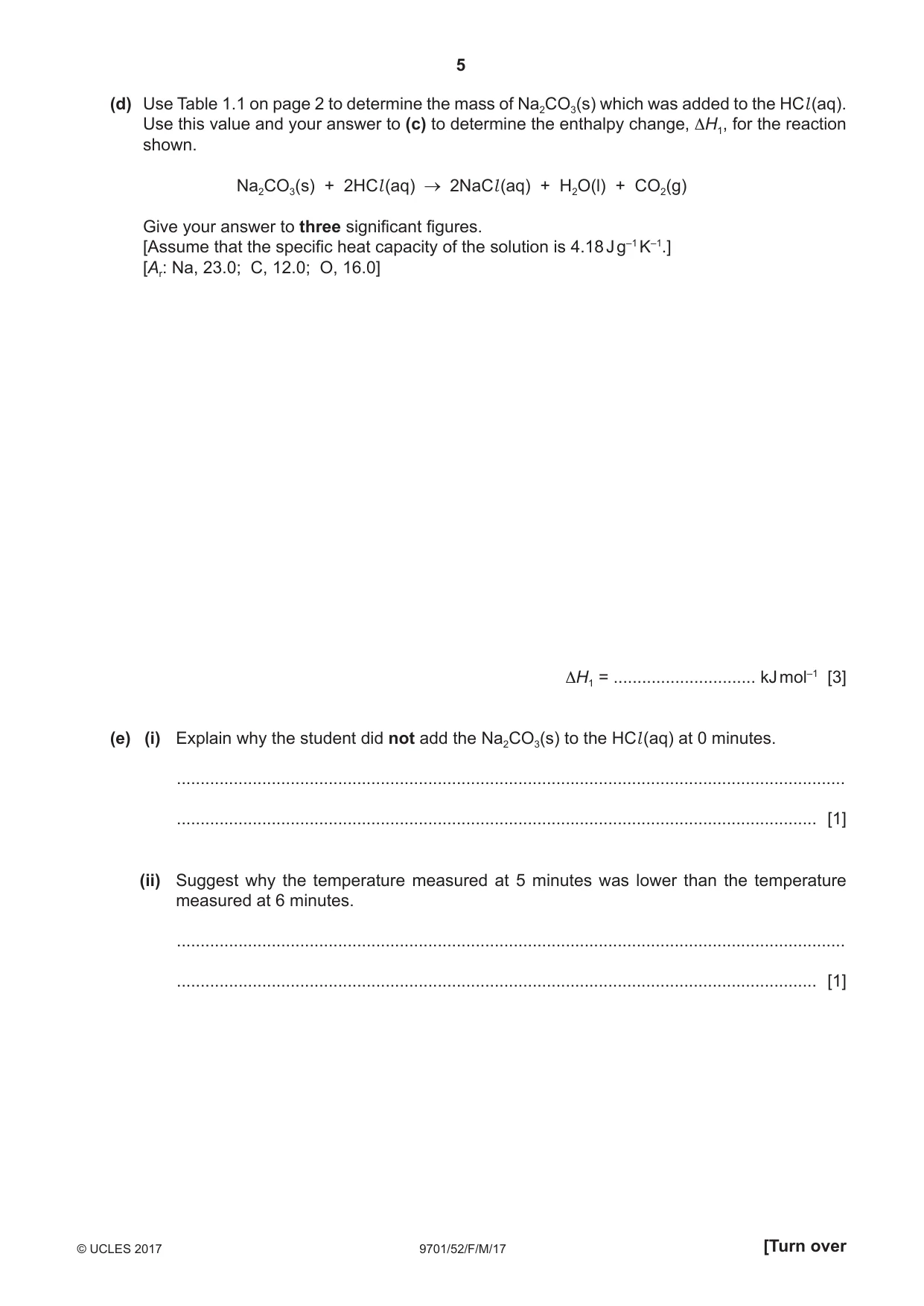
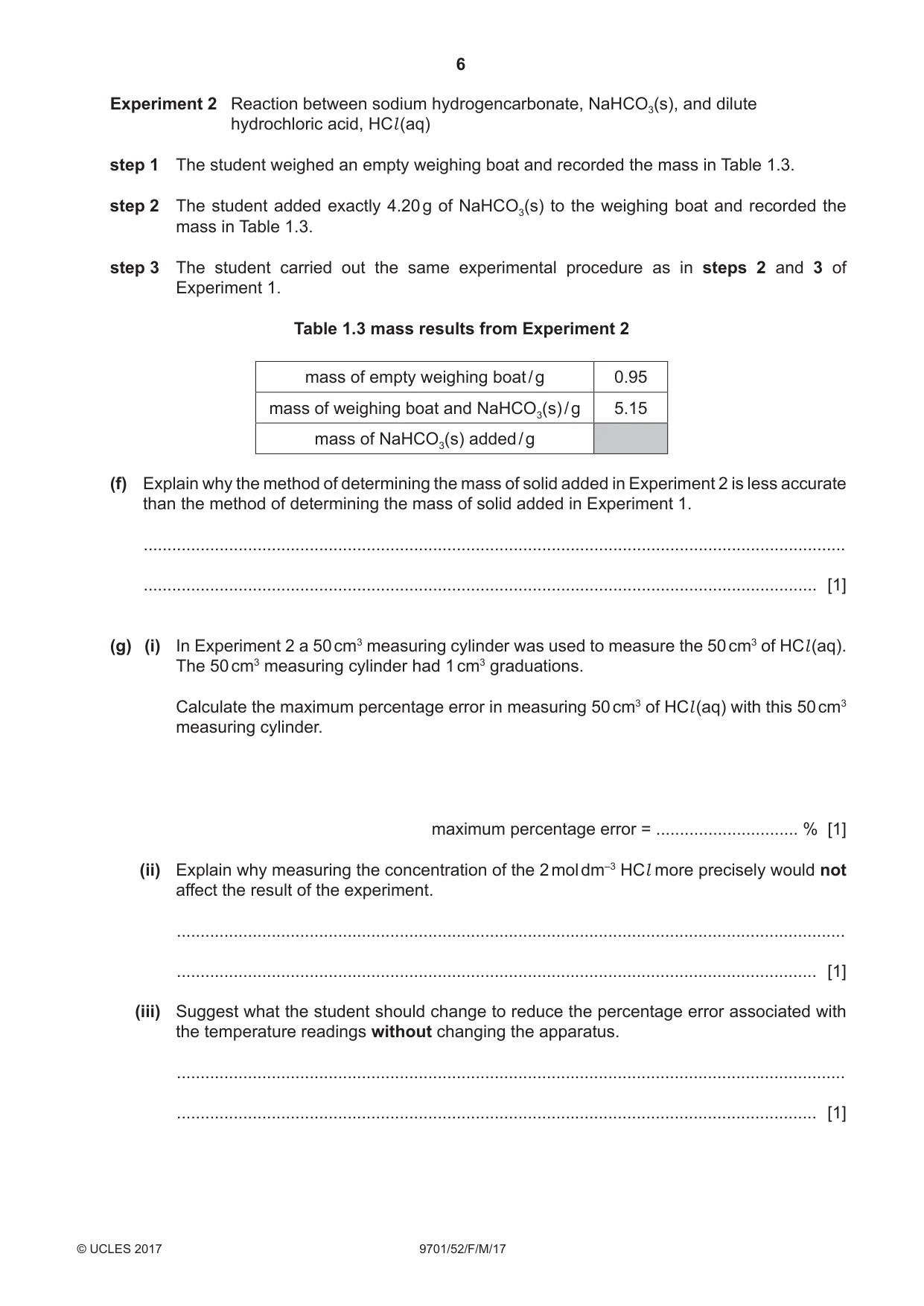
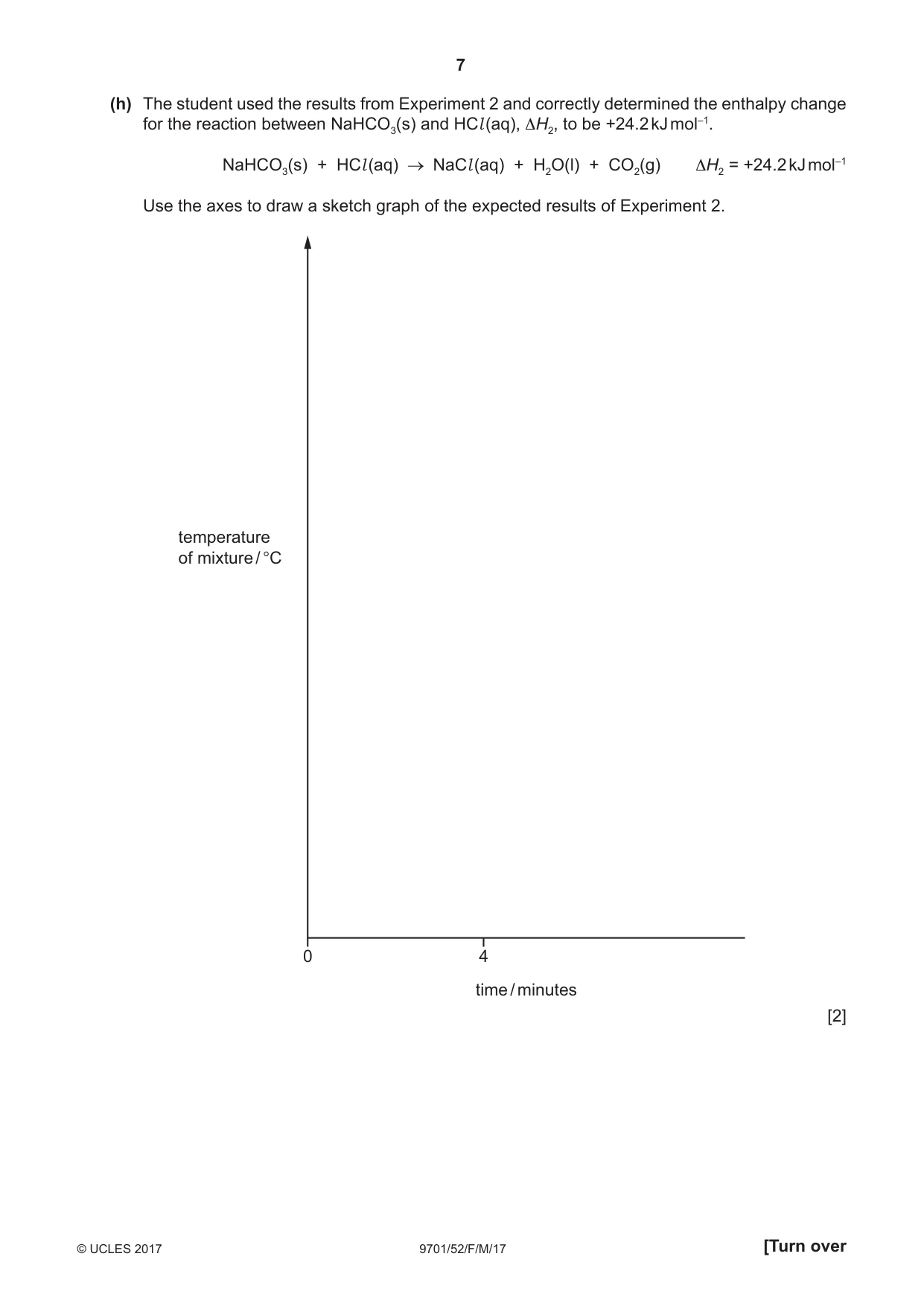
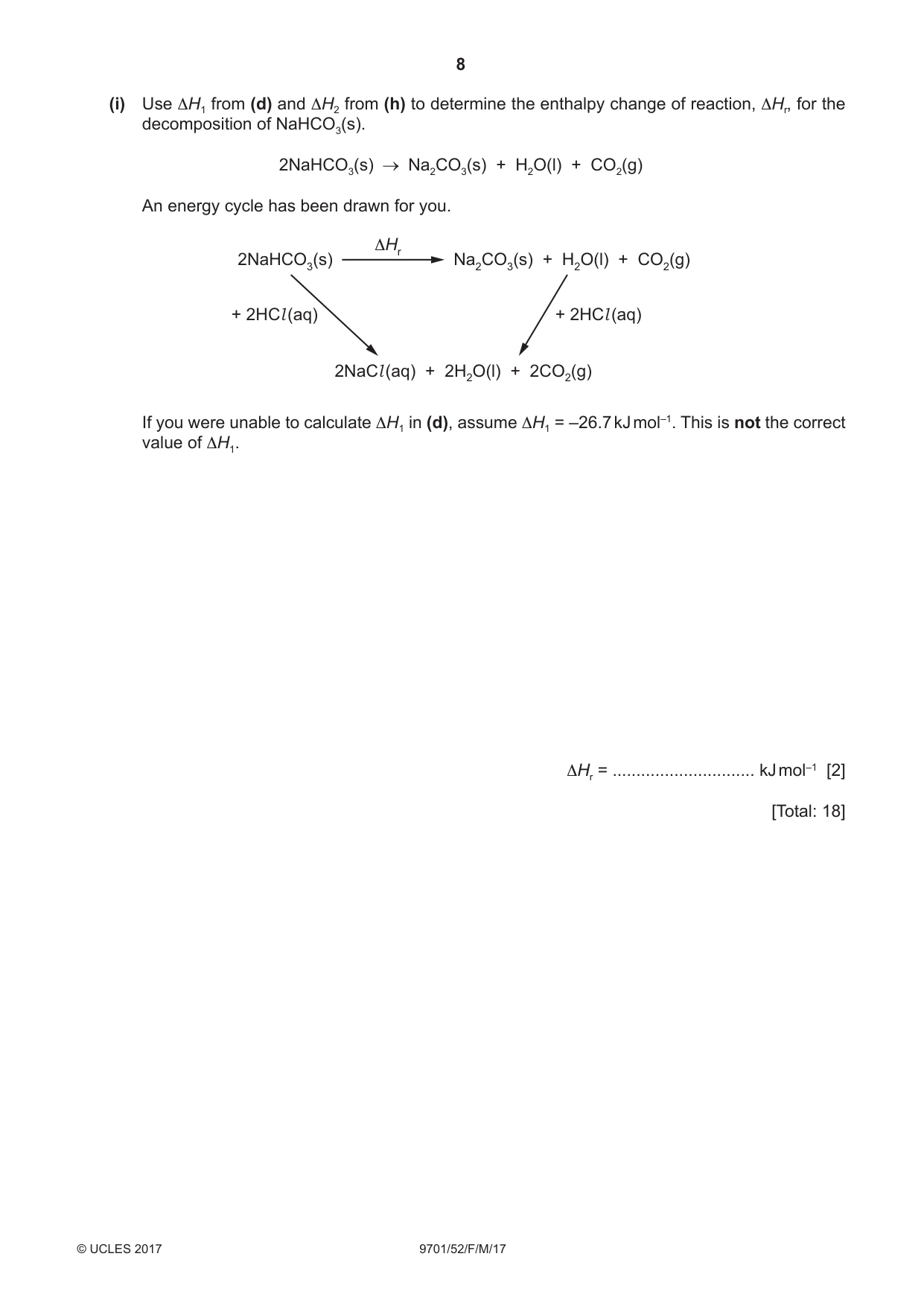
1 The enthalpy change of reaction, ΔHr, for the decomposition of sodium hydrogencarbonate, NaHCO3(s), cannot be measured directly. 2NaHCO3(s) Na2CO3(s) + H2O(l) + CO2(g) A student must carry out two separate experiments and use the results of these experiments to determine the enthalpy change of reaction for the decomposition of sodium hydrogencarbonate. (a) Suggest why the enthalpy change of reaction, ΔHr, for the decomposition of sodium hydrogencarbonate cannot be measured directly. .................................................................................................................................................... .............................................................................................................................................. [1] In both experiments the student used a weighing boat. A weighing boat is a small vessel used to contain solid samples when they are weighed. Experiment 1 Reaction between sodium carbonate, Na2CO3(s), and dilute hydrochloric acid, HCl (aq) step 1 The student added approximately 3 g of Na2CO3(s) to a weighing boat and accurately measured the combined mass of the weighing boat and Na2CO3(s). This mass was recorded in Table 1.1. step 2 The student used a measuring cylinder to measure 50 cm3 of 2 mol dm–3 HCl (aq). step 3 The experiment was carried out and the results were recorded in Table 1.2. step 4 The student reweighed the empty weighing boat and recorded the mass in Table 1.1. Table 1.1 mass results from Experiment 1 mass of weighing boat and Na2CO3(s) / g 4.15 mass of empty weighing boat after addition of Na2CO3(s) to HCl (aq) / g 0.97 mass of Na2CO3(s) added / g Table 1.2 temperature results from Experiment 1 time / minutes 0 1 2 3 5 6 7 8 9 10 temperature of mixture / °C 20.0 19.8 19.8 19.8 24.6 24.7 24.5 24.3 24.1 23.9 (b) Outline how the student carried out step 3 of the experiment. You may find it helpful to write your answer as a series of smaller steps. .................................................................................................................................................... .................................................................................................................................................... .................................................................................................................................................... .................................................................................................................................................... .................................................................................................................................................... .................................................................................................................................................... Draw a labelled diagram of the apparatus. [3] The student plotted a graph of the results and drew two lines of best fit which were both extrapolated as shown. 27 26 25 24 temperature of mixture / °C 23 22 21 20 19 0 1 2 3 4 5 6 7 8 9 10 time / minutes (c) Use the graph to determine the theoretical temperature increase at 4 minutes. theoretical temperature increase = .............................. °C [1] (d) Use Table 1.1 on page 2 to determine the mass of Na2CO3(s) which was added to the HCl (aq). Use this value and your answer to (c) to determine the enthalpy change, ΔH1, for the reaction shown. Na2CO3(s) + 2HCl (aq) 2NaCl (aq) + H2O(l) + CO2(g) Give your answer to three significant figures. [Assume that the specific heat capacity of the solution is 4.18 J g–1 K–1.] [Ar: Na, 23.0; C, 12.0; O, 16.0] ΔH1 = .............................. kJ mol–1 [3] (e) (i) Explain why the student did not add the Na2CO3(s) to the HCl (aq) at 0 minutes. ............................................................................................................................................. ....................................................................................................................................... [1] (ii) Suggest why the temperature measured at 5 minutes was lower than the temperature measured at 6 minutes. ............................................................................................................................................. ....................................................................................................................................... [1] Experiment 2 Reaction between sodium hydrogencarbonate, NaHCO3(s), and dilute hydrochloric acid, HCl (aq) step 1 The student weighed an empty weighing boat and recorded the mass in Table 1.3. step 2 The student added exactly 4.20 g of NaHCO3(s) to the weighing boat and recorded the mass in Table 1.3. step 3 The student carried out the same experimental procedure as in steps 2 and 3 of Experiment 1. Table 1.3 mass results from Experiment 2 mass of empty weighing boat / g 0.95 mass of weighing boat and NaHCO3(s) / g 5.15 mass of NaHCO3(s) added / g (f) Explain why the method of determining the mass of solid added in Experiment 2 is less accurate than the method of determining the mass of solid added in Experiment 1. .................................................................................................................................................... .............................................................................................................................................. [1] (g) (i) In Experiment 2 a 50 cm3 measuring cylinder was used to measure the 50 cm3 of HCl (aq). The 50 cm3 measuring cylinder had 1 cm3 graduations. Calculate the maximum percentage error in measuring 50 cm3 of HCl (aq) with this 50 cm3 measuring cylinder. maximum percentage error = .............................. % [1] (ii) Explain why measuring the concentration of the 2 mol dm–3 HCl more precisely would not affect the result of the experiment. ............................................................................................................................................. ....................................................................................................................................... [1] (iii) Suggest what the student should change to reduce the percentage error associated with the temperature readings without changing the apparatus. ............................................................................................................................................. ....................................................................................................................................... [1] (h) The student used the results from Experiment 2 and correctly determined the enthalpy change for the reaction between NaHCO3(s) and HCl (aq), ΔH2, to be +24.2 kJ mol–1. NaHCO3(s) + HCl (aq) NaCl (aq) + H2O(l) + CO2(g) ΔH2 = +24.2 kJ mol–1 Use the axes to draw a sketch graph of the expected results of Experiment 2. temperature of mixture / °C 0 4 time / minutes [2] (i) Use ΔH1 from (d) and ΔH2 from (h) to determine the enthalpy change of reaction, ΔHr, for the decomposition of NaHCO3(s). 2NaHCO3(s) Na2CO3(s) + H2O(l) + CO2(g) An energy cycle has been drawn for you. ΔHr 2NaHCO3(s) Na2CO3(s) + H2O(l) + CO2(g) + 2HCl (aq) + 2HCl (aq) 2NaCl (aq) + 2H2O(l) + 2CO2(g) If you were unable to calculate ΔH1 in (d), assume ΔH1 = –26.7 kJ mol–1. This is not the correct value of ΔH1. ΔHr = .............................. kJ mol–1 [2] [Total: 18]
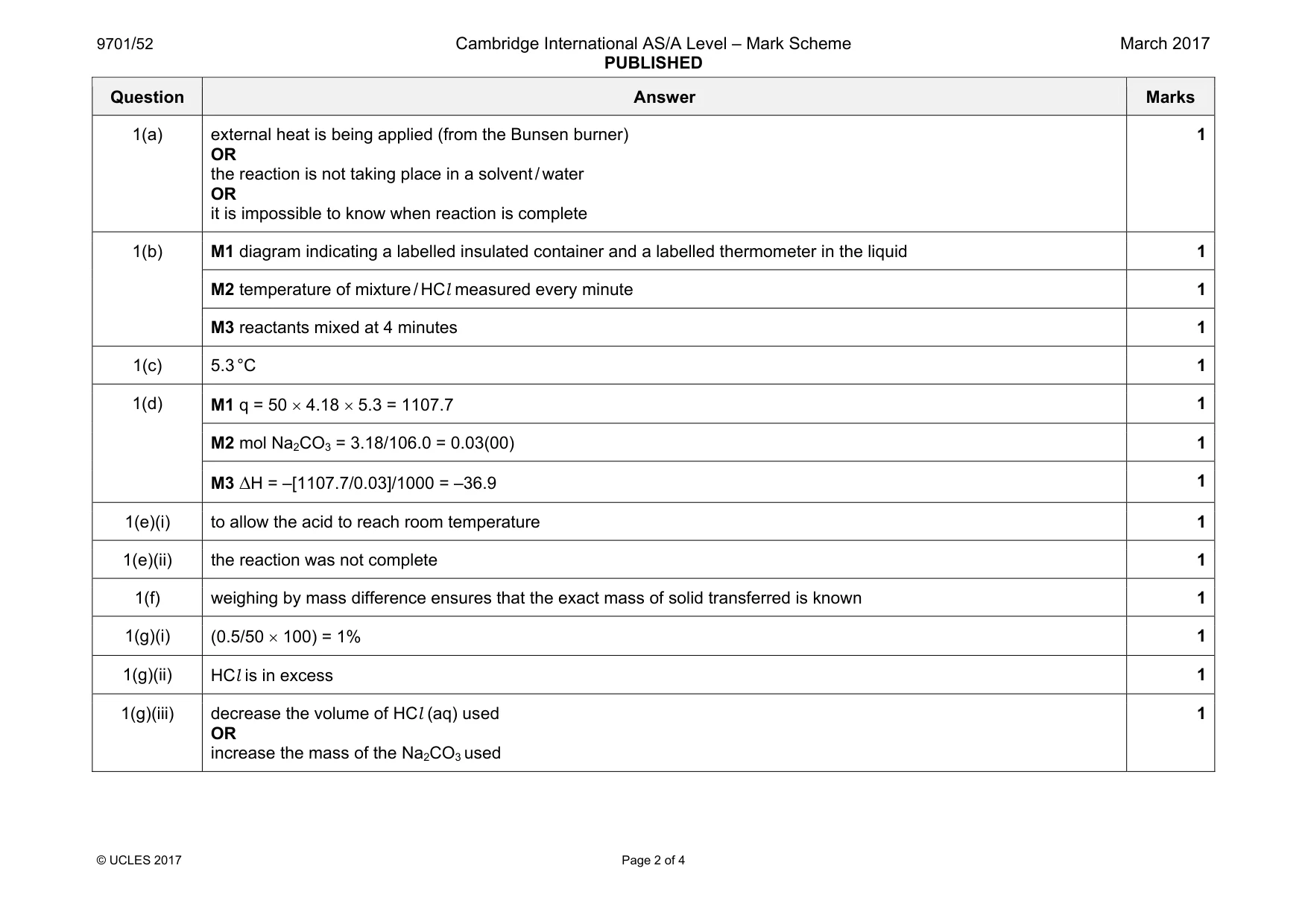
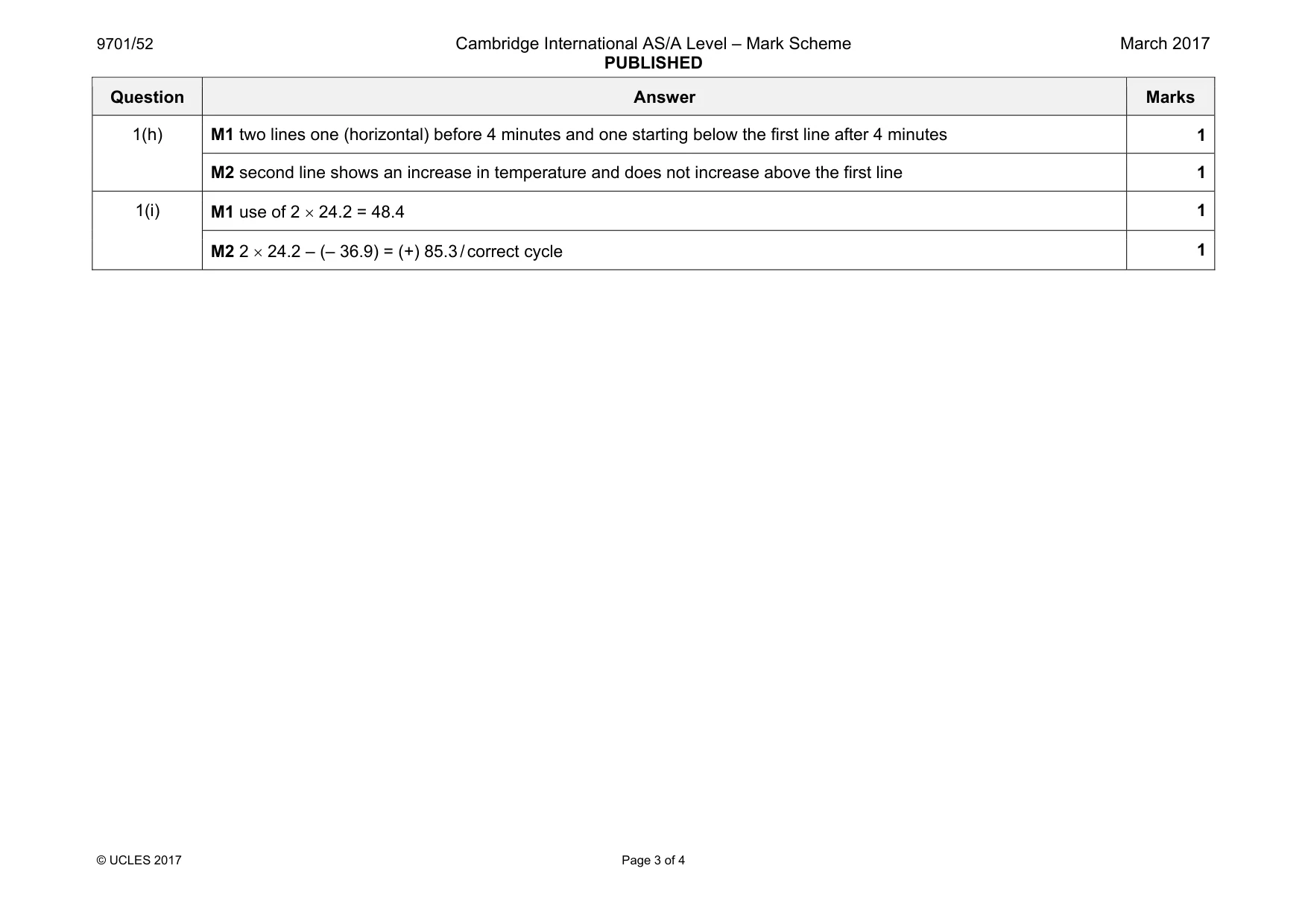
Mark scheme: 1(a) external heat is being applied (from the Bunsen burner) OR the reaction is not taking place in a solvent / water OR it is impossible to know when reaction is complete 1 1(b) M1 diagram indicating a labelled insulated container and a labelled thermometer in the liquid 1 M2 temperature of mixture / HCl measured every minute 1 M3 reactants mixed at 4 minutes 1 1(c) 5.3 °C 1 1(d) M1 q = 50 × 4.18 × 5.3 = 1107.7 1 M2 mol Na2CO3 = 3.18/106.0 = 0.03(00) 1 M3 ∆H = –[1107.7/0.03]/1000 = –36.9 1 1(e)(i) to allow the acid to reach room temperature 1 1(e)(ii) the reaction was not complete 1 1(f) weighing by mass difference ensures that the exact mass of solid transferred is known 1 1(g)(i) (0.5/50 × 100) = 1% 1 1(g)(ii) HCl is in excess 1 1(g)(iii) decrease the volume of HCl (aq) used OR increase the mass of the Na2CO3 used 1 Question Answer Marks 1(h) M1 two lines one (horizontal) before 4 minutes and one starting below the first line after 4 minutes 1 M2 second line shows an increase in temperature and does not increase above the first line 1 1(i) M1 use of 2 × 24.2 = 48.4 1 M2 2 × 24.2 – (– 36.9) = (+) 85.3 / correct cycle 1
Q2 · Transition metal complex ions are coloured
2 Transition metal complex ions are coloured. The formula of a complex ion can be determined using colorimetry. In colorimetry, light of a certain wavelength is passed through a complex ion solution. The absorbance of the light is proportional to the intensity of the colour of the solution. The more concentrated the complex ion solution, the more intense its colour and so the higher the absorbance. A student carried out an experiment to determine the formula of the complex ion formed between aqueous iron(III) ions, Fe3+(aq), and aqueous 2-hydroxybenzoate ions, C6H4(OH)CO2–, which have the structure shown. O O– C OH (a) In the first step of the experiment the student prepared 100.0 cm3 of 0.0500 mol dm–3 aqueous iron(III) nitrate. (i) Determine the mass, in g, of solid hydrated iron(III) nitrate, Fe(NO3)3.9H2O, needed to prepare 100.0 cm3 of a 0.0500 mol dm–3 solution. [Ar: Fe, 55.8; N, 14.0; O, 16.0; H, 1.0] mass of Fe(NO3)3.9H2O = .............................. g [2] (ii) Describe how, after weighing the mass determined in (i), the student should prepare 100.0 cm3 of 0.0500 mol dm–3 aqueous iron(III) nitrate. In your answer you must give the name and capacity, in cm3, of any apparatus used. ............................................................................................................................................. ............................................................................................................................................. ............................................................................................................................................. ............................................................................................................................................. ....................................................................................................................................... [2] (b) The student prepared solutions containing various combinations of 0.0500 mol dm–3 Fe3+(aq) and 0.0500 mol dm–3 aqueous 2-hydroxybenzoate, as shown in the table. The student placed a small sample of each solution into a colorimeter and measured the absorbance. The student made a mistake in test number 9 and did not measure the result. test number 1 2 3 4 5 6 7 8 9 10 11 volume of Fe3+(aq) / cm3 0.0 1.0 2.0 3.0 4.0 5.0 6.0 7.0 9.0 10.0 volume of aqueous 10.0 9.0 8.0 7.0 6.0 5.0 4.0 3.0 1.0 0.0 2-hydroxybenzoate / cm3 absorbance 0 23 46 69 70 58 47 35 13 0 (i) Plot a graph on the grid to show the relationship between absorbance and the volumes of Fe3+(aq) and aqueous 2-hydroxybenzoate used. Use a cross (×) to represent each data point. Draw two lines of best fit. [2] 80 70 60 50 absorbance 40 30 20 10 0 volume of Fe3+(aq) / cm3 0.0 1.0 2.0 3.0 4.0 5.0 6.0 7.0 8.0 9.0 10.0 volume of aqueous 10.0 9.0 8.0 7.0 6.0 5.0 4.0 3.0 2.0 1.0 0.0 2-hydroxybenzoate / cm3 (ii) Use the graph in (i) to determine the volumes of Fe3+(aq) and aqueous 2-hydroxybenzoate which would give the maximum absorbance. volume of Fe3+(aq) = .............................. cm3 volume of aqueous 2-hydroxybenzoate = .............................. cm3 [1] (iii) The point of maximum absorbance shows where all of the ions are combined in the complex. Use the volumes in (ii) to determine the number of moles of 2-hydroxybenzoate ions that form a complex with 1 mole of Fe3+ ions. moles of 2-hydroxybenzoate ions = .............................. [1] (iv) Fe3+(aq) ions exist in aqueous solution as complex ions with the formula [Fe(H2O)6]3+(aq). 2-hydroxybenzoate ions, C6H4(OH)CO2–, are bidentate ligands. Use this information and your answer to (iii) to suggest the formula of the complex ion formed between Fe3+(aq) ions and 2-hydroxybenzoate ions. ....................................................................................................................................... [1] (v) Name the apparatus that should be used to measure the volumes of the solutions given in the table accurately. ....................................................................................................................................... [1]
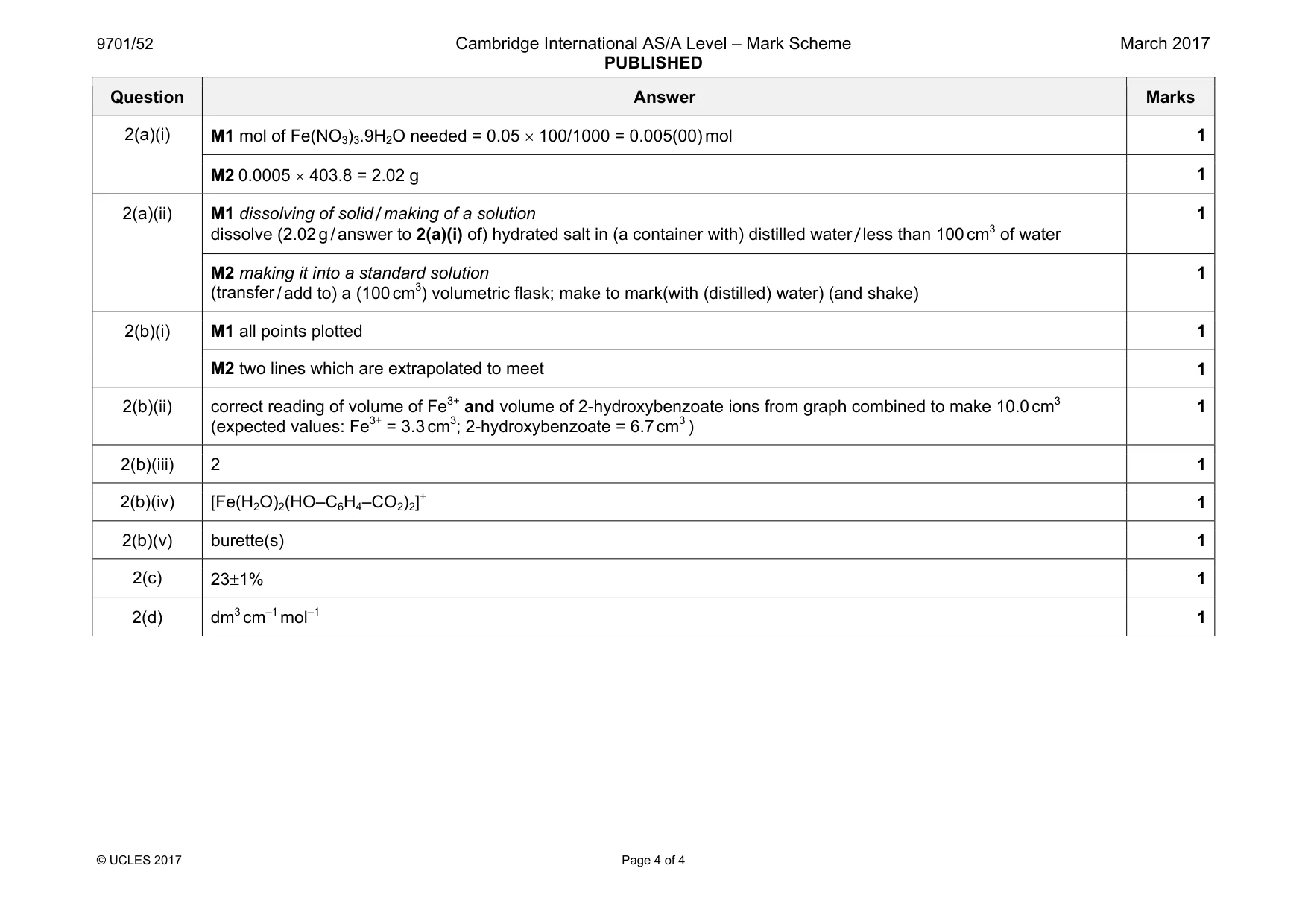
Mark scheme: 2(a)(i) 1 M2 0.0005 × 403.8 = 2.02 g 1 2(a)(ii) M1 dissolving of solid / making of a solution dissolve (2.02 g / answer to 2(a)(i) of) hydrated salt in (a container with) distilled water / less than 100 cm3 of water 1 M2 making it into a standard solution (transfer / add to) a (100 cm3) volumetric flask; make to mark(with (distilled) water) (and shake) 1 2(b)(i) M1 all points plotted 1 M2 two lines which are extrapolated to meet 1 2(b)(ii) correct reading of volume of Fe3+ and volume of 2-hydroxybenzoate ions from graph combined to make 10.0 cm3 (expected values: Fe3+ = 3.3 cm3; 2-hydroxybenzoate = 6.7 cm3 ) 1 2(b)(iii) 2 1 2(b)(iv) [Fe(H2O)2(HO–C6H4–CO2)2]+ 1 2(b)(v) burette(s) 1 2(c) 23±1% 1 2(d) dm3 cm–1 mol–1 1
More questions on Reacting masses and volumes (of solutions and gases)
What was in this paper
The subtopics covered by these 2 questions, and how many questions each got. Open one in a new tab to see every Cambridge question on it.
What you needed in this session
Cambridge’s own grade thresholds for 2017 Feb/March, Paper 5 · Variant 2. A higher threshold means an easier paper — the bar moves with how the cohort did.