Cambridge A Level Chemistry 9701 — 2017 Feb/March Paper 2 · Variant 2
9701/22/F/M/17 · 3 questions · 60 marks · ≈68 min
The question paper and its mark scheme, free to read here and free to download. This is Cambridge’s own paper, exactly as it was sat.
Question paper16 pages
Mark scheme5 pages
Answers below. Sit the paper first if you are practising.
Questions as text
Q1 · The table shows information about some of the elements in the third period
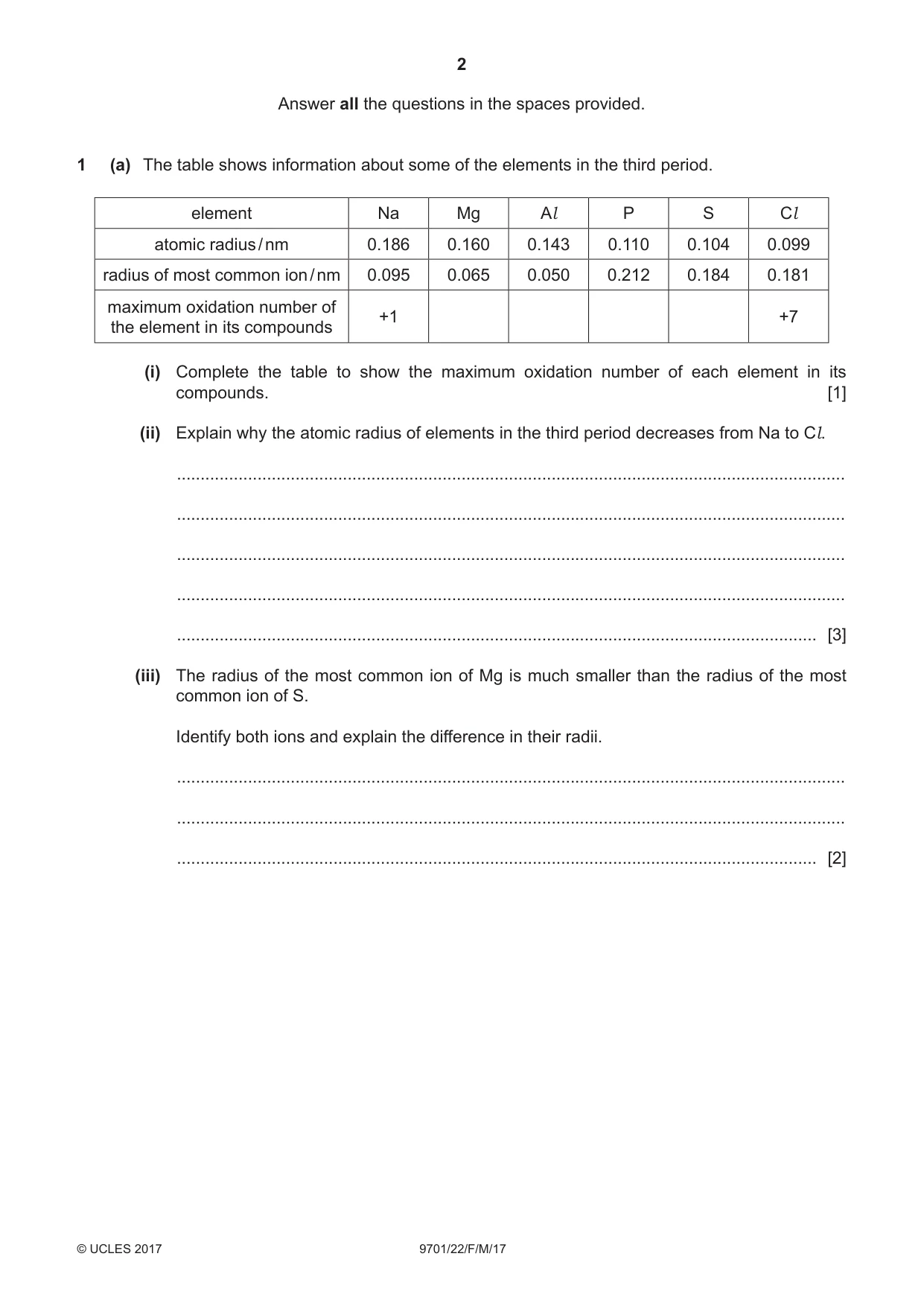
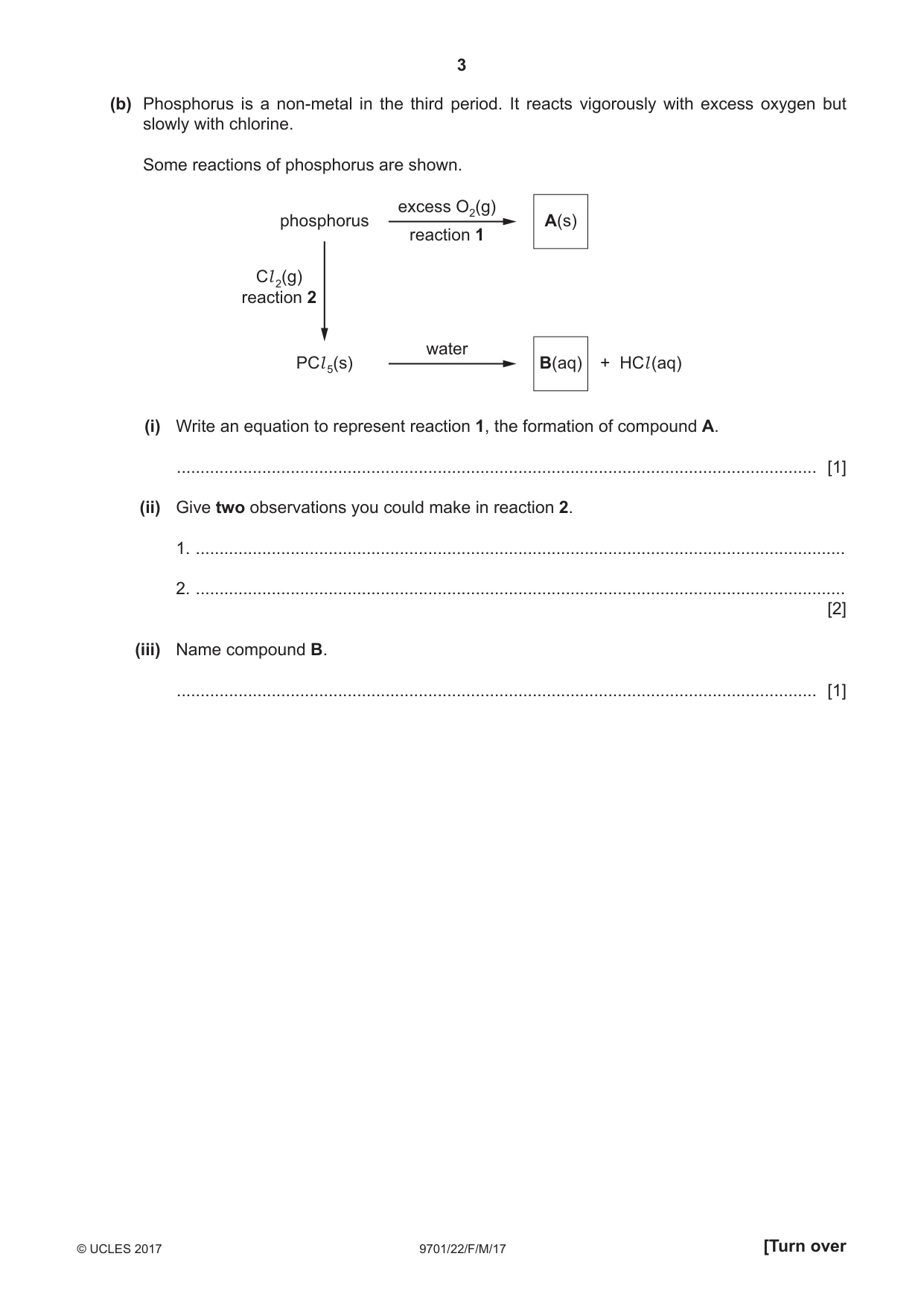
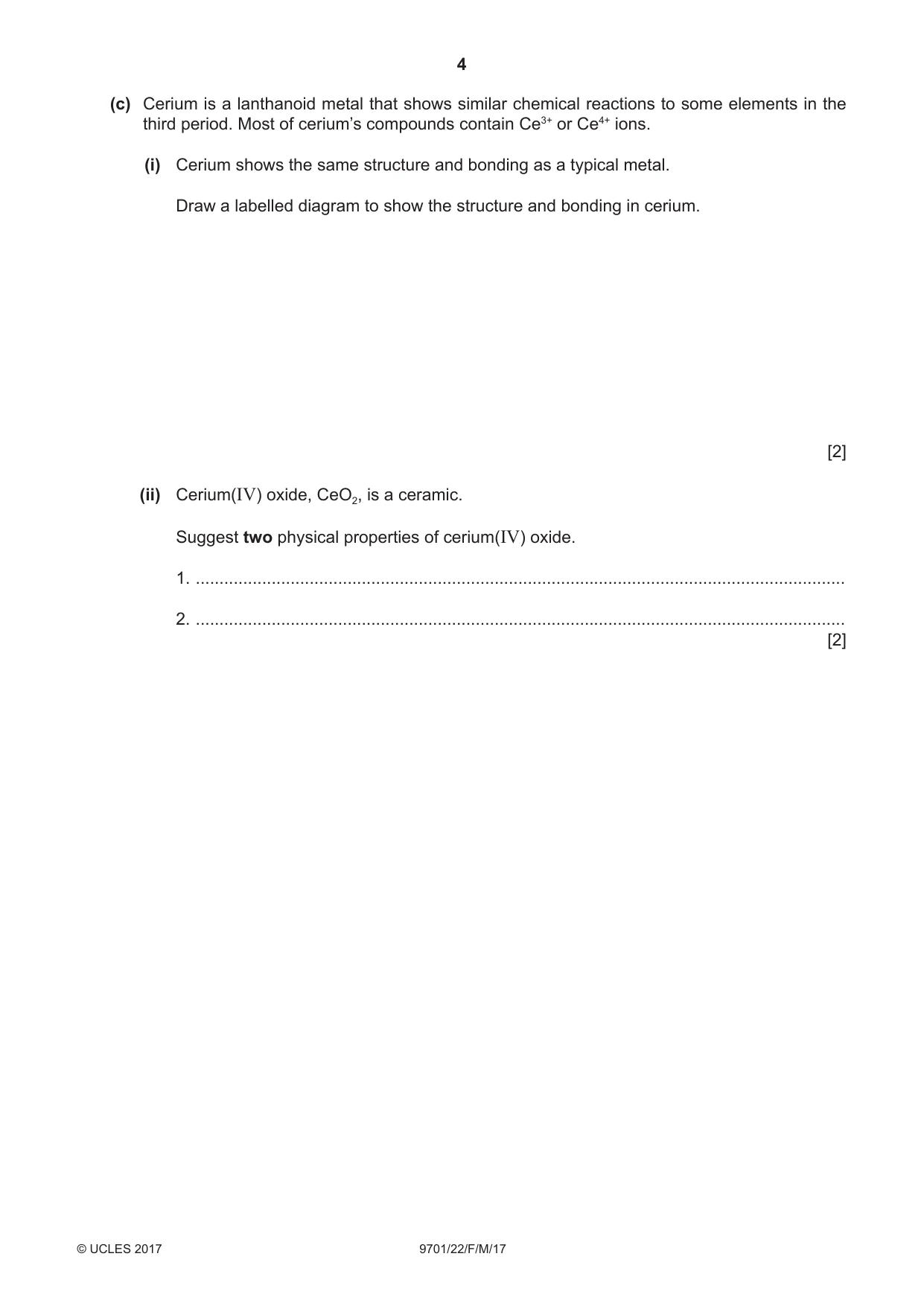
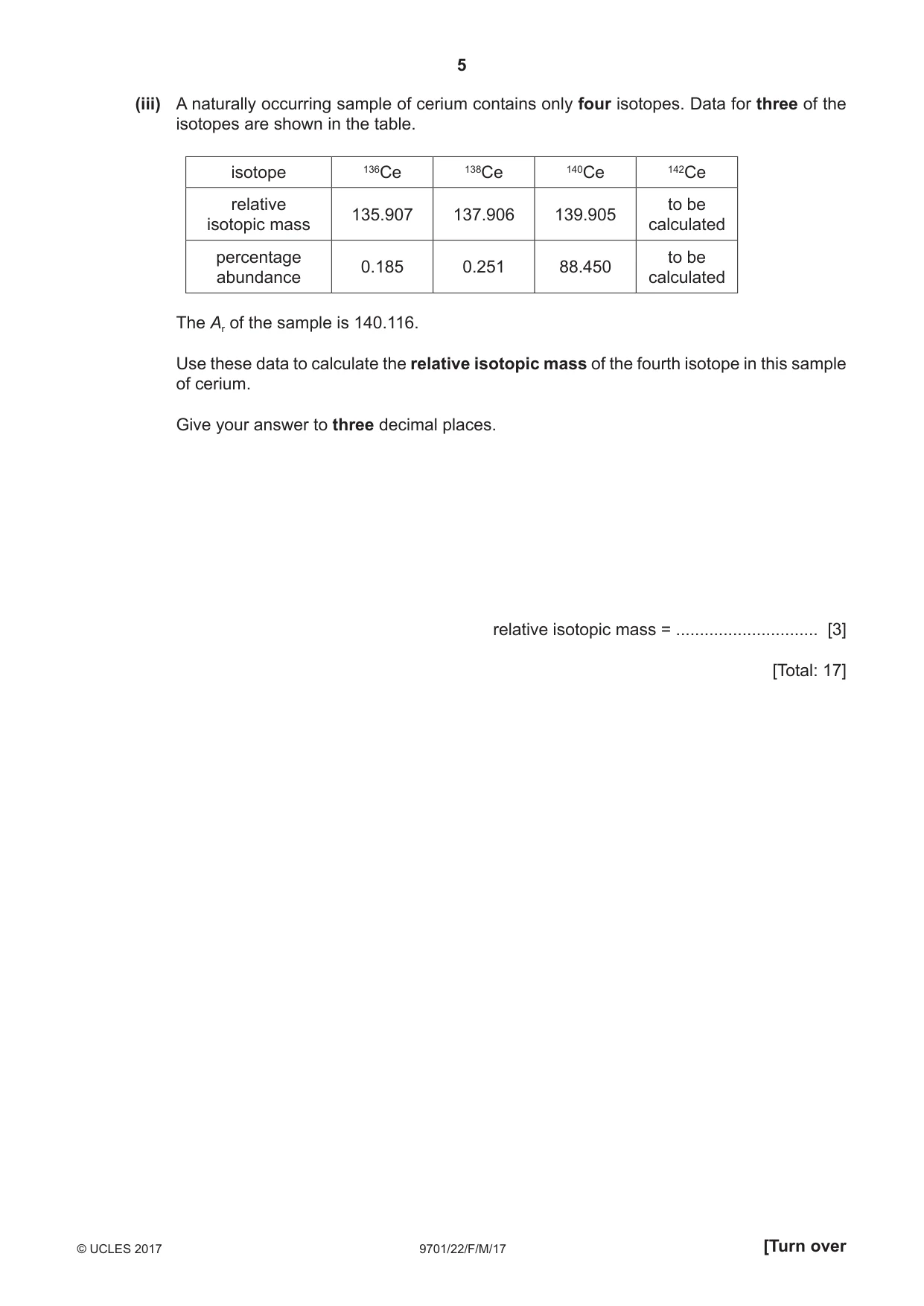
1 (a) The table shows information about some of the elements in the third period. element Na Mg Al P S Cl atomic radius / nm 0.186 0.160 0.143 0.110 0.104 0.099 radius of most common ion / nm 0.095 0.065 0.050 0.212 0.184 0.181 maximum oxidation number of +1 +7 the element in its compounds (i) Complete the table to show the maximum oxidation number of each element in its compounds. [1] (ii) Explain why the atomic radius of elements in the third period decreases from Na to Cl. ............................................................................................................................................. ............................................................................................................................................. ............................................................................................................................................. ............................................................................................................................................. ....................................................................................................................................... [3] (iii) The radius of the most common ion of Mg is much smaller than the radius of the most common ion of S. Identify both ions and explain the difference in their radii. ............................................................................................................................................. ............................................................................................................................................. ....................................................................................................................................... [2] (b) Phosphorus is a non-metal in the third period. It reacts vigorously with excess oxygen but slowly with chlorine. Some reactions of phosphorus are shown. excess O2(g) phosphorus A(s) reaction 1 Cl 2(g) reaction 2 water PCl 5(s) B(aq) + HCl (aq) (i) Write an equation to represent reaction 1, the formation of compound A. ....................................................................................................................................... [1] (ii) Give two observations you could make in reaction 2. 1. ......................................................................................................................................... 2. ......................................................................................................................................... [2] (iii) Name compound B. ....................................................................................................................................... [1] (c) Cerium is a lanthanoid metal that shows similar chemical reactions to some elements in the third period. Most of cerium’s compounds contain Ce3+ or Ce4+ ions. (i) Cerium shows the same structure and bonding as a typical metal. Draw a labelled diagram to show the structure and bonding in cerium. [2] (ii) Cerium(IV) oxide, CeO2, is a ceramic. Suggest two physical properties of cerium(IV) oxide. 1. ......................................................................................................................................... 2. ......................................................................................................................................... [2] (iii) A naturally occurring sample of cerium contains only four isotopes. Data for three of the isotopes are shown in the table. isotope 136Ce 138Ce 140Ce 142Ce relative to be 135.907 137.906 139.905 isotopic mass calculated percentage to be 0.185 0.251 88.450 abundance calculated The Ar of the sample is 140.116. Use these data to calculate the relative isotopic mass of the fourth isotope in this sample of cerium. Give your answer to three decimal places. relative isotopic mass = .............................. [3] [Total: 17]
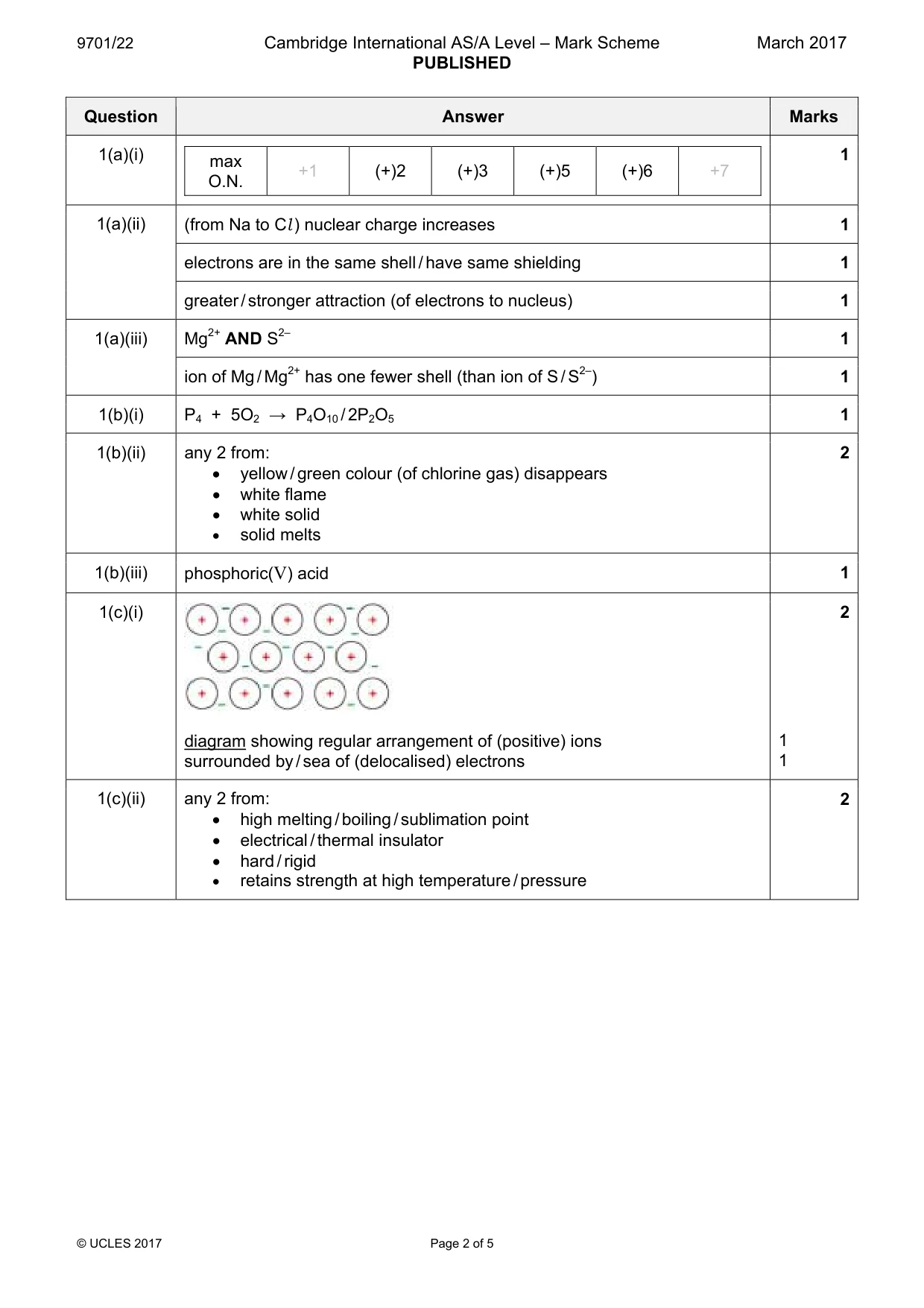
Mark scheme: Question Answer Marks 1(a)(i) 1 max +1 (+)2 (+)3 (+)5 (+)6 +7 O.N. 1(a)(ii) (from Na to Cl ) nuclear charge increases 1 electrons are in the same shell / have same shielding 1 greater / stronger attraction (of electrons to nucleus) 1 1(a)(iii) Mg2+ AND S2– 1 ion of Mg / Mg2+ has one fewer shell (than ion of S / S2–) 1 1(b)(i) P4 + 5O2 → P4O10 / 2P2O5 1 1(b)(ii) any 2 from: 2 • yellow / green colour (of chlorine gas) disappears • white flame • white solid • solid melts 1(b)(iii) phosphoric(V) acid 1 1(c)(i) 2 diagram showing regular arrangement of (positive) ions 1 surrounded by / sea of (delocalised) electrons 1 1(c)(ii) any 2 from: 2 • high melting / boiling / sublimation point • electrical / thermal insulator • hard / rigid • retains strength at high temperature / pressure 1(c)(iii) M1 1 % abundance of fourth isotope = 100 – (0.185 + 0.251 + 88.450) = 11.114 M2 1 (0.185 × 135.907) + (0.251 × 137.906) + (88.450 × 139.905) + (11.114 × RIM) 100 = 140.116 ∴ (140.116 × 100) – 12434.35 = 1577.246 = 11.114 × RIM M3 1 1577.246 RIM = = 141.915 11.114
Q2 · Hydrogen halides are compounds formed when halogens (Group 17 elements) react with…
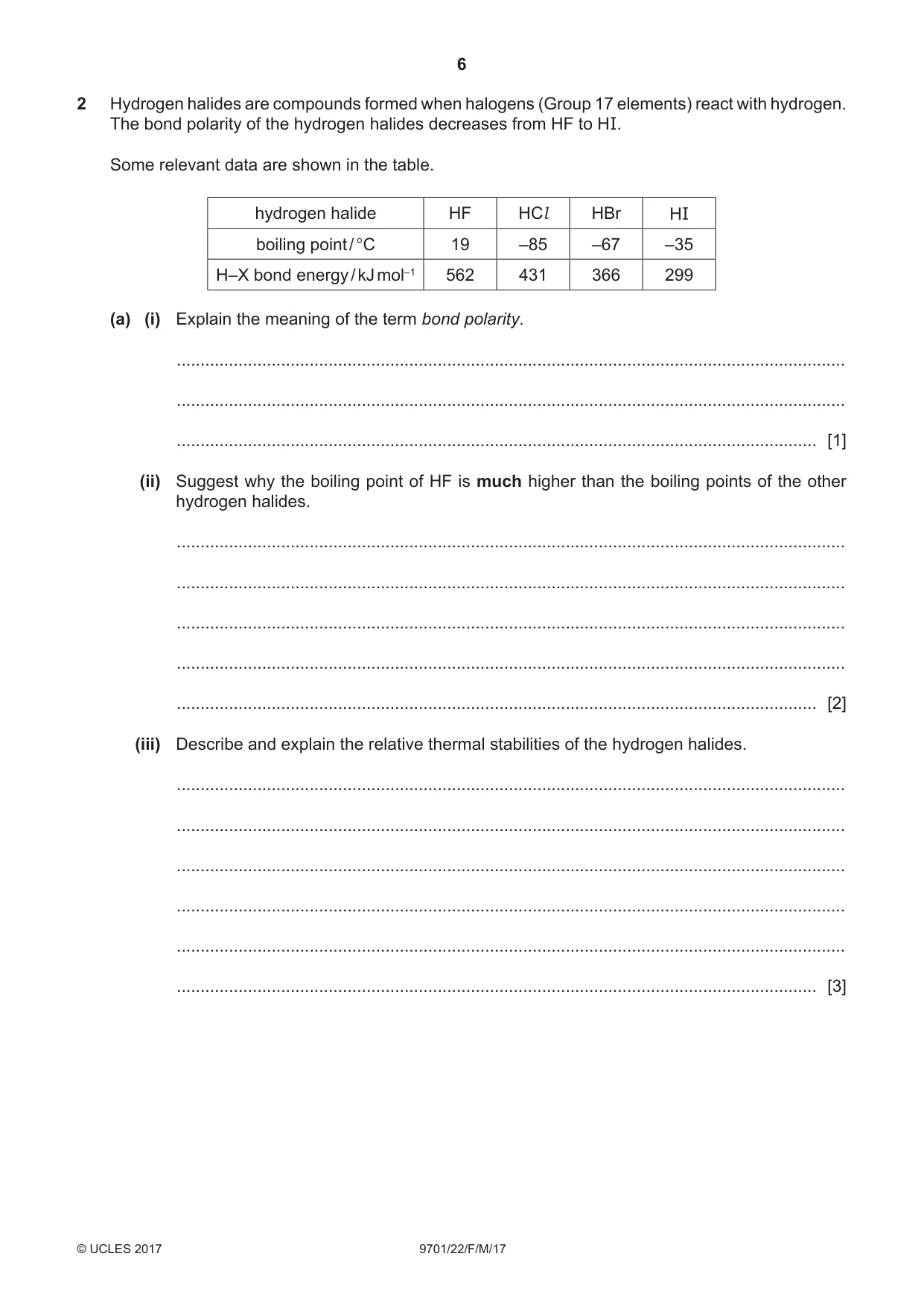
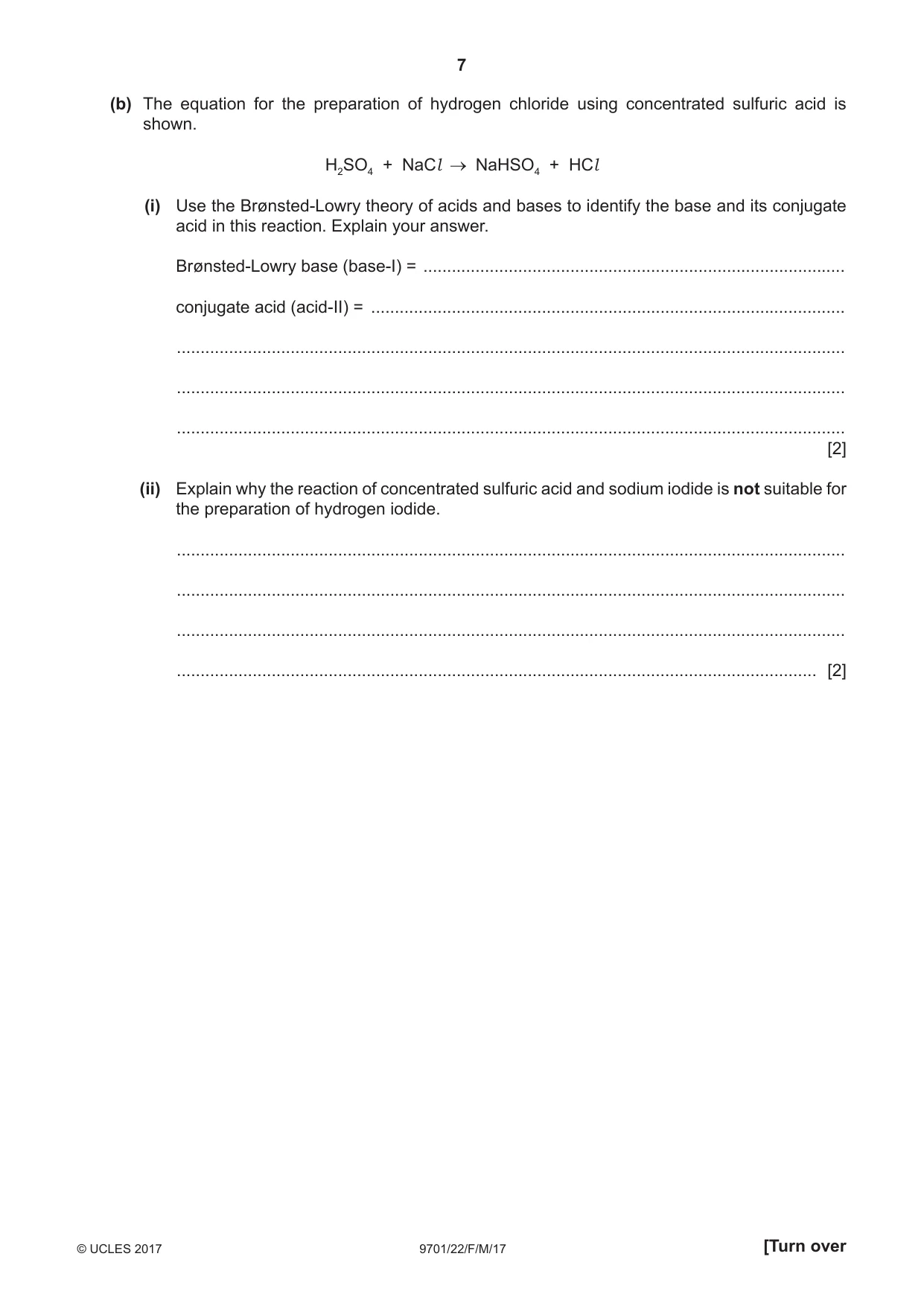
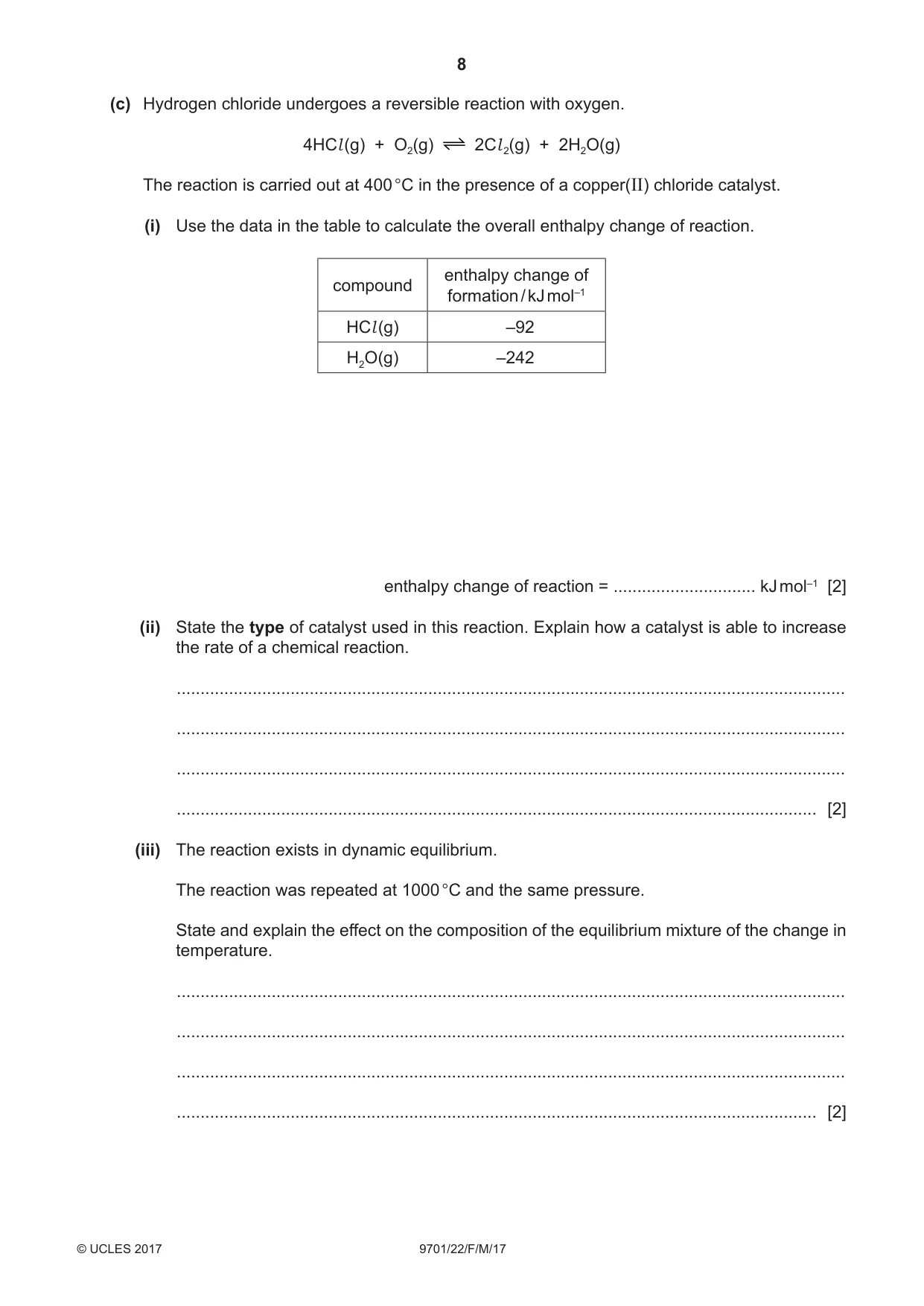
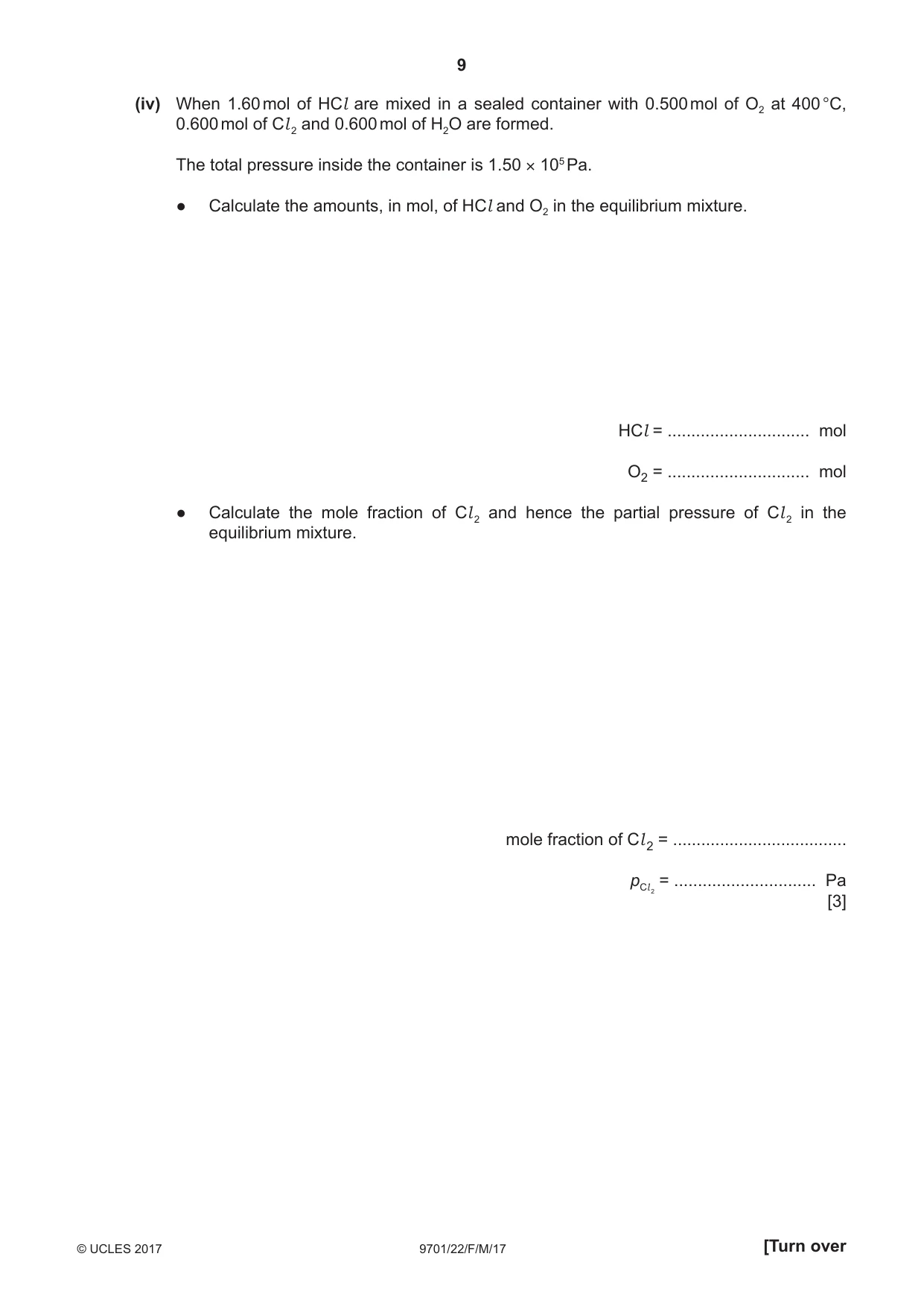
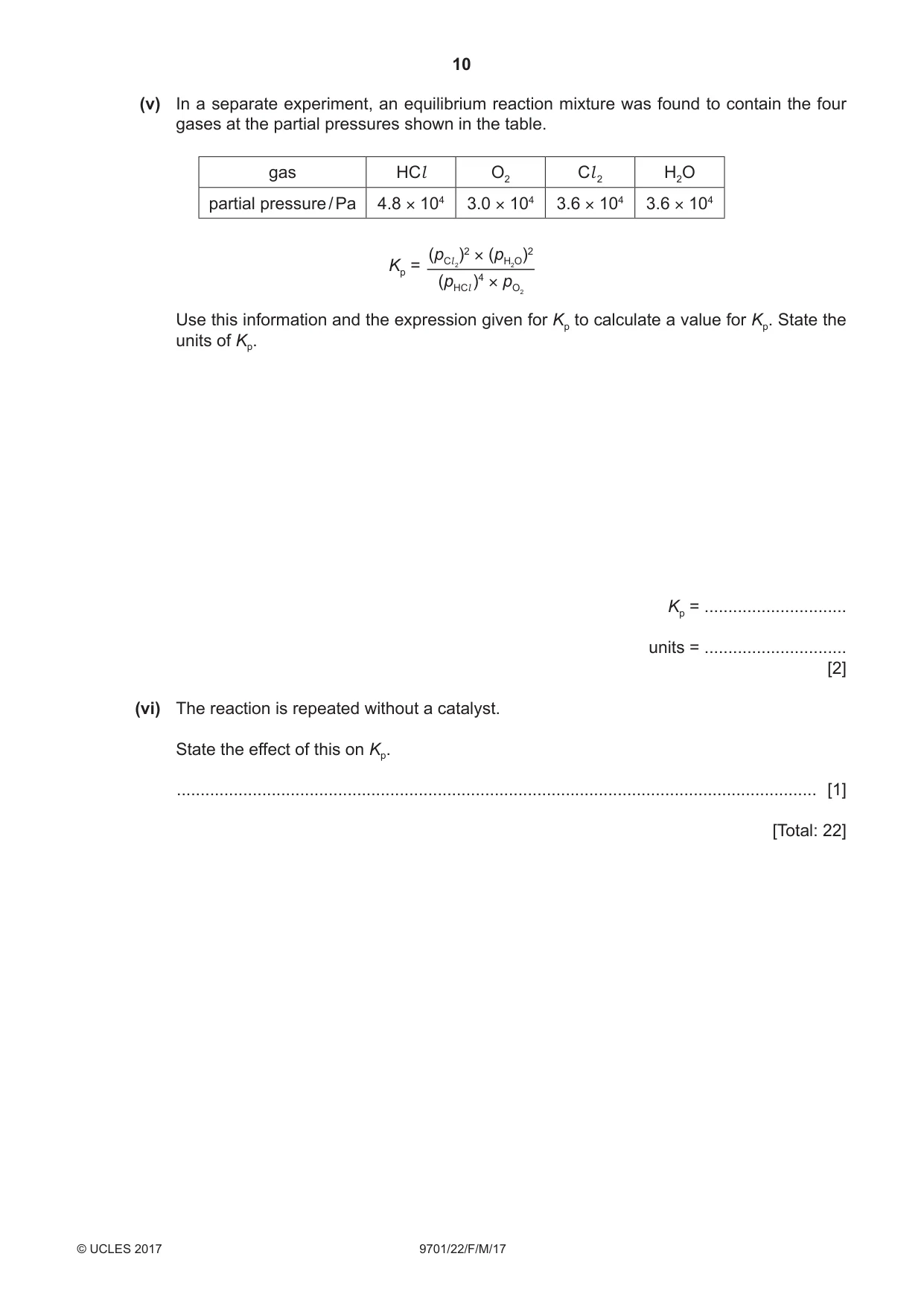
2 Hydrogen halides are compounds formed when halogens (Group 17 elements) react with hydrogen. The bond polarity of the hydrogen halides decreases from HF to HI. Some relevant data are shown in the table. hydrogen halide HF HCl HBr HI boiling point / °C 19 –85 –67 –35 H–X bond energy / kJ mol–1 562 431 366 299 (a) (i) Explain the meaning of the term bond polarity. ............................................................................................................................................. ............................................................................................................................................. ....................................................................................................................................... [1] (ii) Suggest why the boiling point of HF is much higher than the boiling points of the other hydrogen halides. ............................................................................................................................................. ............................................................................................................................................. ............................................................................................................................................. ............................................................................................................................................. ....................................................................................................................................... [2] (iii) Describe and explain the relative thermal stabilities of the hydrogen halides. ............................................................................................................................................. ............................................................................................................................................. ............................................................................................................................................. ............................................................................................................................................. ............................................................................................................................................. ....................................................................................................................................... [3] (b) The equation for the preparation of hydrogen chloride using concentrated sulfuric acid is shown. H2SO4 + NaCl NaHSO4 + HCl (i) Use the Brønsted-Lowry theory of acids and bases to identify the base and its conjugate acid in this reaction. Explain your answer. Brønsted-Lowry base (base-I) = .......................................................................................... conjugate acid (acid-II) = ..................................................................................................... ............................................................................................................................................. ............................................................................................................................................. ............................................................................................................................................. [2] (ii) Explain why the reaction of concentrated sulfuric acid and sodium iodide is not suitable for the preparation of hydrogen iodide. ............................................................................................................................................. ............................................................................................................................................. ............................................................................................................................................. ....................................................................................................................................... [2] (c) Hydrogen chloride undergoes a reversible reaction with oxygen. 4HCl (g) + O2(g) 2Cl 2(g) + 2H2O(g) The reaction is carried out at 400 °C in the presence of a copper(II) chloride catalyst. (i) Use the data in the table to calculate the overall enthalpy change of reaction. enthalpy change of compound formation / kJ mol–1 HCl (g) –92 H2O(g) –242 enthalpy change of reaction = .............................. kJ mol–1 [2] (ii) State the type of catalyst used in this reaction. Explain how a catalyst is able to increase the rate of a chemical reaction. ............................................................................................................................................. ............................................................................................................................................. ............................................................................................................................................. ....................................................................................................................................... [2] (iii) The reaction exists in dynamic equilibrium. The reaction was repeated at 1000 °C and the same pressure. State and explain the effect on the composition of the equilibrium mixture of the change in temperature. ............................................................................................................................................. ............................................................................................................................................. ............................................................................................................................................. ....................................................................................................................................... [2] (iv) When 1.60 mol of HCl are mixed in a sealed container with 0.500 mol of O2 at 400 °C, 0.600 mol of Cl 2 and 0.600 mol of H2O are formed. The total pressure inside the container is 1.50 × 10⁵ Pa. ● Calculate the amounts, in mol, of HCl and O2 in the equilibrium mixture. HCl = .............................. mol O2 = .............................. mol ● Calculate the mole fraction of Cl 2 and hence the partial pressure of Cl 2 in the equilibrium mixture. mole fraction of Cl 2 = ..................................... pCl 2 = .............................. Pa [3] (v) In a separate experiment, an equilibrium reaction mixture was found to contain the four gases at the partial pressures shown in the table. gas HCl O2 Cl 2 H2O partial pressure / Pa 4.8 × 10⁴ 3.0 × 10⁴ 3.6 × 10⁴ 3.6 × 10⁴ (pCl 2)2 × (pH2O)2 Kp = (pHCl )4 × pO2 Use this information and the expression given for Kp to calculate a value for Kp. State the units of Kp. Kp = .............................. units = .............................. [2] (vi) The reaction is repeated without a catalyst. State the effect of this on Kp. ....................................................................................................................................... [1] [Total: 22]
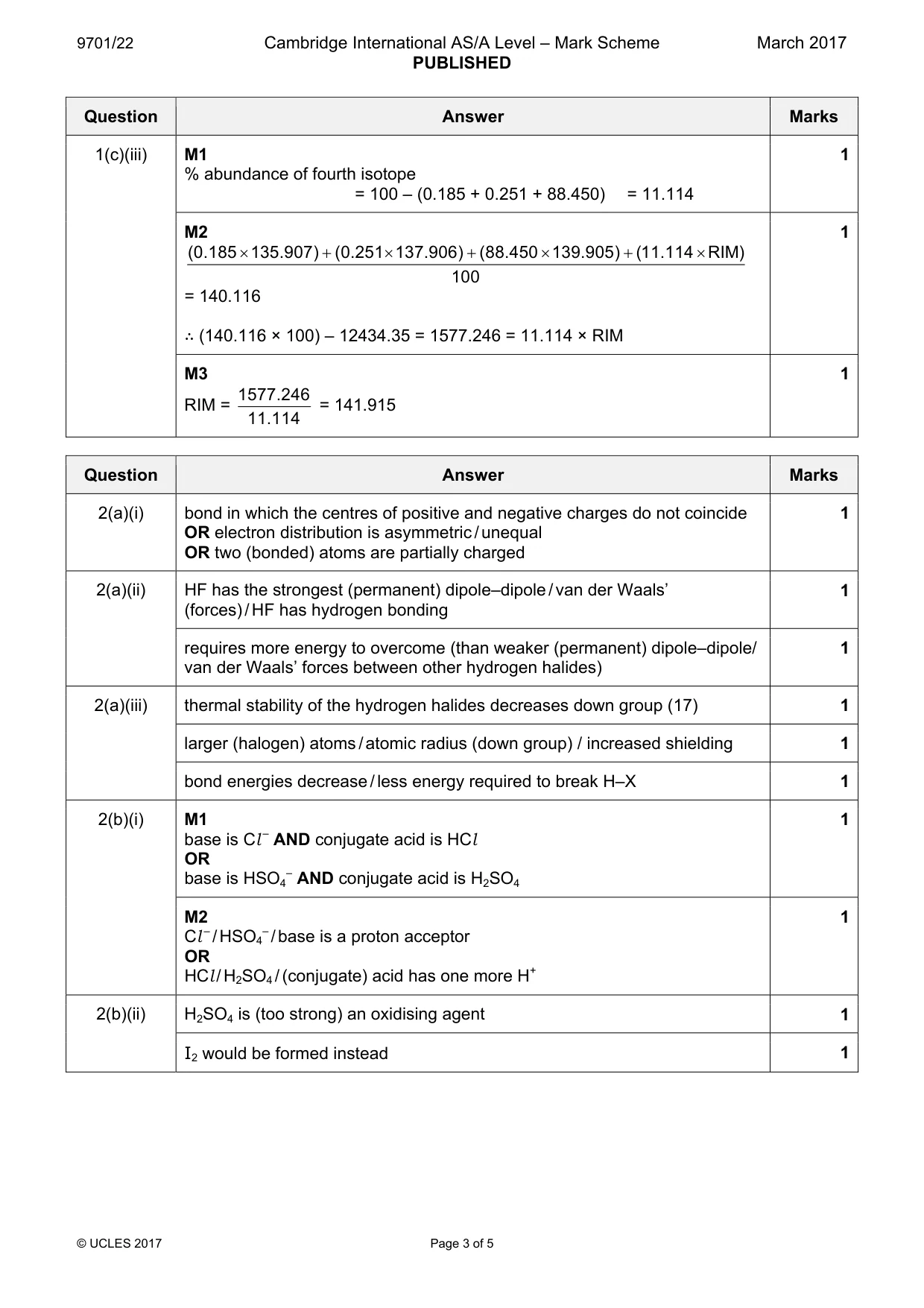
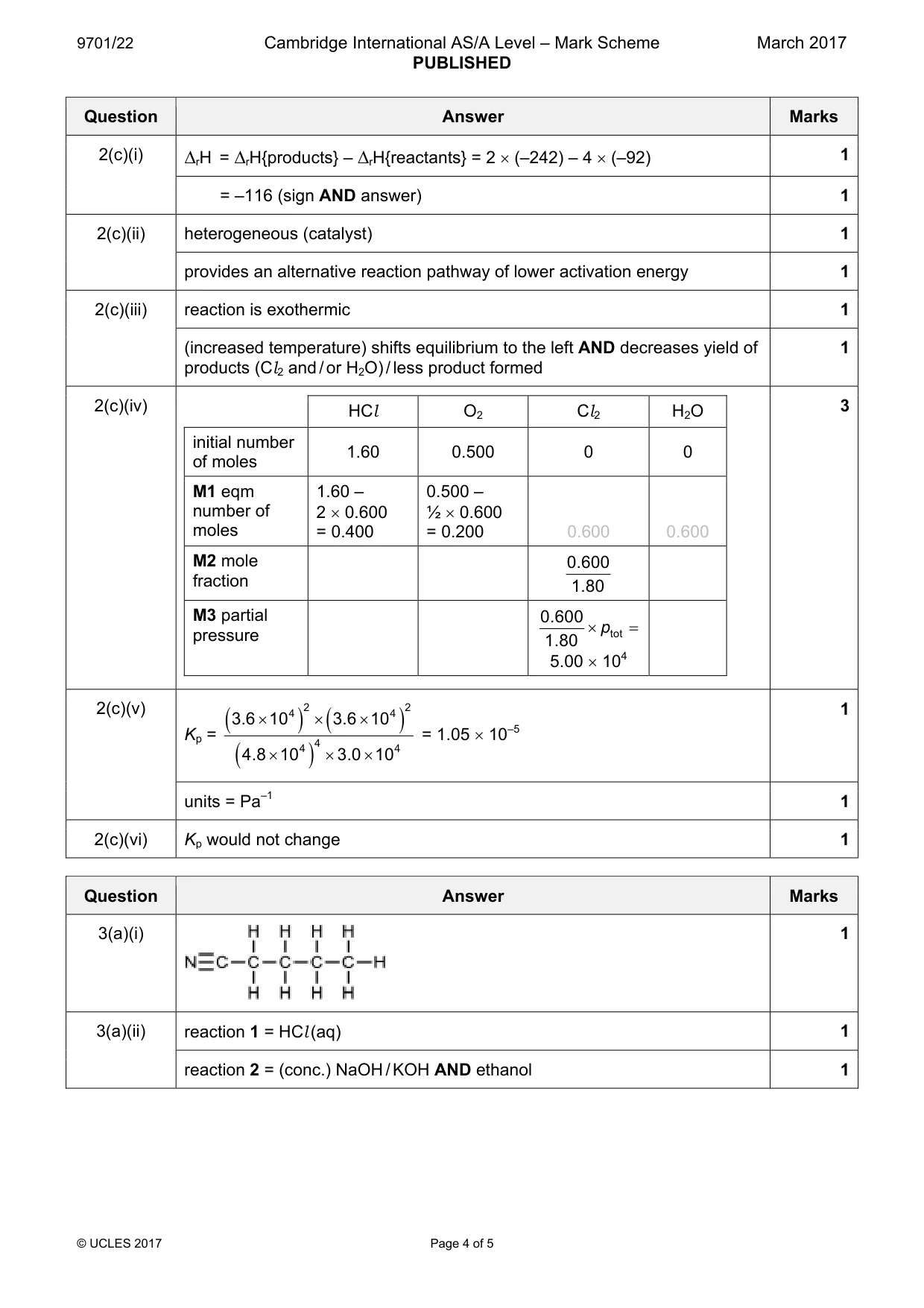
Mark scheme: 2(a)(i) bond in which the centres of positive and negative charges do not coincide 1 OR electron distribution is asymmetric / unequal OR two (bonded) atoms are partially charged 2(a)(ii) HF has the strongest (permanent) dipole–dipole / van der Waals’ 1 (forces) / HF has hydrogen bonding requires more energy to overcome (than weaker (permanent) dipole–dipole/ 1 van der Waals’ forces between other hydrogen halides) 2(a)(iii) thermal stability of the hydrogen halides decreases down group (17) 1 larger (halogen) atoms / atomic radius (down group) / increased shielding 1 bond energies decrease / less energy required to break H–X 1 2(b)(i) M1 1 base is Cl – AND conjugate acid is HCl OR base is HSO4– AND conjugate acid is H2SO4 M2 1 Cl – / HSO4– / base is a proton acceptor OR HCl / H2SO4 / (conjugate) acid has one more H+ 2(b)(ii) H2SO4 is (too strong) an oxidising agent 1 I2 would be formed instead 1 2(c)(i) ∆rH = ∆rH{products} – ∆rH{reactants} = 2 × (–242) – 4 × (–92) 1 = –116 (sign AND answer) 1 2(c)(ii) heterogeneous (catalyst) 1 provides an alternative reaction pathway of lower activation energy 1 2(c)(iii) reaction is exothermic 1 (increased temperature) shifts equilibrium to the left AND decreases yield of 1 products (Cl2 and / or H2O) / less product formed 2(c)(iv) 3 HCl O2 Cl2 H2O initial number 1.60 0.500 0 0 of moles M1 eqm 1.60 – 0.500 – number of 2 × 0.600 ½ × 0.600 moles = 0.400 = 0.200 0.600 0.600 M2 mole 0.600 fraction 1.80 M3 partial 0.600 × ptot = pressure 1.80 5.00 × 10⁴ 2(c)(v) 4 2 4 2 1 3.6 × 10 × 3.6 × 10 ( ) ( ) Kp = 4 = 1.05 × 10⁻⁵ 4.8 × 10 4 × 3.0 × 10 4 ( ) units = Pa–1 1 2(c)(vi) Kp would not change 1
More questions on The chemical properties of the halogen elements and the hydrogen halides
Q3 · A series of reactions starting from 1-bromobutane is shown
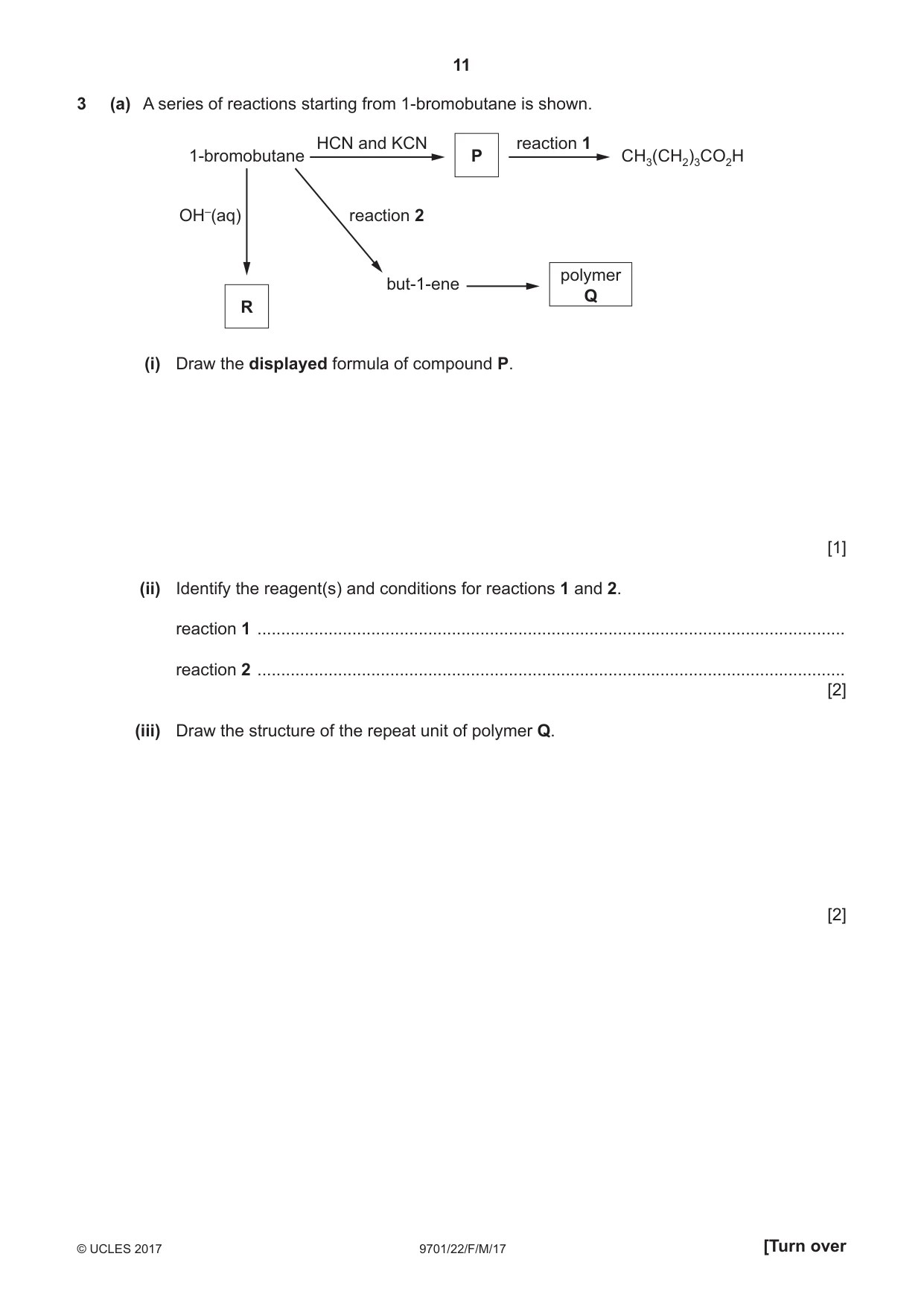
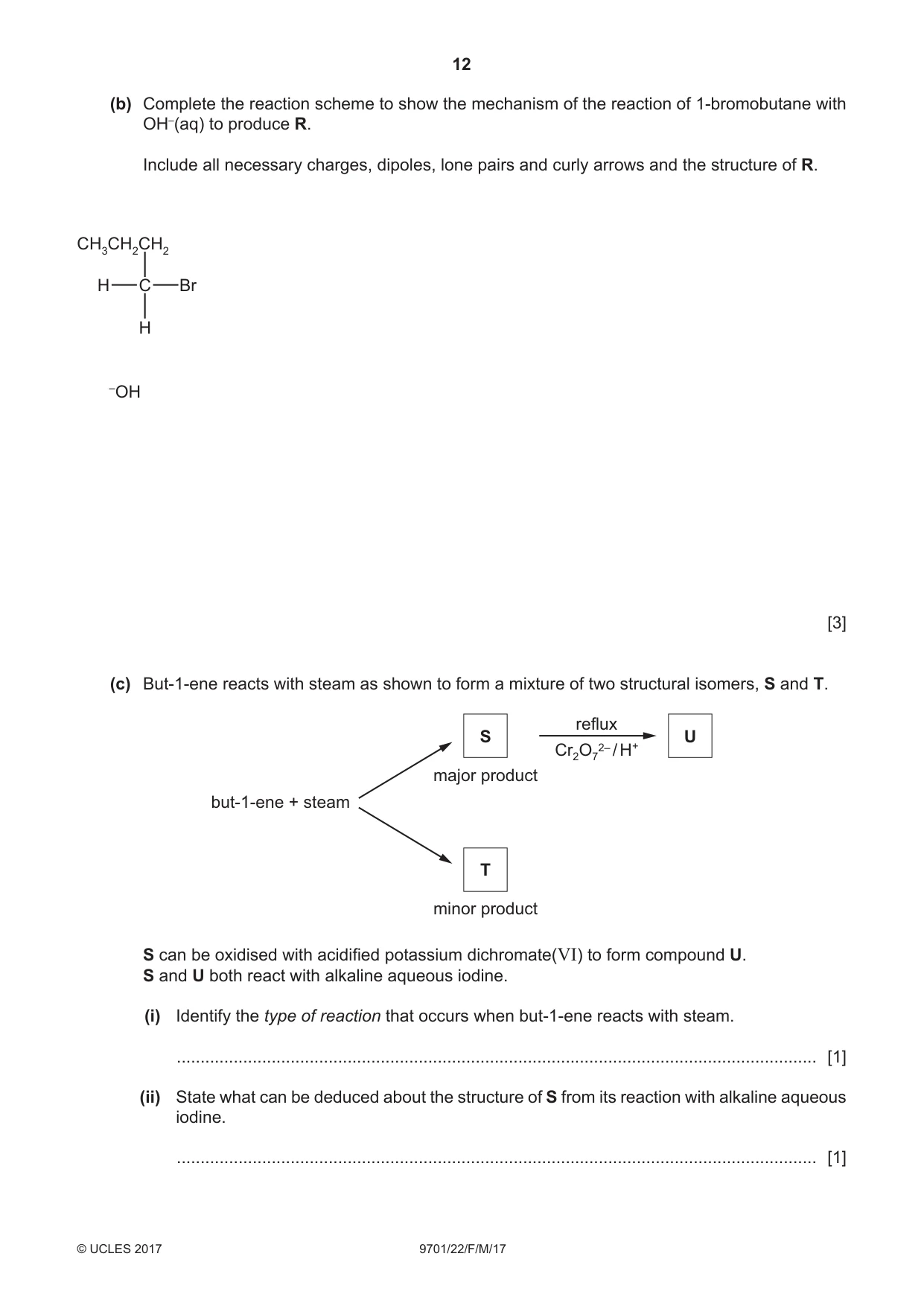
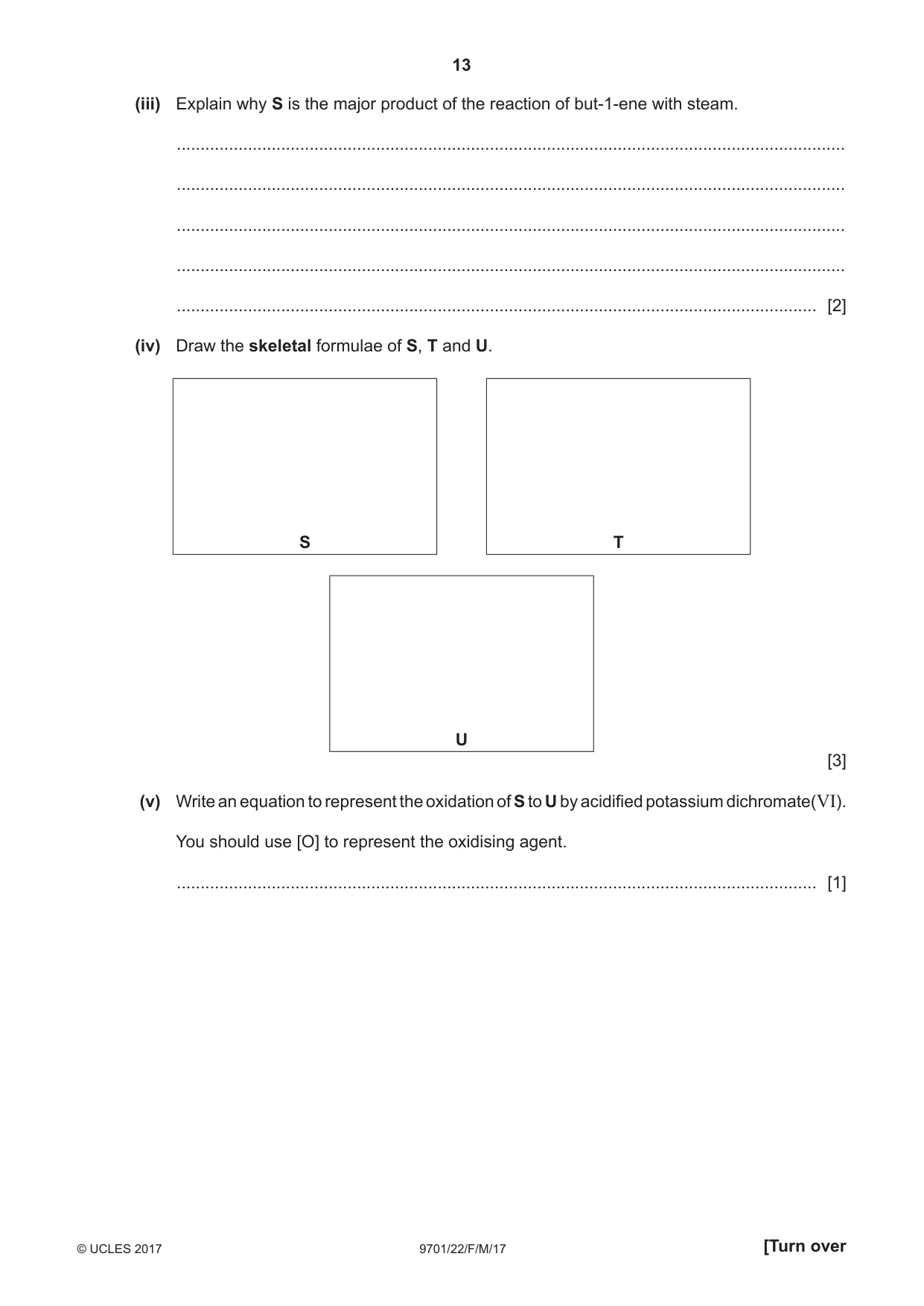
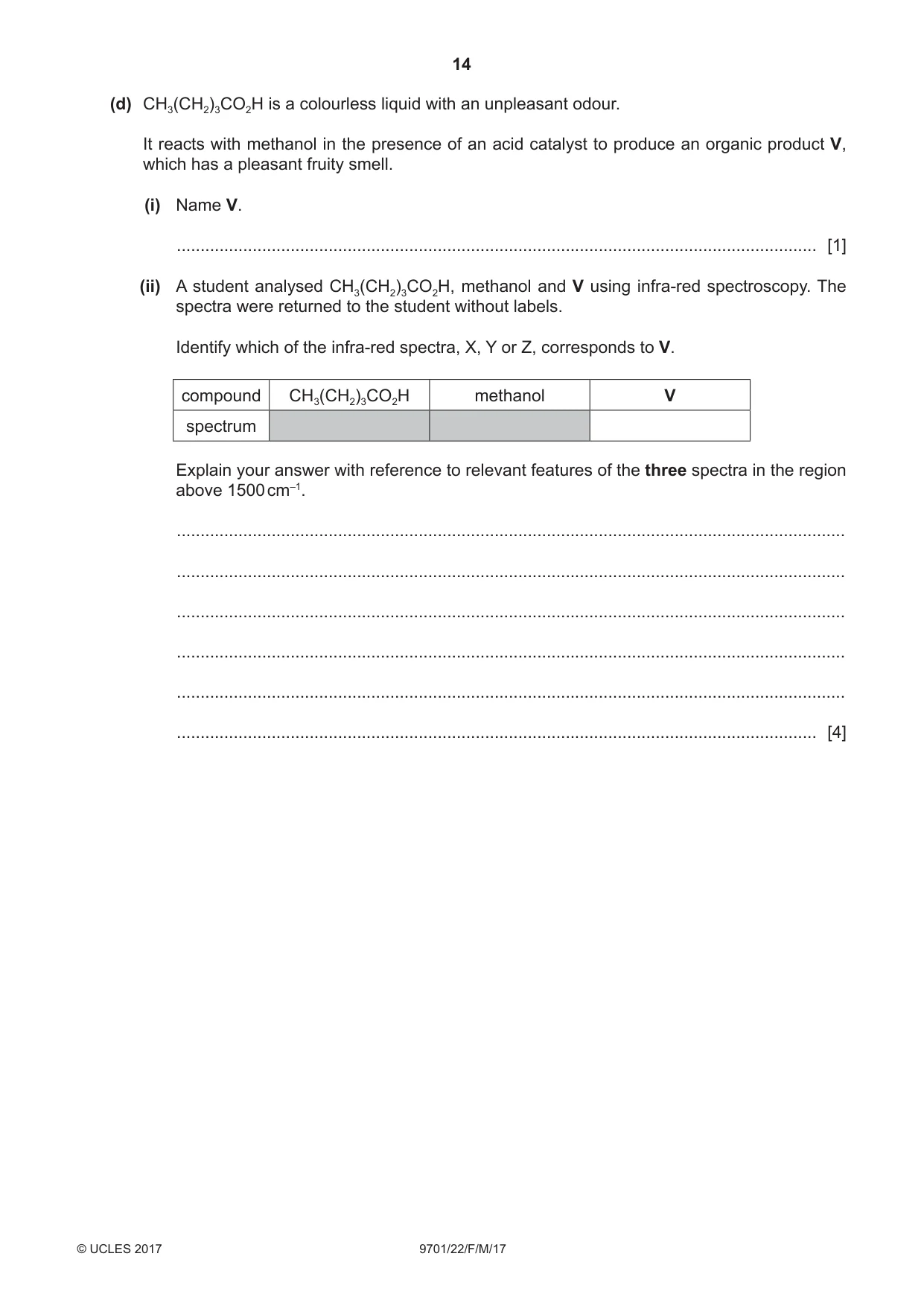
3 (a) A series of reactions starting from 1-bromobutane is shown. HCN and KCN reaction 1 1-bromobutane P CH3(CH2)3CO2H OH–(aq) reaction 2 polymer but-1-ene Q R (i) Draw the displayed formula of compound P. [1] (ii) Identify the reagent(s) and conditions for reactions 1 and 2. reaction 1 ............................................................................................................................ reaction 2 ............................................................................................................................ [2] (iii) Draw the structure of the repeat unit of polymer Q. [2] (b) Complete the reaction scheme to show the mechanism of the reaction of 1-bromobutane with OH–(aq) to produce R. Include all necessary charges, dipoles, lone pairs and curly arrows and the structure of R. CH3CH2CH2 H C Br H –OH [3] (c) But-1-ene reacts with steam as shown to form a mixture of two structural isomers, S and T. reflux S U Cr2O72– / H+ major product but-1-ene + steam T minor product S can be oxidised with acidified potassium dichromate(VI) to form compound U. S and U both react with alkaline aqueous iodine. (i) Identify the type of reaction that occurs when but-1-ene reacts with steam. ....................................................................................................................................... [1] (ii) State what can be deduced about the structure of S from its reaction with alkaline aqueous iodine. ....................................................................................................................................... [1] (iii) Explain why S is the major product of the reaction of but-1-ene with steam. ............................................................................................................................................. ............................................................................................................................................. ............................................................................................................................................. ............................................................................................................................................. ....................................................................................................................................... [2] (iv) Draw the skeletal formulae of S, T and U. S T U [3] (v) Write an equation to represent the oxidation of S to U by acidified potassium dichromate(VI). You should use [O] to represent the oxidising agent. ....................................................................................................................................... [1]
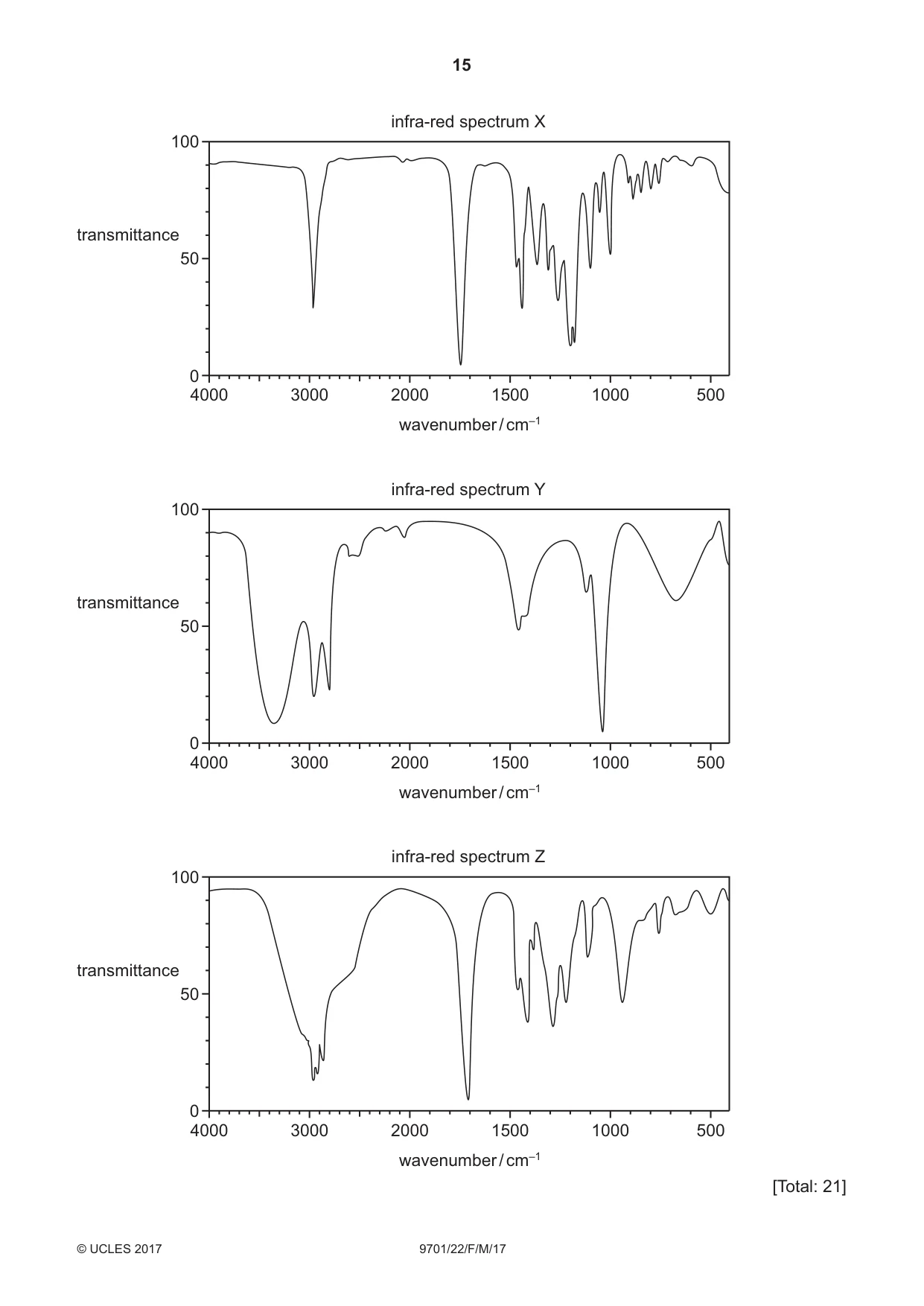
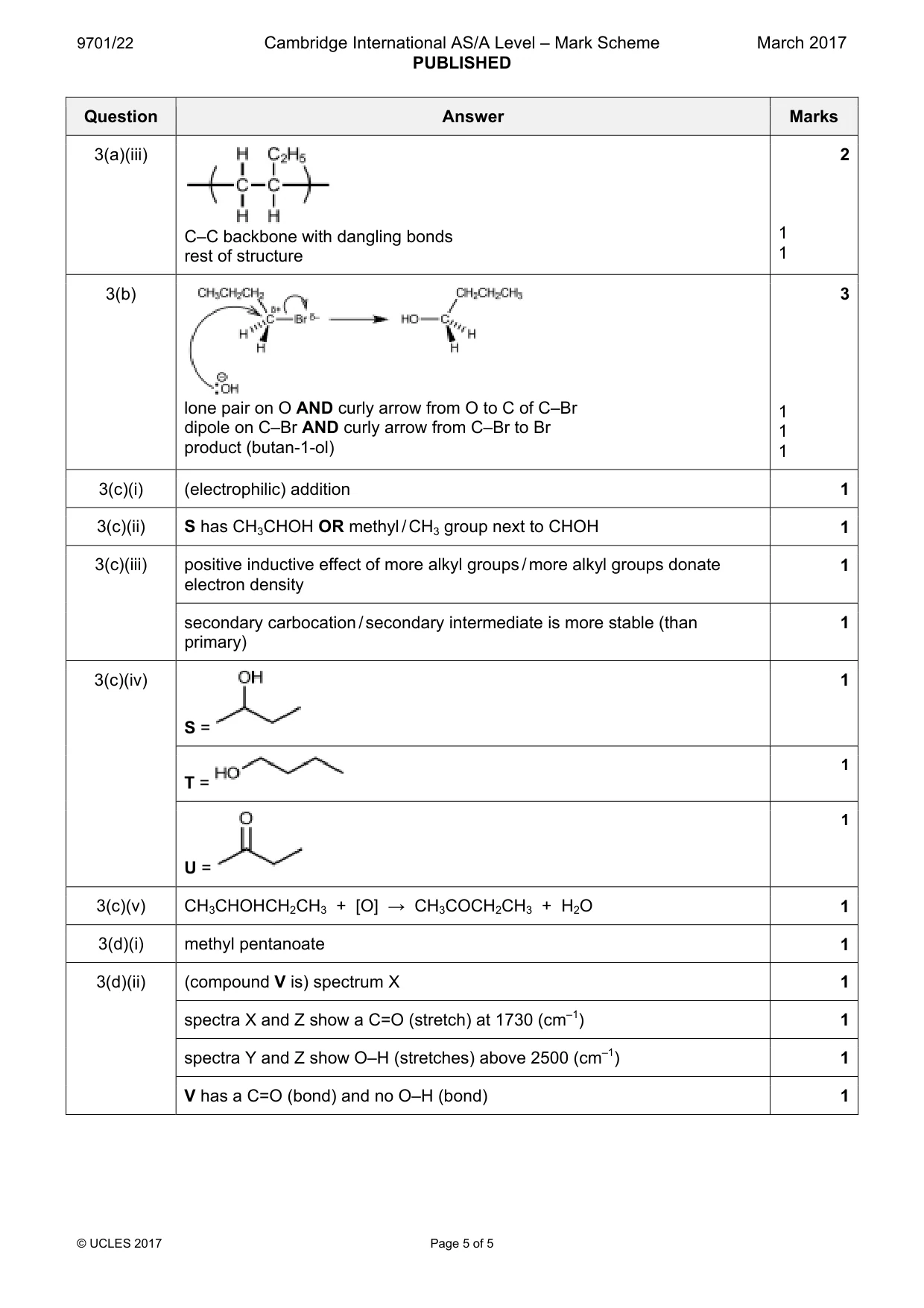
Mark scheme: 3(a)(i) 1 3(a)(ii) reaction 1 = HCl (aq) 1 reaction 2 = (conc.) NaOH / KOH AND ethanol 1 3(a)(iii) 2 C–C backbone with dangling bonds 1 rest of structure 1 3(b) 3 lone pair on O AND curly arrow from O to C of C–Br 1 dipole on C–Br AND curly arrow from C–Br to Br 1 product (butan-1-ol) 1 3(c)(i) (electrophilic) addition 1 3(c)(ii) S has CH3CHOH OR methyl / CH3 group next to CHOH 1 3(c)(iii) positive inductive effect of more alkyl groups / more alkyl groups donate 1 electron density secondary carbocation / secondary intermediate is more stable (than 1 primary) 3(c)(iv) 1 S = 1 T = 1 U = 3(c)(v) CH3CHOHCH2CH3 + [O] → CH3COCH2CH3 + H2O 1 3(d)(i) methyl pentanoate 1 3(d)(ii) (compound V is) spectrum X 1 spectra X and Z show a C=O (stretch) at 1730 (cm–1) 1 spectra Y and Z show O–H (stretches) above 2500 (cm–1) 1 V has a C=O (bond) and no O–H (bond) 1
What was in this paper
The subtopics covered by these 3 questions, and how many questions each got. Open one in a new tab to see every Cambridge question on it.
What you needed in this session
Cambridge’s own grade thresholds for 2017 Feb/March, Paper 2 · Variant 2. A higher threshold means an easier paper — the bar moves with how the cohort did.