Cambridge A Level Chemistry 9701 — 2016 Oct/Nov Paper 5 · Variant 2
9701/52/O/N/16 · 30 marks · ≈34 min
The question paper and its mark scheme, free to read here and free to download. This is Cambridge’s own paper, exactly as it was sat.
Question paper12 pages
Mark scheme7 pages
Answers below. Sit the paper first if you are practising.
Paper as text
Question paper, page 1
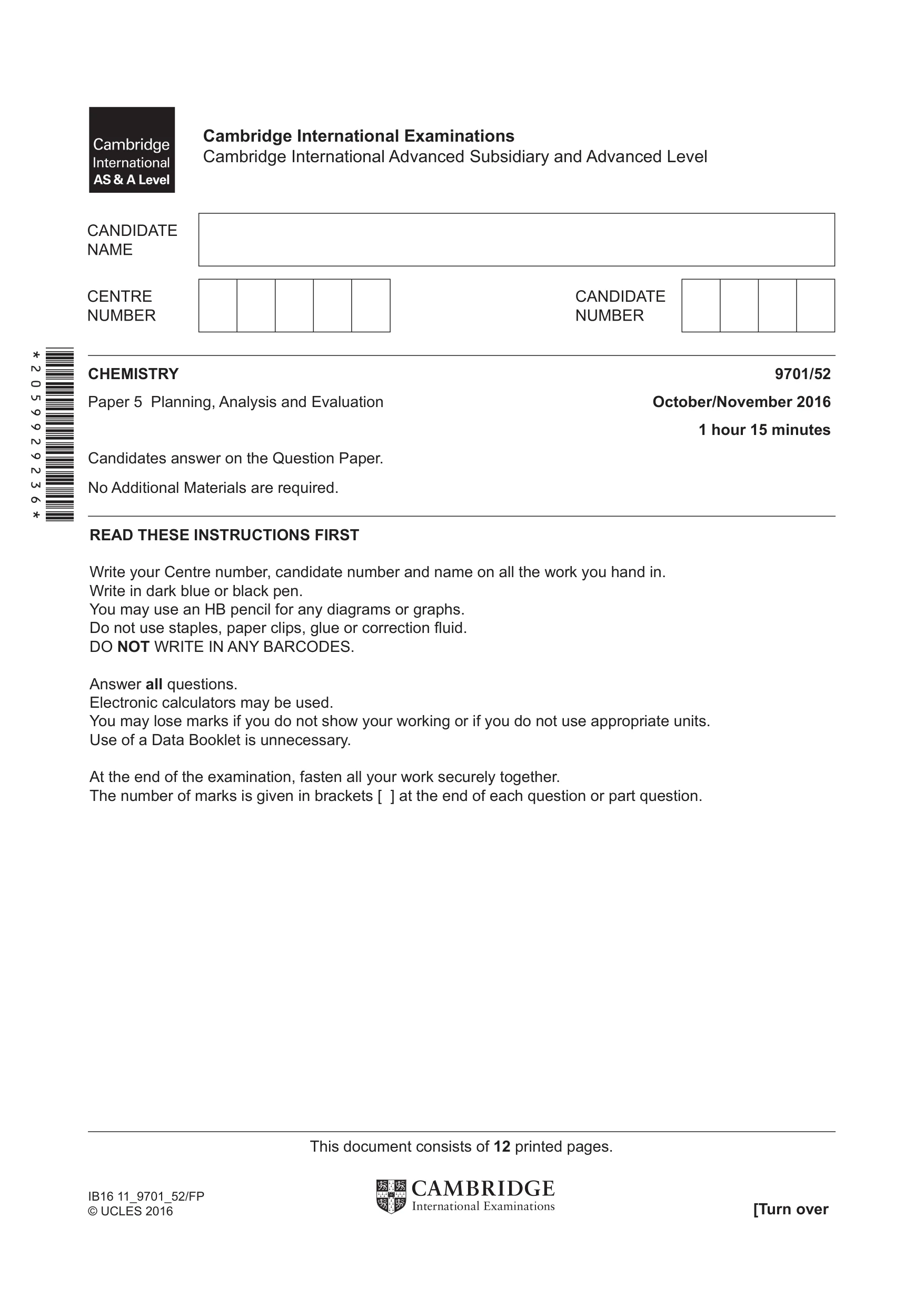
READ THESE INSTRUCTIONS FIRST Write your Centre number, candidate number and name on all the work you hand in. Write in dark blue or black pen. You may use an HB pencil for any diagrams or graphs. Do not use staples, paper clips, glue or correction fl uid. DO NOT WRITE IN ANY BARCODES. Answer all questions. Electronic calculators may be used. You may lose marks if you do not show your working or if you do not use appropriate units. Use of a Data Booklet is unnecessary. At the end of the examination, fasten all your work securely together. The number of marks is given in brackets [ ] at the end of each question or part question. CHEMISTRY 9701/52 Paper 5 Planning, Analysis and Evaluation October/November 2016 1 hour 15 minutes Candidates answer on the Question Paper. No Additional Materials are required. Cambridge International Examinations Cambridge International Advanced Subsidiary and Advanced Level This document consists of 12 printed pages. [Turn over IB16 11_9701_52/FP © UCLES 2016
Question paper, page 2
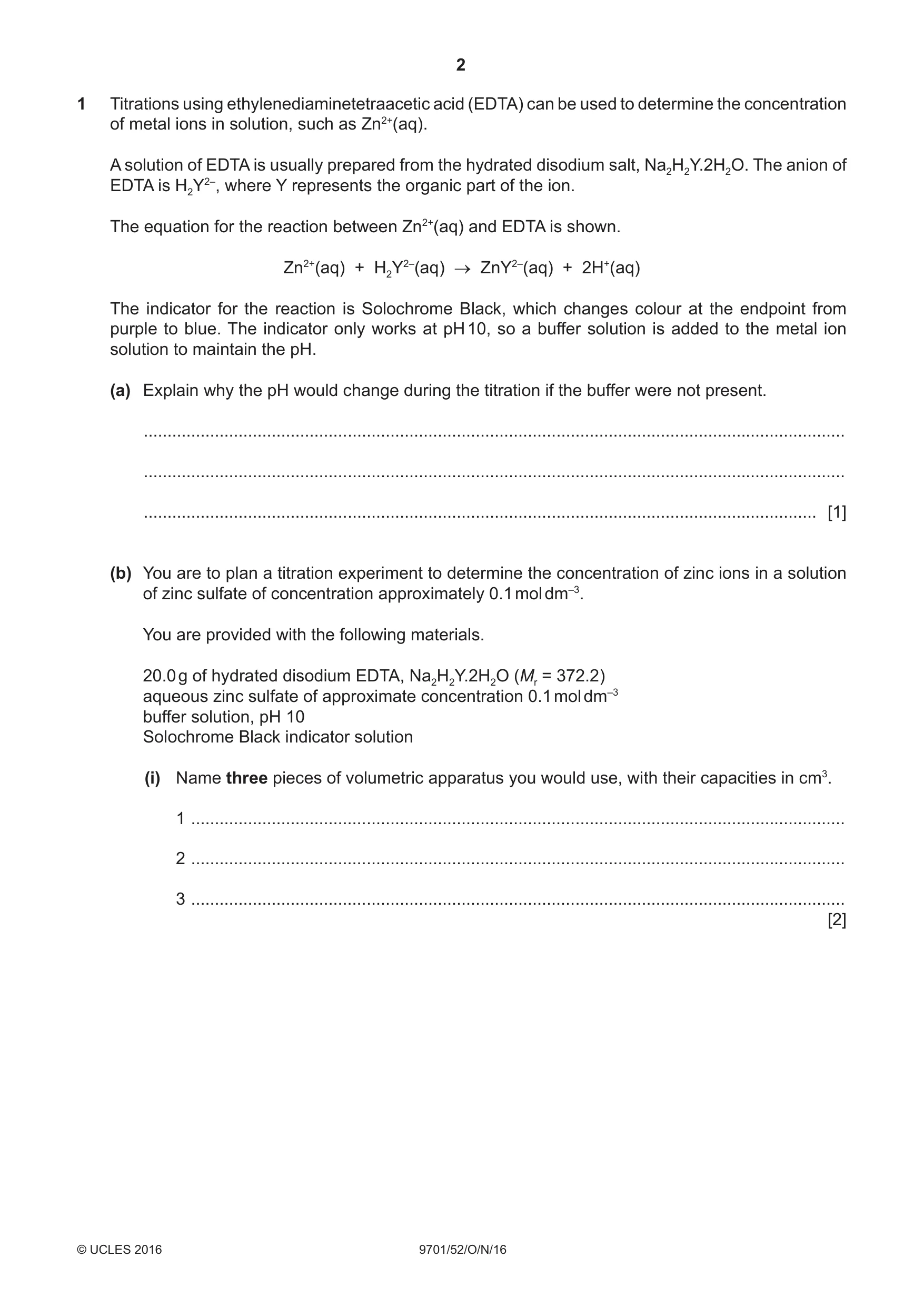
2 9701/52/O/N/16 © UCLES 2016 1 Titrations using ethylenediaminetetraacetic acid (EDTA) can be used to determine the concentration of metal ions in solution, such as Zn2+(aq). A solution of EDTA is usually prepared from the hydrated disodium salt, Na2H2Y.2H2O. The anion of EDTA is H2Y2–, where Y represents the organic part of the ion. The equation for the reaction between Zn2+(aq) and EDTA is shown. Zn2+(aq) + H2Y2–(aq) ZnY2–(aq) + 2H+(aq) The indicator for the reaction is Solochrome Black, which changes colour at the endpoint from purple to blue. The indicator only works at pH 10, so a buffer solution is added to the metal ion solution to maintain the pH. (a) Explain why the pH would change during the titration if the buffer were not present. … … … [1] (b) You are to plan a titration experiment to determine the concentration of zinc ions in a solution of zinc sulfate of concentration approximately 0.1 mol dm–3. You are provided with the following materials. 20.0 g of hydrated disodium EDTA, Na2H2Y.2H2O (Mr = 372.2) aqueous zinc sulfate of approximate concentration 0.1 mol dm–3 buffer solution, pH 10 Solochrome Black indicator solution (i) Name three pieces of volumetric apparatus you would use, with their capacities in cm3. 1 … 2 … 3 … [2]
Question paper, page 3
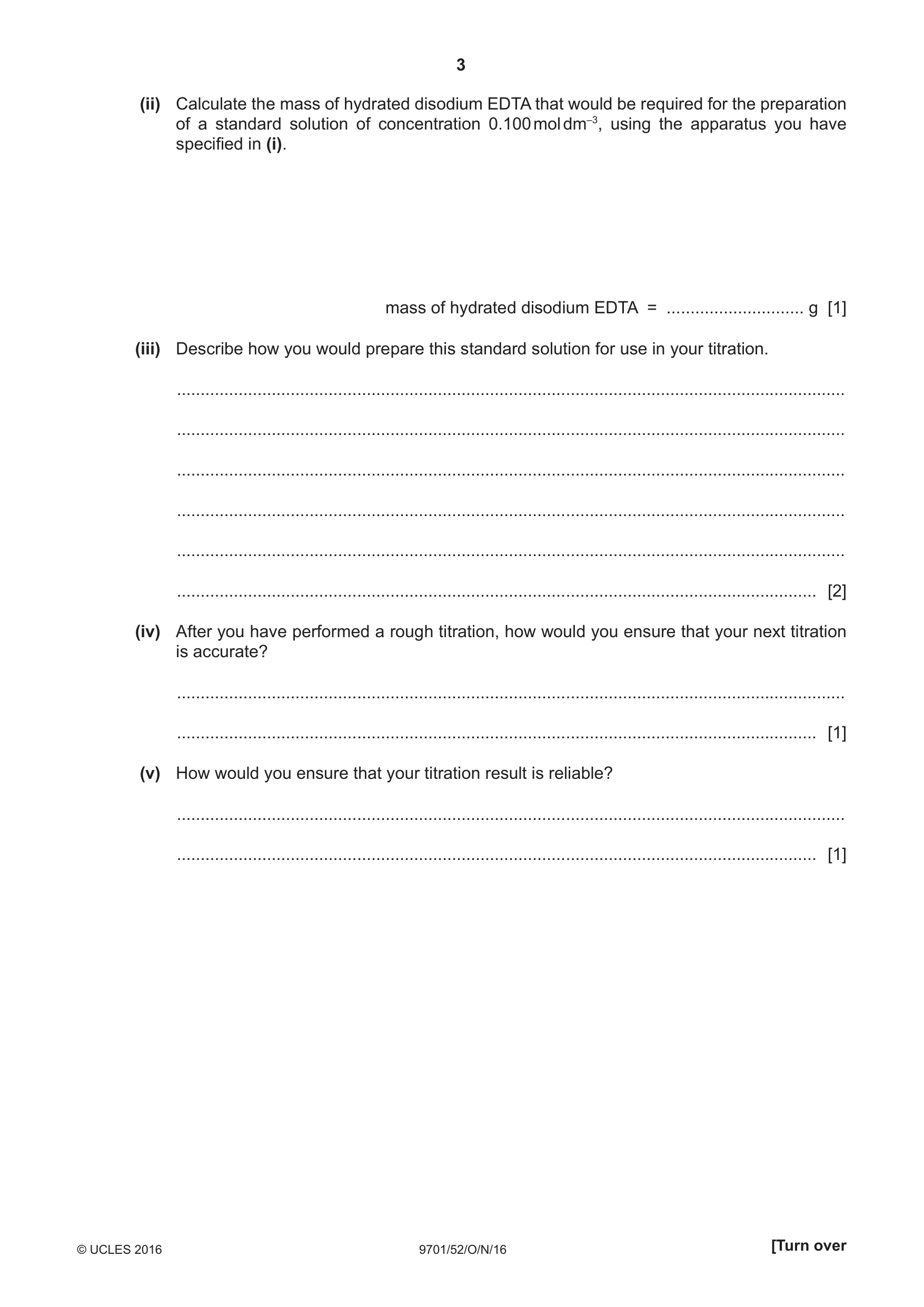
3 9701/52/O/N/16 © UCLES 2016 [Turn over (ii) Calculate the mass of hydrated disodium EDTA that would be required for the preparation of a standard solution of concentration 0.100 mol dm–3, using the apparatus you have specifi ed in (i). mass of hydrated disodium EDTA = … g [1] (iii) Describe how you would prepare this standard solution for use in your titration. … … … … … … [2] (iv) After you have performed a rough titration, how would you ensure that your next titration is accurate? … … [1] (v) How would you ensure that your titration result is reliable? … … [1]
Question paper, page 4
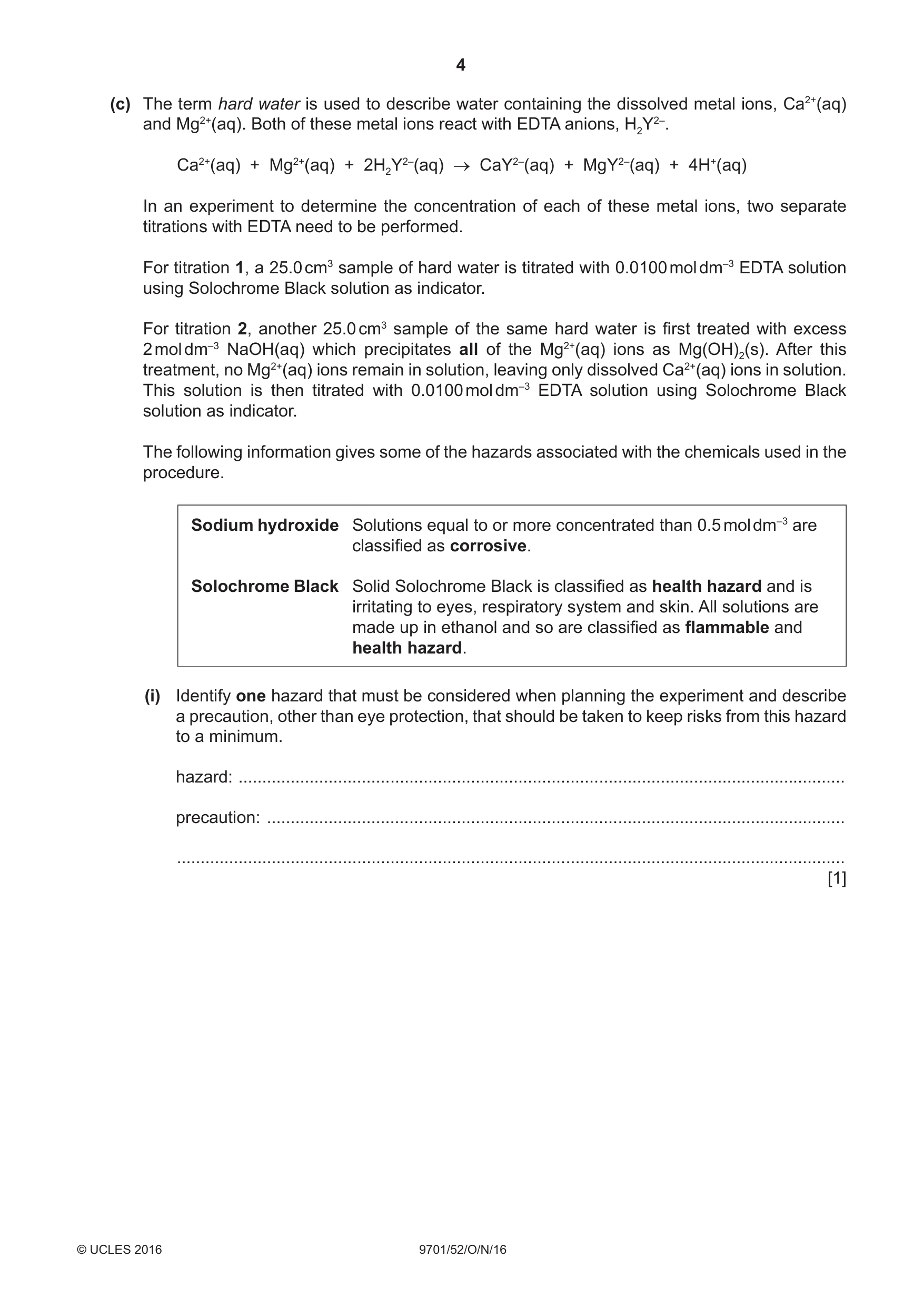
4 9701/52/O/N/16 © UCLES 2016 (c) The term hard water is used to describe water containing the dissolved metal ions, Ca2+(aq) and Mg2+(aq). Both of these metal ions react with EDTA anions, H2Y2–. Ca2+(aq) + Mg2+(aq) + 2H2Y2–(aq) CaY2–(aq) + MgY2–(aq) + 4H+(aq) In an experiment to determine the concentration of each of these metal ions, two separate titrations with EDTA need to be performed. For titration 1, a 25.0 cm3 sample of hard water is titrated with 0.0100 mol dm–3 EDTA solution using Solochrome Black solution as indicator. For titration 2, another 25.0 cm3 sample of the same hard water is fi rst treated with excess 2 mol dm–3 NaOH(aq) which precipitates all of the Mg2+(aq) ions as Mg(OH)2(s). After this treatment, no Mg2+(aq) ions remain in solution, leaving only dissolved Ca2+(aq) ions in solution. This solution is then titrated with 0.0100 mol dm–3 EDTA solution using Solochrome Black solution as indicator. The following information gives some of the hazards associated with the chemicals used in the procedure. Sodium hydroxide Solochrome Black Solutions equal to or more concentrated than 0.5 mol dm–3 are classifi ed as corrosive. Solid Solochrome Black is classifi ed as health hazard and is irritating to eyes, respiratory system and skin. All solutions are made up in ethanol and so are classifi ed as fl ammable and health hazard. (i) Identify one hazard that must be considered when planning the experiment and describe a precaution, other than eye protection, that should be taken to keep risks from this hazard to a minimum. hazard: … precaution: … … [1]
Question paper, page 5
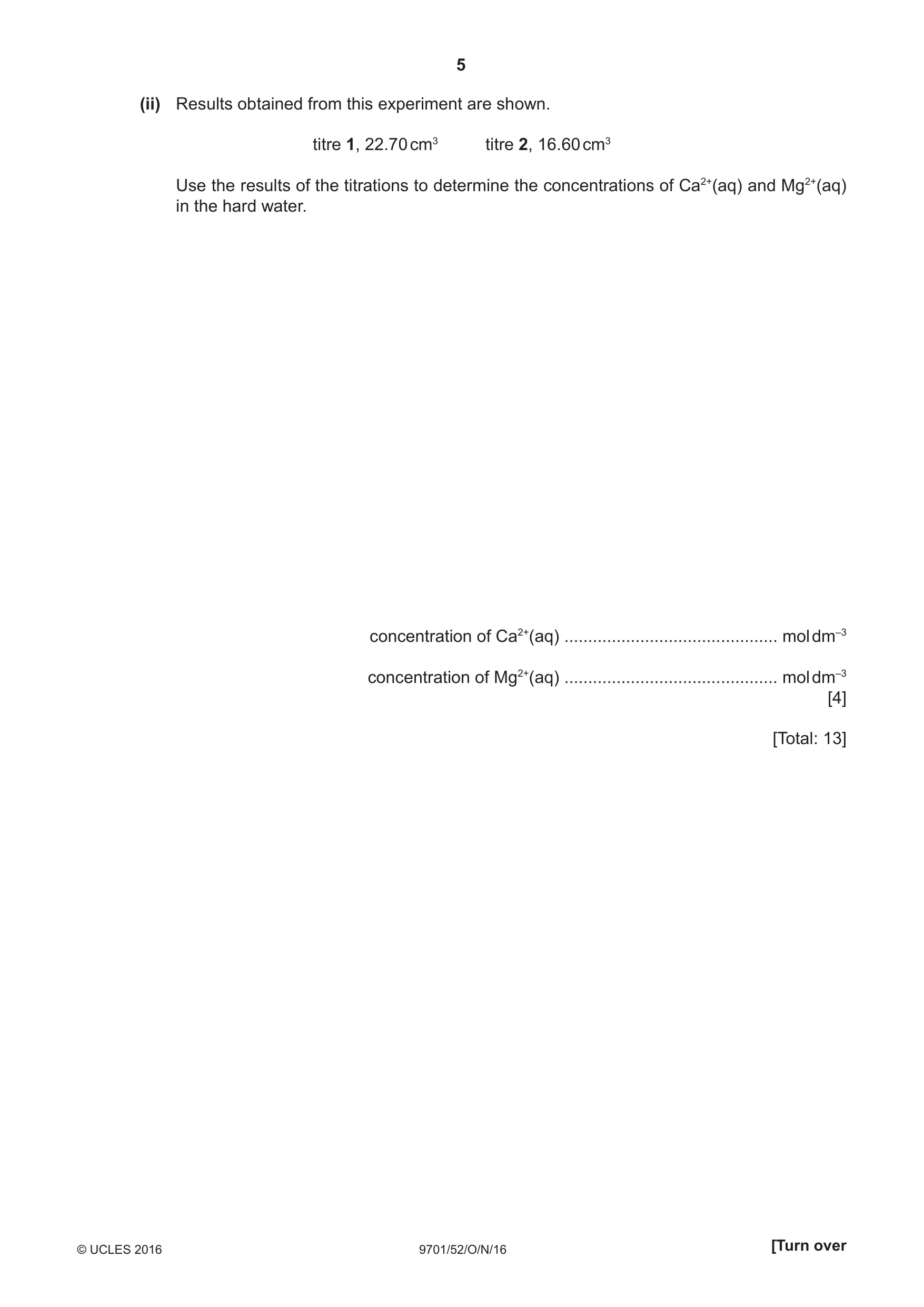
5 9701/52/O/N/16 © UCLES 2016 [Turn over (ii) Results obtained from this experiment are shown. titre 1, 22.70 cm3 titre 2, 16.60 cm3 Use the results of the titrations to determine the concentrations of Ca2+(aq) and Mg2+(aq) in the hard water. concentration of Ca2+(aq) … mol dm–3 concentration of Mg2+(aq) … mol dm–3 [4] [Total: 13]
Question paper, page 6
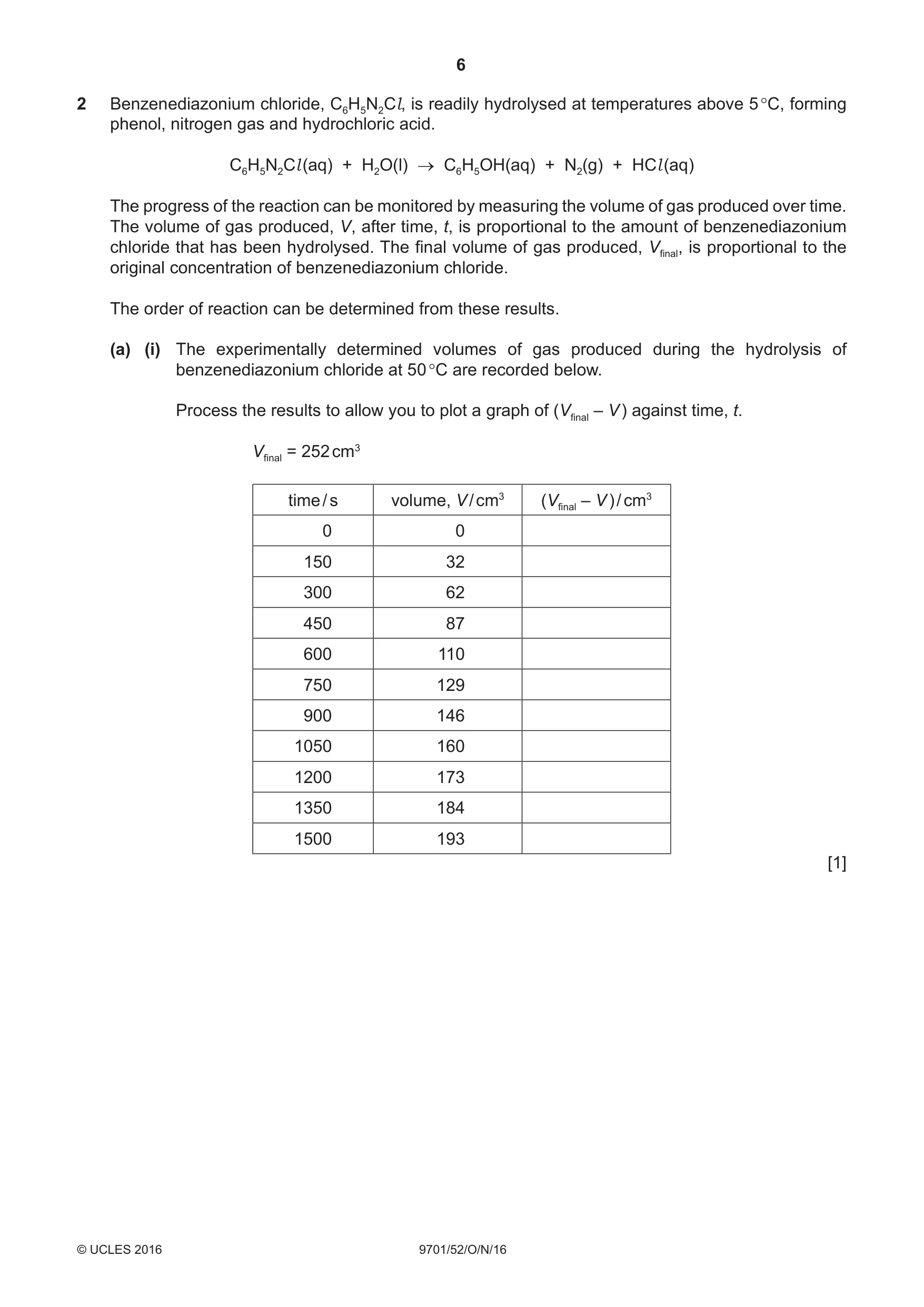
6 9701/52/O/N/16 © UCLES 2016 2 Benzenediazonium chloride, C6H5N2Cl, is readily hydrolysed at temperatures above 5 C, forming phenol, nitrogen gas and hydrochloric acid. C6H5N2Cl (aq) + H2O(l) C6H5OH(aq) + N2(g) + HCl (aq) The progress of the reaction can be monitored by measuring the volume of gas produced over time. The volume of gas produced, V, after time, t, is proportional to the amount of benzenediazonium chloride that has been hydrolysed. The fi nal volume of gas produced, Vfi nal, is proportional to the original concentration of benzenediazonium chloride. The order of reaction can be determined from these results. (a) (i) The experimentally determined volumes of gas produced during the hydrolysis of benzenediazonium chloride at 50 C are recorded below. Process the results to allow you to plot a graph of (Vfi nal – V ) against time, t. Vfi nal = 252 cm3 time / s volume, V / cm3 (Vfi nal – V ) / cm3 0 0 150 32 300 62 450 87 600 110 750 129 900 146 1050 160 1200 173 1350 184 1500 193 [1]
Question paper, page 7
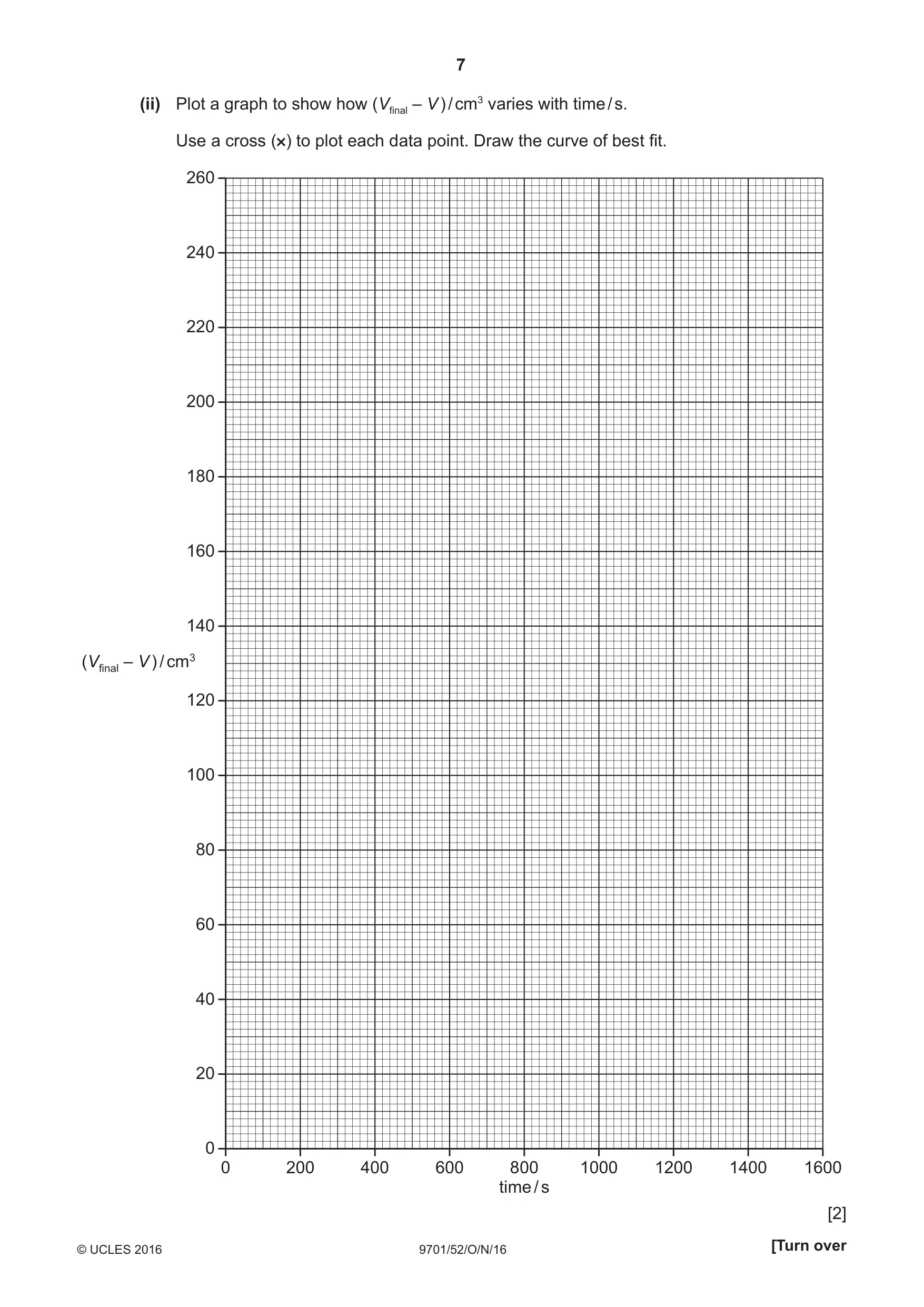
7 9701/52/O/N/16 © UCLES 2016 [Turn over (ii) Plot a graph to show how (Vfi nal – V ) / cm3 varies with time / s. Use a cross () to plot each data point. Draw the curve of best fi t. 260 240 220 200 180 160 140 120 100 80 60 40 20 0 0 200 400 600 800 time / s 1000 1200 1400 1600 (Vfinal – V ) / cm3 [2]
Question paper, page 8
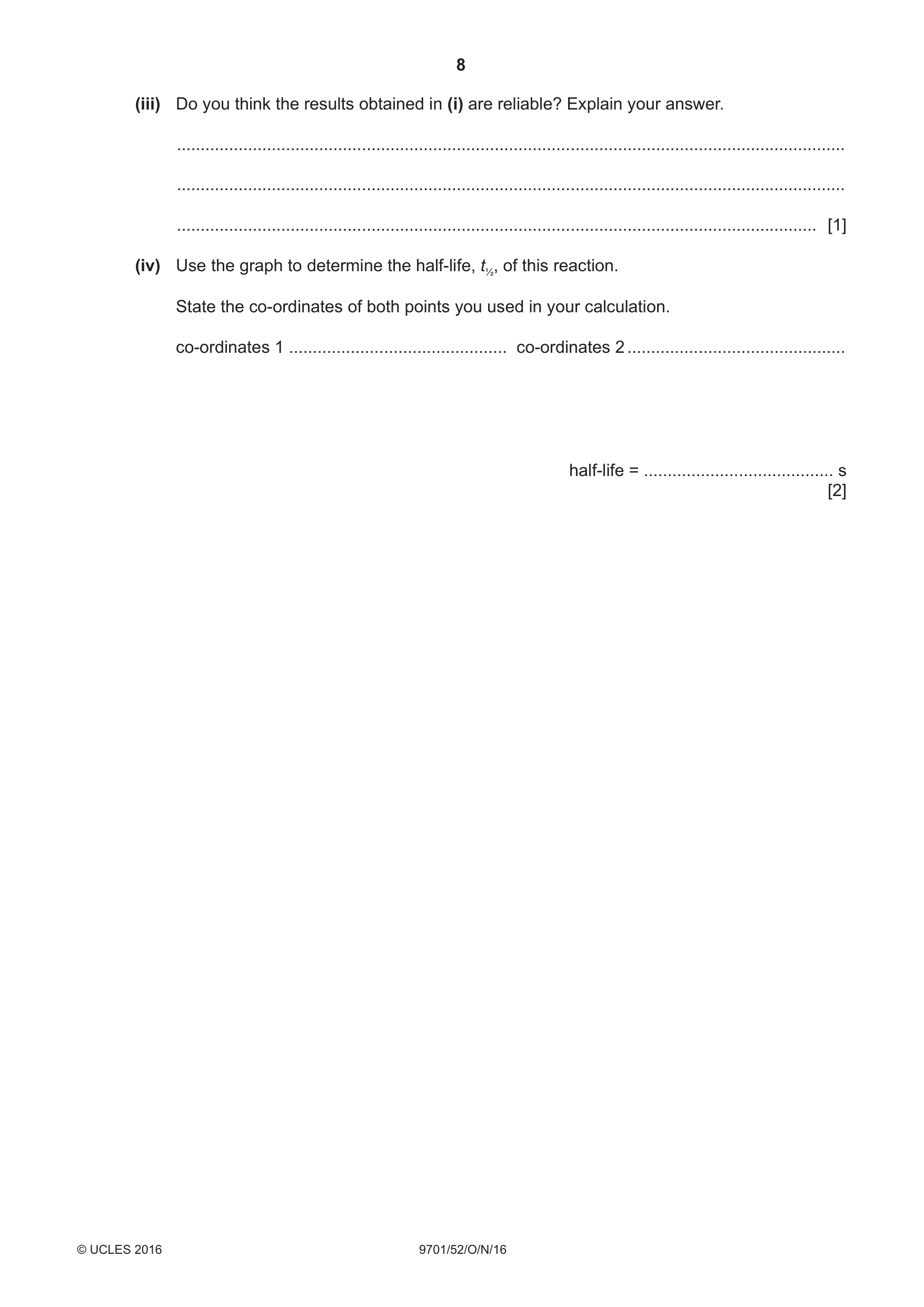
8 9701/52/O/N/16 © UCLES 2016 (iii) Do you think the results obtained in (i) are reliable? Explain your answer. … … … [1] (iv) Use the graph to determine the half-life, t½, of this reaction. State the co-ordinates of both points you used in your calculation. co-ordinates 1 … co-ordinates 2 … half-life = … s [2]
Question paper, page 9
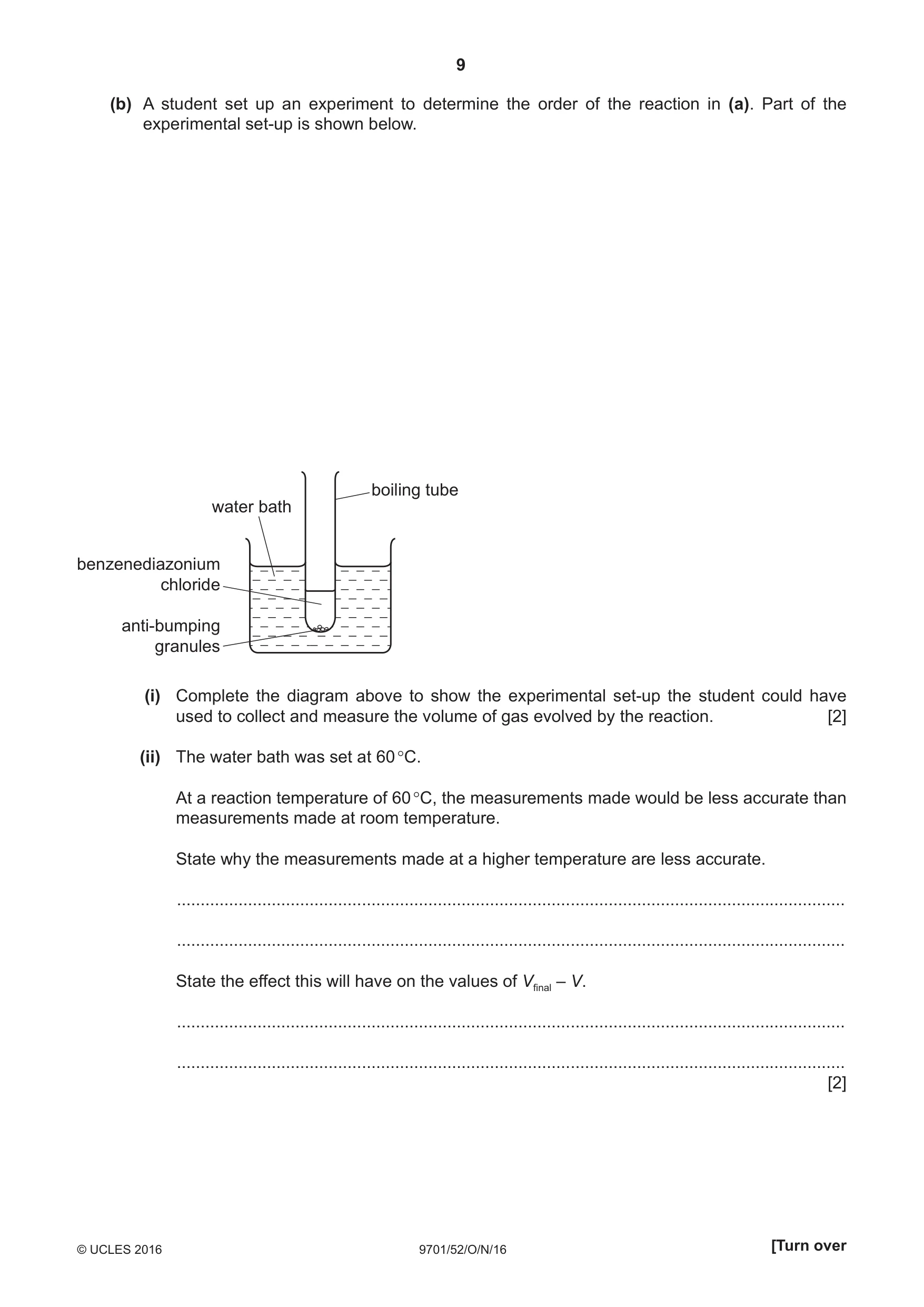
9 9701/52/O/N/16 © UCLES 2016 [Turn over (b) A student set up an experiment to determine the order of the reaction in (a). Part of the experimental set-up is shown below. boiling tube benzenediazonium chloride anti-bumping granules water bath (i) Complete the diagram above to show the experimental set-up the student could have used to collect and measure the volume of gas evolved by the reaction. [2] (ii) The water bath was set at 60 C. At a reaction temperature of 60 C, the measurements made would be less accurate than measurements made at room temperature. State why the measurements made at a higher temperature are less accurate. … … State the effect this will have on the values of Vfi nal – V. … … [2]
Question paper, page 10
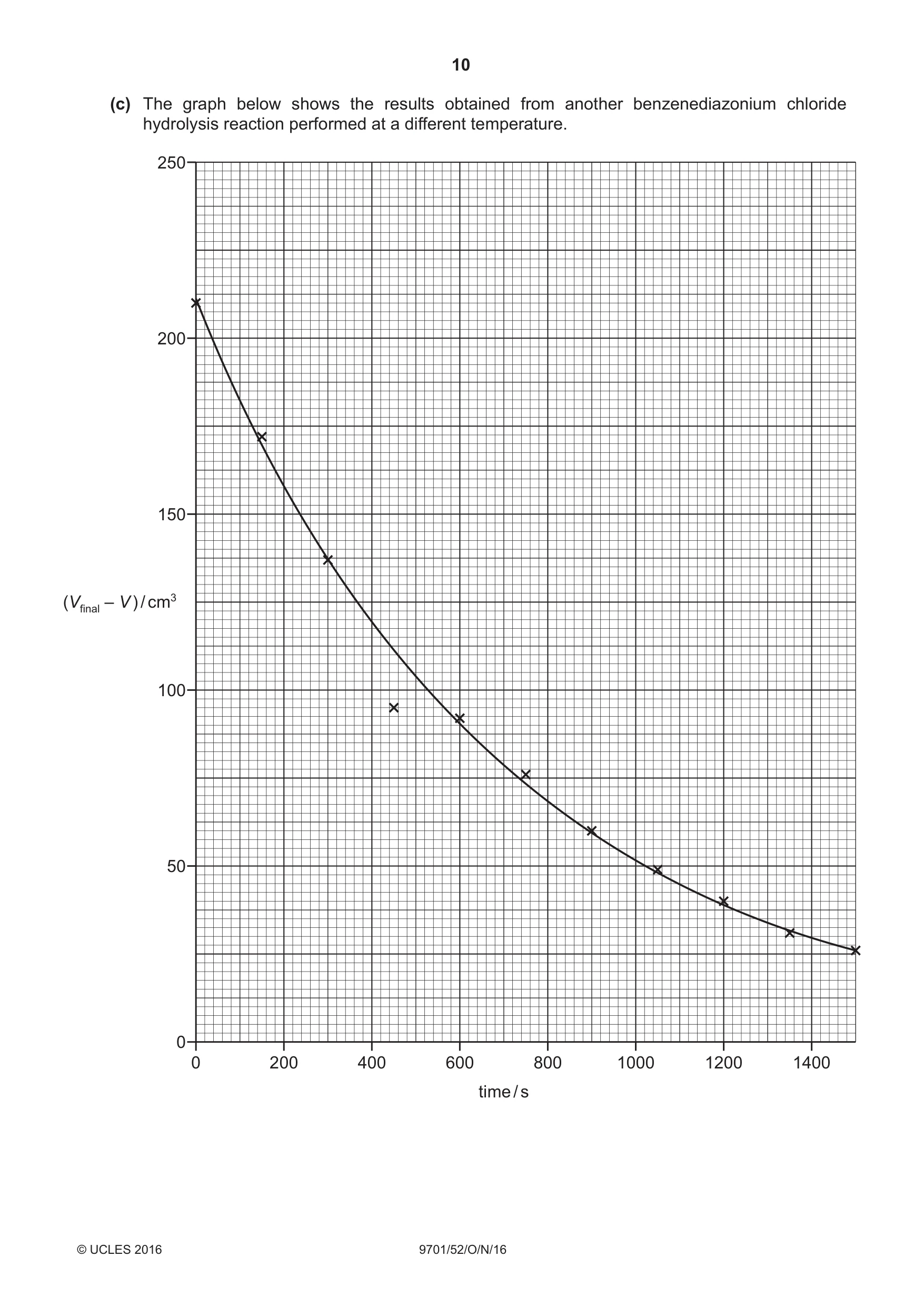
10 9701/52/O/N/16 © UCLES 2016 (c) The graph below shows the results obtained from another benzenediazonium chloride hydrolysis reaction performed at a different temperature. 0 200 400 600 800 time / s 1000 1200 1400 250 200 150 100 50 0 (Vfinal – V ) / cm3
Question paper, page 11
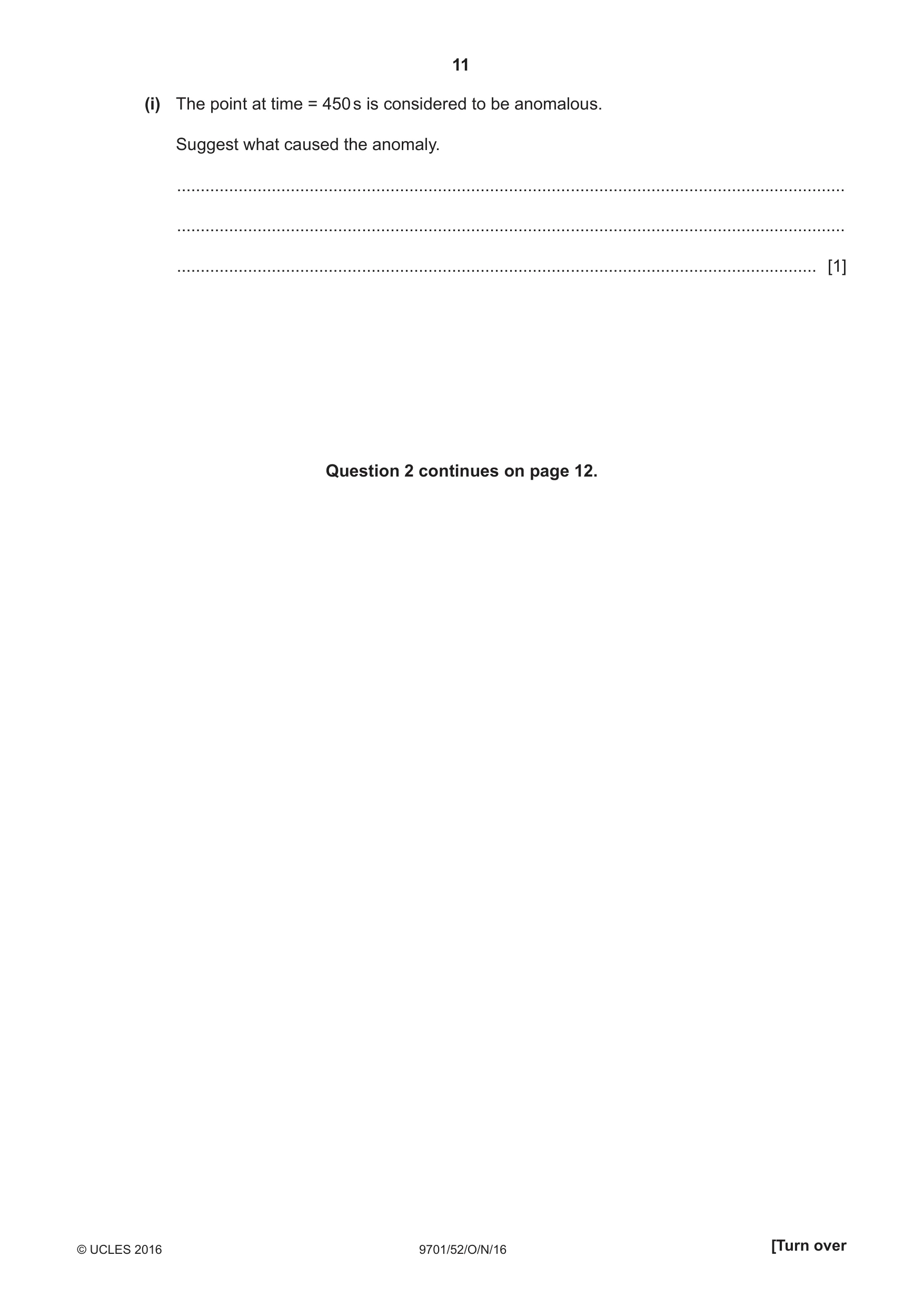
11 9701/52/O/N/16 © UCLES 2016 [Turn over (i) The point at time = 450 s is considered to be anomalous. Suggest what caused the anomaly. … … … [1] Question 2 continues on page 12.
Question paper, page 12
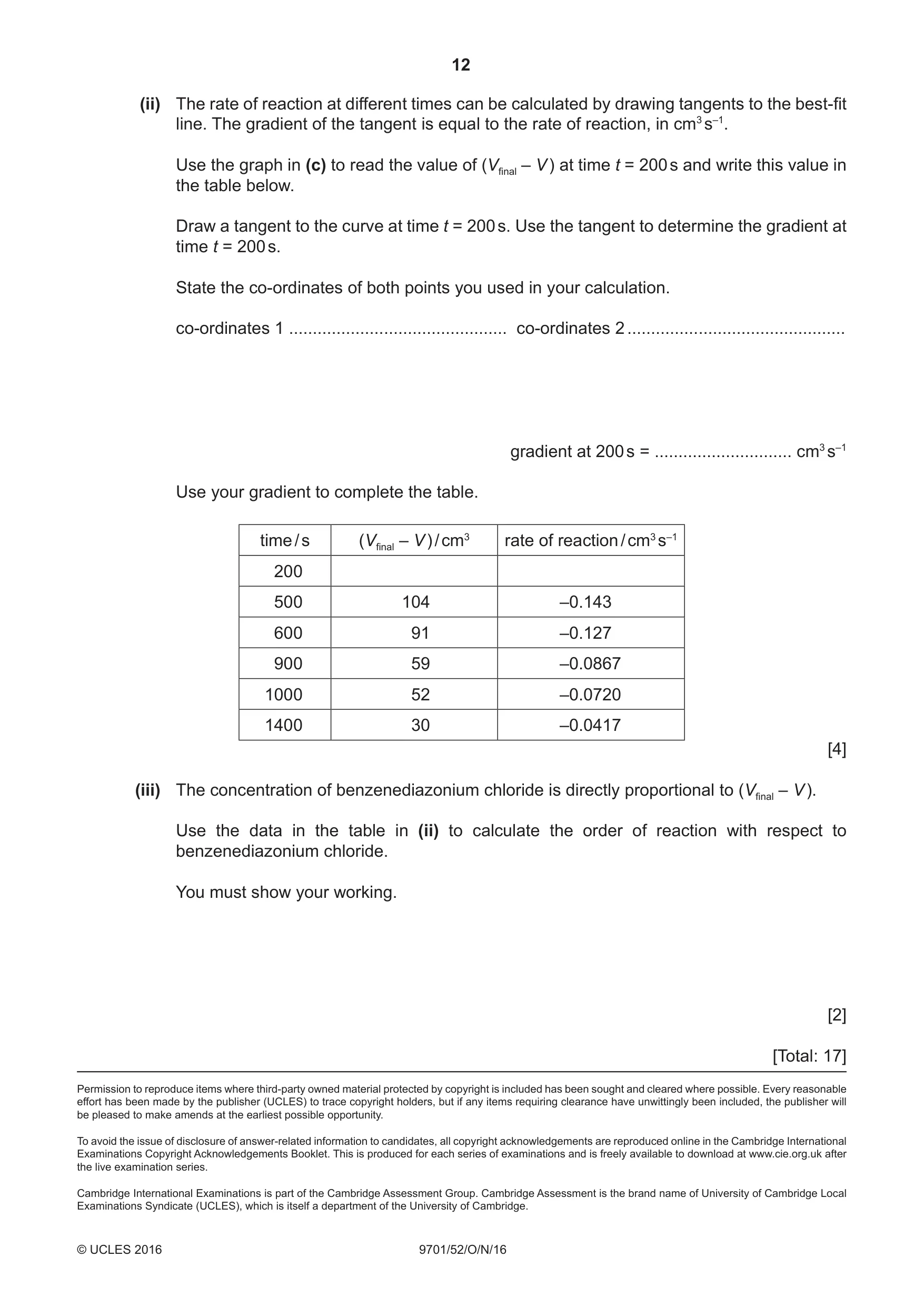
12 9701/52/O/N/16 © UCLES 2016 Permission to reproduce items where third-party owned material protected by copyright is included has been sought and cleared where possible. Every reasonable effort has been made by the publisher (UCLES) to trace copyright holders, but if any items requiring clearance have unwittingly been included, the publisher will be pleased to make amends at the earliest possible opportunity. To avoid the issue of disclosure of answer-related information to candidates, all copyright acknowledgements are reproduced online in the Cambridge International Examinations Copyright Acknowledgements Booklet. This is produced for each series of examinations and is freely available to download at www.cie.org.uk after the live examination series. Cambridge International Examinations is part of the Cambridge Assessment Group. Cambridge Assessment is the brand name of University of Cambridge Local Examinations Syndicate (UCLES), which is itself a department of the University of Cambridge. (ii) The rate of reaction at different times can be calculated by drawing tangents to the best-fi t line. The gradient of the tangent is equal to the rate of reaction, in cm3 s–1. Use the graph in (c) to read the value of (Vfi nal – V ) at time t = 200 s and write this value in the table below. Draw a tangent to the curve at time t = 200 s. Use the tangent to determine the gradient at time t = 200 s. State the co-ordinates of both points you used in your calculation. co-ordinates 1 … co-ordinates 2 … gradient at 200 s = … cm3 s–1 Use your gradient to complete the table. time / s (Vfi nal – V ) / cm3 rate of reaction / cm3 s–1 200 500 104 –0.143 600 91 –0.127 900 59 –0.0867 1000 52 –0.0720 1400 30 –0.0417 [4] (iii) The concentration of benzenediazonium chloride is directly proportional to (Vfi nal – V ). Use the data in the table in (ii) to calculate the order of reaction with respect to benzenediazonium chloride. You must show your working. [2] [Total: 17]
Mark scheme, page 1
® IGCSE is the registered trademark of Cambridge International Examinations. This document consists of 7 printed pages. © UCLES 2016 [Turn over Cambridge International Examinations Cambridge International Advanced Subsidiary and Advanced Level CHEMISTRY 9701/52 Paper 5 Planning, Analysis and Evaluation October/November 2016 MARK SCHEME Maximum Mark: 30 Published This mark scheme is published as an aid to teachers and candidates, to indicate the requirements of the examination. It shows the basis on which Examiners were instructed to award marks. It does not indicate the details of the discussions that took place at an Examiners’ meeting before marking began, which would have considered the acceptability of alternative answers. Mark schemes should be read in conjunction with the question paper and the Principal Examiner Report for Teachers. Cambridge will not enter into discussions about these mark schemes. Cambridge is publishing the mark schemes for the October/November 2016 series for most Cambridge IGCSE®, Cambridge International A and AS Level components and some Cambridge O Level components.
Mark scheme, page 2
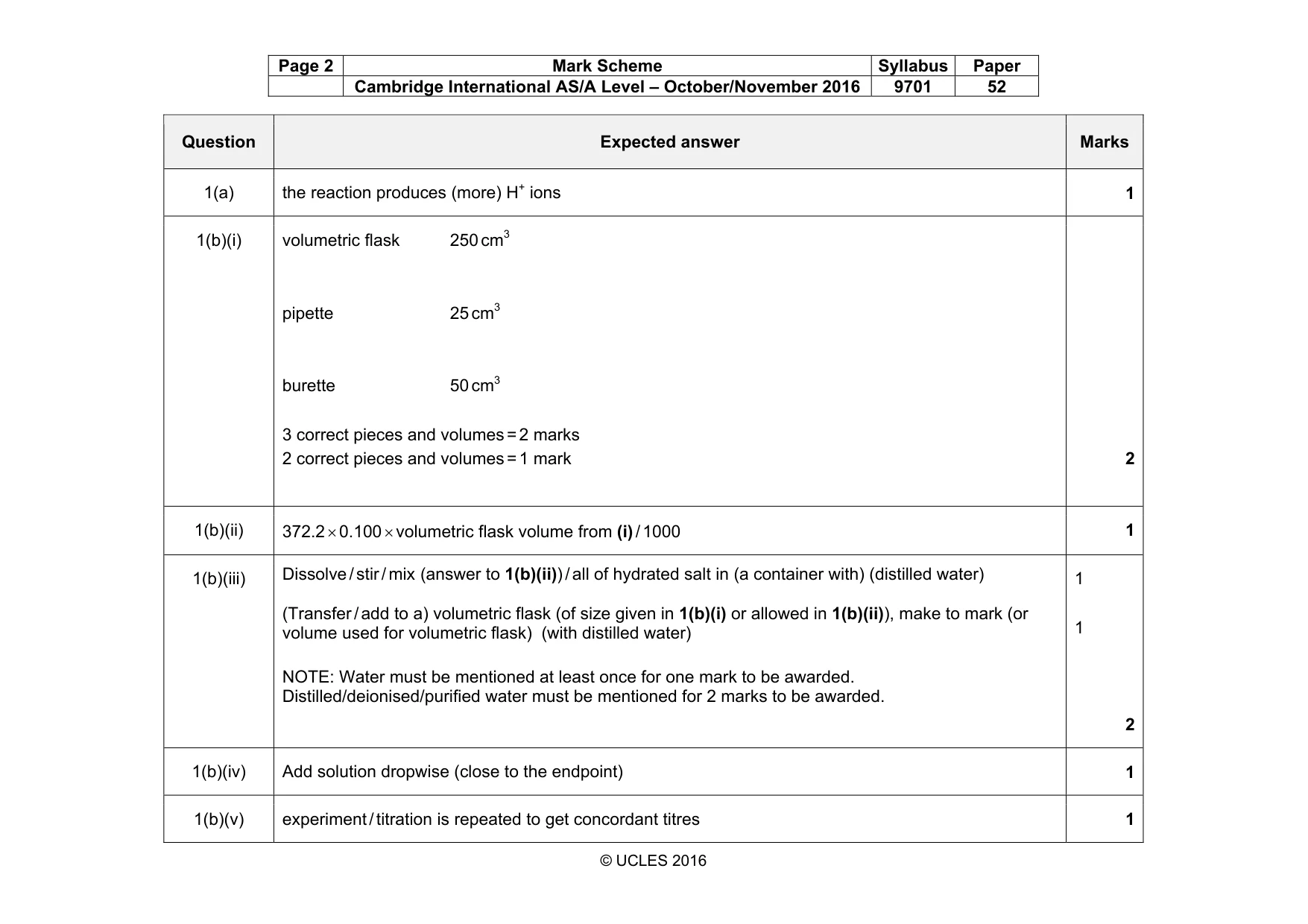
Page 2 Mark Scheme Syllabus Paper Cambridge International AS/A Level – October/November 2016 9701 52 © UCLES 2016 Question Expected answer Marks 1(a) the reaction produces (more) H+ ions 1 1(b)(i) volumetric flask 250 cm3 pipette 25 cm3 burette 50 cm3 3 correct pieces and volumes = 2 marks 2 correct pieces and volumes = 1 mark 2 1(b)(ii) 372.2 × 0.100 × volumetric flask volume from (i) / 1000 1 1(b)(iii) Dissolve / stir / mix (answer to 1(b)(ii)) / all of hydrated salt in (a container with) (distilled water) (Transfer / add to a) volumetric flask (of size given in 1(b)(i) or allowed in 1(b)(ii)), make to mark (or volume used for volumetric flask) (with distilled water) NOTE: Water must be mentioned at least once for one mark to be awarded. Distilled/deionised/purified water must be mentioned for 2 marks to be awarded. 1 1 2 1(b)(iv) Add solution dropwise (close to the endpoint) 1 1(b)(v) experiment / titration is repeated to get concordant titres 1
Mark scheme, page 3
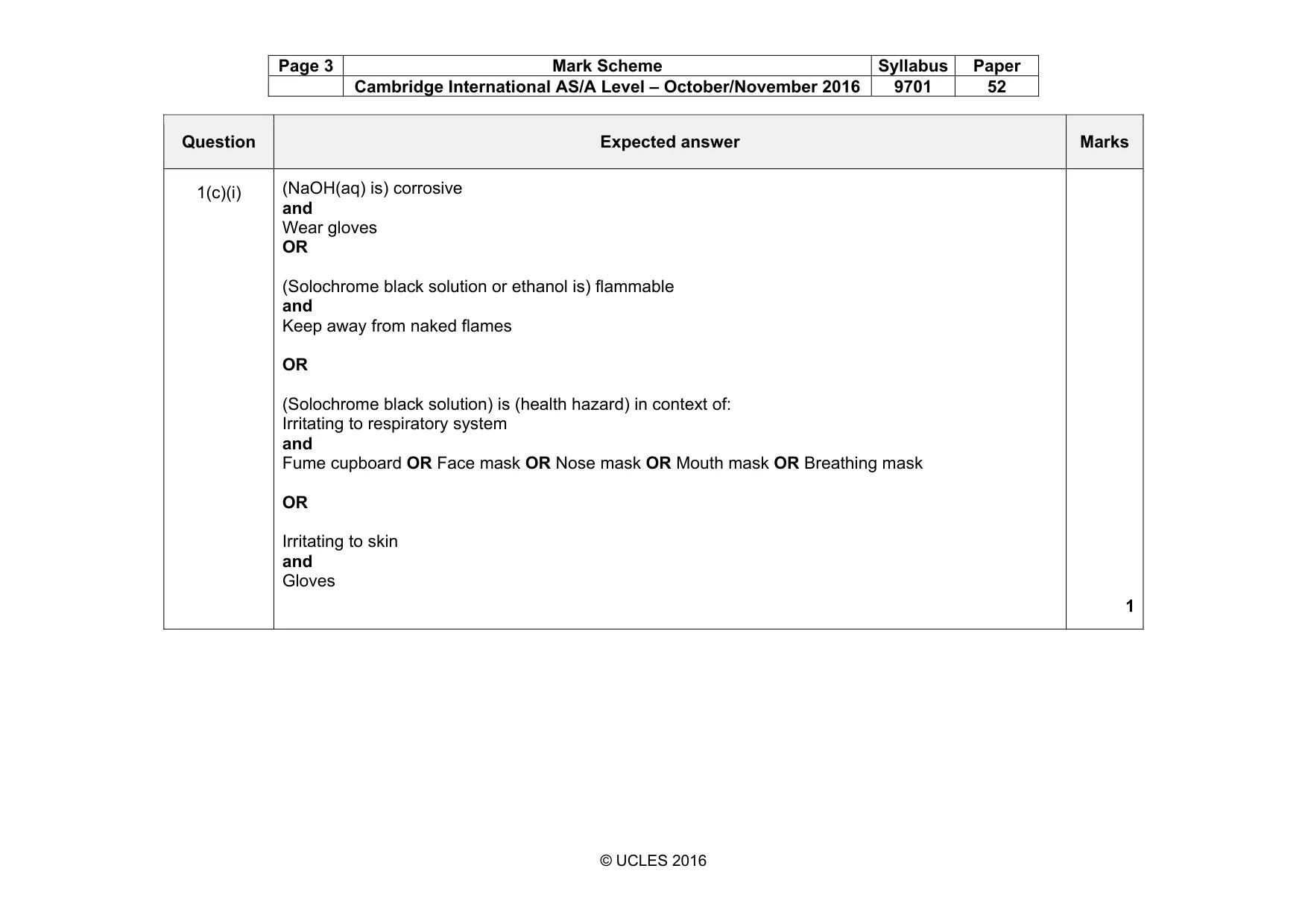
Page 3 Mark Scheme Syllabus Paper Cambridge International AS/A Level – October/November 2016 9701 52 © UCLES 2016 Question Expected answer Marks 1(c)(i) (NaOH(aq) is) corrosive and Wear gloves OR (Solochrome black solution or ethanol is) flammable and Keep away from naked flames OR (Solochrome black solution) is (health hazard) in context of: Irritating to respiratory system and Fume cupboard OR Face mask OR Nose mask OR Mouth mask OR Breathing mask OR Irritating to skin and Gloves 1
Mark scheme, page 4
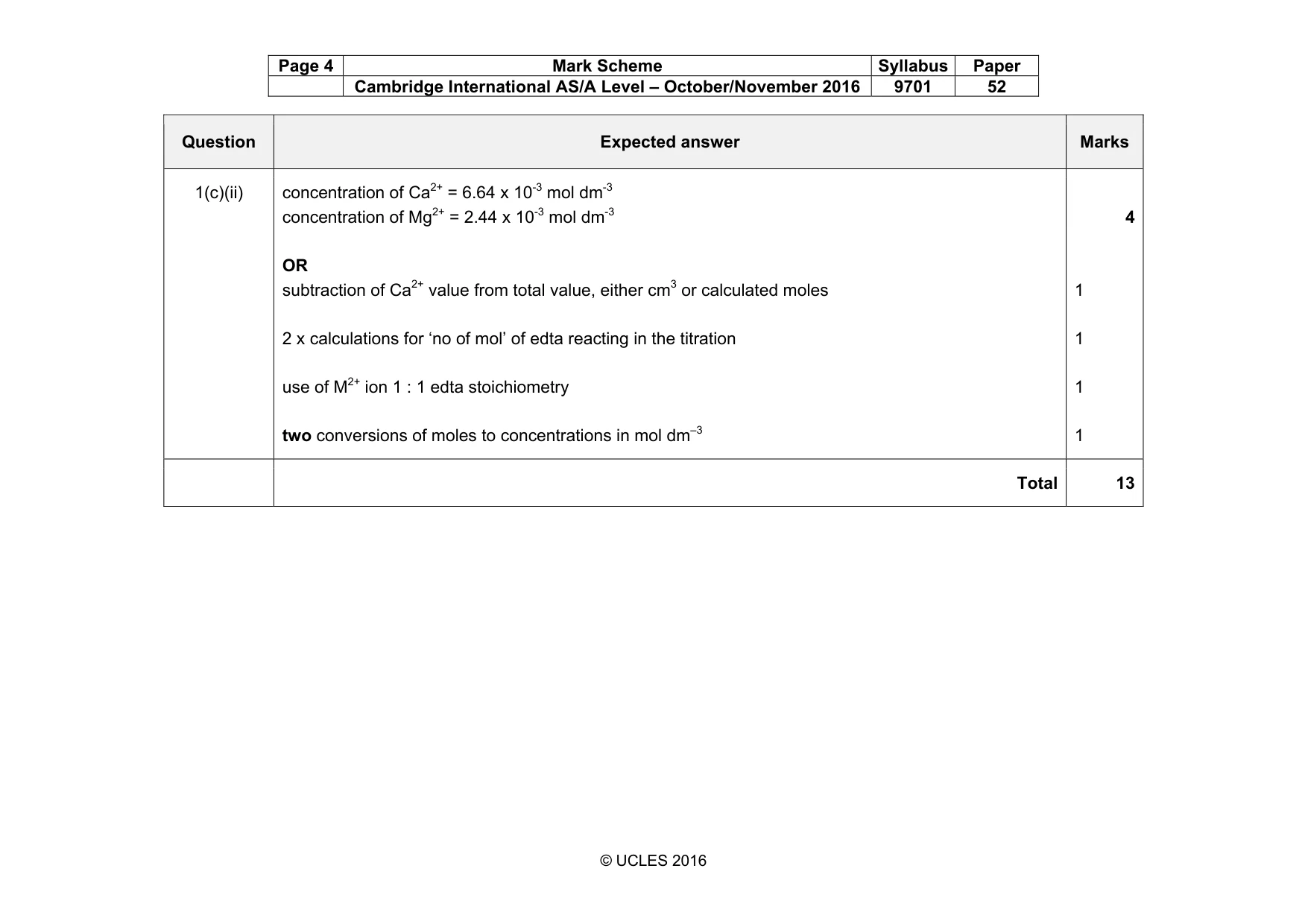
Page 4 Mark Scheme Syllabus Paper Cambridge International AS/A Level – October/November 2016 9701 52 © UCLES 2016 Question Expected answer Marks 1(c)(ii) concentration of Ca2+ = 6.64 x 10⁻³ mol dm-3 concentration of Mg2+ = 2.44 x 10⁻³ mol dm-3 OR subtraction of Ca2+ value from total value, either cm3 or calculated moles 2 x calculations for ‘no of mol’ of edta reacting in the titration use of M2+ ion 1 : 1 edta stoichiometry two conversions of moles to concentrations in mol dm–3 4 1 1 1 1 Total 13
Mark scheme, page 5
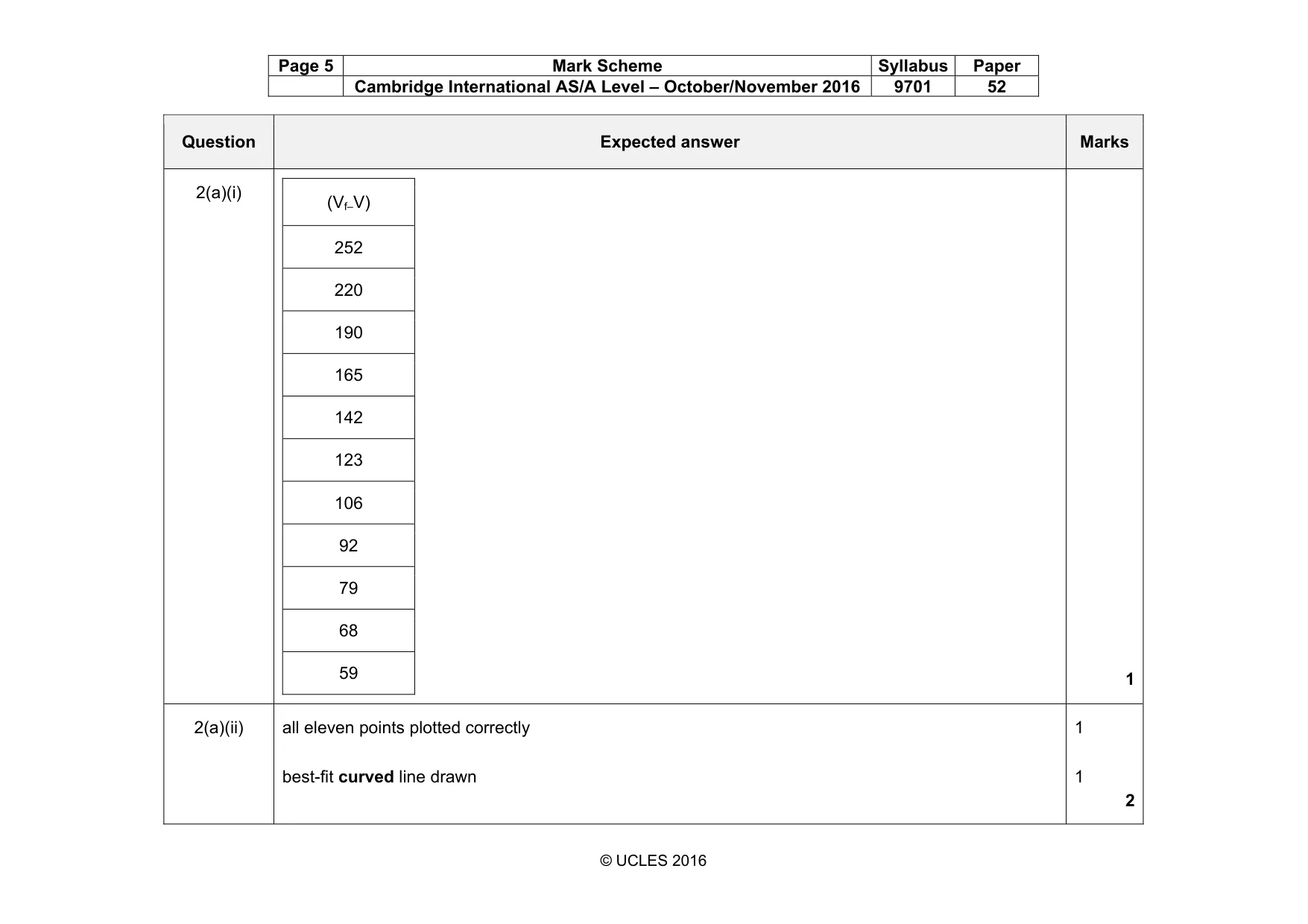
Page 5 Mark Scheme Syllabus Paper Cambridge International AS/A Level – October/November 2016 9701 52 © UCLES 2016 Question Expected answer Marks 2(a)(i) (Vf–V) 252 220 190 165 142 123 106 92 79 68 59 1 2(a)(ii) all eleven points plotted correctly best-fit curved line drawn 1 1 2
Mark scheme, page 6
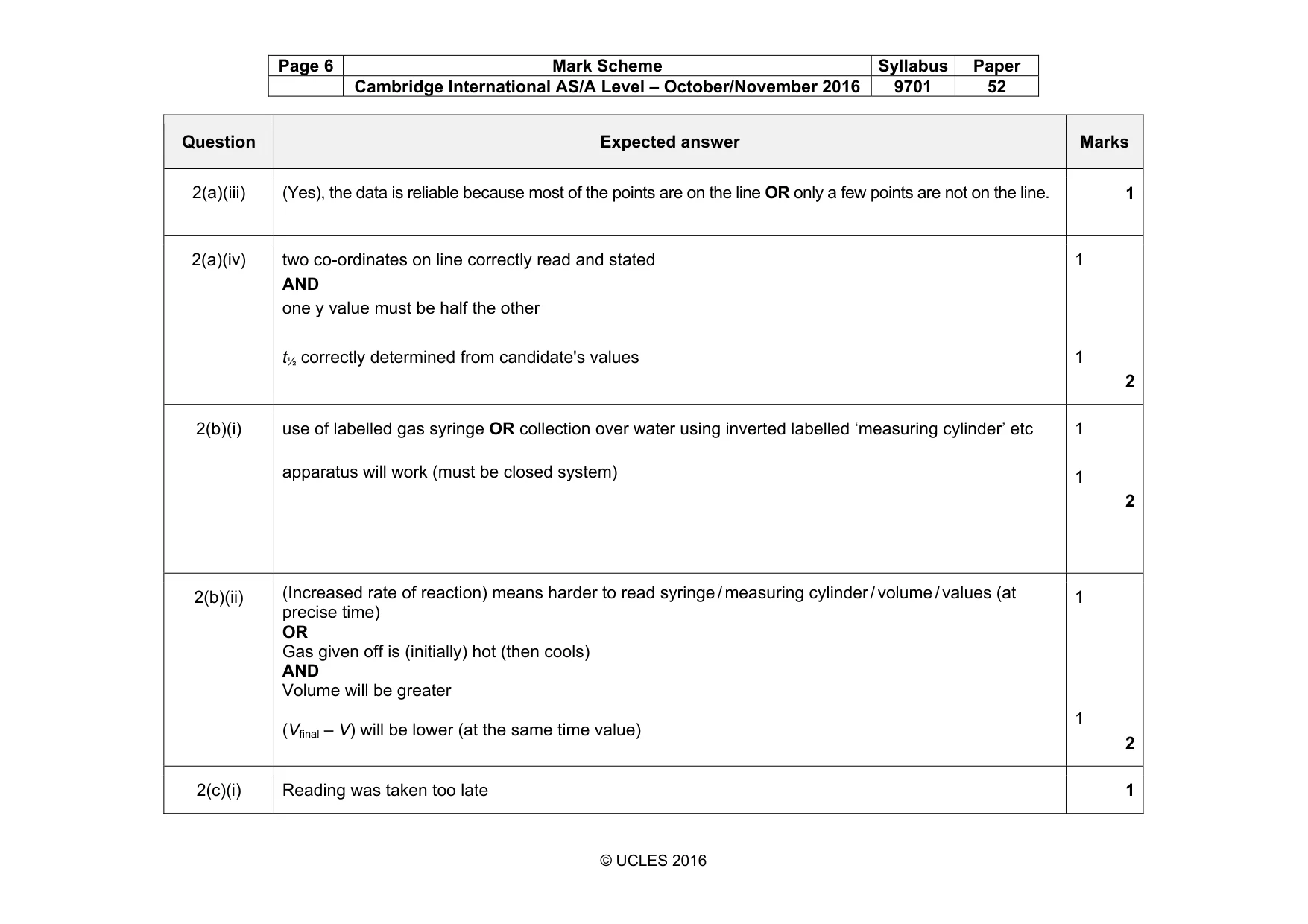
Page 6 Mark Scheme Syllabus Paper Cambridge International AS/A Level – October/November 2016 9701 52 © UCLES 2016 Question Expected answer Marks 2(a)(iii) (Yes), the data is reliable because most of the points are on the line OR only a few points are not on the line. 1 2(a)(iv) two co-ordinates on line correctly read and stated AND one y value must be half the other t½ correctly determined from candidate's values 1 1 2 2(b)(i) use of labelled gas syringe OR collection over water using inverted labelled ‘measuring cylinder’ etc apparatus will work (must be closed system) 1 1 2 2(b)(ii) (Increased rate of reaction) means harder to read syringe / measuring cylinder / volume / values (at precise time) OR Gas given off is (initially) hot (then cools) AND Volume will be greater (Vfinal – V) will be lower (at the same time value) 1 1 2 2(c)(i) Reading was taken too late 1
Mark scheme, page 7
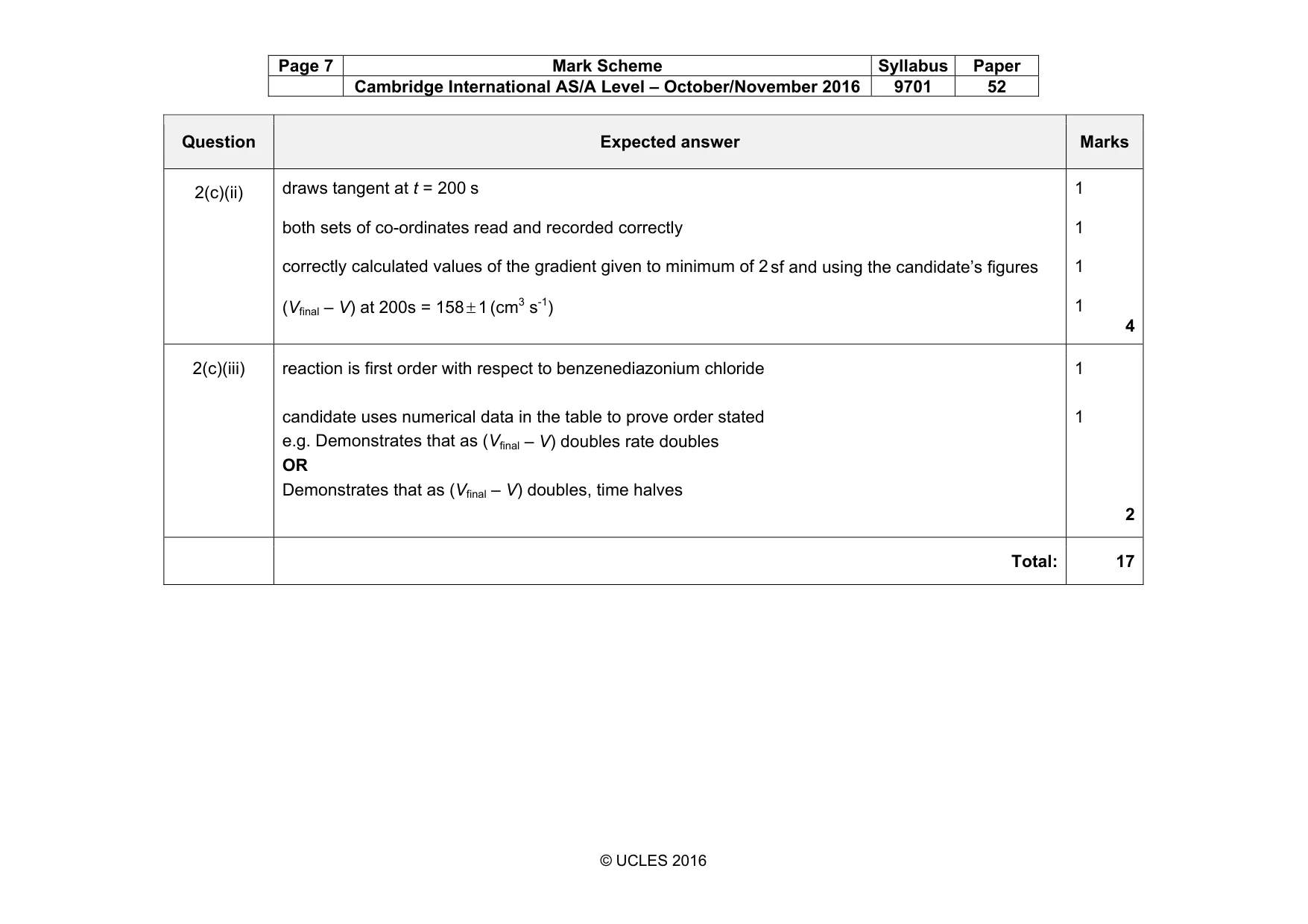
Page 7 Mark Scheme Syllabus Paper Cambridge International AS/A Level – October/November 2016 9701 52 © UCLES 2016 Question Expected answer Marks 2(c)(ii) draws tangent at t = 200 s both sets of co-ordinates read and recorded correctly correctly calculated values of the gradient given to minimum of 2 sf and using the candidate’s figures (Vfinal – V) at 200s = 158 ± 1 (cm3 s-1) 1 1 1 1 4 2(c)(iii) reaction is first order with respect to benzenediazonium chloride candidate uses numerical data in the table to prove order stated e.g. Demonstrates that as (Vfinal – V) doubles rate doubles OR Demonstrates that as (Vfinal – V) doubles, time halves 1 1 2 Total: 17
What you needed in this session
Cambridge’s own grade thresholds for 2016 Oct/Nov, Paper 5 · Variant 2. A higher threshold means an easier paper — the bar moves with how the cohort did.