Cambridge A Level Chemistry 9701 — 2016 Oct/Nov Paper 1 · Variant 2
9701/12/O/N/16 · 40 marks · ≈45 min
The question paper and its mark scheme, free to read here and free to download. This is Cambridge’s own paper, exactly as it was sat.
Question paper16 pages
Mark scheme2 pages
Answers below. Sit the paper first if you are practising.
Paper as text
Question paper, page 1
This document consists of 16 printed pages. IB16 11_9701_12/3RP © UCLES 2016 [Turn over *8022333632* Cambridge International Examinations Cambridge International Advanced Subsidiary and Advanced Level CHEMISTRY 9701/12 Paper 1 Multiple Choice October/November 2016 1 hour Additional Materials: Multiple Choice Answer Sheet Soft clean eraser Soft pencil (type B or HB is recommended) Data Booklet READ THESE INSTRUCTIONS FIRST Write in soft pencil. Do not use staples, paper clips, glue or correction fluid. Write your name, Centre number and candidate number on the Answer Sheet in the spaces provided unless this has been done for you. DO NOT WRITE IN ANY BARCODES. There are forty questions on this paper. Answer all questions. For each question there are four possible answers A, B, C and D. Choose the one you consider correct and record your choice in soft pencil on the separate Answer Sheet. Read the instructions on the Answer Sheet very carefully. Each correct answer will score one mark. A mark will not be deducted for a wrong answer. Any rough working should be done in this booklet. Electronic calculators may be used.
Question paper, page 2
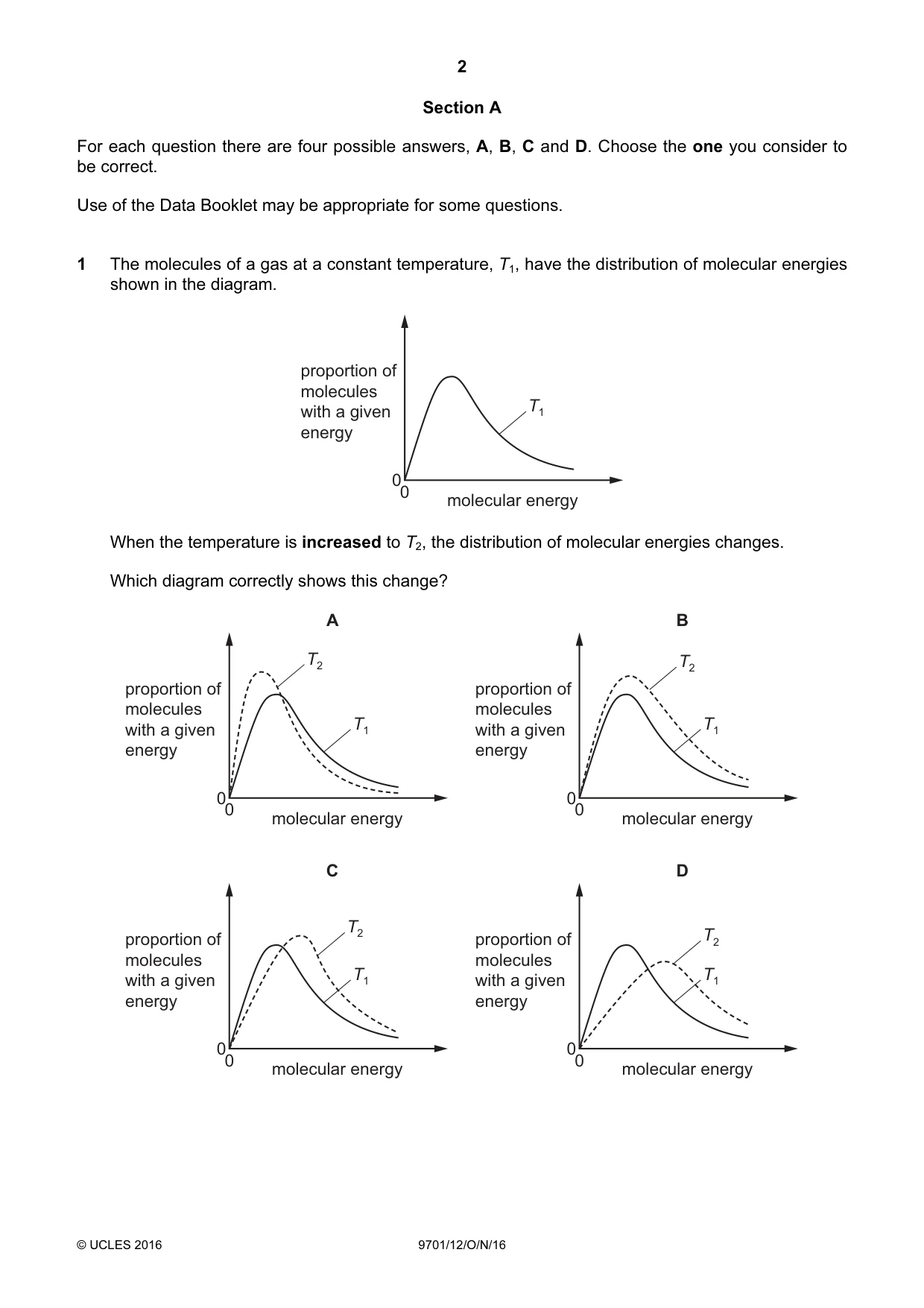
2 © UCLES 2016 9701/12/O/N/16 Section A For each question there are four possible answers, A, B, C and D. Choose the one you consider to be correct. Use of the Data Booklet may be appropriate for some questions. 1 The molecules of a gas at a constant temperature, T1, have the distribution of molecular energies shown in the diagram. proportion of molecules with a given energy molecular energy T1 00 When the temperature is increased to T2, the distribution of molecular energies changes. Which diagram correctly shows this change? proportion of molecules with a given energy molecular energy T1 T2 T2 T2 T2 A proportion of molecules with a given energy molecular energy T1 B proportion of molecules with a given energy molecular energy T1 C proportion of molecules with a given energy molecular energy T1 D 00 00 00 00
Question paper, page 3
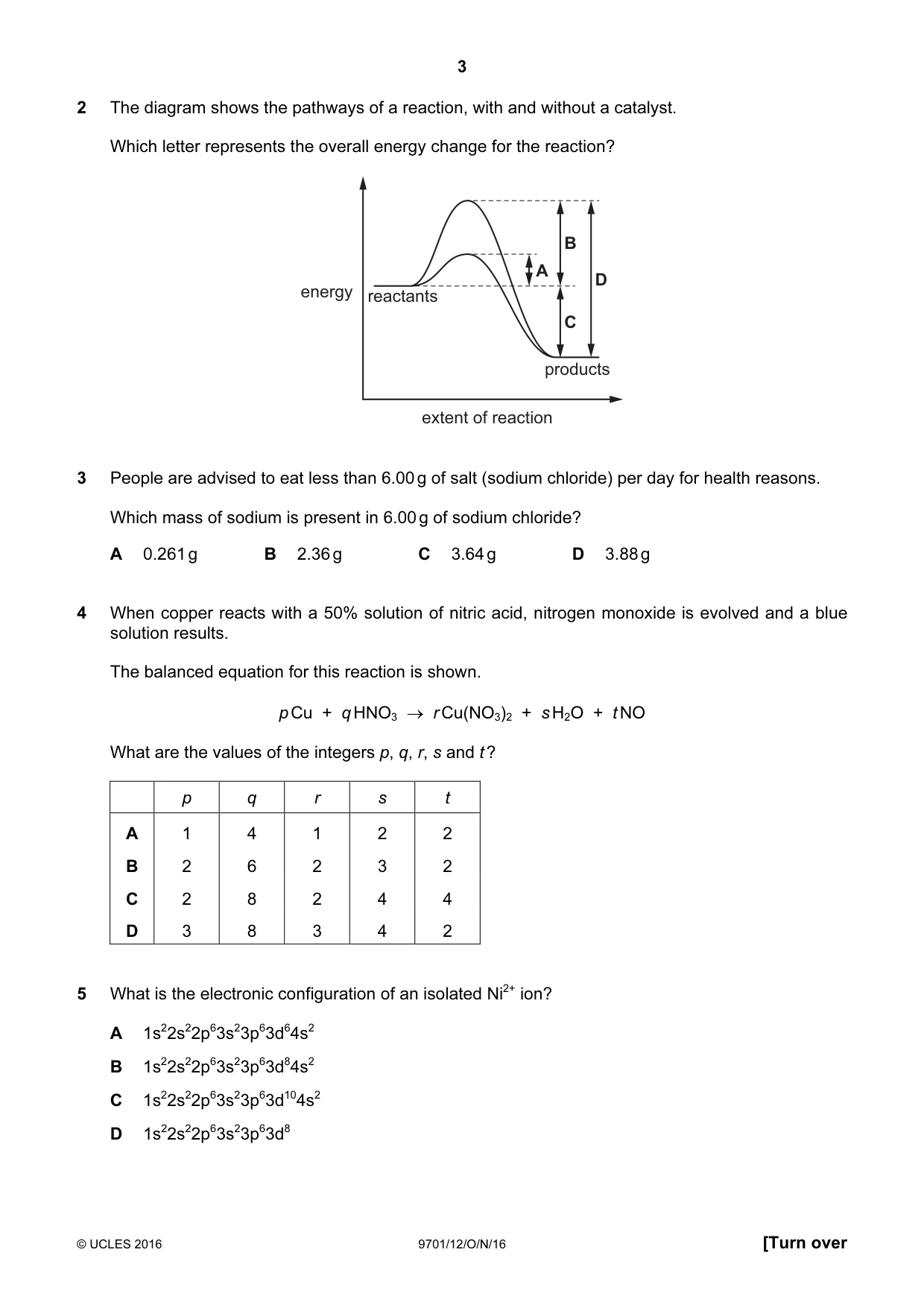
3 © UCLES 2016 9701/12/O/N/16 [Turn over 2 The diagram shows the pathways of a reaction, with and without a catalyst. Which letter represents the overall energy change for the reaction? energy extent of reaction reactants products A B D C 3 People are advised to eat less than 6.00 g of salt (sodium chloride) per day for health reasons. Which mass of sodium is present in 6.00 g of sodium chloride? A 0.261 g B 2.36 g C 3.64 g D 3.88 g 4 When copper reacts with a 50% solution of nitric acid, nitrogen monoxide is evolved and a blue solution results. The balanced equation for this reaction is shown. p Cu + q HNO3 → r Cu(NO3)2 + s H2O + t NO What are the values of the integers p, q, r, s and t ? p q r s t A 1 4 1 2 2 B 2 6 2 3 2 C 2 8 2 4 4 D 3 8 3 4 2 5 What is the electronic configuration of an isolated Ni2+ ion? A 1s22s22p63s23p63d64s2 B 1s22s22p63s23p63d84s2 C 1s22s22p63s23p63d104s2 D 1s22s22p63s23p63d8
Question paper, page 4
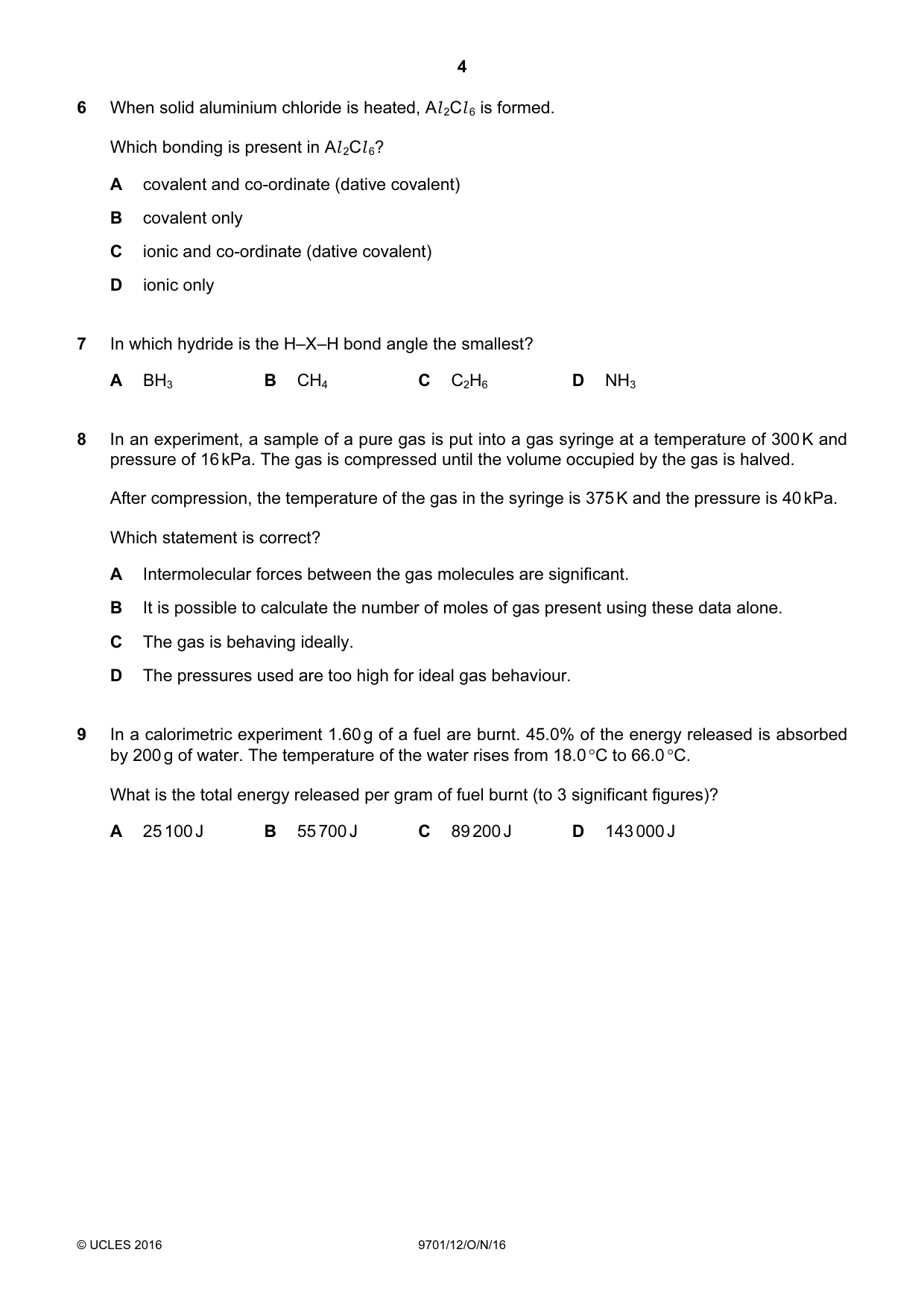
4 © UCLES 2016 9701/12/O/N/16 6 When solid aluminium chloride is heated, Al 2Cl 6 is formed. Which bonding is present in Al 2Cl 6? A covalent and co-ordinate (dative covalent) B covalent only C ionic and co-ordinate (dative covalent) D ionic only 7 In which hydride is the H–X–H bond angle the smallest? A BH3 B CH4 C C2H6 D NH3 8 In an experiment, a sample of a pure gas is put into a gas syringe at a temperature of 300 K and pressure of 16 kPa. The gas is compressed until the volume occupied by the gas is halved. After compression, the temperature of the gas in the syringe is 375 K and the pressure is 40 kPa. Which statement is correct? A Intermolecular forces between the gas molecules are significant. B It is possible to calculate the number of moles of gas present using these data alone. C The gas is behaving ideally. D The pressures used are too high for ideal gas behaviour. 9 In a calorimetric experiment 1.60 g of a fuel are burnt. 45.0% of the energy released is absorbed by 200 g of water. The temperature of the water rises from 18.0 °C to 66.0 °C. What is the total energy released per gram of fuel burnt (to 3 significant figures)? A 25 100 J B 55 700 J C 89 200 J D 143 000 J
Question paper, page 5
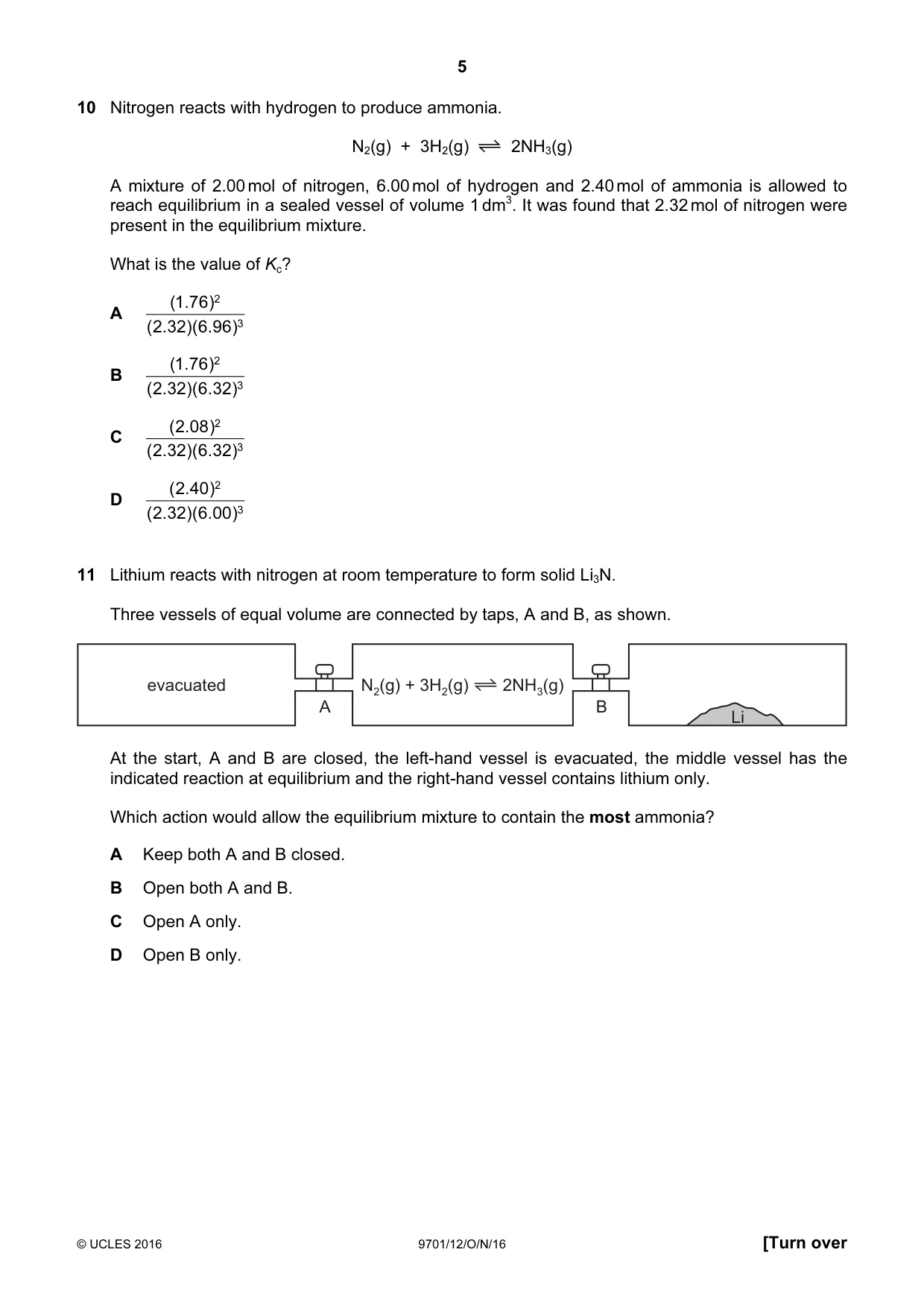
5 © UCLES 2016 9701/12/O/N/16 [Turn over 10 Nitrogen reacts with hydrogen to produce ammonia. N2(g) + 3H2(g) 2NH3(g) A mixture of 2.00 mol of nitrogen, 6.00 mol of hydrogen and 2.40 mol of ammonia is allowed to reach equilibrium in a sealed vessel of volume 1 dm3. It was found that 2.32 mol of nitrogen were present in the equilibrium mixture. What is the value of Kc? A 3 2 ) 96 . 6 )( 32 . 2 ( ) 76 . 1 ( B 3 2 ) 32 . 6 )( 32 . 2 ( ) 76 . 1 ( C 3 2 ) 32 . 6 )( 32 . 2 ( ) 08 . 2 ( D 3 2 ) 00 . 6 )( 32 . 2 ( ) 40 . 2 ( 11 Lithium reacts with nitrogen at room temperature to form solid Li3N. Three vessels of equal volume are connected by taps, A and B, as shown. evacuated N2(g) + 3H2(g) 2NH3(g) Li A B At the start, A and B are closed, the left-hand vessel is evacuated, the middle vessel has the indicated reaction at equilibrium and the right-hand vessel contains lithium only. Which action would allow the equilibrium mixture to contain the most ammonia? A Keep both A and B closed. B Open both A and B. C Open A only. D Open B only.
Question paper, page 6
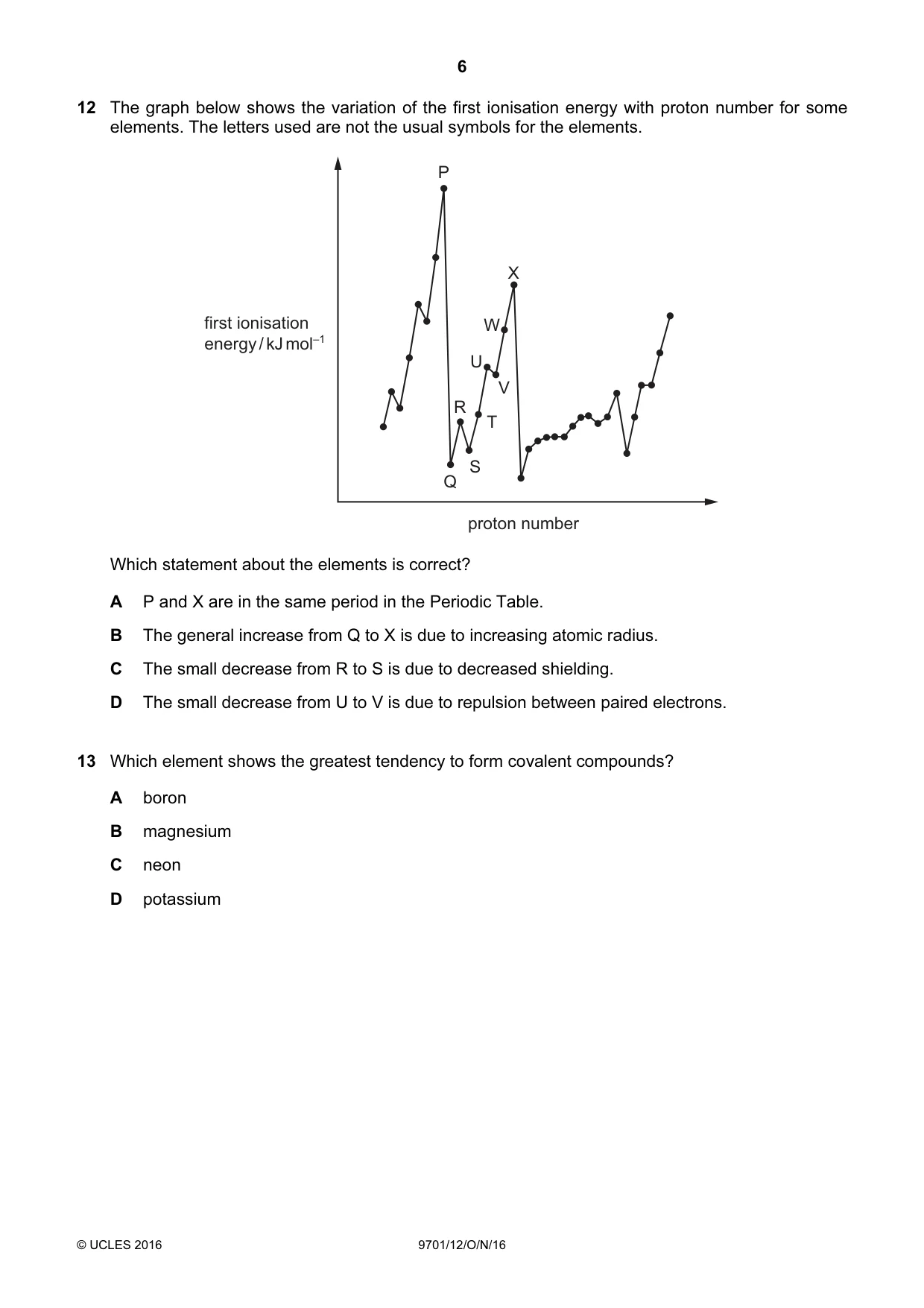
6 © UCLES 2016 9701/12/O/N/16 12 The graph below shows the variation of the first ionisation energy with proton number for some elements. The letters used are not the usual symbols for the elements. first ionisation energy / kJ mol–1 proton number P Q R S T U V W X Which statement about the elements is correct? A P and X are in the same period in the Periodic Table. B The general increase from Q to X is due to increasing atomic radius. C The small decrease from R to S is due to decreased shielding. D The small decrease from U to V is due to repulsion between paired electrons. 13 Which element shows the greatest tendency to form covalent compounds? A boron B magnesium C neon D potassium
Question paper, page 7
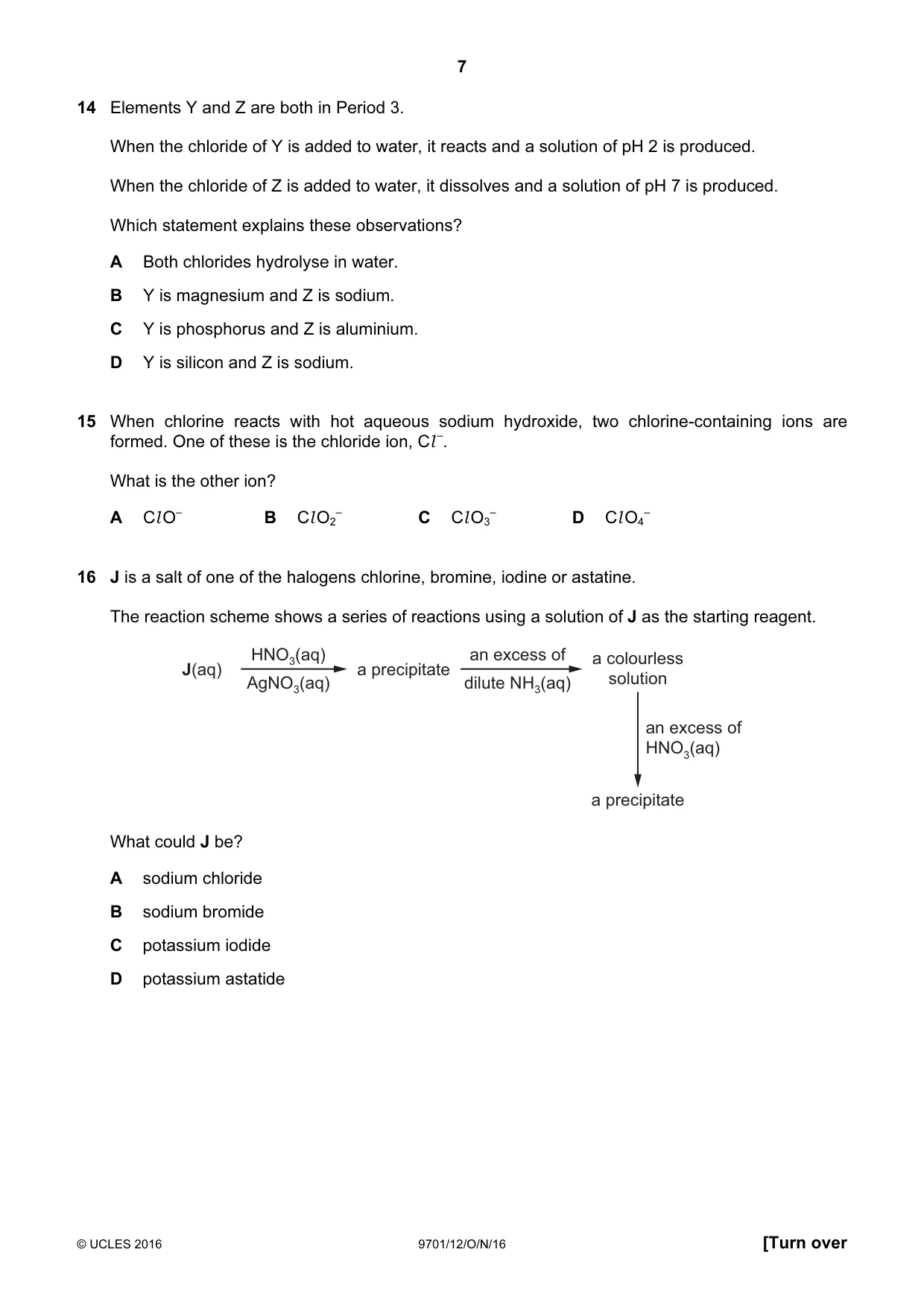
7 © UCLES 2016 9701/12/O/N/16 [Turn over 14 Elements Y and Z are both in Period 3. When the chloride of Y is added to water, it reacts and a solution of pH 2 is produced. When the chloride of Z is added to water, it dissolves and a solution of pH 7 is produced. Which statement explains these observations? A Both chlorides hydrolyse in water. B Y is magnesium and Z is sodium. C Y is phosphorus and Z is aluminium. D Y is silicon and Z is sodium. 15 When chlorine reacts with hot aqueous sodium hydroxide, two chlorine-containing ions are formed. One of these is the chloride ion, Cl –. What is the other ion? A Cl O– B Cl O2 – C Cl O3 – D Cl O4 – 16 J is a salt of one of the halogens chlorine, bromine, iodine or astatine. The reaction scheme shows a series of reactions using a solution of J as the starting reagent. J(aq) a precipitate a colourless solution a precipitate HNO3(aq) AgNO3(aq) an excess of dilute NH3(aq) an excess of HNO3(aq) What could J be? A sodium chloride B sodium bromide C potassium iodide D potassium astatide
Question paper, page 8
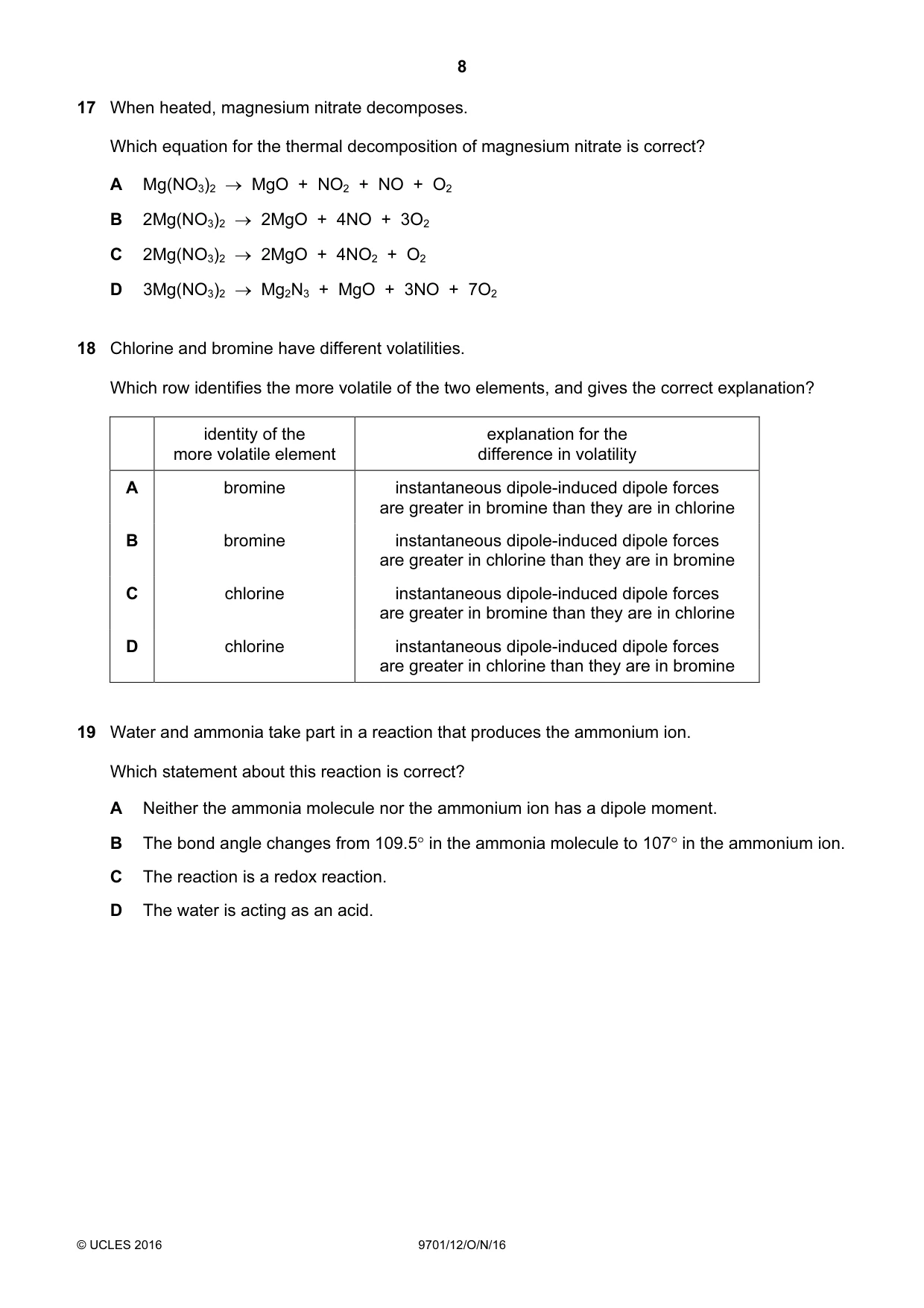
8 © UCLES 2016 9701/12/O/N/16 17 When heated, magnesium nitrate decomposes. Which equation for the thermal decomposition of magnesium nitrate is correct? A Mg(NO3)2 → MgO + NO2 + NO + O2 B 2Mg(NO3)2 → 2MgO + 4NO + 3O2 C 2Mg(NO3)2 → 2MgO + 4NO2 + O2 D 3Mg(NO3)2 → Mg2N3 + MgO + 3NO + 7O2 18 Chlorine and bromine have different volatilities. Which row identifies the more volatile of the two elements, and gives the correct explanation? identity of the more volatile element explanation for the difference in volatility A bromine instantaneous dipole-induced dipole forces are greater in bromine than they are in chlorine B bromine instantaneous dipole-induced dipole forces are greater in chlorine than they are in bromine C chlorine instantaneous dipole-induced dipole forces are greater in bromine than they are in chlorine D chlorine instantaneous dipole-induced dipole forces are greater in chlorine than they are in bromine 19 Water and ammonia take part in a reaction that produces the ammonium ion. Which statement about this reaction is correct? A Neither the ammonia molecule nor the ammonium ion has a dipole moment. B The bond angle changes from 109.5° in the ammonia molecule to 107° in the ammonium ion. C The reaction is a redox reaction. D The water is acting as an acid.
Question paper, page 9
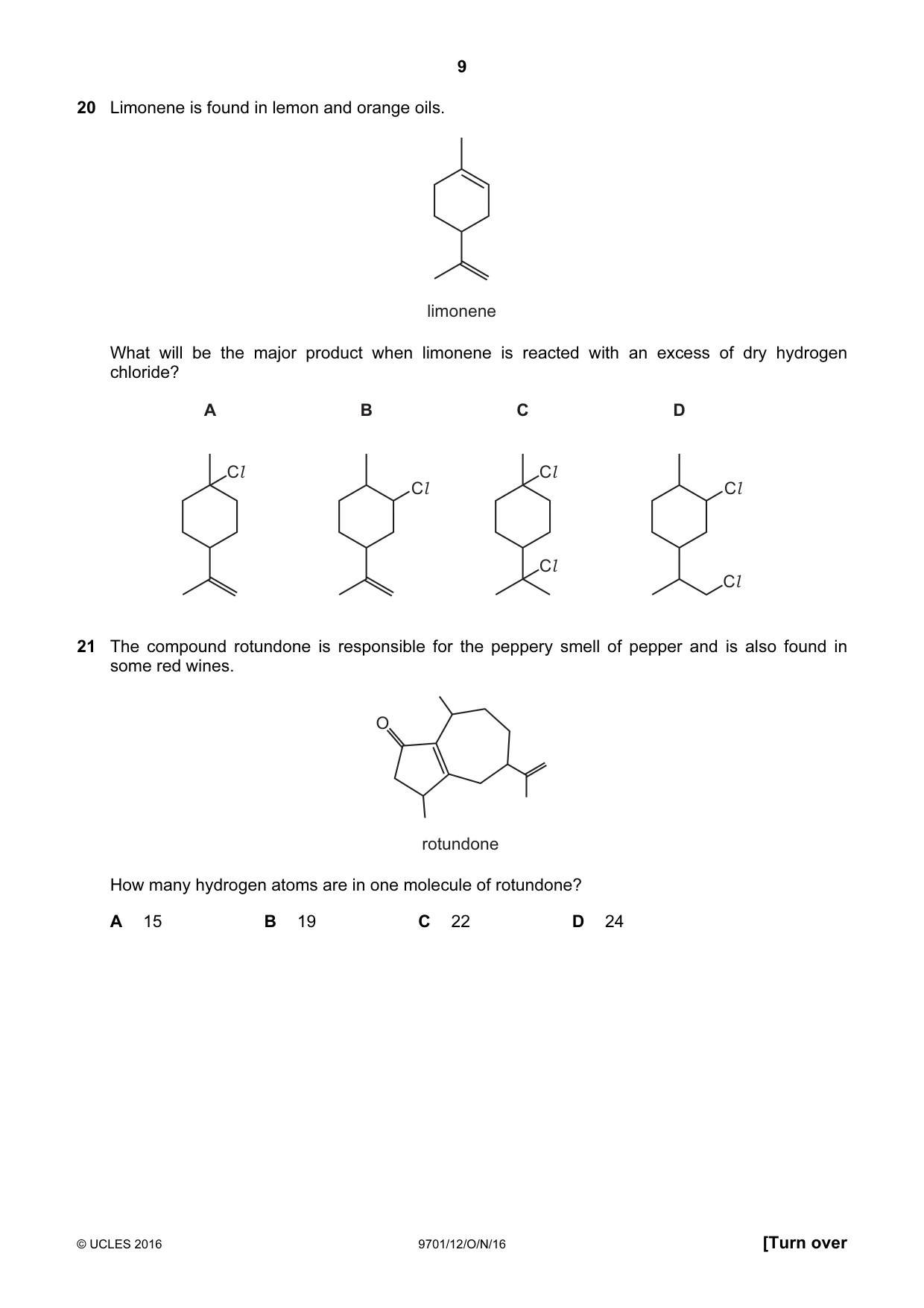
9 © UCLES 2016 9701/12/O/N/16 [Turn over 20 Limonene is found in lemon and orange oils. limonene What will be the major product when limonene is reacted with an excess of dry hydrogen chloride? A B C D Cl Cl Cl Cl Cl Cl 21 The compound rotundone is responsible for the peppery smell of pepper and is also found in some red wines. O rotundone How many hydrogen atoms are in one molecule of rotundone? A 15 B 19 C 22 D 24
Question paper, page 10
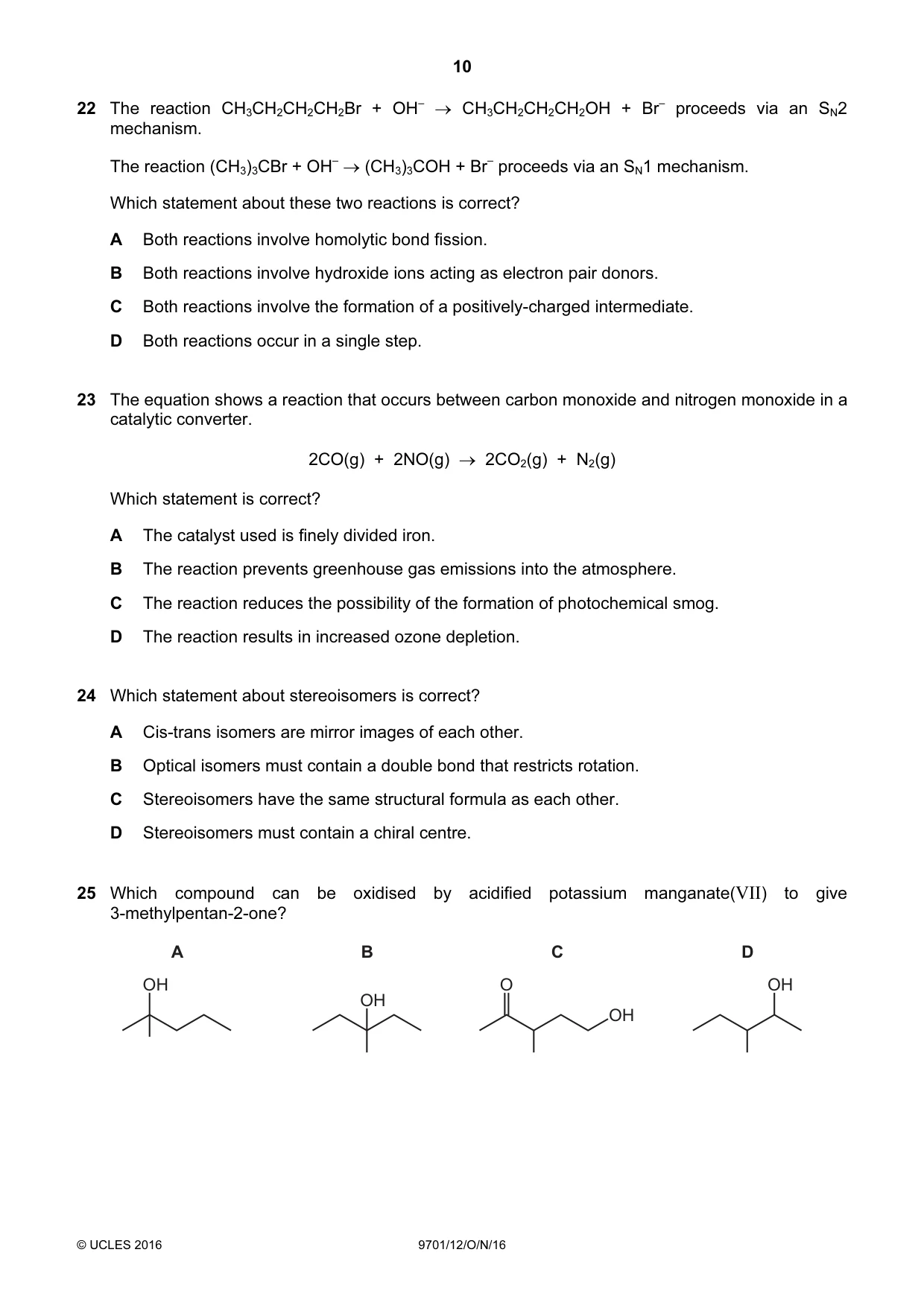
10 © UCLES 2016 9701/12/O/N/16 22 The reaction CH3CH2CH2CH2Br + OH– → CH3CH2CH2CH2OH + Br– proceeds via an SN2 mechanism. The reaction (CH3)3CBr + OH– → (CH3)3COH + Br– proceeds via an SN1 mechanism. Which statement about these two reactions is correct? A Both reactions involve homolytic bond fission. B Both reactions involve hydroxide ions acting as electron pair donors. C Both reactions involve the formation of a positively-charged intermediate. D Both reactions occur in a single step. 23 The equation shows a reaction that occurs between carbon monoxide and nitrogen monoxide in a catalytic converter. 2CO(g) + 2NO(g) → 2CO2(g) + N2(g) Which statement is correct? A The catalyst used is finely divided iron. B The reaction prevents greenhouse gas emissions into the atmosphere. C The reaction reduces the possibility of the formation of photochemical smog. D The reaction results in increased ozone depletion. 24 Which statement about stereoisomers is correct? A Cis-trans isomers are mirror images of each other. B Optical isomers must contain a double bond that restricts rotation. C Stereoisomers have the same structural formula as each other. D Stereoisomers must contain a chiral centre. 25 Which compound can be oxidised by acidified potassium manganate(VII) to give 3-methylpentan-2-one? OH A OH B O OH C OH D
Question paper, page 11
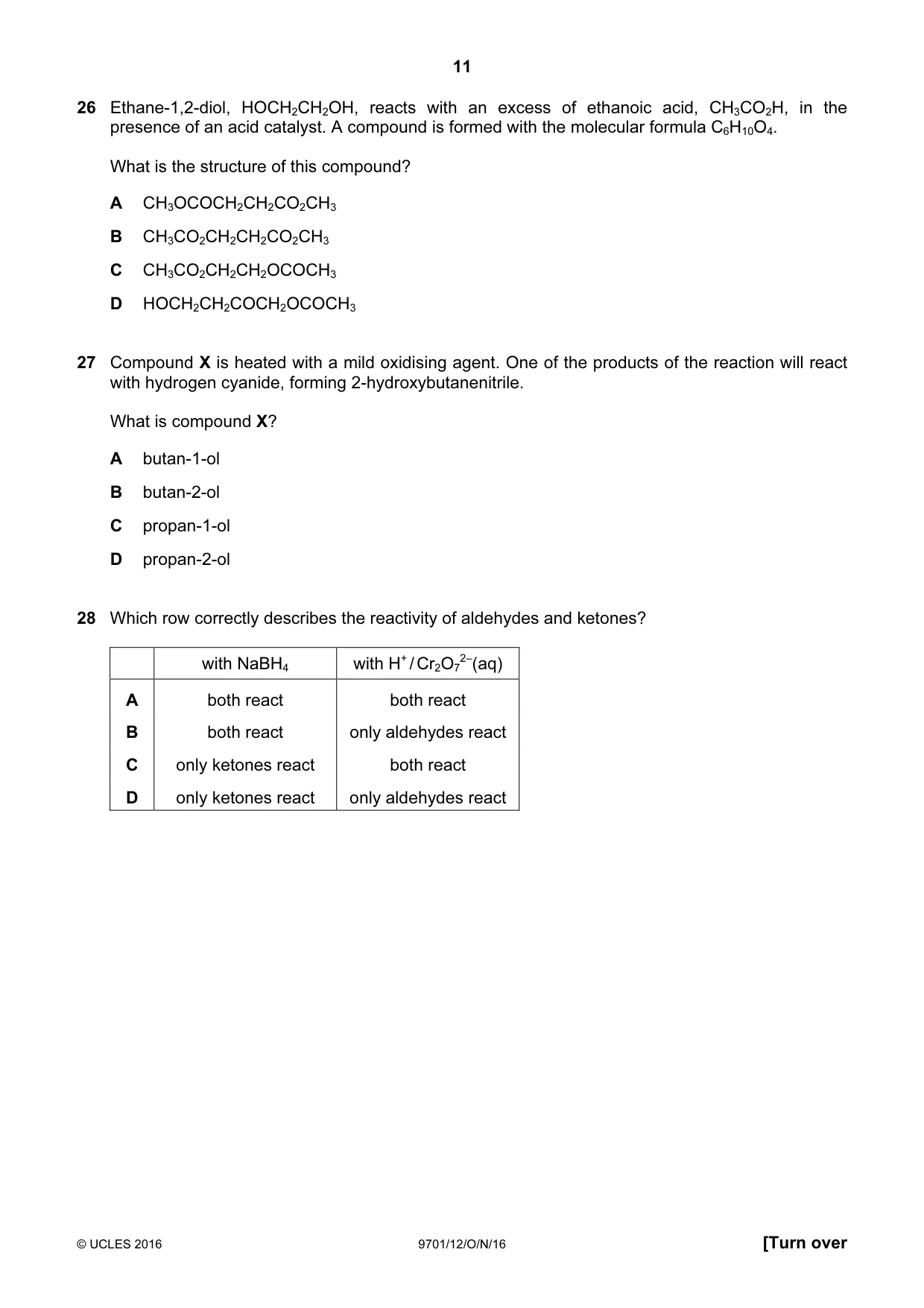
11 © UCLES 2016 9701/12/O/N/16 [Turn over 26 Ethane-1,2-diol, HOCH2CH2OH, reacts with an excess of ethanoic acid, CH3CO2H, in the presence of an acid catalyst. A compound is formed with the molecular formula C6H10O4. What is the structure of this compound? A CH3OCOCH2CH2CO2CH3 B CH3CO2CH2CH2CO2CH3 C CH3CO2CH2CH2OCOCH3 D HOCH2CH2COCH2OCOCH3 27 Compound X is heated with a mild oxidising agent. One of the products of the reaction will react with hydrogen cyanide, forming 2-hydroxybutanenitrile. What is compound X? A butan-1-ol B butan-2-ol C propan-1-ol D propan-2-ol 28 Which row correctly describes the reactivity of aldehydes and ketones? with NaBH4 with H+ / Cr2O7 2–(aq) A both react both react B both react only aldehydes react C only ketones react both react D only ketones react only aldehydes react
Question paper, page 12
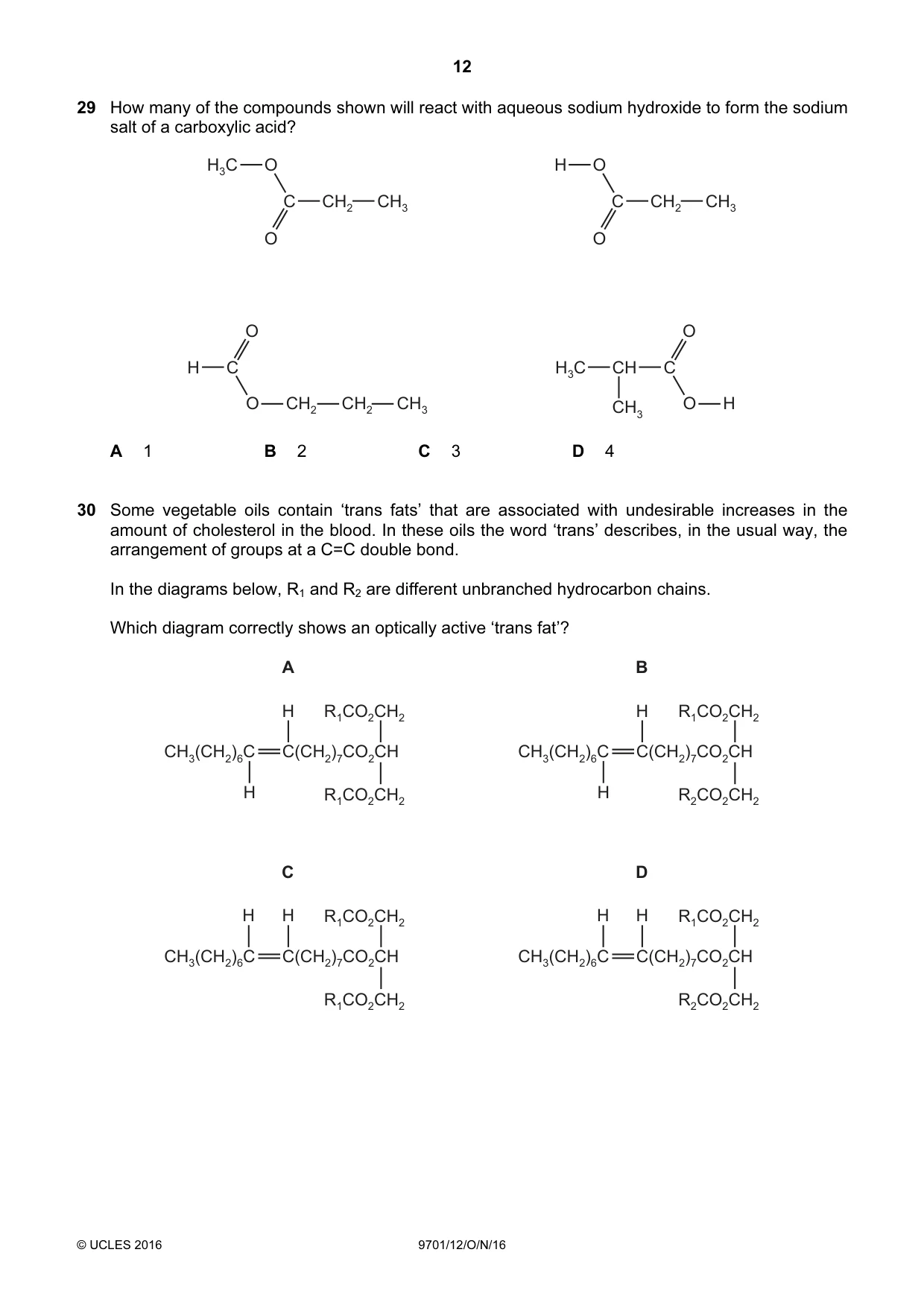
12 © UCLES 2016 9701/12/O/N/16 29 How many of the compounds shown will react with aqueous sodium hydroxide to form the sodium salt of a carboxylic acid? O H3C O C CH2 CH3 O H O C CH2 CH3 O H O C CH2 CH3 CH2 O O H H3C CH CH3 C A 1 B 2 C 3 D 4 30 Some vegetable oils contain ‘trans fats’ that are associated with undesirable increases in the amount of cholesterol in the blood. In these oils the word ‘trans’ describes, in the usual way, the arrangement of groups at a C=C double bond. In the diagrams below, R1 and R2 are different unbranched hydrocarbon chains. Which diagram correctly shows an optically active ‘trans fat’? CH3(CH2)6C C(CH2)7CO2CH A H H R1CO2CH2 R1CO2CH2 R1CO2CH2 R1CO2CH2 CH3(CH2)6C C(CH2)7CO2CH B H H R1CO2CH2 R2CO2CH2 CH3(CH2)6C C(CH2)7CO2CH C H H R1CO2CH2 CH3(CH2)6C C(CH2)7CO2CH D H H R2CO2CH2
Question paper, page 13
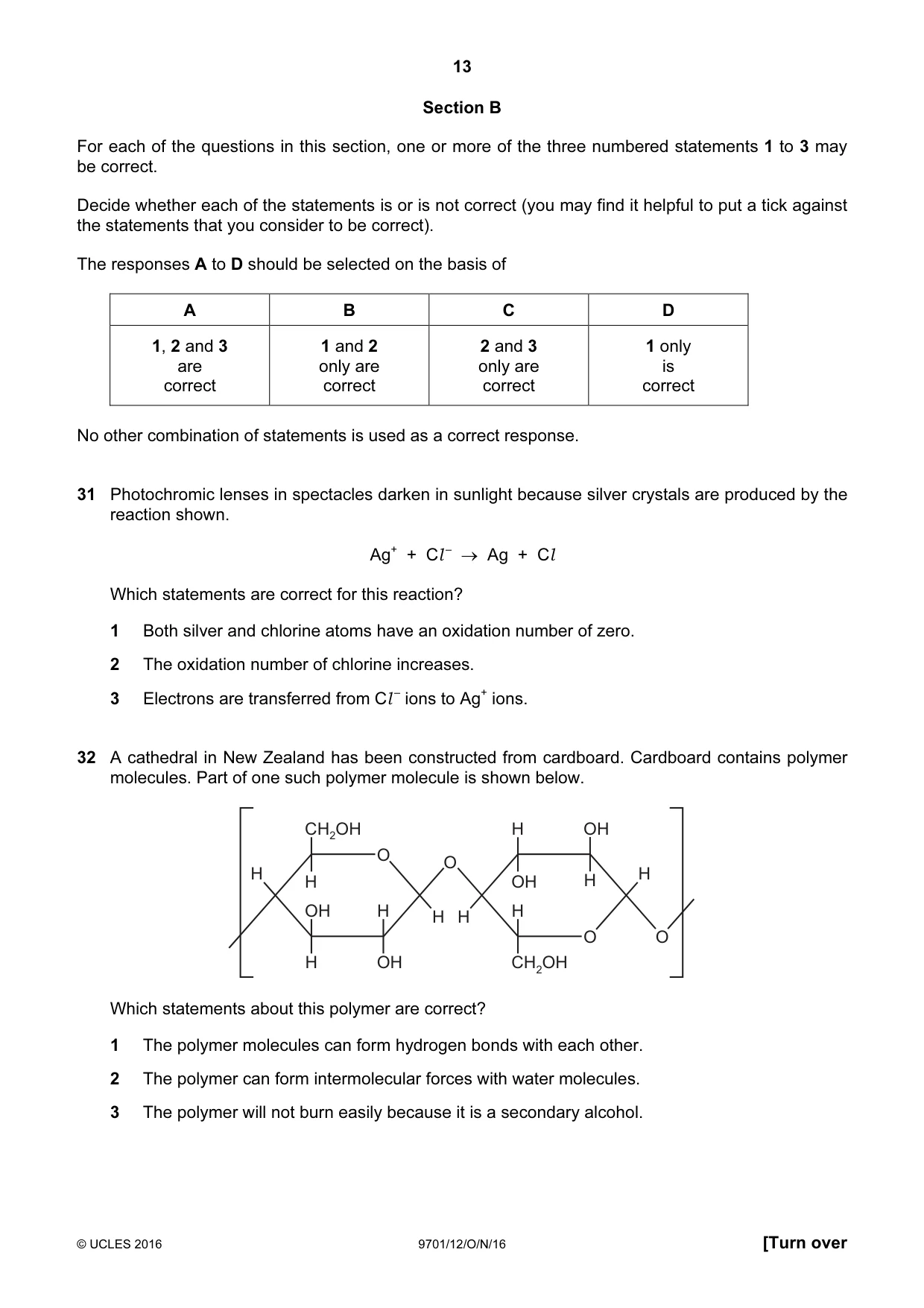
13 © UCLES 2016 9701/12/O/N/16 [Turn over Section B For each of the questions in this section, one or more of the three numbered statements 1 to 3 may be correct. Decide whether each of the statements is or is not correct (you may find it helpful to put a tick against the statements that you consider to be correct). The responses A to D should be selected on the basis of A B C D 1, 2 and 3 are correct 1 and 2 only are correct 2 and 3 only are correct 1 only is correct No other combination of statements is used as a correct response. 31 Photochromic lenses in spectacles darken in sunlight because silver crystals are produced by the reaction shown. Ag+ + Cl – → Ag + Cl Which statements are correct for this reaction? 1 Both silver and chlorine atoms have an oxidation number of zero. 2 The oxidation number of chlorine increases. 3 Electrons are transferred from Cl – ions to Ag+ ions. 32 A cathedral in New Zealand has been constructed from cardboard. Cardboard contains polymer molecules. Part of one such polymer molecule is shown below. OH H H OH CH2OH H H H H OH H H CH2OH H OH O O O O H Which statements about this polymer are correct? 1 The polymer molecules can form hydrogen bonds with each other. 2 The polymer can form intermolecular forces with water molecules. 3 The polymer will not burn easily because it is a secondary alcohol.
Question paper, page 14
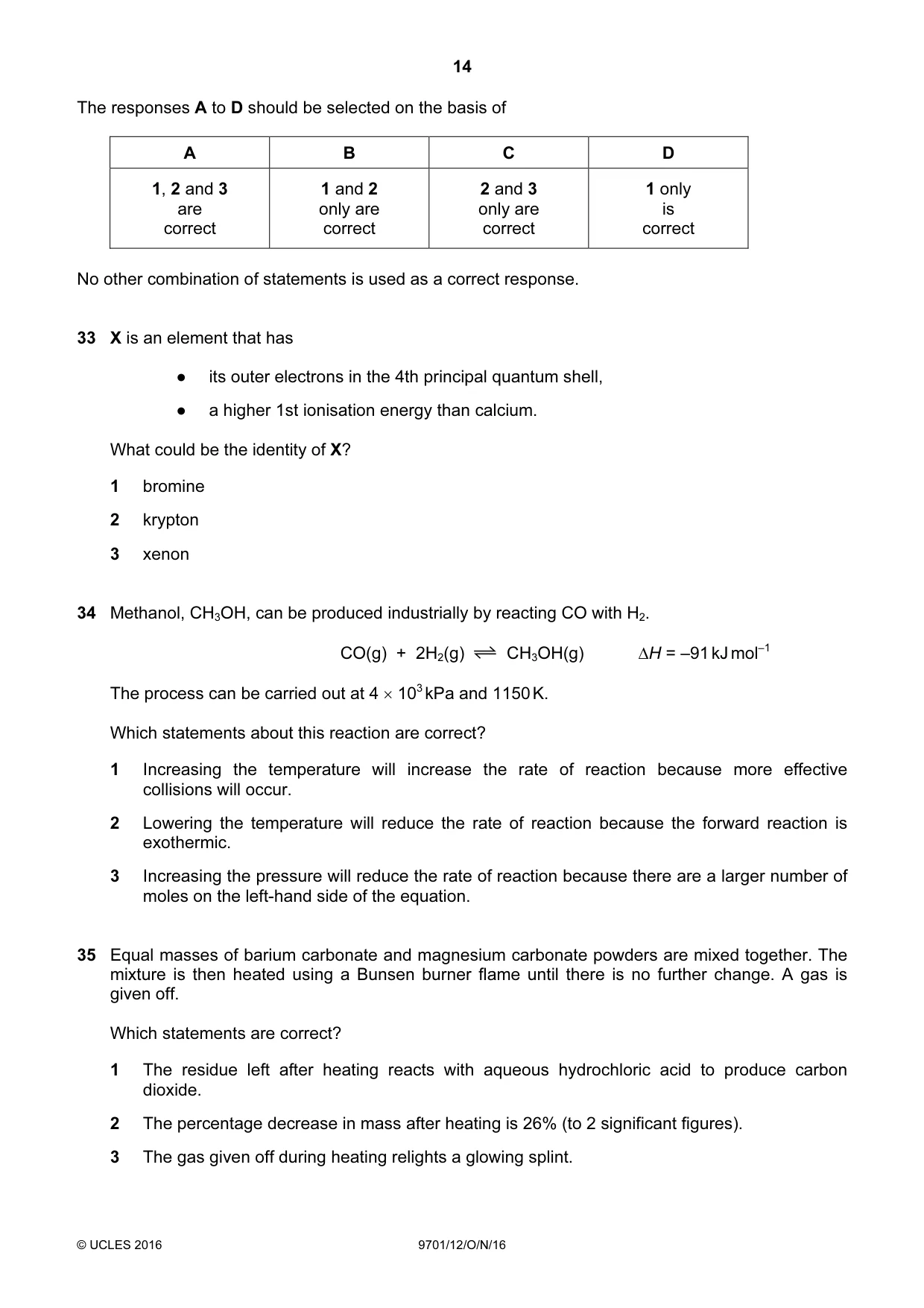
14 © UCLES 2016 9701/12/O/N/16 The responses A to D should be selected on the basis of A B C D 1, 2 and 3 are correct 1 and 2 only are correct 2 and 3 only are correct 1 only is correct No other combination of statements is used as a correct response. 33 X is an element that has ● its outer electrons in the 4th principal quantum shell, ● a higher 1st ionisation energy than calcium. What could be the identity of X? 1 bromine 2 krypton 3 xenon 34 Methanol, CH3OH, can be produced industrially by reacting CO with H2. CO(g) + 2H2(g) CH3OH(g) ∆H = –91 kJ mol–1 The process can be carried out at 4 × 10³ kPa and 1150 K. Which statements about this reaction are correct? 1 Increasing the temperature will increase the rate of reaction because more effective collisions will occur. 2 Lowering the temperature will reduce the rate of reaction because the forward reaction is exothermic. 3 Increasing the pressure will reduce the rate of reaction because there are a larger number of moles on the left-hand side of the equation. 35 Equal masses of barium carbonate and magnesium carbonate powders are mixed together. The mixture is then heated using a Bunsen burner flame until there is no further change. A gas is given off. Which statements are correct? 1 The residue left after heating reacts with aqueous hydrochloric acid to produce carbon dioxide. 2 The percentage decrease in mass after heating is 26% (to 2 significant figures). 3 The gas given off during heating relights a glowing splint.
Question paper, page 15
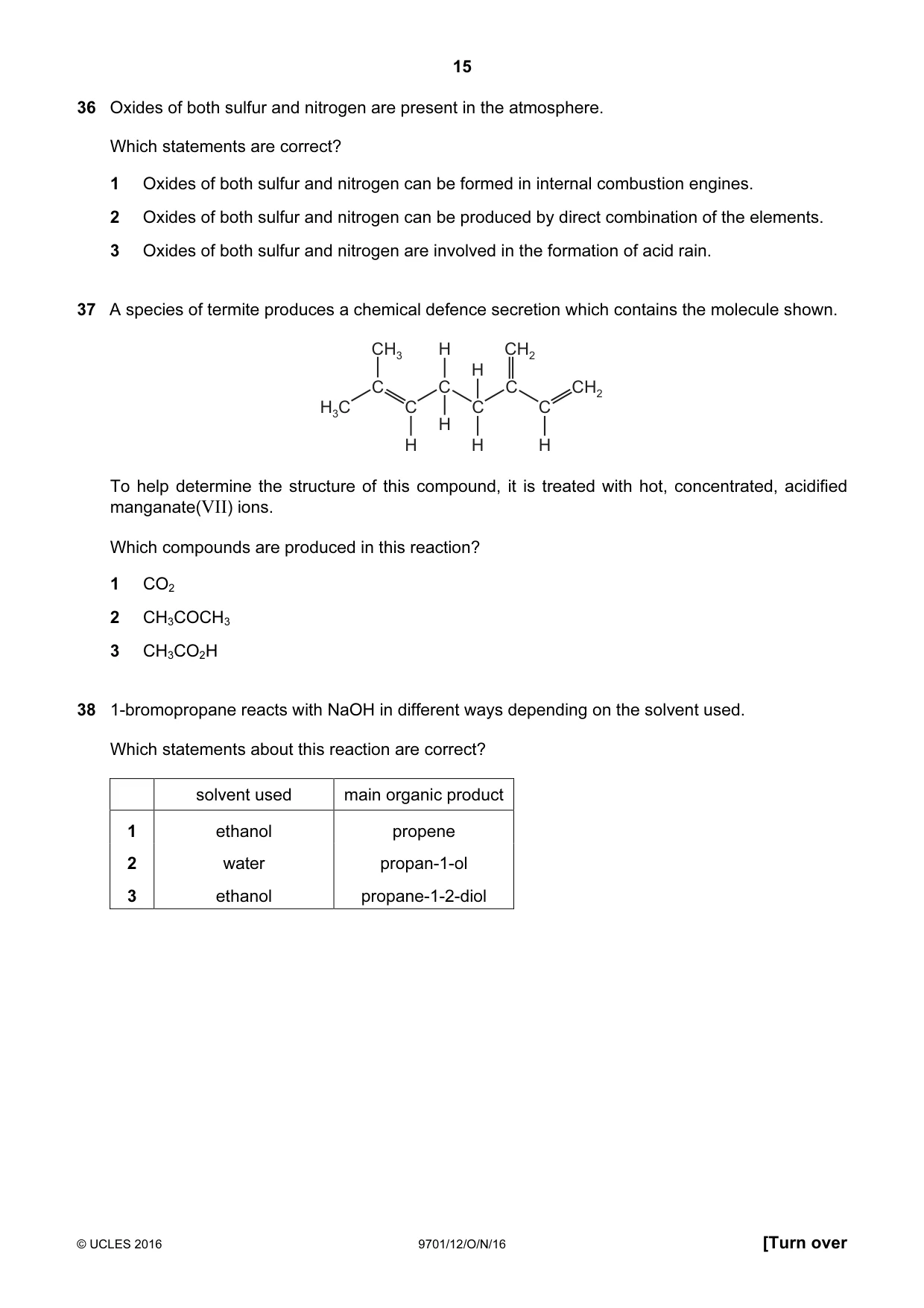
15 © UCLES 2016 9701/12/O/N/16 [Turn over 36 Oxides of both sulfur and nitrogen are present in the atmosphere. Which statements are correct? 1 Oxides of both sulfur and nitrogen can be formed in internal combustion engines. 2 Oxides of both sulfur and nitrogen can be produced by direct combination of the elements. 3 Oxides of both sulfur and nitrogen are involved in the formation of acid rain. 37 A species of termite produces a chemical defence secretion which contains the molecule shown. CH3 H3C C C C C H H H H H H CH2 CH2 C C To help determine the structure of this compound, it is treated with hot, concentrated, acidified manganate(VII) ions. Which compounds are produced in this reaction? 1 CO2 2 CH3COCH3 3 CH3CO2H 38 1-bromopropane reacts with NaOH in different ways depending on the solvent used. Which statements about this reaction are correct? solvent used main organic product 1 ethanol propene 2 water propan-1-ol 3 ethanol propane-1-2-diol
Question paper, page 16
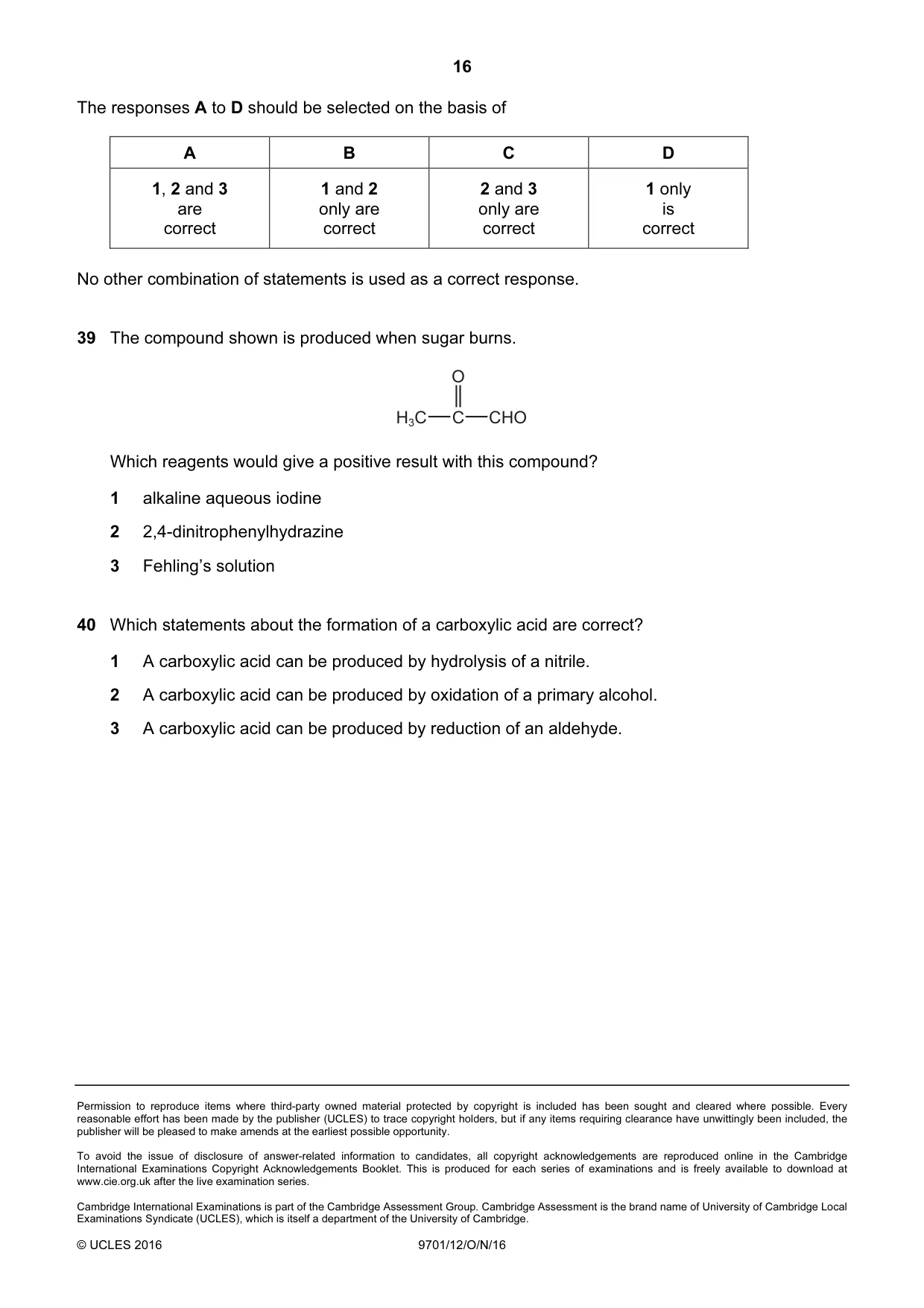
16 Permission to reproduce items where third-party owned material protected by copyright is included has been sought and cleared where possible. Every reasonable effort has been made by the publisher (UCLES) to trace copyright holders, but if any items requiring clearance have unwittingly been included, the publisher will be pleased to make amends at the earliest possible opportunity. To avoid the issue of disclosure of answer-related information to candidates, all copyright acknowledgements are reproduced online in the Cambridge International Examinations Copyright Acknowledgements Booklet. This is produced for each series of examinations and is freely available to download at www.cie.org.uk after the live examination series. Cambridge International Examinations is part of the Cambridge Assessment Group. Cambridge Assessment is the brand name of University of Cambridge Local Examinations Syndicate (UCLES), which is itself a department of the University of Cambridge. © UCLES 2016 9701/12/O/N/16 The responses A to D should be selected on the basis of A B C D 1, 2 and 3 are correct 1 and 2 only are correct 2 and 3 only are correct 1 only is correct No other combination of statements is used as a correct response. 39 The compound shown is produced when sugar burns. H3C C O CHO Which reagents would give a positive result with this compound? 1 alkaline aqueous iodine 2 2,4-dinitrophenylhydrazine 3 Fehling’s solution 40 Which statements about the formation of a carboxylic acid are correct? 1 A carboxylic acid can be produced by hydrolysis of a nitrile. 2 A carboxylic acid can be produced by oxidation of a primary alcohol. 3 A carboxylic acid can be produced by reduction of an aldehyde.
Mark scheme, page 1
® IGCSE is the registered trademark of Cambridge International Examinations. This document consists of 2 printed pages. © UCLES 2016 [Turn over Cambridge International Examinations Cambridge International Advanced Subsidiary and Advanced Level CHEMISTRY 9701/12 Paper 1 Multiple Choice October/November 2016 MARK SCHEME Maximum Mark: 40 Published This mark scheme is published as an aid to teachers and candidates, to indicate the requirements of the examination. It shows the basis on which Examiners were instructed to award marks. It does not indicate the details of the discussions that took place at an Examiners’ meeting before marking began, which would have considered the acceptability of alternative answers. Mark schemes should be read in conjunction with the question paper and the Principal Examiner Report for Teachers. Cambridge will not enter into discussions about these mark schemes. Cambridge is publishing the mark schemes for the October/November 2016 series for most Cambridge IGCSE®, Cambridge International A and AS Level components and some Cambridge O Level components.
Mark scheme, page 2
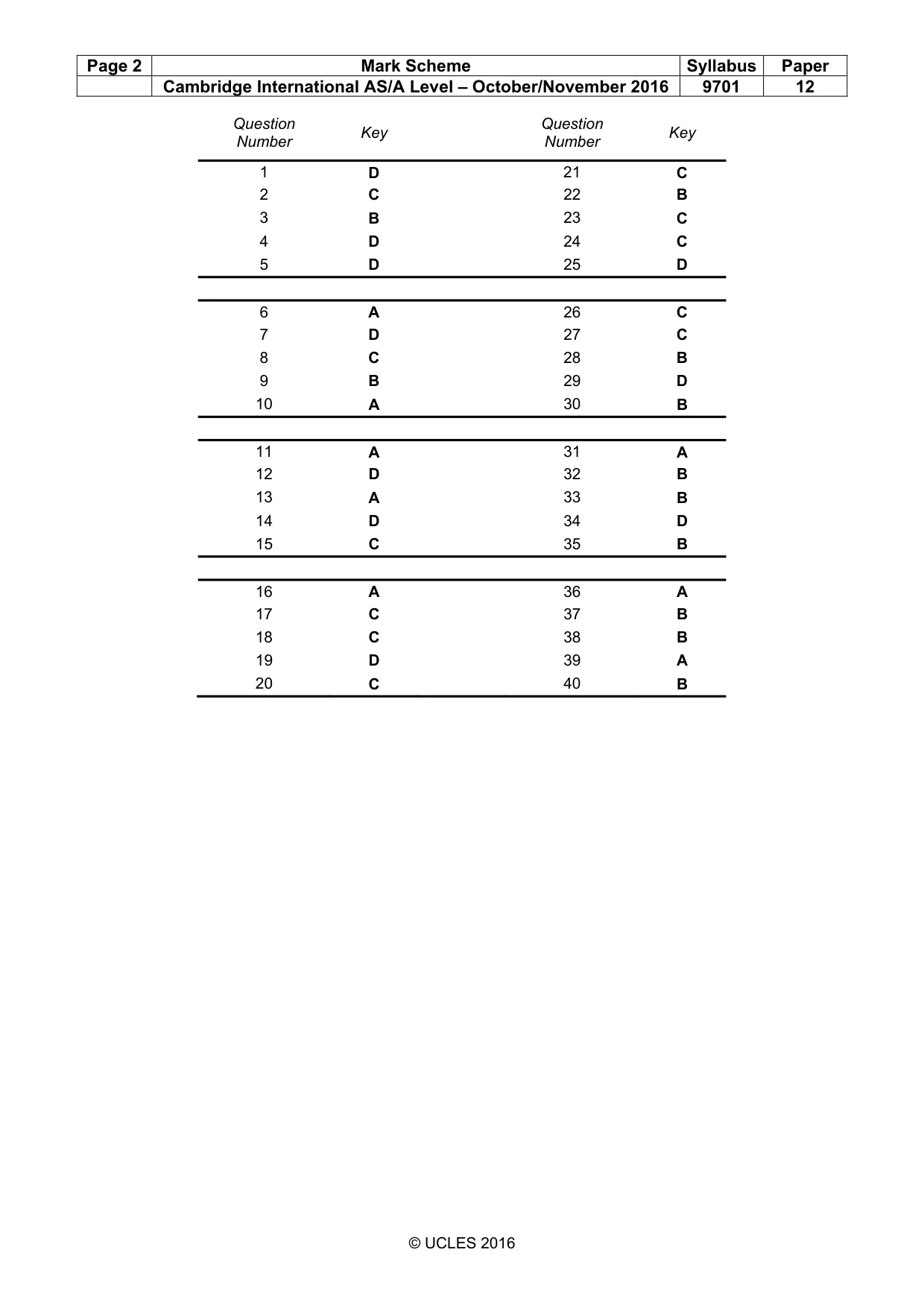
Page 2 Mark Scheme Syllabus Paper Cambridge International AS/A Level – October/November 2016 9701 12 © UCLES 2016 Question Number Key Question Number Key 1 D 21 C 2 C 22 B 3 B 23 C 4 D 24 C 5 D 25 D 6 A 26 C 7 D 27 C 8 C 28 B 9 B 29 D 10 A 30 B 11 A 31 A 12 D 32 B 13 A 33 B 14 D 34 D 15 C 35 B 16 A 36 A 17 C 37 B 18 C 38 B 19 D 39 A 20 C 40 B
What you needed in this session
Cambridge’s own grade thresholds for 2016 Oct/Nov, Paper 1 · Variant 2. A higher threshold means an easier paper — the bar moves with how the cohort did.