Cambridge A Level Chemistry 9701 — 2014 Oct/Nov Paper 5 · Variant 2
9701/52/O/N/14 · 30 marks · ≈34 min
The question paper and its mark scheme, free to read here and free to download. This is Cambridge’s own paper, exactly as it was sat.
Question paper12 pages


Mark scheme5 pages
Answers below. Sit the paper first if you are practising.
Paper as text
Question paper, page 1
This document consists of 10 printed pages and 2 blank pages. [Turn over IB14 11_9701_52/FP © UCLES 2014 *6684370052* READ THESE INSTRUCTIONS FIRST Write your Centre number, candidate number and name on all the work you hand in. Write in dark blue or black pen. You may use an HB pencil for any diagrams or graphs. Do not use staples, paper clips, glue or correction fl uid. DO NOT WRITE IN ANY BARCODES. Answer all questions. Electronic calculators may be used. You may lose marks if you do not show your working or if you do not use appropriate units. Use of a Data Booklet is unnecessary. At the end of the examination, fasten all your work securely together. The number of marks is given in brackets [ ] at the end of each question or part question. CHEMISTRY 9701/52 Paper 5 Planning, Analysis and Evaluation October/November 2014 1 hour 15 minutes Candidates answer on the Question Paper. No Additional Materials are required. Cambridge International Examinations Cambridge International Advanced Level
Question paper, page 2
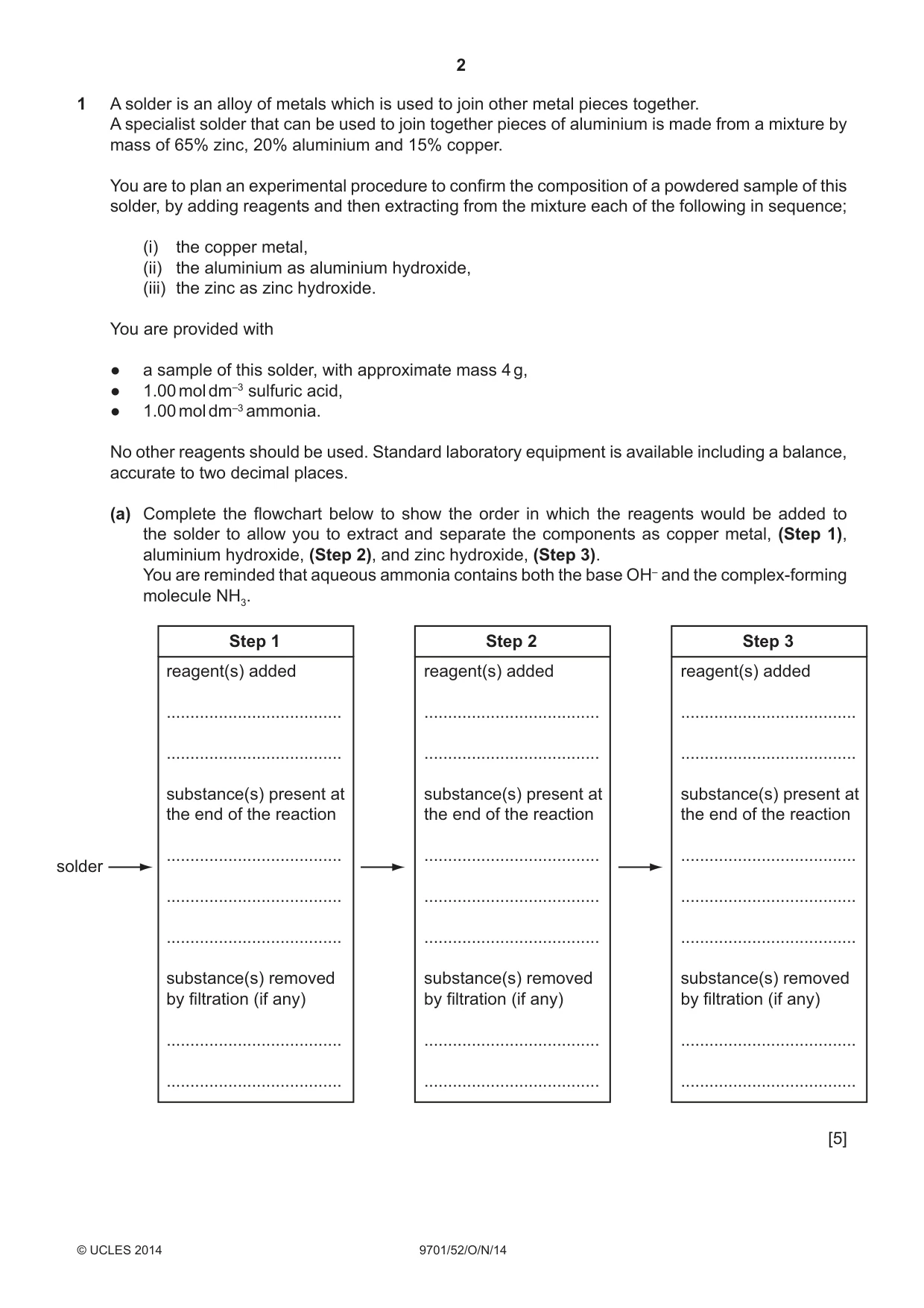
2 9701/52/O/N/14 © UCLES 2014 1 A solder is an alloy of metals which is used to join other metal pieces together. A specialist solder that can be used to join together pieces of aluminium is made from a mixture by mass of 65% zinc, 20% aluminium and 15% copper. You are to plan an experimental procedure to confi rm the composition of a powdered sample of this solder, by adding reagents and then extracting from the mixture each of the following in sequence; (i) the copper metal, (ii) the aluminium as aluminium hydroxide, (iii) the zinc as zinc hydroxide. You are provided with ● a sample of this solder, with approximate mass 4 g, ● 1.00 mol dm–3 sulfuric acid, ● 1.00 mol dm–3 ammonia. No other reagents should be used. Standard laboratory equipment is available including a balance, accurate to two decimal places. (a) Complete the fl owchart below to show the order in which the reagents would be added to the solder to allow you to extract and separate the components as copper metal, (Step 1), aluminium hydroxide, (Step 2), and zinc hydroxide, (Step 3). You are reminded that aqueous ammonia contains both the base OH– and the complex-forming molecule NH3. reagent(s) added … … substance(s) present at the end of the reaction … … … substance(s) removed by filtration (if any) … … solder Step 1 Step 2 Step 3 reagent(s) added … … substance(s) present at the end of the reaction … … … substance(s) removed by filtration (if any) … … reagent(s) added … … substance(s) present at the end of the reaction … … … substance(s) removed by filtration (if any) … … [5]
Question paper, page 3
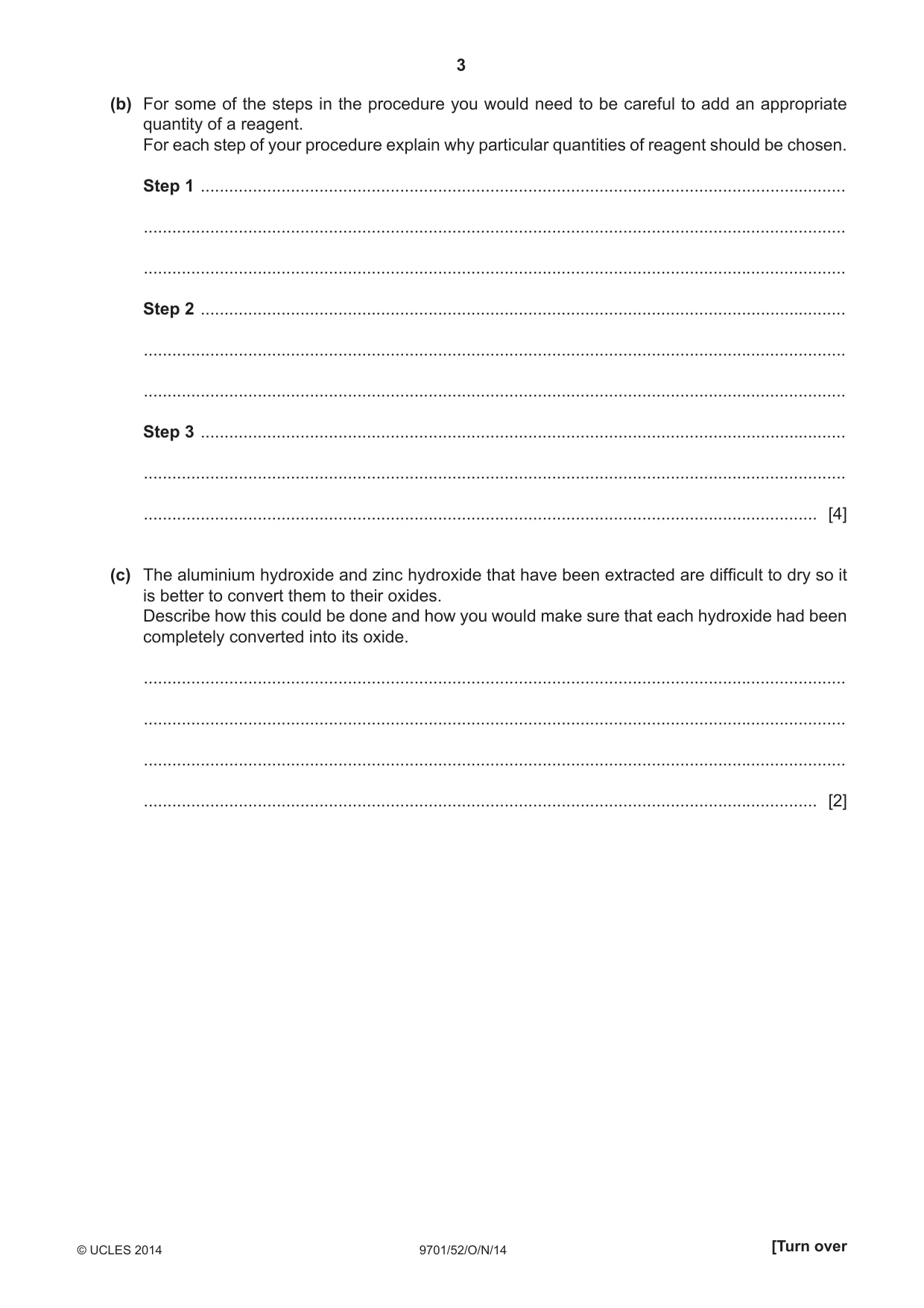
3 9701/52/O/N/14 © UCLES 2014 [Turn over (b) For some of the steps in the procedure you would need to be careful to add an appropriate quantity of a reagent. For each step of your procedure explain why particular quantities of reagent should be chosen. Step 1 … … … Step 2 … … … Step 3 … … … [4] (c) The aluminium hydroxide and zinc hydroxide that have been extracted are diffi cult to dry so it is better to convert them to their oxides. Describe how this could be done and how you would make sure that each hydroxide had been completely converted into its oxide. … … … … [2]
Question paper, page 4
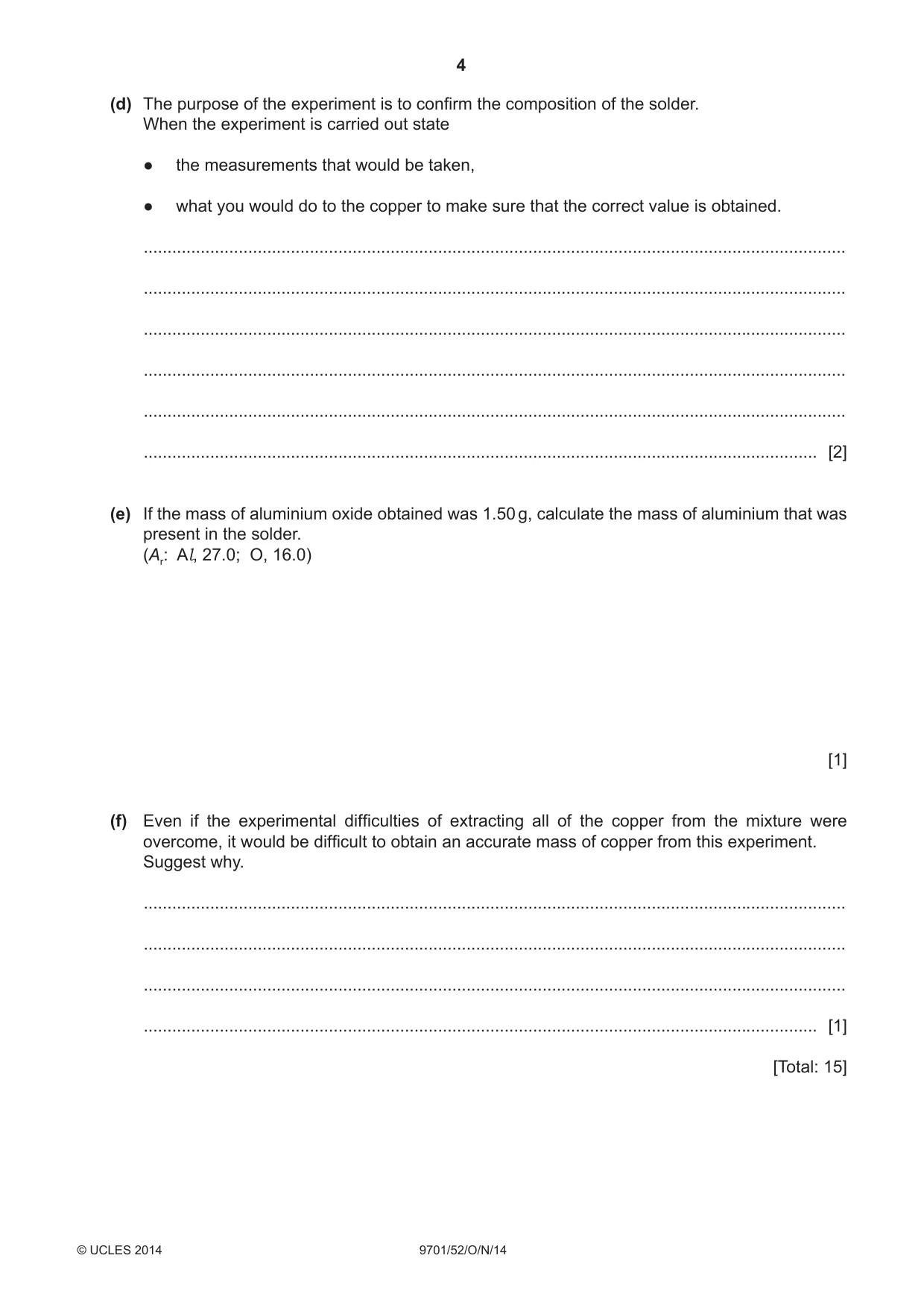
4 9701/52/O/N/14 © UCLES 2014 (d) The purpose of the experiment is to confi rm the composition of the solder. When the experiment is carried out state ● the measurements that would be taken, ● what you would do to the copper to make sure that the correct value is obtained. … … … … … … [2] (e) If the mass of aluminium oxide obtained was 1.50 g, calculate the mass of aluminium that was present in the solder. (Ar: Al, 27.0; O, 16.0) [1] (f) Even if the experimental diffi culties of extracting all of the copper from the mixture were overcome, it would be diffi cult to obtain an accurate mass of copper from this experiment. Suggest why. … … … … [1] [Total: 15]
Question paper, page 5
5 9701/52/O/N/14 © UCLES 2014 [Turn over QUESTION 2 STARTS ON THE NEXT PAGE.
Question paper, page 6
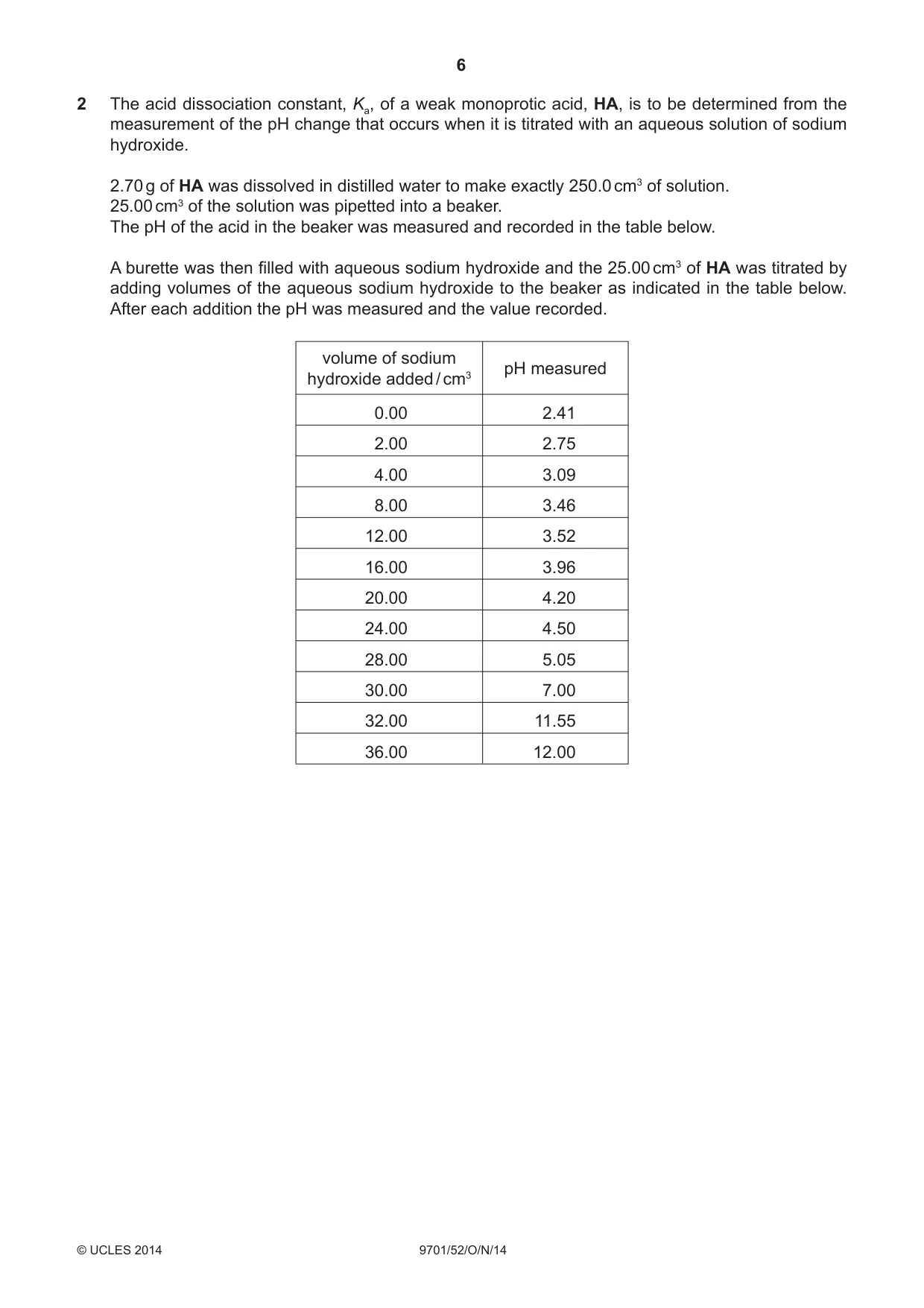
6 9701/52/O/N/14 © UCLES 2014 2 The acid dissociation constant, Ka, of a weak monoprotic acid, HA, is to be determined from the measurement of the pH change that occurs when it is titrated with an aqueous solution of sodium hydroxide. 2.70 g of HA was dissolved in distilled water to make exactly 250.0 cm3 of solution. 25.00 cm3 of the solution was pipetted into a beaker. The pH of the acid in the beaker was measured and recorded in the table below. A burette was then fi lled with aqueous sodium hydroxide and the 25.00 cm3 of HA was titrated by adding volumes of the aqueous sodium hydroxide to the beaker as indicated in the table below. After each addition the pH was measured and the value recorded. volume of sodium hydroxide added / cm3 pH measured 0.00 2.41 2.00 2.75 4.00 3.09 8.00 3.46 12.00 3.52 16.00 3.96 20.00 4.20 24.00 4.50 28.00 5.05 30.00 7.00 32.00 11.55 36.00 12.00
Question paper, page 7
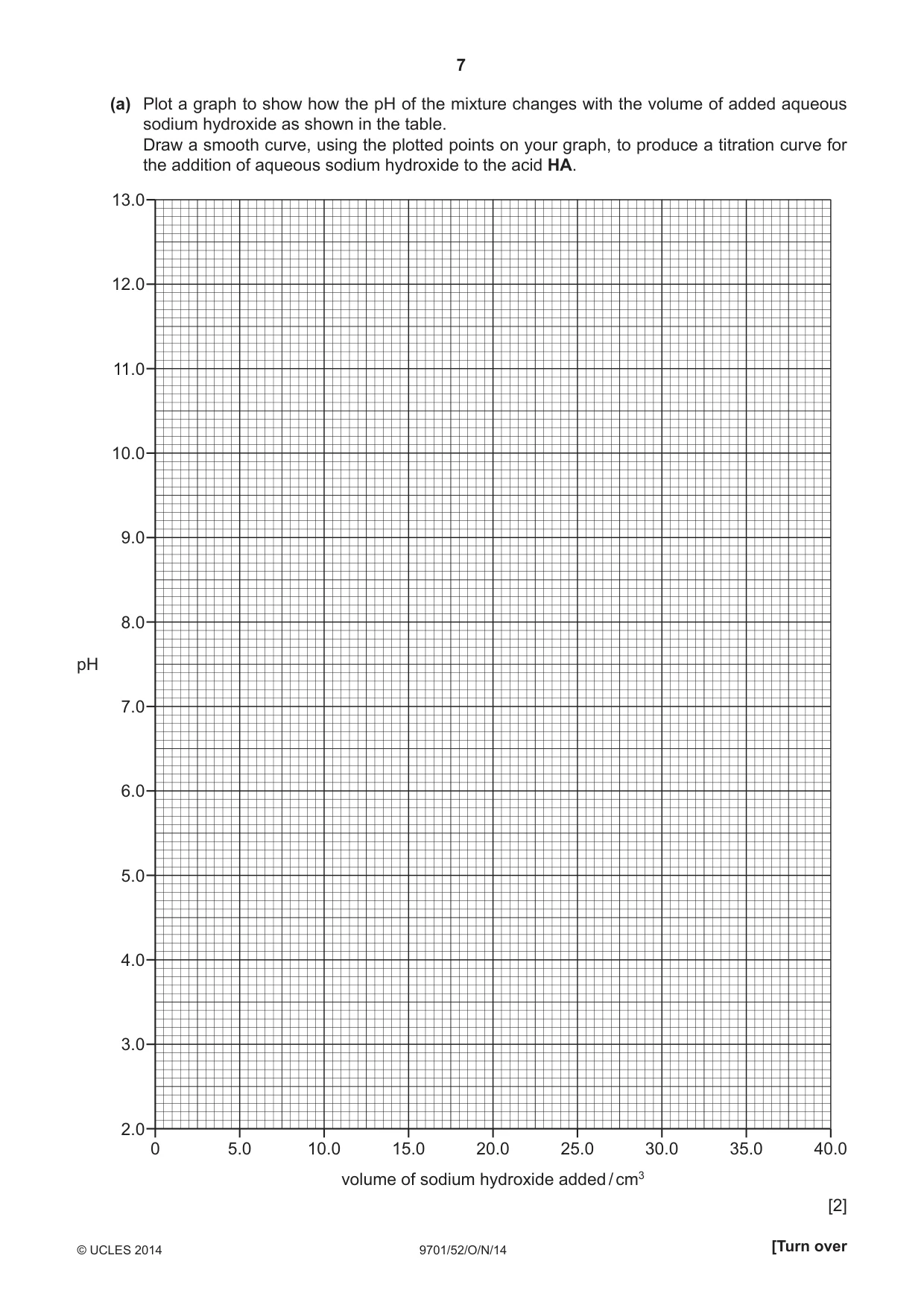
7 9701/52/O/N/14 © UCLES 2014 [Turn over (a) Plot a graph to show how the pH of the mixture changes with the volume of added aqueous sodium hydroxide as shown in the table. Draw a smooth curve, using the plotted points on your graph, to produce a titration curve for the addition of aqueous sodium hydroxide to the acid HA. 0 5.0 10.0 15.0 20.0 volume of sodium hydroxide added / cm3 25.0 30.0 35.0 40.0 13.0 12.0 11.0 10.0 9.0 8.0 7.0 6.0 5.0 4.0 3.0 2.0 pH [2]
Question paper, page 8
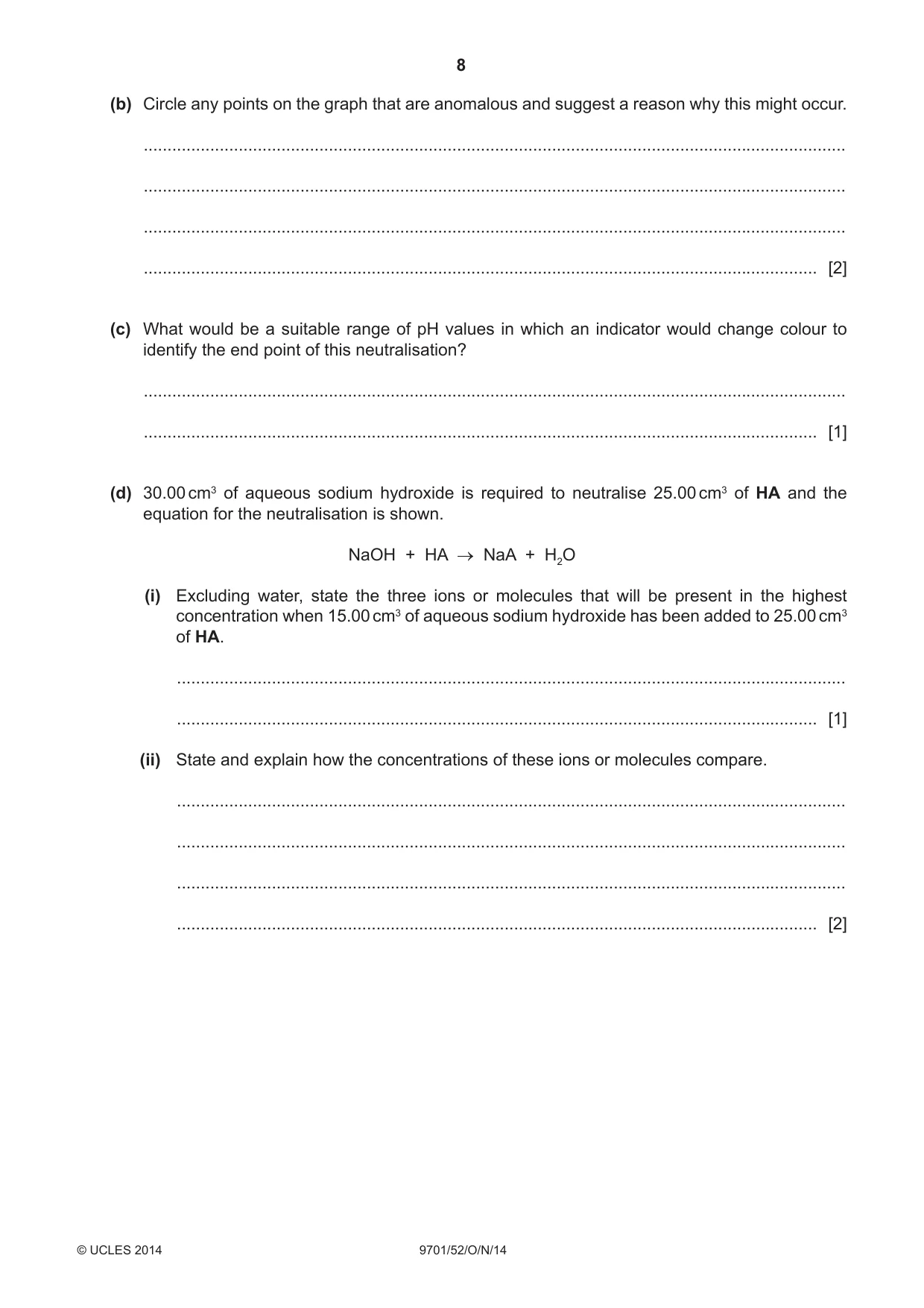
8 9701/52/O/N/14 © UCLES 2014 (b) Circle any points on the graph that are anomalous and suggest a reason why this might occur. … … … … [2] (c) What would be a suitable range of pH values in which an indicator would change colour to identify the end point of this neutralisation? … … [1] (d) 30.00 cm3 of aqueous sodium hydroxide is required to neutralise 25.00 cm3 of HA and the equation for the neutralisation is shown. NaOH + HA → NaA + H2O (i) Excluding water, state the three ions or molecules that will be present in the highest concentration when 15.00 cm3 of aqueous sodium hydroxide has been added to 25.00 cm3 of HA. … … [1] (ii) State and explain how the concentrations of these ions or molecules compare. … … … … [2]
Question paper, page 9
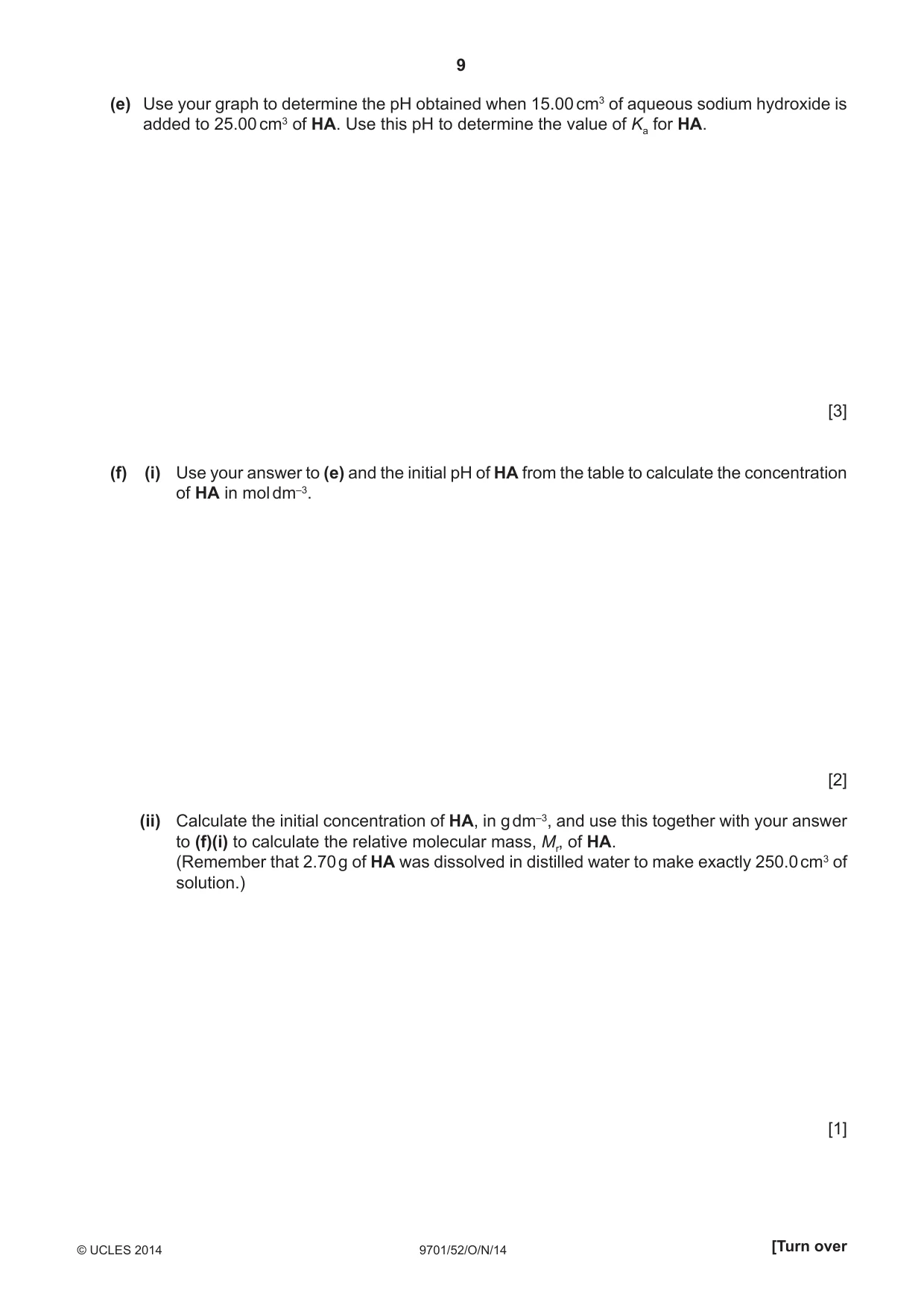
9 9701/52/O/N/14 © UCLES 2014 [Turn over (e) Use your graph to determine the pH obtained when 15.00 cm3 of aqueous sodium hydroxide is added to 25.00 cm3 of HA. Use this pH to determine the value of Ka for HA. [3] (f) (i) Use your answer to (e) and the initial pH of HA from the table to calculate the concentration of HA in mol dm–3. [2] (ii) Calculate the initial concentration of HA, in g dm–3, and use this together with your answer to (f)(i) to calculate the relative molecular mass, Mr, of HA. (Remember that 2.70 g of HA was dissolved in distilled water to make exactly 250.0 cm3 of solution.) [1]
Question paper, page 10
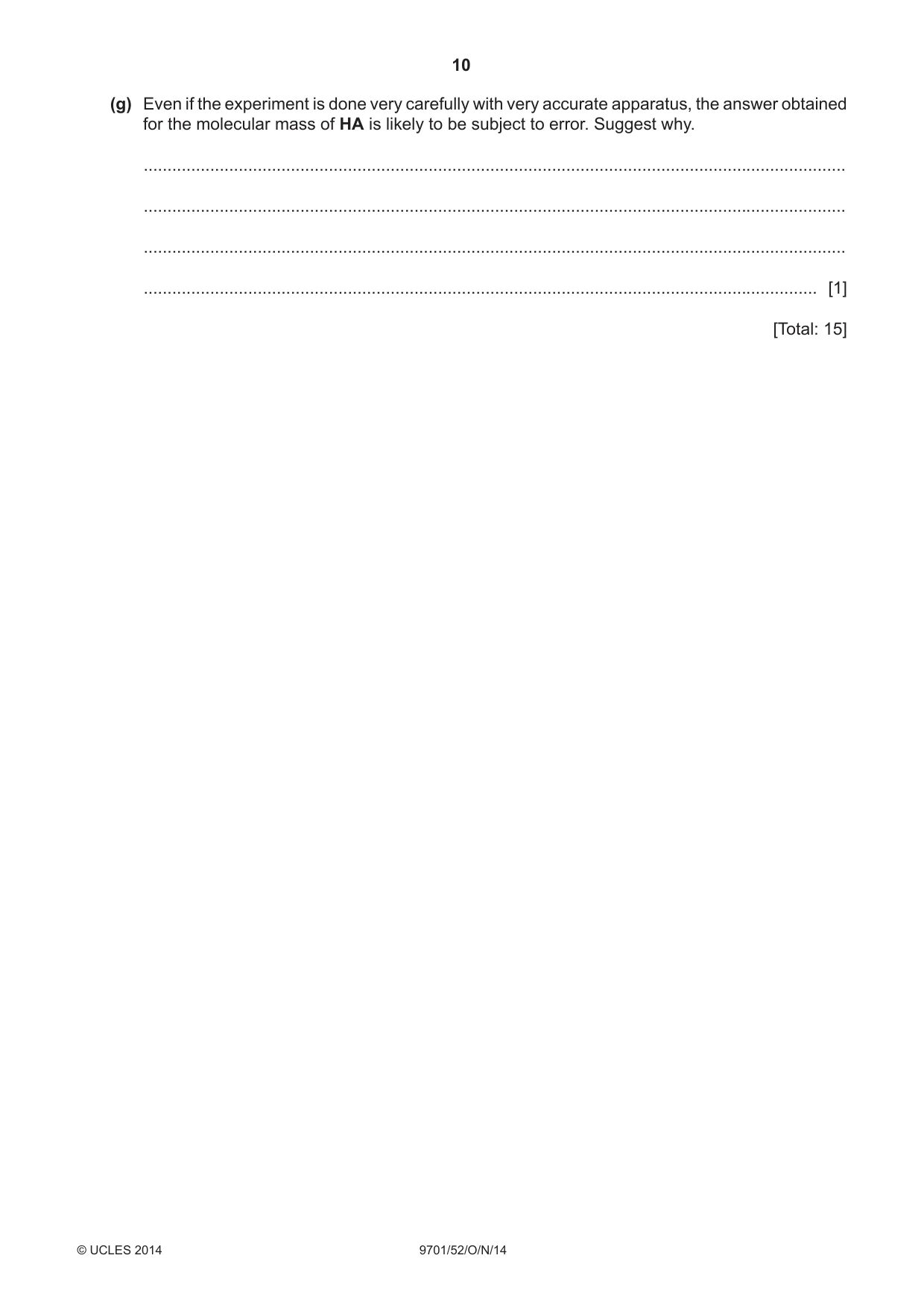
10 9701/52/O/N/14 © UCLES 2014 (g) Even if the experiment is done very carefully with very accurate apparatus, the answer obtained for the molecular mass of HA is likely to be subject to error. Suggest why. … … … … [1] [Total: 15]
Question paper, page 11
11 9701/52/O/N/14 BLANK PAGE © UCLES 2014
Question paper, page 12
12 9701/52/O/N/14 BLANK PAGE © UCLES 2014 Permission to reproduce items where third-party owned material protected by copyright is included has been sought and cleared where possible. Every reasonable effort has been made by the publisher (UCLES) to trace copyright holders, but if any items requiring clearance have unwittingly been included the publisher will be pleased to make amends at the earliest possible opportunity. Cambridge International Examinations is part of the Cambridge Assessment Group. Cambridge Assessment is the brand name of University of Cambridge Local Examinations Syndicate (UCLES), which is itself a department of the University of Cambridge.
Mark scheme, page 1
® IGCSE is the registered trademark of Cambridge International Examinations. CAMBRIDGE INTERNATIONAL EXAMINATIONS Cambridge International Advanced Level MARK SCHEME for the October/November 2014 series 9701 CHEMISTRY 9701/52 Paper 5 (Planning, Analysis and Evaluation), maximum raw mark 30 This mark scheme is published as an aid to teachers and candidates, to indicate the requirements of the examination. It shows the basis on which Examiners were instructed to award marks. It does not indicate the details of the discussions that took place at an Examiners’ meeting before marking began, which would have considered the acceptability of alternative answers. Mark schemes should be read in conjunction with the question paper and the Principal Examiner Report for Teachers. Cambridge will not enter into discussions about these mark schemes. Cambridge is publishing the mark schemes for the October/November 2014 series for most Cambridge IGCSE®, Cambridge International A and AS Level components and some Cambridge O Level components.
Mark scheme, page 2
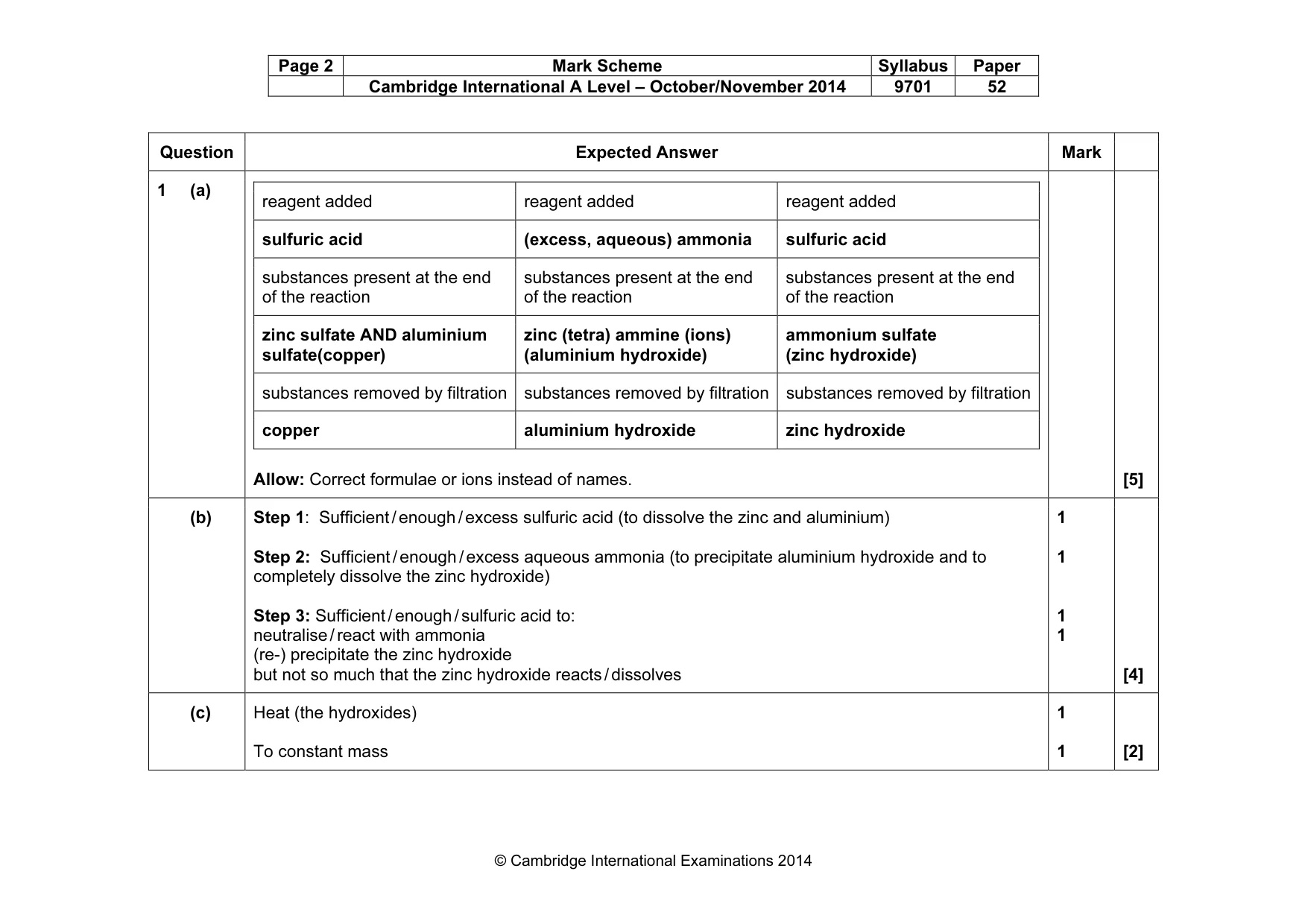
Page 2 Mark Scheme Syllabus Paper Cambridge International A Level – October/November 2014 9701 52 © Cambridge International Examinations 2014 Question Expected Answer Mark 1 (a) reagent added reagent added reagent added sulfuric acid (excess, aqueous) ammonia sulfuric acid substances present at the end of the reaction substances present at the end of the reaction substances present at the end of the reaction zinc sulfate AND aluminium sulfate(copper) zinc (tetra) ammine (ions) (aluminium hydroxide) ammonium sulfate (zinc hydroxide) substances removed by filtration substances removed by filtration substances removed by filtration copper aluminium hydroxide zinc hydroxide Allow: Correct formulae or ions instead of names. [5] (b) Step 1: Sufficient / enough / excess sulfuric acid (to dissolve the zinc and aluminium) Step 2: Sufficient / enough / excess aqueous ammonia (to precipitate aluminium hydroxide and to completely dissolve the zinc hydroxide) Step 3: Sufficient / enough / sulfuric acid to: neutralise / react with ammonia (re-) precipitate the zinc hydroxide but not so much that the zinc hydroxide reacts / dissolves 1 1 1 1 [4] (c) Heat (the hydroxides) To constant mass 1 1 [2]
Mark scheme, page 3
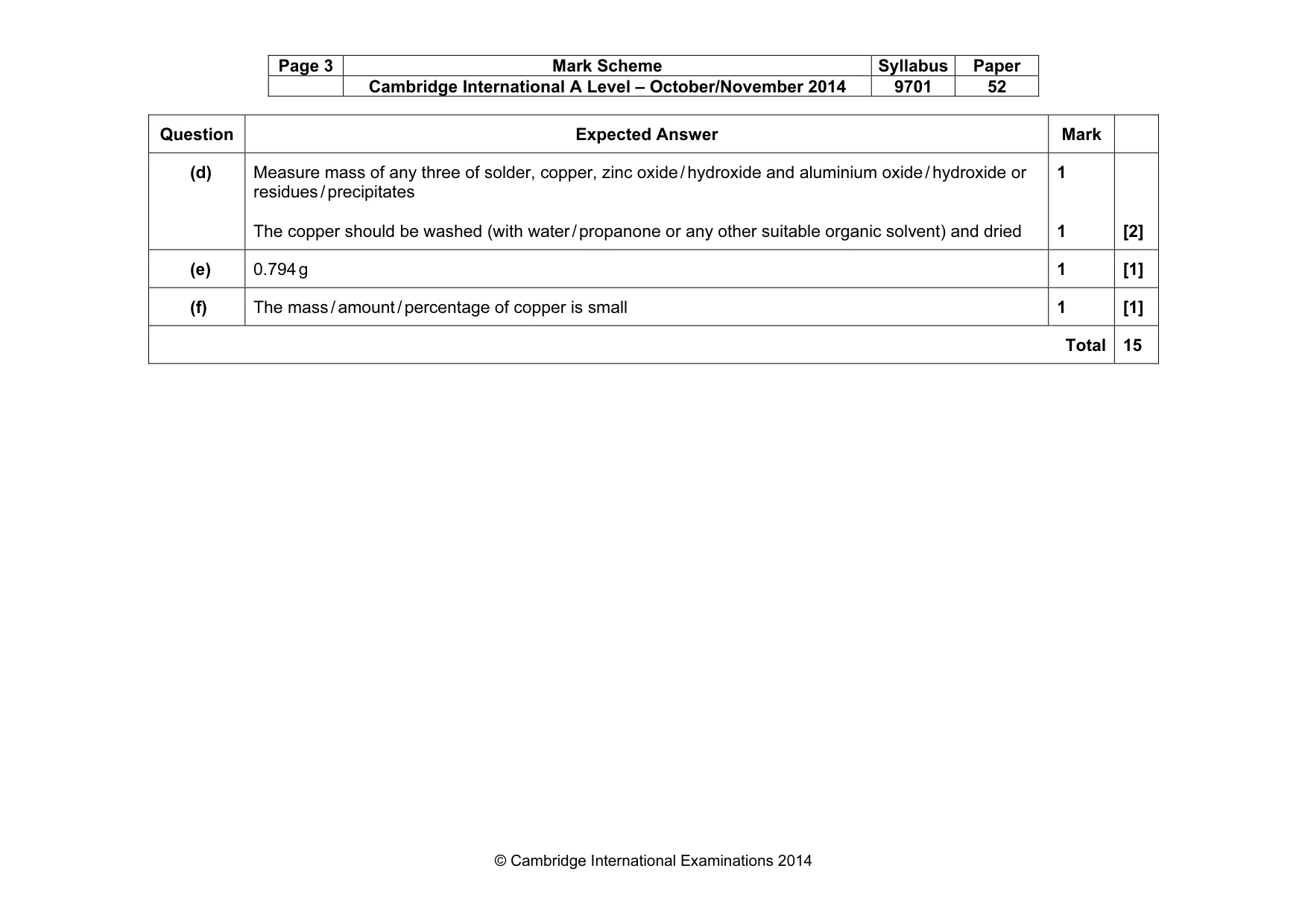
Page 3 Mark Scheme Syllabus Paper Cambridge International A Level – October/November 2014 9701 52 © Cambridge International Examinations 2014 Question Expected Answer Mark (d) Measure mass of any three of solder, copper, zinc oxide / hydroxide and aluminium oxide / hydroxide or residues / precipitates The copper should be washed (with water / propanone or any other suitable organic solvent) and dried 1 1 [2] (e) 0.794 g 1 [1] (f) The mass / amount / percentage of copper is small 1 [1] Total 15
Mark scheme, page 4
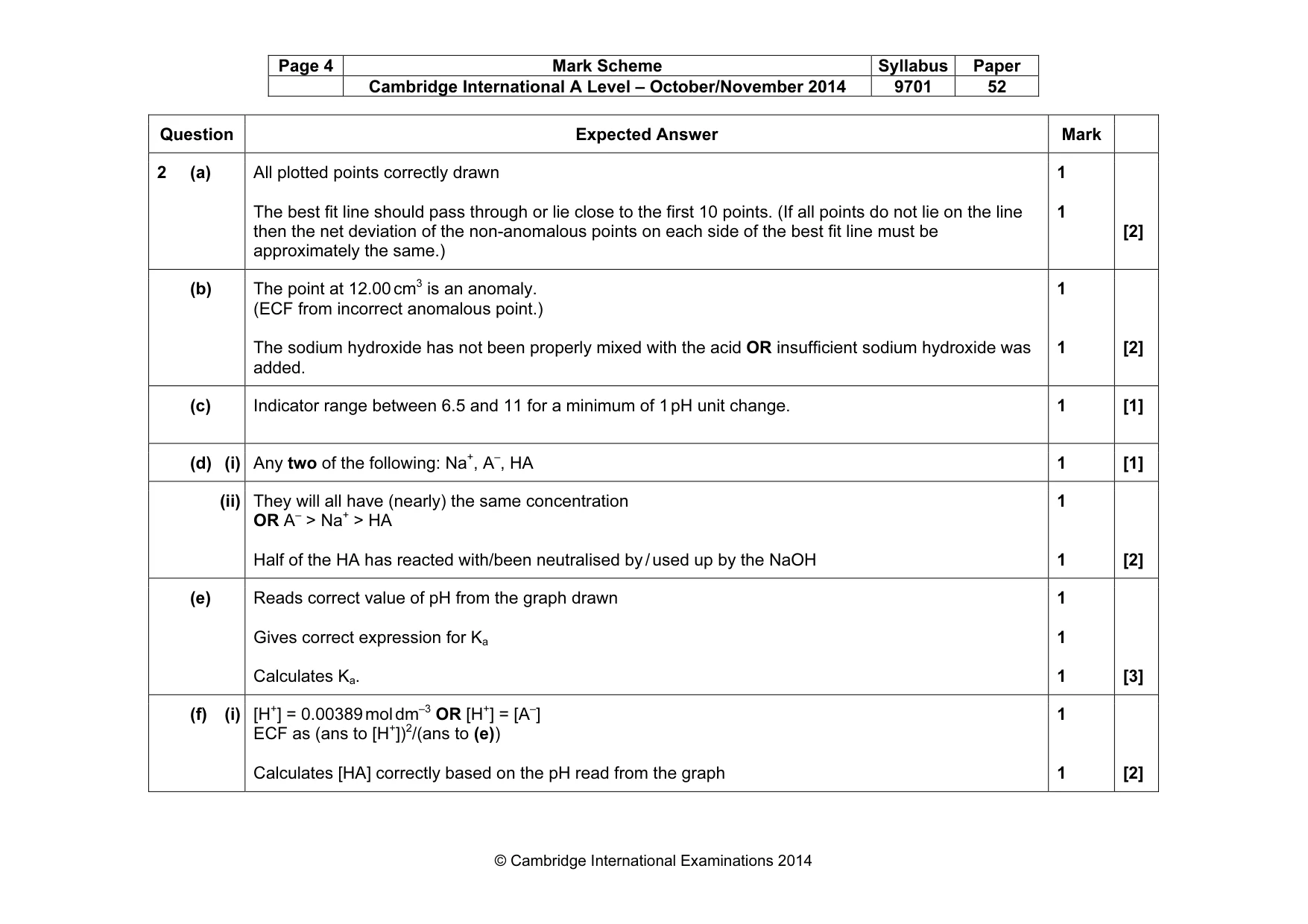
Page 4 Mark Scheme Syllabus Paper Cambridge International A Level – October/November 2014 9701 52 © Cambridge International Examinations 2014 Question Expected Answer Mark 2 (a) All plotted points correctly drawn The best fit line should pass through or lie close to the first 10 points. (If all points do not lie on the line then the net deviation of the non-anomalous points on each side of the best fit line must be approximately the same.) 1 1 [2] (b) The point at 12.00 cm3 is an anomaly. (ECF from incorrect anomalous point.) The sodium hydroxide has not been properly mixed with the acid OR insufficient sodium hydroxide was added. 1 1 [2] (c) Indicator range between 6.5 and 11 for a minimum of 1 pH unit change. 1 [1] (d) (i) Any two of the following: Na+, A–, HA 1 [1] (ii) They will all have (nearly) the same concentration OR A– > Na+ > HA Half of the HA has reacted with/been neutralised by / used up by the NaOH 1 1 [2] (e) Reads correct value of pH from the graph drawn Gives correct expression for Ka Calculates Ka. 1 1 1 [3] (f) (i) [H+] = 0.00389 mol dm–3 OR [H+] = [A–] ECF as (ans to [H+])2/(ans to (e)) Calculates [HA] correctly based on the pH read from the graph 1 1 [2]
Mark scheme, page 5
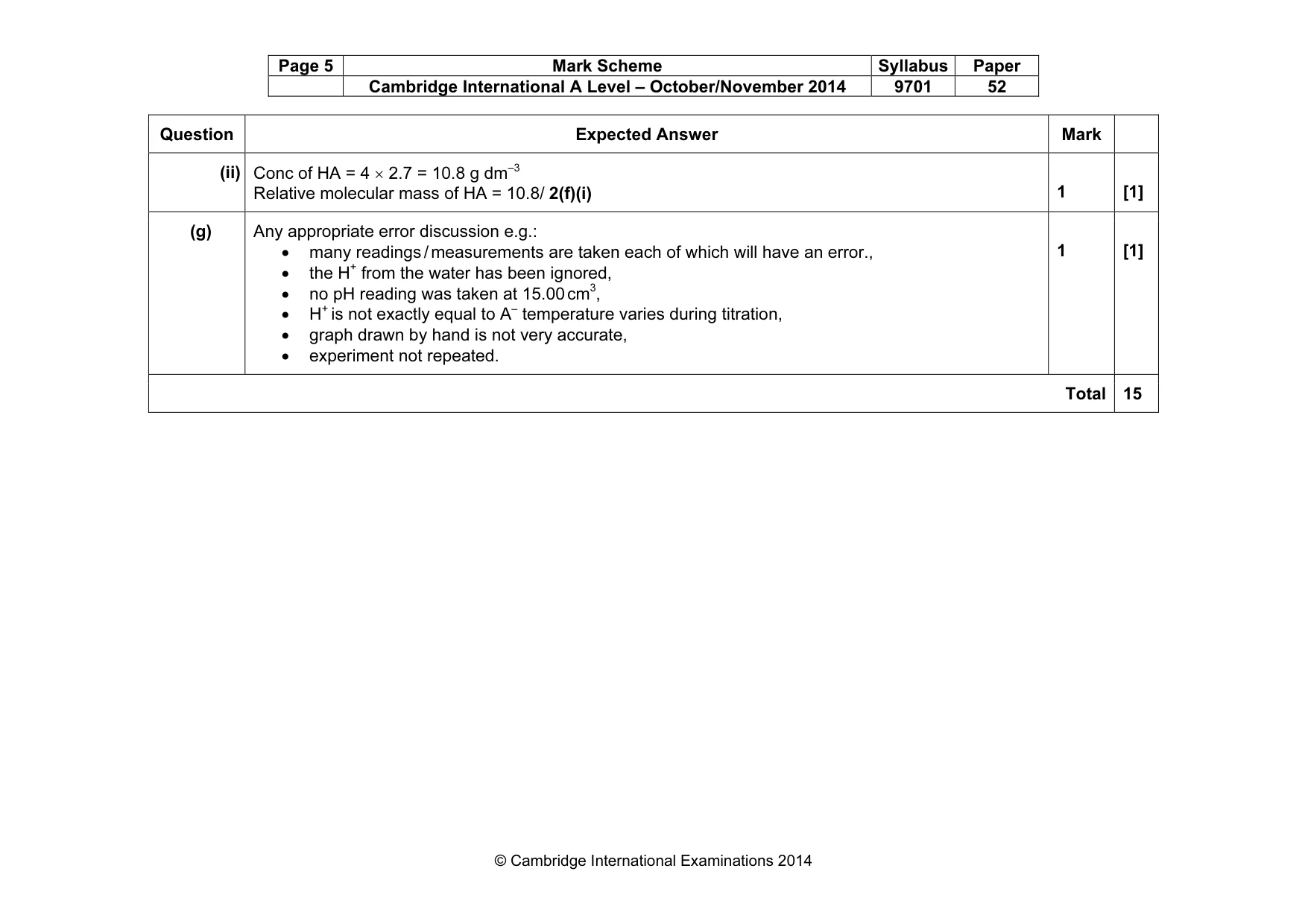
Page 5 Mark Scheme Syllabus Paper Cambridge International A Level – October/November 2014 9701 52 © Cambridge International Examinations 2014 Question Expected Answer Mark (ii) Conc of HA = 4 × 2.7 = 10.8 g dm–3 Relative molecular mass of HA = 10.8/ 2(f)(i) 1 [1] (g) Any appropriate error discussion e.g.: • many readings / measurements are taken each of which will have an error., • the H+ from the water has been ignored, • no pH reading was taken at 15.00 cm3, • H+ is not exactly equal to A– temperature varies during titration, • graph drawn by hand is not very accurate, • experiment not repeated. 1 [1] Total 15
What you needed in this session
Cambridge’s own grade thresholds for 2014 Oct/Nov, Paper 5 · Variant 2. A higher threshold means an easier paper — the bar moves with how the cohort did.