Cambridge A Level Chemistry 9701 — 2014 May/June Paper 2 · Variant 2
9701/22/M/J/14 · 60 marks · ≈68 min
The question paper and its mark scheme, free to read here and free to download. This is Cambridge’s own paper, exactly as it was sat.
Question paper12 pages


Mark scheme7 pages
Answers below. Sit the paper first if you are practising.
Paper as text
Question paper, page 1
This document consists of 9 printed pages and 3 blank pages. [Turn over IB14 06_9701_22/3RP © UCLES 2014 READ THESE INSTRUCTIONS FIRST Write your Centre number, candidate number and name on all the work you hand in. Write in dark blue or black pen. You may use an HB pencil for any diagrams or graphs. Do not use staples, paper clips, glue or correction fl uid. DO NOT WRITE IN ANY BARCODES. Answer all questions. Electronic calculators may be used. You may lose marks if you do not show your working or if you do not use appropriate units. A Data Booklet is provided. At the end of the examination, fasten all your work securely together. The number of marks is given in brackets [ ] at the end of each question or part question. CHEMISTRY 9701/22 Paper 2 Structured Questions AS Core May/June 2014 1 hour 15 minutes Candidates answer on the Question Paper. Additional Materials: Data Booklet Cambridge International Examinations Cambridge International Advanced Subsidiary and Advanced Level
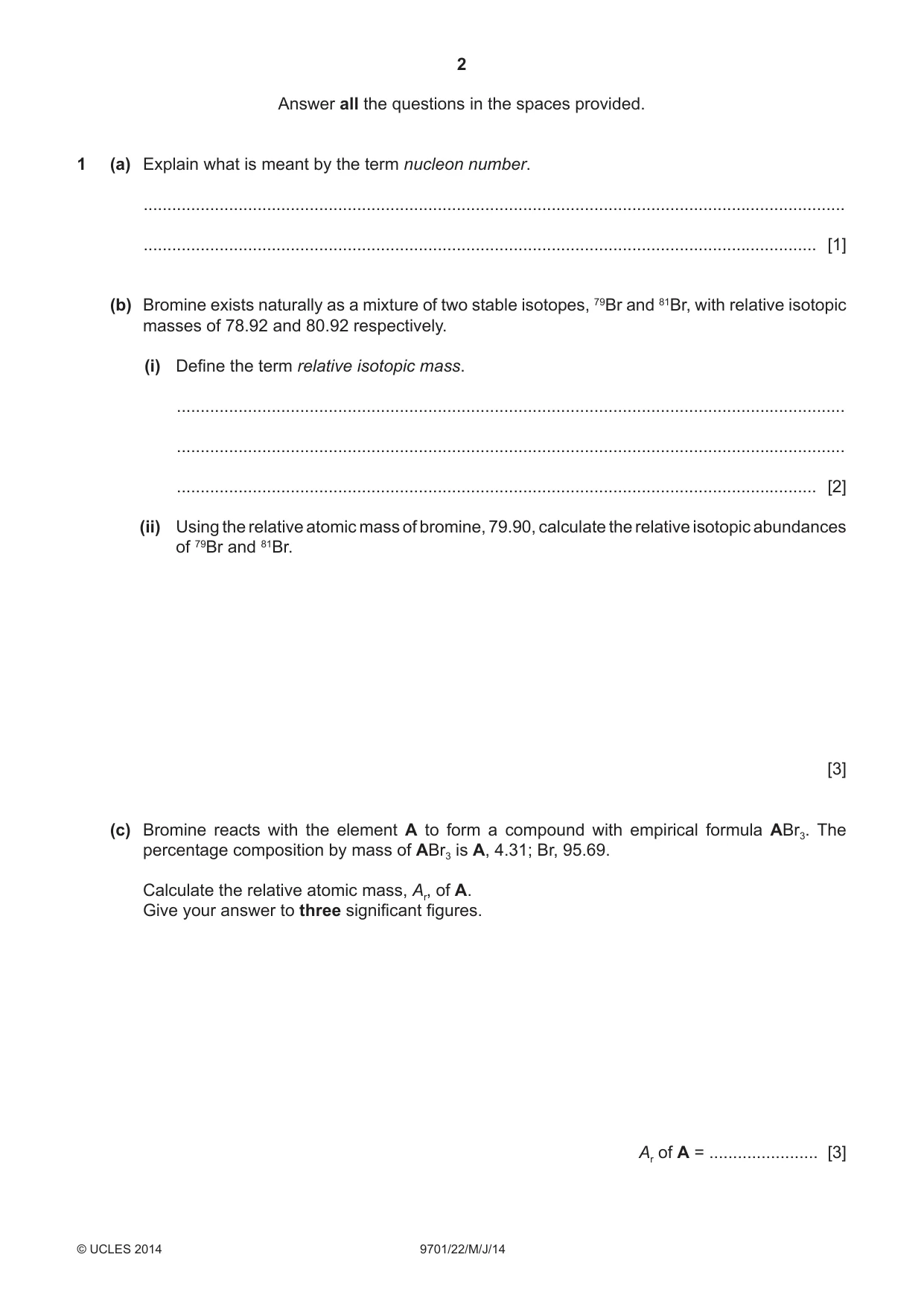
Question paper, page 2
2 9701/22/M/J/14 © UCLES 2014 Answer all the questions in the spaces provided. 1 (a) Explain what is meant by the term nucleon number. … … [1] (b) Bromine exists naturally as a mixture of two stable isotopes, 79Br and 81Br, with relative isotopic masses of 78.92 and 80.92 respectively. (i) Defi ne the term relative isotopic mass. … … … [2] (ii) Using the relative atomic mass of bromine, 79.90, calculate the relative isotopic abundances of 79Br and 81Br. [3] (c) Bromine reacts with the element A to form a compound with empirical formula ABr3. The percentage composition by mass of ABr3 is A, 4.31; Br, 95.69. Calculate the relative atomic mass, Ar, of A. Give your answer to three signifi cant fi gures. Ar of A = … [3]
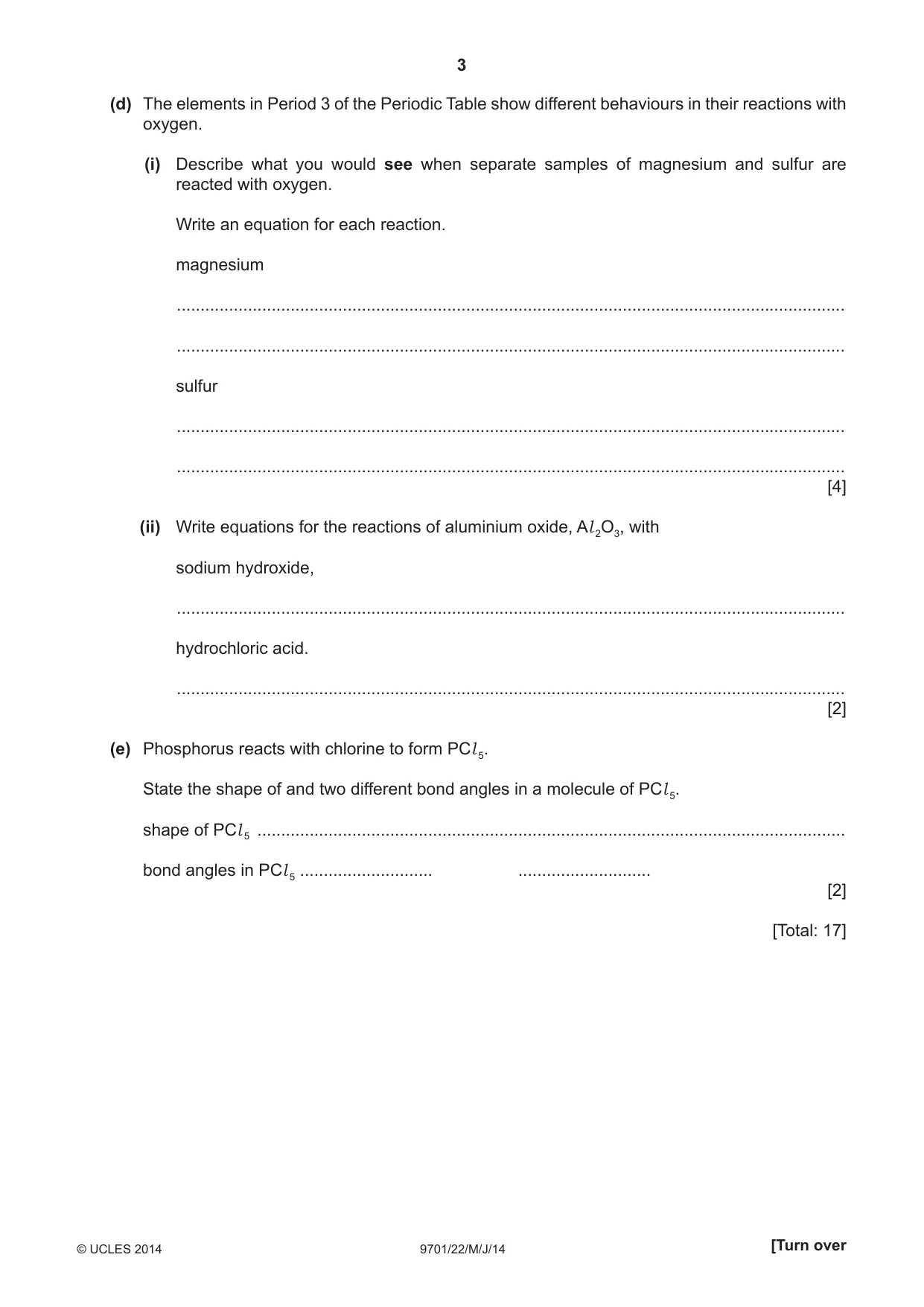
Question paper, page 3
3 9701/22/M/J/14 © UCLES 2014 [Turn over (d) The elements in Period 3 of the Periodic Table show different behaviours in their reactions with oxygen. (i) Describe what you would see when separate samples of magnesium and sulfur are reacted with oxygen. Write an equation for each reaction. magnesium … … sulfur … … [4] (ii) Write equations for the reactions of aluminium oxide, Al 2O3, with sodium hydroxide, … hydrochloric acid. … [2] (e) Phosphorus reacts with chlorine to form PCl 5. State the shape of and two different bond angles in a molecule of PCl 5. shape of PCl 5 … bond angles in PCl 5 … … [2] [Total: 17]
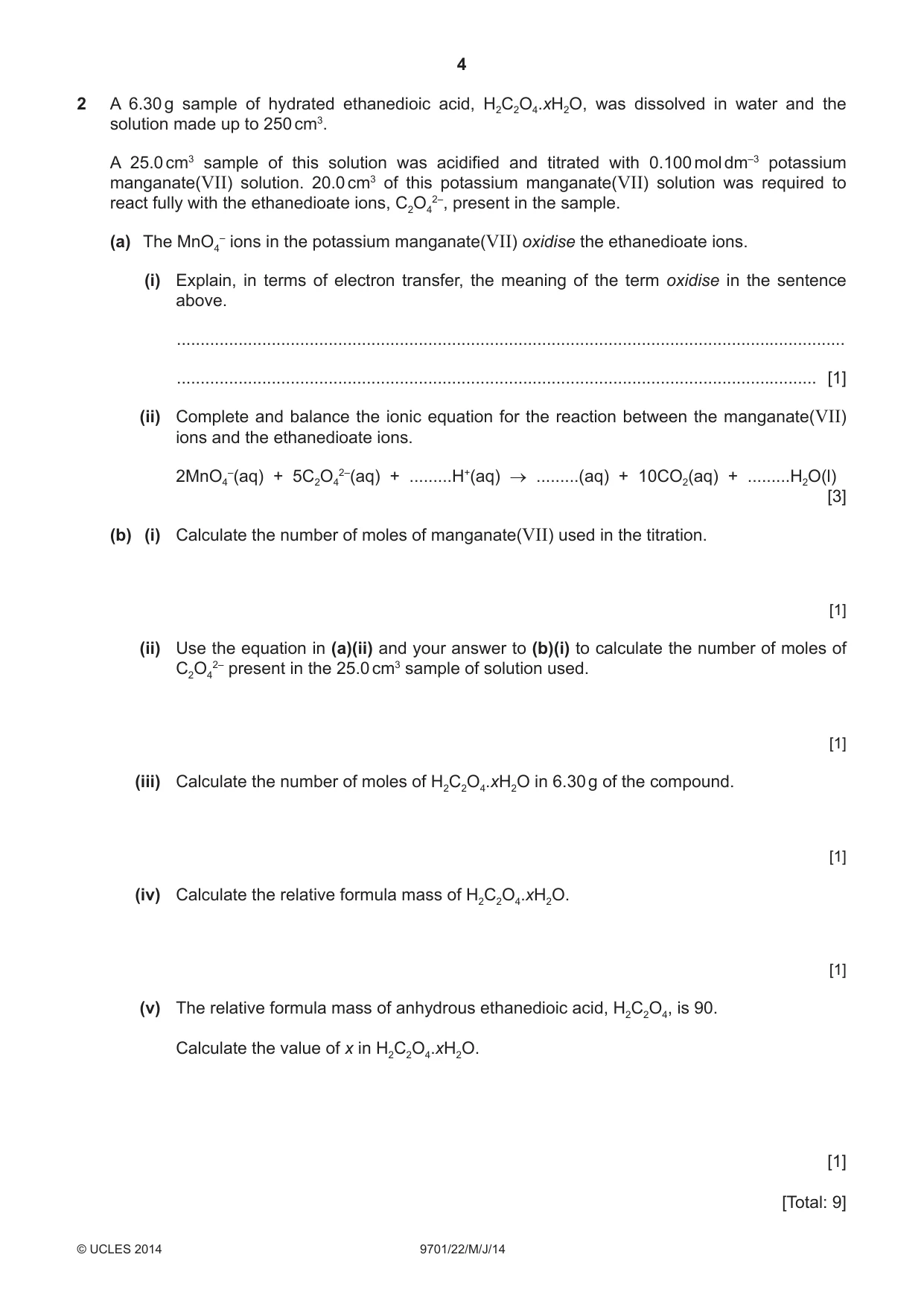
Question paper, page 4
4 9701/22/M/J/14 © UCLES 2014 2 A 6.30 g sample of hydrated ethanedioic acid, H2C2O4.xH2O, was dissolved in water and the solution made up to 250 cm3. A 25.0 cm3 sample of this solution was acidifi ed and titrated with 0.100 mol dm–3 potassium manganate(VII) solution. 20.0 cm3 of this potassium manganate(VII) solution was required to react fully with the ethanedioate ions, C2O4 2–, present in the sample. (a) The MnO4 – ions in the potassium manganate(VII) oxidise the ethanedioate ions. (i) Explain, in terms of electron transfer, the meaning of the term oxidise in the sentence above. … … [1] (ii) Complete and balance the ionic equation for the reaction between the manganate(VII) ions and the ethanedioate ions. 2MnO4 –(aq) + 5C2O4 2–(aq) + …H+(aq) …(aq) + 10CO2(aq) + …H2O(l) [3] (b) (i) Calculate the number of moles of manganate(VII) used in the titration. [1] (ii) Use the equation in (a)(ii) and your answer to (b)(i) to calculate the number of moles of C2O4 2– present in the 25.0 cm3 sample of solution used. [1] (iii) Calculate the number of moles of H2C2O4.xH2O in 6.30 g of the compound. [1] (iv) Calculate the relative formula mass of H2C2O4.xH2O. [1] (v) The relative formula mass of anhydrous ethanedioic acid, H2C2O4, is 90. Calculate the value of x in H2C2O4.xH2O. [1] [Total: 9]
Question paper, page 5
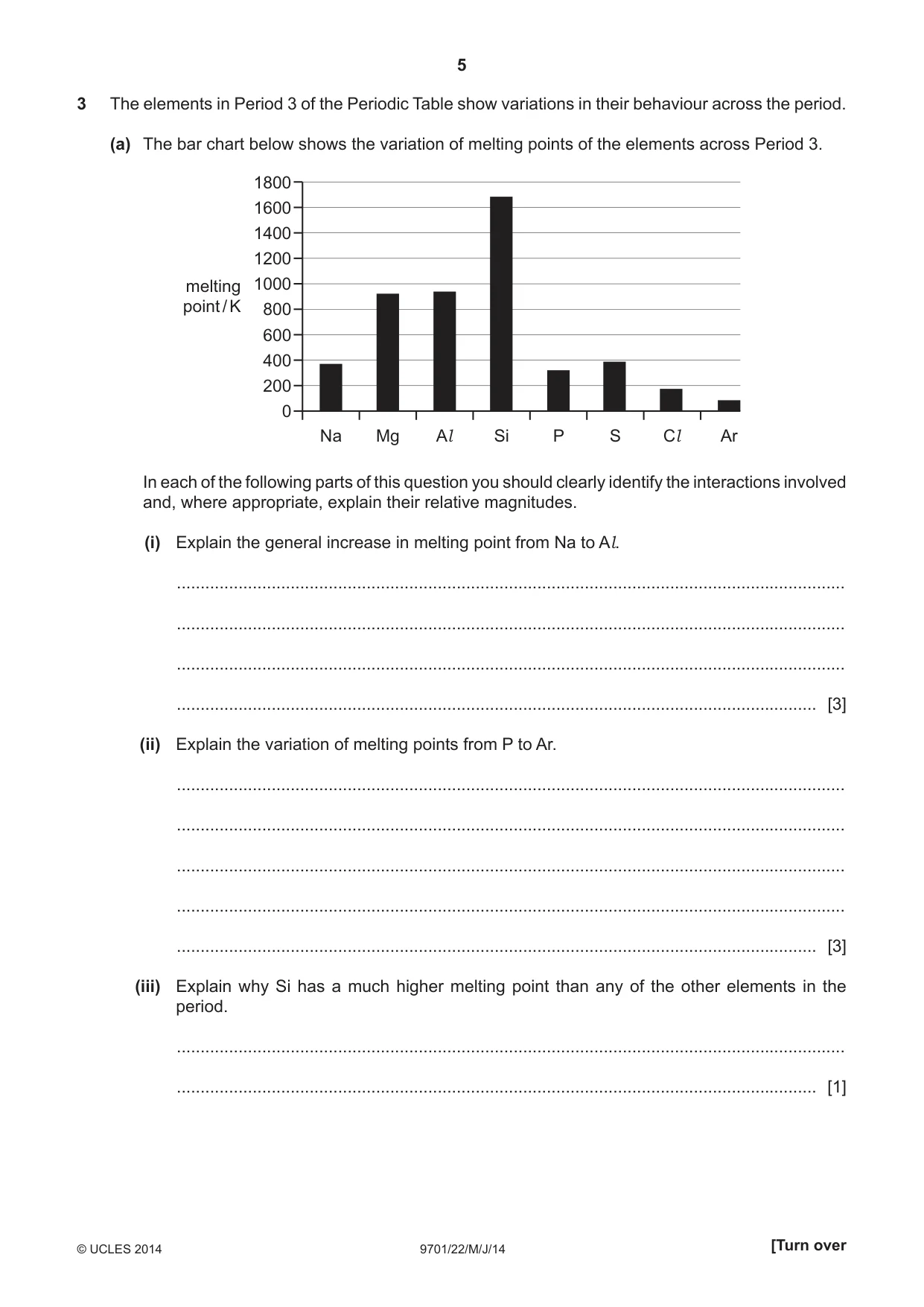
5 9701/22/M/J/14 © UCLES 2014 [Turn over 3 The elements in Period 3 of the Periodic Table show variations in their behaviour across the period. (a) The bar chart below shows the variation of melting points of the elements across Period 3. Na Mg Si P S Ar Al Cl 1800 1600 1400 1200 1000 800 600 400 200 0 melting point / K In each of the following parts of this question you should clearly identify the interactions involved and, where appropriate, explain their relative magnitudes. (i) Explain the general increase in melting point from Na to Al. … … … … [3] (ii) Explain the variation of melting points from P to Ar. … … … … … [3] (iii) Explain why Si has a much higher melting point than any of the other elements in the period. … … [1]
Question paper, page 6
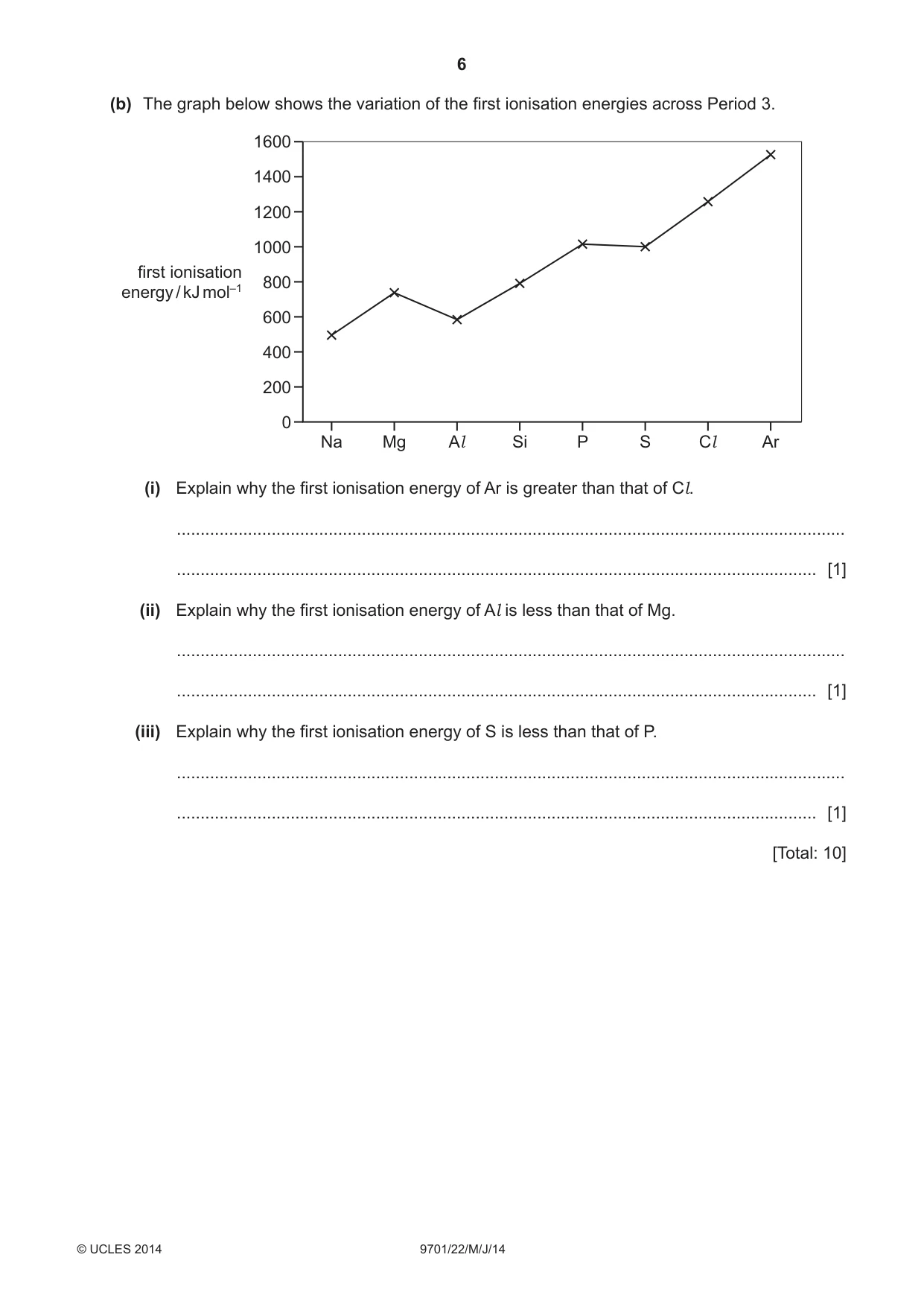
6 9701/22/M/J/14 © UCLES 2014 (b) The graph below shows the variation of the fi rst ionisation energies across Period 3. Na Mg Si P S Ar Al Cl first ionisation energy / kJ mol–1 1600 1400 1200 1000 800 600 400 200 0 (i) Explain why the fi rst ionisation energy of Ar is greater than that of Cl. … … [1] (ii) Explain why the fi rst ionisation energy of Al is less than that of Mg. … … [1] (iii) Explain why the fi rst ionisation energy of S is less than that of P. … … [1] [Total: 10]
Question paper, page 7
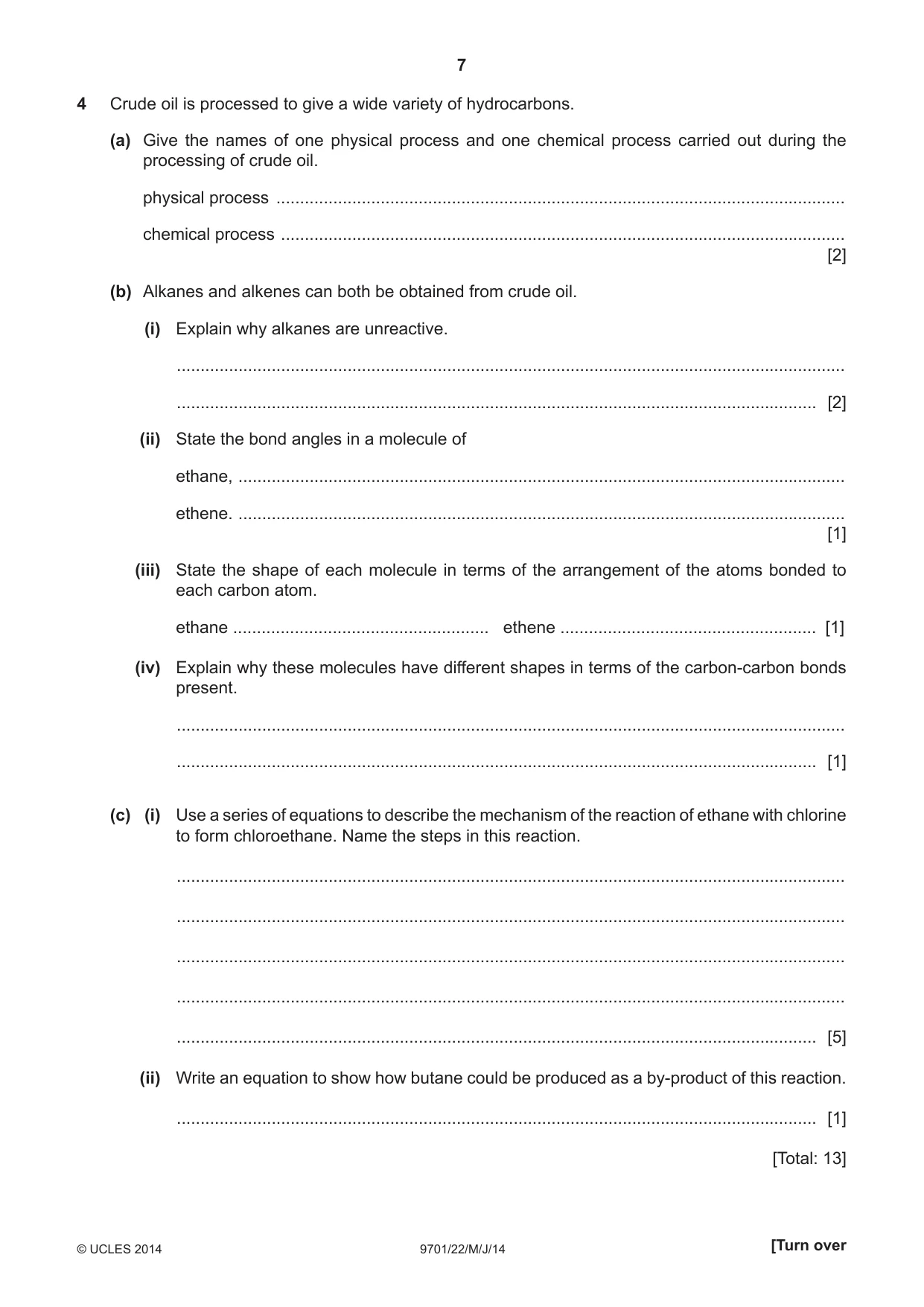
7 9701/22/M/J/14 © UCLES 2014 [Turn over 4 Crude oil is processed to give a wide variety of hydrocarbons. (a) Give the names of one physical process and one chemical process carried out during the processing of crude oil. physical process … chemical process … [2] (b) Alkanes and alkenes can both be obtained from crude oil. (i) Explain why alkanes are unreactive. … … [2] (ii) State the bond angles in a molecule of ethane, … ethene. … [1] (iii) State the shape of each molecule in terms of the arrangement of the atoms bonded to each carbon atom. ethane … ethene … [1] (iv) Explain why these molecules have different shapes in terms of the carbon-carbon bonds present. … … [1] (c) (i) Use a series of equations to describe the mechanism of the reaction of ethane with chlorine to form chloroethane. Name the steps in this reaction. … … … … … [5] (ii) Write an equation to show how butane could be produced as a by-product of this reaction. … [1] [Total: 13]
Question paper, page 8
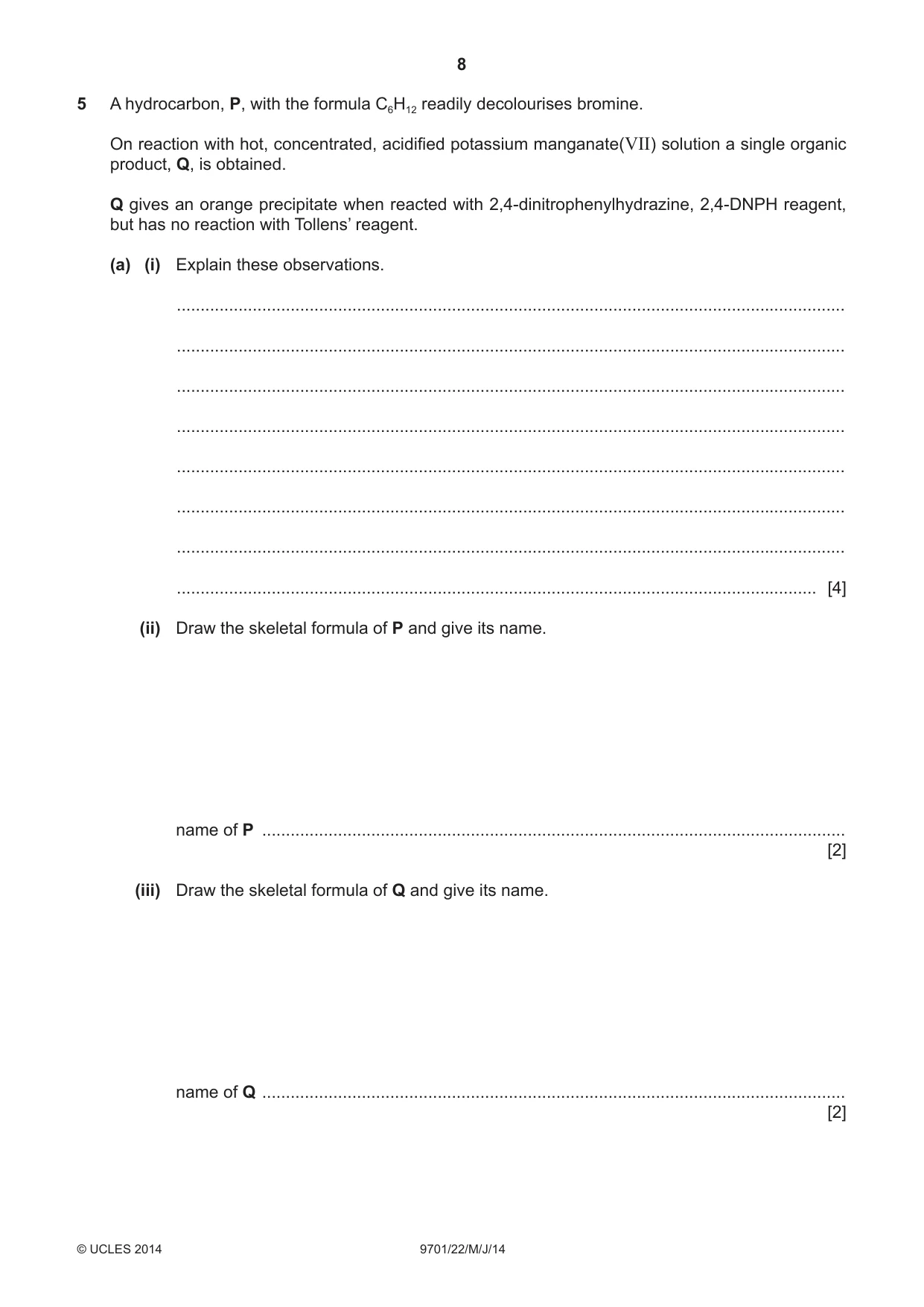
8 9701/22/M/J/14 © UCLES 2014 5 A hydrocarbon, P, with the formula C6H12 readily decolourises bromine. On reaction with hot, concentrated, acidifi ed potassium manganate(VII) solution a single organic product, Q, is obtained. Q gives an orange precipitate when reacted with 2,4-dinitrophenylhydrazine, 2,4-DNPH reagent, but has no reaction with Tollens’ reagent. (a) (i) Explain these observations. … … … … … … … … [4] (ii) Draw the skeletal formula of P and give its name. name of P … [2] (iii) Draw the skeletal formula of Q and give its name. name of Q … [2]
Question paper, page 9
9 9701/22/M/J/14 © UCLES 2014 [Turn over (b) There are several structural isomers of P that also decolourise bromine, but only four of these structural isomers exhibit geometrical (cis-trans) isomerism. Give the structures of any three structural isomers of P that exhibit geometrical (cis-trans) isomerism. [3] [Total: 11]
Question paper, page 10
10 9701/22/M/J/14 BLANK PAGE © UCLES 2014
Question paper, page 11
11 9701/22/M/J/14 BLANK PAGE © UCLES 2014
Question paper, page 12
12 Permission to reproduce items where third-party owned material protected by copyright is included has been sought and cleared where possible. Every reasonable effort has been made by the publisher (UCLES) to trace copyright holders, but if any items requiring clearance have unwittingly been included the publisher will be pleased to make amends at the earliest possible opportunity. Cambridge International Examinations is part of the Cambridge Assessment Group. Cambridge Assessment is the brand name of University of Cambridge Local Examinations Syndicate (UCLES), which is itself a department of the University of Cambridge. 9701/22/M/J/14 © UCLES 2014 BLANK PAGE
Mark scheme, page 1
CAMBRIDGE INTERNATIONAL EXAMINATIONS GCE Advanced Subsidiary Level and GCE Advanced Level MARK SCHEME for the May/June 2014 series 9701 CHEMISTRY 9701/22 Paper 2 (AS Structured Questions), maximum raw mark 60 This mark scheme is published as an aid to teachers and candidates, to indicate the requirements of the examination. It shows the basis on which Examiners were instructed to award marks. It does not indicate the details of the discussions that took place at an Examiners’ meeting before marking began, which would have considered the acceptability of alternative answers. Mark schemes should be read in conjunction with the question paper and the Principal Examiner Report for Teachers. Cambridge will not enter into discussions about these mark schemes. Cambridge is publishing the mark schemes for the May/June 2014 series for most IGCSE, GCE Advanced Level and Advanced Subsidiary Level components and some Ordinary Level components.
Mark scheme, page 2
Page 2 Mark Scheme Syllabus Paper GCE AS/A LEVEL – May/June 2014 9701 22 © Cambridge International Examinations 2014 Question Answers Mark Total 1 (a) The (total) number of protons and neutrons (in the nucleus of an atom) 1 1 (b) (i) Mass of an atom(s) or isotope relative to 12 1 (the mass) of (an atom of) carbon–12 OR relative to carbon–12 which is (exactly) 12 (units) allow a correct expression 1 1 2 (ii) 79Br 81Br 78.92x 80.92(100–x) where x = % abundance of 79Br so 100 ) 80.92(100 78.92 x x − + = 79.9 1 x = 51 hence 79Br : 81Br = 51 : 49 1 1 3
Mark scheme, page 3
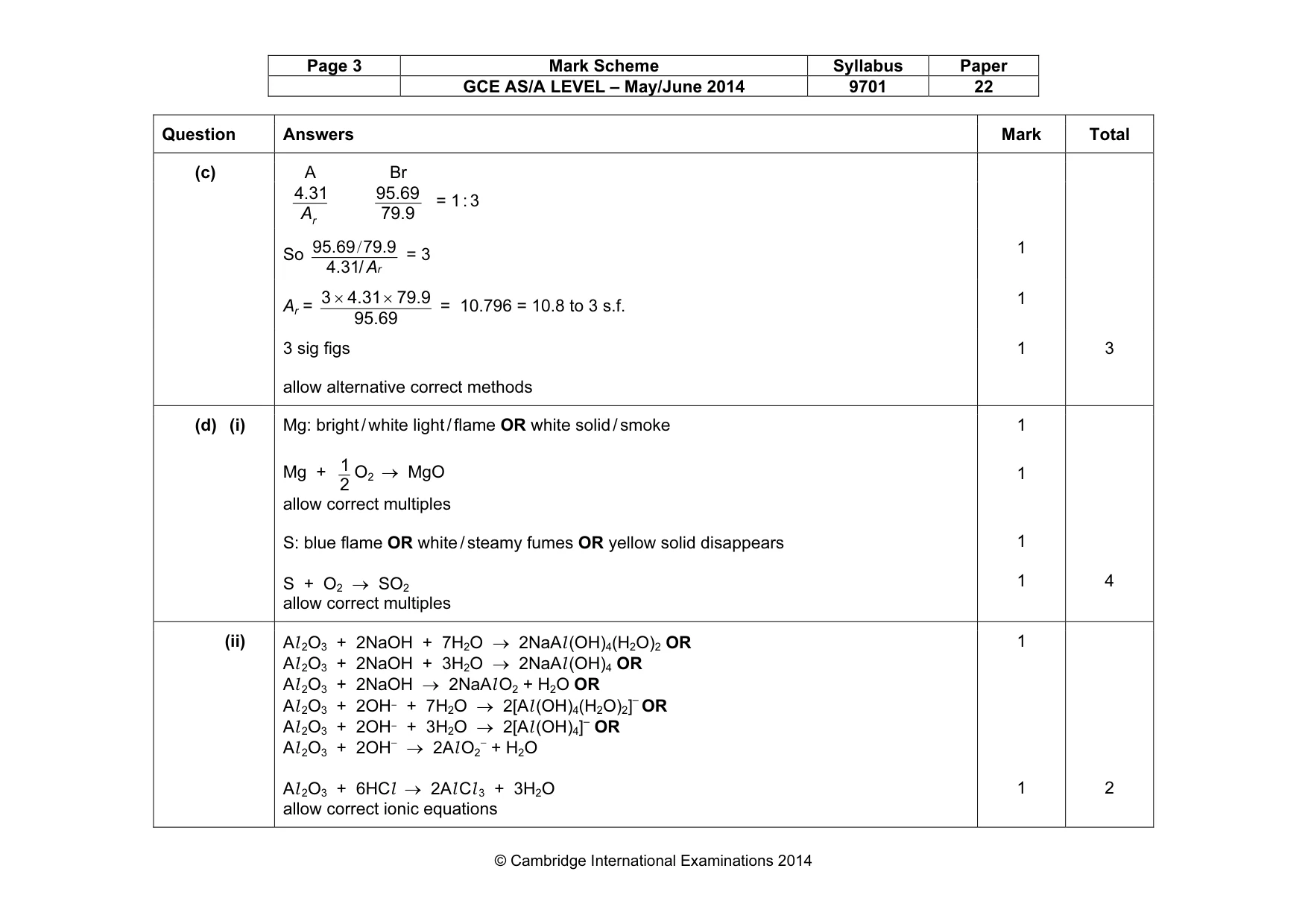
Page 3 Mark Scheme Syllabus Paper GCE AS/A LEVEL – May/June 2014 9701 22 © Cambridge International Examinations 2014 Question Answers Mark Total (c) A Br r A 4.31 79.9 95.69 = 1 : 3 So r A / 4.31 79.9 95.69/ = 3 1 Ar = 95.69 79.9 4.31 3 × × = 10.796 = 10.8 to 3 s.f. 1 3 sig figs allow alternative correct methods 1 3 (d) (i) Mg: bright / white light / flame OR white solid / smoke Mg + 2 1 O2 → MgO allow correct multiples S: blue flame OR white / steamy fumes OR yellow solid disappears S + O2 → SO2 allow correct multiples 1 1 1 1 4 (ii) Al 2O3 + 2NaOH + 7H2O → 2NaAl (OH)4(H2O)2 OR Al 2O3 + 2NaOH + 3H2O → 2NaAl (OH)4 OR Al 2O3 + 2NaOH → 2NaAl O2 + H2O OR Al 2O3 + 2OH‒ + 7H2O → 2[Al (OH)4(H2O)2]– OR Al 2O3 + 2OH‒ + 3H2O → 2[Al (OH)4]– OR Al 2O3 + 2OH− → 2Al O2 − + H2O Al 2O3 + 6HCl → 2Al Cl 3 + 3H2O allow correct ionic equations 1 1 2
Mark scheme, page 4
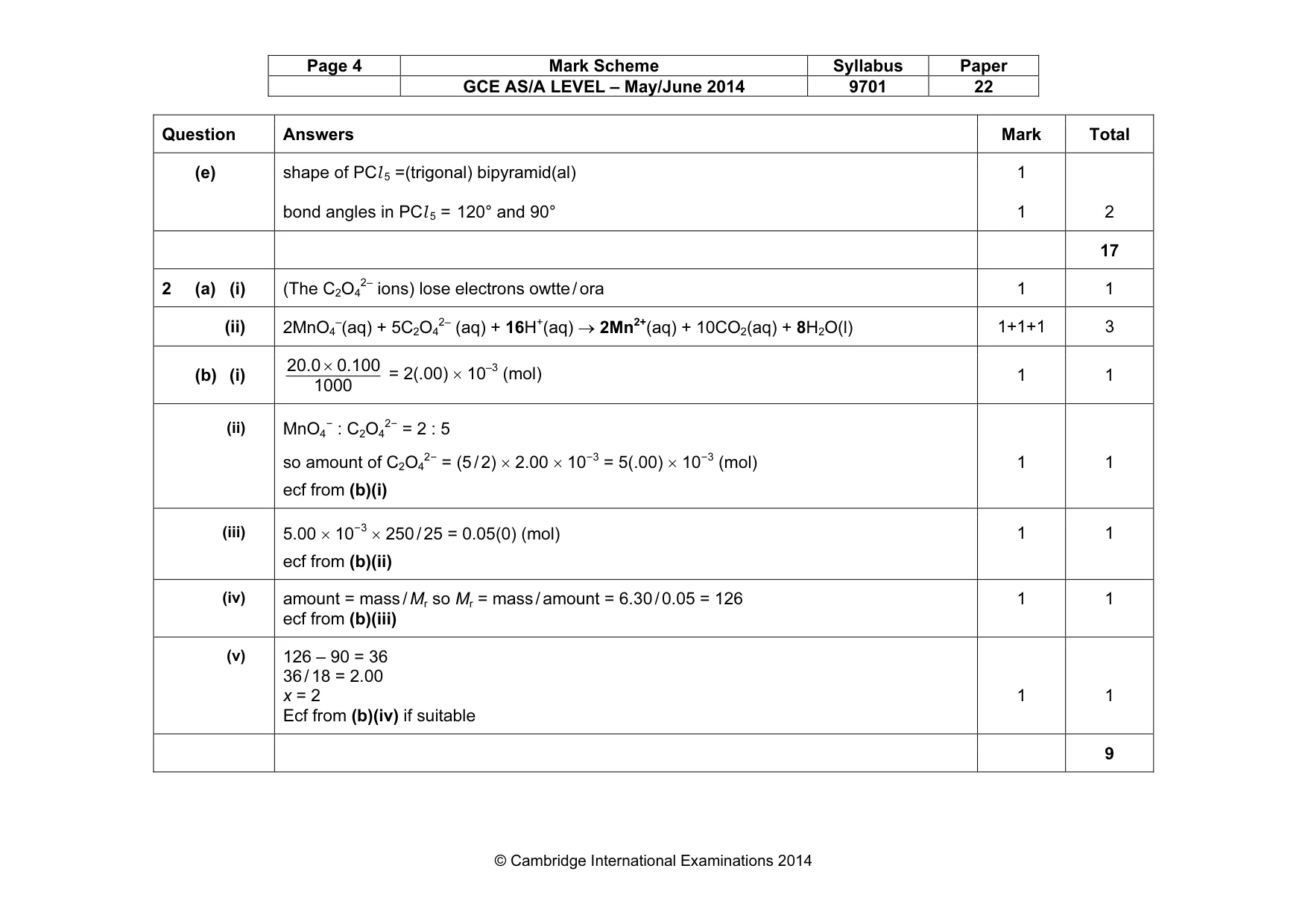
Page 4 Mark Scheme Syllabus Paper GCE AS/A LEVEL – May/June 2014 9701 22 © Cambridge International Examinations 2014 Question Answers Mark Total (e) shape of PCl 5 =(trigonal) bipyramid(al) bond angles in PCl 5 = 120° and 90° 1 1 2 17 2 (a) (i) (The C2O4 2– ions) lose electrons owtte / ora 1 1 (ii) 2MnO4 –(aq) + 5C2O4 2– (aq) + 16H+(aq) → 2Mn2+(aq) + 10CO2(aq) + 8H2O(l) 1+1+1 3 (b) (i) 1000 0.100 20.0× = 2(.00) × 10–3 (mol) 1 1 (ii) MnO4 – : C2O4 2– = 2 : 5 so amount of C2O4 2– = (5 / 2) × 2.00 × 10–3 = 5(.00) × 10–3 (mol) ecf from (b)(i) 1 1 (iii) 5.00 × 10–3 × 250 / 25 = 0.05(0) (mol) ecf from (b)(ii) 1 1 (iv) amount = mass / Mr so Mr = mass / amount = 6.30 / 0.05 = 126 ecf from (b)(iii) 1 1 (v) 126 – 90 = 36 36 / 18 = 2.00 x = 2 Ecf from (b)(iv) if suitable 1 1 9
Mark scheme, page 5
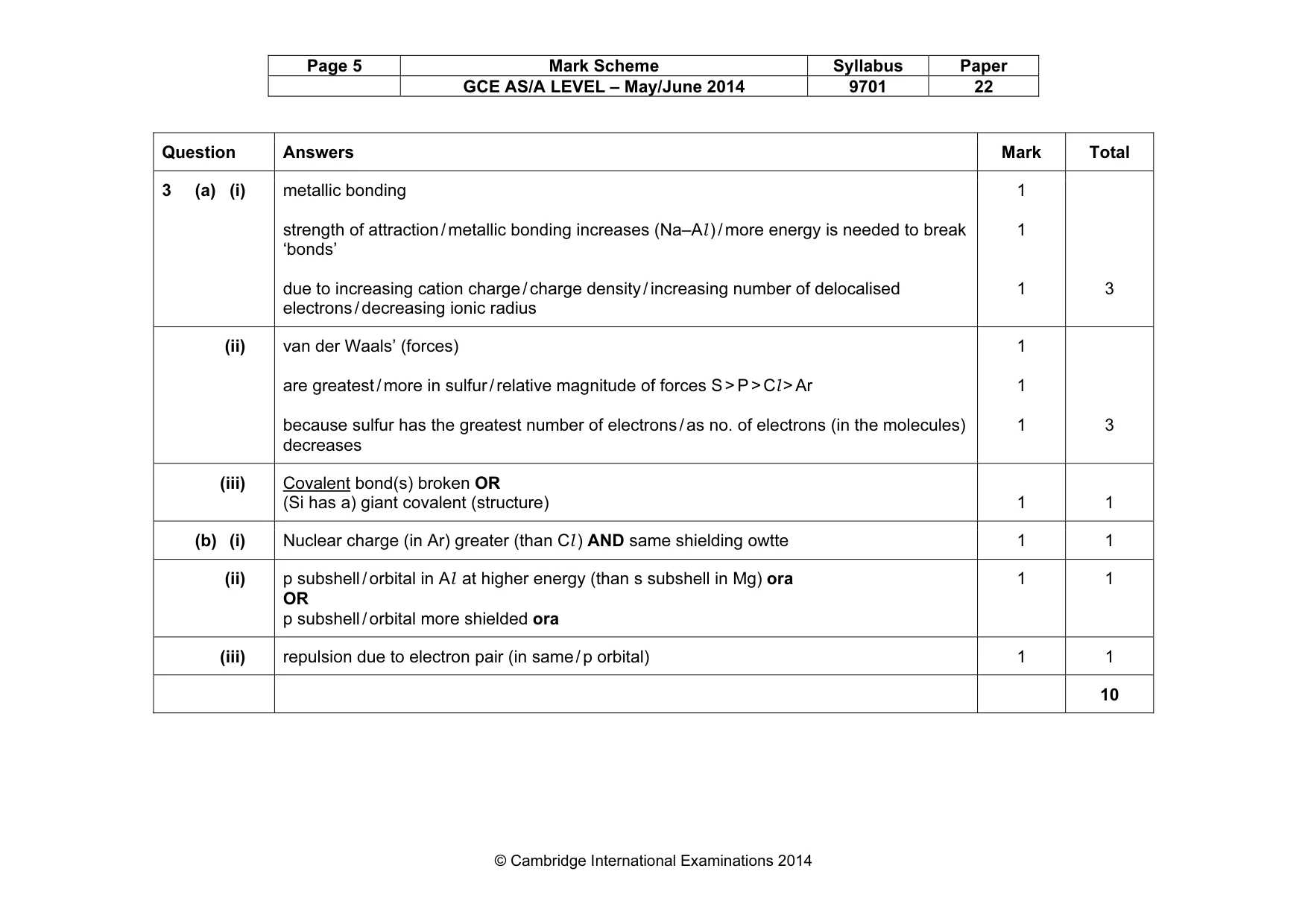
Page 5 Mark Scheme Syllabus Paper GCE AS/A LEVEL – May/June 2014 9701 22 © Cambridge International Examinations 2014 Question Answers Mark Total 3 (a) (i) metallic bonding strength of attraction / metallic bonding increases (Na–Al ) / more energy is needed to break ‘bonds’ due to increasing cation charge / charge density / increasing number of delocalised electrons / decreasing ionic radius 1 1 1 3 (ii) van der Waals’ (forces) are greatest / more in sulfur / relative magnitude of forces S > P > Cl > Ar because sulfur has the greatest number of electrons / as no. of electrons (in the molecules) decreases 1 1 1 3 (iii) Covalent bond(s) broken OR (Si has a) giant covalent (structure) 1 1 (b) (i) Nuclear charge (in Ar) greater (than Cl ) AND same shielding owtte 1 1 (ii) p subshell / orbital in Al at higher energy (than s subshell in Mg) ora OR p subshell / orbital more shielded ora 1 1 (iii) repulsion due to electron pair (in same / p orbital) 1 1 10
Mark scheme, page 6
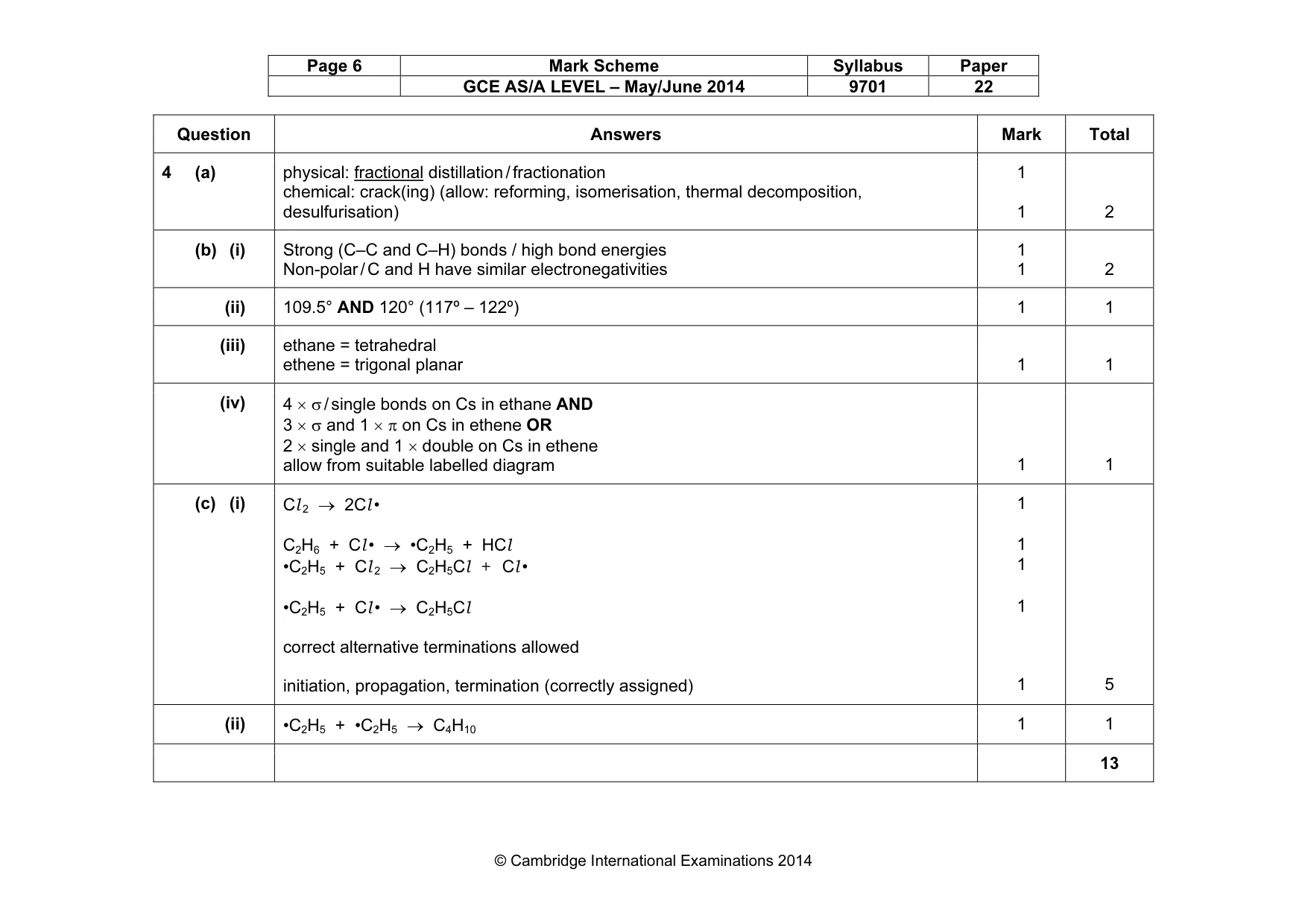
Page 6 Mark Scheme Syllabus Paper GCE AS/A LEVEL – May/June 2014 9701 22 © Cambridge International Examinations 2014 Question Answers Mark Total 4 (a) physical: fractional distillation / fractionation chemical: crack(ing) (allow: reforming, isomerisation, thermal decomposition, desulfurisation) 1 1 2 (b) (i) Strong (C–C and C–H) bonds / high bond energies Non-polar / C and H have similar electronegativities 1 1 2 (ii) 109.5° AND 120° (117º – 122º) 1 1 (iii) ethane = tetrahedral ethene = trigonal planar 1 1 (iv) 4 × σ / single bonds on Cs in ethane AND 3 × σ and 1 × π on Cs in ethene OR 2 × single and 1 × double on Cs in ethene allow from suitable labelled diagram 1 1 (c) (i) Cl 2 → 2Cl • C2H6 + Cl • → •C2H5 + HCl •C2H5 + Cl 2 → C2H5Cl + Cl • •C2H5 + Cl • → C2H5Cl correct alternative terminations allowed initiation, propagation, termination (correctly assigned) 1 1 1 1 1 5 (ii) •C2H5 + •C2H5 → C4H10 1 1 13
Mark scheme, page 7
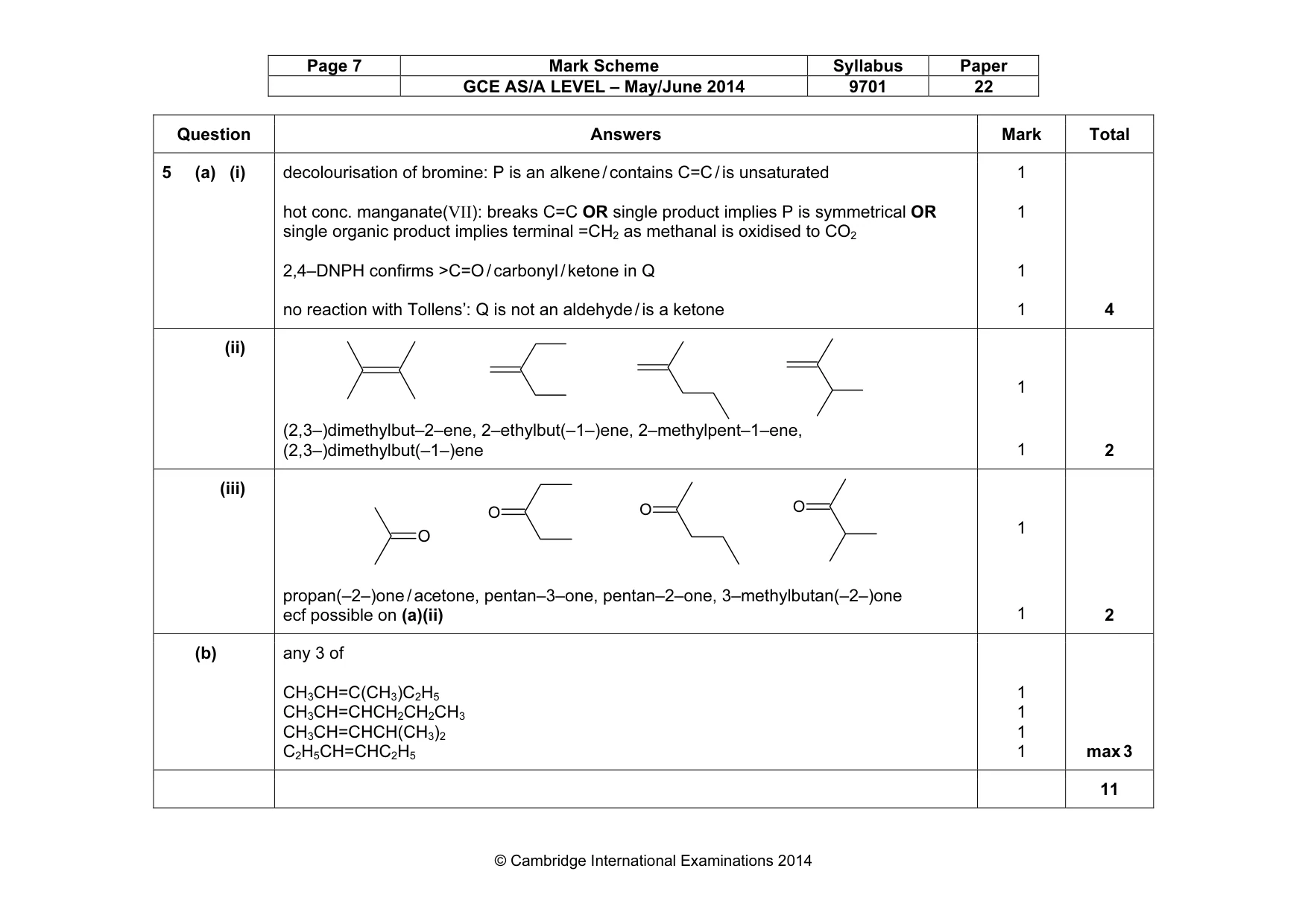
Page 7 Mark Scheme Syllabus Paper GCE AS/A LEVEL – May/June 2014 9701 22 © Cambridge International Examinations 2014 Question Answers Mark Total 5 (a) (i) decolourisation of bromine: P is an alkene / contains C=C / is unsaturated hot conc. manganate(VII): breaks C=C OR single product implies P is symmetrical OR single organic product implies terminal =CH2 as methanal is oxidised to CO2 2,4–DNPH confirms >C=O / carbonyl / ketone in Q no reaction with Tollens’: Q is not an aldehyde / is a ketone 1 1 1 1 4 (ii) (2,3–)dimethylbut–2–ene, 2–ethylbut(–1–)ene, 2–methylpent–1–ene, (2,3–)dimethylbut(–1–)ene 1 1 2 (iii) O O O O propan(–2–)one / acetone, pentan–3–one, pentan–2–one, 3–methylbutan(–2–)one ecf possible on (a)(ii) 1 1 2 (b) any 3 of CH3CH=C(CH3)C2H5 CH3CH=CHCH2CH2CH3 CH3CH=CHCH(CH3)2 C2H5CH=CHC2H5 1 1 1 1 max 3 11
What you needed in this session
Cambridge’s own grade thresholds for 2014 May/June, Paper 2 · Variant 2. A higher threshold means an easier paper — the bar moves with how the cohort did.