Cambridge A Level Chemistry 9701 — 2011 Oct/Nov Paper 2 · Variant 2
9701/22/O/N/11 · 60 marks · ≈68 min
The question paper and its mark scheme, free to read here and free to download. This is Cambridge’s own paper, exactly as it was sat.
Question paper12 pages

Mark scheme7 pages
Answers below. Sit the paper first if you are practising.
Paper as text
Question paper, page 1
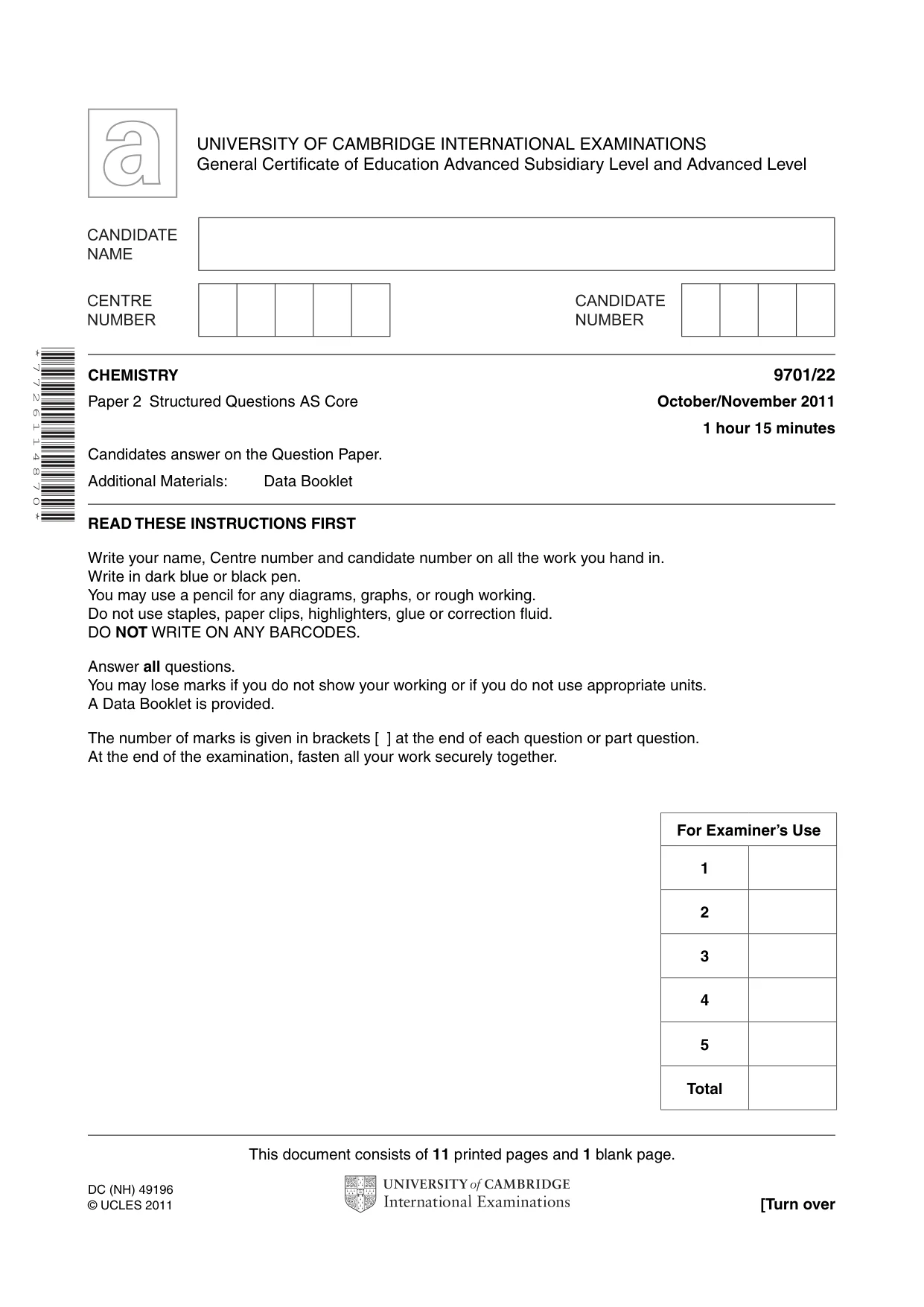
This document consists of 11 printed pages and 1 blank page. DC (NH) 49196 © UCLES 2011 [Turn over UNIVERSITY OF CAMBRIDGE INTERNATIONAL EXAMINATIONS General Certificate of Education Advanced Subsidiary Level and Advanced Level * 7 7 2 6 1 1 4 8 7 0 * CHEMISTRY 9701/22 Paper 2 Structured Questions AS Core October/November 2011 1 hour 15 minutes Candidates answer on the Question Paper. Additional Materials: Data Booklet READ THESE INSTRUCTIONS FIRST Write your name, Centre number and candidate number on all the work you hand in. Write in dark blue or black pen. You may use a pencil for any diagrams, graphs, or rough working. Do not use staples, paper clips, highlighters, glue or correction fluid. DO NOT WRITE ON ANY BARCODES. Answer all questions. You may lose marks if you do not show your working or if you do not use appropriate units. A Data Booklet is provided. The number of marks is given in brackets [ ] at the end of each question or part question. At the end of the examination, fasten all your work securely together. For Examiner’s Use 1 2 3 4 5 Total
Question paper, page 2
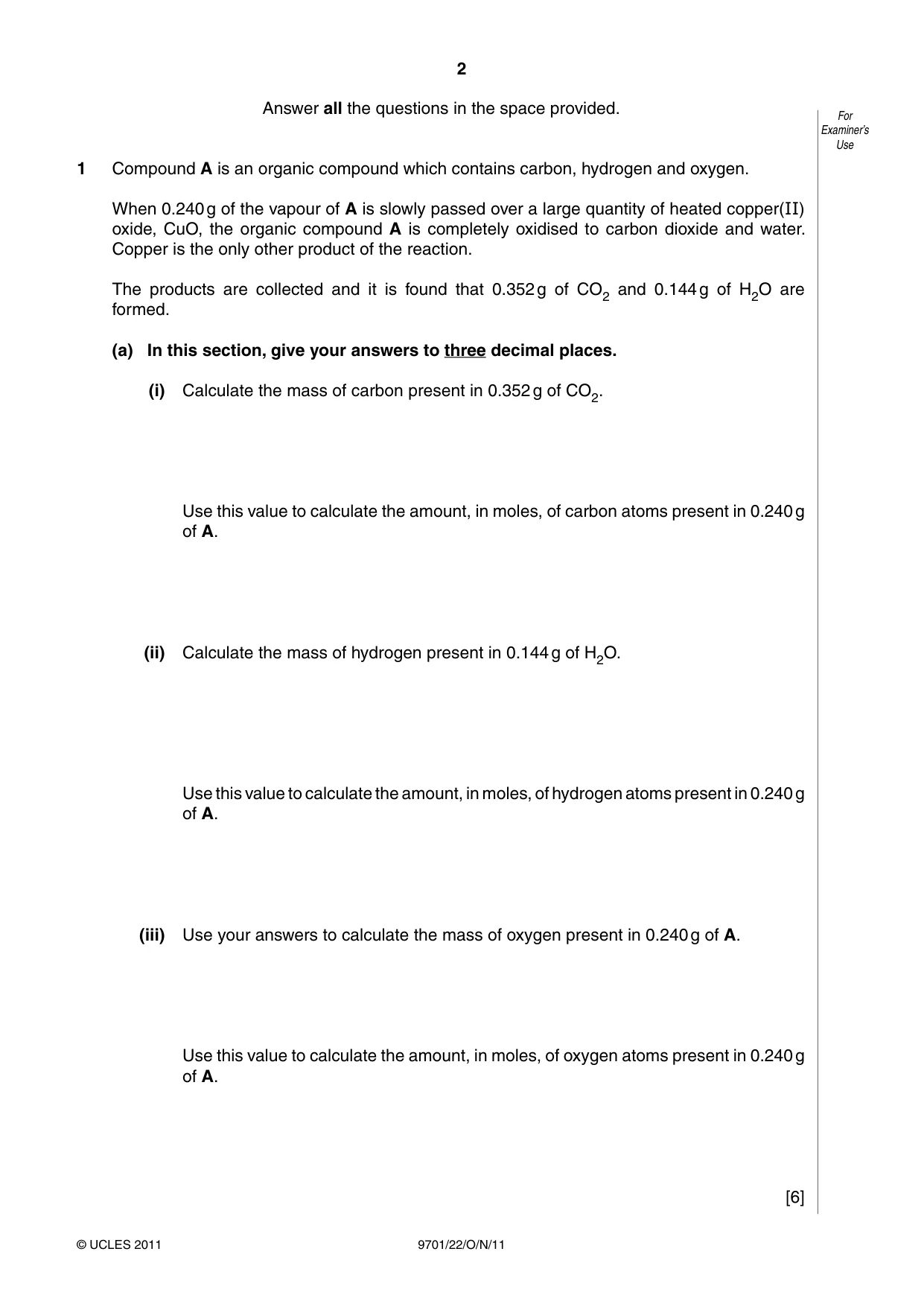
2 9701/22/O/N/11 © UCLES 2011 For Examiner’s Use Answer all the questions in the space provided. 1 Compound A is an organic compound which contains carbon, hydrogen and oxygen. When 0.240 g of the vapour of A is slowly passed over a large quantity of heated copper(II) oxide, CuO, the organic compound A is completely oxidised to carbon dioxide and water. Copper is the only other product of the reaction. The products are collected and it is found that 0.352 g of CO2 and 0.144 g of H2O are formed. (a) In this section, give your answers to three decimal places. (i) Calculate the mass of carbon present in 0.352 g of CO2. Use this value to calculate the amount, in moles, of carbon atoms present in 0.240 g of A. (ii) Calculate the mass of hydrogen present in 0.144 g of H2O. Use this value to calculate the amount, in moles, of hydrogen atoms present in 0.240 g of A. (iii) Use your answers to calculate the mass of oxygen present in 0.240 g of A. Use this value to calculate the amount, in moles, of oxygen atoms present in 0.240 g of A. [6]
Question paper, page 3
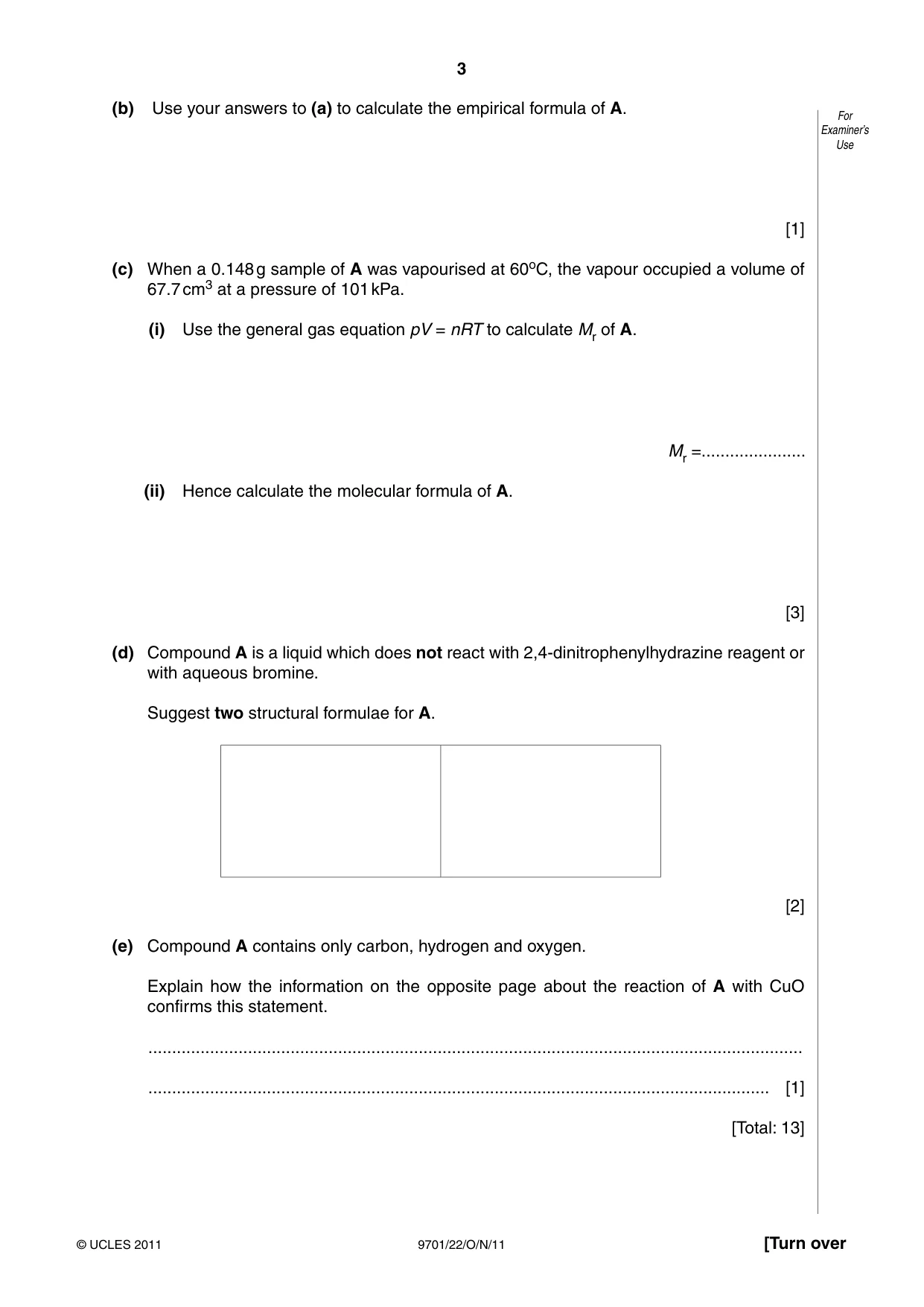
3 9701/22/O/N/11 © UCLES 2011 [Turn over For Examiner’s Use (b) Use your answers to (a) to calculate the empirical formula of A. [1] (c) When a 0.148 g sample of A was vapourised at 60oC, the vapour occupied a volume of 67.7 cm3 at a pressure of 101 kPa. (i) Use the general gas equation pV = nRT to calculate Mr of A. Mr =… (ii) Hence calculate the molecular formula of A. [3] (d) Compound A is a liquid which does not react with 2,4-dinitrophenylhydrazine reagent or with aqueous bromine. Suggest two structural formulae for A. [2] (e) Compound A contains only carbon, hydrogen and oxygen. Explain how the information on the opposite page about the reaction of A with CuO confirms this statement. … … [1] [Total: 13]
Question paper, page 4
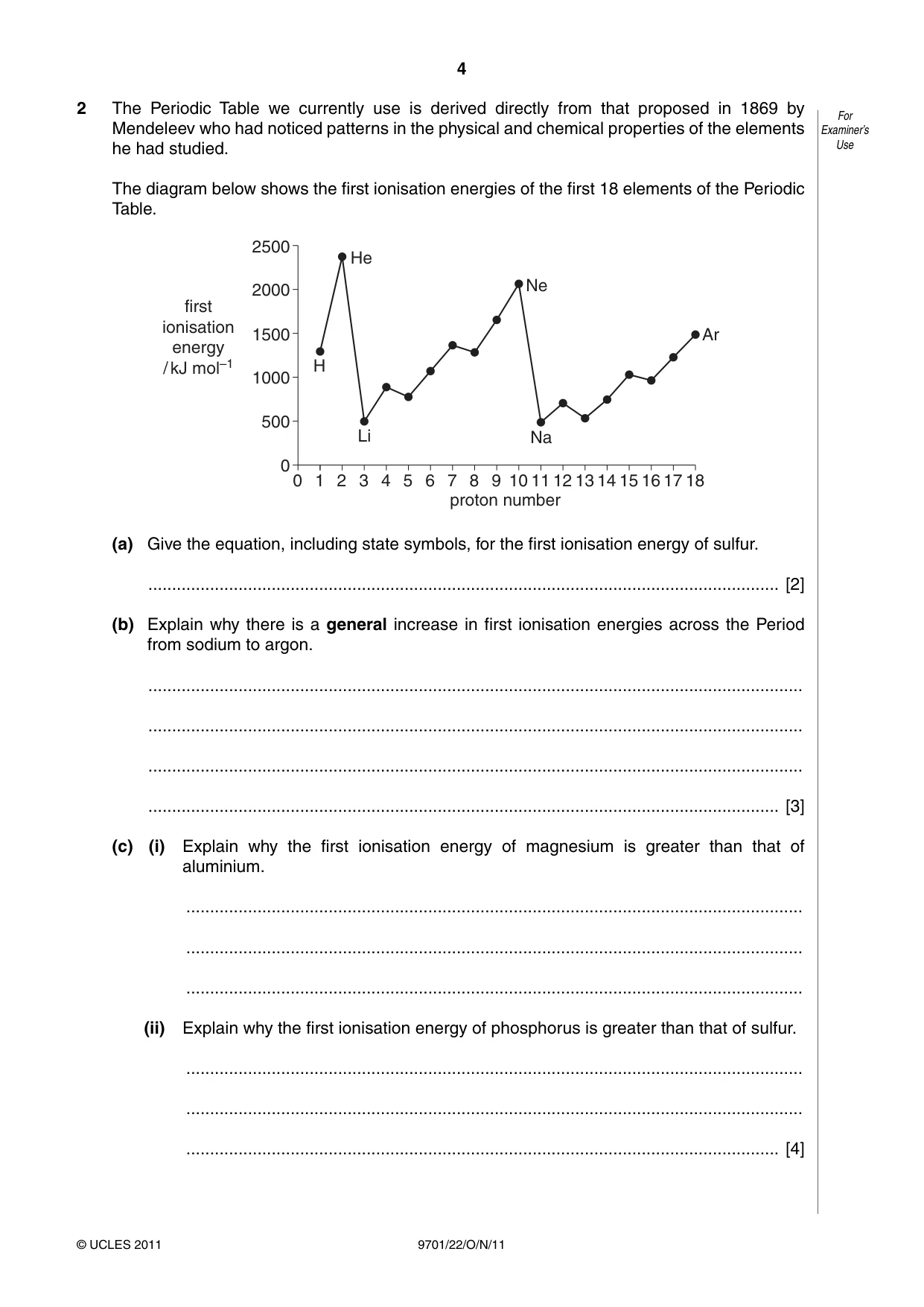
4 9701/22/O/N/11 © UCLES 2011 For Examiner’s Use 2 The Periodic Table we currently use is derived directly from that proposed in 1869 by Mendeleev who had noticed patterns in the physical and chemical properties of the elements he had studied. The diagram below shows the first ionisation energies of the first 18 elements of the Periodic Table. 2500 2000 1500 first ionisation energy / kJ mol–1 1000 500 0 0 1 2 3 4 5 6 7 8 9 proton number 10 11 12 13 14 15 16 17 18 H He Ne Na Ar Li (a) Give the equation, including state symbols, for the first ionisation energy of sulfur. … [2] (b) Explain why there is a general increase in first ionisation energies across the Period from sodium to argon. … … … … [3] (c) (i) Explain why the first ionisation energy of magnesium is greater than that of aluminium. … … … (ii) Explain why the first ionisation energy of phosphorus is greater than that of sulfur. … … … [4]
Question paper, page 5
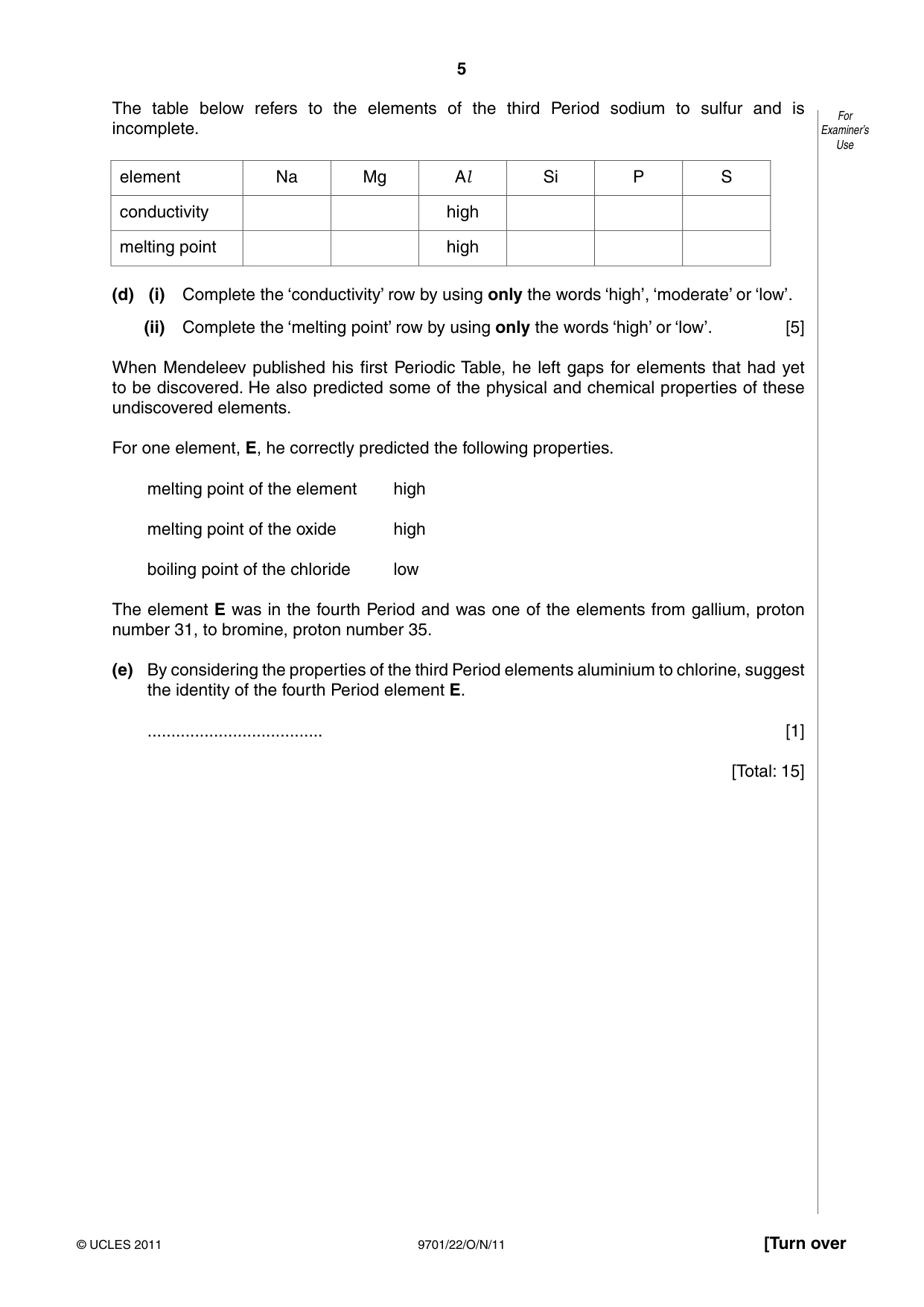
5 9701/22/O/N/11 © UCLES 2011 [Turn over For Examiner’s Use The table below refers to the elements of the third Period sodium to sulfur and is incomplete. element Na Mg Al Si P S conductivity high melting point high (d) (i) Complete the ‘conductivity’ row by using only the words ‘high’, ‘moderate’ or ‘low’. (ii) Complete the ‘melting point’ row by using only the words ‘high’ or ‘low’. [5] When Mendeleev published his first Periodic Table, he left gaps for elements that had yet to be discovered. He also predicted some of the physical and chemical properties of these undiscovered elements. For one element, E, he correctly predicted the following properties. melting point of the element high melting point of the oxide high boiling point of the chloride low The element E was in the fourth Period and was one of the elements from gallium, proton number 31, to bromine, proton number 35. (e) By considering the properties of the third Period elements aluminium to chlorine, suggest the identity of the fourth Period element E. … [1] [Total: 15]
Question paper, page 6
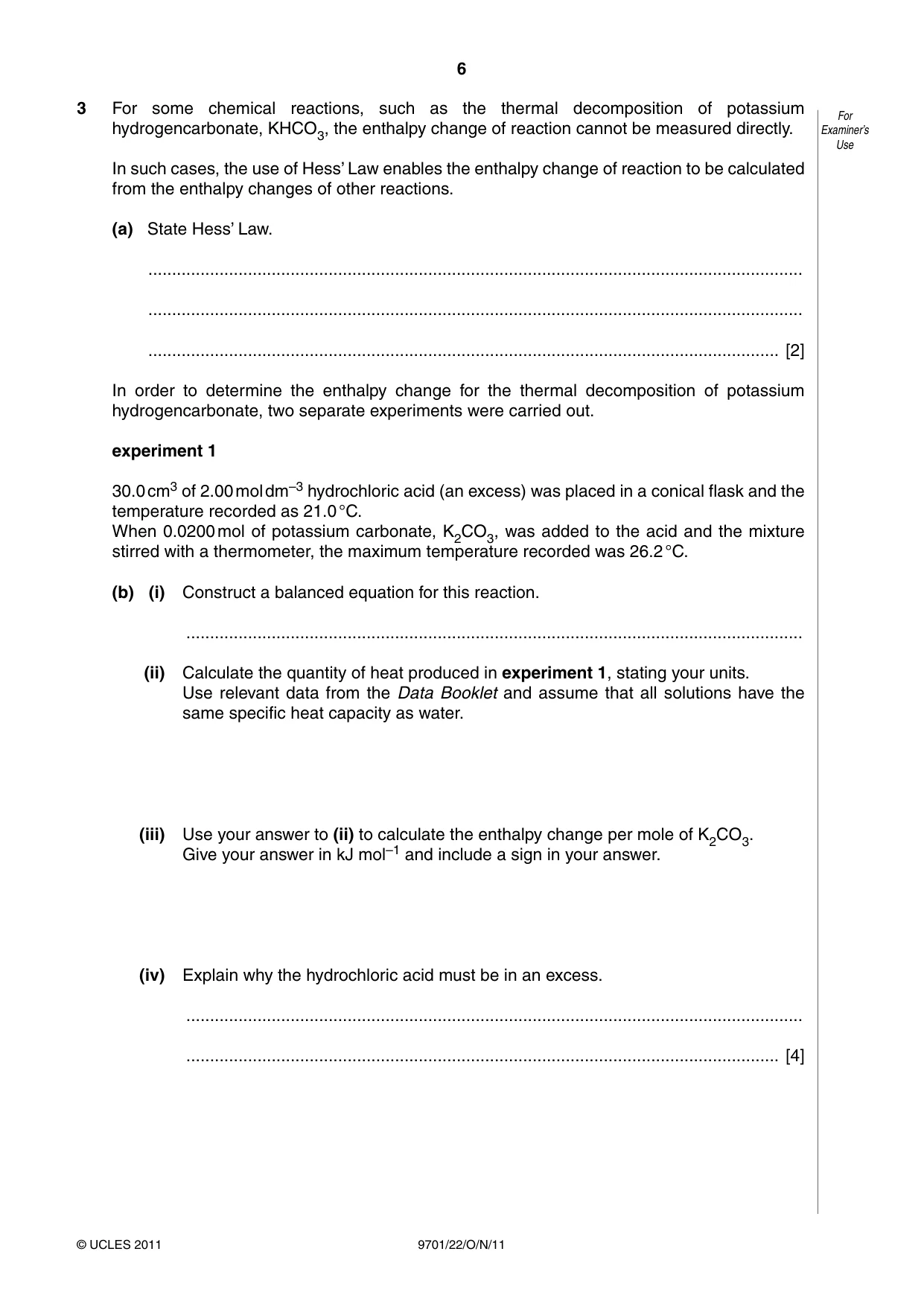
6 9701/22/O/N/11 © UCLES 2011 For Examiner’s Use 3 For some chemical reactions, such as the thermal decomposition of potassium hydrogencarbonate, KHCO3, the enthalpy change of reaction cannot be measured directly. In such cases, the use of Hess’ Law enables the enthalpy change of reaction to be calculated from the enthalpy changes of other reactions. (a) State Hess’ Law. … … … [2] In order to determine the enthalpy change for the thermal decomposition of potassium hydrogencarbonate, two separate experiments were carried out. experiment 1 30.0 cm3 of 2.00 mol dm–3 hydrochloric acid (an excess) was placed in a conical flask and the temperature recorded as 21.0 °C. When 0.0200 mol of potassium carbonate, K2CO3, was added to the acid and the mixture stirred with a thermometer, the maximum temperature recorded was 26.2 °C. (b) (i) Construct a balanced equation for this reaction. … (ii) Calculate the quantity of heat produced in experiment 1, stating your units. Use relevant data from the Data Booklet and assume that all solutions have the same specific heat capacity as water. (iii) Use your answer to (ii) to calculate the enthalpy change per mole of K2CO3. Give your answer in kJ mol–1 and include a sign in your answer. (iv) Explain why the hydrochloric acid must be in an excess. … … [4]
Question paper, page 7
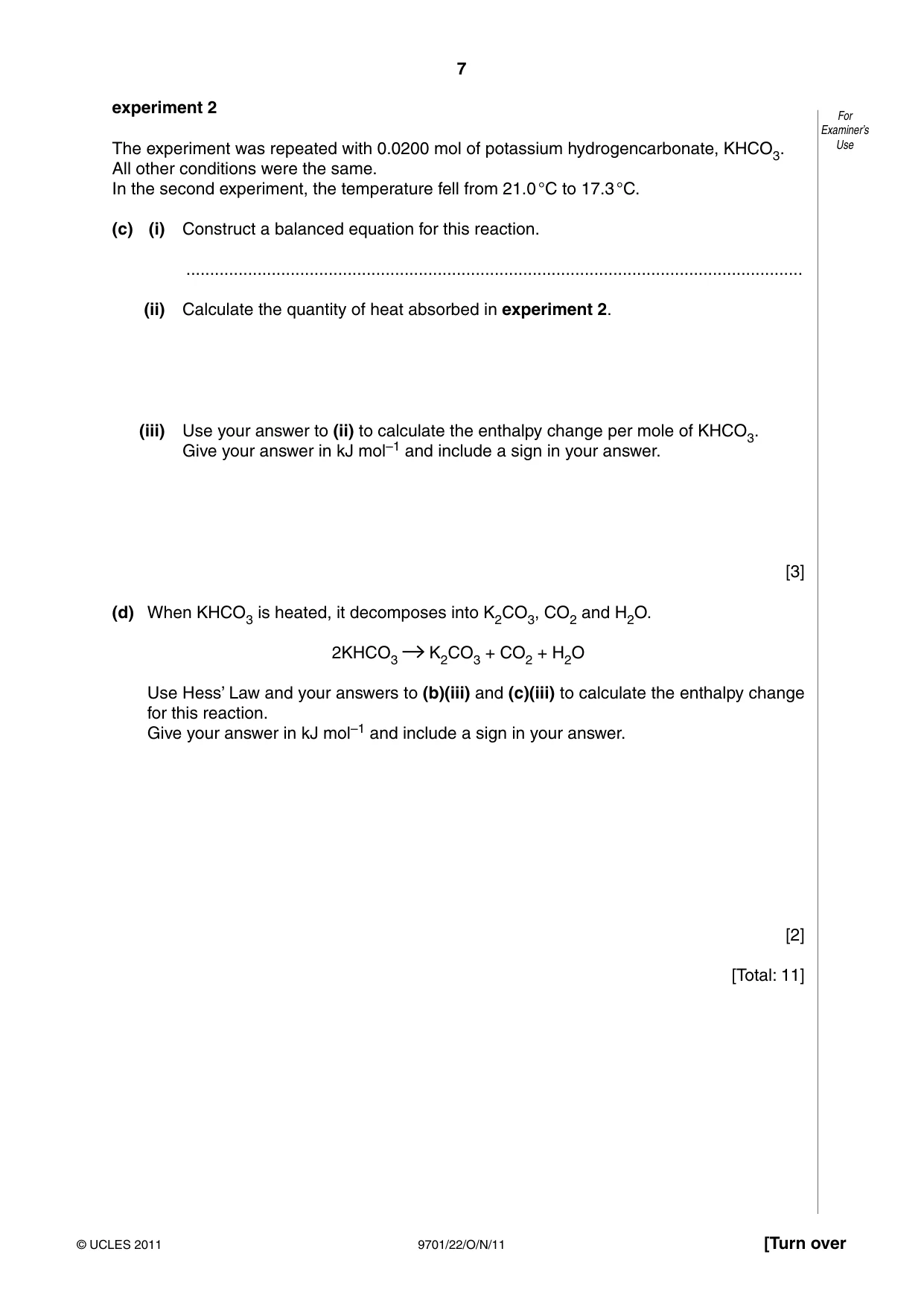
7 9701/22/O/N/11 © UCLES 2011 [Turn over For Examiner’s Use experiment 2 The experiment was repeated with 0.0200 mol of potassium hydrogencarbonate, KHCO3. All other conditions were the same. In the second experiment, the temperature fell from 21.0 °C to 17.3 °C. (c) (i) Construct a balanced equation for this reaction. … (ii) Calculate the quantity of heat absorbed in experiment 2. (iii) Use your answer to (ii) to calculate the enthalpy change per mole of KHCO3. Give your answer in kJ mol–1 and include a sign in your answer. [3] (d) When KHCO3 is heated, it decomposes into K2CO3, CO2 and H2O. 2KHCO3 K2CO3 + CO2 + H2O Use Hess’ Law and your answers to (b)(iii) and (c)(iii) to calculate the enthalpy change for this reaction. Give your answer in kJ mol–1 and include a sign in your answer. [2] [Total: 11]
Question paper, page 8
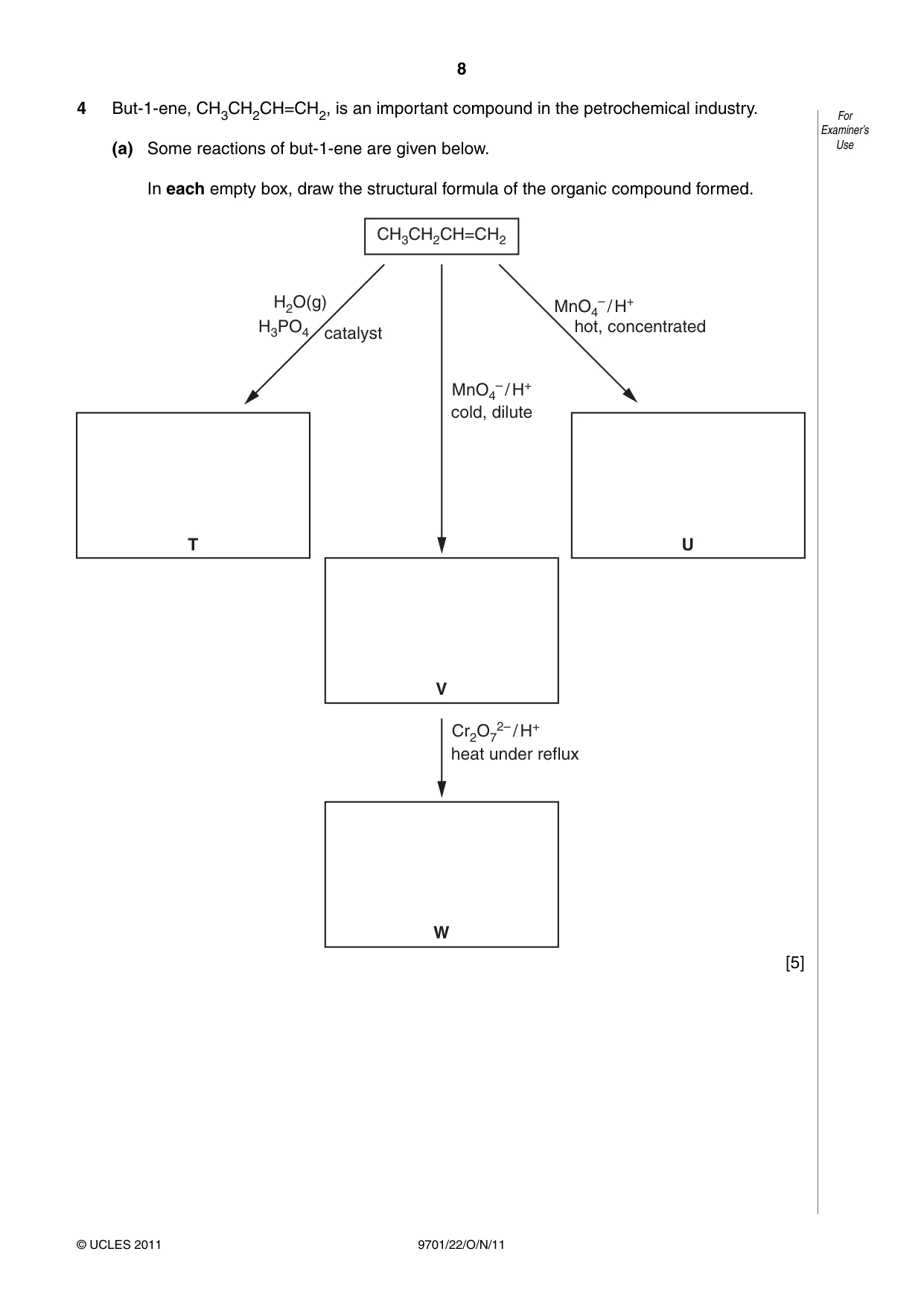
8 9701/22/O/N/11 © UCLES 2011 For Examiner’s Use 4 But-1-ene, CH3CH2CH=CH2, is an important compound in the petrochemical industry. (a) Some reactions of but-1-ene are given below. In each empty box, draw the structural formula of the organic compound formed. CH3CH2CH=CH2 V W T U H2O(g) MnO4 – / H+ hot, concentrated MnO4 – / H+ cold, dilute Cr2O7 2– / H+ heat under reflux H3PO4 catalyst [5]
Question paper, page 9
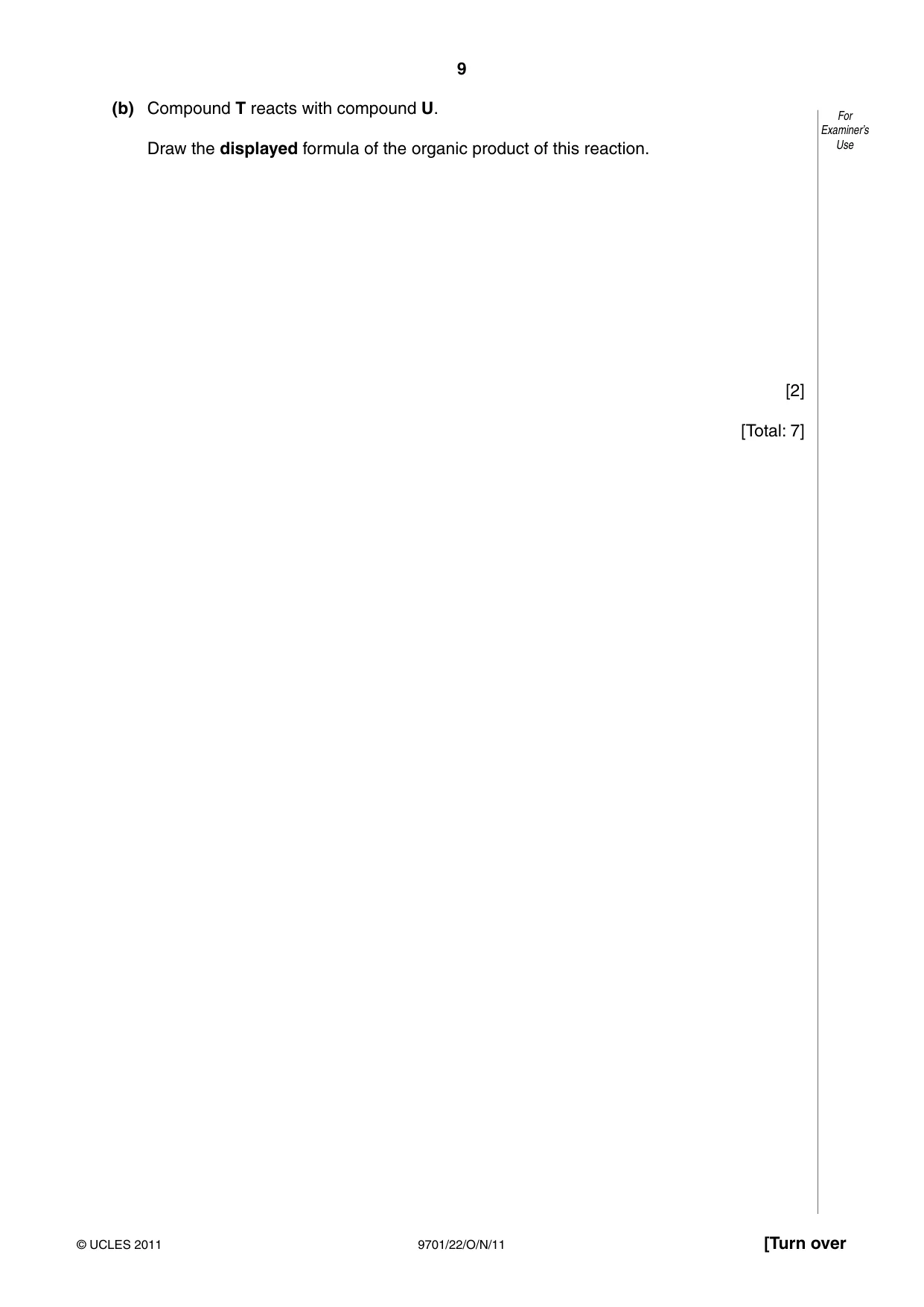
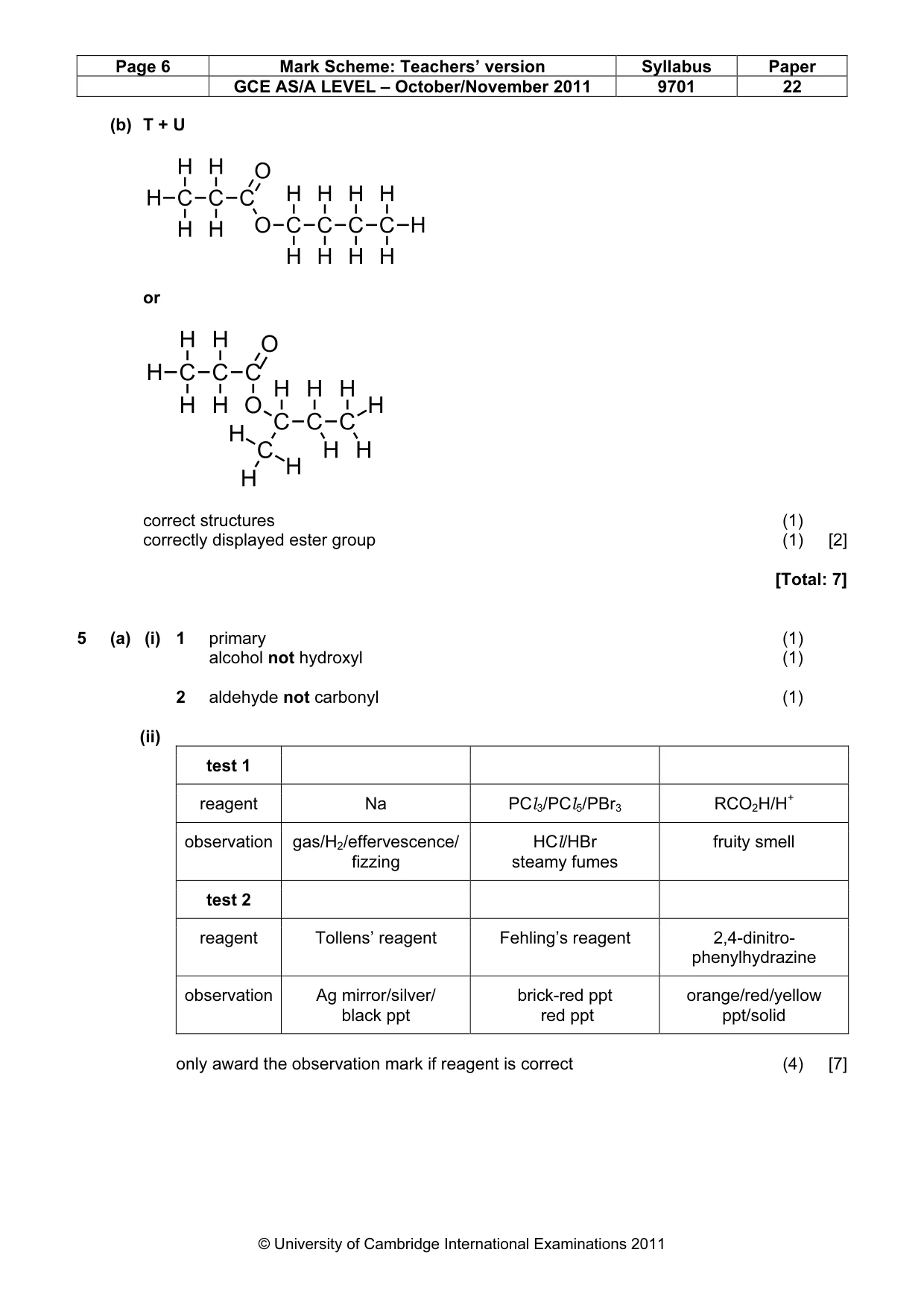
9 9701/22/O/N/11 © UCLES 2011 [Turn over For Examiner’s Use (b) Compound T reacts with compound U. Draw the displayed formula of the organic product of this reaction. [2] [Total: 7]
Question paper, page 10
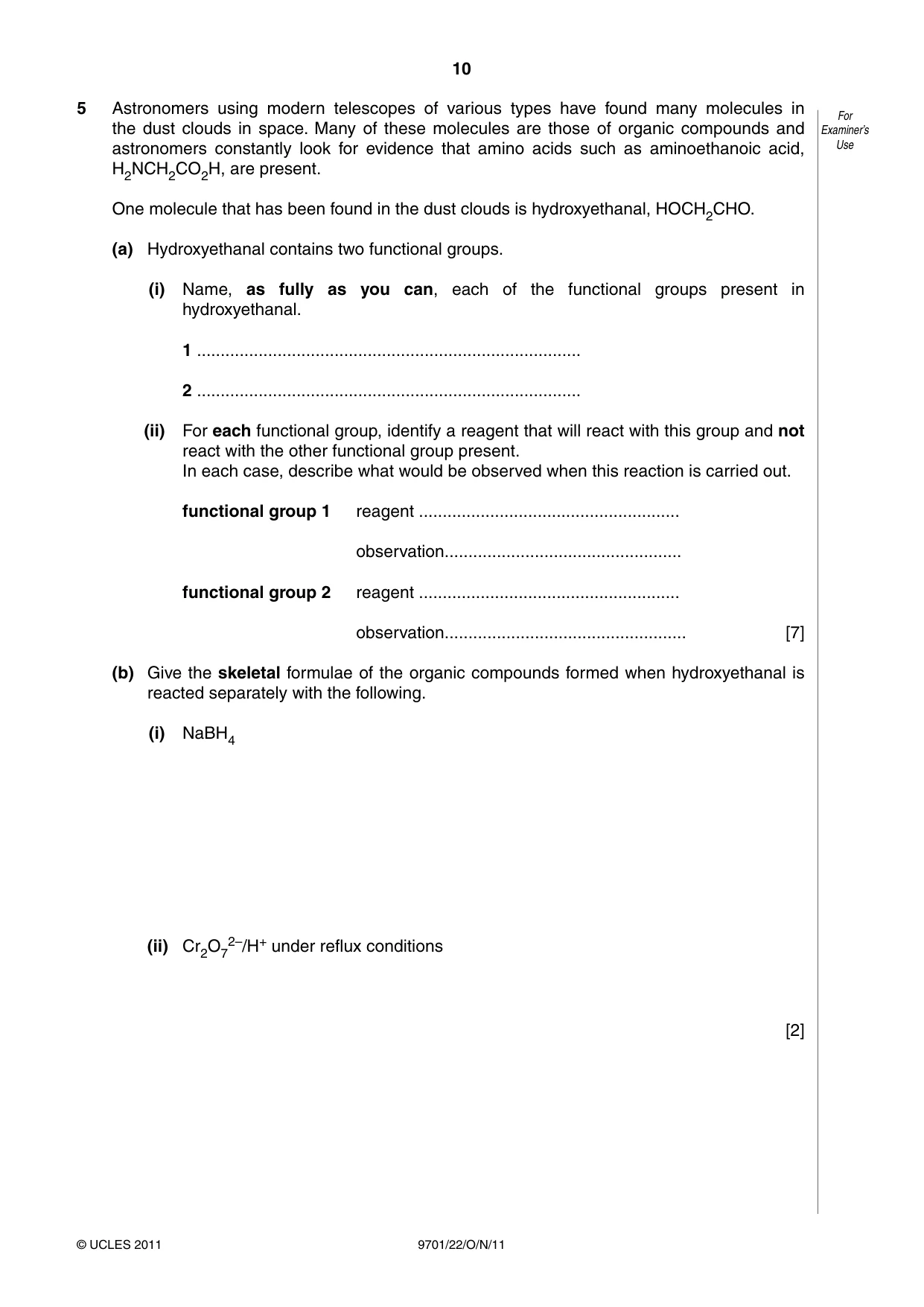
10 9701/22/O/N/11 © UCLES 2011 For Examiner’s Use 5 Astronomers using modern telescopes of various types have found many molecules in the dust clouds in space. Many of these molecules are those of organic compounds and astronomers constantly look for evidence that amino acids such as aminoethanoic acid, H2NCH2CO2H, are present. One molecule that has been found in the dust clouds is hydroxyethanal, HOCH2CHO. (a) Hydroxyethanal contains two functional groups. (i) Name, as fully as you can, each of the functional groups present in hydroxyethanal. 1 … 2 … (ii) For each functional group, identify a reagent that will react with this group and not react with the other functional group present. In each case, describe what would be observed when this reaction is carried out. functional group 1 reagent … observation… functional group 2 reagent … observation… [7] (b) Give the skeletal formulae of the organic compounds formed when hydroxyethanal is reacted separately with the following. (i) NaBH4 (ii) Cr2O7 2–/H+ under reflux conditions [2]
Question paper, page 11
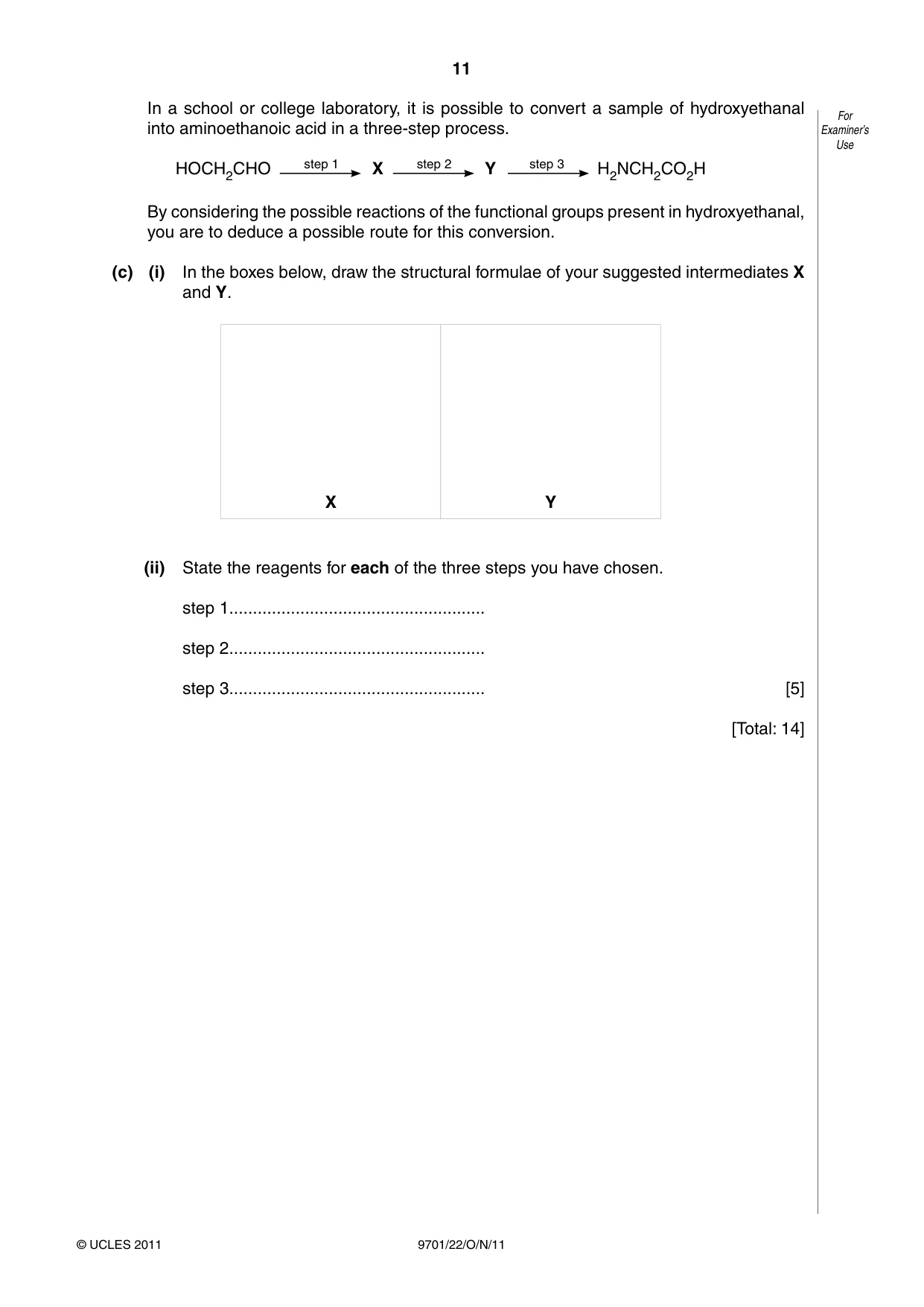
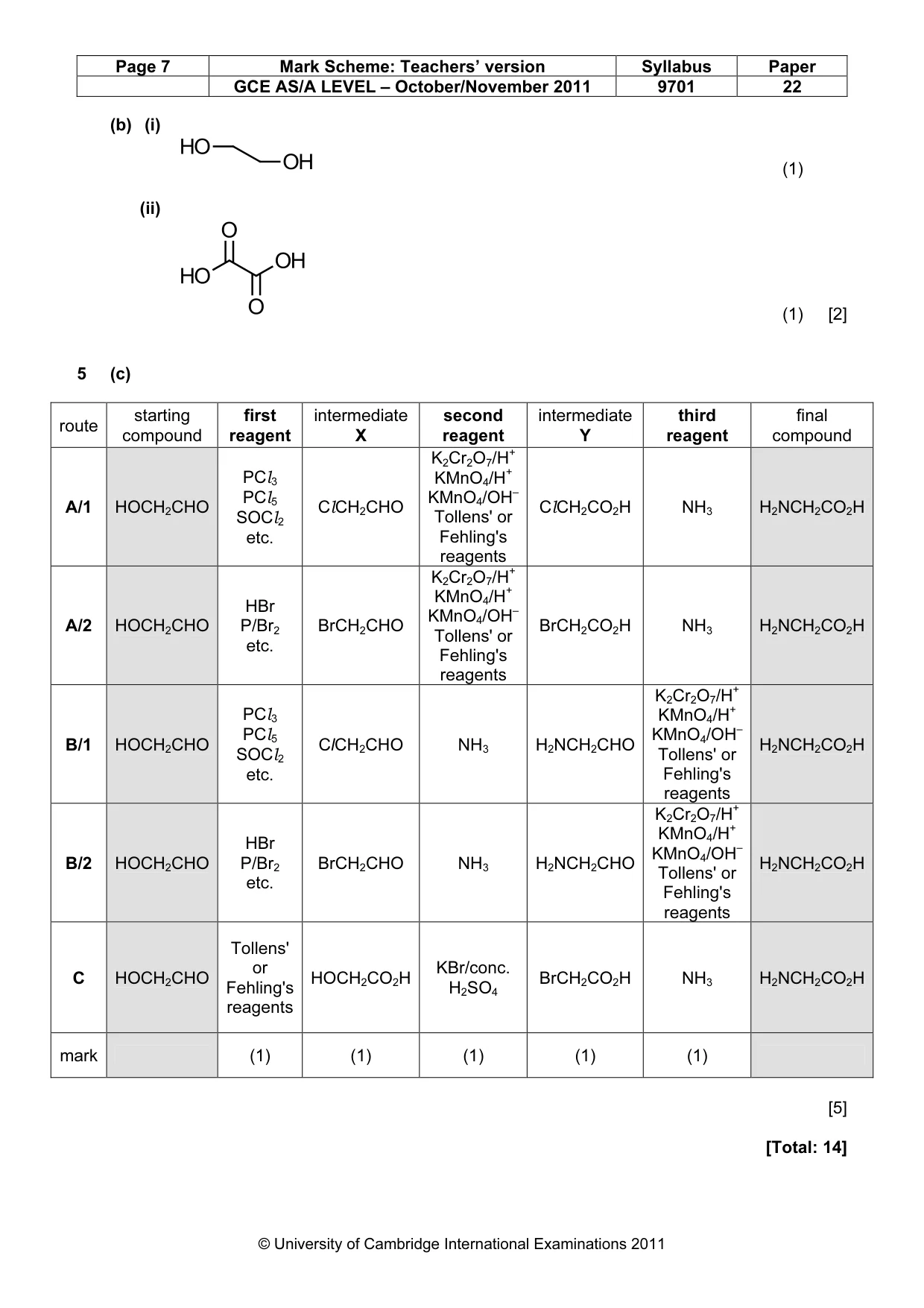
11 9701/22/O/N/11 © UCLES 2011 For Examiner’s Use In a school or college laboratory, it is possible to convert a sample of hydroxyethanal into aminoethanoic acid in a three-step process. HOCH2CHO step 1 X step 2 Y step 3 H2NCH2CO2H By considering the possible reactions of the functional groups present in hydroxyethanal, you are to deduce a possible route for this conversion. (c) (i) In the boxes below, draw the structural formulae of your suggested intermediates X and Y. X Y (ii) State the reagents for each of the three steps you have chosen. step 1… step 2… step 3… [5] [Total: 14]
Question paper, page 12
12 9701/22/O/N/11 © UCLES 2011 Permission to reproduce items where third-party owned material protected by copyright is included has been sought and cleared where possible. Every reasonable effort has been made by the publisher (UCLES) to trace copyright holders, but if any items requiring clearance have unwittingly been included, the publisher will be pleased to make amends at the earliest possible opportunity. University of Cambridge International Examinations is part of the Cambridge Assessment Group. Cambridge Assessment is the brand name of University of Cambridge Local Examinations Syndicate (UCLES), which is itself a department of the University of Cambridge. BLANK PAGE
Mark scheme, page 1
UNIVERSITY OF CAMBRIDGE INTERNATIONAL EXAMINATIONS GCE Advanced Subsidiary Level and GCE Advanced Level MARK SCHEME for the October/November 2011 question paper for the guidance of teachers 9701 CHEMISTRY 9701/22 Paper 2 (AS Structured Questions), maximum raw mark 60 This mark scheme is published as an aid to teachers and candidates, to indicate the requirements of the examination. It shows the basis on which Examiners were instructed to award marks. It does not indicate the details of the discussions that took place at an Examiners’ meeting before marking began, which would have considered the acceptability of alternative answers. Mark schemes must be read in conjunction with the question papers and the report on the examination. • Cambridge will not enter into discussions or correspondence in connection with these mark schemes. Cambridge is publishing the mark schemes for the October/November 2011 question papers for most IGCSE, GCE Advanced Level and Advanced Subsidiary Level syllabuses and some Ordinary Level syllabuses.
Mark scheme, page 2
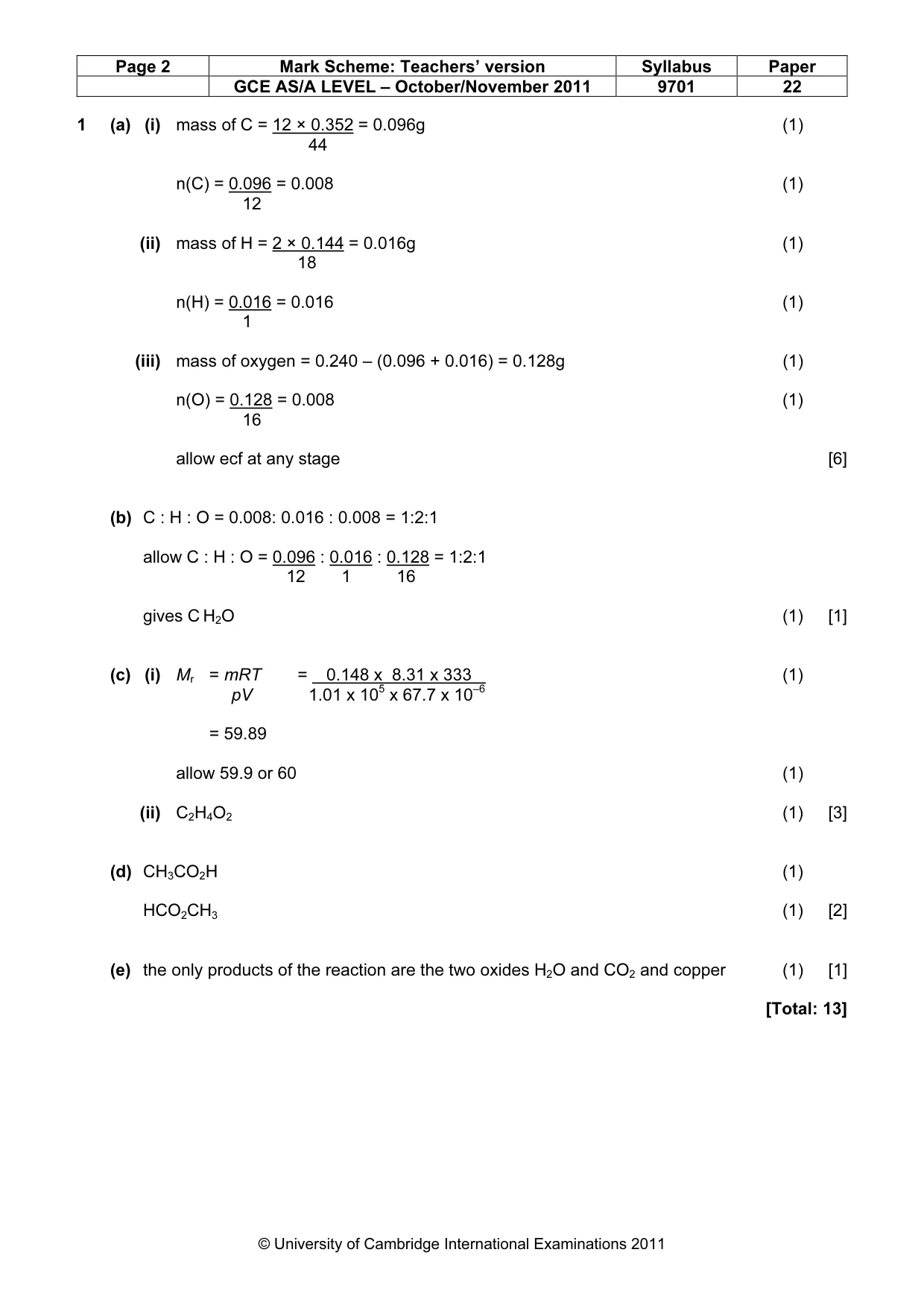
Page 2 Mark Scheme: Teachers’ version Syllabus Paper GCE AS/A LEVEL – October/November 2011 9701 22 © University of Cambridge International Examinations 2011 1 (a) (i) mass of C = 12 × 0.352 = 0.096g (1) 44 n(C) = 0.096 = 0.008 (1) 12 (ii) mass of H = 2 × 0.144 = 0.016g (1) 18 n(H) = 0.016 = 0.016 (1) 1 (iii) mass of oxygen = 0.240 – (0.096 + 0.016) = 0.128g (1) n(O) = 0.128 = 0.008 (1) 16 allow ecf at any stage [6] (b) C : H : O = 0.008: 0.016 : 0.008 = 1:2:1 allow C : H : O = 0.096 : 0.016 : 0.128 = 1:2:1 12 1 16 gives C H2O (1) [1] (c) (i) Mr = mRT = 0.148 x 8.31 x 333 (1) pV 1.01 x 105 x 67.7 x 10–6 = 59.89 allow 59.9 or 60 (1) (ii) C2H4O2 (1) [3] (d) CH3CO2H (1) HCO2CH3 (1) [2] (e) the only products of the reaction are the two oxides H2O and CO2 and copper (1) [1] [Total: 13]
Mark scheme, page 3
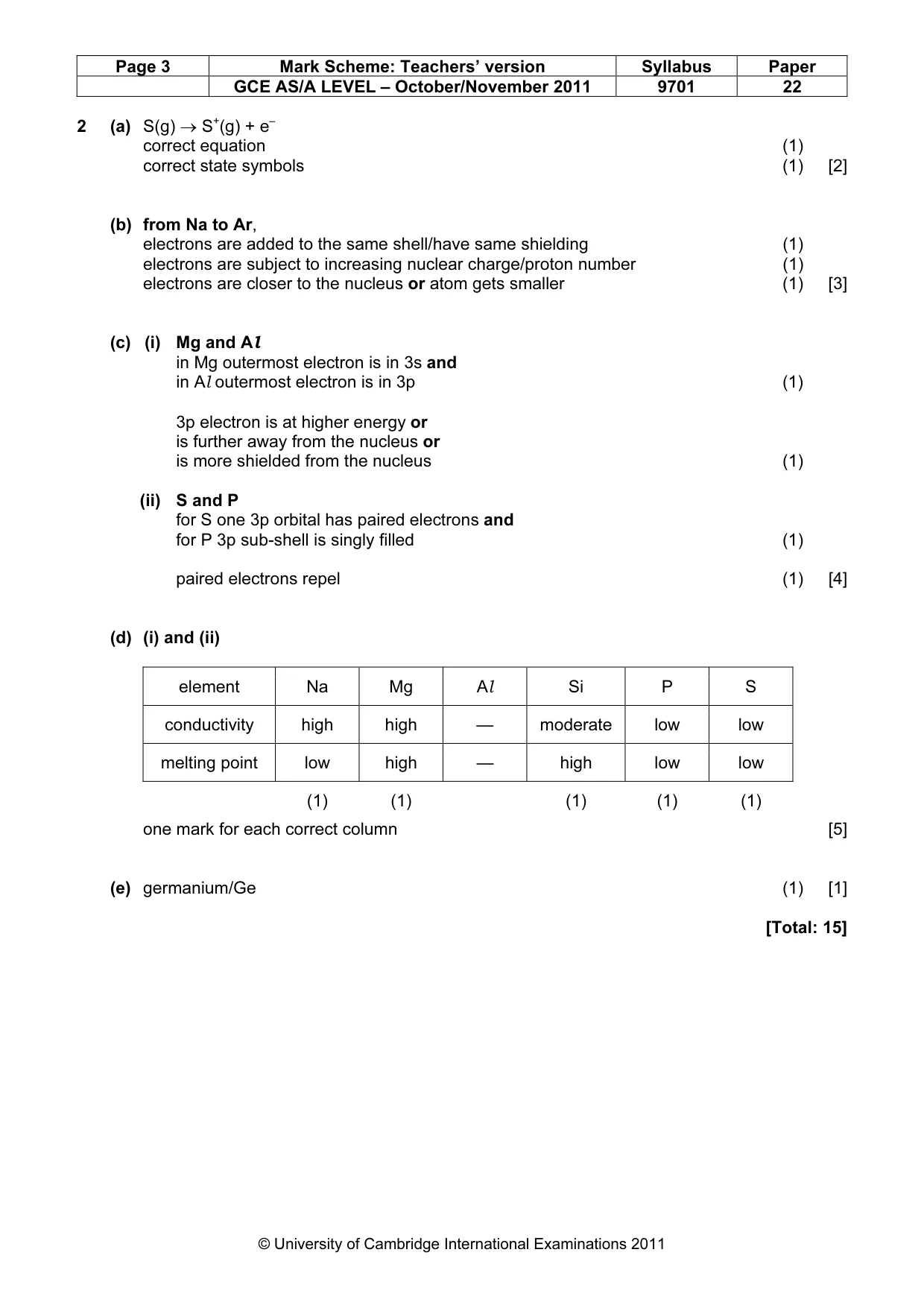
Page 3 Mark Scheme: Teachers’ version Syllabus Paper GCE AS/A LEVEL – October/November 2011 9701 22 © University of Cambridge International Examinations 2011 2 (a) S(g) → S+(g) + e– correct equation (1) correct state symbols (1) [2] (b) from Na to Ar, electrons are added to the same shell/have same shielding (1) electrons are subject to increasing nuclear charge/proton number (1) electrons are closer to the nucleus or atom gets smaller (1) [3] (c) (i) Mg and Al in Mg outermost electron is in 3s and in Al outermost electron is in 3p (1) 3p electron is at higher energy or is further away from the nucleus or is more shielded from the nucleus (1) (ii) S and P for S one 3p orbital has paired electrons and for P 3p sub-shell is singly filled (1) paired electrons repel (1) [4] (d) (i) and (ii) element Na Mg Al Si P S conductivity high high — moderate low low melting point low high — high low low (1) (1) (1) (1) (1) one mark for each correct column [5] (e) germanium/Ge (1) [1] [Total: 15]
Mark scheme, page 4
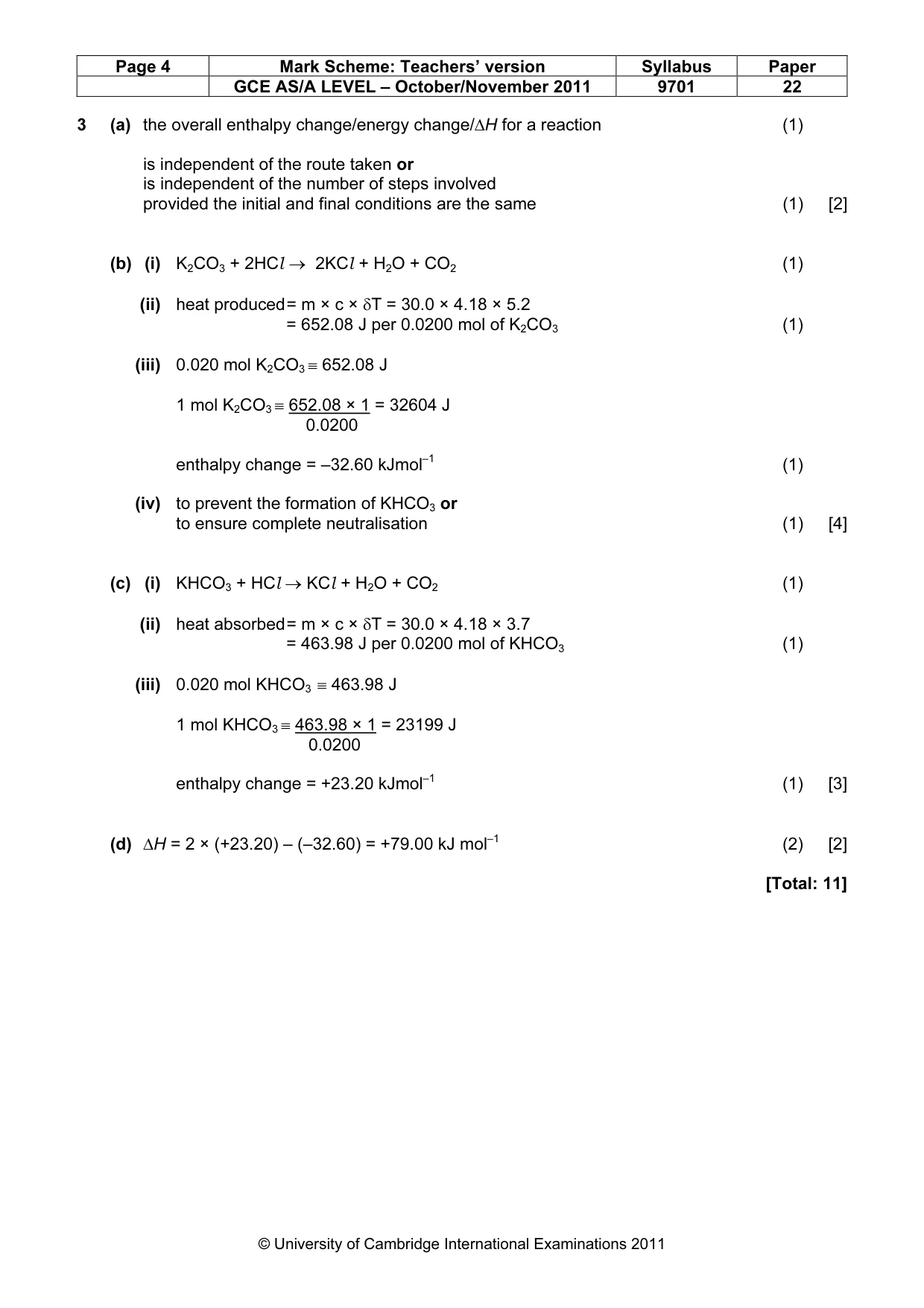
Page 4 Mark Scheme: Teachers’ version Syllabus Paper GCE AS/A LEVEL – October/November 2011 9701 22 © University of Cambridge International Examinations 2011 3 (a) the overall enthalpy change/energy change/∆H for a reaction (1) is independent of the route taken or is independent of the number of steps involved provided the initial and final conditions are the same (1) [2] (b) (i) K2CO3 + 2HCl → 2KCl + H2O + CO2 (1) (ii) heat produced = m × c × δT = 30.0 × 4.18 × 5.2 = 652.08 J per 0.0200 mol of K2CO3 (1) (iii) 0.020 mol K2CO3 ≡ 652.08 J 1 mol K2CO3 ≡ 652.08 × 1 = 32604 J 0.0200 enthalpy change = –32.60 kJmol–1 (1) (iv) to prevent the formation of KHCO3 or to ensure complete neutralisation (1) [4] (c) (i) KHCO3 + HCl → KCl + H2O + CO2 (1) (ii) heat absorbed = m × c × δT = 30.0 × 4.18 × 3.7 = 463.98 J per 0.0200 mol of KHCO3 (1) (iii) 0.020 mol KHCO3 ≡ 463.98 J 1 mol KHCO3 ≡ 463.98 × 1 = 23199 J 0.0200 enthalpy change = +23.20 kJmol–1 (1) [3] (d) ∆H = 2 × (+23.20) – (–32.60) = +79.00 kJ mol–1 (2) [2] [Total: 11]
Mark scheme, page 5
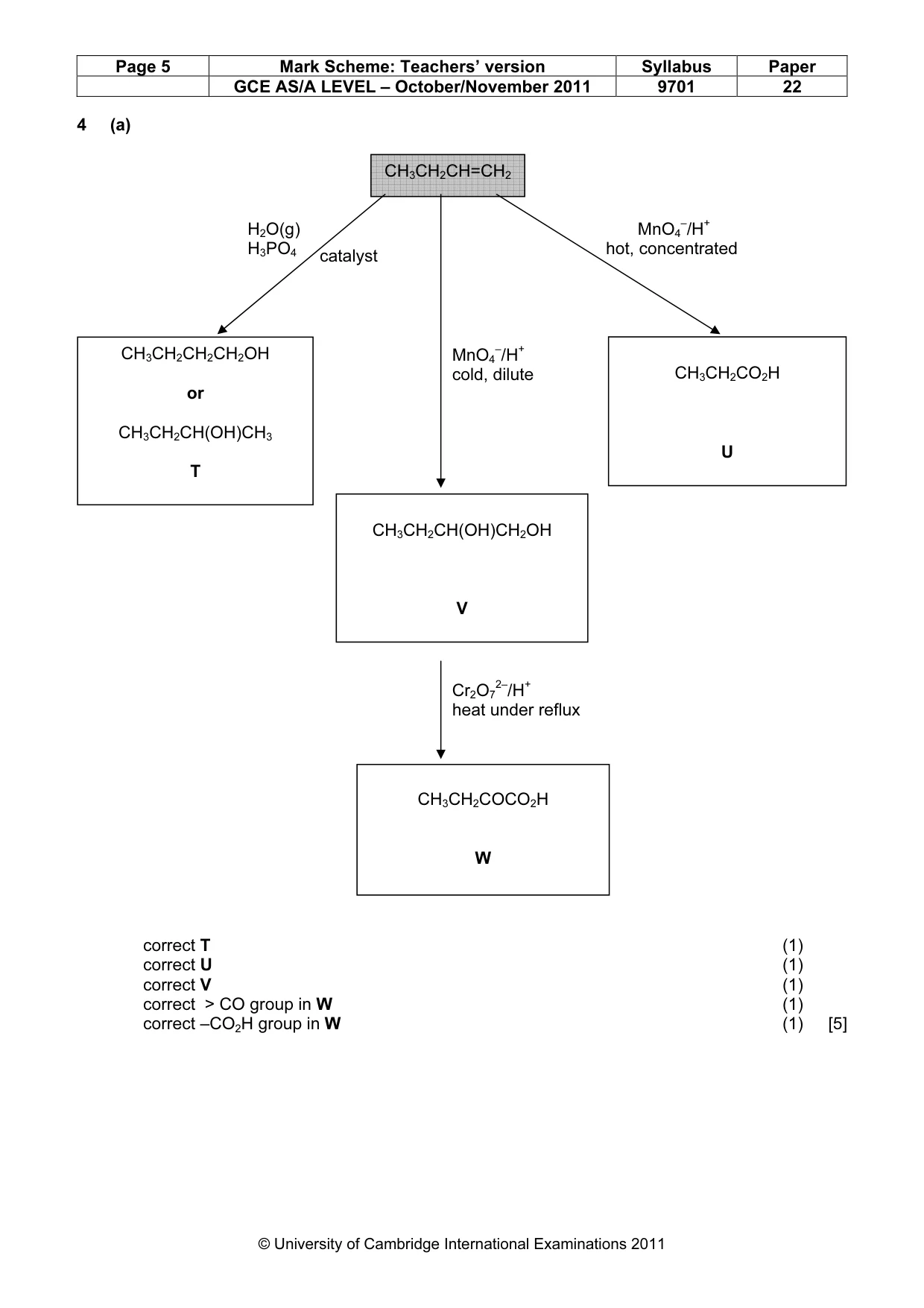
Page 5 Mark Scheme: Teachers’ version Syllabus Paper GCE AS/A LEVEL – October/November 2011 9701 22 © University of Cambridge International Examinations 2011 4 (a) correct T (1) correct U (1) correct V (1) correct > CO group in W (1) correct –CO2H group in W (1) [5] CH3CH2CH=CH2 CH3CH2CH2CH2OH or CH3CH2CH(OH)CH3 T CH3CH2CH(OH)CH2OH V CH3CH2COCO2H W H2O(g) H3PO4 MnO4 –/H+ hot, concentrated MnO4 –/H+ cold, dilute CH3CH2CO2H U Cr2O7 2–/H+ heat under reflux catalyst
Mark scheme, page 6
Page 6 Mark Scheme: Teachers’ version Syllabus Paper GCE AS/A LEVEL – October/November 2011 9701 22 © University of Cambridge International Examinations 2011 (b) T + U or correct structures (1) correctly displayed ester group (1) [2] [Total: 7] 5 (a) (i) 1 primary (1) alcohol not hydroxyl (1) 2 aldehyde not carbonyl (1) (ii) test 1 reagent Na PCl3/PCl5/PBr3 RCO2H/H+ observation gas/H2/effervescence/ fizzing HCl/HBr steamy fumes fruity smell test 2 reagent Tollens’ reagent Fehling’s reagent 2,4-dinitro- phenylhydrazine observation Ag mirror/silver/ black ppt brick-red ppt red ppt orange/red/yellow ppt/solid only award the observation mark if reagent is correct (4) [7]
Mark scheme, page 7
Page 7 Mark Scheme: Teachers’ version Syllabus Paper GCE AS/A LEVEL – October/November 2011 9701 22 © University of Cambridge International Examinations 2011 (b) (i) (1) (ii) (1) [2] 5 (c) route starting compound first reagent intermediate X second reagent intermediate Y third reagent final compound A/1 HOCH2CHO PCl3 PCl5 SOCl2 etc. ClCH2CHO K2Cr2O7/H+ KMnO4/H+ KMnO4/OH– Tollens' or Fehling's reagents ClCH2CO2H NH3 H2NCH2CO2H A/2 HOCH2CHO HBr P/Br2 etc. BrCH2CHO K2Cr2O7/H+ KMnO4/H+ KMnO4/OH– Tollens' or Fehling's reagents BrCH2CO2H NH3 H2NCH2CO2H B/1 HOCH2CHO PCl3 PCl5 SOCl2 etc. ClCH2CHO NH3 H2NCH2CHO K2Cr2O7/H+ KMnO4/H+ KMnO4/OH– Tollens' or Fehling's reagents H2NCH2CO2H B/2 HOCH2CHO HBr P/Br2 etc. BrCH2CHO NH3 H2NCH2CHO K2Cr2O7/H+ KMnO4/H+ KMnO4/OH– Tollens' or Fehling's reagents H2NCH2CO2H C HOCH2CHO Tollens' or Fehling's reagents HOCH2CO2H KBr/conc. H2SO4 BrCH2CO2H NH3 H2NCH2CO2H mark (1) (1) (1) (1) (1) [5] [Total: 14]
What you needed in this session
Cambridge’s own grade thresholds for 2011 Oct/Nov, Paper 2 · Variant 2. A higher threshold means an easier paper — the bar moves with how the cohort did.